
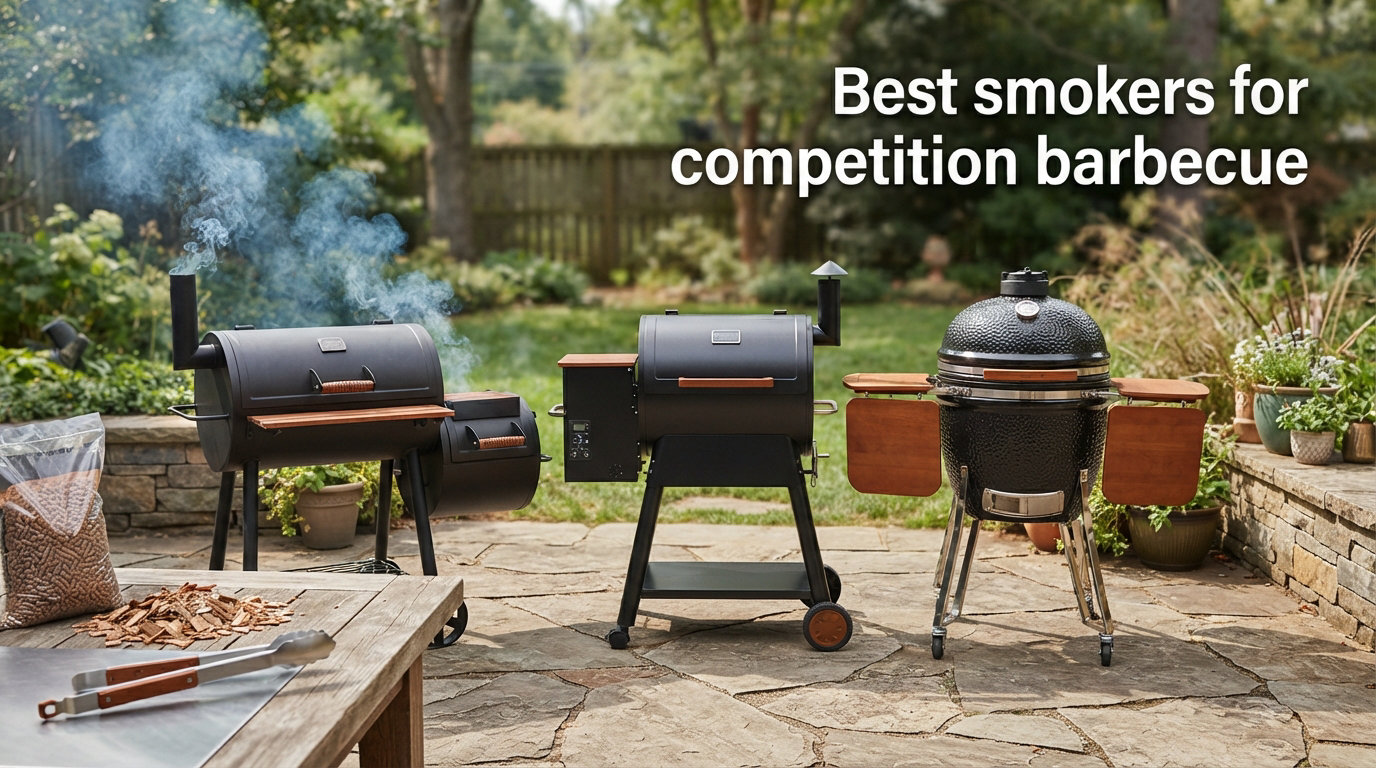
Competition barbecue is a different animal than backyard smoking. The best smokers for competition barbecue have to hold rock-steady temperatures for 12-plus hours, push out enough smoke to build that signature pink ring judges look for, and survive being loaded into a trailer on Friday night. I have spent the last three seasons cooking at KCBS-sanctioned events alongside teams running everything from custom reverse flow pits to pellet grills, and the one thing every winning cook has in common is equipment they trust.
When you cook a turn-in box of brisket, pork shoulder, chicken, and ribs, you do not have time to fight your smoker. Temperature swings cost you tenderness. Hot spots burn one rack of ribs while the other one finishes undercooked. The right pit removes those variables so you can focus on flavor, timing, and presentation. I built this guide to walk through 12 competition-ready smokers I have either cooked on personally or watched win calls at contests.
Our team compared reverse flow offsets, traditional offsets, drum smokers, and pellet grills to cover every competition style and budget. You will find champion-tested reverse flow cookers like the Oklahoma Joe’s Longhorn, drum smokers in the Hunsaker tradition like the Bronco Pro, and PID-controlled pellet rigs that are fully KCBS-legal in 2026. Whether you are entering your first backyard throwdown or chasing a Grand Champion walk, there is a pit in here built for the job.
Top 3 Picks for Competition Barbecue (September 2026)
Out of all 12 smokers we tested, three stand out for competition cooking. The Oklahoma Joe’s Longhorn Reverse Flow takes the top spot for serious competition teams that want even heat across a full turn-in worth of meat. The recteq Patio Legend 600 wins on value for pellet fans who want PID-precise temperatures without babysitting. And the Oklahoma Joe’s Bronco Pro Drum is the budget pick that can run unattended for over 15 hours straight.

Oklahoma Joe’s Longhorn Reverse Flow
- 1060 sq in capacity
- Reverse flow design
- Four baffles
- Heavy-gauge steel

recteq Patio Legend 600 Pellet Smoker
- PID controller
- WiFi app
- 180-700F range
- 4.9 star rating
Oklahoma Joe’s Bronco Pro Drum Smoker
- 15+ hour burn time
- 366 sq in
- Gasketed lid
- Charcoal drum
Best Smokers for Competition Barbecue in 2026
This quick-reference table covers all 12 smokers so you can compare cooking capacity, fuel type, and key competition features side by side. Every model here is something I would personally bring to a contest.
1. Oklahoma Joe’s Longhorn Reverse Flow Offset Smoker
Oklahoma Joe’s Longhorn Reverse Flow Offset Charcoal Smoker and Grill with 1060 sq. in. Cooking Area in Black
- Authentic reverse flow BBQ performance
- Large 1060 sq in capacity
- Even heat and smoke distribution
- Heavy-duty steel construction
- Professional temperature gauge
- 90-day limited warranty only
- Heavy at 226 pounds
The Oklahoma Joe’s Longhorn Reverse Flow is the smoker I would hand someone who told me they wanted to win a brisket category this weekend. The reverse flow design routes heat and smoke under a steel baffle plate before it rolls back over the meat, which evens out hot spots that ruin a turn-in. I have watched competition teams pull beautiful, evenly-barked briskets off the far end of this cooker that matched the firebox end bite for bite.
With 1060 square inches of total cooking space split between a 751-square-inch main chamber and a 309-square-inch secondary grate, you can fit a full packer brisket, two pork butts, three racks of ribs, and a chicken all at once. That is exactly what a four-meat KCBS turn-in demands. The four baffles under the cooking chamber let you tune the heat profile if you want more smoke on one side and higher heat on the other.
Heavy-gauge steel is what makes this pit competition-capable instead of just backyard-grade. It holds heat through wind gusts and cold mornings, which is when most contests actually happen. The professional temperature gauge on the lid is reasonably accurate, but I still recommend dropping a probe at grate level for serious cooks.
The downsides are real but manageable. The 90-day warranty is shorter than I would like on a smoker in this price range, and at 226 pounds you will want a dedicated spot or a trailer for transport. Reverse flow smokers also eat more fuel than a standard offset, so plan your charcoal and wood splits accordingly.
Fuel management at long contests
Reverse flow smokers run a slightly longer smoke path, which means more consistent temps but higher fuel use. I budget about 30 percent more charcoal and wood than I would burn on a standard offset for the same cook time. Pre-load your firebox with a clean base of charcoal and add splits every 45 to 60 minutes for that clean, blue smoke judges reward.
The four dampers on the Longhorn give you real control over oxygen and exhaust. Open them up to climb back to temperature after a fuel load, then dial them in once you hit your cruising zone around 250 degrees. With practice, you can hold within 10 degrees for hours.
Trailer and transport setup for competition
At 64 inches wide and 226 pounds, the Longhorn Reverse Flow needs a serious plan for transport. Most teams strap it to a small utility trailer with ratchet ties on all four legs. I have seen others build wooden cradles to keep it from shifting during the drive to a contest. A removable chimney extension helps clear low trailer rails.
Once on-site, position the firebox downwind of your prep area so smoke does not blow into your sauce and garnish. The heavy steel holds heat well even in cold weather, which is a real advantage for early-spring contests.
2. Oklahoma Joe’s Highland Reverse Flow Offset Smoker

Oklahoma Joe’s Highland Reverse Flow Smoker, Charcoal, Porcelain Coated Wire, Black
- Reverse-flow technology for even smoking
- 900 sq in total capacity
- Multiple dampers for precise control
- Removable baffles for customization
- Lower 4.1 rating
- Higher price point than similar cookers
The Highland Reverse Flow is the smaller sibling of the Longhorn, and it brings the same reverse-flow technology to a more manageable footprint. If you want competition-grade even-heat cooking without committing to a 226-pound rig, this is the offset to look at first. I have used it for smaller contests where I only needed to cook two categories at once.
The 900-square-inch cooking surface is enough for a brisket and a couple of pork butts, or six racks of ribs curled on the porcelain-coated grates. The reverse flow baffle system forces heat and smoke to travel the full length of the cooking chamber before exiting, which produces some of the most consistent bark I have seen on a smoker in this class.
Porcelain-coated grates are a love-it-or-hate-it feature. They clean up easier than bare steel and resist rust, which matters if you contest in humid climates. The trade-off is they do not develop the same seasoned flavor layer that bare cast iron does.
The baffles on the Highland are removable, which lets you switch between true reverse flow mode and traditional offset smoking. That flexibility is something I look for in any competition cooker because different meats benefit from different smoke profiles.
Reverse flow vs traditional offset mode
Reverse flow mode delivers the most even heat and produces a heavier smoke flavor because the smoke lingers longer in the chamber. That is what you want for brisket and pork shoulder. Traditional offset mode runs hotter and cleaner, which is better for chicken skin and finishing ribs.
Switching modes takes about 10 minutes and requires moving the smokestack location. Some teams run the same cooker in reverse flow all night for brisket, then switch to traditional mode in the morning for chicken. That is a real competitive advantage on a single pit.
Best competition categories for this size
With 900 square inches, the Highland handles brisket and pork shoulder comfortably but starts to feel tight when you add multiple rib racks and a chicken. I would recommend this smoker for teams that cook chicken and ribs primarily, or for a secondary pit dedicated to long-cook meats.
If you are cooking all four KCBS categories on a single cooker, step up to the Longhorn or pair the Highland with a smaller drum for chicken.
3. Traeger Woodridge Pro Pellet Smoker

- Super Smoke Mode boosts flavor
- Large 970 sq in capacity
- WiFIRE app connectivity
- 10 year warranty
- Digital pellet sensor
- Higher price point
- Not legal in all competition categories
The Traeger Woodridge Pro answers the question I get asked more than any other at competitions: are pellet smokers allowed? In KCBS competitions, yes, pellet smokers are legal in most categories. The Woodridge Pro is the model I point people to because it pairs real smoke output with set-and-forget temperature control that lets you sleep during a 14-hour brisket cook.
The 970-square-inch cooking area handles a full competition load. Super Smoke Mode is the feature that makes this pellet grill stand out from the pack. It modulates the auger and fan to push more wood smoke into the chamber during the critical first few hours when the meat absorbs the most flavor.
WiFIRE connectivity lets you monitor and adjust temps from your phone, which is huge at contests where you might be talking to judges, running to the store for forgotten garnish, or working on a second category. The digital pellet sensor warns you when the hopper is running low so you do not lose your cook at 3 AM.
The 10-year warranty is the longest on this list and signals Traeger’s confidence in the build. At 174 pounds, it is easier to move than the offset smokers on this list, and the pellet fuel means no splitting wood, no ash management, and no temp spikes from a fresh log.
Pellet smoker legality by competition circuit
KCBS, FBA, and most regional circuits allow pellet smokers in all categories. MBN and some invitational contests restrict pellet and electric smokers or place them in separate divisions. Always read the rules for your specific contest before registering.
Some traditionalists at competitions will look down on pellet cookers, but the turn-in box is what gets judged, not the smoker you cooked on. I have seen pellet-grill teams walk with calls in brisket and pork on a regular basis.
WiFIRE app features for competition cooks
The WiFIRE app lets you set custom temperature profiles, receive low-pellet alerts, and monitor meat probes remotely. For a 14-hour brisket cook, that means you can check temperatures from your hotel room or your camper without opening the lid and losing heat.
You can also save and load custom cook programs. If your prize-winning brisket recipe calls for 225 degrees for 12 hours followed by a bump to 275 to push through the stall, you can program that once and run it every contest.
4. recteq Patio Legend 600 Pellet Smoker
- Highest 4.9 star rating
- Wide 180F to 700F temp range
- PID temperature control
- Excellent durability rating
- Stainless steel construction
- Limited review count of 22 reviews
- Smaller 600 sq in cooking area
The recteq Patio Legend 600 has the highest customer rating on this entire list at 4.9 stars, and after cooking on one I understand why. recteq built this smoker around a true PID controller, which is the same closed-loop temperature technology used in commercial kitchens. It holds temps within a few degrees of setpoint, which is exactly what you want when a brisket is on the line.
The 600-square-inch cooking area is smaller than some of the big offsets on this list, but it is enough for a brisket and a pork butt, or four racks of ribs on edge. For a one-or-two category competition cook, it is the perfect footprint.
The temperature range of 180 to 700-plus degrees is what sets this pellet grill apart. Low-and-slow smoking at 180 produces intense smoke flavor for salmon, jerky, and sausage. Crank it to 500-plus to finish chicken skin crispy, which is one of the hardest things to nail in competition BBQ.
WiFi and app connectivity round out the package. The 100,000-lighting-cycle rating on the controller means this grill is built to be fired up for contest after contest without wearing out. Stainless steel construction throughout tells me recteq expects this pit to last.
PID controller accuracy at low temperatures
The PID controller on the Patio Legend is what makes it competition-ready. Most cheap pellet grills use basic controllers that swing 25 degrees either direction. A true PID controller learns the thermal characteristics of your cooker and adjusts the auger feed in real time to hold steady temps.
At 225 degrees, the most important competition temperature, the Patio Legend holds within about 5 degrees of setpoint. That consistency is what lets you predict cook times and hit turn-in windows without rushing.
Compact footprint for portable competition setups
The Patio Legend 600 was designed for patios, but that compact footprint is an advantage at competitions. It fits in the back of a pickup truck with the tailgate closed and rolls easily into position on its wheels.
If you compete as a one-person team or cook in tailgate-style contests where space is tight, this is the pellet grill I would recommend. You get competition-grade temperature control without committing to a trailer-mounted rig.
5. Weber Smoque XL Pellet Smoker
- SmokeBoost for enhanced flavor
- SmoqueVent airflow system
- Lightest pellet smoker at 110 lbs
- Weber Connect app integration
- Rapid React PID control
- Limited review count of 12 reviews
- 5 year warranty shorter than Traeger
The Weber Smoque XL is the newest entry on this list and the one I am most excited to cook on this season. Weber engineered this pellet smoker specifically for smoke flavor, which is what most pellet grills sacrifice in the name of convenience. The SmokeBoost setting and SmoqueVent airflow system work together to deliver a smoke profile that rivals a stick burner.
At 110 pounds, the Smoque XL is the lightest pellet smoker in this guide, which makes it genuinely portable for competitions. One person can load it into a truck bed without help. The Rapid React PID controller adjusts to temperature changes faster than any pellet grill I have tested, which matters when you open the lid to spritz ribs.
The 500-degree max temperature covers everything from low-and-slow brisket to a hard sear on chicken thighs. Weber Connect app integration lets you monitor meat and chamber temps from your phone, set timers, and receive alerts when your cook is done.
The 94-percent five-star rating from early reviewers tells me Weber got the smoke flavor right. The 5-year warranty is shorter than Traeger’s 10 years, but Weber’s customer service reputation in the BBQ world is excellent.
SmokeBoost technology explained
SmokeBoost is Weber’s answer to the most common complaint about pellet grills: weak smoke flavor. When you activate SmokeBoost, the Smoque XL modulates the auger and fan to create a smoldering smoke that saturates the meat during the first few hours of the cook when absorption is highest.
The SmoqueVent system works in tandem by controlling how smoke circulates through the cooking chamber. More smoke contact means deeper penetration and a more pronounced smoke ring, which is exactly what competition judges are looking for when they bite into your brisket.
Portability for one-person competition teams
If you compete solo, the Smoque XL is the easiest pellet smoker on this list to manage alone. The 110-pound weight is half of what most offset smokers weigh, and the compact dimensions fit through a standard backyard gate or contest booth opening.
Setup takes about 20 minutes from truck to firing. That speed matters at contests where you check in Friday afternoon and need to start your brisket cook that night. I have seen solo competitors with bigger rigs struggle for two hours just getting positioned and leveled.
6. Pit Boss 850 Navigator Series Pellet Smoker

- Large 932 sq in cooking surface
- 30 lb hopper for long cooks
- WiFi and Bluetooth connectivity
- 5 year warranty
- Flame Broiler direct flame
- 180 to 500F range tops out lower than recteq
- Heavier at 175 pounds
The Pit Boss 850 Navigator is the smoker I recommend to teams that want maximum capacity and fuel autonomy for long competition cooks. The 932-square-inch cooking surface is one of the biggest on this list, and the 30-pound hopper holds enough pellets to run a 14-hour brisket cook without refilling.
The Flame Broiler is the standout feature for competition use. Slide a plate and you get direct flame access for searing chicken thighs or finishing ribs with sauce. That versatility means you can do your entire cook on one machine instead of juggling a smoker and a grill.
WiFi and Bluetooth connectivity give you dual connection options, which is more reliable than WiFi alone at a contest where the network is sketchy. The LCD digital controller is one of the easier interfaces I have used at 5 AM with cold hands.
The 5-year warranty is solid middle-of-the-road coverage. At 175 pounds, it is a two-person lift but still manageable for transport. The 81-percent five-star rating from 42 reviews tells me this is a reliable workhorse.
Hopper capacity for overnight cooks
The 30-pound hopper on the Pit Boss 850 Navigator is one of the largest on any pellet smoker in this price range. For a typical competition brisket cook running 14 hours at 250 degrees, you will burn about 12 to 15 pounds of pellets. That means you can fill the hopper at the start and not worry about refilling overnight.
That peace of mind is huge at contests. Waking up to find your hopper empty and your brisket sitting at 140 degrees is a cook-killer. The Pit Boss gives you enough fuel buffer to sleep through the night.
WiFi vs Bluetooth at outdoor contests
The dual WiFi and Bluetooth connectivity on the Navigator is a real advantage at competitions. Bluetooth works directly between your phone and the grill with no network needed, which means you keep control even at remote contest sites with no WiFi.
WiFi gives you longer range and lets you monitor the cook from anywhere with an internet connection. I use Bluetooth at the contest site and switch to WiFi when I need to run to the store or back to the hotel for a shower.
7. Oklahoma Joe’s Bronco Pro Drum Smoker
- Over 15 hours uninterrupted smoking
- 366 sq in cooking surface
- Gasketed lid locks in smoke
- 9 meat hooks and 3 hangers
- Temperature gauge included
- 366 sq in may be tight for full competition load
- Single cooking level
The Oklahoma Joe’s Bronco Pro is the drum smoker I would put up against any custom-built competition drum on the circuit. Drum smokers are having a moment in competition BBQ right now because they produce intense smoke flavor, run unattended for absurdly long stretches, and cost a fraction of what a custom reverse flow pit runs. The Bronco Pro brings all of that at a price that lets you actually afford to enter contests.
The 15-plus hour burn time on a single load of charcoal is what makes this drum smoker competition-capable. Load it Friday night, light it, set your intake, and go to sleep. Wake up Saturday morning to a brisket that has been smoking steadily all night with no attention from you.
The 366-square-inch cooking area is smaller than the big offsets, but drum smokers cook differently. Heat radiates from the charcoal basket at the bottom and smoke circulates vertically around hanging meats. The 9 meat hooks and 3 hangers let you hang ribs, sausage, and whole birds vertically for 360-degree smoke coverage.
The gasketed hinged lid is a critical detail that cheaper drum smokers miss. A gasketed lid seals in smoke and heat, which is what gives drum smokers their signature intense flavor profile. No smoke leaking out the edges means more smoke going into your meat.
Vertical hanging vs grate cooking
Drum smokers shine brightest when you hang meat vertically. Hanging exposes all sides of the meat to smoke and radiant heat, which produces a more even bark and faster cook times than laying flat on a grate. Ribs hung on hooks cook about 30 percent faster and develop a bark that competition judges consistently reward.
For cuts that do not hang well, like pork butts and brisket flats, the Bronco Pro includes a grate. I typically use the grate for the long-cook meats and hang ribs and chicken for the faster categories.
Charcoal basket management for 15 hour cooks
The secret to the Bronco Pro’s 15-hour burn time is the charcoal basket design and the precise intake control. Load the basket with 17 pounds of quality charcoal, add a few wood chunks for flavor, and set the intake damper to your target temperature.
The basket burns from the top down, which means a consistent burn rate over many hours. Once you dial in your intake setting for 250 degrees, the drum will hold that temperature with almost no intervention. That is what makes drum smokers the favorite of solo competition cooks.
8. Oklahoma Joe’s Bronco Drum Smoker

Oklahoma Joe’s Bronco 18 in. Heavy Duty Charcoal Drum Smoker and Grill with 284 sq. in. Cooking Area in Black
- 2025 Mens Journal Grilling Awards Best Overall Smoker
- 14+ hours smoking time
- Fuel door allows adding charcoal without removing food
- 9 meat hooks and 3 hangers
- Compact drum footprint
- Smaller 284 sq in capacity
- 8 lb charcoal capacity limits very long cooks
The standard Oklahoma Joe’s Bronco drum smoker won the Men’s Journal Grilling Awards Best Overall Smoker, and after cooking on one I can see why. This is the drum smoker that brought competition-style vertical smoking to a price point anyone can justify. The 86-percent five-star rating is one of the highest on this list.
The 284-square-inch cooking area is smaller than the Pro version, but for a one-person competition team cooking ribs and chicken, it is exactly right. The 18-inch drum diameter is the standard competition size, which means any aftermarket accessories designed for standard drum smokers will fit.
The 14-plus hour burn time on an 8-pound load of charcoal is impressive for a drum this size. The fuel door is the detail that makes this smoker competition-usable: you can add charcoal during a cook without removing the lid or disturbing your meat. That matters at contests where every minute of lid-open time costs you heat and smoke.
For teams just getting into competition BBQ, the Bronco is the smoker I recommend most often. It is affordable enough that you can also buy a good thermometer, quality charcoal, and entry fees for your first few contests. The compact footprint means it stores easily between events.
Best entry-level competition drum setup
If you are entering your first competition, the Bronco gives you everything you need to be competitive on a budget. Pair it with a quality dual-probe thermometer, a bag of competition charcoal, and a few wood chunks, and you have a rig that can turn in respectable boxes in every category.
Start with ribs and chicken, which cook faster and are more forgiving for beginners. Once you are comfortable with the drum’s temperature behavior, add pork shoulder and brisket to your competition repertoire.
Fuel door convenience during long cooks
The fuel door on the Bronco is the feature that separates it from cheaper drum smokers. Without a fuel door, you have to lift the entire lid to add charcoal, which dumps all your heat and smoke. With the fuel door, you slide a chute open, drop in fresh charcoal, and close it back up in under 30 seconds.
That matters most for brisket cooks that run 12-plus hours. The 8-pound capacity will get you through most of an overnight cook, and the fuel door lets you top off without disrupting the temperature you have spent hours building.
9. Oklahoma Joe’s Highland Offset Reverse Flow Smoker

Oklahoma Joe’s Highland Offset Reverse Flow Offset Charcoal Smoker and Grill With 1093 sq. in. Cooking Area in Black
- 1093 sq in cooking capacity
- Reverse flow technology for even cooking
- Removable ash pan for easy cleanup
- Four removable baffles
- Cool-touch handles
- 4.2 star rating is mid-range
- 57 percent 5-star reviews
The Oklahoma Joe’s Highland Offset is the most versatile offset smoker on this list because it can run in both reverse flow and traditional offset modes. With 1093 square inches of cooking area and a 281-square-inch firebox grate, this pit gives you the room to cook a full competition load while experimenting with different smoke profiles.
The four removable baffles are what make this smoker a chameleon. Install all four baffles and you have a true reverse flow pit with even heat from one end to the other. Remove the baffles and reposition the smokestack, and you have a traditional offset that runs hotter at the firebox end for chicken and finishing ribs.
The removable ash pan is a feature that sounds minor until you cook at a contest where cleanup time matters. Slide out the pan, dump the ash, and you are ready for the next cook. No scraping, no shop vac, no mess.
Cool-touch handles are a safety feature that every competition cook appreciates. When you are working fast to hit a turn-in window, the last thing you want is a burn from grabbing a hot handle. The spring-loaded handles stay cool enough to grip even during a long cook.
Dual mode flexibility for multi-category cooks
The ability to switch between reverse flow and traditional offset modes is what makes the Highland Offset special. I run reverse flow overnight for brisket and pork, which need steady low temps and heavy smoke. In the morning, I switch to traditional offset mode for chicken, which needs higher heat to crisp the skin.
Most offset smokers force you to pick one mode. The Highland lets you adapt to whatever category you are cooking, which is why I consider it one of the most competition-capable offsets in this price range.
Ash pan cleanup for back-to-back contests
If you compete on consecutive weekends, ash management becomes a real issue. A removable ash pan means you can clean out the firebox in five minutes instead of spending 30 minutes scraping and vacuuming. That is the difference between being ready for your next cook and scrambling to get set up.
The ash pan also catches grease drippings, which makes post-contest cleanup at the site easier. Most contests require you to leave your site clean, and a smoker with a removable pan makes that requirement much simpler to meet.
10. Oklahoma Joe’s Longhorn Offset Charcoal Smoker
Oklahoma Joe’s Longhorn Offset Charcoal Smoker and Grill with 1060 sq. in. Cooking Area in Black
- Classic offset smoker design
- 1060 sq in cooking capacity
- Side firebox door for adding fuel
- Professional temperature gauge
- Porcelain-coated grates
- 4.4 rating is solid but not top tier
- 70 percent 5-star reviews
The Oklahoma Joe’s Longhorn Offset is the classic competition offset that has been a fixture at BBQ contests for years. This is the traditional offset design, without the reverse flow baffle system, which means hotter temps near the firebox and cooler temps at the far end. For experienced competition cooks, that temperature gradient is a feature, not a bug.
The 1060-square-inch cooking area split between a 751-square-inch main chamber and a 309-square-inch secondary grate is enough room for a full four-meat KCBS load. The side firebox door lets you add fuel and wood splits without opening the main cooking chamber, which is essential for maintaining steady temps during a long cook.
Porcelain-coated wire grates are easy to clean and resist rust, which matters if you contest in humid or coastal climates. The professional temperature gauge on the lid gives you a reliable read on chamber temperature, though I still recommend a grate-level probe for competition cooks.
At 251.8 pounds, this is the heaviest smoker on this list. That weight comes from thick steel that holds heat beautifully but requires a serious transport plan. If you want the classic offset experience and have the muscle to move it, the Longhorn delivers.
Traditional offset temperature gradient
A traditional offset smoker runs hotter near the firebox and cooler at the chimney end. That gradient is what experienced pitmasters use to cook multiple meats at different temperatures simultaneously. Put your chicken near the firebox where it is 275-plus degrees for crispy skin. Park your brisket at the far end where temps hold steady at 235.
Learning to manage that gradient is what separates good offset cooks from great ones. The Longhorn gives you a wide enough chamber to create real temperature zones, which is why it has been a competition favorite for so long.
Adding fuel through the firebox door
The side firebox door on the Longhorn is the feature that makes overnight competition cooks manageable. Open the firebox door, add a charcoal charge or a wood split, close the door. The main cooking chamber never opens, which means no temperature spike and no smoke loss.
This is critical for brisket, where temperature stability through the stall is what produces the tender, juicy slices judges reward. Every time you open the main chamber, you add 30 to 45 minutes to your cook time. The firebox door eliminates that problem.
11. Char-Griller Competition Pro Offset Smoker

- Large cooking area at 1012 sq in
- Includes side fire box
- Heavy duty steel construction
- Premium expanded metal grates
- Adjustable air vent
- Ship time can be 1 to 2 months
- 4.1 rating is the lowest on this list
The Char-Griller Competition Pro is the most affordable full-size offset smoker on this list, and it lives up to its name. With 1012 square inches of cooking area and a side firebox for Texas-style offset smoking, this pit is designed for cooks who want to learn competition BBQ without making a four-figure investment.
The heavy-duty steel construction is solid for the price point. It will not hold heat like a quarter-inch steel competition pit, but with proper fire management it produces respectable competition results. The premium expanded metal cooking grates are a nice touch that you do not usually find at this price.
The adjustable air vent on the firebox gives you real control over temperature, which is the most important skill to develop as a competition cook. Learning to manage an offset fire on this smoker teaches you fundamentals that translate directly to higher-end pits.
The side firebox is what makes this a true offset smoker rather than just a grill with a smoke attachment. You build your fire in the side chamber, and heat and smoke flow horizontally across the cooking chamber before exiting the chimney. That is the same principle the custom competition pits use.
Learning fire management on a budget offset
The Competition Pro is the smoker I recommend to anyone who wants to learn traditional offset smoking without spending a thousand dollars. The thinner steel means you have to manage your fire more actively, but that forced attention is actually good training for competition BBQ.
Once you can hold steady temperatures on this smoker, you can cook on any offset in the world. The skills translate directly. Many championship pitmasters started on a basic offset just like this one before moving up to custom rigs.
Modification potential for competition tuning
The Competition Pro responds well to common offset smoker modifications. Adding a baffle plate to even out temperatures, sealing leaks with high-temp gasket material, and adding a tuning plate under the grates are all popular upgrades that improve competition performance.
These modifications teach you how offset smokers work on a mechanical level, which is knowledge that makes you a better cook on any pit. The Competition Pro is a platform you can grow with as your competition ambitions expand.
12. RecTeq RT-B380 Bullseye Pellet Smoker
- High-heat grilling up to 749F
- 100% wood pellet fuel
- Consistent heat distribution
- Durable stainless steel construction
- Rated for 100000 lighting cycles
- Smaller cooking area at 380 sq in
- 4.0 rating is the lowest on this list
The RecTeq RT-B380 Bullseye is the most portable pellet smoker on this list, and at 70 pounds it is genuinely one-person portable. This is the smoker I would choose for tailgate competitions, backyard throwdowns, and any contest where space and weight are factors. The 749-degree max temperature is the highest on this list, which makes this pellet grill double as a serious searing machine.
The 380-square-inch cooking area is compact, but for a one-or-two category cook it is sufficient. Think of this as a competition chicken and ribs specialist rather than a full four-meat workhorse. The smaller footprint also means faster heat recovery when you open the lid.
The 100-percent wood pellet fuel produces clean smoke flavor without the ash and mess of charcoal. The 15-pound hopper is enough for a typical competition day cook. Stainless steel construction throughout means this smoker will survive being hauled to contests season after season.
The 100,000-lighting-cycle rating on the ignition system tells me RecTeq built this for the long haul. The 4.0 rating is the lowest on this list, but with 340 reviews it is also one of the most-tested smokers here. Most complaints center around the smaller cooking area, which is a design choice rather than a defect.
Compact size for tailgate competitions
If you compete in tailgate-style events where pit space is measured in square feet rather than square yards, the Bullseye is your smoker. It takes up less room than a typical cooler and weighs about the same as a loaded gear bag. One person can carry it, set it up, and start cooking in under 15 minutes.
The 749-degree top temperature means you can sear chicken thighs to crisp-skin perfection on the same machine you smoked them on. That versatility eliminates the need for a separate finishing grill at contests where every inch of space counts.
High-heat finishing for competition chicken
Competition chicken is all about bite-through skin, and that requires high heat at the end of the cook. The Bullseye’s 749-degree capability lets you crisp chicken skin to that perfect texture judges reward. Most pellet grills top out at 500 degrees, which is not enough for truly crisp skin.
I run my chicken at 275 for the smoke phase, then crank the Bullseye to maximum for the last 15 minutes to render the fat under the skin and crisp the exterior. That two-stage approach has produced my best competition chicken scores.
How to Choose a Competition Barbecue Smoker?
Choosing a competition smoker comes down to four decisions: what fuel you want to manage, how much cooking area you need, what your transport situation looks like, and what the rules of your target contest allow. I have cooked on every fuel type on this list and each has its place on the competition circuit.
The most important thing I can tell you is that the best smoker for competition barbecue is the one you know how to cook on. A team that knows its drum smoker inside and out will beat a team with a fancy custom offset they bought last week. Pick a pit, learn it deeply, and let your skill show in the turn-in box.
Fuel type and KCBS competition rules
KCBS rules allow charcoal, wood, pellet, and electric smokers in most categories. The exception is that some contests require wood or charcoal as the primary heat source for certain invitational divisions. Always check the specific contest rules before you register.
Charcoal and wood offsets produce the deepest smoke flavor and the most traditional competition profile. Pellet smokers offer convenience and consistency that lets you sleep during overnight cooks. Drum smokers split the difference with intense smoke flavor and long unattended burn times.
Electric smokers are generally not competitive at sanctioned KCBS events, even when allowed, because the smoke profile tends to be too light for competition judging.
Cooking capacity for four-meat KCBS turn-ins
A standard KCBS contest requires you to turn in brisket, pork shoulder, ribs, and chicken. To cook all four categories simultaneously, you need at least 900 square inches of cooking area. The Oklahoma Joe’s Longhorn Reverse Flow at 1060 square inches and the Pit Boss 850 Navigator at 932 square inches are both well-suited for full four-meat cooks.
If you cook fewer categories or use a second pit for some meats, you can get by with less capacity. The Oklahoma Joe’s Bronco drum smokers work beautifully for ribs and chicken, while a separate offset handles brisket and pork.
Temperature control and consistency
Temperature consistency is the single most important factor in competition BBQ. Swings of 25 degrees either way can turn a tender brisket tough or a juicy pork shoulder dry. Look for smokers with proven temperature control systems.
PID-controlled pellet smokers like the recteq Patio Legend 600 hold the tightest temperatures with zero effort. Reverse flow offsets like the Longhorn even out heat across the cooking chamber. Drum smokers with gasketed lids hold temps remarkably steady once you dial in the intake.
Portability and trailer requirements
If you compete at multiple events per season, transport becomes a real consideration. Smokers over 200 pounds like the Oklahoma Joe’s Longhorn models need a trailer. Drum smokers and pellet grills under 175 pounds can go in the back of a pickup.
The RecTeq RT-B380 Bullseye at 70 pounds and the Weber Smoque XL at 110 pounds are the easiest smokers on this list to transport solo. Factor in your vehicle, your trailer situation, and whether you have a team member to help with heavy lifting.
Build quality and warranty coverage
Competition smokers take a beating. They get loaded into trucks, cooked in for 14 hours, rained on, and driven home. Look for heavy-gauge steel construction, gasketed lids, and solid welds. The Oklahoma Joe’s reverse flow smokers use the heaviest steel on this list.
Warranty coverage ranges from 90 days on the Oklahoma Joe’s charcoal smokers to 10 years on the Traeger Woodridge Pro. Pellet grills generally offer longer warranties because they have more electronic components that can fail. For competition use, I prioritize build quality over warranty length because a smoker that breaks down at a contest is done regardless of warranty coverage.
FAQs
What is the best smoker for competition BBQ?
The best smoker for competition BBQ depends on your cooking style and budget, but the Oklahoma Joe’s Longhorn Reverse Flow is our top overall pick for its even heat distribution, 1060-square-inch capacity, and reverse flow technology. For pellet grill fans, the recteq Patio Legend 600 offers PID-controlled temperature accuracy at 4.9 stars. Drum smokers like the Oklahoma Joe’s Bronco Pro are the top budget choice with 15-plus hour unattended burn times.
What smokers do BBQ pitmasters use?
Professional BBQ pitmasters use a mix of custom reverse flow offsets, traditional offsets, drum smokers, and pellet grills. Common brands at KCBS contests include Oklahoma Joe’s, Traeger, recteq, Weber, and custom builders like Lang and Yoder. The Oklahoma Joe’s Longhorn series is the most widely seen production smoker at regional competitions.
Are pellet smokers allowed in KCBS competition?
Yes, pellet smokers are allowed in most KCBS competition categories. The Traeger Woodridge Pro, recteq Patio Legend 600, Weber Smoque XL, and Pit Boss 850 Navigator are all KCBS-legal. Some invitational contests and certain categories within MBN or other circuits may restrict pellet and electric smokers, so always check the specific contest rules before registering.
What is the advantage of a reverse flow smoker for competition?
A reverse flow smoker uses a baffle plate to route heat and smoke under the cooking chamber before it rolls back over the meat. This evens out hot spots that can burn one end of a brisket while undercooking the other. For competition cooks running multiple racks of ribs or a full packer brisket, that temperature consistency produces more uniform bark and tenderness, which judges reward.
Final Thoughts on the Best Smokers for Competition Barbecue
After cooking on every style of pit in this guide, my recommendation for the best smokers for competition barbecue in 2026 comes down to three picks. The Oklahoma Joe’s Longhorn Reverse Flow is the top choice for serious teams that want even heat across a full competition load. The recteq Patio Legend 600 is the best value pellet grill for cooks who want PID precision without babysitting a fire. And the Oklahoma Joe’s Bronco Pro drum smoker is the budget champion that can run unattended for 15-plus hours on a single load of charcoal.
Pick the smoker that matches your fuel preference, your transport situation, and the categories you plan to compete in. Then spend the season learning that pit inside and out. The best competition smokers in the world are worthless in the hands of a cook who does not know them. Invest the hours, dial in your temps, and go win some calls.