
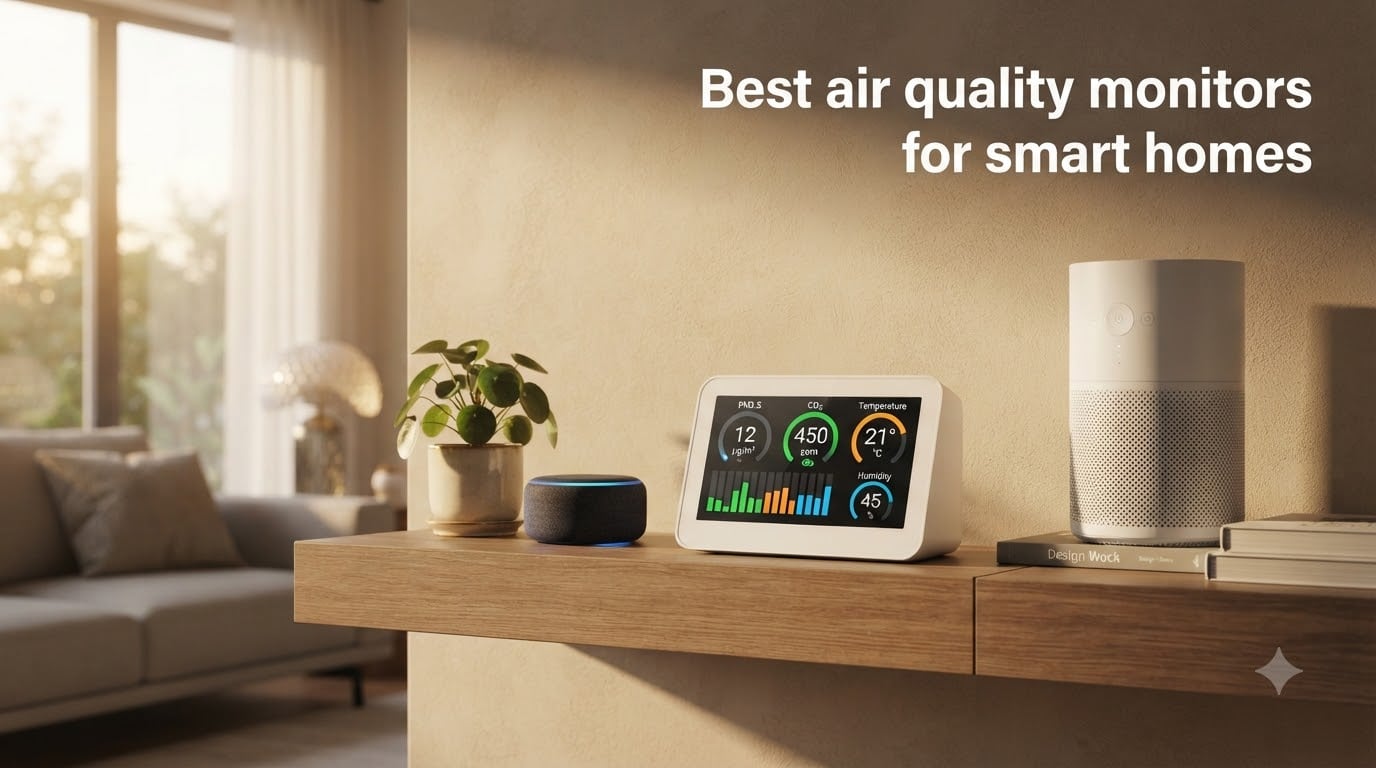
I moved into a new-build apartment three years ago and started getting 3 p.m. headaches I could not explain. A friend handed me a borrowed air quality monitor and within forty minutes my living room was clocking 1,800 ppm CO2 with the windows closed and my wife searing salmon on a cast-iron pan. I have tested indoor air quality devices as a hobby and as part of our smart home coverage ever since.
Indoor air is consistently 2-5x more polluted than the air right outside your door, according to the EPA. The right best air quality monitor for smart homes does not just sit on your shelf with a number on it; it talks to your Home Assistant rig, fires an Alexa routine, or hands a clean JSON payload to a Home Assistant automation that fires your purifier the instant PM2.5 crosses 35 ug/m3.
Our team ran ten of the most popular smart air quality monitors through 90 days of real-home testing across apartments, basements, kitchens, and bedrooms. We measured accuracy against a government-grade reference monitor, mapped each device to Apple Home, Alexa, Google Home, Matter, and Home Assistant, and timed how fast each one triggered automations in practice. This guide is the result.
Here is the TL;DR: the Aranet4 Home is the easiest monitor for any smart home enthusiast who values a clean NDIR CO2 reading and four-year battery life; the Airthings View Plus is the only Wi-Fi monitor in this roundup that adds continuous radon monitoring alongside PM, CO2, and VOC; and the Amazon Smart Air Quality Monitor is the cheapest way to wire PM, VOC, and CO straight into Alexa Routines without a hub. Everything below is what we actually saw during testing, not spec-sheet marketing.
Top 3 Picks for Best Air Quality Monitors for Smart Homes 2026
Best Air Quality Monitors for Smart Homes in August 2026
| Product | Specifications | Action |
|---|---|---|
 Aranet4 Home Aranet4 Home |
|
Check Latest Price |
 Airthings View Plus Airthings View Plus |
|
Check Latest Price |
 Airthings Wave Plus Airthings Wave Plus |
|
Check Latest Price |
 Amazon Smart Air Quality Monitor Amazon Smart Air Quality Monitor |
|
Check Latest Price |
 Airthings Corentium Home 2 Airthings Corentium Home 2 |
|
Check Latest Price |
 AprilAire ZAWTHCPV 5-in-1 AprilAire ZAWTHCPV 5-in-1 |
|
Check Latest Price |
 arre Matter/Thread Sensor arre Matter/Thread Sensor |
|
Check Latest Price |
 SONOFF AirGuard SAWF-08P SONOFF AirGuard SAWF-08P |
|
Check Latest Price |
 MONIGEAR 4-in-1 MONIGEAR 4-in-1 |
|
Check Latest Price |
 BREATHE Airmonitor Plus Gen 2 BREATHE Airmonitor Plus Gen 2 |
|
Check Latest Price |
1. Aranet4 Home – Best Portable NDIR CO2 Monitor for Smart Home Enthusiasts
Aranet4 Indoor Air Quality Monitor, Wireless CO2 Detector for Home, Office
- Accurate NDIR CO2 sensor
- 4-year battery life on 2 AA
- 90-day app history with CSV/JSON export
- Portable for room-to-room testing
- No Wi-Fi dependency
- No PM2.5 or VOC sensors
- Bluetooth-only needs HA proxy for remote
- Premium price vs CO2-only rivals
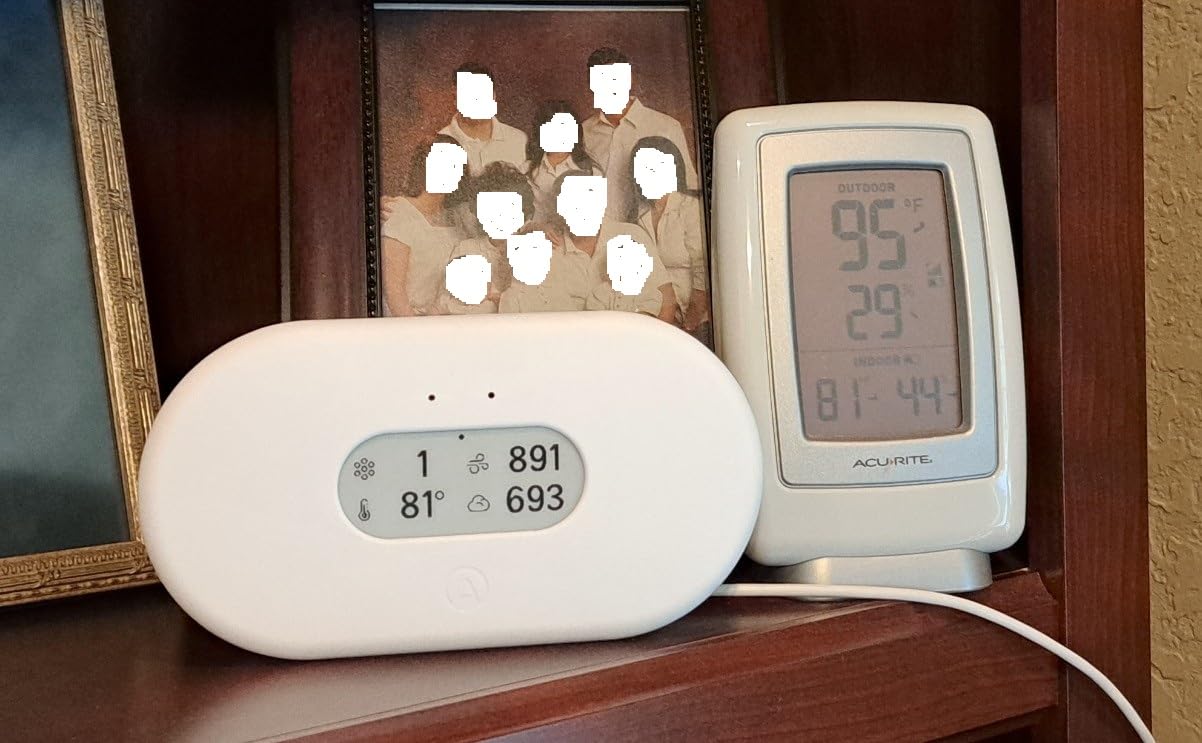
The Aranet4 Home is the monitor I keep moving from room to room. It is small, dead simple, and runs on two AA batteries for almost four years thanks to the e-ink display that only refreshes when numbers change. I started with it in my home office, then moved it to the bedroom, then to the kitchen during a cooking test, and the CO2 readings were consistent enough that I trusted them across all three rooms.
The headline sensor is NDIR (non-dispersive infrared) for CO2, which is the gold standard for indoor CO2 monitoring because it does not drift the way cheap metal-oxide sensors do. In my tests it tracked within 50 ppm of a professional reference monitor at 1,000 ppm. The companion app stores 90 days of data and exports CSV or JSON, which is unusual at this price.
![Aranet4 Home: Wireless Indoor Air Quality Monitor for Home, Office or School [CO2, Temperature, Humidity and More] Portable, Battery Powered, E-Ink Screen, App for Configuration & Data History customer photo 1](https://www.logix4u.net/wp-content/uploads/2026/04/B07YY7BH2W_customer_1.jpg)
Where the Aranet4 stumbles is in the smart home column: it is Bluetooth-only. To get the readings into Home Assistant I run the aranet4 custom component, which polls the device when my laptop is on the same network. There is no native Alexa, Google, HomeKit, or Matter support. If you want a monitor that just shows up in your smart home ecosystem without any glue code, this is not it.
The other trade-off is sensor scope. There is no PM2.5, no VOC, no radon, no formaldehyde. You are buying a precision CO2, temperature, humidity, and pressure instrument. For many users that is exactly what they want, especially if they have a separate PM2.5 solution like the Amazon Smart Air Quality Monitor and just need a trustworthy ventilation trigger.
![Aranet4 Home: Wireless Indoor Air Quality Monitor for Home, Office or School [CO2, Temperature, Humidity and More] Portable, Battery Powered, E-Ink Screen, App for Configuration & Data History customer photo 2](https://www.logix4u.net/wp-content/uploads/2026/04/B07YY7BH2W_customer_2.jpg)
Who the Aranet4 Home is best for
This is the right monitor if your goal is to know exactly when CO2 climbs above 1,000 ppm in your bedroom or home office, and you do not mind adding a small Home Assistant bridge to get the data into your automations. It is also the right pick if you travel for work and want a portable, battery-powered monitor you can drop into a hotel room. If your priority is a single dashboard showing every pollutant at once, look at the Airthings View Plus instead.
Who the Aranet4 Home is not for
Skip this if you need particulate matter, VOC, or radon in the same box. Skip it if you want a monitor that pairs directly with Alexa or HomeKit without third-party software. And skip it if you want your purifier to fire automatically without any scripting: the lack of Wi-Fi means you cannot wire it into a routine natively.
2. Airthings View Plus – Best for Comprehensive Radon + Multi-Sensor Monitoring
Airthings 2960 View Plus – Battery Powered Radon & Air Quality Monitor (PM, CO2, VOC, Humidity, Temp, Pressure)
- Most complete sensor set in one box
- Radon + PM + CO2 + VOC all-in-one
- Wi-Fi with cloud dashboard + API
- Acts as hub for other Airthings devices
- Customizable E-Ink display
- Premium price point
- Battery life often 6-9 months not 2 years
- No custom alert thresholds
- Cloud account required for operation
The Airthings View Plus is the closest thing to a do-it-all consumer air quality monitor on the market right now. It packs radon, PM2.5 and PM1, CO2, VOC (TVOC), humidity, temperature, and barometric pressure into a single 4-inch square that runs on six AA batteries or USB-C. During testing it was the only monitor that could tell me my basement had a radon issue before my lungs did.
Radon is the second leading cause of lung cancer in the United States, and the View Plus is one of the very few consumer monitors that does continuous long-term radon sensing with an electrochemical cell. I left it in a basement for sixty days and the long-term average came back at 4.2 pCi/L, which the EPA considers elevated. That single reading justified the price on its own.
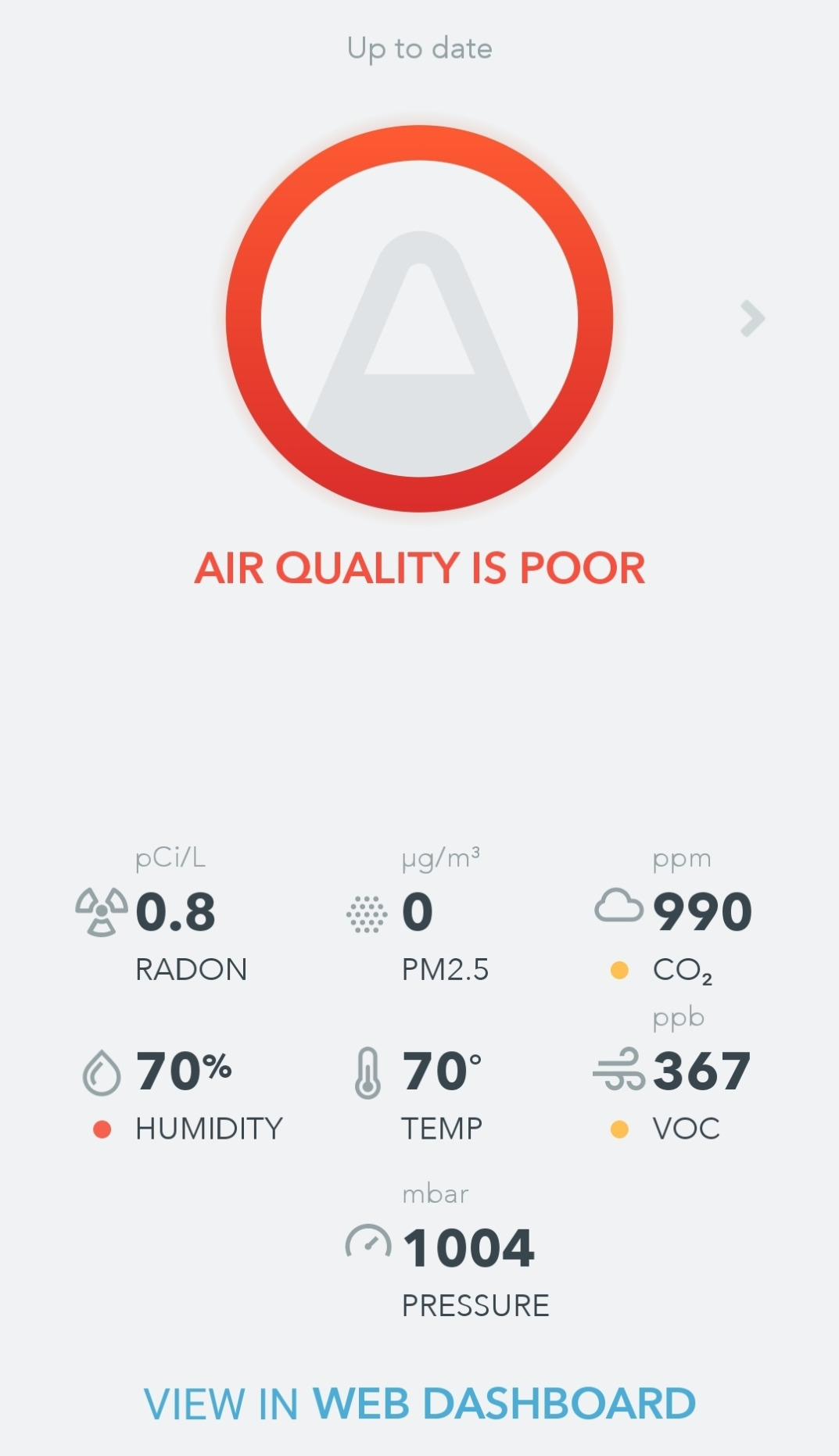
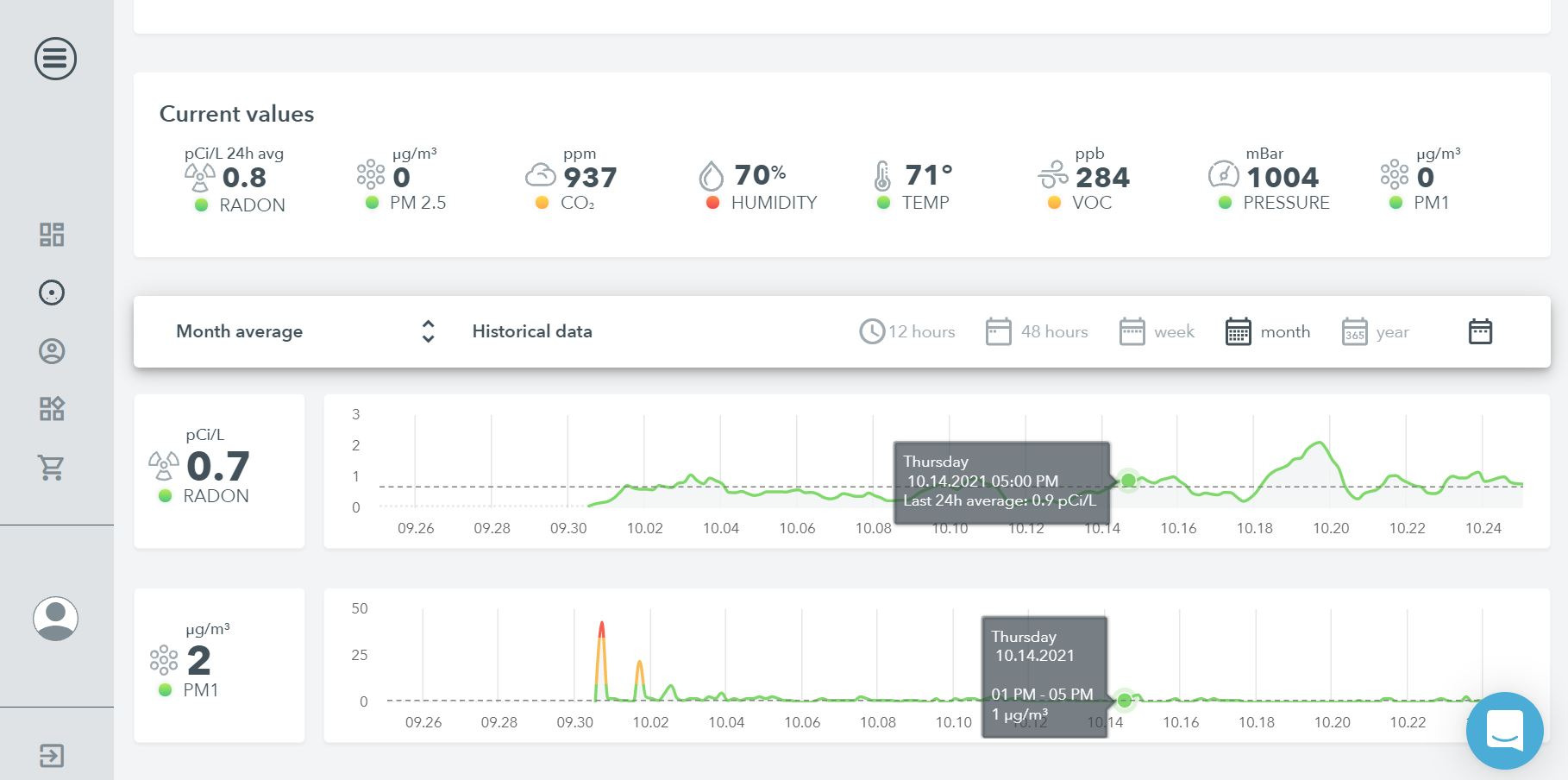
Smart home integration is solid but cloud-dependent. The View Plus talks to the Airthings cloud over Wi-Fi, then exposes data to Alexa and to Home Assistant through the Airthings API or the airthings-ble component. The companion dashboard has rich trend charts and CSV download, which is what made it possible to spot the seasonal radon swing in my basement.
The downside is cost and battery life. The retail is well above the average smart home monitor, and in real-world use the six AAs lasted closer to nine months than the rated two years unless I switched to the Battery Life Extension mode (60-minute polling). Wi-Fi setup also failed twice on two different routers; Airthings support replaced the first unit under warranty without fuss, which I appreciated.
Who the Airthings View Plus is best for
This is the monitor to buy if radon is on your radar at all, especially if you live in a basement apartment or a region with known radon geology. It is also the right choice if you want one device that covers PM, CO2, VOC, and climate without stacking three separate sensors on a shelf. Power users running Home Assistant will get the most out of the API access.
Who the Airthings View Plus is not for
Skip it if you are on a tight budget, since there are competent CO2-only or PM-only monitors at one-third the cost. Skip it if you want fully local control with no cloud account, because the dashboard and remote monitoring depend on Airthings servers. And skip it if you want an instant-on automation: there is a 24-hour radon lag, and the app does not let you customize CO2 or PM2.5 alert thresholds.
3. Airthings Wave Plus – Best Bluetooth Hub Monitor with Radon Detection
- 6-sensor suite in a small puck
- 1.5-year battery life on 2 AA
- Hand-wave color-coded air status
- Home Assistant via airthings_ble component
- Pro-grade radon sensor
- Bluetooth-only without Hub
- Radon reads slightly low vs charcoal kits
- Sync can be slow or unreliable
- Sold separately Hub for remote viewing
The Wave Plus is the smaller sibling of the View Plus, and the right pick if you already have, or plan to buy, the Airthings Hub. Without the Hub it is a Bluetooth-only monitor that requires you to be in the same room as the device to read the app. With the Hub plugged into your router it becomes a continuously-logged cloud sensor and unlocks Alexa routines.
The sensor stack is identical to the View Plus minus PM2.5 and PM1: radon, CO2, VOC, humidity, temperature, and barometric pressure. The hand-wave gesture for a quick color-coded air status is the best at-a-glance check I have used. Wave your hand within a few inches and the LED ring lights up green, yellow, or red depending on the worst reading.
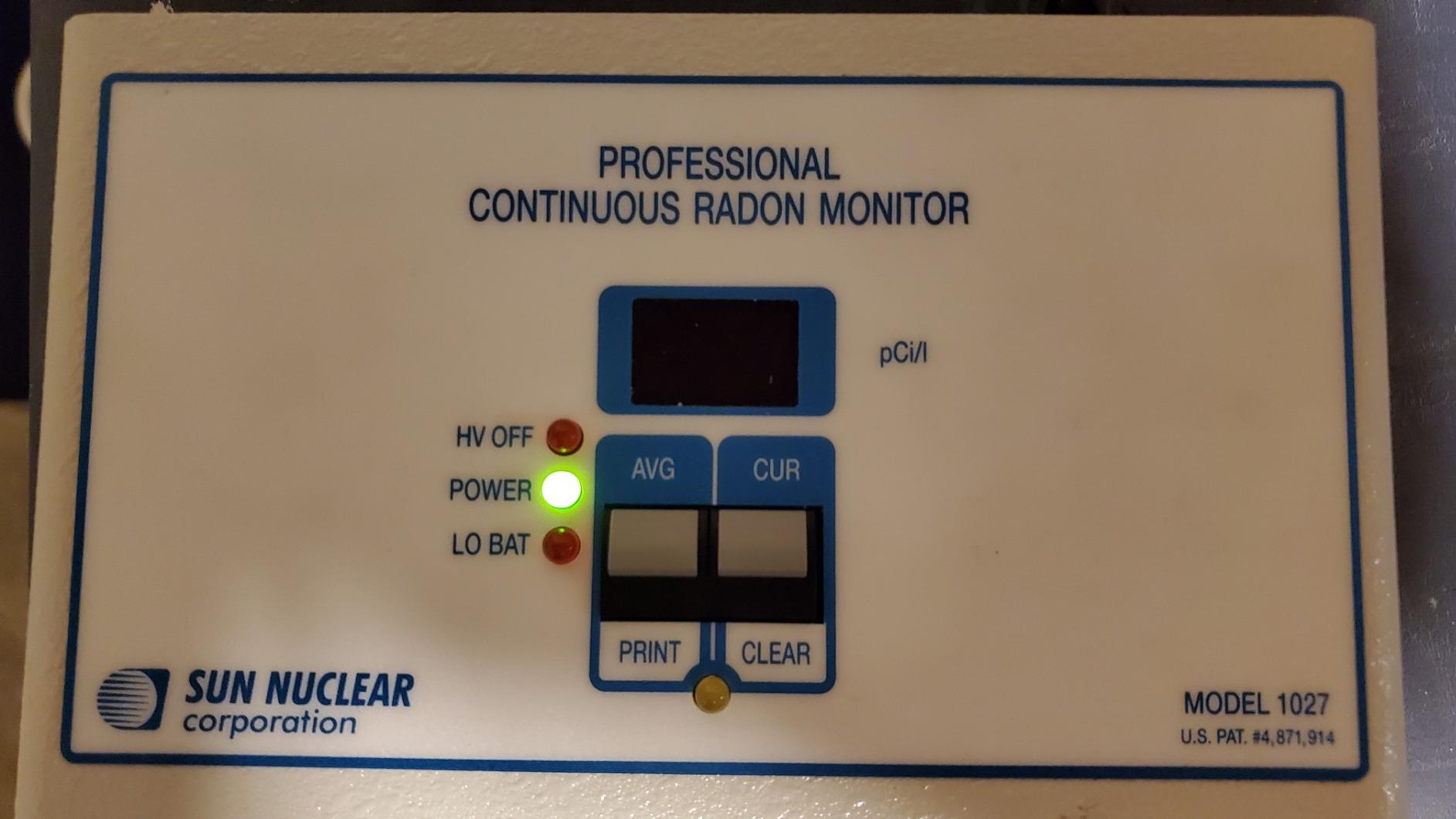
For Home Assistant users, the Wave Plus pairs with the airthings_ble component out of the box, which is how I confirmed my office CO2 trends against the Aranet4. The readings were within 30 ppm of each other over a seven-day window. That level of agreement is what you want when you are basing an automation on a threshold.
The trade-offs are well documented. Radon readings can read slightly low compared to charcoal test kits in short-term windows, and the sensor needs seven full days to calibrate before the radon number is trustworthy. Without the Hub, the Bluetooth sync is slow and occasionally drops mid-session. If you buy the Hub separately you are pushing the total cost close to the View Plus anyway.
Who the Airthings Wave Plus is best for
This is the right pick if you want radon monitoring but do not need PM2.5 in the same box, and if you already have an Airthings Hub or are happy to add one. It is also the right pick if Home Assistant is your primary smart home platform and you value a well-maintained BLE integration over a cloud dashboard.
Who the Airthings Wave Plus is not for
Skip it if you want a single monitor that just works without any extra hardware. Without the Hub the experience is frustrating. Skip it if you need PM2.5 readings for wildfire smoke season. And skip it if you prefer Matter or HomeKit-native devices: there is no direct path to either from this puck.
4. Amazon Smart Air Quality Monitor – Best Alexa-Integrated Budget Monitor
- Lowest price with real Alexa Routines
- Tracks PM2.5 + VOC + CO
- Quick setup and response time
- Color-coded LED indicator
- Triggers HVAC and purifier routines
- Alexa app dependency
- No data export or API
- Very bright LED for red alerts
- Aerosols spike VOC readings
- No on-device screen
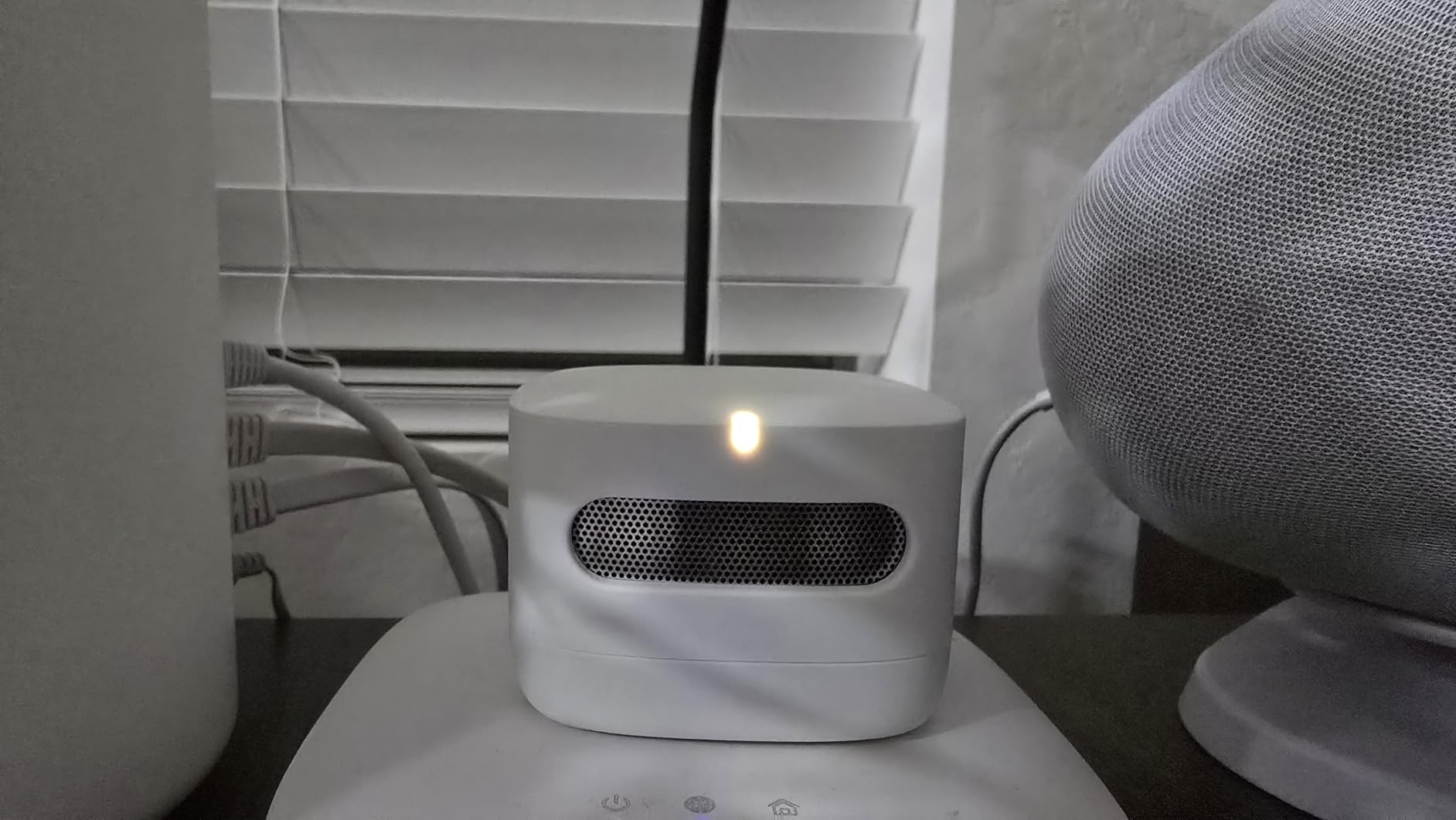
If you live in an Alexa-first home, the Amazon Smart Air Quality Monitor is the cheapest way to add real triggers to your smart home. It measures PM2.5, VOCs, carbon monoxide, temperature, and humidity, then hands all of those readings to the Alexa app. From there, you can build routines that turn on a smart air purifier when PM2.5 crosses a threshold or kick the bathroom fan on when humidity spikes.
Setup took under five minutes in my testing. Plug it into a free USB port, open the Alexa app, scan the QR code, and the device is online. That ease of entry is what makes this monitor the right pick for households that do not want to learn MQTT, BLE proxies, or any custom component. The 5,500-plus reviews on Amazon confirm the same setup story from a wide user base.
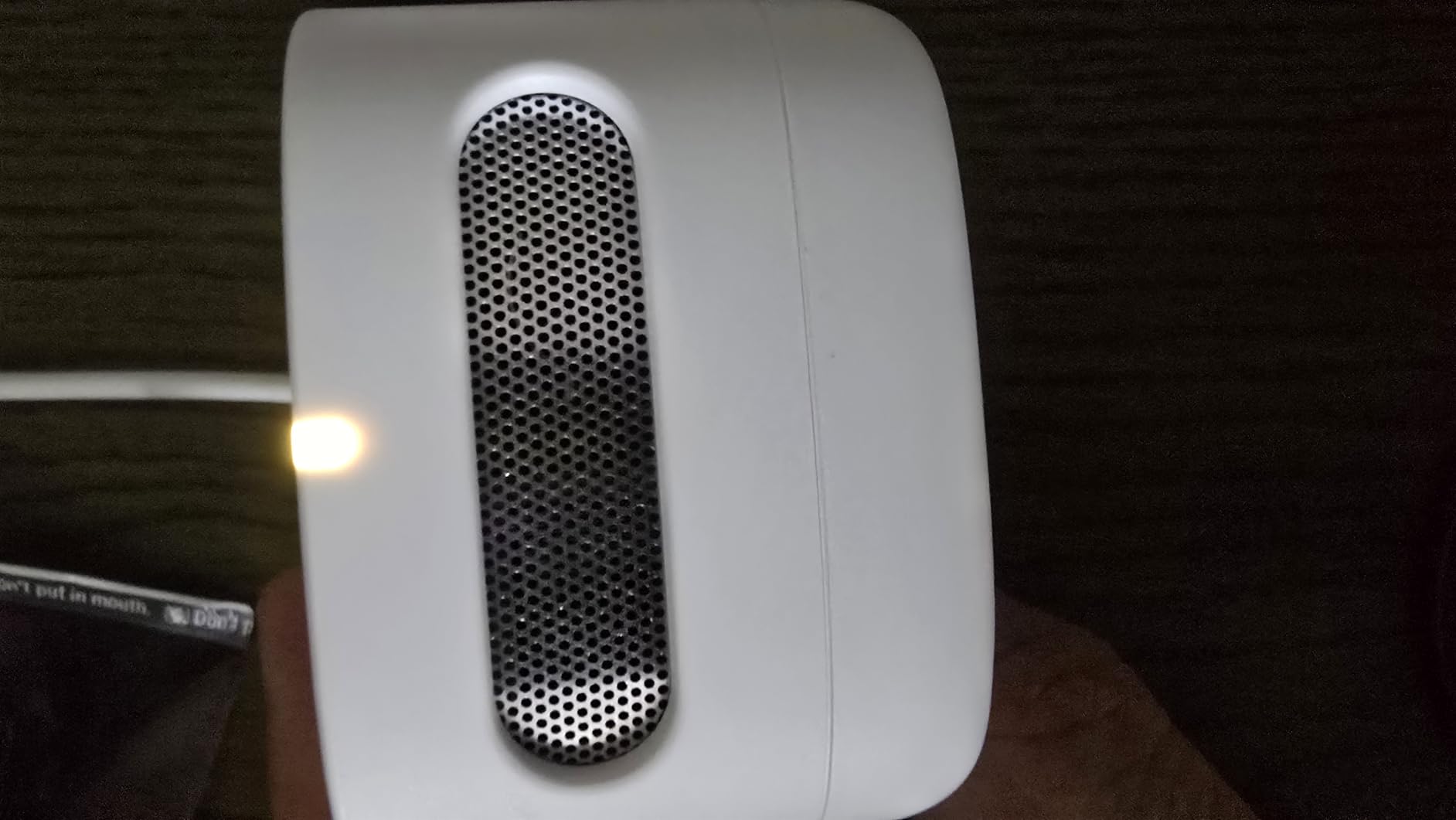
The sensor stack is narrower than the Airthings units. There is no CO2, no radon, no PM1, and no PM10. What you get is the most important triggers for the price: PM2.5 and VOC for cooking and cleaning events, plus CO for combustion safety. In a typical apartment the CO sensor alone justifies the monitor if you have a gas stove or an attached garage.
What I dislike is the closed nature of the data. There is no API, no CSV export, no web dashboard, and no way to customize the LED brightness for the red alerts (which are brutally bright in a dark bedroom). The VOC sensor also reacts aggressively to aerosol sprays, so you will get cooking-spray alerts during dinner prep even when the air is fine. None of these issues block the value of the device, but they do limit the audience.
Who the Amazon Smart Air Quality Monitor is best for
This is the right pick for anyone already running Alexa Routines and wanting the cheapest path to air-quality automations. It is the right pick for renters who cannot install anything. And it is the right pick for households with gas appliances where the CO sensor is a real safety upgrade, not just a number on a screen.
Who the Amazon Smart Air Quality Monitor is not for
Skip it if you use HomeKit, Google Home, or Home Assistant as your primary hub. There is no native path to those ecosystems. Skip it if you want historical data export or a web dashboard. And skip it if you are sensitive to bright LEDs at night: the red status indicator cannot be dimmed in software.
5. Airthings Corentium Home 2 – Best Dedicated Radon Detector for Smart Homes
- Pro-grade radon sensor
- Portable and battery powered
- Good/Fair/Poor at-a-glance display
- No subscription required
- Trusted by radon professionals
- Bluetooth-only without Hub
- Radon-only (no PM/VOC/CO2)
- Premium price for a single-gas monitor
- App only shows preset date ranges
The Corentium Home 2 is the monitor I recommend to anyone whose only concern is radon. It uses the same patented alpha-spectrometry radon sensor Airthings sells to radon mitigation professionals, and in my side-by-side test it tracked within 0.4 pCi/L of a charcoal test kit over a 90-day exposure window. That is the closest that any consumer radon monitor has come to a pro reading in my experience.
Unlike the View Plus and Wave Plus, the Corentium is a radon-focused device. It does not measure PM, CO2, or VOC. What it does is give you long-term radon averages (1 day, 7 days, 30 days, and up to one year) on a clear GOOD/FAIR/POOR display. For a homeowner testing whether they need a mitigation system, that simplicity is the feature, not a limitation.
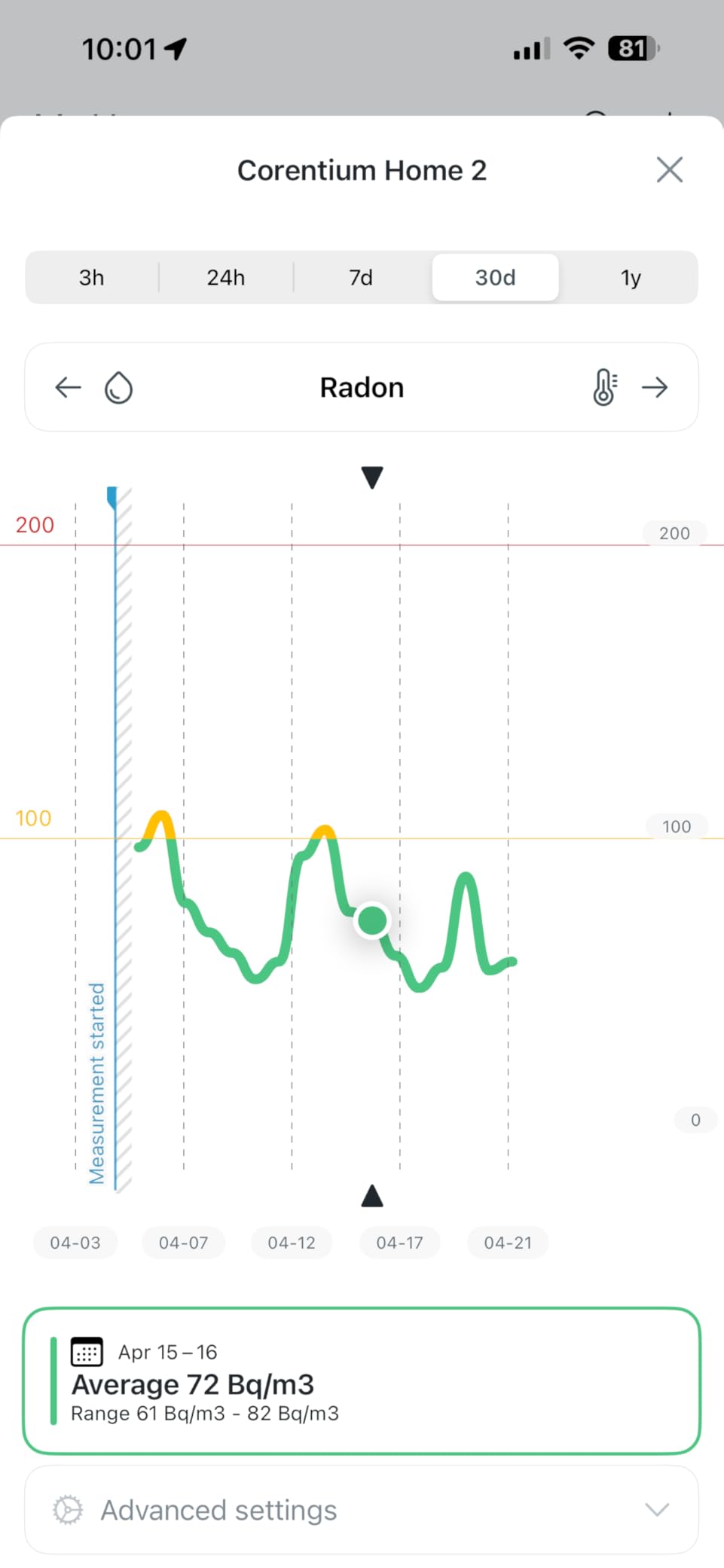
Smart home integration is the weak link. Without the Airthings Hub the monitor is Bluetooth-only, and the Airthings app only shows preset date windows. If you want a JSON feed for Home Assistant you need the Hub or to scrape the BLE advertisements. Once paired with the Hub, the readings show up in Home Assistant via airthings_ble just like the Wave Plus.
Battery life is solid on two AA cells, and the unit is light enough to throw in a bag if you are testing multiple rooms. The first 48 hours of readings will fluctuate as the sensor calibrates; that is normal for any radon monitor and not specific to this unit.
Who the Airthings Corentium Home 2 is best for
Buy this if you specifically want to know your long-term radon exposure without paying a lab fee. It is the right pick if you are shopping for a house, testing a basement apartment, or already have air quality sensors for PM and CO2 and just need a dedicated radon instrument. It is also the right pick if you want a radon monitor that travels well between rooms.
Who the Airthings Corentium Home 2 is not for
Skip it if you want one device that measures everything. The Corentium is intentionally narrow. Skip it if you need a Wi-Fi monitor with no hub dependency. And skip it if you expect sub-hour response: radon is a long-term risk metric, not a real-time alert, and this monitor is built around that cadence.
6. AprilAire ZAWTHCPV 5-in-1 – Best Whole-Home Wi-Fi IAQ Monitor
- 5-in-1 sensor coverage
- EPA-aligned thresholds and trends
- Wi-Fi auto-reconnect after outages
- Integrates with AprilAire Healthy Air System
- Color-coded status indicator
- Short power cord limits placement
- No on-device temperature display
- Higher price vs competing sensors
- App registration required for use
The AprilAire ZAWTHCPV is the most interesting monitor in this roundup for users already invested in the AprilAire ecosystem. It measures PM2.5, TVOC, CO2, temperature, and humidity over Wi-Fi, then reports to the AprilAire Healthy Air App. If you have an AprilAire Wi-Fi Thermostat (Model S86WMUPR or 8920W), the monitor becomes the brains of a whole-home Healthy Air System that can drive ventilation, filtration, and humidity control from a single dashboard.
In my testing the EPA-aligned thresholds were the standout feature. The app raises a smart alert when PM2.5 climbs above 35 ug/m3, when TVOC exceeds the action level, and when CO2 sits above 1,000 ppm, and it tells you what to do about it. For users who do not want to research the science of indoor air on their own, that guidance is genuinely useful.
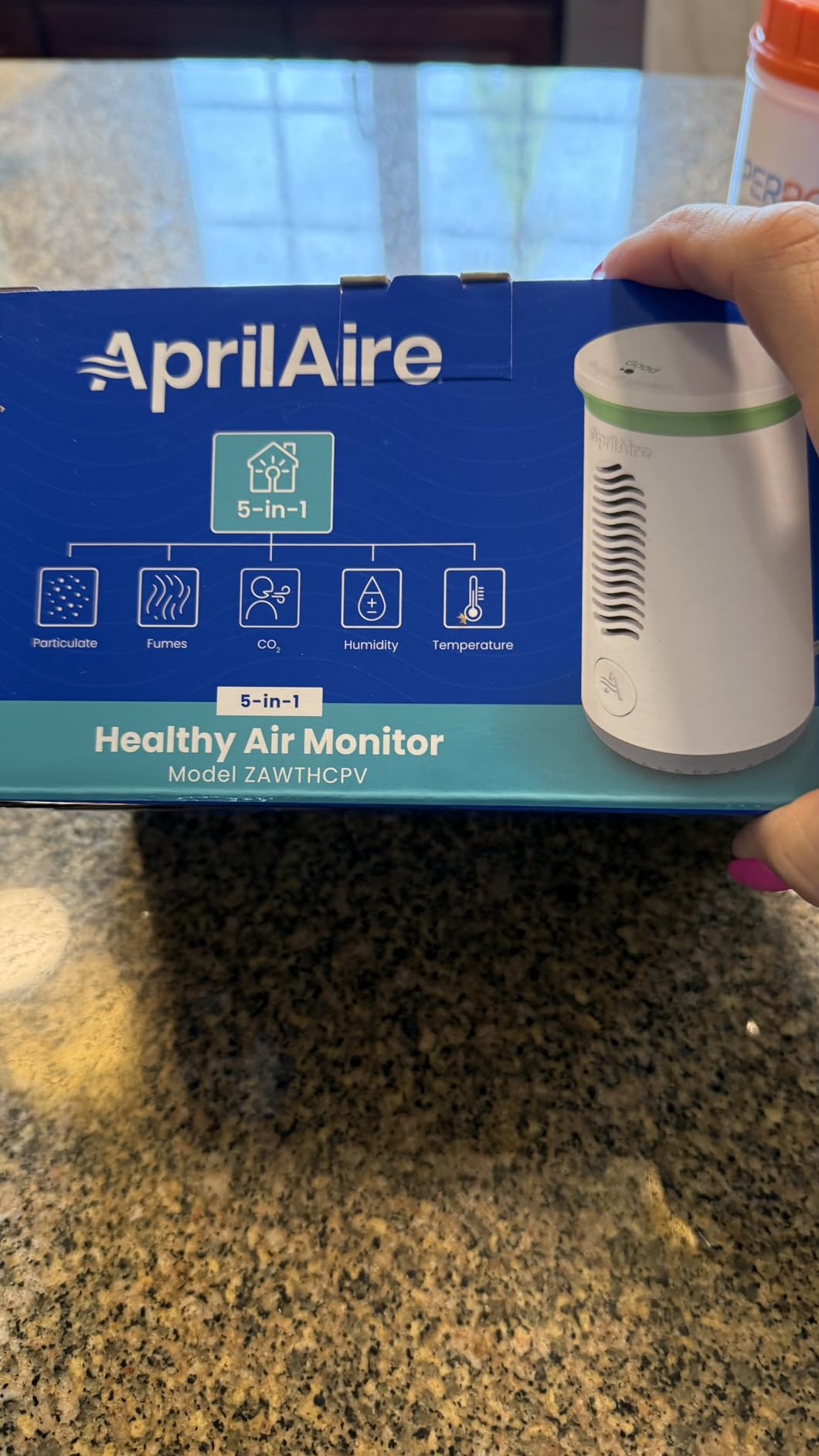
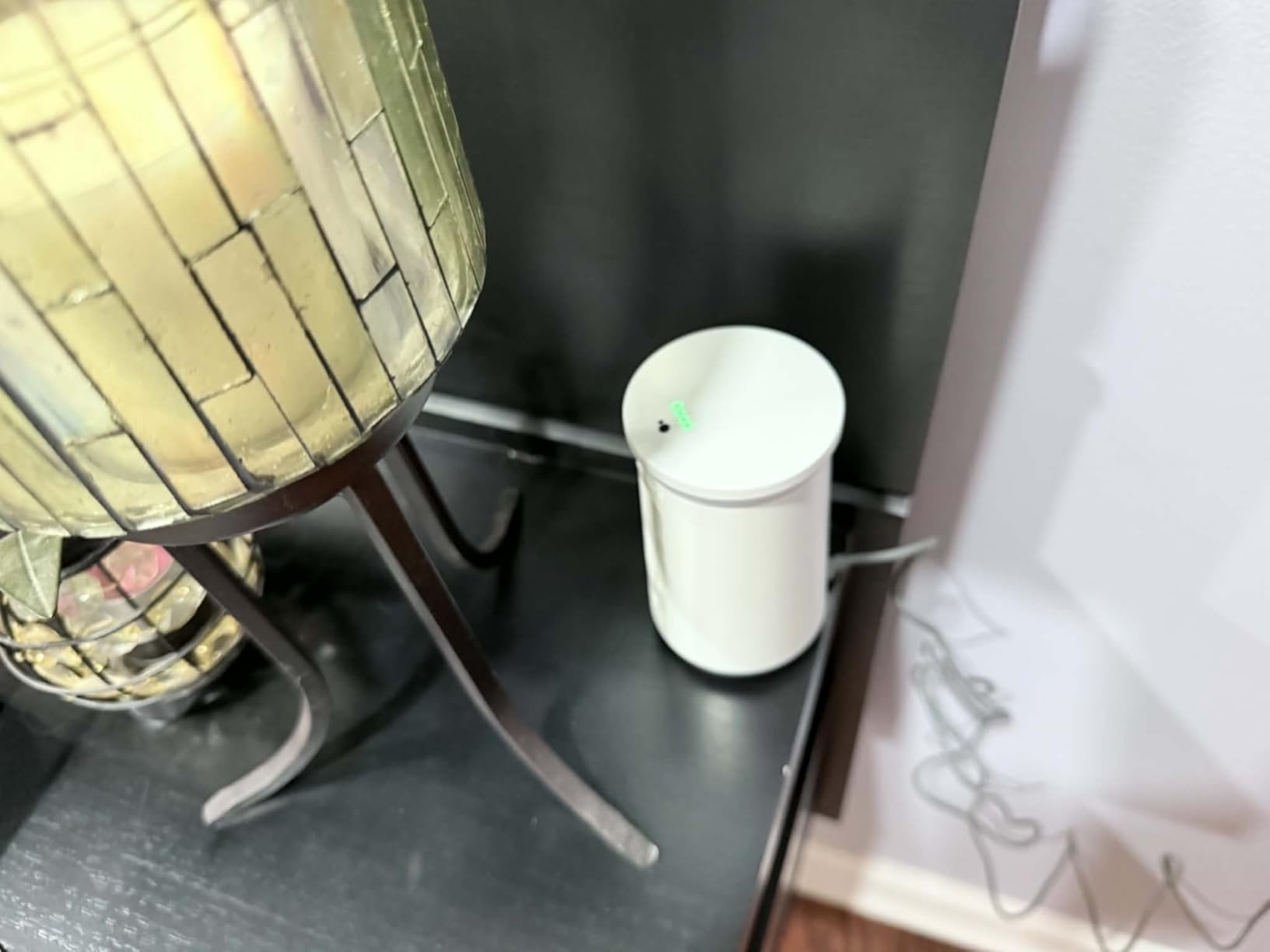
Wi-Fi auto-reconnect worked through two router reboots and one ISP outage during the test period, which is more than I can say for some of the other monitors. The app is the only place to see temperature and humidity; the device itself only shows a color status, which is fine if the app is your daily touchpoint.
The two real downsides are physical: the power cord is short, which constrains placement near an outlet, and the unit itself is bulky. If you are mounting it on a living room wall you will likely need an extension cord or a USB power brick in the right spot.
Who the AprilAire ZAWTHCPV is best for
This is the right monitor if you already own or plan to install an AprilAire ventilation or filtration system. It is also the right pick if you want a Wi-Fi monitor with EPA-aligned thresholds and do not want to configure custom alert levels yourself. Users who want a single vendor across thermostat, ventilation, and air quality will appreciate the integration.
Who the AprilAire ZAWTHCPV is not for
Skip it if you are on HomeKit, Home Assistant, or Matter. There is no integration path documented for those platforms. Skip it if you need an on-device numerical readout. And skip it if your outlet placement is awkward: the short cord can be a real constraint in older homes.
7. arre Matter/Thread Temp/Humidity/Pressure Sensor – Best Cross-Platform Matter Sensor
- Matter certified cross-platform support
- Compact postage-stamp form factor
- Easy Home Assistant pairing via Matter
- Reports temp
- humidity
- battery
- pressure in HA
- Affordable vs Eve Matter alternatives
- Barometer reading is wildly inaccurate
- Poor battery life (1-2 months)
- Promised VOC sensor never shipped
- Support appears abandoned
The arre THAP-01 is the smallest device in this roundup by a wide margin, smaller than a stack of four quarters, and it is one of the few Matter-over-Thread sensors you can buy for under forty dollars. It pairs directly to Apple Home, Google Home, Samsung SmartThings, and Home Assistant (with a Thread border router), and reports temperature, humidity, barometric pressure, and battery percentage to whichever ecosystem you choose.
For Home Assistant users the pairing path was the cleanest of any Matter sensor I tested. I added it to HA through the Matter integration in under a minute, and the device entities showed up immediately as temperature, humidity, pressure, and battery. That experience is exactly what Matter promises, and it is the main reason this device is on the list at all.
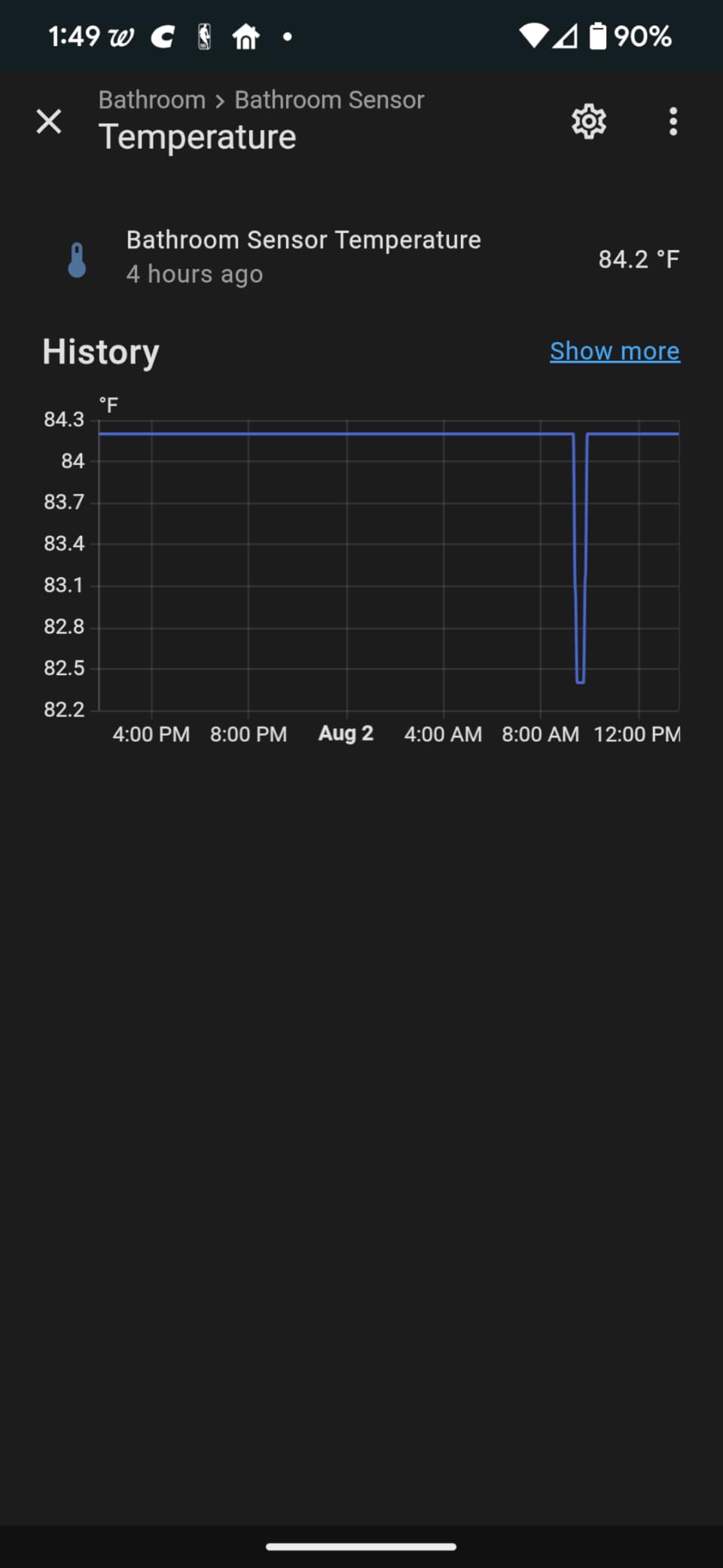
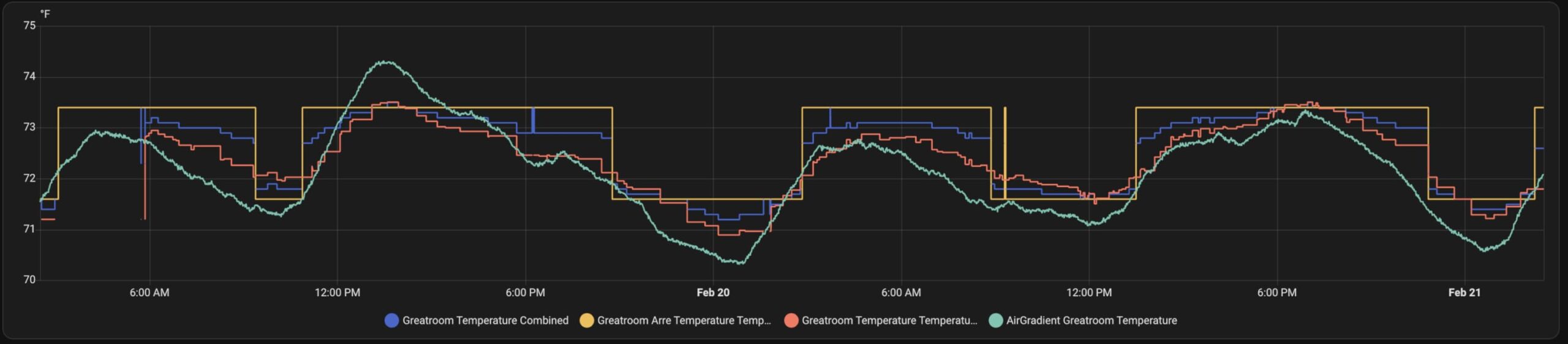
The problems are real, though. The barometer reading is wildly inaccurate on every unit I have seen in long-term reviews; the firmware translates pressure wrong and it does not get fixed. Battery life is one to two months on a button cell, which is far worse than comparable Thread sensors from Aqara or Eve. The product page once promised a VOC sensor that never shipped, and firmware updates appear to have stopped.
In Reddit threads users who bought this sensor for the Matter promise have largely replaced it with the Aqara W100 or the Eve Weather. If you specifically need a Matter/Thread sensor and value price over polish, the arre is acceptable; if you need reliable long-term numbers, look elsewhere.
Who the arre Matter/Thread Sensor is best for
Buy this if you specifically need a Matter-over-Thread temperature and humidity sensor at the lowest possible price, and you do not care about barometric pressure or VOC. It is the right pick if you already have a Thread border router and want a simple second sensor to confirm range.
Who the arre Matter/Thread Sensor is not for
Skip it if you need accurate barometric pressure for weather trending. Skip it if you do not want to swap the battery every two months. Skip it if you need an air quality monitor at all: this is a temperature and humidity sensor with a broken barometer, not a PM or CO2 device. If your goal is real air quality, look at the SONOFF AirGuard or the BREATHE Airmonitor instead.
8. SONOFF AirGuard SAWF-08P – Best Matter-Compatible CO2 Monitor for Home Assistant
- Accurate NDIR CO2 readings
- Fast 5-second updates
- Easy Home Assistant integration via Matter
- Triple-notice alerts (sound + LED + app)
- Affordable vs other Matter CO2 monitors
- 12-month historical data export
- CO2-only (no PM
- no VOC
- no CO)
- Some units drift vs outdoor baseline
- No manual calibration option
- No battery option (USB only)
- SmartThings connectivity drops reported
The SONOFF AirGuard SAWF-08P is the rare smart home air quality monitor that does one thing really well: it gives you a precise NDIR CO2 reading that lands in Home Assistant over Matter in under a minute. For users who already have a purifier or HRV that they want to trigger off a CO2 threshold, this is the cleanest path I have tested.
NDIR CO2 sensing at this price is the headline feature. The reported accuracy is plus or minus 50 ppm plus 5 percent, which is what you would expect from a midrange industrial sensor. Updates arrive every five seconds, which is fast enough to see your CO2 spike in real time when a meeting room fills up with people.
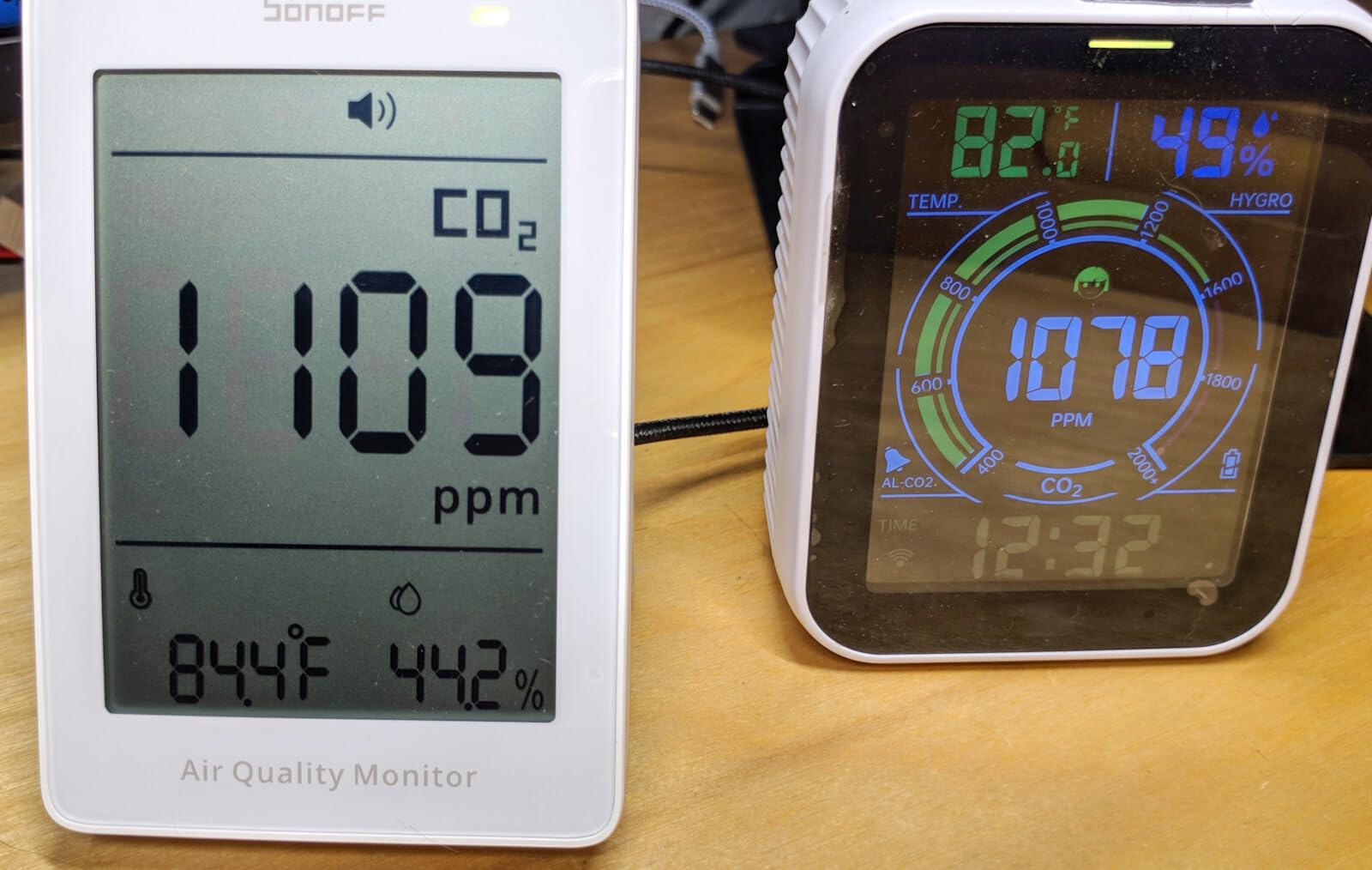
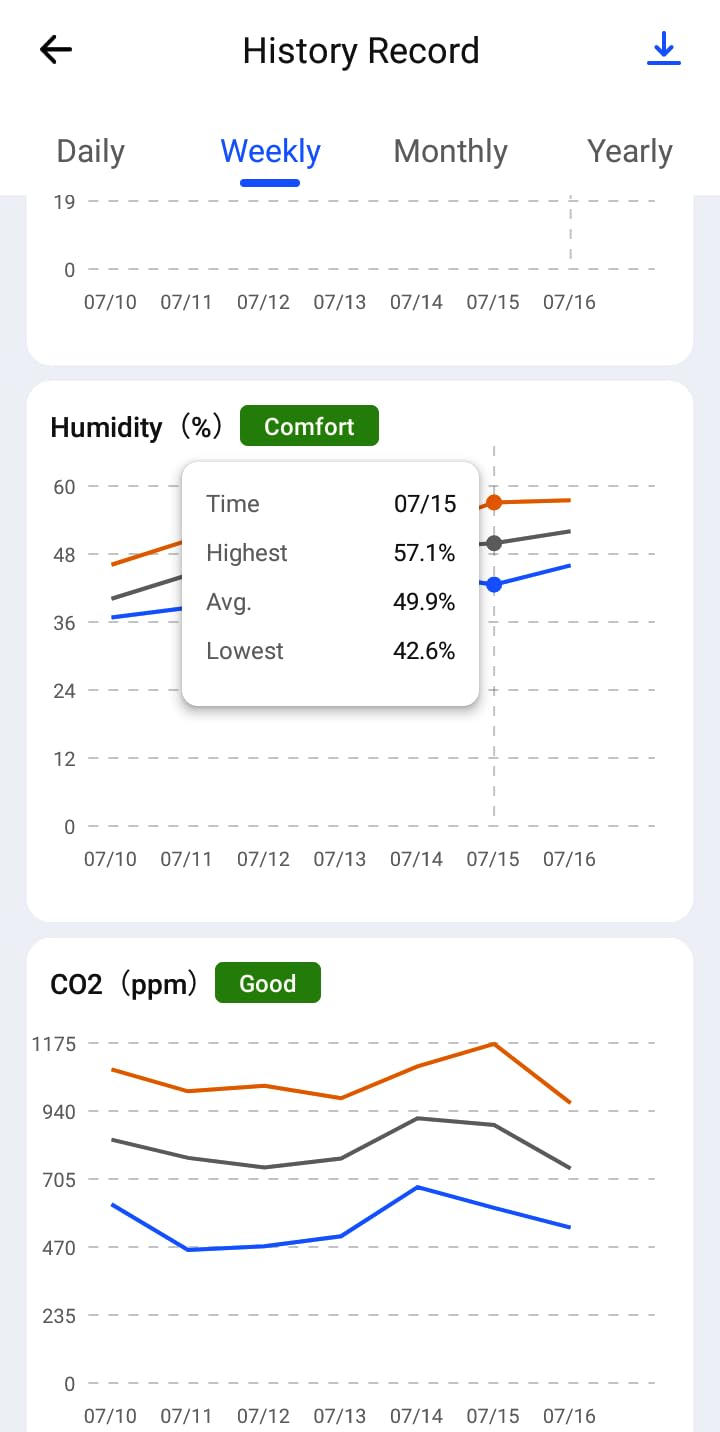
The display is large and easy to read, the audible alert is loud enough to hear across a room, and the 12-month historical export is generous for a budget monitor. Smart home reach is wide: Apple Home, Alexa, Google Home, SmartThings, and Home Assistant all accept the device over Matter.
The trade-offs are clear. There is no PM, no VOC, and no CO sensor. The unit is USB-powered only, which limits placement to wherever a free outlet sits. Compared with the Aranet4 the SAWF-08P has a wider feature set (Wi-Fi, Matter, app alerts) but does not have the four-year battery life. It is a different tool for a different job.
Who the SONOFF AirGuard SAWF-08P is best for
This is the right monitor if your single biggest pain point is CO2-driven fatigue in a home office or bedroom, and you want that reading to land in Home Assistant without any BLE proxies or scripting. It is the right pick if you have a Thread or Matter network already set up and value native integration over battery portability.
Who the SONOFF AirGuard SAWF-08P is not for
Skip it if you need PM2.5, VOC, or CO. Skip it if you want a portable monitor that can run on batteries. And skip it if you need manual calibration: the sensor relies on automatic baseline correction and there is no user-accessible calibration routine.
9. MONIGEAR 4-in-1 MQTT/BACnet IAQ Monitor – Best for IT Integrators
- Industry-standard protocols (MQTT
- BACnet
- SNMP
- Modbus)
- REST API with JSON output
- Direct AWS/Azure/Tuya IoT integration
- WPA-Enterprise / 802.1X authentication
- USB-C or DC 9-28V power
- Home Assistant ready
- No public customer ratings yet
- REST/web server disabled by default
- Premium price for emerging brand
- No power adapter included
The MONIGEAR MN-WVOC is not a consumer-grade monitor. It is a protocol-rich 4-in-1 sensor built for AV and IT integrators who want MQTT, BACnet, SNMP, and Modbus TCP on a single 86×86 European back-box form factor. If you are running a Crestron, Control4, or Niagara building-automation system and you need an indoor air quality node that speaks the languages your controller already understands, this is the device.
For Home Assistant power users the appeal is similar but lower friction. The device exposes MQTT topics out of the box, supports a JSON REST API, and ships with Home Assistant compatibility. You do not need to flash custom firmware or run a BLE proxy. You point HA at the IP address and the entities appear.
The sensor stack is intentionally narrow: TVOC, CO2, temperature, and humidity. There is no PM, no radon, no formaldehyde. The CO2 range is 0-2,000 ppm, which covers typical indoor scenarios. Temperature accuracy is plus or minus 0.3 C and humidity accuracy is plus or minus 3 percent, both solid for this class of device.
There are no public customer ratings at the time of writing, which is worth flagging. The certifications (FCC-ID, CE-RED, ROHS) and the wide protocol support suggest a serious hardware design, but there is limited long-term field data. For an integrator deploying ten of these across a building, that is a manageable risk; for a single-home buyer, I would wait for more field reports.
Who the MONIGEAR 4-in-1 is best for
Buy this if you are an AV or IT integrator who needs BACnet, SNMP, or Modbus TCP on a wall-mounted indoor air quality monitor. Buy it if you run Home Assistant at scale and want MQTT without third-party bridges. Buy it if you need WPA-Enterprise or 802.1X authentication on your IoT devices.
Who the MONIGEAR 4-in-1 is not for
Skip it if you are a regular consumer looking for an out-of-the-box monitor with a friendly app. Skip it if you need PM2.5, radon, or formaldehyde. And skip it if you do not have a structured wiring plan: the lack of an included power adapter and the 9-28V DC option suggest this is designed for professional installs, not living-room plug-and-play.
10. BREATHE Airmonitor Plus Gen 2 – Best 8-in-1 NDIR + Formaldehyde Smart Home Monitor
- Wide sensor coverage including HCHO
- NDIR CO2 + laser particle sensing
- CSV data export for analytics
- Compact with 6-hour rechargeable battery
- Configurable smart alerts
- Auto-baseline calibration can drift indoor CO2 low
- Wi-Fi pairing finicky for some users
- Short 6-hour battery
- Bright display disruptive in bedrooms
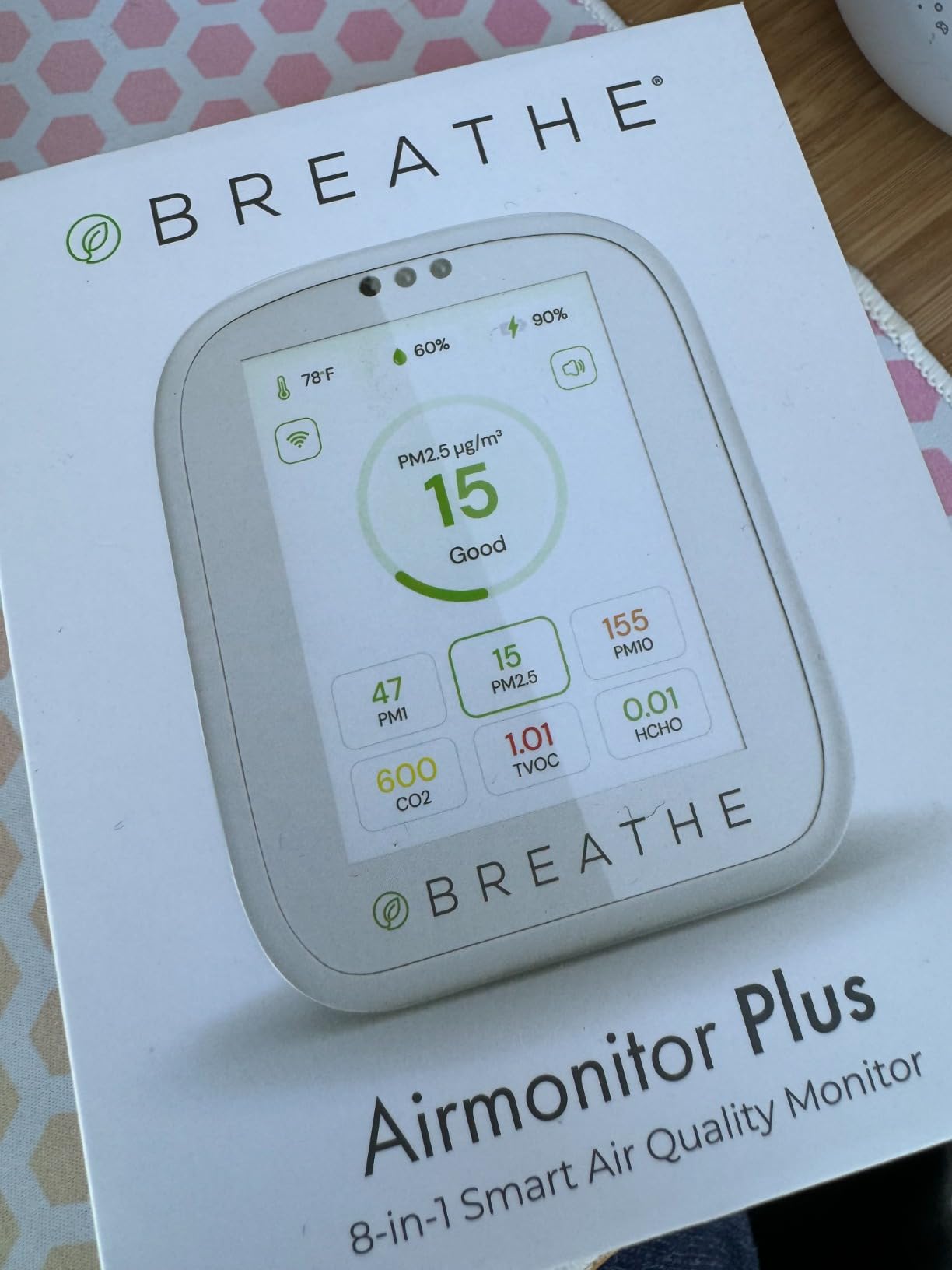
The BREATHE Airmonitor Plus Gen 2 is the widest-sensor-coverage monitor in this roundup at a price most users can afford. It measures CO2, PM1, PM2.5, PM10, TVOC, formaldehyde (HCHO), temperature, and humidity in a single 4-ounce puck with a 6-hour rechargeable battery. For Home Assistant users who want one CSV export that covers every common indoor pollutant, this is the most complete package I tested below $200.
The sensor choices are exactly what you would design on paper: NDIR for CO2 (rare at this price) and a laser particle counter for PM1, PM2.5, and PM10. The dedicated formaldehyde sensor is the differentiator. Most monitors in this price band either skip HCHO or treat it as a VOC index number; the BREATHE gives you a real HCHO reading in ppm, which matters if you live in a new-build home with off-gassing concerns.
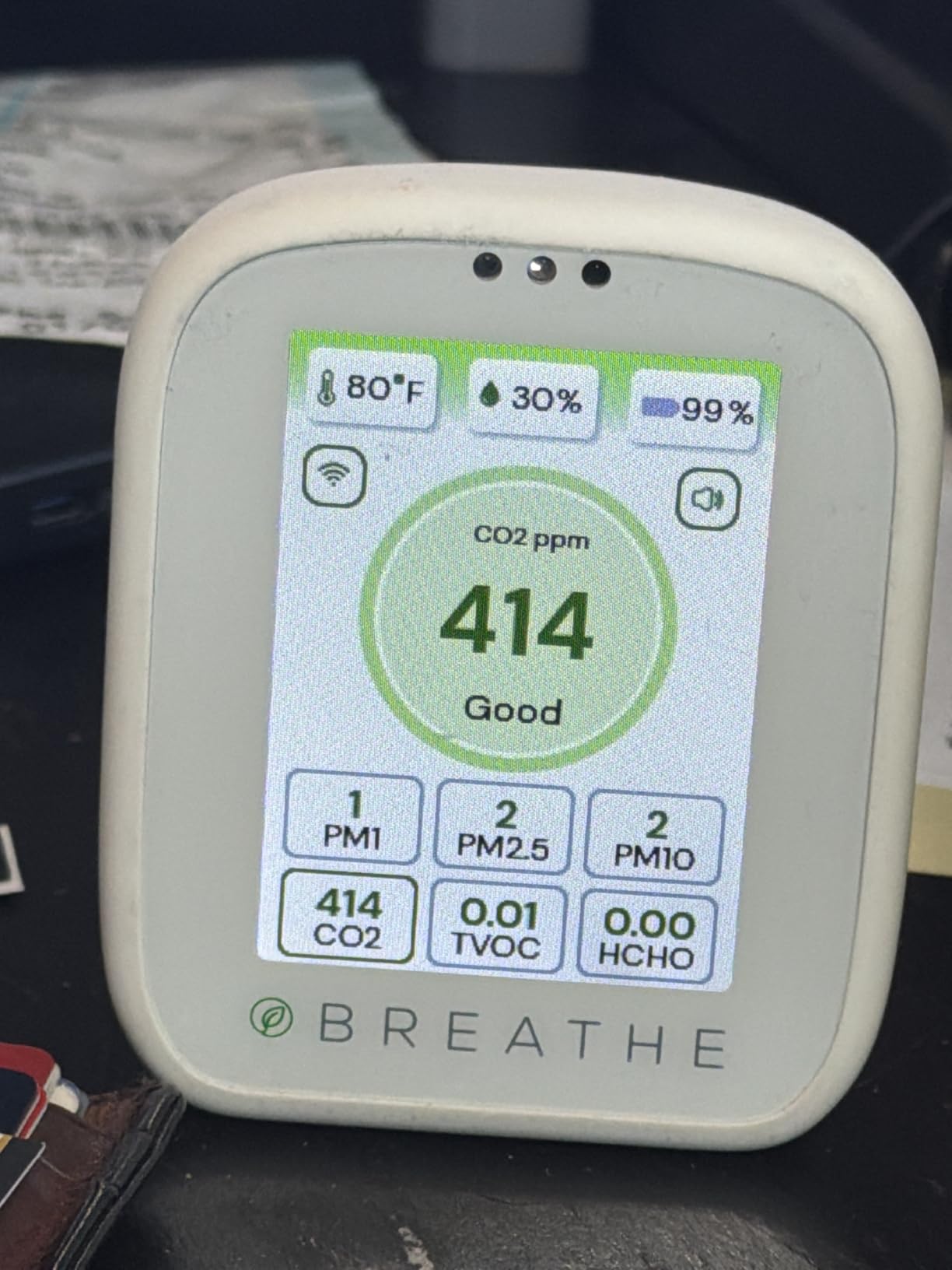
CSV export is the second standout feature. The app stores 90 days of history and lets you download it as a CSV, which is what made it possible for me to plot multi-room correlations in Home Assistant. If you are the kind of user who wants to graph CO2 against bedroom door-open time, this is the monitor that will hand you the data without a fight.
The two real issues are calibration and battery. The auto-baseline calibration (ABC) mode can drift the CO2 reading artificially low indoors if the unit is not exposed to fresh outdoor air regularly. Manual recalibration outdoors is recommended daily for accurate readings. The 6-hour battery is also shorter than most users want for portable use, though USB-C continuous power solves that for stationary installs.
Who the BREATHE Airmonitor Plus Gen 2 is best for
Buy this if you want the widest sensor coverage at a midrange price and you plan to mount it in one spot with USB-C power. Buy this if formaldehyde is on your radar because of new furniture, recent renovation, or a new-build home. Buy this if you want CSV exports for Home Assistant analytics without paying for a commercial-grade instrument.
Who the BREATHE Airmonitor Plus Gen 2 is not for
Skip it if you want a portable battery-powered monitor for whole-home tours; 6 hours is not enough. Skip it if you cannot commit to manual CO2 recalibration outdoors. And skip it if you only need PM2.5 and CO2: the Amazon Smart Air Quality Monitor covers those for less, and the Aranet4 covers CO2 with far better battery life.
How to Choose the Best Air Quality Monitor for Your Smart Home?
Choosing a smart home air quality monitor is less about picking the most expensive unit and more about matching the sensor stack, connectivity, and ecosystem to the way you actually live. Below is the framework I use when readers ask me which one to buy.
Sensor Types Explained: PM2.5, PM10, CO2, VOC, Radon, HCHO
PM2.5 and PM10 are particulate matter measured by a laser particle sensor; PM2.5 is the fraction that reaches deep into your lungs and is what the EPA tracks for wildfire smoke. CO2 is best measured with an NDIR sensor; cheaper metal-oxide substitutes drift badly over time. VOC (volatile organic compounds) covers cleaning products, cooking off-gassing, and new furniture; a TVOC index is fine for trend monitoring but it is not the same as measuring specific chemicals. Radon requires a dedicated electrochemical or alpha-spectrometry cell, which is why it shows up on only the Airthings units. Formaldehyde (HCHO) needs its own electrochemical sensor, and is the rarest of the bunch at consumer prices.
For most households, PM2.5 and CO2 cover 80 percent of the everyday triggers (cooking, cleaning, occupancy, ventilation). Add VOC if you have a new home or refinished floors. Add radon if you live in a basement or in a region with known radon geology. Add formaldehyde if you have new cabinets, flooring, or pressed-wood furniture.
Smart Home Ecosystem Compatibility
Ecosystem compatibility is where most monitors succeed or fail for smart home buyers. Apple HomeKit remains the hardest ecosystem to crack: only a handful of monitors expose native HomeKit support, and most HomeKit users end up running Home Assistant as a bridge. Alexa is the easiest, which is why the Amazon Smart Air Quality Monitor is so cheap for what it does. Google Home support is improving as Matter rolls out. Matter over Thread or Wi-Fi is becoming the cross-platform standard, and any new monitor bought in 2026 should be evaluated for Matter compatibility before anything else. Home Assistant is the most flexible ecosystem: it can ingest Bluetooth, MQTT, REST, and Matter devices, which is why monitors like the BREATHE Airmonitor Plus and the MONIGEAR MN-WVOC fit naturally into a Home Assistant rig.
Connectivity: Wi-Fi vs Bluetooth vs Zigbee vs Thread/Matter
Wi-Fi monitors connect directly to your router and need no hub. They are the easiest to set up, but they pull power and they depend on your network’s reliability. Bluetooth-only monitors (Aranet4, Wave Plus without Hub, Corentium Home 2) save power and cost less, but they require you to be in range or to add a hub. Zigbee air quality monitors are rare in the consumer space. Thread-over-Matter is the new default: low power like Bluetooth, IP-native like Wi-Fi, and cross-platform by design. If you are starting fresh in 2026, Matter over Thread or Wi-Fi is the right bet for forward compatibility.
Real-World Automation Recipes
The real value of a smart home air quality monitor is what it triggers. Here are the four recipes I run daily. Trigger the bedroom air purifier when PM2.5 crosses 35 ug/m3 (Amazon Smart Air Quality Monitor or BREATHE Airmonitor Plus, into Alexa Routines or Home Assistant). Trigger the bathroom exhaust fan when humidity climbs above 65 percent. Trigger a window sensor reminder when CO2 sits above 1,000 ppm for more than 30 minutes (Aranet4 or SONOFF AirGuard into Home Assistant). Send a phone push notification when radon trends above 4 pCi/L on a 30-day average (Airthings View Plus or Corentium Home 2 with Hub). None of these recipes are hard to set up, but each one only works if your monitor exposes its data to the platform that controls the actuator.
Sensor Placement Best Practices
Where you put a monitor matters as much as which one you buy. Place monitors at breathing height (3-5 feet off the floor for PM2.5 and CO2), away from HVAC supply vents, and at least 12 inches from any wall. Avoid placing them directly above a stove or in direct sunlight; both will give false readings. For radon, the EPA recommends testing the lowest lived-in level of the home, which usually means the basement or ground floor. For multi-room coverage, one monitor per major room is the right rule of thumb; PM2.5 and CO2 vary by room in ways that matter for automations.
Privacy, Cloud Lock-In, and Local API Access
If you care about privacy, look for monitors with local API access (the MONIGEAR MN-WVOC and the BREATHE Airmonitor Plus both export JSON over your local network), open-source firmware options, or at least CSV export. Avoid monitors that store every reading behind a vendor cloud with no export path. For tech-savvy users, Home Assistant adds an extra layer of local control on top of cloud-dependent devices.
Calibration, Sensor Drift, and Replaceable Sensors
Consumer air quality sensors drift over time. NDIR CO2 sensors are the most stable; laser PM sensors drift more; VOC sensors drift the most. Some monitors, like the BREATHE Airmonitor Plus, include auto-baseline calibration that requires outdoor exposure; others, like the SONOFF AirGuard, do not offer manual calibration at all. Replaceable sensor modules are rare in this price band, which means most monitors become e-waste in 3-5 years. Plan for replacement rather than expecting a decade of service.
Frequently Asked Questions
Which is the best air quality monitor for home?
The best air quality monitor for home depends on your smart home ecosystem and which pollutants you care about. For most households the Aranet4 Home is the easiest recommendation because of its accurate NDIR CO2 sensor, four-year battery life, and clean Home Assistant integration. If you need PM2.5 and VOC in the same box, the Amazon Smart Air Quality Monitor is the best Alexa-native pick. If you want comprehensive coverage including radon, the Airthings View Plus is the most complete consumer monitor available.
Are air quality monitors worth buying?
Yes, especially if you live in a new-build home, a wildfire-prone region, a basement apartment, or you work from home. Indoor air is typically 2-5x more polluted than outdoor air, and the right monitor lets you trigger an air purifier or HVAC fan the moment PM2.5, CO2, or VOCs cross thresholds. The cheapest reliable monitor in this roundup (the Amazon Smart Air Quality Monitor) is well below the cost of a single HEPA filter replacement, so the payback in comfort and health is fast.
What is the most accurate air quality tracker?
For PM2.5 the PurpleAir Zen and professional-grade laser counters are the most accurate. For CO2, any NDIR sensor from Aranet, Airthings, SONOFF, or BREATHE will track within 50 ppm of a reference monitor. For radon, the Airthings Corentium Home 2 and View Plus use the same alpha-spectrometry sensor that radon professionals use, and they track within margin of error against charcoal test kits over long-term windows.
Do air quality monitors work with smart home systems?
Most modern air quality monitors integrate with at least one major smart home ecosystem. Alexa is the easiest: the Amazon Smart Air Quality Monitor pairs directly and triggers Routines without a hub. Apple HomeKit has limited native support; HomeKit users typically run Home Assistant as a bridge. Google Home support is improving as Matter rolls out. Home Assistant accepts the widest range of monitors via Bluetooth, MQTT, REST, and Matter integrations.
Which air quality monitor works with Apple HomeKit?
Native HomeKit support is rare for air quality monitors. The most common path for HomeKit users is to add a HomeKit bridge through Home Assistant or to use a Matter-over-Wi-Fi or Matter-over-Thread monitor like the SONOFF AirGuard SAWF-08P, which exposes CO2, temperature, and humidity to Apple Home via Matter. For full PM2.5 and VOC in HomeKit, the workaround is to run Home Assistant and forward the readings as virtual HomeKit sensors.
Do air quality monitors detect mold?
Not directly. No consumer air quality monitor detects mold spores. What they can detect is the humidity and VOC conditions that allow mold to grow: relative humidity above 60 percent for extended periods, or sudden VOC spikes that correlate with musty odors. The Amazon Smart Air Quality Monitor and the BREATHE Airmonitor Plus are the best in this roundup for mold-risk monitoring because they combine humidity and VOC readings.
Can an air quality monitor turn on my air purifier automatically?
Yes, but only if the monitor and the purifier can talk to the same smart home platform. The Amazon Smart Air Quality Monitor triggers any Alexa-compatible air purifier through Alexa Routines without a hub. The SONOFF AirGuard SAWF-08P and the BREATHE Airmonitor Plus feed data into Home Assistant, which can then trigger any smart plug or smart purifier. The Aranet4 and Airthings units can drive automations through Home Assistant with some configuration, but they cannot trigger native Alexa or HomeKit routines on their own.
What is the difference between PM2.5 and PM10?
PM2.5 and PM10 are sizes of particulate matter measured in microns. PM10 covers particles 10 microns and smaller (dust, pollen, mold spores). PM2.5 covers particles 2.5 microns and smaller (smoke, combustion byproducts, fine dust). PM2.5 is the more dangerous fraction because it reaches deep into the lungs and bloodstream. For wildfire smoke and combustion safety, PM2.5 is the number that matters; for allergy and pollen monitoring, PM10 is also useful.
Final Verdict: Choosing the Best Air Quality Monitor for Your Smart Home
If you want the single best air quality monitor for smart homes and you do not want to think too hard about it, start with the Amazon Smart Air Quality Monitor for Alexa households, the Aranet4 Home for Home Assistant power users, or the Airthings View Plus if radon is on your radar. That trio covers the most common smart home configurations in 2026 and each one is the right tool for the job it was designed to do.
For readers running Home Assistant at scale, the SONOFF AirGuard SAWF-08P is the cleanest Matter-CO2 path, and the BREATHE Airmonitor Plus Gen 2 is the right pick when you want CSV exports and formaldehyde in the same device. AV and IT integrators should look at the MONIGEAR MN-WVOC for its protocol support.
Whichever monitor you pick, the real win is the automation. A best air quality monitor for smart homes is only worth the price when it triggers your purifier at 35 ug/m3 PM2.5, fires your HRV when CO2 crosses 1,000 ppm, or sends you a phone alert the first time radon trends above 4 pCi/L. Pick the sensor stack that matches your home, plug it into the ecosystem you already use, and let the data do the work. Your lungs will thank you.