
If you want one set of tire chains for your SUV this winter, the SCC 0232805 Auto-Trac Light Truck/SUV is the pick. It is the only chain here that carries both a Class S clearance rating and a self-tightening ratchet, and it has the largest body of owner feedback of any set we looked at. That combination matters more on an SUV than on a sedan, because you are wrapping more rubber and driving more mass.
Most people searching for the best tire chains for SUVs are not looking for a toy. They are driving a mountain pass, a county road that never got plowed, or a commute that turns into an unplowed street by the third storm of the season. They need something that bites, something that stays on, and something that will not freeze their hands off while you fit it in the dark.
We spent weeks comparing 12 chain and cable sets, reading the owner reviews, and working through the sizing charts so you do not have to. The short version: the best tire chains for SUVs are not always the heaviest steel. Clearance, self-tightening hardware, and honest sizing information separate a chain that works from one that ends up in the garage.
We also broke down how these compare to our picks for the best snow chains for trucks if you tow or run a body-on-frame SUV, since the sizing logic there is different. And if your winter prep list is still forming, our cordless tire inflator picks are a good complement, since cold pressure is the other half of winter grip.
Top 3 Best Tire Chains for SUVs (October 2026)
SCC 0232805 Auto-Trac
- Self-tightening ratchets
- Diamond pattern cross chain
- Class S clearance
- Set of 2

SCC SZ143 Super Z6 Cable
- Low-profile cable design
- Built-in rubber tightener
- No vehicle movement needed
- Set of 2

AUVEBY HKN-120 Auto Fixing
- 1-minute auto-fixing buckle
- Manganese steel alloy
- Gloves and storage box included
- Set of 2
All 12 Tire Chains for SUVs at a Glance
The table below is the fastest way to narrow the field. Every entry is a set of two chains sized for SUV and light-truck fitments, and every one carries a stated speed limit you should respect.
| Product | Specifications | Action |
|---|---|---|
| SCC 0232805 Auto-Trac Light Truck/SUV |
|
Check Latest Price |
| SCC SZ143 Super Z6 Cable |
|
Check Latest Price |
| AUVEBY HKN-120 Auto Fixing |
|
Check Latest Price |
 Artizles HKN150 Auto Tightening Artizles HKN150 Auto Tightening |
|
Check Latest Price |
 AUVEBY HYR-S Heavy Duty AUVEBY HYR-S Heavy Duty |
|
Check Latest Price |
 KYX Alloy Steel Set of 6 KYX Alloy Steel Set of 6 |
|
Check Latest Price |
 SCITOO QG2228CAM SCITOO QG2228CAM |
|
Check Latest Price |
 Coco Bird 4WD-90 Coco Bird 4WD-90 |
|
Check Latest Price |
 Artizles ALN160 Artizles ALN160 |
|
Check Latest Price |
 HAPPYMATE HKN130 HAPPYMATE HKN130 |
|
Check Latest Price |
 DC Cargo Mall Cable X-Small DC Cargo Mall Cable X-Small |
|
Check Latest Price |
 DEDC KS1619 DEDC KS1619 |
|
Check Latest Price |
1. SCC 0232805 Auto-Trac Light Truck/SUV – The Self-Tightening Standard
- Self-tightening ratchets center the chain with no separate tensioners
- Class S clearance covers light-truck and SUV fitments
- Diamond cross chain gives a smoother quieter ride than radial links
- Installs in 1-3 minutes per tire once you know the sequence
- Sizing chart lists overlapping tire sizes so fit should be confirmed with the maker
- Ratchet cable and carry case are the weak points and tear easily
- Instructions do not say which colored cable end goes to the rear on driver vs passenger side
This is the chain we keep coming back to because it solves the two problems SUV owners actually hit: clearance and retensioning. The ratchets on each end pull the chain tighter and center it as you drive, so you are not stopping every quarter mile to check. Once the sequence clicks in your hands, owners report 1-3 minutes per tire.
The diamond cross-chain pattern is the quieter of the two link layouts, which matters on a long highway stretch where a square-link pattern drums against the tread. The chain is alloy steel, and the whole set weighs 15.6 pounds, so it is a real pack-in-the-cargo-area item rather than something you sling in a door pocket.
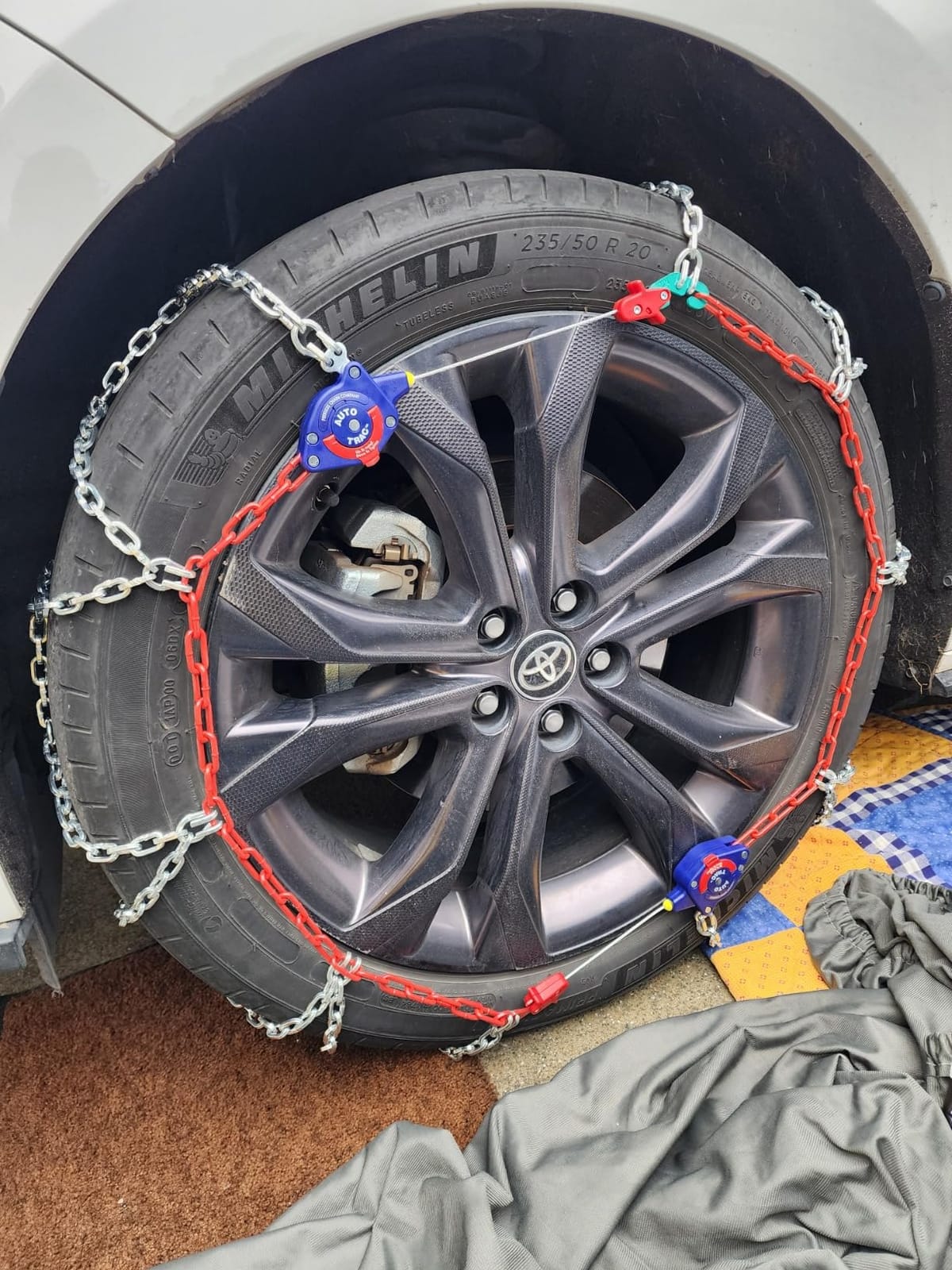
The honest weakness is fitment data. The published size chart lists overlapping tire ranges, and several buyers report the chain running slightly short until they confirmed the exact size with the manufacturer. A chain that is too small is not a mild inconvenience, it breaks, and a chain that is too large can throw off. Confirm your tire size before a storm week, not during one.
Two smaller issues come up repeatedly. The ratchet cable and the zippered carry case are the first things to fail, so treat the case as disposable and expect to replace the cable eventually. The instructions also leave out which colored cable end routes to the rear on the driver side versus the passenger side, which is exactly the kind of detail that costs you ten minutes the first time.
Fresh chains can also arrive knotted together in the box, so pull them out and lay them flat in the trunk as soon as they arrive, not on the morning of the storm.
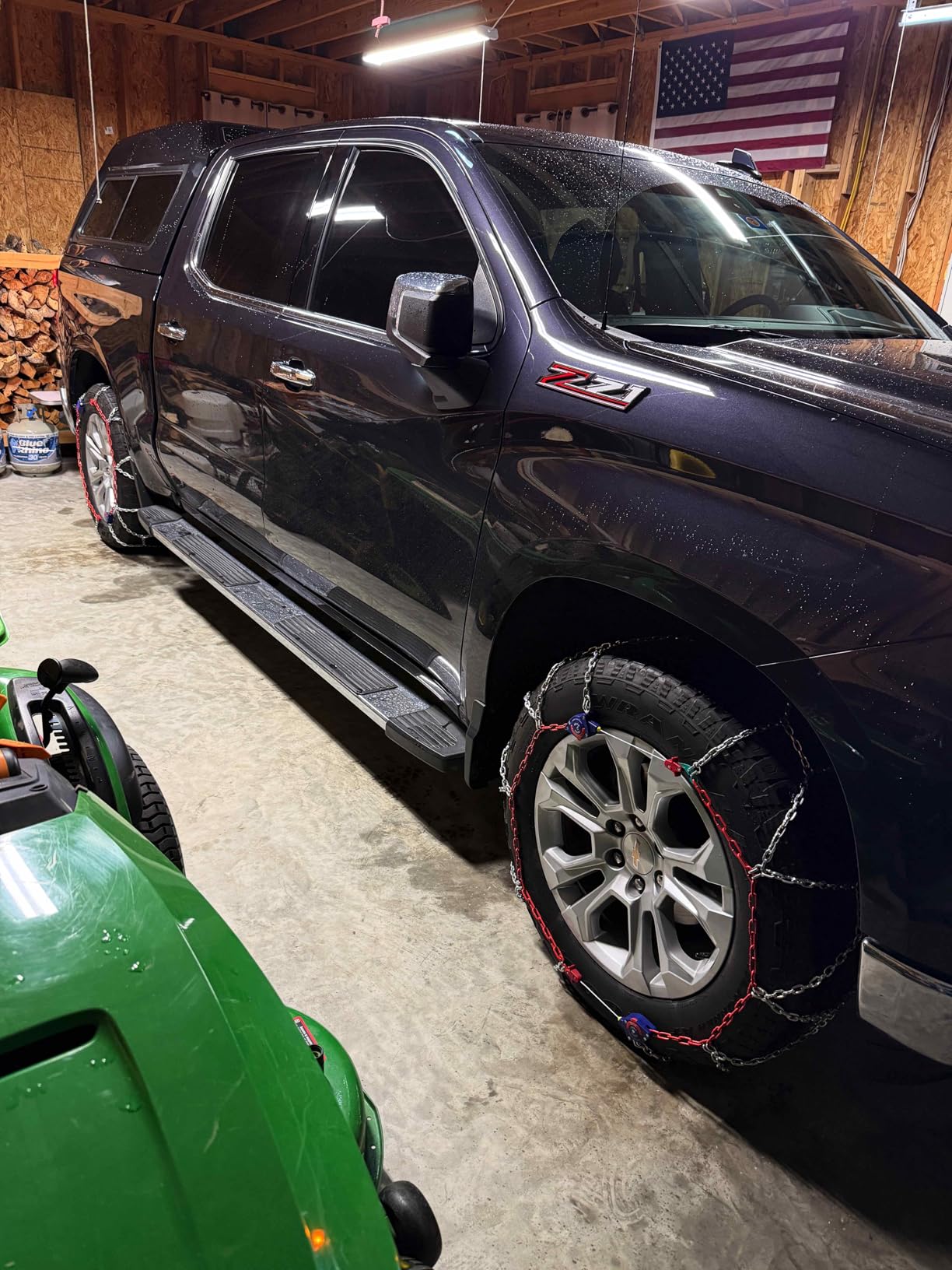
Best fit for a daily-driver SUV with normal clearance
If you drive a mainstream crossover or a mid-size SUV on factory suspension, with tire widths in the light-truck range this chain covers, this is the set to buy. The self-tightening behavior removes the single most common failure of cheap chains, which is loosening on a hill and needing a re-tighten.
It is also the right call if you want a chain that still feels civil at 30 mph, which is the rated limit and the realistic one. Nobody should be driving a chain-equipped SUV at highway speed, but when you do have to move at pace, a self-centering chain is calmer than a slack one.
Not the right fit if clearance is tight or you carry one set only
Skip it if your SUV is lowered or sits on short-travel factory suspension with a small gap between the tire and the fender liner. Alloy link chains need more room than a cable, and the listing does not tell you how much. If you are not sure, the cable option below is the safer bet.
Also consider whether you need two sets rather than one. One pair goes on the rear axle. Two pairs cover all four wheels when a chain restriction sign demands it, and most drivers discover this at the worst possible time if they only bought one.
2. SCC SZ143 Super Z6 Cable – Best for Tight Wheel Wells
SCC SZ143 Super Z6 Cable Tire Chain for Passenger Cars, Pickups, and SUVs – Set of 2
- Very low profile suits SUVs and crossovers with limited drive-tire clearance
- Lightweight at roughly one pound per set and far easier to store than steel link chains
- Integrated rubber tightener removes the need to stop and re-tighten
- Installs without moving the vehicle on narrow mountain roads
- Cable design gives less bite on packed and deep snow than full steel link chains
- Size must be matched carefully to tire width and the chart overlaps
- Not appropriate for sustained highway or bare-asphalt driving
This is the most-reviewed chain in the group, and the reason is not grip, it is geometry. If your SUV has a modest gap between tire and fender liner, a cable is the only thing that is going to fit, and this one weighs about a pound for the pair. You can carry it in a backpack.
The built-in rubber tightener is the detail owners praise most. Instead of a ratchet or a bungee you have to find and hook, the tensioner is part of the cable run, so there is nothing to adjust after installation and nothing to lose in the snow.
The trade-off is real and it is traction. Cable chains give up bite compared with a full steel link on packed snow and on deep snow, and owners say so directly. On a well-maintained highway at moderate speed in a storm, they are plenty. On a steep unplowed climb, you will feel the difference.
Sizing is the other thing to get right. The chart overlaps across sizes, so match on your actual tire width and confirm with the manufacturer if your size sits near a boundary. A cable that is too small simply will not seat.
One more note: this is not a chain for bare asphalt. Cable wear on a long dry stretch is how cables die, and this warranty runs one year against defects in workmanship and materials.
Best fit for low-clearance SUVs and anyone who hates carrying heavy steel
Choose this if wheel-well clearance is your binding constraint, or if you want a chain you can keep in the cabin permanently without thinking about it. A one-pound pair changes how willing you are to carry chains at all, and carrying them is half of being prepared.
It is also the honest answer for a driver who mostly needs storm insurance rather than deep-snow capability. A cable set handles a snow emergency on a suburban road. It will not be your first choice for a mountain pass in eight inches of fresh snow.
Where the trade-off bites you
Deep snow, unplowed grades, and recovery work are where the cable construction runs out of depth. If your winter includes a mountain pass with a chain requirement, or you tow on snow, this is the wrong tier and you should step up to a link chain.
Watch the speed reality too. A cable on 60 mph of wet highway is both unsafe and destructive to the cable. Chains belong below 30 mph, and this one is a storm kit rather than a touring chain.
3. AUVEBY HKN-120 Auto Fixing – Fastest Install in the Group
- Auto-tightening cable locks in place after driving forward so nothing needs re-adjusting later
- Full set fits in under five minutes with two people working one tire each
- Reported to bite hard ice and frozen sleet that plastic strap chains cannot handle
- Gloves
- replacement buckles and a storage box are all in the kit
- Light-duty gauge with several owners limiting use to emergency or short trips
- Removal is awkward and a loosened section can wrap the axle if not unclipped fully
- Written instructions are unclear on bringing the chain over the tire
The design idea here is the click-and-go auto-fixing device, which replaces the rubber tightener found on cable chains. You drape the chain, roll forward a short distance, and the cam pulls itself tight. There is no second pass around the tire to find a hook.
Owners report that a full set goes on in under five minutes with two people, and the rating sits at 4.5 with only 6 percent one-star, one of the cleanest distributions in this group. The grip on hard ice is the other reason people keep it, with accounts of chains carrying a vehicle down a mountain highway in an ice storm.
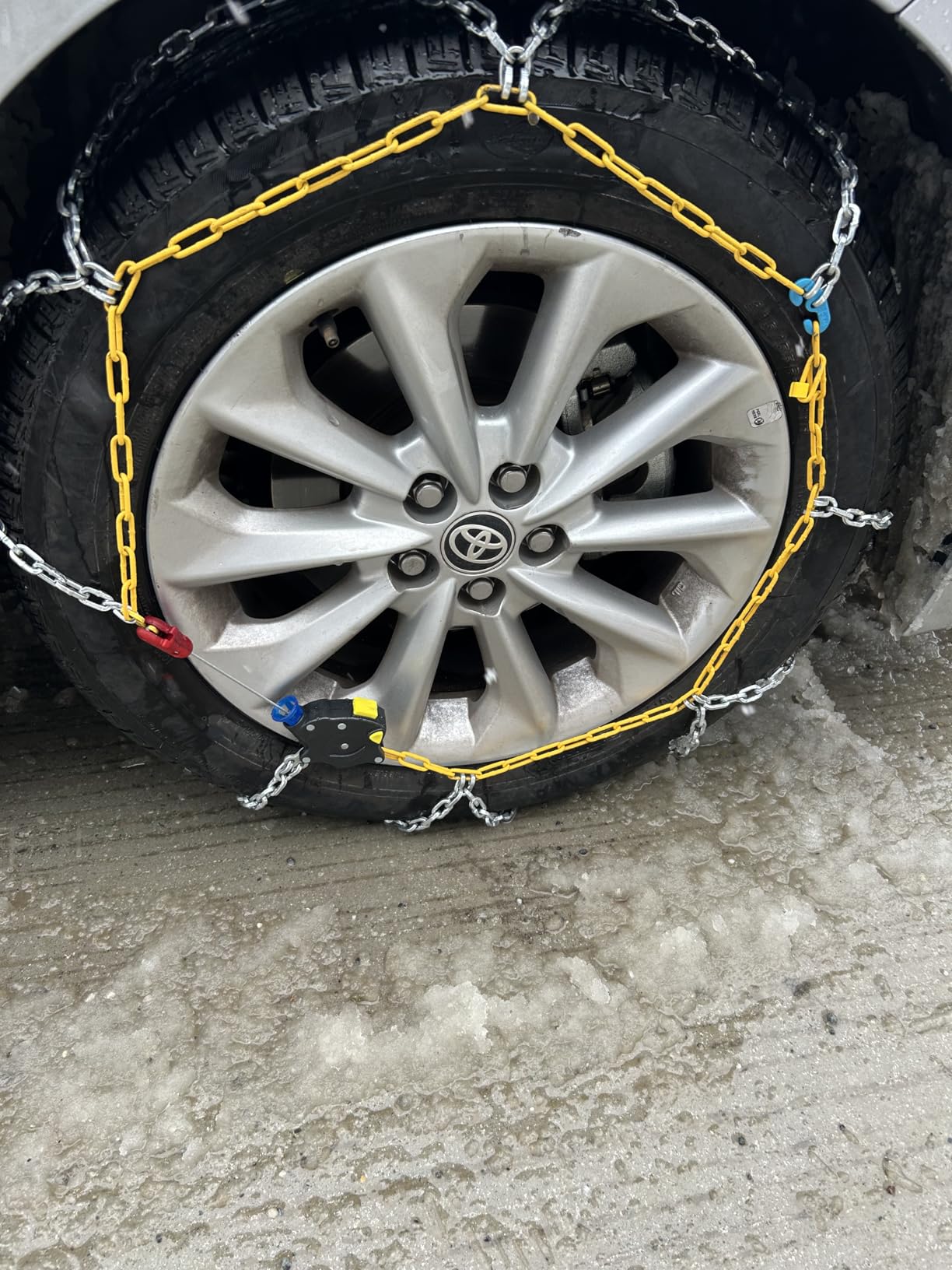
The honest limit is gauge. Multiple owners describe the chain as light-duty and restrict it to emergency or short trips rather than sustained mountain driving, which is a reasonable self-imposed ceiling for this construction.
Removal is the part people complain about. A loosened section that is not unclipped fully can wrap around the axle and the brake line, so take the process slowly. The written instructions are also weak on the step of bringing the chain over the tire, and owners say the color-coded video is far more useful than the manual.
Sizing runs from 225/70R15 to 265/35R19, which covers most crossover and mid-size SUV fitments. Check clearance carefully if your vehicle is lowered or on large wheels, since the fitment list is a tire-size list rather than a clearance promise.
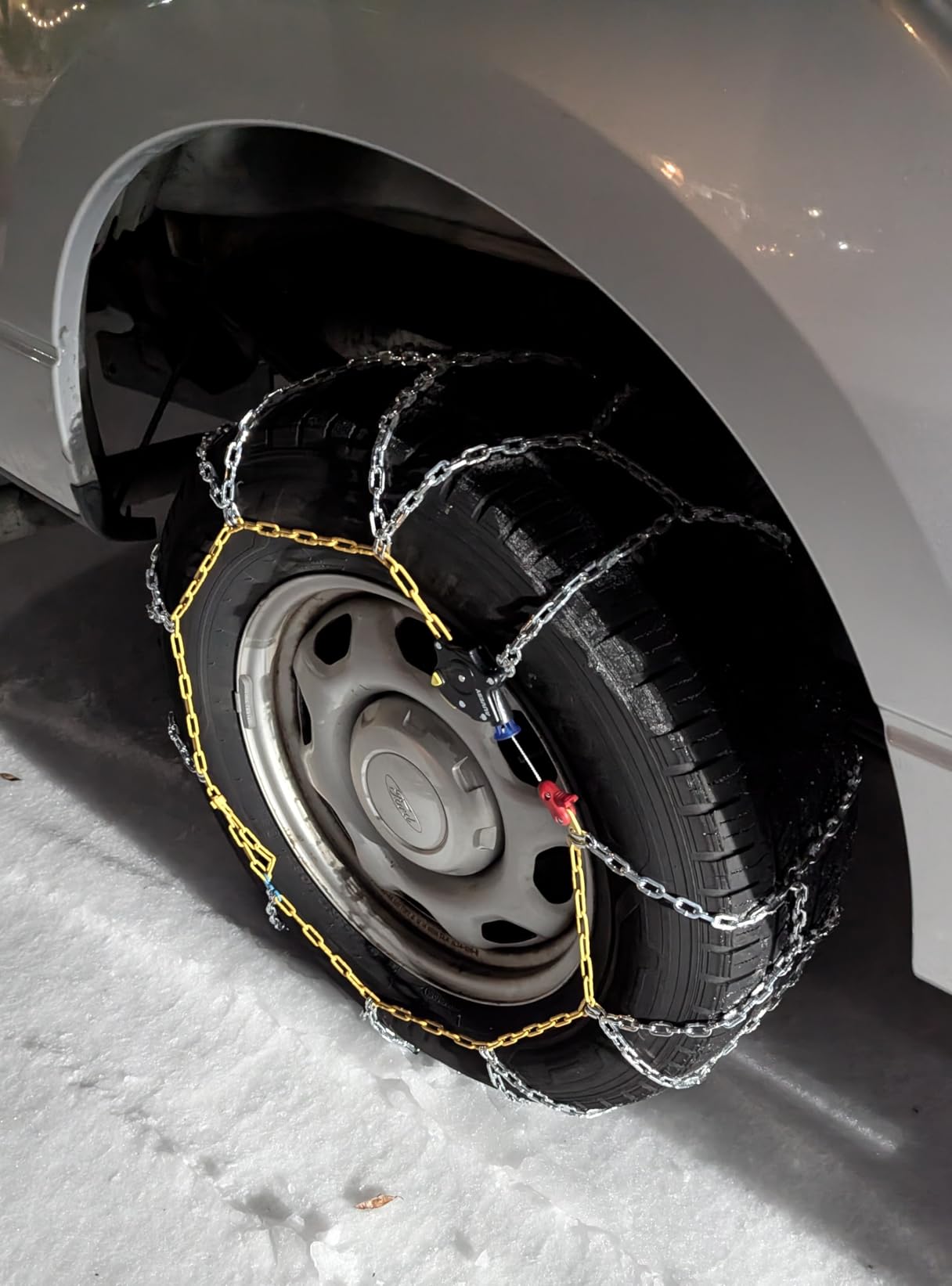
Best fit when install speed matters more than long-term abuse
Pick this if the worst case is a storm on your commute, or if you genuinely cannot get a second person to help. The auto-fixing buckle removes the two-person fit that is the most common complaint in owner reviews across this whole category.
The included kit is unusually complete for this tier: a pair of work gloves, replacement buckles, a user guide, and a storage box. Gloves matter more than they sound when you are fitting metal at seven degrees.
Where it falls short
If you plan to run these on a mountain route repeatedly, or on a truck that pushes snow, the light gauge is the limiter. Step up to the heavy-duty variant later in this list if your use case is sustained work rather than emergency response.
And respect the warranty terms. Coverage is void above 50 km/h, which is 31 mph, and the manufacturer does not cover use on non-icy roads. That is a reasonable boundary for a chain and worth knowing before you decide the limit is negotiable.
4. Artizles HKN150 Auto Tightening – Wide Size Coverage for Big Wheels
Auto Tightening Snow Chains Tire Chains For Cars Suv Pickup Trucks – Auto Tightening 1 Min Quick Fit AND Easy Installation, Reusable Universal Emergency Traction Snow Chains – Set of 2(HKN150)
- Auto-tightening mechanism centers and tensions without stopping to adjust
- Wide size coverage including truck and SUV fitments up to 22 inch wheels
- Owners report holding up under snow-plow use on trucks and Wranglers
- Install and removal typically 2-5 minutes once practiced
- Light-duty grade with owners flagging the plastic retractor and light chain gauge
- Can arrive knotted together and one reviewer spent about 45 minutes untangling
- Removal needs the release joint positioned correctly and is sometimes fiddly
The headline here is range. This chain covers 31×10.5-15 through 285/30 R22, which reaches into wheel and tire sizes that most passenger-rated chains stop short of. If you have moved up to larger wheels and are worried about finding anything that fits, this is a short list problem solved.
Owners with trucks and Wranglers report using it under snow-plow work, and installation typically lands at 2-5 minutes once you have practiced. The diamond pattern gives a smoother ride than a straight cross-chain and improves traction on snow, mud, sand, and ice.
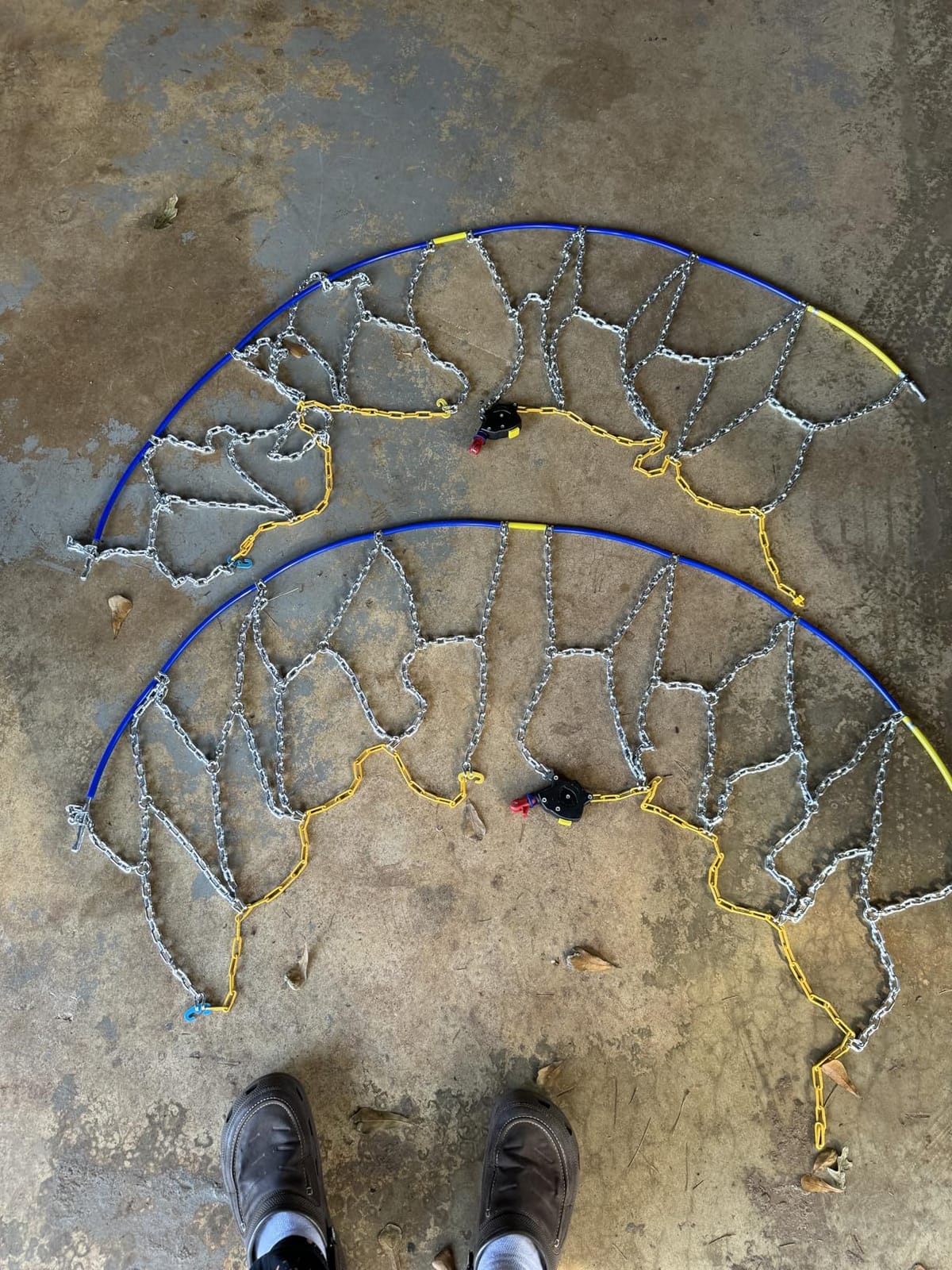
The recurring caveat is again gauge. Several owners flag the plastic retractor mechanism and the light chain as the limiting factor for sustained mountain driving, and it is the same pattern you will see across the auto-tightening category: fast and convenient, not built for a season of abuse.
Packaging is a real annoyance. This one can ship with the two sets knotted together, and one reviewer spent about 45 minutes untangling a pair. That is a solvable problem if you open the box the day it arrives, and a disaster if you open it during a storm.
Removal also has a learning curve. The release joint has to be positioned correctly, and some owners end up lifting the wheel or rolling the vehicle back and forth. On very wide tires the locked joint can be hard to locate, so know where it is before you need it in bad light.
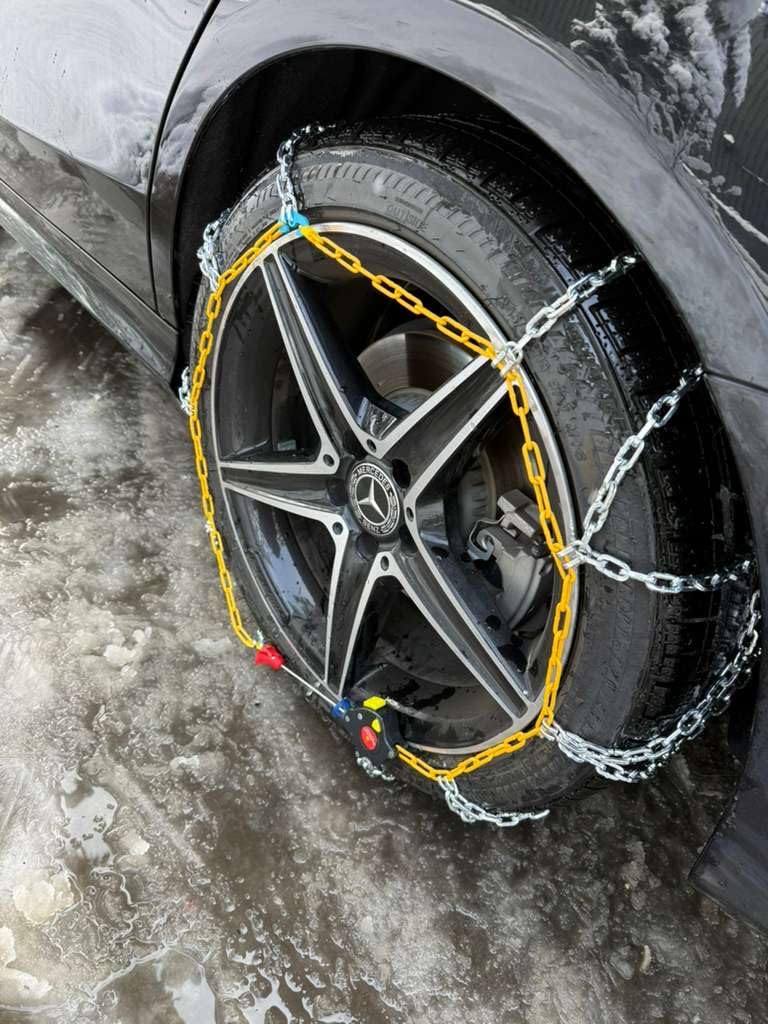
Best fit for larger wheels and modified fitments
This is the one to consider if you are on 20, 21, or 22 inch wheels, or if you have a fitment that smaller chains simply do not cover. The manufacturer states the manganese steel alloy will not damage tires, and the auto-tightening system handles the tensioning for you.
For a truck or Wrangler owner who plows their own driveway in winter, the reported durability under plow use is the reason to look here first.
Where the light gauge bites
For long highway stretches with chains on, or repeated trips through the same mountain pass, the light gauge and the plastic retractor will age faster than a full steel-link chain. Treat this as a strong emergency and moderate-duty chain rather than a permanent winter setup.
Also budget time for the first untangle. Open the box early, lay both chains flat, and confirm the release joint works on a dry driveway before you need it on a road.
5. AUVEBY HYR-S Heavy Duty – Built for Pickups and Off-Road SUVs
- Heaviest chain in the group with 4.5mm diameter and 16mm tall links for truck and off-road SUV tires
- Auto-tightening install with no moving or jacking of the vehicle
- Storage box included and the chains rinse clean for reuse
- Targets tire widths 235 through 275
- Heavier bulk makes these less convenient to carry and store than cable-style chains
- Speed limited to under 50 km/h which is 31 mph
- Limited review volume for this specific variant compared with the cable-chain listings
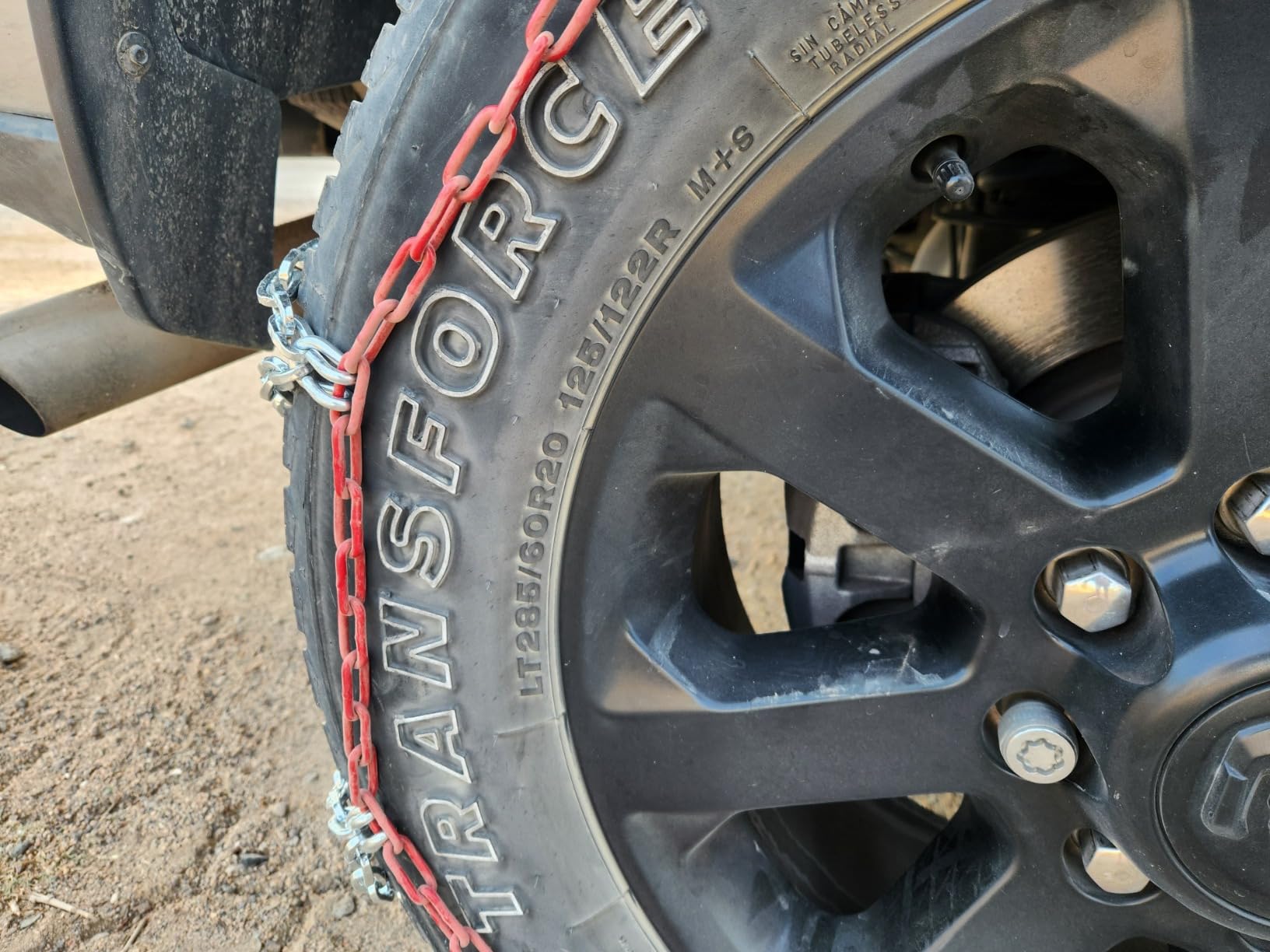
This is the heavy-duty member of the AUVEBY auto-fixing line, and the difference from the HKN-120 is physical: 4.5mm chain diameter and 16mm of tread height. Those numbers are the reason it is aimed at pickups and off-road SUVs rather than crossovers.
It carries a 4.5 average with 74 percent five-star and only 5 percent one-star, which is the strongest rating distribution in the group. Buyers cite build gauge and the auto-fixing buckle as the reasons to choose it over the lighter cable chains when you have bigger tires.
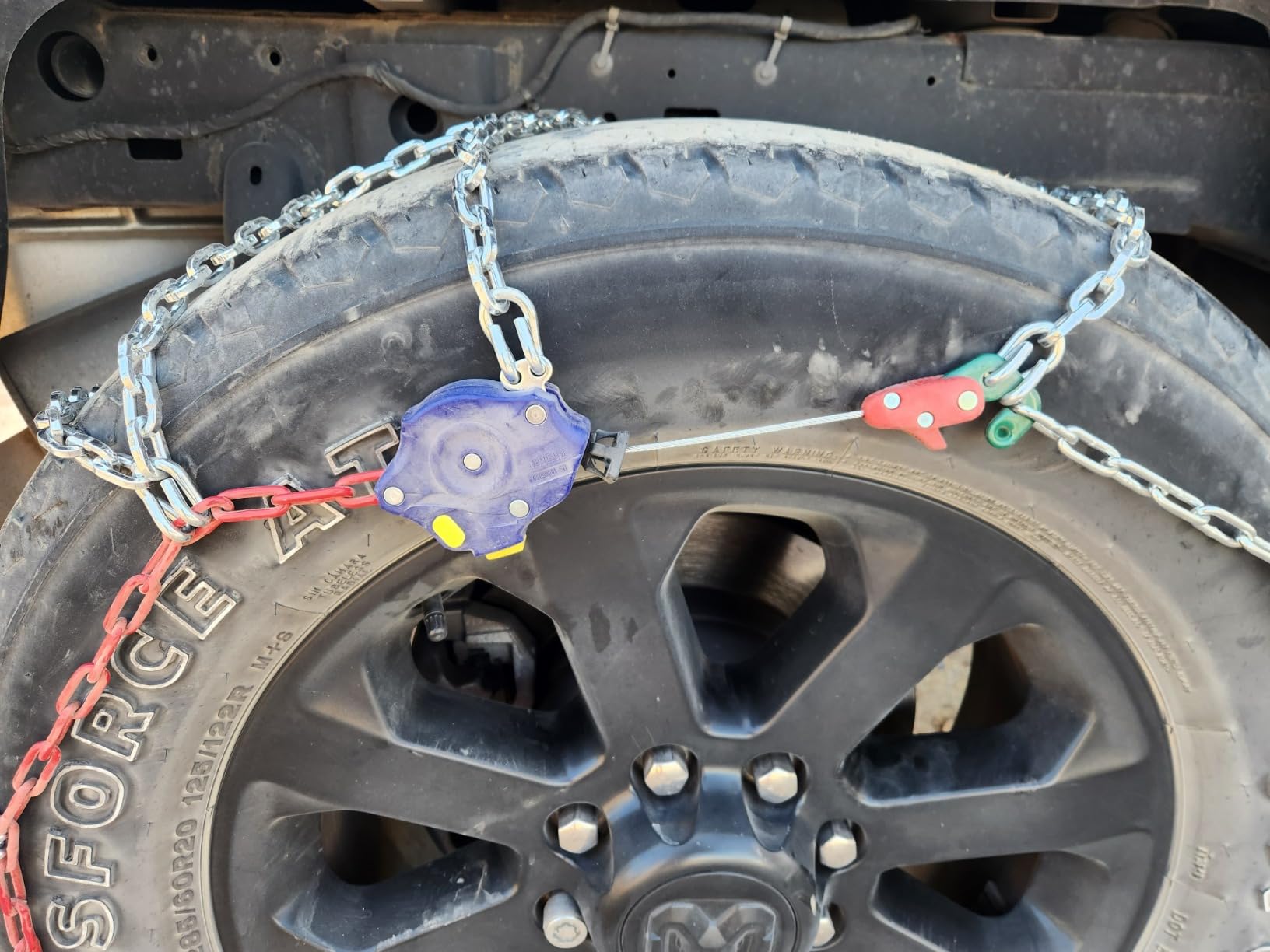
The cost of that durability is weight. At 9.21 kg for the set, this is a substantial object to lift into a bed or a cargo area, and heavier bulk makes it less convenient to keep in the cabin. Plan on a dedicated mounting point rather than a footwell.
Speed is capped at under 50 km/h, which is 31 mph, and the warranty is void above that. Installation is still a 1-minute auto-fixing job with no need to move or jack the vehicle.
Storage is handled well: a storage box is included, and the chains rinse clean and air-dry for reuse, which matters if you plan to keep them through several storms.
Best fit for trucks and off-road builds on 235 to 275 widths
If your SUV is a body-on-frame truck or an off-road build, this is the right amount of steel. A crossover on stock tires does not need 16mm of tread height, and carrying the weight for it is wasted effort.
Choose it when your tire width sits in the 235-275 range and your terrain is genuinely unplowed. The rinse-and-reuse design suits a driver who keeps chains mounted for the whole season rather than pulling them out once a year.
Where it is more than you need
On a lighter crossover with a tight wheel well, this chain may not physically clear the tire, and the weight is pure inconvenience. Check your clearance before buying and do not assume bigger is better.
Review volume is also modest for this specific variant compared with the cable listings, so treat the strong distribution as encouraging rather than conclusive.
6. KYX Alloy Steel Set of 6 – The Only Six-Chain Set Here
- Six chains cover all four tires plus a spare set which is unusual at this tier
- Spiked alloy steel links bite into ice and packed snow
- Adjustable length lets one chain cover a wide range of SUV and truck tire widths
- Storage bag and waterproof floor mat make roadside fitting in the wet practical
- Installation runs about 10 minutes rather than the sub-minute claims of auto-tightening designs
- Universal adjustable sizing means more manual fitting than vehicle-specific chains
Everything else in this list is a set of two. This is a set of six, which means all four tires, a spare pair in the trunk, or a second vehicle covered. For a family with two SUVs that is the shortest path to full coverage, and it is the single most distinctive thing about this product.
The construction is alloy steel with metal spikes on the outer links, and reviewers highlight the bite on ice and packed snow. Adjustable length covers tire widths from 7.28 to 10 inches, so one chain handles a wide range of SUV and truck fitments without a model number lookup.
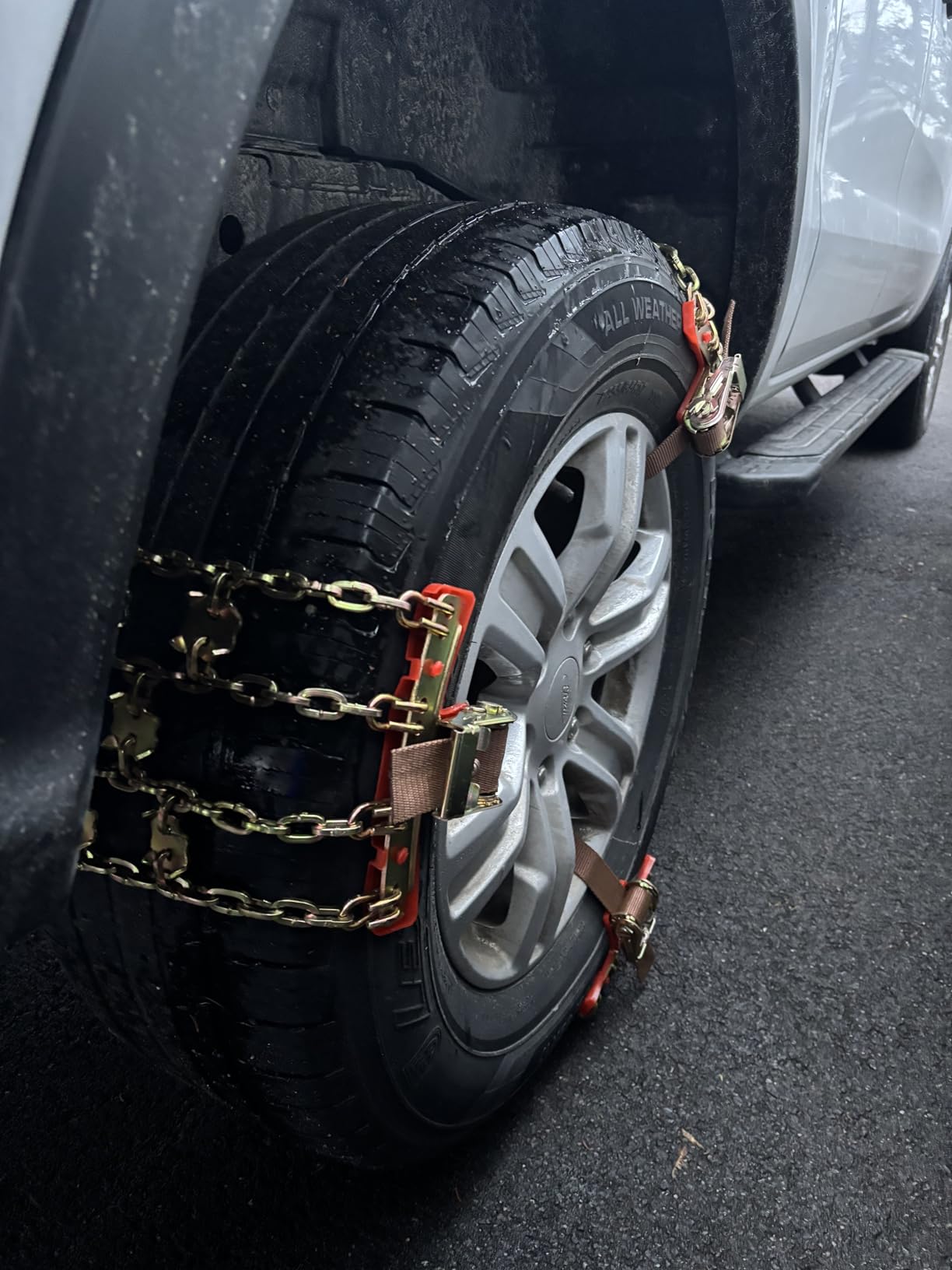
Installation is about 10 minutes with no special tools, and that is the honest trade-off. This is not an auto-tightening design, so you are wrapping, tensioning, and fastening by hand. For a driver who pre-fitted chains on a calm day, ten minutes is fine. For a storm stop on a highway shoulder, it is a long time.
Because it is universal and adjustable rather than vehicle-specific, expect more manual fitting than a chain cut for your exact tire size. That flexibility is also what makes a six-pack practical across two vehicles.
It ranks second in the Industrial and Off-the-Road snow chain category, which tells you where the design intent sits: between a light cable chain and a true heavy truck chain.
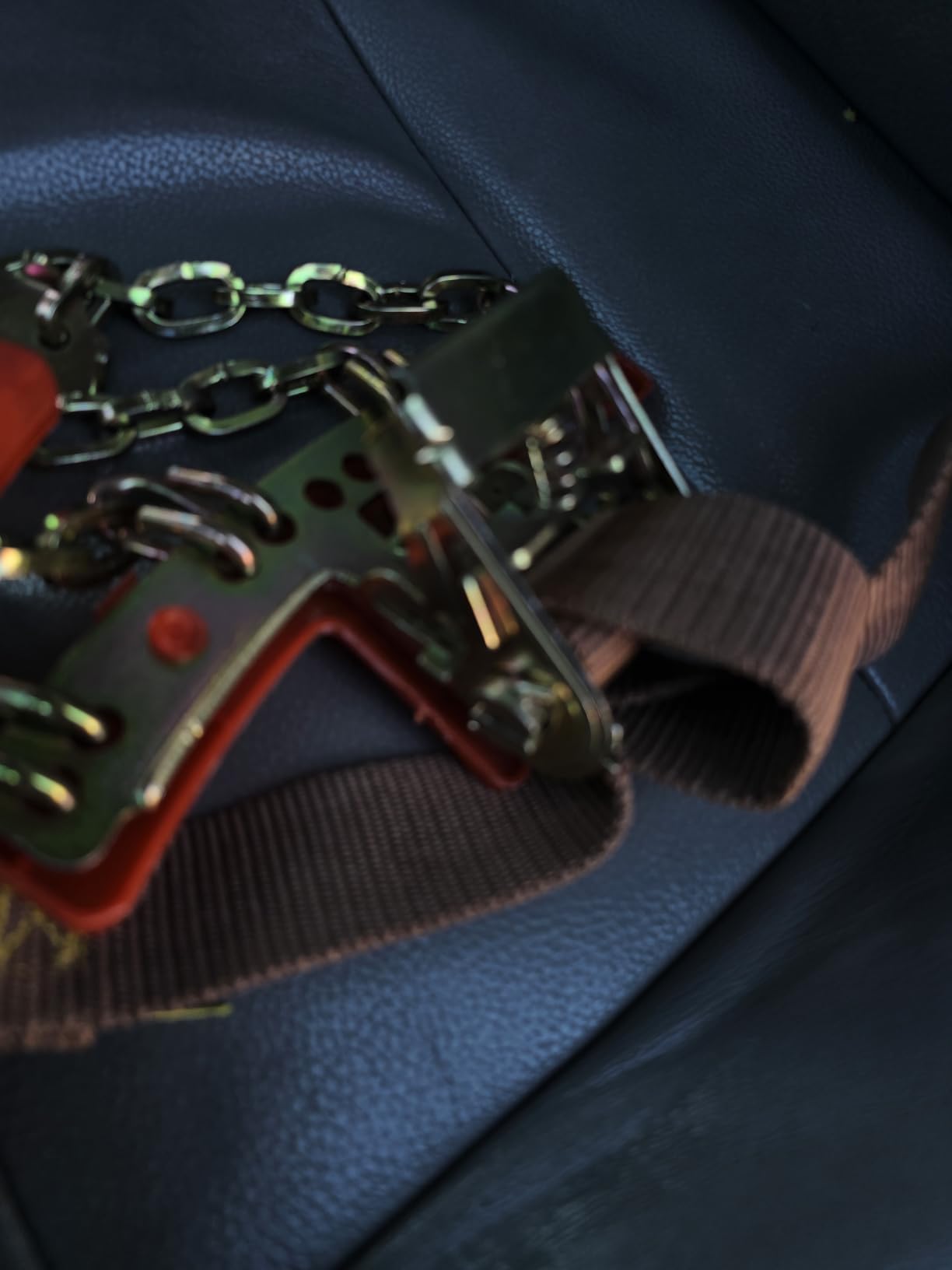
Best fit for households running two vehicles or four driven wheels plus a spare
This is the pick if you need chains on all four tires regularly, which is what a chain restriction sign actually requires. Two sets of two covers one vehicle fully; a set of six covers one vehicle fully and still leaves two in reserve.
It is also a strong answer for a driver who wants to share a single chain between a small crossover and a truck, since the adjustable length spans both width ranges.
Where it is not the right tool
If your winter is short and your roads are plowed within a few hours, ten minutes of hand fitting is time you do not need to spend. The auto-tightening designs earlier in this list exist precisely to remove that step.
Also note this is spike-studded alloy steel rather than a low-profile cable, so check your wheel-well clearance before ordering for a lowered or heavily modified SUV.
7. SCITOO QG2228CAM – Straight Cross-Chain for Recovery Work
SCITOO QG2228CAM Snow Chains for Passenger Car,Pickup,Trucks,SUV – Set of 2
- Straight-across tread pattern resists side slip in deep snow for some owners
- Very wide 225-295mm size band covers most SUV
- pickup and light truck fitments
- Reports of chains holding up while pulling cars and tractors out of ditches
- Self-tensioning cam cams the chain tight after a short roll forward
- Universal size range means many owners must cut chain links with bolt cutters before first use
- Failure to size the chain before a trip is a recurring complaint
- Locking cam quality is uneven across units
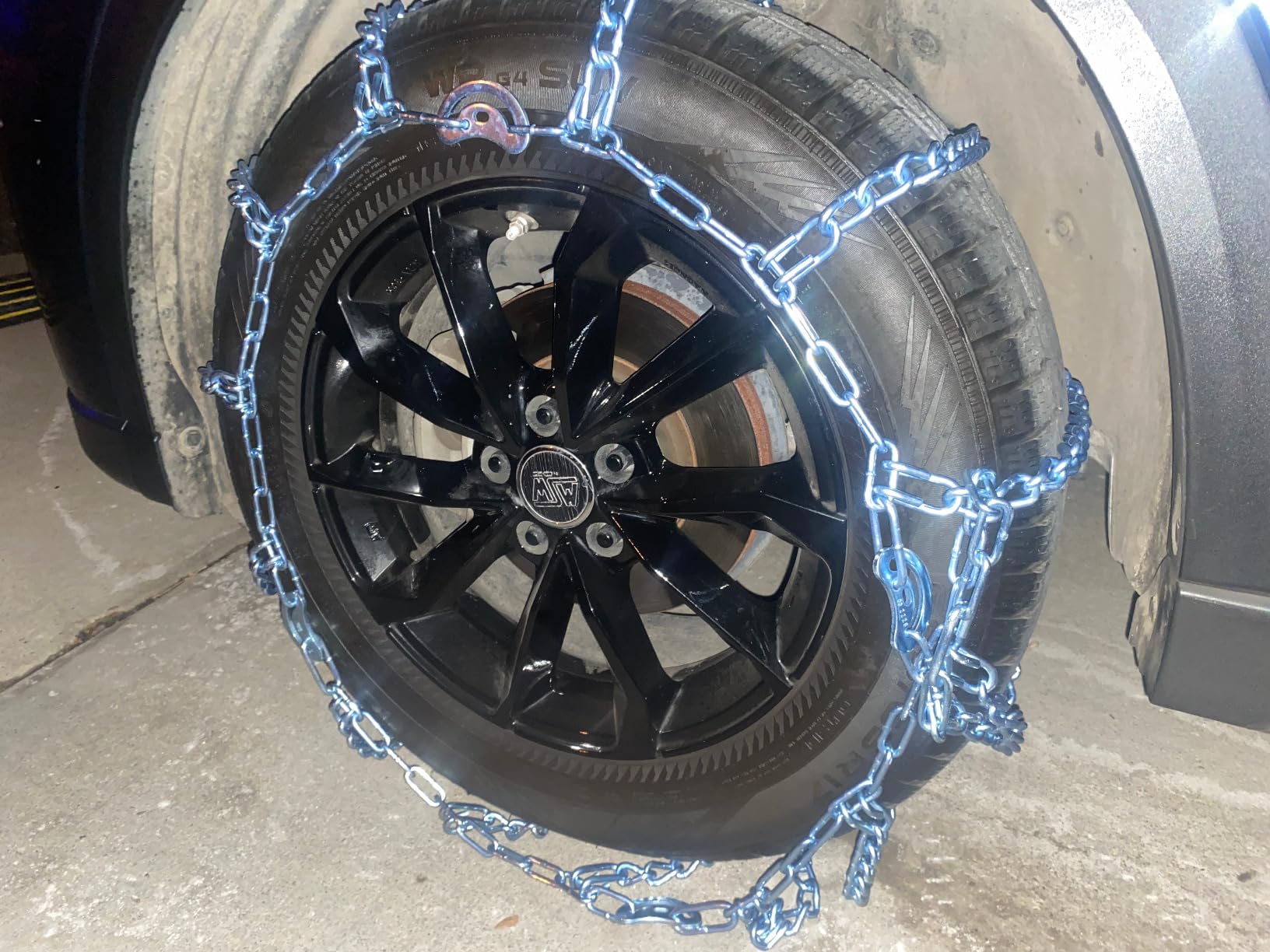
This one comes up in recovery conversations, which is a category of its own. Owners report using these chains to pull cars and tractors out of ditches, and the heat-treated thick alloy manganese steel is the reason that is plausible rather than foolish.
The straight-across tread pattern is worth a note. Some owners prefer it to a diamond pattern specifically because it resists side slip in deep snow, where a diamond cross chain can allow the chain to walk laterally on the tread.
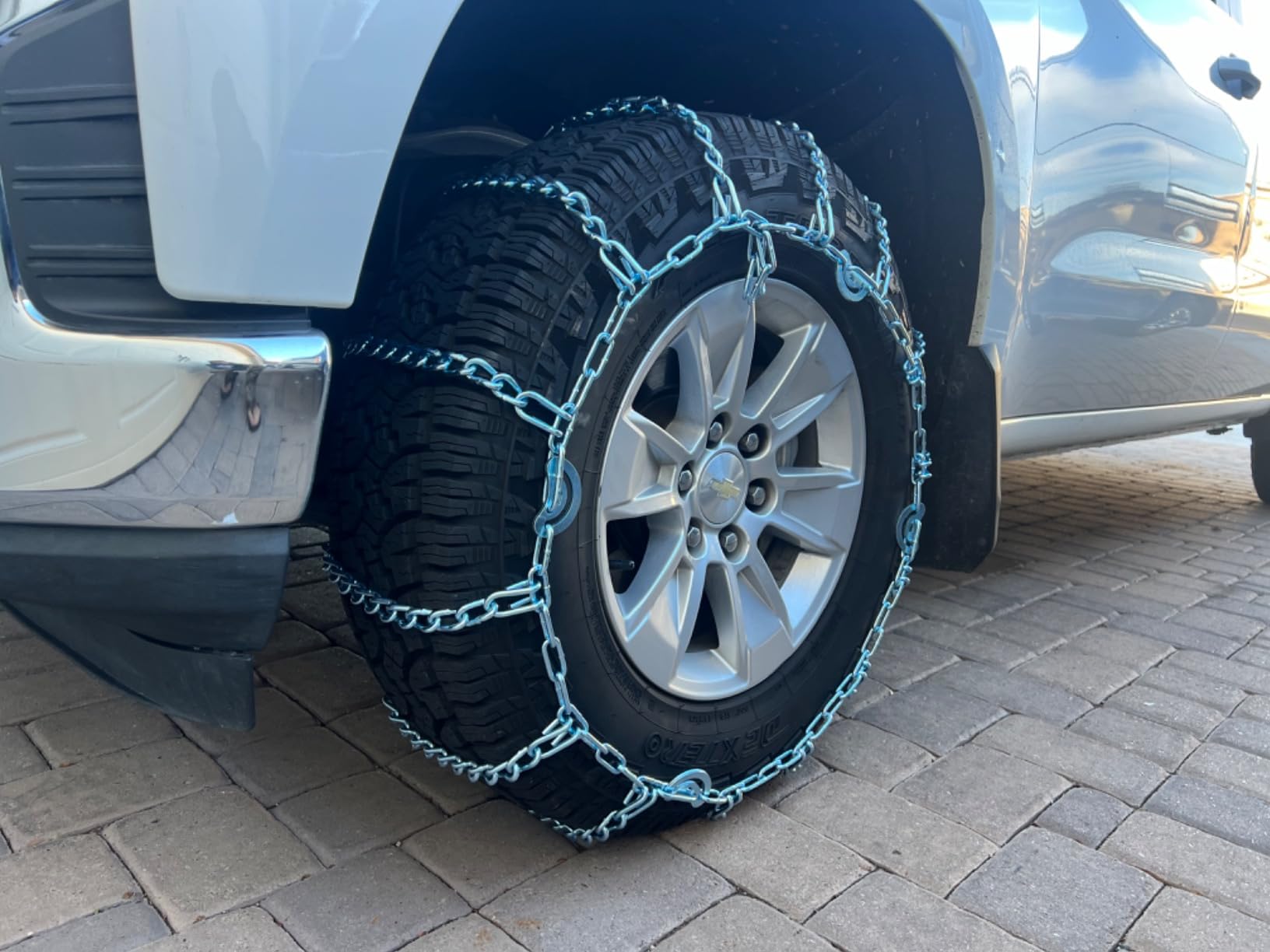
The dominant instruction across reviews is simple: fit and trim the chains before you need them. Because the size range is universal at 225-295mm, many owners find they must cut chain links with bolt cutters to fit their tire before first use. Do that on a workbench, not on a roadside.
Locking cam quality is uneven across units, which is the flaw that shows up when you most need a reliable cam. The cam locks the chain tight after a short roll forward, and the mechanical tensioners assist braking on packed snow and ice.
The speed limit is 40 km/h, which is about 25 mph, and the width band covers 225-295mm tires on 15 to 20 inch wheels.
Best fit for self-recovery and deep-snow side-slip conditions
If you tow, recover vehicles, or work rural roads where a stuck truck is a routine Tuesday, the straight cross-chain pattern and the heat-treated steel justify the setup time. The cam tensioning means you are not hand-tightening in a blizzard.
The 225-295mm band is broad enough to cover most crossover, pickup, and light truck fitments without hunting for a specific model, which saves a step if you own more than one rig.
Where preparation is on you
That realization at the top of a pass is a bad place to discover it, so size and trim the chains on a workbench at home rather than in a turnout with a storm closing in.
8. Coco Bird 4WD-90 – Conventional Heavy-Link Steel
COCO BIRD Snow Chains, Thickened and Wear-Resistant High Carbon Steel Anti Slip Tire Chain for Light Truck, Pickups, and SUVs, Set of 2 (4WD-90)
- Heavy square-link carbon steel with carburizing resists deformation over repeated winter use
- Installs without a jack and users do all four tires in about 15-25 minutes
- Diamond mesh keeps continuous contact which improves braking and stability on steep grades
- Sold in separate sizes so you can run a lighter chain on the front for fender clearance
- Chains can arrive tangled and need to be untangled before fitting
- The red hook chain may need lengthening for the largest tires in the range
- Only a 30-day manufacturer warranty which is the shortest in this group
This is the old-school answer, and it is a good one. Square steel links with high-temperature carburizing for hardness and wear resistance, full-coverage diamond mesh, and a fit without any auto-tightening gimmick to fail. Owners on pickups report good traction in 6-10 inches of snow.
The differentiator is availability in separate smaller sizes. That lets you run a lighter chain on the front tires to preserve fender clearance and a heavier one on the rear, which is exactly the situation a lot of modified SUVs end up in.
Installation is tool-free and needs no jack, and users get all four tires done in roughly 15-25 minutes. For many drivers that is fine, and the durability trade for a cable or auto-tightening chain is worth it.
Two practical issues. Chains can arrive tangled and need untangling before fitting, and the red hook chain may need lengthening for the largest tires in the range. Check both on a dry driveway when the box arrives.
The warranty is 30 days, which is the shortest in this group by a wide margin. Some buyers also found the chains too stiff and difficult to fit, so if you are not confident with a hand-tensioned chain, an auto-tightening design will serve you better.
Best fit for drivers who want maximum link depth and durability
Pick this if deep snow is your normal winter rather than an emergency, and you are willing to spend 20 minutes fitting. Square links bite harder than cables and have no plastic components in the load path to crack in the cold.
It is also the right structure for mixed fitments. Running a lighter chain on the front and a heavier one on the rear is a real technique for SUVs with limited fender clearance, and this is one of the few sets here sold in a way that makes it possible.
Where it is overkill or a nuisance
At 18.9 pounds this is a genuinely heavy object, and the 30-day warranty offers no long-term protection. If your winter is occasional rather than sustained, the lighter options give you more value per stored pound.
It is also a poor match for a tight wheel well, since a full heavy-link chain needs more clearance than a cable or an auto-fixing design.
9. Artizles ALN160 – Widest Size Range of the Group
Auto Tightening Snow Chains for Cars, SUVs & Pickup Trucks – 1-Min Quick-Fit Auto Installation, Reusable Universal Emergency Traction Tire Chains – Set of 2(ALN160)
- Covers the widest tire-size range here up to 315-section tires on 22 inch wheels
- Automatic tensioning removes the need to stop and re-tighten mid-drive
- Knurled links grip the tire without scuffing it
- Lighter than the heavy-link steel options while still covering large fitments
- Sizing must be chosen from a very long tire-size list and the wrong model will not fit
- Light-gauge construction limits long-distance or sustained mountain driving
- Fewer ratings than the comparable listings in this group
This is the large-tire sibling of the Artizles auto-tightening line, and its range is the reason it exists. It covers 265/75 R15 through 315/30 R22, which reaches tire sizes that smaller chains in this list simply cannot address.
The knurled chain design is the detail worth knowing. Rather than a smooth chain that can chafe a sidewall during a long drive, the knurled surface seats a snug fit that buyers say will not damage tires, and it weighs only 4.72 kg for the pair.
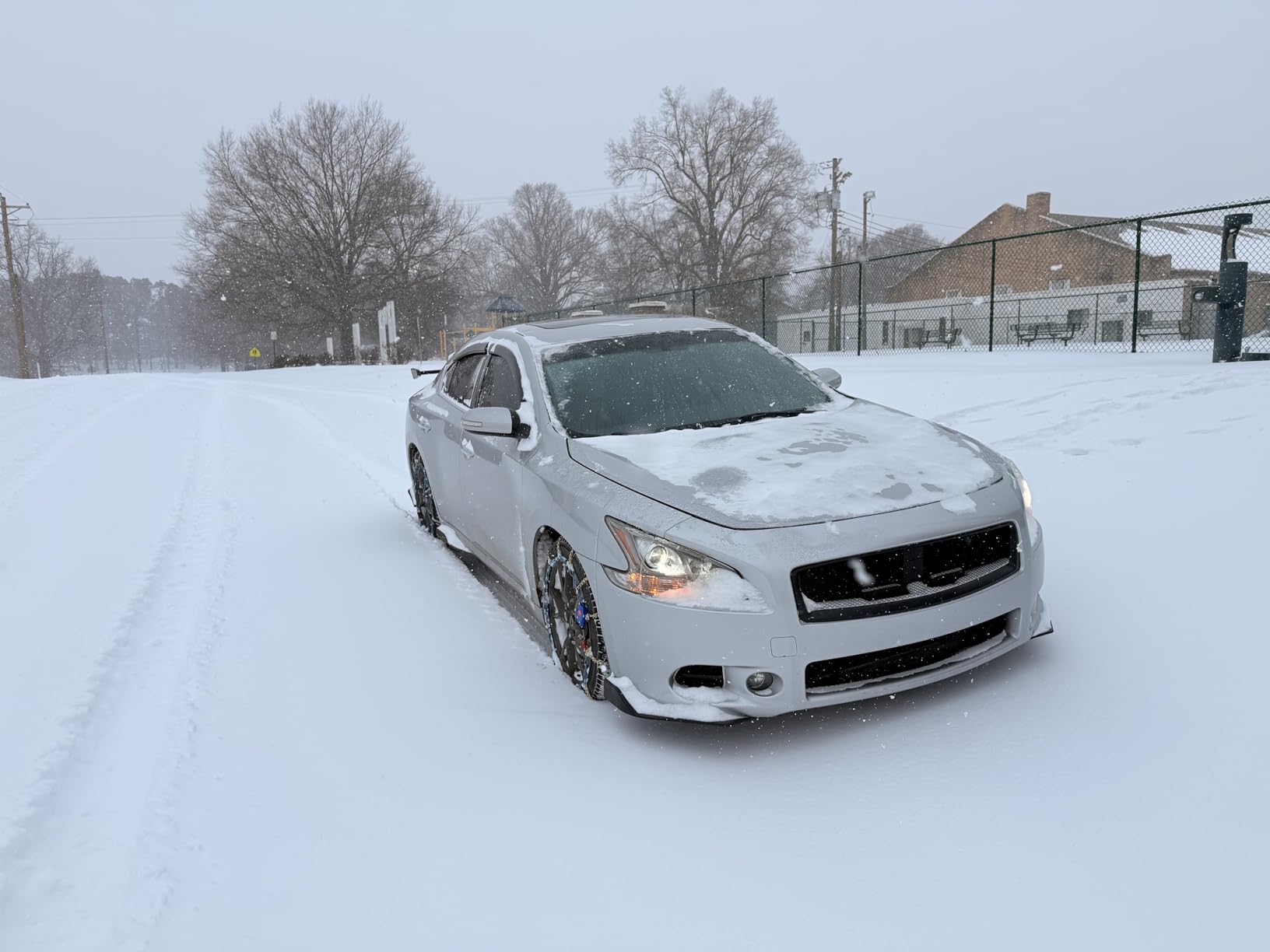
Sizing is the trade. You are choosing a model from a very long tire-size list, and picking the wrong one means it will not fit at all. That is a worse failure mode than a chain that fits loosely, so take five minutes with your tire size in hand.
Light-gauge construction is the other limit, and it is the same recurring theme across the auto-tightening category. Buyers report the quick-fit buckle and the automatic tensioner as the deciding factors, but the gauge caps it for long-distance or sustained mountain driving.
Review volume is the smallest of the Artizles listings here, so weigh the design logic a little more heavily than the rating.
Best fit for oversized tires where other chains stop short
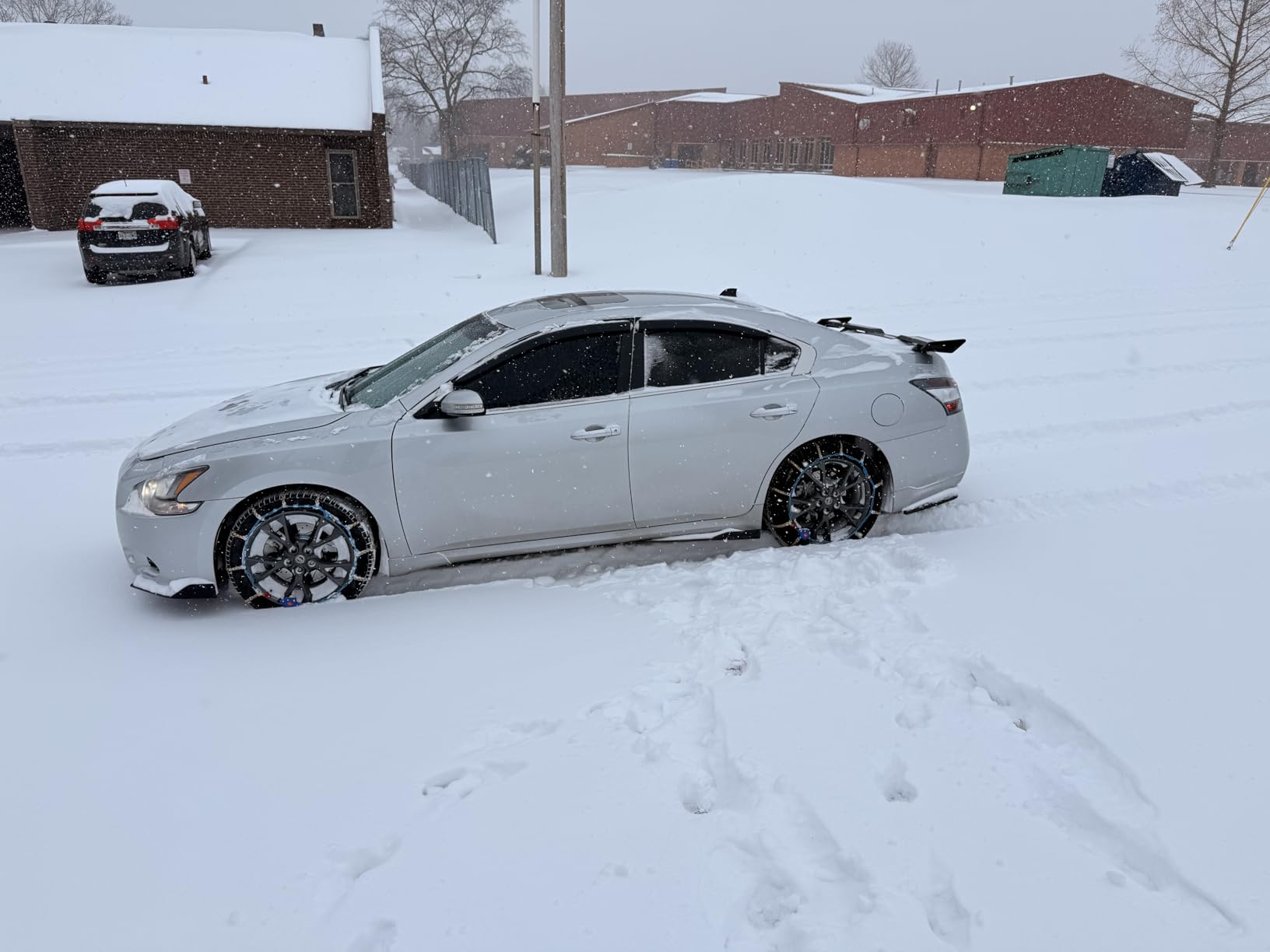
Choose this if you are on 315-section tires or 22 inch wheels, or if your fitment sits near the top of what chains cover at all. The manufacturer states the manganese steel alloy is tested over 1000 km, which is a durability claim worth taking seriously.
The knurled design also makes it a reasonable choice for someone worried about sidewall scuffing on a long chain-required highway run, which is the scenario that actually generates complaints about damaged tires.
Where caution is warranted
A long sizing list plus light gauge plus the smallest review base in the family makes this the pick we would most want to fit and test ourselves before committing to a mountain season.
Do a dry fit on your driveway with the exact tire size confirmed, and confirm the model number with the manufacturer if your size sits near a boundary in the list.
10. Auto-Fixing Snow Chains HKN130 – Fastest Per-Wheel Install
- Fastest reported install in the group at under a minute per wheel after the first chain
- Installable at night on rear wheels without turning the wheel for visibility
- Heat-treated alloy steel holds up for the one to three uses per year most owners need
- Owners report good vibration characteristics and quiet running
- Will not clear small 14 inch tires on compact cars
- Wheel-arch clearance is tight on lowered vehicles
- Some adjustment is needed after driving a short distance
The fastest install we found, at under a minute per wheel after the first chain goes on. The fitting method requires no moving of the vehicle, no jacking, and no tire removal, which is the whole design goal.
Owners like the vibration characteristics and quiet running, which matters if your chain-required route includes a highway segment. The heat-treated alloy steel is specced for the one to three uses per year that most owners actually need, and it carries a one-year warranty.
The fitment constraint is real. This chain starts at 235/75 R15, so it will not clear a small 14 inch tire on a compact car, and it runs up to 245/35 R21. Check your size before assuming coverage.
Clearance is tight on lowered vehicles, and some adjustment is needed after driving a short distance. That is normal for this type of self-tensioning fit, but budget for a re-check rather than assuming it locked itself perfectly.
The recommended maximum speed is 25 mph, which is 40 km/h, and the kit includes a storage box sized for a trunk.
Best fit for rear-wheel fitting at night in a storm
This is the one to consider if you regularly fit chains in the dark, on a rear axle, with a flashlight and gloves. Owners specifically call out that it can be installed on rear wheels without turning the wheel for visibility, which solves a genuinely annoying problem.
It is also a strong fit for a driver who wants a maintained chain rather than a seasonal project, since one to three uses a year is exactly what heat-treated steel in this class is specced for.
Where the speed and clearance limits show up
A 25 mph limit is the most conservative in the group, and that is deliberate. If you need to cover a faster chain-required highway segment, this is not the set, and no chain is the right answer at that speed.
On lowered vehicles, verify clearance in daylight before a storm. A tight fit that works in a store parking lot can stop working with two inches of snow packed in the wheel arch.
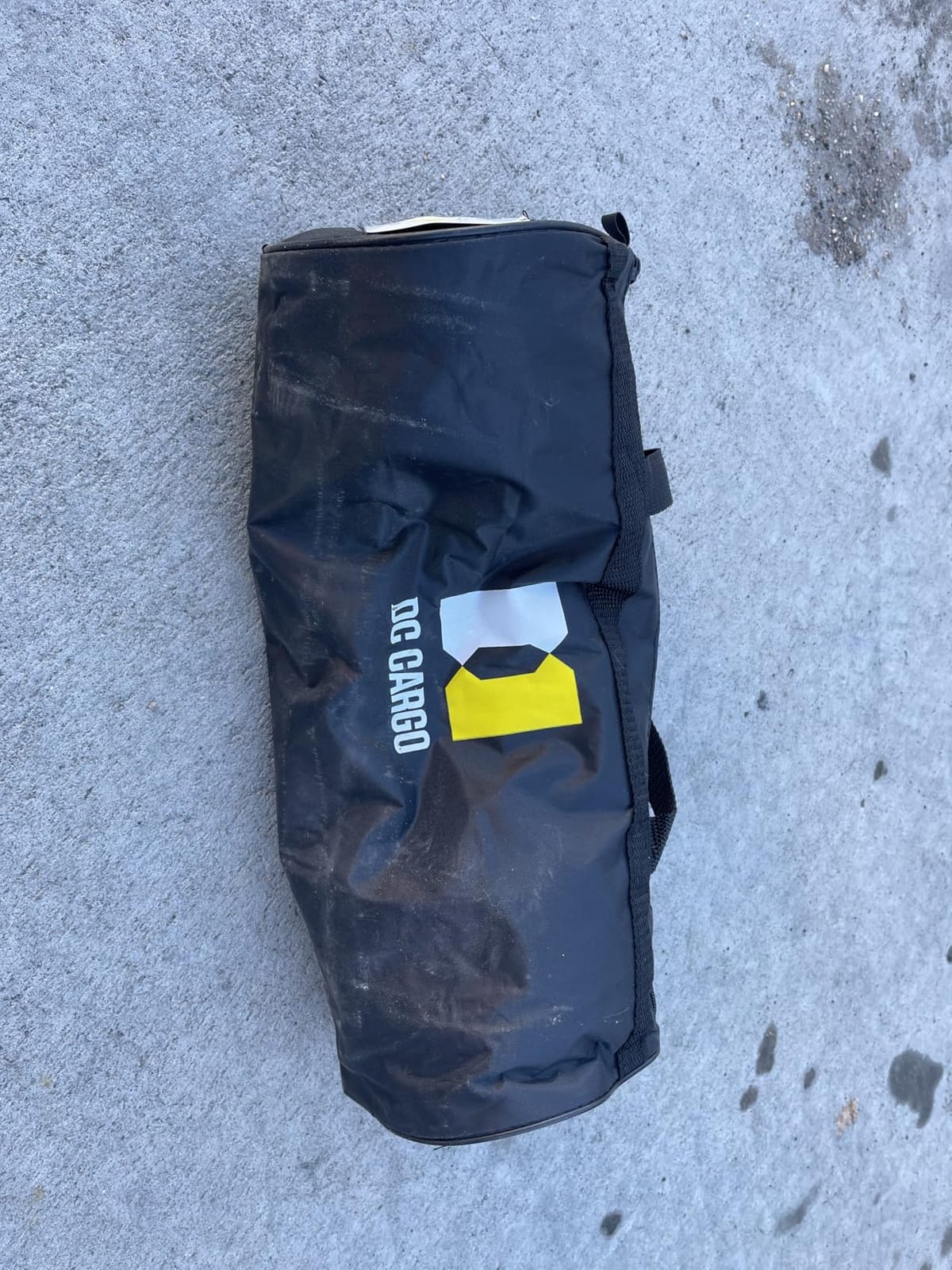
11. DC Cargo Mall Cable X-Small – Lightest Emergency Kit
- Lightest and most compact option here at under 5 pounds for the set
- Cable design clears tight wheel wells on small SUVs and crossovers
- Carrying case makes emergency stowage in a trunk or cargo area straightforward
- Simplest install and removal compared with traditional link chains
- Cable construction gives noticeably less bite than steel-link chains on deep or packed snow
- X-Small size covers only the narrowest tire widths in the range
- 30 mph speed limit and cable wear on long stretches of bare pavement
This is the lightest kit in the roundup at just over 4 pounds for the set, and it comes with a carrying case sized for permanent stowage in a trunk or cargo area. For a driver who wants chains present at all times without thinking about weight, that is a real advantage.
It is also Class S rated, so it is designed for vehicles with limited operating clearance, and reviewers consistently call the install and removal the simplest of anything in this list.
Be clear-eyed about what it is. This is a light-duty emergency kit for smaller SUVs, not a mountain-pass chain. The one-star reviews concentrate almost entirely on heavy-snow use cases, which is exactly the scenario the cable construction is not built for.
The X-Small size covers only the narrowest tire widths available, and the listing is offered in four sizes, so check the size chart carefully. A 30 mph speed limit applies, and cable wear on long stretches of bare pavement is how cables fail.
A limited lifetime warranty is included, which is unusual at this tier, though in practice the failure mode for a cable is wear rather than a defective part.
Best fit as a permanent trunk item for a small crossover
Choose this if your SUV is a compact crossover, your winters are moderate, and you want the psychological insurance of always having something in the cargo area. Under five pounds means you can leave it there permanently rather than loading it during a storm.
The carrying case is not a trivial accessory. A chain loose in a cargo area is a projectile and a mess, and the case is what makes permanent stowage practical.
Where it will disappoint you
Deep or packed snow is where this falls short, and the X-Small sizing limits you further to narrow tires. If you drive somewhere that gets real accumulation, the step up to a link chain earlier in this list is money well spent.
Do not run it on bare asphalt. Cable wear is progressive and silent, and you will find out the cable was compromised at the worst possible moment.
12. DEDC KS1619 – For 32 and 33 Inch Off-Road Tires
DEDC Auto Lock Snow Tires Chains 4.5mm Heavy-Duty Mn Steel Fits 275 285 295
- Only product here rated for true 32 and 33 inch off-road tire sizes on 15 to 17 inch wheels
- 4.5mm manganese steel bites hard ice and held up on Hummer and F-250 use
- Anti-tangle design keeps chains usable between trips
- Owners report accurate fitment charts that matched the tires they ordered for
- Written instructions are vague and most owners say to watch a video instead
- Heaviest item in the group at nearly 10 kg per set
- Installation is quick but not quite as effortless as the marketing suggests
This exists because of a specific problem: 32 and 33 inch off-road tires. Almost nothing in this roundup covers them, which is exactly the complaint owners of lifted trucks raise. This one is sized from 32×11.5 R15 through 33×12.5 R22.
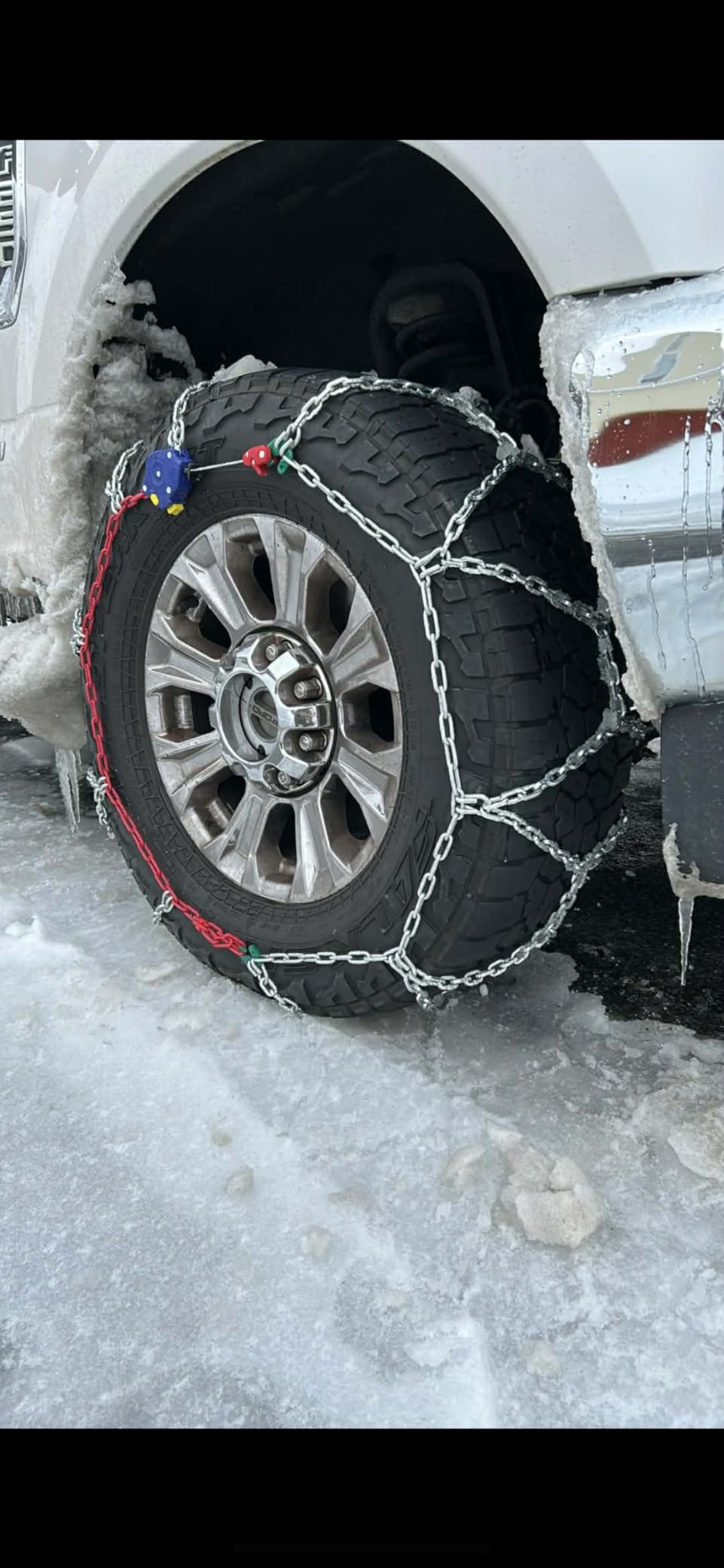
The chain is 4.5mm manganese steel, and owners report using it on Hummer and F-250 work with strong grip on ice and packed mountain snow. The anti-tangle structure is a genuine benefit for someone who keeps chains mounted for a season rather than one storm.
It also holds the highest five-star share of anything reviewed here at 75 percent, with only 4 percent one-star. Owners mention accurate fitment charts that matched the tires they ordered for, which is worth noting given how often sizing is the weak point in this category.
The weight is the trade at 9.95 kg for the set, which makes this the bulkiest item here. Plan the mounting point before you buy rather than after.
Instruction clarity is the one consistent complaint, and owners consistently solve it by watching a video instead. Do the same, and practice on a dry driveway. Installation is quick but not quite as effortless as the marketing implies.
Best fit for lifted trucks and oversized off-road tires
If you are on 32 or 33 inch tires, this may be the only chain in the roundup that fits, which makes the comparison simple. The anti-tangle design and the included storage box suit a driver who keeps chains on hand for hunting access, plowing, and mountain passes.
The included extra-long gloves are a small but telling detail. They are there because the fitting process involves sharp steel and cold hands, which is another reason to practice before you need it.
Where it is wrong for you
On a stock crossover this is dead weight at nearly 10 kg for the pair, and you would be paying for steel capacity you will never use. Match the chain to the tire, not the ambition.
And plan on learning the install from a video rather than the included instructions. Owners who skipped that step are the ones who struggled on a roadside.
Which Wheels Get Chains on an AWD or 4WD SUV
On a rear-wheel-drive SUV, chains go on the rear axle. That is the axle that breaks traction first, and it is the axle you cannot steer if it lets go. On a front-wheel-drive vehicle the logic inverts and the fronts get the chains.
For AWD and 4WD, the commonly repeated rule from owners is that the rear still gets priority. r/4Runner users are near-universal on this: if you own one pair, the rear is the pair, because the rear is harder to control when it steps out. Fit a second pair on the front only when a sign requires chains on all four.
Chain requirement signs are frequently misunderstood, particularly the Washington State R1, R2, and R3 designations. R1 means chains are required, R2 means chains required except on four-wheel-drive and all-wheel-drive vehicles unless carrying chains to put on, and R3 means chains required except on four-wheel-drive and all-wheel-drive vehicles without chains. That third category is the one that catches people out, because you are required to physically have the chains with you even though you are not required to be in them.
Owners on r/subaruoutback debate exactly this tension, since low-clearance Outbacks are a marginal fit for most link chains. If you are in that camp, the cable options in this roundup exist for precisely your situation.
Chain Types Explained: Link, Cable and Auto-Fixing Designs
Link chains use steel or alloy links that bite deepest into snow and ice. They are the correct answer for deep snow, grades, and recovery work, and they are also the heaviest and the least forgiving of tight wheel wells.
Cable chains replace the side links with steel cable while keeping cross members across the tread. They sit nearly flat, clear almost any wheel well, weigh a fraction of a link chain, and give up measurable bite on packed and deep snow.
Auto-fixing designs use a cam or buckle mechanism that self-tensions as you roll forward, removing the need to stop and retighten. The recurring caveat across this category is light gauge, which limits them to emergency and moderate duty rather than sustained mountain driving.
Self-tightening ratchets sit somewhere between the second and third option. The SCC Auto-Trac uses ratchets that tighten and center the chain while preserving real steel link depth, which is why it earned the top spot despite being heavier than most of the field.
Snow socks and traction boards are the fourth option and the one to consider when chains will not physically fit. They trade raw grip for convenience, and they are not legal substitutes on a road that specifically requires chains.
How to Size Chains and Measure Wheel-Well Clearance
Read your tire size off the sidewall, not off the marketing. It looks like 245/55R19, where 245 is the section width in millimeters, 55 is the aspect ratio, and 19 is the wheel diameter in inches. Match that full string against the chain size list.
Sizing confusion is the single most common complaint in owner reviews across this category, and the cause is overlapping size ranges in published charts. When your tire falls in two sizes, the safer error is the larger one, but confirm with the manufacturer rather than guessing. A chain that is too small breaks. A chain that is too large can throw off.
Universal-fit designs make this worse, not better, because the chain has to be trimmed or adjusted before first use. Owners of the SCITOO chains describe cutting links with bolt cutters on a workbench, which is fine as a planned task and terrible as a roadside surprise.
For clearance, park the SUV level, turn the steering to full lock, and look at the gap between the tire sidewall and the fender liner at the closest point. Repeat on the other side. A link chain needs visibly more room than a cable, and two inches of packed snow in the arch will change your answer.
Before the season starts, fit the chains on a dry driveway in daylight, drive twenty feet, and re-check tension. That single step resolves most of the fall-off complaints we saw. People on r/overlanding stress testing chains before a storm is not cargo-cult advice, it is the cheapest insurance in this article.
Installation, Tension Checks and Legal Rules
Every chain here with a quick-fit design shares the same sequence: drape the chain over the tire, roll forward a short distance, and let the tensioner take up the slack. Designs with ratchets work the same way. Designs without, like the KYX set of six, need a manual tighten.
After the first drive segment, stop and re-check. Self-tensioning systems take up slack on the first rotation and are effectively final after that, which is exactly why they reduce fall-off on steep climbs. Chains without a tensioning device should be re-tightened at every stop.
Speed limits are not suggestions. These chains are rated at 25 to 31 mph, and the warranty on several is void above that. A chain at highway speed is a projectile, a tire damage bill, and an insurance problem. Plan your route to stay under the limit.
On legality, check your state department of transportation before you drive. Most mountain states run a tiered system where the sign dictates the requirement, and penalties for driving through a chain-controlled section without them are meaningful. Chain control sections in Washington, Colorado, Utah, and California are the ones that catch unprepared drivers most often.
Storage deserves one sentence that most guides skip. Rinse and air-dry chains after every use, never store them damp, and lay them flat rather than coiled. Salt residue left on steel is what turns a durable chain into a rusted one by March.
If you also carry a compressor for emergencies, our cordless tire inflator guide covers the other half of winter readiness, because a flat at 4 degrees changes the whole plan.
Frequently Asked Questions
Do I need chains on all 4 tires with AWD?
Usually not. On most AWD and 4WD SUVs chains go on the rear axle, which is the axle that loses traction and becomes hardest to control. You only need all four when a posted chain control sign requires it. If you own one pair, the rear is the pair.
Do you put snow chains on all four tires or just two?
Just two on the rear is standard practice for most passenger and light SUVs. Four chains are required only when a sign explicitly demands chains on all four wheels, which happens on chain-controlled mountain routes. AWD does not exempt you from that requirement.
What are the easiest tire chains to put on?
Self-tightening and auto-fixing designs are the easiest because you drape the chain, roll forward a short distance, and the built-in tensioner centers and tightens it. The HAPPYMATE HKN130 reports under a minute per wheel, while traditional link chains that need a manual tighten take considerably longer.
What are the best snow chains for an SUV?
The SCC 0232805 Auto-Trac is the best all-around choice because it combines a Class S clearance rating, self-tightening ratchets, and a diamond cross-chain pattern. For SUVs with tight wheel-well clearance, the SCC SZ143 Super Z6 cable chain is the better fit, and for 32 and 33 inch tires the DEDC KS1619 is the only option here that fits.
Can tire chains damage my tires or rims?
Properly sized chains do not damage tires. Damage usually comes from a chain that is too small, one that has been left on too long, or a smooth chain chafing a sidewall. The knurled designs grip without scuffing, and the Coco Bird set is advertised as not damaging tires. Check fitment and remove chains on bare asphalt.
Conclusion
The best tire chains for SUVs come down to your clearance and your wheel sizes, not to a single universal winner. For most drivers the SCC 0232805 Auto-Trac is the right first purchase, because Class S clearance, self-tightening ratchets, and real link depth are hard to find together anywhere else.
If clearance is tight, take the SCC SZ143 Super Z6 cable instead and accept less bite for a fit that actually works. If you are on oversized off-road tires, the DEDC KS1619 covers a size range nothing else here reaches. And if you regularly need all four wheels covered, the KYX six-chain set is the only package in this roundup that does it in one purchase.
Whichever you choose, fit it on a dry driveway before the season starts. Confirm your tire size against the chart, drive twenty feet, and re-check the tension. That single habit resolves most of the problems we read about in thousands of owner reviews.
For the rest of your winter prep, our cargo carrier guide covers the other gear that has to fit in the back of the same vehicle. Stay safe out there in 2026.