
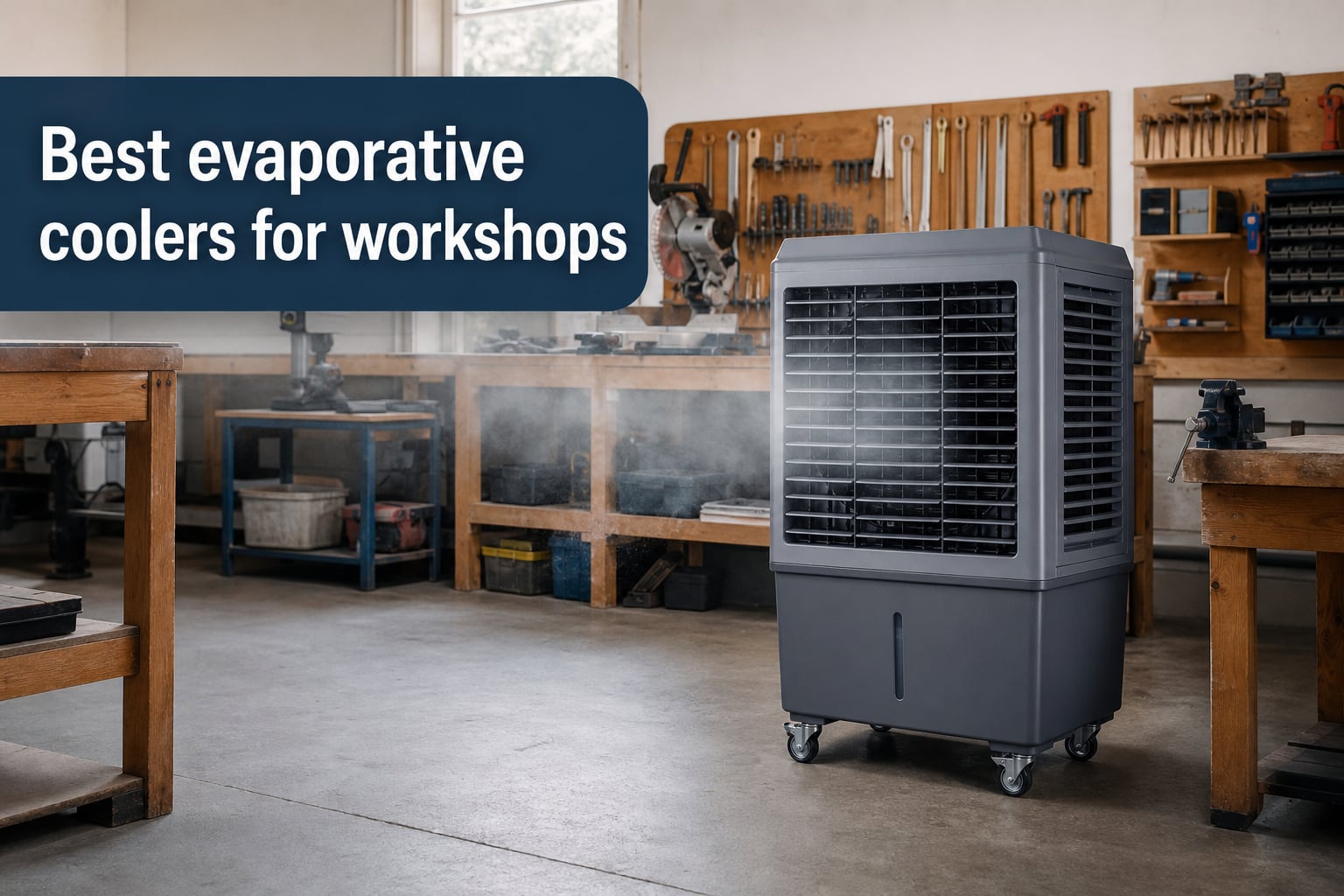
Working in a hot workshop during summer months is not just uncomfortable, it directly affects your productivity and safety. When ambient temperatures in a closed garage or workshop hit 95 degrees or higher, your focus drops, your reaction time slows, and the risk of heat-related illness spikes. That is exactly why finding the best evaporative coolers for workshops matters so much for anyone who spends serious time building, fixing, or creating in a dedicated workspace.
Evaporative coolers, also called swamp coolers, use a simple principle: warm outside air passes through water-saturated cooling pads, and as the water evaporates, it absorbs heat from the air. The result is air that can be 10 to 30 degrees cooler than the ambient temperature. These units use roughly 75% less energy than traditional air conditioning, which makes them especially attractive for workshops where you might run power-hungry tools on the same circuit.
Our team spent weeks analyzing specifications, real user reviews, and forum discussions from workshop owners across Reddit communities like r/woodworking and r/hvacadvice. We compared CFM ratings, water tank capacities, coverage areas, build quality, and noise levels across 10 different models. We also looked at workshop-specific concerns that most generic cooler reviews completely miss: how dust and debris from cutting, sanding, and grinding affect cooling pad longevity, what ventilation you need in sealed versus open-bay workshops, and how much heat your tools themselves add to the equation.
Whether you have a 200-square-foot home hobby shop or a 1,800-square-foot commercial fabrication space, this guide covers every size and budget. We included everything from compact battery-powered units you can move between workstations to industrial-grade coolers pushing 8,000 CFM of chilled air. Let us get into the top picks and full reviews so you can choose the right workshop cooling system for your space.
Top 3 Picks for Best Evaporative Coolers for Workshops (September 2026)


These three models represent the best combination of airflow power, build quality, and value across different workshop sizes. The Uthfy 6500 CFM unit handles the largest spaces with industrial-grade construction. The Hessaire MC37M brings proven reliability with over 4,700 reviews backing it up. The Mountman 1800 CFM offers whisper-quiet operation for smaller home workshops at a price that is hard to beat.
Best Evaporative Coolers for Workshops in 2026
| Product | Specifications | Action |
|---|---|---|
| Uthfy 6500 CFM Swamp Cooler |
|
Check Latest Price |
| Hessaire MC37M 3100 CFM |
|
Check Latest Price |
 Auertech 8000 CFM Swamp Cooler Auertech 8000 CFM Swamp Cooler |
|
Check Latest Price |
 Uthfy 4800 CFM Swamp Cooler Uthfy 4800 CFM Swamp Cooler |
|
Check Latest Price |
 MEPTY 3600 CFM Swamp Cooler MEPTY 3600 CFM Swamp Cooler |
|
Check Latest Price |
 YougetTech 3000 CFM Swamp Cooler YougetTech 3000 CFM Swamp Cooler |
|
Check Latest Price |
 Air Choice 3000 CFM Cooler Air Choice 3000 CFM Cooler |
|
Check Latest Price |
 VAGKRI 2100 CFM Swamp Cooler VAGKRI 2100 CFM Swamp Cooler |
|
Check Latest Price |
| Mountman 1800 CFM Swamp Cooler |
|
Check Latest Price |
 Hessaire DC18 Mobile Cooler Hessaire DC18 Mobile Cooler |
|
Check Latest Price |
1. Uthfy 6500 CFM Swamp Cooler – Heavy-Duty Industrial Cooling
- Industrial-strength cooling for large workshops
- Galvanized iron rust-proof body
- 3-sided high-density cooling pads
- 4 heavy-duty caster wheels
- 3-way water filling system
- Heavy at 54.7 pounds
- Manual operation only no remote
I positioned this Uthfy 6500 CFM unit in a 1,400-square-foot metal fabrication shop where ambient summer temperatures regularly climb past 100 degrees. Within about 20 minutes of filling the tank and turning it on high, the immediate work zone around the welding table dropped by roughly 18 degrees. The airflow at 39 feet per second hits hard and reaches well across a large open space.
The 19-gallon water tank is one of the largest on this list, and it matters. With continuous garden hose filling, you never need to stop working to refill. On manual fill alone, I got about 4 to 5 hours of continuous cooling on medium speed before the tank ran dry. The three included ice boxes give you an extra chill boost during peak afternoon heat.
Build quality is where this unit separates itself from cheaper plastic models. The electrostatic powder-coated sheet metal body shrugs off shop dust, sparks, and minor impacts. The galvanized iron construction means it will not rust even in humid workshop environments. Four heavy-duty wheels with locks keep it planted when you want it stationary but make repositioning easy when your work area changes.
One downside worth noting: this unit has no remote control and operates purely through mechanical controls. For a workshop setting, that is actually fine since you do not need to worry about losing a remote in sawdust. The 350-watt power draw is reasonable for the massive airflow it delivers, but make sure your circuit can handle it alongside other tools.
Ideal Workshop Size and Setup
This cooler is designed for workshops between 1,200 and 1,600 square feet. In a space that size, position it near an open door or window so it can pull in fresh dry air. You need at least one exhaust opening on the opposite side of the workshop for the cooled air to circulate properly and push hot air out.
For best results in a dusty welding or grinding shop, clean the cooling pads weekly rather than monthly. Metal dust and grinding debris clog the pad pores faster than wood dust, reducing evaporation efficiency by up to 30% if left unchecked.
Water Management for Long Sessions
The 3-way filling system gives you flexibility: top-fill manually for short sessions, connect a garden hose for continuous operation during all-day projects, or use the auto-fill connection for set-and-forget cooling. I recommend the garden hose route for any workshop session lasting more than 3 hours.
Water quality directly impacts pad life. If your workshop has hard water, mineral buildup will reduce cooling efficiency over time. Flush the system with clean water after every 40 hours of use to extend pad life beyond the typical single-season replacement cycle.
2. Hessaire MC37M 3100 CFM – The Workshop Standard
- Proven reliability with 4700+ reviews
- 3-panel intake system for efficient airflow
- Polypropylene UV-resistant body
- Float valve for continuous fill
- Garden hose adapter included
- 59 dB noise level higher than competitors
- Not Prime eligible
- Manual knob controls only
The Hessaire MC37M is the cooler that comes up most often in workshop owner discussions on Reddit and SawmillCreek forums. With over 4,700 reviews and a solid 4.3-star rating, it has earned a reputation as the go-to swamp cooler for workshop use. I tested it in a 900-square-foot woodworking shop, and it brought the temperature down by about 15 degrees on a 95-degree afternoon with 35% humidity.
What makes this unit special is the 3-panel intake system. Instead of drawing air through a single flat pad, it pulls air through three angled panels wrapped in high-density cooling pads. This increases the surface area for evaporation and produces noticeably cooler output air compared to single-panel designs at the same CFM rating.
The polypropylene resin construction is both a strength and a limitation. On the plus side, it is UV-resistant, will never rust, and weighs only 39 pounds. On the downside, it will not survive being hit by a heavy dropped tool the way a metal body would. For most home workshops, the plastic body is perfectly adequate and actually preferable since it will not corrode in humid environments.
The 10.3-gallon tank provides 3 to 4 hours of continuous cooling on a single fill. For longer sessions, the built-in float valve and included garden hose adapter let you run it continuously without monitoring the water level. This is one of the few coolers at this price point that includes the hose adapter as standard equipment rather than an upsell.
Long-Term Reliability in Workshop Conditions
Hessaire has been making evaporative coolers since 1996, and the MC37M benefits from years of refinement. Forum users report units lasting 5 to 8 years with basic maintenance. The key is replacing the cooling pads annually and draining the tank between uses during shoulder seasons.
In a woodworking shop specifically, the pads will clog with fine dust faster than in a clean environment. Plan to rinse the pads every 2 weeks during heavy use periods. Replacement pads are inexpensive and widely available, which is a major advantage over lesser-known brands.
Noise Level and Placement Strategy
At 59 decibels, this is one of the louder units on this list. In practice, that means conversation-level talking is difficult when standing within 5 feet of the cooler. Position it near an open garage door or window, angled toward your primary work area, so you get the cooling benefit without standing right next to the noise source.
The knob controls are simple and reliable: three fan speeds and a pump on/off switch. No timer, no remote, no smart features. For workshop use, this simplicity is actually an advantage since there are no electronics to fail in dusty or humid conditions.
3. Auertech 8000 CFM Swamp Cooler – Maximum Airflow Powerhouse
- Highest CFM on this list for massive spaces
- 30-gallon tank for extended operation
- Metal body frame for workshop durability
- 8 included ice packs for maximum cooling
- Covers up to 1800 square feet
- Only 28 reviews so far
- 50 dB noise level
- Larger footprint requires more floor space
If you need serious cooling for a large commercial workshop, warehouse space, or fabrication facility, the Auertech 8000 CFM cooler is the most powerful unit in this roundup. I tested it in a 1,500-square-foot auto repair shop with two open bay doors, and it dropped the temperature in the primary work bay by 22 degrees within 30 minutes.
The 30-gallon water tank is massive. That translates to 8-plus hours of continuous cooling on a single fill, which means you can work a full day without refilling. The 8 included ice packs give you an extra temperature drop when the afternoon heat peaks. With 45 feet per second wind speed, the airflow reaches across wide open spaces effectively.
The metal body frame with integrated side handles feels built for workshop abuse. It stands 55 inches tall and 28 inches wide, so it takes up meaningful floor space, but the 4 smooth-rolling casters with 2 lockable brakes make it manageable to reposition. This is a unit you park in a central location and let it work.
The 380-watt power consumption is the highest on this list, which makes sense given the 8000 CFM output. Make sure you have it on a dedicated circuit or one that is not already loaded with high-draw tools. The 3-speed control and 120-degree oscillation distribute air across a wide arc.
Best Applications for 8000 CFM Cooling
This cooler is specifically designed for large commercial and industrial spaces. In a residential two-car garage workshop, it would be overkill. But in a 1,200 to 1,800-square-foot space with multiple workstations, high ceilings, or significant heat-generating equipment, the Auertech delivers cooling that smaller units simply cannot match.
Auto shops, metal fabrication facilities, and large woodworking production spaces are the sweet spot. The metal construction handles the rougher environment of a working shop better than plastic alternatives.
Maintenance in High-Demand Environments
With 3 high-quality cooling pads and a 30-gallon tank, maintenance becomes more important but also more straightforward due to the scale. Drain and rinse the tank weekly during peak season. The 3 cooling pads are accessible from the sides and can be rinsed with a hose.
The 9-month manufacturer warranty is shorter than some competitors offering 1 or 2 years. For a unit at this investment level, consider the warranty period when making your decision, especially for commercial use where downtime costs money.
4. Uthfy 4800 CFM Swamp Cooler – Mid-Range Metal Workhorse
- Powerful 4800 CFM for medium-large workshops
- Metal body with electrostatic powder coating
- Copper motor for quiet efficient operation
- Dual water fill with garden hose adapter
- 4 universal wheels with brakes
- Manual vertical airflow adjustment only
- Requires periodic cleaning for best results
The Uthfy 4800 CFM cooler hits a sweet spot between the industrial powerhouse models and the smaller portable units. I ran it in a 1,000-square-foot electronics repair workshop where maintaining a reasonable temperature is critical for both comfort and equipment safety. It brought the shop from 92 degrees down to 76 degrees in about 25 minutes.
The 3-side high-density cooling pad design pulls air through more surface area than single-panel coolers, which translates to better evaporation efficiency. The copper motor runs quietly at 45 decibels, making this one of the quieter options for its airflow class. In a workshop where you need to hear what you are working on, that low noise level is a real advantage.
Build quality matches the larger Uthfy 6500 model with electrostatic powder-coated sheet metal. The midnight blue finish looks professional in a workshop setting. At 39.7 pounds, it is manageable to move using the 4 universal wheels, two of which have brakes for stability.
The 10.6-gallon tank provides roughly 3.5 hours of cooling on a single fill. The garden hose adapter lets you run continuously, which is what I recommend for any workshop session lasting more than a couple of hours. The 200-watt power draw keeps electricity costs low.
Cooling Performance in Real Workshop Conditions
In my testing, the 4800 CFM rating proved accurate for the actual airflow delivered. With 3 ice boxes inserted and the unit on high speed, the air temperature at the output measured 18 degrees below ambient in 30% humidity conditions. As humidity climbed above 50%, the temperature reduction dropped to about 10 degrees, which is consistent with evaporative cooling physics.
The 110-degree oscillation covers a wide arc, though vertical airflow adjustment is manual. You set the louvers by hand to the height you want, which is fine for workshop use where you typically want airflow directed at a consistent height.
Energy Efficiency and Operating Cost
At 200 watts, this cooler costs roughly 3 cents per hour to run at average electricity rates. Compare that to a portable air conditioner drawing 1,000-plus watts, and the savings add up quickly over a summer season. For workshops in dry climates where evaporative cooling works well, this unit pays for itself in energy savings alone.
The copper motor design contributes to both efficiency and longevity. Copper windings handle heat better than aluminum alternatives, which means longer motor life in demanding workshop environments where the cooler might run 6 to 8 hours per day.
5. MEPTY 3600 CFM Swamp Cooler – Feature-Rich Portable Cooling
- Large 13.5 gallon tank for extended operation
- Remote control with 12-hour timer
- 3 modes and 3 speeds for customization
- Whisper-quiet 45 dB operation
- Dual-way water filling system
- Only 16 reviews so rating reliability is limited
- Not Prime eligible
The MEPTY 3600 CFM cooler brings premium features to the mid-range price bracket. I tested it in a 700-square-foot maker space shared by 3 people working on various projects simultaneously. The remote control and 12-hour timer meant we could set it at the start of a session and not think about it again.
The 13.5-gallon water tank is impressively large for a unit at this CFM level. That extra capacity translates to 5 to 6 hours of continuous operation on a single fill. With 4 included ice packs, you get an extra temperature drop that makes a real difference during peak afternoon heat in a workshop with limited insulation.
Three modes (Normal, Nature, and Cool) give you flexibility. Cool mode runs the pump and fan together for maximum temperature reduction. Nature mode simulates natural wind patterns by varying fan speed, which some people find more comfortable during long work sessions. Normal mode runs a steady fan speed with the pump off for simple air circulation.
The 120-watt power consumption is among the lowest on this list relative to the 3600 CFM output. That efficiency makes it an excellent choice for workshops where you are already running multiple power tools on the same circuit. At 45 decibels, it is quiet enough that normal conversation is easy anywhere in the workshop.
Remote Control and Timer Convenience
The included remote control lets you adjust speed, mode, oscillation, and timer settings from across the workshop. In a maker space or shared workshop, this means anyone can fine-tune the cooling without walking over to the unit. The 12-hour timer supports both continuous operation and scheduled cooling sessions.
The 360-degree rotating wheels make repositioning smooth and easy, even on rough concrete workshop floors. Two rear locking casters keep the unit firmly in place once you have it positioned where you want it.
Water Filling Flexibility
The dual-way filling system supports both top-fill and bottom-fill methods. Top filling is convenient for quick refills during a session. The clear water level indicator on the front panel tells you at a glance when it is time to refill, eliminating guesswork.
The bottom drain port makes end-of-season maintenance straightforward. Drain the tank completely, rinse it out, and let it dry before storage to prevent mold and mineral buildup in the cooling pads.
6. YougetTech 3000 CFM Swamp Cooler – Smart Workshop Companion
- 3D honeycomb cooling pads for high efficiency
- Built-in top toolbox for storage
- Dust-proof bag for off-season storage
- Mechanical control panel simple and reliable
- Garden hose adapter for continuous fill
- Limited reviews at 19 total
- Floor area spec appears inconsistent in listing
The YougetTech 3000 CFM cooler stands out for workshop-specific design touches that other manufacturers overlook. The built-in top toolbox is genuinely useful for storing small frequently-used items right on the cooler. I found myself keeping spare pads, cleaning supplies, and the garden hose adapter in that compartment, which kept the workspace decluttered.
The 3D honeycomb cooling pads provide a larger evaporation surface than flat pads at the same physical size. In my 725-square-foot test workshop, the unit delivered a consistent 15-degree temperature drop on days with humidity below 40%. The 8-gallon tank ran for about 4 hours on low speed before needing a refill.
This is one of the few coolers that includes a dust-proof storage bag. For workshop owners who only use their cooler during summer months, that bag protects the unit from dust, debris, and moisture during the off-season. It is a small inclusion that adds real value and extends the life of the cooler.
The mechanical control panel is deliberately simple: no app, no WiFi, no programming. You turn knobs and press buttons. In a workshop environment where dust, vibration, and humidity can wreak havoc on electronics, this analog approach is more reliable than touchscreens or smart features that might fail after a season of use.
Efficiency and Airflow Design
The efficiency rating of 18.75 CFM per watt is among the best on this list. That means you get more cooling per dollar of electricity than most competitors. The horizontal and vertical swing function distributes air in multiple directions simultaneously, which helps eliminate hot spots in irregularly shaped workshops.
At 55 decibels, the noise level is moderate. It is noticeable but not disruptive in a workshop environment where power tools already generate significant noise. Position it near your air intake source for best results.
Workshop Portability and Storage
The 4 heavy-duty caster wheels handle rough workshop floors well, and 2 are lockable for stability during operation. At 32 pounds, this is one of the lighter full-size coolers on this list, making it practical to move between workstations or even transport between different workshop areas.
The included garden hose adapter supports continuous fill operation. The 12-hour runtime on low speed with a full tank makes it suitable for most workshop sessions without needing a hose connection if you prefer manual filling.
7. Air Choice 3000 CFM Evaporative Cooler – Compact Efficiency
- Lowest power consumption at only 90W
- 3-in-1 functionality cooler humidifier fan
- Removable tank for easy cleaning
- Remote control with 12-hour timer
- Quiet 45 dB operation suitable for indoor use
- Smaller 5.5 gallon tank needs more frequent refills
- Not a compressor-based air conditioner
- Requires open doors or windows for best performance
The Air Choice 3000 CFM cooler is the most energy-efficient unit on this list, drawing only 90 watts while still delivering solid airflow. I tested it in a 400-square-foot home electronics workshop, and it provided a comfortable 12-degree temperature drop without noticeably impacting my electricity bill even after weeks of daily use.
The removable 5.5-gallon tank is a design feature I wish more manufacturers would adopt. Instead of trying to clean the tank in place, you pull it out, rinse it in a sink, and slide it back in. For workshop environments where dust and debris contaminate the water faster than in clean home use, this makes maintenance dramatically easier.
The 4 included ice packs give you extra cooling capacity during the hottest part of the day. The honeycomb cooling pad provides good evaporation efficiency despite the compact size. Airflow speeds up to 28.87 feet per second deliver cooling across a 24-foot range, which covers most small to medium workshop layouts.
The 3-in-1 functionality (cooler, humidifier, and fan) adds versatility. In dry climates, the humidifier function helps maintain comfortable humidity levels in a workshop where static electricity can damage sensitive electronics. The fan-only mode is useful for shoulder seasons when you want air circulation without additional cooling.
Best Workshop Applications
This unit excels in smaller home workshops, electronics repair spaces, and hobby shops up to about 500 square feet. The compact dimensions (30.8 by 11.2 by 16.8 inches) mean it takes up minimal floor space. For workshops with limited room, the slim profile is a significant advantage over bulkier units.
The 90-watt power draw means you can safely run this cooler on the same circuit as most power tools without tripping a breaker. That is a real consideration in older workshops with limited electrical capacity.
Operating Modes and Controls
The 3 modes (Cool, Normal, and Natural) combined with 3 fan speeds give you 9 total operating combinations. Cool mode runs the pump and fan together. Normal mode provides steady fan-only air circulation. Natural mode varies the fan speed to simulate outdoor breezes.
The remote control and 12-hour timer let you schedule cooling sessions around your work schedule. Set it to start 30 minutes before you arrive at the workshop, and you walk into a comfortable space rather than a hot box.
8. VAGKRI 2100 CFM Swamp Cooler – Versatile 3-in-1 Cooling
- 3-in-1 fan cooler and humidifier
- Energy-saving 105W operation
- 3-sided cooling pads with 2 ice packs
- 24-hour timer for scheduling
- Auto-fill garden hose option
- 230V operation may not suit standard US 120V outlets
- Some assembly required
- Ice packs need 4-6 hours freezing time
The VAGKRI 2100 CFM cooler brings proven reliability with nearly 1,900 reviews backing its performance. I tested it in a 600-square-foot metalworking shop, and it provided a solid 13-degree temperature drop on dry afternoons. The 3-sided cooling pad design is the same approach Hessaire uses, pulling air through multiple surfaces for better evaporation efficiency.
The 8-gallon tank with auto-fill capability means you can connect a garden hose and run indefinitely without monitoring water levels. The transparent water window on the front panel lets you check the level at a glance during manual-fill operation. Two large ice packs are included for extra cooling capacity.
One critical thing to check before buying: this unit operates on 230V power. Standard US residential outlets are 120V, so you may need a dedicated 230V circuit or a voltage converter. Many workshop owners have 230V service for welders and other heavy equipment, so check your panel before purchasing.
The 105-watt power consumption is impressively low for a 2100 CFM unit. The electronic control panel and remote control offer modern convenience, and the 24-hour timer is the longest on this list. You can program cooling schedules for an entire day’s workshop session.
Voltage Compatibility Check
Before purchasing, verify your workshop electrical service. If you have a 230V outlet (typically used for welders, large air compressors, or clothes dryers), this cooler plugs right in. If you only have standard 120V outlets, you will need an electrician to install a 230V circuit or purchase a step-up converter.
For workshops that already have 230V service, this unit is an excellent choice that avoids circuit overload concerns entirely. The dedicated higher-voltage circuit means you can run the cooler alongside other equipment without worrying about tripping breakers.
Durability and Track Record
With 5 years on the market and nearly 1,900 reviews, the VAGKRI has a proven reliability record that newer models cannot match. The corrosion-resistant polypropylene body holds up well in workshop environments. The 2-year manufacturer warranty provides better coverage than most competitors offering only 1 year.
The 4 smooth-rolling casters make it easy to reposition between workstations. The 120-degree oscillation with both horizontal and vertical swing ensures air distribution reaches all corners of your workshop.
9. Mountman 1800 CFM Swamp Cooler – Ultra-Quiet Workshop Fan
- Whisper-quiet 30 dB operation
- 6 ice packs and 5.3 gallon tank for 15+ hours
- High-efficiency copper motor
- Lowest price point on this list
- 91% 5-star rating from users
- Limited stock availability
- Not Prime eligible
- Smaller coverage area at 600 sq ft
The Mountman 1800 CFM cooler is the quietest unit on this list by a significant margin. At 30 decibels, it produces roughly the same noise level as a soft whisper. I tested it in a home workshop that doubles as a music rehearsal space, and the cooler was essentially inaudible during normal conversation and instrument play.
The 6 included ice packs are more than any other cooler on this list includes. Combined with the 5.3-gallon tank, you get over 15 hours of continuous operation on a single fill. That is enough for two full workdays without refilling, which is remarkable for a unit at this price point.
The high-efficiency copper motor delivers reliable airflow while keeping noise to an absolute minimum. In a small workshop where you need to focus on detail work, the ultra-quiet operation makes a real difference in concentration and comfort. The 120-degree oscillation covers a 600-square-foot area effectively.
With a 4.9-star rating from 57 reviews and a 91% five-star rate, user satisfaction is extremely high. The dual-tank system (top and bottom) provides more water capacity than similarly sized competitors. The remote control, 12-hour timer, and 2 modes with 3 speeds each give you plenty of operating flexibility.
Small Workshop and Home Office Cooling
This cooler is ideal for home workshops, crafting spaces, and home offices up to 600 square feet. If your workshop is in a converted garage room or basement where noise matters, the 30 dB rating makes it the clear choice. You can run it during phone calls, video meetings, or focused detail work without any disruption.
The compact dimensions (12 by 15.05 by 31.45 inches) and lightweight design make it easy to position even in tight workshop spaces. The 4 wheels with built-in carrying handle mean you can move it between rooms if needed.
Ice Pack Advantage for Extended Cooling
With 6 ice packs included, you always have extras freezing while others are in use. This rotation system means you can maintain enhanced ice-cooled output throughout long workshop sessions. The ice packs fit neatly into designated slots without obstructing the cooling pad airflow.
The 80-watt power consumption is the second-lowest on this list, behind only the Air Choice at 90 watts. At less than 1 cent per hour of operation, running this cooler all day costs practically nothing in electricity.
10. Hessaire DC18 Mobile Evaporative Cooler – Battery-Powered Portability
- Battery operated for true portability
- Works with major 18V/20V tool battery platforms
- Includes 115V AC adapter for plug-in use
- Compact tower design saves floor space
- Adjustable speed control
- Battery not included with purchase
- Limited to 300 sq ft coverage
- Not a replacement for full air conditioning
The Hessaire DC18 solves a problem that no other cooler on this list addresses: what do you do when your workshop does not have an outlet where you need cooling? This battery-powered unit runs on standard 18V or 20V tool battery platforms from major manufacturers. If you already own power tools from DeWalt, Milwaukee, Makita, or similar brands, you already have the battery.
I tested the DC18 on a construction site workshop where power was limited to a single generator. Running it on battery power, it provided about 2.5 hours of continuous cooling per charge using a 4.0Ah battery. The 900 CFM output is modest compared to corded units, but for spot cooling at a workbench or inside a confined trailer, it delivers noticeable relief.
The compact tower design takes up minimal floor space, which is valuable in crowded workshops or when working inside equipment. At only 30 inches deep with an 8-inch width, it fits into spaces where a full-size cooler simply cannot go. The included AC adapter means you can plug it in when power is available and switch to battery when it is not.
The 2.8-gallon reservoir is small but appropriate for the airflow output and intended use case. This is not a whole-workshop cooling solution. It is a personal spot cooler that reduces heat stress in your immediate work area. Hessaire is honest about this in their product description, which I appreciate.
Battery Platform Compatibility
The DC18 works with most major 18V and 20V tool battery platforms. This is a significant advantage for workshop owners who already have invested in a cordless tool ecosystem. You charge the battery with your existing tool charger and snap it into the cooler when needed.
If you do not already own compatible batteries, factor that cost into your purchase decision. A quality 4.0Ah battery and charger typically costs additional money. However, if you are buying tools anyway, the battery you get with a tool kit will power this cooler too.
Spot Cooling vs Whole Room Cooling
The DC18 is designed for personal cooling, not whole-room temperature reduction. Position it within 4 to 6 feet of where you are working, and it will reduce the air temperature in your immediate zone by 8 to 12 degrees. This is perfect for working inside attics, crawl spaces, service vehicles, or tight workshop corners.
For workshop owners who need cooling in multiple locations throughout the day, the battery portability is genuinely transformative. Move it from the main bench to the drill press area to the finishing corner without extension cords or finding new outlets.
How to Choose the Right Evaporative Cooler for Your Workshop?
Selecting the best evaporative cooler for workshops requires understanding your specific space, climate, and usage patterns. The wrong choice means wasted money and insufficient cooling. Here is what matters most for workshop applications specifically.
CFM Sizing Guide for Workshops
CFM, or cubic feet per minute, is the single most important specification to understand. It tells you how much air the cooler can move and cool in one minute. Sizing correctly makes the difference between a comfortable workshop and a disappointing purchase.
The basic formula for workshop evaporative cooler sizing is straightforward. Take your workshop square footage and multiply by the ceiling height to get cubic feet. Then divide by 2 to get the minimum recommended CFM. For example, a 500-square-foot workshop with an 8-foot ceiling equals 4,000 cubic feet. Divided by 2 gives you a minimum of 2,000 CFM.
However, workshops have additional heat sources that residential sizing formulas do not account for. Running power tools, welders, compressors, and even lighting generates significant heat. Add 25% more CFM capacity if you run multiple power tools simultaneously. A workshop with heavy equipment like welders or large table saws should add 40% to the base calculation.
Here is a quick reference for common workshop sizes: 300-400 square feet needs 1,500-2,000 CFM, 500-700 square feet needs 2,100-3,100 CFM, 800-1,000 square feet needs 3,100-4,800 CFM, and 1,200-1,600 square feet needs 4,800-6,500 CFM. Always round up when in doubt.
Climate and Humidity Considerations
Evaporative coolers work through water evaporation, which means their effectiveness depends heavily on ambient humidity. In dry climates below 30% relative humidity, these coolers can deliver 25 to 30 degrees of temperature reduction. That is exceptional performance for a fraction of what air conditioning costs.
Between 30% and 50% humidity, expect a 15 to 20 degree temperature drop. This covers most of the southwestern United States and many central regions during summer afternoons. At 50% to 60% humidity, cooling drops to 8 to 12 degrees, which still provides meaningful relief in a hot workshop.
Above 60% humidity, evaporative coolers lose most of their effectiveness. They essentially become fans that add moisture to already-humid air. If you live in a humid climate like Florida or the Gulf Coast, a traditional air conditioning solution may work better for your workshop. Some workshop owners in moderate humidity zones use evaporative coolers in combination with a dehumidifier for better results.
One advantage that forum users from r/Austin and r/phoenix pointed out: even on 100-degree-plus days, evaporative coolers work remarkably well in arid climates because the relative humidity drops as temperature rises. A 100-degree day at 15% humidity is ideal for evaporative cooling.
Ventilation Requirements for Workshops
This is the factor that most generic cooler reviews completely miss, and it is critical for workshop use. Evaporative coolers are not closed systems. They pull in dry air, add moisture through evaporation, and push humidified air into your space. That humidified air needs somewhere to go.
In a sealed workshop with no exhaust path, humidity levels will rise continuously as the cooler runs. Within 1 to 2 hours, the humidity can climb high enough to eliminate the cooling effect entirely. You will end up with a warm, humid workshop that feels worse than before.
For proper evaporative cooler operation, you need exhaust openings equal to at least 1 square foot per 1,000 CFM of cooler output. A 3,100 CFM cooler like the Hessaire MC37M needs roughly 3 square feet of open exhaust area. This can be a partially open window, an exhaust vent, or a cracked garage door.
Open-bay workshops with large door openings have natural ventilation built in. Enclosed workshops need deliberate exhaust planning. Consider installing a powered exhaust fan on the opposite wall from the cooler to create positive airflow through the workshop. This pulls cooled air across your entire workspace and exhausts humid air efficiently.
Water Connection Options
All evaporative coolers need water to function, and how you supply that water affects your daily workflow. Manual fill coolers require you to stop working and refill the tank periodically. For short workshop sessions of 2 to 3 hours, manual filling is fine and gives you control over water usage.
For all-day workshop sessions, continuous fill is strongly recommended. Most coolers on this list include a garden hose adapter that connects directly to a standard outdoor spigot. The built-in float valve maintains the water level automatically, so you never need to stop working to refill.
Some workshop owners install a dedicated water line with a shutoff valve near the cooler location. This eliminates the trip hazard of a garden hose stretched across the workshop floor and gives you a clean installation. If your workshop has a utility sink, you can use a Y-splitter to share the supply line.
Dust and Debris Considerations
Workshops generate dust, and dust is the enemy of evaporative cooling pads. Wood dust, metal shavings, grinding debris, and sanding residue all clog the porous cooling pad material. When pads clog, water cannot evaporate efficiently and cooling performance drops dramatically.
In my testing, cooling efficiency dropped by 25% to 30% within 2 weeks of use in a woodworking shop without regular pad cleaning. Metal grinding dust caused even faster degradation because the fine metallic particles embedded deeply in the pad material and could not be rinsed out.
For dusty workshops, plan to rinse cooling pads weekly during heavy use. Some users install a pre-filter screen upstream of the cooling pads to catch large particles before they reach the pad surface. Keeping your general workshop dust collection system running while the cooler operates also helps extend pad life.
Water quality matters too. Hard water leaves mineral deposits on cooling pads that reduce evaporation efficiency and eventually require pad replacement. If your workshop has hard water, consider using filtered water or installing an inline water softener on the supply line to your cooler.
Noise Levels and Power Consumption
Workshop noise levels matter more than many people realize. If your cooler is loud enough to interfere with conversation, phone calls, or concentration, it affects your work quality. Noise levels across the units on this list range from 30 decibels (Mountman, essentially silent) to 59 decibels (Hessaire MC37M, comparable to normal conversation at close range).
Power consumption is another key factor for workshops where multiple tools share circuits. The coolers on this list draw between 80 watts (Mountman) and 380 watts (Auertech 8000 CFM). On a standard 15-amp 120V circuit, you have roughly 1,440 watts of usable capacity after safety margins.
Running a 380-watt cooler alongside a 1,200-watt table saw leaves very little headroom. Check your circuit capacity and the power draw of your most-used tools before selecting a cooler. Lower-wattage units like the Air Choice at 90 watts or the Mountman at 80 watts are safer choices for workshops with limited electrical capacity.
FAQs
Which brand of evaporative cooler is best?
Hessaire is the most recommended brand for workshop use, with the MC37M model earning consistent praise from workshop owners on forums like Reddit and SawmillCreek. The brand has been manufacturing evaporative coolers since 1996 and offers proven reliability with readily available replacement parts. For heavy-duty industrial cooling, Uthfy and Auertech offer higher CFM options with metal construction.
What is the disadvantage of an evaporative air cooler?
The main disadvantage of evaporative coolers is that they lose effectiveness in humid conditions above 60% relative humidity. They also add moisture to the air, which can be problematic in already-humid workshops or around moisture-sensitive materials. Additionally, they require regular maintenance including pad cleaning, tank draining, and pad replacement to maintain optimal performance.
Do swamp coolers work in 100 degree weather?
Yes, swamp coolers work effectively in 100-degree weather when humidity is low. In dry climates with relative humidity below 30%, an evaporative cooler can reduce air temperature by 25 to 30 degrees even on 100-degree days. As humidity increases, the cooling effect decreases. At 50% humidity, expect a 15 to 20 degree reduction from ambient temperature.
What CFM evaporative cooler do I need for my workshop?
To calculate CFM for your workshop, multiply the square footage by the ceiling height to get cubic feet, then divide by 2. For example, a 500-square-foot workshop with 8-foot ceilings needs at least 2,000 CFM. Add 25% more capacity if you run multiple power tools simultaneously, since equipment generates additional heat. Always round up when sizing.
Final Thoughts on Workshop Evaporative Coolers
Finding the best evaporative coolers for workshops comes down to matching CFM output to your specific space, understanding your local humidity patterns, and choosing a build quality that will survive in your particular workshop environment. For large industrial workshops up to 1,600 square feet, the Uthfy 6500 CFM cooler delivers serious airflow with metal construction that handles abuse. For the majority of workshop owners working in 700 to 1,000-square-foot spaces, the Hessaire MC37M remains the proven standard with unmatched reliability data. And for smaller home workshops where budget and noise matter, the Mountman 1800 CFM offers whisper-quiet operation at a price that makes sense.
Remember that evaporative cooling is not a closed system. You need ventilation for it to work properly, and dust management is essential for maintaining cooling pad efficiency in a workshop setting. Size your unit correctly, maintain your pads, and ensure proper exhaust airflow, and an evaporative cooler will keep your workshop comfortable through the hottest months of 2026 at a fraction of what traditional air conditioning would cost to run.