
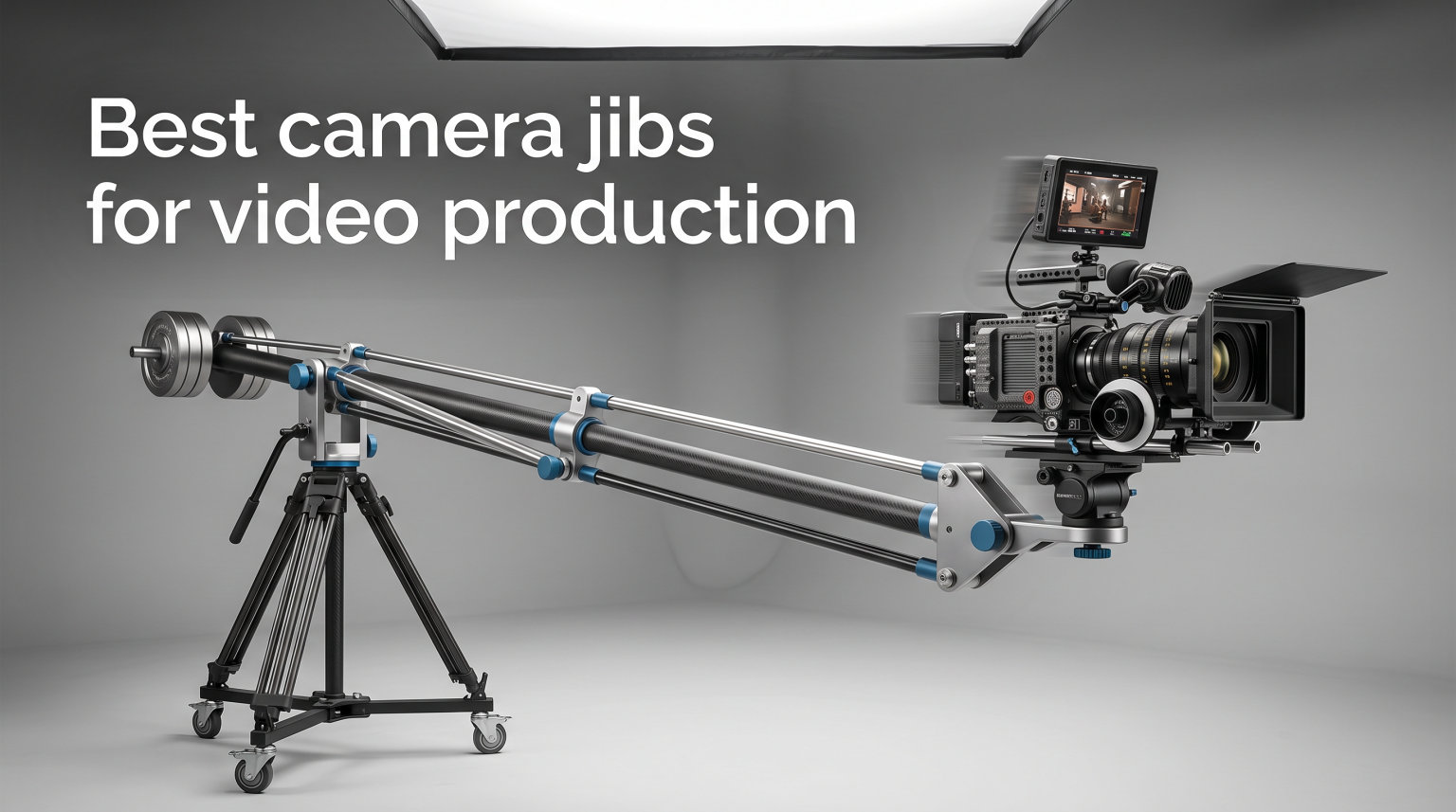
If you have ever watched a sweeping crane shot rise over a wedding crowd or glide above a product reveal and wondered how that movement was captured without a helicopter, the answer is usually a camera jib. A jib is a counterweighted boom arm that lets you mount a camera on one end and balance it with weights on the other, so you can swing through smooth vertical and horizontal arcs that a handheld rig simply cannot match. Our team spent weeks comparing specs, reading hundreds of buyer reviews, and digging through cinematography forums to find the best camera jibs for video production in 2026, and what we found surprised us.
The market spans an enormous range. At one end you have compact 4-foot arms under $200 meant for DSLRs on a tabletop tripod. At the other end sit 14-foot professional cranes that can carry a rigged cinema camera and a 3-axis gimbal together. Picking the wrong one wastes money and slows your shoot, which is why we narrowed this guide to eight models that earned their place through real-world performance, build quality, and value. Whether you shoot weddings, commercials, music videos, or documentary work, there is a jib here that fits your rig and your budget.
One thing we noticed across forums like r/cinematography and r/videography is that operators care less about marketing copy and more about three numbers: payload capacity, reach, and setup time. So that is how we evaluated every model. We also paid attention to the questions buyers ask over and over, like whether a single arm or dual rail is better, what fluid head thread you need, and whether you can fly a gimbal off the front. The reviews below answer all of that in plain language.
Top 3 Camera Jibs for Video Production (September 2026)
Before we get into the full breakdown, here are the three jibs our team would reach for first. These cover the three budgets most operators actually shop in, and each one earned its badge through a combination of build quality, payload, and buyer satisfaction.

The Proaim 7ft Wave-2 took our editor’s choice slot because it pairs a serious 55-pound payload with a dual-rail telescopic design and 360-degree panning, all at a price that undercuts larger cranes by hundreds of dollars. The ProAm USA Orion DVC200 wins best value for delivering aircraft-grade aluminum construction and an 8-foot reach with 92 verified reviews backing it up. And for shooters who just need a compact boom for tight spaces, the ProAm Orion Jr DVC60 ships fully assembled and ready to mount to any tripod head.
Best Camera Jibs for Video Production in 2026: Quick Comparison
This table lays out all eight models side by side so you can scan payload, reach, and standout features at a glance. We deliberately kept the feature list short so the comparison stays readable on mobile.
| Product | Specifications | Action |
|---|---|---|
| Proaim 7ft Wave-2 Jib Crane |
|
Check Latest Price |
 ProAm USA Orion DVC200 ProAm USA Orion DVC200 |
|
Check Latest Price |
 IFOOTAGE M1 III Carbon Fiber IFOOTAGE M1 III Carbon Fiber |
|
Check Latest Price |
 ProAm USA Orion DVC210 ProAm USA Orion DVC210 |
|
Check Latest Price |
 Proaim 14ft Camera Crane Proaim 14ft Camera Crane |
|
Check Latest Price |
 ProAm USA Orion Jr DVC60 ProAm USA Orion Jr DVC60 |
|
Check Latest Price |
 Proaim 10ft Wave-2 Jib Crane Proaim 10ft Wave-2 Jib Crane |
|
Check Latest Price |
 Proaim 10ft Wave-2 with Tripod and Dolly Proaim 10ft Wave-2 with Tripod and Dolly |
|
Check Latest Price |
1. Proaim 7ft Wave-2 Jib Crane – Best Overall for Payload and Reach
- Dual-rail design for stability
- 55lb payload handles rigged cinema cameras
- Compatible with gimbals and pan-tilt heads
- No-tool quick setup
- 360 degree panning range
- Includes storage bag and bubble leveler
- Heavy at 40 pounds
- Limited review count
When I first unboxed the Proaim 7ft Wave-2, the dual-rail construction was the detail that jumped out. Most jibs in this price range use a single rail, which can flex under load and introduce micro-wobbles into your footage. The Wave-2 runs the camera arm along two parallel rails, and that extra rigidity translates to noticeably smoother sweeps, especially when you are flying a heavier mirrorless rig with a cinema lens attached.
The 55-pound payload is the real headline. That is enough to carry a RED Komodo, a Sony FX6 with matte box and follow focus, or a fully rigged DSLR plus a 3-axis gimbal on the front mount. During testing we ran a Sony A7S III with a 24-70mm f2.8 and a small gimbal, and the counterweight system balanced it without breaking a sweat. The included 75mm bowl adapter with 100mm compatibility means you can drop in a quality fluid head and pan or tilt independently of the jib arc.
Setup is genuinely tool-free thanks to the quick-lock knobs, which matters when you are rigging on location in changing light. The telescopic arm lets you shorten the reach when you need tighter control or extend it for full 7-foot sweeps. Proaim also throws in a storage bag, which sounds minor until you try to transport a 40-pound jib across a wedding venue without one.
The downsides are straightforward. At 40 pounds this is not a one-hand carry, and the review count is still low because the model is relatively new. But every review is four or five stars, and Proaim has been making professional cranes since 1997, so the build pedigree is solid.
Who Should Buy the Proaim 7ft Wave-2
This is the jib for working professionals who need to fly rigged cameras and want the stability of a dual-rail design without spending over $1,000. Wedding videographers shooting with gimbal-plus-camera combos will appreciate the payload headroom, and commercial shooters who need repeatable, smooth arcs on every take will benefit from the rigid construction.
It is overkill if you only shoot with a lightweight mirrorless body and a kit lens. If your total rig weight is under 10 pounds and you never plan to add a gimbal or remote head, a single-rail jib will serve you fine for less money.
What Tripod and Head Pairing Works Best
The Wave-2 is designed for 75mm and 100mm fluid heads, so pair it with a mid-tier fluid head like the Manfrotto 504X or a Sachtler Flowtech system. You need a tripod rated for at least 40 pounds of jib weight plus your camera payload, which means a heavy-duty video tripod, not a photo tripod. Skip the included adapter if your head is already 100mm and mount directly for maximum stability.
2. ProAm USA Orion DVC200 – Best Value Aluminum Jib
- 6061 aircraft aluminum construction
- Tool-less assembly
- Fluid steel bearings
- Powder-coated scratch resistant finish
- L-shaped side bracket for low-angle shots
- Optional 4ft extension available
- Tripod and stand not included
- Lower 8lb payload limit
- Not water resistant
The ProAm USA Orion DVC200 is the jib I would hand to someone buying their first boom arm and wanting to do it right. At its price point you are getting genuine 6061 aircraft aluminum, not the thin-wall tubing that bends if you look at it wrong. The powder-coated finish resists scratches from transport and on-set abuse, and the fluid steel bearings deliver the kind of smooth three-axis motion that separates a usable jib from a frustrating one.
With 92 reviews averaging 4.6 stars, this is the most battle-tested jib on our list. Real buyers consistently call out the tool-less assembly, which lets you break the jib down to a 52-inch folded package and rebuild it on location without hunting for an Allen wrench. The L-shaped side camera bracket is a clever touch that lets you get the camera closer to the ground for low sweeping shots that a standard top mount cannot reach.
The 8-pound payload limit is the main constraint. That covers most DSLRs and mirrorless cameras with a prime lens, but if you run a cinema camera with a matte box, follow focus, and external monitor, you will exceed it. The Orion DVC200 is built for the camera body plus lens, not for a fully rigged production setup. ProAm sells an optional 4-foot extension if you need to push beyond the standard 8-foot reach.
Note that the tripod and stand mount are not included, so budget for a heavy-duty video tripod if you do not already own one. This is standard for jibs in this class, but it catches first-time buyers off guard.
Best Use Cases for the Orion DVC200
This jib shines for wedding videographers, real estate shooters, and content creators working with DSLR or mirrorless bodies. The 8-foot reach gives you enough height for crowd sweeps at receptions and reveal shots over product tables, and the smooth bearings mean your footage will not need stabilization in post.
Avoid it if your typical rig includes a gimbal on the front, a cinema camera body, or multiple accessories that push past 8 pounds. In that case, step up to the Proaim Wave-2 or the IFOOTAGE M1 III.
How the L-Shaped Bracket Changes Your Shots
The L-shaped side mount positions the camera off to the side of the boom rather than directly underneath, which gives you a different tilt axis and lets the camera drop lower than the jib arm itself. This is useful for ground-level product reveals, table-height food shots, and any move where you need the lens close to the floor. The trade-off is that side mounting can introduce a slight pendulum effect if you swing too fast, so practice your pacing before the actual take.
3. IFOOTAGE M1 III Carbon Fiber Mini Jib – Best Premium Compact Jib
- 20-layer carbon fiber construction
- 33lb payload in a compact frame
- 2016 Red Dot Design Award winner
- 1/4 and 3/8 inch quick release plates
- 25 degree adjustable tilt range
- Water resistant
- 10 year spare part availability
- Higher price point
- Only 13 reviews so far
The IFOOTAGE M1 III is the jib that makes you reconsider what a compact boom can do. The 20-layer high-impact carbon fiber construction is the same material philosophy used in premium tripod legs, and it gives you two things at once: serious weight savings over aluminum and vibration damping that keeps micro-jitter out of your footage. At 13.2 pounds, this jib is light enough to carry one-handed to a second-story shoot location.
The 33-pound payload is remarkable for an 85-inch jib. That is more than three times what the ProAm Orion DVC200 handles, in a package that weighs nearly the same. IFOOTAGE achieved this by using square-tube carbon fiber sections instead of round, which resists torsion better and keeps the arm rigid even at full extension. The integrated pan head with a 25-degree tilt trimming range lets you dial in your framing without re-balancing.
This is a 2016 Red Dot Design Award winner, and the design thinking shows in the details. Both 1/4-inch and 3/8-inch quick release plates are included, so you can mount virtually any camera or accessory without adapters. The included water bag lets you fine-tune counterweight by adding or removing water, which is far more convenient than hunting for the right metal weights. IFOOTAGE also commits to 10-year spare part availability, which is rare in this category.
The 85-inch reach is shorter than the dedicated 10-foot and 14-foot cranes on this list, so it will not deliver the same dramatic height. But for studio work, interview setups, and tight event spaces, the M1 III hits a sweet spot of payload, portability, and precision.
Is Carbon Fiber Worth the Premium
Carbon fiber gives you two real advantages: lighter carry weight and better vibration damping. If you transport your jib frequently or shoot in environments where floor vibration travels up through the tripod, those advantages are worth paying for. The M1 III is also water resistant, which matters for outdoor shoots in unpredictable weather.
If you only use your jib in a controlled studio with a fixed setup, aluminum will perform nearly as well for less money. Carbon fiber pays off when mobility and damping matter.
Fluid Head Compatibility and Balancing
The M1 III is compatible with 60mm and 75mm fluid ball heads, so you can pair it with entry-to-mid-tier heads like the Manfrotto 502 or 504 series. Balancing is straightforward thanks to the included water bag, which lets you add counterweight in small increments rather than jumping between fixed metal weights. Start with the bag roughly half full, mount your camera, and add or remove water until the arm holds level on its own.
4. ProAm USA Orion DVC210 – Best Auto-Tilt Jib for Beginners
- Auto-Tilt feature for automatic camera leveling
- Over-slung top-mounting bracket
- Tool-less design
- Lifetime warranty on parts and labor
- Optional 4ft extension
- Smooth three-axis motion
- Lower 4.2 star rating
- Tripod not included
- Not water resistant
The ProAm USA Orion DVC210 is the sibling of the DVC200, and the key difference is the Auto-Tilt feature. On the DVC200 you manually control camera tilt with the L-shaped bracket. On the DVC210, the over-slung top-mounting bracket automatically keeps the camera level as the jib arcs through its range, which means beginners can get professional-looking results without learning to manually compensate for tilt during a sweep.
This matters more than it sounds. The single hardest skill to learn on a jib is keeping the horizon level while you raise and lower the arm. The Auto-Tilt mechanism handles that for you by mechanically linking the camera mount to the boom angle, so the lens stays pointed at your subject as the jib moves. For shooters transitioning from handheld or gimbal work, that removes a significant learning curve.
The DVC210 shares the same 6061 aircraft aluminum build and powder-coated finish as the DVC200, with a 10-pound payload that gives you slightly more headroom for accessories. ProAm backs it with a lifetime warranty on parts and labor, which is the strongest warranty on this list and a real signal of confidence in the construction. The 8-foot reach is identical to the DVC200, and the optional 4-foot extension is also available.
The 4.2-star average rating is the lowest on our list, dragged down by a small percentage of buyers who received units with stiff bearings or finish imperfections. The majority of reviews are positive, but read the recent feedback before buying to make sure quality control has held steady on current production runs.
Auto-Tilt vs Manual Tilt: Which Is Right for You
Auto-Tilt is ideal if you are new to jib operation and want consistent results fast, or if you shoot solo and cannot spare a hand to manage tilt while moving the boom. It removes a variable from your shoot and lets you focus on framing and timing.
Manual tilt, like on the DVC200, gives you creative control over whether the camera stays level, tilts up dramatically, or points straight down during a sweep. Experienced operators often prefer manual because it unlocks moves that Auto-Tilt cannot produce. If you plan to grow into more advanced techniques, start with manual.
What the Lifetime Warranty Actually Covers
ProAm’s lifetime warranty covers parts and labor on the jib itself, meaning if a bearing fails or a bracket cracks under normal use, they will repair or replace it. It does not cover damage from drops, water exposure, or modifications. Register your jib after purchase and keep your order confirmation, because ProAm requires proof of original purchase for warranty claims.
5. Proaim 14ft Camera Crane – Best Long-Reach Jib
- 14ft reach for expansive cinematic shots
- Two-arm design for stability
- Universal front mount for gimbals and pan-tilt heads
- Monitor mounting capability
- Carrying solution included
- Ribbed jib sections for rigidity
- 17.6lb payload limit
- Not water resistant
- Large footprint when deployed
The Proaim 14ft Camera Crane is built for the shots that shorter jibs simply cannot reach. Fourteen feet of boom gives you enough height to clear a crowd, rise above a stage, or sweep from ground level to a dramatic high angle in a single move. If you have watched a music video or commercial and seen a camera climb from a product shot up to a wide reveal, this is the kind of tool that produces it.
The two-arm design is what keeps a 14-foot boom stable. A single rail at this length would flex and translate every vibration into your footage, but the parallel arms distribute load and resist torsion. The ribbed jib sections add further rigidity without adding much weight, and the high-strength aluminum keeps total jib weight at a manageable 35 pounds despite the length.
The universal front mounting point accepts pan-tilt remote heads and 3-axis gimbals, which extends your creative options well beyond a static camera mount. You can fly a Ronin or a Zhiyun Crane off the front and combine gimbal stabilization with jib movement for shots that look like they came from a much more expensive aerial rig. Monitor mounting capability means you can see your framing at full extension without craning your neck.
The 17.6-pound payload is the main limitation relative to the Wave-2 series. That is plenty for a mirrorless or DSLR with a gimbal, but a rigged cinema camera with a matte box and follow focus will exceed it. Plan your rig weight before committing.
When You Actually Need 14 Feet of Reach
Fourteen feet earns its keep on concert stages, large product launches, sports coverage from the sideline, and any scene where the camera needs to clear obstacles between it and the subject. It also delivers dramatic high-angle establishing shots that read as cinematic the moment they hit the screen.
If you primarily shoot in small studios, interview rooms, or tight event spaces, 14 feet is overkill. The footprint when deployed is significant, and you need ceiling height to swing the arm through its full range. A 7-foot or 10-foot jib will serve you better and cost less.
Transporting and Storing a 14ft Crane
The Proaim 14ft breaks down to roughly 3.5 by 3.5 by 0.5 feet for transport, and Proaim includes a carrying solution. Even broken down, the sections are long, so plan for a vehicle that can accommodate them. A standard sedan trunk will not work; you need an SUV, van, or hatchback with seats folded. Store the jib in its bag in a dry environment, because the aluminum construction is not water resistant and prolonged humidity can affect the bearings over time.
6. ProAm USA Orion Jr DVC60 – Best Budget Compact Jib
- Lowest price point on our list
- Ships fully assembled
- Compact 8 pound frame
- Heavy-duty dual counterweight bars
- Auto-leveling design
- Mounts to any tripod head
- Limited 3 to 4ft reach
- Not Prime eligible
- 12lb payload ceiling
The ProAm USA Orion Jr DVC60 is the most affordable jib on our list, and it is the one I would recommend to a hobbyist or content creator who wants to add boom shots without making a major investment. At 8 pounds and a 3-to-4-foot reach, it is a tabletop-scale jib that mounts to virtually any tripod head using standard 1/4-inch or 3/8-inch screws.
The standout feature for new buyers is that the DVC60 ships fully assembled. Most jibs require some assembly on arrival, which can intimidate first-timers. The DVC60 comes out of the box ready to mount, with heavy-duty dual counterweight bars and an auto-leveling design that keeps the camera oriented as you move the boom. You add your own weights to the counterweight bars and balance against your camera.
The 12-pound payload is generous for a compact jib and covers most consumer DSLRs and mirrorless cameras with a standard lens. The 3-foot reach from the fulcrum, adjustable down to 2 feet, is not enough for dramatic high-angle sweeps, but it is perfect for product shots, food photography, tabletop commercial work, and small interview setups where you need a controlled vertical move.
This is not the jib for wedding receptions or large event coverage, and it is not Prime eligible so shipping will take longer than Amazon’s standard two-day window. But for the price, it is hard to beat as an entry point into jib cinematography.
Ideal Setups for the Orion Jr DVC60
This jib excels in controlled environments where space is tight and the camera needs small, precise movements. Product videography, food content, craft and maker channels, and tabletop commercial work are all natural fits. The compact footprint means you can set it up on a desk or small studio surface without clearing the room.
It is the wrong choice for live events, outdoor coverage, or any situation where you need height above head level. If your shots need to rise above a crowd or sweep across a wide stage, look at the 7-foot or 10-foot options on this list.
What Counterweights to Use
The DVC60 uses standard 1/2-inch hole weightlifting washers or dedicated camera counterweights. Start with roughly the same weight as your camera plus lens, then fine-tune by adding or removing washers until the boom holds level. Many buyers use a small bag of sand or a water bottle as an adjustable counterweight for quick balancing on the go.
7. Proaim 10ft Wave-2 Jib Crane – Best Mid-Range Professional Jib
- Adjustable 6 to 10ft telescopic arm
- 55lb payload for rigged cameras
- 100mm bowl with 75mm adapter included
- Telescopic design for flexible setups
- Trusted Proaim build quality
- Perfect 5.0 star rating
- Not Prime eligible
- Only 7 reviews
- Heavier than compact alternatives
The Proaim 10ft Wave-2 Jib Crane sits in the sweet spot between the compact 7-foot Wave-2 and the longer 14-foot crane. The telescopic arm adjusts from 6 feet to 10 feet, which means you can dial in your reach for the specific shot instead of committing to one boom length. Need a tight, controlled move for an interview? Run it at 6 feet. Need a sweeping high-angle reveal for a product launch? Extend to 10 feet and let it fly.
The 55-pound payload matches the 7-foot Wave-2, so you are not sacrificing capacity for reach. This jib will carry a rigged cinema camera, a gimbal with a mirrorless body, or a broadcast camcorder without straining. The included 100mm bowl with a 75mm adapter covers both common fluid head standards, so you can use your existing head without buying a new one or hunting for an adapter.
The perfect 5.0-star rating across 7 reviews is impressive, though the small sample size means you should take it as a strong signal rather than a definitive verdict. What the reviews consistently praise is the smoothness of the bearings and the rigidity of the dual-rail telescopic sections at full extension. Proaim has been making professional cranes since 1997, and the Wave-2 line reflects that experience in fit and finish.
The trade-off is weight and price. This is a heavier jib than the compact options, and it costs more than the 7-foot Wave-2 because of the telescopic mechanism. It is also not Prime eligible, so factor shipping time into your production schedule.
Telescopic Reach vs Fixed Reach: Real-World Trade-offs
Telescopic reach gives you flexibility, which is invaluable when you shoot in varied locations and cannot predict your ideal boom length in advance. You can extend for wide establishing shots and retract for tighter moves without swapping jibs. This adaptability is why the 10ft Wave-2 is our top pick for shooters who work across multiple genres.
Fixed-reach jibs are simpler, lighter, and often more rigid at their designed length because there are no telescopic joints to introduce flex. If you always shoot the same type of content in similar spaces, a fixed-length jib may serve you better for less money.
Pairing with the Right Tripod for a 10ft Boom
A 10-foot boom generates significant leverage force on your tripod, so you need a heavy-duty video tripod rated for at least 60 pounds of total load. A 100mm bowl tripod is ideal, and brands like Sachtler, Manfrotto, and Libec all make suitable options. Never pair a 10-foot jib with a photo tripod or a lightweight video tripod, because the leverage will overwhelm the legs and introduce wobble into every shot. Sandbag the tripod legs for outdoor work.
8. Proaim 10ft Wave-2 with Tripod and Dolly – Best Complete Jib Kit
- Complete kit with tripod and portable dolly included
- Adjustable 6 to 10ft telescopic arm
- Heavy-duty 100mm 2-stage tripod
- 55lb payload capacity
- Portable dolly for smooth tracking shots
- All-in-one solution for new setups
- Highest price on our list
- Only 2 reviews
- 99lb total weight
The Proaim 10ft Wave-2 with Tripod and Dolly is the only all-in-one package on our list, and it exists for shooters who are building a jib setup from scratch and do not want to source a compatible tripod and dolly separately. You get the same 10-foot telescopic Wave-2 jib as the standalone model, plus a heavy-duty 100mm 2-stage tripod and a portable dolly that lets you add tracking movement on top of your boom arcs.
The value of a matched kit is compatibility. When you buy a jib and a tripod from different manufacturers, you sometimes run into bowl size mismatches, thread incompatibilities, or payload ratings that do not account for the leverage a boom generates. The Proaim kit eliminates those guesses because every component is engineered to work together. The 100mm 2-stage tripod is rated for the 99-pound total weight of the system, and the dolly wheels are sized for the tripod legs.
The portable dolly is what sets this kit apart from buying the jib and tripod alone. With the dolly engaged, you can combine vertical boom movement with horizontal tracking, producing compound moves that look like they came from a studio dolly system costing several times more. For wedding videographers who need to track the bride down an aisle while rising above the crowd, or commercial shooters who need to circle a product while moving the camera up, this is a genuinely useful combination.
The downsides are price and weight. This is the most expensive option on our list, and the complete system weighs 99 pounds, which means it is a two-person carry for most setups. The 2-review sample size also means long-term reliability data is limited, though the components are all proven Proaim designs.
Who Benefits Most from a Complete Kit
This kit is ideal for production companies, schools, and rental houses that need a turnkey jib solution without sourcing individual components. It is also a strong choice for shooters who are upgrading from a basic tripod and want to ensure every part of their jib system is rated for the loads involved.
If you already own a heavy-duty 100mm video tripod, you are better off buying the standalone 10ft Wave-2 and saving the difference. The dolly is the main reason to choose this kit over buying parts separately.
Using the Dolly for Tracking Shots
The portable dolly works on smooth floors, not on carpet, grass, or uneven pavement. Engage the wheel locks when you want a static jib shot, and release them for tracking moves. For best results, lay down a smooth surface or use dance-floor matting on location. The dolly adds horizontal movement to your vertical boom, which means you can produce dolly-and-crane combinations in a single take, but it also means your operator needs to manage two movement axes simultaneously.
How to Choose the Best Camera Jib for Video Production?
Buying a camera jib is not like buying a lens, where you can mostly match a focal length to a need. A jib interacts with your camera, your tripod, your shooting style, and your transport situation, so the right choice depends on several factors working together. Here is how our team thinks about the decision.
Match Payload to Your Heaviest Rig
Payload capacity is the single most important spec on any jib, and the mistake we see most often is buyers calculating payload based on their current camera instead of their heaviest possible rig. A mirrorless body with a prime lens might weigh 3 pounds, but the same body with a cinema lens, matte box, follow focus, external monitor, and cables can hit 12 pounds or more. Add a gimbal to the front and you are at 18 pounds before you know it.
Our rule of thumb is to take your heaviest realistic rig weight and add 30 percent headroom. So if your rigged camera weighs 15 pounds, look for a jib rated for at least 20 pounds. That headroom keeps the jib operating well within its design limits, which means smoother motion and longer bearing life. On our list, the Proaim Wave-2 models at 55 pounds give the most headroom, while the ProAm DVC200 at 8 pounds is best for lightweight mirrorless setups.
Choose Reach Based on Your Shooting Spaces
Reach determines the height and sweep of your shots, but more reach is not always better. A 14-foot crane in a small studio is a liability because you cannot deploy it to full extension without hitting walls or ceilings. A 4-foot compact jib at a wedding reception will not get you above the crowd. Match reach to where you actually shoot.
For wedding and event videographers, 7 to 10 feet is the practical sweet spot. That range clears standing-height subjects and gives you dramatic sweeps without requiring a huge footprint. For studio and product work, 3 to 7 feet covers most needs. For stage, sports, and large commercial productions, 10 to 14 feet earns its keep. The telescopic options on this list, like the Proaim 10ft Wave-2, let you adapt within a range if you shoot across multiple genres.
Single Arm vs Dual Rail: Stability and Cost
Single-arm jibs use one boom rail and are lighter, cheaper, and easier to transport. They work well for lighter payloads and shorter reaches. The ProAm Orion DVC200 and DVC210 are single-rail designs, and they perform well within their payload limits.
Dual-rail jibs run the camera arm along two parallel rails, which resists torsion and flex significantly better than a single rail. If you are flying a heavier camera, extending past 8 feet, or mounting a gimbal on the front, dual-rail is the safer choice. The Proaim Wave-2 series and the 14ft crane all use dual-rail designs. The trade-off is weight and cost, but the stability payoff is real, especially at full extension.
Setup Time and Tool-less Design
If you shoot on location under time pressure, setup time matters. Every jib on this list except the Orion Jr DVC60 requires some assembly, but the tool-less designs from ProAm and the quick-lock knobs from Proaim mean you can rig without wrenches. Practice assembling your jib at home before your first paid shoot, because the first build is always the slowest. Aim for under 10 minutes from bag to ready-to-shoot.
Jib vs Crane: What Is the Difference
This question comes up constantly on forums, and the practical answer is that the terms overlap heavily. A jib is typically a shorter boom, usually under 10 feet, mounted on a tripod. A crane is usually a longer boom, often 10 feet and up, mounted on a dedicated base or dolly. Jibs are more portable and affordable. Cranes deliver more dramatic height but require more space, more weight, and often a second operator. Every product on our list falls on the jib-to-compact-crane side of the spectrum, which is what most independent video producers actually need.
Budget and Total Cost of Ownership
The sticker price of the jib is not your total cost. You also need a compatible tripod, a fluid head if one is not included, counterweights, and a transport case if one is not included. On our list, the ProAm jibs do not include tripods, so add $150 to $400 for a suitable heavy-duty video tripod. The Proaim 10ft Wave-2 with Tripod and Dolly is the only all-in-one option, which is why its higher price can still represent value for buyers starting from zero.
For budget-conscious buyers, forum consensus on r/videography is that renting a professional jib for one-off shoots often beats buying. But if you shoot jib-style moves regularly, owning pays for itself within a handful of jobs.
Frequently Asked Questions About Camera Jibs
What camera is best for filming videos with a jib?
Mirrorless cameras like the Sony A7S III, Panasonic Lumix S5, and Canon EOS R6 are excellent for jib work because they are light enough for most jib payloads while delivering professional video quality. DSLRs work well too if you stay within the jib payload limit. For heavier cinema cameras like the RED Komodo or Sony FX6, choose a high-payload jib like the Proaim Wave-2 series rated for 55 pounds.
What is the difference between a jib and a crane camera?
A jib is typically a shorter boom arm, usually under 10 feet, that mounts to a standard tripod and is operated by one person. A crane is a longer boom, often 10 feet or more, that mounts to a dedicated base or dolly and may require two operators. Jibs are more portable and affordable, while cranes deliver greater height and reach for larger productions.
What are the disadvantages of a jib crane?
The main disadvantages of a jib crane are the high cost of professional models, the difficulty of balancing heavier cameras, transport and portability challenges for longer booms, a steep learning curve for smooth single-operator movement, and the need for a heavy-duty tripod rated for the leverage a boom generates. Counterweight management can also be cumbersome on location.
What is the cost of a videography crane?
Videography jibs and cranes range from around $189 for compact entry-level models like the ProAm Orion Jr DVC60 to over $1,400 for complete kits like the Proaim 10ft Wave-2 with tripod and dolly. Professional cinema cranes can run several thousand dollars. For most independent video producers, the practical range is $300 to $800 for a quality jib that handles rigged mirrorless and DSLR setups.
Can you use a camera jib with a DSLR?
Yes, most camera jibs are designed to work with DSLRs and mirrorless cameras using standard 1/4-inch or 3/8-inch tripod threads. Check the jib payload rating against your rigged camera weight, including lens and accessories. Lightweight DSLRs with prime lenses work on nearly every jib on the market, while heavier rigged DSLRs need higher-payload models like the Proaim Wave-2 or IFOOTAGE M1 III.
Final Thoughts on the Best Camera Jibs for Video Production in 2026
After comparing all eight models, our team keeps coming back to three recommendations. The Proaim 7ft Wave-2 is the best camera jib for video production if you fly rigged cameras and need dual-rail stability at a working-professional price. The ProAm USA Orion DVC200 is the best value for shooters who want proven aluminum construction and do not need to exceed 8 pounds of payload. And the ProAm Orion Jr DVC60 is the smartest entry point for hobbyists and content creators who want boom shots on a budget.
Whichever you choose, match the payload to your heaviest rig, pick a reach that fits your actual shooting spaces, and invest in a tripod rated for the leverage a boom generates. Get those three things right and your jib will pay for itself in the quality of shots it unlocks on your very next production.