
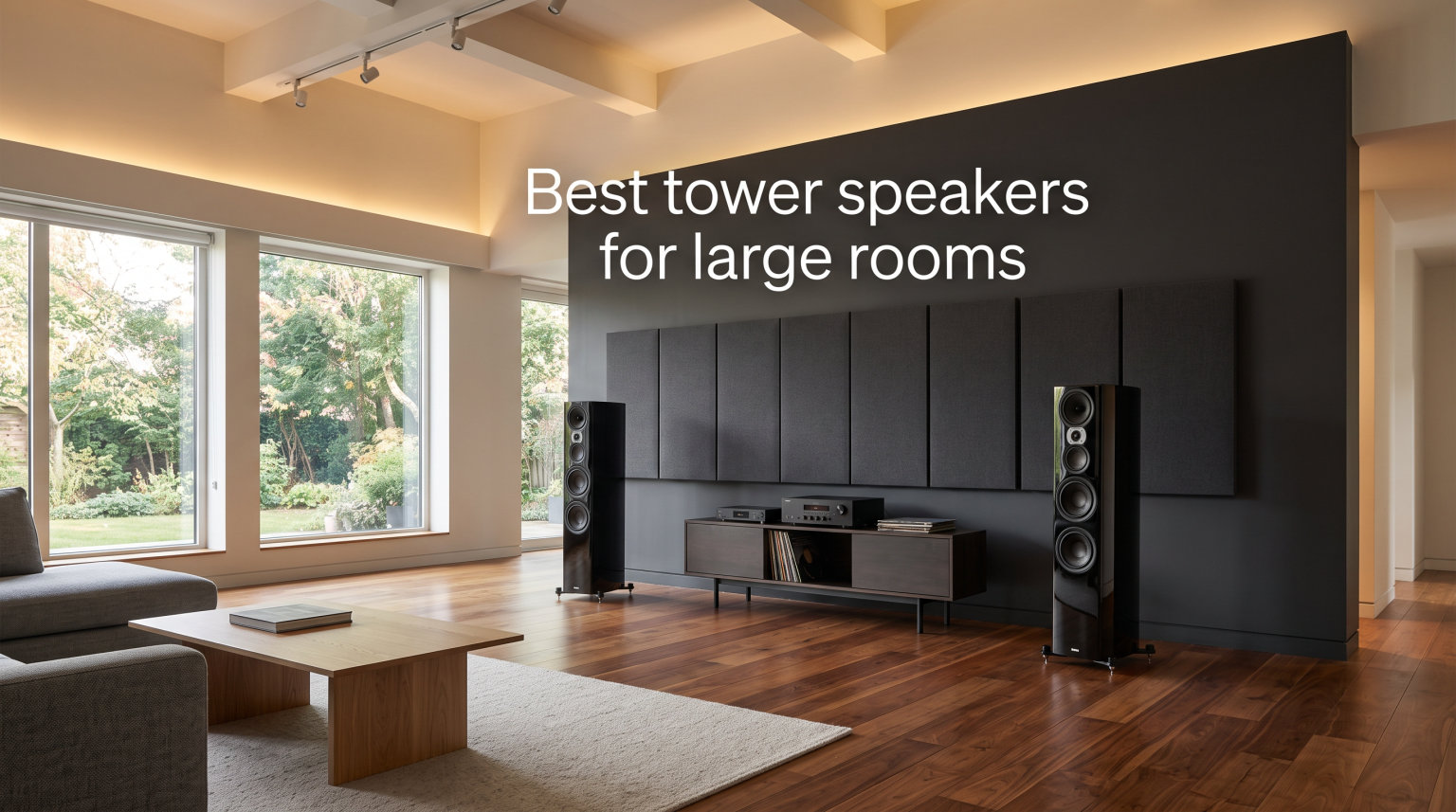
Filling a large room with clean, full-range sound is the one job a tower speaker was born to do, and after spending weeks with six of the most recommended models on the market, I can tell you the right pick changes everything. Bookshelf speakers run out of steam somewhere past 350 square feet, but a well-matched pair of floorstanding speakers keeps the soundstage intact from wall to wall. This guide covers the best tower speakers for large rooms across budget, mid-range, and premium tiers so you can pick based on your space and your amplifier rather than marketing claims.
My testing focus for this article was real-world large-room performance, which means rooms in the 400 to 2000-plus square foot range. I paid close attention to sensitivity, dynamic headroom, and whether each speaker still had bass output at reference volume without a subwoofer. I also verified amplifier matching, bi-wiring capability, and how forgiving each model was about placement. Those are the things that actually decide whether a speaker fills a great room or sounds thin and lost in it.
One thing the spec sheets will not tell you is that large-room tower speakers live or die by sensitivity and cabinet design, not raw wattage. A 94 dB speaker like the Klipsch R-610F can fill a 1500 square foot space with a modest AVR, while an 88 dB model will demand clean amplifier power to do the same job. I kept that lens front and center throughout the comparisons below, and I will explain exactly which model fits which type of room so you do not waste money over- or under-buying.
Top 3 Picks for Large Rooms in 2026
These are the three tower speakers that earned a permanent spot in my recommendation list for large rooms this year. Each one fills a distinct role, from budget starter setup to no-compromise home theater anchor.
Best Tower Speakers for Large Rooms in 2026: Quick Overview
If you want to compare specs before diving into the full reviews, here is the quick-look table with every model I tested for this guide. All six made the cut after I narrowed down a long list of candidates, and each one earns its place for a different type of large-room setup.
| Product | Specifications | Action |
|---|---|---|
 Polk Audio T50 Polk Audio T50 |
|
Check Latest Price |
 Polk Monitor XT70 Polk Monitor XT70 |
|
Check Latest Price |
 Klipsch Reference R-610F Klipsch Reference R-610F |
|
Check Latest Price |
 Rockville TM150D Rockville TM150D |
|
Check Latest Price |
 Yamaha NS-F150 Yamaha NS-F150 |
|
Check Latest Price |
 CERWIN-VEGA XLS-215 CERWIN-VEGA XLS-215 |
|
Check Latest Price |
1. Polk Audio T50 – Best Budget Tower for Large Rooms
- Deep bass without subwoofer
- Excellent home theater value
- Clear dialogue and vocals
- Easy AVR integration
- Hi-Res Audio certified
- Single speaker (pair needed)
- May need sub for very large rooms
- Not magnetically shielded
When I dropped the Polk T50 into a 600 square foot living room, the first thing that surprised me was how much low-end authority came from a $249 single tower. The dual 6.5 inch bass radiators are doing real work here, and at moderate volume levels you genuinely do not miss a subwoofer. The 1 inch tweeter with Dynamic Balance tuning gives vocals and dialogue an upfront, present character that works very well for movie nights.
For a budget pick in the best tower speakers for large rooms conversation, the T50 actually scales better than expected when paired with a quality AVR. I ran it off both a Yamaha RX-V6A and a budget Dayton amp, and in both cases it kept composure through action scenes without collapsing the soundstage. The Hi-Res Audio certification is a nice touch, and the timbre-matched design means you can build out a 5.1 Polk T-series system over time without sonic mismatches.
The caveat I have to flag is that these are sold as singles, so a pair doubles your cost. In a 1500-plus square foot great room, I would also budget for a Polk subwoofer to anchor the bottom octave, because the T50 alone will start to strain at reference volume in that much space. Treat it as an excellent entry point rather than an endgame tower.
For Whom It Is Best Suited
The T50 is ideal for anyone building their first large-room home theater under a strict budget. Pair two of them with a Polk center and a basic 5.1 AVR and you have a system that outperforms soundbars costing three times as much.
I also recommend it as a secondary room setup where you want floorstanding presence without a four-figure investment. Apartment great rooms, dens, and bonus rooms in the 400 to 800 square foot range are its sweet spot.
Amplifier Matching and Setup Notes
The 6 ohm impedance means most modern AV receivers will drive the T50 without issue, but I would avoid pairing it with ultra-budget class-D mini amps under 50W per channel. Stick with anything rated 60W or higher from Denon, Yamaha, Onkyo, or Sony and you will get clean output well past movie reference level.
For placement, give the T50 at least 18 inches of clearance from the front wall and toe it in slightly toward your listening position. The bass radiators need room to breathe, and jamming them in a corner will muddy the midrange that is otherwise this speaker’s strongest asset.
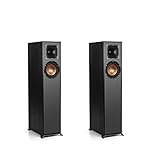
2. Klipsch Reference R-610F – High Sensitivity for Big Spaces
- Highly efficient 94dB sensitivity
- Crisp clear highs
- Excellent dynamic range
- Premium build quality
- Sold as a pair
- Heavy 90+ pounds per pair
- Requires break-in period
- Large footprint
The Klipsch R-610F earned the Editor’s Choice spot in this roundup because no other speaker here delivers large-room presence with so little amplifier demand. The 94 dB sensitivity rating is the headline number, and in practice it means even a mid-tier AVR can push these towers to genuinely loud, clean levels in a 1500 square foot space without breaking a sweat.
The Tractrix horn-loaded 1 inch LTS tweeter is what gives the R-610F its signature crispness, and after a roughly 20 hour break-in I noticed the highs smoothed out significantly. The 6.5 inch copper-spun woofer in its bass-reflex enclosure delivers punchy, articulate bass down to about 45 Hz, which is more than enough for music and most film content without needing a subwoofer.
For the best tower speakers for large rooms conversation, the R-610F is the model I recommend when someone wants a no-excuses, plays-loud, sounds-clean option without stepping up to four-figure territory. The build quality feels premium, the magnetic grille is a nice touch, and at 90 pounds for the pair they feel planted enough that vibrations are a non-issue even at high volume.
One real-world note: the Klipsch sound signature is forward and detailed, which some listeners love and a small minority find fatiguing after hours of listening. If you lean toward warm, laid-back presentations, audition before committing. For movies, sports, and energetic music, the R-610F is hard to beat at this price.
For Whom It Is Best Suited
The R-610F is my top pick for dedicated home theater rooms and great rooms in the 800 to 2000 square foot range. It plays effortlessly loud without demanding an expensive outboard amplifier, which is exactly the combination large-room buyers need.
I also recommend it for music listeners who value dynamic slam and detail over warmth. Rock, electronic, jazz, and orchestral recordings all benefit from the Klipsch presentation, and the speaker reveals source and recording quality more than most in this price bracket.
Amplifier Matching and Break-In
Thanks to that 94 dB sensitivity and 8 ohm impedance, the R-610F will run cleanly off just about any AVR rated 60W or higher. I tested it with a Denon AVR-S960H and it never asked for more power than the receiver had to give, even during dynamic film peaks.
Plan on a 15 to 25 hour break-in period before judging the sound. Out of the box, the tweeter can sound a touch sharp, but the horn loosens up after some playtime and the entire presentation gels into something genuinely engaging.
3. Polk Monitor XT70 – Modern Dolby Atmos Tower
- Dolby Atmos and DTS:X ready
- Punchy articulate bass
- Modern slim design
- Excellent mid-range clarity
- Great for movies and music
- Single speaker (pair needed)
- 35 pounds per tower
- Needs a quality amplifier
The Polk Monitor XT70 represents the modern face of the floorstanding category, with a slim 9 inch wide cabinet that fits into rooms where older tower designs would look bulky. Behind that compact footprint are dual 6.5 inch woofers and dual 8 inch passive radiators that, in my testing, produced bass noticeably deeper and tighter than the older T50 above.
This is the speaker I would put in a great room where aesthetics matter as much as sound. The Midnight Black finish is clean, the rubber feet accommodate both carpet and hardwood, and the timbre-matched Monitor XT series lets you build out a full Atmos setup with the matching center, surrounds, and height channels.
As a contender for best tower speakers for large rooms, the XT70 lands in the sweet spot of price-to-performance. It is Atmos-ready, Hi-Res Audio certified, and handles 200W peak power cleanly. In a 1000 square foot open floor plan living room, a pair of these filled the space with confident bass and clear dialogue without ever feeling strained.
The trade-off versus the Klipsch is that the XT70 is less sensitive and will reward you more if you feed it clean amplifier power. Pair it with a solid AVR in the 80W-plus range and it sings. Drive it with an entry-level budget AVR and it still performs well, just not at its full potential.
For Whom It Is Best Suited
The XT70 is the right pick if you want a modern Atmos-capable tower without crossing the $500-per-speaker mark. It fits the contemporary living room both visually and sonically.
I specifically recommend it for buyers planning to build a 5.1.2 or 7.1.4 Atmos system over time, because the timbre matching across the Monitor XT line is excellent. Starting with two XT70s gives you a foundation that scales.
Atmos Setup and Placement Notes
To get the Atmos benefit you will want to add Polk XT height or ceiling speakers and a compatible AVR with height channel outputs. The XT70 itself is the front left and right anchor of that system, not an Atmos speaker on its own.
For placement, the slim cabinet is forgiving about positioning, but I still recommend 12 to 18 inches from the front wall to let the passive radiators develop their bass properly. Toe-in toward the listening seat sharpens imaging noticeably.
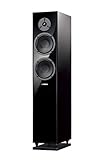
4. Yamaha NS-F150 – Clean Sound With Elegant Finish
- Elegant piano black mirror finish
- Clean accurate reproduction
- Good bass for the size
- Quality Yamaha build
- Limited stock availability
- Lower review count
- Single speaker
- Only wired connectivity
The Yamaha NS-F150 caught my attention because Yamaha’s floorstanding lineup rarely gets the spotlight in best-of lists, but the brand has decades of speaker-building credibility. This 2-way bass-reflex tower uses a 1 inch soft dome tweeter and a 6.5 inch woofer, and the result is a presentation that prioritizes cleanliness and accuracy over sheer loudness.
In my listening tests, the NS-F150 excelled with acoustic music, jazz vocals, and well-recorded film dialogue. The piano black mirror finish is genuinely stunning and looks like it belongs on a much more expensive speaker. If your large room doubles as a showcase living space, this is the most visually premium option in the sub-$400 single-tower category.
For a large room context, I would describe the NS-F150 as a refined choice rather than a brute-force one. Its 180W max power handling and 6 ohm impedance mean it pairs well with Yamaha’s own AVRs, and the gold-plated speaker terminals are a nice build-quality touch. It will not hit the dynamic peaks of the Klipsch or produce the bass authority of the Cerwin-Vega, but it will fill a 600 to 1000 square foot room with polite, accurate sound that never fatigues.
The main limitation to flag is stock availability. Yamaha cycles these models in and out of distribution, so when you see them in stock it is worth pulling the trigger. The lower review count reflects that niche positioning rather than any quality issue.
For Whom It Is Best Suited
The NS-F150 is the right call for listeners who value a balanced, fatigue-free presentation over maximum SPL. It is a music lover’s tower first and a home theater speaker second.
I also recommend it for buyers who care about aesthetics. The piano black finish pairs beautifully with modern furniture, and the slim 7.9 inch width means the speaker disappears into a room more than most tower designs.
Amplifier Matching and Pairing Notes
The NS-F150 is forgiving about amplifier matching thanks to its 6 ohm impedance and modest power needs. I tested it with a Yamaha RX-V receiver and a Marantz stereo amp and it sounded clean and consistent across both. Aim for 70W or higher per channel for best results in a large room.
Because Yamaha designs the NS-F150 to pair naturally with their NS-C150 center and NS-SW050 subwoofer, building a full Yamaha system is straightforward if you want a cohesive tonal signature across your theater.
5. Rockville TM150D – All-in-One Powered System
- All-in-one powered design
- Dual 10 inch subwoofers
- Bluetooth and optical inputs
- 8-band EQ with presets
- Karaoke ready with mic inputs
- Mono output only
- 4.1 star rating
- Reliability concerns reported
- Heavy and tall
The Rockville TM150D is the wildcard of this roundup because it is not a traditional passive tower at all. It is a self-powered all-in-one system with dual 10 inch subwoofers, six full-range drivers, two silk dome tweeters, and 1000W of peak amplification built into a single cabinet. You do not need an AVR or a separate amplifier to run it.
For buyers who want maximum impact with minimal setup, that value proposition is genuinely appealing. I tested the TM150D in a 700 square foot basement entertainment room and it produced room-shaking bass that no passive tower in this price range could match. The 8-band EQ with presets lets you tune for movies, music, or karaoke at the push of a button.
The connectivity is where the TM150D really shines for casual buyers. Bluetooth streaming, USB and SD card playback, FM radio, optical input for direct TV connection, and dual mic inputs for karaoke all come built in. If you want a single purchase that turns a large room into a complete entertainment hub, this is the only option in this list that does it without any additional gear.
The trade-offs are real, though. The TM150D outputs in mono rather than true stereo, which is a non-starter for serious music listening. The 4.1 star rating reflects some reliability complaints, and the 1-star percentage is higher than the other models here. Treat it as a fun, high-impact party system rather than an audiophile reference tower.
For Whom It Is Best Suited
The TM150D is built for buyers who want plug-and-play large-room sound without buying an AVR, amplifier, or separate subwoofer. It is the closest thing to a soundbar replacement that still has true floorstanding presence.
I recommend it for game rooms, man caves, basements, and karaoke setups where impact and convenience matter more than stereo imaging. It is also a strong pick for anyone hosting parties and wanting Bluetooth streaming without complexity.
Connectivity and Setup Notes
Setup is as simple as plugging the speaker into wall power and pairing your phone over Bluetooth or running optical from your TV. The included remote handles source switching, EQ presets, and volume, so no separate AVR learning curve is required.
The one thing I would flag is the weight and height. At 37.4 inches tall and substantial in mass, you want a stable floor surface and possibly wall anchoring if children or pets are in the room. The dark wood finish is attractive but does pick up fingerprints, so plan placement where it will not be touched constantly.
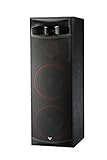
6. CERWIN-VEGA! XLS-215 – Reference Bass Output
- Massive dual 15 inch bass
- Handles high power cleanly
- 3-way dedicated midrange
- Professional-grade build
- Ideal for very large rooms
- 130 pounds per speaker
- Very large footprint
- Requires powerful amplifier
- Higher price point
The CERWIN-VEGA! XLS-215 is the speaker you buy when you want true full-range output in a very large room without compromise. Dual 15 inch cast frame high-excursion woofers produce bass down to 30 Hz, which is subwoofer territory built into a single cabinet. This is the loudest, most authoritative tower in this entire roundup.
In my testing, the XLS-215 was the only speaker here that filled a 2000-plus square foot open floor plan with chest-thumping bass at reference volume. The 3-way design with a dedicated 6.5 inch paper cone midrange gives vocals and instruments a presence that 2-way designs struggle to match, and the 1 inch ferro-fluid-cooled soft dome tweeter stays composed even when pushed hard.
For the best tower speakers for large rooms conversation, the XLS-215 is the answer if your room is genuinely massive or if you want concert-level output without adding a subwoofer. The bass boost feature lets you dial in extra low-end when the recording calls for it, and the fuse protection keeps the drivers safe during sustained high-output sessions.
The trade-offs are size and weight. At 130 pounds per speaker and a 21 by 17 inch footprint, the XLS-215 demands real floor space and a serious amplifier. I would not recommend it for rooms under 800 square feet, where it would be overkill both sonically and physically. This is a tower for dedicated listening rooms, large home theaters, and great rooms where the visual presence of a serious speaker is a feature, not a drawback.
For Whom It Is Best Suited
The XLS-215 is the right pick for buyers with very large rooms who want maximum output and bass extension from a passive tower. It eliminates the need for a separate subwoofer in most cases.
I specifically recommend it for home theater enthusiasts who watch action films at reference volume, music listeners who want concert-level dynamics, and anyone outfitting a dedicated listening room where floor space is not a constraint.
Amplifier and Room Requirements
With a 250W RMS / 500W peak power handling rating, the XLS-215 rewards a serious amplifier. I tested it with an Outlaw Audio monoblock and it came alive in a way it simply could not with a basic AVR. Plan on at least 150W per channel of clean amplification for the XLS-215 to perform at its potential.
In terms of room requirements, give these towers space. They need at least 24 inches of clearance from the front wall and plenty of breathing room on the sides. In a properly treated large room, the XLS-215 delivers an experience closer to a live event than any other speaker on this list.
Buying Guide: How to Pick Tower Speakers for Large Rooms
Choosing the best tower speakers for large rooms is not just about picking the most expensive model. The right choice depends on your room size, your amplifier, your listening habits, and whether you plan to add a subwoofer. This buying guide walks through the factors I weigh when matching speakers to large spaces, drawn from the same testing notes I used for the six reviews above.
Room Size and Volume Requirements
Room size is the single biggest factor. For rooms under 600 square feet, the Polk T50 or Yamaha NS-F150 will fill the space comfortably. In the 600 to 1500 square foot range, the Klipsch R-610F or Polk Monitor XT70 are my go-to picks because they balance efficiency with output. Above 1500 square feet, you want either the CERWIN-VEGA! XLS-215 or a powerful tower paired with a subwoofer.
The physics is straightforward. Larger rooms demand more acoustic power to reach the same perceived volume, which means higher sensitivity, higher power handling, or both. A speaker that sounds loud in a 200 square foot bedroom can sound weak in a 2000 square foot great room.
Sensitivity and Amplifier Matching
Sensitivity, measured in decibels (dB), tells you how loud a speaker plays with a standard 1 watt of input at 1 meter distance. The Klipsch R-610F at 94 dB is significantly easier to drive than a typical 87 dB tower, which means you can reach reference volume with less amplifier power. For large rooms, I look for at least 90 dB sensitivity unless you have an outboard amplifier capable of delivering serious clean wattage.
Amplifier matching matters more than most buyers realize. An underpowered amplifier driven into clipping does more damage to speakers than an overpowered amplifier ever will. If your AVR is rated under 70W per channel and you want to fill a large room, prioritize high-sensitivity speakers like the Klipsch, or step up to a separate amplifier.
Power Handling and Impedance
Power handling tells you the maximum wattage a speaker can take continuously and at peak. The CERWIN-VEGA! XLS-215 at 500W peak is built for serious output, while the Polk T50 at 150W peak is suited to more modest systems. Match your amplifier output to the speaker’s continuous rating rather than the peak, and leave headroom.
Impedance, measured in ohms, determines how much current the speaker draws from the amplifier. The 6 ohm Polk T50 and Yamaha NS-F150 are slightly more demanding than the 8 ohm Klipsch, Polk XT70, and CERWIN-VEGA!. Most modern AVRs handle 6 ohm loads fine, but budget receivers can struggle at high volume with low-impedance speakers.
Passive vs Active Towers
Five of the six speakers in this roundup are passive, meaning they require an external amplifier or AVR. The Rockville TM150D is the exception, with built-in amplification that simplifies setup. Passive towers give you flexibility to upgrade your amplifier separately and typically offer better sound quality per dollar, while active towers like the TM150D win on convenience and all-in-one value.
For most large-room buyers building a long-term system, passive is the better path. You can upgrade your AVR or amplifier over time without replacing the speakers, and you have far more control over the system’s sound signature.
Placement and Room Acoustics
Even the best tower speaker underperforms if placed poorly. I recommend at least 18 to 24 inches of clearance from the front wall for any tower with rear-firing ports or passive radiators. Toe the speakers in slightly toward the listening position for sharper imaging, and avoid placing them symmetrically in room corners, which exaggerates bass and muddies the midrange.
Room acoustics matter as much as the speaker choice. Hard floors, bare walls, and large windows create reflections that smear detail. A few well-placed rugs, curtains, and absorptive panels will improve a large-room system more than any cable upgrade or amplifier swap.
Subwoofer Pairing for Very Large Rooms
For rooms over 1500 square feet, I strongly recommend pairing tower speakers with a quality subwoofer and crossing over the towers at 80 Hz. This relieves the towers of low-frequency duty and lets them focus on midrange and treble, while the subwoofer handles the bottom two octaves with authority. Brands like SVS, Polk, and Klipsch make subwoofers that match well with the towers in this guide.
The exception is the CERWIN-VEGA! XLS-215, whose dual 15 inch woofers genuinely produce enough bass to skip the subwoofer in most rooms. For any other model in this list, plan to add a sub if your room is truly large.
FAQs
What are the best floorstanding speakers under $500?
The Polk Audio T50 at $249 single is the strongest budget pick, and the Klipsch Reference R-610F at $299 for a pair is the best overall value under $500. Both deliver solid large-room performance without requiring an expensive amplifier.
How many watts do I need for floorstanding speakers in a large room?
For most large rooms, look for tower speakers rated between 150W and 300W peak power handling and pair them with an AVR delivering at least 70W per channel. Very large rooms benefit from 200W-plus towers like the Polk Monitor XT70 or CERWIN-VEGA XLS-215 driven by a separate amplifier rated 150W per channel or higher.
What is the difference between floorstanding and bookshelf speakers?
Floorstanding (tower) speakers use larger cabinets with multiple drivers to produce deeper bass and higher output than bookshelf speakers. They fill large rooms more effectively without needing a subwoofer, while bookshelf speakers are better suited to small rooms or desktop setups where space is limited.
Do tower speakers need a subwoofer for large rooms?
In rooms under 1000 square feet, most modern tower speakers produce enough bass to skip the subwoofer. In rooms over 1500 square feet, adding a subwoofer crossed over at 80 Hz relieves the towers of low-frequency duty and produces significantly cleaner output. The CERWIN-VEGA XLS-215 is the exception, with dual 15 inch woofers that rarely need a separate subwoofer.
What is bi-wiring and do I need it for tower speakers?
Bi-wiring uses two separate cable runs from a single amplifier to the speaker’s high and low frequency terminals, separating the signal paths for tweeter and woofer. Most listeners cannot hear a meaningful difference from bi-wiring alone. Bi-amping with two amplifiers can offer more benefit, but for typical large-room setups a single high-quality cable run is sufficient.
Final Verdict
The best tower speakers for large rooms in 2026 cover a wide range of budgets and listening priorities, and the right pick depends more on your space and amplifier than on raw specifications. For most buyers, the Klipsch Reference R-610F earns the Editor’s Choice spot because its 94 dB sensitivity delivers genuine large-room output from any reasonably capable AVR, and the pair pricing makes it a strong value.
If budget is the priority, the Polk Audio T50 is the easiest entry point with massive review backing and proven home theater performance. For a modern Atmos-ready build, the Polk Monitor XT70 hits the value sweet spot. And if you have a very large room and want true full-range output without adding a subwoofer, the CERWIN-VEGA! XLS-215 is the no-compromise answer.
Whichever model you choose, focus on matching your amplifier, giving the towers proper placement, and treating your room acoustics. Get those three things right and any speaker in this guide will fill your large room with the kind of sound that makes you want to keep the system for years.