
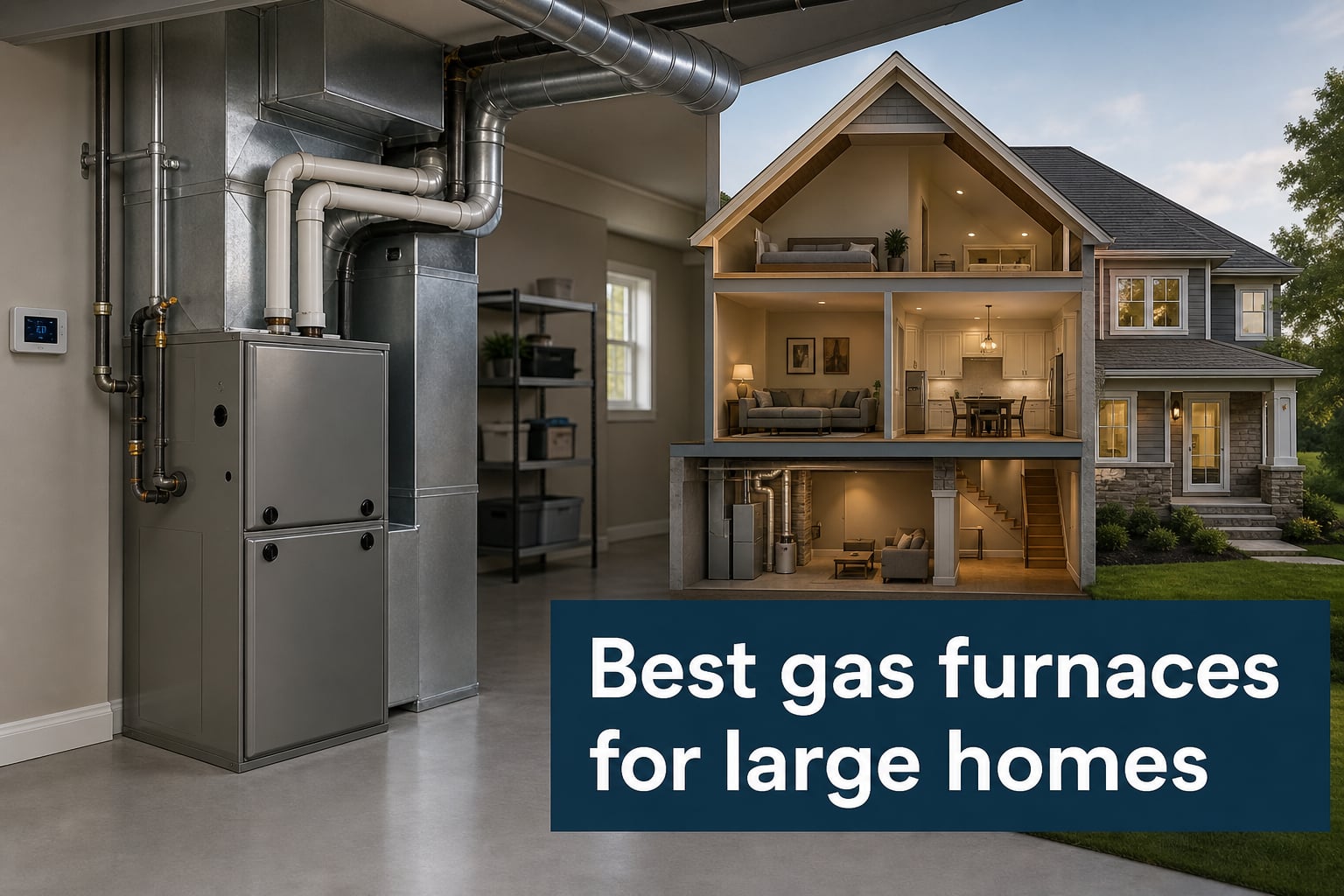
Finding the best gas furnaces for large homes starts with a less exciting question than brand or BTU: what does your house actually lose on its coldest day? A large floor plan, tall ceilings, a finished basement, duct condition, insulation, and climate can change the answer dramatically.
This guide compares 10 natural-gas furnace listings for homes with substantial heating loads. I focused on verified capacity, efficiency, staging, blower information, cabinet fit, buyer ratings, and the limitations stated for each model rather than repeating broad brand claims.
Every unit here is an upflow/horizontal model, so layout matters before anything else. Have a qualified HVAC contractor perform a Manual J load calculation and verify local code, venting, gas supply, electrical requirements, duct capacity, and whether the furnace is approved for your installation.
The top 3 picks make the clearest starting points for large-home planning 2026
The 100,000 BTU Goodman two-stage model is the strongest all-around match in this group when a load calculation supports that capacity. The 120,000 BTU model brings the largest stated output and airflow, while the 80,000 BTU 80% unit is a straightforward option for an existing non-condensing setup where its lower efficiency and orientation fit.
The best gas furnaces for large homes in 2026 cover 60,000 to 120,000 BTU
Capacity is only a screening tool, not a sizing recommendation. The comparison below puts the key listed specifications in one place, but it cannot replace a room-by-room load calculation or a contractor’s review of the whole forced-air heating system.
| Product | Specifications | Action |
|---|---|---|
 Goodman 100k 80% Single-Stage Goodman 100k 80% Single-Stage |
|
Check Latest Price |
 Goodman 100k 96% Two-Stage Goodman 100k 96% Two-Stage |
|
Check Latest Price |
 Goodman 80k 80% Single-Stage Goodman 80k 80% Single-Stage |
|
Check Latest Price |
 Goodman 80k 92% Single-Stage Goodman 80k 92% Single-Stage |
|
Check Latest Price |
 Goodman 80k 80% Single-Stage Goodman 80k 80% Single-Stage |
|
Check Latest Price |
 Goodman 60k 96% Two-Stage Goodman 60k 96% Two-Stage |
|
Check Latest Price |
 Goodman 80k 96% Single-Stage Goodman 80k 96% Single-Stage |
|
Check Latest Price |
| Goodman 80k 96% Two-Stage |
|
Check Latest Price |
 Goodman 60k 96% Single-Stage Goodman 60k 96% Single-Stage |
|
Check Latest Price |
 Goodman 120k 96% Two-Stage Goodman 120k 96% Two-Stage |
|
Check Latest Price |
The Goodman GR9S801005CN is a 100,000 BTU choice for existing 80% installations
- 100
- 000 BTU capacity
- Multi-speed operation
- Stainless steel heat exchanger
- Listed 5.0 rating
- No downflow installation
- 80% efficiency
The GR9S801005CN pairs a 100,000 BTU input with 80% listed efficiency and a multi-speed, single-stage design. Its listed dimensions are 28 by 21 by 34 inches, so measure the service clearances and cabinet opening rather than assuming a 21-inch cabinet will slide into an older closet.
The listing gives it a 5.0 rating from 13 reviews, a small but uniformly positive sample. It also identifies a stainless steel tubular dual-diameter primary heat exchanger and upflow/horizontal installation.
For a large house, this model makes sense only where a load calculation supports 100,000 BTU and an 80% furnace is appropriate for the venting arrangement. An 80% unit sends more fuel energy out with combustion gases than a 96% AFUE furnace, so annual usage and local climate deserve attention.
The listing calls out a 10-year parts limited warranty with registration and a 10-year unit replacement limited warranty. Read the complete manufacturer terms with the installer, because registration, labor, and installation conditions can matter as much as the named coverage.
The installation fit is limited to upflow or horizontal positions
This is not a downflow furnace. That restriction is a hard filter for homes where the furnace sits above the conditioned space or the ductwork requires a downflow configuration.
Ask the installer to confirm vent sizing, condensate requirements, and the compatibility of any coil, filtration cabinet, humidifier, or zoning equipment. A furnace replacement is a system project, not simply a cabinet swap.
The comfort profile is simple single-stage heating
A single-stage burner is either on at full output or off. It can be a sensible fit, but it generally gives a large house fewer low-output, longer-run heating cycles than a two-stage furnace.
Forum discussions regularly favor longer run times for evening temperatures across multiple floors. If uneven rooms are your main complaint, have the duct system and return-air path checked alongside the furnace choice.
The Goodman GR9T961004CN is the strongest 100,000 BTU two-stage option
Goodman 96% AFUE Two Stage Upflow/Horizontal multi-speed 100k BTU Low NOx Natural Gas furnace (21 wide) (GR9T961004CN)
- 96% AFUE
- Two-stage heating
- 1600 CFM listed
- Energy Star certified
- No downflow installation
- Accessories sold separately
This 100,000 BTU GR9T961004CN is a 96% AFUE, two-stage natural gas furnace with a listed 1,600 CFM airflow capacity. The higher AFUE means that, under the AFUE test measure, 96% of fuel energy becomes usable heat rather than leaving as exhaust.
It holds a 4.7 rating across 41 reviews, with the listing reporting 82% five-star reviews. The record also identifies a multi-speed ECM motor, low-NOx operation, Energy Star certification, and an aluminized steel primary heat exchanger.
Two stages are particularly useful to investigate for a large home because the furnace can operate at a lower stage during milder demand and reserve high fire for colder conditions. That does not promise perfect room-to-room balance, but it can support steadier forced-air heating when ducts are designed and commissioned well.
The model is listed for upflow or horizontal installation and has a 21-inch cabinet width. It is not a downflow solution, and accessories such as venting or LP-conversion components are listed separately.
The 1,600 CFM rating needs a ductwork review
Airflow is not a decorative spec: it affects how heat travels through the supply trunks and how comfortably the system operates. A contractor should verify static pressure, return sizing, filter type, and whether the existing ducts can accept the blower settings.
In a two-story house, ask for supply-and-return measurements on both levels. That diagnostic work often says more about upstairs comfort than increasing furnace size.
The high-efficiency design needs a compatible venting plan
A 96% AFUE furnace is a condensing design, so installation details differ from an 80% replacement. Confirm the approved vent material, routing, drain path, and cold-weather protection for the condensate line.
Smart thermostat compatibility is also a wiring and setup question. Have the installer confirm the control supports two-stage heat and configure it to call stages in the intended order.
The Goodman GR9S800803BN is an 80,000 BTU 80% option with a narrow cabinet
- 80
- 000 BTU output
- Multi-speed ECM motor
- Reduced noise claim
- 17.5 inch cabinet
- No downflow installation
- 80% efficiency
The GR9S800803BN lists 80,000 BTU capacity, 80% efficiency, and multi-speed single-stage operation. Its 17.5-inch cabinet is a practical detail for a tight mechanical room, although the final fit still depends on depth, height, service access, and duct transitions.
The listing shows a 4.6 rating based on 52 reviews and says 82% are five-star reviews. It names a multi-speed ECM motor, an aluminized steel primary heat exchanger, and R32 readiness.
For a large but relatively efficient home in a moderate climate, 80,000 BTU can be enough, but only the heat-loss calculation can establish that. A large floor plan does not automatically call for the largest furnace, especially when insulation, windows, and air sealing have improved.
The unit is upflow/horizontal only. It is also a single-stage design, so compare its simple operating approach with the longer, lower-stage cycles available on the two-stage choices in this roundup.
The 17.5-inch cabinet can help with replacement constraints
Measure not just the furnace cabinet but the path into the basement, attic, or utility room. Check whether a filter rack, evaporator coil, and transitions will keep the finished system within the available envelope.
A narrow cabinet can create duct transition questions. The installer should size transitions to keep pressure reasonable instead of abruptly reducing airflow space.
The 80% efficiency rating suits specific replacement situations
An 80% furnace may align with an existing non-condensing venting setup, but local codes and the complete installation design decide what is permitted. It is not automatically the right choice for every large home.
For homes with long, cold winters, compare projected fuel use against a 92% or 96% option using the same calculated heating load. Use comparable assumptions, not a generic savings promise.
The Goodman GR9S920803BN is a 92% AFUE middle-ground 80,000 BTU furnace
- 92% AFUE
- 80
- 000 BTU
- Low NOx
- 51 dB listed
- Single-stage heating
- No downflow installation
The GR9S920803BN is an 80,000 BTU, single-stage furnace with a 92% AFUE rating and low-NOx natural-gas operation. The product data lists a 17.5-inch width and a 51-decibel noise figure, though noise in a finished home also depends on duct design, blower settings, and installation quality.
Its 4.6 rating comes from 17 reviews, with the listing reporting 91% five-star reviews. That is encouraging feedback, while still being a smaller sample than some other units here.
This model fills the space between basic 80% equipment and the 96% AFUE options. Its 92% AFUE means less fuel energy is lost than with 80% equipment, but its single-stage burner remains a simpler comfort approach than the two-stage models.
The listing notes whole-house heating, remote control, and upflow/horizontal orientation. Treat remote control as a feature to clarify with the seller and installer, including what control equipment is included and which thermostat functions are supported.
The 92% AFUE rating is the primary reason to compare this model
AFUE is a seasonal efficiency metric, not a prediction of your exact utility bill. Duct leakage, thermostat settings, air infiltration, and maintenance influence real fuel use after installation.
Still, AFUE is useful for an apples-to-apples first pass. Compare 92% with 80% and 96% only after confirming each candidate has the right output and installation orientation.
The single-stage operation favors straightforward controls
Single-stage equipment can be easier to pair with basic controls, but a thermostat still needs to be correctly selected and set up. Ask whether the existing thermostat wiring is sound and whether an outdoor sensor or zoning panel affects operation.
For a multi-story residence, address return-air shortages and duct balancing before expecting a new furnace alone to fix a persistently cold second floor.
The Goodman GR9S800804BN is a well-reviewed 80,000 BTU 80% alternative
- 80
- 000 BTU
- ECM motor
- 10-year parts warranty listed
- 63 reviews
- No downflow installation
- 80% efficiency
The GR9S800804BN is another 80,000 BTU, 80% efficiency, multi-speed single-stage furnace. It adds a listed multi-speed ECM motor, which is intended to give the system more airflow control than a basic fixed-speed blower setup.
This listing has a 4.5 rating from 63 reviews, the largest review count among the 80% units in this collection. The product information also names an aluminized steel primary heat exchanger and a 10-year parts limited warranty with registration.
For a big house, 80,000 BTU may serve an efficient shell or a milder climate, while a draftier house of the same square footage may need more output. Never select capacity from square footage alone, because ceiling height and design temperature change the load.
It is for upflow/horizontal installations only and lists natural gas as the fuel type. Verify the available gas line, vent connection, combustion air arrangement, and any local low-NOx requirement before treating it as a compatible replacement.
The ECM motor supports system tuning but does not resize bad ducts
A blower motor can be configured to suit the connected equipment and airflow target, yet it cannot compensate for crushed flex duct, undersized returns, or a heavily restrictive filter. A static-pressure test is useful before and after replacement.
That test provides a baseline that you can keep with the installation paperwork. It also gives a technician useful information if airflow complaints appear later.
The warranty is worth reading beyond the headline term
Homeowners often prioritize longevity and repair support over a long feature list. The forum research also points to local contractor access and parts availability as important practical factors over a furnace’s service life.
Confirm who performs warranty labor, what registration is required, and whether the installing company will service this model. Those answers are local and cannot be inferred from an online listing.
The Goodman GR9T960603BN is a 60,000 BTU two-stage model for efficient large homes
- 96% AFUE
- Two-stage ECM motor
- 1200 CFM listed
- Energy Star certified
- Professional installation required
- No downflow installation
The GR9T960603BN has a listed 60,000 BTU heating capacity, 96% AFUE, two-stage operation, and 1,200 CFM airflow. Do not dismiss the smaller input merely because the house is large: a tightly built or upgraded large home can have a lower heat loss than an older, smaller one.
It is rated 4.5 from 46 reviews. The data cites Energy Star certification, a multi-speed ECM motor, low-NOx operation, and warranty terms that include 10-year unit replacement and parts limited coverage plus a lifetime compressor limited warranty.
Two-stage operation makes this a compelling configuration to ask about when a load calculation lands near 60,000 BTU. The lower stage may run longer during ordinary winter weather, which can reduce the noticeable hot-and-cold swings associated with full-fire-only heating.
This is still an upflow/horizontal model, and the listing says professional installation is required. That is appropriate for every furnace on this list: combustion safety, venting, gas piping, electrical work, and commissioning require qualified work.
The smaller capacity must be judged by calculated load
Some online sizing rules use a broad BTU-per-square-foot range. Those shortcuts can miss insulation levels, window area, air leakage, basement conditions, and the local outdoor design temperature.
Ask for the actual Manual J report and the selected furnace’s output at the design condition. That documentation makes it easier to understand why a contractor did not simply select the biggest cabinet.
The two-stage control needs thermostat confirmation
A compatible thermostat must call for first and second stage correctly. If you have a smart thermostat, check the manufacturer’s equipment-compatibility information and let the installer set staging parameters.
For zone control, the contractor should confirm the minimum airflow needs of the furnace and the zone panel’s strategy. Closing too many dampers without a suitable bypass or variable-airflow plan can create pressure problems.
The Goodman GR9S960803BN is an efficient 80,000 BTU single-stage model
- 96% efficiency
- 80
- 000 BTU
- ECM blower
- Strong review volume
- Single-stage heating
- No downflow installation
The GR9S960803BN combines 80,000 BTU capacity with 96% listed efficiency, a multi-speed ECM motor, and single-stage operation. For homeowners who want high AFUE but do not need two-stage heating, it is one of the clearest specification combinations in this group.
It has a 4.4 rating across 70 reviews, the largest review count in this roundup. The listing summary says buyers particularly mention the ECM motor’s efficiency and quieter operation, while also noting the upflow/horizontal-only limitation.
High efficiency can reduce fuel waste compared with an 80% option, but it does not erase comfort issues from poorly balanced ducts. In a large house, request airflow readings and a check of the farthest rooms after startup.
The product data identifies an aluminized steel primary heat exchanger and R32 readiness. Verify every connected cooling-system component and refrigerant detail independently; furnace and air-conditioning compatibility involves the entire matched system.
The 96% rating makes venting and condensate details important
Condensing furnaces create liquid condensate that must be drained correctly. The installer should route and protect the line for your climate, and explain where the drain terminates and how it will be checked during maintenance.
Ask whether the vent run meets the approved length and fitting limits for the installed configuration. These details are not optional extras on a high-efficiency system.
The single-stage burner can still pair with a variable blower
The burner stage and blower behavior are separate parts of the comfort picture. A multi-speed ECM motor may offer useful airflow control even though the burner has only one firing rate.
Have the contractor explain the selected blower speed for heating and cooling, especially if you add an air cleaner, humidifier, or higher-efficiency filter. Each component can affect resistance to airflow.
The Goodman GR9T960803BN is an 80,000 BTU two-stage comfort-focused choice
- 96% AFUE
- Two-stage operation
- Multi-speed ECM motor
- Low NOx
- No downflow installation
- Smaller review sample
The GR9T960803BN is an 80,000 BTU, 96% AFUE two-stage model with a multi-speed ECM motor and low-NOx natural-gas operation. This combination targets homeowners who need the 80,000 BTU capacity range but place a premium on longer low-stage cycles.
Its listing shows a 4.3 rating from 21 reviews and describes 66% five-star reviews. Treat that as useful but limited owner feedback, and weigh it with installation support and the contractor’s ability to obtain service parts locally.
For a large home with fluctuating heat demand, two-stage heating can keep the furnace from immediately operating at full output for every call. Proper thermostat setup and duct balancing remain necessary for that potential to translate into comfortable rooms.
The data lists upflow/horizontal installation and an aluminized steel primary heat exchanger. It also says the model replaces multiple older models, a detail worth confirming if you are matching an existing coil or cabinet transition.
The 80,000 BTU capacity is a common but not universal large-home fit
An 80,000 BTU model can be right for one 2,500-square-foot house and wrong for another of the same size. A high-ceilinged home in a cold climate can need more heat, while a well-insulated home may need less.
For a multi-story layout, ask the contractor to account for stack effect and return-air placement. Those factors affect why upper floors often feel warmer in winter.
The low-NOx designation may matter in regulated locations
Low-NOx equipment is designed to limit nitrogen oxide emissions. Local rules can set requirements, so confirm compliance with the authority having jurisdiction instead of relying on a general description.
Also verify whether the home uses natural gas or needs propane conversion. Conversion kits, where supported, are not assumed to be included with the furnace listing.
The Goodman GR9S960603BN is a 60,000 BTU 96% AFUE single-stage option
- 96% AFUE
- Multi-speed operation
- Low NOx
- Listed up to 2000 sq ft
- Lower review count
- Single-stage operation
The GR9S960603BN is a 60,000 BTU, 96% AFUE, single-stage furnace with multi-speed operation and low-NOx natural-gas capability. Its product data says it heats areas up to 2,000 square feet, which is a general listing statement rather than a substitute for a heat-loss calculation.
The unit has a 4.2 rating from 17 reviews. The data notes that 71% of those reviews are five-star but also flags a 15% one-star share, so this is a model where careful local installation support deserves extra weight.
It can still belong in a large-home comparison because square footage alone is a weak sizing tool. A large, efficient home in a moderate region may have a calculated load that fits 60,000 BTU, whereas a leaky home in a severe climate may not.
Its single-stage burner gives it a simpler operating pattern than the two-stage 60,000 BTU model. Compare the two only after verifying capacity, cabinet fit, venting, and control requirements are alike for your specific project.
The stated coverage area is only a rough screening clue
Coverage claims cannot account for your ceiling height, insulation, window exposure, infiltration, or preferred indoor temperature. They should not be used to choose equipment for a large residence.
A good load calculation also separates room loads, which helps locate areas that may need duct changes or zoning. That information is more useful than guessing from the home’s total area.
The review pattern calls for strong commissioning practices
A furnace should be commissioned with combustion analysis, gas-pressure verification, temperature-rise checks, and airflow setup according to the installation instructions. Keep the startup report with your warranty records.
Plan routine maintenance as well: replace filters at the interval appropriate to the filter and system, keep returns clear, and schedule professional inspection based on local advice and manufacturer guidance.
The Goodman GR9T961205DN supplies the highest listed capacity and airflow
- 120
- 000 BTU capacity
- 2000 CFM listed
- Two-stage operation
- 96% efficiency
- No downflow installation
- Mixed review feedback
The GR9T961205DN is the largest model in this set, with 120,000 BTU heating capacity, 96% listed efficiency, two-stage operation, and 2,000 CFM airflow. Its 24.5-inch cabinet width and listed dimensions of 28 by 24.5 by 33.5 inches make physical fit a first-order question.
It is rated 4.1 from 22 reviews. The product data reports 71% five-star reviews along with a notable 21% one-star share, so I would give commissioning, local parts support, and installer experience special attention before selecting it.
A 120,000 BTU furnace is not a default answer for a large home. If it is oversized, it can heat the thermostat area quickly, cycle more often, and reduce the long steady runs that help distribute heat across a large duct system.
When the load really does require this output, the two-stage burner and listed 2,000 CFM airflow are relevant advantages to discuss with the HVAC designer. The furnace still requires an upflow or horizontal layout, plus compatible ducts and return capacity.
The 2,000 CFM blower rating requires large, capable ducts
More available airflow is valuable only when the supply and return network can move it without excessive pressure or noise. Contractors should inspect trunk sizes, branch runs, return paths, grilles, and filter cabinet dimensions.
Do not accept a capacity upgrade that leaves old duct restrictions untouched. In a large home, air distribution is as important as heat production.
The 24.5-inch cabinet needs careful space planning
Measure all sides of the mechanical space, including the room needed to remove panels and service the heat exchanger, blower, drain, and filter. Access is part of long-term reliability because neglected service access makes maintenance harder.
Confirm the equipment can be brought into the home without destructive alterations. This is especially important for basement replacements with narrow stairwells or finished walls.
The right large-home furnace begins with a documented load calculation
A gas furnace burns natural gas in a combustion chamber, transfers heat through a heat exchanger, and a blower distributes the warmed air through ducts. For a large home, appropriate sizing supports consistent heating, sensible fuel use, and better comfort across expansive or multi-story rooms.
Start with a Manual J calculation, not a nameplate BTU number. The contractor should use your location’s winter design temperature, wall and attic insulation, window type and area, home orientation, air leakage, ceiling heights, and the condition of the basement or crawlspace.
The BTU target should reflect heat loss rather than home size alone
Use square footage only as an early conversation starter. A 3,000-square-foot home with an insulated attic and tight windows can have a lower heating load than a 2,000-square-foot house with poor insulation, many air leaks, and a cold climate.
Multi-story homes need extra attention to vertical air movement. Ask for room-by-room results, especially for rooms over garages, top-floor bedrooms, additions, and areas with large glass exposure.
After the load calculation, compare the furnace’s output at the relevant efficiency rating with the calculated load. Ask the contractor to explain the selected capacity, not merely state that it is a standard size for your square footage.
The AFUE number explains seasonal fuel conversion efficiency
AFUE stands for Annual Fuel Utilization Efficiency. An 80% AFUE furnace is rated to turn 80% of its fuel energy into heat over a standardized season, while a 96% AFUE model is rated at 96%.
Higher AFUE often changes venting and condensate requirements because high-efficiency furnaces are condensing units. The right selection depends on climate, expected run time, installation conditions, code, and the building load, not AFUE alone.
Compare fuel-use implications with the same heating load and reasonable local fuel assumptions. Avoid claims that one percentage difference will produce the same savings in every house.
The staging choice changes how heat is delivered
A single-stage gas furnace operates at one heat level. A two-stage gas furnace can run at a lower stage for ordinary demand and a higher stage when conditions call for it, which is why it is frequently considered for large homes with comfort concerns.
A variable-speed or multi-speed blower manages air movement, not necessarily burner stages. The models here list multi-speed operation or ECM motors, but the exact comfort result still depends on the thermostat, ductwork, filter resistance, and setup.
Ask your installer to describe the thermostat’s staging logic and the target temperature rise. This direct question turns feature names into an installation plan you can evaluate.
The system fit includes ducts, combustion, controls, and service access
Before signing, check the installation orientation; all ten models in this guide are listed as upflow/horizontal only. Also have the contractor inspect the existing coil, filter housing, supply and return plenums, gas line, vent path, drain location, electrical service, and combustion-air needs.
A smart thermostat can work well with a central heating system, but compatibility depends on the furnace controls and available wiring. Confirm two-stage operation, accessory control, and zoning compatibility in writing if those functions matter to you.
For longevity, plan maintenance from day one. Keep filters appropriate for the blower and duct design, keep registers and returns unobstructed, and arrange periodic professional service based on manufacturer guidance and local conditions.
The reliability decision should include the local support network
No online list can promise that a particular unit will be trouble-free. Forum discussions make a useful point: homeowners value a model that local technicians know, can service, and can obtain parts for over a long operating life.
Ask two or three qualified contractors which of these configurations they support in your area, who handles warranty labor, and how quickly typical service parts can be obtained. Independent answers are more meaningful than a generic endorsement.
Keep the Manual J report, model and serial information, registration confirmation, startup readings, and service records. That small file helps with warranty work, future diagnostics, and eventual replacement planning.
The most common large-home furnace questions have direct answers
What is the most reliable gas furnace brand?
There is no single reliable brand answer for every location. Reliability depends on correct sizing, careful installation, regular maintenance, and whether qualified local technicians can obtain parts and provide warranty service. Compare local contractor support alongside the manufacturer warranty and verified product specifications.
What size furnace do I need for a large home?
Use a Manual J heat-loss calculation rather than choosing by square footage. The calculation accounts for climate, insulation, windows, leakage, ceiling height, and room layout, then a contractor matches the furnace output and duct system to that result. A large home may need 60,000, 80,000, 100,000, or 120,000 BTU depending on those factors.
Can a furnace be too large for a house?
Yes. An oversized furnace can heat the thermostat area too quickly, causing short cycles and poorer heat distribution. It may also make temperature swings more noticeable. Select capacity from a documented load calculation and confirm that the ductwork can handle the selected blower airflow.
What is the typical lifespan of a gas furnace?
Service life varies with installation quality, maintenance, operating conditions, and repair history. Homeowner discussions in the research include systems lasting more than 20 years with regular maintenance, but that is not a guarantee. Maintain filters, keep service records, and have combustion and airflow checked professionally.
What is the 5000 rule for a furnace?
The 5000 rule is a rule of thumb that multiplies a repair cost by the furnace age and compares the result with 5,000. It is not a technical sizing or safety rule. Use it only as one discussion point after a technician diagnoses the unit, checks safety, and estimates remaining service life.
The best choice is the correctly sized model with the right installation plan
The best gas furnaces for large homes are not automatically the highest-BTU or highest-AFUE models. In this group, the Goodman GR9T961004CN is a strong 100,000 BTU two-stage candidate, while the GR9T961205DN is the high-capacity option for homes whose documented load and ductwork truly call for it.
Bring this list to a qualified HVAC contractor, request a Manual J calculation, and compare the resulting output, orientation, venting, airflow, thermostat, and service plan. That process gives you a better basis for choosing a gas furnace in 2026 than any one-size-fits-all ranking.