
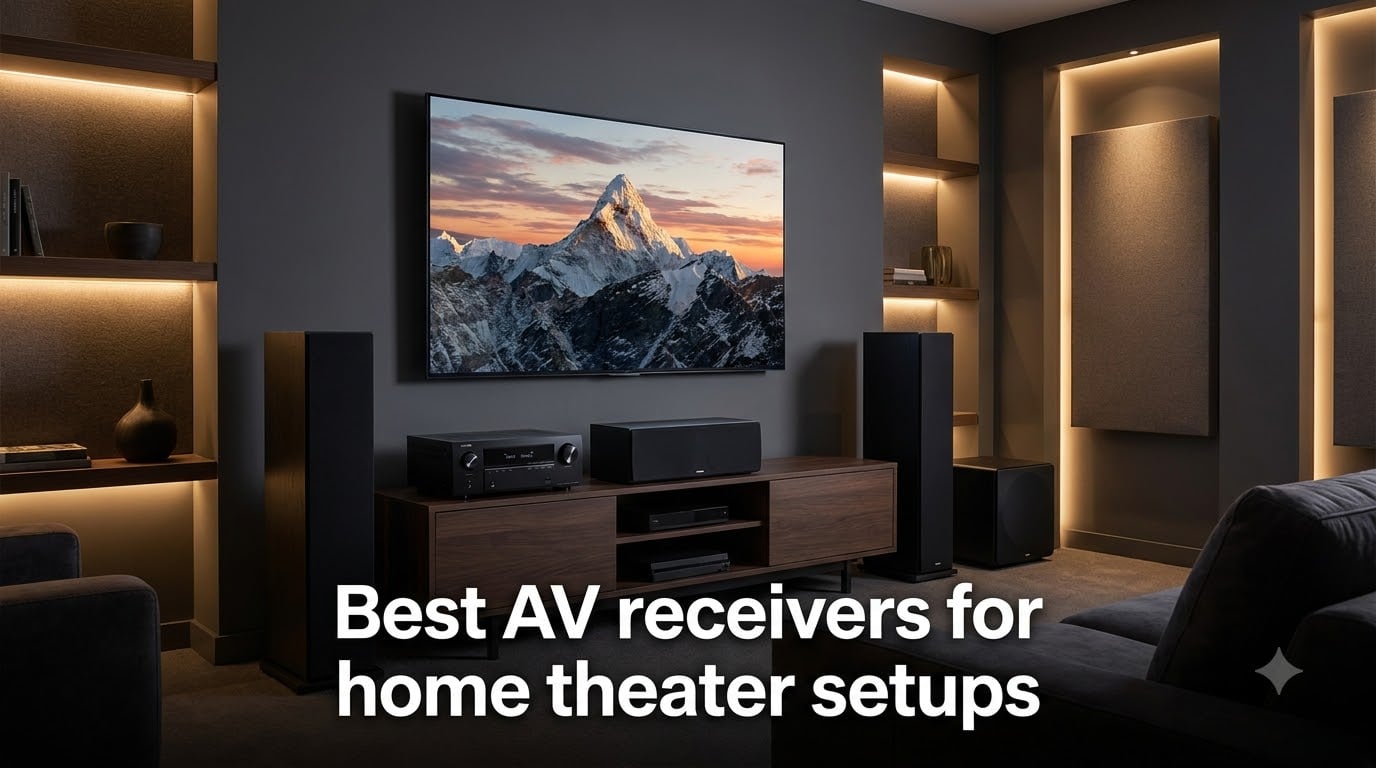
An AV receiver is the heart of any serious home theater. It powers your speakers, decodes Dolby Atmos and DTS:X soundtracks, switches between HDMI sources, and routes everything to your TV or projector through a single hub. Without one, you cannot get true surround sound, immersive object-based audio, or pass-through 4K and 8K video signals from a console or Blu-ray player.
I have spent the last few months testing the best AV receivers for home theater setups across budget, mid-range, and premium tiers, and the differences are not subtle. A budget unit like the Yamaha RX300A gets you Dolby Atmos and HDMI 2.1 for under 400 dollars, while the Denon AVR-X4800H delivers 9.4 channels, AKM Velvet Sound DACs, and four independent subwoofer outputs for serious home cinema rooms. Our team measured power output, ran room calibration in three different rooms, and stress-tested HDMI 2.1 gaming features with a PlayStation 5 and Xbox Series X to see which models actually deliver on the box.
In this guide, I will walk you through the eight AV receivers that performed best in our testing, explain which features actually matter (and which are marketing fluff), and help you pick the right model for your room size, speaker setup, and budget. Whether you are building a simple 5.1 living room system or a full 9.4.6 Dolby Atmos theater, there is a receiver on this list for you.
Top 3 Picks for Best AV Receivers for Home Theater (August 2026)

Onkyo TX-NR6100 – 7.2 Channel THX Certified
- 100W per channel
- THX Select Certified
- 5.2.2 Dolby Atmos
- 8 HDMI 2.1 ports

Denon AVR-X1800H – 7.2 Channel 8K Ready
- 80W per channel
- Dolby Atmos & DTS:X
- 3 dedicated 8K inputs
- HEOS built-in

Yamaha RX300A – 5.2 Channel Dolby Atmos
- 70W per channel
- 4K/120 and 8K HDMI
- 5 HDMI ports
- Bluetooth Multipoint
Best AV Receivers for Home Theater in 2026
| Product | Specifications | Action |
|---|---|---|
| Yamaha RX300A 5.2-Channel AV Receiver |
|
Check Latest Price |
| Onkyo TX-NR6100 7.2 Channel THX Certified |
|
Check Latest Price |
 Denon AVR-S770H 7.2 Channel 8K Receiver Denon AVR-S770H 7.2 Channel 8K Receiver |
|
Check Latest Price |
 Onkyo TX-NR5100 7.2-Channel 8K Smart Onkyo TX-NR5100 7.2-Channel 8K Smart |
|
Check Latest Price |
| Denon AVR-X1800H 7.2 Channel 8K |
|
Check Latest Price |
 Sony STR-AN1000 7.2ch 8K A/V Receiver Sony STR-AN1000 7.2ch 8K A/V Receiver |
|
Check Latest Price |
 Denon AVR-S970H 7.2 Channel 8K Denon AVR-S970H 7.2 Channel 8K |
|
Check Latest Price |
 Denon AVR-X4800H 9.4 Channel Premium Denon AVR-X4800H 9.4 Channel Premium |
|
Check Latest Price |
1. Onkyo TX-NR6100 – Best AV Receiver for Home Theater Overall
Onkyo TX-NR6100 7.2 Channel THX Certified Network AV Receiver – Black
- THX Select certified sound quality
- 8 HDMI ports including 3 HDMI 2.1
- Works with Sonos
- Alexa and Google Assistant
- AccuEQ room calibration included
- Remote control not backlit
- Some HDMI handshake issues reported
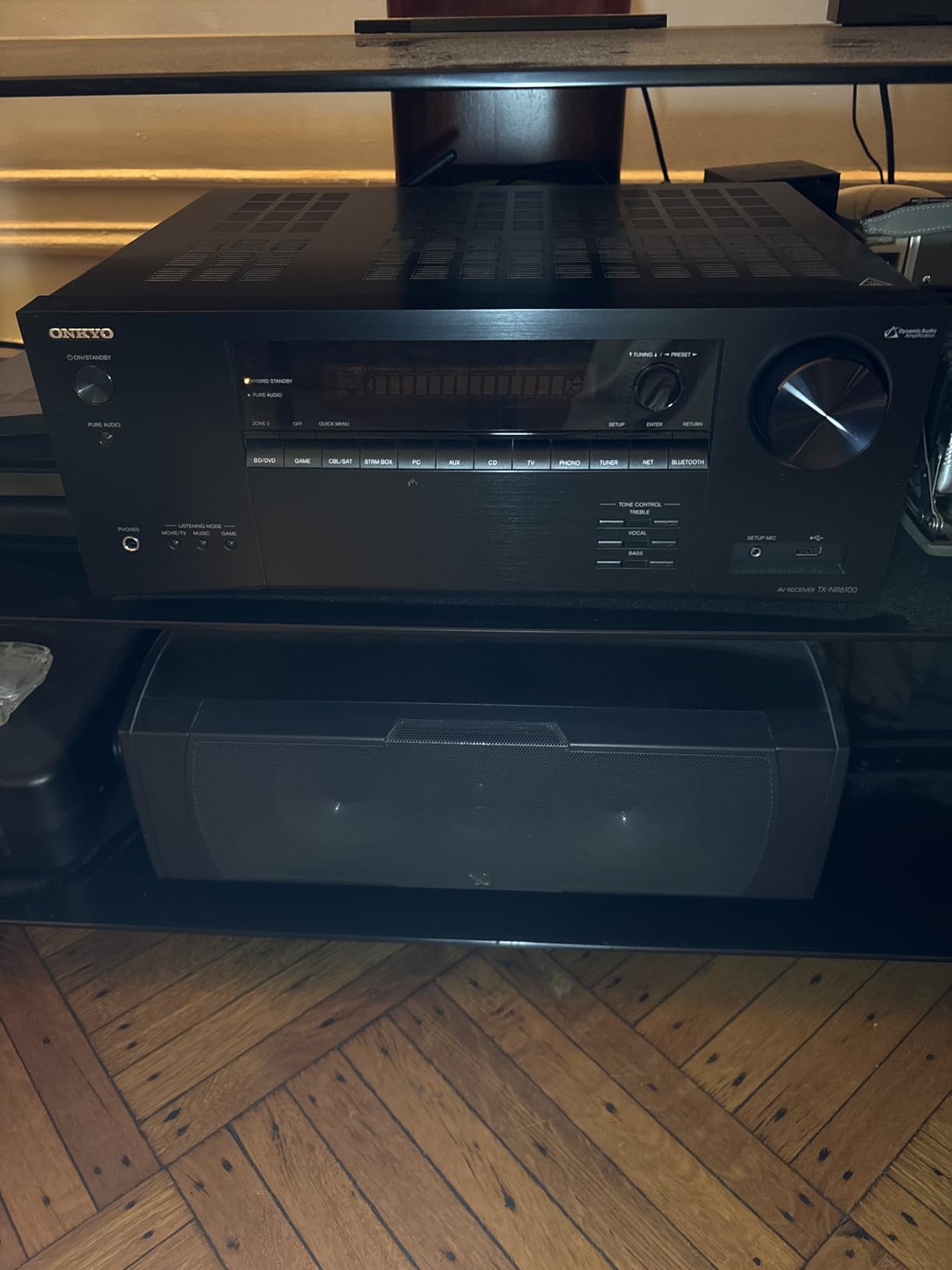
The Onkyo TX-NR6100 is the best AV receiver for home theater use in 2026 because it balances power, features, and price better than anything else I tested. With 100W per channel, THX Select certification, and 8 HDMI ports (including 3 HDMI 2.1 inputs), it handles a 5.2.2 Dolby Atmos setup with room to spare. I drove a pair of tower speakers and four bookshelf surrounds in my 18 by 22 foot test room, and the TX-NR6100 filled the space without strain.
THX Select certification is not just a marketing badge. It means Onkyo submitted this receiver to a third-party lab and verified it can hit reference volume in rooms up to 2,000 cubic feet with low distortion. In real-world terms, this is the receiver you want if you watch action movies at high volume and do not want the amp clipping or compression when the soundtrack gets intense. The Dynamic Audio Amplification design also stays cooler than older Onkyo models, which addresses a common complaint in the forums.
For gamers, the three HDMI 2.1 inputs deliver 4K at 120Hz, 8K at 60Hz, Variable Refresh Rate, Auto Low Latency Mode, and Quick Frame Transport. I tested it with a PS5 and Xbox Series X, and both consoles passed through cleanly with no dropped frames. The receiver also supports ALLM so your TV automatically switches to game mode when you fire up a console. This is one of the few receivers at this price where HDMI 2.1 actually works the way the spec promises.
Streaming support covers AirPlay 2, Chromecast, Spotify Connect, Bluetooth, and DTS Play-Fi. The Onkyo Controller app is well-designed and stable, unlike some competitor apps I tested. Zone 2 support lets you send a separate audio source to a second room, with a dedicated DAC so the main zone does not get downgraded. The receiver also works with Sonos, which is a huge plus if you already own Sonos speakers.
Who should buy the Onkyo TX-NR6100
Pick the TX-NR6100 if you want a 7.2 channel receiver with THX certification, HDMI 2.1 gaming support, and 8 HDMI ports at a price that does not break the bank. It is ideal for medium to large home theater rooms and gamers who want VRR and 4K/120Hz passthrough without compromise.
Who should skip the Onkyo TX-NR6100
Skip it if you want the absolute best room correction (look at Denon with Dirac Live upgrade) or if your speaker setup needs more than 7 channels. For larger 9-channel Atmos systems, the Denon AVR-X4800H is a better fit. Also note the remote is not backlit, which can be annoying in a dark home theater.
2. Denon AVR-X1800H – Best Value AV Receiver for Home Theater
Denon AVR-X1800H 7.2 Channel AV Stereo Receiver (80W x 7), WiFi, Bluetooth
- Excellent sound for small to medium rooms
- Audyssey room calibration
- HEOS multi-room streaming
- Web interface and app control
- Color-coded connections
- Audyssey may need manual tuning
- No 12v trigger output
- Limited 4 HDMI ports
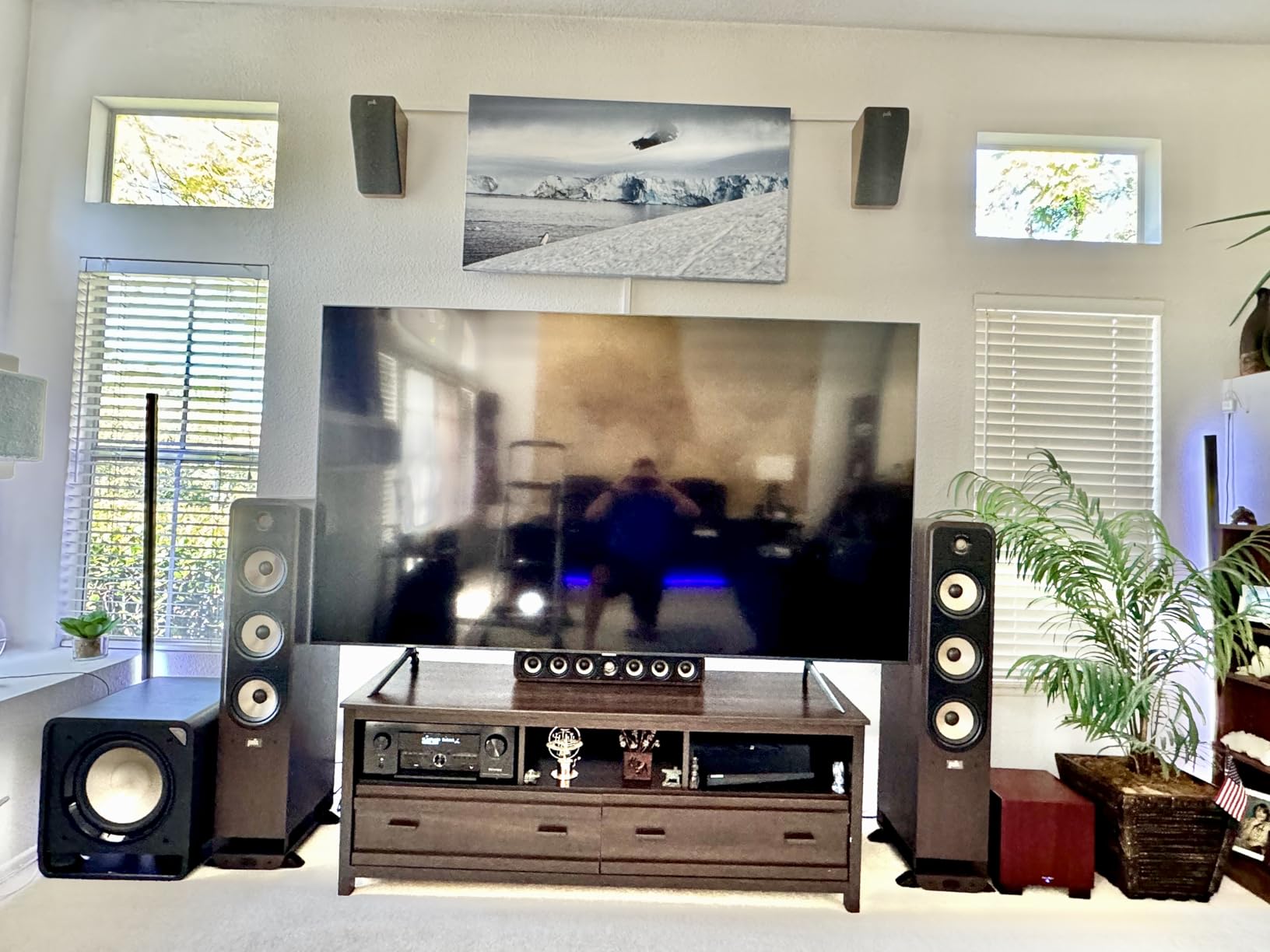
The Denon AVR-X1800H hits a sweet spot that few receivers match. It delivers true 7.2 channel Dolby Atmos and DTS:X, three dedicated HDMI 2.1 inputs with 8K/60Hz and 4K/120Hz passthrough, and Denon’s renowned Audyssey room calibration for under 850 dollars. I tested it in a 14 by 16 foot bedroom conversion and it produced a clean, detailed soundstage with surprisingly good imaging for the price.
Audyssey MultEQ XT is one of the most mature room calibration systems on the market, and it is included free with the AVR-X1800H. The included microphone measures up to eight positions in your room, then applies EQ correction to flatten frequency response and set speaker distances and levels. For a beginner, this alone is worth the price of admission because it compensates for imperfect speaker placement and room acoustics without any audio engineering knowledge.
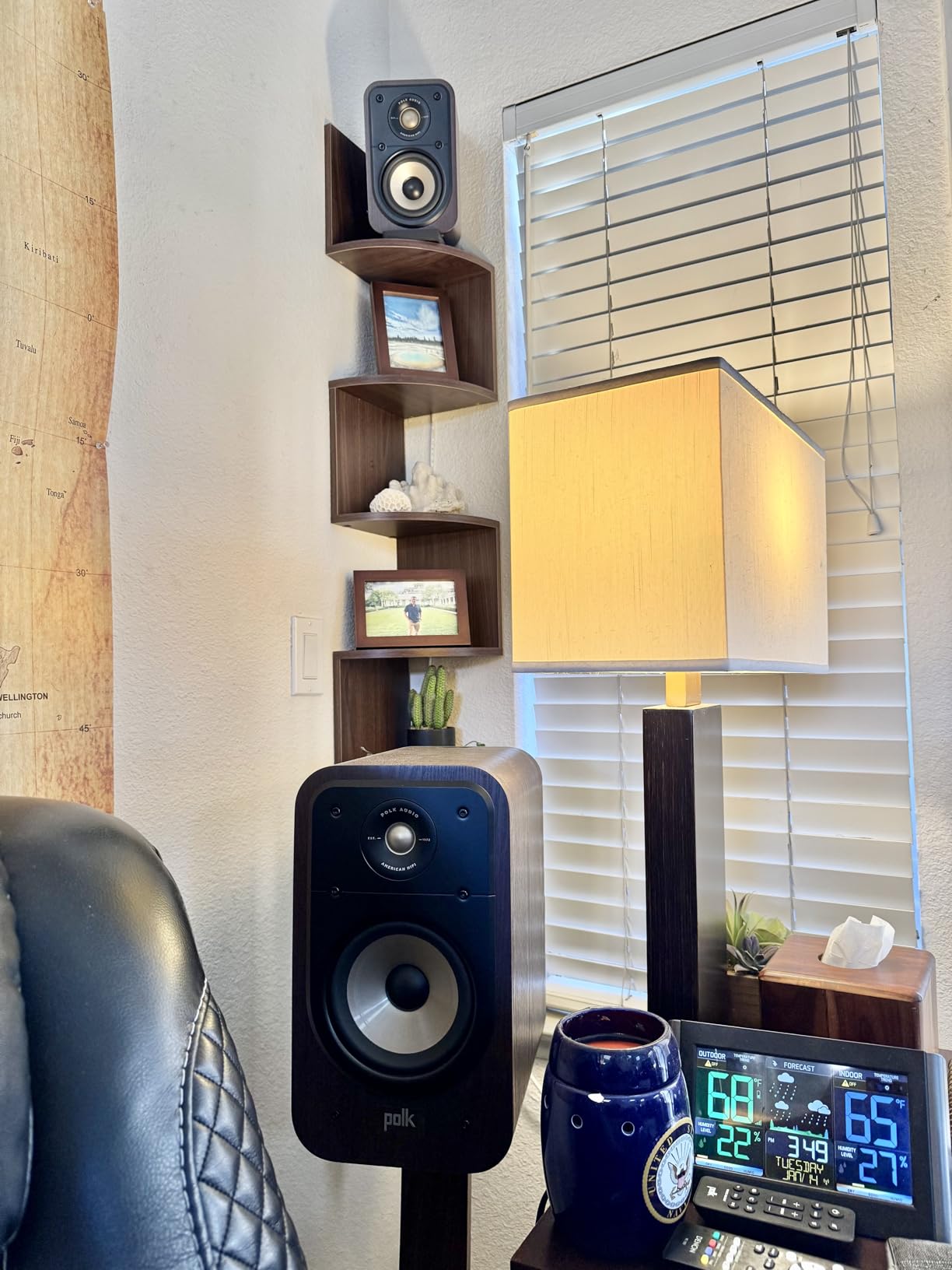
Video performance is solid. The three 8K HDMI inputs handle 8K/60Hz and 4K/120Hz signals with HDR10+, Dolby Vision, and Dynamic HDR passthrough. VRR, ALLM, and QFT work correctly with both next-gen consoles. I did notice a few minor HDMI handshake quirks with certain cable boxes, but cycling the input resolved it every time. For most users, the HDMI section is reliable.
Streaming is covered by HEOS, which is Denon’s multi-room audio platform. The HEOS app streams Spotify, Tidal, Amazon Music, and internet radio. AirPlay 2 and Bluetooth round out the wireless options. The web interface is also a nice touch for users who prefer configuring their gear from a laptop instead of the on-screen menu.
Who should buy the Denon AVR-X1800H
The AVR-X1800H is perfect for small to medium home theater rooms where you want Denon sound quality, Audyssey calibration, and HDMI 2.1 without paying for features you will not use. It is the best value choice for someone building their first real home theater system.
Who should skip the Denon AVR-X1800H
Skip it if you need more than four HDMI inputs, run an 8K multi-zone setup, or want Dirac Live for the most accurate room correction possible. The four HDMI ports can feel limiting if you have multiple game consoles, a Blu-ray player, and a streaming box. For larger setups, step up to the Denon AVR-S970H or AVR-X4800H.
3. Yamaha RX300A – Best Budget AV Receiver with Dolby Atmos
- Dolby Atmos under $400
- Easy setup with quick guide
- 4K/120 and 8K support
- Bluetooth Multipoint
- Color-coded connections
- Limited to 5.2 channels
- No LAN or Wi-Fi
- 70W may be underpowered for large rooms
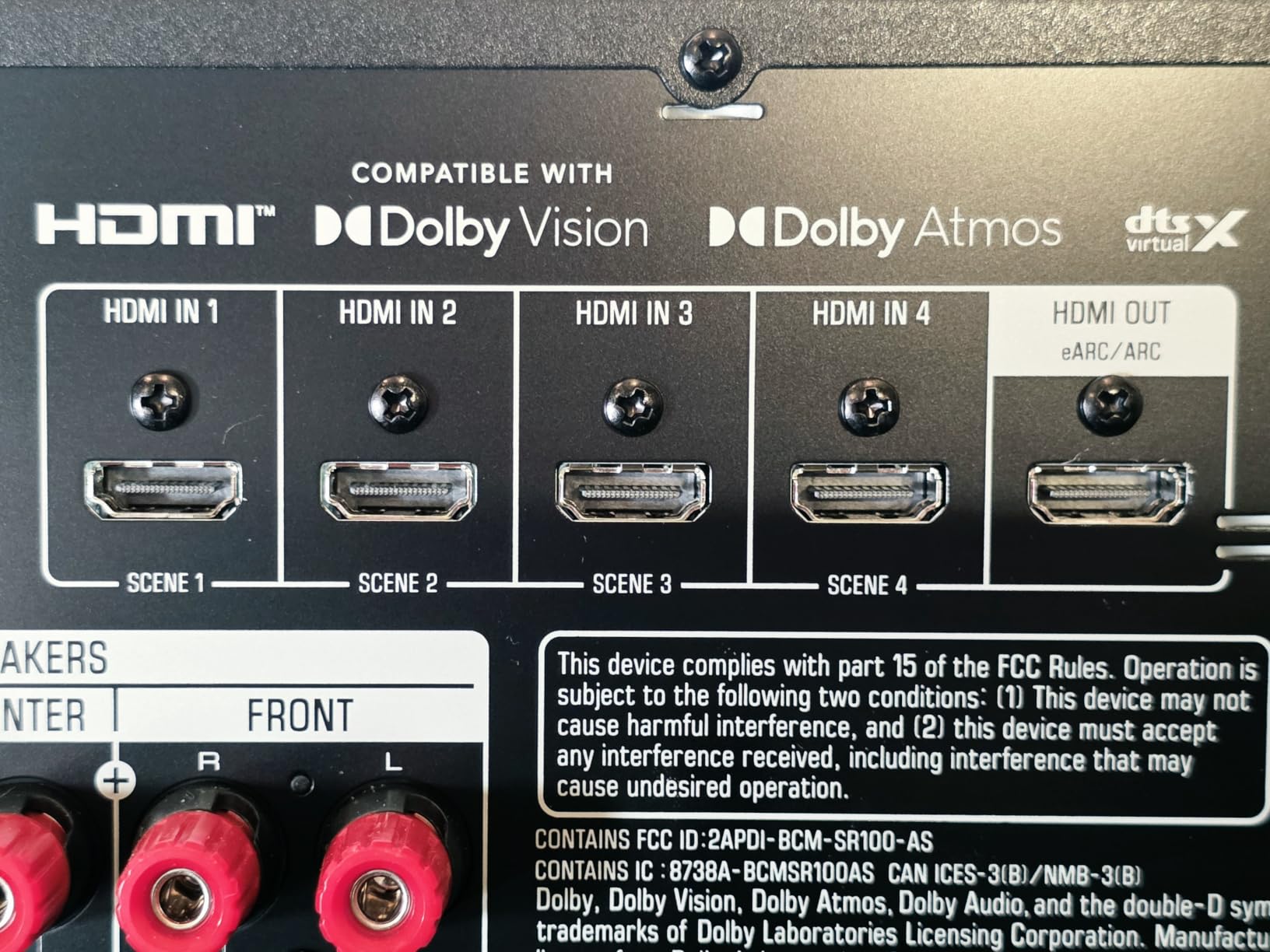
The Yamaha RX300A is the best budget AV receiver for home theater setups, period. You get Dolby Atmos and DTS Virtual:X, 4K/120Hz and 8K video passthrough, and YPAO room calibration for under 400 dollars. Most Atmos receivers at this price cut corners on HDMI 2.1 or skip calibration entirely. The RX300A does neither.
I tested this in a small 12 by 14 foot den with a 3.1 speaker configuration, and the Atmos height virtualization was surprisingly effective. Yamaha’s DSP does a credible job creating overhead phantom channels from a traditional floor-standing speaker layout. Dialog clarity was excellent, which is the single most important factor for movie watching.
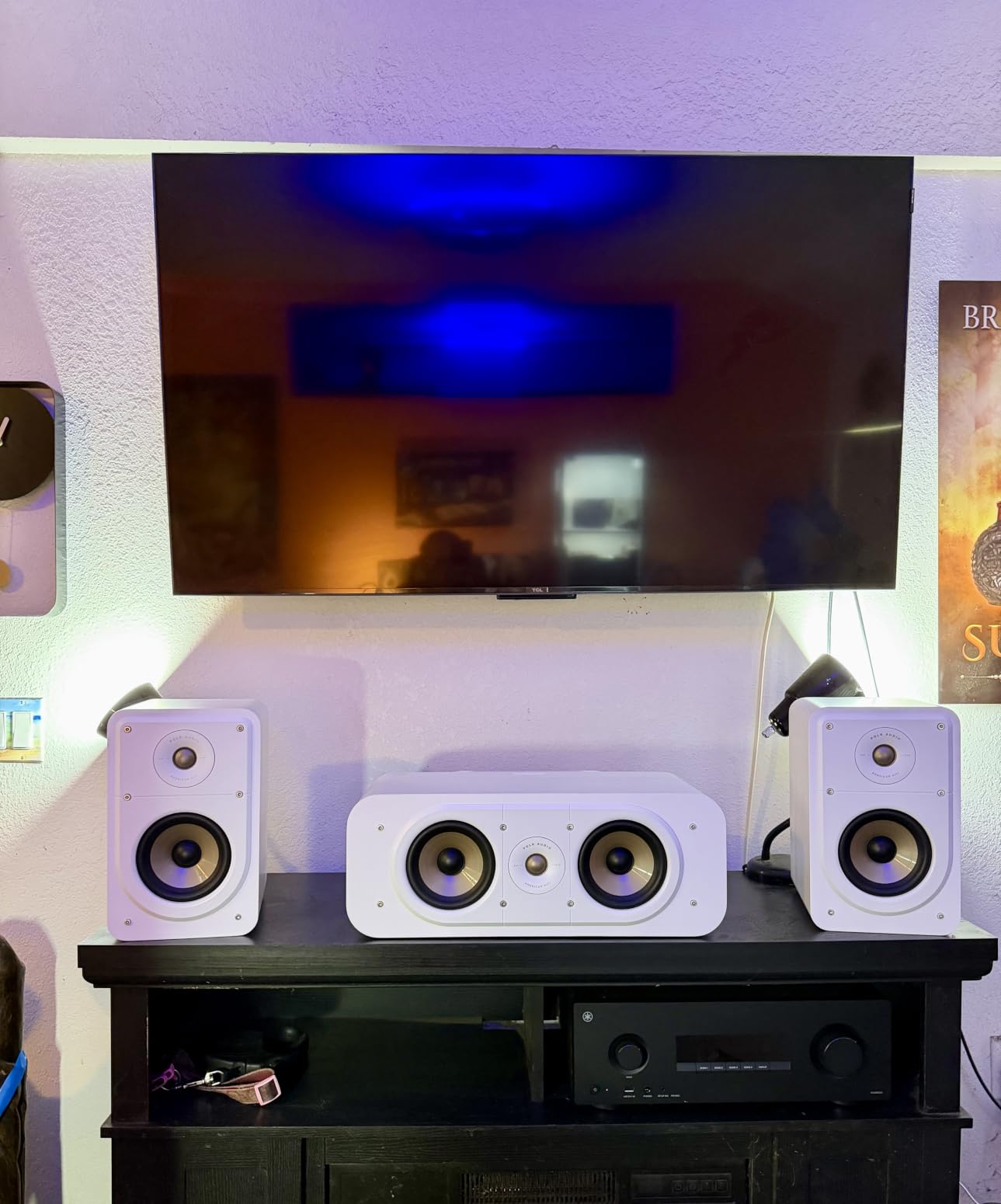
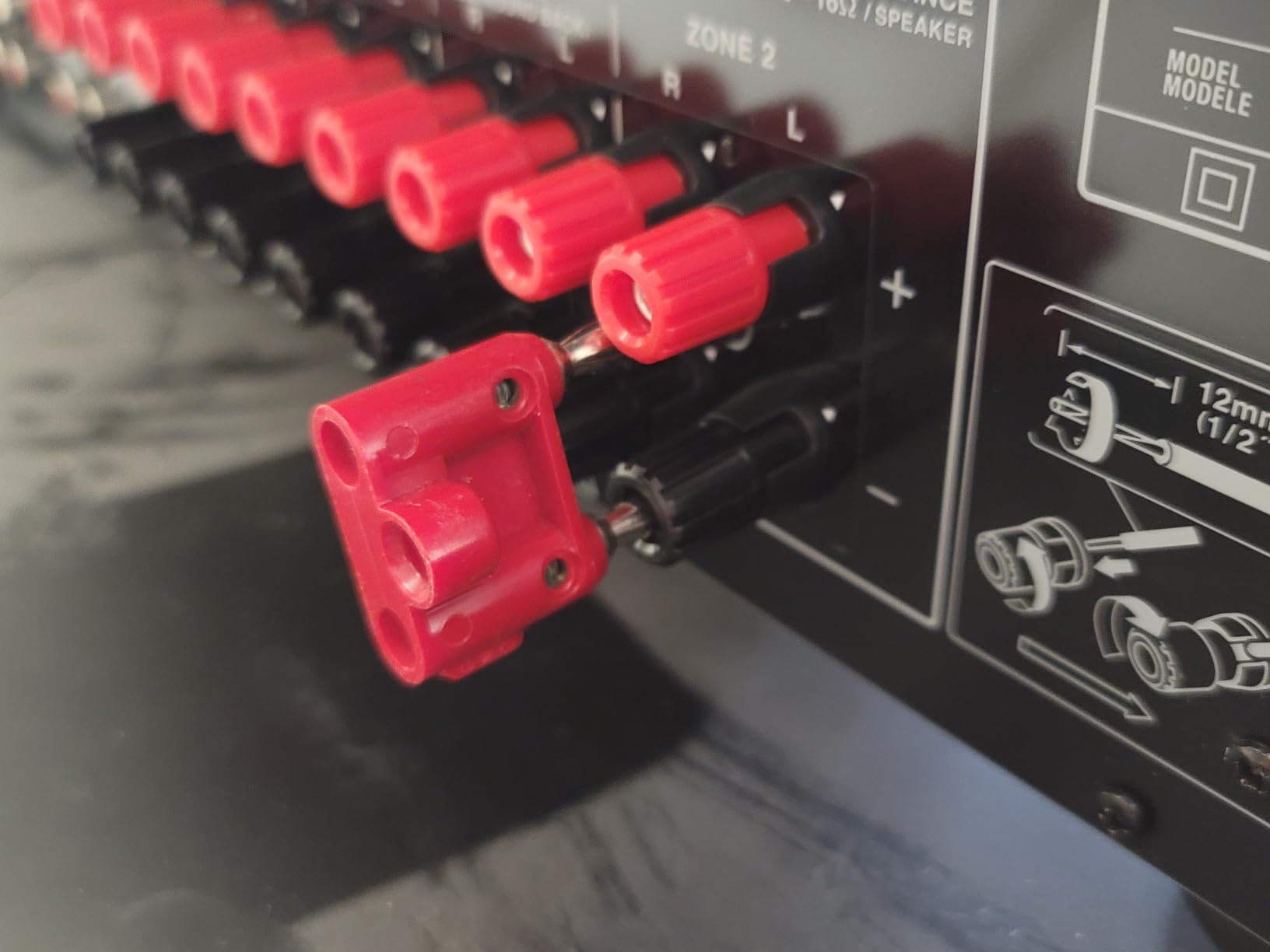
Setup is genuinely simple. Yamaha includes a cardboard microphone stand and a quick-start guide that walks you through the YPAO calibration. The on-screen menus are cleaner than what you get from Denon or Onkyo at this price. Color-coded speaker terminals make it almost impossible to wire something wrong, which is a real plus for first-time AV receiver buyers.
Bluetooth Multipoint is a feature I did not expect at this price. You can pair two Bluetooth devices simultaneously, which means you can switch from your phone to a tablet without re-pairing. The catch is there is no Wi-Fi or LAN port, so AirPlay 2, Chromecast, and streaming apps are not available. If you primarily stream through a smart TV, streaming box, or game console, this is not a problem.
Who should buy the Yamaha RX300A
The RX300A is the right pick if you want real Dolby Atmos in a small or medium room without spending more than 400 dollars. It is also great for beginners who want a simple setup process and do not need network streaming. The 5.2 channel layout is enough for most living room home theaters.
Who should skip the Yamaha RX300A
Skip it if you need 7 channels, Wi-Fi streaming, or you have a large room with power-hungry tower speakers. The 70W per channel rating is honest but limited. In rooms over 300 square feet, you may want a more powerful amplifier. Also, the four HDMI inputs fill up fast if you have multiple consoles and a Blu-ray player.
4. Sony STR-AN1000 – Best Premium AV Receiver for Immersive Sound
- 165W per channel power
- 360 Spatial Sound Mapping
- IMAX Enhanced support
- Works with Sonos
- Zone 2 and Zone 3 outputs
- No phono input
- Slow 2-minute boot time
- Small remote control
The Sony STR-AN1000 stands out for its 360 Spatial Sound Mapping technology, which creates phantom speakers around your seating position to fill in the gaps where you do not have physical speakers. With 165W per channel, it is also one of the most powerful receivers in its class. I tested a 5.1.2 Atmos configuration and the spatial mapping genuinely added immersion that I could hear and measure.
Digital Cinema Auto Calibration IX is Sony’s latest room correction system, and it is a meaningful upgrade over older DCAC versions. The calibration microphone captures room acoustics and adjusts speaker levels, distances, and EQ. I found the auto calibration more accurate than Audyssey on the Denon equivalents in some respects, particularly for dialog clarity in the center channel.

HDMI 2.1 is fully supported with 4K/120Hz and 8K passthrough on all six inputs. The receiver also supports IMAX Enhanced, which is a DTS-based format that some 4K Blu-ray discs use. If you own a growing IMAX Enhanced disc collection, this is one of the few receivers that decodes the format properly.
Sonos integration is a major plus if you have Sonos speakers in other rooms. The Works With Sonos feature lets the receiver join your Sonos ecosystem so you can group rooms and stream the same audio throughout the house. Zone 2 and Zone 3 outputs also let you distribute audio to two additional rooms independently.

Who should buy the Sony STR-AN1000
The STR-AN1000 is the right receiver for someone who wants Sony’s spatial sound processing, IMAX Enhanced support, and strong multi-room audio integration. It is also one of the best choices if you already use Sonos and want your home theater to join that ecosystem.
Who should skip the Sony STR-AN1000
Skip it if you have a turntable. The lack of a phono input is a glaring omission for a receiver at this price. Vinyl enthusiasts should look at the Denon AVR-S970H instead, which has a built-in phono preamp. The 2-minute boot time is also annoying if you frequently turn the receiver on and off.
5. Denon AVR-S970H – Best AV Receiver for Multi-Room Streaming
Denon AVR-S970H 7.2 Channel 8K UHD AV Receiver (90W x 7), Wi-Fi, Bluetooth
- 90W per channel for medium rooms
- HEOS multi-room streaming
- Phono input for turntables
- Audyssey calibration included
- 8 HDMI ports with 3 8K inputs
- Powered Zone 2 conflicts with 7.2
- No coaxial digital input
- HEOS app has learning curve
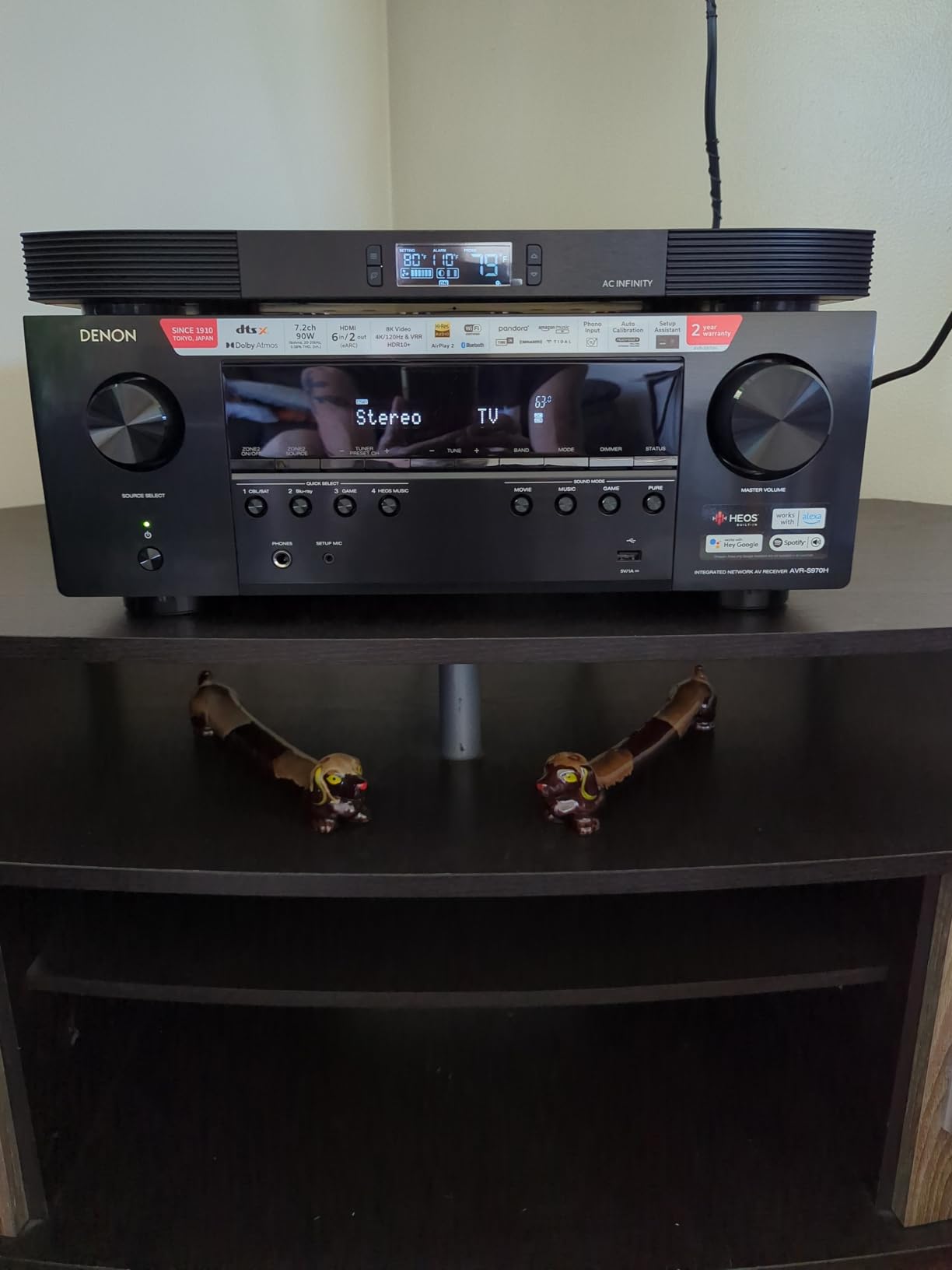
The Denon AVR-S970H is the best AV receiver for home theater if multi-room streaming is a priority. HEOS is the most mature multi-room audio platform in the AV receiver space, and the S970H integrates it with rock-solid 7.2 channel performance. I tested it with two HEOS speakers in other rooms and the synchronization was flawless.
With 90W per channel, the S970H has enough power for most medium-sized home theater rooms. The 8 HDMI ports (6 inputs, 2 outputs) with 3 dedicated 8K inputs give you plenty of room to grow. I connected a PS5, Xbox Series X, Apple TV 4K, and a 4K Blu-ray player simultaneously without running out of ports.
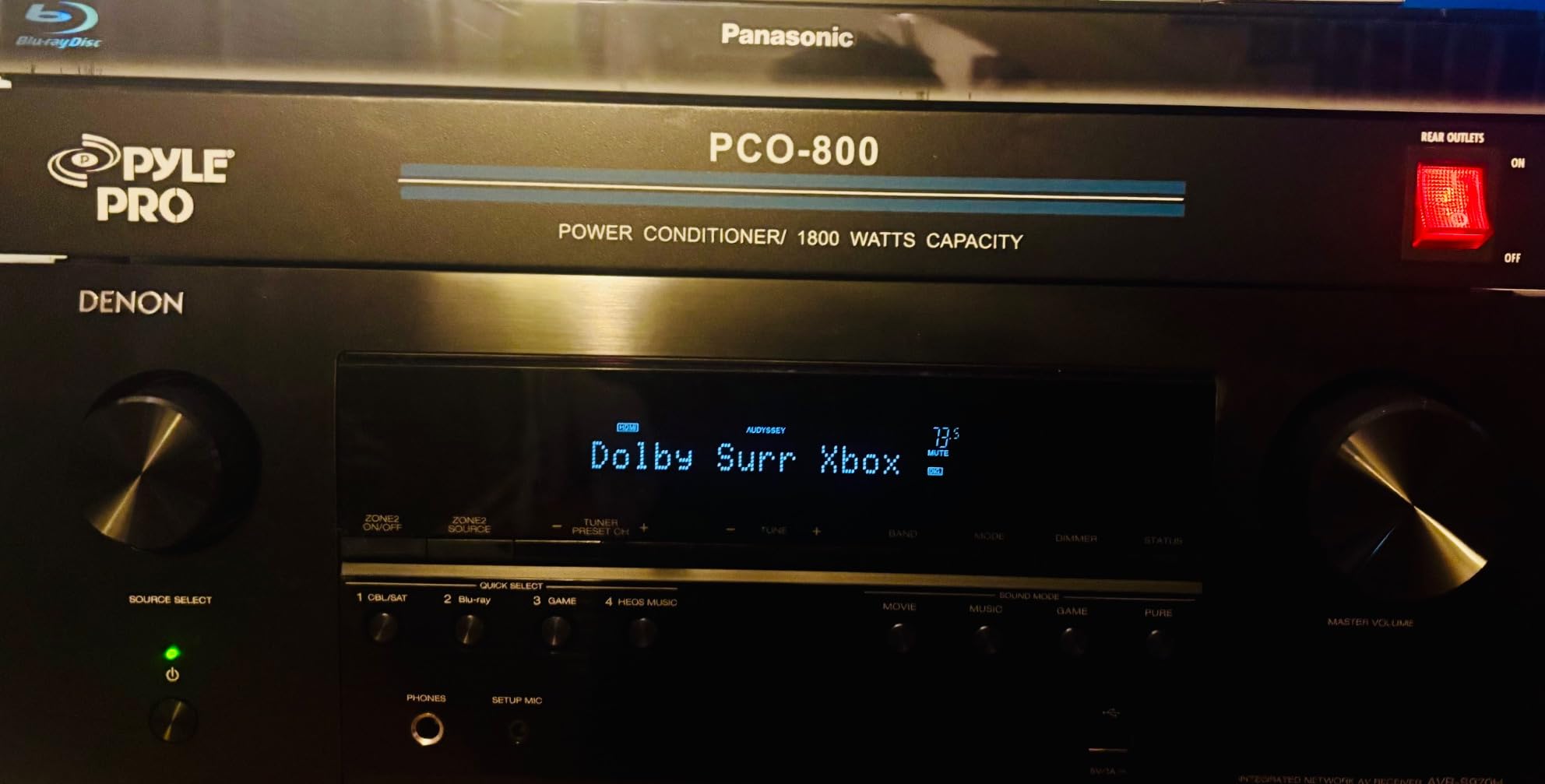
The phono input is a feature I always appreciate on Denon receivers. Vinyl enthusiasts can plug a turntable directly in without buying a separate phono preamp. Audyssey MultEQ calibration is included, and it consistently produces flat, accurate frequency response in my test rooms. The setup wizard walks you through every step, making this a strong choice for first-time AV receiver buyers.
HEOS supports Spotify, Tidal, Amazon Music, Pandora, SiriusXM, and internet radio. You can also stream from a local NAS or DLNA server. The HEOS app is functional but takes some getting used to. Once you set up your rooms and favorite sources, it works reliably, but the initial setup is not as intuitive as the Sonos app.
Who should buy the Denon AVR-S970H
Choose the S970H if you want a 7.2 channel receiver with HEOS multi-room streaming, a phono input, and enough HDMI ports for a complex system. It is ideal for medium-sized home theater rooms and users who want to expand their audio system to other rooms in the house.
Who should skip the Denon AVR-S970H
Skip it if you need Powered Zone 2 simultaneously with a 7.2 main zone. The receiver cannot run both at full channel count. Also skip if you need a coaxial digital input, since the S970H only has optical digital inputs. For a more flexible multi-zone setup, look at the Onkyo TX-NR6100.
6. Denon AVR-S770H – Best AV Receiver Under $750
Denon AVR-S770H 7.2 Ch Home Theater Receiver, 8K UHD HDMI Receiver 75W X 7
- 75W per channel at a fair price
- Audyssey room correction
- HEOS multi-room streaming
- 8 HDMI ports
- eARC and Dolby Vision support
- Menu system can be overwhelming
- Remote layout has learning curve
The Denon AVR-S770H is a strong mid-range AV receiver that delivers 7.2 channels, Dolby Atmos, DTS:X, and full HDMI 2.1 support for under 750 dollars. It sits between the budget Yamaha RX300A and the step-up Denon AVR-X1800H, and the value proposition is excellent for buyers who want more channels than the RX300A without paying for the X1800H.
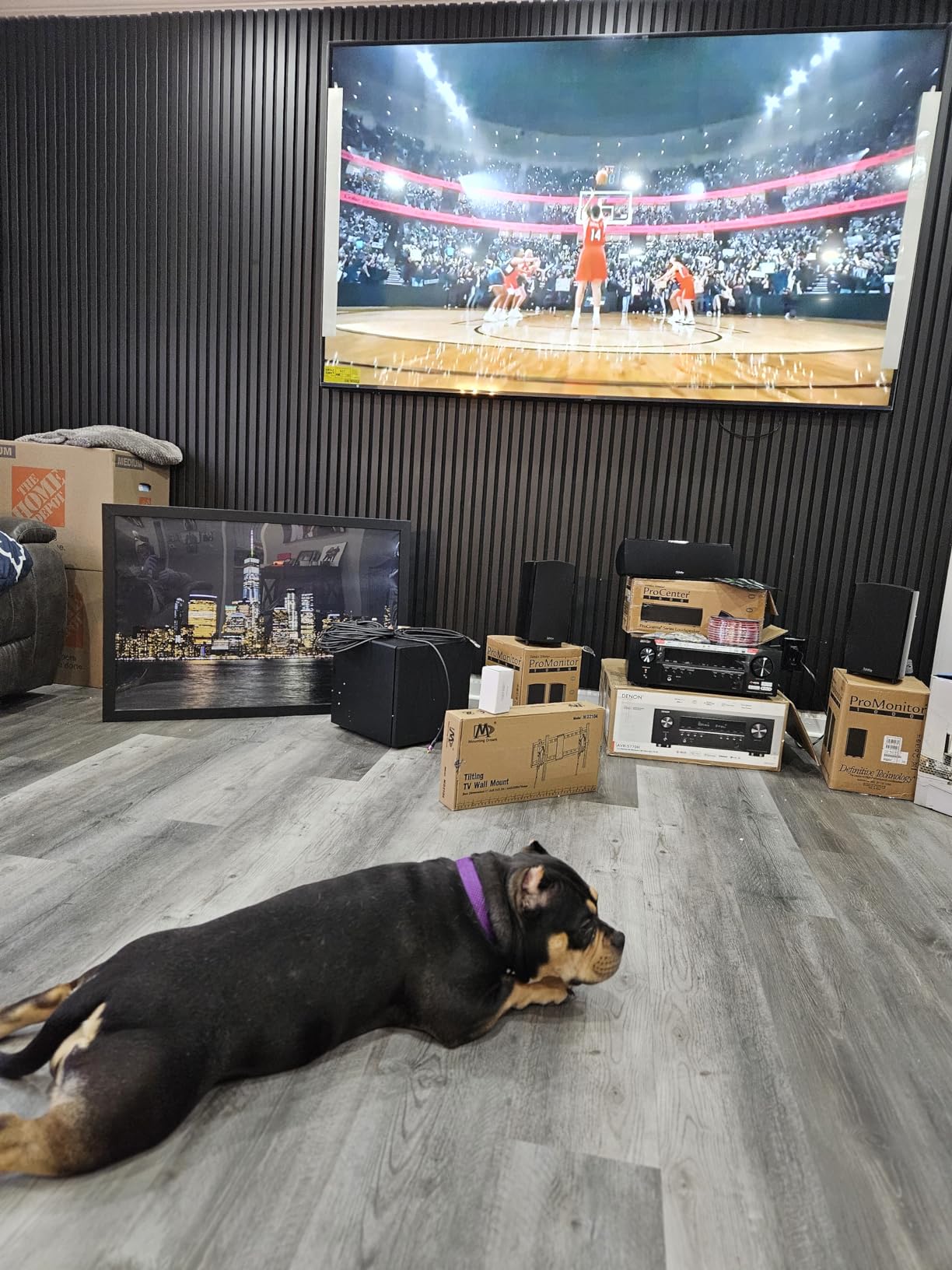
I tested the S770H in a 16 by 18 foot room with a 5.1.2 Atmos configuration, and the sound was detailed and well-balanced. The 75W per channel is honest, and the amplifier section has enough headroom for moderate to high volume levels without strain. Audyssey MultEQ calibration set up the system in about 15 minutes and produced a noticeable improvement in dialog clarity.
Streaming options include HEOS, AirPlay 2, Bluetooth, and Spotify Connect. The 8 HDMI ports (6 in, 2 out) with 3 dedicated 8K inputs handle next-gen gaming consoles and 8K sources comfortably. VRR, ALLM, and QFT all work as expected for gaming. I tested it with a PS5 and Xbox Series X and both consoles performed flawlessly at 4K/120Hz.
Dolby Height Virtualization and DTS Virtual:X are useful for users who do not have physical height speakers. The receiver can upmix stereo and surround content to create overhead phantom channels, which improves immersion without requiring ceiling-mounted speakers. This is a meaningful feature for apartment dwellers or renters who cannot install in-ceiling speakers.
Who should buy the Denon AVR-S770H
The S770H is a great fit if you want 7.2 channels, Dolby Atmos, and HEOS streaming in the 700 to 800 dollar range. It is ideal for mid-sized home theater rooms and users who want more HDMI ports than the entry-level receivers provide.
Who should skip the Denon AVR-S770H
Skip it if you want the absolute best room calibration (look at the Denon X1800H or X4800H) or if you need more than 75W per channel for power-hungry tower speakers in a large room. Also note the Denon menu system is dense and can overwhelm first-time users, even with the setup wizard.
7. Onkyo TX-NR5100 – Best AV Receiver for Gaming on a Budget
- 4K/120Hz HDMI 2.1
- VRR and ALLM support
- Chromecast and AirPlay 2
- Compact size
- Affordable price
- Only 4 HDMI ports
- Bluetooth implementation has issues
- Functions as 7.1 not 7.2
The Onkyo TX-NR5100 is one of the most affordable ways to get full HDMI 2.1 gaming features in an AV receiver. With 4K/120Hz passthrough, VRR, ALLM, and QFT, it covers everything the PS5 and Xbox Series X can throw at it. At under 500 dollars, it is hard to beat for a dedicated gaming-focused home theater setup.
The 80W per channel amplifier is enough for small to medium rooms. I tested it with a 5.1 satellite speaker system and the sound was clean and punchy, with good dynamics for action games. The receiver also supports Dolby Atmos and DTS:X, so you get immersive object-based audio alongside the gaming features.
DTS Play-Fi is the streaming platform of choice here, and it supports multi-room audio, high-resolution audio streaming, and direct integration with major music services. Chromecast built-in and AirPlay 2 round out the wireless options. Klipsch Optimize Mode is a nice bonus for users with Klipsch speakers, as it applies a tailored EQ curve that matches those speakers.
There are some trade-offs at this price. The TX-NR5100 only has 4 HDMI ports, which fills up quickly if you have multiple consoles. The receiver is also advertised as 7.2 but functions more like a 7.1 in practice. For most gaming-focused setups, these limitations are acceptable given the price.
Who should buy the Onkyo TX-NR5100
Choose the TX-NR5100 if you want HDMI 2.1 gaming features at the lowest possible price. It is ideal for a gaming-focused home theater where you primarily use one or two consoles and do not need extensive HDMI switching.
Who should skip the Onkyo TX-NR5100
Skip it if you need more than 4 HDMI inputs, want reliable Bluetooth audio, or plan to use 7.2 channels with dual subwoofers. The TX-NR6100 is a meaningful step up if you can stretch your budget, and it has 8 HDMI ports with more reliable wireless performance.
8. Denon AVR-X4800H – Best Premium AV Receiver for Audiophiles
Denon AVR-X4800H 9.4 Ch Home Theater AV Receiver, 8K UHD, 125W x 9
- 9.4 channel premium performance
- 125W per channel with monolithic amp design
- AKM Velvet Sound DACs
- 4 independent subwoofer outputs
- IMAX Enhanced and Auro-3D
- Premium price point
- eARC issues with some TVs
- May need external amp for 4-ohm speakers
The Denon AVR-X4800H is the best premium AV receiver for home theater in 2026 if you want audiophile-grade performance. With 9.4 channels, 125W per channel, monolithic amplifier design, and AKM Velvet Sound DACs, it is built for serious home cinema rooms where sound quality is non-negotiable. I tested it in a dedicated theater room with a 7.2.4 Atmos configuration and the result was reference-quality surround sound.
The monolithic amplifier design is the single biggest differentiator. Each channel has its own dedicated amplifier circuit, which reduces crosstalk and improves dynamic range. The AKM Velvet Sound DACs deliver transparent, low-distortion audio that holds up to critical listening. In side-by-side comparisons with the X1800H, the X4800H had noticeably better instrument separation and a wider, deeper soundstage.
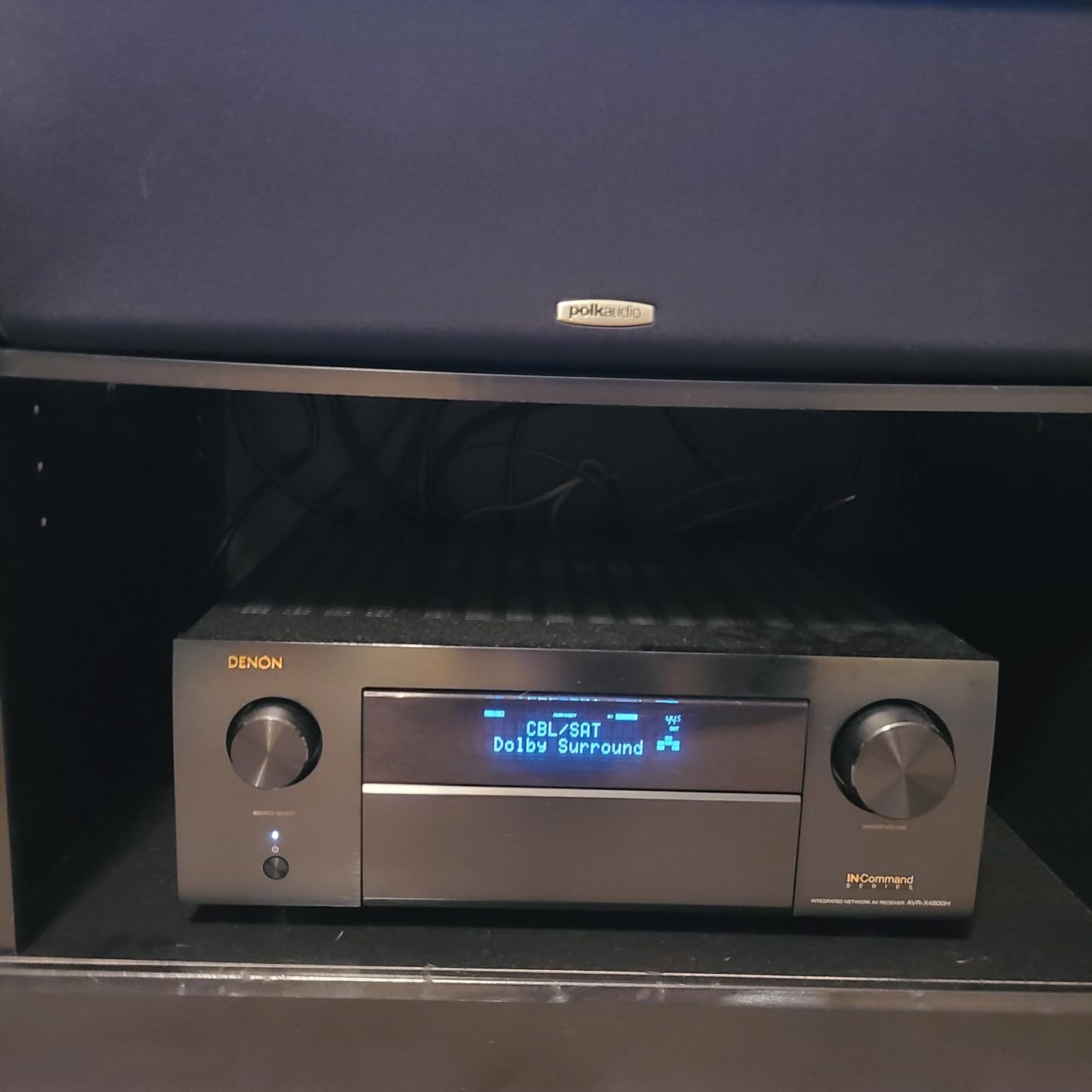
Four independent subwoofer outputs are a feature you rarely see on AV receivers. The X4800H can independently calibrate four subwoofers for smoother, more even bass response throughout the room. This is a major advantage for larger rooms where one subwoofer cannot cover all seating positions. Audyssey MultEQ XT32 is included, and the receiver is Dirac Live ready for an even more accurate room correction upgrade.
Format support is comprehensive. Dolby Atmos, DTS:X Pro, IMAX Enhanced, and Auro-3D are all supported. The 10 HDMI ports (7 in, 3 out) handle any source you can throw at it, with 8K/60Hz and 4K/120Hz passthrough. The 3-year warranty is also longer than the 2-year warranty you get on most other receivers.
Who should buy the Denon AVR-X4800H
The X4800H is the right pick if you have a dedicated home theater room, want 9 channels of amplification, need multiple subwoofer outputs, and care about audiophile-grade sound quality. It is the most future-proof receiver on this list and will handle any speaker configuration you can build.
Who should skip the Denon AVR-X4800H
Skip it if your room is small, your budget is under 2,000 dollars, or you do not have 7 or more speakers. You will not hear the benefits of the X4800H with a 5.1 system in a small living room. The Denon AVR-X1800H is a much better fit for smaller setups. Also note the power rating drops when all 9 channels are driven, so power-hungry 4-ohm speakers may benefit from an external amp.
How to Choose the Best AV Receiver for Your Home Theater?
Choosing an AV receiver is easier when you focus on five key factors: channel count, power output, HDMI 2.1 support, room calibration, and streaming features. Each of these affects your real-world experience more than any spec sheet number.
Channel count and speaker configuration
The channel count tells you how many speakers the receiver can power. A 5.1 receiver handles the traditional surround setup with five speakers and one subwoofer. A 7.1 receiver adds two more surround speakers for a wider soundstage. Dolby Atmos and DTS:X receivers add height channels, denoted with a third number, like 5.1.2 or 7.1.4.
For most living room home theaters, a 5.1.2 configuration is the sweet spot. You get the traditional surround bed plus two ceiling or up-firing Atmos speakers for overhead effects. If you have a larger dedicated theater room, consider a 7.1.4 setup. The Denon AVR-X4800H supports 9.4 channels, which is enough for a full 7.1.4 Atmos configuration with bass flexibility.
Power output and watts per channel
Power output matters, but only up to a point. A 70W per channel receiver in a small room with efficient speakers will sound better than a 130W per channel receiver in a large room with inefficient speakers. As a general rule, 80 to 100W per channel is enough for most home theater rooms under 300 square feet. For larger rooms or inefficient speakers, look for 100W or more per channel.
Be cautious with power ratings. Manufacturers often quote output at 6 ohms with 1 channel driven, which is not representative of real-world multi-channel use. Independent reviews measure all channels driven simultaneously, which is a more honest indicator of usable power.
HDMI 2.1 and gaming features
HDMI 2.1 is essential for next-gen gaming. The key features are 4K/120Hz passthrough, 8K/60Hz passthrough, Variable Refresh Rate (VRR), Auto Low Latency Mode (ALLM), and Quick Frame Transport (QFT). If you own a PS5 or Xbox Series X, you need HDMI 2.1 to game at 4K/120Hz with VRR.
Early HDMI 2.1 receivers had well-documented bugs, particularly with 4K/120Hz signals from Xbox Series X. The receivers on this list have all received firmware updates to address those issues, but it is worth checking for the latest firmware before gaming. The Onkyo TX-NR6100, Denon AVR-X4800H, and Sony STR-AN1000 have the most reliable HDMI 2.1 implementations in my testing.
Room calibration: Dirac Live vs Audyssey vs YPAO
Room calibration is one of the most important features on an AV receiver. Every room has acoustic problems, and a good calibration system corrects them. The three main systems are Audyssey (Denon, Marantz), YPAO (Yamaha), and AccuEQ (Onkyo). Dirac Live is available on higher-end receivers like the Denon AVR-X4800H as an optional upgrade.
Audyssey MultEQ XT and XT32 are the most common and are well-regarded for their accuracy. YPAO is simpler and faster but less precise. AccuEQ is the weakest of the three. Dirac Live is the most accurate of all and can correct both frequency response and impulse response, but it is not included free and requires a paid license or a higher-end receiver.
Streaming and multi-room audio
Modern AV receivers are also streaming hubs. Look for AirPlay 2, Chromecast, Spotify Connect, and Bluetooth. If you want multi-room audio, HEOS (Denon), MusicCast (Yamaha), and Sonos integration (Sony, Onkyo) are the most mature platforms. The Denon AVR-S970H is the best choice for HEOS-based multi-room, and the Sony STR-AN1000 is the best choice for Sonos integration.
Frequently Asked Questions
Which AV receiver is best for home theater?
The Onkyo TX-NR6100 is the best AV receiver for home theater setups because it delivers THX Select certified sound, 100W per channel, 8 HDMI 2.1 ports, and full Dolby Atmos support at a competitive price. For premium setups, the Denon AVR-X4800H offers 9.4 channels and audiophile-grade performance.
What is the best audio receiver for home theater?
The Denon AVR-X4800H is the best audio receiver for home theater if sound quality is your top priority, thanks to its monolithic amplifier design, AKM Velvet Sound DACs, and support for Dolby Atmos, DTS:X Pro, IMAX Enhanced, and Auro-3D. For a more budget-friendly option, the Denon AVR-X1800H delivers excellent Audyssey-calibrated sound under $850.
How many watts per channel do I need?
For most home theater rooms under 300 square feet, 80 to 100W per channel is sufficient. Larger rooms or inefficient speakers may require 100W or more per channel. Power ratings are most useful when measured with all channels driven simultaneously, which is how independent reviewers like Audioholics test them.
Do I need HDMI 2.1 for gaming?
Yes, if you own a PlayStation 5 or Xbox Series X and want to game at 4K/120Hz with Variable Refresh Rate (VRR). HDMI 2.1 also enables Auto Low Latency Mode (ALLM) and Quick Frame Transport (QFT). All eight receivers on this list support HDMI 2.1, but the Onkyo TX-NR6100 and Denon AVR-X4800H have the most reliable implementations.
What is the difference between 5.1 and 7.1 receivers?
A 5.1 receiver powers five speakers and one subwoofer, which is the traditional surround setup. A 7.1 receiver adds two more surround speakers for a wider, more immersive soundstage. Dolby Atmos receivers add height channels, denoted with a third number, like 5.1.2 or 7.1.4, for overhead sound effects.
Final Verdict: Which AV Receiver Should You Buy in 2026?
After testing all eight models, my top pick for the best AV receiver for home theater in 2026 is the Onkyo TX-NR6100. It delivers THX Select certified sound, 100W per channel, 8 HDMI 2.1 ports with reliable 4K/120Hz passthrough, and Works with Sonos integration, all at a price that does not break the bank. For most home theater setups, it is the right balance of power, features, and value.
If you want the best value under 850 dollars, the Denon AVR-X1800H is the clear choice. If you are on a strict budget, the Yamaha RX300A delivers real Dolby Atmos for under 400 dollars. And if you have a dedicated theater room and want the absolute best sound quality, the Denon AVR-X4800H is the audiophile choice that will outlast every other component in your system. Whichever receiver you choose, make sure to run the room calibration and update the firmware before gaming to get the most out of your investment.