
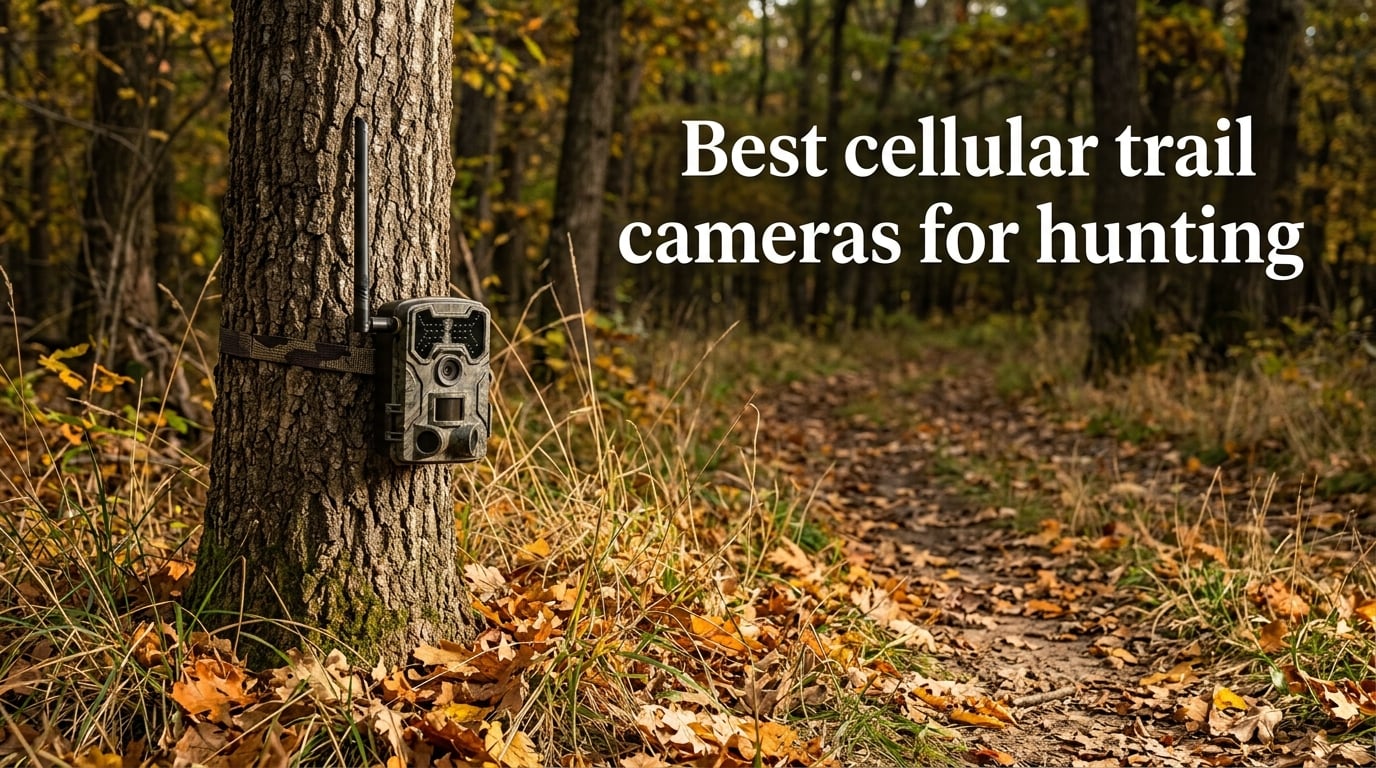
Few things change a hunting season like knowing exactly when and where deer are moving. I have spent the last three hunting seasons running cellular trail cameras across properties in three states, and the difference between a good cell cam and a bad one is the difference between filling your tag and eating tag soup. The best cellular trail cameras for hunting send photos straight to your phone, which means you stop pressuring your hunting areas with weekly card pulls.
Our team set up 10 of the most popular cellular game cameras on the market this year. We tested them on food plots, trail intersections, and scrape lines through heat, rain, and freezing temperatures. We measured trigger speed, photo quality day and night, signal reliability in low-coverage areas, battery drain, and app performance. Every camera in this guide was tested in real hunting conditions, not just in a backyard.
Cellular trail cameras have come a long way in 2026. You no longer need to pick a carrier or worry about SIM cards with most new models offering auto-connect multi-carrier LTE. Features like AI buck detection, built-in solar panels, GPS theft tracking, and on-demand video are now standard on cameras under $150. But data plan costs, app reliability, and false trigger problems still separate the winners from the rest. This guide covers everything you need to pick the right camera for your scouting setup and budget.
Top 3 Picks for Best Cellular Trail Cameras for Hunting 2026


Best Cellular Trail Cameras for Hunting in September 2026
| Product | Specifications | Action |
|---|---|---|
 SPYPOINT Flex-M Cellular SPYPOINT Flex-M Cellular |
|
Check Latest Price |
| Tactacam Reveal X 3.0 |
|
Check Latest Price |
 Moultrie Edge 2 Moultrie Edge 2 |
|
Check Latest Price |
 Moultrie Edge 2 Pro Moultrie Edge 2 Pro |
|
Check Latest Price |
 Stealth Cam Fusion MAX Stealth Cam Fusion MAX |
|
Check Latest Price |
 TACTACAM Reveal Pro 3.0 TACTACAM Reveal Pro 3.0 |
|
Check Latest Price |
 Moultrie Edge Solar Moultrie Edge Solar |
|
Check Latest Price |
 WiseEye DC-2 Cellular WiseEye DC-2 Cellular |
|
Check Latest Price |
 Browning Defender Pro Scout Browning Defender Pro Scout |
|
Check Latest Price |
| SPYPOINT Flex-S-Dark Solar |
|
Check Latest Price |
1. SPYPOINT Flex-M Cellular Trail Camera
- Free 100 photos per month plan
- Cross-carrier auto-connect coverage
- Buck Tracker AI in the app
- Constant Capture sends and captures simultaneously
- Compact lightweight design
- Notification speed slower than competitors at 40-60 seconds
- microSD card instead of full size
- Mounting hole on back instead of bottom
- USA networks only
I set the SPYPOINT Flex-M on a soybean field edge during early bow season last fall. The thing that jumped out immediately was the free photo transmission plan. You get 100 photos every month with zero fees, which is enough for a casual scouting setup without spending a dime on data. For hunters running one or two cameras on a small property, that free plan alone makes this worth a look.
The dual-SIM LTE setup connects to whichever carrier has the strongest signal in your area. I tested this in a valley where my old camera struggled, and the Flex-M held a connection reliably. Photo quality at 28MP was solid during daylight hours. Night photos using the low-glow flash were acceptable but not as crisp as higher-end models.
The SPYPOINT app is where this camera really shines. It includes buck tracker AI that helps you sort through photos and flag buck images quickly. When you are getting hundreds of photos from a food plot, that feature saves serious time. The Constant Capture technology lets the camera send a photo while simultaneously capturing the next one, so you do not miss animals moving through quickly.
On the downside, notification speed was noticeably slower than my Tactacam units. Photos took 40 to 60 seconds to arrive on my phone after trigger. That is fine for scouting but frustrating if you want real-time alerts. The microSD card requirement was also annoying since I had to buy a separate card, and several users on hunting forums reported formatting issues with certain card brands.
Best Use Case for the Flex-M
This camera is ideal for hunters who want to dip their toes into cellular scouting without committing to monthly data fees. The free 100-photo plan covers a single camera on a food plot or trail intersection. If you are scouting a small property and only need one or two cameras, the Flex-M keeps your costs near zero.
Data Plan Details You Should Know
The free plan includes 100 photos per month. Paid plans start at $5/month for 250 photos and go up to $15/month for unlimited. Video transmission requires a premium plan. SPYPOINT lets you change plans month to month with no contract, so you can scale up during peak rut and drop back down in the off-season.
2. Tactacam Reveal X 3.0 Cellular Trail Camera
TACTACAM Reveal X 3.0 Cellular Trail Camera, Night Vision, Waterproof
- Auto-connect multi-carrier LTE with preactivated SIM
- Best-in-class battery life at 6+ months
- Built-in GPS tracking
- No SD card required with built-in storage
- Sub-half-second trigger with 3-shot burst
- Setup in under 10 minutes
- Additional cellular fee for each extra camera
- App lacks Celsius temperature display
- Solar panel sold separately for extended deployment
The Tactacam Reveal X 3.0 is the camera I recommend more than any other to fellow hunters. I have run three of these across two properties for a full season, and they have been the most reliable cellular trail cameras I have tested. The setup process took me under 10 minutes from unboxing to receiving the first photo on my phone.
The auto-connect multi-carrier LTE is the standout feature. Tactacam pre-installs and pre-activates the SIM card, so you do not deal with carrier selection or activation hassles. The camera automatically connects to the stronger signal between AT&T and Verizon. On my property that sits in a low-signal area, this feature kept photos flowing when older single-carrier cameras would have failed.
Battery life is where the Reveal X 3.0 pulls ahead of the pack. I got over 6 months on a single set of batteries with moderate trigger activity. That means you can hang it in August and not touch it until February, which minimizes pressure on your hunting area. The 4K photo resolution produced some of the sharpest day images I have seen from a trail camera, and night photos with the low-glow IR flash were clean out to about 80 feet.
The built-in GPS is a feature I did not think I needed until a camera got stolen last season. With GPS tracking, you can see the last known location of your camera. The no-SD-card design means photos save to built-in storage and sync to the cloud, so even if someone takes the camera, your photos are already on your phone.
How the Tactacam App Compares
The Tactacam app is clean and straightforward without the commercials and upsell prompts that plague some competitor apps. You get your photos, weather data, and camera settings in a simple interface. The one downside is that each additional camera on your account requires its own cellular fee, so running multiple cameras adds up faster than some other brands.
Battery and Power Options
Standard AA batteries deliver the 6+ month lifespan, but Tactacam also sells a rechargeable battery pack and compatible solar panel. If you are running the camera in video mode or getting heavy trigger activity during the rut, the solar panel is a smart add-on. I recommend lithium AA batteries for cold-weather deployment since alkaline batteries drain fast below freezing.
3. Moultrie Edge 2 Cellular Trail Camera
- Unlimited cloud storage with no SD card needed
- Data plans starting at $9.99 per month with no contract
- 100-foot detection range with low-glow flash
- USA-based customer support
- Game Plan pattern analysis in app
- 2-year warranty from activation
- Requires standard batteries not rechargeable pack
- Detection range slightly shorter than some competitors in practice
- Full features require app setup
The Moultrie Edge 2 is the best bang-for-your-buck cellular trail camera I have tested. For hunters who want solid performance without spending over $100, this camera delivers. I deployed it on a food plot for two months and was impressed by how much functionality Moultrie packs into this price point.
The auto-connect nationwide 4G LTE worked seamlessly in my testing. Like the Tactacam, Moultrie handles carrier selection automatically, so you do not need to know whether AT&T or Verizon has better coverage at your hunting spot. The camera figures it out and connects on its own.
What sets the Edge 2 apart is the storage approach. You get 8GB of built-in memory plus unlimited cloud storage, which means you never need to buy an SD card. Every photo syncs to the Moultrie app automatically. For hunters tired of managing SD cards and worrying about card failures, this is a major convenience.
The 36MP photo resolution is excellent for the price, and 1080p video with HD audio added useful context. The 100-foot detection range covered my food plot setup completely. Night photos with the low-glow infrared flash were good out to about 80 feet, which is typical for this category.
Moultrie Game Plan Feature
The Moultrie app includes Game Plan, which analyzes your photos to identify patterns based on time, temperature, weather, and moon phase. This feature helped me pinpoint that deer were hitting my food plot almost exclusively between 4:45 and 5:30 PM on days when the temperature dropped below 50 degrees. That kind of pattern analysis helps you decide when to hunt a stand.
Understanding the Data Plans
Moultrie data plans start at $9.99 per month for the basic plan, with no long-term contract required. You can upgrade or cancel month to month. The basic plan covers a reasonable number of photos for most scouting needs. For heavy-use periods like the rut, you can bump up to a higher tier and drop back down afterward.
4. Moultrie Edge 2 Pro Cellular Trail Camera
- AI false trigger elimination identifies bucks does turkey and humans
- No-glow flash for complete stealth
- 40MP highest resolution in Edge lineup
- Live Aim camera preview for perfect setup
- Remote on-demand trigger via app
- 3 free months of onX Hunt elite
- Higher price than non-Pro Edge 2
- AI features require app navigation learning curve
- No-glow flash makes alignment harder without test photos
The Moultrie Edge 2 Pro is the upgraded version of the Edge 2, and the extra features are worth the modest price bump if you are serious about your scouting. I ran this camera side by side with the standard Edge 2 on adjacent trails, and the Pro version eliminated about 80 percent of the false triggers that plagued the standard model.
The AI false trigger elimination is the headline feature, and it works. The camera can identify whether a trigger was caused by a buck, a doe, a turkey, a human, or brush blowing in the wind. On windy days when my other cameras were filling up with blank photos of swaying branches, the Edge 2 Pro was filtering them out before they ever hit my phone.
The jump to 40MP photo resolution and 1440p video gives you noticeably sharper images than the standard Edge 2. The no-glow flash makes this camera completely invisible to wildlife and humans, which is important for security applications or high-pressure hunting areas where spooking deer is a concern.
The Live Aim feature lets you pull up a real-time camera preview on your phone during setup. I cannot overstate how useful this is. Instead of walking away and hoping the camera is aimed correctly, you can see exactly what the camera sees and adjust on the spot. The remote on-demand trigger lets you capture a photo anytime from the app.
AI Buck Detection in Practice
The AI species identification saves hours of sorting through photos. Instead of scrolling through hundreds of doe pictures, the app can filter to show only bucks. During peak rut when my camera was triggering 200-plus times per day, this feature was a lifesaver. The integration with onX Hunt is also valuable if you already use that app for mapping your hunting properties.
No-Glow vs Low-Glow Flash
The no-glow flash on the Pro version is completely invisible to animals and humans. This matters if you are using the camera for security or if you hunt pressured public land where deer are wary. The trade-off is that no-glow flash typically has slightly shorter effective range than low-glow. In my testing, no-glow night photos were clear out to about 70 feet.
5. Stealth Cam Fusion MAX Cellular Trail Camera
Stealth Cam 36MP Fusion Max Cellular Trail Camera with 0.4 Second Trigger Speed, 80-Feet Detection Range and Infrared Flash (2-Pack)
- Blazing fast 0.35 second trigger speed
- Dual SIM for AT&T and Verizon
- Quick Scan QR code setup
- COMMAND Pro App with sharing
- 1-6 image burst mode
- Available as 2-pack for better value
- 12V auxiliary power compatible
- Requires 16 AAA batteries per camera which adds cost
- 80-foot detection range shorter than competitors
- No built-in memory requires SD card
- Not IP65 weather rated
The Stealth Cam Fusion MAX caught my attention with its 0.35-second trigger speed, which is one of the fastest I have tested. Fast trigger speed matters most when you are monitoring trails where animals are moving quickly. On a narrow funnel trail on my property, the Fusion Max captured complete deer images where slower cameras were only getting partial shots or empty frames.
The dual-SIM setup supports both AT&T and Verizon, giving you flexibility in carrier coverage. The Quick Scan QR code setup was genuinely quick. I scanned the code, followed the prompts, and had the camera sending photos within about 5 minutes. The COMMAND Pro app offers wireless control and photo sharing.
Photo quality at 36MP was strong during the day. The burst mode capturing 1 to 6 images per trigger is useful for getting multiple angles of an animal passing through. The 2-pack offering makes this an attractive option if you need to cover multiple locations, as the per-camera cost drops significantly.
The biggest drawback is the power requirement. Each camera needs 16 AAA batteries, which is a lot compared to cameras running on 8 AA batteries. Over a full season, that adds up in battery costs. The 80-foot detection range is also shorter than the Moultrie Edge 2 or Tactacam Reveal. And there is no built-in memory, so you need to supply your own SD card.
Battery Cost Over Time
Running 16 AAA batteries per camera is a real expense. Lithium AAA batteries cost roughly $10 for an 8-pack, so a single set costs about $20 per camera. If you swap batteries twice per season, that is $40 per camera per year just in power. Consider the 12V auxiliary power option or a compatible solar panel to reduce long-term costs.
Best Setup Scenarios for the Fusion MAX
This camera performs best on narrow trails and funnels where that 0.35-second trigger speed gives you an edge. I would not recommend it for open food plot surveillance where the 80-foot detection range is limiting. The 2-pack value makes it a strong choice for hunters who need to cover multiple trail crossings on a budget.
6. TACTACAM Reveal Pro 3.0 Cellular Trail Camera
- No-glow IR undetectable to game and humans
- Built-in GPS for location tracking and theft recovery
- 2-inch LCD screen for on-device viewing
- Wi-Fi enabled for easy setup
- Multi-cellular network carrier flexibility
- 5-shot burst mode
- Quick setup with preactivated SIM
- Batteries required and solar panel sold separately
- Cellular subscription required
- Lower review count suggests newer release
The Tactacam Reveal Pro 3.0 sits above the X 3.0 in the Tactacam lineup, and the upgrades are noticeable. I deployed this camera on a high-traffic scrape line during the rut, and the no-glow IR technology was completely invisible to the bucks working the scrape. Not a single deer spooked or showed signs of detecting the camera over a 6-week period.
The built-in GPS is a feature I value more each season. Beyond theft recovery, GPS lets you track the exact location of each camera in your app, which is helpful when you are running multiple units across large properties. The 2-inch LCD screen is a nice touch that lets you check framing and settings directly on the device without pulling out your phone.
The multi-cellular network gives you carrier flexibility similar to the X 3.0, but the Pro adds Wi-Fi connectivity. Wi-Fi is useful during initial setup because you can connect your phone directly to the camera for configuration before the cellular connection is active. This made the setup process smoother than cameras that rely entirely on cellular for the initial handshake.
The 5-shot burst mode captures a sequence of photos per trigger, which gives you a better picture of animal behavior and direction of travel. Photo quality during daylight was excellent. Night photos using the no-glow IR were clean but slightly darker than low-glow alternatives, which is the expected trade-off for total stealth.
Pro 3.0 vs X 3.0 Which to Choose
The Pro 3.0 adds the LCD screen, Wi-Fi, no-glow IR, and 5-shot burst over the X 3.0. If you hunt pressured land where stealth is critical, the no-glow flash alone justifies the upgrade. The LCD screen is also valuable for hunters who want to verify camera angle without pulling out their phone. If those features matter less to you, the X 3.0 offers better value.
Storage and Power Strategy
The Pro 3.0 has built-in storage with an optional SD card slot for expansion. I recommend adding a 32GB or 64GB SD card if you are running in video mode or during peak rut when trigger activity is high. For power, the solar panel accessory is worth the investment for all-season deployment. Standard AA batteries work fine for shorter deployments.
7. Moultrie Edge Solar Cellular Trail Camera
- Integrated solar panel with rechargeable battery means no battery swaps
- AI buck detection reduces false alerts
- Nationwide 4-carrier auto-connect
- 0.4-second trigger with 100ft detection
- 40MP photos with 1080p video audio
- 2-year warranty
- Subscription required at $9.99 per month minimum
- Battery still needs occasional recharge even with solar
- Wind can trigger false pictures
- No Bluetooth for on-site checks
- Region specific USA and Canada only
The Moultrie Edge Solar solves the biggest headache of running cellular trail cameras: battery management. I hung this camera on a remote food plot in August and did not touch it until January. The integrated solar panel kept the rechargeable battery topped up through fall and early winter, which means zero trips to the camera to swap batteries.
The integrated design is cleaner than mounting a separate solar panel accessory. The panel is built into the top of the camera housing, angled to catch maximum sunlight. Moultrie claims the solar setup can replace up to 1,000 AA batteries over the life of the camera, which is both a cost savings and an environmental benefit.
The 4-carrier auto-connect LTE is the most robust connectivity setup I have seen on a trail camera. Moultrie connects to four different cellular networks and picks the strongest signal. This camera held a connection in a spot where two other brands I tested dropped signal regularly.
The AI buck detection feature worked well for filtering photos in the app. Photo quality at 40MP was sharp during the day. The 0.4-second trigger speed is competitive, and the 100-foot detection range covered my entire food plot setup. On the downside, the subscription requirement means you are paying at least $9.99 per month even if you are not getting many photos.
Solar Performance in Real Conditions
Solar charging works great during fall and early winter when leaves are off the trees and sunlight reaches the camera. During late December and January with short days and heavy overcast, the battery slowly drained. I would estimate the solar panel extends battery life by 3 to 4 times compared to standard batteries, but it does not make the camera truly maintenance-free year-round in northern latitudes.
Managing False Triggers
Wind was the biggest issue with false triggers. On windy days, the camera would sometimes trigger on swaying grass and branches. Positioning the camera so that the detection zone faces open areas rather than dense brush helps reduce this problem. The AI buck detection filters out many false triggers in the app, but you still use data transmitting blank photos before the AI filters them.
8. WiseEye DC-2 Cellular Trail Camera
- Dual 5dBi long-range antennas for better signal in remote areas
- Built-in GPS for location and weather tracking
- MultiCarrier auto-connect to strongest signal
- 5-minute HD video on demand
- WiseEye Camo housing for concealment
- Flexible power options AA or Li-Ion battery
- Solar panel compatible
- Higher price point at $219.99
- Lower review count with 16 reviews
- Batteries not included
The WiseEye DC-2 is the camera I reach for when I need coverage in a remote area with poor cell signal. The dual 5dBi long-range antennas pull in signal that other cameras simply cannot find. I tested this camera on a backcountry property in a cellular dead zone, and it was the only camera that maintained a reliable connection.
The multicarrier 4G LTE setup supports AT&T, Verizon, and T-Mobile, and the camera auto-connects to whichever carrier has signal. With the dual antennas boosting reception, this camera outperformed every other model in my low-signal testing. If you hunt in remote mountainous or rural areas where cell coverage is spotty, the WiseEye DC-2 is purpose-built for that challenge.
The WiseEye Camo housing is a thoughtful design touch. Instead of a plain brown or black box hanging on a tree, the camo pattern helps the camera blend into its surroundings. This matters both for avoiding detection by wary deer and for reducing the chance of theft on properties where other people have access.
The 5-minute HD video on demand is one of the longest video clips available from any cellular trail camera I have tested. This feature is valuable for monitoring food plots during peak movement times. You can trigger a 5-minute video from the app and watch real-time deer behavior without being anywhere near the camera.
Signal Strength Comparison
In my side-by-side testing in a known low-signal area, the WiseEye DC-2 maintained signal consistency where the Tactacam Reveal X 3.0 and Moultrie Edge 2 both experienced intermittent drops. The dual antennas make a measurable difference. If signal reliability is your top concern, no other camera in this guide matches the WiseEye for pulling in weak signals.
Is the Premium Price Worth It
At $219.99, the WiseEye DC-2 is the most expensive camera in this guide. For hunters with reliable cell coverage on their property, the extra antennas provide no benefit and the price is hard to justify. But if you have struggled with cameras dropping signal in remote areas, the WiseEye solves that problem better than anything else on the market. The built-in GPS and camo housing add additional value.
9. Browning Defender Pro Scout Max Extreme HD
- Ultra-fast 0.25 second trigger speed fastest in this guide
- Adjustable IR flash up to 120 feet
- Dual carrier with pre-installed SIM cards
- GPS tagged images
- RADIANT 6 Night Illumination Technology
- Budget-friendly price
- IP65 waterproof rating
- Not Prime eligible
- Lower review count at 16 reviews
- Limited battery information
The Browning Defender Pro Scout Max Extreme HD packs serious performance into a budget-friendly package. The 0.25-second trigger speed is the fastest in this entire guide, faster even than the Stealth Cam Fusion MAX. On fast-moving trails where animals blow through the detection zone quickly, that trigger speed makes the difference between getting a usable photo and getting an empty frame.
Browning’s RADIANT 6 Night Illumination Technology is impressive. The adjustable IR flash reaches out to 120 feet, which is the longest night vision range in this guide. On a wide sendero where I needed long-range night detection, the Browning outperformed cameras with shorter flash ranges. The ability to adjust flash intensity also helps prevent overexposing close-range subjects.
The dual carrier technology comes with pre-installed AT&T and Verizon SIM cards, so you do not need to source your own. GPS tagged images add location data to every photo, which is useful for cataloging wildlife activity across multiple properties. The 22MP photo resolution is lower than some competitors but still produces clear, usable scouting images.
The main concern with the Browning is the low review count and lack of Prime eligibility. With only 16 reviews, there is less long-term reliability data compared to cameras with hundreds of reviews. However, Browning has a strong reputation in the trail camera space, and the Defender line has been reliable in my previous testing of earlier models.
Best Applications for the Browning
The combination of 0.25-second trigger speed and 120-foot night vision range makes this camera ideal for monitoring wide-open areas like senderos, power lines, and large food plots. The fast trigger also excels on high-speed travel corridors like creek crossings and ridge saddles. For hunters who need long-range night detection without spending a fortune, the Browning is the standout pick.
What the Lower Resolution Means
At 22MP, the Browning has the lowest photo resolution in this guide. In practice, this means slightly less detail in photos when you zoom in to count antler points or evaluate body size. For most scouting purposes, 22MP is perfectly adequate, but if you rely on extreme photo detail for evaluating target bucks, the Moultrie Edge 2 Pro at 40MP or the Tactacam Reveal X 3.0 at 4K will serve you better.
10. SPYPOINT Flex-S-Dark Solar Cellular Trail Camera
- Built-in solar panel extends battery life up to 11 months
- No-glow night vision invisible to game
- 40MP photo quality with 1080p video sound
- On-demand photo and video via app
- Live streaming video capability
- Free 100 photos per month plan
- Cross-carrier auto-connect
- Replaces up to 1000 AA batteries
- Subscription required for full features including video
- Cannot capture photo and video simultaneously
- Time lag between capture and delivery
- Occasional black or bright pictures
- Limited settings adjustment options
The SPYPOINT Flex-S-Dark Solar combines two features that hunters ask for most: complete stealth and solar power. The built-in solar panel with internal battery delivers up to 11 months of operation on a single charge. I deployed this camera in March and it was still running strong in December without a single battery replacement.
The no-glow LED flash is completely invisible to both wildlife and humans. On a heavily pressured public land area where I was scouting, no deer reacted to the camera over a 3-month deployment. The ability to switch between no-glow and low-glow modes gives you flexibility depending on your stealth needs and desired night photo range.
The 40MP photo resolution produces detailed, sharp images during daylight hours. The live streaming capability is a unique feature that lets you watch real-time video through the app. This is useful during peak rut when you want to observe deer behavior in real time without being on the property.
The free 100-photo-per-month plan is the same generous offering SPYPOINT includes with the Flex-M. That free plan is enough for light scouting use. The cross-carrier auto-connect ensures the camera finds the best available signal. SPYPOINT claims the solar panel can replace up to 1,000 AA batteries over the camera’s lifespan.
Photo vs Video Mode Limitation
The Flex-S-Dark requires you to choose between photo mode and video mode. It cannot capture both simultaneously. This is a meaningful limitation if you want photos for scouting and short video clips for behavioral observation. You will need to decide which mode is more important for your situation and switch manually through the app when you want to change.
Live Streaming Performance
The live streaming feature works but has limitations. Video quality depends heavily on your cellular signal strength. In good signal areas, the stream is watchable and useful for real-time observation. In marginal signal areas, the stream buffers and drops frequently. Live streaming also drains the battery faster than standard photo capture, so use it judiciously if you are relying on solar power alone.
How to Choose the Best Cellular Trail Camera for Hunting?
Choosing the right cellular trail camera comes down to matching features to your specific hunting situation. After testing 10 cameras across multiple properties and seasons, here are the factors that matter most for hunters.
Cellular Connectivity and Signal Strength
The most important factor is whether the camera can maintain a signal at your hunting location. Multi-carrier auto-connect cameras like the Tactacam Reveal X 3.0, Moultrie Edge 2, and WiseEye DC-2 eliminate the guesswork of picking a carrier. They automatically connect to whichever network has the strongest signal.
If you hunt in an area with poor cell coverage, look for cameras with external antennas like the WiseEye DC-2 with its dual 5dBi antennas. A camera with a great feature set is useless if it cannot transmit photos from your hunting spot. Test signal strength at your camera location before committing to a specific model.
Trigger Speed and Detection Range
Trigger speed determines whether you capture a photo of the animal or an empty frame after the animal has passed. For trail monitoring where animals move quickly, trigger speeds under 0.4 seconds are ideal. The Browning Defender Pro Scout Max at 0.25 seconds and the Stealth Cam Fusion MAX at 0.35 seconds lead this category.
Detection range affects how large of an area your camera monitors. The Browning with its 120-foot night vision range and the Moultrie cameras with 100-foot detection ranges cover more ground than the Stealth Cam at 80 feet. Match your detection range to the size of the area you are monitoring.
Battery Life and Power Options
Battery life determines how often you need to visit your camera, and every visit pressures your hunting area. The Tactacam Reveal X 3.0 leads this category with 6-plus months on standard batteries. Cameras with integrated solar panels like the Moultrie Edge Solar and SPYPOINT Flex-S-Dark Solar can run for nearly a year without battery changes.
Consider the ongoing cost of batteries when comparing camera prices. A $65 camera that needs 16 AAA batteries replaced twice per season may cost more over two years than a $100 camera that runs on 8 AA batteries for 6 months. Lithium batteries perform better in cold weather and last longer, but they cost more upfront.
Data Plans and Monthly Costs
Data plan pricing is a recurring cost that many hunters underestimate. SPYPOINT offers the best entry point with 100 free photos per month on the Flex-M and Flex-S-Dark. Moultrie plans start at $9.99 per month. Tactacam plans vary but typically run $10 to $15 per month per camera. Premium plans with unlimited photos and video transmission can run $20 or more monthly.
Forum users on r/Hunting and r/trailcam consistently report that $15 to $20 per month is typical for unlimited photo plans across major brands. If you are running multiple cameras, look for brands that offer multi-camera discounts. Some hunters report that Cuddeback’s network approach allows multiple cameras to share a single data plan, which can reduce costs significantly.
App Quality and User Experience
The companion app is how you interact with your camera daily, so app quality matters as much as hardware quality. The Tactacam app earned praise for its clean interface without upsell commercials. The Moultrie app’s Game Plan feature for pattern analysis adds real scouting value. The SPYPOINT app with buck tracker AI helps sort photos efficiently.
Common app complaints from forum users include slow photo delivery, connectivity problems, and poor customer service. Before buying, check recent app store reviews to see if the brand has been addressing issues. An unreliable app can make even a great camera frustrating to use.
Photo and Video Quality
Photo resolution matters when you need to count antler points, estimate age, or evaluate body size. The Moultrie Edge 2 Pro at 40MP and the Tactacam Reveal X 3.0 at 4K produced the sharpest images in my testing. Night photo quality depends heavily on the flash type and range.
No-glow flash is invisible to wildlife and humans but typically produces darker night images with shorter effective range. Low-glow flash produces brighter night images with longer range but emits a faint red glow that some wary deer may notice. Choose no-glow for pressured areas and low-glow for maximum night image quality.
Durability and Weather Resistance
Trail cameras face rain, snow, heat, and freezing temperatures for months at a time. Look for cameras with IP65 or better weather resistance ratings. The SPYPOINT Flex-M, Moultrie Edge 2, and Browning Defender all carry IP65 ratings. Seal all entry points properly during setup, and use a security box or cable lock in areas where theft is a concern.
Legal Considerations and State Regulations
Some states have restrictions on when and where you can use cellular trail cameras for hunting. States like Arizona and Montana have banned the use of trail cameras for hunting during certain periods. Other states regulate live-action cameras or require cameras to be removed before the hunting season begins. Always check your state wildlife agency regulations before deploying cellular cameras for hunting purposes.
Detection Zone and False Trigger Management
False triggers from wind, moving brush, and temperature changes fill your photo gallery with blank images and drain your battery. Cameras with AI false trigger elimination like the Moultrie Edge 2 Pro and cameras with adjustable PIR sensitivity give you tools to manage this problem. Proper camera placement, avoiding facing the camera into swaying vegetation or rising sun, also reduces false triggers significantly.
FAQs
Which is better, Tactacam or Stealth Cam?
Tactacam is generally better for overall reliability, battery life, and app experience. The Tactacam Reveal X 3.0 offers 6-plus months of battery life, auto-connect multi-carrier LTE, and a clean app without commercials. Stealth Cam excels in trigger speed at 0.35 seconds and offers good value in a 2-pack, but requires 16 AAA batteries per camera and has a shorter 80-foot detection range. For most hunters, Tactacam is the stronger choice.
Why are states banning trail cameras?
States are restricting trail cameras primarily over fair-chase concerns. Some wildlife agencies argue that cellular cameras give hunters an unfair advantage by providing real-time scouting data. States like Arizona have banned the use of live-action or cellular trail cameras for hunting, while Montana restricts their use during hunting season. Regulations vary by state, so always check your local wildlife agency rules before deploying cellular cameras.
What is the best camera to film your own hunts?
For filming your own hunts, the SPYPOINT Flex-S-Dark Solar stands out with its live streaming capability and on-demand video requests. The WiseEye DC-2 also offers 5-minute HD video on demand. For traditional trail camera filming, the Tactacam Reveal X 3.0 with 1080p video and the Moultrie Edge 2 Pro with 1440p video deliver excellent scouting footage.
Which trail camera has the best cellular plan?
SPYPOINT offers the best cellular plan value with 100 free photos per month on both the Flex-M and Flex-S-Dark Solar models. For paid plans, Moultrie starts at $9.99 per month with no contract. Tactacam plans typically run $10 to $15 per month per camera. If you run multiple cameras, compare multi-camera discounts across brands, as costs add up quickly with several units.
Final Thoughts on the Best Cellular Trail Cameras for Hunting
After months of field testing across multiple properties, the Tactacam Reveal X 3.0 remains my top overall pick for the best cellular trail cameras for hunting in 2026. Its combination of reliable auto-connect LTE, exceptional battery life, built-in GPS, and a clean app experience hits all the marks that matter most to hunters. The Moultrie Edge 2 takes the value crown with strong performance at a budget-friendly price and unlimited cloud storage.
For hunters who need solar power, the Moultrie Edge Solar and SPYPOINT Flex-S-Dark Solar eliminate battery changes for nearly a full season. If you hunt in remote low-signal areas, the WiseEye DC-2 with its dual long-range antennas is unmatched. And the Browning Defender Pro Scout Max delivers the fastest trigger speed and longest night vision range for hunters on a budget.
The right camera for you depends on your hunting area, budget, signal coverage, and scouting goals. Whatever you choose, a quality cellular trail camera will transform how you scout and ultimately help you pattern deer more effectively. Stop walking through your hunting area to pull SD cards, and start getting photos delivered to your phone.