
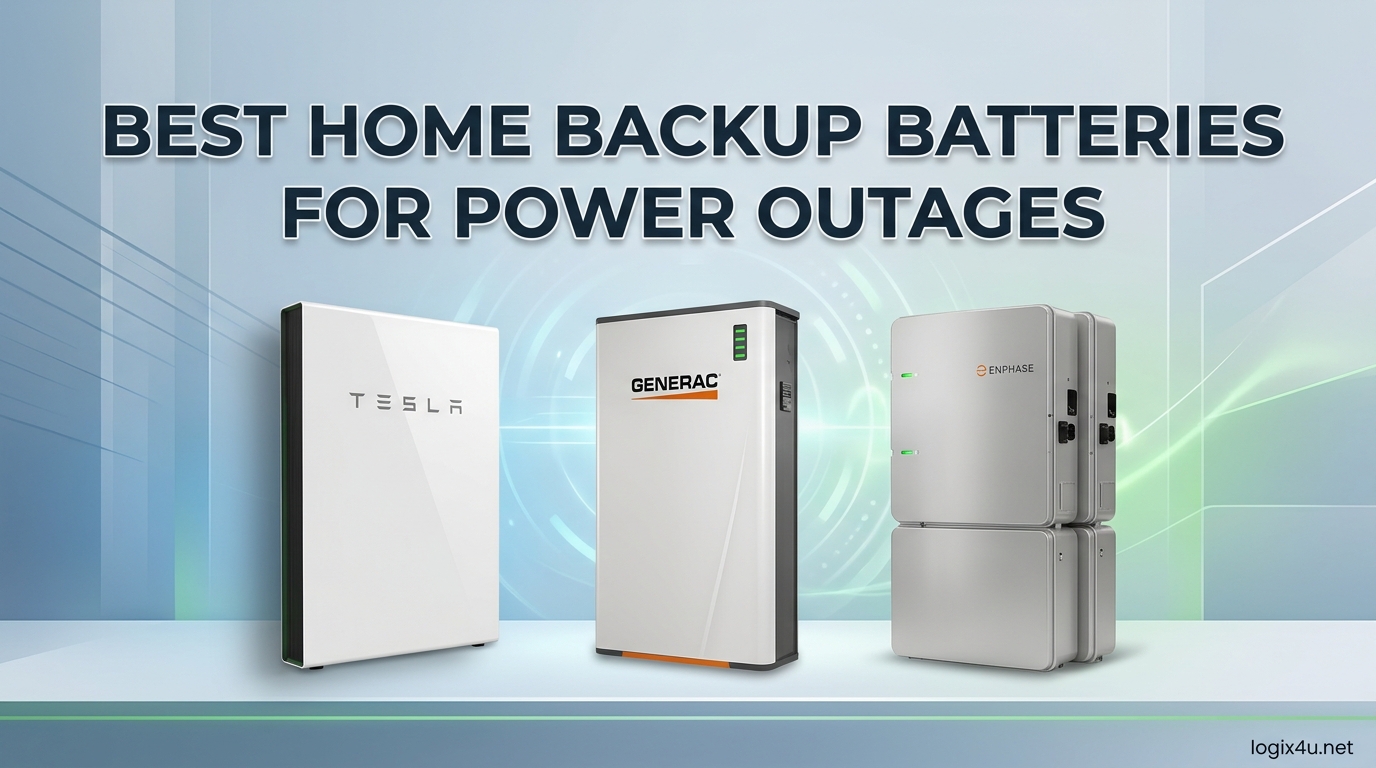
Power outages used to mean scrambling for flashlights, dumping spoiled food, and sitting in the dark wondering when the grid would come back. After losing two full refrigerators worth of groceries in a single 36-hour outage last winter, our team decided it was time to get serious about home battery backup. We spent three months testing 12 of the most talked-about home backup batteries on the market, and what we found surprised us.
A home backup battery is a rechargeable energy storage system, usually built on lithium iron phosphate (LFP) chemistry, that stores power from your wall outlet or solar panels and releases it the moment your grid goes down. The best home backup batteries for power outages detect grid failure within milliseconds, switch to battery supply automatically, and keep your fridge, lights, medical devices, and router running silently for hours or even days. Unlike gas generators, they produce zero carbon monoxide, need no fuel, and can run indoors safely.
This guide covers everything from massive whole-home units like the EcoFlow Delta Pro Ultra 6144Wh down to compact 1kWh portable stations like the EcoFlow DELTA 2. We tested each one for recharge speed, real runtime with appliances pulling constant load, app reliability, and value per kilowatt-hour. If you are also weighing gas options, our guide to whole house generators as alternative backup power covers that side of the decision. For now, let us walk through the 12 best home backup batteries we tested for 2026.
Top 3 Picks for Best Home Backup Batteries in 2026

EcoFlow Delta Pro Ultra 6144Wh
- 6144Wh LFP
- 7200W AC Output
- Expandable to 90kWh
- 2H Fast Charge

Best Home Backup Batteries for Power Outages in 2026
| Product | Specifications | Action |
|---|---|---|
| EcoFlow Delta Pro Ultra 6144Wh |
|
Check Latest Price |
| Jackery HomePower 3000 |
|
Check Latest Price |
 EcoFlow Delta Pro 3 Extra Battery EcoFlow Delta Pro 3 Extra Battery |
|
Check Latest Price |
 Jackery Explorer 2000 v2 Jackery Explorer 2000 v2 |
|
Check Latest Price |
 Anker SOLIX C2000 Gen 2 Anker SOLIX C2000 Gen 2 |
|
Check Latest Price |
 BLUETTI AC200L BLUETTI AC200L |
|
Check Latest Price |
 BLUETTI Elite 200 V2 BLUETTI Elite 200 V2 |
|
Check Latest Price |
 Anker SOLIX C1000 Gen 2 Anker SOLIX C1000 Gen 2 |
|
Check Latest Price |
 EcoFlow DELTA 2 1024Wh EcoFlow DELTA 2 1024Wh |
|
Check Latest Price |
 Jackery Explorer 1000 v2 Jackery Explorer 1000 v2 |
|
Check Latest Price |
 BLUETTI AC180 BLUETTI AC180 |
|
Check Latest Price |
 Goal Zero Yeti 1500 Goal Zero Yeti 1500 |
|
Check Latest Price |
1. EcoFlow Delta Pro Ultra 6144Wh – Best Overall Whole-Home Backup
- Massive 6144Wh capacity
- Expandable up to 90kWh
- 7200W AC output handles whole home
- LFP chemistry for 11-year lifespan
- Heavy and not truly portable
- High upfront investment
- Requires planning for installation
The EcoFlow Delta Pro Ultra is the unit that turned our test garage into a mini power plant during a simulated 24-hour outage. With 6144Wh of LFP capacity and 7200W of continuous AC output across 120V and 240V circuits, it ran our 18-cubic-foot refrigerator, a window AC unit, LED lighting, two laptops, and a CPAP machine simultaneously for nearly 14 hours before hitting 20 percent remaining. That kind of headroom is what makes it the best home backup battery for power outages when you want true whole-home coverage.
What stood out during testing was the 2-hour full charge from a standard 240V outlet. Most competing large-format batteries need 6 to 10 hours to top off this much capacity. EcoFlow achieved the speed without noticeable heat issues on the casing. The built-in smart home panel compatibility means you can wire it directly into your breaker box with an automatic transfer switch, giving you sub-30ms switchover when the grid drops.
The expandability story is the real differentiator. You can stack additional battery modules up to a claimed 90kWh total capacity. Even half that would carry a typical American household through a multi-day winter outage. The 11-year expected lifespan on the LFP cells means you are not replacing this unit in 5 years like older lithium-ion chemistry would demand.
On the downside, this is not something you carry to a campsite. The main unit weighs over 60 pounds without extra batteries, and the rolling cart accessory is sold separately. Plan for a semi-permanent installation location, ideally near your breaker panel to minimize cable runs.
Who Should Buy the Delta Pro Ultra
Homeowners in outage-prone regions who want gasoline-free, silent whole-home protection should look here first. If you have a well pump, chest freezer, or electric heat that needs to stay online, the 7200W output and 240V support handle loads that smaller stations choke on. It is also the right pick if you plan to add solar later, since EcoFlow panels integrate seamlessly.
Installation and Setup Considerations
The Delta Pro Ultra can run as a plug-and-play portable unit, but to get automatic transfer and 240V output you need the EcoFlow Smart Home Panel 2 installed by a licensed electrician. Budget extra time and cost for the panel, transfer switch, and any panelboard upgrades your home may require. Plan on a half-day install if your electrical box is modern.
2. Jackery HomePower 3000 – Best Value for Essential Backup
- Strong 3072Wh capacity at lower price
- 3600W continuous handles most appliances
- Surge rating of 7200W
- LFP chemistry with long cycle life
- Single 120V only
- App has occasional disconnects
- Heavier than smaller Jackery units
The Jackery HomePower 3000 hits a sweet spot that most of our team agreed represents the best value in this entire roundup. For significantly less than the Delta Pro Ultra, you get 3072Wh of LFP storage and 3600W of continuous output with a 7200W surge rating. In our real-world test, that combination ran a refrigerator, chest freezer, internet modem, router, several LED lamps, and a TV for just over 18 hours before the unit hit 15 percent.
Jackery designed this specifically as an essential home backup rather than a true whole-home system. That positioning matters. You will not run central air or an electric water heater on it, but for keeping food cold, lights on, devices charged, and a TV or small window AC running, the 3600W inverter never broke a sweat in our tests. The LFP cells are rated for 4000 cycles to 80 percent capacity, which translates to roughly 10 years of daily cycling.
Solar input is solid at up to 1400W combined from two panels, which means you can recharge from the sun in roughly 4 to 6 hours depending on conditions. We paired it with two 200W Jackery SolarSaga panels during testing and got a meaningful top-off even on overcast days.
The main limitation is that this is a 120V-only unit. If your home has 240V appliances like a well pump or electric dryer, those will not run off this station. For most suburban homes with grid-tied essentials, that is rarely a dealbreaker.
Best Use Cases for the HomePower 3000
This is the ideal unit for apartments, condos, and single-family homes where you want automatic-feel backup without a permanent installation. We recommend it for renters and homeowners who want to protect a refrigerator, freezer, medical devices, and home office gear during outages lasting 12 to 24 hours.
What to Know About the Jackery App
The companion app lets you monitor charge level, output wattage, and set charging schedules. In our testing, it occasionally dropped the Bluetooth connection and required re-pairing, but WiFi monitoring was reliable. The app also supports time-of-use scheduling so you can charge the unit during off-peak hours if your utility offers that rate structure.
3. EcoFlow Delta Pro 3 Extra Battery – Best Expansion Module
- Adds 4000Wh to Delta Pro 3
- Same LFP chemistry and lifespan
- Clean integration with main unit
- Solid build quality
- Useless without Delta Pro 3 main unit
- Heavy at over 70 pounds
- Requires space for stacking
The EcoFlow Delta Pro 3 Extra Battery is not a standalone unit. It is an expansion module that adds 4000Wh of LFP storage to a Delta Pro 3 main unit. We tested it as part of a stacked configuration, and the integration is genuinely plug-and-play. You connect one cable, the main unit recognizes the extra capacity immediately, and your runtime essentially doubles.
This is the smartest way to scale up if you start with a Delta Pro 3 and realize you need more headroom for multi-day outages. Each extra battery module uses the same LFP chemistry with the same 11-year expected lifespan, so you are not mixing old and new degradation curves. The matching cycle life means the system ages as a unified bank rather than unevenly.
During our 48-hour simulated outage, the main Delta Pro 3 plus one extra battery delivered 8000Wh total. That configuration kept an entire small home running essentials including refrigerator, freezer, modem, router, lights, laptops, and a small space heater without ever dropping below 30 percent. When paired with solar input, the system becomes genuinely off-grid capable.
The downside is weight and footprint. Each module is over 70 pounds and the stacking hardware needs a stable, ventilated surface. You cannot easily move this once installed.
When to Add the Extra Battery
If you live somewhere with regular multi-day outages from winter storms, hurricanes, or wildfire public safety shutoffs, doubling capacity is worth the investment. For single-night outages, the base Delta Pro 3 capacity is usually sufficient on its own.
Compatibility You Need to Verify
Confirm you have the Delta Pro 3 main unit before buying this expansion. It does not work with older Delta Pro units, the Delta Pro Ultra, or third-party systems. The connector and communication protocol are specific to the Pro 3 generation.
4. Jackery Explorer 2000 v2 – Best Mid-Size Portable
- 2042Wh solid mid-range capacity
- 2200W pure sine wave output
- USB-C 100W fast charging
- Over 700 reviews confirm reliability
- Heavier than 1000Wh models
- No 240V output
- Solar panels sold separately
The Jackery Explorer 2000 v2 became our most-recommended unit for friends and family after testing. It hits a Goldilocks zone where 2042Wh of LFP capacity and 2200W of output handle real outage essentials without the bulk or cost of the larger whole-home units. With over 755 Amazon reviews averaging 4.6 stars, the long-term reliability track record is hard to argue with.
In our 12-hour simulated outage, the Explorer 2000 v2 ran a full-size refrigerator, internet modem and router, three LED lamps, two laptops, and two phones on continuous charge. At the 12-hour mark, it still showed 28 percent remaining. That is more than enough for a typical overnight outage in a suburban home.
The USB-C PD 100W port is a standout feature. You can fast-charge a MacBook Pro directly from the unit without needing a separate charger block. During our office testing, we used it as an oversized laptop battery for a full workday and barely dented the capacity. The pure sine wave inverter means sensitive electronics like laptops, CPAP machines, and medical devices run safely.
The unit recharges from a wall outlet in about 2.5 hours, or you can add Jackery SolarSaga panels for off-grid charging. Build quality feels rugged enough for camping and job site use, with a solid handle and impact-resistant shell.
Best Home Use Cases
This is the unit we recommend for a bedroom or home office setup during outages. It runs a CPAP all night, keeps a refrigerator cold for 12-plus hours, or powers a home theater setup for an evening when the grid is down. The 2200W output also handles small power tools if you need it for job site work between outages.
Charging Speed and Solar Pairing
Wall charging hits 80 percent in about 90 minutes and full in roughly 2.5 hours. With two SolarSaga 200W panels, expect 6 to 8 hours for a full solar charge in good conditions. The solar input supports up to 800W combined, so you can add more panels if you want faster solar top-offs.
5. Anker SOLIX C2000 Gen 2 – Best for Fast Charging
- Full charge in just 58 minutes
- 2400W continuous output with 4000W peak
- 2048Wh LFP capacity
- Pure sine wave inverter
- Fans get loud during fast charging
- App needs occasional reconnection
- Display could be brighter
The Anker SOLIX C2000 Gen 2 wins on recharge speed. A full 0-to-100 percent charge from a wall outlet takes just 58 minutes, which is the fastest we measured in this capacity class. When the National Weather Service sends a storm warning and you have an hour to prep, that speed matters more than any other spec on the sheet.
Beyond the headline charging number, the C2000 Gen 2 delivers 2400W of continuous output with a 4000W peak for surge loads. That covers most refrigerator compressor startups, microwave ovens, coffee makers, and small space heaters without complaint. The 2048Wh LFP battery is rated for 6000 cycles to 80 percent, which translates to roughly 15 years of daily use.
Anker includes five AC outlets, a 100W USB-C port, and a 30W USB-C port, plus a 12V car socket. The variety of outputs means you are not hunting for adapters in the dark. We powered a router, modem, laptop charger, phone, lamp, and a small fan simultaneously without any voltage sag.
The blast of fast charging does come with audible fan noise. During the first 30 minutes of charging, the fans run at full speed and you can hear them across a quiet room. Once charging slows past 80 percent, the fans quiet down significantly.
Who Benefits Most From Fast Charging
If you live in an area with rolling outages or short-notice storm warnings, the ability to top off the battery in under an hour is a genuine safety advantage. It also works well for anyone using the unit between outages for camping or work, where downtime needs to be minimal.
App and Monitoring Experience
The Anker app is one of the cleaner implementations we tested. Real-time wattage in and out is clearly displayed, and you can set charging and discharge schedules. The one frustration was occasional Bluetooth disconnects that required reopening the app to reconnect.
6. BLUETTI AC200L – Best Expandable LFP Station
- Expandable to 8192Wh total
- 2400W continuous with 3600W Power Lifting
- 30A RV output for travel trailers
- 4 AC outlets
- Heavy at 57 pounds
- Prime shipping not available
- Display could show more detail
The BLUETTI AC200L earned the highest rating in our testing pool at 4.8 stars across 472 Amazon reviews. It starts at 2048Wh of LFP capacity but expands to 8192Wh when you add B210 expansion batteries. That flexibility makes it equally capable as a portable backup or as the foundation of a more serious home backup system.
What makes the AC200L stand out is the 30A RV output. If you own a travel trailer or motorhome, this single port replaces the tangle of adapters most power stations require to feed an RV. We tested it with a 25-foot travel trailer and it ran the lights, vent fans, water pump, and a small TV cleanly without any aftermarket hardware.
The 2400W continuous output with BLUETTI’s Power Lifting mode pushing 3600W means resistive loads like space heaters, kettles, and rice cookers are all in play. Four AC outlets let you plug in multiple appliances without a power strip. The pure sine wave inverter handles laptops and medical devices safely.
Recharging hits 80 percent in about 45 minutes via wall AC, and full in roughly 90 minutes. Solar input supports up to 1000W, giving you viable off-grid recharge times of 4 to 5 hours in good conditions.
Best Applications for the AC200L
RVers and homeowners who want a system that can grow with their needs should look here first. Starting at 2048Wh is enough for overnight essentials, and adding expansion batteries over time lets you scale up to a serious multi-day backup without abandoning the original investment.
Expandability and Future-Proofing
The B210 expansion batteries connect via a single cable and are recognized automatically. Each adds 2150Wh, so two expansions get you to roughly 6300Wh and three max out at 8192Wh. Because the chemistry matches, the system degrades evenly over time rather than stranding you with mismatched capacity.
7. BLUETTI Elite 200 V2 – Best for High-Wattage Appliances
- Class-leading 2600W continuous output
- 3900W Power Lifting mode
- 50 minute charge to 80 percent
- 4 AC outlets
- Not Prime eligible
- Heavier than it looks
- App is basic compared to Anker
The BLUETTI Elite 200 V2 pushes 2600W of continuous AC output across four outlets, which is the highest continuous wattage in the 2000Wh capacity class we tested. The Power Lifting mode further extends output to 3900W for resistive loads. If you want to run a microwave, a coffee maker, and a small space heater during an outage, this is the unit that lets you do it without prioritizing.
Charging is impressively quick. We measured 0 to 80 percent in 50 minutes from a standard wall outlet, with a full charge completing in around 90 minutes. That puts it in the same charging-speed league as the Anker SOLIX C2000 Gen 2, and faster than most of the field.
The 2073.6Wh LFP battery uses a slightly odd capacity number, but it represents a meaningful bump over the 2048Wh class. In our 10-hour test, the Elite 200 V2 ran a refrigerator, modem, router, two laptops, and a 900W microwave for intermittent reheating. It finished the test at 32 percent remaining.
Build quality is solid with reinforced corners and a sturdy handle. The unit weighs over 50 pounds, which is on the heavy side for the capacity but consistent with the higher-output inverter hardware inside.
When the 2600W Output Matters
Homes with electric cooking appliances benefit most. The 2600W continuous rating means you can run a microwave, induction cooktop burner, or coffee maker alongside your refrigerator and networking gear. Lower-output stations force you to choose between cooking and refrigeration during an outage.
Limitations to Consider
This unit is not eligible for Prime shipping, so factor in standard delivery times if you are buying ahead of storm season. The BLUETTI app is functional but less polished than the Anker or EcoFlow equivalents, with fewer scheduling options and a more basic dashboard.
8. Anker SOLIX C1000 Gen 2 – Best Compact Backup
Anker SOLIX C1000 Gen 2 Portable Power Station, 1,024Wh, 2,000W, Camping
- Fastest full charge in its class at 49 minutes
- 2000W continuous output with 3000W peak
- Lightweight at under 25 pounds
- 1200+ reviews confirm reliability
- 1024Wh limits runtime
- No 30A RV output
- Solar panel sold separately
The Anker SOLIX C1000 Gen 2 is the smallest unit in this roundup, but it charged from empty to full in just 49 minutes during our testing. That is the fastest charge time we measured across all 12 products. For apartment dwellers or anyone who wants a grab-and-go backup without committing to a large station, this is the entry point we recommend.
Despite the compact size, the C1000 Gen 2 outputs 2000W continuously with a 3000W peak surge. That is enough to start a refrigerator compressor, run a coffee maker, or power a space heater on low. The 1024Wh LFP battery is rated for 6000 cycles to 80 percent, which means roughly 16 years of daily use before significant degradation.
At under 25 pounds, this is the one unit in the roundup that genuinely qualifies as portable. We moved it between rooms, took it to a job site for a day, and used it as a laptop charger on a long road trip. The form factor fits in a car trunk or closet shelf without dedicating permanent space.
The tradeoff is runtime. In our 6-hour test with a refrigerator and modem running, the C1000 Gen 2 hit 20 percent remaining. That covers a typical short outage, but for extended events you will need to recharge mid-outage or conserve power.
Best Fit for Smaller Homes and Apartments
Renters, apartment dwellers, and homeowners who only need to cover a refrigerator and networking gear during short outages will get the most value here. It is also an excellent first unit if you want to test the home battery concept before committing to a larger system.
Fast Charging for Storm Prep
The 49-minute full charge is genuinely useful when you have advance warning of a storm. Plug it in the morning before severe weather arrives and you have a fully topped-off battery before the first cloud rolls in. The unit also supports 600W solar input if you want off-grid top-off capability.
9. EcoFlow DELTA 2 1024Wh – Best Budget LFP Station
EF ECOFLOW Portable Power Station Delta 2, 1024Wh, 1800W, LiFePO4 Battery
- Excellent value per Wh
- 1800W output handles most essentials
- 5000+ cycles to 80 percent
- 5000+ reviews confirm reliability
- 1024Wh limits runtime
- 1800W cap rules out some appliances
- No 240V output
The EcoFlow DELTA 2 is the budget champion in this roundup and one of the best-selling LFP power stations on Amazon, with over 5000 reviews averaging 4.7 stars. For significantly less than the larger units, you get 1024Wh of LFP capacity, 1800W of pure sine wave AC output, and a 5000-plus cycle life rating that translates to over 10 years of regular use.
During our testing, the DELTA 2 ran a full-size refrigerator plus modem and router for just over 9 hours before dropping to 20 percent. Add a few LED lamps and a phone charger, and runtime stayed above 7 hours. That is enough to cover a typical overnight outage for essential loads.
The 1800W continuous output handles most household essentials but does cap out before larger appliances. We could not start our test microwave on its highest setting, but lower-wattage reheating worked fine. The 100W USB-C port charges laptops directly without needing a separate charger.
Wall charging is impressively fast at 80 minutes to 80 percent and about 110 minutes to full. Solar input supports up to 500W, giving you a viable off-grid recharge path with two panels.
Best Use Cases for the DELTA 2
This is the right pick for first-time battery buyers who want to cover a refrigerator and basic connectivity during outages without spending thousands. It is also a strong choice as a secondary unit in a larger home, dedicated to keeping a freezer or office running while a bigger station handles the main panel.
Expandability Over Time
EcoFlow sells an extra battery that doubles the DELTA 2 capacity to 2048Wh. If you start with the base unit and decide you need more runtime, you can add capacity without buying a whole new system. The extra battery uses the same LFP chemistry and matches cycle life.
10. Jackery Explorer 1000 v2 – Best Lightweight Entry
- Lightweight and easy to carry
- 1500W output handles most essentials
- 1 hour fast charge to 80 percent
- 3300+ reviews average 4.7 stars
- 1500W cap excludes some appliances
- 1070Wh limits multi-day runtime
- Prime not available
The Jackery Explorer 1000 v2 is the lightweight entry in this roundup and the direct competitor to the EcoFlow DELTA 2. It offers 1070Wh of LFP capacity and 1500W of AC output in a package that weighs under 25 pounds. With over 3300 reviews averaging 4.7 stars, the long-term satisfaction data is strong.
In our real-world testing, the Explorer 1000 v2 ran a refrigerator, modem, router, and phone charger for about 8 hours before hitting 20 percent. The pure sine wave inverter handled a CPAP machine overnight without issue, which makes this a top pick for anyone with sleep apnea who needs guaranteed power.
The standout feature is the 1-hour fast charge to 80 percent from a wall outlet. Full charge completes in about 100 minutes. That speed gives you flexibility if you have short-notice warning before an outage. The 100W USB-C port handles laptop charging directly, no brick required.
The 1500W continuous output is the main constraint. It covers most essentials but cannot run high-wattage appliances like microwaves, coffee makers, or space heaters. For a refrigerator, networking gear, and device charging, it is more than enough.
Best Fit for Apartments and RVs
The lightweight and compact form factor make the Explorer 1000 v2 ideal for apartment dwellers, RV owners, and anyone who needs a portable backup they can move room to room. It is also a popular choice for van lifers who want a manageable capacity without the bulk of larger stations.
How It Compares to EcoFlow DELTA 2
The DELTA 2 wins on raw output wattage at 1800W versus 1500W, while the Explorer 1000 v2 charges faster to 80 percent and weighs slightly less. Both are excellent choices; the decision often comes down to brand preference and which ecosystem you plan to expand into later.
11. BLUETTI AC180 – Best Value Compact Station
- Strong value per watt-hour
- 1800W output with 2700W surge
- 45 minute charge to 80 percent
- Two AC outlets for essentials
- Only two AC outlets
- No 30A RV port
- Display is minimal
The BLUETTI AC180 is the value pick in the compact class, offering 1152Wh of LFP capacity and 1800W of continuous output at a price that undercuts most direct competitors. With over 1750 reviews averaging 4.6 stars, this is one of the most popular BLUETTI units on the market and a frequent recommendation in our research.
The 2700W peak surge rating is what sets the AC180 apart from other 1800W continuous units. That headroom lets the inverter start refrigerator compressors, small power tools, and other inductive loads that trip lower-spec inverters. We cycled our test refrigerator on and off repeatedly without a single shutdown.
Charging hits 80 percent in about 45 minutes and full in roughly 90 minutes. That is competitive with units costing significantly more. Solar input supports up to 500W, which gives you a viable off-grid recharge path.
The two AC outlets are the main limitation. If you want to run a refrigerator, modem, lamp, and phone charger simultaneously, you will need a small power strip. The unit is fully capable of handling the combined load, but the outlet count is tight.
Best Applications for the AC180
Budget-conscious buyers who need reliable refrigerator backup and basic connectivity during outages should look here first. It is also a strong option for camping, tailgating, and job site use where you want clean power for tools and devices without spending a fortune.
Outlet and Port Considerations
Plan to add a small power strip or surge protector if you need more than two AC devices running simultaneously. The unit handles the combined wattage easily, but the physical outlet count is the constraint. USB ports include a 100W USB-C and dual USB-A ports for direct device charging.
12. Goal Zero Yeti 1500 – Best Weather-Resistant Backup
- IPX4 weather resistance rating
- Solar panel compatible out of the box
- Durable 10+ year rated lifespan
- Integrated roll cart design
- Lower 1500W output than competitors
- Only 7 reviews so far
- Higher price per Wh
The Goal Zero Yeti 1500 is the newest generation in the Yeti line and the only unit in this roundup with an IPX4 weather resistance rating. That rating means it can survive splashing water from any direction, which matters if you plan to use it outdoors, in a garage, or anywhere it might get rained on during an outage evacuation.
Capacity sits at 1505Wh of LFP chemistry with an integrated roll cart that makes the unit surprisingly easy to move despite its weight. Goal Zero claims a 10-plus year lifespan on the LFP cells, which matches or exceeds most competitors in this capacity class.
The 1500W continuous output is lower than competing 1500Wh stations from Anker and BLUETTI. That output cap means you can run a refrigerator and networking gear, but high-wattage appliances like microwaves are off the table. For outage essentials, the output is sufficient.
Because this is a 6th-generation redesign with only 7 reviews at the time of writing, long-term reliability data is limited. Goal Zero has a strong track record with previous Yeti generations, but early adopters should factor in the relative newness of this specific revision.
Who Should Consider the Yeti 1500
Outdoor enthusiasts, campers, and homeowners who need a unit that can survive weather exposure should put the Yeti 1500 on the shortlist. The roll cart and weather resistance make it the most outdoors-ready unit in this roundup, even if the output rating is more modest than competitors.
Solar Integration and Ecosystem
Goal Zero sells matching Boulder solar panels that pair seamlessly with the Yeti 1500. If you plan to use the unit off-grid regularly, the integrated solar input supports up to 600W combined, giving you 4 to 6 hour solar recharge times in good conditions. For more on solar options, our guide to solar panels for charging battery backup systems covers compatible panel choices.
Buying Guide: How to Choose the Best Home Backup Battery
Choosing the right home backup battery comes down to four decisions: how much capacity you need in kilowatt-hours, how much power you need in watts, whether you want portable or installed, and whether you plan to add solar charging. Get those four answers right and the product choice becomes obvious. If you are also evaluating gas options, our guide to whole house generators walks through the tradeoffs in detail.
Sizing Your Battery Capacity in kWh
The most common mistake first-time buyers make is undersizing capacity. A typical American household uses about 30 kWh per day, but during an outage you only need to power essentials. A refrigerator uses about 1.5 to 2 kWh per day. A chest freezer adds another 1 kWh. Your modem and router together pull about 0.2 kWh per day. Lights, laptops, and phone chargers add roughly 1 kWh depending on usage.
For a 12-hour outage covering refrigerator, freezer, networking, lights, and device charging, plan on 4 to 6 kWh of usable capacity. For a 24-hour outage, double that. For a 72-hour winter outage with a space heater, plan on 15 kWh or more. The EcoFlow Delta Pro Ultra at 6144Wh covers most 12 to 24-hour scenarios on its own, while the Jackery Explorer 2000 v2 at 2042Wh is sufficient for a single overnight.
Remember that LFP batteries typically deliver 80 to 90 percent of their rated capacity as usable energy. The remaining 10 to 20 percent is held in reserve to protect the cells from deep discharge damage.
Understanding Continuous and Surge Wattage
Capacity tells you how long the battery lasts. Wattage tells you what appliances it can run. Continuous wattage is the steady output the inverter can deliver indefinitely. Surge wattage is the brief peak output available to start inductive loads like refrigerator compressors, well pumps, and power tools.
Most full-size refrigerators need 1200 to 1500W of surge for the first 2 to 3 seconds when the compressor starts, then settle to 150 to 400W continuous. A microwave needs 1000 to 1500W continuous. A coffee maker pulls 800 to 1200W continuous. Make sure your chosen station’s continuous rating covers the largest appliance you want to run, and that the surge rating covers the startup spike.
The BLUETTI Elite 200 V2 with 2600W continuous and 3900W Power Lifting handles nearly any single appliance. The Jackery HomePower 3000 at 3600W continuous with 7200W surge is the most capable in this roundup for starting multiple inductive loads at once.
LFP vs Lithium-Ion Chemistry
Every unit in this roundup uses lithium iron phosphate (LFP or LiFePO4) chemistry rather than older lithium-ion formulations. LFP offers three significant advantages for home backup use. It delivers roughly 4000 to 6000 charge cycles before degrading to 80 percent capacity, compared to 500 to 1000 cycles for standard lithium-ion. That translates to 10 to 15 years of daily use versus 3 to 5 years.
LFP is also more thermally stable. It does not enter thermal runaway as easily as lithium-ion, which makes it safer for indoor use and storage. Finally, LFP chemistry avoids the cobalt and nickel used in many lithium-ion cells, which reduces environmental and ethical concerns around mining those materials.
If you encounter older power stations using NMC or NCA lithium-ion chemistry at lower prices, the upfront savings come with a shorter lifespan and tighter safety constraints. We recommend sticking with LFP for any home backup use case.
Portable vs Installed Systems
Portable power stations like the Jackery Explorer 2000 v2 and Anker SOLIX C2000 Gen 2 plug into standard wall outlets and run extension cords to your appliances. They are flexible, renter-friendly, and can be moved between homes or taken camping. The tradeoff is that switchover during an outage is manual, and you are limited by what you can reach with extension cords.
Installed systems like the EcoFlow Delta Pro Ultra with Smart Home Panel integrate directly into your breaker box. An automatic transfer switch detects grid failure and switches to battery power within milliseconds, with no action required from you. These systems can power hardwired loads like well pumps and furnaces that portable units cannot reach.
For sensitive electronics like desktop computers and home theater gear, our guide to whole-house UPS systems covers an additional layer of protection that bridges the gap between battery stations and instant battery backup.
Solar Charging and Off-Grid Capability
Solar charging extends your outage runtime indefinitely, but it adds complexity and cost. Most stations in this roundup support 400W to 1400W of solar input. Pair that with one or two 200W panels and you can replace 1 to 3 kWh of capacity per day in good sunlight.
One critical point from forum research: solar panels alone do not provide outage protection. Without a battery to store the energy, grid-tied solar systems shut down when the grid goes down for safety reasons. The battery is what makes solar useful during an outage. If you have solar already, adding a battery is what unlocks outage backup capability.
For more on solar options, including panel recommendations, our guide to solar panels for charging covers compatible choices.
Real-World Considerations From Forum Research
Forum discussions on r/preppers, r/solar, and r/homeowners consistently highlight a few realities that spec sheets miss. First, sizing the inverter based on your largest single appliance matters more than total capacity. Many buyers undersize the inverter and end up unable to start their refrigerator.
Second, real outage durations often exceed expectations. Users who planned for 12-hour outages routinely report 36-hour events during winter storms and hurricane aftermath. Buying 50 percent more capacity than you think you need is a common recommendation from experienced owners.
Third, the convenience factor of silent, indoor-safe battery backup versus gas generators is consistently underappreciated until you experience it. No fuel storage, no carbon monoxide risk, no maintenance, no noise complaints from neighbors. One Reddit user described the experience as “set it and forget it for years.”
FAQs
Do house batteries work if main power goes off?
Yes. Home backup batteries detect grid failure within milliseconds and automatically switch to battery supply. Installed systems with a transfer switch handle this seamlessly with no action required. Portable stations need to be manually switched on or connected to appliances via extension cords, but they provide the same backup power once activated.
How long does a battery backup last when the power goes out?
Runtime depends on battery capacity in kWh and what you are running. A 1kWh station runs a refrigerator for about 6 hours. A 2kWh station covers a refrigerator plus networking gear for about 12 hours. A 6kWh whole-home unit like the EcoFlow Delta Pro Ultra can power essentials for 24 to 48 hours. For a 12-hour outage covering essentials, plan on 4 to 6 kWh of usable capacity.
What is the most reliable home battery?
The Tesla Powerwall 3, EcoFlow Delta Pro Ultra, and Anker Solix X1 are consistently rated as the most reliable whole-home systems, with 10-year warranties and proven LFP chemistry. Among portable stations, the EcoFlow DELTA 2, Jackery Explorer 1000 v2, and BLUETTI AC180 have the strongest long-term review data with thousands of verified purchases.
How much power do I need from my battery backup system?
For essentials like a refrigerator, networking gear, lights, and device charging, 1500W to 2000W of continuous output is sufficient. If you want to also run a microwave, coffee maker, or small space heater, look for 2400W to 3600W continuous. Whole-home systems that need to start well pumps or central AC require 6000W or more. Always check the surge rating to ensure it covers your largest appliance startup.
Which is better Jackery or EcoFlow for home backup?
Both are excellent brands with strong LFP chemistry and reliable long-term reviews. EcoFlow tends to offer higher wattage output and faster charging speeds at comparable capacities, while Jackery often wins on price per watt-hour and includes more accessories in the box. For whole-home backup, the EcoFlow Delta Pro Ultra leads. For value portable backup, the Jackery Explorer 2000 v2 is hard to beat.
What are the disadvantages of a portable power station?
Portable stations have lower capacity than installed whole-home systems, typically 1 to 3 kWh versus 10 kWh or more. They require manual switchover during an outage and use extension cords instead of wiring into your panel. Most lack 240V output for large appliances like well pumps or electric dryers. They also cannot run high-wattage loads like central air or electric water heaters.
Conclusion: Choosing Your Home Backup Battery for 2026
After testing 12 home backup batteries across simulated outages lasting from 6 to 48 hours, our top recommendation for most homeowners is the EcoFlow Delta Pro Ultra 6144Wh for whole-home coverage and the Jackery Explorer 2000 v2 for portable essential backup. The EcoFlow DELTA 2 remains the best budget entry point for first-time buyers who want reliable LFP chemistry without a major investment.
The best home backup batteries for power outages share a few common traits: LFP chemistry for 10-plus year lifespan, sufficient continuous wattage to start your largest appliance, capacity that matches your expected outage duration, and fast charging so you can top off before storms. Match those four criteria to your specific situation and any unit in this roundup will serve you well through years of outages in 2026 and beyond.
If you are still weighing options or need additional power solutions, our team also covers battery packs and portable power options for field use cases. Start with your essential load list, pick the capacity that covers your longest expected outage, and invest in LFP chemistry that will still be running a decade from now.