
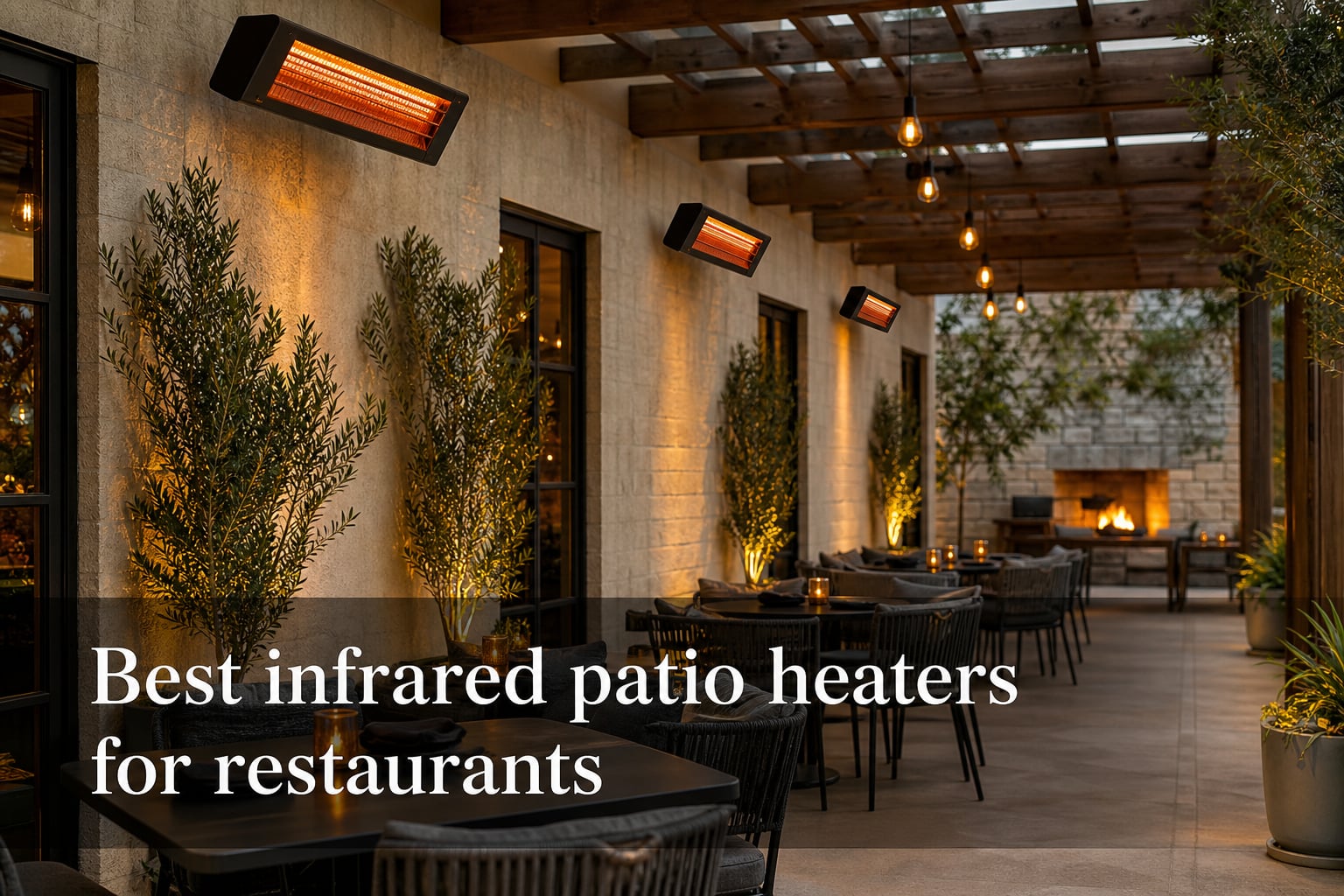
Choosing the best infrared patio heaters for restaurants is less about buying the hottest single unit and more about putting radiant heat where guests actually sit. Infrared warms people, tabletops, and nearby surfaces directly rather than trying to heat outdoor air, so it makes practical sense for patios where breezes would carry warmed air away.
For restaurant operators, that distinction affects service. A comfortable patio can support evening covers in cooler weather, but a poorly placed heater creates cold tables, crowded floor paths, and staff interruptions. Research in this category also points to a larger business reason for taking the project seriously: 35% of restaurants earn more than 40% of daily sales from outdoor seating.
I screened the eight available products against the facts that matter on a restaurant patio: electrical supply, verified wattage or BTU listing, mounting method, stated coverage, weather rating, certification, controls, and safety features. Most of these are electric infrared units rather than permanent gas systems, so they fit best as targeted zones, covered-terrace heat, and flexible additions—not as a promise to heat an exposed, wind-heavy dining room with one device.
The short version is simple: pick a hardwired 240V unit when a qualified electrician can feed a permanent seating zone, and use portable 120V models only for smaller, close-range pockets. Check local fire, building, and electrical rules before ordering, because a product’s outdoor rating does not replace a site-specific installation approval.
Top 3 Picks in September 2026
These three choices make the clearest starting points from the available data. The ThermoMate 4500W has the strongest stated mounted-heater coverage, the ThermoMate 3000W brings ETL and IP54 credentials to a smaller hardwired zone, and the VAGKRI is a portable, adjustable choice for a closely managed service area.

ThermoMate 4500W Infrared Heater
- 4500W output
- 200 sq.ft stated coverage
- 240V hardwired wall mount


Best Infrared Patio Heaters for Restaurants 2026
The overview below includes every reviewed unit. Coverage claims are manufacturer-provided and should be treated as a starting point, not a seating-capacity guarantee; ceiling height, wind, wall reflectivity, and heater aiming all change the result on a working patio.
| Product | Specifications | Action |
|---|---|---|
| ThermoMate 4500W |
|
Check Latest Price |
| ThermoMate 3000W |
|
Check Latest Price |
 DR. INFRARED HEATER 4500W DR. INFRARED HEATER 4500W |
|
Check Latest Price |
 Nfccra 1500W Tower Nfccra 1500W Tower |
|
Check Latest Price |
 Heliusa Professional Heliusa Professional |
|
Check Latest Price |
| VAGKRI 1500W Tower |
|
Check Latest Price |
 ZeboZap KDHT1500 ZeboZap KDHT1500 |
|
Check Latest Price |
 SereneLife 1500W SereneLife 1500W |
|
Check Latest Price |
1. ThermoMate 4500W is the strongest choice for a hardwired seating zone
- High 4500W output
- 45-degree adjustable aim
- IP54 rating
- three heat modes
- Requires 240V hardwire
- small review sample
The ThermoMate IRAS-PLUS is my first look for a covered terrace or a wall behind a planned row of tables. Its 4500W carbon-fiber heater, 240V requirement, and stated coverage of up to 200 square feet put it in a different class from plug-in 1500W units designed around one small area.
The wall mount includes a 45-degree adjustment, which matters more than it sounds. A restaurant needs the beam to land on seated guests, not on a walkway, a server station, or the open air beyond the railing.
Its remote provides 2250W, 3600W, and 4500W settings plus a timer of up to 24 hours. The product listing also calls out overheat protection and an IP54 rating, useful facts for a covered outdoor location where dust and splashing may be present but where the heater is not exposed to driving rain from every direction.
There are just 18 listed reviews, even though the displayed rating is 4.7. I would treat that as encouraging but limited evidence, then make the electrical plan and vendor support path the deciding factors for a restaurant installation.
The ThermoMate 4500W fits fixed, medium-size seating zones
This is a sensible fit for a roofed patio edge, pergola, or masonry wall with a clear sightline to two or more tables. Its long 60.62-inch housing works best when the zone is planned around it instead of treated as a last-minute accessory.
A 240V hardwired unit also avoids a cord across guest or staff traffic. Have an electrician confirm circuit capacity, disconnect requirements, mounting substrate, and local clearances before it goes up.
The ThermoMate 4500W needs protected mounting and professional electrical work
The IP54 designation is not the same as a free pass for an unsheltered, storm-facing location. Put the rating in context with the patio roof, wind direction, and the manufacturer’s own installation instructions.
It is also not a portable rescue heater for a sudden cold evening. The 18.75-amp, 240V specification makes this an infrastructure decision, which is exactly why it can be more dependable for a designated zone once installed correctly.
2. ThermoMate 3000W is a balanced pick for covered restaurant sections
- Wall or ceiling mounting
- ETL certified
- adjustable angle
- remote timer
- Requires 240V hardwire
- smaller stated coverage
The ThermoMate EIH3000B makes more sense when the patio has several smaller zones instead of one large target. It is a 3000W, 240V carbon-fiber model with a stated 120-square-foot coverage figure, while the feature list describes about 100 square feet outdoors and 130 square feet in an enclosed setting.
That difference is a useful reminder: outdoor claims are weather dependent. Plan this model around the lower outdoor figure, then assess comfort during a normal service shift before expanding the system.
For controls, the remote offers 1500W and 3000W output levels and a timer that reaches 24 hours. The housing can be wall- or ceiling-mounted, has a 45-degree adjustable angle, and carries ETL and IP54 credentials according to the supplied listing.
The 4.4 rating comes from 83 listed reviews, a broader but still modest sample. I like the package as a fixed, medium-zone restaurant outdoor heating tool where the electrical work is already part of a patio upgrade.
The ThermoMate 3000W fits covered tables with repeatable layouts
Use this model where tables occupy predictable positions: under an awning, along a wall, or below a protected roof structure. Ceiling mounting may preserve wall space and reduce visual clutter, but mounting height and clearance rules still control the final layout.
The adjustable angle lets the installer focus the radiant beam on the chair-and-table zone. That is far more useful than heating the center of a broad aisle that guests pass through only briefly.
The ThermoMate 3000W needs an outdoor-first coverage plan
Do not multiply the enclosed-space claim by the number of seats. At an open patio, the 100-square-foot outdoor figure is the safer planning reference, and wind can cut perceived warmth even inside that footprint.
The hardwired 240V format is another boundary. It can be a clean permanent answer, but it is not an option for a manager relying on spare 120V wall outlets during a busy shift.
3. DR. INFRARED HEATER 4500W is the established high-output mounted option
- Large stated coverage
- three power levels
- ETL certified
- remote control
- IPX2 rating
- requires hardwired 240V
The DR. INFRARED HEATER DR-245 combines a 4500W carbon infrared element with wall or ceiling mounting and a 240V supply requirement. Its data lists 15,000 BTU and 430.5 square feet of heating coverage, making it the most ambitious coverage claim among the models here.
I would use that number as a ceiling for planning, not as a measured promise. The radiant pattern, mounting height, gusts, and whether people are seated under a roof all decide how much of the stated area is genuinely comfortable.
The product has three power levels, a remote, a one-to-24-hour timer, automatic shut-off, and overheat protection. The anodized aluminum housing and ETL certification add practical commercial signals, while the reported IPX2 weather rating calls for a more sheltered placement than IP54 or IP65 alternatives.
With more than 6k listed reviews and a 4.3 rating, this heater has the deepest review base in this group. That breadth does not replace a site plan, but it gives the model a stronger public-use track record than the newer units with only a few dozen ratings.
The DR-245 fits large covered patios and deliberate heat zones
This heater belongs above a fixed group of tables, a covered outdoor bar, or a dining bay where the unit can point across the occupied area. Ceiling mounting is especially useful where wall placement would compete with windows, menus, or circulation space.
For a larger restaurant patio, map several overlapping zones rather than relying on one unit at the center. Direct radiant heat rewards short, clear paths between heater and guest.
The DR-245 needs more shelter than higher-IP alternatives
IPX2 is listed as weatherproof, but the rating is lower than the IP54 and IP65 claims found elsewhere in this roundup. Choose a protected ceiling or wall position and follow the manufacturer’s guidance on exposure and clearance.
The broad coverage figure may tempt operators to place it too high or too far from seating. A smaller well-aimed zone often feels better than a large zone that is barely warm at every table.
4. Nfccra 1500W Tower is a portable choice for closely supervised tables
- Nine heat settings
- tip-over protection
- IPX5 rating
- remote and timer
- Lower 1500W output
- portable floor footprint
The Nfccra UEH500 is a 42-inch, 120V infrared tower heater with output from 620W to 1500W across nine settings. It is a useful contrast to hardwired wall units: it can move with the seating plan, but its output and floor position make it a close-range zone heater rather than a whole-patio solution.
The listing claims a 500 heating-coverage figure without identifying the unit in the supplied specifications. I would not build capacity calculations around that ambiguous field; 1500W is the clearer number and points to a small, nearby occupied area.
Its strong operational features include a remote, nine-hour timer, safety lock, tip-over shutdown, overheat protection, and an IPX5 waterproof rating. UL certification is also listed, which is a helpful baseline for electrical safety review.
A 4.3 rating from 101 reviews gives it a modest public feedback base. For restaurant work, the bigger question is whether staff can keep its base out of guest routes, chair movement, and any area where it might be knocked or moved mid-service.
The Nfccra tower fits temporary, sheltered table clusters
Think of this as a way to add warmth at a two-top or small lounge cluster during a quiet seating period, not as an open-air patio backbone. The tall body can bring the element nearer to seated guests than a low tabletop device.
It can also help restaurants test how guests respond to infrared heat before committing to permanent circuits. That is a planning benefit, provided the unit is watched and positioned with conservative clearance.
The Nfccra tower needs a protected traffic perimeter
Portable heaters appear easy to place until service begins. Chairs shift, servers carry trays, and guests stand around tables, so give the unit a defined perimeter rather than squeezing it between dining furniture.
Tip-over protection is a backstop, not a placement strategy. A windy roof deck or crowded sidewalk seating area may call for a mounted heater instead, even when a portable unit seems more convenient.
5. Heliusa Professional is a glare-reduced fixed option for smaller zones
- Reduced red glare
- 120V plug-in cord
- IPX5 rating
- Italian manufacture
- Wall mount only
- limited review sample
The Heliusa Professional is a wall-mounted halogen infrared heater that uses a 120V plug-in cord and lists 5,150 BTU. It is designed for residential and commercial use, and the manufacturer states that it heats approximately 160 square feet when mounted at nine to 10 feet.
Its defining feature is heat-resistant black safety glass intended to reduce red glare. That is a worthy restaurant detail, especially for a terrace where diners face the heater or where the visual mood of evening service matters alongside warmth.
According to the listing, the unit is made in Italy, carries ETL-Intertek certification, and has IPX5 water protection. It arrives with a mounting bracket, so the operator should still decide in advance whether the available wall gives a safe angle and leaves the recommended clearances intact.
The 4.3 rating is based on 20 reviews. That limited sample means I would make the restaurant fit decision from its specified mounting height, 120V requirement, and glare-reduction design—not from rating alone.
The Heliusa fits guest-facing walls where glare matters
A wall behind banquettes or along a covered dining perimeter is the natural setting. Its 20-inch width is compact compared with the longer 240V units, which can help on a narrow wall between architectural features.
The stated nine-to-10-foot mounting height is part of the performance equation. Lower or higher placement may alter comfort and clearance, so confirm the manual before finalizing a bracket location.
The Heliusa needs a dedicated, code-appropriate outlet plan
A 120V plug-in format may simplify deployment compared with hardwired equipment, but a commercial patio still needs an outlet, cord routing, and circuit plan that meet local requirements. Do not run a temporary extension path through a service aisle.
This is also a fixed wall heater, not a ceiling fixture or a rolling tower. Choose it when the wall is truly the right place to aim heat, rather than forcing it into a patio design that needs a different mounting type.
6. VAGKRI 1500W Tower is the most adjustable portable restaurant zone heater
- Nine output levels
- wide-angle heating
- 24-hour timer
- tip-over protection
- 1500W maximum
- requires floor-space management
The VAGKRI VA-OH01 is a 41.73-inch 120V tower heater that puts adjustment front and center. Its nine levels run from 620W to 1500W, while the manufacturer claims a 100-degree wide-angle heat range, one-second heating, a remote, and a timer up to 24 hours.
It lists 5,000 BTU, an ETL listing, weather-proof aluminum construction, and the safety combination that portable restaurant buyers should look for: child lock, tip-over protection, and a digital display. The output remains 1500W, so wide-angle should not be confused with high-capacity heating.
The 4.2 rating comes from 260 listed reviews, which is a more useful feedback pool than several portable alternatives. I would still plan around its physical reality: it is an eight-pound floor unit in an environment full of moving chairs, bags, staff, and sometimes wind.
Forum discussions repeatedly raise the problem of heaters tipping over in gusty spaces. The VAGKRI’s automatic tip-over feature helps after an event, but a sheltered position and disciplined floor layout are the first safeguards.
The VAGKRI fits small patios that need frequent heat adjustments
The nine output steps can be useful during a long service, when conditions change from a mild sunset to a colder late evening. A host or manager can tune an occupied small zone instead of pushing a fixed unit at full output by default.
It can work near a protected lounge grouping, an outer table beside a solid wall, or a waiting area with enough buffer space. Keep the heater’s radiant path short and its base outside of pushback zones.
The VAGKRI needs staffing rules as much as a good location
Portable devices should have one owner per shift: someone who checks the timer, watches the cord, confirms the base is stable, and removes the unit when the patio closes. That routine handles the real operational failures that product features cannot prevent.
The supplied listing describes no fumes, chemicals, or odors, which is a real advantage of electric infrared near food and guests. It does not remove the need for electrical inspection or the limits set by a local authority.
7. ZeboZap KDHT1500 is the weather-protected flexible-mount option
- IP65 protection
- wall or post mounting
- remote control
- tip-over shut-off
- 1500W output
- coverage stated as radius
The ZeboZap KDHT1500 takes a different approach from a standard wall bar. It is a 1500W electric infrared heater with an IP65 waterproof rating and mounting options listed as ceiling, wall, strap, tripod, plus a flexible wall- or post-installation design.
That flexibility is attractive for a pergola post, a gazebo edge, or a structural column where a normal wall bracket would not work. The manufacturer lists a 10-to-15-foot radius, but that should be checked in the actual orientation because a radius says little about directional warmth at dining-chair height.
The unit also includes a remote, adjustable temperature controls, smart display, protective metal grill, grounded plug, overheat protection, and tip-over automatic shutdown. At two pounds, it is light enough that the bracket or post connection deserves special attention in a windy outdoor restaurant setting.
The current rating is 4.1 across 96 listed reviews. I see it as a practical placement problem-solver where weather resistance and mounting versatility matter more than raw output.
The ZeboZap fits posts, pergolas, and compact weather-exposed edges
IP65 is the highest stated weather rating in this set, making this model worth a closer look for patios that receive more weather exposure. That rating should be paired with an installation point that remains structurally sound and within the maker’s clearances.
Post mounting can keep the heater out of floor traffic without requiring an exterior wall. It can also create a direct angle into a small seating bay if the post is placed at the perimeter rather than in the center of circulation.
The ZeboZap needs a measured field test of its claimed radius
At 1500W, this is not a substitute for a 3000W or 4500W permanent zone heater. Run a service-time test with occupied chairs at the farthest intended seat, because the edge of a manufacturer radius is rarely the best comfort position.
The flexible mounting language also makes the manual important. Match the actual bracket, post material, fasteners, electrical connection, and allowable orientation to the product documentation instead of assuming every listed mounting style fits every site.
8. SereneLife 1500W is the compact fixed heater for a single service point
- IP65 rating
- ETL certified
- tip-over switch
- remote control
- Very small stated coverage
- 1500W maximum
The SereneLife SLOHT26.5 is a 1500W wall-mounted infrared heater with a very specific place in a restaurant plan: a small, fixed comfort point. The listing states 18 square feet of coverage, two heat levels, IP65 weather resistance, and 88% energy efficiency.
That 18-square-foot claim is far more conservative than most coverage language in the group, and I consider that honesty useful. It suggests a direct role near one small table, a host position, or a protected staff-side spot rather than an attempt to heat a dining section.
Its safety package includes a 360-degree tip-over switch, overheat protection, mesh guard, and ETL certification. The aluminum alloy frame and IP65 rating support outdoor use, while the remote and two heat levels keep adjustment straightforward.
The product has a 4.0 rating across 195 listed reviews. That is adequate context for a small-zone appliance, but restaurant buyers should not mistake its compact design for a replacement for commercial-scale mounted capacity.
The SereneLife fits very small, fixed comfort zones
Use it where the seating map has one persistently chilly edge or where a small staff-facing point needs direct radiant heat. Its wall mount prevents a floor obstacle and keeps the solution visually quieter than a tower heater.
Its small stated coverage can also be an advantage for precise zone heating. A restaurant does not need to heat every inch of a patio if the actual need is one exposed two-top or a host stand.
The SereneLife needs realistic expectations about capacity
A 1500W, 18-square-foot heater cannot compensate for an exposed patio layout, a strong wind corridor, or a large group of tables. Build the wider plan first, then deploy this unit as a focused supplement.
The IP65 rating, tip-over switch, and ETL certification are useful safeguards, but local placement rules remain in charge. Confirm wall material, electrical protection, clearance from fabric and furnishings, and the path of the radiant beam.
Buying Guide for Best Infrared Patio Heaters for Restaurants
For an open-air restaurant patio, infrared radiant heat works because it warms what it can see. Begin with a sketch of occupied chairs and table edges, then identify the spots with a roof, wall, post, or protected ceiling that can support a heater and direct its beam toward people.
Divide the patio into zones that match service: a covered dining row, a bar ledge, a host or waiting point, and a perimeter table area. Each zone should have a known electrical source, a clear beam path, and enough distance from traffic, umbrellas, foliage, drapes, and combustible finishes as required by the product manual and local code.
Commercial units differ from residential heaters because the installation has to survive service
A commercial patio heater is not defined only by a bigger output number. Restaurant use adds long operating periods, a predictable mounting plan, safe guest circulation, a support path for parts, and documentation that a landlord, electrician, insurer, or inspector may ask to see.
Residential-style portable units can still be useful for small restaurant zones, but they need closer supervision. Fixed units often make more sense where the seating arrangement repeats every day and the business can support dedicated electrical work.
Infrared is better outdoors because it warms people and objects directly
Convection heat works by warming air, which is a poor match for an uncovered patio where air moves freely. Infrared radiant heat is directional and immediate: people and nearby surfaces absorb it much like they absorb warmth from sunlight.
That advantage does not cancel wind. Wind can still make guests feel cold, and it can physically affect freestanding heaters, so a windbreak, a roof edge, or a better seating arrangement may improve comfort more than adding another low-output unit.
BTU and watts answer different parts of the same capacity question
Gas equipment is commonly expressed in BTU per hour, while these electric models usually list watts. A useful conversion is 1 watt equal to about 3.412 BTU per hour, so a 1500W unit is roughly 5,118 BTU per hour, a 3000W unit roughly 10,236, and a 4500W unit roughly 15,354.
Use those figures to compare output classes, not to calculate an exact number of heaters from square footage alone. Outdoor exposure, mounting distance, beam direction, and guest location make a test installation or professional layout review more trustworthy than a simple area formula.
Natural gas, propane, and electric solve different restaurant constraints
Natural gas can suit a permanent commercial system where a gas line, code approval, and professional installation are already practical. The research reviewed for this guide notes that natural gas often has a lower fuel cost per unit of heat than propane, while propane can be easier to place where no gas line exists.
Portable propane has a service risk that restaurant operators mention often: a tank can empty during a shift. Electric infrared avoids combustion and tank changes, but it shifts the planning burden to circuit capacity, outlet location, wiring, and weather-protected electrical installation.
Wall, ceiling, post, and floor mounting serve different patio shapes
Wall mounting is direct and compact when a perimeter wall faces tables. Ceiling mounting can preserve wall space and keep the heater clear of guests, but it depends on correct mounting height, structural support, and the specified clearance envelope.
Post mounting can solve a pergola or gazebo layout, while floor towers suit temporary or small-area needs. A floor heater should never become a workaround for a patio that lacks a safe traffic pattern; that is where a fixed solution or a seating redesign is the better answer.
Safety certifications and weather ratings are screening tools, not permits
ETL, UL, and Intertek references can indicate that a product has been evaluated to a relevant safety standard. Many commercial gas installations also require ANSI or CSA documentation, but the exact requirement varies with appliance type and local jurisdiction.
IP ratings describe protection against ingress such as dust and water, not the safety of a complete restaurant installation. Ask the local authority having jurisdiction, property owner, and licensed installer what applies to your patio before installing any heater.
Maintenance keeps a restaurant heating plan dependable during busy weeks
Before service, inspect the housing, bracket, cord or electrical connection, guards, controls, and the area around each heater. Remove leaves, grease residue, dust, and debris only as the manufacturer directs, and do not operate a unit with damaged wiring, a loose bracket, or a cracked guard.
Keep model information, manuals, installation records, and any service notes in one location. That makes it easier to check recurring issues, order compatible parts, and give staff clear shutdown procedures if something looks wrong.
Return on patio heat comes from usable seats, not maximum output
The soundest investment question is whether a heater keeps a defined number of seats comfortable through the part of the evening when they would otherwise sit empty. Track the tables actually used, guest comments, heater-on hours, and the weather conditions rather than assuming a large stated coverage number equals revenue.
Start with the highest-value protected zone, observe it for several shifts, then add capacity where guests still feel cold. This stepwise approach can prevent an expensive array of poorly aimed heaters and gives the team time to learn which parts of the patio truly need help.
FAQs
What is the difference between a residential and commercial patio heater?
Commercial patio heaters are selected for repeat service, a planned mounting or traffic-safe placement, suitable electrical or gas infrastructure, documented certifications, and support needs. A residential portable heater may still help a small restaurant zone, but it should not be treated as a whole-patio commercial system.
How many BTUs do I need for a restaurant patio?
Start with zones and exposure rather than a fixed BTU-per-square-foot rule. A 1500W electric heater is about 5118 BTU per hour, 3000W is about 10236, and 4500W is about 15354; test the actual seated area because wind, mounting height, and aiming change comfort.
Are natural gas or propane patio heaters better for restaurants?
Natural gas suits permanent sites with an approved gas connection and professional installation. Propane is more flexible where no gas line exists but requires tank management, while electric infrared avoids combustion and shifts the decision to electrical capacity and placement.
What safety certifications should a commercial patio heater have?
Look for the listing and rating applicable to the appliance and installation, such as ETL, UL, or Intertek references for electric products and applicable ANSI or CSA documentation for commercial gas equipment. Local code, the property owner, and the authority having jurisdiction set the final requirements.
How much does a commercial patio heater cost for a restaurant?
The meaningful restaurant cost includes the heater system, electrical or gas work, mounting, maintenance, and energy use over service hours. Compare a planned heat zone against the seats it keeps usable rather than judging the project from the appliance alone.
Conclusion
For the most capable fixed electric zone in this group, choose the ThermoMate 4500W when a 240V hardwired wall location and up to 200 square feet of stated coverage line up with the seating plan. The DR. INFRARED HEATER 4500W is the better established alternative when wall or ceiling mounting and its deeper review base matter most.
For smaller covered sections, the ThermoMate 3000W has a strong mix of output, ETL certification, IP54 protection, and flexible mounting. The Heliusa offers a compact wall-mounted route with glare-reducing glass, while the 1500W Nfccra, VAGKRI, ZeboZap, and SereneLife models work best as deliberately limited zones.
The best infrared patio heaters for restaurants in 2026 will not fix an exposed layout by themselves. Map the seats, identify wind and traffic problems, confirm electrical capacity and local rules, then choose the output and mount that put radiant warmth on guests rather than into empty air.