
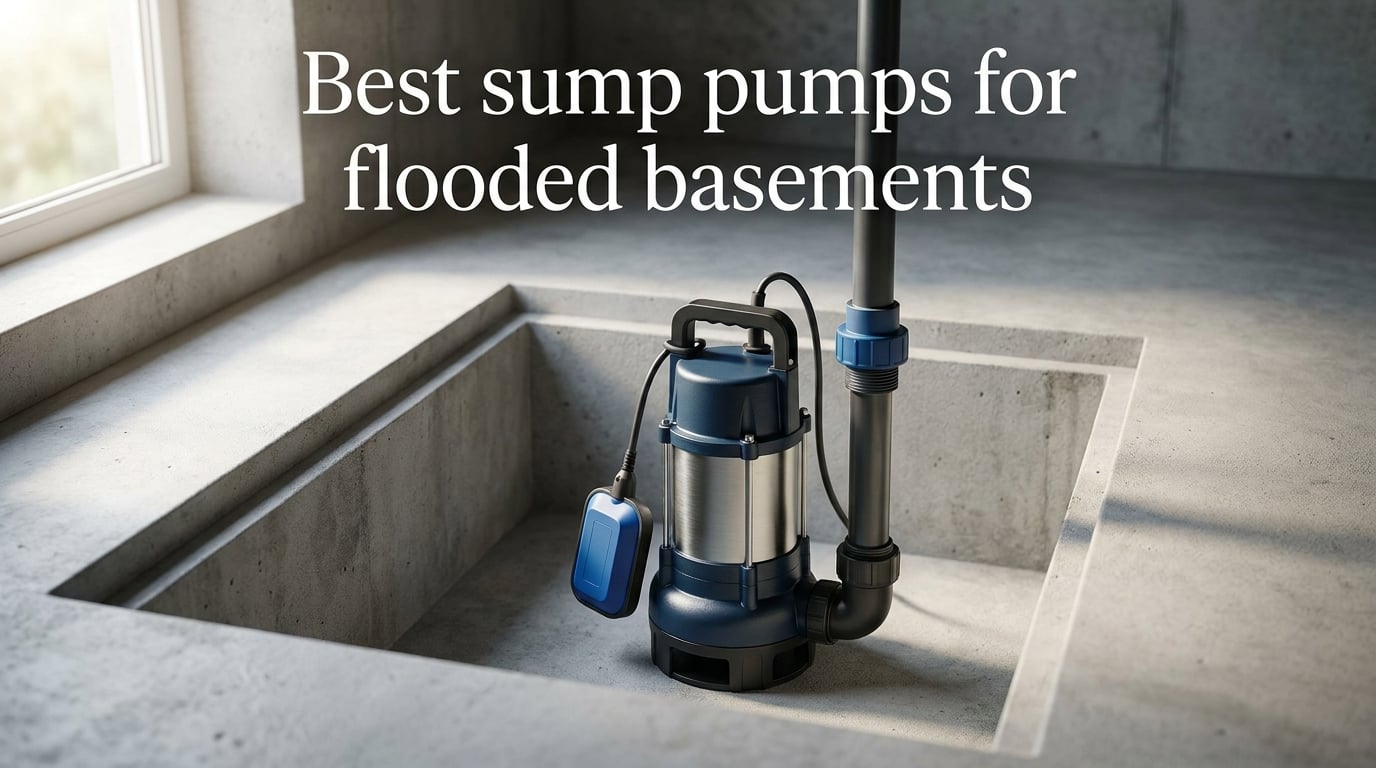
A flooded basement needs the right kind of pump, not simply the largest motor on a product label. The best sump pumps for flooded basements are automatic submersible units sized for the water entering a properly built sump pit; for water already across the floor, a portable utility pump can be the more practical first response.
That difference matters. A permanent primary sump pump handles groundwater and drainage water as it rises in the pit, while an emergency water-removal pump must sit in the flooded area and move water through a hose. Neither type can safely pump sewage unless its documentation specifically says it is made for that job.
I would begin with the discharge height, pit width, water source, and power-outage risk rather than horsepower alone. We compared the supplied product specifications, stated flow ratings, construction, automatic controls, customer-review patterns, and stated support or warranty details to separate dependable primary-pump candidates from portable flood-cleanup tools.
One practical reality from homeowner discussions is that a pump failure is most frightening during the same storm that causes the water problem. If your basement is finished, has a history of rapid inflow, or loses utility power in storms, plan for an alarm or a separate battery-backed system instead of treating it as an optional later upgrade.
The top three choices cover primary pumping, backup power, and emergency drainage 2026
The Wayne is the strongest all-around primary-pump choice here because it pairs a 3/4 HP motor and 5,490 GPH stated capacity with a cast-iron volute, top suction, and a five-year warranty. The Westinghouse is the pick when an outage plan matters as much as normal operation, while the Acquaer 1/2 HP offers automatic pumping and a stated 4,060 GPH for homeowners who want a lighter thermoplastic unit.
This quick card highlights the lead pick only; the full reviews below explain when its larger motor is justified and when a portable or backup-oriented unit makes more sense. Pump labels state maximum flow under favorable conditions, so compare the lift from your pit to the discharge point before treating one rating as a promise of real-world output.

The eight sump pumps below show the important capacity and control differences in 2026
The comparison card includes every evaluated model. Treat GPH as a starting point: discharge height, pipe diameter, elbows, check-valve resistance, and debris can all reduce the volume a pump moves after installation.
| Product | Specifications | Action |
|---|---|---|
 Wayne 3/4 HP Heavy Duty Wayne 3/4 HP Heavy Duty |
|
View Product |
| Westinghouse Battery Backup System |
|
View Product |
 Acquaer 1/2 HP Clean Dirty Water Acquaer 1/2 HP Clean Dirty Water |
|
View Product |
 LANCHEZ 1/2 HP 5200 GPH LANCHEZ 1/2 HP 5200 GPH |
|
View Product |
 AQUASTRONG 3/4 HP 4200 GPH AQUASTRONG 3/4 HP 4200 GPH |
|
View Product |
 Cleartide 1/3 HP Utility Pump Cleartide 1/3 HP Utility Pump |
|
View Product |
 Acquaer 1/3 HP Automatic Pump Acquaer 1/3 HP Automatic Pump |
|
View Product |
 6699 1.5 HP 7000 GPH 6699 1.5 HP 7000 GPH |
|
View Product |
1. The Wayne 3/4 HP Heavy Duty is the strongest permanent primary-pump choice
- High stated flow
- Top suction design
- Five-year warranty
- Tested over one million cycles
- Indoor use only
- No backup power
The Wayne 57526-WYN2 is the model I would put first on a shortlist for a conventional basement sump pit with recurring heavy rain or snowmelt. Its manufacturer-stated 5,490 GPH capacity, 3/4 HP motor, and 25-foot maximum lift suit a household that needs a capable corded primary pump rather than a one-time cleanup tool.
The construction is persuasive on paper: a stainless-steel motor housing protects the motor area, and the cast-iron volute is built for durability. Wayne also states that this pump was tested for more than one million cycles and backs it with a five-year warranty, which speaks directly to the recurring-cycle worry homeowners raise after a storm failure.
Top suction is a useful detail in a sump pit because it is intended to prevent air lock and limit debris buildup at the bottom. The 1-1/2 inch NPT discharge must still match your existing plumbing, and a correctly oriented check valve is needed so discharged water does not run back into the pit.
There is no battery function built in, so this is not the full answer in an outage-prone area. Pair it with an alarm and an independent backup plan if the same storms that fill your pit also threaten power.
The Wayne fits homeowners who need reliable high-volume primary pumping
This is a fit for an established sump pit, a finished or unfinished basement, and frequent groundwater movement where a submersible pump is preferred for quieter, contained operation. It is also a sensible candidate when the discharge route has a meaningful vertical rise, provided the actual lift remains within the stated 25-foot limit.
I would choose it over a smaller emergency utility pump when the goal is automatic, repeated protection rather than carrying a pump to standing water after a flood starts.
The Wayne is less suitable when battery operation or outdoor use is required
Buyers needing power-outage coverage need a separate battery backup or a dual-system design. The listing specifies indoor use only, so it is not the right tool for outdoor pond work or exposed applications.
Measure the pit and inspect the discharge fitting before ordering; high capacity does not help if the pump cannot sit level or connect cleanly to the existing pipe.
2. The Westinghouse dual system is the best answer for power-outage protection
- Battery backup
- Automatic switchover
- Alarm included
- Stainless steel construction
- Battery not included
- 50 pound system
The Westinghouse WH50BBU combines a 1/2 HP primary pump and battery backup pump in one system, which directly addresses the storm-plus-outage scenario. It lists a 30-foot maximum lift and an 87 GPM flow rate, or 5,220 gallons per hour when that GPM figure is converted.
What separates it from the other entries is automatic switchover. If line power fails, the backup system can take over, and the included alarm system, battery controller, charger, and box provide more visibility than a basic corded pump.
The top-suction layout is intended to resist air lock and reduce debris buildup, while the cast iron and stainless-steel construction targets corrosion resistance. At 50 pounds, it is a system I would plan to install deliberately rather than a portable unit to move around during an emergency.
The supplied components do not include the battery. That is a material planning point: select a compatible battery, understand how long it can run under your expected inflow, and test the backup before seasonal storms.
The Westinghouse is right when the primary risk includes a power failure
This system makes the most sense for a basement where water damage would be especially disruptive or where outages are common during heavy weather. It is also useful for homeowners who want a primary pump and backup architecture instead of adding those pieces later.
Its compact design is stated to fit tight sump pits, but confirm the actual 14.4 by 9.3 by 15 inch product dimensions against the basin and plumbing layout.
The Westinghouse is not the simplest choice for a quick flood cleanup
A dual system has more parts to inspect, including the battery, controller, alarm, and both pumping paths. Someone removing one-off water from a floor will find a portable utility pump easier to position and drain through a hose.
Do not assume battery backup means unlimited runtime. Rainfall inflow, battery capacity, discharge height, and pump cycling determine how long the backup can protect the basement.
3. The Acquaer 1/2 HP clean-dirty pump is the balanced automatic option
- Adjustable float
- Strong lift rating
- Thermal protection
- Three-year warranty
- Float needs adjustment
- Thermoplastic housing
The Acquaer 1/2 HP model has a stated 4,060 GPH flow rate and a 32-foot maximum lift, making it a flexible option for a basement, pool, garden, or other clean-to-dirty-water drainage task. Its automatic adjustable float is specified to turn on at 10 inches and off at 2.8 inches.
I like the explicit adjustment range because float behavior is one of the most common sources of confusion in narrow pits. Set too tight, a float may bind on the basin wall or discharge pipe; set too loose, it may allow a larger water rise before the motor starts.
The thermoplastic housing resists corrosion and helps keep the 9-pound pump manageable. Built-in thermal overload protection and a stated three-year warranty make this a more credible repeated-use option than a bare-bones utility pump.
It is still important to separate a stated maximum of 4,060 GPH from the flow at your actual head. Long runs, elbows, and higher discharge points lower output, so use the 32-foot lift figure as a ceiling rather than your day-to-day expectation.
The Acquaer works best where float adjustment and lift height matter
This pump suits buyers who want automatic control but need to tune the float to the basin water range. Its stated 32-foot lift is helpful when the discharge must reach higher ground before it can run away from the foundation.
The 1/2 HP motor is a sensible middle ground for many residential drainage jobs, assuming the inflow is not so extreme that a higher-capacity permanent primary system is warranted.
The Acquaer needs attention when the pit is very narrow or debris is heavy
The float may require adjustment, according to the product review summary. Test several cycles after installation and check that no pipe, cord, or basin feature blocks its travel.
For a permanent pit that receives large debris, inspect the intake and clean the basin regularly. Automatic operation cannot compensate for a blocked intake or a frozen exterior discharge line.
4. The LANCHEZ 1/2 HP model is the high-flow vertical-float choice
- Compact vertical switch
- Cast iron and stainless build
- 26 ft lift
- Thermal protection
- Some float-switch reports
- Lower 4.4 rating
The LANCHEZ Q450212-L2 lists a 1/2 HP PSC motor, a stated 5,200 GPH flow rate, and a 26-foot maximum lift. Its standout feature is an integrated vertical float switch that activates at 10.24 inches and turns off at 4.33 inches.
A vertical float is worth seeking out in a confined sump pit because it moves up and down in a smaller footprint than a tethered float. That does not make it immune to problems, but it can reduce the chance of a long float arm catching on the basin wall.
The cast-iron and stainless-steel construction is appropriate for a pump intended for residential basement flooding and dewatering work. It also lists thermal overload protection, a 10-foot grounded waterproof cord, and a 1-1/2 inch NPT discharge.
The product data includes some reports of float-switch issues and a 4.4 rating from 112 reviews. I would treat that as a reason to test its cycling behavior early and keep the pit clear, not as a reason to skip sizing and installation checks for every other pump.
The LANCHEZ is a good fit for a constrained pit that needs a vertical switch
Choose this layout when a conventional tethered float would have little room to swing without touching plumbing. The stated 5,200 GPH capacity is also attractive for a homeowner who wants more flow than many 1/2 HP labels suggest.
It can be used for basement dewatering and other listed applications, but the water type must match the manufacturer intended intended use before it goes into service.
The LANCHEZ needs close early-cycle testing because the switch controls everything
The float switch is the component that tells an automatic pump when to start and stop. Pour water into the pit and watch multiple complete cycles after installation, checking for rubbing, stalled movement, or a pump that does not shut off.
Do not use an automatic sump pump to solve an unknown drainage issue without also investigating where the water comes from and where the discharge goes.
5. The AQUASTRONG 3/4 HP is the long-cord automatic-pump option
- Long power cord
- Top suction
- Adjustable float
- Thermal overload
- One-year warranty
- Limited review count
The AQUASTRONG B0CF9HVY2P is a 3/4 HP automatic submersible model with a stated 4,200 GPH flow rate and 30-foot lift. Its 20-foot UL power cable is a practical distinction for a basement where the outlet is not directly beside the sump basin.
The pump combines stainless steel and thermoplastic components, uses top suction to reduce air lock and clogging, and includes thermal overload protection. Its piggy-back plug gives access to the float-switch connection, which can make basic diagnosis easier when the pump fails to start.
Review data lists only 39 reviews and a 4.4 rating, so there is less customer-history volume than with some alternatives. The stated one-year warranty is also shorter than the Wayne five-year coverage and the three-year coverage listed for the Acquaer models.
Still, the long cord, stated 30-foot lift, and automatic float operation make it a workable candidate when electrical reach and standard basement water management drive the decision.
The AQUASTRONG fits installations where outlet distance is a real constraint
A 20-foot cord can reduce the temptation to add an unsuitable extension cord in a damp area. The pump should still connect to a properly protected receptacle as required by local electrical rules and the product instructions.
It also makes sense for buyers who want a 3/4 HP motor with automatic operation and have confirmed that the 1-1/2 inch NPT discharge fits their installation.
The AQUASTRONG is less compelling when long warranty coverage is the top priority
The listed one-year warranty is shorter than several other reviewed options, and the customer-review sample is comparatively small. Those points matter more for a pump expected to cycle for years as a primary defense.
Keep the piggy-back plug and float cord arranged so they do not become a snag point in the pit. A clean, testable float path matters as much as motor size.
6. The Cleartide 1/3 HP is the portable emergency-drainage choice
- Lightweight
- Smart sensor
- Dry-run protection
- Adapters included
- Manual mode needs monitoring
- Not a fixed primary system
The Cleartide EUTP33 is better understood as a portable submersible utility pump than as a fixed, basin-installed primary sump pump. It states a 1/3 HP copper-wound motor, 2,790 GPH capacity, 30-foot lift, and auto/manual dual-mode operation.
For water already on a basement floor, this smaller 3.8-kilogram pump has a clear advantage: it can be positioned where water collects, then connected through its included adapters. The smart sensor is specified to start at 1-1/5 inches and stop at 1/5 inch in automatic mode, which supports relatively shallow-water removal.
Its smart protection system lists dry-run, overheating, and overload protection, and the intake handles debris up to 1/8 inch. That debris limit calls for a realistic approach: sweep or remove larger grit first instead of assuming the pump can chew through a dirty flood.
With a 4.7 rating from 115 reviews, the review summary is favorable, but portability is still its defining trait. I would keep it as a rapid-response tool or use it for pool, pond, hot-tub, and garden draining rather than substitute it for a primary sump system.
The Cleartide is best for removing standing water after a leak or localized flood
This is useful when water has bypassed the sump pit, such as after a plumbing leak, appliance failure, or a low spot in the basement. Its low weight, 10-foot cord, and supplied fittings support setup in several drainage tasks.
Automatic mode can reduce babysitting, but place the pump on a stable surface and route the hose well away from the foundation before starting it.
The Cleartide is not the permanent answer for continuous groundwater control
It is not presented as a fixed primary sump-pit unit with a conventional float setup. In manual mode it requires constant monitoring, which makes it unsuitable for unattended storm protection.
If basement water arrives regularly, fix the drainage path and install a correctly sized permanent sump system. A portable pump is a useful second line, not a replacement for that work.
7. The Acquaer 1/3 HP automatic pump is the shallow-water cleanup choice
Acquaer 1/3 HP Automatic Submersible Water Pump, 2160 GPH Sump Pump, 115V
- Starts at shallow depth
- Garden-hose adapter
- Check valve included
- Three-year warranty
- Lower 1/3 HP motor
- Not a heavy-duty primary
The second Acquaer is a 1/3 HP automatic water-removal pump designed around shallow activation. Its built-in electronic sensor is specified to turn the pump on at 1-1/2 inches of water and off below 1/4 inch, a useful range when the goal is getting a flooded floor as dry as possible.
It lists 2,160 GPH, a strainer base that filters debris, built-in temperature control, a 10-foot cord, a 3/4 inch garden-hose adapter, and a check valve. That accessory set makes the setup more approachable for pool covers, hot tubs, and emergency water removal.
The 4.3 rating comes from 1,271 reviews, giving this model the largest review count of the group. Its 1/3 HP rating and lower stated flow mean I would not assign it to a pit receiving fast, continuous storm inflow.
The stated three-year warranty gives a measure of longer-term support for its intended role. As with any bottom-suction design, clear the strainer and prevent fabric, leaves, or sediment from sealing the intake against the floor.
The Acquaer is ideal when shallow remaining water is the main problem
Choose this pump for cleanup after water has spread beyond a basin, especially when a taller float pump would stop while a layer of water remains. The electronic sensor removes the need for a swinging float in that shallow-water task.
The garden-hose adapter can simplify routing to an appropriate discharge point, though a larger hose and minimal restrictions may be needed to get the stated capacity.
The Acquaer is not sized for severe inflow into a permanent sump pit
A 2,160 GPH stated rate is useful for removal work but lower than the permanent-pump candidates listed above. A basement with a history of fast inflow needs a primary system selected against its actual water volume and discharge head.
Never leave a floor-drainage setup running unattended without checking the hose and the outlet point. A shifted hose can put pumped water back near the home.
8. The 6699 1.5 HP pump is the maximum-flow emergency option
- Highest stated flow
- 30 ft lift
- Four adapters
- 16 ft power cord
- Lower 4.3 rating
- Heavier portable unit
The 6699-branded SUB 7000S has the largest stated capacity in this group: 7,000 GPH or 117 GPM, with a 1.5 HP motor and a 30-foot maximum lifting height. It is a portable submersible utility pump made for fast removal from pools, sump pits, cellars, and flooded areas.
Its stated ability to handle solids up to 1.5 inches sets it apart from the finer-intake portable models. A 16-foot cord and four hose adapters also make it flexible when an emergency requires reaching an outlet and connecting to whatever hose size is available.
For a serious floor flood, I would consider this kind of capacity after confirming that the discharge hose, outlet location, and electrical circuit can support the work. A narrow garden hose can become the limiting factor, so the pump may not move water at its label maximum rate through every setup.
The product 4.3 rating from 127 reviews and 14.3-pound weight are trade-offs. It is not the lightest tool to carry into a wet basement, and the smaller review base means the long-term evidence is thinner than for established primary-pump choices.
The 6699 is appropriate when a large water volume needs fast portable removal
This is the natural choice among these eight for a major cleanup where the water is already present and a high stated flow rate is the deciding factor. Its 1.5-inch solids specification may also help with dirty water that would challenge a fine strainer.
Keep the pump on a stable surface, use the largest compatible discharge path, and monitor it. Moving water quickly does not remove the need to locate the cause of the basement flood.
The 6699 is not a substitute for a battery-backed primary sump system
It is corded, so it cannot work during an outage without a suitable backup power plan. Its adjustable float can automate operation, but the product is better suited to utility drainage than a fully planned, permanently installed groundwater-control system.
After the emergency, inspect the basement for damaged outlets, contaminated water, and mold risk before treating the cleanup as complete.
The right sump pump comes from matching real inflow, lift, and backup needs
Start with the source of the water. A sump pump is installed in a pit at the basement low point and automatically sends groundwater or drainage water through a discharge pipe; a portable utility pump is for water that is already outside that pit.
GPH is only meaningful at the lift and plumbing resistance in your home
GPH means gallons per hour, but maximum GPH is usually measured under low-resistance conditions. Measure the vertical rise from the pump to the highest point of the discharge line, then account for horizontal pipe, elbows, check valves, and the required route away from the foundation.
A pump rated at 5,000 GPH does not necessarily move 5,000 gallons every hour in your installation. Compare the manufacturer performance curve when available, and choose capacity above your normal inflow instead of matching it exactly.
Horsepower should follow water volume, not a guess based on basement size
A 1/3 HP model can work for modest groundwater control or shallow-water removal, while 1/2 HP and 3/4 HP primary pumps fit many homes with more persistent water. A 1.5 HP utility pump is for high-volume removal, not automatic proof that it is the best permanent installation.
If your pump runs every 30 minutes during heavy rain, as homeowners often report, note how long each cycle lasts. Very short cycles can point to a small basin, while long or nonstop cycles can mean the water volume exceeds the pump or the discharge is returning water to the foundation.
A submersible pump is usually the better choice for a finished basement
Submersible pumps sit in the pit, run more quietly, and keep the motor enclosed below the cover. That quieter operation is why they are commonly preferred for finished basements and living areas near the basin.
A pedestal pump has a motor above the pit and is easier to reach for service, but it is louder and needs vertical clearance. Neither design is automatically superior; pit dimensions, noise tolerance, service access, and expected debris should decide it.
A vertical float switch is the safer choice when the pit leaves little room to swing
Vertical switches move in a narrow up-and-down path, which can work well in tight basins. Tethered floats need open space to swing, and they can snag against the wall, pipe, cord, or pump if installation is cramped.
Whatever switch you pick, test it. Fill the pit with water, watch the start point, confirm the pump keeps running, and verify shutoff after the water drops. Repeat this test before the wet season and after any plumbing change.
A battery backup is necessary when storm outages and water inflow overlap
A battery backup sump pump does not replace a strong primary pump; it protects against line-power loss and can provide a second pumping path. Choose a system with an alarm, learn what battery it needs, and review its expected runtime under the load your pit creates.
Keep in mind that no backup can compensate for an undersized discharge or a blocked exterior outlet. Backup planning should include a check valve, discharge routing that does not freeze or recirculate, and a way to receive alarms when you are away.
Installation is DIY-friendly only when the pit, wiring, and drainage already meet requirements
Replacing an existing compatible pump can be manageable: unplug the old unit, remove it, inspect the pit, reconnect the discharge and check valve, secure the cord, and perform several water tests. Follow the product manual and local requirements, especially for GFCI-protected power.
Call a qualified plumber or basement-waterproofing professional when there is no sump pit, the pit is undersized, water is coming through walls or floor cracks, the discharge route is unclear, or electrical work is needed. Moving water is only one part of preventing future flooding.
A flooded basement should be pumped out in a cautious sequence
Turn off power to affected areas if it can be done safely, and do not enter standing water near energized equipment.
Identify whether the water is clean, gray, or sewage-contaminated; sewage needs different equipment and cleanup precautions.
Place a portable pump at the lowest accessible point or inspect the primary sump pit if it should already be working.
Route the discharge well away from the foundation and watch the hose outlet while pumping.
Remove water gradually if there is major exterior groundwater pressure, then dry, clean, and investigate the cause.
Test a primary pump at least before seasons when heavy rain is expected, and inspect it after a major event. Clear the pit, check the float free movement, examine the check valve and discharge outlet, and listen for an unusual motor sound.
The answers below address the most common flooded-basement pump questions
What is the best pump to drain a flooded basement?
For a flooded basement, use an automatic submersible primary sump pump if water enters a sump pit repeatedly. Use a portable submersible utility pump if water is already spread across the floor. The Wayne 3/4 HP is the strongest primary-pump choice in this group, while the 6699 1.5 HP has the highest stated portable flow rate.
Will a sump pump drain a flooded basement?
A sump pump drains a flooded basement only if the water reaches its sump pit and the pump, float switch, power supply, and discharge line are working. Water sitting elsewhere on the floor may need to be moved to the pit or removed with a portable utility pump.
How do you pump water out of a flooded basement?
First address electrical safety and identify whether water is contaminated. Then use a working sump pump in its pit or place a portable submersible pump at the lowest point, run its discharge well away from the foundation, monitor the hose, and dry the area after pumping.
What type of sump pump is best for basement?
A submersible automatic sump pump is usually best for a basement because it sits quietly inside the pit and activates as water rises. Pick a vertical float for a tight basin, size capacity for the discharge height and inflow, and add battery backup where storms can cause outages.
The best choice is the pump that matches your permanent system or emergency plan
For a dependable corded primary sump pump, the Wayne 3/4 HP is the lead recommendation because of its stated capacity, durable materials, cycle testing, and five-year warranty. For a plan that covers outages too, the Westinghouse dual system is the more complete route.
The portable Cleartide, shallow-water Acquaer, and high-capacity 6699 are useful when water has already escaped the pit. Before choosing among the best sump pumps for flooded basements in 2026, measure your lift and basin, inspect the discharge destination, and decide how the system will keep working when power goes out.