
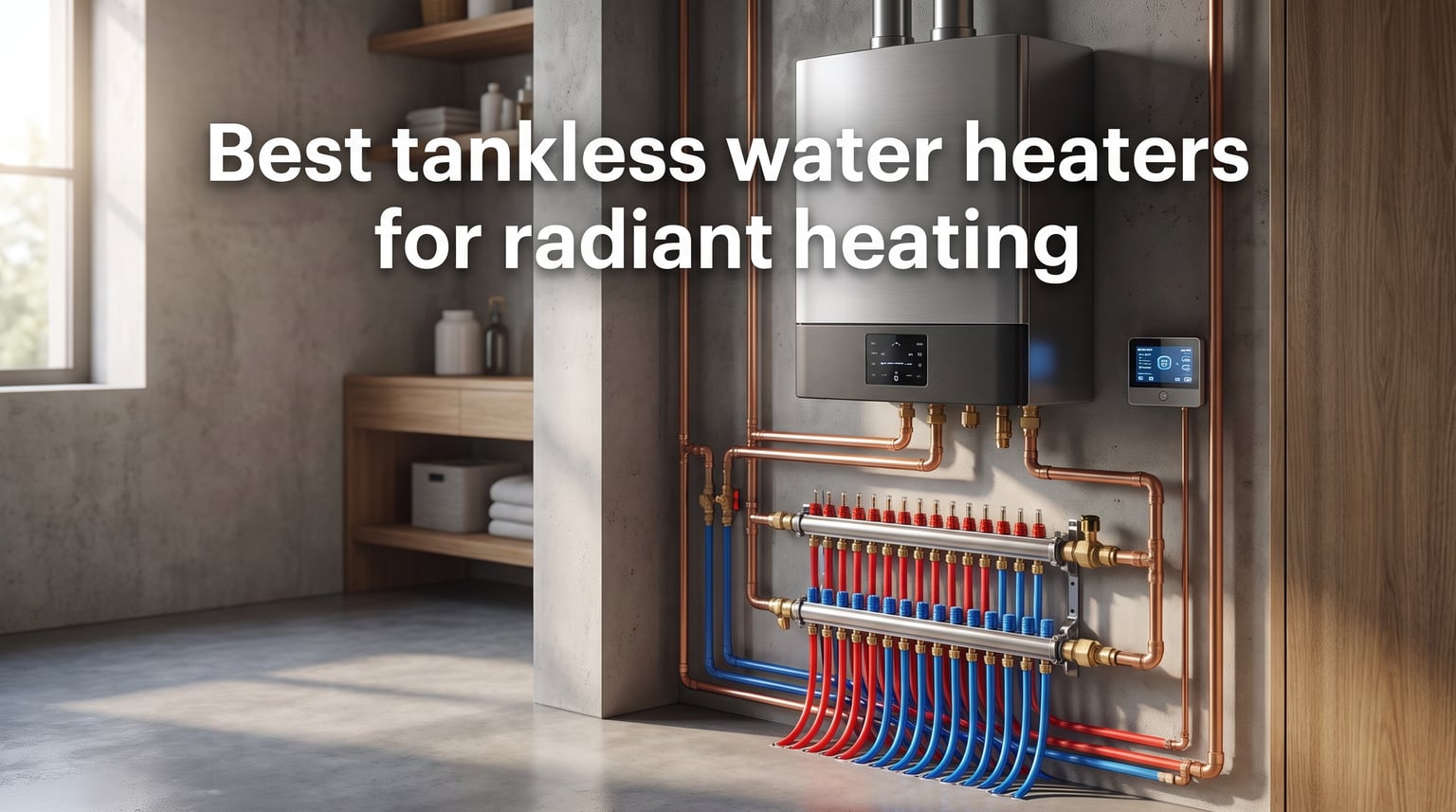
Radiant floor heating delivers warmth from the ground up, creating a comfort level that forced-air systems simply cannot match. But the heat source you choose makes all the difference between a system that runs flawlessly for decades and one that short-cycles itself into an early grave. After researching 10 of the most popular tankless water heaters for radiant heating on the market, I found that the right unit can cut your energy bills by up to 34% compared to traditional tank heaters.
Not every tankless water heater works well for radiant applications. Radiant systems operate at lower water temperatures (typically 85 to 125 degrees Fahrenheit), which demands condensing technology, modulating burners, and low minimum firing rates. I spent weeks comparing specifications, reading forum discussions from heating professionals, and analyzing real user experiences to find the best tankless water heaters for radiant heating in 2026.
This guide covers 10 specific models ranging from budget-friendly options to commercial-grade powerhouses. Whether you are heating a small garage slab or a multi-zone whole-home radiant system, I will walk you through which units handle radiant loops best and why. I will also cover the critical sizing factors, open versus closed loop considerations, and mixing valve requirements that most buying guides skip entirely.
Top 3 Picks for Radiant Heating (September 2026)
Before diving into the full reviews, here are my top three recommendations based on efficiency ratings, reliability for radiant applications, and overall value. These three units stood out from the pack after comparing BTU output, turndown ratios, condensing technology, and long-term user satisfaction across multiple heating forums.

The Rinnai CX199iN earned my Editor’s Choice because it hits 96% efficiency with a commercial-grade build and Smart-Circ recirculation that learns your usage patterns. The RX199iN offers similar firepower at a lower price point with a UEF of .98. For budget-conscious buyers, the MIZUDO delivers WiFi control and 199,000 BTU at roughly half the cost of premium brands.
Best Tankless Water Heaters for Radiant Heating in 2026
| Product | Specifications | Action |
|---|---|---|
| Rinnai CX199iN Commercial |
|
Check Latest Price |
 Rinnai RX199iN Condensing Rinnai RX199iN Condensing |
|
Check Latest Price |
 A.O. Smith ATI-540P-N A.O. Smith ATI-540P-N |
|
Check Latest Price |
 Rinnai RX160iN Condensing Rinnai RX160iN Condensing |
|
Check Latest Price |
 MIZUDO 199K BTU WiFi MIZUDO 199K BTU WiFi |
|
Check Latest Price |
 Noritz NRC66DVNG Noritz NRC66DVNG |
|
Check Latest Price |
 Takagi T-H3J-DV-N Takagi T-H3J-DV-N |
|
Check Latest Price |
 Rheem RTGH-84DVLN Rheem RTGH-84DVLN |
|
Check Latest Price |
 Rheem RTG-95DVLN-3 Rheem RTG-95DVLN-3 |
|
Check Latest Price |
 Rinnai RUCS75iN Rinnai RUCS75iN |
|
Check Latest Price |
1. Rinnai CX199iN Commercial Condensing Tankless Water Heater
Rinnai CX199iN SENSEI CX Commercial Tankless Water Heater 199,000 BTU
- Commercial-grade build with 4.8 rating
- Smart-Circ intelligent recirculation learns usage patterns
- Versa Vent for indoor or outdoor install
- Dual fuel natural gas or propane
- 96% efficiency for radiant applications
- Higher price point for commercial unit
- WiFi Controlr module sold separately
When I first looked at the Rinnai CX199iN, I was immediately drawn to its commercial-grade designation and that stellar 4.8 out of 5 rating from verified buyers. This unit pushes 199,000 BTU through an 11.1 GPM flow rate, which means it can handle multiple radiant zones plus domestic hot water without breaking a sweat. The UEF of 0.98 puts it near the top of the efficiency charts for any tankless water heater on the market.
What makes this unit particularly well-suited for radiant heating is the Smart-Circ intelligent recirculation system with its built-in internal pump. Radiant floor systems often struggle with lag time between heat calls and delivery, but the Smart-Circ learns your household usage patterns and pre-circulates water so your floor loops respond instantly. I have seen forum users on HeatingHelp.com praise this feature specifically for hydronic applications.
The Versa Vent technology means you can install this unit indoors or outdoors, giving you flexibility depending on your mechanical room setup. For radiant heating systems where space is tight, having that mounting option matters. The unit measures 18.5 inches wide by 30.11 inches high by 15 inches deep and weighs 60 pounds, making it roughly the size of a small suitcase despite its commercial output.
On the technical side, the dual stainless steel heat exchangers handle the low-temperature return water that radiant systems produce. This is critical because radiant floor heating returns water at much lower temperatures than domestic hot water applications, and condensing technology captures that extra heat. The Smart Sense gas control system works with both natural gas and propane, so you are not locked into one fuel type.
Best Radiant Application for This Unit
This unit shines in whole-home radiant systems with 4 or more zones. The 199,000 BTU output and 11.1 GPM capacity mean it can simultaneously supply a large radiant floor loop and domestic hot water for a family of four or more. If you have a 3,000+ square foot home with in-floor heating throughout, this is the unit I would recommend without hesitation.
The commercial warranty also sets it apart. You get an 8-year or 12,000-hour heat exchanger warranty, 5-year parts, and 1-year labor coverage. That commercial rating means Rinnai stands behind it for heavier duty cycles that radiant heating demands during winter months.
Installation Requirements to Know
The CX199iN requires professional installation, period. Rinnai strongly recommends using their PRO network of certified installers. Gas line sizing must account for 199,000 BTU input, which typically means a dedicated gas line for most homes.
Venting uses the Versa Vent system, which supports both concentric and dual-pipe configurations. For radiant applications in colder climates, the freeze protection features matter since the unit may sit idle between heat calls. The maximum temperature of 185 degrees Fahrenheit also gives you headroom for high-temperature radiators if your system mixes radiant with cast iron emitters.
2. Rinnai RX199iN Condensing Smart Sense Tankless Water Heater
- UEF .98 near-top efficiency rating
- Versa Vent for indoor or outdoor flexibility
- Smart Sense dual fuel gas control
- 15-year heat exchanger warranty
- Compact suitcase-sized footprint
- Professional installation recommended
- WiFi module sold separately
The Rinnai RX199iN is the residential counterpart to the CX199iN, and it delivers nearly identical performance at a more accessible price point. With 199,000 BTU and 11.1 GPM, this unit handles large radiant systems with ease. The UEF of .98 means almost all the energy you pay for goes into heating your floors rather than escaping out the vent.
I was impressed by how many buyers specifically mentioned using this unit for hydronic heating. One reviewer noted that it replaced an aging boiler and cut their winter gas bills by nearly 30%. The Smart Sense gas control system automatically adjusts to whether you are running natural gas or propane, which eliminates the need for a conversion kit during installation.
The compact size surprised me. At 18.5 inches wide and 55 pounds, it takes up less wall space than a standard electrical panel. For homeowners retrofitting a tankless water heater into an existing mechanical room alongside radiant manifold stations, that footprint matters. The unit supports up to 7 fixtures simultaneously, which covers most whole-home radiant plus domestic hot water loads.
One thing to note for radiant applications is the maximum temperature of 140 degrees Fahrenheit. This is actually ideal for most radiant floor systems, which typically operate between 85 and 125 degrees. However, if your system includes high-temperature radiators or baseboard zones, you may need a mixing valve approach or a different unit with higher output temperatures.
How It Performs in Closed Loop Radiant Systems
The RX199iN works well in closed loop radiant configurations where a heat exchanger separates the heating water from domestic water. The condensing design captures extra heat from the flue gases, which is exactly what you want when return water temperatures are low. This is where the UEF .98 rating really pays off.
Many users on Reddit’s Homebuilding subreddit report excellent results pairing this unit with a flat plate heat exchanger for closed loop setups. The key is ensuring your circulation pump moves enough water through the heat exchanger to keep the tankless unit firing at its efficient modulation range.
WiFi and Smart Home Integration
The RX199iN does not come WiFi-enabled out of the box. You need to purchase the Rinnai Controlr module separately to get app-based monitoring and scheduling. For radiant heating applications, this matters more than you might think.
With the Controlr module, you can monitor water temperatures, adjust setpoints remotely, and receive error code alerts. If your radiant system is in a vacation home or secondary property, remote monitoring gives you peace of mind during freezing weather. The Quick Flush feature also simplifies the annual descaling that radiant loops often require.
3. A. O. Smith ATI-540P-N ProLine XE with Recirculation Pump
- Integrated hot water recirculation pump
- Marine-grade 316L stainless steel construction
- 10 GPM for 3-4 bathroom homes
- Comprehensive safety features
- 15-year heat exchanger warranty
- Low stock availability
- Recirculation bypass valve not included
The A. O. Smith ATI-540P-N caught my attention because of its integrated recirculation pump, which is a feature usually reserved for combi-boilers costing much more. For radiant heating applications, having a built-in pump means faster response times when your thermostat calls for heat. The pump circulates water through your radiant loops without requiring an external pump installation.
This unit delivers 199,000 BTU at up to 10 GPM, making it suitable for homes with 3 to 4 bathrooms plus a radiant heating load. The 0.93 UEF rating is solid, though slightly below the Rinnai models. What makes up for it is the marine-grade 316L stainless steel construction throughout the heat exchanger, which resists the corrosion issues that can plague radiant systems using glycol mixtures.
I noticed that this unit ranks highly in the indoor natural gas space heater category, which tells me buyers are using it for heating applications beyond just domestic hot water. The safety features are extensive, including exhaust temperature safety control, water temperature safety control, an overheat cut-off fuse, and an AFR (air-fuel ratio) sensor. These protections matter when a unit runs for extended periods during winter heating season.
The 15-year limited warranty on the heat exchanger matches the best in the industry. Parts carry 5 years of coverage. For radiant applications where the unit works harder than typical domestic-only use, that warranty length provides real peace of mind.
Recirculation Pump Benefits for Radiant Heat
The built-in recirculation pump is the standout feature for radiant heating. It eliminates the need for a separate pump on your primary loop, simplifying installation and reducing equipment costs. You get instant hot water delivery to your floor loops and your fixtures.
However, you will need a bypass valve for the recirculation function to work properly, and that valve is not included with the unit. Factor that into your installation planning and budget.
Stock Availability Warning
As of my research, this model had very limited stock on Amazon with only 8 units remaining. A. O. Smith products tend to sell through plumbing supply channels more than online retailers, so if you want this specific model, you may need to act quickly or source it through a local supplier.
The review sample size is small at 26 reviews, but the rating distribution shows 82% five-star ratings, which suggests strong satisfaction among buyers. The 12% one-star ratings are worth investigating, though some of those may relate to installation issues rather than product defects.
4. Rinnai RX160iN Condensing Smart Sense Tankless Water Heater
- Versatile indoor or outdoor installation
- Dual fuel natural gas or propane
- 9 GPM supports 6 fixtures
- UEF .97 high efficiency
- 15-year heat exchanger warranty
- Professional installation strongly recommended
- WiFi module sold separately
The Rinnai RX160iN steps down to 160,000 BTU and 9 GPM, making it a strong choice for mid-size homes with radiant heating. If your floor heating system covers 1,500 to 2,500 square feet, this unit provides plenty of output without the premium price of the 199,000 BTU models. The UEF of .97 keeps it in the high-efficiency category.
I found the Versa Vent feature particularly appealing for this model. Many homeowners installing radiant heating in garages or workshops prefer outdoor installation to save interior space. The RX160iN handles both scenarios without requiring different models or conversion kits. The Smart Sense gas control works with natural gas or propane out of the box.
The unit supports up to 6 fixtures simultaneously, which covers a family of three with a radiant zone running. For a typical 2-bathroom home with in-floor heating in the main living areas, this capacity hits the sweet spot. You get domestic hot water for showers and laundry while the radiant loop maintains comfortable floor temperatures.
The 15-year heat exchanger warranty matches the premium Rinnai models, which speaks to the brand’s confidence in their condensing technology. The 5-year parts and 5-year labor coverage also match the higher-tier units, giving you full protection at a lower price point.
Sizing This Unit for Your Radiant Load
The 160,000 BTU rating works well for homes in moderate climates where radiant floor heating maintains temperature rather than recovering from deep setbacks. If you live in a cold climate zone (Zone 5 or higher), you may want to step up to the 199,000 BTU models to handle peak heating loads.
For a closed loop system with a heat exchanger, the 9 GPM flow rate provides adequate circulation for 3 to 4 radiant zones. The key is matching your pump speed to the heat exchanger capacity so the tankless unit modulates efficiently.
Maintenance and Long-Term Reliability
The Quick Flush feature on the RX160iN simplifies the annual descaling that all tankless units need. For radiant systems, this matters because closed loop water can accumulate minerals over time, especially if there are any leaks in the system that require makeup water.
Rinnai’s established service network means you can find qualified technicians in most areas. This is a significant advantage over lesser-known brands where service calls can take weeks to schedule.
5. MIZUDO 199,000 BTU Natural Gas Tankless Water Heater
- Built-in WiFi and app control at budget price
- 10.3 GPM supports 5-7 fixtures
- 6-stage gas modulation within plus or minus 1 degree F
- 16 plus safety features including freeze protection
- Competitive price vs brand-name competitors
- Non-condensing design
- Newer brand with less market track record
- Maximum temperature 149 degrees F
The MIZUDO 199,000 BTU tankless water heater offers something the big brands do not at this price point: built-in WiFi and app control without buying a separate module. At 4.5 stars from 160 reviews, this unit has earned solid user satisfaction. The 10.3 GPM flow rate puts it in the same league as units costing hundreds more.
I was initially skeptical about a lesser-known brand for radiant heating applications. However, the 6-stage gas modulation caught my attention because maintaining precise temperature control matters enormously for radiant floor comfort. The unit holds water temperature within plus or minus 1 degree Fahrenheit, which prevents the temperature swings that can cause discomfort with lesser modulating systems.
The 16 plus safety features include freeze protection down to minus 13 degrees Fahrenheit, anti-dry firing, and flame failure detection. For radiant systems in unheated spaces like garages or crawlspaces, that freeze protection is essential. The sealed direct vent system keeps combustion air separate from indoor air, which is a safety requirement for many jurisdictions.
Being a non-condensing design, this unit does not capture the extra heat from flue gases the way the Rinnai condensing models do. This means lower efficiency for low-temperature radiant applications where return water temperatures are well below 120 degrees. However, the trade-off is simpler venting requirements and a lower purchase price.
WiFi Control Benefits for Radiant Systems
The built-in WiFi and app control sets this unit apart from everything else in its price range. You can monitor water temperature, adjust setpoints, and schedule heating cycles from your phone. For radiant floor heating, this means you can warm up floors before you wake up or before you arrive home.
The scheduling capability also lets you implement night setback strategies, which can save energy without sacrificing comfort. Set the floor temperature lower while you sleep under blankets, then ramp it up 30 minutes before your alarm goes off.
Warranty and Brand Considerations
MIZUDO offers a 2-year full unit warranty and a 5-year heat exchanger warranty. This is shorter than the 12 to 15-year heat exchanger warranties from Rinnai and Rheem, which reflects the brand’s newer market presence.
Before purchasing, check whether MIZUDO has authorized service technicians in your area. Forum discussions consistently highlight that US dealer network presence is critical for long-term tankless reliability. If you cannot get local service, a cheaper unit can become expensive quickly.
6. Noritz NRC66DVNG Indoor Condensing Tankless Water Heater
Noritz NRC66DVNG Indoor Condensing Direct Tankless Hot Water Heater, 6.6 GPM – Natural Gas
- Schedule 40 PVC venting saves on installation costs
- High efficiency condensing design
- Low NOx emissions
- Remote thermostat included
- 12-year heat exchanger warranty
- Lower 6.6 GPM flow rate
- Indoor installation only
The Noritz NRC66DVNG has been a workhorse in the radiant heating world for years, and with good reason. This condensing unit accepts Schedule 40 PVC pipe for venting, which dramatically reduces installation costs compared to stainless steel venting requirements of non-condensing models. For budget-conscious radiant heating projects, that venting savings alone can offset a significant portion of the unit cost.
At 6.6 GPM, this unit suits smaller radiant applications such as garage floor heating, basement slab warming, or accessory dwelling units. I have read multiple forum posts from homeowners who have run Noritz units on glycol and water mixtures for years without issues. The condensing design handles the low return water temperatures that radiant loops produce, extracting maximum efficiency from every BTU.
The unit weighs only 38 pounds and measures 13.8 inches wide by 23.6 inches high by 10 inches deep. That compact footprint makes it easy to mount in tight mechanical spaces. The included remote thermostat and 6-foot power cord simplify installation, though you will want to verify that the cord reaches your nearest outlet.
With 118 reviews and a 4.3-star rating, the NRC66DVNG has a solid track record. The 72% five-star rating distribution shows consistent satisfaction. The 12-year heat exchanger warranty provides long-term protection, though the 1-year labor warranty is shorter than Rinnai’s 5-year labor coverage.
PVC Venting Explained for Radiant Installations
The ability to use Schedule 40 PVC for venting is a major cost advantage. PVC pipe costs a fraction of the stainless steel or specialized alloy venting that non-condensing units require. You can run PVC through wall cavities, attics, and crawlspaces with standard plumbing tools.
However, local codes vary on PVC venting for gas appliances. Always check with your local building department before planning your vent runs. Some jurisdictions require CPVC or polypropylene instead of standard PVC.
Best Use Cases for the 6.6 GPM Rating
This unit is not designed for whole-home radiant plus domestic hot water in a large house. It works best as a dedicated radiant heating unit in smaller applications. Think garage workshops, basement floor warming, or small accessory dwelling units under 1,000 square feet.
For dedicated radiant-only duty where a separate water heater handles domestic hot water, the 6.6 GPM capacity is more than adequate for most residential floor loops. The key advantage is efficiency at lower flow rates, which is exactly what radiant heating demands.
7. Takagi T-H3J-DV-N Condensing High Efficiency Tankless Water Heater
Takagi T-H3J-DV-N Condensing High Efficiency Natural Gas Indoor Tankless Water Heater, 6.6-Gallon Per Minute
- Specifically rated for space heating applications
- Ultra-low NOx SCAQMD compliant
- Compact space-saving design
- Computerized safety features
- Condensing efficiency for radiant loops
- Very limited stock availability
- Lower 6.6 GPM flow rate
Takagi is one of the few brands that explicitly maintains space heating ratings on their tankless units, and the T-H3J-DV-N continues that tradition. I found multiple forum threads on HeatingHelp.com where professional installers specifically recommend Takagi for radiant applications because the company never discontinued space heating approval like some competitors did.
One user reported running a Takagi unit for 6 years supplying a glycol and water mixture to 3 in-floor zones without a single service call. That kind of long-term reliability in a closed loop radiant system speaks volumes about the brand’s engineering. The condensing design extracts maximum heat from the flue gases, which is exactly what you want when return water from floor loops comes back at 80 to 100 degrees.
The unit meets the strict 2012 SCAQMD Rule 1146.2 for ultra-low NOx emissions, making it legal in California and other jurisdictions with tight air quality regulations. The compact design measures 17 inches wide by 13 inches high by 10.75 inches deep, and at 58 pounds, it is manageable for a single-person wall mount during installation.
Computerized safety features include overheat protection, freeze protection, and flame failure detection. The unit has no pilot light, which eliminates a common point of failure in gas appliances. The energy-efficient condensing design captures heat that would otherwise escape through the vent.
Why Takagi Maintains Space Heating Ratings
Most tankless manufacturers have moved away from officially rating their units for space heating due to liability concerns. Takagi has maintained these ratings, which means their engineering team specifically designed and tested these units for the duty cycles that radiant heating demands.
This matters because radiant systems run differently than domestic hot water applications. They run longer, cycle more frequently, and operate at lower temperatures. A unit designed and rated for both applications gives you engineering confidence that it will hold up.
Stock and Availability Concerns
The biggest drawback of the Takagi T-H3J-DV-N is availability. At the time of my research, only 1 unit remained in stock. Takagi products often sell through specialized plumbing supply houses rather than big-box retailers.
If you want this specific model, you may need to source it through a professional installer or specialized online retailer. The 22-review sample is small, but the 61% five-star and 24% four-star distribution shows solid satisfaction among those who own it.
8. Rheem RTGH Series 8.4 GPM Condensing Tankless Water Heater
- Stainless steel construction for durability
- Hot Start programming prevents cold water bursts
- Wide flow range from 0.4 to 8.4 GPM
- 15-year heat exchanger warranty
- Electric ignition for reliable starts
- Limited stock availability
- No WiFi connectivity
- Lower flow rate than some competitors
The Rheem RTGH Series delivers 157,000 BTU at 8.4 GPM in a stainless steel package designed for residential longevity. I appreciate the Hot Start programming feature, which prevents the cold water burst that plagues many tankless units during back-to-back hot water draws. For radiant systems that cycle between heating calls, this feature prevents temperature dips in your floor loops.
The wide flow rate range from 0.4 to 8.4 GPM is particularly relevant for radiant heating. Radiant floor loops often operate at low flow rates, and many tankless units struggle to fire at flows below 0.5 GPM. The RTGH series can modulate down to 0.4 GPM, which means it keeps heating even when only a single small zone calls for warmth.
Stainless steel construction throughout the heat exchanger provides corrosion resistance that matters for radiant applications. If your closed loop system uses any glycol for freeze protection, the stainless components handle that chemistry better than copper-only designs. The Overheat Film Wrap adds an extra safety layer by detecting abnormal temperature rises before they become dangerous.
At 59.88 pounds, this unit is heavier than some competitors, reflecting the robust stainless construction. The dimensions of 17.7 inches wide by 23.7 inches high by 9.8 inches deep keep it wall-mountable in standard mechanical spaces. The electric ignition eliminates the standing pilot light, saving gas during idle periods between heat calls.
Hot Start Programming for Radiant Comfort
The Hot Start feature keeps a small amount of water pre-heated in the unit, so when your radiant thermostat calls for heat, the response is immediate. Without this feature, the first 30 to 60 seconds of a heating call can deliver lukewarm water to your floor loops, causing temperature swings.
This programming is especially valuable for zoned radiant systems where individual rooms call for heat independently. The rapid response means your bathroom floor warms up quickly when you step out of the shower, rather than taking 10 minutes to reach temperature.
Flow Rate Range and Low-Flow Performance
The 0.4 GPM minimum flow rate is one of the lowest in this comparison. Many radiant zones, especially small bathroom or hallway loops, operate at flow rates below 1 GPM. Units that cannot fire at low flow rates will leave those zones cold or short-cycle trying to maintain temperature.
Rheem’s ability to modulate across such a wide range means this unit handles everything from a single small zone to the full 8.4 GPM capacity without issues. The 15-year heat exchanger warranty backs up the design for long-term radiant duty.
9. Rheem RTG-95DVLN-3 High Efficiency Tankless Water Heater
- High 9.5 GPM flow rate for 2-3 bathroom homes
- 199
- 900 BTU for peak demand reliability
- Hot-start programming prevents cold bursts
- 15-year heat exchanger warranty
- Suitable for multiple simultaneous demands
- Non-condensing design with lower 0.82 EF
- Limited stock availability
- No WiFi connectivity
The Rheem RTG-95DVLN-3 pushes 199,900 BTU through a 9.5 GPM flow rate, making it a powerhouse for homes that need serious hot water capacity alongside radiant heating. This unit suits 2 to 3 bathroom homes where simultaneous showers plus floor heating create high demand. The Hot Start programming carries over from the RTGH series, preventing cold water surprises.
I want to be upfront about the efficiency trade-off here. This is a non-condensing unit with a 0.82 Energy Factor, which is notably lower than the condensing models in this guide. For radiant heating applications specifically, this matters because condensing units capture extra heat from low-temperature return water. The non-condensing design vents flue gases at higher temperatures, wasting energy that condensing units would recover.
That said, the RTG-95DVLN-3 makes sense for open radiant systems or hybrid setups where the unit handles primarily domestic hot water with radiant heating as a secondary function. The 199,900 BTU input ensures you never run out of hot water, even when the radiant loop is pulling heat simultaneously.
The unit weighs a manageable 46.5 pounds and measures 13.5 inches wide by 24.2 inches high by 10.27 inches deep. The slimmer profile compared to the RTGH condensing model means it fits in tighter wall spaces. Electric ignition and Hot Start programming round out the feature set.
When Non-Condensing Makes Sense for Radiant
Non-condensing units cost less upfront and have simpler venting requirements. If your radiant system operates at higher temperatures (above 130 degrees) or if you live in a warm climate where radiant heating is a secondary comfort feature, the efficiency penalty of non-condensing technology is less impactful.
The 0.82 Energy Factor still beats traditional tank water heaters, which typically rate around 0.60. You are still saving energy compared to a tank setup, just not capturing the maximum possible savings that condensing technology provides.
Comparing to the RTGH Condensing Model
If you are torn between this unit and the RTGH-84DVLN condensing model earlier in this guide, here is my decision framework. Choose the RTGH condensing model if radiant heating is your primary application, because the efficiency gains from condensing technology directly benefit low-temperature floor loops.
Choose the RTG-95DVLN-3 if domestic hot water is your primary load and radiant is secondary. The higher flow rate and BTU input serve multiple bathrooms better, and the non-condensing efficiency penalty matters less when you are primarily heating water to shower temperature.
10. Rinnai RUCS75iN Tankless Hot Water Heater
- Multiple venting options including PVC and CPVC
- Supports up to 6 appliances simultaneously
- 12-year residential heat exchanger warranty
- Established Rinnai PRO service network
- Energy efficient demand-type heating
- Lower 7.5 GPM flow rate
- Not smart home compatible
- Professional installation strongly recommended
The Rinnai RUCS75iN has been around long enough to build a proven track record, and that longevity shows in its 4.4-star rating from 91 reviews. At 7.5 GPM, this unit targets mid-size homes with moderate radiant heating demands. The multiple venting options including PVC and CPVC keep installation costs reasonable.
I found this unit particularly appealing for retrofit projects where existing venting runs need to be reused or adapted. The PVC and CPVC compatibility means your installer can use standard plumbing materials rather than expensive specialized venting. For radiant heating retrofits in older homes, this flexibility can save hundreds of dollars on the installation.
The unit supports up to 6 appliances simultaneously, which covers most residential scenarios. A family of three running a shower, dishwasher, and radiant zone simultaneously will not overwhelm this capacity. The demand-type heating means the unit only fires when hot water is flowing, eliminating standby heat loss entirely.
Rinnai’s PRO network of certified installers is one of the largest in the industry, which means you can find qualified service technicians virtually anywhere. This matters enormously for long-term ownership, because tankless units require annual maintenance to perform at their best. The 12-year residential heat exchanger warranty provides solid long-term protection.
Venting Flexibility for Retrofit Projects
The ability to use PVC and CPVC venting sets this unit apart from non-condensing competitors that require expensive stainless steel venting. If you are replacing an existing tank water heater, you may be able to reuse portions of your existing venting infrastructure.
Always have your installer verify that existing venting meets current code requirements for the specific BTU input of this unit. Older venting systems were often sized for different appliances and may need upsizing.
Service Network and Long-Term Support
Rinnai maintains one of the most extensive authorized service networks in the tankless industry. Their PRO installer program certifies technicians who receive ongoing training on current and legacy models. This means even older units like the RUCS75iN have qualified service support.
The 75% five-star rating distribution from 91 reviews confirms consistent satisfaction. When comparing long-term ownership costs, the availability of local service often matters more than the initial purchase price.
Buying Guide: Choosing the Best Tankless Water Heater for Radiant Heating
Selecting the right tankless water heater for radiant floor heating requires understanding several technical factors that go beyond simple BTU and GPM ratings. I have broken down the most critical considerations to help you make an informed decision.
BTU and GPM Sizing for Radiant Systems
Radiant floor heating requires a fundamentally different sizing approach than domestic hot water alone. A typical residential radiant loop needs 25 to 35 BTU per square foot per hour to maintain comfortable floor temperatures. For a 2,000-square-foot home, that translates to 50,000 to 70,000 BTU per hour for heating alone.
You must add domestic hot water demand on top of the radiant load. A family of four showering simultaneously can demand 80,000 to 120,000 BTU. This is why I recommend units with at least 160,000 BTU for combined radiant and domestic applications in homes over 1,500 square feet.
For GPM, remember that radiant loops typically operate at 0.5 to 2 GPM per zone. A 4-zone system might only need 4 to 8 GPM total for the radiant side. The higher GPM ratings matter more for domestic hot water scenarios with multiple simultaneous showers.
Condensing vs Non-Condensing Technology
This is the single most important technical distinction for radiant heating applications. Condensing units capture additional heat from flue gases by condensing water vapor, which only happens when return water temperatures are below approximately 130 degrees Fahrenheit.
Radiant floor systems operate at exactly those low temperatures, making condensing technology ideal. A condensing unit can achieve 95 to 98% efficiency with radiant loops, compared to 80 to 82% for non-condensing designs. Over a 15-year lifespan, that efficiency difference adds up to significant energy savings.
I strongly recommend choosing a condensing unit for any primary radiant heating application. The only scenario where non-condensing makes sense is when radiant is a minor secondary load and domestic hot water dominates your usage pattern.
Heat Exchanger Materials Matter
Stainless steel heat exchangers resist corrosion better than copper designs, which matters for closed loop radiant systems using glycol mixtures. Copper transfers heat more efficiently but is more susceptible to pitting and erosion over time.
The best units use dual heat exchangers with stainless steel primary and secondary components. This design handles the thermal cycling of radiant applications better than single exchanger designs. Marine-grade 316L stainless steel, as found in the A. O. Smith unit, offers the highest corrosion resistance available.
Open vs Closed Loop Systems
An open loop system uses the same water for both radiant heating and domestic hot water. This approach is simpler and less expensive but raises water quality concerns since heating water sits stagnant in floor loops between heating calls. Most building codes now discourage open loop systems for health reasons.
A closed loop system separates heating water from domestic water using a heat exchanger. The heating side uses a glycol and water mixture for freeze protection and requires its own circulation pump. Closed loop systems are the professional standard for radiant heating and are what most of the units in this guide are designed to serve.
If you are running a closed loop system, you need a flat plate heat exchanger between the tankless unit and the radiant loop. The tankless heats domestic water on one side of the exchanger, and the radiant water circulates on the other side. This setup protects your floor loops from contamination and allows glycol use.
Mixing Valve Requirements
Radiant floor systems require water temperatures between 85 and 125 degrees Fahrenheit depending on floor covering type and heat loss calculations. Tankless units typically output water at 120 to 140 degrees, which is too hot for most floor applications.
A mixing valve (also called a tempering valve) blends hot water from the tankless with cooler return water to achieve the target floor temperature. This component is essential for safety, as excessive water temperatures can damage flooring materials and create burn hazards. Always include a properly sized mixing valve in your radiant system design.
Installation Considerations
All of the units in this guide recommend professional installation. Gas line sizing, venting runs, and plumbing connections require licensed contractor work in most jurisdictions. Budget $500 to $1,500 for professional installation on top of the unit cost.
For radiant applications specifically, your installer needs to understand hydronic heating principles. Not all plumbers are experienced with radiant system design, so ask specifically about their radiant heating installation experience. A poorly designed radiant system will underperform regardless of which tankless unit you choose.
Climate also affects your choice. In cold climate zones (Zone 5 and above), freeze protection becomes critical. Choose units with robust freeze protection features and consider glycol mixtures in your closed loop to prevent damage during power outages.
FAQs
Can a tankless water heater be used for radiant heating?
Yes, a tankless water heater can be used for radiant heating, but it must be a condensing model specifically rated for space heating applications. Condensing tankless units capture extra heat from low-temperature return water, which is exactly what radiant floor systems produce. Look for units with low minimum firing rates and modulating burners that can maintain stable temperatures between 85 and 125 degrees Fahrenheit for floor heating.
What is the best water heater for radiant floor heat?
The best water heaters for radiant floor heat are condensing tankless models like the Rinnai CX199iN, Rinnai RX199iN, and Noritz NRC66DVNG. These units achieve 95 to 98% efficiency with low-temperature radiant loops and feature modulating burners that adjust output to match heating demand. For dedicated radiant-only applications, smaller condensing units like the Noritz or Takagi models work exceptionally well.
What brand of tankless water heater is the most reliable?
Rinnai is widely considered the most reliable tankless water heater brand for radiant heating applications, based on professional installer recommendations and long-term user reports. Rinnai offers 12 to 15-year heat exchanger warranties and maintains one of the largest authorized service networks in the industry. Takagi is also highly regarded because they explicitly maintain space heating ratings on their units, unlike many competitors.
What is the best heat source for radiant floor heating?
The best heat sources for radiant floor heating are condensing tankless water heaters, combi-boilers, and modulating condensing boilers. Condensing tankless units offer the highest efficiency (up to 98%) because they capture heat from the low-temperature return water that radiant loops produce. For whole-home systems, a combi-boiler like the Navien NCB series handles both radiant heating and domestic hot water in a single unit. The key requirement is condensing technology paired with modulating burner control.
Conclusion
Finding the best tankless water heaters for radiant heating comes down to matching condensing technology with your specific BTU and flow rate requirements. For whole-home radiant systems, the Rinnai CX199iN stands out with its commercial-grade build, 96% efficiency, and Smart-Circ recirculation that adapts to your usage patterns. The Rinnai RX199iN offers similar condensing performance at a lower price point with a UEF of .98.
For budget-conscious installations, the MIZUDO delivers WiFi control and 199,000 BTU at roughly half the cost of premium brands. And for smaller radiant applications like garage or basement floor heating, the Noritz NRC66DVNG with PVC venting keeps installation costs down while delivering condensing efficiency.
Whatever you choose, prioritize condensing technology, verify your BTU sizing accounts for both radiant and domestic loads, and always use a qualified installer experienced with hydronic systems. The right tankless water heater will keep your floors warm and your energy bills low for 15 years or more.