
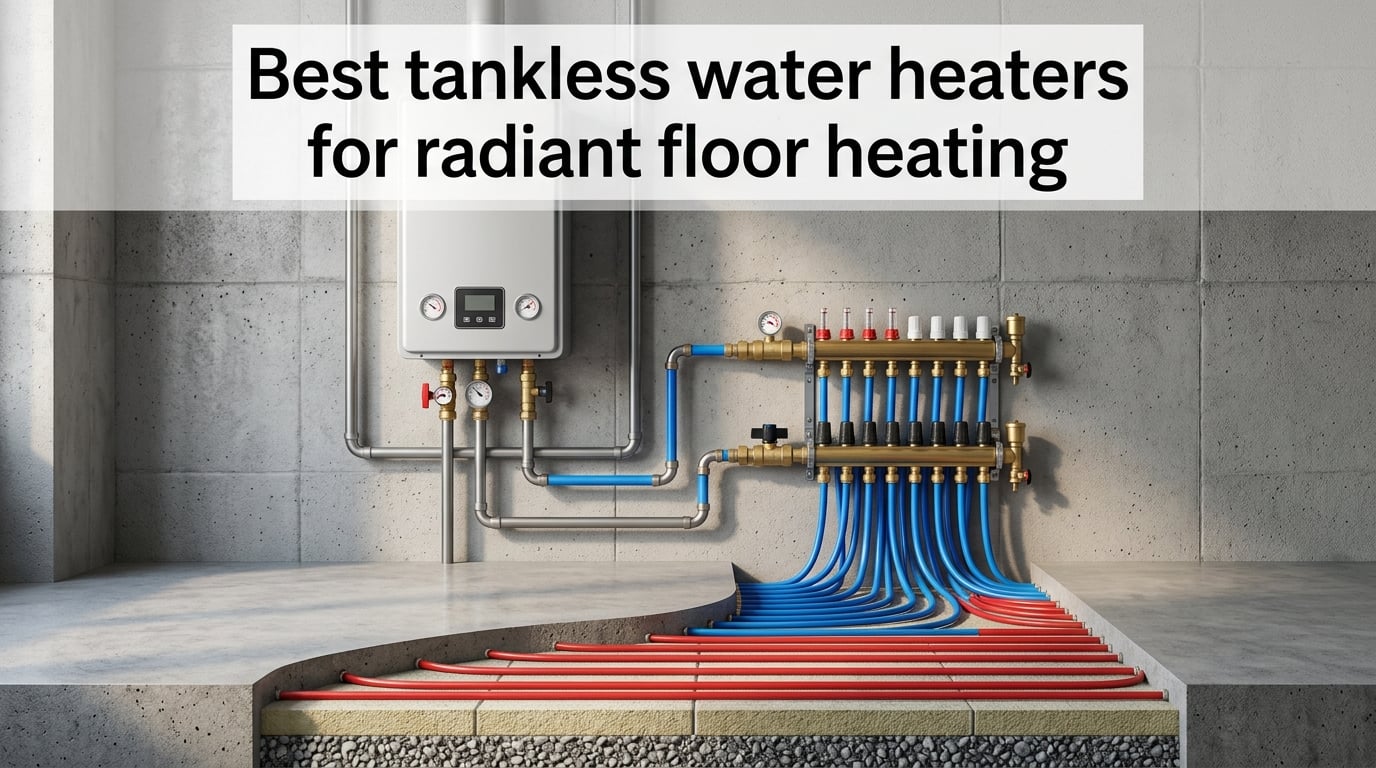
Choosing the best tankless water heaters for radiant floor heating is less about buying the biggest unit and more about matching heat output, minimum flow, and system controls. A radiant loop often needs lower water temperatures than domestic hot water, but its small zones can create a flow rate that is too low to keep an on-demand heater firing.
Yes, a tankless water heater can heat a radiant floor when the unit is sized from an actual heat-loss calculation and the hydronic design maintains the heater’s required flow. Most radiant systems circulate water through PEX at roughly 85–140°F, so a mixing valve, circulator, and frequently a buffer tank matter as much as the heater’s headline BTU number.
I ranked the ten verified models below by their published capacity, temperature limits, fuel and installation fit, control features, warranty details, and review data. Think of this as a selection guide rather than a substitute for a licensed hydronic designer: confirm that the manufacturer permits your intended space-heating application before installation.
The top three picks cover high-output, propane, and compact radiant systems 2026
The Rinnai CX199iN is the strongest match where a high-temperature ceiling, 199,000 BTU input, and integrated recirculation are useful. The Rinnai RX180iN is my balanced choice for homeowners who need fuel flexibility and 0.98 UEF efficiency, while the FOGATTI 170S suits a moderate load where compact size and published low-pressure operation are priorities.
These tankless water heaters for radiant floor heating compare capacity and installation limits
The table is a first-pass screen, not a heat-load calculation. GPM is chiefly a domestic-water measure, while the BTU input, temperature ceiling, heater modulation range, and your loop design determine whether a unit will serve a particular hydronic heating load.
| Product | Specifications | Action |
|---|---|---|
 Rinnai RX180iN Rinnai RX180iN |
|
Check Latest Price |
 Rheem RTG-84XLN-3 Rheem RTG-84XLN-3 |
|
Check Latest Price |
 Rinnai CX199iN Rinnai CX199iN |
|
Check Latest Price |
 Rinnai RE180iP Rinnai RE180iP |
|
Check Latest Price |
 MIZUDO WCIU-HW199A1G MIZUDO WCIU-HW199A1G |
|
Check Latest Price |
 Rheem RTG-95DVLP-3 Rheem RTG-95DVLP-3 |
|
Check Latest Price |
 Westinghouse HW180A0G Westinghouse HW180A0G |
|
Check Latest Price |
 A. O. Smith ATI-540P-N A. O. Smith ATI-540P-N |
|
Check Latest Price |
 FOGATTI Instagas Comfort 170S FOGATTI Instagas Comfort 170S |
|
Check Latest Price |
 CAMPLUX WA686 CAMPLUX WA686 |
|
Check Latest Price |
1. Rinnai RX180iN is the balanced condensing choice for flexible fuel setups
- Natural gas or propane
- 0.98 UEF
- Indoor or outdoor
- Quick Flush feature
- Professional installation needed
- WiFi module not included
The RX180iN brings a published 180,000 BTU input, up to 10 GPM, and 0.98 UEF into a relatively versatile package. I would put it near the top of a short list when the project may use either natural gas or propane and the installer needs an indoor or outdoor location.
Its 140°F maximum temperature is normally within the range a mixed radiant loop needs. That ceiling also signals why the control package matters: a radiant manifold should not receive an uncontrolled high-temperature supply.
Rinnai lists copper and stainless-steel materials, Smart Sense gas control, Versa Vent installation flexibility, and a Quick Flush maintenance feature. The listing also states a five-year labor and parts warranty, while the review data cites a 15-year heat-exchanger warranty; verify the current warranty terms and the application classification in writing.
A mixed-fuel project is where the RX180iN fits best
This model makes sense for a home whose fuel decision is not final or where propane is the available alternative to natural gas. Its 10 GPM rating leaves room if one appliance will also provide domestic hot water, though that combined demand must be calculated rather than assumed.
A 140°F limit is what the system designer must account for
Low-temperature floors rarely need more than this limit, but a design with unusual heat loss or separate higher-temperature loads may need another approach. Check the required loop supply temperature on the coldest design day before choosing it.
2. Rheem RTG-84XLN-3 is the outdoor natural-gas option with hot-start control
- Hot-start programming
- 180000 BTU
- Stainless steel
- 15-year heat exchanger warranty
- Outdoor only
- Non-condensing
- Natural gas only
The Rheem RTG-84XLN-3 supplies 180,000 BTU and is rated for 8.4 GPM, which puts it in the useful middle of this group. Its hot-start programming is notable because recurring calls for heat and domestic-water draws benefit from stable starts rather than cold bursts.
This is an outdoor-only, natural-gas, non-condensing unit. I would only consider it after mapping the insulated supply and return piping from its exterior location to the mechanical side of the radiant system.
Rheem specifies a 140°F maximum temperature, overheat protection, and a 15-year heat-exchanger warranty with one year of labor and five years of parts. The 39.3-pound wall-mounted cabinet is compact, but weather exposure and local freeze protection still belong in the installation plan.
An exterior mechanical location is the right use case for this Rheem
It is a logical candidate where indoor vent routing is difficult and local climate permits outdoor equipment with properly protected piping. An exterior heater is not automatically simpler once isolation valves, service access, and freezing conditions are considered.
A non-condensing vent path is the installation tradeoff
Non-condensing equipment does not require condensate disposal in the same way as condensing equipment, but it has its own venting requirements. Have the installer match vent material and clearances to the product manual and local code.
3. Rinnai CX199iN is the high-capacity pick for demanding multi-zone layouts
Rinnai CX199iN SENSEI CX Commercial Tankless Water Heater 199,000 BTU
- 199000 BTU
- 11.1 GPM
- Internal recirculation pump
- 185°F maximum
- Professional installation needed
- WiFi module not included
- Commercial warranty terms
The CX199iN has the most headroom of the Rinnai choices here: 199,000 BTU, 11.1 GPM, a listed 185°F maximum, and 0.98 UEF. That temperature ceiling does not mean a floor should receive 185°F water; it means the unit offers a broader control range for a properly mixed hydronic design.
Rinnai identifies it as a commercial condensing model with Smart-Circ intelligent recirculation and an internal pump. Those built-in features do not replace the dedicated circulator, hydraulic separation, or buffer volume that a zoned radiant system may need, but they can be helpful in the wider hot-water layout.
I would view this as the strongest candidate when multiple zones, large domestic-water demand, or a high-load building call for extra capacity. The listing identifies natural gas as the power source, so confirm fuel configuration with the seller and manufacturer before purchase.
A larger or more complex load is where the CX199iN stands out
The published 199,000 BTU input and 11.1 GPM rating provide more margin than the smaller units for a system with several calls at once. A heat-loss report still wins over rule-of-thumb sizing, particularly in a well-insulated home with a modest radiant load.
A commercial warranty requires close reading before space-heating use
Review data describes an eight-year or 12,000-hour heat-exchanger warranty for commercial use. Get the applicable warranty category, maintenance requirements, and allowed heating configuration confirmed before the equipment is installed.
4. Rinnai RE180iP is the indoor propane choice for homes without natural gas
- Propane fuel
- Indoor installation
- LED diagnostics
- 15-year heat exchanger warranty
- Non-condensing
- Propane only
- 160°F maximum
The Rinnai RE180iP gives a propane-fed radiant project 180,000 BTU and 8.5 GPM in an indoor package. For a rural home or a site without natural-gas service, that fuel match may be more decisive than a small difference in GPM.
The unit is non-condensing and has a listed 160°F maximum temperature. That leaves ample adjustment range for many radiant floor loops, but condensing alternatives may be preferable where their venting and condensate requirements are practical.
Its LED screen supplies service reminders and error codes, a real convenience when diagnosing a no-heat call. The reported warranty is one year of labor, five years of parts, and 15 years on the heat exchanger.
An indoor propane system is the RE180iP’s clear niche
I would shortlist this Rinnai where an indoor vent route is already part of the project and propane storage is established. The installer should verify regulator capacity, gas line sizing, combustion air, and vent specifications rather than relying on the old appliance’s connections.
A medium-flow radiant system is a better match than a very large one
Its 8.5 GPM specification supports considerable domestic demand, yet GPM does not define a closed-loop heating load. Use the home’s design heat loss and expected water temperature drop to establish the hydronic flow requirement.
5. MIZUDO WCIU-HW199A1G is the smart-control natural-gas option with cold-weather protection
- 199000 BTU
- WiFi app control
- ±1°F modulation
- Freeze protection
- Non-condensing
- 149°F maximum
- Direct vent kit separate
MIZUDO publishes 199,000 BTU, 10.3 GPM, WiFi and app control, plus six-stage gas modulation that targets ±1°F accuracy. Stable output is especially relevant to a radiant floor because small temperature swings can make a slab or finished floor feel less consistent over a long call.
The sealed-combustion design draws combustion air from outside, and the product listing claims freeze protection down to -13°F. Those are useful facts for cold-climate planning, though the indoor installation and required 3 by 5 inch direct-vent kit need to be included in the site design.
This unit is non-condensing and tops out at 149°F. I would regard that as suitable for a conventional low-temperature floor, while treating it as a firm limit for any system that might have a higher-temperature secondary load.
Smart monitoring is the MIZUDO advantage for a hands-on owner
WiFi and app control make it easier to check status and setpoint behavior without standing in the mechanical room. Remote controls are useful for observation, but they do not correct an undersized gas line, low radiant flow, or an incorrect mixing-valve setting.
A low-temperature loop is the proper match for its 149°F ceiling
Radiant floors normally operate well below this ceiling, often around 85–140°F depending on floor construction and heat loss. The system should include a high-limit strategy and correct mixing to protect flooring materials.
6. Rheem RTG-95DVLP-3 is the high-input indoor propane alternative
- 199900 BTU
- 9.5 GPM
- Hot-start programming
- Universal venting compatibility
- Non-condensing
- 140°F maximum
- Limited review sample
The Rheem RTG-95DVLP-3 is the highest-input propane model in this lineup at 199,900 BTU, with a 9.5 GPM listing. It is an indoor, non-condensing unit designed around liquid propane, a practical configuration for large rural homes that already depend on that fuel.
Hot-start programming helps reduce cold-water bursts, while the digital display supports straightforward status checking. The product data also lists universal venting compatibility and compatibility with a half-inch gas line, but a licensed installer must still size the actual line for length, fuel, and load.
The 140°F maximum temperature can work well for floor loops, yet it narrows future options compared with models listed to 160°F or 185°F. Its stated warranty is one year of labor, five years of parts, and 15 years on the heat exchanger.
A high-load propane house is where this Rheem makes sense
It combines near-200,000 BTU input with 9.5 GPM for an application that has both substantial domestic hot-water demand and a calculated heating load. If it will serve both functions, the peak overlap needs to be part of the sizing worksheet.
A 140°F ceiling requires a confirmed design temperature
That number is adequate for many hydronic floors, especially slab and low-temperature staple-up systems. It is not a substitute for checking the required supply-water temperature at the design outdoor condition.
7. Westinghouse HW180A0G is the temperature-stability choice for smaller multi-zone systems
- ±1°F control
- WiFi app control
- 165°F maximum
- Freeze protection
- Non-condensing
- Indoor only
- Limited review sample
The Westinghouse HW180A0G lists 180,000 BTU, 7.9 GPM, WiFi app control, and ±1°F temperature stability. I find the published stability claim more meaningful to a radiant application than an inflated fixture count, because floors respond slowly and benefit from steady water temperature.
It is an indoor natural-gas, non-condensing unit with a listed 165°F maximum temperature. That leaves good headroom for a mixed low-temperature loop and may be more flexible than 140°F models when design conditions call for a warmer supply.
The product data includes freeze protection, overheat protection, a copper heat exchanger, and CSA certification. Its support period is described as two to five years after-sale support, so obtain the full warranty document and terms before making it part of a long-lived heating system.
A controlled moderate-load system is this model’s best application
It is a good paper match for a smaller to medium home with several zones when the system designer adds buffer capacity if needed. The 7.9 GPM headline should not be used as the flow target for the PEX manifold.
A 165°F maximum adds control range without changing floor limits
The radiant side should still operate at its calculated lower temperature through a mixing arrangement. Higher available heater temperature should be treated as flexibility, not a target for floor supply water.
8. A. O. Smith ATI-540P-N is the condensing pick with an integrated recirculation pump
- Condensing design
- Integrated recirculation pump
- 316L stainless steel
- 15-year heat exchanger warranty
- Natural gas only
- Limited review sample
- Professional installation needed
The A. O. Smith ProLine XE ATI-540P-N is a 199,000 BTU indoor natural-gas condensing model with 10 GPM and 0.93 UEF. Its integrated recirculation pump and marine-grade 316L stainless-steel heat exchanger make it one of the more purposefully equipped options in this group.
An internal recirculation pump can improve domestic hot-water delivery, but I would not assume it performs the full job of the radiant circulator. Hydronic loops require their own flow, pressure, zoning, air elimination, and often hydraulic separation strategy.
A. O. Smith lists a 15-year limited heat-exchanger warranty and five years on parts, along with common venting capability for up to eight units. That scalability is useful project information, although one correctly sized unit is simpler than a multi-unit installation.
A condensing indoor system is where the ATI-540P-N has the clearest appeal
Choose it when a condensate drain, appropriate vent route, and natural-gas supply are already workable at the mechanical location. The 0.93 UEF figure gives a concrete efficiency reference that several non-condensing listings do not provide.
A dedicated hydronic layout is still needed despite the internal pump
Radiant zones can have low and changing flow that differs from a domestic recirculation loop. Ask the designer to show how the heater will meet its firing flow while each zone valve opens and closes.
9. FOGATTI Instagas Comfort 170S is the compact choice for moderate heat loads
- Compact design
- ±1°F control
- Low-pressure operation
- CSA certified
- 170000 BTU limit
- Natural gas only
- Not recommended above 2000 feet
The FOGATTI Instagas Comfort 170S is smaller in capacity at 170,000 BTU and 7.5 GPM, but that does not make it a poor radiant heat source by default. A tight, modest-size home may have a far lower design heat loss than a large, older building, making right-sizing more valuable than excess input.
Published features include ±1°F precision temperature control, a four-stage combustion system, a high-efficiency copper heat exchanger, and operation across 15–150 PSI water pressure. Its 158 reviews provide one of the deeper feedback samples in this ten-product set.
Two limits deserve attention: it is natural-gas only, and the listing recommends use below 2,000 feet altitude. High-elevation buyers should not treat that note casually, since altitude can reduce combustion performance and changes equipment selection.
A compact mechanical space and a moderate load suit the FOGATTI
I would consider it when the heat-loss calculation supports 170,000 BTU input and physical space is tight. Its reported one-third traditional-tank footprint is useful where a full-size tank heater would crowd the utility room.
Low-altitude locations are the necessary condition for this listing
The stated below-2,000-foot recommendation is unusually specific and should be followed unless the manufacturer supplies a different approved configuration. Confirm elevation, gas derating, and local code requirements before ordering.
10. CAMPLUX WA686 is the outdoor high-input option for carefully planned piping runs
CAMPLUX 199,000 BTU Tankless Water Heater Natural Gas Outdoor Up to 8.4 GPM
- 199000 BTU
- ±0.5–1°F stability
- CSA certified
- Freeze protection
- Outdoor only
- 6.86 GPM rating
- Separate wire controller
The CAMPLUX WA686 has a listed 199,000 BTU input and outdoor natural-gas installation, paired with 6.86 GPM and a stated maximum of 8.4 GPM at a 65°F inlet temperature. That combination makes the heat input compelling, but its modest published flow deserves a more deliberate hydronic design.
CAMPLUX reports ±0.5–1°F temperature fluctuation, CSA certification, anti-freeze protection, dry-combustion protection, overheat protection, water-pressure protection, and flame-failure protection. Those safety features are welcome, yet outdoor plumbing remains exposed to greater heat loss and freeze risk than a protected indoor installation.
The listing notes a separate wire controller for temperature adjustment and lifetime troubleshooting support. I would choose it only when the exterior location shortens the venting problem without creating an overly long, poorly insulated route to the manifold.
An outdoor location close to the radiant manifold is the best fit
Keeping the supply and return run short reduces distribution loss and simplifies freeze protection. Long exterior pipe runs can erode the practical benefit of an outdoor unit even when the heater itself has a high BTU rating.
A low GPM listing calls for a buffer and flow check
At 6.86 GPM, this is the lowest published base flow rate in the group. The installer should verify the heater’s minimum activation flow and use a buffer tank or hydraulic separator when small zones could make flow unstable.
A heat-loss calculation is the first step in choosing a radiant tankless heater
Do not size a tankless water heater solely by square footage. Insulation, window area, air leakage, local winter design temperature, floor covering, and whether the heater also makes domestic hot water can move the required load dramatically.
Start with a room-by-room heat-loss calculation. Then identify the design supply-water temperature, the expected temperature drop through each loop, and the circulation rate needed to deliver the calculated BTU per hour.
As a rough screening range, many whole-house gas tankless models for this job list 170,000–199,900 BTU of input. That range is not a recommendation to install a 199,000-BTU unit in every home; oversized equipment may cycle poorly if the system cannot maintain its minimum firing flow.
A buffer tank is often the solution to low-flow zoning problems
Forum discussions repeatedly flag a familiar failure mode: one small radiant zone calls, flow through the heater falls below its minimum, and the burner shuts down or cycles. A properly sized buffer tank adds water volume and, when configured correctly, lets the tankless run in longer, steadier cycles while the distribution side follows zone demand.
It also separates the heater’s flow requirement from the variable flow of manifold circulators. This is a design decision for a hydronic professional, not simply a tank added after the fact.
A closed loop is usually the cleaner way to protect the heater
Many radiant systems use a closed heating loop, sometimes separated from domestic water through an approved heat exchanger arrangement. Local code, water quality, cross-connection rules, and the heater manufacturer’s approved piping diagrams control what is permitted.
Do not assume an open direct system is accepted everywhere or covered under every warranty. Confirm whether glycol is allowed too, because freeze protection chemistry and heat exchanger compatibility are product-specific.
Condensing units are generally the efficient choice when drainage and venting are practical
Condensing tankless heaters reclaim heat from exhaust and typically publish higher efficiency figures, such as 0.98 UEF for the Rinnai RX180iN and CX199iN or 0.93 UEF for the A. O. Smith. Their lower exhaust temperatures can broaden venting options, but they produce condensate that needs code-compliant draining and protection from freezing.
Non-condensing units avoid that condensate-management step, but may have lower efficiency and different venting needs. For a long heating season, compare the full installed system: vent route, drain location, gas supply, maintenance access, and projected runtime all matter.
Natural gas is usually the straightforward fuel where service is available
Natural gas models dominate the verified list and work well when the meter and pipe sizing support the heater’s full input. The FOGATTI, MIZUDO, Westinghouse, CAMPLUX, A. O. Smith, and several Rinnai and Rheem listings are natural-gas options.
Propane is a sound choice for locations without gas mains, as shown by the Rinnai RE180iP and Rheem RTG-95DVLP-3. It requires equipment configured for propane, correctly sized storage and regulators, and installation by a qualified professional.
Electric tankless units are usually a different sizing conversation
None of the ten products analyzed here is an electric tankless unit. Electric resistance tankless equipment can be practical for small loads where electrical service is ample, but whole-home radiant loads may require substantial electrical capacity; compare that requirement with a gas tankless, heat pump, or boiler before committing.
A tankless boiler alternative may also be more appropriate where the project is dedicated space heating, has many small zones, or requires manufacturer-supported hydronic controls. The best heat source is the one that matches the load and approved piping method, not the product with the largest marketing number.
Minimum flow, venting, water quality, and warranty terms decide long-term reliability
Minimum flow is the specification most often missed in tankless water heater radiant floor heating projects. Ask for the ignition or activation-flow requirement, then compare it with the flow available when the smallest zone is operating by itself.
Hard water is another recurring concern in homeowner and heating forums because scale can impair heat exchange. Use isolation valves, follow the maker’s flushing procedure, and assess whether water treatment is appropriate for the local water chemistry.
Plan venting from the manual, not from a generic installer shortcut. Indoor direct-vent systems need the correct termination clearances and combustion-air path, while outdoor units need protected, insulated hydronic piping and a cold-weather plan.
Finally, read the warranty as carefully as the BTU label. Some warranties distinguish domestic water, combined domestic and heating use, and heating-only service; retain the approved installation diagram and maintenance records.
FAQs answer the key radiant tankless questions directly
Can I use a tankless water heater for radiant floor heating?
Yes. A tankless heater can supply radiant floor heating when a heat-loss calculation, approved hydronic piping design, and adequate flow keep the unit operating correctly. Small zones often need a buffer tank or hydraulic separation so flow does not fall below the heater’s activation requirement.
What is the best water heater for radiant floor heat?
The best choice matches the home’s calculated heat loss, available fuel, installation location, required supply temperature, and minimum flow behavior. In this comparison, the Rinnai CX199iN is the high-capacity pick, while the Rinnai RX180iN offers condensing efficiency and natural-gas or propane flexibility.
What is the most efficient way to heat water for radiant floor heating?
A correctly sized condensing heater running a low-temperature radiant loop can be efficient because radiant floors commonly use 85–140°F water and avoid tank standby loss. Efficiency also depends on proper mixing, stable flow, insulated piping, scale control, and a condensate plan where required.
What brand of tankless water heater is the most reliable?
Reliability depends on approved installation, water quality, service access, and warranty coverage as much as the badge on the cabinet. Rinnai and Rheem have multiple high-output choices in this set, while A. O. Smith offers a condensing model with a 316L stainless-steel heat exchanger and integrated recirculation pump.
The right tankless choice is the one matched to your radiant design
For the best tankless water heaters for radiant floor heating in 2026, start with the Rinnai CX199iN when capacity and temperature range lead the brief, the Rinnai RX180iN when fuel flexibility and 0.98 UEF matter, and the A. O. Smith ATI-540P-N when a condensing unit with integrated recirculation fits the design.
Before you buy, have a qualified installer confirm heat loss, minimum firing flow, fuel supply, venting, buffer-tank need, water treatment, and warranty eligibility. That short design review is what turns a capable tankless heater into dependable floor heat.