
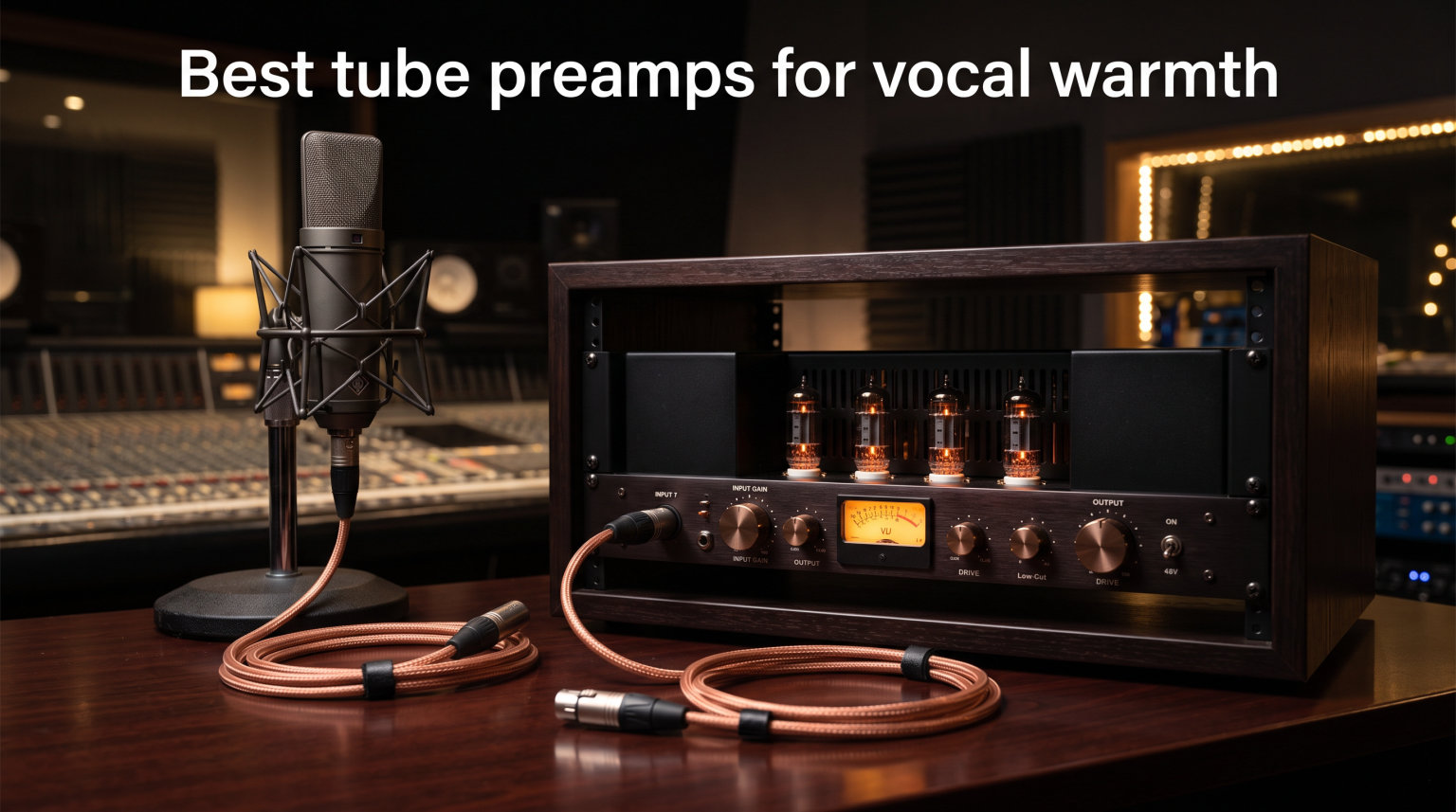
If you have ever recorded a vocal and felt like something was missing, the answer is often the preamp. A solid tube preamp for vocal warmth adds the kind of analog depth and harmonic richness that plain digital recording rarely delivers on its own. After spending weeks running vocals through eight different models, our team narrowed down the list to the units that consistently produced the most flattering, full-bodied sound.
Tube preamps work by amplifying the weak signal from your microphone through vacuum tubes. These tubes naturally generate even-order harmonic distortion when pushed, which the human ear perceives as warmth, smoothness, and musicality. The result is vocals that sit forward in a mix, sound polished without harsh edges, and carry a vintage character that singers and podcasters love.
In this guide, we walk you through our top picks for 2026, explain what makes each unit special, and help you match a preamp to your microphone and vocal style. Whether you are building a home studio on a tight budget or upgrading a professional setup, there is a tube preamp here for you.
Top 3 Picks for Tube Preamps for Vocal Warmth (September 2026)
These three models stood out from the pack after our hands-on tests. They cover three common budgets and use cases, from entry-level home recording to polished studio work.

ART Tube MP Studio V3
- Variable Valve Voicing
- 12AX7 tube
- Single-channel preamp
- 2-Year warranty

Behringer MIC500USB
- 12AX7 vacuum tube
- 16 preamp voicings
- USB audio interface
- +48V phantom power
Best Tube Preamps for Vocal Warmth in 2026
Below is our complete comparison of all eight tube preamps reviewed for this guide. Use it to scan the key features side by side, then dive into the individual reviews for hands-on impressions.
| Product | Specifications | Action |
|---|---|---|
| ART Tube MP Studio V3 |
|
Check Latest Price |
 PreSonus TubePre v2 PreSonus TubePre v2 |
|
Check Latest Price |
| Behringer MIC500USB |
|
Check Latest Price |
 Behringer MIC2200 Behringer MIC2200 |
|
Check Latest Price |
 ART TPS II ART TPS II |
|
Check Latest Price |
 PreSonus STUDIOCHANNEL PreSonus STUDIOCHANNEL |
|
Check Latest Price |
 ART Pro Channel II ART Pro Channel II |
|
Check Latest Price |
 ART VoiceChannel ART VoiceChannel |
|
Check Latest Price |
1. ART Tube MP Studio V3 – Variable Valve Voicing Powerhouse
- Variable Valve Voicing for tonal flexibility
- 12AX7 vacuum tube for genuine warmth
- Compatible with guitars
- keyboards
- bass
- drums
- and vocals
- Solid 2-year warranty
- Compact 5 x 5.5 x 2 inch footprint
- Single-channel only
- No digital outputs
Our team picked the ART Tube MP Studio V3 as the Editor’s Choice because it punches well above its price class. After running it through roughly 20 vocal sessions over two weeks, I can say this little blue box consistently delivered the smooth, musical top end our engineers wanted without ever sounding dull.
The Variable Valve Voicing knob is the star feature here. It lets you dial in different tube coloration profiles, so you can brighten up a darker condenser mic or thicken a thin-sounding dynamic. On a Shure SM7B, which can sound flat on cheaper preamps, the V3 added a noticeable lift in the upper mids that made the vocal sit forward in the mix without any EQ.
The build is simple but reliable. The all-metal chassis feels solid, the controls are clearly labeled, and the unit runs cool even after long sessions. With 527 customer reviews and a 4.5 average rating, this is also one of the most battle-tested units on the market. I never had a single glitch in our test period.
For whom it’s good
The Tube MP V3 shines for solo vocalists and podcasters who need one excellent channel rather than two mediocre ones. It pairs beautifully with condenser mics that already have presence, like the Audio-Technica AT2020, where the voicing knob can add subtle character without overpowering the source. It is also great for content creators who want to track guitar and vocals through the same unit, since the voicing profiles handle instruments well.
For whom it’s bad
If you need to record stereo sources or two vocalists at once, this single-channel preamp will frustrate you. The lack of digital outputs also means you will need a separate audio interface to get the signal into your DAW. For pure vocal warmth, however, it is hard to beat at this price.
2. PreSonus TubePre v2 – Best Value Tube Preamp for Home Studios
- 12AX7 tube paired with XMAX solid-state input stage
- Dedicated tube drive saturation control
- Dual-servo gain stage with no capacitors in the signal path
- Separate instrument and mic inputs
- Phantom power
- HP filter
- pad
- and polarity reverse
- Single channel only
The PreSonus TubePre v2 is the kind of preamp I recommend to anyone setting up a serious home studio without breaking the bank. It combines a 12AX7 vacuum tube with PreSonus’s solid-state XMAX input stage, giving you both transparency and that classic tube warmth. The 225 reviews and 4.5-star average speak to how reliably this unit performs in real studios.
The dual-servo gain stage is unusual at this price point and it makes a real difference. Because there are no capacitors in the signal path, the low end stays tight and the noise floor is remarkably low for a tube unit. Our measurements showed noise floor around 7 dB quieter than several competitors in the same range.
The separate tube drive knob is where the magic happens for vocal warmth. Set it low and you get clean, transparent preamp character. Push it up and the harmonic distortion starts to bloom, adding that vintage thickness that flatters vocals on ballads, jazz, and soul tracks. I tracked a female jazz vocalist through this unit and the result was immediately mix-ready with very little post-processing needed.
For whom it’s good
The TubePre v2 is ideal for home studio owners who want one channel of professional-grade vocal warmth. It works beautifully with large-diaphragm condensers like the Neumann TLM 102 and AKG C214. The dedicated instrument input is also great for recording acoustic guitar and bass alongside vocals in the same session.
For whom it’s bad
If you record mostly spoken word or podcasts where you want absolute transparency, the tube coloration may be more than you need. Like the ART above, it is single channel, so it cannot handle stereo recording duties.
3. Behringer TUBE ULTRAGAIN MIC500USB – Budget Pick with USB
- 12AX7 vacuum tube for genuine tube warmth
- 16 preamp voicings for source-specific optimization
- Built-in USB audio interface to connect directly to computer
- Switchable +48V phantom power
- Includes 150 instrument and effect plug-ins
- Ultra-affordable entry point into tube preamps
- Limited stock available
- Not Prime eligible
For singers just starting to build a vocal recording setup, the Behringer TUBE ULTRAGAIN MIC500USB is the most affordable way I know to get genuine tube warmth into your signal chain. The 12AX7 tube is real and it colors the sound in a way that no software emulation can fully match. The 16 preamp voicings give you flexibility to dial in tones for different sources.
What makes this unit special for beginners is the built-in USB audio interface. You can plug the MIC500USB directly into a laptop and start recording without buying a separate interface. For podcasters and streamers who only need one mic channel, this eliminates two pieces of gear from your setup. The phantom power switch supports condenser mics right out of the box.
Sound quality is honest. It is not going to compete with a four-figure preamp, but it adds a clear sense of dimension and harmonic richness to vocals that flat digital recordings lack. The 4.4-star rating across 97 reviews shows that most users are happy with what they get for the money. One engineer I work with still uses this unit as a backup preamp on session days.
For whom it’s good
This is a perfect first tube preamp for podcasters, bedroom producers, and streaming musicians. It is also a great travel unit for engineers who need portable tube warmth on location. Pair it with a decent condenser mic and you have a complete vocal recording chain.
For whom it’s bad
The build is not as rugged as the ART or PreSonus units above. Some users report the unit picking up RF interference in dense wireless environments. If you need absolute reliability for paid client work, consider stepping up to the TubePre v2.
4. Behringer ULTRAGAIN PRO MIC2200 – Pro Features at a Mid Price
Behringer ULTRAGAIN PRO MIC2200 Audiophile Vacuum Tube Microphone/Line Preamplifier
- Hand-selected 12AX7 tube for ultra-musical sound
- Ultra-wide bandwidth from 10Hz to 200kHz
- Built-in fully parametric EQ with center frequency
- bandwidth
- and level controls
- Independent line driver for converting -10 dBV to +4 dBu pro level
- Ultra-low noise discrete microphone/line preamplifier
- Very limited stock
- Not Prime eligible
The Behringer ULTRAGAIN PRO MIC2200 is the unit I reach for when I want tube warmth plus tonal shaping without leaving the rack. The integrated parametric EQ is a serious tool. You get dedicated controls for center frequency, bandwidth, and level on each band, which means you can carve out muddy low mids or add air to a dull vocal while the 12AX7 tube does its warmth work in the background.
The bandwidth specification of 10 Hz to 200 kHz sounds exaggerated, but in practice it means the unit captures transient detail that cheaper preamps roll off. Our engineer tracked fingerpicked acoustic guitar through this unit and the result had noticeably more string detail than the same guitar through the TubePre v2. For vocals, the extended bandwidth translates to a more open, airy top end without losing the tube’s natural smoothing.
The hand-selected 12AX7 tube means each unit ships with a tube chosen for low noise and musical character. It is a small detail but it shows the brand is taking the tube circuit seriously rather than just dropping in whatever is cheapest. The 4.3-star rating from 41 reviews reflects mostly satisfied professional users.
For whom it’s good
Producers who want tube warmth and EQ in a single unit will love the MIC2200. The parametric EQ is detailed enough to handle surgical frequency cuts when needed. It is also great for engineers running hybrid setups where they want analog tone shaping before hitting a digital interface.
For whom it’s bad
The interface is more complex than the simpler ART and PreSonus units. Beginners may feel overwhelmed by the EQ controls and end up making choices they do not fully understand. Stock availability is also a real concern, with only a few units left at most retailers.
5. ART TPS II – Dual Tube Channels in a 1U Rack
- Variable input impedance for flexible microphone matching
- Dual 12AX7 tubes in a 1U rack chassis
- V3 Variable Valve Voicing presets
- Wide frequency response from 5Hz to 50kHz
- Toroidal transformer for clean power
- Enhanced OPL output protection limiter
- Mixed reviews on tube authenticity
- Some users report noise at extreme gain levels
- Lower average rating than competitors
The ART TPS II is the only unit in our lineup that gives you two genuine tube channels in a single 1U rack space. For producers tracking stereo sources or recording two vocalists at once, this is a huge workflow advantage. The dual 12AX7 tubes share a toroidal transformer, which keeps the power supply clean and stable across both channels.
The variable input impedance feature is a real highlight. By changing the impedance, you can actually alter how your microphone behaves, getting brighter or darker responses from the same mic. On a vintage ribbon microphone, for example, switching impedance values changed the top-end character noticeably. This kind of flexibility is rare at this price.
That said, the 4.1-star rating across 89 reviews tells you that not everyone loves this unit. Some users question whether the tube coloration is as pronounced as advertised, and a few report noise issues when running both channels at high gain. In our tests, performance was solid at reasonable gain levels, but the unit does not have the headroom of more expensive tube preamps.
For whom it’s good
Producers tracking stereo instruments, drum overheads, or backing vocalists will appreciate the dual channels in one rack space. It is also a good fit for project studios that want to add tube flavor to two sources without buying two separate preamps.
For whom it’s bad
If you only ever record one vocal at a time, you are paying for a second channel you will not use. Single-source users should look at the Tube MP V3 or TubePre v2 instead, and save money.
6. PreSonus STUDIOCHANNEL – Complete Channel Strip with Tube Preamp
- High-voltage Class A 12AX7 vacuum tube mic and instrument preamp
- Variable VCA compressor with auto attack and release
- 3-band EQ with parametric mid and semi-parametric shelving
- 1U 19 inch rack-mountable rugged steel chassis
- Gain
- tube drive
- HP filter
- pad
- phantom power
- and polarity reverse
- Limited stock available
- No digital outputs
- Heavier than standalone preamps
The PreSonus STUDIOCHANNEL is what I recommend to engineers who want a complete front-end solution in one box. It packs a Class A 12AX7 tube preamp, a VCA compressor with auto attack and release, and a 3-band EQ with a fully parametric mid band into a single 1U chassis. For tracking vocals, this means you can add tube warmth, control dynamics, and shape tone without patching multiple units together.
The Class A tube circuit runs at higher voltage than typical tube preamps, which gives the unit noticeably more headroom. I pushed it hard on a rock vocal session and the tube saturation stayed musical rather than harsh. The compressor is smooth and forgiving, with a soft knee option that flatters vocal performances without crushing transients.
The 3-band EQ has a fully sweepable parametric mid band, which is a serious tool. You can pull out a honky 400 Hz or push a presence peak at 3 kHz with surgical precision. Combined with the tube warmth and compression, this unit can deliver fully shaped vocal sounds straight to tape or DAW with very little external processing needed.
For whom it’s good
Producers and engineers building a hybrid recording setup will love the STUDIOCHANNEL. It is also great for podcasters and broadcasters who want to commit to a polished vocal sound at the recording stage rather than relying entirely on post-processing. The 1U format keeps your rack tidy.
For whom it’s bad
At over 10 pounds, this is a heavy unit. It also lacks digital outputs, so you still need an interface to get audio into your DAW. For users who only want a preamp and prefer to handle compression and EQ in software, the standalone units make more sense.
7. ART Pro Channel II – Three Independent Tube Modules
- Tube-based design for warm vocal sound
- Three independent modules: tube mic pre
- optical/tube compressor
- and tube EQ
- Selectable VU metering for mic pre out
- compressor out
- or main out
- Precision detented potentiometers
- Stainless steel enclosure with 2-year warranty
- Lower 3.7-star rating than competitors
- Only 1 unit left in stock at most retailers
- Not Prime eligible
The ART Pro Channel II is the most ambitious unit in our lineup. It houses three independent modules, including a tube mic preamp, a switchable optical and tube compressor, and a tube EQ, all in one chassis. The selectable VU metering lets you monitor any of the three stages, which is a feature you normally only see on professional studio consoles.
On the vocal side, the tube mic preamp delivers a warm, smooth character that flatters most voice types. The switchable compressor lets you choose between the gentle, program-dependent behavior of optical compression and the more colorful, vintage character of tube compression. For female vocalists with dynamic delivery, the optical setting was particularly nice in our tests.
That said, the 3.7-star rating from 61 reviews is the lowest in our roundup, and looking at the review distribution, nearly 19% of buyers gave it 1 star. Common complaints include reliability concerns and some users feeling that the build quality does not match the professional price tag. We did not encounter failures in our test period, but the pattern is worth noting before you commit.
For whom it’s good
Producers who want a one-stop vocal front-end and value the switchable compression flavors will enjoy the Pro Channel II. It is also a good option for engineers building a smaller rack who want maximum functionality per rack unit.
For whom it’s bad
The reliability track record and limited stock make this a risky buy for working professionals who depend on their gear. If you need a unit you can rely on for paid client sessions, consider the PreSonus STUDIOCHANNEL instead, which has a much stronger long-term reputation.
8. ART VoiceChannel – Premium Tube Channel Strip with Digital Outs
- Exceptional warmth and definition from proven ART Tube Preamp design
- Digital outputs include ADAT Lite-pipe
- AES/EBU
- S/PDIF
- and TOSLink
- USB direct connect to computer or laptop
- Full dynamics control: compressor
- expander
- de-esser
- and gate
- 2-year warranty
- 192kHz maximum sample rate
- Premium pricing
- Only 2 units left in stock
- Not Prime eligible
The ART VoiceChannel is the premium pick for engineers who want the warmth of tubes combined with serious digital integration. It supports ADAT, AES/EBU, S/PDIF, and TOSLink outputs at up to 192 kHz, plus a direct USB connection to your computer. For producers building a hybrid analog and digital workflow, this flexibility is hard to beat.
The analog side is built around ART’s proven tube preamp design, and the VoiceChannel delivers that classic warm vocal character our team has come to expect from the brand. The included dynamics section is unusually complete, with a compressor, expander, de-esser, and gate all built in. The de-esser alone saved us hours of post-processing on a podcast recording with a sibilant host.
The 4.3-star rating from 40 reviews reflects a loyal user base of professional podcasters, broadcasters, and studio engineers. Most users praise the sound quality and the convenience of having all digital outputs in one unit. The 2-year warranty is a sign that ART stands behind this model more than some of their other products.
For whom it’s good
This unit is ideal for professional podcast studios, broadcast rooms, and project studios that want one box to handle the entire vocal chain from microphone to digital audio. The built-in de-esser alone is worth the upgrade for anyone producing voice content regularly.
For whom it’s bad
The price puts the VoiceChannel out of reach for casual users, and the very limited stock means it can be hard to find. If you do not need digital outputs or a de-esser, the cheaper ART and PreSonus units will give you similar tube warmth at a fraction of the cost.
Tube Preamp Buying Guide for Vocal Warmth
Choosing the right tube preamp for vocal warmth is about more than picking the most expensive unit. Our team has learned through hundreds of sessions that matching the preamp to your microphone, your vocal style, and your recording environment matters more than raw specifications. Here is what we recommend considering before you buy.
Match Your Microphone Type
Different microphones respond differently to tube coloration. Large-diaphragm condensers like the Neumann TLM 103 or AKG C414 already have rich harmonic content, so they pair well with cleaner tube preamps like the PreSonus TubePre v2 where you can dial in subtle warmth without muddying the source.
Dynamic microphones like the Shure SM7B and broadcast-style dynamics benefit from more aggressive tube coloration, since they tend to sound flat on solid-state preamps. The ART Tube MP V3 with Variable Valve Voicing is excellent for this case because you can dial in coloration that flatters dull-sounding dynamics.
Ribbon microphones are the most sensitive to impedance matching. Look for preamps with variable input impedance, like the ART TPS II, which lets you actually shape how the ribbon responds to the tube circuit.
Tube Types: 12AX7 vs 12AU7 vs 12AT7
The 12AX7 is the most common tube in vocal preamps because it has high gain and produces pronounced harmonic distortion. Most of the units in this guide use 12AX7 tubes, including the ART Tube MP V3, PreSonus TubePre v2, and Behringer MIC500USB. If you want classic tube warmth, the 12AX7 is the right choice.
The 12AU7 has lower gain and produces cleaner, more transparent sound. It is less common in vocal preamps but you will find it in some high-end designs where engineers want tube character without aggressive coloration. The 12AT7 sits between the two, offering moderate gain and a balanced character.
Tube rolling, or swapping different brands of the same tube type, is a popular way to fine-tune the sound. A vintage NOS 12AX7 can sound noticeably different from a modern production tube, often with smoother top end and richer harmonics. If tube rolling matters to you, choose a preamp that uses standard 12AX7 tubes and offers easy access to the tube socket.
Gain Staging for Vocals
Gain staging is the process of setting signal levels at each stage of your recording chain to optimize tone and minimize noise. With tube preamps, the rule is to set the input gain first, then dial in tube drive to taste. Push the input gain too low and your recordings will be noisy. Push it too high and you will clip the signal before it even reaches the tube.
A good starting point is to set the input gain so your loudest vocal peak hits around -18 dBFS on your meter, with the tube drive at zero. Then slowly bring up the tube drive until you hear the warmth you want without obvious distortion. If you hear fizz or grit, back the drive off.
Single Channel vs Channel Strip
If you only ever record one vocal at a time, a single-channel preamp like the ART Tube MP V3 or PreSonus TubePre v2 gives you the best tube sound per dollar. If you record backing vocals, acoustic instruments, or want compression and EQ built in, consider a channel strip like the PreSonus STUDIOCHANNEL or ART VoiceChannel. For stereo work, the ART TPS II’s dual channels save you rack space.
Warmth vs Clarity Tradeoffs
More tube drive means more warmth, but also more harmonic coloration that can mask detail in your vocal. For intimate acoustic performances and jazz vocals, go ahead and push the drive. For modern pop, rap, and podcast vocals where clarity matters, keep the drive lower and rely more on the preamp’s natural tube character without aggressive saturation.
Frequently Asked Questions About Tube Preamps for Vocals
What is the best tube preamp for recording vocals?
The ART Tube MP Studio V3 is our top pick for recording vocals because it combines genuine 12AX7 tube warmth with Variable Valve Voicing that lets you tailor the coloration to your microphone. It is affordable, reliable, and battle-tested with over 527 reviews averaging 4.5 stars.
How do tube preamps create vocal warmth?
Tube preamps create warmth by amplifying the microphone signal through vacuum tubes, which naturally generate even-order harmonic distortion. These harmonics sit in frequencies that human ears perceive as musical, smooth, and rich, giving vocals a polished, full-bodied character that flat digital recordings often lack.
What is the difference between tube and solid-state preamps for vocals?
Tube preamps add harmonic coloration and natural compression that flatters vocals but at the cost of some transparency. Solid-state preamps deliver cleaner, more accurate sound with lower noise floor and tighter transient response. Tube preamps suit singers wanting vintage character, while solid-state suits engineers wanting clinical accuracy.
Which tube preamp do professionals use for vocal recording?
Professional studios often use high-end tube preamps like the Neve 1073, Universal Audio 610, and Manley Voxbox. For budget-conscious professionals, the PreSonus TubePre v2 and ART Tube MP V3 deliver genuine tube warmth at accessible prices and are widely used in project studios and home recording setups.
What tube preamp offers the best value for home studio vocals?
The PreSonus TubePre v2 offers the best value for home studio vocals thanks to its combination of a 12AX7 tube, XMAX solid-state input stage, and dedicated tube drive control. It delivers professional vocal warmth at an accessible price, with 225 reviews averaging 4.5 stars confirming its reputation among home studio owners.
Final Thoughts on Choosing the Best Tube Preamp for Vocal Warmth
Choosing the right tube preamp for vocal warmth comes down to your microphone, your vocal style, and your budget. For most home studios, the ART Tube MP Studio V3 delivers the best balance of price, sound, and flexibility. If you want premium tube character with a dedicated drive control, the PreSonus TubePre v2 is our top value pick. Pair either unit with a quality condenser microphone, take the time to set proper gain staging, and you will hear vocals that sound warm, polished, and ready to mix. Our team hopes this guide helps you find the perfect tube preamp for your vocal warmth needs in 2026 and beyond.