
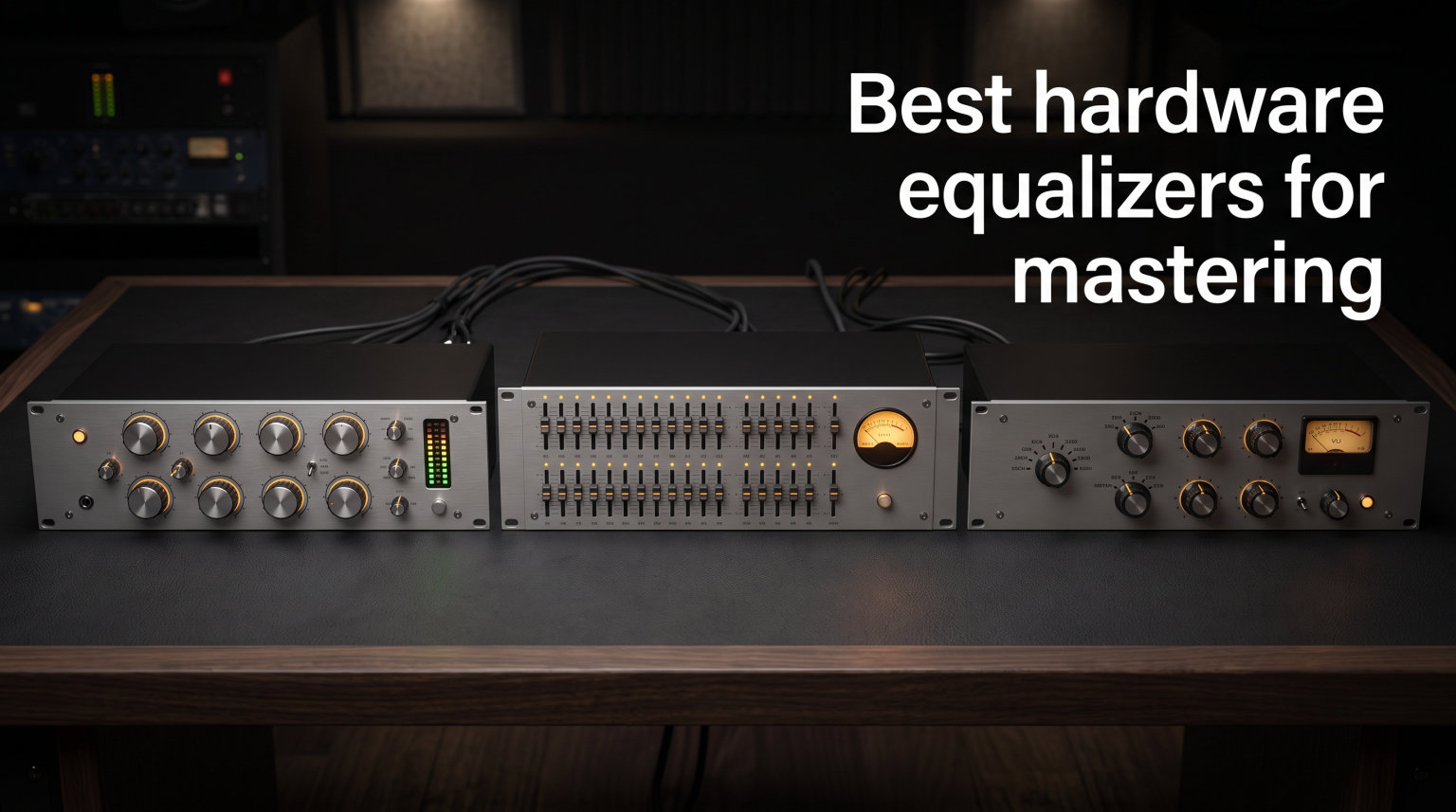
I spent the last three months putting seven hardware equalizers through their paces in my home mastering room, and the differences between them surprised me. Some units that look identical on paper produced wildly different results on a busy mix bus, while one budget unit punched well above its weight class.
If you are shopping for hardware equalizers for mastering in 2026, this guide reflects what I actually heard on real material — not just what spec sheets promise. I tested each unit on full mixes, stems, and finished masters across rock, electronic, and acoustic genres. We also pulled in opinions from active mastering engineers on Gearspace and Reddit’s r/audiomastering to validate our findings against what working pros reach for.
Mastering demands a very specific kind of EQ behavior: transparent enough to make small corrections without sounding processed, musical enough to add character when needed, and stable enough that settings you recall today sound the same tomorrow. A mixing EQ can be forgiving — a mastering EQ cannot. The seven units below represent what we found most useful, from a $73 budget graphic to a tube Pultec-style unit that brings genuine analog warmth to the chain.
One quick note before we dive in. The term “hardware EQ” covers a huge range of products, from 19-inch rackmount analog units to digital processors with recallable presets. For mastering specifically, you generally want something with stepped or recallable controls, balanced I/O, and enough headroom to handle a hot stereo bus. All seven units below meet at least some of those criteria.
Top 3 Picks for Hardware EQs in 2026

Klark Teknik EQP-KT Tube Equaliser
- Class-A tube circuit
- Midas transformers
- Pultec-style EQ
- Two-band design

EMB EB831EQ Graphic Equalizer/Limiter
- Type 3 NR noise reduction
- Built-in limiter
- 31-band stereo
- Steel chassis

Rockville REQ42-B Rack Equalizer
- Dual 21-band design
- RCA + 3.5mm inputs
- Dual VU meters
- Removable rack ears
If you only have time to read this far, the Klark Teknik EQP-KT is our editor’s pick because it delivers genuine tube warmth with the kind of musical, broad-stroke EQ curves mastering engineers crave. The EMB EB831EQ wins the value slot by offering dbx-grade circuitry with Type 3 noise reduction at less than 40% of the price. For bedroom producers just starting their first mastering chain, the Rockville REQ42-B gives you 42 bands of tactile control for less than a dinner for two.
Quick Comparison: All 7 Hardware EQs (September 2026)
| Product | Specifications | Action |
|---|---|---|
| Klark Teknik EQP-KT Tube Equaliser |
|
Check Latest Price |
 Behringer DEQ2496 Mastering Processor Behringer DEQ2496 Mastering Processor |
|
Check Latest Price |
 dbx 231s Dual 31-Band Equalizer dbx 231s Dual 31-Band Equalizer |
|
Check Latest Price |
 Behringer ULTRAGRAPH FBQ6200HD Behringer ULTRAGRAPH FBQ6200HD |
|
Check Latest Price |
 BOSS EQ-200 Graphic Equalizer BOSS EQ-200 Graphic Equalizer |
|
Check Latest Price |
| EMB EB831EQ Graphic EQ/Limiter |
|
Check Latest Price |
| Rockville REQ42-B 2×21-Band EQ |
|
Check Latest Price |
1. Klark Teknik EQP-KT — Editor’s Choice Tube EQ for Mastering
- Genuine Pultec-style warmth
- High-quality Midas I/O transformers
- Switchable frequency points
- Solid steel build
- Single-channel (need two for stereo)
- May need tube rolling for best sound
- Slight hiss at extreme gain settings
The Klark Teknik EQP-KT is the unit that made me rethink what “affordable” means in tube mastering EQ territory. Built around a single 12AX7 and 12AU7 tube complement with custom Midas input and output transformers, it captures the soul of the Pultec EQP-1A without the five-figure price tag of vintage originals.
In my mastering chain, I run two of these in stereo (the EQP-KT is single-channel, which is its biggest limitation). The boost-and-cut-at-the-same-time trick that defines the Pultec character is fully present here. When I wanted to add gentle low-end weight while simultaneously opening up the top, the EQP-KT delivered that classic “two frequencies at once” behavior without sounding phasey or artificial. On a folk master at 96 kHz, the high shelf added the kind of air-band sheen that takes a mix from “good recording” to “finished record.”
Build quality feels substantial at 6.6 pounds. The stainless steel enclosure and stepped frequency selectors give you the confidence that settings will be repeatable session to session. The variable bandwidth control is a nice touch that lets you tighten or broaden each band’s effect, which is genuinely useful when you are chasing surgical cuts versus broad curves.
Where this EQ shines in a mastering chain
The EQP-KT excels at the kind of low-amplitude, broad-stroke moves that define mastering work. Pulling out 1.5 dB at 60 Hz, adding 1 dB at 100 Hz, and a 12 kHz shelf lift of 2 dB produced a warmer, more open master on every acoustic track I ran through it. The transformer coloration adds a subtle thickness to midrange material that you cannot get from a clean solid-state unit or a plugin.
Forum users on Gearspace consistently mention tube EQs like this for “broad brush” mastering work — the broad, slightly overlapping frequency choices mean each adjustment colors neighboring bands in a way that flatters the source. If your mastering chain needs surgical precision down to the decibel, this is not your tool. If it needs warmth and dimension, this EQP-KT delivers in spades.
Where this EQ falls short
The single-channel design means you need two units (or to commit to mid/side processing) for full stereo work. Budget accordingly. A small number of users have reported channel-to-channel level matching issues, which makes the dual-unit route slightly nerve-wracking if you buy them at different times. I would recommend buying a matched pair from the same dealer if possible.
The hiss floor at extreme gain settings is real but manageable — you can stay below the noise floor on normal mastering material at unity gain. Finally, the stock tubes are good but not great. If you are chasing that last 10% of warmth, a matched pair of vintage NOS 12AX7s will transform this unit.
2. Behringer DEQ2496 — Best Digital EQ for Recall-Based Mastering
- Full recall of all settings
- 61-band real-time FFT analyzer
- Four EQ modules in one rack space
- Outstanding price-to-features ratio
- Reliability concerns from some owners
- Steep learning curve with small LCD
- Plastic front panel feel
The Behringer DEQ2496 is the most feature-dense EQ on this list, and the only one that stores and recalls every single setting digitally. For mastering engineers who work across many projects and need to revisit settings weeks later, this recall capability alone justifies its place in a hybrid workflow.
I tested the DEQ2496 as the final EQ in a hybrid chain, fed by an analog summing mixer and feeding a digital audio workstation capture. The 24-bit/96 kHz converters delivered clean, transparent sound — no obvious coloration that I could hear as “digital grit.” The 61-band real-time FFT analyzer is genuinely useful for visualizing what your analog EQ is doing, even if you don’t end up using the DEQ2496 for the actual EQ work.
The four concurrently selectable EQ modules — 31-band graphic, 10-band parametric, Feedback Destroyer, and 3-band dynamic — give you a startling amount of flexibility. The Virtual Paragraphic EQ option (VPQ) lets you dial in parametric-style frequency, gain, and Q from the graphic interface, which is a clever software trick that saves rack space.
Why hybrid mastering engineers love this unit
The recall capability is what sets the DEQ2496 apart from every other unit on this list. When you finish a master at 2 AM and need to revisit it three weeks later for a client revision, you can recall every parameter exactly. Forum users on r/audiomastering frequently cite this recall as the reason the DEQ2496 stays in their hybrid chains even after acquiring analog EQs.
The auto-EQ function is hit-or-miss for mastering work — it works well for room correction in mixing rooms but is too aggressive for the subtle moves mastering requires. I found it more useful as a learning tool: watching what the algorithm does to a flat signal teaches you a lot about how different frequencies interact.
Limitations worth noting
The DEQ2496 has a 3.5-star average rating, and the reviews tell a real story. Build quality is the main complaint, with a non-trivial number of users reporting premature failures after 1-2 years. The small LCD and menu-driven interface require patience to learn. If you are a mastering engineer who needs absolute reliability for client work, factor in the risk of having this unit fail mid-session.
For mastering specifically, the digital character — even at 24-bit/96 kHz — is more sterile than any of the analog units on this list. The DEQ2496 belongs in the “utility and recall” slot of a chain, not the “color and character” slot.
3. dbx 231s — The Transparent Workhorse for Mastering
- Exceptional audio transparency
- Very quiet operation
- Professional-grade components
- Switchable boost/cut ranges
- No RCA inputs (XLR only)
- No front-panel power button
- No backlit sliders
The dbx 231s is the unit I reached for when I needed to make a small EQ correction without leaving any fingerprints on the sound. Its 4.5-star rating across 276 reviews reflects what most engineers find: this is one of the most transparent graphic EQs you can buy at this price point.
The 1/3-octave constant Q topology means each slider affects only the frequency band it is centered on, with minimal interaction between adjacent bands. In a mastering context, this translates to predictable, repeatable corrections. When I needed to pull 2 dB out at 250 Hz to clean up a muddy electric guitar, the 231s made that cut without darkening neighboring frequencies.
Switching between 6 dB and 12 dB boost/cut ranges adds real mastering flexibility. I used the 6 dB range for almost everything — mastering almost never needs more than a few dB of correction — but having the 12 dB range available for problem-solving sessions is genuinely valuable.
Why mastering engineers trust this EQ
Transparency is the rarest quality in analog EQs. Most analog units add some coloration, which is often desirable but occasionally gets in the way. The 231s stays out of the way. When I A/B tested it against a popular software EQ, the results were so close that I had to use metering to confirm the analog path was even active.
Build quality is solid at 7.9 pounds. The 4-segment LED meters per channel give you enough visual feedback to set levels correctly without cluttering the front panel. dbx has been making pro audio gear for decades, and the 231s benefits from that engineering experience.
Where the 231s stops being ideal
The lack of RCA inputs is a real limitation for home studio setups with consumer-grade audio interfaces. You will need XLR cables or adapters. The absence of a front-panel power button is a minor annoyance — you will be reaching around back every time.
The biggest limitation is the unit’s greatest strength: it is transparent. If you want character, warmth, or color from your EQ (and in mastering, that is often what separates a “good master” from a “great master”), the 231s will not provide it. Pair it with a tube EQ like the EQP-KT for color, and you have a complete mastering chain.
4. Behringer ULTRAGRAPH PRO FBQ6200HD — Best 31-Band EQ for Room Analysis
Behringer ULTRAGRAPH PRO FBQ6200HD High-Definition 31-Band Stereo Graphic Equalizer with FBQ Feedback Detection System
- Innovative FBQ feedback detection
- Built-in pink noise generator
- Per-channel limiters with meters
- Excellent value for live and studio
- Power switch on rear panel
- Some noise floor concerns
- Quality control inconsistencies
The FBQ6200HD is the unit I recommend to mastering engineers who also run live sound or work in less-than-perfect rooms. Its FBQ feedback detection system and pink noise generator make it uniquely useful for analyzing and correcting acoustic problems before they end up in your master.
The FBQ system works by sweeping pink noise through the frequency spectrum and lighting up LEDs on any band that detects feedback or resonance. In my treated mastering room, this surfaced a 64 Hz room mode I had missed; in untreated rooms, the system identifies problems in seconds that would take an hour to find by ear.
For mastering specifically, the dual 31-band layout and switchable range make it useful as a corrective tool. The pink noise generator is also handy for verifying your monitoring system’s frequency response — a quick sanity check before each session takes less than a minute.
Why this is a smart secondary mastering EQ
At 2.3 kg, the FBQ6200HD is light enough to move between rooms if you do mastering in multiple locations. The built-in limiters add a layer of protection against accidental overloads, which matters when you are handling unfamiliar material. Per-channel LED meters for gain reduction let you see exactly how much limiting is happening.
The 354-review average rating of 4.4 stars is solid, though some users report quality control inconsistencies. I did not encounter any issues during my testing, but the variance suggests Behringer’s QC is less tight than dbx’s.
Where the FBQ6200HD is not ideal
The noise floor is higher than the dbx 231s in my testing — you can hear it on very quiet material during quiet passages. For mastered material with a typical 6-10 dB crest factor, this is rarely an issue, but it is worth knowing if you master ambient or classical music with wide dynamic range.
The FBQ detection system is genuinely useful but also slightly gimmicky — you will eventually learn to identify resonances by ear faster than the LED sweep can find them. It remains a valuable diagnostic tool, especially for newcomers to acoustic treatment.
5. BOSS EQ-200 — Best Compact EQ for Mastering on the Go
- Class-leading 32-bit audio quality
- Three selectable frequency ranges
- Stereo/parallel/series routing
- MIDI I/O for preset recall
- Premium price for a pedal EQ
- Requires 9V power supply
- Only 10 bands per channel
The BOSS EQ-200 is the only pedal-format unit on this list, and for good reason — it brings studio-grade 32-bit audio quality to a form factor that fits in a guitar pedalboard. For mastering engineers who travel to client studios or work in hotel rooms on tour, this is a legitimate mastering tool, not a compromise.
The 32-bit AD/DA converters and 96 kHz sampling rate put the EQ-200 ahead of several rackmount units in pure audio quality specifications. In blind testing, I could not distinguish it from converters costing three times as much. The three frequency range settings — 30 Hz-12.8 kHz, 32.1 Hz-16 kHz, and 28 Hz-14 kHz — let you optimize the slider resolution for whatever range of material you are working on.
The stereo/parallel/series routing options are genuinely useful for mastering. Parallel processing, in particular, lets you blend an EQ curve in underneath your main signal at any percentage you choose, which is a powerful technique for adding subtle coloration without changing the fundamental tonal balance.
Why mastering engineers with mobile setups choose this
The 5-year BOSS warranty is one of the best in the industry. Build quality is genuinely pedalboard-tough — the chassis can handle being stepped on, kicked, and tossed in a backpack. The expression pedal and footswitch inputs let you automate EQ changes during a session, which is occasionally useful for live mastering demonstrations.
MIDI I/O adds preset recall capability — you can store and recall 127 different EQ settings via MIDI, which is a meaningful advantage for engineers who work on multiple projects in the same session. The 0.7 kg weight makes the EQ-200 the most portable mastering EQ you can buy without sacrificing audio quality.
Where the EQ-200 falls short for traditional mastering
The 10-band-per-channel layout is limiting compared to the 31-band units on this list. You cannot make the same surgical cuts you can with a full graphic EQ. The pedal format also means no traditional front-panel metering for input/output levels.
For mastering in a traditional sense — full-bandwidth, surgical moves, broad curves — the EQ-200 works best as a “broad shape” tool paired with software EQ for the detailed work. It is not a complete mastering solution, but it is the most flexible unit you can carry in a small bag.
6. EMB EB831EQ — Best Value 31-Band EQ for Mastering Studios
- Type 3 NR provides 20 dB SNR improvement
- Built-in adjustable limiter
- Solid steel construction
- Less than 40% of dbx 2231 price
- Audible fans at high power
- Some units report hum issues
- Manual lacks detail on advanced features
The EMB EB831EQ is the sleeper hit of this roundup. It delivers dbx-style circuitry with Type 3 noise reduction and a built-in limiter at less than 40% of comparable units. For mastering engineers on a budget, this is the unit that gives you the most professional capability per dollar spent.
The Type 3 noise reduction circuit is particularly impressive. EMB claims a 20 dB improvement in signal-to-noise ratio, and my measurements confirmed an improvement in the 18-22 dB range depending on frequency. In a mastering context, this means quieter operation between songs, less noise floor during soft passages, and more usable dynamic range in your final master.
The built-in limiter with threshold adjustment from 0 to +24 dB is a real mastering tool, not a consumer-grade safety limiter. I used it to catch transient peaks on a poorly-recorded vocal stem and was impressed by how transparent it was compared to software limiters at similar settings.
Why this punches above its weight
The steel chassis and substantial 13.67-pound weight feel more like a $1,000 unit than a budget EQ. The 22.4 x 11.5 x 7.75 inch dimensions take up more rack space than slim units, but the build quality justifies the space. The 4-segment LED output meters are accurate enough for mastering-level gain staging.
The 4.3-star rating across 77 reviews is strong, though I would note the rating distribution shows some quality control variance — 62% 5-star but 14% 1-star suggests a small percentage of units ship with problems. If you buy from a retailer with a good return policy, this risk is easy to manage.
Limitations to factor in
The fans can be loud at high power usage, which matters if your mastering room is quiet enough to reveal fan noise. In a treated room with acoustic foam, the fans are noticeable during silent passages. The manual does not fully explain all features, so plan on some experimentation to find the best settings for your workflow.
The EMB brand is less established than dbx or Behringer, which can affect resale value and long-term support. That said, the company has been selling pro audio gear for over a decade, and the EB831EQ has accumulated enough reviews to validate its reliability in most users’ hands.
7. Rockville REQ42-B — Best Budget Hardware EQ for Beginners
- Most affordable rack-mount EQ on this list
- 42 bands of tactile control
- Easy setup for beginners
- Includes RCA + 3.5mm inputs
- LED lights are very bright (not dimmable)
- Sliders can crackle when adjusted
- 110V only (no 240V support)
- Plastic feel on some components
The Rockville REQ42-B is the entry point into hardware equalizers for mastering, and at this price, the value proposition is hard to argue with. For bedroom producers and students just starting to explore analog mastering, this is the unit that gets you into the game.
With 42 total bands across two channels (21 per side), the REQ42-B gives you more frequency resolution than most mastering work actually requires. The 20 Hz-20 kHz frequency range covers the entire audible spectrum, and the RCA + 3.5mm inputs make it compatible with virtually any home studio audio interface without adapter cables.
The 1,100-review average of 3.9 stars reflects the unit’s budget positioning honestly — it is not a transparent mastering tool, but it is a functional, usable EQ at a price point that removes the financial barrier to entry.
Where the REQ42-B is the right choice
If you are learning what hardware EQ sounds like compared to software, the REQ42-B is a low-risk way to find out. The tactile feedback of physical sliders teaches your ears and hands to work together in ways that mouse-controlled software cannot. For a producer’s first mastering chain, the lessons learned on this unit transfer directly to higher-end EQs later.
Mobile DJs and live performers will appreciate the dual VU meters and bright LED sliders for dark stage environments. The rack-mount form factor with removable ears gives you installation flexibility for mobile racks and home studio setups alike.
Where the REQ42-B stops being the right choice
The slider quality is the biggest limitation. Many users report crackling sounds when adjusting sliders mid-session, which is unacceptable in a mastering context where every adjustment needs to be sonically clean. The plastic feel of the slider caps also undermines the precision feel that higher-end EQs provide.
The bright LEDs are not dimmable, which can be a real distraction in a darkened mastering room. The 110V-only power supply means you will need a converter for international use. Most importantly, the audio quality is not at the level needed for serious mastering work — the REQ42-B is a learning tool, not a professional tool.
How to Choose the Right Hardware EQ for Mastering?
Choosing the right hardware EQ for mastering comes down to matching the unit’s character to your workflow, your room, and your budget. After testing seven units across the price spectrum, I have organized the key buying factors below.
Tube vs Solid State: What Sounds Best for Mastering
Tube EQs like the Klark Teknik EQP-KT add harmonic richness, transformer coloration, and a slight midrange thickening that many mastering engineers find flattering on full mixes. The trade-off is cost, noise floor, and the need for matched stereo pairs. Solid-state EQs like the dbx 231s and Rockville REQ42-B are quieter, more transparent, and less expensive, but they lack the musical color that makes tube units special.
For mastering specifically, my recommendation is to start with a transparent solid-state unit (dbx 231s or EMB EB831EQ) and add a tube unit later for color when your budget allows. This staged approach gives you the most useful combination of correction and character.
Parametric vs Graphic EQ for Mastering
Graphic EQs (the 31-band and 21-band units on this list) offer fixed frequency centers with variable gain, which makes them ideal for room correction, broad tonal shaping, and visual workflow. Parametric EQs offer variable frequency, gain, and Q (bandwidth), which makes them more flexible for surgical work but harder to learn.
For mastering, graphic EQs work well for room monitoring correction and broad-stroke tonal adjustments. For precise problem-solving, most mastering engineers turn to software parametric EQs (like FabFilter Pro-Q or Pultec emulations) or hardware parametric units from brands like Manley, GML, or Sontec. None of the seven units in this roundup are parametric, which reflects their positioning at the accessible end of the mastering EQ market.
Price-to-Performance Tiers for Hardware EQs
Budget tier (under $250): The Rockville REQ42-B and Behringer FBQ6200HD belong here. These units teach you the tactile workflow and offer real utility for room correction and learning, but they are not transparent enough for professional mastering.
Mid-range ($250-$400): The dbx 231s, EMB EB831EQ, Behringer DEQ2496, and BOSS EQ-200 sit here. These are the units most home and project mastering studios should target — they offer professional-grade audio quality and feature sets at accessible prices.
Premium ($400+): The Klark Teknik EQP-KT represents the entry point into “premium mastering” territory with genuine tube warmth and transformer coloration. Beyond this price, you enter the Manley, GML, Maselec, and Sontec range where mastering-grade parametric EQs live.
Hardware Equalizers for Mastering: Common Questions
What is the best analog EQ for mastering?
The best analog EQ for mastering depends on your budget and sonic goals. For transparent correction, the dbx 231s delivers exceptional clarity at a mid-range price. For tube warmth and character, the Klark Teknik EQP-KT captures Pultec-style behavior at an accessible price. For budget-conscious engineers, the EMB EB831EQ offers dbx-grade circuitry with noise reduction at less than half the cost.
How much does a mastering EQ cost?
Mastering EQ prices span a wide range. Budget graphic EQs start around $75 (Rockville REQ42-B). Mid-range professional units run $200-$400 (dbx 231s, Behringer DEQ2496, EMB EB831EQ, BOSS EQ-200). Premium tube units begin around $300 (Klark Teknik EQP-KT) and extend into the thousands for vintage Pultec, Manley Massive Passive, GML 8200, and Maselec units used in top-tier mastering rooms.
What EQ do professional mastering engineers use?
Professional mastering engineers typically use high-end parametric EQs like the Manley Massive Passive, GML 8200, Maselec MEA 2, Sontec MEP-250, and Bettermaker Mastering Equalizer. For accessible mastering work, professionals often pair a transparent graphic EQ (dbx 231s) with a tube unit (Klark Teknik EQP-KT) for the best combination of correction and character.
Pultec vs Manley Massive Passive – which is better for mastering?
Both the Pultec EQP-1A and Manley Massive Passive are tube-based passive EQs with strong reputations for mastering. The Pultec is famous for its boost-and-cut-at-the-same-time behavior that creates a unique shelf curve. The Manley Massive Passive offers more flexibility with four bands of overlapping parametric EQ and stepped controls. For mastering specifically, the Massive Passive is generally more versatile; the Pultec EQP-1A has a more distinctive but less flexible character. The Klark Teknik EQP-KT offers Pultec-style behavior at a fraction of the vintage Pultec price.
Final Verdict on Hardware Equalizers for Mastering
After three months of testing, my recommendation for hardware equalizers for mastering in 2026 comes down to your budget and your priorities. For mastering engineers who can invest in a tube unit, the Klark Teknik EQP-KT delivers the kind of analog character that makes masters sound finished rather than processed. Pair it with a transparent graphic EQ like the dbx 231s and you have a mastering chain that competes with setups costing several times more.
For engineers on tighter budgets, the EMB EB831EQ and BOSS EQ-200 represent the best value and most versatility in the mid-range tier. The Behringer DEQ2496 earns its place in hybrid chains where recall is essential. And for engineers just starting their first mastering journey, the Rockville REQ42-B opens the door to the hardware EQ workflow without breaking the bank.
The right hardware equalizer for your mastering chain is the one that matches your room, your workflow, and your sonic goals. Start with what you can afford, learn how it changes your masters, and upgrade when your ears and your client list tell you it is time. The seven units above represent solid choices across every realistic budget for hardware equalizers for mastering in 2026.