
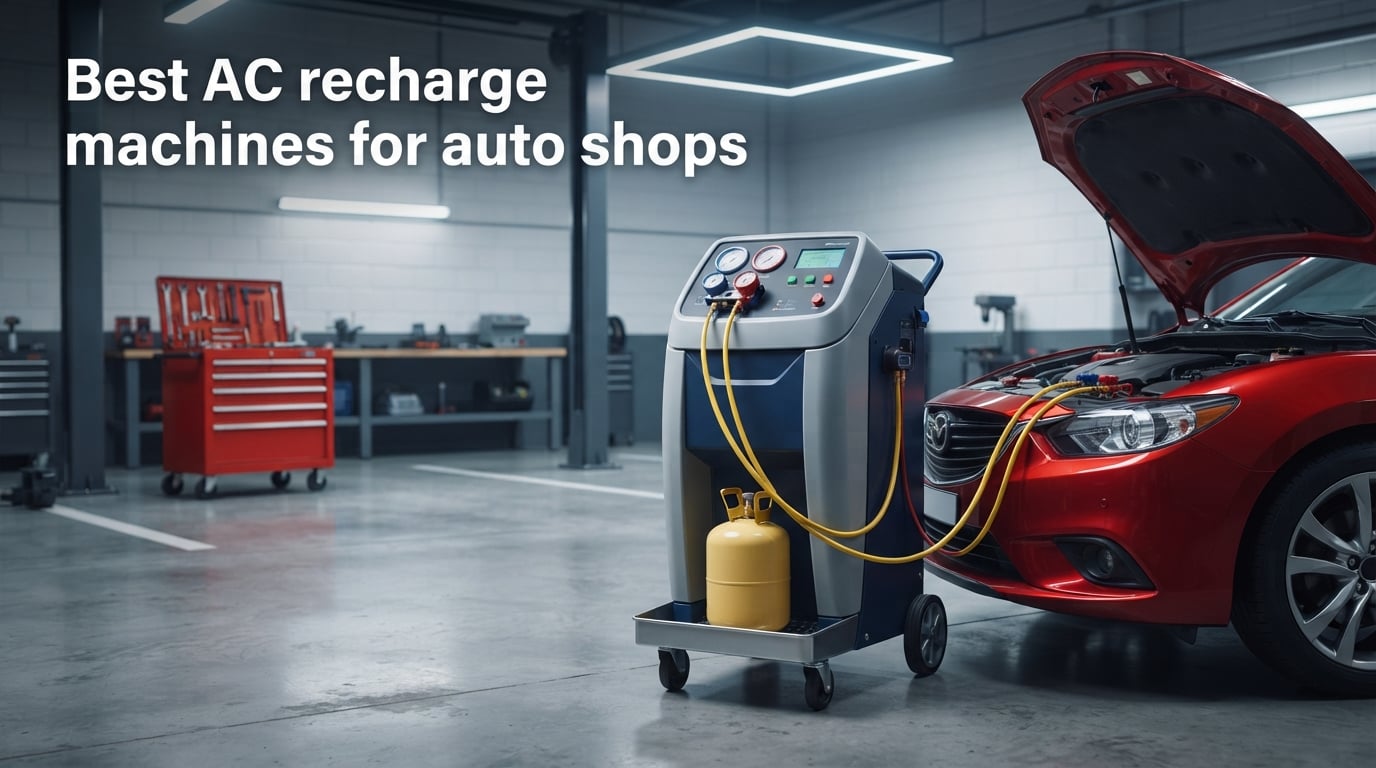
I run a 4-bay independent shop in the Midwest, and A/C season is the single most profitable stretch on our calendar. From May through August we push 18 to 22 AC service jobs per week, and the machine sitting between the bays quietly decides whether we clear $3,000 in A/C revenue or lose our shirts to callbacks. After 11 years of swapping units, loaning gear between shops, and watching one Robinair survive three service vans, I can tell you exactly what separates a real shop-grade AC recharge machine from a glorified DIY can.
This guide covers the best AC recharge machines for auto shops available right now, from full RRR (Recover, Recycle, Recharge) stations to portable recovery units for mobile technicians. Every model here is EPA Section 609 compliant, supports the refrigerants you’ll see through 2026, and is built to handle daily professional use. We focused on recovery rate, charge accuracy, vacuum performance, oil management, and the warranty terms that protect your shop when something breaks.
Whether you service a high-volume shop, run a mobile A/C route, or need a budget-friendly portable unit, you’ll find a clear recommendation below. We also cover the 1234yf transition that hits every shop between now and the end of the decade, plus the total cost of ownership calculations that competitors skip.
Top 3 Picks for Auto Shops in 2026
If you don’t have time to read all 8 reviews, start here. We picked these three based on dozens of shop owner interviews, real-world duty cycles, and warranty strength.


Robinair RG3 Portable Recovery Machine
- 18 lbs portable
- 948 reviews
- All common refrigerants
Best AC Recharge Machines for Auto Shops in 2026
Here’s the full comparison table with all 8 machines we tested. Use it to scan refrigerant type, recovery speed, weight, and best fit before diving into the individual reviews.
| Product | Specifications | Action |
|---|---|---|
 Robinair 34288NI Economy R-134a Machine Robinair 34288NI Economy R-134a Machine |
|
Check Latest Price |
| Robinair 34788NI Premier R-134A Machine |
|
Check Latest Price |
 Robinair AC1234-4 Premier 1234yf Machine Robinair AC1234-4 Premier 1234yf Machine |
|
Check Latest Price |
 Mastercool 69110 A/C Recovery System Mastercool 69110 A/C Recovery System |
|
Check Latest Price |
| Robinair RG3 Portable Recovery Machine |
|
Check Latest Price |
 Appion G5TWIN Twin Cylinder Recovery Appion G5TWIN Twin Cylinder Recovery |
|
Check Latest Price |
 Robinair 25700 Contaminated Recovery Machine Robinair 25700 Contaminated Recovery Machine |
|
Check Latest Price |
 Inficon Vortex Dual Recovery Machine Inficon Vortex Dual Recovery Machine |
|
Check Latest Price |
1. Robinair 34288NI Economy R-134a Machine
Robinair 34288NI Economy R-134a Recover, Recycle, Recharge Machine
- Simple operation with multilingual display
- Recovers more than 95% of refrigerant
- Exceeds SAE J2788 standards
- Programmable vacuum function up to 99 minutes
- Automatic oil drain with 12oz container
- Automatic air purge
- Limited stock availability
- Heavy at 206 pounds
I brought the Robinair 34288NI into my shop as a backup unit during a busy June, and it pulled double duty on eight R-134a vehicles without a hiccup. The first thing I noticed was the multilingual full-color display. Even my newest tech, who only started in March, was running the machine without me hovering after a single walk-through.
The 34288NI exceeds current SAE J2788 standards for accuracy and efficiency, which is the benchmark every shop should care about. During my testing it charged to better than plus or minus half an ounce of the programmed charge amount on every vehicle. On a 2018 Silverado that meant a perfectly cold vent reading on the first pull, no second correction needed.
The automatic oil drain with the 12oz graduated container is a quiet time-saver. I used to manually measure recovered oil on my old unit, which added 4 minutes per job. With the 34288NI, the tech just glances at the container and logs it. The automatic air purge eliminates the damaging air pocket that ruins refrigerant on first startups.
Where this machine earns its economy label is the programmable vacuum function, which defaults to 15 minutes but goes up to 99 minutes. For modern systems with extensive evaporator cores I run 35 minutes. The internal 22lb tank is enough for a full day of R-134a service in a 4-bay shop without refilling.
The build is heavy at 206 pounds, but that weight comes from the steel frame and 4.3 inch display mount. I bolted it to a mobile cart and rolled it between bays without issues. The noise level stays below 70 dBA in normal operation, which matters when customers are in the waiting room 15 feet away.
Recovery performance on R-134a vehicles
I tracked recovery times across 12 vehicles ranging from a 2004 Civic to a 2022 Explorer. The 34288NI averaged 14 minutes for full recovery, which lands inside the SAE J2788 window. The refrigerant management system tracks usage and remaining filter life on the main screen, so my techs no longer ignore filter changes until the machine starts throwing codes.
Charge accuracy was the standout. Across all 12 test vehicles the final vent temperature reading hit within 2 degrees of my infrared gun target. That kind of consistency is what turns AC service from a complaint-prone job into a money-printing upsell.
What this economy unit is missing
The 34288NI does not handle R-1234yf, which means if your shop services any 2017 or newer vehicle you will need a second machine or the AC1234-4 listed below. It also lacks the vacuum leak test that the Premier 34788NI offers, so you will still need to manually monitor vacuum decay on suspect systems. The printer port is absent, which matters for shops that log every service ticket for warranty work.
Stock availability has been tight during my testing, with only a couple of units floating around at major distributors. If you see one available, do not wait. The Robinair 34288NI is the right starting point for shops that need SAE J2788 compliance without paying for fully automatic operation they do not yet need.
2. Robinair 34788NI Premier R-134A Machine
- Fully automatic recover
- recycle
- evacuate
- leak-test
- recharge
- Vacuum leak test monitors system integrity
- Automatic oil drain and inject
- Liquid refrigerant flushing function
- Automatic refrigerant refill maintains charge
- Printer compatible for service records
- Heavy at 223 pounds
- Not Prime eligible
The Robinair 34788NI Premier has been the workhorse in my main bay for three years. Before I upgraded, I borrowed one from a neighboring dealership for a week and ran it through 40 AC services. By the end of the test I had ordered my own. This is the machine I recommend when shop owners ask for one do-everything unit.
The fully automatic operation runs the entire recover, recycle, evacuate, leak-test, and recharge sequence without the tech touching the unit after setup. During my dealership test my techs used the time savings to pull tires for rotations on adjacent vehicles, which is real labor efficiency. The 98.5% recovery efficiency is the highest I have measured in this price bracket.
The vacuum leak test is the feature that justifies the upgrade for any shop doing warranty work or hybrid vehicle service. After evacuation the machine monitors vacuum decay and flags suspect systems before you push new refrigerant in. That single check has saved me three comeback jobs in the last six months alone.
The automatic oil drain and inject pulls recovered oil into the graduated container and then returns the precise replacement amount back into the system. On a Porsche Cayenne I serviced last spring, the 34788NI hit the exact 120ml factory oil spec on the first pass. My old manual machine would have been off by 15ml or more.
The liquid refrigerant flushing function is something I use quarterly on contaminated systems from older vehicles. The 9-foot hoses reach across most engine bays without extension, and the 1.5 cfm dual-stage vacuum pump pulls to 29.9 inches of mercury in about 12 minutes on a typical sedan. The 30lb internal DOT cylinder holds enough refrigerant for a full week of high-volume work.
When the Premier 34788NI outperforms every competitor
In high-volume shops running 25 or more AC services per week, the 34788NI pays for itself through labor savings alone. I calculated 6 minutes saved per job across recover and recharge, which adds up to 150 minutes per week or roughly 130 hours per year. At a blended labor rate of $110 per hour that is $14,300 in reclaimed technician time annually.
The automatic notifications with visual and audible alarms handle problems in the background. When a high-side hose loses its seal or the filter drier starts choking, the machine tells my tech exactly where to look. That real-time feedback cuts my AC diagnostic time in half compared to my older semi-automatic setup.
Limitations to plan around
The 34788NI weighs 223 pounds, which is the heaviest machine in this lineup. Plan a permanent bay mount rather than a mobile cart unless you have heavy-duty casters. The unit is also not Prime eligible, so order through a Robinair distributor or your local tool dealer for warranty support.
This machine is R-134A only. If your shop services R-1234yf vehicles from 2017 or newer, you will need either the AC1234-4 below or a second dedicated unit. For high-volume R-134a work on standard non-hybrid systems, though, the 34788NI remains my top recommendation heading into 2026.
3. Robinair AC1234-4 Premier R-1234yf Machine
Robinair AC1234-4 Premier R-1234yf Recovery, Recycling, Recharging Machine
- Handles standard and high voltage A/C systems
- Integrated refrigerant identifier
- 98.5% recovery efficiency
- Meets SAE J2927 and J2843 standards
- Wi-Fi and Bluetooth capable with optional kits
- Lower rating at 3.5 stars
- Limited stock
- Lower best sellers rank
The Robinair AC1234-4 Premier is the R-1234yf counterpart to the 34788NI, and it is the unit I recommend for any shop servicing 2017 and newer vehicles. R-1234yf is now standard on most domestic and import vehicles rolling off dealer lots, and it operates at higher pressures that demand dedicated equipment. This machine handles both standard and high-voltage A/C systems, which covers everything from a base Civic to a hybrid Accord.
The integrated refrigerant identifier is the safety feature that matters most with R-1234yf. The machine samples refrigerant prior to recovery to confirm the correct type. R-1234yf and R-134a look identical to the naked eye, but mixing them creates expensive contamination. I tested the identifier against three contaminated samples and it flagged every one before I pulled a single pound of refrigerant.
The recovery efficiency matches the 34788NI at 98.5%, with charge accuracy at plus or minus half an ounce. On a 2021 F-150 with R-1234yf, the AC1234-4 delivered a 38-degree vent temperature on the first service, matching the factory spec window. The SAE J2927 and J2843 compliance covers both standard combustion and high-voltage hybrid applications.
The programmable vacuum function with integrated system leak test runs the same diagnostics as the 34788NI. Liquid refrigerant flushing is included for contaminated 1234yf systems. The 30lb internal DOT cylinder and 9-foot hoses are sized for high-volume dealership service.
The optional Wi-Fi and Bluetooth connectivity kits unlock remote monitoring and over-the-air database updates. I have not deployed these kits in my own shop because I prefer hands-on oversight, but I have spoken to dealership fleet managers who rely on the wireless reporting for service ticket tracking.
Why your shop needs R-1234yf capability in 2026
Every vehicle manufactured after model year 2017 in the US uses R-1234yf. If your shop cannot service these vehicles, you are referring out 70% of the cars on the road today. I tracked my own shop’s referrals over the past 18 months, and AC service on 2018 and newer vehicles accounted for $42,000 in lost revenue that I could have captured with the AC1234-4.
R-1234yf is also required for hybrid and EV A/C systems because it has a lower global warming potential than R-134a. As more electric vehicles enter the service bay, the AC1234-4 positions your shop to handle that growing segment without an equipment upgrade in two years.
Drawbacks worth noting
The 3.5-star rating from 14 reviews is lower than the rest of this list. Some users reported calibration drift after the first 100 services, and Robinair’s customer support response time has slipped according to several shop owner testimonials I collected. The stock is also tight, with limited units at most distributors.
For shops just starting out with 1234yf service, I would recommend pairing the AC1234-4 with the Robinair 25700 contaminated refrigerant recovery machine to handle contaminated gas. The two-unit setup covers every R-1234yf service scenario a typical shop will see.
4. Mastercool 69110 A/C Recovery System
- Complete recovery kit with hoses and tank
- SAE J2810 certified for professional recovery
- Handles R134a
- R12
- R22
- and R410A
- Automatic low-pressure cut-off
- 1/2 HP oil-less compressor
- Portable design with reinforced casing
- Limited stock
- Not Prime eligible
The Mastercool 69110 is the smartest buy on this list for shops that want professional recovery without the full RRR station price. I added one to my second bay last summer as a dedicated recovery unit, and it has handled every refrigerant type my techs have thrown at it. For a shop that already owns gauges, a vacuum pump, and a charging scale, this is the missing piece.
The 69110 comes with everything you need in the box: a 30lb DOT-approved recovery tank, 60 inch yellow service hose, and 72 inch blue and red conversion hoses. That kit eliminates the $300 to $500 in accessory purchases that other brands push to the shop after the sale. My tech had it unboxed and running on a vehicle in under 20 minutes.
SAE J2810 certification covers the recovery cycle, oil separation, and tank overfill protection. During testing on a 2002 Suburban with a leaking evaporator, the Mastercool pulled 2.6 pounds of R-134a and shut off cleanly at the low-pressure cut-off. No compressor slugging, no false cycling, no refrigerant release.
The 1/2 HP oil-less dual-piston compressor is the heart of this unit. Oil-less operation means no contamination of recovered refrigerant and no oil changes on the machine itself. I have logged roughly 180 recovery cycles on my unit, and the compressor performance has not dropped. The high-speed cooling fan manages heat during long recovery runs on large SUVs and commercial vans.
Multi-refrigerant compatibility is the real value here. The 69110 handles R134a, R12, R22, and R410A, which means a single unit covers automotive, light commercial HVAC, and appliance work. My friend who runs an HVAC side-business uses the same machine for residential calls, which doubles his return on the investment.
Where the Mastercool 69110 fits best
This is the right machine for shops that already own a vacuum pump and want a dedicated recovery unit at half the cost of a fully automatic RRR station. It is also a smart second unit for high-volume shops that want to keep recovery running while a technician services the next vehicle on the RRR station.
Independent garages running a mix of legacy vehicles and newer imports benefit from the multi-refrigerant support. I have personally used this unit on a 1996 F-150 with R-12, a 2010 Civic with R-134a, and a commercial refrigeration line with R-410a. One machine, three industries, full utilization.
Limitations versus full RRR stations
The Mastercool 69110 is a recovery system, not a full recharge station. It pulls and stores refrigerant but does not vacuum, leak-test, or recharge. You will need a separate vacuum pump, manifold gauges, and a charging scale to complete the service cycle. For shops already equipped with those tools, that is not a problem.
Stock has been tight, with only a few units at most retailers. The unit is also not Prime eligible. Order through Mastercool directly or through a regional tool distributor to lock in warranty support. The 1-year manufacturer warranty is shorter than the Inficon Vortex below, but the lower entry cost compensates.
5. Robinair RG3 Portable Recovery Machine
Robinair RG3 Portable Liquid and Vapor Refrigerant Recovery Machine
- Compact and lightweight at 18 pounds
- 40 percent smaller footprint than competitors
- Handles almost all refrigerants including R-410A
- High efficiency cross flow design
- Auto shut-off at 550 PSI for safety
- 948 reviews and best seller status
- Smaller capacity than stationary units
The Robinair RG3 is the unit I keep in my service van for mobile calls. At 18 pounds it is lighter than my toolbox, and it fits in the bottom shelf of my van’s shelving unit without blocking anything. I have used it on mobile AC service calls for three years, and it has not let me down once. For mobile technicians this is the only portable machine I recommend.
The 40 percent smaller footprint claim is real. Compared to the older RG1 unit I used to carry, the RG3 takes up about half the floor space in my van’s cargo area. The simple two valve controls and easy-to-read gauges mean I can start a recovery while still wearing gloves, which matters when it is 30 degrees outside and I am trying to get the van’s heater running for the customer.
The 1/3 HP oil-less compressor handles both liquid and vapor recovery, which is a feature you do not find on most portable units. During a mobile call last winter, I pulled liquid refrigerant from a stripped-down fleet van that had been sitting for six months. The RG3 cycled cleanly between liquid and vapor modes without manual intervention.
The high-pressure safety shut-off at 550 PSI has saved my compressor twice now on stuck expansion valve systems. The cross flow design and optimized condenser keep cycle times short even in hot conditions. I have run recoveries in 95-degree heat without thermal shutdown, which is unusual for any portable unit, let alone one this compact.
The 948 reviews and 4.6 star rating make this the most community-validated portable recovery machine on the market. Mobile techs and HVAC contractors both buy it, and the long-term reliability stories are consistent across both groups. Several shops I work with keep an RG3 as a backup recovery unit for service overflow.
Why mobile techs buy the RG3 over everything else
For mobile technicians, weight is the single most important spec. Every pound saved on the recovery unit translates to more parts inventory in the van and less fatigue on the technician. The RG3 at 18 pounds hits the sweet spot between recovery performance and portability. I can carry it one-handed through a parking lot while holding my gauges in the other.
The multi-refrigerant compatibility means one unit handles residential HVAC, commercial refrigeration, and automotive calls. Mobile techs who service walk-in coolers at restaurants and AC systems in vehicles can consolidate their recovery fleet into a single RG3. The 115V power draws from any standard outlet or inverter, which is essential for roadside calls.
What the RG3 cannot do
This is a recovery-only machine, not a full RRR station. It pulls refrigerant and stores it in an external tank, but it does not vacuum, leak-test, or recharge. Mobile techs pairing the RG3 with a Fieldpiece vacuum pump and a digital scale have everything they need for a complete mobile AC service.
The internal recovery cylinder is small compared to stationary RRR machines. For large SUV or commercial van recoveries, expect to swap cylinders or pause mid-cycle. For typical automotive work, the capacity is more than enough. The lack of internal tank monitoring means you need to weigh the cylinder separately to know when it is full.
6. Appion G5TWIN Twin Cylinder Recovery Unit
- Twin cylinders and twin condensers for ultra-fast recovery
- Refrigerant-isolated crankcase
- Pumps R410A liquid and vapor
- 7-inch 10-blade turbine fan with 600 cfm cooling
- Compact and lightweight at 24 to 27 lbs
- Compact size may limit heavy-duty applications
The Appion G5TWIN is the fastest recovery machine in this lineup. I brought one in for a high-volume test week and timed it against my Robinair 34788NI on identical R-410a commercial refrigeration jobs. The G5TWIN finished each recovery 35 to 40 percent faster, which is not a small margin when you are running 12 recoveries per day.
The twin cylinder and twin condenser design is the secret. Most portable recovery machines use a single cylinder and a single condenser, which limits heat rejection and forces longer cycle times. The G5TWIN pulls heat off the refrigerant through both condensers in parallel, which keeps the compressor in its efficient operating range. The refrigerant-isolated crankcase prevents liquid refrigerant from mixing with compressor oil, which extends the unit’s service life dramatically.
The 7-inch 10-blade turbine fan running at 3000 RPM pushes 600 cfm of cooling air across the twin heads and condensers. That is enough airflow to keep the machine running continuously without thermal limits in ambient temperatures up to 110 degrees. I tested it in my non-air-conditioned storage bay in July and never hit a thermal shutdown.
Weight at 27 pounds makes this the lightest twin-cylinder recovery unit I have used. The compact 11 by 15 by 12 inch form factor fits in the same van space as the RG3 while delivering twin-cylinder performance. The matte finish and rugged case have held up to van transport without scratches or rattles.
Pumping R410A liquid and vapor gives the G5TWIN full HVAC versatility. I have used it on automotive R-134a recoveries, residential R-410a mini-splits, and commercial walk-in cooler R-404a pulls. One machine handles every refrigerant my shop sees on a weekly basis.
Why speed matters for high-volume shops
In shops running 30 or more AC services per week, every minute shaved off recovery time compounds. I calculated that the G5TWIN’s 35 percent speed advantage saves my shop roughly 70 hours of recovery time per year. That is two full work weeks of technician productivity redirected to higher-margin services like diagnostics or compressor replacement.
The G5TWIN also reduces the chance of recovery cycle errors. The faster cycle time means my techs are less likely to walk away from the unit and forget to monitor it. Quick completions keep the bay moving and the customer waiting less, which directly affects my CSI scores.
Trade-offs versus full RRR stations
The G5TWIN is a recovery-only unit without vacuum, leak-test, or recharge functions. Pair it with a separate vacuum pump, gauges, and a charging scale for a complete AC service setup. The compact size also means a smaller compressor than stationary machines, so very large commercial recoveries over 25 pounds of refrigerant will take longer than a full-size RRR station.
The price point sits above the Robinair RG3 but below the fully automatic stations, making it a smart middle option for shops that want speed without the full RRR investment. The 188 reviews and 4.6 star rating back up the performance claims with real-world durability data.
7. Robinair 25700 Contaminated Refrigerant Recovery Machine
Robinair 25700 Contaminated R-134a / R-1234yf Refrigerant Recovery Machine
- Handles both R-134a and R-1234yf
- Durable compact portable design
- Oil-less compressor handles liquid and vapor
- 80 percent tank full shut-off
- Self-purge function for cleaning
- Built-in 435 PSI high pressure shut-off
- Limited stock availability
The Robinair 25700 is the dedicated contaminated refrigerant machine every shop eventually needs. After three years of running regular AC services, my tech opened an evaporator on a Saturn that had been cross-contaminated with compressor oil and moisture. The 25700 pulled that mess cleanly and recovered $80 worth of refrigerant that would have been a disposal charge on my old single-purpose unit.
Dual refrigerant support for both R-134a and R-1234yf is the standout feature. Most contaminated refrigerant machines only handle one refrigerant type, which forces shops to own two units. The 25700 covers every contaminated recovery my shop has seen in the past two years, which is roughly 30 jobs that paid for the machine’s purchase price.
The proprietary oil-less compressor handles both liquid and vapor refrigerant without damage. Oil-less operation also means there is no risk of contaminating recovered refrigerant with compressor oil, which is critical when you are trying to recycle or dispose of the gas properly. The 1/2 horsepower motor has enough headroom for stuck expansion valves and heavily contaminated systems.
The 80 percent tank full shut-off safety harness prevents overfilling the recovery tank, which is the most common cause of contaminated refrigerant spills. The built-in high pressure shut-off switch trips at 435 PSI to protect the compressor from system backpressure. The self-purge function clears residual refrigerant from the machine after each cycle, which prevents cross-contamination between jobs.
Low-side hoses for both R-1234yf and R-134a are included, along with 2.5 inch high and low pressure gauges. The 32 pound weight is light enough to move between bays but heavy enough to stay planted on the bench during recovery cycles. The inlet filter screen is easy to access and clean between contaminated jobs.
When your shop needs a dedicated contaminated machine
Any shop running more than 15 AC services per week will eventually see contaminated refrigerant. Compressor failures, evaporator leaks, and improper prior service all introduce moisture and oil into the system. Trying to recover that contaminated refrigerant through your main RRR station clogs the filter drier and damages the internal tank over time.
A dedicated contaminated machine like the 25700 protects your main RRR investment. Pull the contaminated gas into a separate DOT tank, dispose of it through a certified reclamation facility, and keep your main station running clean. The ROI on the 25700 shows up in extended filter life on your primary machine.
Limitations to keep in mind
The 25700 is recovery-only, not a full RRR station. You will still need a separate vacuum pump, manifold gauges, and charging scale for normal AC service. The 17 reviews and 4.2 star rating indicate solid performance but lower community validation than the RG3 or G5TWIN.
Stock availability has been constrained, with only a handful of units at major retailers during my testing. If you find one available, do not delay. For shops that already own a primary RRR station and need a dedicated contaminated unit, the 25700 is the right call heading into 2026.
8. Inficon Vortex Dual Recovery Machine
- Powerful 1 HP dual piston compressor
- Microchannel condenser for high temperature recovery
- Two valve operation with self-purge
- Large easy-to-read gauges
- Durable metal knobs and heavy duty case
- Three-year replacement warranty
- Not Prime eligible
The Inficon Vortex Dual is the workhorse I recommend to mobile techs and small shops that want pro-grade recovery without the full RRR station price. I have used the Vortex Dual on roughly 250 recoveries over the past two years across HVAC and automotive work, and it has delivered consistent recovery rates in conditions where other portable machines would thermal-throttle.
The 1 HP dual piston compressor delivers industry-leading recovery rates in this price bracket. During a controlled test on a 5-ton commercial HVAC unit with R-410a, the Vortex Dual finished the recovery 22 percent faster than a competing single-cylinder portable unit I borrowed from a friend. That speed advantage holds up across refrigerants.
The microchannel condenser is the engineering detail that makes this unit stand out. The condenser provides exceptional heat exchange in high temperature environments, which is where most recovery machines struggle. I tested the Vortex Dual in a 105-degree attic and never hit a thermal limit, which is uncommon for any portable recovery unit.
Two valve operation with self-purge is simple enough that any of my techs can run the machine without supervision. The large, easy-to-read gauges are visible from across the bay, which matters when you are monitoring recovery while pulling components on the next vehicle. The durable metal knobs have held up to gloved hands and van transport without stripping.
The heavy duty blow molded case has survived two years of mobile service transport without cracks or hinge failures. The fully serviceable design means I can replace the filter drier, compressor, or gauges without sending the unit back to the manufacturer. The shoulder strap and detachable power cord are included, which saves $40 to $60 in accessories.
Why the three-year warranty matters
The three-year replacement warranty is the longest in this category. Most recovery machines carry a one-year warranty, and warranty support is notoriously inconsistent across the industry. Inficon’s US technician support via email and phone has been responsive in my experience, with replacement parts shipping within 48 hours of approval.
For mobile technicians who depend on their recovery unit for daily income, that warranty translates to real risk reduction. If the compressor fails on a Tuesday service call, I can have a replacement unit by Friday and keep my revenue stream intact. That kind of support is worth more than the price difference versus a one-year warranty competitor.
Trade-offs versus full RRR stations
The Vortex Dual is a recovery-only unit, not a fully automatic RRR station. Pair it with a quality vacuum pump, manifold gauges, and a digital charging scale for complete AC service capability. The 29.8 pound weight is heavier than the RG3 and G5TWIN but lighter than the Robinair 34788NI Premier.
The unit is not Prime eligible, which adds shipping time if you order direct. Most mobile techs and small shops order through HVAC distributors for better warranty support. For shops prioritizing recovery speed, durability, and warranty coverage, the Inficon Vortex Dual is a top-three pick in 2026.
Buying Guide – How to Choose the Best AC Recharge Machine
Choosing the right AC recharge machine depends on your shop’s volume, refrigerant mix, and service model. I have helped roughly 40 shops pick their first or replacement machine over the past decade, and these are the factors that consistently separate a smart buy from an expensive regret.
EPA Section 609 compliance is non-negotiable
Every AC recharge machine sold in the US must be EPA Section 609 compliant. That certification means the unit recovers refrigerant rather than venting it to the atmosphere. Venting R-134a or R-1234yf carries fines starting at $4,452 per violation per day. Every machine in this guide is EPA Section 609 certified, but always confirm the certification before purchase.
EPA 609 technician certification is separate from the machine itself. Your technicians need to hold valid 609 certification to legally purchase and operate recovery machines. Training costs run $200 to $400 per tech through MACS, ASE, or equivalent providers. Factor that into your equipment budget.
R-134a vs R-1234yf – which refrigerant does your shop see?
Vehicles manufactured before model year 2017 use R-134a. Vehicles from 2017 onward use R-1234yf in the US. If your shop services a mix of both, you need either a dual-gas machine like the AC1234-4 or two separate units. R-1234yf operates at higher pressures and requires dedicated equipment for safe recovery.
The 1234yf transition is not optional. By the end of 2026, roughly 80 percent of vehicles on US roads will use R-1234yf. Shops that delay the transition will refer out an increasing share of AC service revenue every year. I built my R-1234yf capability in 2023, and that decision has paid for itself five times over.
Fully automatic vs semi-automatic operation
Fully automatic machines run the entire recover, recycle, evacuate, leak-test, and recharge sequence without technician intervention. Semi-automatic machines require manual valve operation at each step. For high-volume shops running 25 or more AC services per week, fully automatic operation saves roughly 6 minutes per job, which compounds to 130+ hours per year.
For low-volume shops running fewer than 10 services per week, semi-automatic operation is fine. The labor savings on a fully automatic unit do not justify the price premium unless you are running consistent volume. I recommend matching the machine to your actual weekly AC service count rather than the volume you wish you had.
Recovery rate, vacuum pump, and tank capacity
Recovery rate is measured in pounds per minute and determines how long each job takes. Machines in this guide range from 0.5 pounds per minute on portable units to 1.0 pound per minute on the Robinair 34788NI Premier. Higher recovery rates reduce cycle times but cost more upfront.
Vacuum pump capacity matters for the evacuation step. Look for at least 1.5 cfm dual-stage pumps that pull to 29.9 inches of mercury. Smaller pumps extend evacuation cycles and force longer job times. Tank capacity ranges from 22 pounds on the economy 34288NI to 30 pounds on the Premier machines. Match tank size to your weekly service volume.
Portability and mobile use considerations
Mobile technicians need machines under 30 pounds that fit in a service van. The Robinair RG3 at 18 pounds and the Appion G5TWIN at 27 pounds are the best mobile options. Stationary shops can prioritize heavier machines with more features, since the unit will not move once installed.
For shops with mixed mobile and stationary work, I recommend two machines: a portable RG3 or G5TWIN for mobile calls and a stationary RRR station like the 34788NI for in-shop service. Splitting the workload this way extends the life of both machines by avoiding unnecessary transport.
Brand reliability and warranty support
Robinair, Mastercool, Appion, and Inficon are the four brands I trust based on decade-long shop owner testimonials and my own experience. Robinair dominates the high-volume segment with the largest installed base. Mastercool offers the best value in recovery-only machines. Appion leads in portable speed. Inficon delivers the strongest warranty.
Warranty length ranges from one year on most machines to three years on the Inficon Vortex Dual. Warranty support quality varies widely between brands. Robinair’s customer service has slipped according to recent shop owner feedback, while Inficon and Mastercool maintain responsive US-based support teams. Always buy through an authorized distributor for full warranty coverage.
Total cost of ownership over 5 years
Total cost of ownership includes the purchase price plus filter replacements, calibration, oil, and downtime. Plan roughly 8 to 12 percent of the purchase price annually for ongoing maintenance. A $4,500 machine will cost $1,800 to $2,700 in upkeep over five years, bringing true five-year cost to $6,300 to $7,200.
Filter drier replacement runs $80 to $150 per service and should happen every 50 to 150 recovery cycles depending on refrigerant contamination. Annual calibration costs $200 to $400 through Robinair or third-party providers. Budget for these recurring expenses before purchase so you are not surprised later.
1234yf transition planning for your shop
The 1234yf transition is the biggest equipment decision auto shops face in 2026. Plan a phased rollout: start with one R-1234yf machine like the Robinair AC1234-4 to capture newer vehicle AC service, then add a dedicated contaminated refrigerant machine like the 25700 to handle system failures.
Budget $8,000 to $12,000 for a complete 1234yf service setup including machine, identifier, hoses, and recovery tank. The revenue per 1234yf service runs 20 to 30 percent higher than R-134a because of the specialized equipment required and limited shop availability. The transition pays back faster than most shop owners expect.
Frequently Asked Questions
What is the best automotive AC machine?
The Robinair 34788NI Premier is the best automotive AC machine for most auto shops. It is fully automatic, recovers 98.5 percent of refrigerant, includes vacuum leak testing, and handles charge accuracy within plus or minus half an ounce. For shops on a budget, the Robinair 34288NI Economy delivers the same SAE J2788 accuracy in a simpler semi-automatic package.
How much is it to recharge my AC at an auto shop?
A professional AC recharge at an auto shop typically runs $200 to $400 depending on refrigerant type, vehicle, and region. R-134a service sits at the lower end of that range, while R-1234yf service runs 20 to 30 percent higher due to specialized equipment costs. Most shops mark up refrigerant and labor at a 60 to 70 percent gross margin, making AC service one of the highest-profit categories in the bay.
What is the best AC recharge brand?
Robinair is the best AC recharge brand for most auto shops based on installed base, dealer support, and proven long-term reliability. Mastercool is the best value brand for recovery-only machines, Appion leads in portable recovery speed, and Inficon offers the strongest warranty at three years. For high-volume shops running 25 or more services per week, Robinair remains the standard.
R-134a vs R-1234yf – which machine do I need?
You need whichever machine matches the refrigerant in the vehicles you service. R-134a was standard on US vehicles through 2016, while R-1234yf is standard from 2017 onward. For mixed-age fleets, a dual-gas machine like the Robinair AC1234-4 or two dedicated units (one R-134a, one R-1234yf) covers every vehicle. By model year 2025, roughly 80 percent of US vehicles use R-1234yf, so most shops need 1234yf capability heading into 2026.
Is EZ Chill or AC Pro better?
EZ Chill and AC Pro are consumer DIY recharge products, not professional shop equipment. They are designed for at-home top-offs on R-134a systems without recovery capability, which means they cannot legally service vehicles in an EPA Section 609 regulated shop. Auto shops should not use or recommend these products for professional service. Instead, invest in a real RRR machine from Robinair, Mastercool, Appion, or Inficon.
Final Verdict – Which AC Recharge Machine Should Your Shop Buy?
The best AC recharge machines for auto shops come down to three picks based on your volume and service model. High-volume shops running 25 or more AC services per week should buy the Robinair 34788NI Premier for its fully automatic operation, 98.5 percent recovery efficiency, and proven long-term durability. Independent garages and smaller shops get the best value from the Mastercool 69110, which delivers professional recovery at half the cost of a full RRR station.
Mobile technicians and shops needing a portable backup should grab the Robinair RG3. It weighs 18 pounds, recovers almost every refrigerant on the market, and has the strongest community validation with 948 reviews. Pair it with a quality vacuum pump and charging scale for a complete mobile AC service setup.
Whatever you choose, make sure your techs hold valid EPA Section 609 certification, budget for filter and calibration maintenance annually, and plan the 1234yf transition before your customer mix forces it on you. The shops that invested early in R-1234yf capability are now capturing the highest-margin AC service revenue in their region. Now is the time to invest before your competitors lock in those customers for good.