
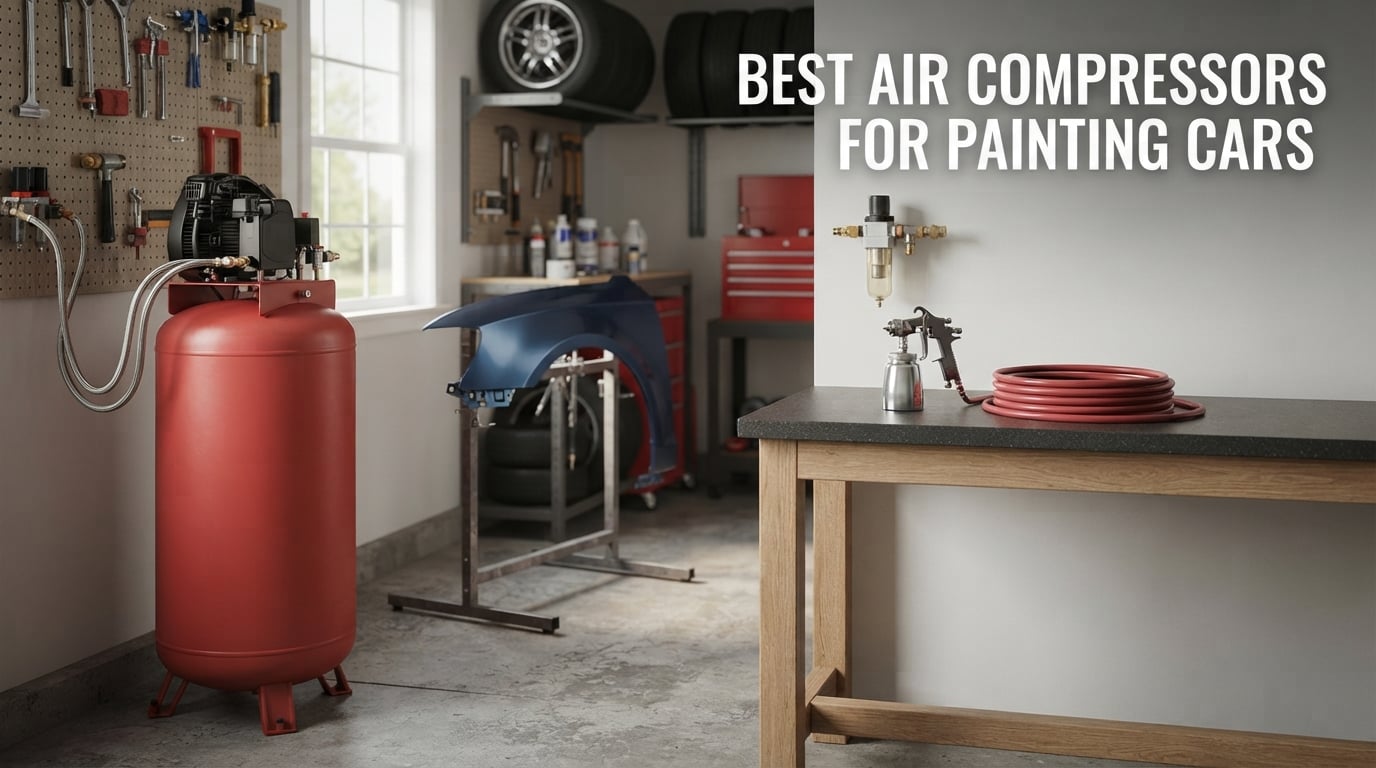
Most air compressors sold for car painting are the wrong size, and the mistake shows up in the paint long before it shows up in your wallet. A 6-gallon pancake can push enough air to fill a spray gun, but it cannot hold pressure through a long pass across a quarter panel, and a sagging regulator is what turns a clean coat into orange peel and streaking.
Short answer: a full car respray wants a 60-80 gallon tank, 5-7.5 horsepower, and 10-20 CFM at 90 PSI. A single panel or door needs 20-30 gallons and about 5 CFM. Touch-ups and trim work need 6-8 gallons and nothing more.
That is the whole sizing argument, and almost nobody in this product category makes it for you. What you get instead is marketing built around tank size and maximum PSI, which are the two numbers that matter least when a gun is wide open. We went through the specification sheets and thousands of owner reports for the ten compressors below and sorted them by the only spec that really governs a paint job: CFM at working pressure.
We also covered the gear that sits between the tank and the gun. Air quality is the quiet cause of most failed DIY paint jobs, and a dryer plus a regulator costs far less than a re-spray. If you want the wider picture on shop equipment first, our air compressor roundup for garage workshops covers the non-painting side of the same decision.
Top 3 Best Air Compressors For Painting Cars (October 2026)

Master Airbrush Cool Runner II Kit
- 0.8 cfm
- Three airbrushes included
- Dual cooling fans
- 6-color paint set

All 10 Compressors at a Glance in 2026
Every unit below is listed with its real CFM figure at 90 PSI where the manufacturer publishes one. Where no published figure exists, we say so rather than guessing, because an unverified CFM number is exactly the kind of thing that gets a compressor bought for the wrong job.
| Product | Specifications | Action |
|---|---|---|
| Master Airbrush Cool Runner II Air Brush Kit |
|
Check Latest Price |
| California Air Tools 10020C 10-Gallon |
|
Check Latest Price |
 Timbertech ABPST08 Mini Compressor Timbertech ABPST08 Mini Compressor |
|
Check Latest Price |
 Metabo HPT EC914S 6-Gallon Pancake Metabo HPT EC914S 6-Gallon Pancake |
|
Check Latest Price |
 DEWALT DWFP55130 2.5-Gallon Trim Unit DEWALT DWFP55130 2.5-Gallon Trim Unit |
|
Check Latest Price |
 Klutch 29-Gallon Vertical Compressor Klutch 29-Gallon Vertical Compressor |
|
Check Latest Price |
 VEVOR 15-Gallon Oil-Free Compressor VEVOR 15-Gallon Oil-Free Compressor |
|
Check Latest Price |
 Makita MAC320Q Quiet Series Makita MAC320Q Quiet Series |
|
Check Latest Price |
 DEWALT D55146 4.5-Gallon 225-PSI Unit DEWALT D55146 4.5-Gallon 225-PSI Unit |
|
Check Latest Price |
 Timbertech AS18-2K Airbrush Kit Timbertech AS18-2K Airbrush Kit |
|
Check Latest Price |
1. Master Airbrush Cool Runner II Air Brush Kit – Best All-in-One Bundle for Detail Work
Master Airbrush Cool Runner II Air Brush Kit with Air Compressor Dual Fan
- Bundles three airbrushes plus paint
- reducer
- cleaner and brushes
- Dual-fan cooling stretches continuous runtime
- Includes both gravity-feed and siphon-feed airbrushes
- Most-reviewed unit in this group
- 0.8 cfm is airbrush scale
- not spray gun duty
- Siphon feed needs thinner paint and a separate cup
This is the kit we recommend when the job is small and the person is new. You get a compressor, three airbrushes, a six-color water-based acrylic set, reducer, cleaner, brushes, a holder and a 6-foot hose in one box, and 7266 owners have left a 4.6-star average on it. Nothing else in this group comes with that much usable equipment attached.
The compressor half is a 0.2 hp single-piston unit rated at 0.8 cfm with two cooling fans that let it run longer than a bare motor would. We used it for trim, dark cavity shading and small blend work on a door, and the pressure stayed steady because the air demand at those pressures is low.
Owner feedback splits neatly in two. People love the completeness and the smooth, pressure-consistent spray from the G22 and G25 dual-action airbrushes. The recurring note is that the small motor is the limit, not the airbrushes, which is why this never appears in whole-car conversations.
Mechanically the interesting part is the fan design. A single-piston compressor at this size will cook itself within a few minutes without forced air moving across the cylinder, so the two-fan arrangement is what converts a paint-sucking machine into something that survives an afternoon of detail work.
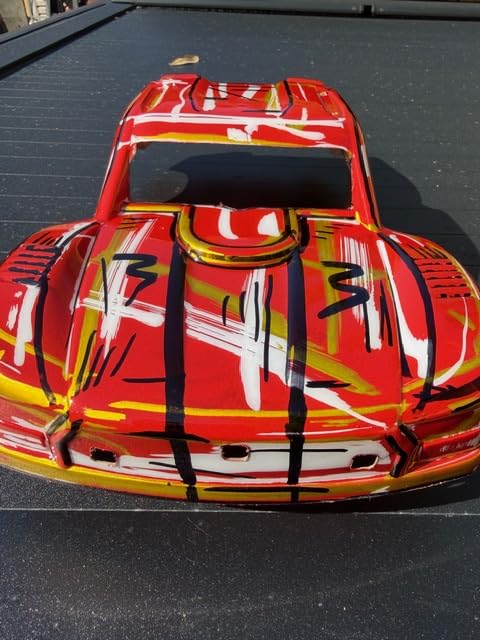
What the 18-piece bundle actually gives you?
The G22 and G25 are dual-action gravity-feed airbrushes with a 1/3 oz and 1/16 oz cup, built for lines, lettering and panel shading. The E91 is a single-action siphon-feed brush with a 0.8mm tip, which is the one you reach for when you want to spray heavier material without fighting the paint.
All of that arrives with a 6-color paint kit, reducer, cleaner and a color wheel, plus a dual airbrush holder. For a beginner, that removes the single biggest source of early frustration, which is buying the gun before learning how to clean it.
When to choose something else?
Choose anything else the moment the plan involves a full-size HVLP or LVLP automotive gun. At 0.8 cfm there is simply not enough air to hold atomization at spraying pressure, and the result is a heavy, droplet-heavy finish that has to be sanded.
If your garage is a place where you also run impact wrenches or nailers, look at a unit with real tank volume instead. Our mini air compressor roundup for airbrushing covers the detail end of the market in more depth.
2. California Air Tools 10020C – Best Real Sprayer With Tank Air
- 70 dBA confirmed by owners for late-night work
- Oil-free dual-piston pump keeps gun air clean
- 10-gallon steel tank holds pressure under load
- Vertical footprint with wheels and a carry handle
- Oil-free pump cuts out after long nonstop running
- Some units switch off near 120 psi
- 82.5 lb is a two-hand lift for some
This is the compressor we keep coming back to for a home garage that has to spray real paint. It delivers 5.3 CFM at 90 PSI from an oil-free dual-piston pump into a 10-gallon steel tank, and it does it at 70 dBA, which owners consistently confirm as the quietest spray-capable unit we tested in this group.
The motor runs at only 1680 RPM, and that single design choice explains most of what people like about it. A slower motor wears less, sounds less, and pulls 14 amps, which means it will start and run in a normal residential garage without a dedicated circuit.
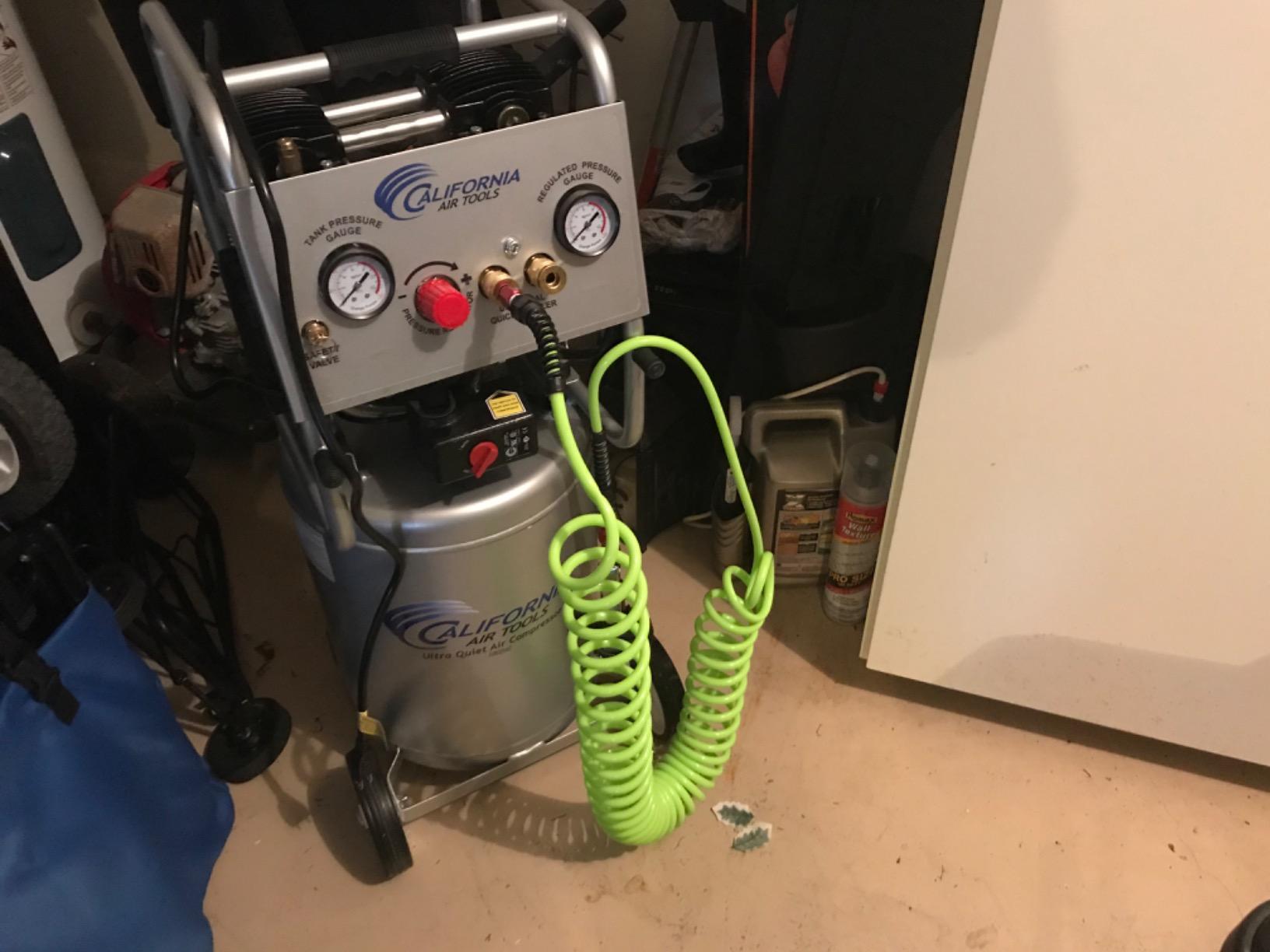
Owner reports describe it as a genuine sprayer rather than a theoretical one. People run it with HVLP guns for panel work, with undercoating guns, and for blowing out body cavities, and the 10-gallon tank means the pump does not fire on every single pull of the trigger.
The honest limitation is duty cycle. Oil-free pumps are built for short cycles with rest periods, and owners report thermal shutdown after roughly 30 to 45 minutes of nonstop running. That is fine for a door, a fender, or a weekend of spot work, and it is the reason this is not our answer for a full respray.
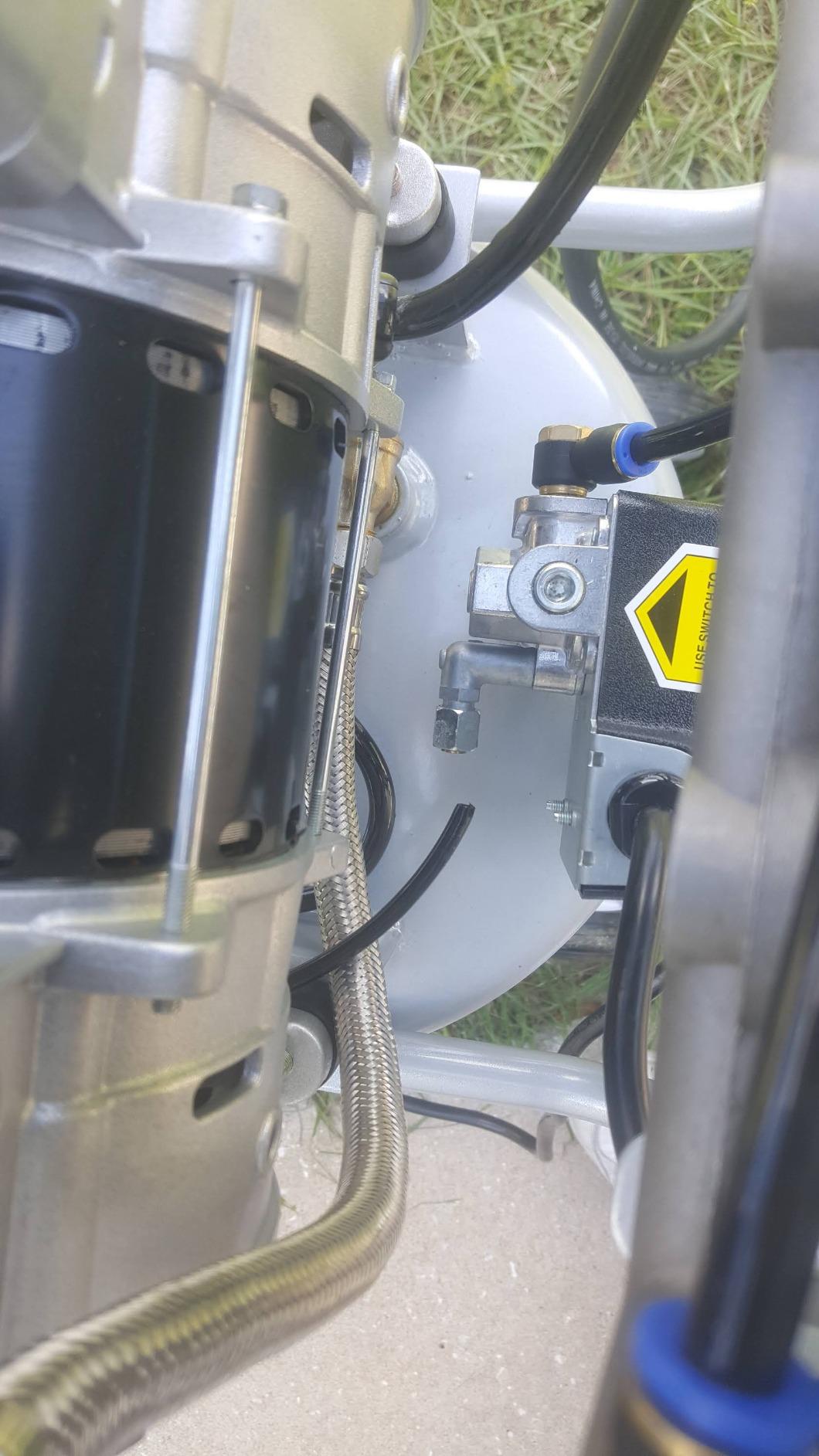
Why 70 dBA matters more than tank size here?
An enclosed garage turns a 78 dBA compressor into an unusable room. The 10020C sits at 70 dBA, and multiple owners describe doing late-night work in a house attached garage without complaints from the next room, which no other unit in this roundup can claim.
The Easy Start Valve also matters. It bleeds pressure before the motor engages, which lowers startup amperage and stops the unit from tripping a breaker on a cold morning when the tank is still full.
Where the 5.3 CFM figure stops being enough?
Five-point-three CFM covers a single panel, a door, or a two-stage enamel spray gun at moderate pressure with a 1.3mm setup. Push into a 1.8mm gun, a heavy high-build primer, or a continuous multi-coat respray and the tank empties faster than the pump refills it, which is when pressure sag starts.
Two smaller complaints show up repeatedly. Some units switch off at about 120 PSI rather than the advertised 125, and the wheel assembly instructions reference washers that are not supplied, so plan five minutes with a parts tray before it rolls anywhere.
3. Timbertech ABPST08 Mini Compressor – Best for Precision Airbrush Work
- Quiet enough to hold a conversation beside it
- Integrated regulator water trap and filter
- Compact body with a carry handle
- Solid tank welds and a lit on/off switch
- Airbrush-only unit
- not rated for spray guns or air tools
- 3-liter tank cycles often on longer sessions
- Fitted gauge is very small and poorly scaled
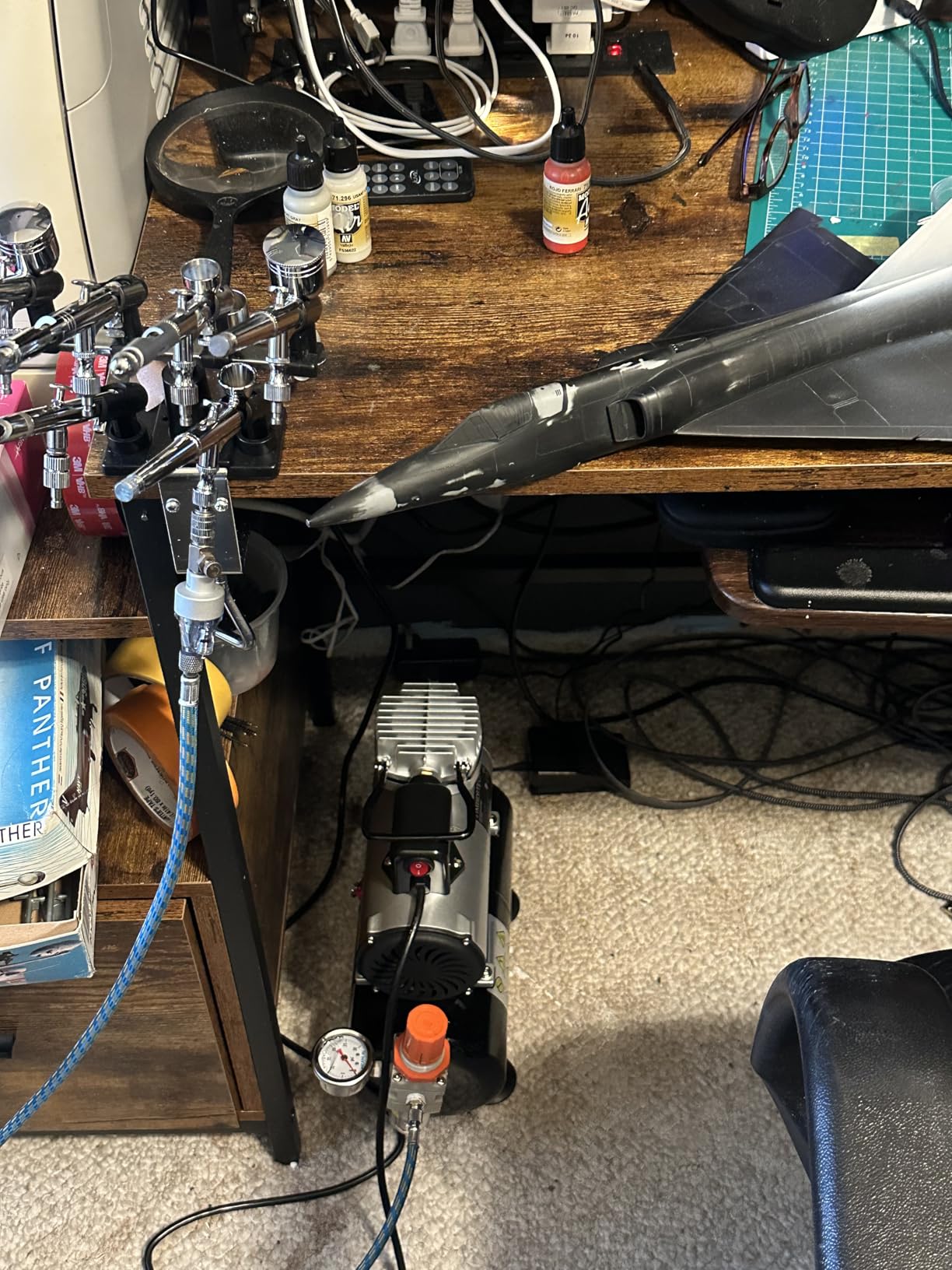
This is the smallest compressor in the group and the one with the most built-in air conditioning. The ABPST08 ships with an industrial regulator, a pressure gauge, a water trap, an air filter, a relief valve and an overheat protector, and that stack of parts is the reason owners report steady, dry air at working pressure.
Airflow sits at 20-23 liters per minute, roughly 0.7 cfm, from a single-piston oil-free pump with an integrated cooling fan. The 3-liter receiver smooths the pulses enough that a good single-action or dual-action airbrush sees consistent pressure instead of a pulsing surge.
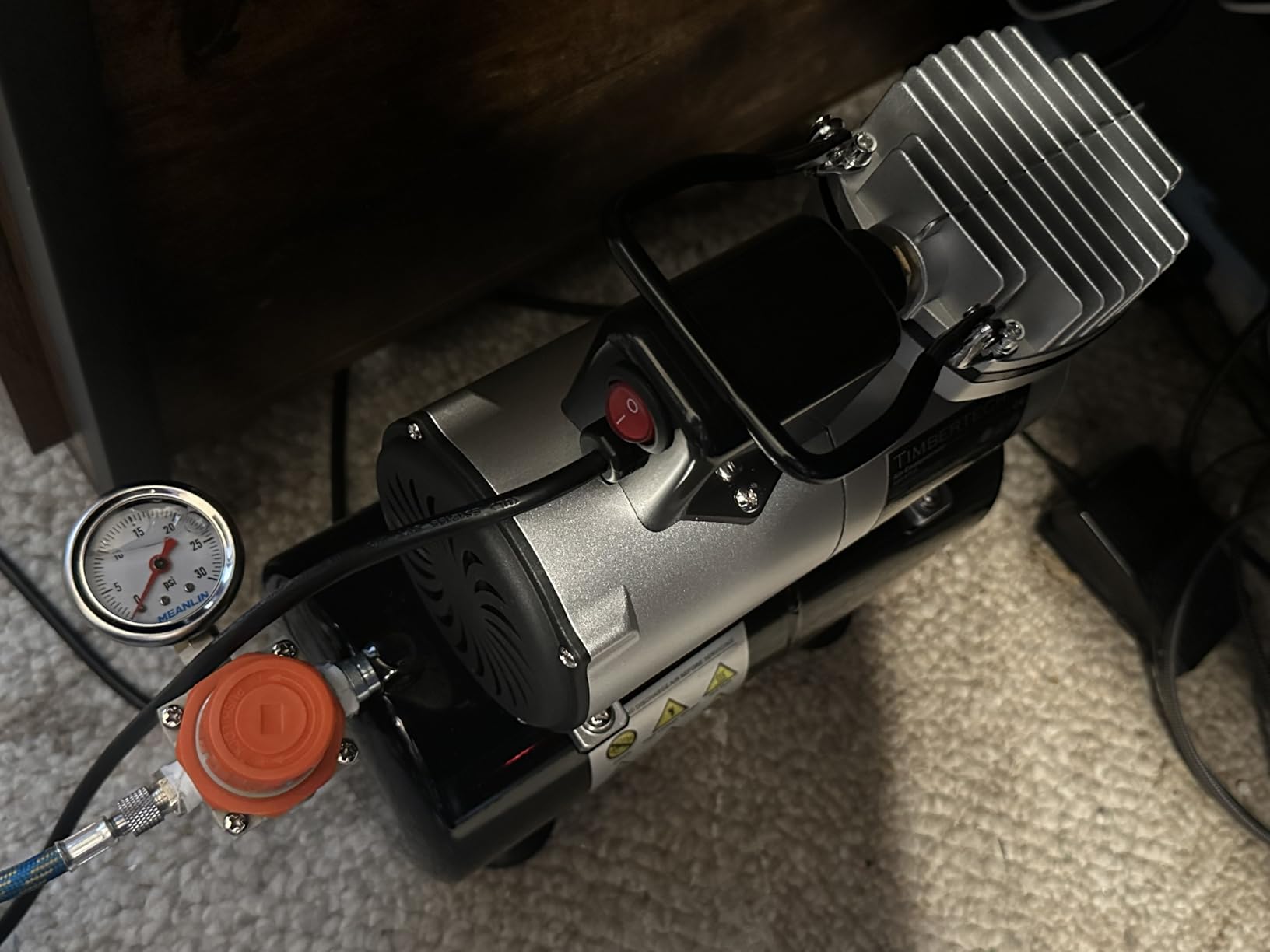
Owners treat this as a dedicated airbrush machine and it performs like one. Several report driving high-end Iwata and H&S airbrushes without trouble, and the 50 dB rating means it can sit next to your bench in a room where you are trying to hear a difference in your work.
The 3-liter tank is the constraint. It fills often, and on a longer session owners pause it to let it cool. If your airbrushing runs longer than a couple of hours at a stretch, budget for pauses or pick a larger unit from a different category.
Why the built-in water trap matters for paint?
Every one of those inline components exists to solve a specific problem. The water trap pulls liquid out of the line before it reaches the nozzle, and the filter catches what passes, and both defects show up in the finish as speckle, dark flecks, or a finish that fails to blend.
On a small airbrush job that is manageable. On a car panel it is not, which is why this unit sits at number three rather than higher, and why the bigger compressors on this list still need a separate dryer and separator installed.
When this is the wrong tool?
It is the wrong tool the moment you attach a spray gun. The manufacturer rates this as airbrush-only and explicitly excludes spray guns and pneumatic tools, and a 0.7 cfm supply cannot keep a gun atomizing at spraying pressure.
The fitted pressure gauge is also a genuine irritant. It is very small and its 0-100 PSI range is a poor match for airbrush working pressures, so most owners end up judging pressure by trigger feel rather than by needle position.
4. Metabo HPT EC914S – Best Budget Pancake With Real Airflow
- 200 PSI max and 4 cfm beat most pancake units
- Fast recovery after draw-down
- Light at 41 lb with a solid roll cage
- Owners run airbrush and spray gear off it
- Audibly loud under load
- Airflow drops at high elevation
- 6-gallon tank is small for sustained spraying
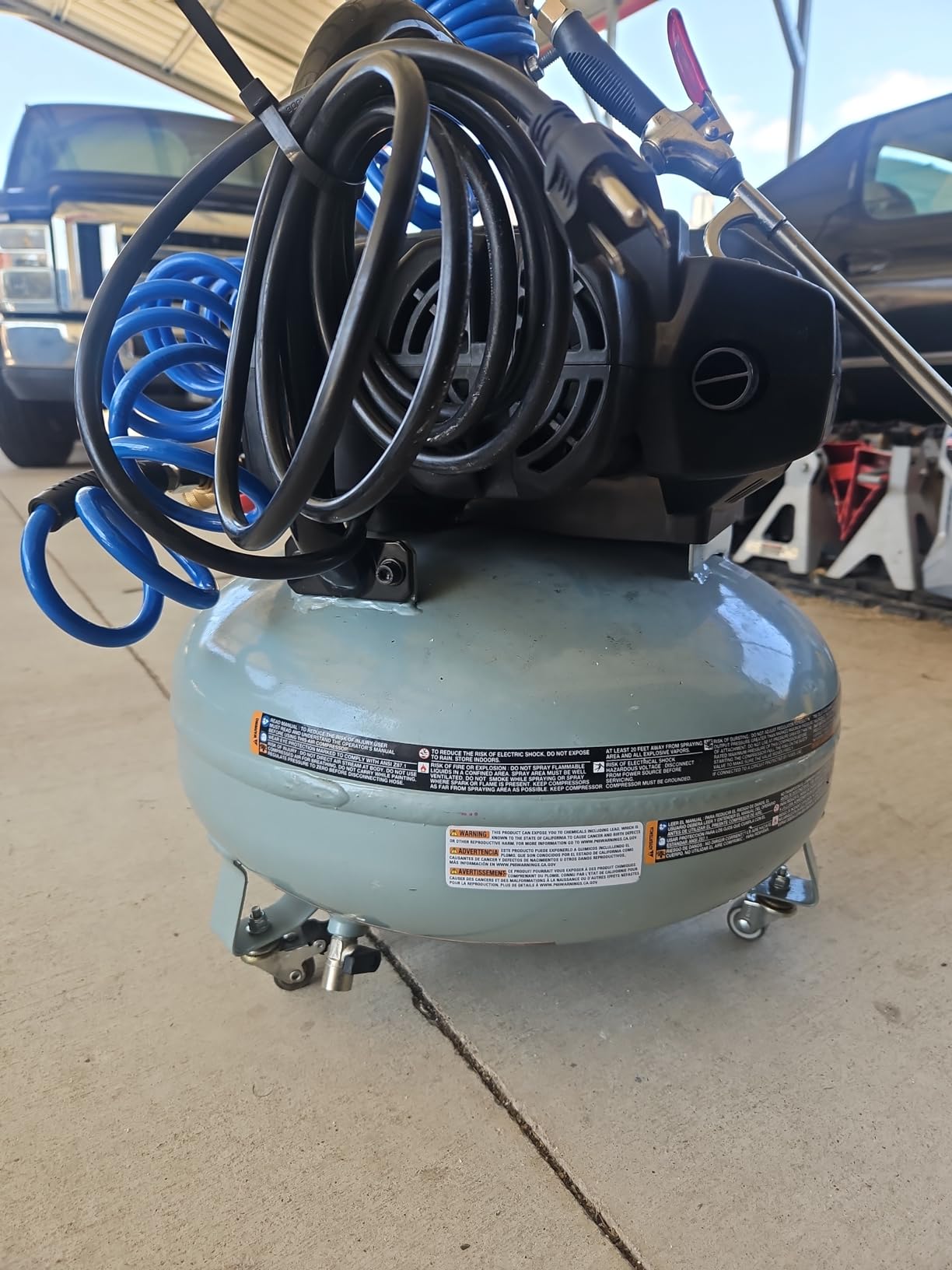
Most 6-gallon pancake compressors deliver about 2.5 to 3 CFM at 90 PSI and top out at 125 PSI. The EC914S is the exception: 4 CFM at 90 PSI, 200 PSI max, and a 73 dBA rating, in a 41-pound body that is roughly 22 percent lighter than a conventional twin-stack machine.
That 200 PSI storage pressure is the underrated part. The compressor can fill right up, so during a spray pull it has a much deeper reserve before the regulator starts sagging, which is exactly the behaviour you want when a gun is open full.
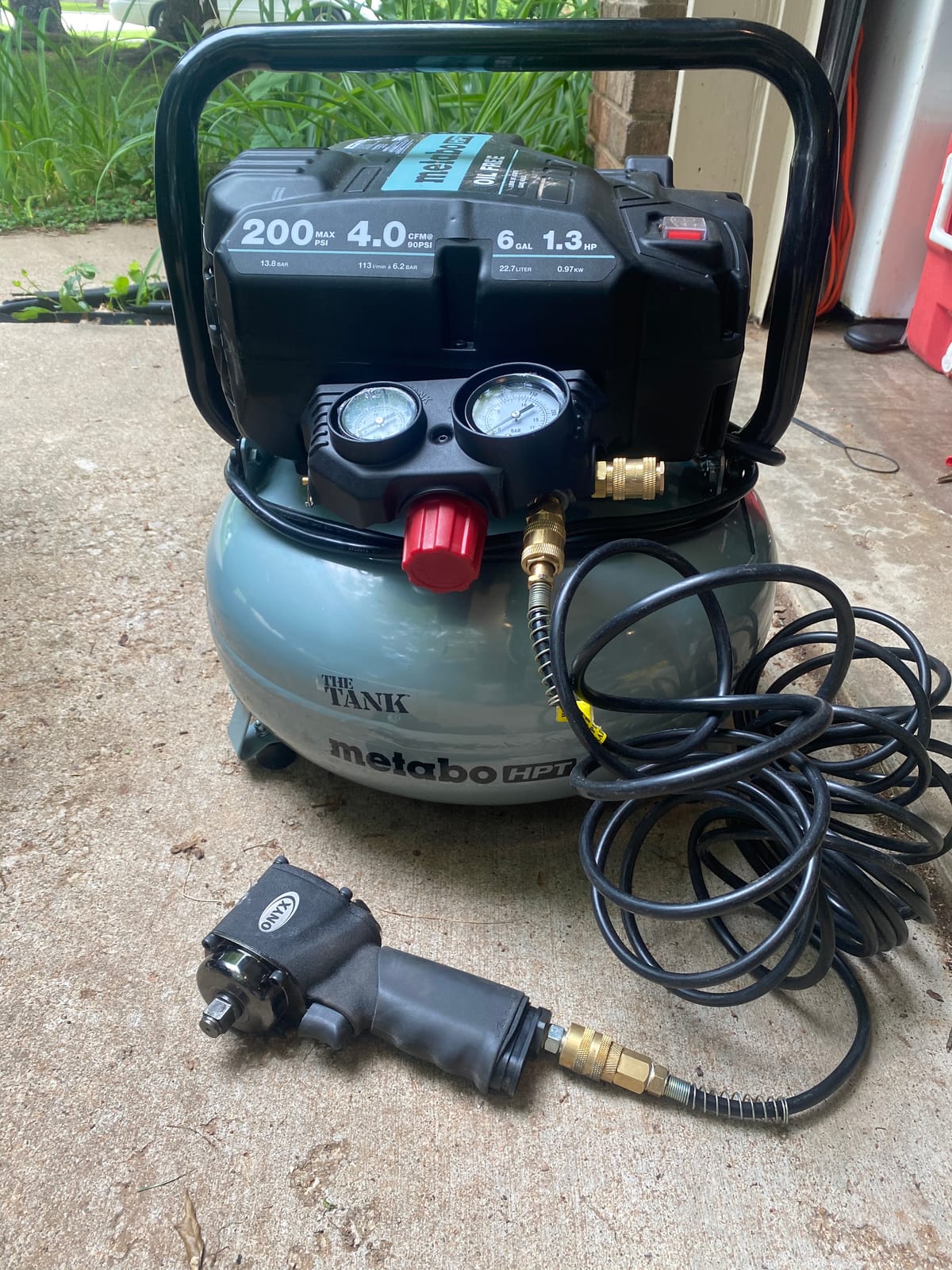
Owners consistently describe it as well built and stable, and several use it with airbrush guns and small spray equipment. Recovery after a draw-down is fast, which is why multiple nailers can run at the same time without depth inconsistency.
Noise is the complaint that shows up most. Several reviewers describe it as audibly loud under load, louder than the marketing suggests, and at 73 dBA it sits in the middle of this group rather than at the quiet end.
What 4 CFM actually buys you at the gun?
Four CFM covers a touch-up gun, a small HVLP detail gun, and a single panel on a low-pressure clear coat. It also covers blending, which is the job most people underestimate, because blending a colour transition is a long, thin, low-flow pass rather than a full wet coat.
It does not cover a full car. A full respray involves hours of continuous demand, and at 4 CFM with a 6-gallon tank this unit cycles hard enough that the finish, not the machine, ends up paying for the shortfall.
Check your altitude before you commit
Air density falls with altitude and a small oil-free pump feels it more than a large cast iron one. Owners at elevation report longer fill times and less delivery from the rated figure, so if you are high up, treat the 4 CFM number as a ceiling rather than a target.
The roll cage gets more appreciation than it gets credit for. It is what lets the machine sit on its side or its back in a vehicle without the pump hanging in oil, and it is a reason this holds up as a job-site unit rather than a bench-only machine.
5. DEWALT DWFP55130 – Best for Trim Work Alongside a Bigger Unit
DEWALT Air Compressor for Trim, 200-PSI Max, Quiet Operation (DWFP55130)
- 71.5 dBA oil-free pump
- quieter than typical small units
- 12 amp draw starts without tripping breakers
- Runs or stores in either orientation
- Dual couplers run two nailers at once
- 2.5-gallon tank cycles constantly for spray work
- 3 SCFM starves larger guns and a plasma cutter
The DWFP55130 is a trim compressor, and DEWALT says so plainly. At 2.5 gallons and 3.0 SCFM at 90 PSI it is built for finish and brad nailers, and pairing it with a larger spray unit is the arrangement a lot of serious home shops end up with.
Two numbers make it useful in a working garage. The 12 amp draw starts easily on a shared household circuit without tripping a breaker, and 71.5 dBA measured to ISO3744 is genuinely quiet for a compressor of this output.
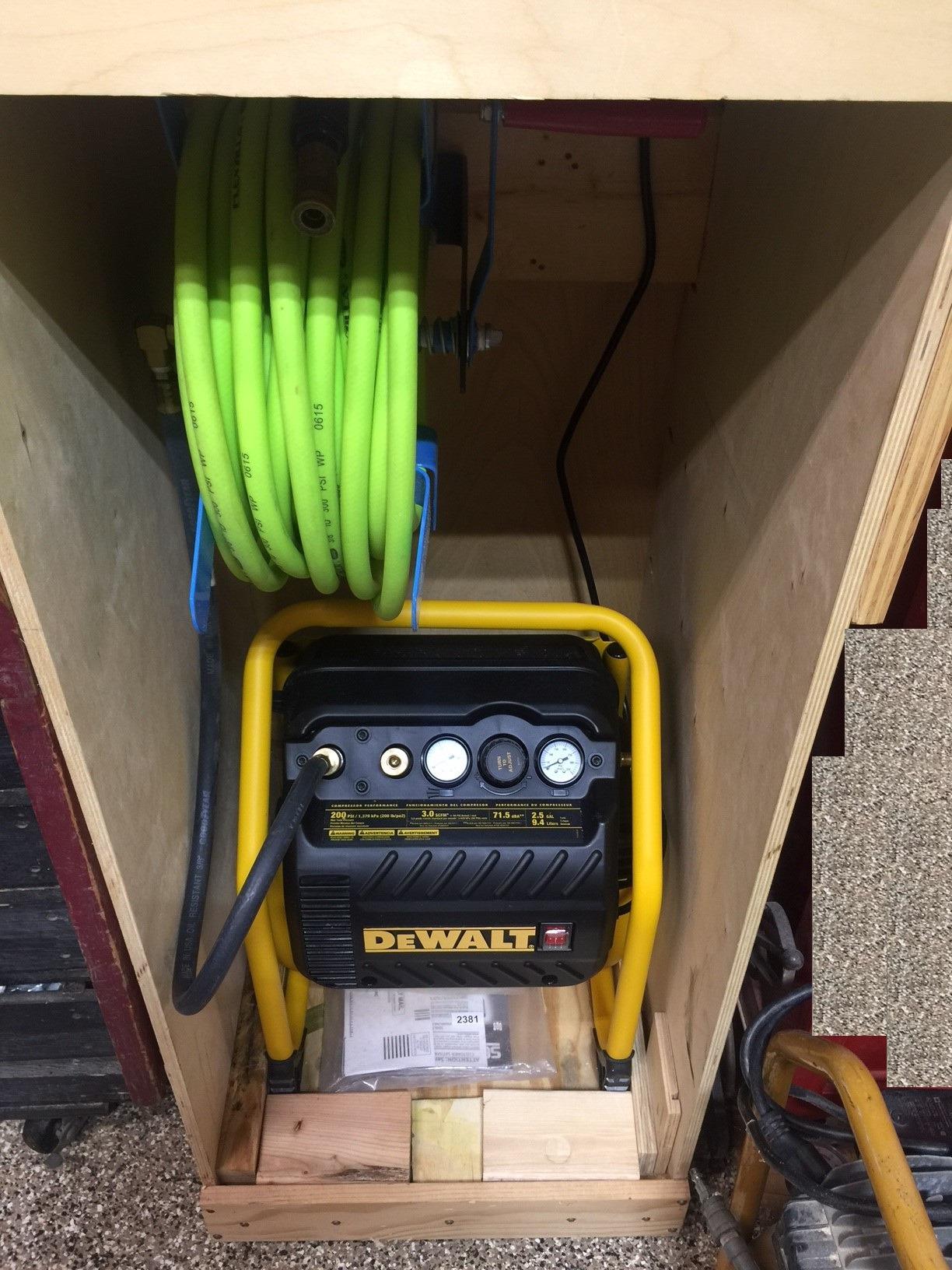
Owners like the flexibility of a machine that runs or stores in either orientation. That matters when the same unit serves a job-site nailer in the morning and a bench task in the evening, because you can park it upright against a wall without worrying about oil migrating.
The dual quick couplers are popular for running two finish nailers simultaneously, and the roll cage plus cord wrap protect the pump during transport. It is a well-considered small machine for the job it was actually designed to do.
When a two-compressor setup makes sense?
The enthusiasts who get the best results from a mixed garage run a small unit like this for nailers, blow guns and tools, and switch to a large tank only when a gun is open. It removes the cycling wear that comes from feeding framing nailers and a spray gun from one machine.
Short cycling is the real enemy of compressor life. A unit that fires every few seconds under a spray gun runs hot, and oil-free pumps tolerate that far less than cast iron ones, so separating tool duty from spray duty is the cheapest durability upgrade available.
Where 3 SCFM runs out of road?
Three SCFM is enough for trim, touch-up and a single small panel at low pressure. Push past that and the 2.5-gallon tank cycles so frequently that the pressure you set on the regulator is a memory rather than a setting.
Owners also note it will starve larger spray guns and a plasma cutter, which is a useful warning. If you own a plasma cutter, this is the wrong class of machine and no amount of clever pairing will change that.
6. Klutch 29-Gallon Vertical – Best 120V Tank for Panel Work
Klutch 29-Gallon Air Compressor, 2.5 HP, 120V, 175 PSI, 5.1 CFM at 90 PSI
- 29-gallon vertical tank holds serious reserve air
- Runs on 120V so no 240V circuit work
- Owners report holding pressure for a week
- Flat-free tires and handle work in a tight shop
- Vertical footprint saves floor space
- 81 dB is the loudest in this group
- 127 lb needs two people or a ramp
- One detailed review reports a bypassed power switch
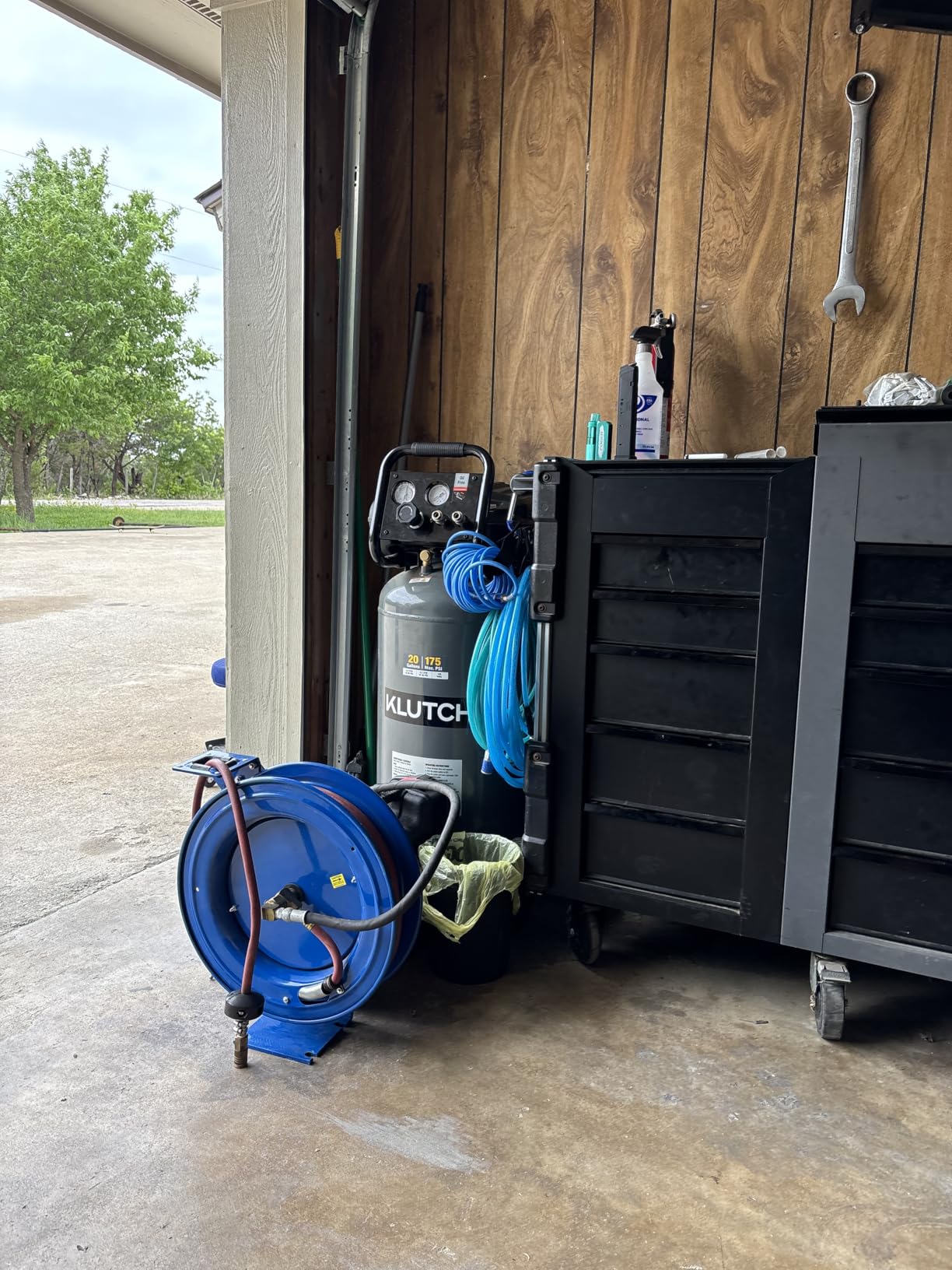
Capacity is the argument for the Klutch. A 29-gallon vertical tank is more air than most people running spray equipment in a home garage will ever own, and at 120 volts you can install it without an electrician.
Airflow is 5.1 SCFM at 90 PSI from a 2.5 hp motor, filling to 175 PSI max. In practice owners report that tools rarely stall waiting for a refill, and several describe pressure holding for a week with no measurable loss, which is what a properly rated steel tank should do.
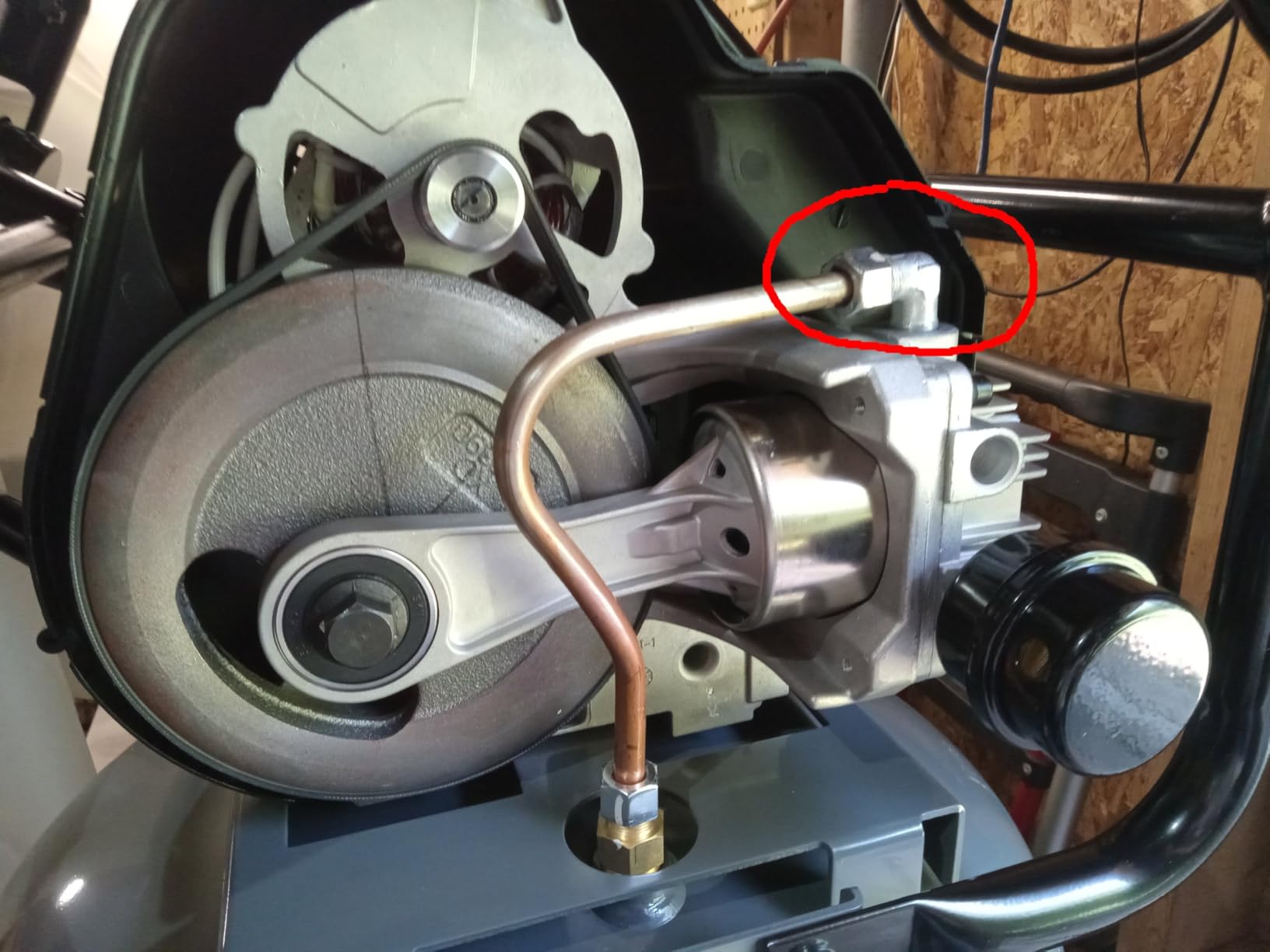
The vertical footprint is a genuine advantage in a one-car garage. It measures 23.2 by 21.1 by 45.3 inches, so it stands against a wall instead of sprawling across the floor, and the large flat-free tires plus a handle make it movable when you need the space.
Owners also call out the brass quick-connect coupler, which takes a hose swap one-handed. On a machine this heavy, being able to change a line without dragging the compressor around the shop is a bigger quality-of-life win than it sounds.
Why 29 gallons changes the spraying experience?
Tank volume is not the same as performance, and we will say that plainly. A big tank does not deliver more CFM. What it does is give you a much deeper air reserve, so a short high-flow pull comes off stored air instead of dragging the pressure down while the pump catches up.
That difference is what lets you hold a consistent gun pressure through a full pass rather than watching the needle wander, and it is why a 29-gallon tank at 120 volts can be a better painting experience than a small unit with a theoretically higher headline number.
What to check before you commit to a heavy vertical?
At 127 lb this is a two-person lift or a ramp job, and at 81 dB it is the loudest machine in this roundup. Neither is disqualifying, but both change your plan, so measure the door, the socket distance and your tolerance for noise before you order.
One detailed review reports a power switch that was internally bypassed, so the unit could not be shut off by its own switch. That is an isolated report rather than a pattern, but it is a good reminder to test the switch and the breaker the day the machine arrives.
7. VEVOR 15-Gallon – Best for High Airflow on a Lean Budget
VEVOR Air Compressor, 15 Gallon Steel Tank, 2HP 5.3 CFM@90 PSI Oil Free Air Compressor & Max. 125PSI Pressure, 78dB Ultra Quiet Portable Compressor, for Auto Repair, Tire Inflation, Spray Painting
- Owners find it far quieter than typical units at this output
- 5.3 cfm fills fast and holds pressure through spray work
- Seamless steel welds with no reported leaks
- Dual outlets run two hoses at once
- Power cord is roughly 40 inches
- Extension cords cause shutdowns or cycling
- Thin wheels and handle hardware
- 125 PSI max trails the 200 psi class
The VEVOR 15-gallon has the highest published airflow of any 120-volt unit in this roundup at 5.3 cfm at 90 PSI, paired with a 15-gallon steel tank. On paper that combination is closer to what a spray gun wants than anything else at this size and voltage.
The quiet claim holds up better than most. Owners consistently report that it is far quieter than typical pancake or hotdog compressors at this output level, and the 78 dB figure comes from a real silencer system with a thickened cover, a rubber muffler pipe and filter cotton.
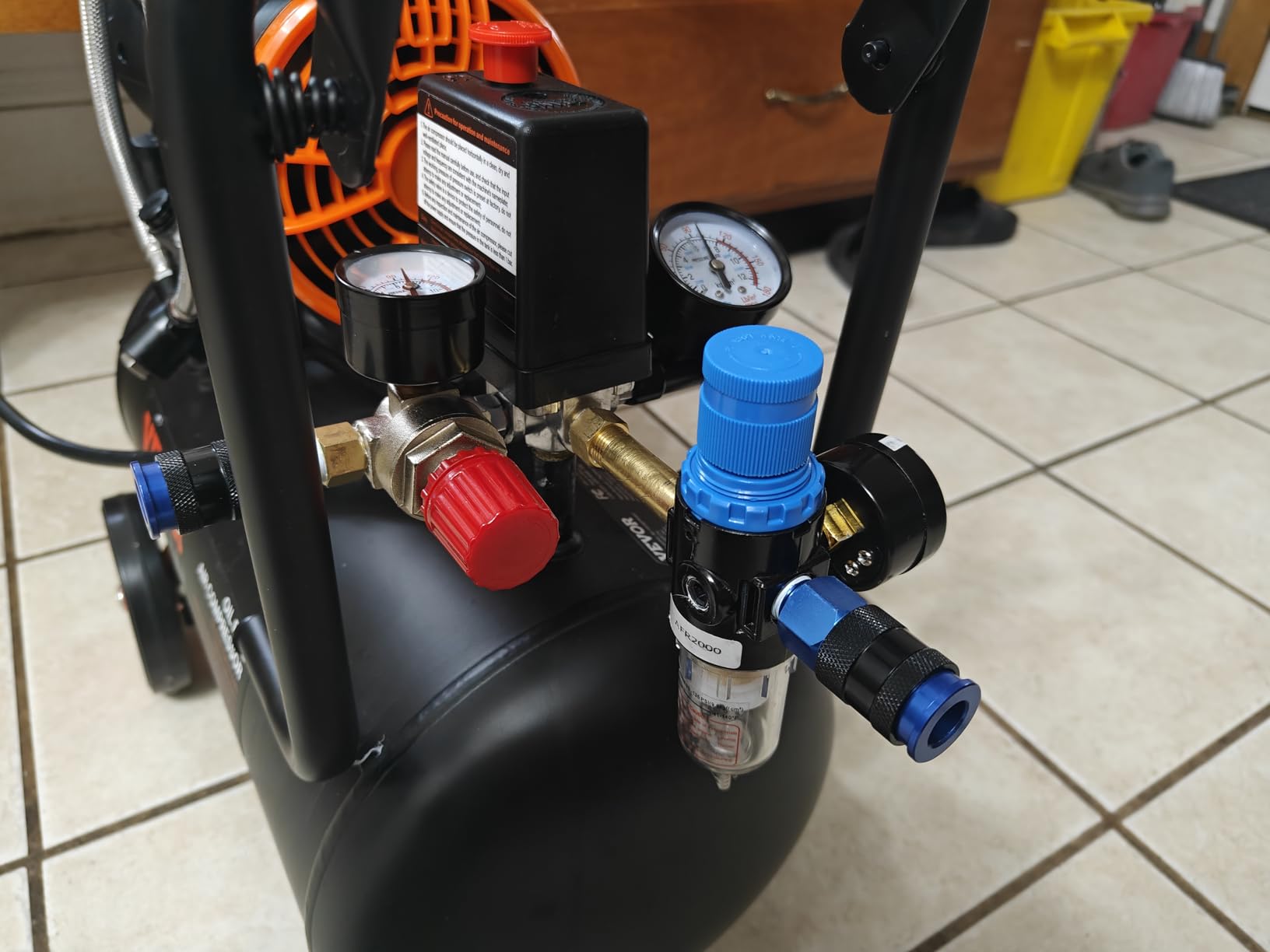
Build quality inside the tank is better than the exterior hardware suggests. Owners report three-layer Q235B steel with seamless welds and a rust-resistant coating, plus no air leaks from the tank after months of service, and several mobile detailers use it successfully with air tools.
Value is the reason it keeps appearing in recommendation threads. Multiple owners note that comparable specifications from other brands cost substantially more, which matters when the compressor is one purchase inside a larger garage build.
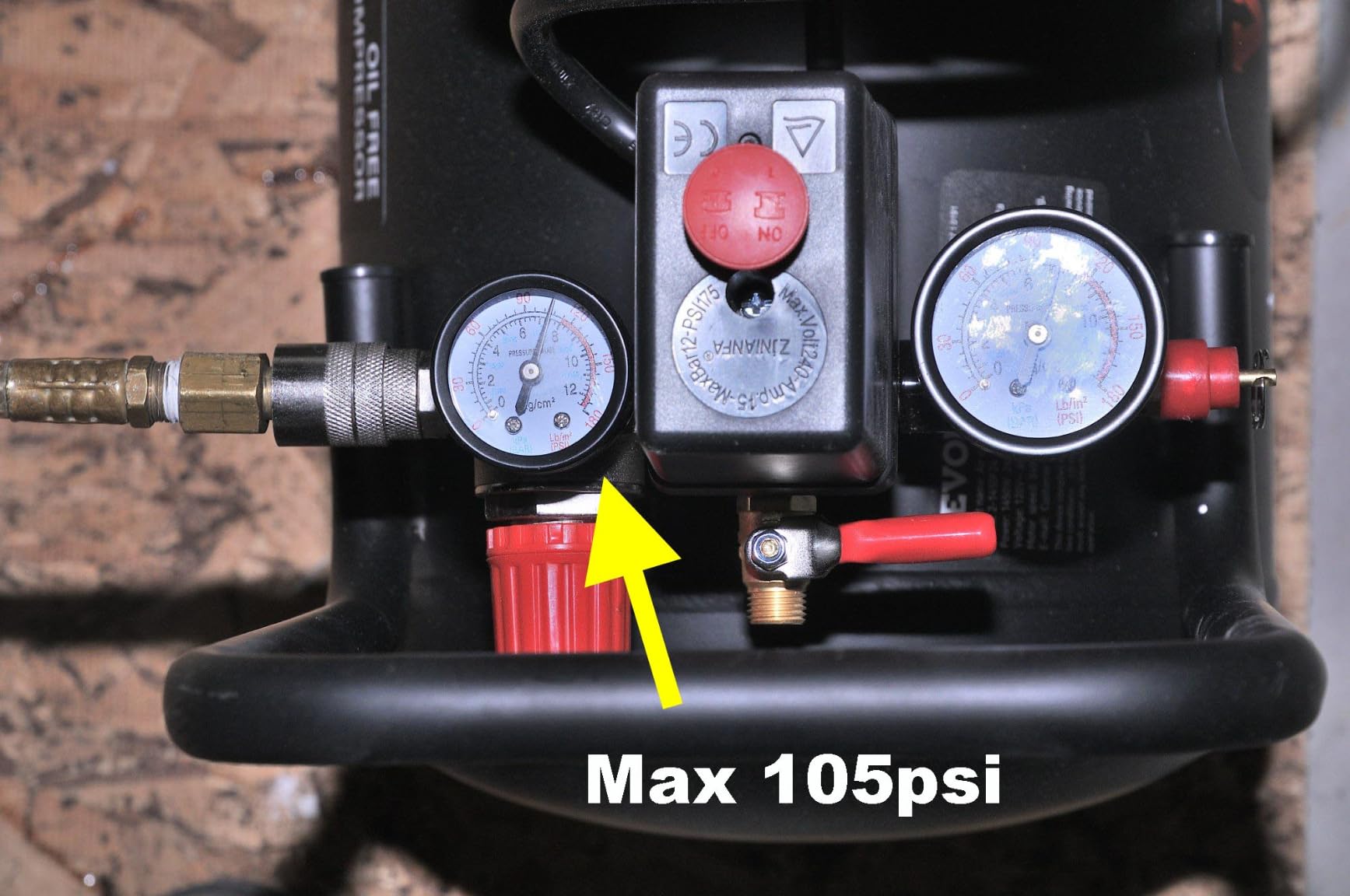
The power cord will decide where this lives
The cord is roughly 40 inches, and owners are clear that this unit dislikes extension cords, which can cause shutdowns or cycling issues. That means the compressor has to sit close to a wall outlet, and in a typical one-car garage that is a placement decision you should make before the machine arrives.
The other placement note is the 125 PSI maximum. A 15-gallon tank filling to 125 PSI gives you plenty of stored air, but you have less headroom above working pressure than a 200 PSI pancake, so a sudden full-open gun pull pulls down further.
What to watch during long sessions?
The motor housing runs hot enough to feel sharp during extended runs, and the automatic overheat protection will cut in if you push it hard. Plan pauses between panels rather than trying to spray a whole car in one continuous session on this unit.
Two smaller items: the wheels and handle are thin compared with the tank and pump, and the wheels and handle are the first things to fail on a unit this size. If you roll it regularly, budget for a caster swap rather than a compressor replacement.
8. Makita MAC320Q – Best for Quiet Indoor Work
Makita MAC320Q Quiet Series 1-1/2 HP, 3 Gallon, Oil-Free, Electric Air Compressor
- Quiet enough that air tools
- not the compressor
- are loudest
- Fast recharge keeps pace with continuous tool demand
- Oil-free dual-piston pump needs no maintenance
- Dual outputs with separate tank and tool gauges
- Solid build owners expect to outlast cheaper units
- Bigger and heavier than the 3-gallon rating suggests
- 135 PSI max cycles more often than 200 psi units
- Quick-connect fittings can stick open
- Some need unplugging before they restart
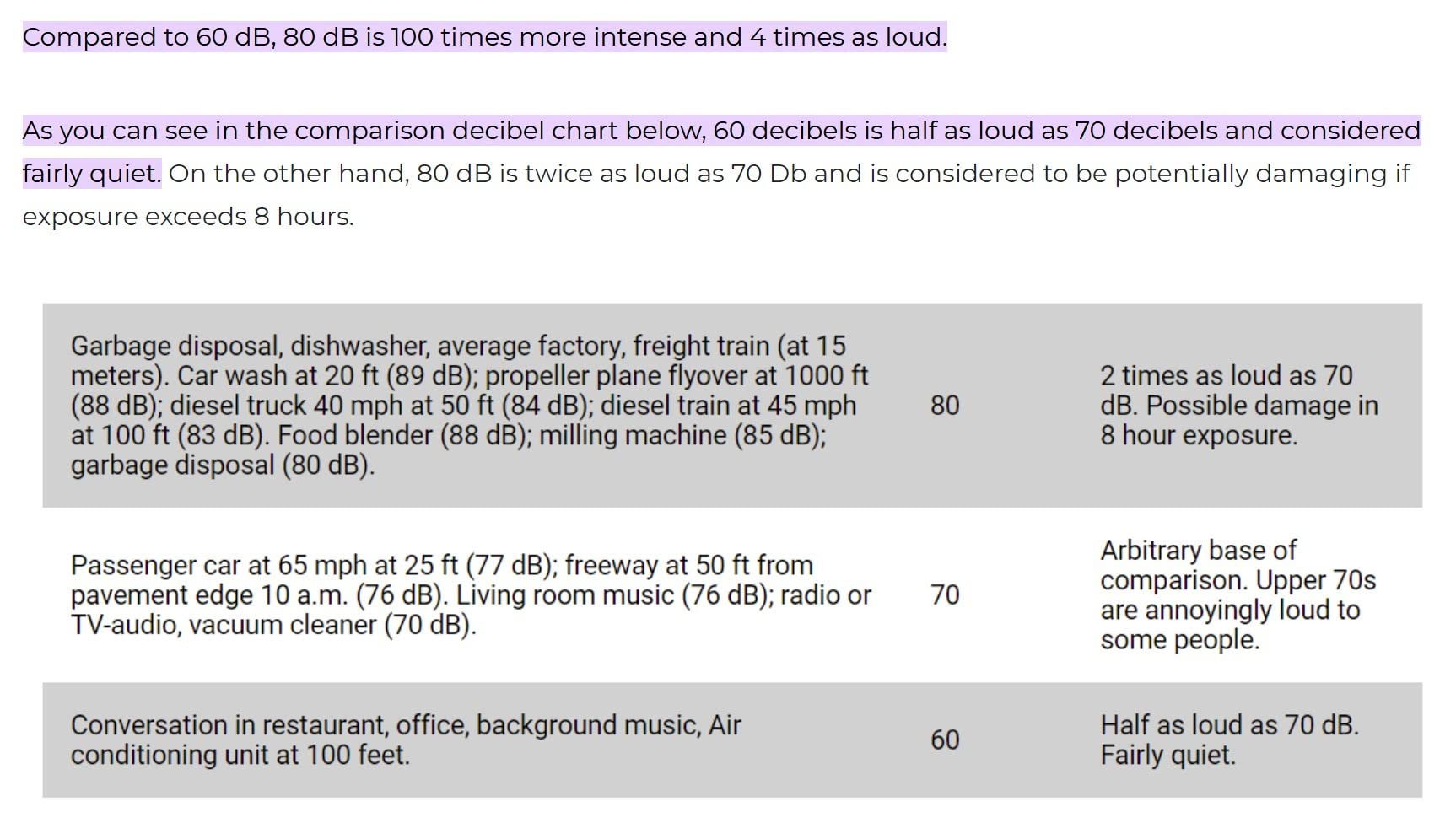
Makita built the MAC320Q for people who cannot work next to a loud machine. At 60 dB it is the second quietest compressor here, and owners upgrading from entry-level units say the compressor stops being the thing they hear at all.
The motor runs at a lower 1750 RPM for longer motor and pump life, and the oil-free dual-piston pump removes maintenance from the ownership list entirely. The 8.5 amp draw is also one of the lowest in the group, so it will not fight you over a circuit.
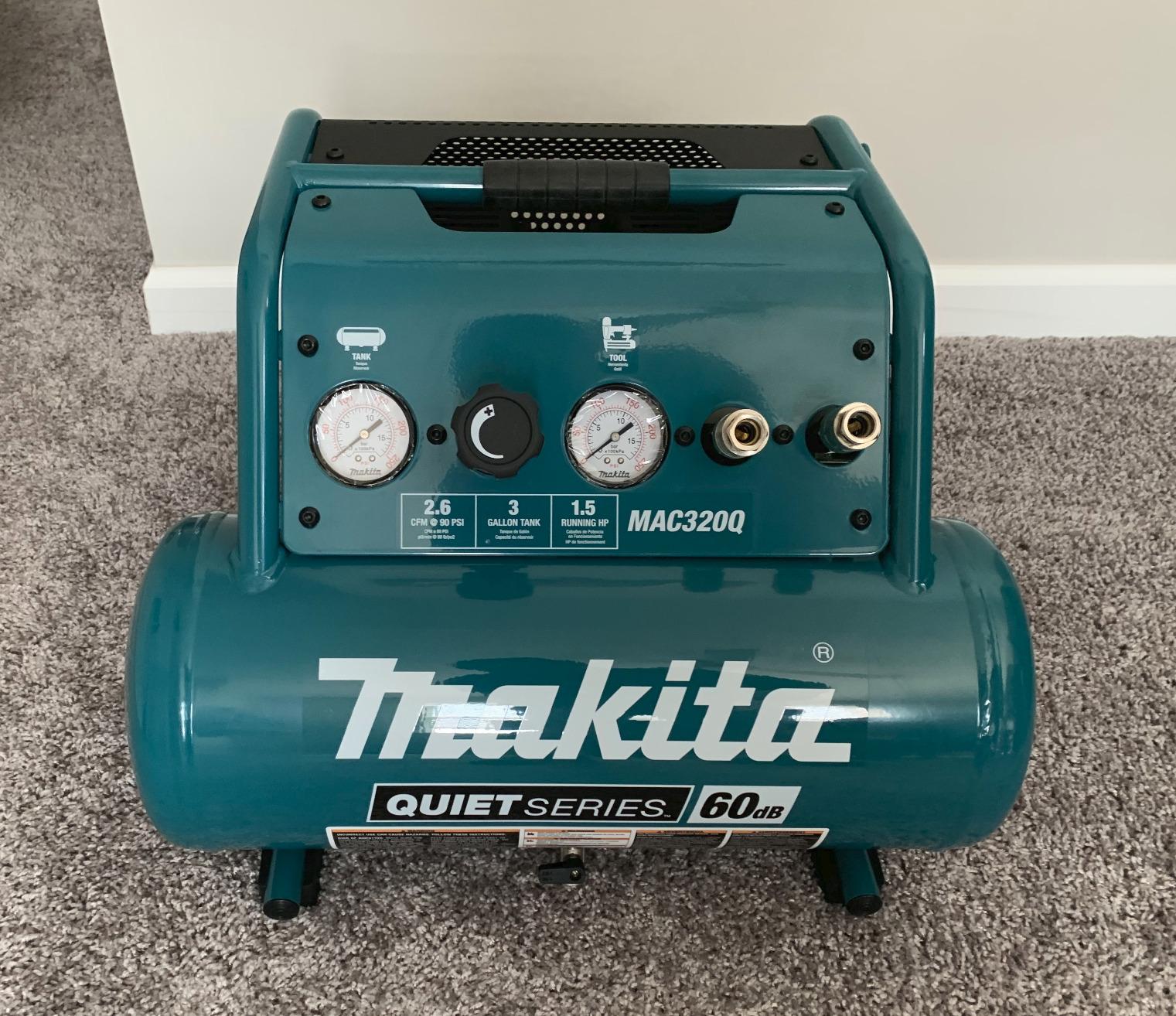
Recharge speed is the second thing owners notice. It refills fast enough to keep pace with continuous tool demand, which avoids the dead wait that owners of 1-gallon compressors describe, and that is why it shows up in finish carpentry and small powdercoating setups.
Control is the third. Two hose outputs plus separate tank and regulated tool pressure gauges means you can set gun pressure independently of line pressure, and for spraying that separation is the difference between a repeatable pass and a guessing game.
Where the 3-gallon label stops being accurate?
Owners consistently report this is larger and heavier than 3 gallons suggests, with several saying it is bigger and heavier than the 6-gallon unit it replaced. The listed dimensions of 12 by 12 by 12 inches are reported by owners to be wrong, so measure your shelf space rather than trusting the spec sheet.
That matters because the whole appeal of a compact quiet compressor is that you can hide it. If you cannot, the 60 dBA advantage is much less useful, since you will be standing next to it rather than across the garage from it.
Long-ownership gripes worth knowing
At 135 PSI max it cycles more often than the 200 PSI units in this roundup, and that extra cycling is the main reason for the 4.6-star average sitting where it is rather than higher. Some owners also report that hose quick-connect fittings stick open, and that the unit needs unplugging and a drain valve opened before it will restart after a tripped breaker.
Actual noise can also exceed the 60 dBA spec according to some owners, usually when the pump is running under heavy load rather than filling. Treat 60 dBA as the filling figure and expect more during a spray pull.
9. DEWALT D55146 – Best for High Stored Tank Pressure
DEWALT Air Compressor, 225-PSI Max, Hand Carry with Wheels, 4-1/2 Gallon (D55146)
- Fills to 200-220 PSI and cycles near 160 psi
- Owners report service life beyond a decade
- Stores upright with two output ports
- Large 2 inch gauges behind a protected console
- Oil-free so no oil in the supply air
- 88 lb and bulky
- a two-person load
- Full 15 amp draw needs its own circuit
- Tank is hard to drain without tilting to 45 degrees
- Regulator output caps near 140-150 psi
The D55146 is the only unit here with 225 PSI tank storage, and that is a bigger deal for paint work than the tank size suggests. It fills to roughly 200-220 PSI and cycles on around 160 PSI, which puts a deep reserve above any gun pressure you would ever set.
Long-term ownership is the headline here. Several owners report machines still running after a decade of service, and that durability record is why this unit survives in garages that have been repainted and reorganized twice.
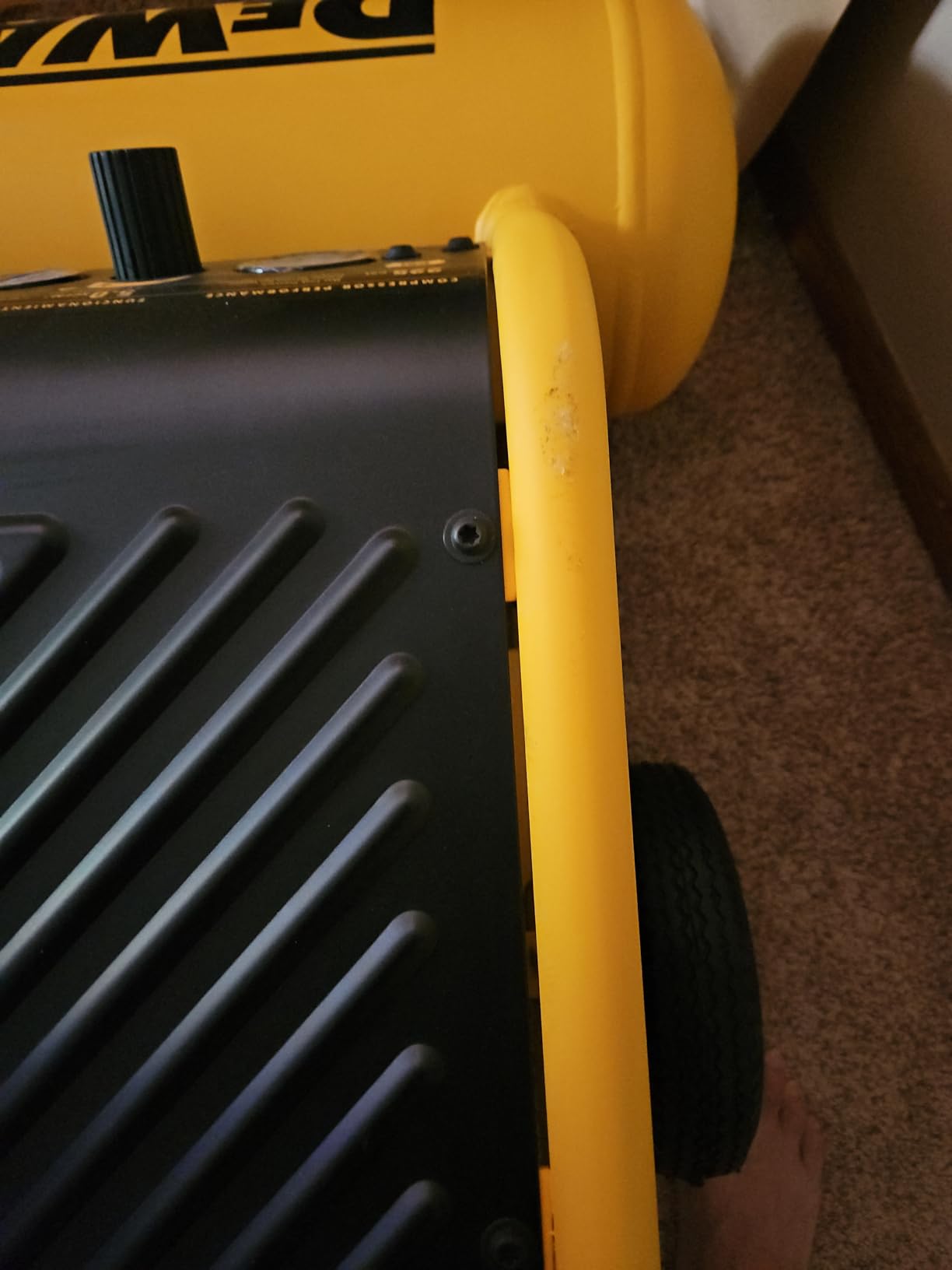
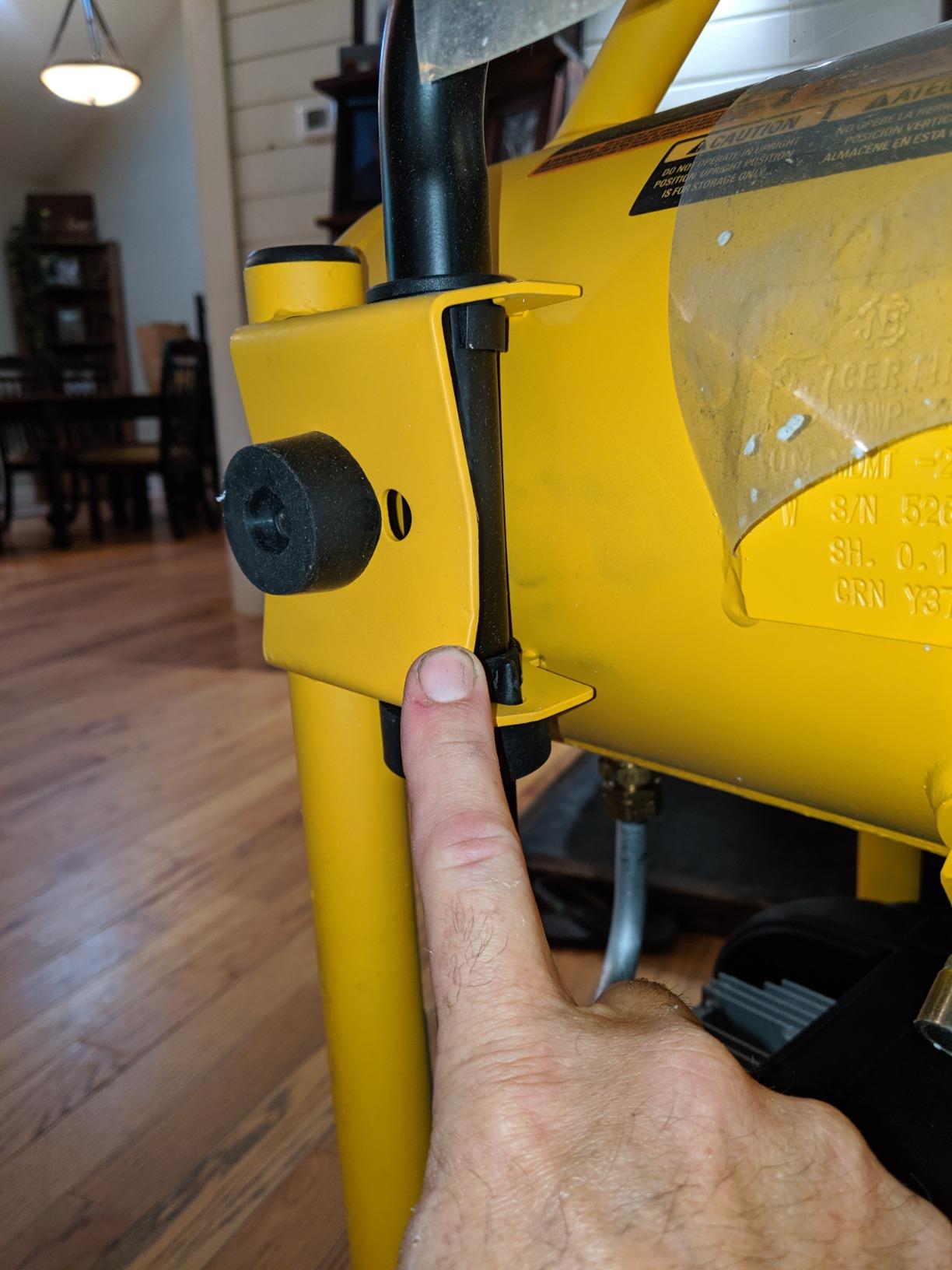
Storage and access are handled well. It stands upright to save floor space, has two output ports for simultaneous hoses, and puts large 2-inch gauges and couplers behind a protective metal console, which is where a 225 PSI tank can hurt someone if it is left open.
It is also oil-free, so there is no pump oil in the supply air, and the 10-inch non-flat pneumatic tires make it genuinely movable across a shop floor once you get it out of a vehicle.
What stored pressure really does for a spray pass?
Pressure in the tank is reserve. When you open a spray gun, the regulator feeds from that reserve, and a 200-plus PSI tank holds the delivered pressure steady far longer than a 125 PSI tank does, so a long pass across a door does not drift.
That is a real finish benefit. Consistent gun pressure means consistent atomization, which means consistent film thickness, which means fewer areas that need a second coat and fewer sand-throughs when you find a sag.
The limitations are physical, not electrical design flaws
At 88 lb and bulky, loading this into a vehicle is a two-person job. It draws a full 15 amps and needs its own dedicated circuit, which rules it out of a shared household outlet and rules out a garage with a shared circuit at all.
Two more practical notes. The tank is hard to drain properly and must be tilted to about 45 degrees to empty, and the regulator output caps around 140-150 PSI, which means the extra stored pressure cannot be fully used and can damage the regulator if you lean on it. The 3-in-1 couplers also reject some high-flow connector styles.
10. Timbertech AS18-2K Airbrush Kit – Best First Airbrush Setup
Timbertech Airbrush Kit With Compressor AS18-2K Basic Start Kit With Air Hose, Cleaning Brushes, and Test Paints for Hobby, Body Tattoo, Model painting, Automotive Graphic, Make-up
- 47 dB pump autostarts and autostops instead of running flat out
- Steady pressure with fine regulator adjustment
- Bundle includes airbrush hose brushes and filter
- Owners suggest pairing it with a better airbrush
- Lock-down cap stops the regulator drifting
- Bundled airbrush clogs easily and is hard to clean
- Working pressure tops out near 30 PSI
- Included test paints are considered low quality
- Compressor runs hot during long sessions
The AS18-2K is the cheapest way to find out whether you like airbrushing before you commit to a garage setup. At 47 dB it is the quietest unit in this roundup, and the autostart at 3 bar with autostop at 4 bar means it only runs while you are actually spraying.
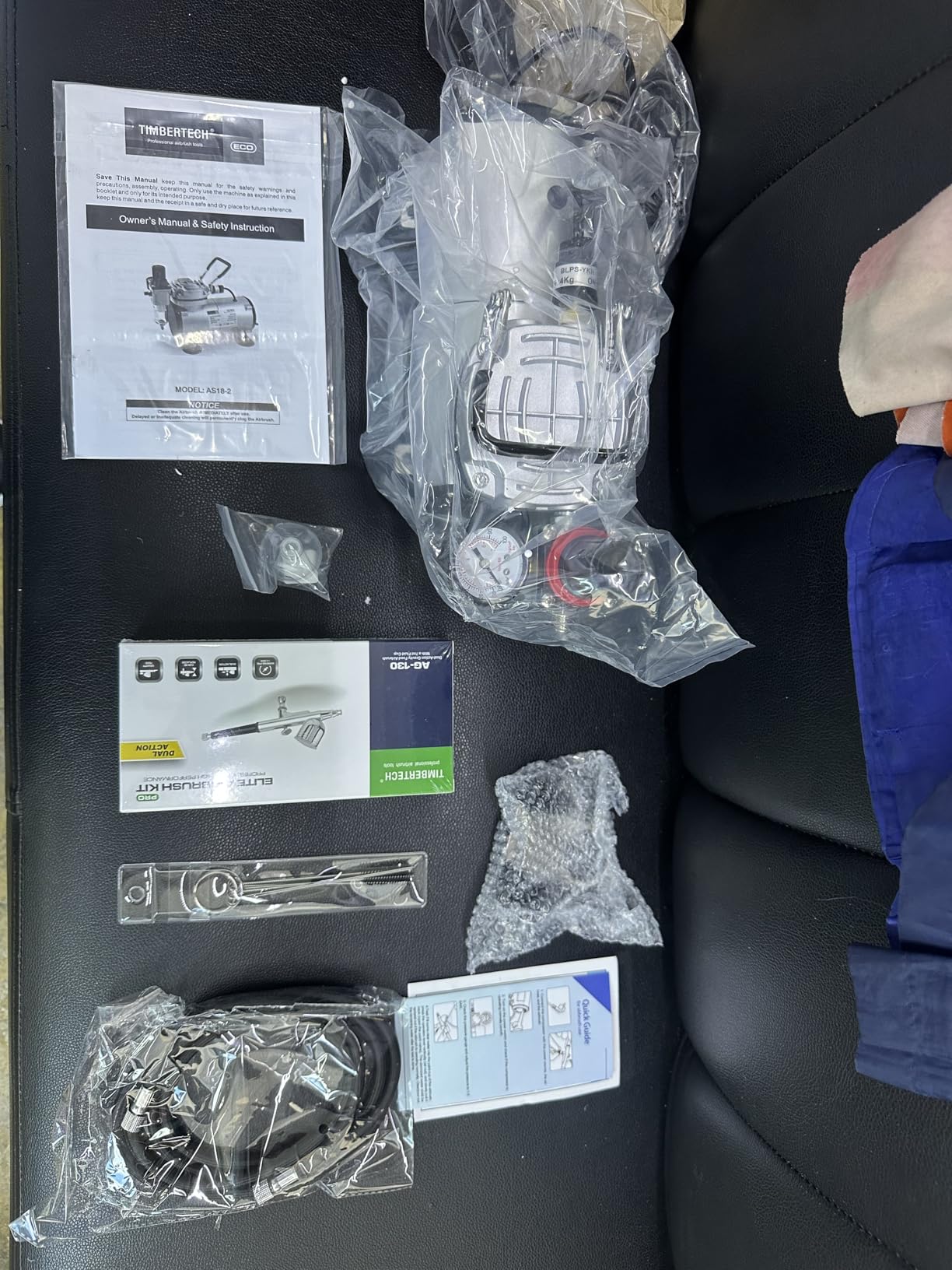
Reviewers rate the compressor half of this kit highly on its own. They describe steady pressure that responds to fine regulator adjustments, and the regulator, gauge, water trap, filter, relief valve and overheat protector are all fitted at the factory.
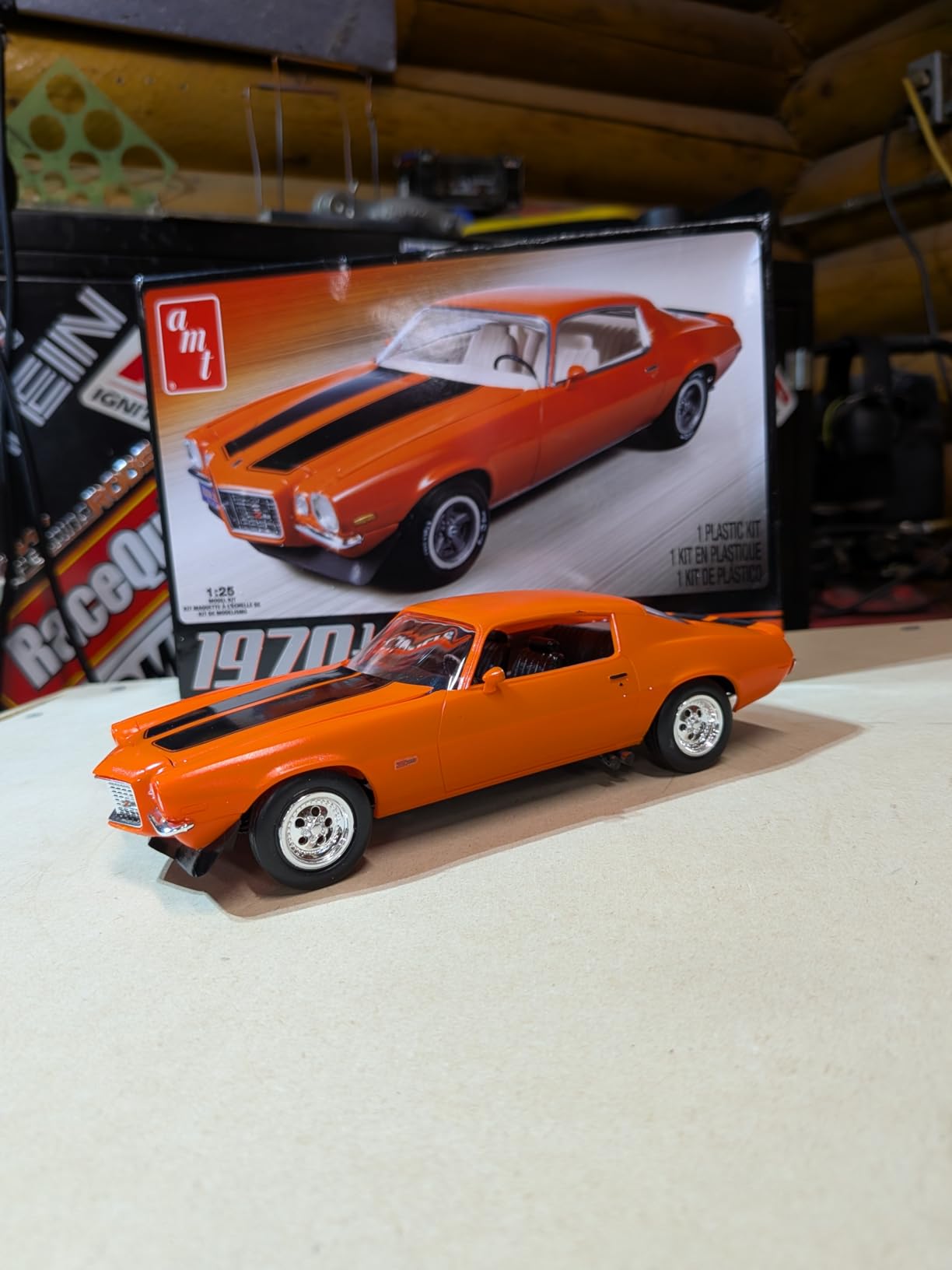
The common recommendation from experienced owners is to keep the compressor and replace the airbrush. Several note that buying a separate airbrush still costs less than a premium all-in-one kit, and the included double-action gravity-feed brush with a 0.30mm nozzle is the part most likely to disappoint you.
That brush clogs easily, is hard to clean, and one unit reportedly failed after brief use. The included test paints are also considered low quality, so buy proper paint before you judge the technique.
When a 30 PSI ceiling is acceptable?
Thirty PSI is ample for model painting, nail art, cake decorating, temporary tattoos, spray tanning and automotive graphics on small parts. If those are your jobs, this is a complete answer, and the quiet operation means you can work on them in a room with people in it.
It is not enough for thinned primer or heavier-viscosity paint, which is where owners hit the limit. If your plan includes primers on a panel, move up to a unit with a real tank and a higher ceiling.
Why autostart and autostop matter for a shared room?
Most small compressors run continuously from the moment they switch on, which is why they are the loudest thing in a workshop even when you are not using them. Autostart at 3 bar and autostop at 4 bar means this one runs only during a trigger pull.
That design choice, plus the lock-down cap that stops the regulator setting from drifting, is why it suits a hobby bench rather than a paint booth. The compressor still runs warm during long sessions, so give it breaks.
Buying Guide: Sizing a Compressor for a Paint Job in 2026
Start with the gun, not the tank. Every spray gun publishes a CFM figure at a stated pressure, and that number is the demand you have to meet. A 1.3 mm HVLP gun sitting at 30 PSI wants roughly 7 CFM, a 1.8 mm gun at 40 PSI wants closer to 14, and a small detail gun wants 2 to 3.
Then add headroom. The compressor should deliver 1.5 to 2 times the gun’s published CFM. This one rule appears in almost every technician write-up and in very few product roundups, and it exists because you cannot run a compressor at its rated output indefinitely while also filling the tank it just emptied.
Gun class to compressor size
Airbrush and touch-up guns at 15-30 PSI: 0.5 to 1 CFM, a 2 to 6 gallon tank. The two Timbertech units and the Master Airbrush bundle cover this class.
LVLP and MP10 guns at 25-35 PSI: 3 to 6 CFM, a 6 to 15 gallon tank. The Metabo HPT, VEVOR, California Air Tools and Klutch all land here.
HVLP guns at 30-40 PSI: 7 to 12 CFM, a 20 to 30 gallon tank. This is the smallest class that comfortably holds a full pass.
High-build primers and full respray guns at 40 PSI: 14 to 20 CFM, a 60 to 80 gallon tank with a 5 to 7.5 hp two-stage pump. Nothing in this roundup reaches this class, and that is an honest gap rather than an oversight.
Project size to tank size, with a 26-gallon verdict
A 26-gallon air compressor is a fair panel and touch-up size, not a whole-car respray size. It will hold enough air for a door, a fender, a hood, and most blends, and the answer to whether it is any good for painting cars is yes for a car in pieces and no for a car in one piece.
Full car respray means hours of continuous demand, not 30-second tool bursts, and no 26-gallon unit from this list is built for that. If a full respray is the project, budget for a 60-gallon two-stage shop compressor and a dedicated 240-volt circuit, and plan the paint booth separately.
One smart middle path is running two compressors. Keep a small unit for tools and a large unit for spraying only, which is exactly the arrangement our twin stack air compressor guide covers for buyers who want tool capacity and paint capacity without one machine doing both badly.
Single-stage, two-stage, oil-free and oil-lubricated
A single-stage pump compresses in one pass and is cheaper, lighter and fine for a panel. A two-stage pump compresses twice, runs cooler, pulls less power per CFM and holds pressure far better under sustained load, which is why every full-respray recommendation you will read names a two-stage machine.
On oil-free versus oil-lubricated the online advice is more divided than the marketing suggests. The common instruction is that oil-free is mandatory for automotive work, and oil-free pumps do keep oil out of the line by design. Enthusiasts on r/projectcar counter that an oil-lubricated cast iron pump survives the high duty cycle of painting longer, provided you fit a proper coalescing filter and separator.
The balanced answer is that oil-free is the lower-risk default for a one-car garage, and oil-lubricated wins on longevity for a shop that sprays every day. Whichever you choose, the filter is not optional, and the reason is in the next section.
110V versus 240V and duty cycle
Anything above about 3 hp, and every 5 hp two-stage, wants 240 volts and a dedicated circuit. The 2.5 hp Klutch and the 1.6 hp DEWALT D55146 run on 120 volts, which is why the D55146 needs its own 15 amp circuit and the Klutch does not.
Duty cycle is the percentage of time a compressor is permitted to run. Paint duty is closer to continuous than tool duty, and that gap is exactly why oil-free compressors in this roundup report thermal shutdown after 30 to 45 minutes while cast iron two-stage units keep going.
What to avoid?
Avoid anything under about 4 CFM at 90 PSI if a real spray gun is going to hang off it. Also avoid 2 to 3 gallon pancake units for anything beyond a single small panel, and treat any compressor advertised only with tank size and maximum PSI as a tool machine rather than a paint machine.
Two buying mistakes show up over and over. The first is buying too small and buying twice, which is why this guide is organized around CFM rather than gallons. The second is buying a compressor and never fitting a dryer, which is the subject of the next section.
Air Quality: Dryers, Separators and the Defects They Prevent
Compressor air is wet. Warm air carries moisture, a cooling tank condenses it, and that water carries straight to your gun unless something removes it. This is the single most common cause of a failed DIY paint job, and it costs almost nothing to fix.
A water separator or moisture trap at the tank removes bulk liquid water and is included on the two Timbertech units. It prevents dark flecks and speckle in the finish.
An inline dryer or refrigerated dryer removes the remaining moisture down to a much lower level. It is what prevents fish-eyes, the small craters caused by surface tension around a contaminant.
An after-cooler drops air temperature before it enters the tank, so less moisture condenses inside the steel in the first place. One r/projectcar owner describes fitting one between the pump and the tank on a 5 hp 60-gallon two-stage and reporting no paint problems afterward.
A dedicated high-flow regulator with a gauge lets you set gun pressure once and read it accurately, instead of guessing from trigger feel. It also keeps pressure stable across a long pass.
Correct fittings matter more than people expect. Short undersized hoses and cheap quick-connects starve the gun of airflow, and a starved gun atomizes badly no matter how good the compressor is.
Each of these maps to a named defect. Blushing, where a coat goes milky or dull, comes from solvent evaporating too fast in moving air. Fish-eyes and cratering come from oil or silicone on the surface or in the air. Bubbling and popping come from moisture and from a coat applied too soon over a solvent-heavy one.
Good filtration solves the first two. Good air, correct temperature and correct flash times between coats solve the third. None of that costs more than a compressor does, and skipping it is the most expensive shortcut in car painting.
One safety note for garage work. Keep the garage door fully open and the ventilation running whenever you spray, and never run a combustion-heated compressor in an enclosed space. Solvent vapours and carbon monoxide do not mix well, and a cross-draft also helps you avoid overspray on the fresh coat.
Frequently Asked Questions
What size air compressor should I use to paint a car?
A full car respray wants a 60 to 80 gallon tank, 5 to 7.5 horsepower, and 10 to 20 CFM at 90 PSI, ideally a two-stage pump. A single panel, door or spot repair needs 20 to 30 gallons and about 5 CFM. Touch-ups and trim work need 6 to 8 gallons and roughly 4 CFM.
How many CFM do you need to paint a car?
For a full respray with an HVLP or high-build primer gun, 14 to 20 CFM at 90 PSI. For a single panel or door with an LVLP gun, 5 to 7 CFM. For touch-up work, 2 to 3 CFM. Use 1.5 to 2 times your gun’s published CFM figure so the compressor can sustain the demand and refill the tank at the same time.
Is a 26 gallon air compressor good for painting cars?
A 26-gallon unit is a good size for single panels, doors, spot repairs and blending, provided it delivers at least 5 CFM at 90 PSI. It is not a whole-car respray size, because a full respray demands hours of continuous airflow rather than short bursts.
Which is better for car painting, HVLP or LVLP?
LVLP and MP10 guns are easier to run because they use less air at lower pressure, so they need roughly 3 to 6 CFM and work with mid-size compressors. HVLP guns atomize more efficiently and reduce overspray, but they demand 7 to 12 CFM or more, so they need a larger two-stage unit. For a home garage, LVLP is usually the more realistic pairing.
Can I use a small air compressor to paint a car?
A small compressor under 4 CFM at 90 PSI can handle touch-ups, trim and one small panel, but pressure will sag mid-pass on anything larger and the finish will show orange peel and streaking. A 2.5 gallon pancake cycles constantly and will wear out quickly. For anything beyond a single panel, use at least a 6 gallon compressor with 4 CFM or more, and fit a water separator and dryer.
The Best Air Compressors for Painting Cars in 2026
The Master Airbrush Cool Runner II kit takes our Editor’s Choice because it is the best-rated and most-reviewed product here at 4.6 stars across 7266 reviews, and because it arrives with everything a beginner needs in one box. Pick it for detail, trim, blends and touch-ups rather than for a respray.
For actual spray gun work in a home garage, the California Air Tools 10020C is the one we recommend. Five-point-three CFM at 90 PSI into a 10-gallon tank, oil-free, and quiet enough at 70 dBA to run after dark, and it suits a panel or a door very well.
Buy the VEVOR 15-gallon if you want the highest published airflow available on 120 volts, and buy the Klutch 29-gallon if you want tank volume and no electrical work. Skip all of them and go to a 60-gallon two-stage shop compressor if a full respray is the actual plan.
Whichever you choose, size it by CFM at 90 PSI, not by gallons, and fit a water separator and inline dryer before the first coat. A compressor that can feed your gun but cannot keep the air clean is how a good paint job gets sanded off on a Saturday. If you are still comparing formats, our pancake air compressor guide for DIYers and portable compressor guide cover the other two common shapes.