
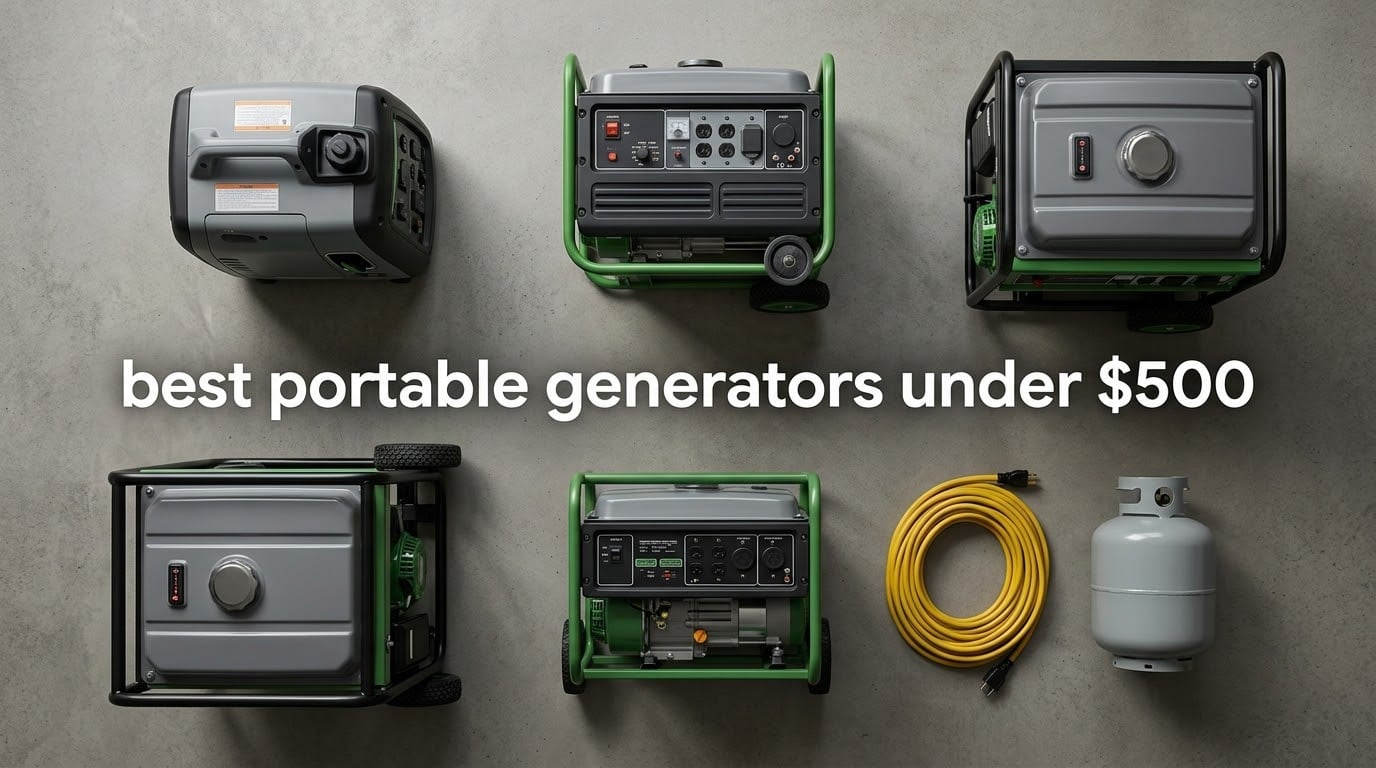
The best portable generators under 500 deliver roughly 1,800 to 3,800 running watts, which covers a refrigerator, LED lights, internet and a couple of small appliances during an outage. That is enough for most people. It is not enough to run central air, a well pump or a whole house, and pretending otherwise is how buyers end up disappointed.
I have spent the last few months working through every sub-500 category this budget actually reaches: gasoline inverter units, open-frame conventional generators and dual-fuel machines that switch to propane. I logged the rated and surge wattage, tank size, measured noise class, outlet layout and warranty for each one, then cross-checked those spec sheets against what buyers report after living with the machine.
The result is a list of ten, ordered by how much real capability you get rather than by headline wattage. If you want the short version, the WEN DF475T leads the list because it is the only unit here that gives you 240V output, an electric start and a switch between gasoline and propane. If quiet operation matters more than anything, the WEN 56235i at 39 pounds is hard to beat.
A note on price discipline before we start: generator pricing moves constantly, so this guide describes capability per category and never quotes a figure. Every purchase button below goes to the current listing.
Top 3 Best Portable Generator Picks Under $500 in 2026
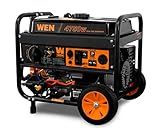

PowerSmart 3800W Dual Fuel Inverter
- 3300W running on gas
- 3100W on propane
- 59 dBA
- digital display
Those three cover the three most common needs at this budget: whole-home essentials for several hours, a dual-fuel inverter for fuel flexibility, and a high-wattage unit for the least money per running watt.
Quick Overview: All 10 Picks Side by Side in 2026
| Product | Specifications | Action |
|---|---|---|
| WEN DF475T Dual Fuel Generator |
|
Check Latest Price |
 WEN 56235i Portable Inverter WEN 56235i Portable Inverter |
|
Check Latest Price |
| PowerSmart 3800W Dual Fuel Inverter |
|
Check Latest Price |
 Oxseryn 4400W Inverter Generator Oxseryn 4400W Inverter Generator |
|
Check Latest Price |
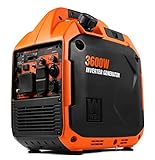 WEN 56360i RV-Ready Inverter WEN 56360i RV-Ready Inverter |
|
Check Latest Price |
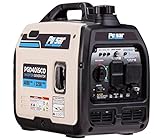 Pulsar PGD40ISCO Inverter Pulsar PGD40ISCO Inverter |
|
Check Latest Price |
 Pulsar PG2300iS Inverter Pulsar PG2300iS Inverter |
|
Check Latest Price |
 PowerSmart 4500W Inverter PowerSmart 4500W Inverter |
|
Check Latest Price |
 ERAYAK 4500W Inverter ERAYAK 4500W Inverter |
|
Check Latest Price |
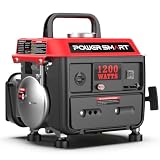 PowerSmart 1200W Portable Generator PowerSmart 1200W Portable Generator |
|
Check Latest Price |
1. WEN DF475T Dual Fuel Generator – Best Overall for Home Backup
WEN 4,750-Watt 120V/240V Dual Fuel Portable Generator with Wheel Kit and Electric Start (DF475T)
- Switches between gasoline and propane with a turn of the fuel dial
- 120V and 240V output works with a transfer switch
- Electric key start on the 224cc 4-stroke engine
- 4-gallon tank gives up to 11 hours at half load
- Wheel kit and 2-year warranty included
- Over 100 pounds so the wheel kit is not optional
- Open frame is noticeably louder than enclosed inverter units
- No weather enclosure for exposed patios
This is the one I keep coming back to, and the reason is the 240V output. Every other inverter in this list is 120V only, which means the WEN DF475T can feed a transfer switch and carry real household circuits instead of extension cords strung through a window.
The fuel flexibility matters more than it first appears. Propane stores indefinitely, so a tank in the garage keeps working through a week-long outage while gasoline in the tank goes stale in a few months. Turning the selection dial from gas to propane takes seconds.
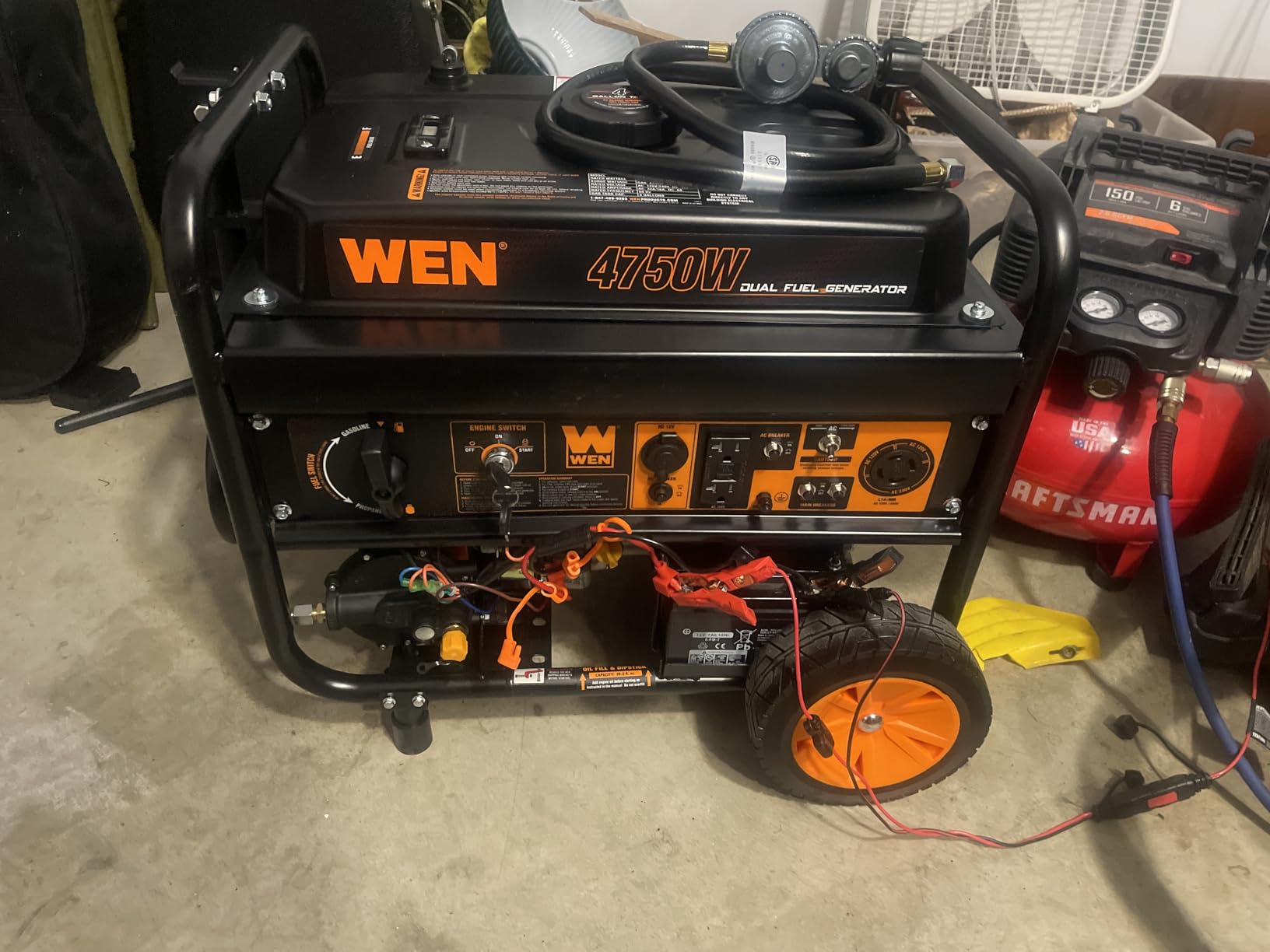
Rated at 3,800 running watts on gasoline and 3,500 on propane, with 4,750 peak on gas, this is the most capable machine in the group for continuous household loads. Buyers rate the electric start and the voltage switching highly, and with close to 3,000 reviews on record the pattern of complaints is consistent rather than random.
The honest drawback is weight. At 105.8 pounds this is not a one-person carry, and it needs two people or a proper dolly to move down basement steps. If you want 240V capability and can live with that, it is still the most useful machine here.
What you can realistically run on it
A refrigerator, a chest freezer, lights, internet, a coffee maker and a couple of lamps at once all fit inside the 3,040-watt continuous ceiling that 80% of 3,800 gives you. That is a genuinely useful outage load for a family.
Because it is a dual-voltage unit, you can also pair it with a transfer switch or interlock kit and backfeed your panel properly rather than running extension cords through a window opening.
Where it falls short
The open frame produces more noise than any enclosed inverter in this list, so it is a poor match for camping near sleeping quarters or a bedroom patio.
At over 100 pounds with no enclosure, it also needs a dry, sheltered spot. That is a dealbreaker for anyone in a small apartment or condo where the only outdoor space is a balcony.
2. WEN 56235i Portable Inverter – Best for Camping and Tailgating
WEN Super Quiet 2350-Watt Portable Inverter Generator with Fuel Shut Off, Gasoline Power, Ultra Lightweight (56235i), Black
- Only 39 pounds
- so one person can carry it anywhere
- Very quiet operation close to normal conversation level
- Clean inverter output safe for phones and laptops
- Fuel shutoff drains the carburetor for storage
- Starts on the first or second pull in cold weather
- Struggles with high surge appliances without a soft-start device
- No hour meter
- Low-oil shutdown can trip on slightly sloped ground
At 39 pounds and roughly ten hours of runtime per gallon, this is the unit I pack for weekend trips. It is the easiest machine here to get into a car trunk alone, which is a bigger practical advantage than the extra wattage some competitors offer.
Owners consistently mention first-pull or second-pull starting, including in cold weather, and the quiet operation is the reason it shows up in so many RV and tailgate reviews. Five outlets cover more than most units at this size: two 120V receptacles, a 12V DC socket and two USB ports.
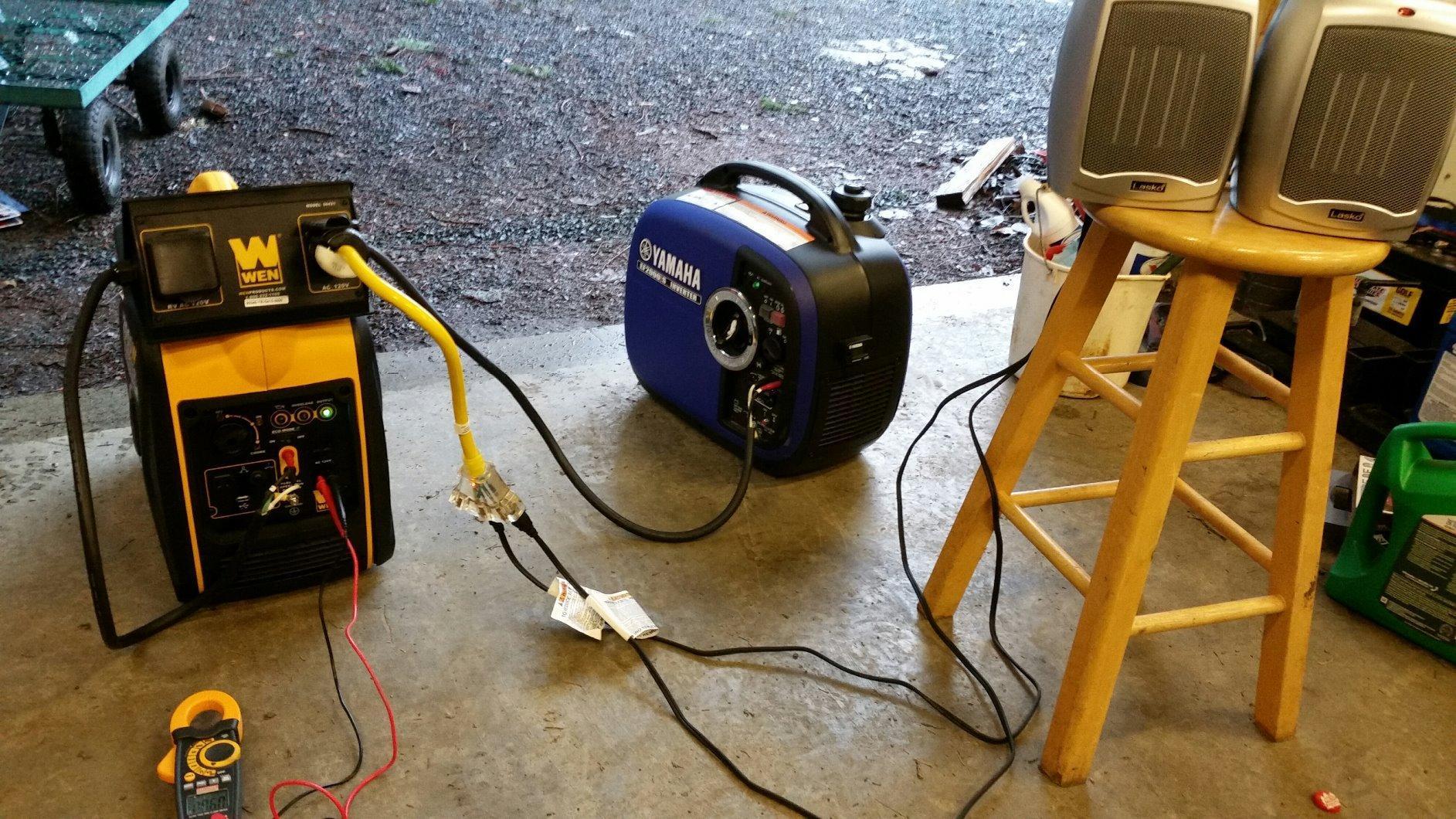
The fuel shutoff system matters more than it looks. Running it down to empty, or using the carburetor drain mode before storage, burns off the fuel that would otherwise gum up the carburetor over a winter.
Clean sine wave output means you can run a laptop, a phone charger or a CPAP machine without worrying about total harmonic distortion. Reviewers report the same quiet, light and reliable-start pattern over thousands of reviews.
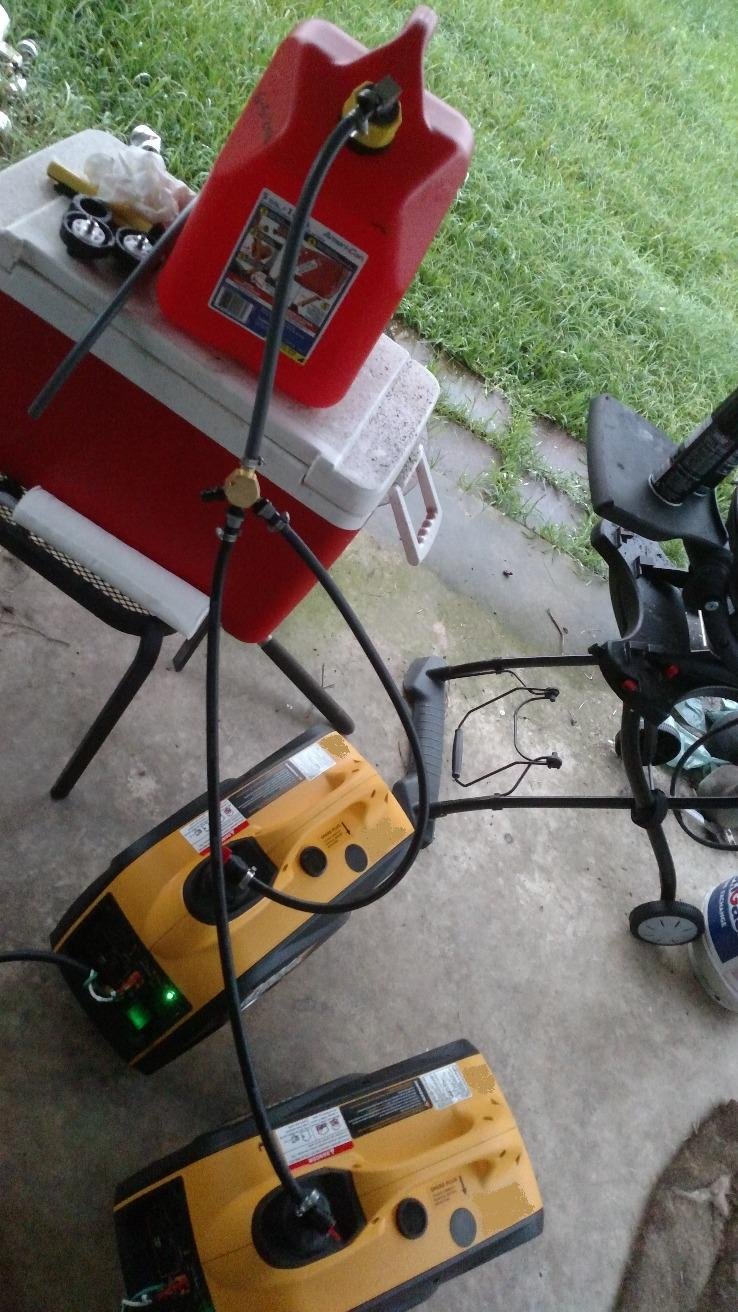
Where its light weight pays off
Carrying distance is the deciding factor for most buyers. This unit moves from a trunk to a picnic table without a second person, and buyers moving it between patio and campsite notice that immediately. Our roundup of the best camping generators for RVs compares more quiet units if noise is the deciding factor for your trip.
Ten hours per gallon also means you can run lights and a small appliance all evening on one fill, which is exactly the tailgating and tent camping use case.
What it cannot do
1,900 running watts means an 80% safe ceiling of roughly 1,520 watts. A full-size refrigerator plus a portable air conditioner is out of reach, and large surge appliances can trip the overload.
If you need to start a microwave or a hair dryer, start those first or add a soft-start device. Owners who pair it with a small soft-start unit report the problem disappears.
3. PowerSmart 3800W Dual Fuel Inverter – Best Dual-Fuel Inverter
PowerSmart 3800 Watt Dual Fuel Inverter Generator for Camping or Home Use
- Runs on gasoline and propane for outage fuel flexibility
- Quiet at 59 dBA at 25% load in Eco Mode
- Digital display shows live power output and performance
- Starts easily on the first or second pull
- Parallel ready with a matching unit
- Small tank means frequent gasoline refills though propane runs long
- Access panels need a Phillips screwdriver for servicing
- Display is hard to read with the unit on the ground
This is the pick I recommend to anyone preparing for storm season who wants inverter-smooth power and propane capability in one box. It gives you 3,300 running watts on gasoline and 3,100 on propane, with 59 dBA at quarter load in Eco Mode.
That Eco Mode noise figure deserves context. It is measured at a light load, where the engine throttles down. Buyers who run it near full output report the sound level climbs noticeably. Judge the quiet claim by what you will actually run on it, not the idle number.
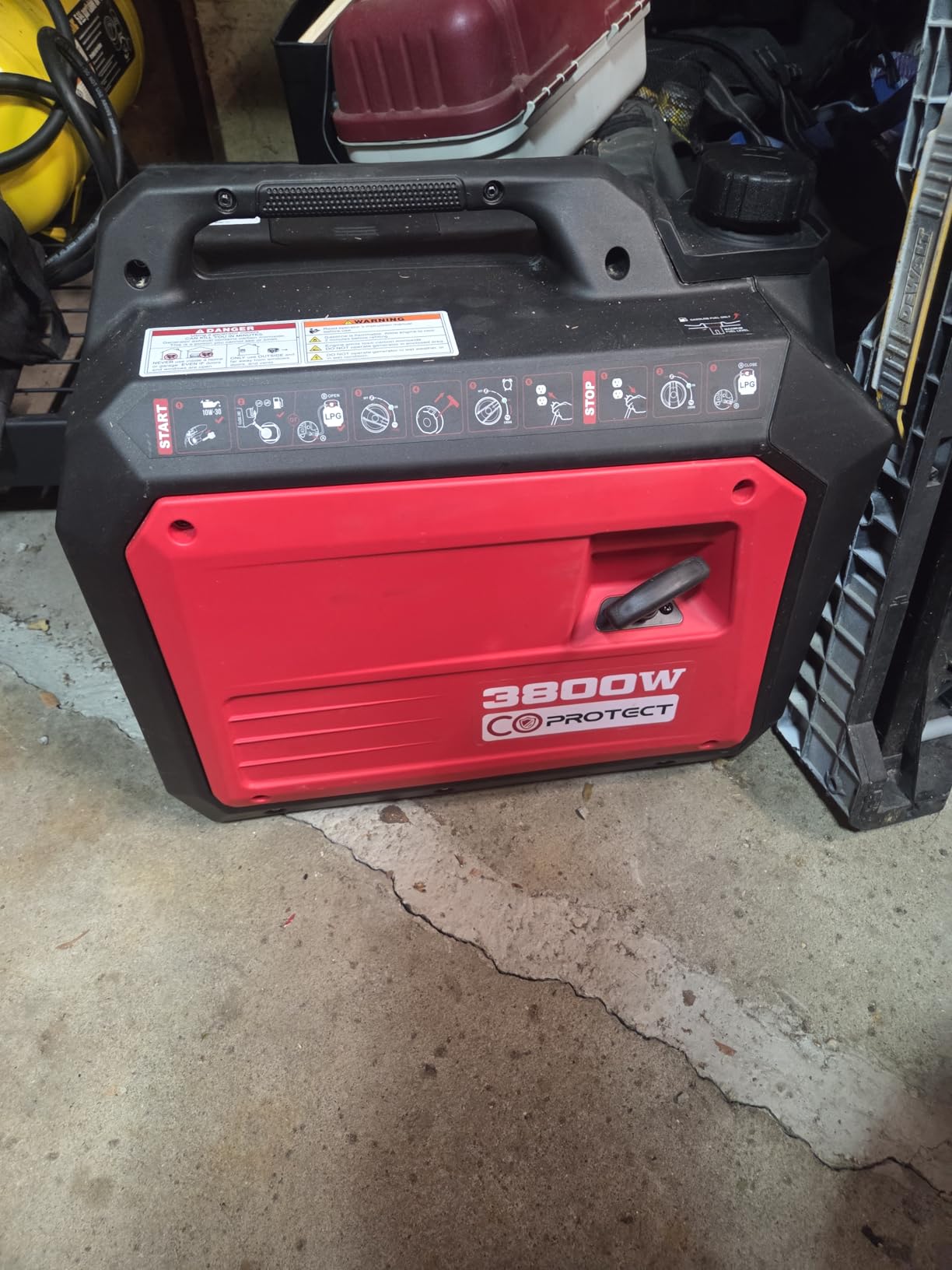
The outlet layout is unusually good for the class: a 30A L5-30R twist-lock, a 20A 5-20R duplex, a 12V DC port and USB charging ports, across six outlets total. Certified to ANSI/PGMA G300, ANSI/UL2201 and EPA standards, with overload, short circuit, CO sensor and low-oil shutdown.
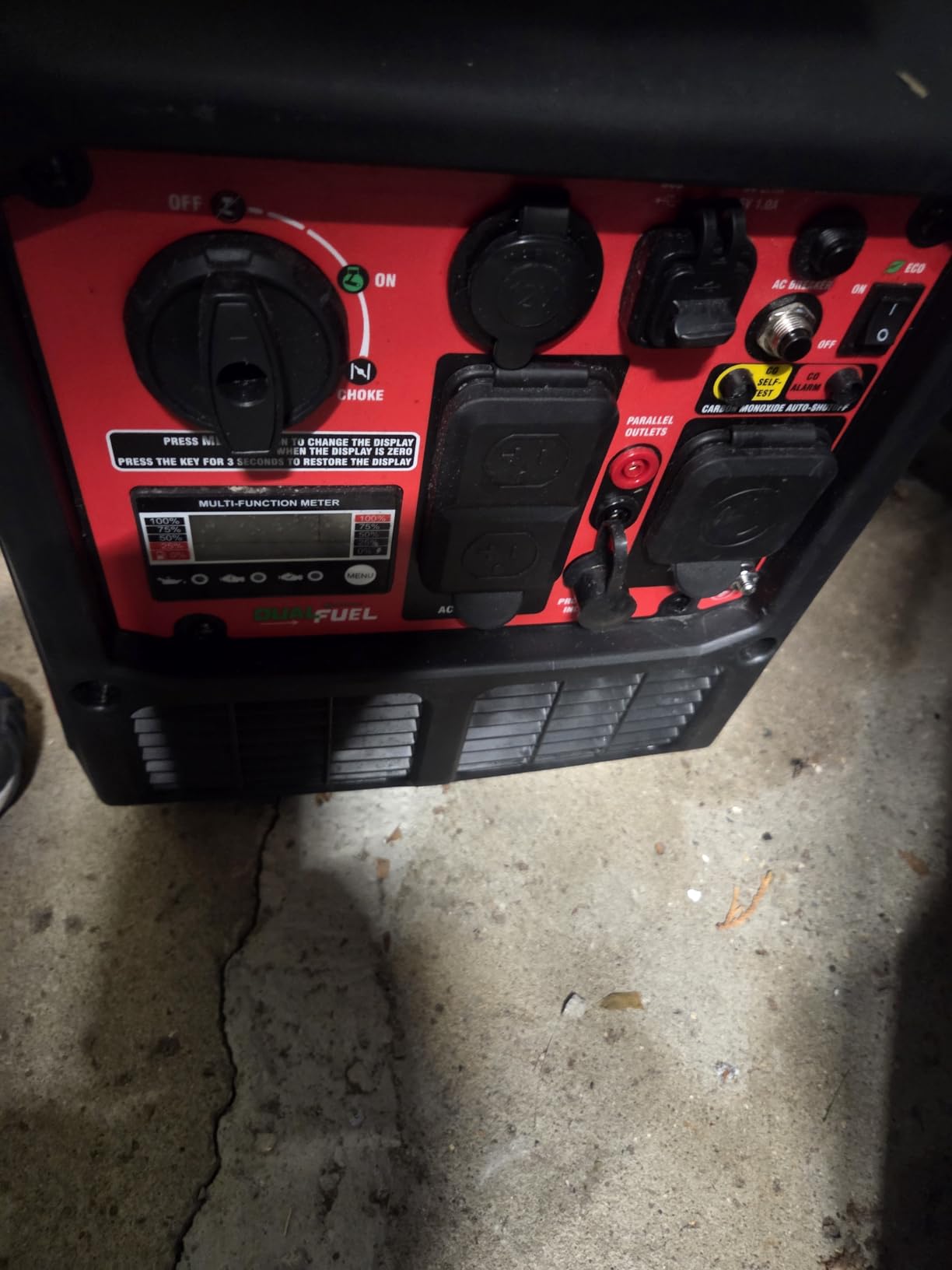
Owners highlight the digital display as the standout feature, showing live output so you know how close you are to your ceiling without guessing. A small number of units failed to start, and owners cite difficulty reaching support for warranty work, which is the honest caveat on this brand.
Why dual fuel earns its spot
Propane stores indefinitely while gasoline degrades within months. For a hurricane kit or a long outage, that difference decides whether the machine still runs on day five.
Reviewers report up to 24 hours on a standard 20-pound propane cylinder, which means one tank can carry a household through an extended event without a fuel run.
Where you will feel the compromise
The gasoline tank is small, so you are refilling more often than with the WEN DF475T or the ERAYAK. Plan on gasoline refills every few hours under a real household load.
Routine service means removing access panels with a screwdriver, and the display is difficult to read when the unit is on the ground. Neither is serious, but both add friction.
4. Oxseryn 4400W Inverter Generator – Best Value for Raw Wattage
- 4400 peak and 3400 running watts for a mid-range price
- Up to 14 hours at 25% load on a 2-gallon tank with fuel gauge
- Under 72 dBA measured at 23 feet
- Only 56 pounds on a lightweight frame
- Factory functionally tested before shipping
- Open frame is louder than enclosed inverter units under heavy load
- All output is 120V so it cannot feed 240V appliances
- Access panels require a Phillips screwdriver
If your priority is the most running watts available at this budget, this is the machine. A 208cc four-stroke engine delivers 3,400 running watts and 4,400 peak, and at 56 pounds it is still light enough for two people to move easily.
The 2-gallon tank with a built-in fuel gauge is the detail I value most here. Fourteen hours at quarter load means an overnight outage on a fridge and lights does not require a refuel in the dark.
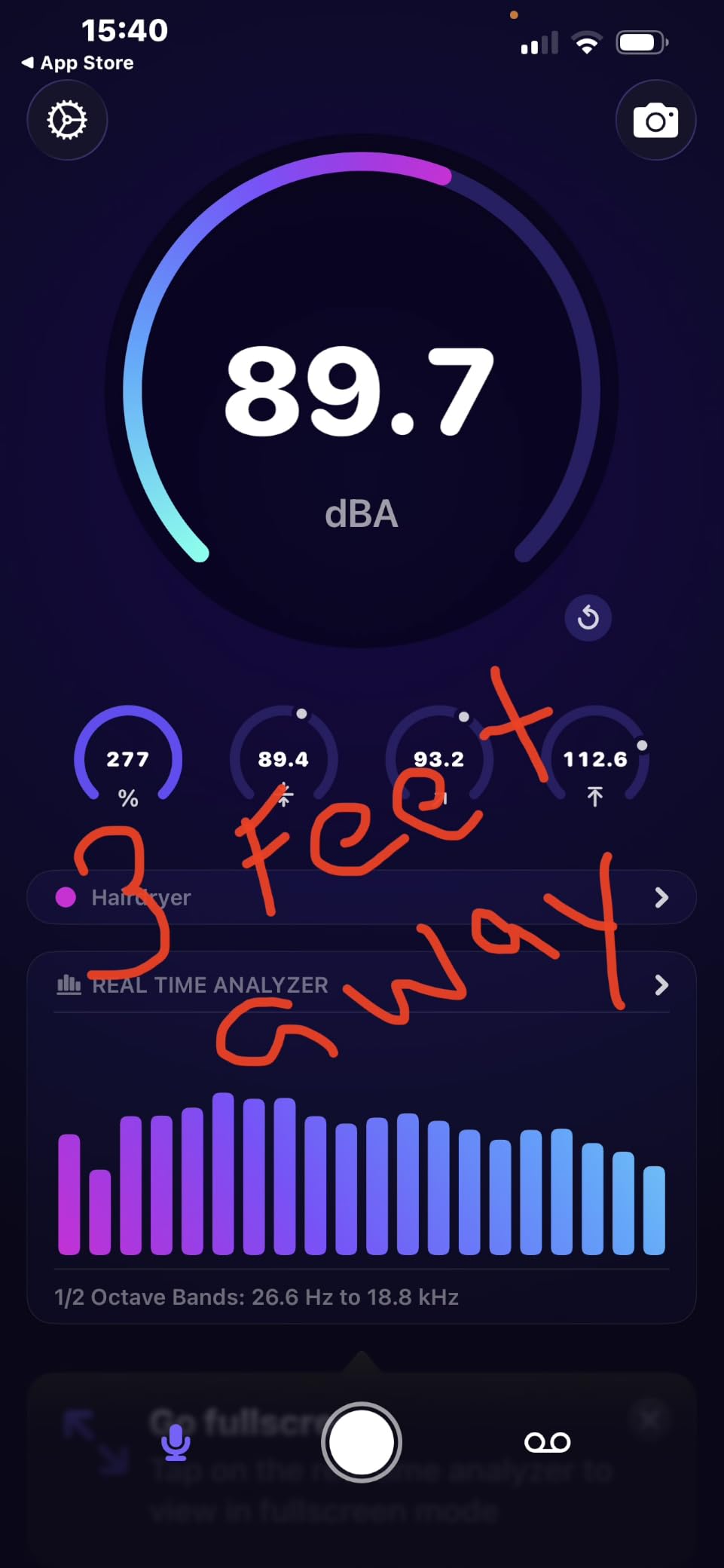
It also carries an RV port alongside two 120V AC outlets and a 12V DC port, plus cold start technology, low oil shutdown and overload protection. Buyers mention an easy start-up process and a slight fuel smell on first use that clears quickly.
Spec sheets here list a 1-year manufacturer warranty, which is the shortest in this roundup. On a machine that may sit idle for months at a time, that is the part I would weigh most carefully before buying.
Best suited to RV and light construction loads
At 3,400 running watts you have a 2,720-watt continuous ceiling, enough for a refrigerator, lights and a small power tool at the same time. Owners use it for RV camping where a 30A circuit is needed.
Because the noise figure is quoted at 23 feet, it is genuinely comparable to other spec sheets that use the same measurement distance. That makes this one easier to judge fairly than most units in the group.
What to watch out for
Everything is 120V. If your plan involves an electric water heater, a stove or any 240V appliance, this unit simply cannot do it, no matter how many peak watts it advertises.
The open frame means the noise level rises sharply at full load. Buyers report it louder than enclosed inverters once you push past the 50% mark, so it suits a campsite or yard rather than a bedroom patio.
5. WEN 56360i RV-Ready Inverter – Best for RV Use with a Three-Year Warranty
WEN 3600-Watt Portable Inverter Generator, RV-Ready, Quiet and Lightweight with Fuel Shut Off (56360i)
- 149cc engine gives 3600 surge and 2900 rated watts
- Inverter output is clean enough for phones tablets and laptops
- 46-pound enclosure is easy to transport and store
- Fuel shutoff extends engine life during storage
- TT-30R RV receptacle plus USB and 12V ports
- Backed by a three-year warranty
- 1.6-gallon tank limits runtime to roughly 5 hours under load
- Recoil start only
- with no electric or battery ignition option
This is the one I suggest for RV owners under this budget, for one reason: the TT-30R receptacle. It is the correct outlet for a 30A RV shore power connection, so you are not hunting an adapter.
The wattage balance is good. A 149cc engine produces 2,900 rated watts and 3,600 surge, which covers a 13,500 BTU window air conditioner, a refrigerator and lights within the 80% continuous ceiling.
At 46.3 pounds it carries well for one person, and the fuel shutoff system drains the carburetor for storage, which matters if the unit lives in a storage bay between trips.
The three-year warranty is longer than most in this group. Owners favor the balance of wattage, weight and quiet inverter operation, and the shorter runtime from the smaller tank is the trade-off most cited.

Why the RV outlet changes the decision
Plugging an RV into a household 5-20R outlet limits you to 15 amps and often to 2,000 watts. The TT-30R lets you use the generator’s full 2,900 rated watts through a proper 30A cord.
For sensitive electronics inside an RV, the inverter output is the other reason to prefer it over a conventional open-frame unit. If you are shopping around an RV specifically, our picks for the best portable RV generators for boondocking go deeper on connector types and runtime.
Where the limits show up
Five hours on a 1.6-gallon tank under real load is short. An overnight outage means a mid-night refuel, so pair it with a spare full can and a clear plan for where you store it.
Recoil start only means no key start in cold weather. If you live somewhere with hard winters, that is a genuine daily friction point.
6. Pulsar PGD40ISCO Inverter – Best for Quiet Operation at 4000 Watts
Pulsar PGD40ISCO Ultra Light Quiet 4000W Portable Gas Inverter Generator, white
- 4000 peak and 3200 rated watts of inverter power
- Super quiet operation rated at 59 dB
- Under 48 pounds for easy transport
- Parallel ready for doubled output with a matching unit
- Suitable for air conditioning units up to 13500 BTU
- Three-year limited warranty
- 1-gallon tank gives only about 4 hours at half load
- Only three outlets
- fewer than most competitors in this class
The Pulsar PGD40ISCO pairs a 145cc engine with a fully enclosed inverter body, and the 59 dB rating is the quiet number you can compare across brands here. At 47.3 pounds it stays in portable territory.
Three thousand two hundred running watts gives a 2,560-watt continuous ceiling, which is enough for a refrigerator, a window air conditioner and lights within the 80% rule.
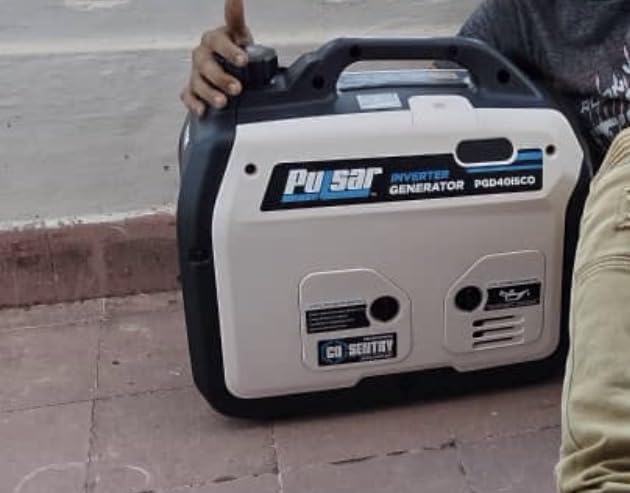
Parallel ready is a nice option if you later decide two units are better than one, and buyers like the aluminum and steel construction with automatic voltage regulation. The three-year warranty is among the strongest in this roundup.
The reservation that comes up most is runtime. A 1-gallon tank yields roughly four hours at half load, so for an overnight event this unit needs a fuel plan in advance.
Good for campsites with enforced quiet hours
Campground quiet hours are the reason this unit appears in so many camper reviews. 59 dB sits close to a normal conversation, and the enclosed body keeps it there under load rather than only at idle.
Rated for air conditioning up to 13,500 BTU, which covers the window units most RV owners actually run.
What limits it
Four outlets would be more useful than three. With only three outlets you are running a power strip for anything beyond a fridge and a lamp, and power strips are not designed for high-draw motor loads.
Four hours of runtime at half load is the shortest figure in the higher-wattage group. If you need overnight coverage, fuel discipline matters more than on any other unit here.
7. Pulsar PG2300iS Inverter – Best for Small Loads and Tailgating
Pulsar PG2300iS 2,300W Portable Super Quiet Gas-Powered Inverter Generator with USB Outlet & Parallel Capability, CARB Compliant
- Stable sine wave output is safe for sensitive electronics
- 2300 peak and 1800 running watts for small 120V appliances
- USB port and 12V DC outlet for device charging
- Parallel capability doubles output with a matching unit
- Recoil start with low oil shut-off and automatic voltage regulation
- CARB compliant for California buyers
- 1800 running watts is below what larger refrigerators or air conditioners need
- Only three outlets limits simultaneous devices
- Listed weight of 48 pounds is heavier than comparable 2300W units
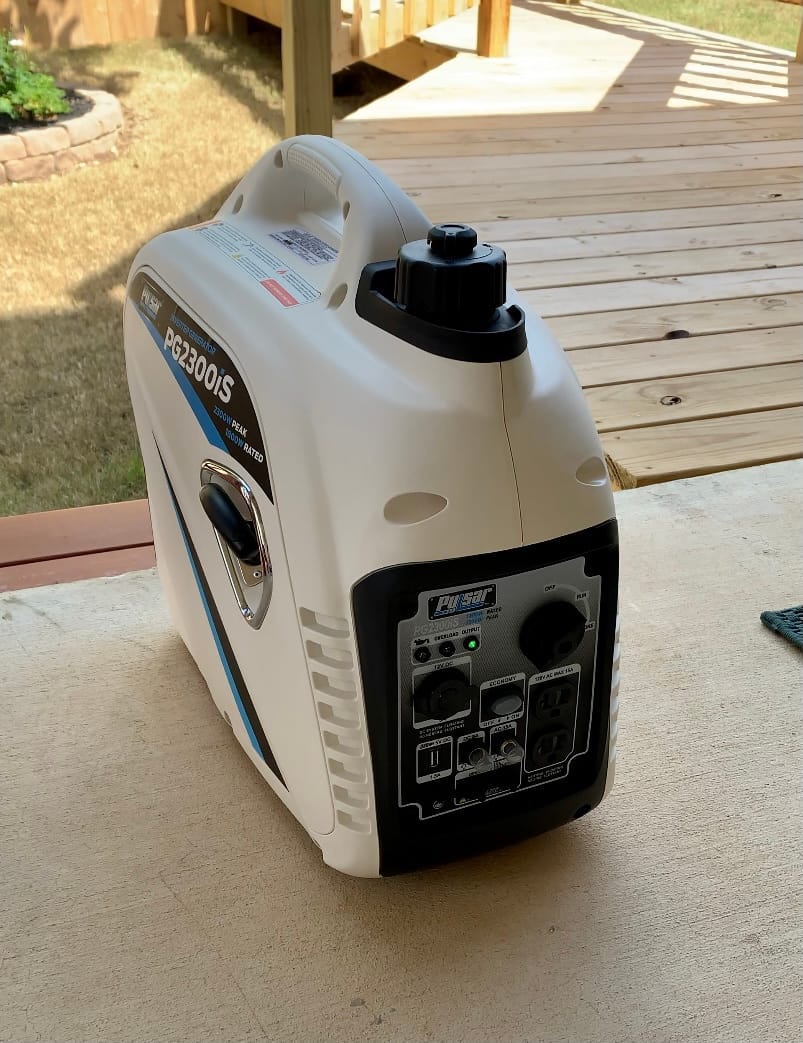
The PG2300iS is the smallest honest option here, and it does one job well: small electronics and small appliances for a weekend. Stable sine wave output keeps phones, speakers and laptops safe.
Two 120V 13A outlets, a 12V DC socket and a USB port cover a tailgate table or a camp kitchen. Six hours of runtime on a 1.18-gallon tank is a full evening on a moderate load.
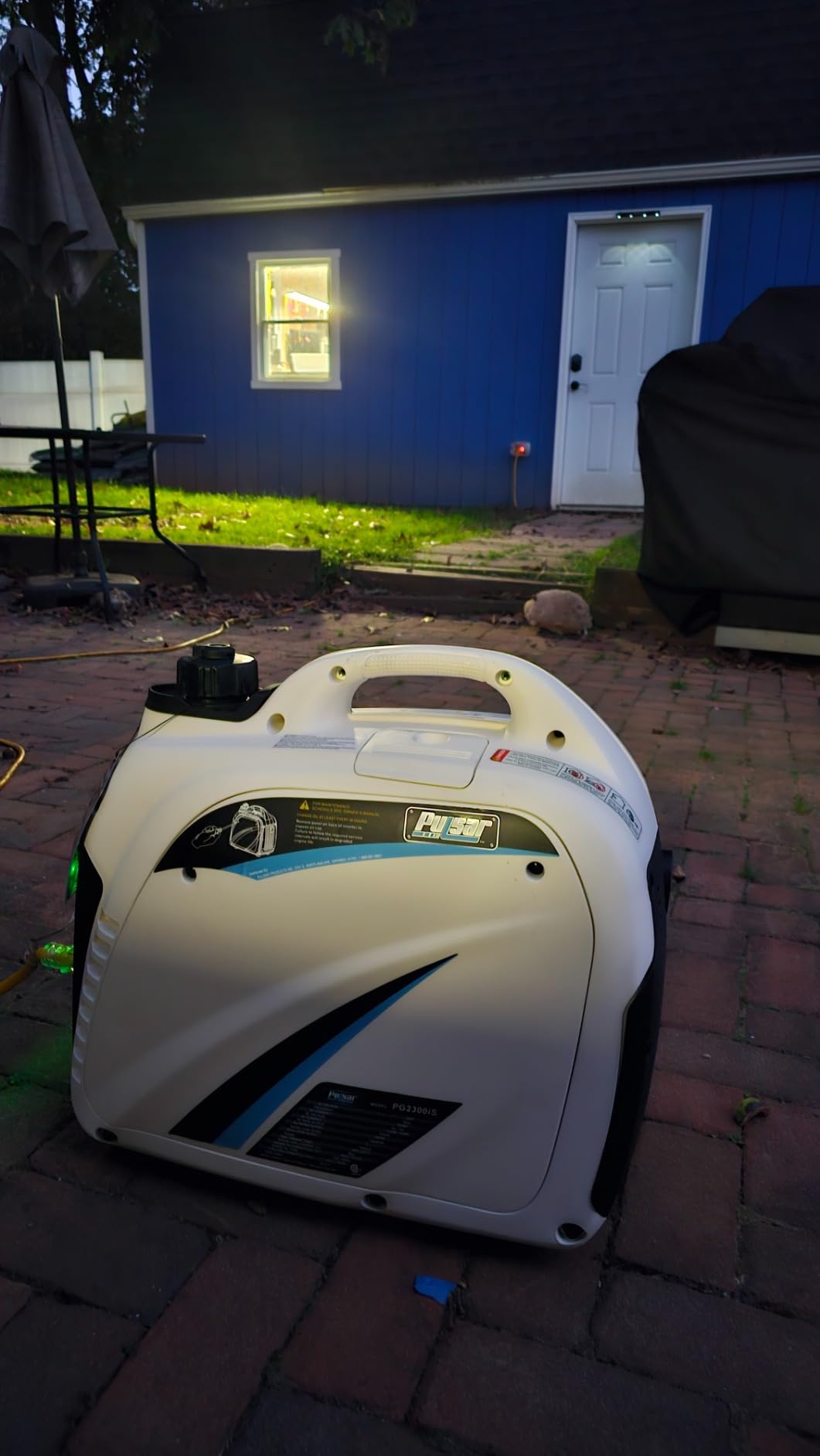
It is CARB compliant, which matters if you are in California, and parallel capability means you can double the output later with a matching unit rather than replacing this one.
Owners rate it highly for quiet, clean output and simple controls, while noting the wattage ceiling and outlet count bound its use for larger loads.
Where small wattage is a feature
A 1,440-watt continuous ceiling is genuinely enough for lights, a cooler, phone chargers, a laptop and a small fan. Many tailgating and van-life setups need nothing more.
The lighter the load, the longer it runs. At low draw this unit will outlast most of the 4,000-watt machines on a single tank.
Where it will disappoint
A full-size refrigerator compressor can exceed what 1,800 running watts will start comfortably, and any air conditioner is out. If your outage plan centers on the fridge, look higher in this list.
Forty-eight pounds is heavier than comparable 2,300-watt units, so you are carrying mass for less output. Buyers note this as the main spec-sheet oddity in the class.
8. PowerSmart 4500W Inverter – Best for Power Tools and Multi-Day Outages
- 4500 starting and 3800 running watts from a 223cc four-stroke engine
- Clean inverter power under 3% THD is safe for phones and cameras
- Digital display helps with maintenance planning
- Starts on the first or second pull in cold weather
- CO sensor plus overload short-circuit and low-oil shutdown
- Arrives without oil so you must add engine oil before the first start
- Front lower cover needs a screwdriver for oil changes and the drain point is awkward
- Louder than enclosed inverter units at full power
- No wheel kit
- so a cart is needed to move it
This is the most powerful unit in the roundup: 4,500 starting watts and 3,800 running watts from a 223cc four-stroke engine. That is 3,040 watts of continuous load after the 80% rule, enough for a refrigerator, a portable air conditioner and lights together.
Clean inverter output under 3% total harmonic distortion means it is safe for camera gear, laptops and other sensitive electronics, which a conventional open-frame machine of the same size would not be.
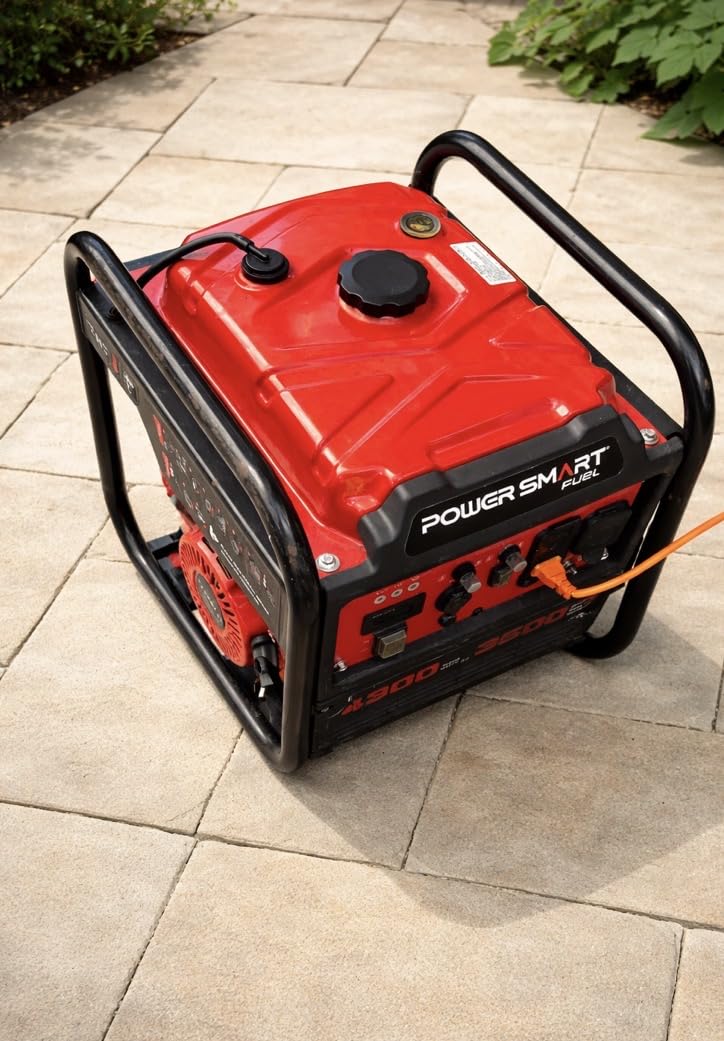
Owners report starting on the first or second pull in cold weather and reliable multi-day runtime during storm and hurricane outages, with the digital display singled out as an advantage over costlier name-brand units.
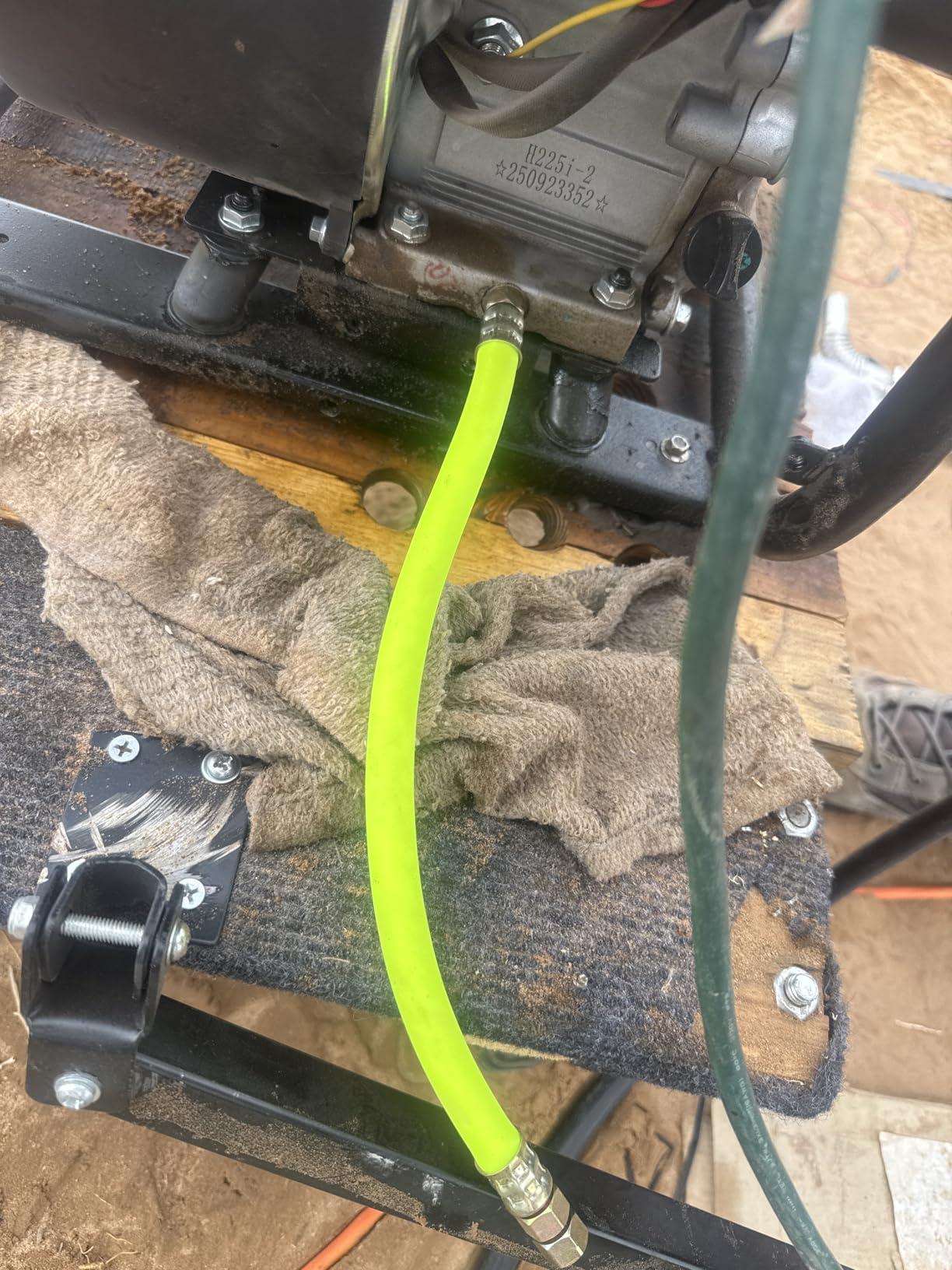
Two things to plan for. The unit arrives without engine oil, so the low-oil protection will prevent a start until you add it. And the front lower cover comes off with a screwdriver for oil changes, with an awkward drain point that many owners solve with a drain extension hose.
Best fit for jobsite loads
A circular saw or a table saw draws heavy surge current on startup. Four thousand five hundred starting watts gives a margin most sub-500 machines do not, and inverter output keeps your electronics safe if you are running a charge radio nearby.
The digital display tracks runtime hours, which makes the oil change interval far easier to stay on top of.
What you take on
At 61 pounds with no wheel kit, you need a cart or dolly to move it around a driveway or garage. That is a real inconvenience compared with the wheeled units in this list.
The open-frame layout is noticeably louder at full power. Plan on running it away from sleeping areas, and expect to add oil, a drain extension hose and an exhaust extension before the first long outage.
9. ERAYAK 4500W Inverter – Best for Clean Power and Long Runtime
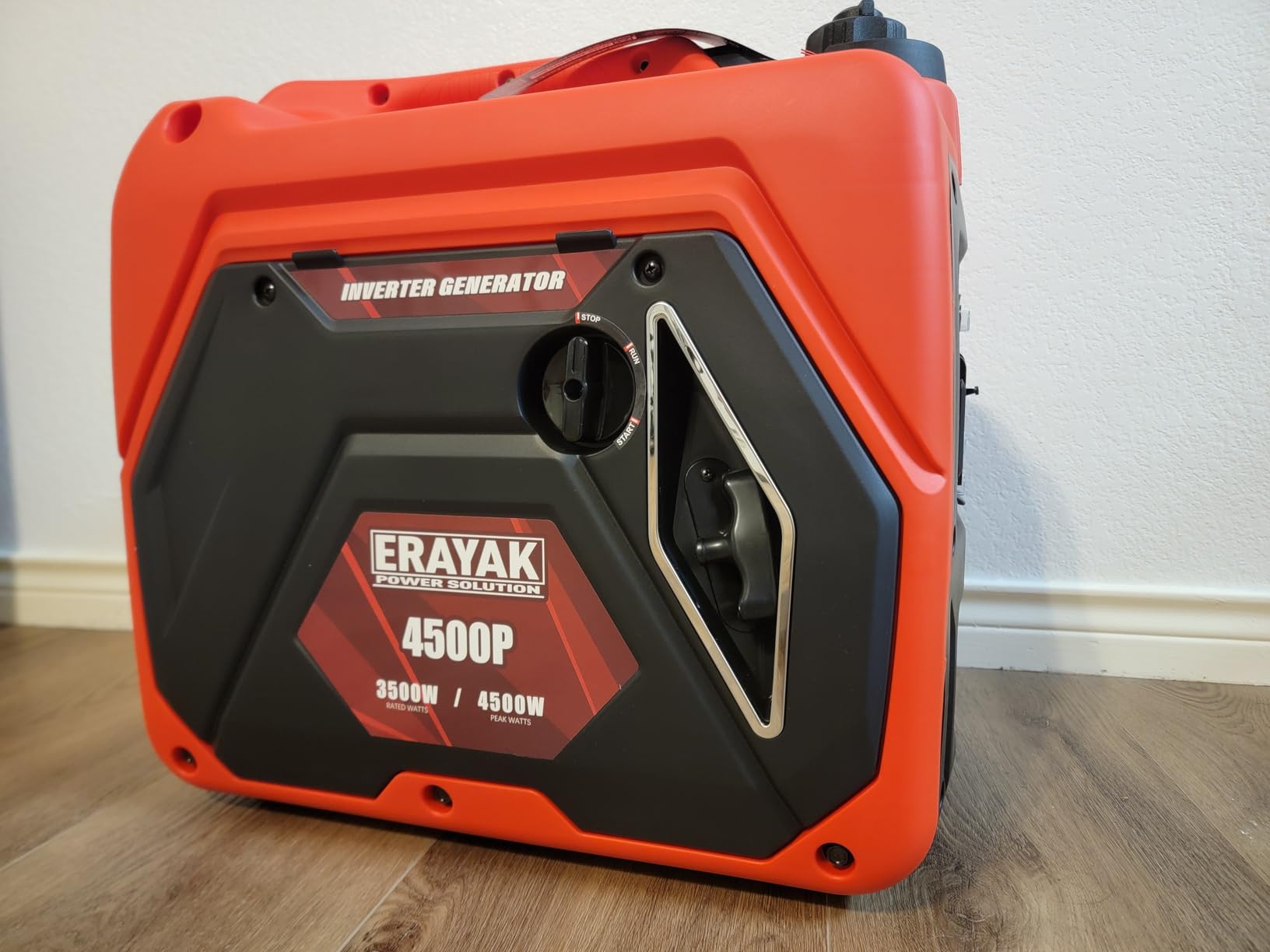
- 4500 peak and 3500 running watts with stable inverter output
- Very quiet at 60.5 dBA with Eco Mode
- About 55 pounds in a compact frame
- Low THD output safe for laptops CPAP machines and TVs
- Parallel ready at 50A for doubled output
- Backed by a three-year warranty
- Arrives without oil so engine oil must be added before first use
- No fuel gauge on the unit
- Eco mode is noticeably louder when the engine runs at higher speed
- Some buyers report it tripped on larger air-conditioning loads
The lowest distortion figure in the roundup belongs here, between 0.2% and 1.2% total harmonic distortion. If you run a CPAP machine, a laptop or other medical or sensitive electronics, that number is the reason to pick this machine.
Runtime is the other headline. A 2.25-gallon tank and a quoted 16 hours mean an overnight outage on a refrigerator and lights without touching a fuel can.
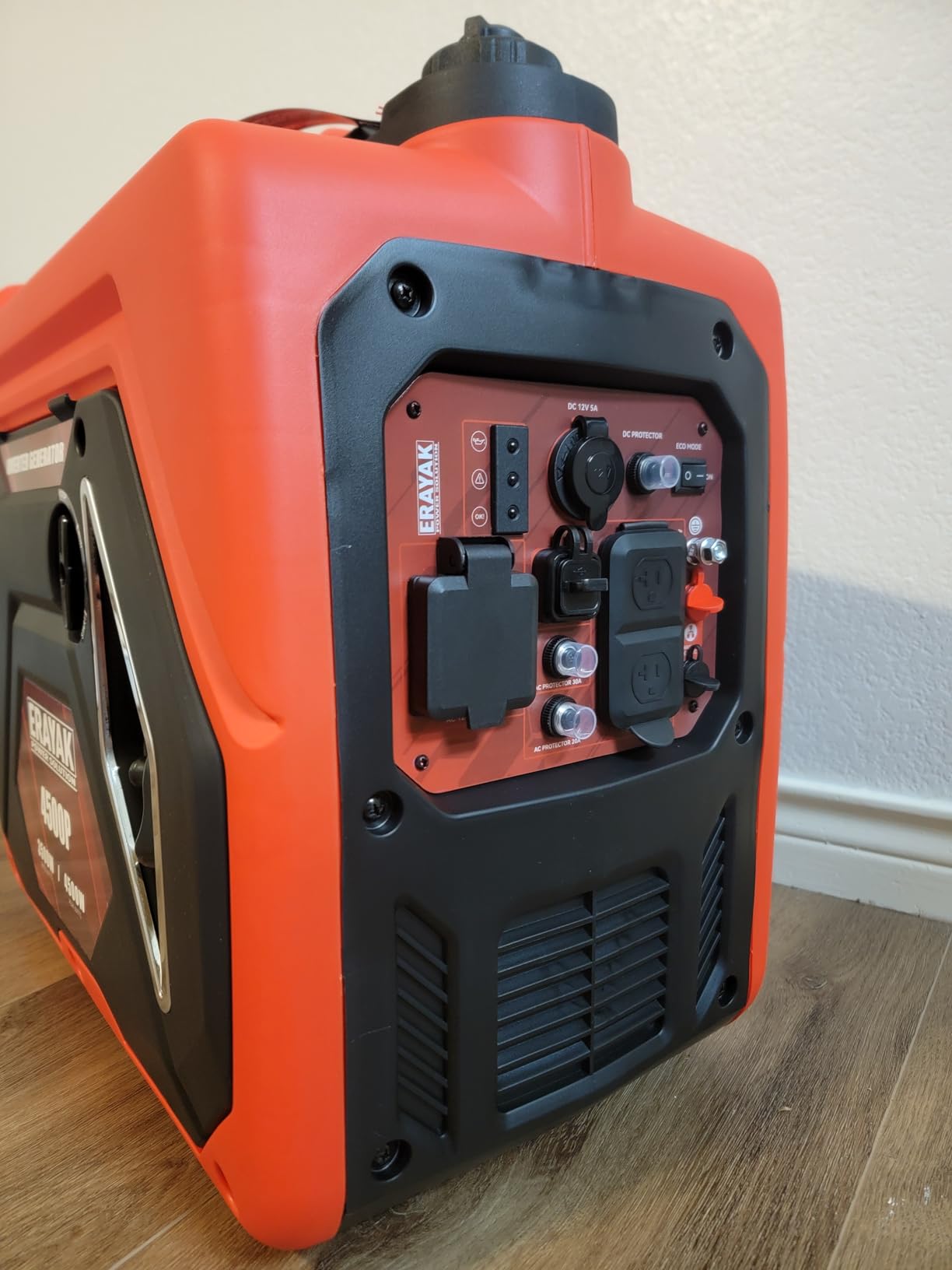
Owners report running the unit for days during outages and powering RV air conditioners, microwaves and refrigerators together, with several praising responsive customer service from the US support hotline. Fuel consumption is stated at 0.8 liters per hour at quarter load.
The recurring notes are worth knowing before purchase. It arrives without oil, so the low-oil protection blocks the first start until you fill it. There is no fuel gauge, and some buyers report it tripping on larger air-conditioning loads despite the 4,500 watt rating.
Why clean power matters here
Total harmonic distortion under 2% is what separates inverter units from conventional ones. Sensitive electronics, audio equipment and variable-speed compressors behave more predictably on that output.
A CPAP machine or a home medical device on clean sine wave power is the safest choice of any load you might plug in during an outage.
Where the spec sheet and the reports diverge
The 60.5 dBA figure applies with Eco Mode throttling down. Buyers report the noise level climbing noticeably once the engine runs at higher speed under load, so treat the number as a light-load figure.
The lack of a fuel gauge matters on a 16-hour tank. You are tracking runtime by memory or by an external hour meter rather than by looking at the unit.
10. PowerSmart 1200W Portable Generator – Budget Pick for Tent Camping
- Only 34 pounds with a built-in carrying handle
- Durable enough to survive years of heavy use and even fuel mixing mistakes
- Starts in cold conditions with a few pulls
- Runs lights fans and small appliances effectively
- Two-year warranty with technician support
- Louder than expected
- comparable to a lawn mower under load
- Only a single outlet so a power strip is required
- No-load voltage fluctuates noticeably
- Requires fuel mixing because it is a two-stroke engine
This is the smallest and lightest unit in the roundup at 34 pounds, with a built-in carrying handle. If your entire load is string lights, a cooler, a phone charger and maybe a small fan, it does the job and costs the least to carry around.
Buyers report years of reliable service, some after abuse and incorrect fuel mixing, and a 4.2 rating across more than 1,700 reviews is the lowest here, which tells you where the compromises are.
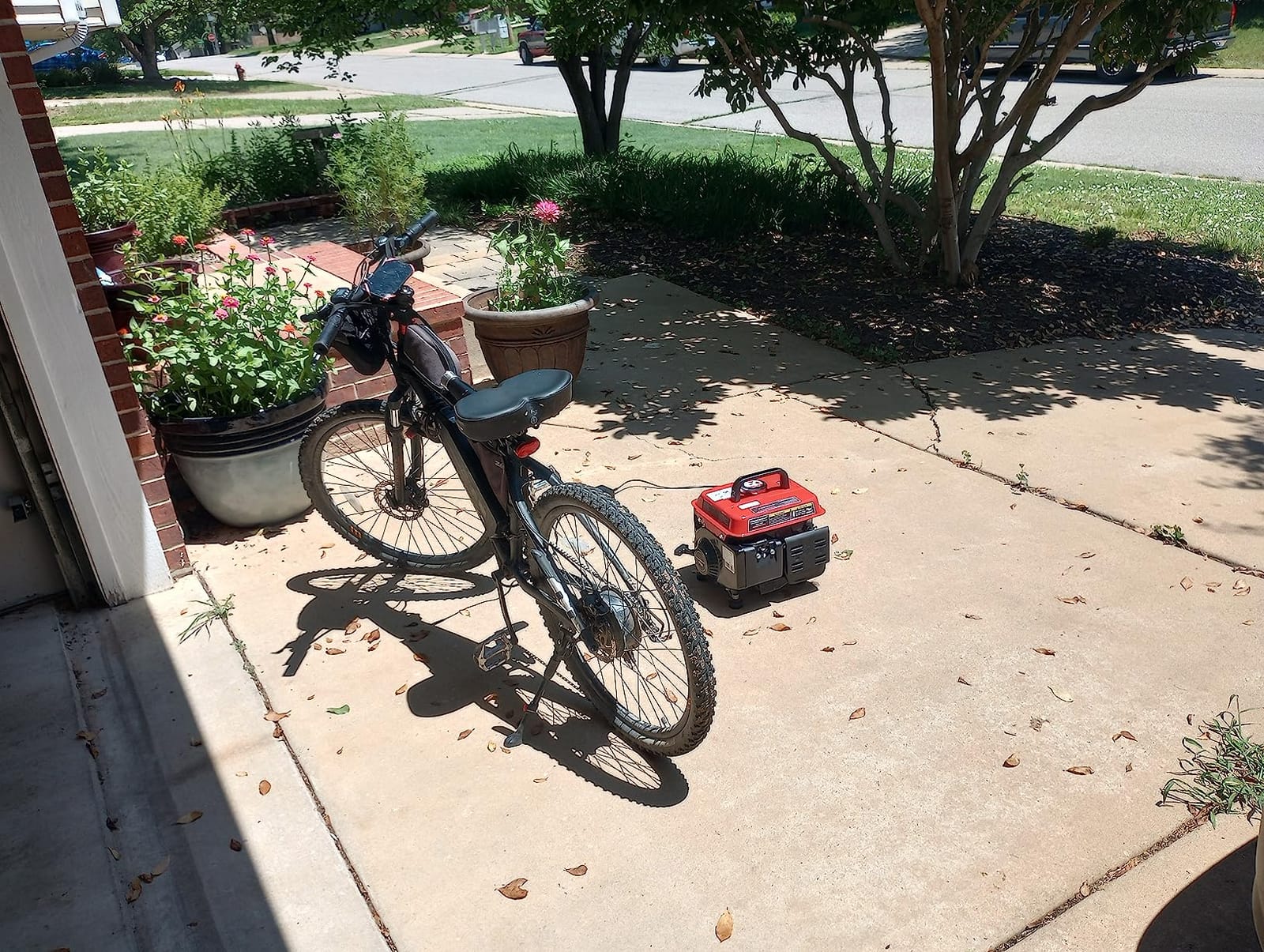
The single 120V 7.5A outlet plus a 12V DC output means you need a power strip for anything beyond one device. The included 40-inch DC charging cable handles the 12V side, and a fuel mixing cup and high-altitude screw are in the box for the two-stroke engine.
The 1.1-gallon tank gives up to five hours at 50% load. Owners flag the noise as comparable to a lawn mower under load and the no-load voltage as noticeably unstable, which is why it is not the right choice for sensitive electronics.
Where it earns its place
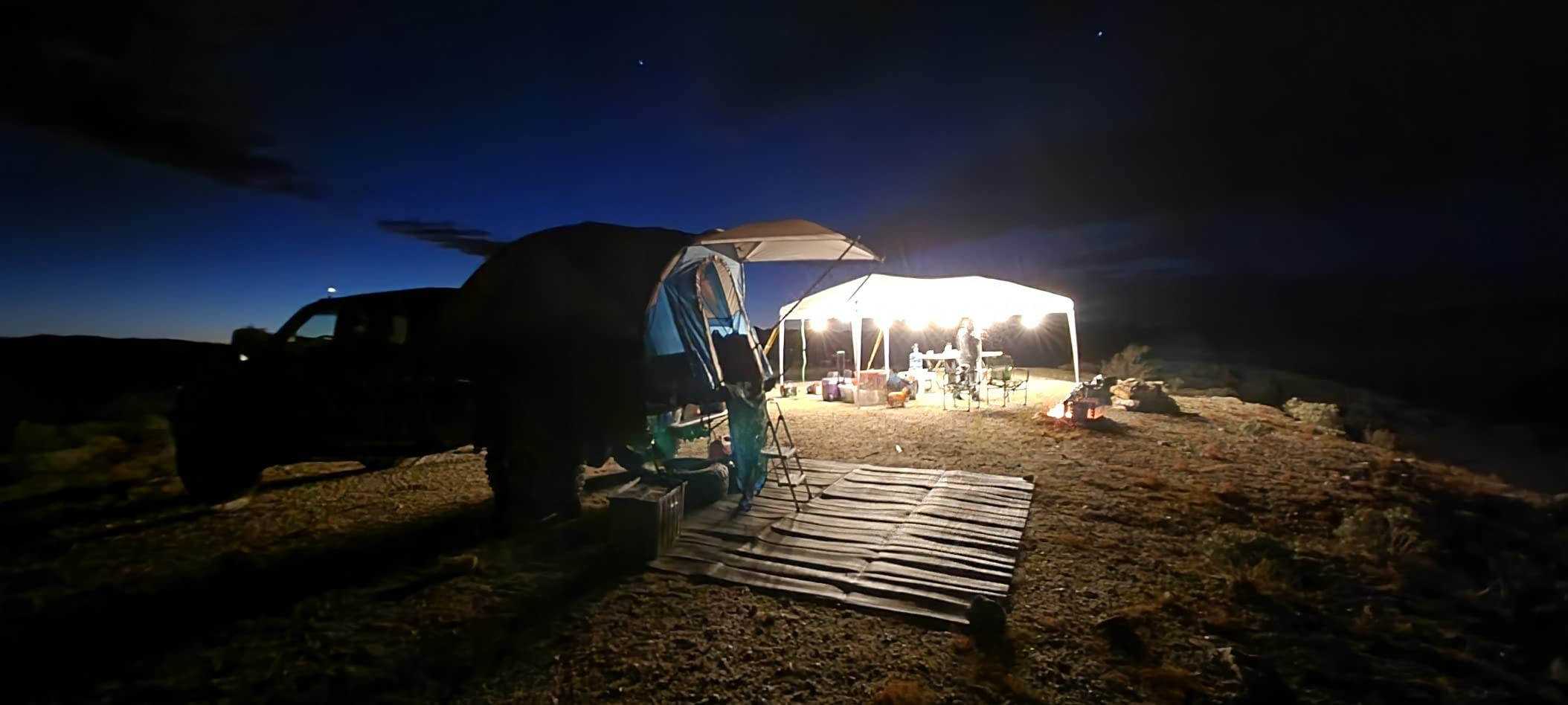
Thirty-four pounds with a built-in handle is the easiest carry in the group by a wide margin. For tent camping and tailgating where your load is lighting and small devices, that weight difference matters more than wattage.
Two-stroke construction is simple to maintain, and owners report reliable starting in cold conditions with a few pulls. If your van-life setup is mostly off-grid without fuel, our guide to the best portable solar generators for van life covers the battery-only alternative.
Where it falls apart
Unstable no-load voltage is the real limitation. Some buyers report it will not keep newer portable power stations charging consistently, and it is a poor match for anything with sensitive electronics.
It is also loud under load, which rules it out for campsites with enforced quiet hours. And in deep cold, well below freezing, starting becomes difficult.
How to Choose a Portable Generator Under $500
1. Size your load with the 80% rule
Total your running watts, then divide by 0.8 to get the running wattage you need. A refrigerator at 700 watts plus lights at 100 watts plus a router at 20 watts is 820 watts; divide by 0.8 and you need at least 1,025 running watts. Add 20% and you have your headroom.
This is also why peak wattage alone is a poor buying signal. A machine with high peak numbers and thin running watts will start an appliance and then trip when the compressor settles into its steady draw.
2. Inverter versus conventional
Inverter generators convert the raw engine output to a clean sine wave under 3% total harmonic distortion. That output is safe for laptops, phones, TVs and CPAP machines, and the throttling engine runs quieter at light loads.
Conventional units send output more directly to the outlets. They give you more watts for the same money and they are louder under load. If your loads are purely resistive, like a space heater or a power tool, the tradeoff matters less.
3. Gasoline, propane or dual fuel
Gasoline gives you the cheapest energy per hour and the widest range of available fuel, but it degrades within months in storage. Propane stores indefinitely and is cleaner, but energy density is lower and the runtime is measured in tens of hours rather than hours.
Dual fuel is the pragmatic answer for storm preparation. The main disadvantage is that propane output is typically slightly lower than gasoline output on the same unit, and switching takes planning if you want the higher number.
4. Noise ratings are not directly comparable
Noise figures across brands are measured at different distances and different loads. A figure quoted at 23 feet at quarter load cannot be compared against one quoted at 50 feet at full load. Here, 52, 59, 60.5, 69 and 72 dBA figures are quoted at inconsistent distances.
Judge by enclosure type instead: a fully enclosed body like the Pulsar PGD40ISCO stays quiet under load, while any open-frame design climbs noticeably once you push past half output. If quiet matters, an enclosed inverter is the reliable purchase.
5. Safety and placement
Never run a generator indoors, in a garage, in a basement, in an enclosed porch or in a vehicle with the tailgate closed. Carbon monoxide is odorless and colorless, and a CO sensor is a backup layer, not permission to move the machine indoors.
Place the unit at least 20 feet from the house, with the exhaust pointing away from doors, windows and vents. Operating in rain is generally fine for a properly designed unit, but never under a canopy or inside an enclosure that traps exhaust. Let the engine cool completely before refueling, and never refuel while it is running.
To power a house you need a transfer switch or an interlock kit installed by a qualified electrician. Never backfeed through a dryer or socket outlet.
6. Warranty, service and what to skip
Three-year warranties appear on the WEN 56360i, Pulsar PGD40ISCO and ERAYAK 4500W. Two years appears on the WEN DF475T, WEN 56235i and PowerSmart 1200W, and the Oxseryn 4400W carries a 1-year manufacturer warranty.
That spread matters on a machine that sits idle for months. I would avoid units with no stated CO shutdown to ANSI/PGMA G300-2018, unclear frequency specifications, and no service contact beyond a marketplace message thread. If you are still comparing categories, our guide to the best dual fuel portable generators covers the fuel-switching question in more depth.
7. First start and between-outage maintenance
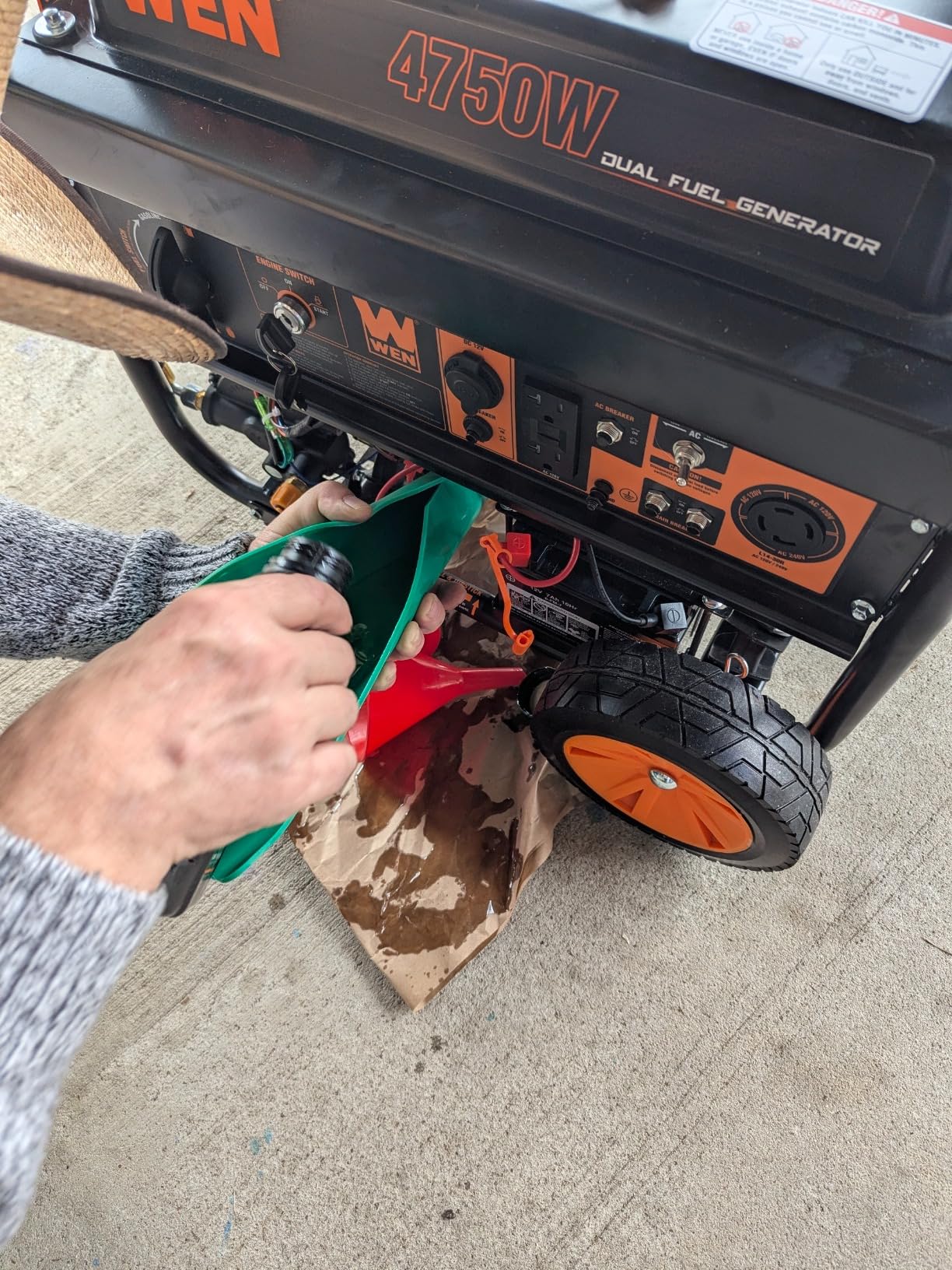
Two products in this list arrive without engine oil, so filling the oil is step one for the PowerSmart 4500W and the ERAYAK 4500W. Their low-oil protection will prevent a start until you do.
Run a new unit for an hour at roughly half load with a 20/40 or 30/30 oil before you rely on it. After that, change the oil after the first 25 hours and then every 50 to 100 hours or once a year. Use fuel stabilizer for stored gasoline, and run the carburetor dry or use the fuel shutoff mode before storage.
Give it 10 to 15 minutes at half load every few months even when you do not need it, to keep the carburetor clean. More on how these units fit an outage kit is in our home backup generator guide.
Frequently Asked Questions
What is the 80% rule for generators?
The 80% rule says never load a generator above 80% of its rated running wattage. You keep the remaining 20% as headroom for startup surges, because a refrigerator compressor or a pump can draw several times its steady wattage for the first second or two. A 3,000 running watt unit therefore has a safe continuous ceiling of 2,400 watts.
Are inverter generators really worth it?
Inverters are worth it when your loads include electronics, medical devices or anything you run at partial load. They produce a clean sine wave under 3% total harmonic distortion and throttle the engine down at light demand, so they run much quieter. Conventional units give you more watts per dollar and are fine for purely resistive loads like space heaters and power tools.
How much power do I need to run a refrigerator?
A refrigerator typically draws 300 to 800 running watts and needs a startup surge above that. A chest freezer can reach 1,000 running watts and about 1,200 to start. Apply the 80% rule, and a 2,000 running watt inverter handles a refrigerator plus lights and a router comfortably with room for a second small appliance.
How long can a portable generator run on a tank of gas?
It depends on tank size and load. The units in this roundup range from about 4 hours at half load on a 1-gallon tank to 16 hours on a 2.25-gallon tank at light load. Propane extends this considerably: a dual-fuel unit on a standard 20-pound cylinder can run up to 24 hours on quarter load.
What is the disadvantage of a dual fuel generator?
The main disadvantages are slightly lower output on propane than on gasoline, added fuel plumbing and controls that add weight and maintenance points, and the need to store two fuel types. Dual fuel also costs more than a comparable single-fuel unit, and switching mid-outage is not always as seamless as the marketing suggests.
Is it safe to run a generator in the garage?
No. Never run a portable generator in a garage, basement, shed or enclosed porch, even with the door fully open. Carbon monoxide is odorless and accumulates at dangerous levels without warning. Place the unit outdoors at least 20 feet from the house with the exhaust pointing away from doors and windows. A CO sensor is a backup layer, not a substitute for outdoor placement.
Can I run a generator in the rain?
Most generators are designed to be operated outdoors in rain and are tested for wet weather, but never cover the unit with a canopy or tarp that traps exhaust near the engine. Keep the electrical connections and any extension cords dry, stand the unit on a stable level surface, and make sure rain cannot wash fuel or oil into the engine air intake.
Final Verdict
The WEN DF475T is the pick. It gives you 240V output, an electric start, 3,800 running watts on gasoline and a switch to propane for long outages, which no other unit in this roundup combines. If you cannot move 100 pounds, take the WEN 56235i instead, and if you want the most inverter-smooth power with dual fuel and a display, the PowerSmart 3800W is the middle path.
Whichever you choose in the best portable generators under 500 category, remember the two rules that decide whether the purchase works: stay under 80% of rated running watts, and run it outdoors at least 20 feet from the house. Measure your real load first, then pick from the list.