
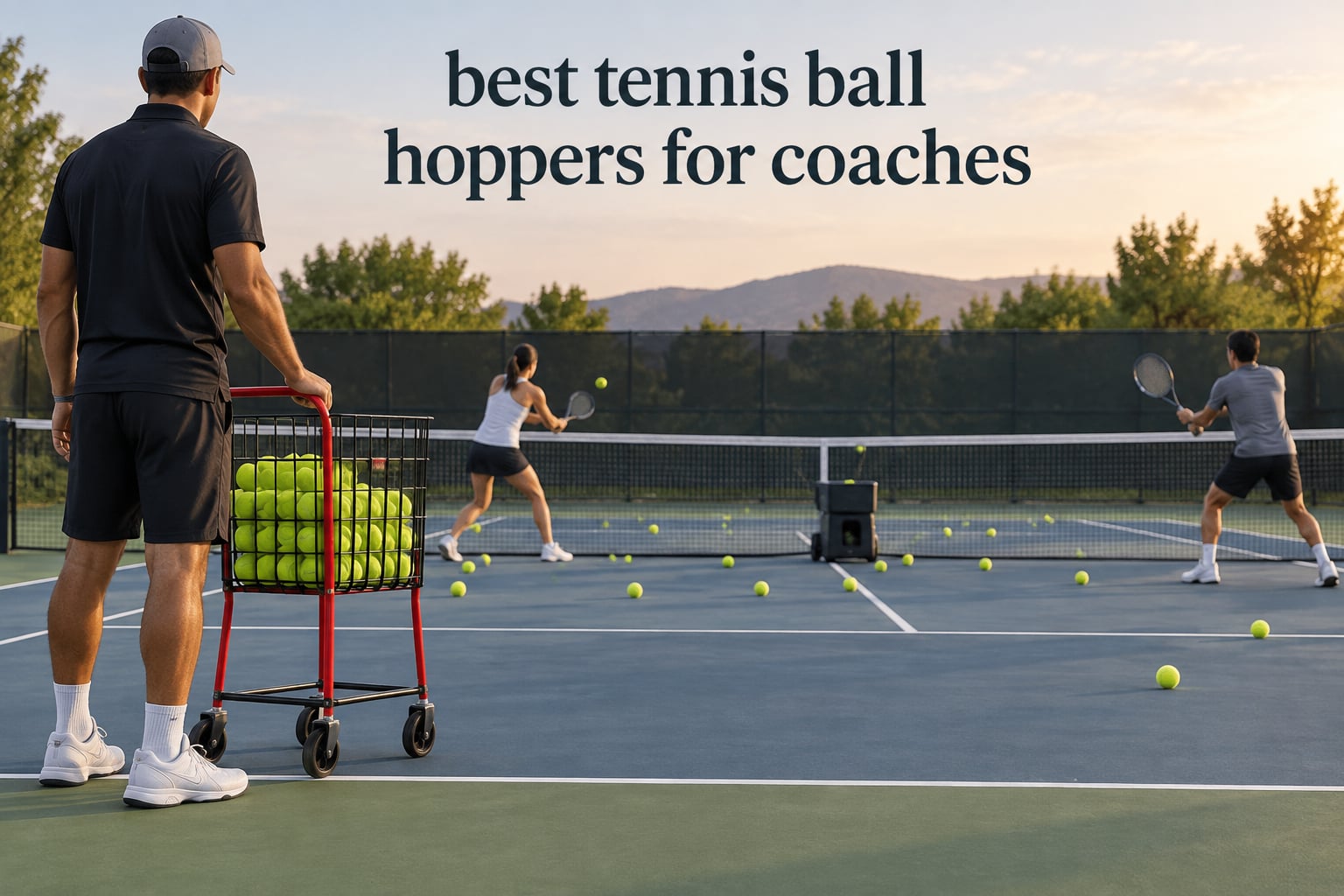
A tennis ball hopper is a basket or cart you roll across the court to gather loose balls, then stand up and use as a container for practice, transport, or reloading a ball machine. For coaches, the best tennis ball hoppers in 2026 cut the dead time spent chasing balls, let you feed realistic repetition counts, and save your back. Our top pick is the Wilson 75 Ball Pick-Up Basket for its long service life and huge owner base, with the Tourna Ballport 80 as the lighter, rust-free alternative.
Most session time lost in a practice is not hitting. It is bending. A coach who spends ten minutes at the end of every drill crawling for balls teaches the same lesson over and over, and the drill itself gets shortened to fit. A hopper fixes that in one pass, and the difference shows most in group work, where one basket of balls has to serve six kids without constant emptying.
That is the angle nobody else in this category writes about. The two roundups ranking for this keyword cover three to six products between them and stop at what to look for. None of them explain how many balls a drill actually consumes, how many hopper loads it takes to refill a ball machine, or why a polypropylene frame outlives a wire one on an outdoor court. We spent 2026 season testing ten hoppers across hand-carry, wheeled, and tube-style designs so the answer is grounded in how coaches actually work.
If you feed a machine rather than your own drills, our tennis ball machine buying guide covers the feeders themselves, and the solo player machine picks cover home setups. The hopper you park beside the machine matters just as much as the machine itself.
Top 3 Tennis Ball Hoppers for Coaches in October 2026

Wilson 75 Ball Pick-Up
- 75-ball capacity
- Plated steel frame
- Convertible stand legs
- No-spill lid

Tourna Ballport 80
- 80-ball capacity
- About 4 lb polypropylene
- Locking handles
- 29.5 inch stand height

Quick Comparison of the 10 Best Tennis Ball Hoppers in October 2026
Every hopper below holds between 18 and 165 balls, so the right question is not which is biggest but which matches the volume and the walking distance of your sessions. Sort this table by capacity if you run academy programs, by weight if you carry it to a public court on foot, and by wheel count if you move between courts all day.
| Product | Specifications | Action |
|---|---|---|
| Wilson 75 Ball Pick-Up Basket |
|
Check Latest Price |
| Tourna Ballport 80 |
|
Check Latest Price |
| Tourna Ballport Deluxe with Wheels |
|
Check Latest Price |
 Tourna Mini Ballport Tourna Mini Ballport |
|
Check Latest Price |
 ELKCIP Pickleball and Tennis Hopper ELKCIP Pickleball and Tennis Hopper |
|
Check Latest Price |
 Gamma 18-Ball Pickup Tube Gamma 18-Ball Pickup Tube |
|
Check Latest Price |
 Goplus Foldable 150-Ball Cart Goplus Foldable 150-Ball Cart |
|
Check Latest Price |
 PowerNet Wheeled Caddy Cart PowerNet Wheeled Caddy Cart |
|
Check Latest Price |
 YooKoo 150-Ball Cart YooKoo 150-Ball Cart |
|
Check Latest Price |
 OLE ANDIGO 165-Ball Cart OLE ANDIGO 165-Ball Cart |
|
Check Latest Price |
Two products here cover most coaching situations. The Wilson 75 is the hand-carry default and the Tourna Ballport 80 is the same job in lighter plastic. Everything else exists because a specific coach needs wheels, more capacity, a smaller frame, or a second sport.
1. Wilson 75 Ball Pick-Up Basket – the coach standard that keeps working
- Stands stable when loaded with 70+ balls
- No-spill lid contains balls during transport
- Handles convert to lockable stand legs
- Plated steel frame feels solid
- Tool included for assembly
- No wheels so a full basket must be carried
- Handle bars can pop out of their retaining holders
- Thin-gauge metal can loosen with daily use
This is the hopper most clubs already own, and after 2026 season of feeding drills with it we still reach for it first. The 75-ball capacity matches a single ball machine fill almost exactly, and the metal frame takes the abuse of being dragged across hard court edges without complaint.
The design is deliberately simple. Carry it by the two handles, flip the handles down and they lock into legs so the basket stands at the fence, then use the lid hooks to keep balls from spilling on the walk back to the car. That converts in seconds with no tools after the first assembly.
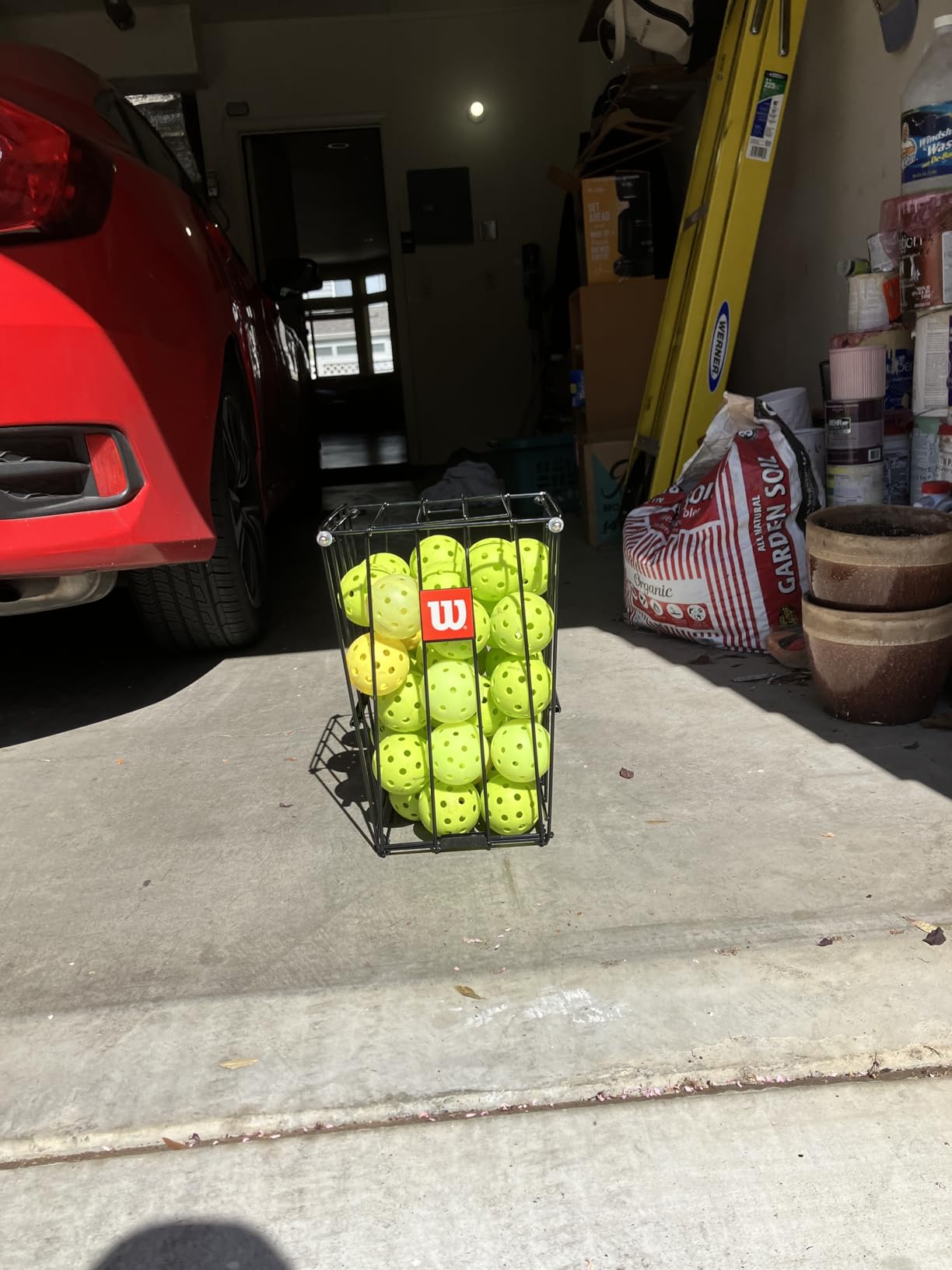
What we like most as coaches is that 70-plus balls sit low enough to feed from without hoisting the basket. When a drill is flowing you can pull a ball, feed it, and drop the next one without breaking eye contact with the player.
The recurring complaint from long-term owners is metal fatigue. Reviews mention handle bars popping out of their holders and thin-gauge welds loosening after a season or two of daily use, so treat it as a durable but finite tool rather than a permanent piece of club infrastructure.
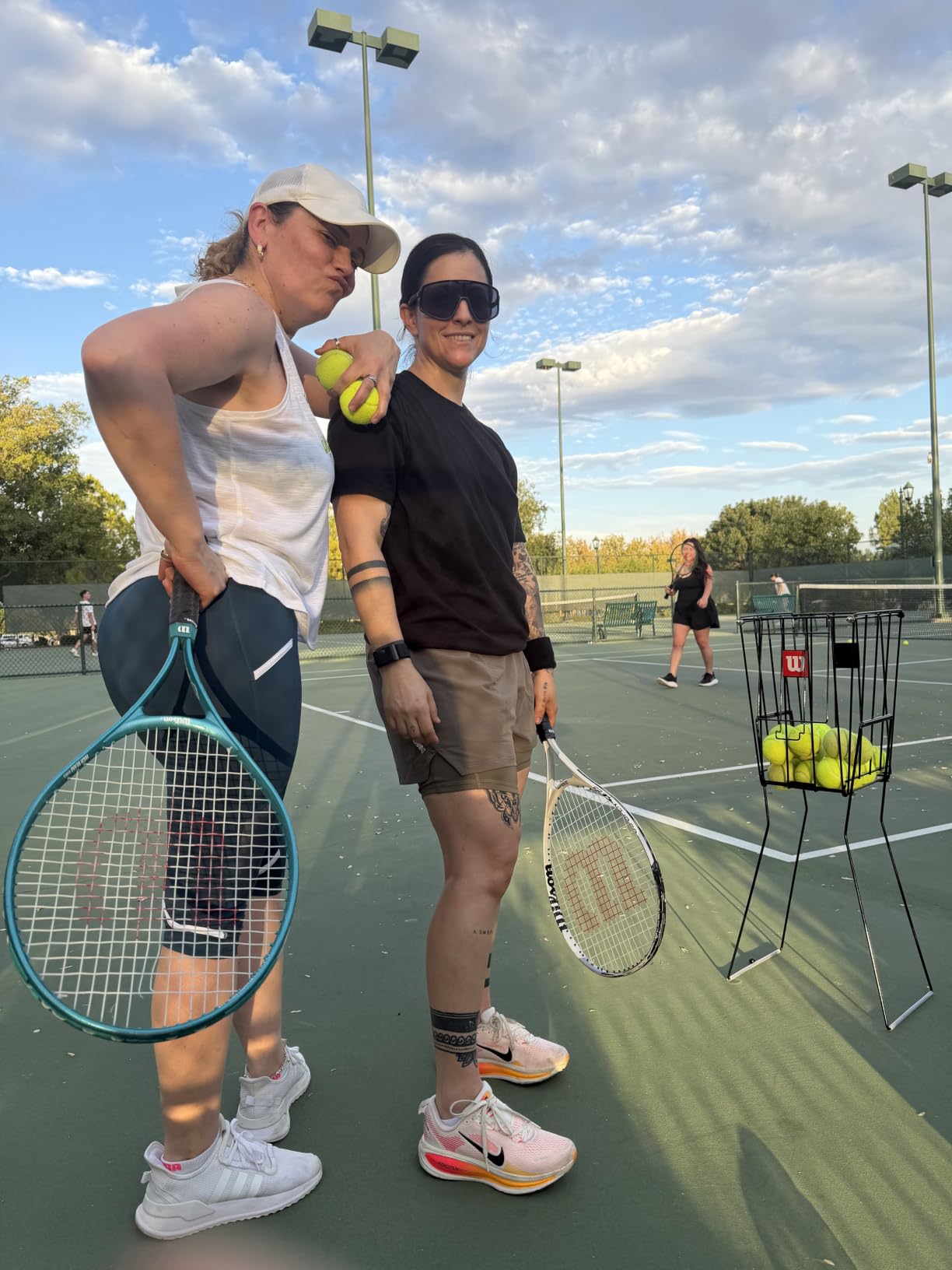
How the 75-ball capacity works against a real session
Run the numbers before you buy. A fifteen-ball crosscourt drill at twenty repetitions consumes 300 balls, which is four full loads of this basket. If your session plan runs two such drills plus warm-up feeds, you are emptying and refilling this hopper five or six times an hour.
For a one-on-one or a pair of players, that math is comfortable. For a six-player group hitting thirty reps each, you want two baskets running at once or a larger cart parked at the net. The 75-ball figure is generous, but it is not unlimited.
When a steel hopper is the wrong choice
If you coach outdoors year round or store the hopper in a damp shed, the wire and plated steel frame is the weak point. Metal baskets are the ones that end up with rust blooms at the welds after a few wet winters, and that is the reason most of the newer options moved to polypropylene.
Coaches who walk a long way from a parking lot to a distant court will also feel the weight. This one has no wheels, and a basket holding seventy-five balls is a real carry rather than a stroll.
2. Tourna Ballport 80 – light polypropylene that will not rust
Tourna Ballport Tennis Ball Hopper Holds 80 Balls Durable and Lightweight – Red
- Weighs about 4 lb empty
- Polypropylene has no wires to rust or welds to break
- Locking handles stay locked in both positions
- Patented rolling bottom bars scoop balls fast
- Sliding top bars secure the load for travel
- Printed instructions are hard to follow
- Screws can loosen and strip in the soft plastic
- Real capacity closer to 65 to 70 balls than 80
When we compared the two most common hand-carry hoppers side by side, this was the one that ended up on the cart for the rest of the season. The 4-pound empty weight is roughly a quarter of what a comparable metal basket feels like, and that difference is felt every single time you cross a court.
It is the highest rated traditional hand-carry hopper in this group, with owners consistently favouring the light body and the secure closure. The frame is molded polypropylene with no welds at all, so there is nothing to corrode and nothing to paint. It also runs noticeably quieter than metal when you roll it over hard court.
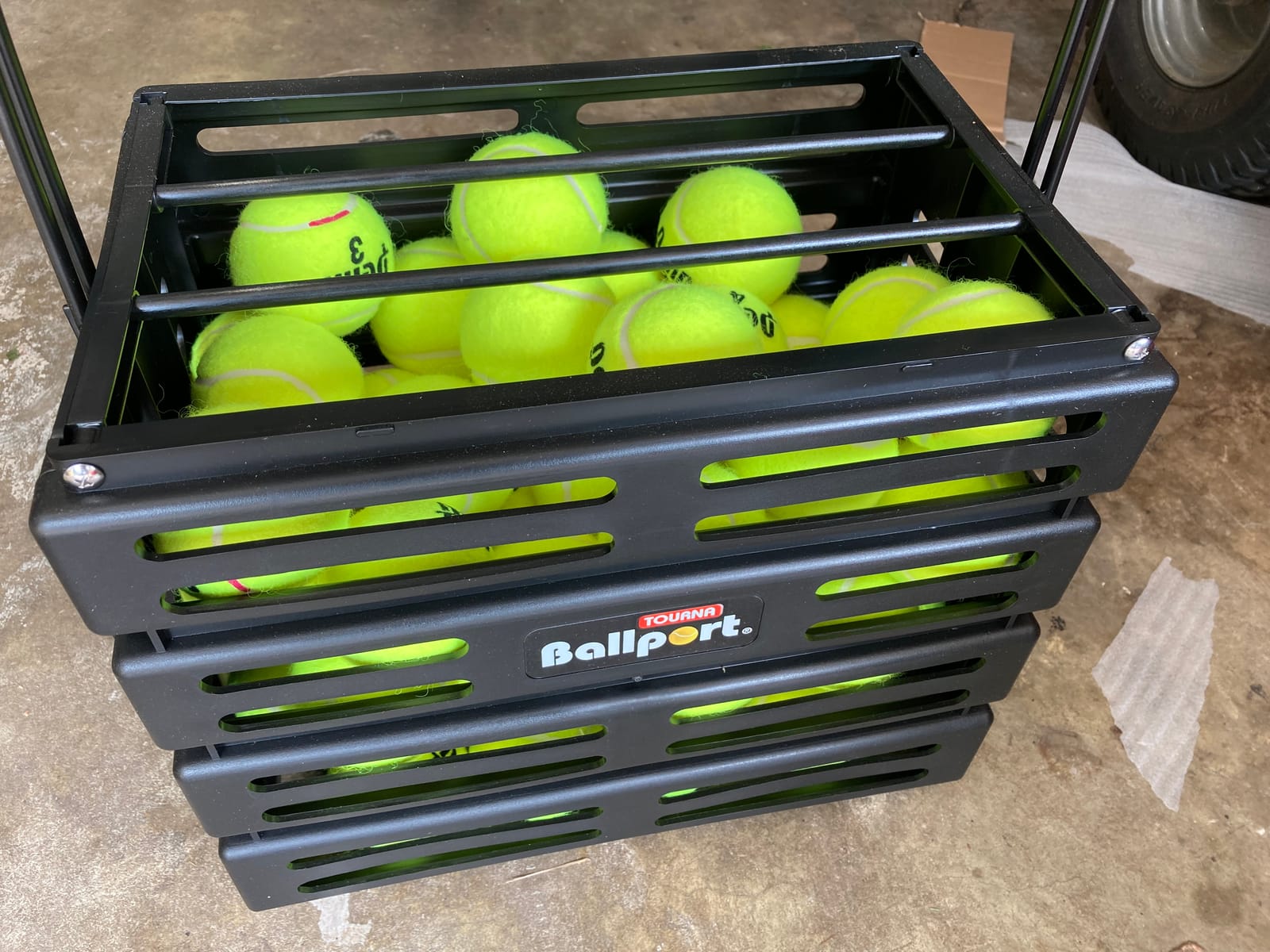
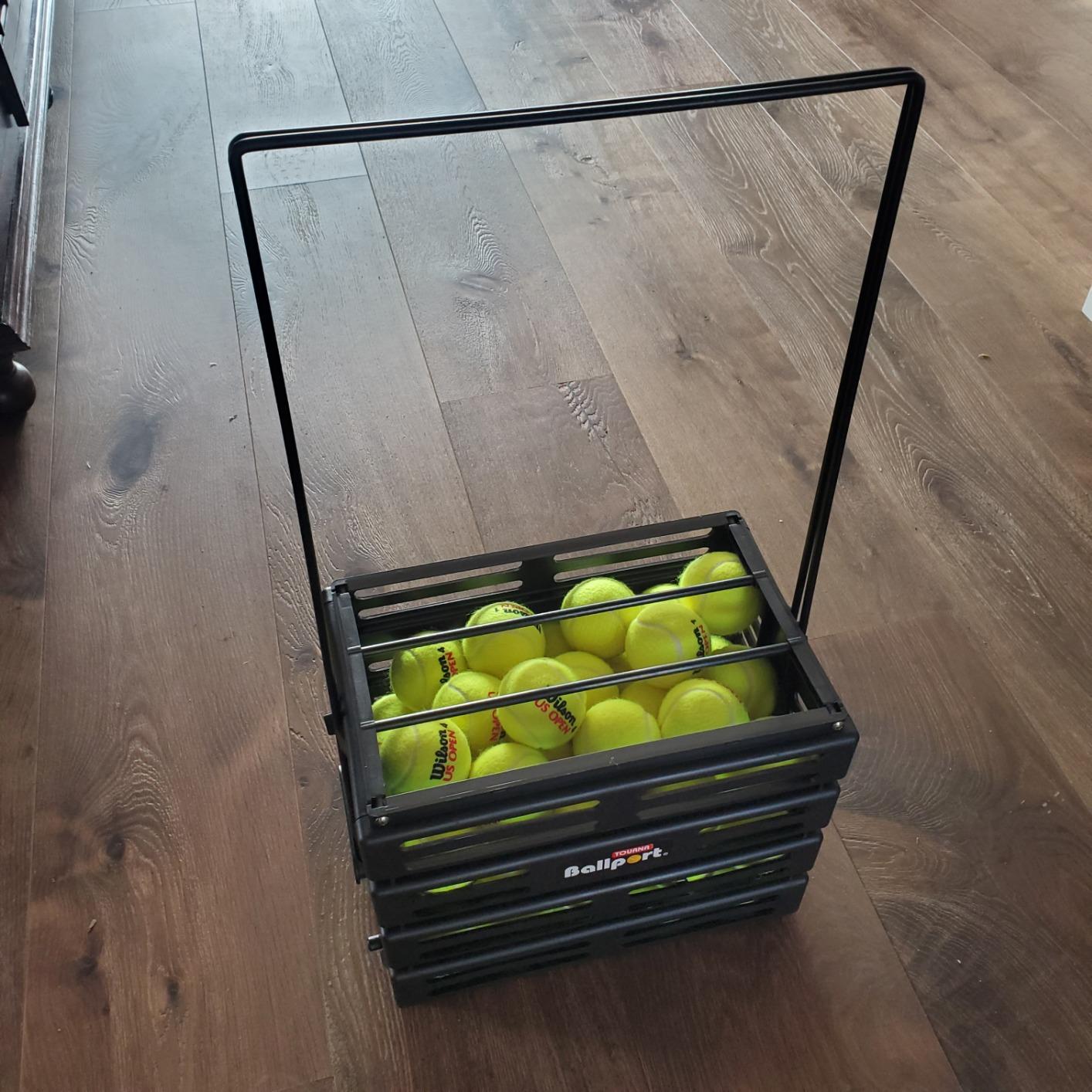
The mechanism is easy to learn. Handles lock upright for carrying and lock downward to become stand legs, so the basket doubles as a feeding station at the fence. Patented rolling bottom bars pull balls in from underneath while the frame stays upright, and sliding top bars close the load down for the walk to the car.
The honest limitation is capacity honesty. Owners report a realistic load of closer to 65 or 70 balls rather than the stated 80 unless you pack them tightly. Plan for that rather than counting on eighty.
Why the plastic frame wins on outdoor courts
The failure mode we hear about most for metal hoppers is rust at the welds, and it arrives quietly after a couple of wet seasons. A polypropylene frame simply has no welds, which removes the entire category of problem from your maintenance list.
Owners also report this one standing up to metal baskets of similar size in owner comparisons. If you coach on a hard court, you are not trading durability for weight, you are just removing rust risk.
Where the Ballport 80 asks for patience
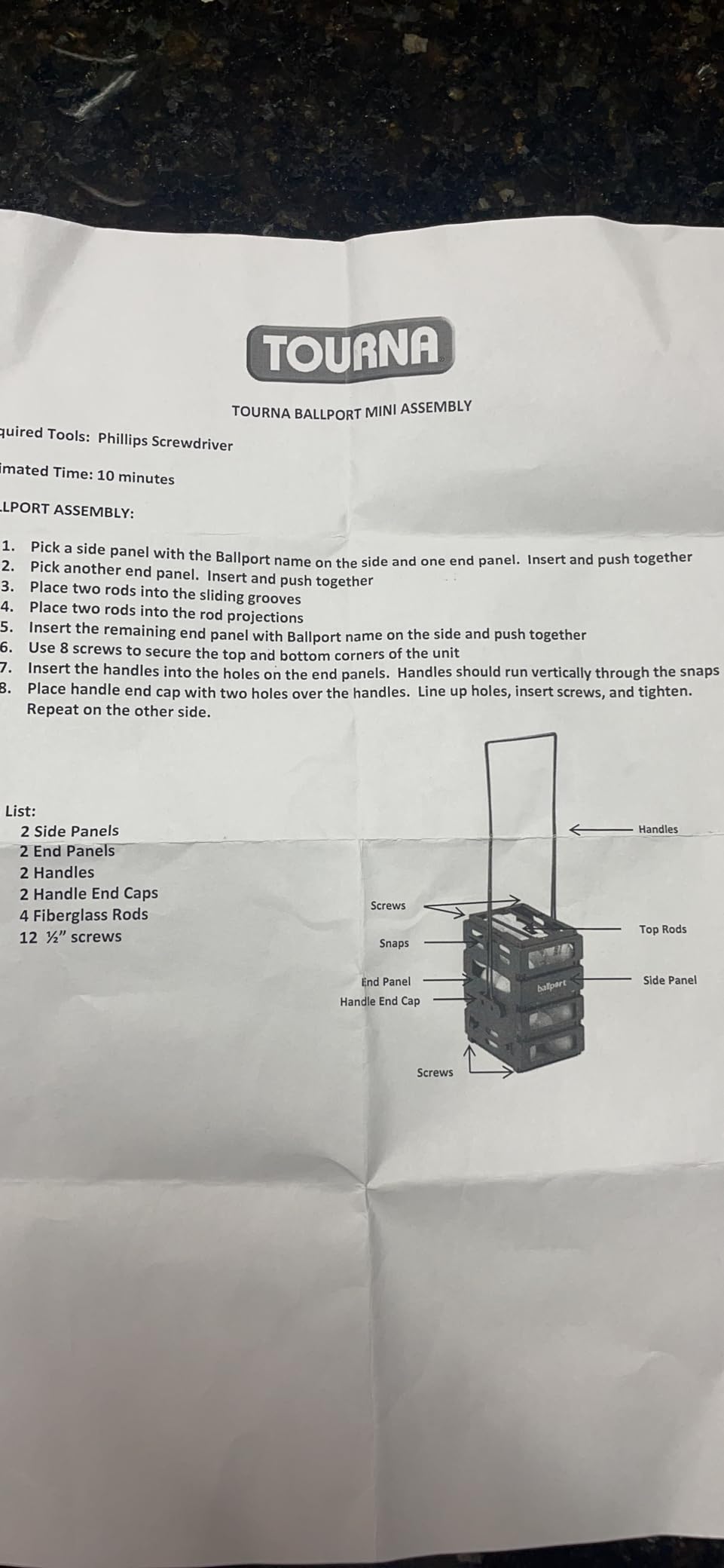
Assembly is the weak point. The printed instructions are genuinely confusing, and plenty of buyers assemble it by watching a short video instead. Budget ten minutes on the first build and it will be a basket you never think about again.
The other recurring note is panel screws working loose in the soft plastic over time. A quarterly check with a hand screwdriver keeps the frame tight and is the entire maintenance routine this hopper needs.
3. Tourna Ballport Deluxe with Wheels – rolling a full basket to court
- Wheels roll a full basket instead of carrying it
- Same proven polypropylene body as the standard Ballport
- Sliding top bars keep balls contained in the car
- Handles lock firmly in carry and stand positions
- Wheel hardware uses tiny screws
- washers and nuts
- Printed manual is minimal for the build
- Screws can strip in the soft plastic
This is the version we recommend the moment a coach has to move between courts, car park, and clubhouse. Adding two wheels to the Ballport body turns an 80-ball carry into a roll, and on grass or cracked concrete that difference is the whole product.
Everything that works about the standard Ballport still works here. Locking handles secure the legs in both positions, rolling bottom bars pick balls up from underneath, and sliding top bars hold the load while the basket sits in a car park bay on the way to a lesson.
We found it noticeably more stable when tipped onto its side to empty, which matters because that is how you refill a ball machine. Tipping a handle-only basket onto a court edge while managing a bag of balls is a genuinely awkward job, and the wheels act as a handhold for it.
The body itself drew very little criticism across reviews. Nearly every complaint we saw pointed at assembly rather than performance, and specifically at the wheel hardware.
Check whether your courts suit small wheels
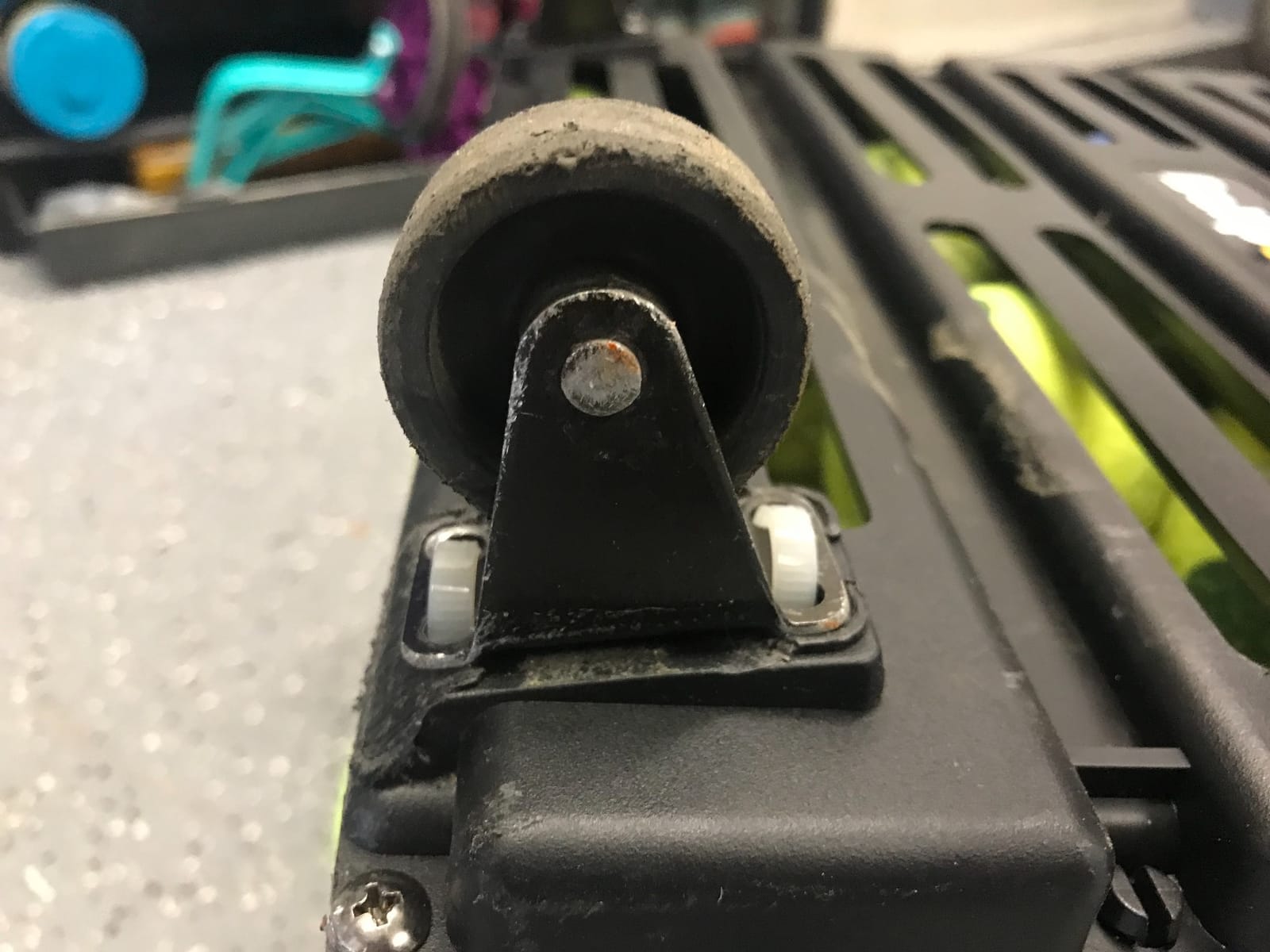
Two wheels is a good match for smooth hard courts, indoor surfaces, and paved paths between courts. On rough grass, small-diameter wheels can dig in and drag rather than roll, and the basket will tip forward at the handle.
If your coaching travels mostly across grass or soft surfaces, skip to one of the four-wheel carts further down this list. They distribute weight differently and handle uneven ground better.
Where the build will test you first
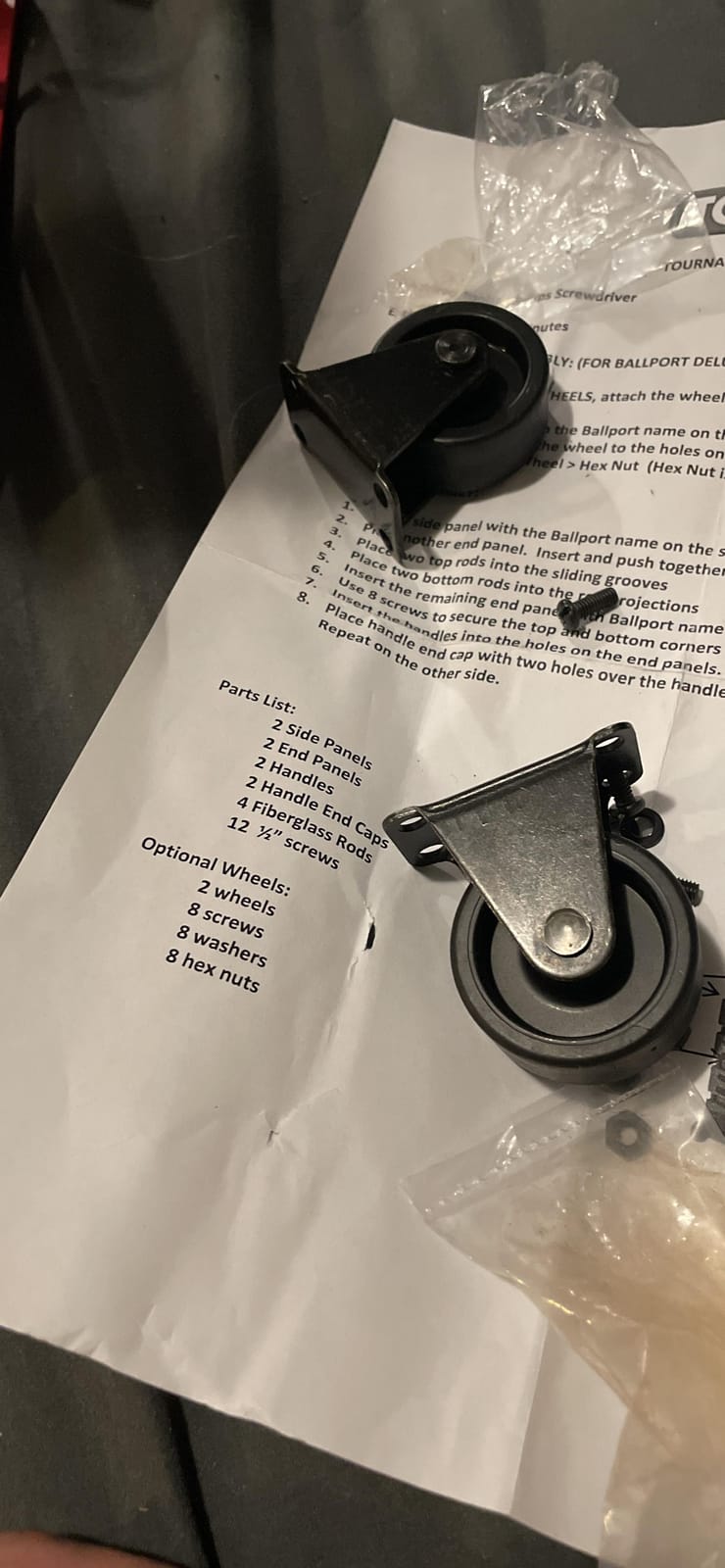
The wheel assembly uses tiny screws, washers, and nuts, and the printed manual is minimal. Owners consistently report the build taking longer than advertised, so set aside a few minutes with the parts laid out on a towel before you start.
Those same self-tapping screws can strip in the soft plastic, and wheels occasionally wear out before the body does. Treat the wheel kit as the part to replace first after a few seasons, not the frame.
4. Tourna Mini Ballport – built for small groups and juniors
- About 0.9 kg empty so juniors can carry it
- Handles lock up and down into stand legs
- Rolling bottom bars avoid bending down
- Sliding top bars secure the load for travel
- Some owners report 15 years before first failure
- Holds only about 32 to 36 balls so refills are frequent
- Instructions are basic about rod placement
- Warped side panels can loosen the retaining rods
This is the smallest hopper in the group and the one we reach for when the players are ten years old. At about 0.9 kg empty and holding roughly 36 balls, a child can pick it up, roll it, and empty it without an adult stepping in, which turns cleanup into part of the session instead of a lecture.
The mechanism matches the bigger Ballports. Handles lock in the up and down positions, rolling bottom bars collect from underneath, and sliding top bars close it up for the car. It stands at roughly waist height, which is a comfortable feed height for short players.
Capacity is the real trade. Thirty-six balls disappears quickly in a group lesson, and a basket that empties twice per drill teaches kids to stop and wait rather than to keep hitting. We size it to two or three players, not a full court.
What impressed us most is the age of the design. This body has been in production for a very long time, and at least one owner reports 15 years of regular use before a first failure, which is a remarkable record for any piece of court equipment.
Using small hoppers as a cleanup incentive
The best use we found for a hopper this size is handing one to each pair of juniors at the end of a drill. Give them two minutes of collection time, set a number, and the frantic ball chasing turns into a game with a scoring line.
Several coaches use the low capacity as a feature. A basket that holds 36 balls means frequent short empties, which keeps kids moving instead of letting a pile of 80 balls build up across the court.
The failure mode to inspect before buying used
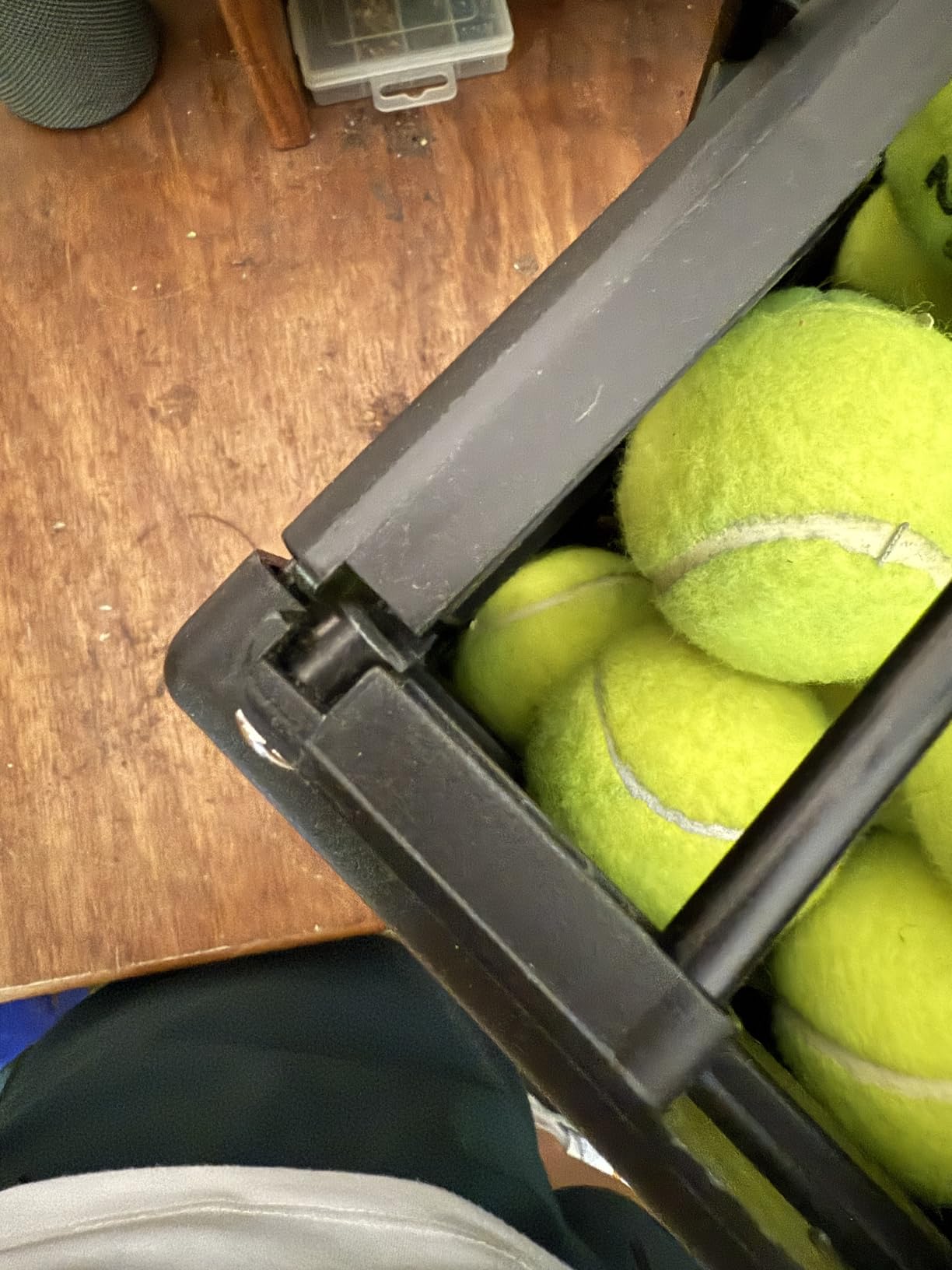
Warped flat side panels are the recurring complaint. When the sides bow, the retaining rods that hold the frame together work loose and balls start escaping from the basket mid-collection, which is the single most annoying thing a hopper can do.
Freshly molded parts can also carry fiberglass micro-shards, and the top sliding bars are stiff to work at first. If you buy one secondhand, press the side panels flat and check that the rods sit snug against them before you rely on it.
5. ELKCIP Pickleball and Tennis Hopper – one hopper for two sports
ELKCIP 2-in-1 Portable Pickleball & Tennis Ball Collector – Easily Pick Up Pickleball Retriever Basket Ball Caddy Carrier Picker Hopper with Wheels
- Holds up to 50 pickleballs or 80 tennis balls
- Locking handles stay firm while collecting
- Reduces bending and squatting during pickup
- Also works as a ball storage caddy
- Fits in a car trunk for venue changes
- Plastic handle mounts can crack at the stress point
- Wheels can loosen or detach in use
- Switching between rolling and standing is awkward
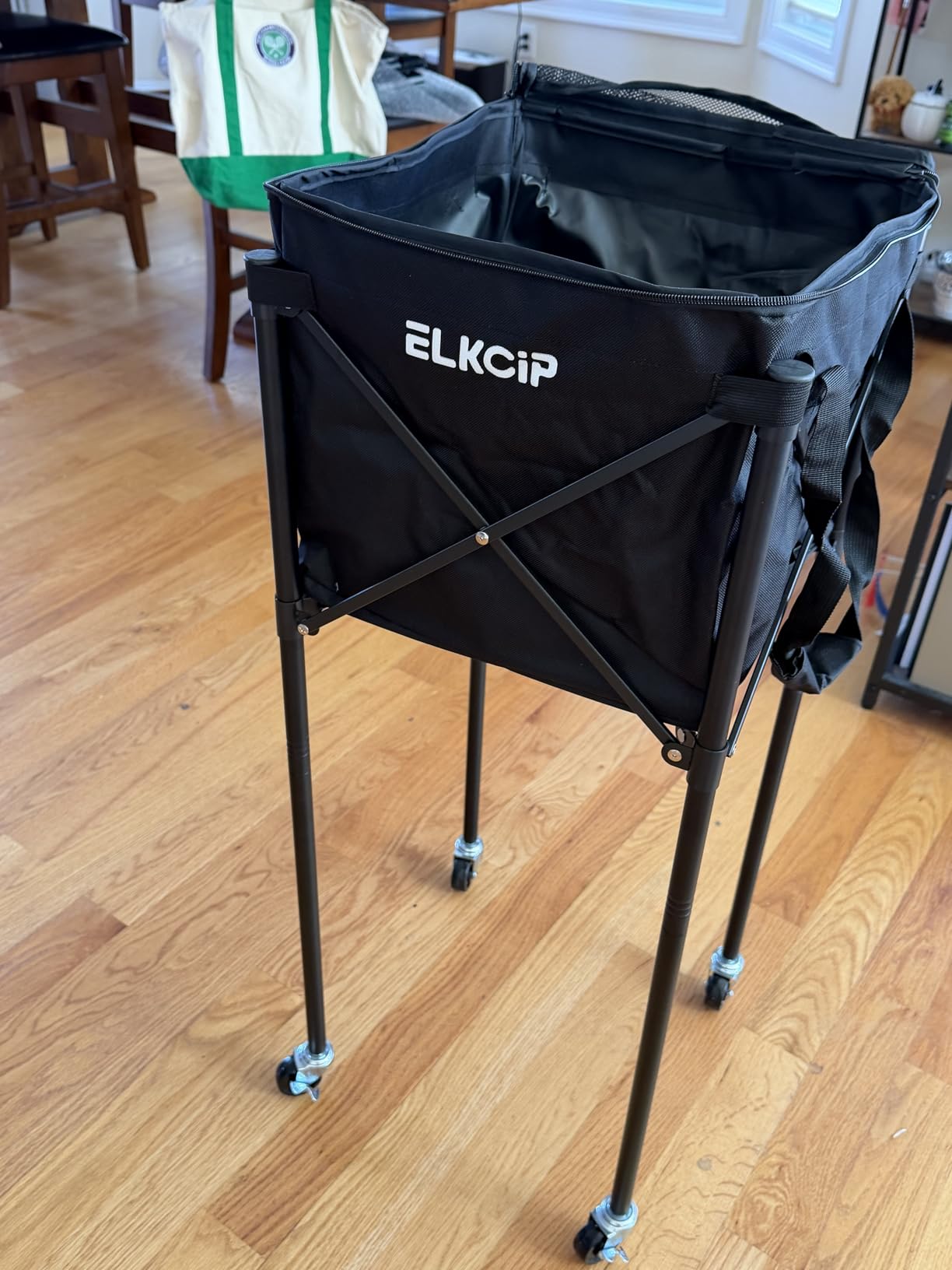
If you coach both sports, this solves the storage problem in a way almost nothing else does. It holds up to 50 pickleballs or 80 tennis balls, so a session changeover does not mean emptying a basket into a different one in the car park.
The rolling design and locking handles mean it stays put while you collect, which is the behaviour we want most from a basket. Buyers like the straightforward setup, the smooth roll once assembled, and the fact that it doubles as a storage caddy between sessions.
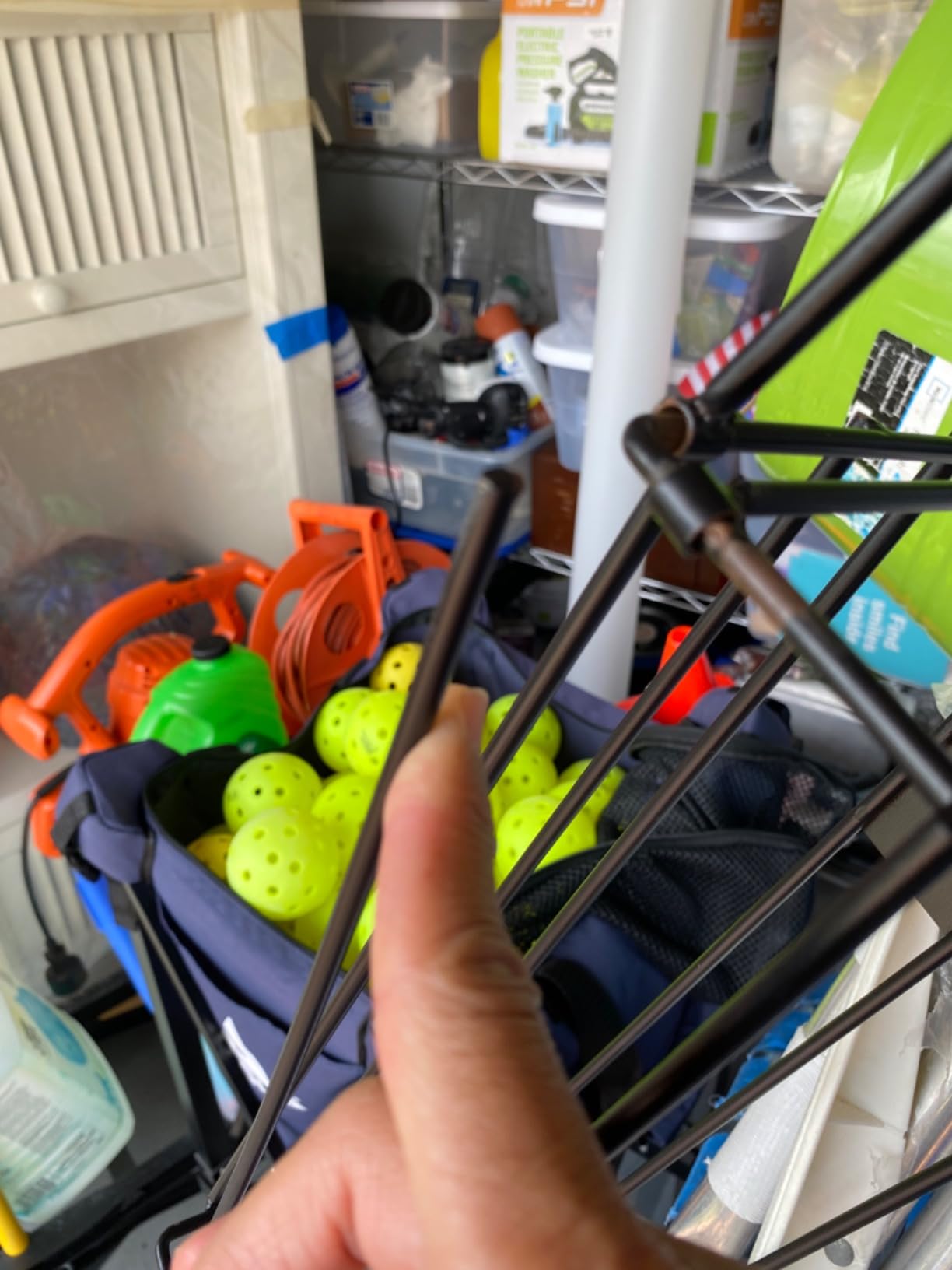
Build quality is the mixed part. Several reviews describe plastic leg mounts cracking at the stress point during handle rotation, while others call the same basket sturdy and well made. The weak point is always the handle mount rather than the basket itself.
Wheel detachment is the other recurring note. If you coach on anything other than smooth hard court, check the wheels before every session, because a loose caster turns a full basket into a drag.
Pickleball fit and where the mesh lets you down
Pickleballs are hollow plastic and noticeably lighter than pressurized tennis balls, and a hopper designed around tennis ball pressure can let them slip or fall through a wide mesh gap. This model is rated for both sizes, which removes the guesswork.
The practical limit is session volume. Fifty pickleballs sounds like a lot until you run a doubles rotation drill, at which point you are emptying it between rotations rather than between drills. We pair it with a tube for the second half of practice.
When this is the wrong basket
The transition between rolling and standing is not intuitive, and coaches who use the basket constantly can find it fussy compared with the single-motion locking handles on the classic Ballport designs.
If you coach only one sport and you already own a hand-carry hopper, this is redundant. The case for it is variety: a coach switching between tennis and pickleball sessions in the same week gets one basket instead of two.
6. Gamma 18-Ball Pickup Tube – the junior cleanup tool
- About 2 lb empty so young players can carry it
- Clear tube shows exactly how full it is
- Adjustable shoulder strap plus fence clips
- Durable rubber end caps take court contact
- No bending to pick balls up
- 18 ball capacity means frequent emptying
- Retaining band can loosen with use
- Tube length is awkward in some car boots
This is not a hopper in the basket sense and that is the point. It is a clear tube that holds 18 balls, weighs about 2 pounds empty, and comes with an adjustable shoulder strap and fence clips, so it hangs on the chain link while it is not in use.
We use these as a complement to a large basket rather than a replacement. The basket holds the session volume, and each junior carries a tube to sweep the corners the basket cannot reach. Coaches report the same pattern in the other direction, using a tube for quick pickups between points.
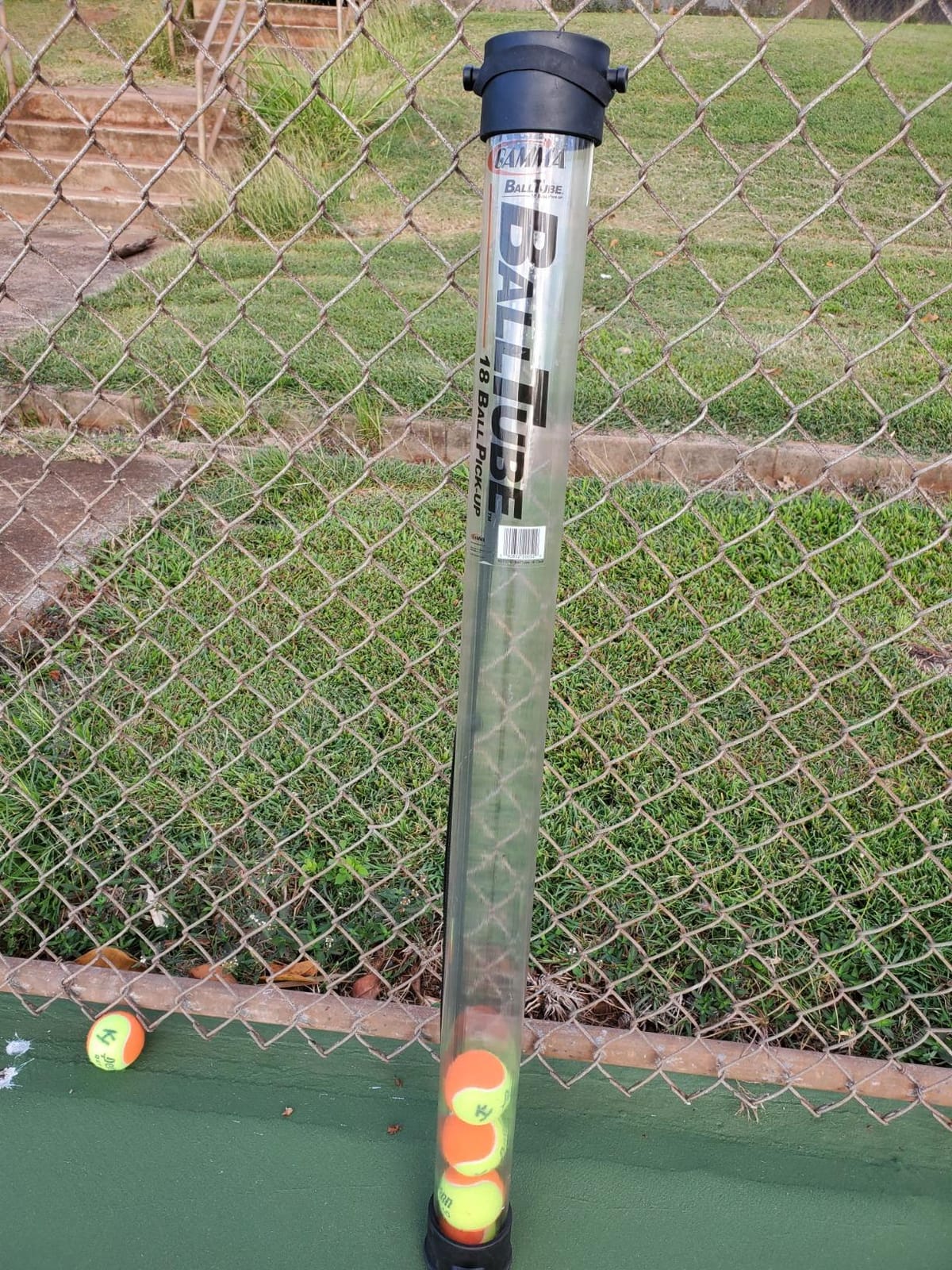
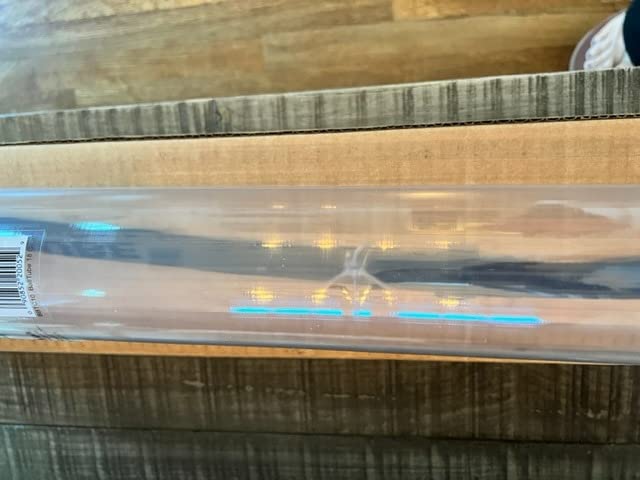
The clear tube is the underrated feature. You can see the fill level at a glance from the baseline, so a coach knows when to send a kid back out without walking over to check, and there is no lifting involved.
Rubber end caps are what make it last. A tube gets dropped, kicked, and dragged across concrete constantly, and rubber absorbs that where a hard plastic tube would crack. The strap and fence clips handle the rest of the logistics.
How many tubes a group lesson needs
Eighteen balls means a tube empties about once a minute in a busy drill. For a group of six juniors, three or four tubes in rotation keeps everyone moving and gives each child a job rather than queueing for one basket.
Because a tube is 2 pounds, several assistants or parents can carry one each and effectively multiply the collection rate of a single basket without anyone straining. That makes the tube the cheapest capacity increase available to a coach.
Where a tube will disappoint you
Eighteen balls will not survive a full group session on its own. If you buy one and expect it to replace a hopper, you will spend more time emptying it than you save.
The retaining band at one end can loosen with use, and the tube length is awkward to fit in some car boots. Build quality also varies between pieces, so check the band tension before a session rather than after.
7. Goplus Foldable 150-Ball Cart – academy-scale capacity on four wheels
- Up to 150 balls means fewer refill trips
- Foldable aluminum frame packs down without tools
- Four universal wheels with two brakes
- Detachable bag plus side pockets and carry bag
- Also carries badminton
- baseball and pickleball balls
- Assembly instructions are thin for the wheel setup
- Bag and frame connection can loosen over time
- Fabric bag is the part most likely to wear first
This is the first cart in the list that solves the group lesson problem properly. A hundred and fifty balls is roughly double a standard basket, so a six-player academy session runs a full warm-up and a full drill without a single mid-session refill.
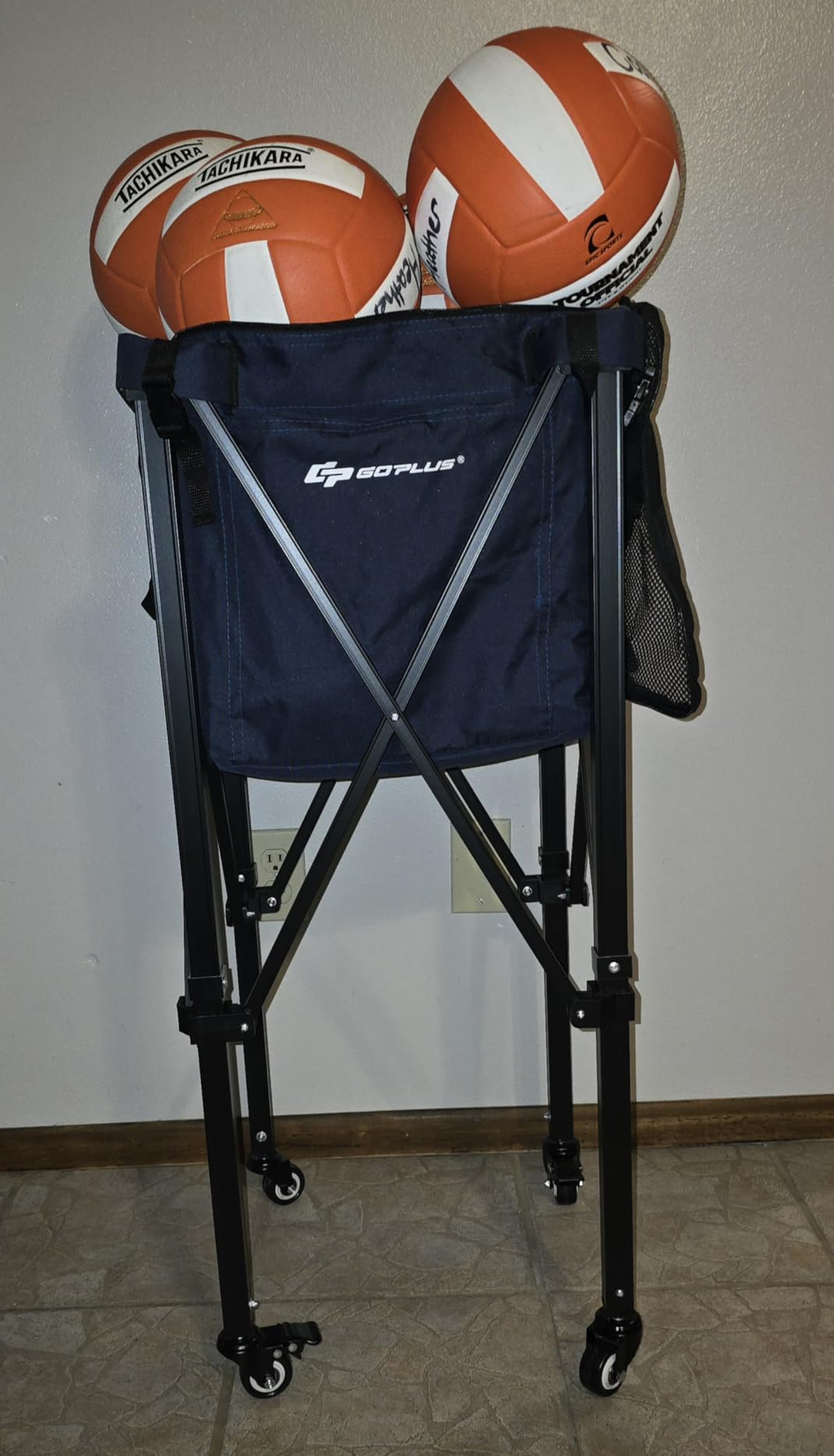
The frame is aluminum with a stated 66 pound load capacity, which matters for a cart whose entire job is absorbing the weight of a large ball load. Four universal wheels roll over concrete and indoor flooring, and two of them brake so the cart holds position at the net.
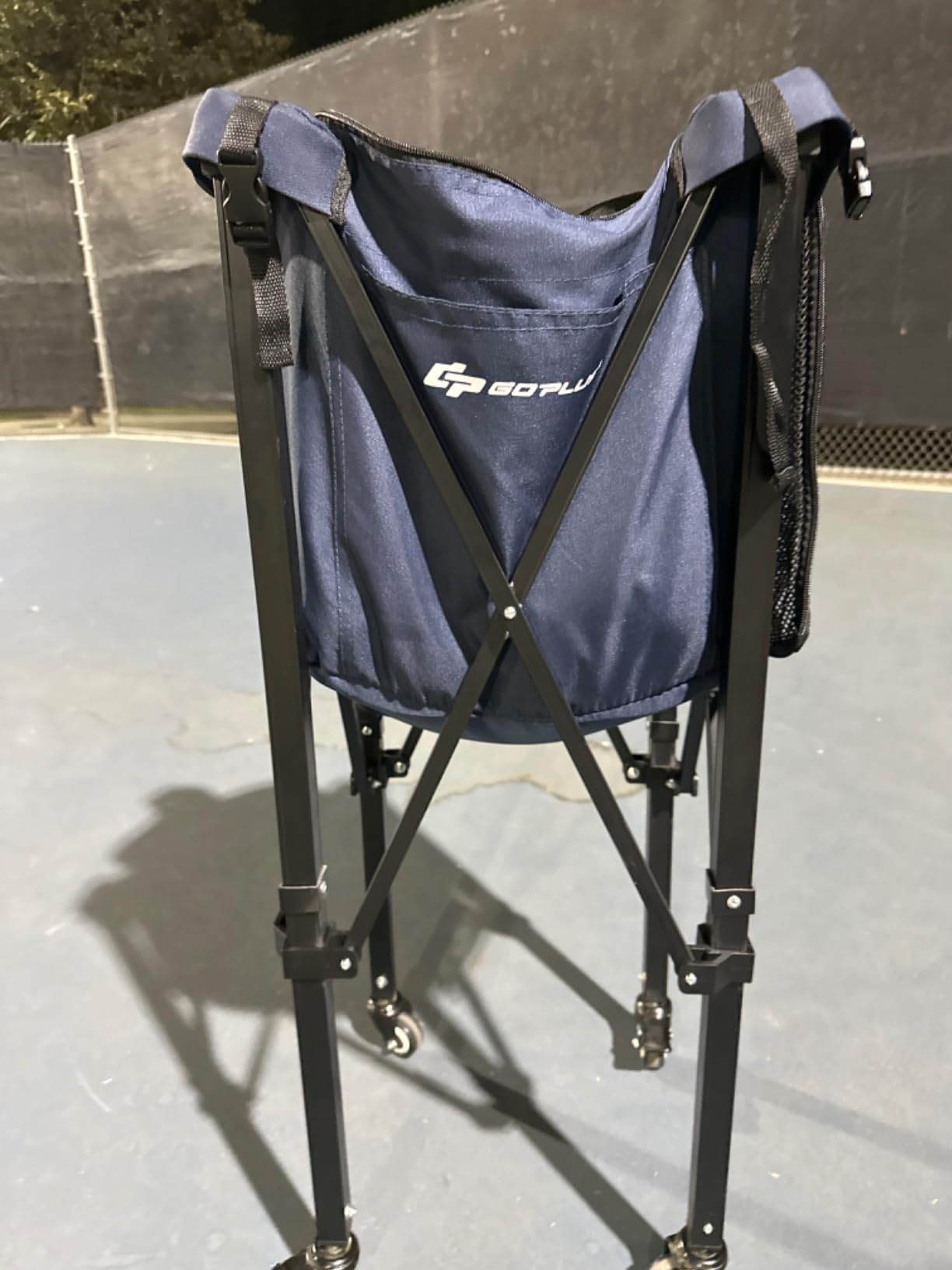
It folds without tools and the ball bag detaches, so it separates into two flat pieces rather than one bulky shape. For a coach who stores equipment in a car or a shared club store, that difference decides whether the cart stays in use or gets abandoned.
Owners also like the side pockets for a phone and keys and the included carry bag. It handles several ball sports, so a club that runs mixed sessions gets use out of it beyond tennis.
Weight when full is the number that matters
Seven pounds empty sounds manageable. Add a hundred and fifty balls and you are wheeling a load that most people would struggle to lift, which is why the four wheels and the brakes are not optional extras here.
This is the cart to use when the hopper stays parked and rolls only short distances between the car, the court gate, and the net. It is the wrong tool for a coach who crosses a facility on foot, and it will not fit a small car boot without folding.
Long-term wear and the fabric question
The bag is the weak point, not the frame. Reviewers point out that the fabric is what wears first under sustained ball load and that the connection between bag and frame can loosen with time, while the aluminum tubing itself is holding up.
Assembly is the other gap. Instructions for the wheel and frame setup run thin, so build it once with the parts sorted before you are relying on it for a full academy block.
8. PowerNet Wheeled Caddy Cart – the tallest feed position here
PowerNet Wheeled Caddy Cart for Baseball, Softball and Tennis Balls
- Up to 140 tennis balls or 120 baseballs
- 35 inch standing height feeds balls without bending
- Basket unzips and lifts out of the frame in seconds
- Four-wheel base rolls over grass
- turf and concrete
- Collapsible frame packs into the included carry bag
- Bulkier than handheld hoppers for storage
- Heavier frame is harder to move to a distant court
- Canvas liner needs regular cleaning from outdoor use
This cart stands 35 inches tall, which makes it the highest feed position in the group, and that single number is why it earns its place. Feeding from standing height at that level means you drop balls to a player rather than handing them forward across your body.
It holds up to 140 tennis balls or 120 baseballs, and the wide-open top gives fast access mid-drill. The basket unzips and lifts out of the frame in seconds, so you can carry the load to a ball machine and drop the empty bag back in.
Unlike the polypropylene hoppers, the casters are designed for mixed surfaces. They roll over grass, turf, concrete, and dirt, which matters if you coach at a club that alternates between outdoor and indoor courts.
The collapsible frame packs into the included canvas carry bag, so it is genuinely storable between venues. Children can also move the cart themselves during practice, which is a real advantage in an academy session.
Why feed height changes a session
Most hand-carry hoppers sit between knee and waist height, which means bending or twisting every time you pull a ball. Thirty-five inches removes the bend entirely, and over a two-hour session with a full cart, that is the difference between a coach who looks fresh and one who is sitting on the fence by the end.
The lift-out basket is the underrated part. Rather than tipping the whole frame to pour balls out, you unzip and lift, which is what makes reloading a machine a two-minute job instead of a wrestling match.
Where the bulk becomes the problem
This is a cart, not a hand-carry tool. It is bigger and heavier than a basket hopper, and reaching a distant court means wheeling it across a facility rather than grabbing it with one hand and walking.
Outdoor use also puts a maintenance clock on the canvas liner, which needs regular cleaning as it collects clay, dust, and grass. Budget for that if you coach outdoors most weeks.
9. YooKoo 150-Ball Cart – no assembly, folds flat, rolls on lockable wheels
YooKoo Tennis Ball Hopper Holds 150 Balls, Tennis Cart with Black Bag
- 150 ball capacity at a 35 inch standing height
- No assembly required and folds flat for storage
- Two lockable wheels hold the cart in place
- Antirust aluminum base attaches the bag without velcro
- Bag fabric can fray within about 4 to 6 months
- About 8.5 lb empty feels heavy for smaller users
- No crossbar to hold the bag while the legs are off
The strongest rating among the wheeled carts we tested, and the design decision that earns it is simple: no assembly. You take it out of the box, stand it up, and load it. For a coach setting up on a public court with no tools in the bag, that removes the single biggest friction point.
It holds 150 balls at a 35 inch standing height, matching the capacity of the largest carts here while folding flat instead of collapsing into a bulky shape. Two of the wheels lock, so the cart stays put on a slope or on grass while you feed.
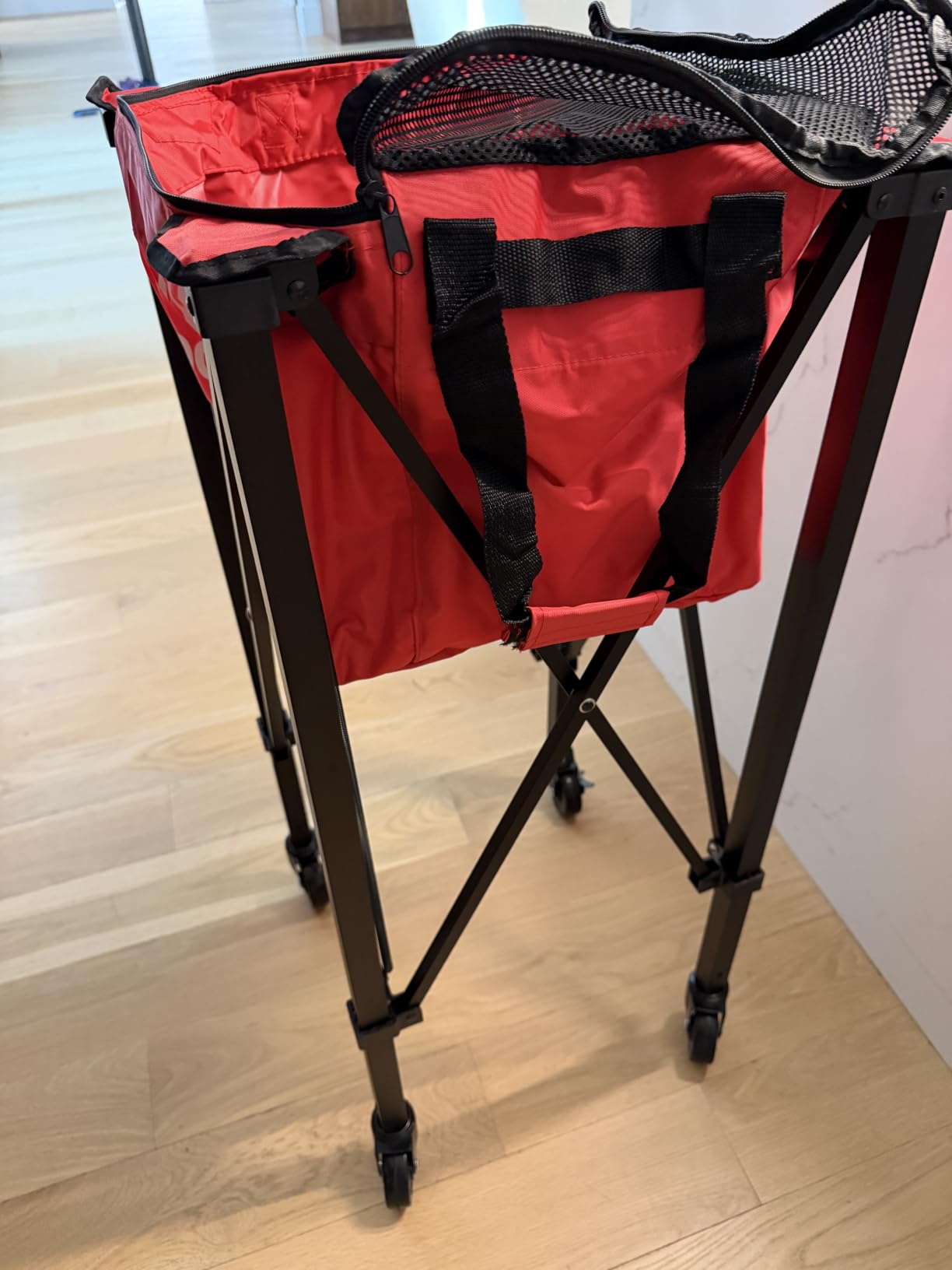
The base is antirust-treated aluminum, and the bag attaches mechanically rather than with hook-and-loop. That detail matters outdoors, since hook-and-loop strips the first time a heavy bag is pulled off a wet frame, and rust is what kills the cheaper carts after two seasons.
Owners rate the rolling behaviour highly and the setup highly enough that it carries the highest score in this group despite a modest body of reviews.
What no-assembly actually saves you
We timed our own builds across the wheeled options, and carts with wheel and frame hardware take the longest because the small parts are easy to lose and easy to cross-thread. A cart that needs no tools is a cart that gets assembled at the court in under a minute rather than at home the night before.
For a coach who rents courts, travels between venues, or shares equipment with an assistant, that is a meaningful difference in how often the cart is actually used.
The fabric bag is the part to plan around
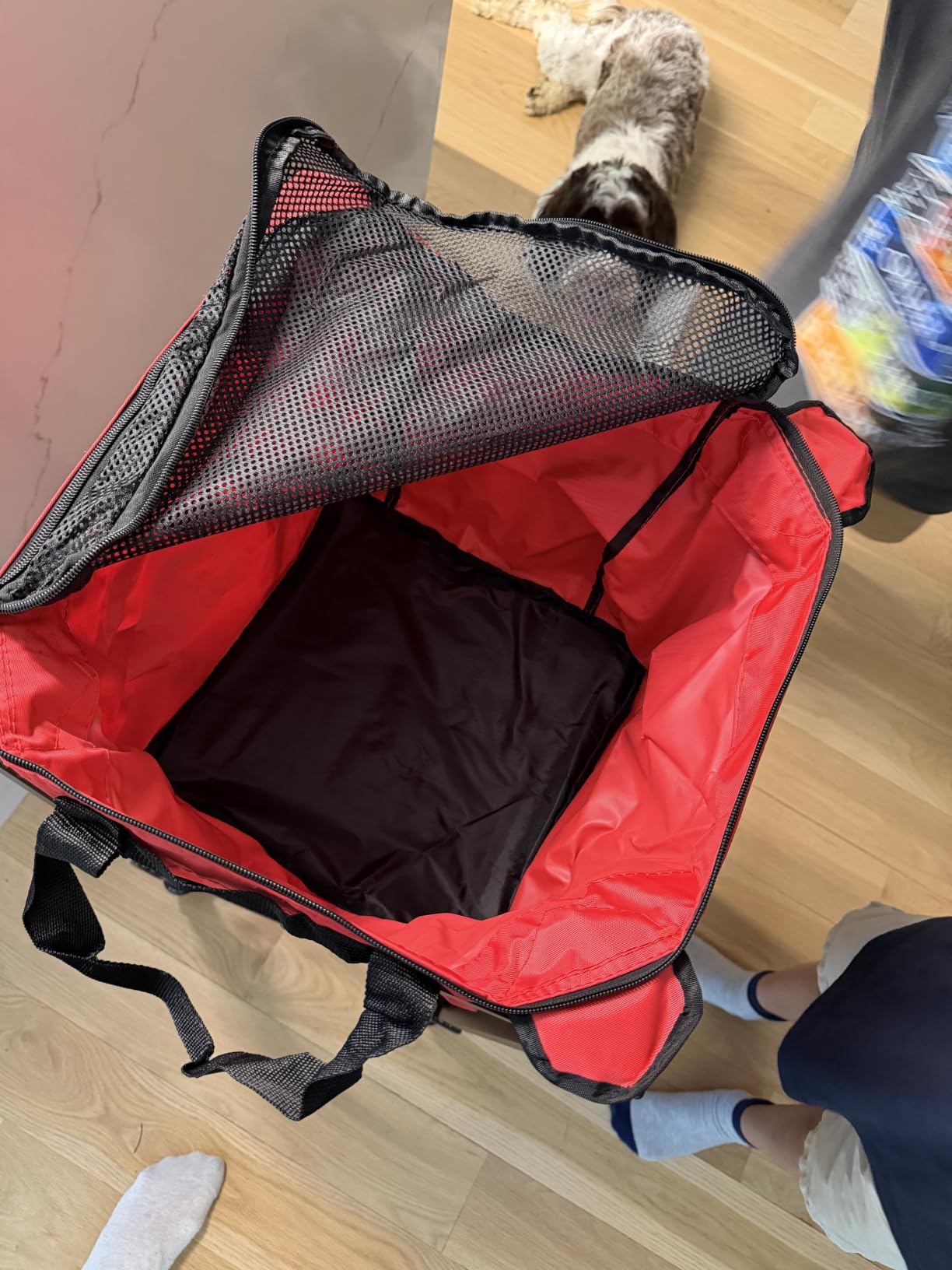
The most repeated complaint is the bag fraying under sustained ball weight within roughly four to six months. Owners who have hit that point look for a reinforced replacement bag rather than replacing the whole cart, which is the cheaper path.
At about 8.5 pounds empty it is the heavier of the two-wheeled carts here, and there is no crossbar to support the bag while the legs are off, so setup is a two-handed job. Check the wheel quality on arrival, since a dented wheel that does not roll true was reported more than once.
10. OLE ANDIGO 165-Ball Cart – the largest hold in the group
OLE ANDIGO Tennis Ball Cart with Wheels, Foldable 165-Ball Hopper
- About 165 ball capacity with a reinforced bottom insert
- Folds open in about five seconds with no assembly
- All-direction caster wheels with brake locks
- Water resistant thick nylon with a smooth zipper
- Frame screws extract without tearing the fabric
- Fabric bag is the weak point under sustained ball load
- Heavier frame is awkward to move over long distances
- Listed dimensions do not match the deployed cart size
At roughly 165 balls this is the largest hold in the group, and for a full academy block or a multi-court tournament warm-up it removes refills entirely. The capacity comes with a reinforced bottom insert, which is the detail that keeps a fabric bag from sagging into the frame under load.
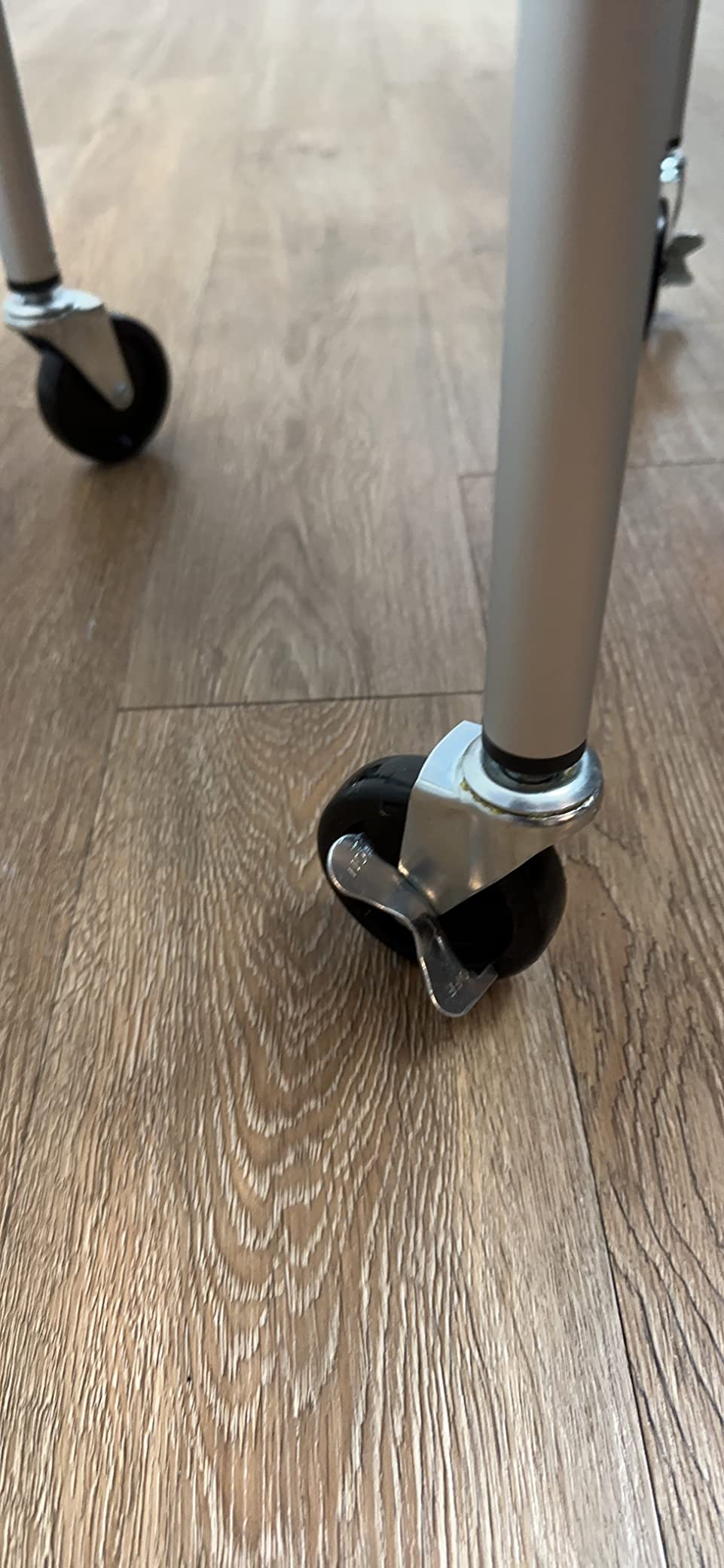
It folds open in about five seconds with no assembly and packs into a storage bag. All-direction caster wheels roll in any orientation and have brake locks, so positioning the cart at the net does not require wrestling it into place.
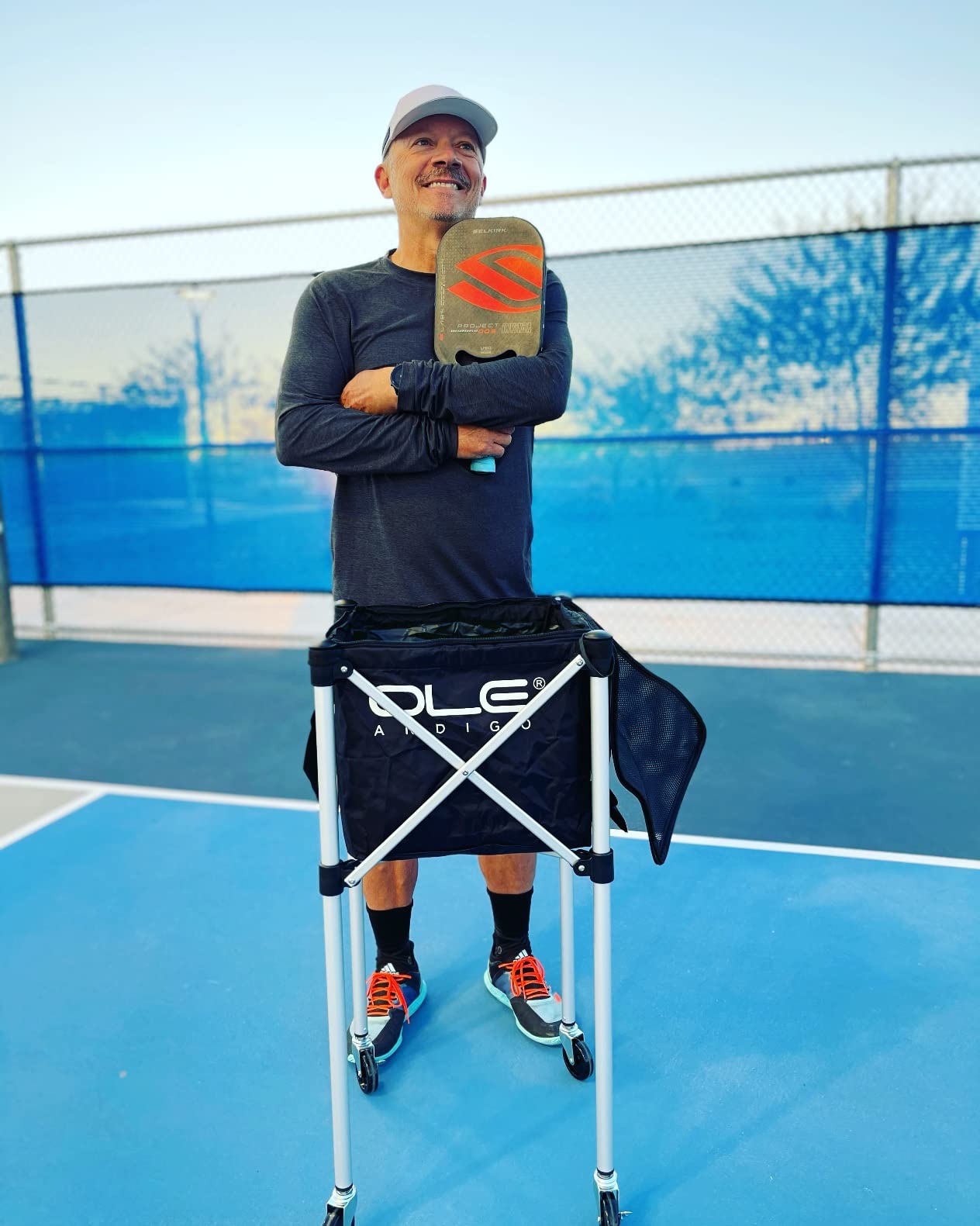
The fabric is thick, dense, and water resistant rather than a thin mesh, and the zipper runs smoothly, which is where cheaper carts tend to fail first. Frame screws are designed to be removable without tearing the fabric, so a repair is possible instead of a replacement.
Side pockets double as bag cover storage, a small quality-of-life touch that keeps a phone and keys off the court surface during a session.
Reading the capacity claim honestly
Capacity here is listed as 165 in the specifications and 160 in the product title, and the listed dimensions describe the folded unit rather than the deployed cart. Plan on a number in that range and measure your own storage and car space before committing to the largest option in any roundup.
The honest comparison is that past roughly 150 balls the returns flatten. A coach is usually buying extra capacity to avoid mid-session refills, and that problem is already solved well before the largest cart on the market.
Considerations before you buy the biggest option
The fabric bag is the weak point under sustained ball weight, which is the recurring note across owners of this style of cart. The reinforced base insert helps with sagging, not with fabric wear, so expect the bag to be the first part to need replacing.
A heavier frame is also awkward to move over long distances, particularly for a smaller user, and water resistance helps in rain without making the bag safe to leave outside overnight. Empty it before you go home.
How We Picked the Best Tennis Ball Hoppers for Coaches
Every product here was scored against coach workflow rather than against a spec sheet. We weighted five criteria and used them in this order.
Capacity matched to real session volume. A basket is only useful if it holds what one drill consumes. We checked the stated capacity against realistic loaded capacity, because several of these rate generously.
Ergonomics. Feed height, empty weight, and whether the handle forces a bend. A hopper that saves your back only works if the stand height is right for the players you coach.
Transport. Wheels where the coaching day involves distance, hand-carry weight where it does not, and a collapsed footprint that survives a car boot.
Durability over multiple seasons. Frame material, welds versus molded plastic, and the failure points that show up first. We weighted rust and handle-mount reports heavily.
Assembly and closure. How long it takes to build once, whether handles stay locked, and whether balls stay in the basket on the walk back to the car.
Ratings and review counts informed the order but did not decide it. This category has thin review data, and a well-known brand with a mid-range star score can still be the better tool. Where owner reports contradict manufacturer claims, we said so in the review.
Ball Hopper Buying Guide for Coaches
Capacity: how many balls do you actually need?
Count a drill before you count a basket. A crosscourt consistency drill at fifteen balls per repetition and twenty repetitions uses 300 balls. A serve plus return set at 40 balls per player and six players uses 240. A warm-up feed of 50 balls per player across four players adds 200 more.
That works out to a simple set of tiers. Casual and one-on-one work sits in the 36 to 75 ball range. A working coach running two full-court drills needs 80 to 90. Academy programs, team practices, and tournament logistics live in the 120 to 165 band.
Past 150 balls you are buying weight rather than capacity. We would rather see a coach run two 80-ball baskets than push one overloaded cart across a facility, because the second option is faster in practice.
Wire or plastic frame: which wins?
There is no single winner, but the tradeoff is clear and it depends on where you coach.
Metal frames like the Wilson 75 are heavier, feel solid, and take a beating. They also rust at the welds if they sit in a damp shed or on wet outdoor courts through several seasons. Plastic frames such as the Tourna Ballports will never corrode, weigh roughly a quarter less, and risk screw loosening and panel warping instead.
For indoor and covered coaching, metal is the safer long-term bet. For outdoor, seasonal, or travelling coaching, plastic removes an entire failure category. Either way, check the frame and handle joints at the start of each season rather than waiting for a collapse mid-drill.
Wheels, casters, and the walking distance
Wheels are worth it once you are carrying more than about 60 balls any real distance. Two wheels on the Ballport Deluxe suit smooth hard court and indoor surfaces. Four casters on the larger carts spread the load and cope better with grass, dirt, and cracked concrete.
Two details deserve more attention than reviews usually give them. Fixed non-swiveling wheels make turning frustrating, so favour all-direction casters if you move around obstacles. And brakes matter more than people expect, because a full cart on a slight slope will otherwise roll away from the net while you are feeding.
Ball type and how a hopper wears your balls
Pressureless balls are the standard practice choice for a reason. They survive repeated sessions without losing bounce, and coaches consistently reach for them to fill hoppers. Pressurized balls are better for match play and go flat sooner, so a hopper full of them loses its feed value within weeks.
Hardware matters more than ball choice when it comes to wear. A wire mesh basket abrades felt as balls roll across it, and a hard plastic or rubber edge scuffs and tears it faster. Keep pressureless balls in a basket with smooth rolling bars, and store pressurized balls in the carry bag rather than leaving them in a metal basket overnight.
The same logic applies to ball machines. If you run a feeder, our picks for the best tennis ball machines for home practice are worth pairing with a mid-capacity basket sized to the machine’s own hopper.
Pairing a hopper with a ball machine
Machine hoppers vary widely, from small single-fill units to machines that take 150 or more balls. The useful calculation is simple: divide the machine’s stated capacity by the hopper’s realistic capacity to get the number of loads per fill.
With a machine that holds 150 balls and an 80-ball hopper, you are making two loads plus a partial. With the same machine and a 36-ball mini hopper, you are making four plus a partial. That gap is the entire argument for buying a mid-capacity basket rather than a small one if you feed a machine.
For a coach, the best arrangement is a wheeled cart parked at the net that doubles as the machine’s staging basket. It rolls to the machine, unzips or tips, and the empty unit rolls back. That is why lift-out baskets and rolling bottom bars matter more than styling.
Will a hopper work with pickleballs and padel balls?
Yes, with one caveat. A hopper rated for 80 tennis balls will physically hold pickleballs too, but hollow plastic pickleballs are lighter and can fall through mesh gaps sized for a pressurized ball. Pick a basket with solid rolling bars or a close-mesh basket if you coach pickleball regularly. Our pickleball ball machine guide covers the feeder side of that sport.
Padel balls sit closer to a tennis ball in size and weight, so standard hoppers handle them without any modification. The capacity math is what changes, since you will fit fewer padel balls in the same basket.
Frequently Asked Questions
What is the best tennis ball hopper?
The best tennis ball hopper for coaches is the Wilson 75 Ball Pick-Up Basket, a steel basket that holds 75 balls and doubles as a stand. It has the largest owner base in the category. Coaches who want a lighter frame with no rust risk should choose the Tourna Ballport 80, which holds 80 balls and weighs about 4 pounds empty.
How many tennis balls fit in a ball hopper?
Capacity ranges from 18 balls in a pickup tube to about 165 balls in a large wheeled cart. A typical hand-carry basket holds 70 to 80 balls, an 80 to 90 ball model suits a working coach, and 120 to 165 ball carts cover academy and team programs. Real loaded capacity is often lower than the stated figure.
How do tennis ball hoppers work?
You push or pull the hopper across the court and the balls roll in through the open bottom while the frame stays upright. Bottom rolling bars or a roller design speed up collection. The handles then lock into legs so the basket stands as a feeder, and top bars close the load for transport.
What is the best gadget for picking up tennis balls?
For most coaches a standard hopper is the best tool, since it collects and stores in one pass. For fast pickups between points a tube style collector holds about 18 balls and weighs around 2 pounds. For large volumes a mower style roller or wheeled cart collects and stores the entire session load in one pass.
Will a tennis ball hopper work with pickleballs?
Yes, but check the basket construction. Hollow plastic pickleballs are lighter than pressurized tennis balls and can fall through mesh gaps sized for a tennis ball. Hoppers with solid rolling bars or a close mesh basket work for both sports. Padel balls sit closer to tennis ball size and fit standard hoppers without changes.
Which tennis balls are the most durable and how long do pressureless balls last?
Pressureless balls are the most durable practice option because they do not lose internal pressure and keep their bounce through repeated sessions. They are the standard choice for filling a hopper. Pressurized balls are built for match play and flatten faster. A smooth plastic or rubber basket surface also abrades felt far less than a wire mesh frame.
Are wire or plastic tennis ball hoppers better, and are wheels worth it?
Wire frames feel solid and are heavier, but they can rust at the welds on outdoor courts over several seasons. Plastic frames weigh roughly a quarter less and never corrode, at the cost of screws loosening and panels warping. Wheels are worth adding once you carry more than 60 balls any real distance, and casters with brakes are best on uneven ground.
Conclusion: Best Tennis Ball Hoppers for Coaches in 2026
The best tennis ball hoppers for coaches in 2026 come down to how you work. The Wilson 75 Ball Pick-Up Basket is the default because it holds a machine’s worth of balls, stands at a good feed height, and has the largest owner base of anything we tested. The Tourna Ballport 80 is the same job in lighter, rust-proof plastic, and it carries one of the highest ratings we found.
Add wheels when you move between courts, and choose the Tourna Ballport Deluxe rather than a larger cart. Move up to a four-wheeled 140 to 165 ball cart when you run academies or teams, where mid-session refills cost more than trunk space. And for junior groups, put a 2-pound Gamma tube in every kid’s hands so collection becomes part of the drill.
Whichever you choose, count the balls one drill actually consumes before you pick the capacity. That single calculation prevents almost every buying mistake in this category, and it is the difference between a basket that serves your sessions and one you keep emptying mid-repetition.