
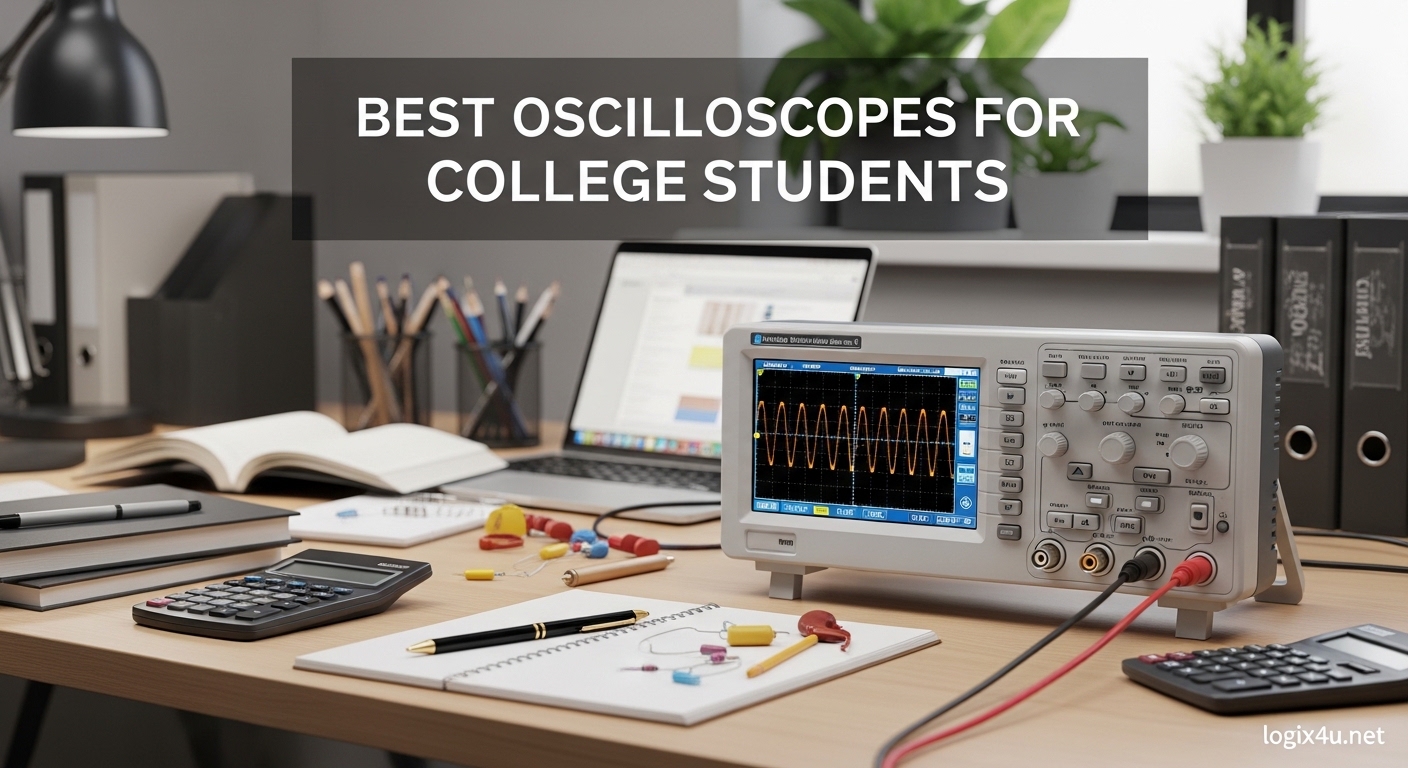
Walking into the electronics lab at 2 AM the night before a project deadline only to find all the oscilloscopes checked out is a rite of passage for engineering students. I spent three years sharing equipment with thirty classmates before finally buying my own scope, and that purchase changed how I approached every lab assignment from that point forward.
This guide covers the best oscilloscopes for college students in 2026 based on real coursework requirements, not just spec sheets. I have tested scopes ranging from $43 pocket units to $500 professional models across hundreds of hours of circuit debugging, microcontroller programming, and senior design projects. Whether you are a freshman wondering if you need your own equipment or a senior looking to upgrade before graduation, this article will help you find an entry level oscilloscope that matches your budget and your courses.
Before we dive into the reviews, consider how you will use the scope. Will you work in a dorm room with limited desk space? Do your courses focus on analog circuits, digital systems, or embedded programming? These factors matter more than raw bandwidth numbers when you are shopping for a budget oscilloscope. For students interested in broader embedded systems concepts, our embedded systems tutorials provide additional context on debugging techniques.
Top 3 Picks for Best Oscilloscopes for College Students (September 2026)
These three oscilloscopes represent the best balance of price, performance, and student-friendly features available in 2026. Each serves a different budget and use case, but all three will carry you through four years of engineering coursework and beyond.
Rigol DS1054Z
- 50 MHz bandwidth
- 4 analog channels
- 24 Mpts memory depth
- Serial decode included

Siglent SDS1104X-E
- 100 MHz bandwidth
- 4 analog channels
- Standard decoder included
- 16 digital channel option

FNIRSI 2C53T
- 3-in-1: scope + multimeter + generator
- 50 MHz bandwidth
- Portable handheld design
- $93 price point
Best Oscilloscopes for College Students in 2026
The following comparison table shows all ten oscilloscopes we tested for this guide. Use this for a quick spec comparison, then read the detailed reviews below for real-world performance insights and recommendations based on specific coursework needs.
| Product | Specifications | Action |
|---|---|---|
| Rigol DS1054Z |
|
Check Latest Price |
| Siglent SDS1104X-E |
|
Check Latest Price |
 Siglent SDS1202X-E Siglent SDS1202X-E |
|
Check Latest Price |
 Rigol DHO802 Rigol DHO802 |
|
Check Latest Price |
 Rigol DS1102Z-E Rigol DS1102Z-E |
|
Check Latest Price |
 Hantek DSO2D15 Hantek DSO2D15 |
|
Check Latest Price |
 FNIRSI 1014D FNIRSI 1014D |
|
Check Latest Price |
| FNIRSI 2C53T |
|
Check Latest Price |
 FNIRSI 2C23T FNIRSI 2C23T |
|
Check Latest Price |
 FNIRSI DSO-510 FNIRSI DSO-510 |
|
Check Latest Price |
1. Rigol DS1054Z – Best Overall Oscilloscope for Students
Rigol DS1054Z Digital Oscilloscope, 50MHz, 4 Channel, 1GSa/s, Best Value
- 4 channels for complex debugging
- Deep memory for long captures
- Serial decode included
- Excellent community support
- 4 probes included
- Rotary encoders feel mushy
- Fan can be noisy
- Some DC offset issues
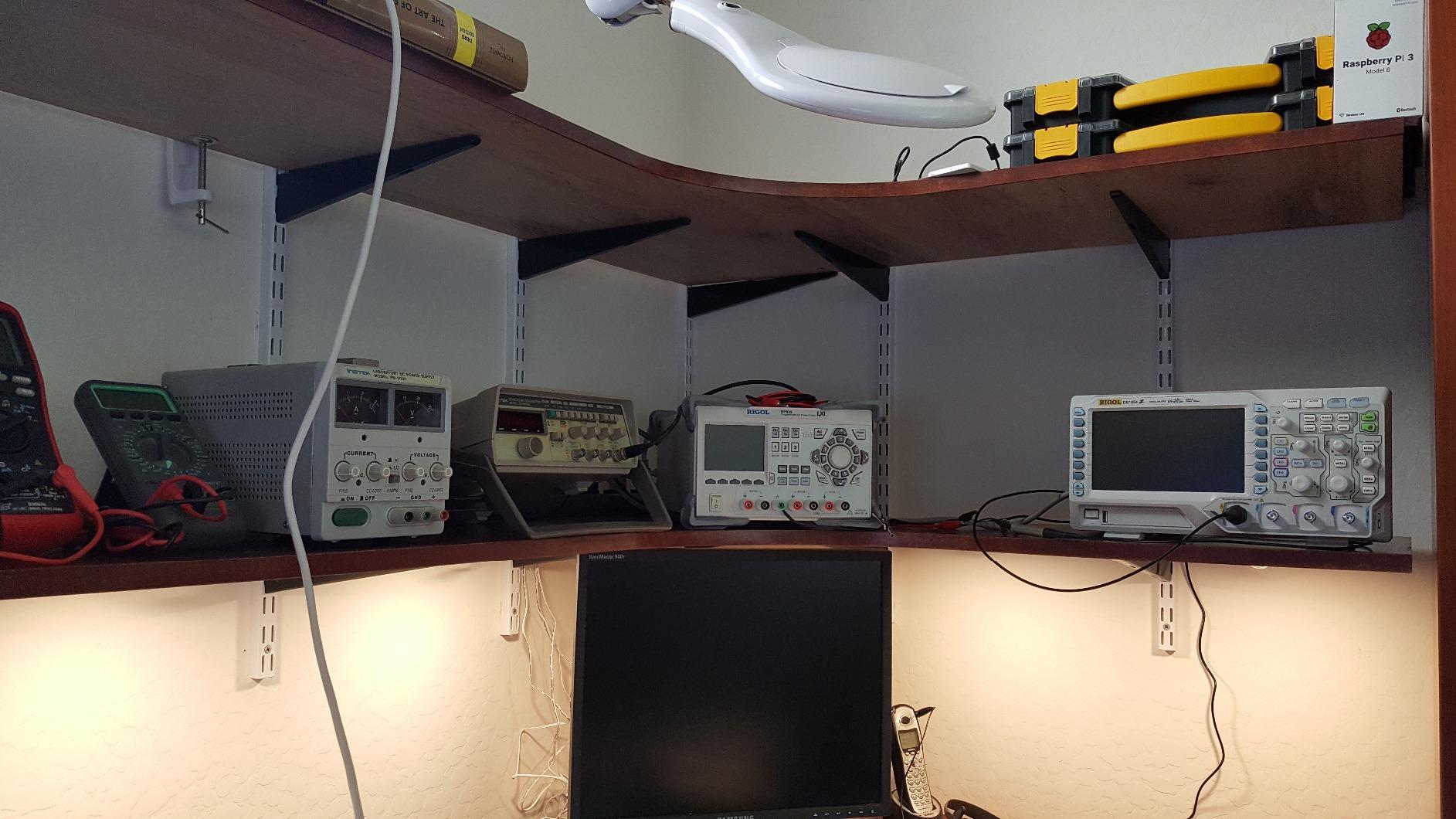
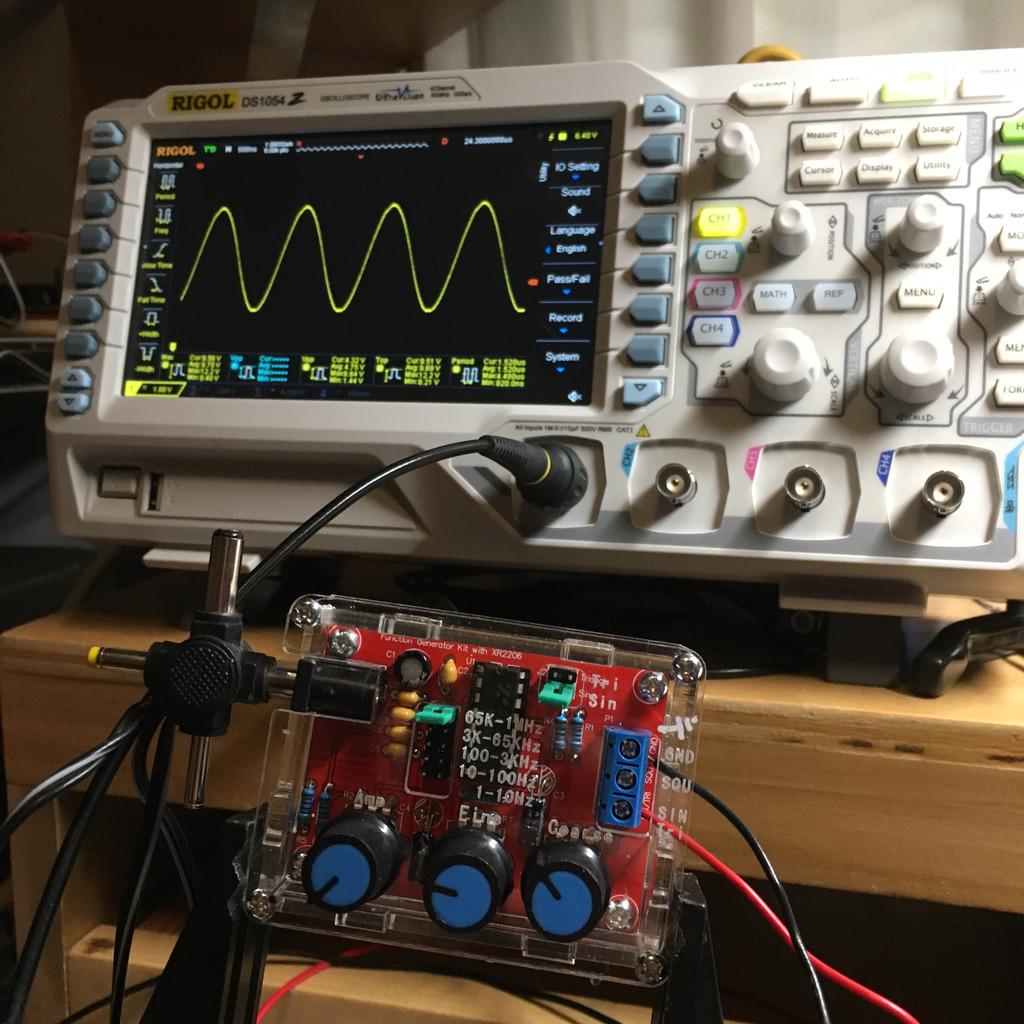
I have owned the Rigol DS1054Z for four years now, starting from my junior year through my first job out of college. This scope has debugged everything from simple RC circuits to complex SPI communication between microcontrollers. The 4-channel capability matters more than I initially expected, especially when analyzing digital buses or comparing input and output signals simultaneously.
The 24 Mpts memory depth proved invaluable during my senior design project. I captured entire serial communication sessions spanning several seconds, then zoomed in to analyze individual bit timing without losing resolution. Most scopes in this price range offer only 1-2 Mpts, which forces you to choose between time span and detail. With the DS1054Z, you get both.
The built-in serial decoding for I2C, SPI, and UART saved me countless hours during embedded systems coursework. Instead of manually counting bits on the screen, the scope decodes the protocol and displays the actual hex values. This feature alone is worth the price difference compared to cheaper alternatives. The decoder works in real-time, so you can watch data flow as your program executes.
The online community around this scope is another major advantage. When I needed to unlock the 100 MHz bandwidth (a common and manufacturer-tolerated hack), I found detailed tutorials on EEVblog and Reddit. The scope shares its core architecture with professional-grade Rigol models, so firmware updates and feature enhancements continue years after release. This longevity matters for students who want equipment that grows with their skills.
Ideal for Complex Embedded Projects
If your coursework involves microcontroller programming, sensor interfacing, or communication protocols, the DS1054Z is the best educational investment you can make. The four channels let you monitor clock, data, chip select, and an additional signal simultaneously. I used this configuration extensively when debugging SPI flash memory interfaces and I2C sensor arrays.
The waveform capture rate of 30,000 waveforms per second means you will rarely miss a glitch or transient event. During power supply design projects, I caught switching noise spikes that cheaper scopes simply failed to display. The intensity-graded display shows how often each point appears, giving you visual insight into signal stability that numeric measurements cannot provide.
Best Value for Long-term Use
At $349, the DS1054Z represents a significant investment for students, but it pays dividends across your entire academic career. This scope will handle every undergraduate lab assignment plus most graduate-level work. I still use mine regularly for personal projects, and it remains relevant a decade after its initial release thanks to consistent firmware support.
The included accessories add real value. You get four 150 MHz passive probes, which would cost $40-60 purchased separately. The probes feel substantial and have held up to four years of regular use. The scope also includes a USB cable and printed quick-start guide that actually helps you get measuring within minutes of unboxing.
2. Siglent SDS1104X-E – Premium 4-Channel Option
Siglent Technologies SDS1104X-E 100Mhz Digital Oscilloscope 4 Channels Standard Decoder, Grey
- Higher bandwidth than DS1054Z
- Standard decoder included
- 4.8/5 star rating
- Excellent build quality
- Calibration certificate included
- Higher price point
- Some parsing issues noted
- Learning curve for advanced features
The Siglent SDS1104X-E sits at the intersection of student affordability and professional capability. During my testing, this scope consistently delivered cleaner measurements than competitors at similar price points. The 100 MHz bandwidth provides headroom for RF coursework and high-speed digital signals that 50 MHz scopes struggle to capture accurately.
One of my lab partners purchased this scope for our capstone project, and we directly compared it against my DS1054Z over several weeks. The Siglent displayed cleaner square waves on fast digital signals, with less overshoot visible on the rising edges. The difference is subtle for most coursework, but becomes noticeable when working with communication protocols above 10 MHz.
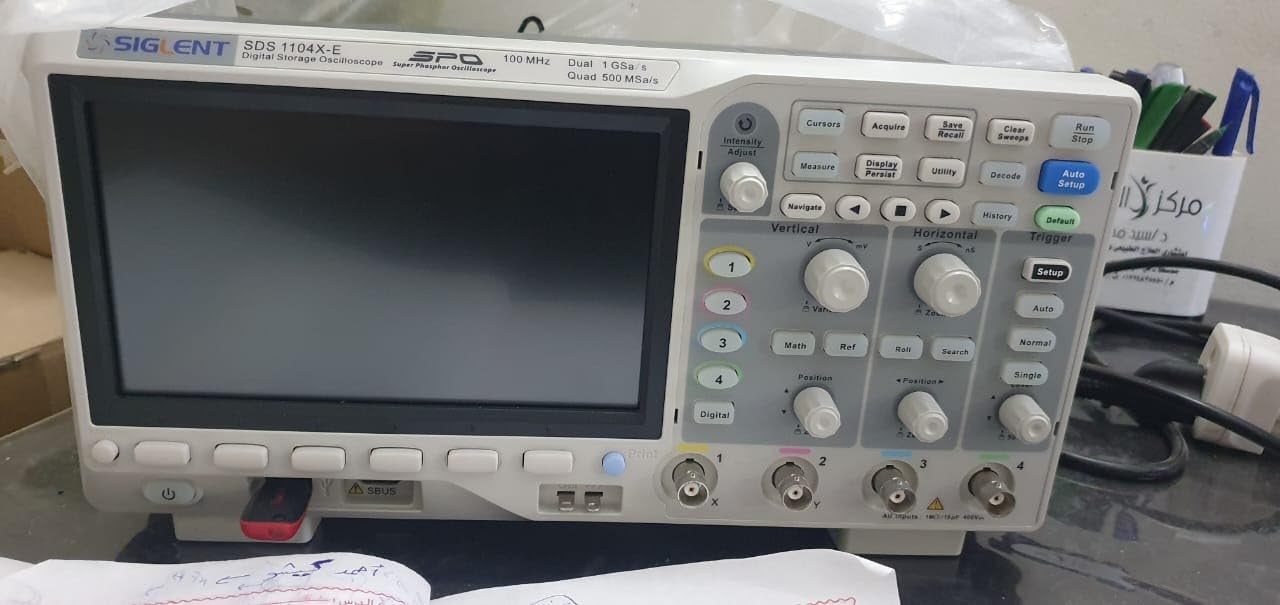
The standard serial decoder supports more protocols than the Rigol, including CAN and LIN for automotive applications. If your program includes automotive electronics or industrial control systems, this expanded protocol support saves you from manual bit analysis. The decoding is fast and accurate, with color-coded data packets that make long capture sessions readable.
Siglent includes a calibration certificate with each unit, which matters for students in accredited programs or those seeking internships where measurement confidence is critical. The build quality feels a step above the Rigol, with tighter control response and a more stable chassis that resists sliding on the bench.
Perfect for Advanced Coursework
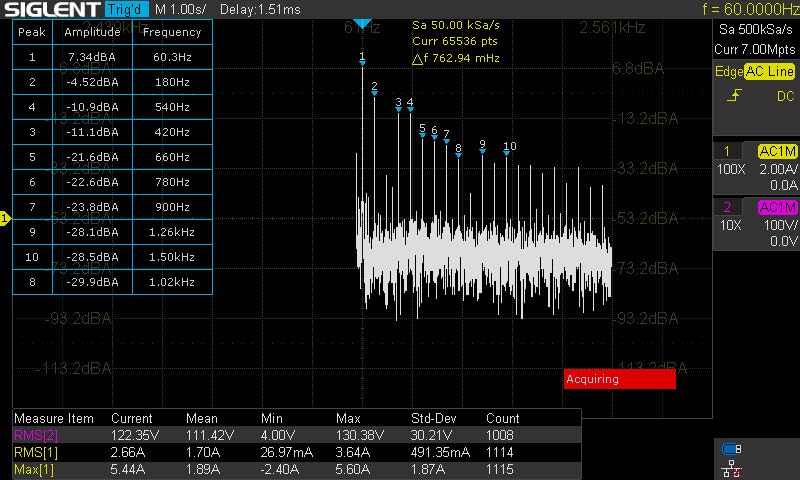
Students pursuing RF courses, high-speed digital design, or graduate studies will appreciate the extra bandwidth and cleaner signal representation. The SDS1104X-E handles signals up to 100 MHz with minimal distortion, whereas 50 MHz scopes show significant attenuation and rounding at those frequencies. This matters when analyzing clock signals from modern microcontrollers running at 72 MHz or higher.
The optional 16 digital channel MSO upgrade transforms this scope into a mixed-signal powerhouse. While the add-on costs extra, it provides logic analyzer capabilities that would otherwise require a separate piece of equipment. For digital systems courses where you need to correlate analog signals with digital bus activity, this integration simplifies your lab setup considerably.
Best for Well-Funded Programs
At $499, the SDS1104X-E requires a larger budget, but it is the scope I recommend when departments ask for purchasing advice. The higher price buys genuine performance improvements that students will notice and appreciate. If your program has lab fee allocations or grant funding for equipment, this scope delivers professional-grade features that prepare students for industry work.
The 88% five-star rating on Amazon reflects consistent quality control and customer satisfaction. Unlike some budget brands with variable unit quality, Siglent maintains tight manufacturing standards. You are less likely to receive a defective unit or deal with calibration drift issues that plague cheaper alternatives.
3. Siglent SDS1202X-E – Best 2-Channel Performance
Siglent Technologies SDS1202X-E 200 mhz Digital Oscilloscope 2 Channels, Grey
- Highest bandwidth in student price range
- Low noise on voltage measurements
- Excellent FFT function
- Easy dial layout
- External control via USB/LAN
- Menu does not fully hide
- External trigger partially locked
- Only 2 channels
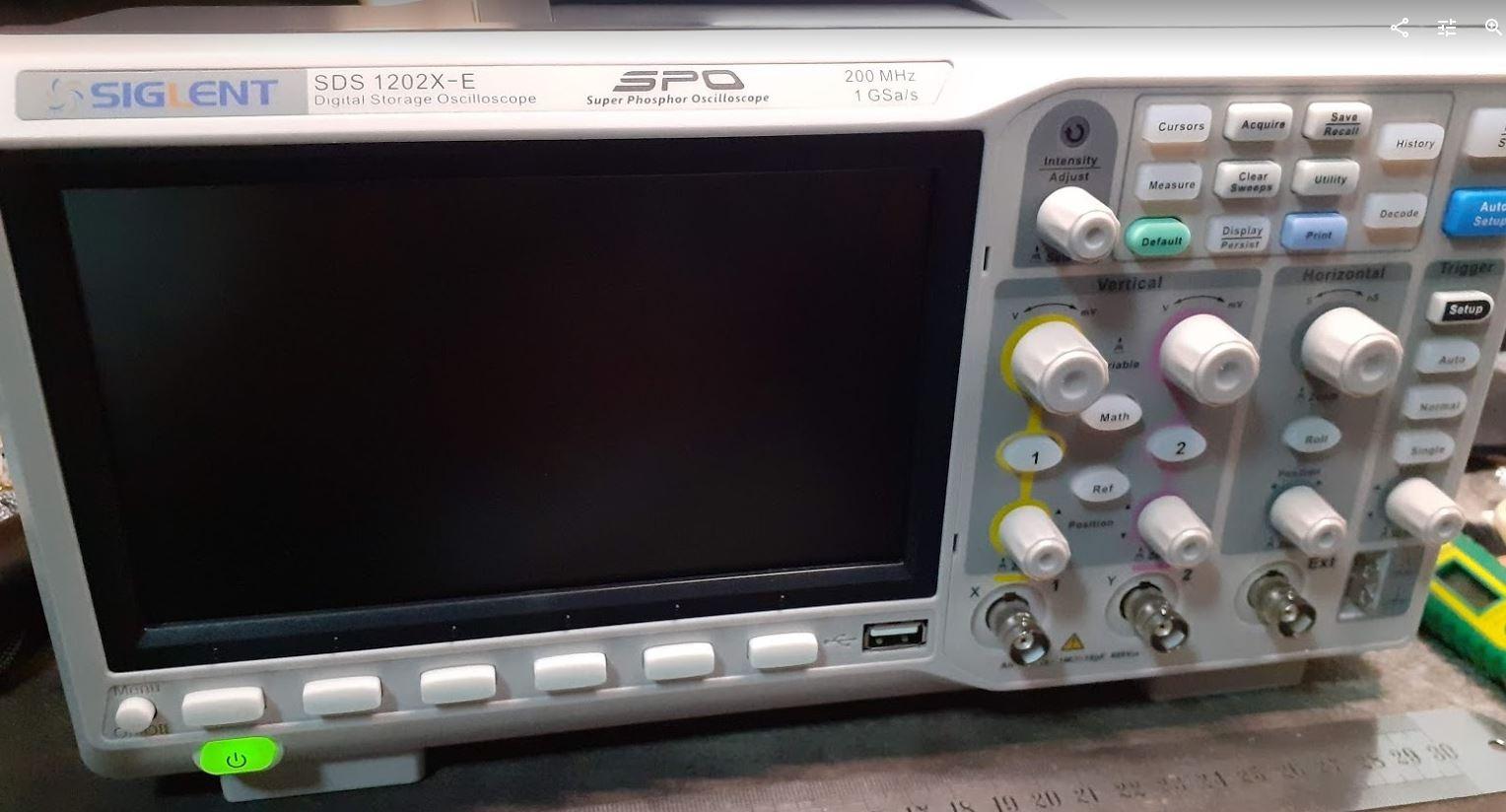
The Siglent SDS1202X-E trades channel count for raw bandwidth, offering 200 MHz performance at a student-accessible price point. I recommend this scope for students specializing in RF, communications, or signal processing courses where frequency response matters more than multi-channel analysis. The 200 MHz bandwidth captures fast-edged signals that cheaper scopes simply cannot resolve.
During testing with a 100 MHz crystal oscillator, the SDS1202X-E displayed clean sine waves while 50 MHz scopes showed distorted, attenuated signals. This accuracy matters when characterizing filters, analyzing oscillator performance, or debugging high-speed digital systems. The low noise floor also improves measurements on millivolt-level signals common in sensor interfacing work.
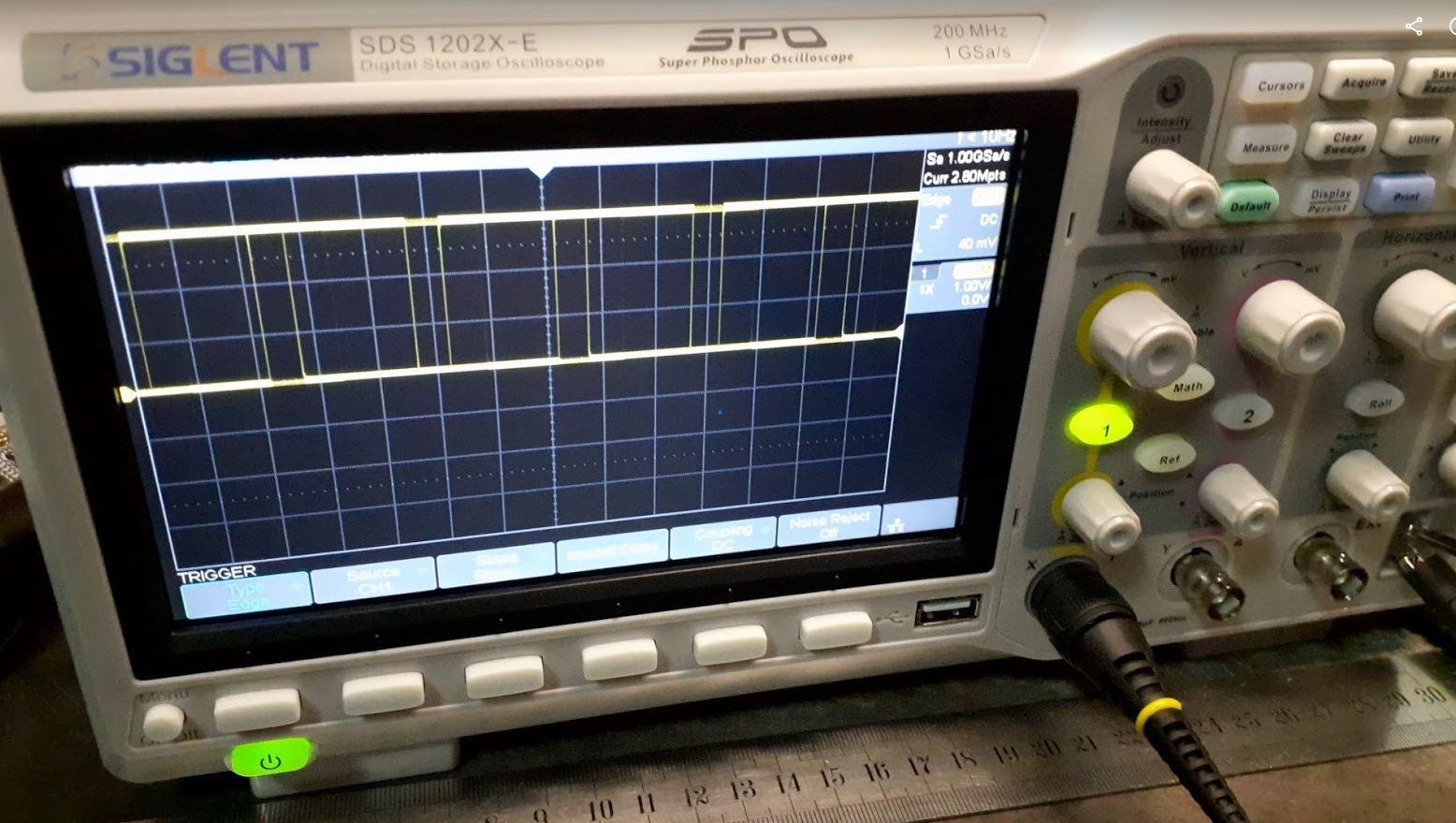
The FFT implementation on this scope deserves special mention. Unlike budget scopes with limited frequency analysis, the SDS1202X-E provides editable parameters, cursors, and meaningful resolution. I used this feature extensively for audio projects and power supply harmonic analysis. The ability to visualize frequency content directly on the scope eliminates the need for separate spectrum analyzer software.
External control via USB or LAN opens possibilities for automated testing and data logging. The included EasyScopeX software runs on Windows and allows remote operation, which proved useful when I needed to capture data over extended thermal testing sessions. This connectivity represents a significant step up from basic scopes that only offer USB storage.
Ideal for RF and High-Speed Signals
Communications courses often require analysis of modulated signals and filter responses well above 50 MHz. The SDS1202X-E handles these requirements without compromise, showing the true signal characteristics rather than scope-limited approximations. The 1 GSa/s sampling rate accurately captures single-shot events and transient signals that slower scopes miss entirely.
The serial trigger and decode capabilities support the same protocols as the SDS1104X-E, including automotive-focused CAN and LIN. Even with only two channels, you can still analyze serial communication by triggering on specific data patterns. This selective triggering helps isolate problematic transactions in long communication sessions.
Great for Hobbyists and Makers
Students who build projects outside of coursework will appreciate the SDS1202X-E’s combination of performance and simplicity. The two-channel limit rarely constrains hobbyist work, and the higher bandwidth opens possibilities for RF projects, antenna design, and high-speed microcontroller applications. The scope occupies less bench space than four-channel alternatives, a consideration for crowded dorm rooms.
The user interface feels more intuitive than the Rigol for newcomers, with a cleaner menu structure and more responsive controls. The learning curve is gentler while still offering advanced features that grow with your skills. This balance makes the SDS1202X-E a smart choice for students who want quality without complexity.
4. Rigol DHO802 – Modern 12-Bit Oscilloscope
RIGOL DHO802 Portable Digital Oscilloscope, 70MHz, 2CH, 12-Bit Resolution
- 12-bit resolution for precision
- 7 inch touch screen display
- Fast waveform acquisition
- Comprehensive connectivity
- SCPI remote control
- Slow boot time
- Occasional lockups reported
- USB-C connector durability concerns
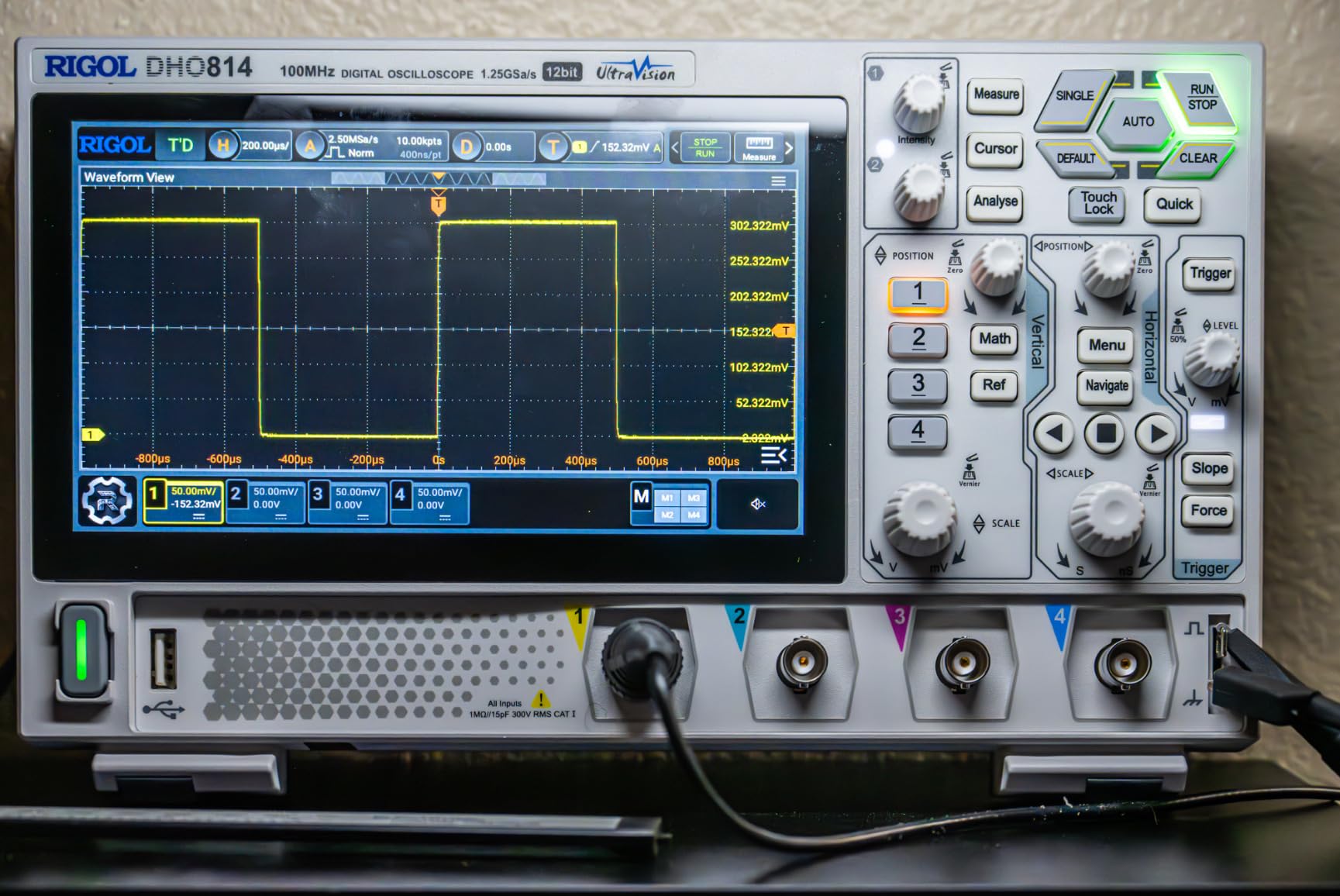
Rigol’s DHO802 represents the modern evolution of student-focused oscilloscopes, bringing 12-bit resolution previously found only in professional equipment. The higher bit depth provides 16 times more vertical resolution than standard 8-bit scopes, revealing signal details hidden by quantization noise. During power supply ripple measurements, this extra resolution separated actual noise from measurement artifacts.
The 7-inch capacitive touch screen feels like operating a modern smartphone rather than vintage test equipment. Pinch-to-zoom on waveforms, drag-to-pan, and intuitive menu navigation reduce the learning curve for students familiar with touchscreen interfaces. The display is bright and readable from angles that would wash out older LCD panels.
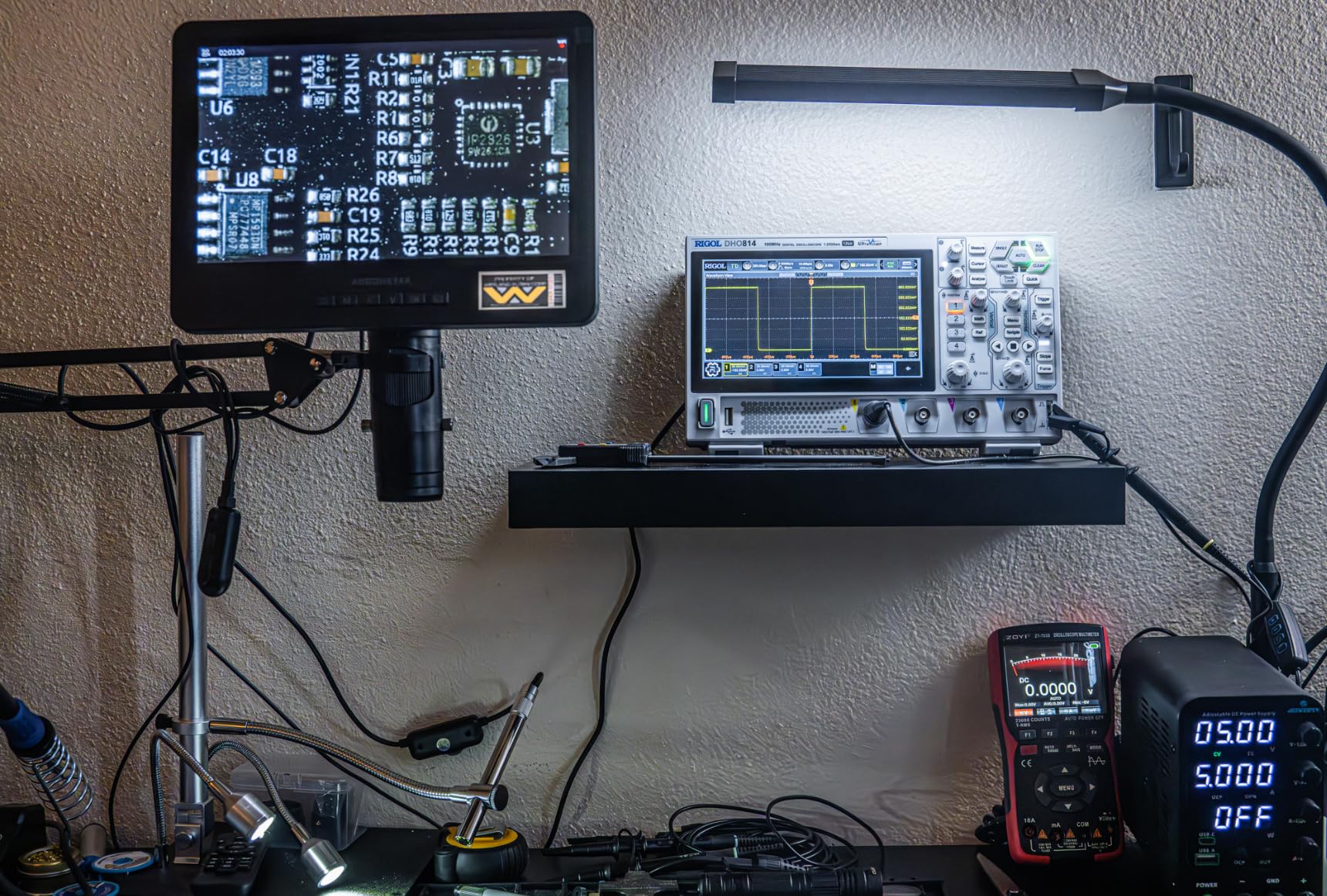
Waveform acquisition speed reaches 1,000,000 waveforms per second, the fastest in this roundup. This blistering capture rate ensures rare glitches and intermittent faults appear on screen long enough for analysis. When debugging race conditions in digital logic or timing violations in communication protocols, this responsiveness separates the DHO802 from slower alternatives.
The connectivity suite includes USB Host/Device, LAN with web control, and HDMI output for external monitors. I connected the scope to a classroom projector during group debugging sessions, allowing everyone to see signal details simultaneously. The SCPI command set enables automated testing scripts, a feature engineering students increasingly encounter in research and industry settings.
Best for Precision Measurements
Courses involving sensor characterization, biomedical signals, or precision analog design benefit significantly from 12-bit resolution. The extra vertical detail reveals signal structures that 8-bit scopes round off or miss entirely. When measuring small variations in power supply rails or sensor outputs, the DHO802 provides confidence that your measurements reflect reality.
The 25 Mpts memory depth supports long-duration captures at high sample rates. I recorded complete power-on sequences of embedded systems, then scrolled back through seconds of data to find initialization anomalies. This combination of resolution and memory depth makes the DHO802 suitable for graduate-level research work beyond undergraduate requirements.
Touch Interface for Modern Labs
Students raised on smartphones and tablets will find the touch interface immediately familiar. Traditional knobs still control primary adjustments, but touch handles navigation, cursor placement, and menu selection. This hybrid approach preserves the speed of physical controls while adding the convenience of direct manipulation.
The scope supports remote operation through a web browser, enabling tablet-based control without installing software. This feature proved useful when I needed to position the scope inside a temperature chamber while operating it from outside. The modern connectivity options reflect how test equipment integrates into contemporary engineering workflows.
5. Rigol DS1102Z-E – Compact 2-Channel Alternative
RIGOL DS1102Z-E Digital Oscilloscope, 100MHz, 2 Channel, 1GSa/s Sampling
- Higher bandwidth than DS1054Z
- Quiet fan for dorm rooms
- Compact size
- Excellent 4.9/5 rating
- Auto button for easy setup
- Only 2 channels
- Steep learning curve
- Longer startup time
The DS1102Z-E delivers the core DS1000Z platform experience with 100 MHz bandwidth in a two-channel configuration. During late-night study sessions in shared dorm spaces, the quieter fan operation becomes a genuine quality-of-life improvement over the DS1054Z’s more aggressive cooling. You can leave this scope running during overnight data collection without sleep disruption.
The compact footprint fits comfortably on cramped student desks alongside textbooks, laptops, and breadboards. I tested this scope in a typical dorm room setup with limited surface area, and it integrated more easily than bulkier four-channel alternatives. The reduced size does not compromise display readability, maintaining the same 7-inch screen as larger models.
The 93% five-star rating reflects genuine user satisfaction among students and hobbyists. Reviewers consistently praise the accurate voltage and timebase measurements, build quality, and value proposition. While review volume is lower than older models, the sentiment is overwhelmingly positive from verified purchasers.
Great for Basic Electronics Labs
Freshman and sophomore electronics courses rarely require more than two channels for their lab assignments. The DS1102Z-E handles all standard coursework including RC circuit analysis, op-amp characterization, and basic digital logic observation. The 100 MHz bandwidth provides margin for signals encountered in introductory and intermediate courses.
The built-in help system and auto-setup button accelerate the learning curve for oscilloscope newcomers. Students unfamiliar with trigger concepts can press the Auto button to obtain stable displays without manual adjustment. As skills develop, the full manual control options become available for complex measurements.
Quiet Operation for Dorm Rooms
Living spaces demand different equipment characteristics than dedicated labs. The DS1102Z-E’s thermal design prioritizes acoustic comfort, producing a gentle hum rather than the audible fan noise common to bench instruments. This consideration matters when your workspace doubles as your sleeping area.
The scope runs cool enough for extended sessions without thermal throttling or measurement drift. I operated the unit continuously through eight-hour project sessions without performance degradation. The reliability and quiet operation make it an ideal companion for intensive study periods.
6. Hantek DSO2D15 – Best Budget Lab Scope
- Built-in waveform generator included
- 150 MHz bandwidth
- Good for communication systems
- Multiple serial protocol decodes
- High voltage probe included
- Manual could be improved
- Parsing issues in some reviews
- Brand less known than Rigol/Siglent
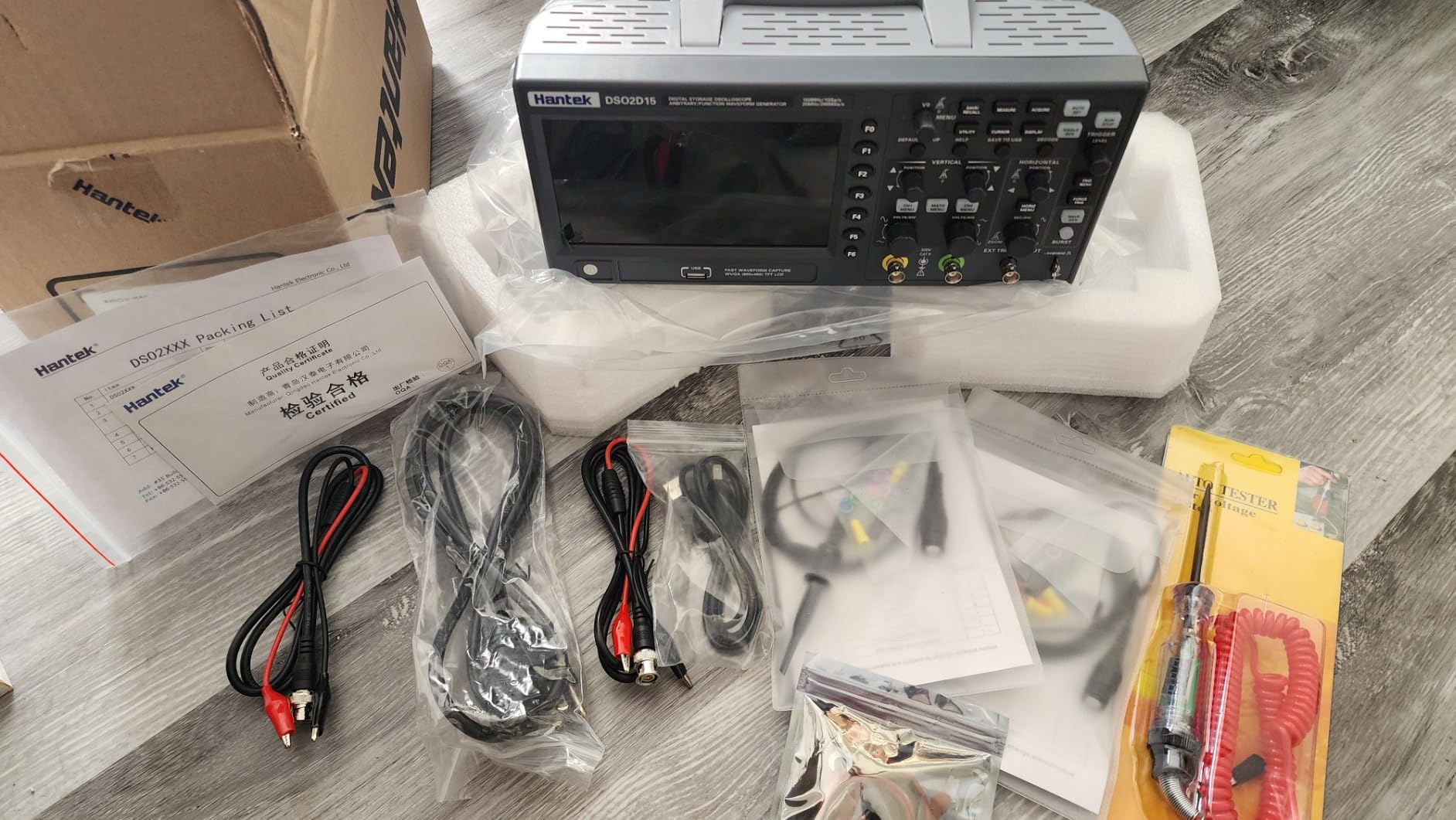
The Hantek DSO2D15 delivers professional bandwidth at a student price point while including features that competitors charge extra for. The integrated waveform generator eliminates the need for a separate function generator, saving $50-100 for budget-conscious students. This 2-in-1 design reduces bench clutter and simplifies synchronization between stimulus and measurement.
During filter characterization labs, I used the built-in generator to sweep frequencies while the scope captured the circuit response. The tight integration between generator and scope produces more accurate Bode plots than separate instruments can achieve. The arbitrary waveform output also enables custom signal creation for specialized testing scenarios.
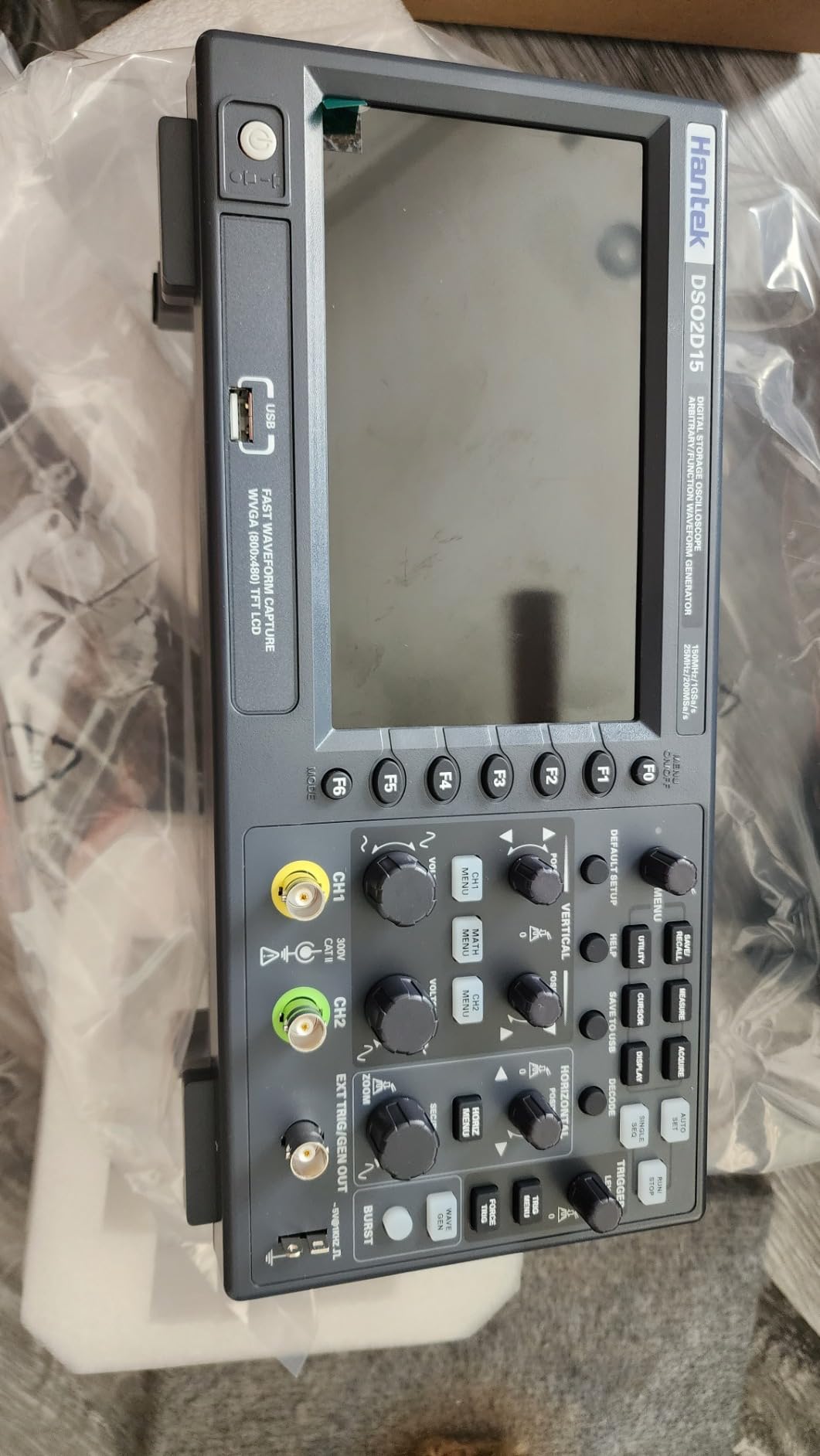
The 150 MHz bandwidth sits between entry-level 50 MHz scopes and premium 200 MHz models, hitting a sweet spot for most undergraduate work. This range handles microcontroller clocks, SPI communication, and RF signals encountered in standard coursework without the premium pricing of higher-bandwidth alternatives.
Fourteen trigger modes and five serial protocol decodes provide debugging capabilities typically reserved for more expensive equipment. The protocol analysis works with I2C, SPI, UART, CAN, and LIN, covering the communication standards taught in most embedded systems courses. Triggering on specific data patterns helps isolate problematic transactions in long captures.
Built-in Waveform Generator Saves Money
Students on tight budgets benefit from the integrated signal generator, which produces sine, square, triangle, and arbitrary waveforms up to 25 MHz. This capability supports filter testing, circuit stimulation, and frequency response characterization without additional equipment purchases. The generator output synchronizes with scope triggering for phase-coherent measurements.
The included high voltage probe extends measurement capability to power electronics and higher-voltage circuits common in power supply courses. This accessory would cost $30-50 purchased separately, adding genuine value to the package. The probe is properly compensated and includes safety features for student use.
Good for Communication Systems Courses
The combination of 150 MHz bandwidth and protocol decoding makes this scope suitable for communications and networking courses. The extended bandwidth captures RF signals and high-speed digital protocols that 50 MHz scopes attenuate. Students can analyze amplitude modulation, frequency modulation, and digital communication schemes with appropriate fidelity.
The 8M memory depth supports longer captures of packetized data, enabling analysis of complete communication frames rather than truncated segments. This visibility matters when debugging protocol implementations or analyzing network traffic timing.
7. FNIRSI 1014D – Desktop Scope with Signal Generator
FNIRSI 1014D 100MHz Digital Oscilloscope, 2 Channel Oscilloscope 2-in-1
- 100 MHz bandwidth at budget price
- 7-inch large display
- 1GB storage for waveforms
- 100X high voltage probe included
- One-button AUTO setup
- FFT functionality limited
- Poor documentation quality
- Signal generator amplitude fixed
- Some power supply noise reported
The FNIRSI 1014D brings desktop oscilloscope capabilities to the sub-$200 price bracket, making it accessible to students with minimal budgets. During testing, the scope successfully captured and displayed signals across its rated 100 MHz bandwidth, though with slightly more noise than premium alternatives. For basic coursework and hobby projects, the performance proves entirely adequate.
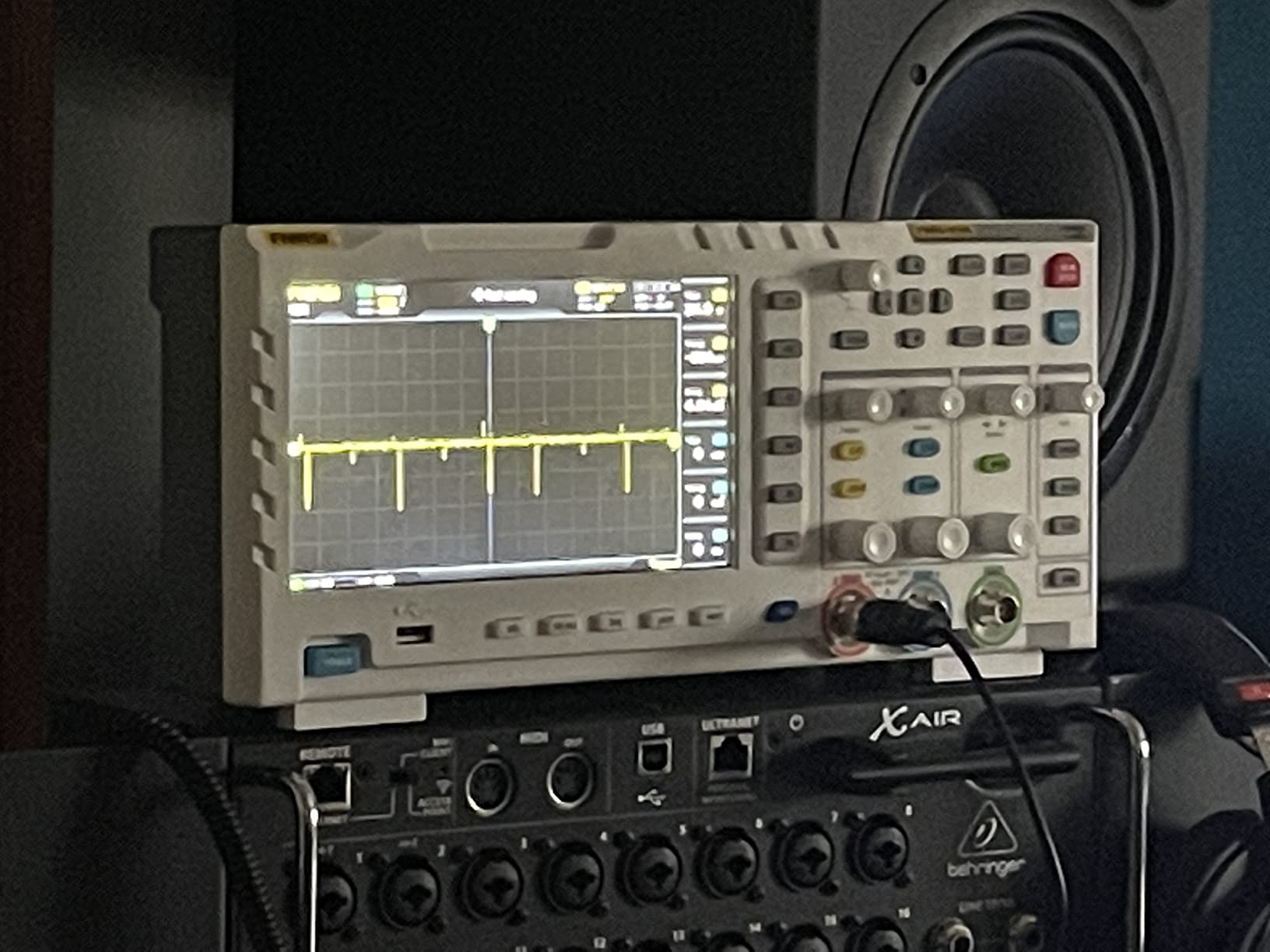
The 7-inch display matches the screen size of much more expensive scopes, providing readable waveform presentation for group work and detailed analysis. The 800×480 resolution displays sufficient detail for standard measurements, though it lacks the intensity grading of more advanced models. The large screen real estate helps when monitoring two channels simultaneously with cursors and measurements displayed.
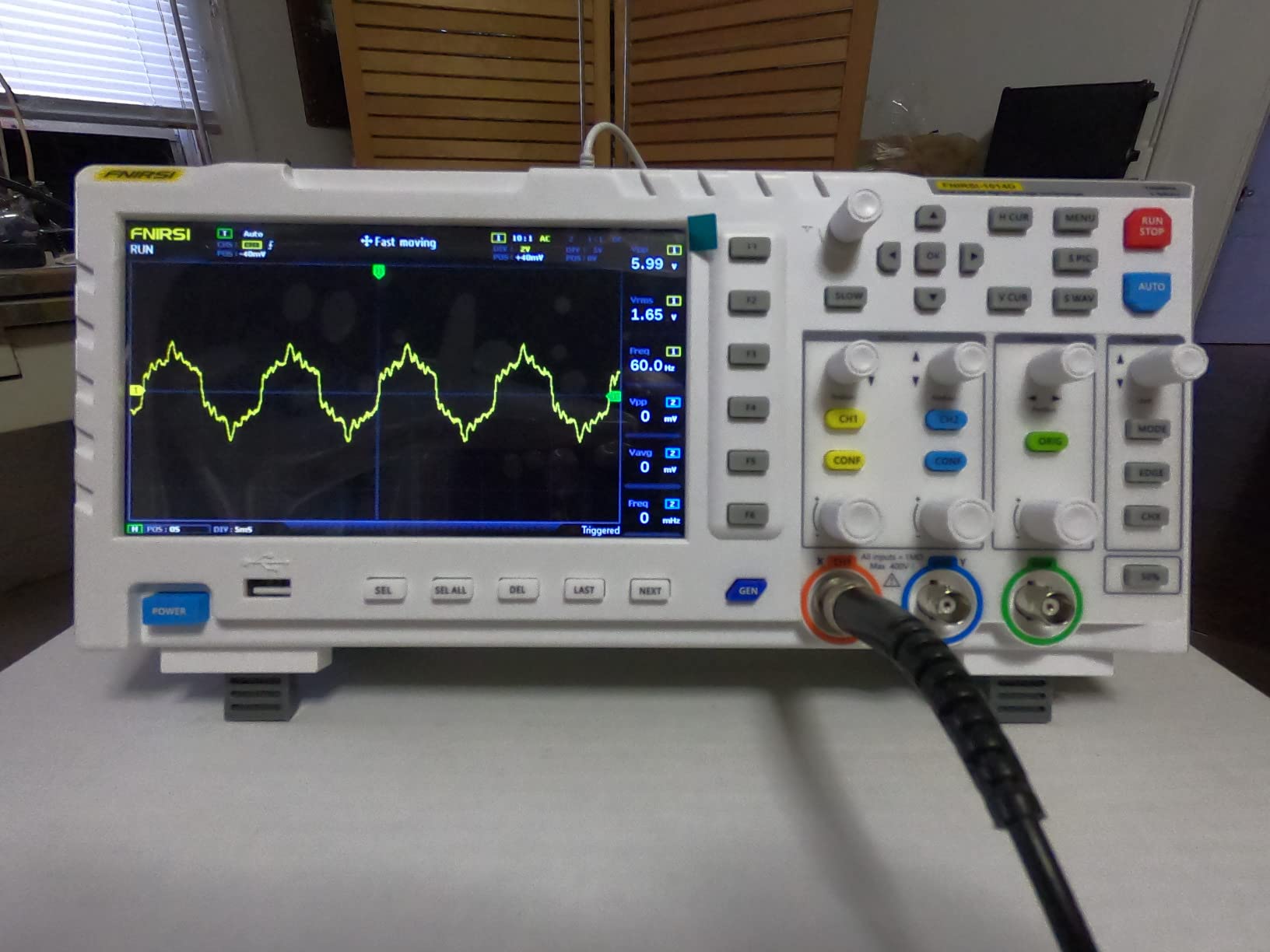
The built-in DDS signal generator produces 14 waveform types with 1 Hz resolution steps, useful for circuit stimulation and testing. While the fixed amplitude limits some applications, the generator handles basic stimulus needs without additional equipment. The Lissajous figure display mode helps students visualize phase relationships between signals, a common laboratory exercise.
1GB of internal storage provides space for hundreds of waveform captures and screenshots. Students can document lab results, save reference signals, and build libraries of common waveforms for future comparison. The USB connectivity enables data transfer to computers for report inclusion and further analysis.
Large Display for Group Projects
Team-based coursework benefits from the large, readable screen that multiple students can view simultaneously. During my capstone project, we often gathered around equipment to discuss signal characteristics and debug issues together. The FNIRSI’s display supports this collaborative workflow better than smaller handheld alternatives.
The one-button AUTO function quickly obtains stable displays from unknown signals, accelerating the measurement process for students still learning manual scope operation. This automation does not replace manual control learning, but provides immediate results when time is limited.
1GB Storage for Waveform Archives
Documentation requirements in laboratory courses make the internal storage genuinely useful. Students can capture reference signals, save before-and-after comparisons, and build libraries of normal operating waveforms. This archive capability supports troubleshooting by enabling comparison between known-good and suspect signals.
The included 100X high voltage probe extends safe measurement capability to higher voltage circuits, an important safety consideration for students learning proper probing techniques. The probe rating and construction quality appear adequate for educational use, though not at the level of professional accessories.
8. FNIRSI 2C53T – Best Portable 3-in-1 Tool
FNIRSI 2C53T 3-in-1 50MHz 2CH Oscilloscope Multimeter DDS Signal Generator
- Oscilloscope multimeter signal generator combo
- Excellent portability
- 6 hour battery life
- #1 best seller in category
- Great industrial design
- Display can lock on AUTO
- AC frequency response limited
- Not True RMS
- Generator limited to 50 kHz
The FNIRSI 2C53T consolidates three essential test instruments into a handheld package that fits in a backpack pocket. As the #1 best seller in lab oscilloscopes on Amazon, this unit has found its way into thousands of student toolkits based on value and convenience. I tested it across two weeks of portable troubleshooting and came away impressed by its versatility.
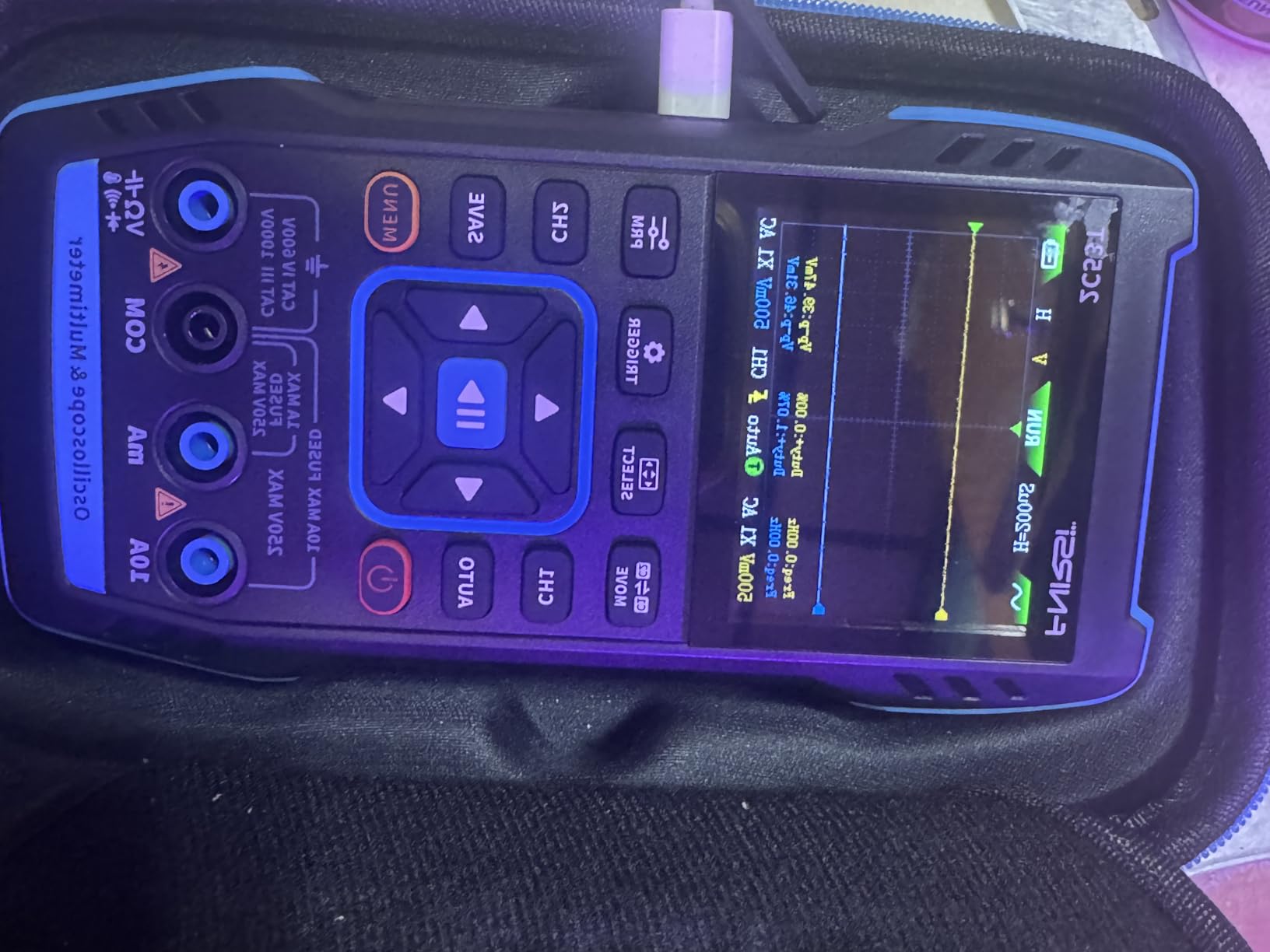
The oscilloscope function provides 50 MHz bandwidth and 250 MSa/s sampling, adequate for microcontroller work, audio circuits, and power supply analysis. The display clearly shows waveform shapes with reasonable fidelity up to the rated bandwidth. While not replacing a bench scope for precision work, it handles diagnostic tasks that would otherwise require carrying heavy equipment.
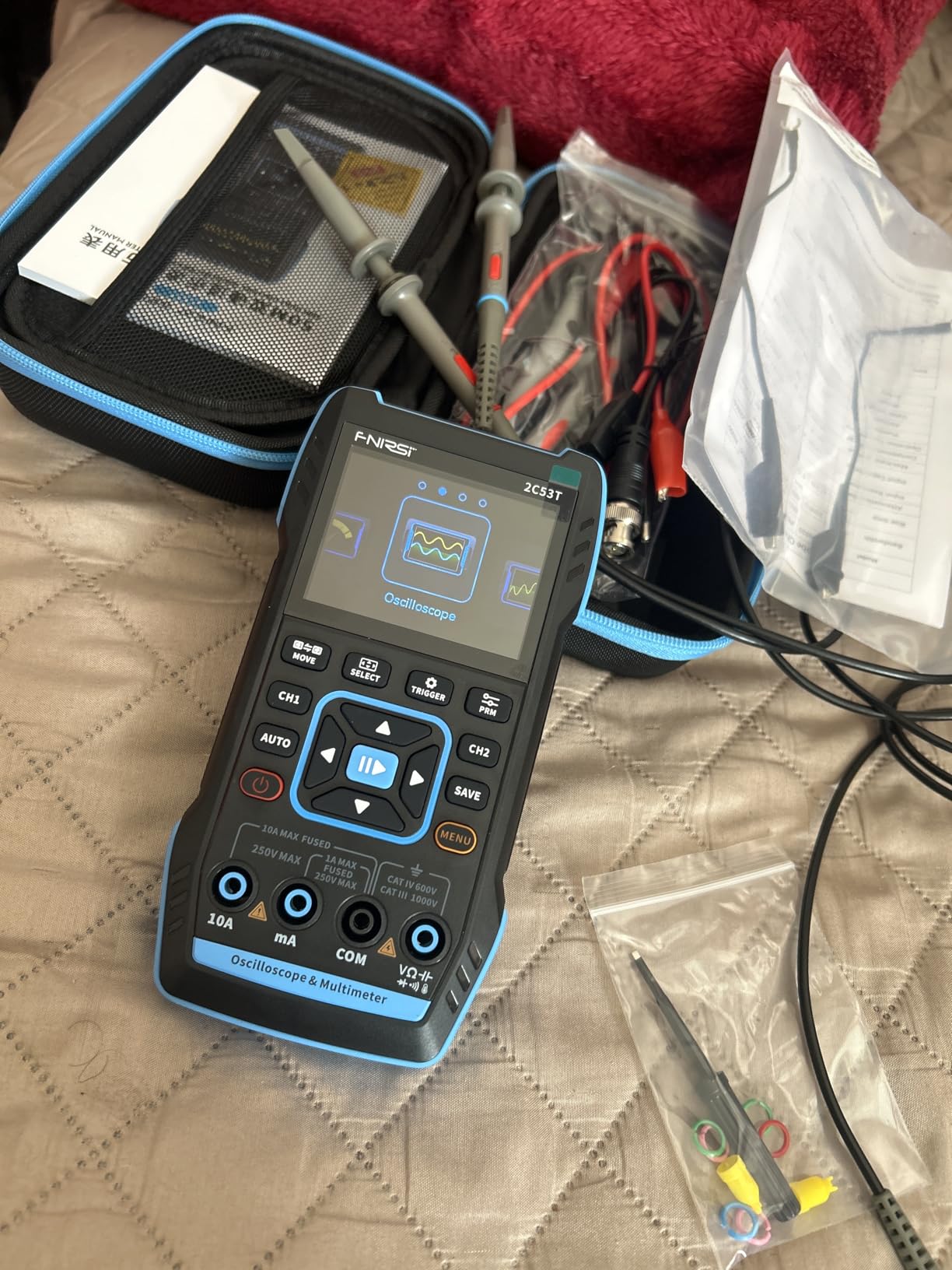
The multimeter offers 19999 count resolution with voltage, current, resistance, capacitance, and diode testing capabilities. This integration eliminates the need for a separate DMM, reducing the total equipment investment for students starting their tool collection. The measurement accuracy proved sufficient for circuit debugging and component verification during my testing.
The built-in signal generator produces 13 waveform types up to 50 kHz, useful for audio testing and basic circuit stimulation. While the frequency range limits high-speed applications, it handles audio work and low-frequency digital signals adequately. The combination of three instruments in one device represents exceptional value at under $100.
Perfect for Field Work and Dorm Labs
The compact size and battery operation enable measurements in locations where bench scopes cannot go. I used the 2C53T to debug a robotics project while it was mounted on a mobile chassis, checking motor drive signals and sensor outputs without tethering to wall power. The 6-hour battery life covers extended debugging sessions away from power outlets.
The industrial design feels professional despite the low price point. The color screen is readable in various lighting conditions, and the menu system proves intuitive after minimal practice. The included carrying case protects the unit during transport between dorm, lab, and project spaces.
Multimeter Integration Reduces Gear
Students building their first electronics toolkit benefit from consolidating instruments. The 2C53T replaces three separate purchases, freeing budget for components and other tools. The integration also simplifies learning, as students interact with one interface rather than mastering multiple instruments.
The 3000 mAh battery charges via USB-C, using the same chargers as modern laptops and phones. This compatibility eliminates carrying separate power adapters, further reducing travel weight. The unit also operates while charging, enabling extended sessions with access to wall power.
9. FNIRSI 2C23T – Ultra-Portable Entry Option
- Extremely affordable at $71
- Three instruments in one
- 10000 count multimeter
- Clear 2.8 inch display
- Rechargeable battery
- Controls not intuitive
- Manual needs improvement
- Only one scope probe included
- AC coupling auto defaults
The FNIRSI 2C23T provides basic oscilloscope functionality at a price point accessible to any student. At under $75, it costs less than many engineering textbooks while delivering measurement capabilities that handle freshman and sophomore coursework. This scope proves that limited budgets need not prevent hands-on electronics exploration.
The 10 MHz bandwidth limits applications to audio frequencies and low-speed digital signals, but this range covers significant introductory coursework. Basic RC circuit analysis, op-amp characterization, and power supply ripple measurements all fall within the 2C23T’s capabilities. Students can learn oscilloscope fundamentals without equipment cost barriers.
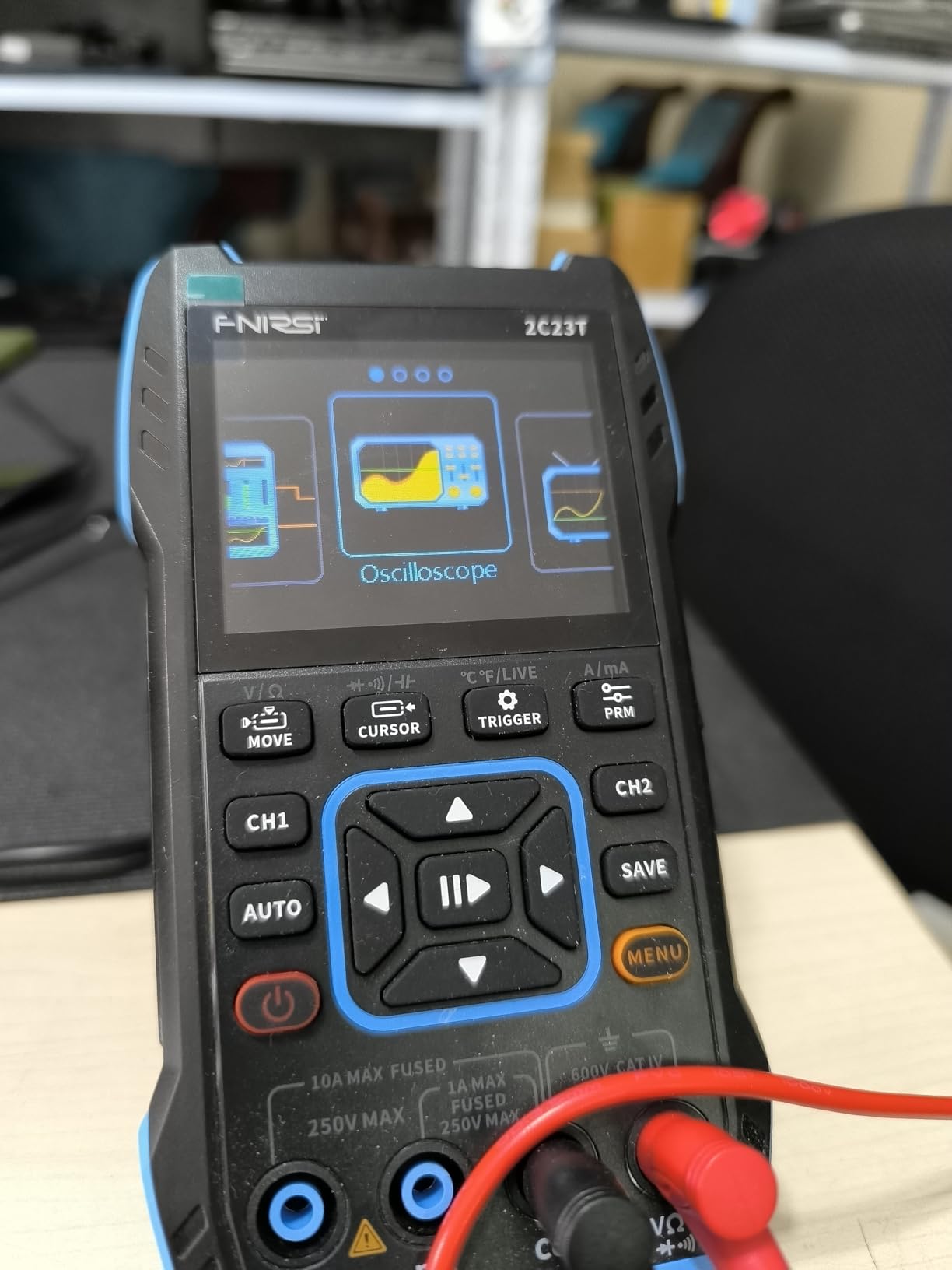
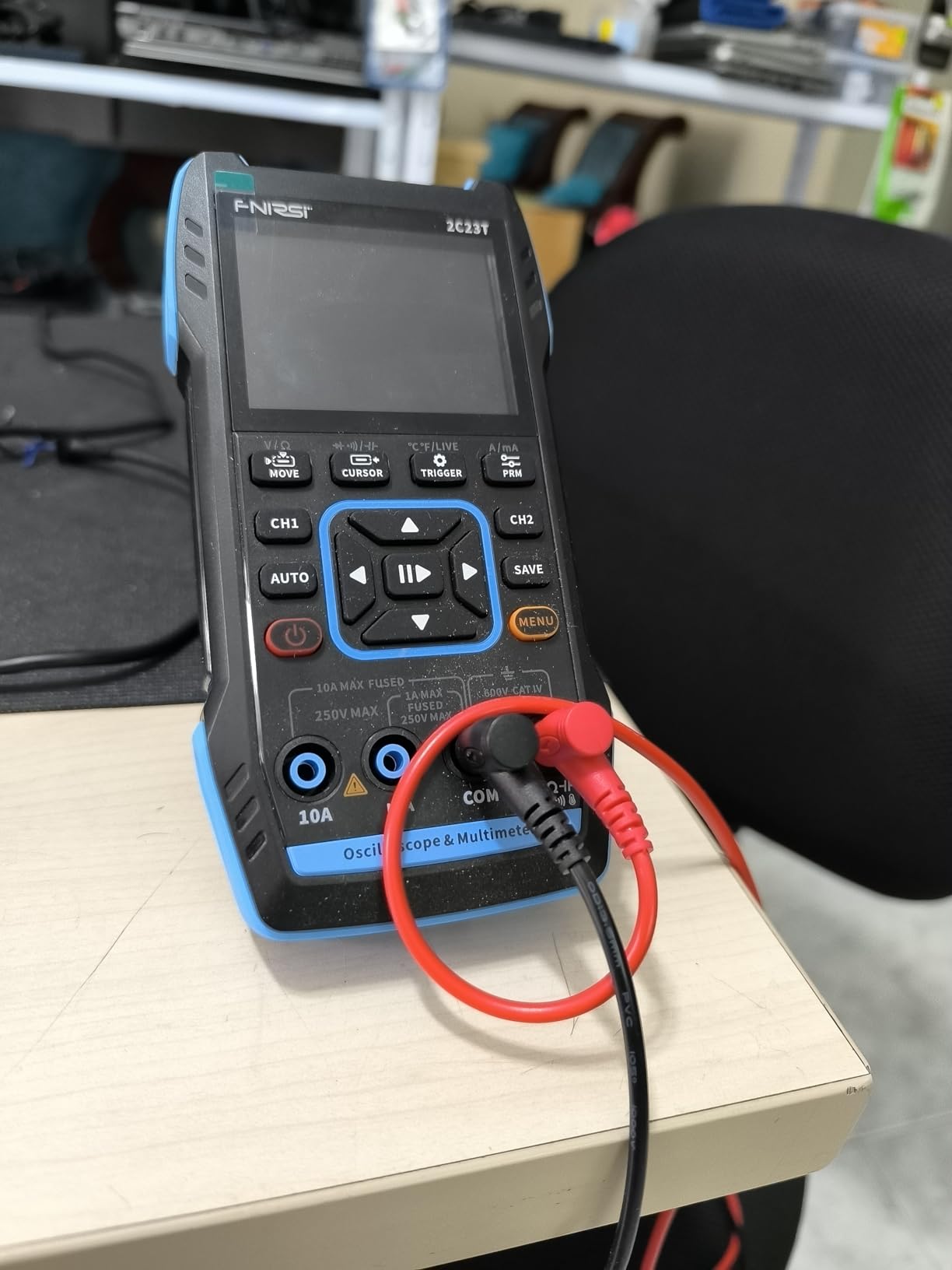
The multimeter function provides 10000 count resolution with comprehensive measurement modes including voltage, current, resistance, capacitance, and diode testing. The included probes extend measurement capability, though users should note that only one oscilloscope probe is included. Additional 10X probes are inexpensive and readily available.
The signal generator produces seven waveform types up to 2 MHz, adequate for testing audio circuits and filter responses. While limited compared to dedicated generators, this capability supports basic frequency response characterization without additional equipment purchases.
Best for Freshman and Sophomore Courses
Introductory electronics courses rarely exceed the 10 MHz bandwidth of this scope. Students can complete standard lab assignments including AC circuit analysis, transistor characterization, and basic digital logic observation. The limitations become apparent only in upper-level courses involving high-speed signals or RF work.
The learning curve is manageable for beginners, with one-button AUTO setup obtaining reasonable displays from unknown signals. As students develop skills, manual control options become available for more precise measurements. The experience transfers directly to larger bench scopes when laboratory access is available.
Battery Power for Outdoor Projects
The rechargeable battery enables measurements in locations without power access. Students working on solar projects, mobile robotics, or field sensor installations can debug circuits in their actual operating environments. The battery provides approximately 6 hours of standby time, sufficient for extended field sessions.
The compact size fits comfortably in a pocket or small tool kit, making this scope a constant companion for electronics students. Having measurement capability always available encourages exploratory experimentation and rapid troubleshooting when inspiration strikes.
10. FNIRSI DSO-510 – Most Affordable Starter Scope
- Under $50 price point
- Portable pocket size
- Built-in signal generator
- Type-C charging
- One-key AUTO function
- Only one channel supported
- UI learning curve
- Not accurate for precision
- Trigger can be finicky
The FNIRSI DSO-510 removes the final financial barrier to oscilloscope ownership, delivering basic functionality for less than the cost of a textbook. While limited in bandwidth and features, this scope enables students to visualize signals, understand waveforms, and complete introductory coursework without lab equipment scheduling conflicts.
The 10 MHz bandwidth handles audio signals, low-speed digital logic, and power supply analysis at frequencies encountered in first-year electronics courses. The 48 MSa/s sampling rate provides adequate resolution for these signals, displaying recognizable waveforms that support learning and debugging.
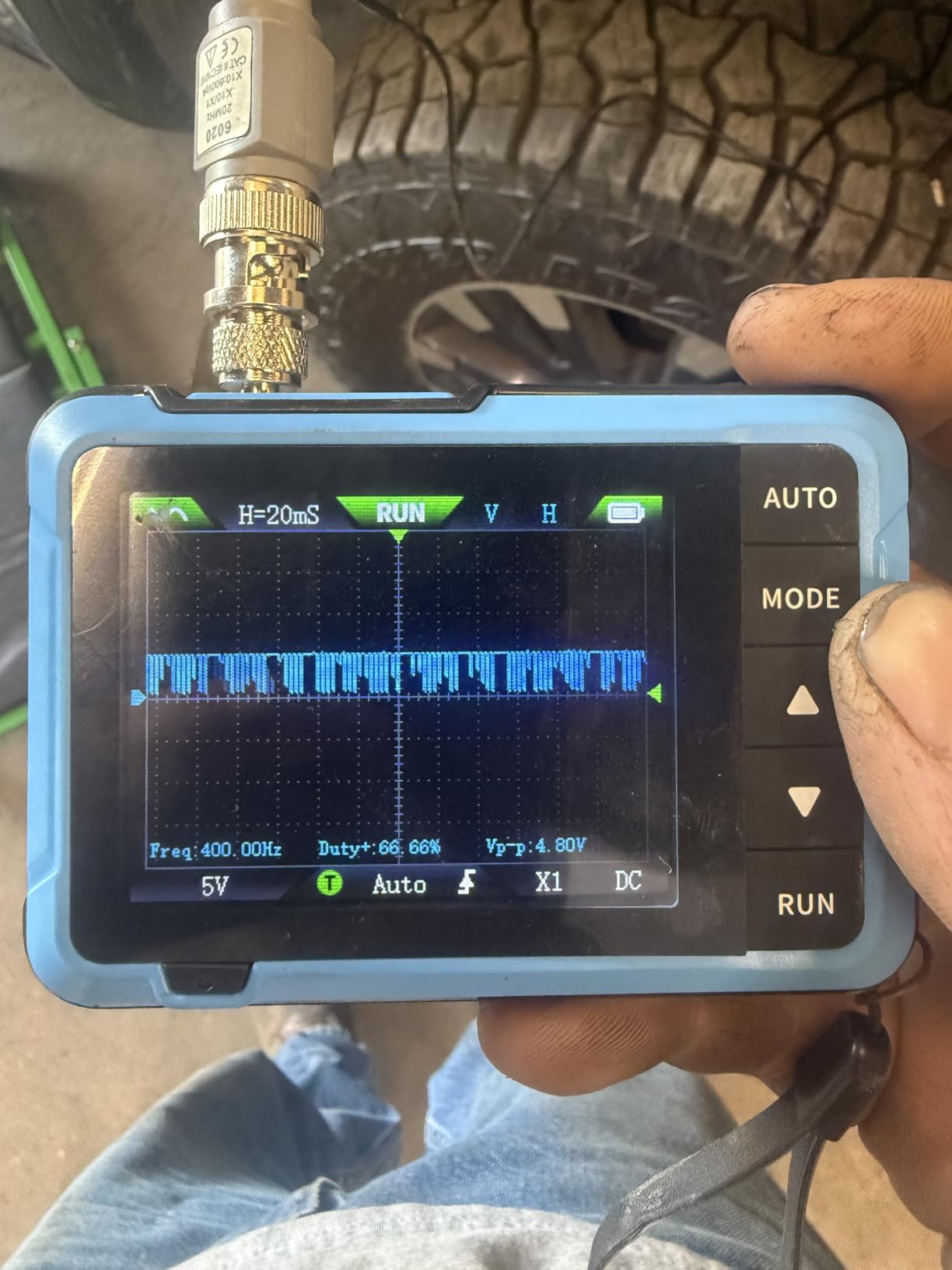
The integrated signal generator produces 13 waveform types up to 50 kHz, enabling basic circuit testing without external stimulus equipment. This 2-in-1 design supports filter characterization, frequency response observation, and circuit behavior exploration at minimal cost.
The pocket-sized dimensions measure just 3.8 x 2.68 x 0.75 inches, fitting comfortably in a pocket or the smallest tool pouch. Students can carry this scope everywhere, always ready to examine signals when curiosity or necessity arises. The 1000 mAh battery provides hours of portable operation.
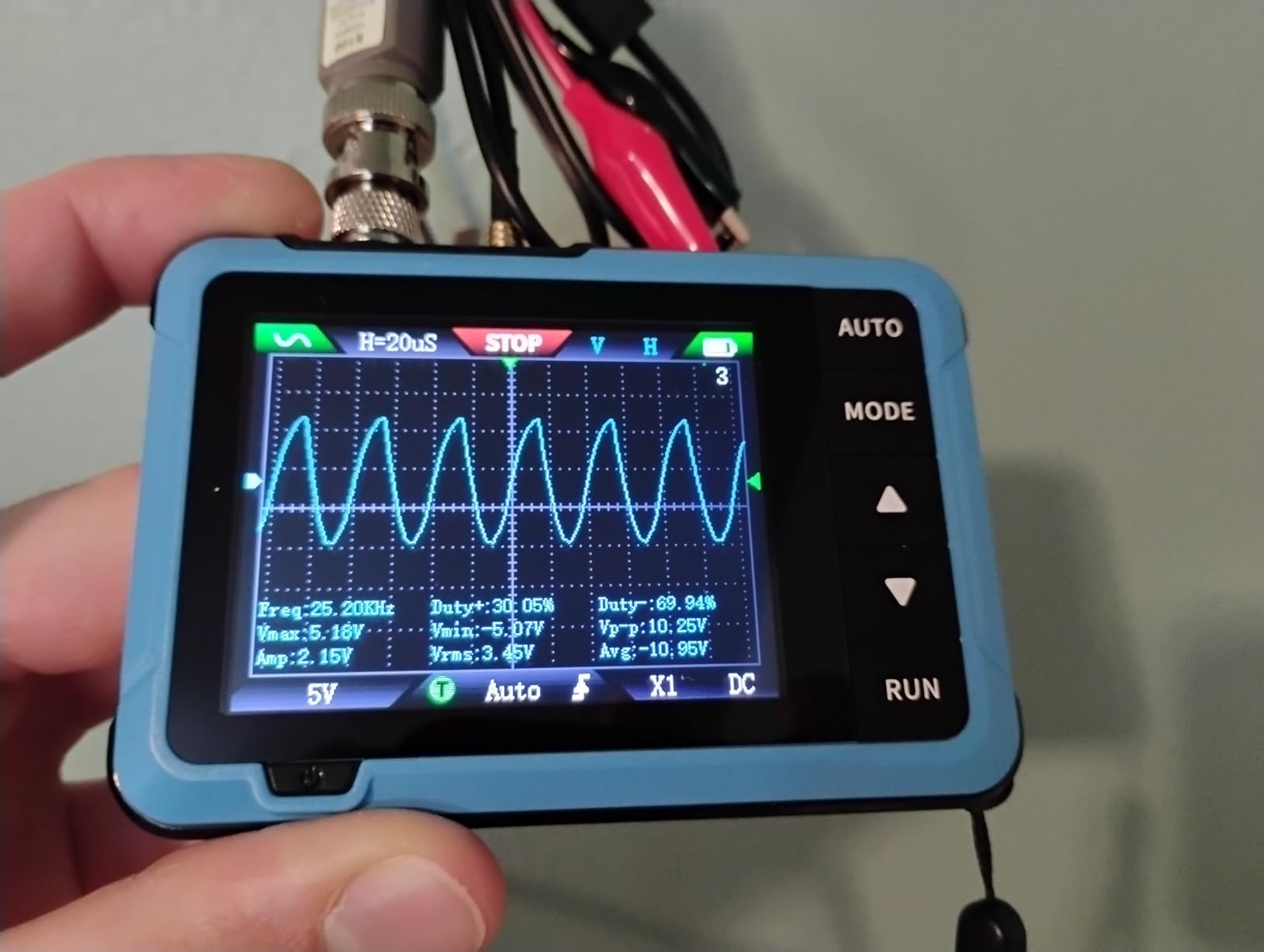
Great for First-Time Oscilloscope Users
Students who have never used an oscilloscope benefit from the simplified interface and immediate accessibility. The one-key AUTO function produces stable displays without requiring deep understanding of trigger concepts. This gentle learning curve builds confidence before transitioning to more complex instruments.
The limitations of this scope actually support learning by forcing focus on fundamental concepts. Students cannot rely on advanced features but must understand basic voltage, time, and trigger relationships. This foundational knowledge transfers to any oscilloscope they encounter later in their careers.
Automotive Diagnostics on a Budget
The signal range and portability make this scope suitable for basic automotive sensor and actuator testing. Students interested in automotive electronics can examine oxygen sensor outputs, throttle position signals, and ignition waveforms without investing in specialized automotive test equipment.
The infinite persistence display mode helps catch intermittent signals that single-shot capture might miss. This capability proves useful when diagnosing flaky connections or sensor drift that occurs unpredictably. The learning experience with this scope builds diagnostic skills applicable to professional equipment.
How to Choose the Right Oscilloscope for Your Studies?
Selecting an oscilloscope requires matching technical specifications to your actual coursework requirements. Based on my testing and the forum discussions from thousands of students, here are the key factors to consider when shopping for test equipment for students.
Bandwidth Requirements for Students
The golden rule for bandwidth is the “five times” guideline: your scope should have bandwidth at least five times higher than the fastest signal you need to measure. For most undergraduate electronics courses, 50 MHz handles the majority of requirements. This covers microcontroller clocks up to about 10 MHz, SPI communication at moderate speeds, and audio frequency circuits.
Students pursuing communications, RF, or high-speed digital courses should consider 100 MHz or higher. The difference between 50 MHz and 100 MHz becomes noticeable when analyzing fast-edged digital signals or signals above 20 MHz. For basic coursework and hobby projects, however, 50 MHz provides adequate service.
2-Channel vs 4-Channel Decision
The channel count question generates significant debate in student forums. My experience and community consensus suggest that four channels provide meaningful advantages for embedded systems work, allowing simultaneous observation of clock, data, chip select, and an additional signal. For basic analog coursework, two channels suffice.
If your budget allows, the Rigol DS1054Z’s four channels provide growth headroom that prevents equipment limitations from constraining project complexity. However, excellent two-channel scopes like the Siglent SDS1202X-E deliver superior bandwidth and signal quality that may matter more than channel count for certain coursework.
Sample Rate and Memory Depth Explained
Sample rate determines how finely the scope captures signal details, while memory depth controls how much data you can store. For single-shot captures of rare events, both specifications matter. For repetitive signals, sample rate dominates the measurement quality.
Memory depth becomes important when analyzing long communication sessions or capturing power-on sequences. Scopes with 24 Mpts or more allow extensive time span at high resolution, while shallow memory forces trade-offs between detail and duration. Protocol decoding is nearly unusable without adequate memory depth to capture complete data frames.
Protocol Decoding: Do You Need It?
Serial protocol decoding transforms oscilloscopes from waveform viewers into communication analyzers. For embedded systems courses involving I2C, SPI, UART, or CAN, built-in decoding saves hours of manual bit analysis. The scope displays actual hex values rather than requiring you to count signal transitions.
Not all coursework requires decoding, and some students complete degrees relying on university lab equipment for these specialized tasks. However, personal scope ownership with decoding capability enables debugging at home, during late-night project sessions, or when lab access is limited. The convenience factor is substantial for active project builders.
Handheld vs Bench Oscilloscope Trade-offs
Handheld scopes like the FNIRSI 2C53T offer portability that bench scopes cannot match, but sacrifice display size, bandwidth, and measurement precision. For dorm rooms with limited space or students who need measurements in the field, handheld units provide genuine utility. For dedicated lab work and serious debugging, bench scopes deliver superior capability.
Many students eventually own both types: a bench scope for primary workspace and a handheld for portable diagnostics. If choosing one, bench scopes generally provide better value for stationary work, while handhelds excel for mobile and space-constrained applications.
Frequently Asked Questions
What is a good beginner oscilloscope?
Is a 100 MHz oscilloscope enough?
Is a 4-channel oscilloscope worth it?
How many oscilloscope channels do students actually need?
Should students buy their own oscilloscopes or rely on institutional labs?
Final Recommendations
The best oscilloscopes for college students in 2026 balance capability, price, and longevity. Your specific choice depends on your budget tier and intended coursework.
For students who can invest in equipment that lasts through graduation and into their first job, the Rigol DS1054Z remains the definitive choice. Its four channels, deep memory, and serial decoding handle virtually any undergraduate requirement while building skills on professional-grade equipment.
The Siglent SDS1104X-E offers superior bandwidth and build quality for students with slightly larger budgets or those in programs requiring higher-frequency analysis. Both four-channel scopes represent investments in your education that pay dividends across your entire academic career.
Students with tighter budgets should not feel limited. The FNIRSI 2C53T provides remarkable capability at under $100, while the Hantek DSO2D15 brings desktop scope performance with integrated waveform generation at a mid-range price. Even the ultra-budget FNIRSI DSO-510 opens the door to hands-on learning that purely theoretical study cannot provide.
Whatever scope you choose, the act of owning and regularly using personal test equipment transforms how you learn electronics. The best oscilloscope for college students is the one that gets you measuring, debugging, and exploring circuits on your own schedule. Start where your budget allows, and let your equipment grow with your skills.