
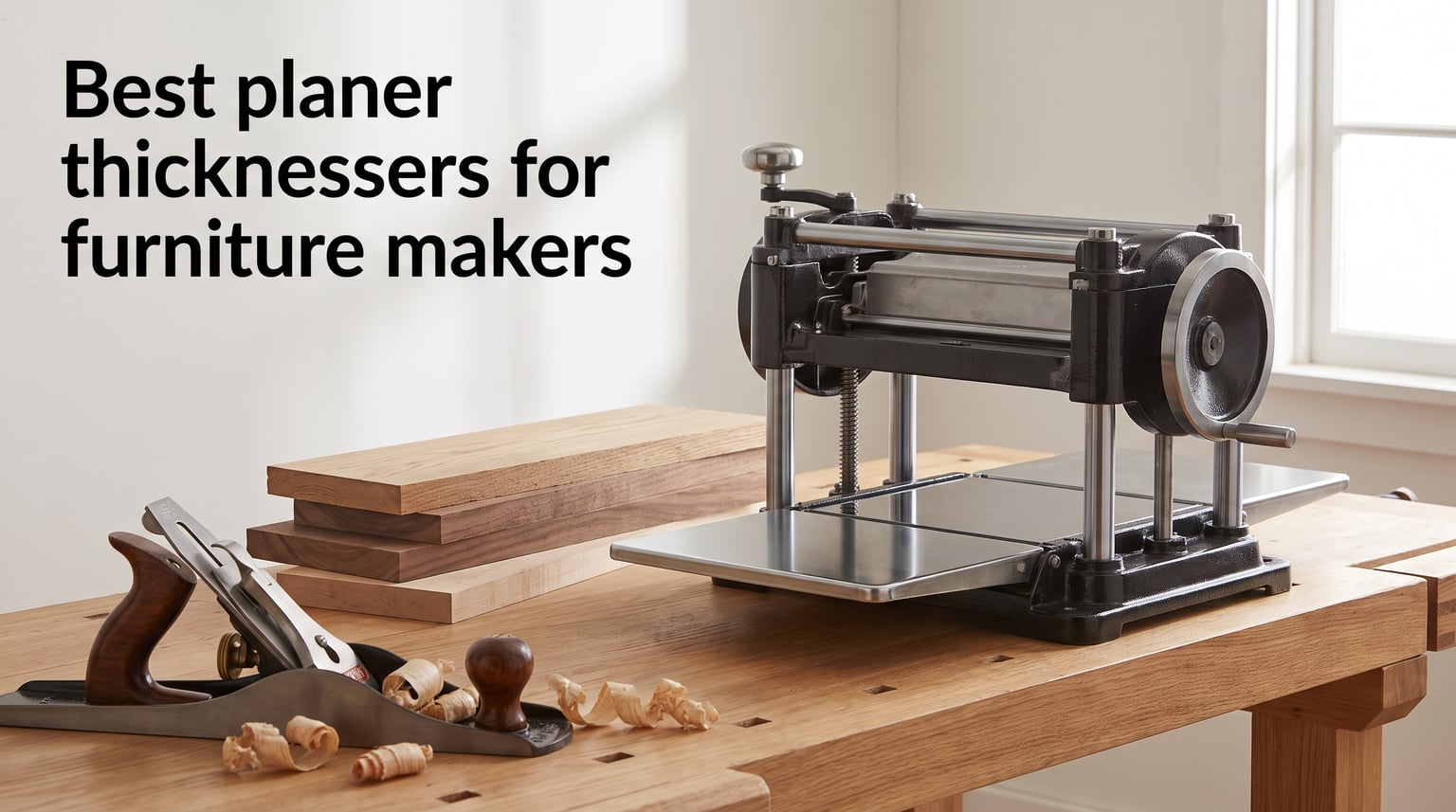
Furniture work gets easier when every rail, panel, and drawer part comes off the bench at a repeatable thickness. The best planer thicknessers for furniture makers turn rough lumber into consistent stock, but they do not replace the first flat reference face made with a jointer, hand plane, or sled.
A thickness planer, also called a thicknesser, pulls a board through a rotating cutterhead and leaves its two faces parallel. That matters when glue-ups need matching parts, frame-and-panel doors need even members, and a tabletop should finish at one planned thickness.
I compared the supplied listings by cutterhead, width, depth control, feed options, dust connection, and buyer-feedback signals rather than repeating marketing claims. The selection is mainly 13-inch benchtop machines, plus one 8-inch jointer that belongs beside a planer in a furniture-making workflow but is not itself a thickness planer.
My short answer for 2026 is to favor an insert-style cutterhead if surface quality, quieter running, and easier spot maintenance matter most. A conventional knife machine can still be a sensible choice when you want straightforward blade changes and accept more attention to setup and board support.
The top 3 picks give furniture makers the clearest starting point 2026
The Cutech 40700H is the first pick for its six-row spiral cutterhead and snipe-minimizing lead-screw design. The FINDBUYTOOL two-speed model is the feature-rich option for switching from roughing to finishing passes, while the WOODERS model is the straightforward 13-inch, four-blade choice for a basic benchtop setup.
Those labels are about stated features and the available ratings, not a claim that one machine fits every board. Long, thin furniture parts still need well-supported infeed and outfeed, a stable stand, and conservative passes.
These planer thicknessers make up the 2026 quick overview
Read the listed cutterhead and feed details as a way to narrow the field, then confirm the current manual, included parts, and dust-port compatibility before committing. A listed width is the maximum board width, not a promise that a wide and heavily cupped board can take a deep pass without difficulty.
| Product | Specifications | Action |
|---|---|---|
 Cutech 40700H Cutech 40700H |
|
Check Latest Price |
 FINDBUYTOOL 2-Speed FINDBUYTOOL 2-Speed |
|
Check Latest Price |
 Cutech 40180HI Jointer Cutech 40180HI Jointer |
|
Check Latest Price |
 FindBuyTool 13-Inch FindBuyTool 13-Inch |
|
Check Latest Price |
 WOODERS 13-Inch WOODERS 13-Inch |
|
Check Latest Price |
 VEVOR Two-Blade VEVOR Two-Blade |
|
Check Latest Price |
 VEVOR With Stand VEVOR With Stand |
|
Check Latest Price |
 VEVOR Three-Blade VEVOR Three-Blade |
|
Check Latest Price |
1. The Cutech 40700H is the finish-focused 12.5-inch choice
- Six-row spiral head
- Two-sided carbide inserts
- Snipe-minimizing lead screws
- Board return rollers
- Single feed speed
- Small review sample
The Cutech 40700H brings the feature that I would put at the center of a furniture-shop decision: a six-row spiral cutterhead with staggered tungsten-carbide inserts. Small inserts shear across the wood in overlapping paths, which can help leave a smoother surface and localize maintenance when one edge becomes damaged.
Its 12.5-inch cutting width is slightly short of the common 13-inch class, so I would measure panel plans before choosing it. That difference rarely affects narrow rails or face-frame parts, but it can matter when a glued panel is sized close to the machine limit.
The four lead screws and patented coupling design are presented as a snipe minimizer, and the front depth-of-cut indicator gives a direct reference while setting stock. Board return rollers are a practical detail when working alone because they send a completed board back across the top instead of making you walk around the machine.
The listing shows a 4.9 rating from 23 reviews, with the supplied distribution showing 92 percent five-star and 8 percent four-star reviews. That is an encouraging signal, though it is a smaller feedback pool than the large-review VEVOR listings below.
A spiral cutterhead suits finish-sensitive hardwood work
For figured woods and show faces, the staggered insert format is the reason to consider this machine. It does not eliminate the need for light final passes and grain-aware feeding, but it gives furniture makers a cutterhead built around surface quality rather than a simple straight-knife layout.
Two-sided inserts also let an owner rotate an edge before replacing the insert. I would still keep spare inserts and the correct driver in the shop, because a nicked insert can telegraph a line across every board.
A single feed speed limits roughing and finish-pass control
This is a single-speed planer, so it lacks the separate feed-rate choice offered by the FINDBUYTOOL two-speed and VEVOR three-blade machines. That does not stop it from thicknessing lumber; it means the user cannot select a slower feed solely for a finer finish.
For long furniture stock, support is as important as the machine’s internal snipe system. Keep the planer level on a firm bench or stand, hold neither end up or down during feeding, and take small finishing passes near the final thickness.
2. The FINDBUYTOOL two-speed model gives the most control options
- Two feed speeds
- 40-insert helical head
- Ball-screw adjustment
- 4 inch dust port
- Small review sample
- No Prime eligibility listed
This 13-inch FINDBUYTOOL thickness planer combines a 2.5HP, 15-amp motor with a 40-carbide-insert helical cutterhead. Its stated 20,000 RPM motor and 13-inch capacity put it squarely in the furniture-maker benchtop category.
The important distinction is the two-speed feed system: 21 FPM for faster roughing and 12 FPM for smoother finishing. I like that division because rough lumber and a final pass ask different things of the machine; removing bulk efficiently is not the same task as preparing a visible tabletop face.
It also lists a ball-screw height adjustment with ±0.05 mm accuracy, a dual-scale depth gauge, and six preset thickness positions. Those features can reduce setup repetition when a project needs several rails, stiles, or drawer sides at the same target thickness.
The listing shows a 4.9 rating from 11 reviews, so the star average is strong but the sample is limited. Treat the supplied feature set as more informative than trying to make a broad durability call from 11 reviews.
Two feed rates separate rough milling from final passes
The 21 FPM setting is intended for roughing, while the 12 FPM setting targets a smoother finish. For furniture parts, I would leave a little extra material during earlier milling and use the slower setting for the last light pass after the wood has rested.
Feed rate cannot fix a dull insert, poor grain direction, or a board that is badly twisted. It does give a useful extra control when trying to reduce sanding work on straight-grained material.
A 4-inch port suits a serious dust-collection plan
A 4-inch dust port is a more conventional connection size for many shop dust-collection setups than the smaller ports found on some compact planers. Chip extraction matters because a clogged exhaust can leave chips on the board and interrupt a consistent cut.
The extendable feed tables reach a stated 45 inches, yet long boards can still droop beyond them. Add auxiliary support at both ends and check that it is level with the planer bed rather than tilted toward it.
3. The Cutech 40180HI creates the flat reference a planer needs
- Spiral carbide head
- Cast-iron tables
- Long adjustable fence
- Quick angle stops
- It is a jointer not a thicknesser
- Minor alignment reports
The Cutech 40180HI is included because furniture makers often need a jointer before they need a thickness planer pass. This 8-inch benchtop jointer creates the flat face and straight edge that a thicknesser alone cannot reliably establish from a cupped or twisted board.
It uses a six-row spiral cutterhead with staggered tungsten-carbide inserts, paired with cast-iron tables. The 24-inch adjustable aluminum fence has quick stops at 90 and 135 degrees, which speaks directly to edge-jointing and bevel work rather than thicknessing.
The listing records a 4.8 rating from 209 reviews, a much deeper feedback pool than the two Cutech planer listings. Its supplied review material also flags some minor alignment reports, so table and fence setup deserve attention when it arrives.
I would not buy this as a substitute for a thickness planer because it has no stated thicknessing feed system. I would consider it as the companion machine for turning rough boards into stock with one flat reference face before final dimensioning.
An 8-inch jointer solves the first-face problem
A thickness planer makes faces parallel; it follows the existing shape unless the stock is supported by a sled. A jointer removes material from the top face while the board rides on its existing underside, giving you the first flat reference that supports accurate planer work.
That distinction is central to furniture making. For cabinet doors, case parts, and table components, starting with a true face and edge reduces surprises during glue-up and joinery.
A long fence supports edge-jointing and repeatable angles
The 24-inch fence provides more reference than a very short benchtop fence, and its stated quick stops target common angle changes. The fence enhancement brackets and guide post are meant to stabilize the fence and keep tables parallel.
Check coplanarity and fence square before milling project stock. The reported minor alignment concerns do not prove a fault in every unit, but they make a careful initial setup a sensible part of ownership.
4. The FindBuyTool 13-inch helical planer prioritizes stated accuracy
- Four-column frame
- Helical insert head
- Repeat depth stops
- 4 inch dust system
- Benchtop capacity limits
- No two-speed feed listed
The FindBuyTool 13-inch helical cutterhead planer lists 40 tungsten-carbide insert knives and a four-column, anti-wobble foundation. The manufacturer claims thickness tolerance under 0.1 mm, which is relevant when matching a set of drawer parts or keeping frame components uniform.
Its stated 15-amp, 120-volt motor runs at 20,000 RPM and feeds at 27.5 FPM. The 13-inch cutting width and 0.12-inch maximum cutting depth make it a conventional-size benchtop thicknesser, although heavy or wide boards should still receive shallow cuts.
An eight-position depth stop helps repeat batch settings. That feature is useful when milling a stack of parts after a test piece confirms the target thickness, because it lowers the chance of winding the head below the desired final dimension.
The supplied review data gives it a 4.6 rating from 43 reviews, with 79 percent five-star ratings. That is a fairer feedback base than a handful of reviews, though it remains wise to check setup and feed performance on scrap before touching finished stock.
A four-column frame targets repeatable thickness
Column stiffness influences how consistently the cutterhead stays positioned across a board. The four-column design is the stated answer here, and it pairs logically with a depth-stop system when a project contains many identical components.
For fine furniture, verify thickness with calipers at several points rather than trusting any dial alone. A small test board can show whether the machine is producing the same result at each side and from one pass to the next.
A helical head makes insert maintenance more targeted
The four-row cutterhead uses individual carbide inserts rather than long disposable knives. If one cutting edge is damaged, rotating the affected insert can be less wasteful than changing an entire knife set.
The tradeoff is more individual fasteners and inserts to keep clean and seated correctly. Disconnect power before maintenance, use the correct tool, and clear resin or dust from the pocket before tightening an insert.
5. The WOODERS 13-inch planer keeps the straight-knife format simple
- 13 inch capacity
- 2000W copper motor
- Spare blades included
- 0 to 3 mm depth
- Durability reports
- Lower rating than leaders
The WOODERS PL13-15AB is a 13-inch benchtop wood planer with a stated 2,000W all-copper motor and a four-HSS-blade cutterhead at 10,000 RPM. It offers adjustable planing depth from zero to 3 mm and an integrated dust outlet for a vacuum connection.
The package listing includes spare boxed planer blades, which is useful because straight-knife tools need a maintenance plan from the first day. HSS blades can produce a clean cut, but they are more exposed to damage from hidden grit, staples, or knots than carbide inserts.
Its rating is 4.5 from 28 reviews, and the supplied review summary includes some durability concerns. I would treat this model as a modest-use option, inspect it closely at setup, and avoid asking it to take aggressive cuts through difficult stock.
It lists an anti-snipe design and a heavy-duty iron blade shaft. Those details are welcome, but consistent results still depend on a flat support surface, clean feed rollers, and feeding boards straight without lifting the trailing end.
Four HSS blades favor familiar maintenance
A multi-blade straight cutterhead is easy to understand: the knives work across the whole board width, and the spare blades address the first replacement cycle. It can be a good learning format for an owner who is willing to learn careful knife handling and setup.
Inspect lumber before it enters the machine. Reclaimed material, embedded fasteners, and dirt are common reasons any planer blade loses its edge early.
A 3 mm depth rating is not a target for every pass
The stated maximum is 3 mm, but maximum depth is not the same as a recommended furniture-making pass. I would reduce the bite for wide hardwood boards, figured grain, or final sizing, because a lighter cut reduces strain and can leave a cleaner surface.
Listen for slowing and watch the chip flow. If the feed changes or the cut becomes rough, stop and investigate rather than forcing a board through the cutterhead.
6. The VEVOR two-blade model offers a supported 13-inch table
- Long worktable
- 23500 RPM motor
- Over-current protection
- Vacuum port
- Two-knife head
- Heavy at 54 pounds
This VEVOR two-blade planer lists a 13-inch worktable and a 35-inch total support length, using a 15-amp, 2,000W motor rated at 23,500 RPM. It is made for hard- and softwood material removal and includes a vacuum port for dust collection.
The stated capacity is boards up to 6 inches thick and 13 inches wide. Those dimensions cover many furniture parts, but the amount taken per pass should change with wood width, density, grain, and how flat the board was before it reached the thicknesser.
The provided feedback shows a 4.4 rating from 322 reviews, with 70 percent five-star ratings. That volume is useful context, though the remaining ratings show that a lower-cost benchtop machine still benefits from measured expectations and careful setup.
Its two-knife cutter is a conventional arrangement rather than a spiral cutterhead. I would pick it when table support and standard knife maintenance matter more than the finish and localized insert service associated with carbide insert heads.
A 35-inch support length helps but does not replace roller stands
Longer infeed and outfeed support can help keep a board from tipping as it enters and exits. That directly addresses snipe, the extra-deep cut that often appears at one or both board ends when stock loses level support.
For a long tabletop board, set auxiliary stands at the same height as the bed and test the path with the machine off. Do not support the board by lifting it into the cutterhead; let the feed rollers control the board once they engage.
A two-knife head calls for a blade-change routine
The high-precision two-knife cutter uses hardened blades described as HRC55-60. Keep the knife-change instructions, a clean work area, and suitable hand protection ready before blades dull instead of waiting for rough surfaces to force the job.
Forum discussions repeatedly raise early blade dulling and difficult chip collection as pain points. Clean stock, shallow cuts, and a connected collector are the practical response regardless of the exact planer brand.
7. The VEVOR with stand suits a dedicated floor location
- Detachable stand
- Foldable extensions
- Automatic feeding
- Dust exhaust
- Heavy at 67 pounds
- Single feed speed
The VEVOR B09BHY57WH packages a 13-inch planer with an iron stand, making it different from a machine that must be lifted onto a bench for each use. It lists a 15-amp, 1,800W motor, 8,000 RPM blade speed, foldable extension plates, and a dust exhaust connection.
The listed cutting range is 0.2 to 6.3 inches thick, with a maximum width of 13 inches. Its automatic feeding and infeed/outfeed tables are intended to make stock movement more controlled, but a stand does not remove the need for a clear, straight board path.
At 67 pounds, the machine and stand arrangement is substantial for a small shop. I would map the footprint with the extensions open, leaving room for the longest boards planned for the project instead of judging space by the closed machine alone.
The rating is 4.3 from 259 reviews, with 66 percent five-star ratings in the supplied distribution. Its power-off protection electromagnetic switch is a useful safety feature, while its 8,000 RPM figure is lower than several other products in this roundup.
An included stand reduces bench-lifting but uses floor space
A stand can make a planer more ready for regular milling and offers a fixed location for a dust hose. It also fixes the tool in one part of the shop, so consider where boards will enter, exit, and wait between passes.
Stable mounting matters. Woodworking community advice often recommends bolting benchtop planers down to stop movement, and a floor-standing arrangement should likewise sit level and resist shifting during use.
Foldable extensions help storage between milling sessions
The foldable extension plates make the planer easier to park when the work is done. Open them fully and confirm that their ends are level before dimensioning finish stock, because a slight mismatch can contribute to snipe or handling errors.
The dust exhaust is not optional decoration in a furniture shop. Capture chips as they are produced, and never reach into the exhaust or cutter area while the machine is connected to power.
8. The VEVOR three-blade model adds two feed-speed choices
- Two speed settings
- Three-knife cutter
- 35 inch support
- Vacuum port
- Heavy at 61.9 pounds
- Lower 4.2 rating
The VEVOR three-blade two-speed planer has a 13-inch worktable and a 35-inch total support length. It combines a 2,000W motor rated at 23,500 RPM with three quick-change knives and selectable feed speeds of 24 f/m for quick planing or 15 f/m for smoother finishing.
Those two speeds make it the conventional-knife alternative for someone who wants separate roughing and finishing modes. The slower 15 f/m setting is the one I would reserve for final passes on visible furniture faces after a test cut confirms grain direction.
The listing gives a 4.2 rating from 526 reviews, with 63 percent five-star ratings and a more mixed distribution than the top-rated models. That does not make it unusable; it does mean this is a machine where checking alignment, cutter setup, and feed behavior early is especially important.
It weighs 28.1 kilograms, listed as 61.9 pounds, so it is not a casual one-hand bench tool. Plan for a stable base, safe lifting help, and a dust hose that does not pull on the port as boards move through.
Two speed settings give knife-planer users a finishing option
The 24 f/m mode targets faster material removal, while 15 f/m targets a smoother finish. A slower feed gives the cutter more cutting events along the board, but clean knives and light final cuts remain the foundation of a good result.
Use the faster mode on rough stock only after the board has one flat reference and has been checked for defects. Save enough thickness for a finishing pass rather than trying to hit the final dimension during the first aggressive cuts.
Three blades can improve cuts per pass but still need equal setup
A three-knife head spreads cutting across three blades, yet all knives must be set correctly to avoid ridges or inconsistent surfaces. Follow the product instructions when changing blades and replace damaged knives as a matched set when the guidance calls for it.
The built-in 20-amp over-current protector and vacuum port support safer operation. They do not change the basic rules: wear eye and hearing protection, keep hands away from the cutter path, and never plane a board shorter than the machine’s documented minimum.
The right buying choice starts with your stock and workflow
Pick a thickness planer based on the wood you expect to mill, the surfaces you want to show, and the room available for stock handling. A furniture maker who buys surfaced lumber occasionally has different needs from someone processing rough hardwood for every project.
A cutterhead choice answers the finish and maintenance question
A straight-knife cutterhead uses long knives across the board. It is familiar and can work very well, but a nick affects the full cutting width and knife changes demand careful alignment.
A helical or spiral cutterhead uses many small carbide inserts arranged to cut at an angle. The terms are often used loosely in listings, so inspect the stated insert count and arrangement rather than relying on the label alone.
Insert heads can reduce noise and tear-out and allow an owner to rotate only a damaged edge. They also have many individual fasteners, so cleaning pockets and tightening inserts correctly becomes part of maintenance.
A 13-inch capacity fits many parts but not every glued panel
A 13-inch maximum cutting width accommodates most rails, stiles, drawer sides, and narrower solid-wood panels. It will not pass a 14-inch panel, and a board exactly at the limit can be awkward if it has cupping or needs edge cleanup.
Measure the finished width you truly need before purchasing. It is often smarter to plan a tabletop glue-up around the capacity than to assume a benchtop planer will process a wide panel after assembly.
Thickness capacity matters too. The supplied VEVOR listings state stock near 6 inches or 6.3 inches thick, while the FINDBUYTOOL two-speed listing states 6 inches; verify the manual’s minimum and maximum figures for your intended material.
Shallow passes prevent snipe, tear-out, and overload
Snipe is a deeper cut at a board’s leading or trailing end. It usually happens when a board tips as it enters or leaves the cutterhead, when bed support is poor, or when the planer’s adjustment and feed system need attention.
Use these steps to reduce it:
Joint or flatten one face before thicknessing, or use a sled for a board without a reference face.
Set infeed and outfeed support level with the planer bed.
Keep the board moving straight and do not lift either end while rollers control it.
Take light final passes and leave a little extra length on stock that will be trimmed later.
Keep beds clean and feed rollers free of resin and packed dust.
Forum contributors repeatedly mention bolting portable planers down. A rigid bench or stand can reduce movement, but level board support remains the more direct cure for end-of-board snipe.
Dust collection keeps the cut visible and the machine feeding
Every listed thicknesser includes a dust outlet or dust port, with the two FindBuyTool models specifying 4-inch ports. Connect a collector sized and approved for woodworking chips; a small shop vacuum may not move the volume needed for uninterrupted heavy planing.
Watch chip flow during every pass. If chips collect in the hood, stop the machine, disconnect power, and clear the obstruction only after all motion has stopped.
Dust extraction also protects the finish. Chips trapped under a board can mark its surface, and a dirty bed can make feeding less consistent.
Dry, clean lumber is the correct planer input
Plane dry lumber, not wet lumber. Wet wood can change shape as it dries, leaves a poorer surface, and is more likely to clog the machine with damp chips.
Bring rough boards into the shop long enough to acclimate when possible, then inspect them for metal, grit, deep checks, and loose knots. A moisture meter and metal detector are practical safeguards when the source of lumber is uncertain.
For rough milling, remove material in stages and let stressed boards rest before the final pass. That pause can reveal movement that would otherwise show up after you have already milled a part to its final thickness.
Safe operation follows a short, repeatable routine
Read the machine-specific manual and confirm the board meets its documented length, width, and thickness limits.
Wear eye and hearing protection, remove loose clothing and jewelry, and tie back long hair.
Inspect stock for nails, screws, staples, mud, and loose defects before feeding.
Set a modest depth of cut, especially for wide hardwood or figured grain.
Stand clear of the board’s travel path and keep hands away from the cutterhead opening.
Wait for the cutterhead to stop completely and disconnect power before clearing a jam, changing knives, or cleaning inside the machine.
These rules address the problems woodworkers report most often: jams, slipping or inconsistent feed, blade damage, and excess chips. They are not a substitute for the product manual, which controls whenever its instructions are more specific.
These common thickness-planer questions have direct answers
What is the best thickness planer on the market?
For the supplied products, the Cutech 40700H is the strongest finish-focused pick because it combines a six-row spiral cutterhead, two-sided carbide inserts, and a snipe-minimizing lead-screw design. The best choice changes with capacity, feed-speed needs, dust collection, and the condition of the lumber you mill.
What are common problems with thicknesser planers?
Common problems include snipe at board ends, feed rollers slipping, blades or inserts dulling, chip buildup, jams, and tear-out. Level infeed and outfeed support, clean stock, shallow passes, regular cleaning, and connected dust collection address many of these issues.
Do I really need a thickness planer?
You need a thickness planer if you regularly buy rough lumber or need project parts with matching thickness and parallel faces. It is especially useful for furniture and cabinetry, but it does not flatten a twisted board by itself; first create a flat reference face with a jointer, hand plane, or sled.
Is it better to plane wood wet or dry?
Plane dry lumber. Wet wood can move as it dries, leaves a less predictable surface, and creates damp chips that can interfere with collection. Let lumber acclimate, inspect it for defects and metal, then take conservative passes.
How thin can I plane wood?
The safe minimum thickness depends on the exact planer and its manual. Thin strips can flex, break, or be pulled into the machine, so use a documented minimum thickness and a suitable carrier board or sled when the manufacturer permits that method.
The best choice is the one that matches your furniture-making routine
For the best planer thicknessers for furniture makers, I would start with the Cutech 40700H when a spiral insert cutterhead and snipe-focused design lead the list. Choose the FINDBUYTOOL two-speed model when roughing and finishing feed-rate control matters, and remember that the Cutech 40180HI jointer is the complementary tool for producing the first flat face.
Whichever model you select in 2026, confirm the listing details, check the machine-specific manual, and prepare level stock support and dust collection before the first board enters the cutterhead. Careful milling is what turns a capable benchtop thicknesser into reliable furniture stock.