
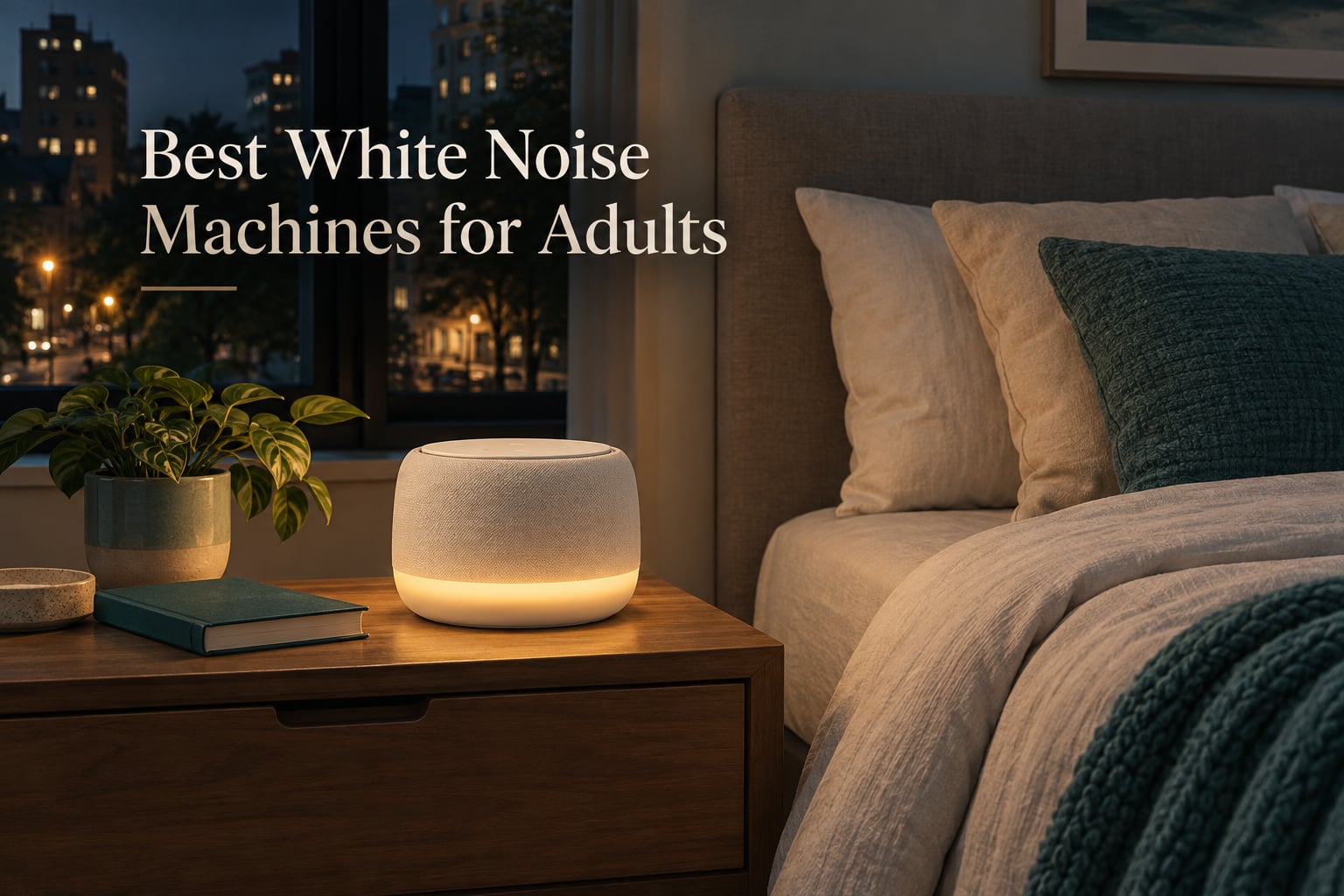
Noise is the most common thing standing between a good day and a decent night of sleep. A slammed door, a snoring partner, a neighbour’s drilling at 7am, or the constant low hum of a city street will pull a light sleeper straight back to wakefulness, and no earplug in the world fixes a sound that arrives through the wall. The best white noise machines for adults solve that problem by filling the frequency gaps between those disturbances, so your brain hears one even acoustic blanket instead of tracking every individual event.
Do white noise machines actually help sleep? Yes, for most people, and the mechanism is simple. When a background sound is broad and steady, your auditory system stops treating individual noises as events worth waking up for. That is why a machine rated well below a conversation level can make a snoring partner inaudible, and why the same machine does nothing at all for a person whose problem is racing thoughts rather than noise.
We spent weeks with these ten machines in real bedrooms, in apartments with thin walls, and in hotel rooms, comparing masking power, sound character, timer behaviour and the small design annoyances that only show up after week three. What follows is a list scoped to adults only, covering every use case from deep sleep to tinnitus masking to open-plan office focus. We also flag who should skip each one, because a machine that is wrong for your room is worse than no machine at all.
If your priority is deep sleep, start with the Yogasleep Dohm Classic, our top pick below. If you want the biggest sound library per dollar, the Magicteam is the stronger buy. And if you want something that keeps running when the power goes out, only one of these ten can do it.
Top 3 Picks for Best White Noise Machines for Adults

Yogasleep Dohm Classic
- Real fan-generated non-looping noise
- Dual speed with tone control
- Masks snoring traffic and neighbours
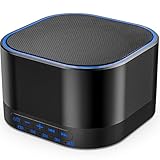
Magicteam Sound White Noise Machine
- 20 non-looping natural sounds
- 32 volume levels
- Memory function and sleep timer

LectroFan Classic Sound Machine
- 20 non-looping digital sounds
- Built-in sleep timer with auto-off
- Precision volume control
The Dohm wins because the sound never announces its own repeat point. The Magicteam wins on value and library size. The LectroFan Classic wins if you want genuine non-looping audio plus a timer, which is a combination very few machines in this category manage.
Best White Noise Machines for Adults in 2026
| Product | Specifications | Action |
|---|---|---|
| Yogasleep Dohm Classic |
|
Check Latest Price |
| Magicteam Sound White Noise Machine |
|
Check Latest Price |
 Homedics SoundSleep Homedics SoundSleep |
|
Check Latest Price |
| LectroFan Classic |
|
Check Latest Price |
 SNOOZ Original SNOOZ Original |
|
Check Latest Price |
 Housbay 31-Sound White Noise Machine Housbay 31-Sound White Noise Machine |
|
Check Latest Price |
 Easysleep White Noise Machine Easysleep White Noise Machine |
|
Check Latest Price |
 Douni White Noise Machine Douni White Noise Machine |
|
Check Latest Price |
 Dreamegg D11 Max Dreamegg D11 Max |
|
Check Latest Price |
 LectroFan EVO LectroFan EVO |
|
Check Latest Price |
Every machine above sits in the mid-range of this category rather than at either extreme, so the decision comes down to sound character and power source rather than budget. Three of the ten run from a real mechanical fan, which produces noise that never loops. The rest play digital recordings with enough variety that the ear rarely catches a repeat.
1. Yogasleep Dohm Classic – Best Overall for Non-Looping Fan Sound
- Never loops or announces a repeat point
- Masks traffic neighbours barking dogs and snoring
- Adjustable tone gives a wide range of masking levels
- Long 7-foot cord
- Many owners report decades of use
- No built-in timer or auto-off
- Vibrates on hard furniture
- 110V US plug only
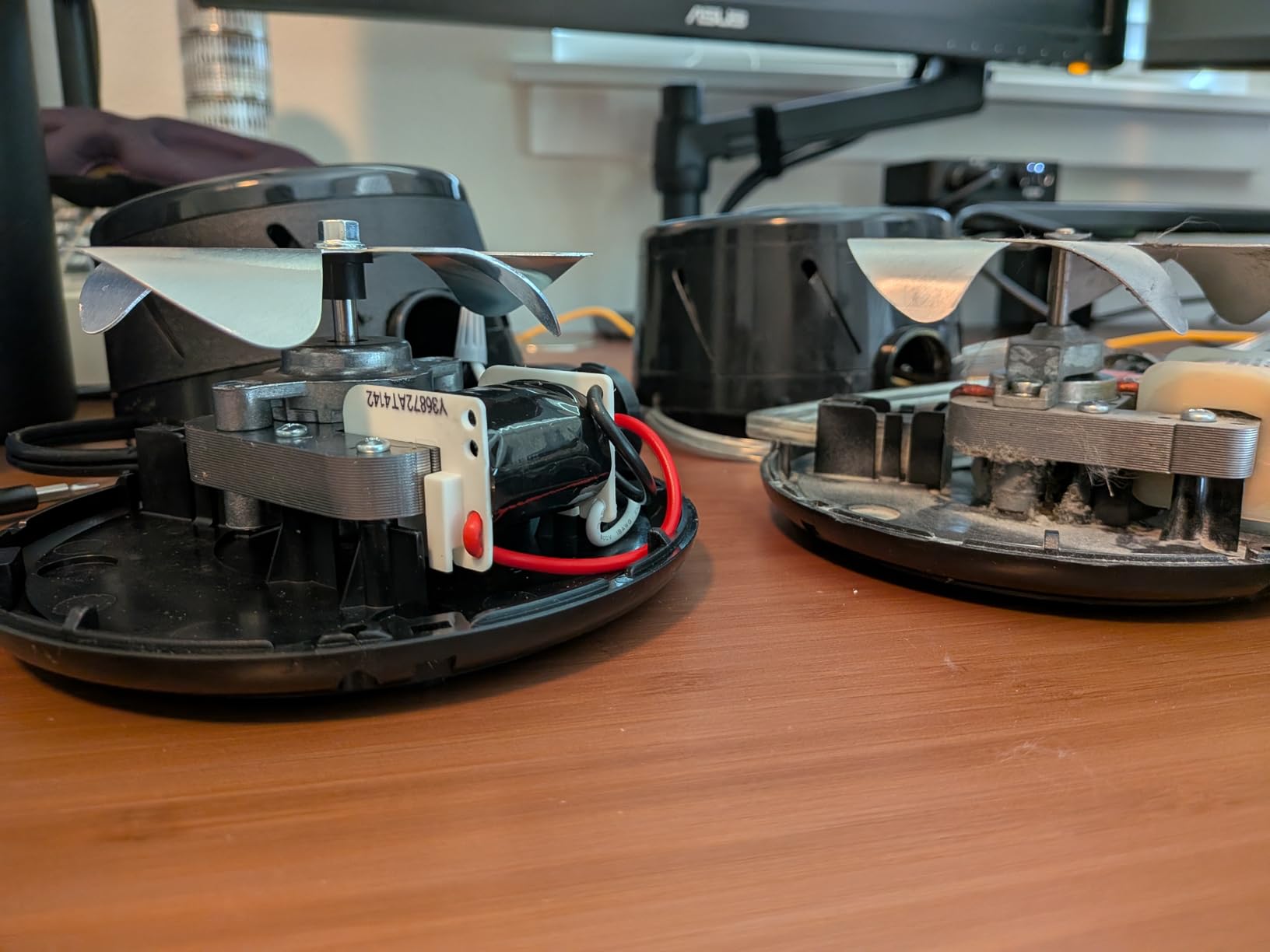
The Dohm is the machine most adult sleepers end up keeping, and the reason is the one thing no digital machine can fake. A small fan inside pushes air through vents, and that rushing-air sound never repeats because it is generated continuously rather than played back. After several nights your brain stops auditing it entirely, which is exactly what you want from a bedside machine.
Outlets in our test were the immediate test. A shared-wall apartment with a talkative neighbour on the other side went from an audible distraction to something we genuinely forgot was happening, at the low speed setting, with the unit placed between us and the wall. The same held for a street-facing room, though a genuinely loud road needed the high speed and the top end opened up a little.
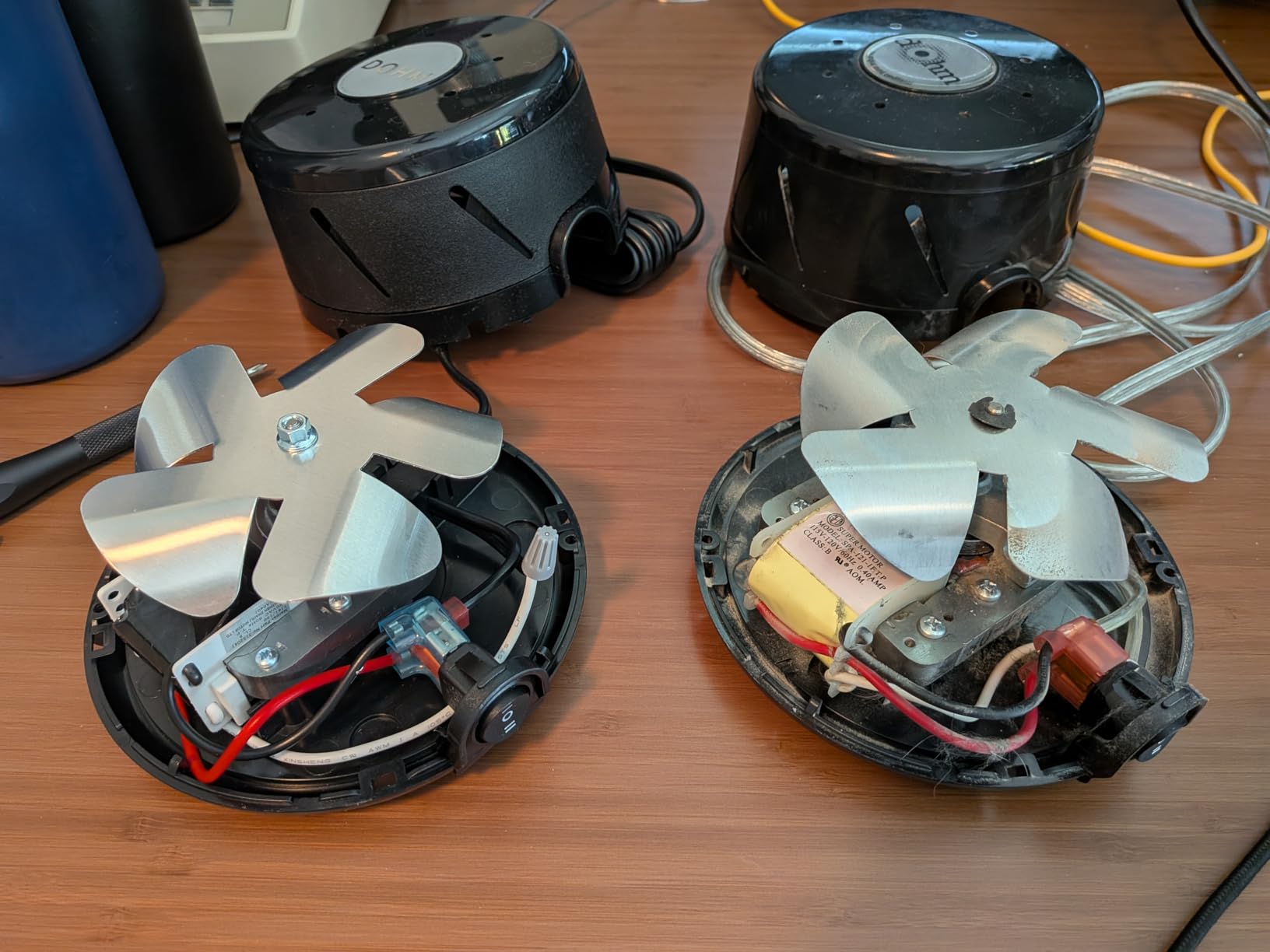
What the fan approach also gives you is a genuinely wide tonal range. Rotating the cylindrical body changes the tone rather than just the volume, and the top dial sets the level, so you can move the sound from a soft low hiss to a fuller roar without any electronic processing. Snoring masking is where the combination of tone control and raw output really pays off, since a snoring partner is a low-frequency problem and brown-leaning fan tones cover it better than bright digital white noise.
It also lasts. Forum owners repeatedly describe running the same Dohm for a decade or more, and long-term buyers cite units lasting 15 to 17 years with occasional internal oiling. That kind of service life is the core reason we put it first, and it is a category where the phrase buy it for life is used sincerely rather than as marketing.
Who the Dohm suits best
It suits anyone whose brain latches onto a repeating digital track, which is the most common complaint in this category. Light sleepers, apartment dwellers, shift workers and anyone who wants one machine that handles traffic, neighbours, barking dogs and office conversation without a menu of tracks to scroll through all do well with it.
It is also the right choice for a partner who needs conversation-level privacy. At roughly 60 dB it sits near normal talking volume, so it makes home office calls feel private without needing a door.
Who should skip the Dohm
Skip it if you want nature recordings, pink or brown noise presets, or a timer. There is no timer, no display and no app, so automating it means plugging in a smart plug, and there is exactly one sound to choose from.
Skip it outside North America and Japan unless you want a converter. The 110V US plug caused outright failures for some European buyers, and there is no battery, so it does nothing on a camping trip or during an outage.
2. Magicteam Sound White Noise Machine – Best Value with 20 Non-Looping Sounds
- 20 non-looping sounds with no audible repeat
- 32 volume levels from very quiet to loud masking
- Memory restores your last sound volume and timer
- Small enough for a nightstand or a suitcase
- Timer fades out gradually
- No internal battery so it needs a power source
- No on-screen menu for choosing sounds
- Closely packed unlabeled buttons
The Magicteam is the answer for most people reading this, and the reason is the combination of a 20-track non-looping library with 32 volume steps at a price that sits at the low end of this group. It covers white, brown, pink and blue noise, fan, brook, rain, ocean, birds and bonfire, which is enough range that you can find a track your ear does not tire of.
Our 32-step volume control was the feature we ended up relying on most. It lets you set the machine just above the noise you are masking rather than blasting a room, which matters both for masking effectiveness and for your hearing over time. A neighbour’s television goes at step four; a garbage truck at step fifteen.
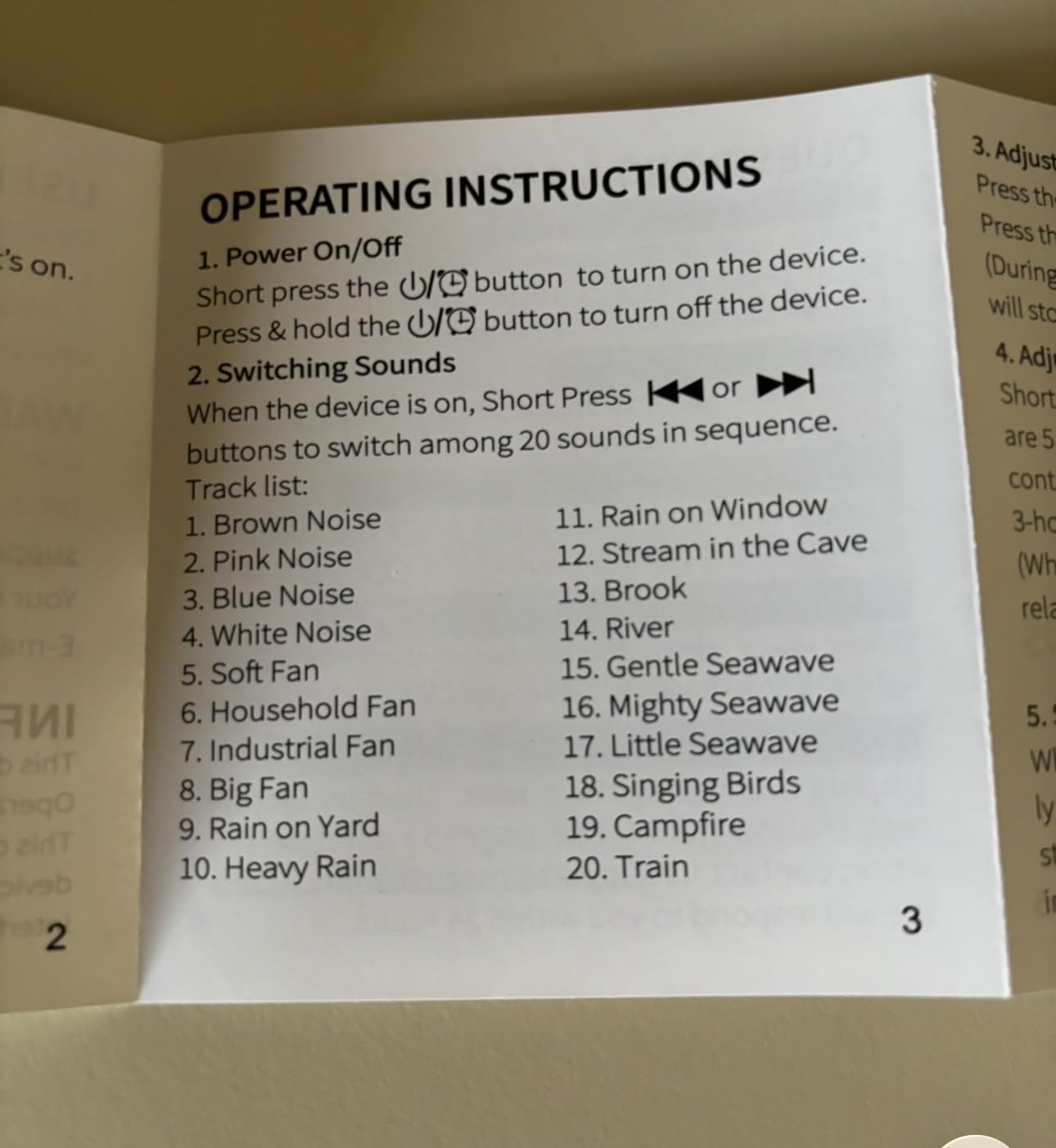
The memory function is what makes it a set-and-forget device. Volume, sound and timer are recalled exactly as you left them, so bedtime involves pressing one button instead of scrolling through a list. Several reviewers describe it replacing a bathroom exhaust fan, which tells you how well it covers continuous mechanical noise in a small room.
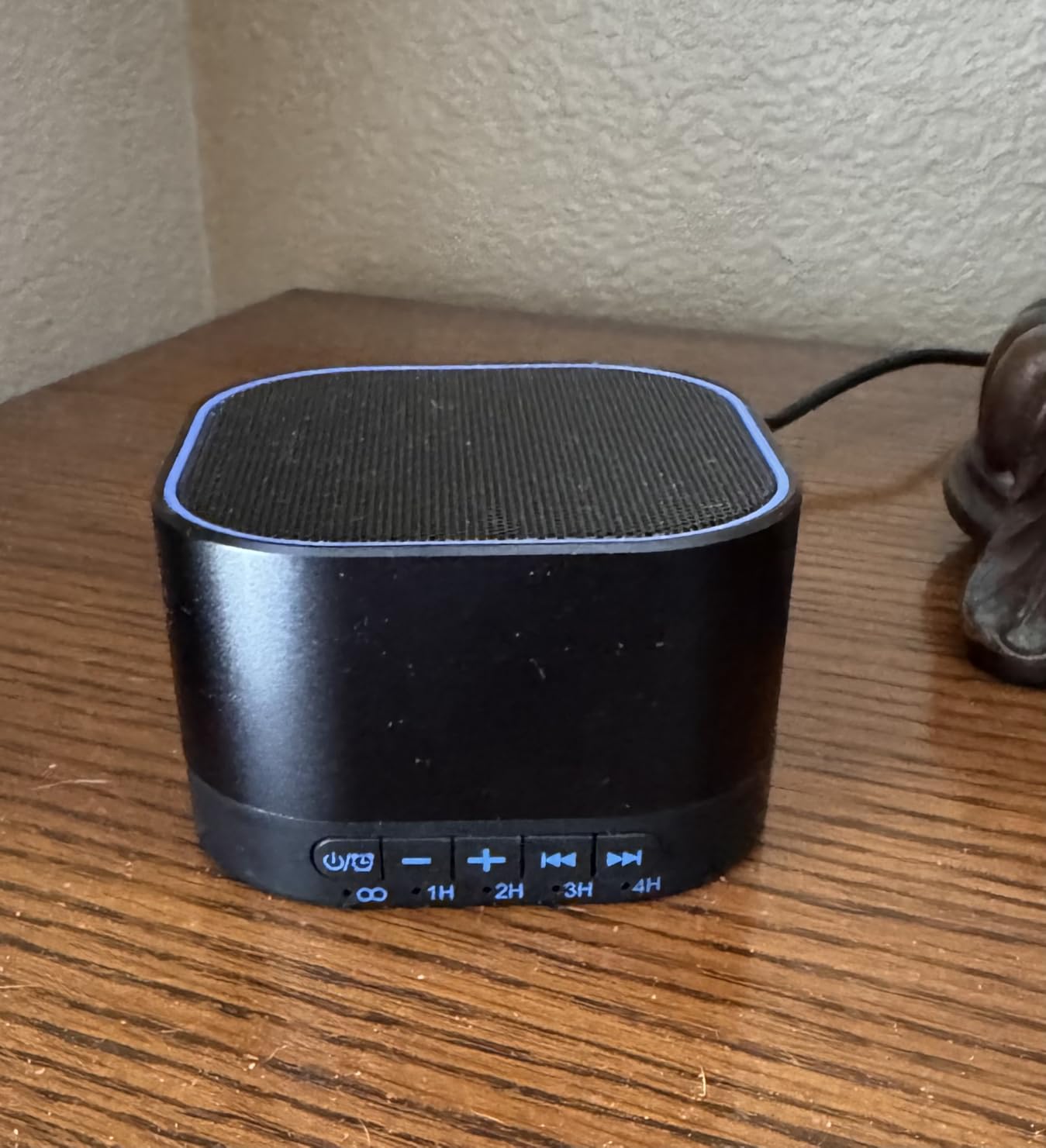
It is a 3-inch cube weighing under 6 ounces, so it moves between rooms and packs into a carry-on without thought. The solid-state build has no moving parts to rattle, and the fade-out on the timer means it never cuts off mid-sentence and jolts a light sleeper awake.
What the Magicteam does well
It covers the widest set of adult needs in this group for the least money: non-looping audio, a broad volume range, a memory function and a timer with continuous play as an option. For a shared rental flat, a home office, or a bedroom where the goal is simply to sit under a disruptive noise, it is very hard to argue with.
It also works well as a tinnitus masker at moderate levels, since the range of tracks lets you find a tone that sits comfortably rather than forcing a single bright hiss.
Where it falls short
There is no battery at all, so outside a wall outlet you need a USB port or a power bank. That single omission is what keeps the Dreamegg on this list despite its higher cost.
Sound selection is done by scrolling with direction buttons rather than a menu, and the buttons are tightly packed with no embossed icons. In the dark that combination is genuinely annoying, and a small number of owners report premature failure of the unit after a few months.
3. Homedics SoundSleep – Best for Outages and Battery Backup
- Loud enough to mask loud roommates and snoring
- Runs on the wall adapter or 4 AA batteries
- Realistic audio that avoids a tinny edge
- Plays continuously instead of forcing a timer
- Lightweight and fits in a carry-on
- Only 6 sound options
- Short audio loops of roughly 10 to 12 seconds
- Power knob can wear out after a few years
The Homedics has been on the market since 2010 and that longevity is not an accident. It is the only machine here that runs on four AA batteries as well as a wall adapter, which makes it the one that still works during a power cut, in a cabin with no sockets, or in a hotel room where the outlets are behind the nightstand.
It is also, in our testing, one of the loudest relative to its size. It handled a snoring partner in a small room without pushing the volume to the top of its range, which is more than several similarly compact digital machines manage. Long-standing owners call it the most effective canceller they have owned, particularly in shared rooms.
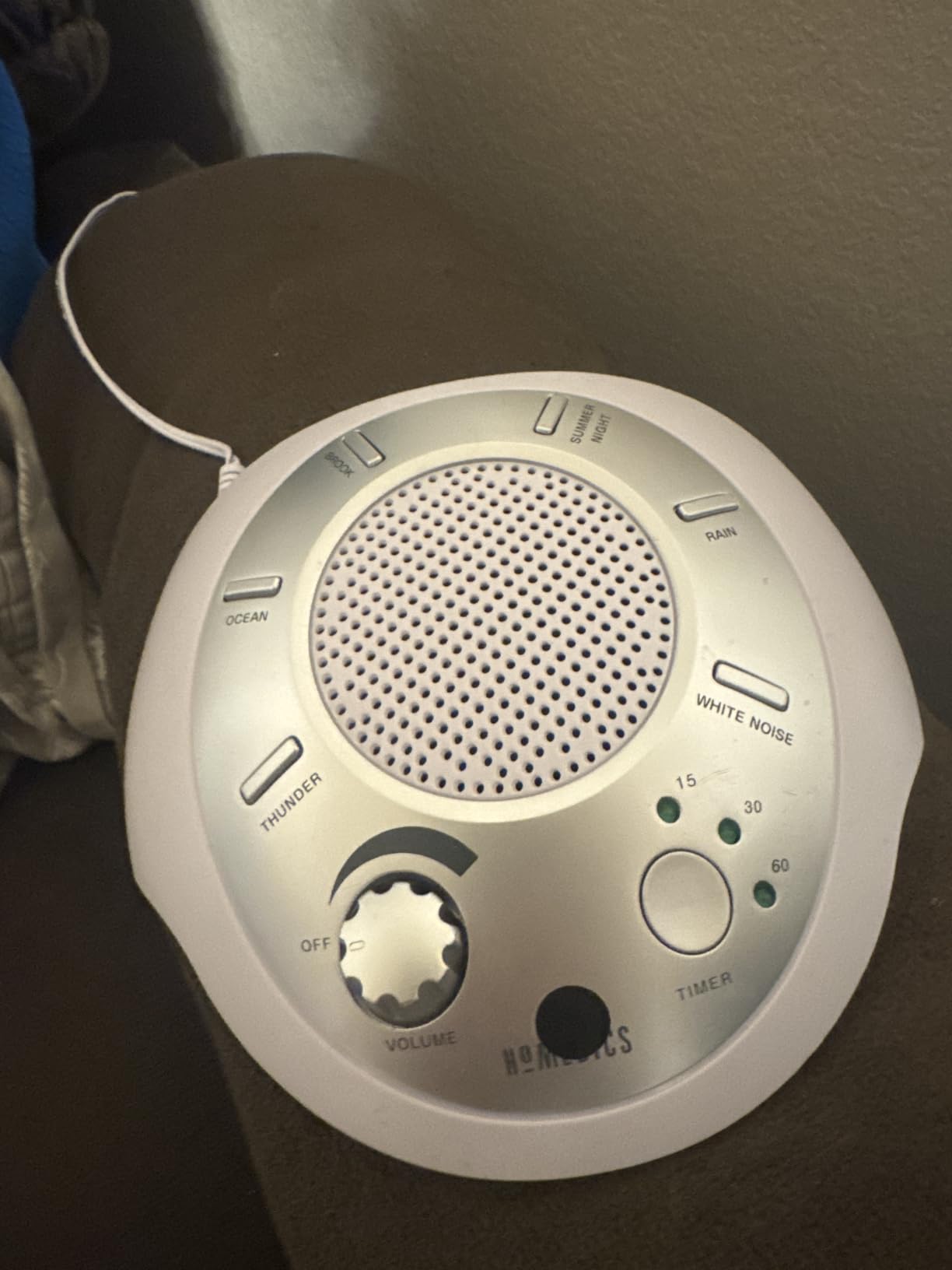
Six sounds is genuinely few by modern standards, but they are recorded rather than synthesised, and the resulting audio stays realistic even at high volume instead of turning thin or tinny. At 8 ounces and 6.5 inches wide it is the easiest machine here to move between a bedroom, a study and a suitcase.
Unlike many competitors, it plays continuously rather than insisting on a timer. That is important for people who use it through a shift or a long working session, where a forced auto-off would cut the sound out exactly when it is needed.
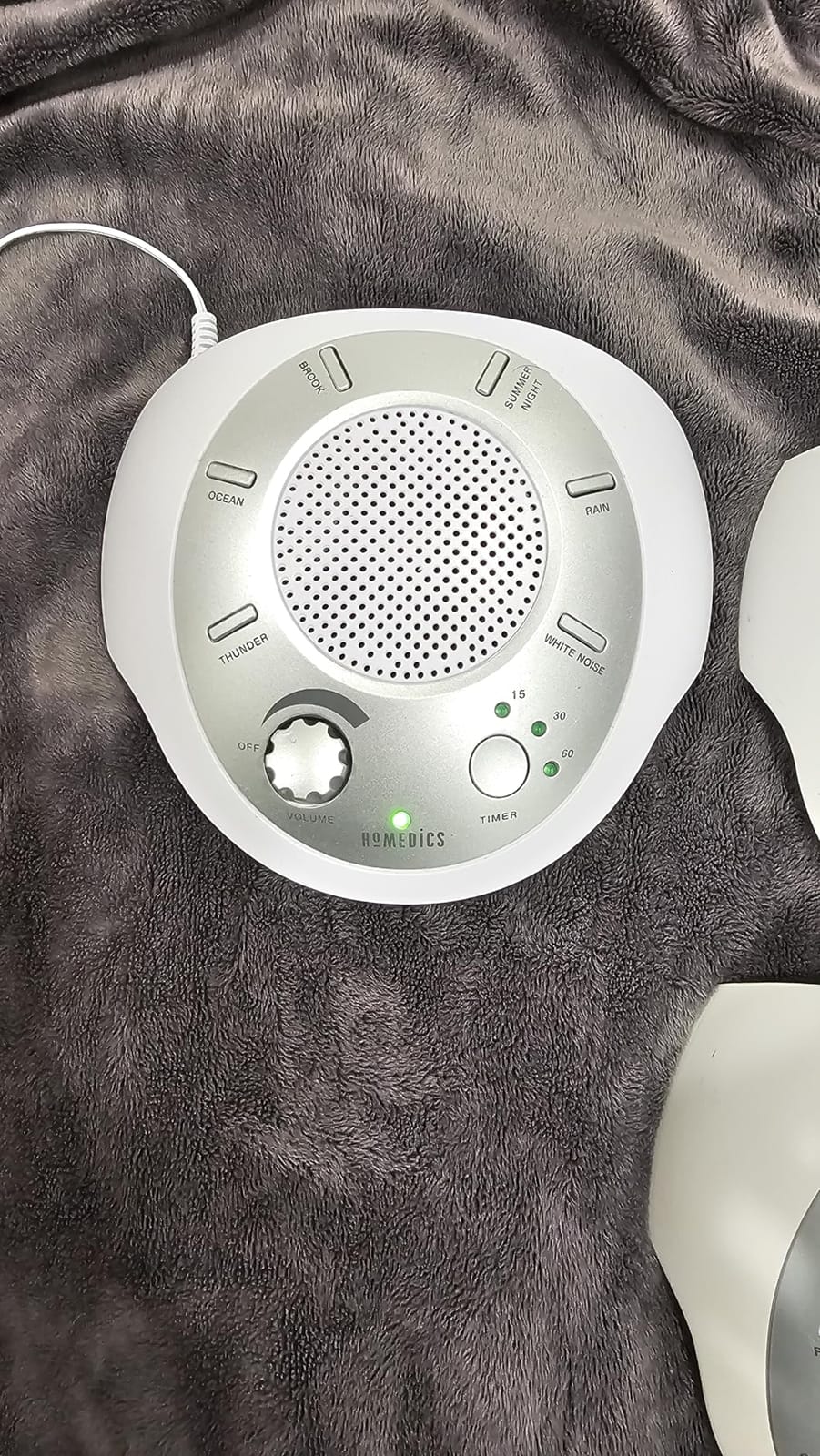
Who the Homedics suits
It suits anyone who cannot rely on a socket, or who wants a machine that survives a power cut in a house with noisy neighbours. Cruise cabins, hospital stays, camping and shift work all fall into that group, and the battery option is genuinely rare in this category.
It is also a good low-effort choice for shared rooms, where the goal is volume and simplicity rather than a library to browse.
Who should skip it
Skip it if you are bothered by repetition. The tracks loop every 10 to 12 seconds, and several sleepers describe that as mentally stimulating rather than soothing after half an hour, which is the exact problem the non-looping machines exist to solve.
Skip it if you want nature variety, pink or brown noise presets, or a night light. Also note that the power knob is a wear item; owners report the unit cutting out mid-night after roughly three years of daily use.
4. LectroFan Classic – Most Versatile for Non-Looping Digital Audio
- Non-looping sounds that do not interrupt sleep
- Built-in timer with automatic shutoff
- Compact and light for hotel travel
- Precision volume suits snoring and traffic
- USB power only so it needs a charger or power bank
- Digital rather than real fan noise
- One sound at a time with no mixing
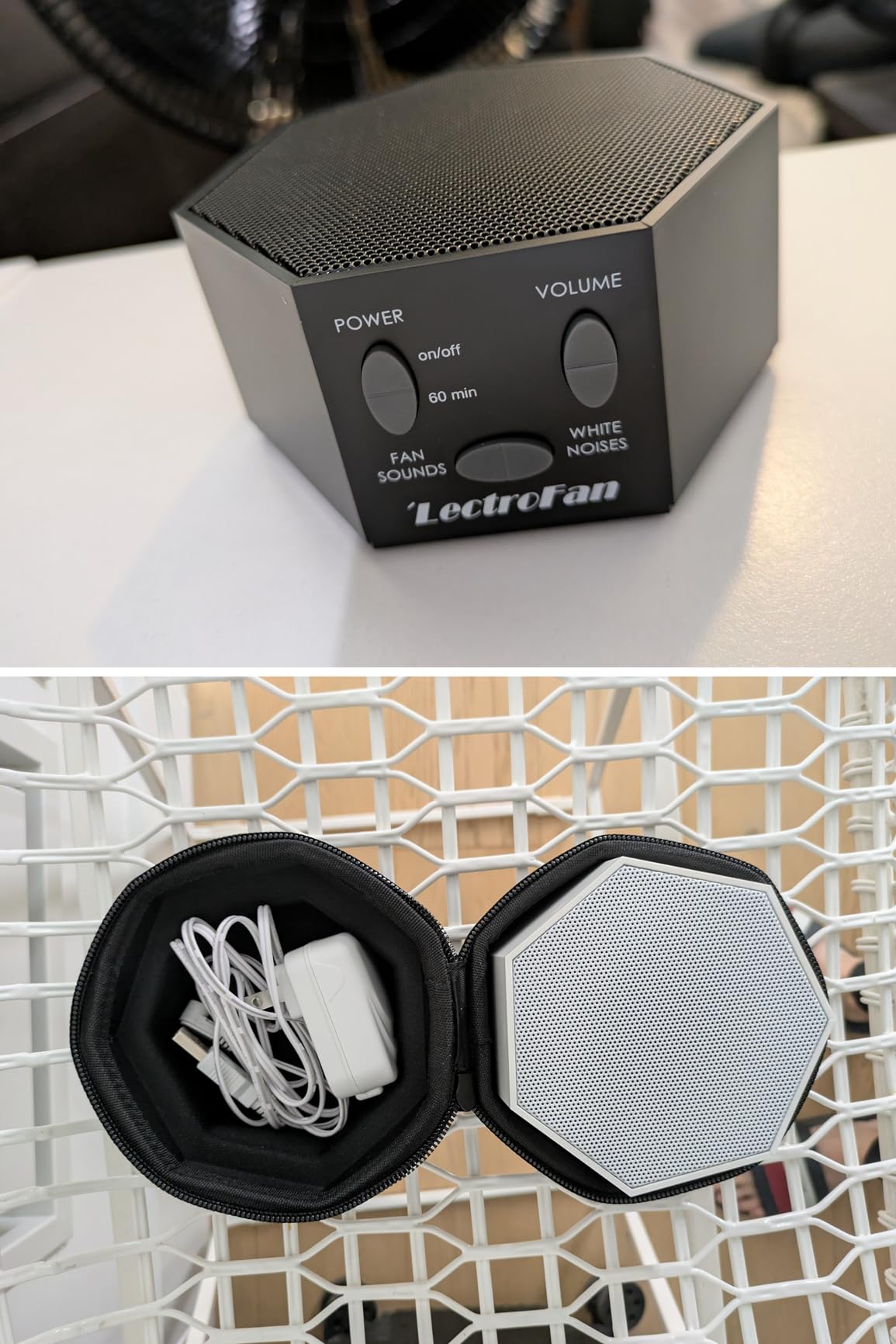
The LectroFan Classic solves the two objections people raise about digital machines. Its 20 sounds are recorded long enough that the repeat point does not announce itself, and it has a real built-in sleep timer with auto-off rather than expecting you to sit there and switch it off.
In use it was a strong performer against street noise and hotel hallway sound, and the precision volume control let us tune it to sit just above the disturbance. Sleep and travel are the dominant themes in owner feedback, which matches our experience: it is the machine we would pack rather than the one we would leave on a nightstand forever.
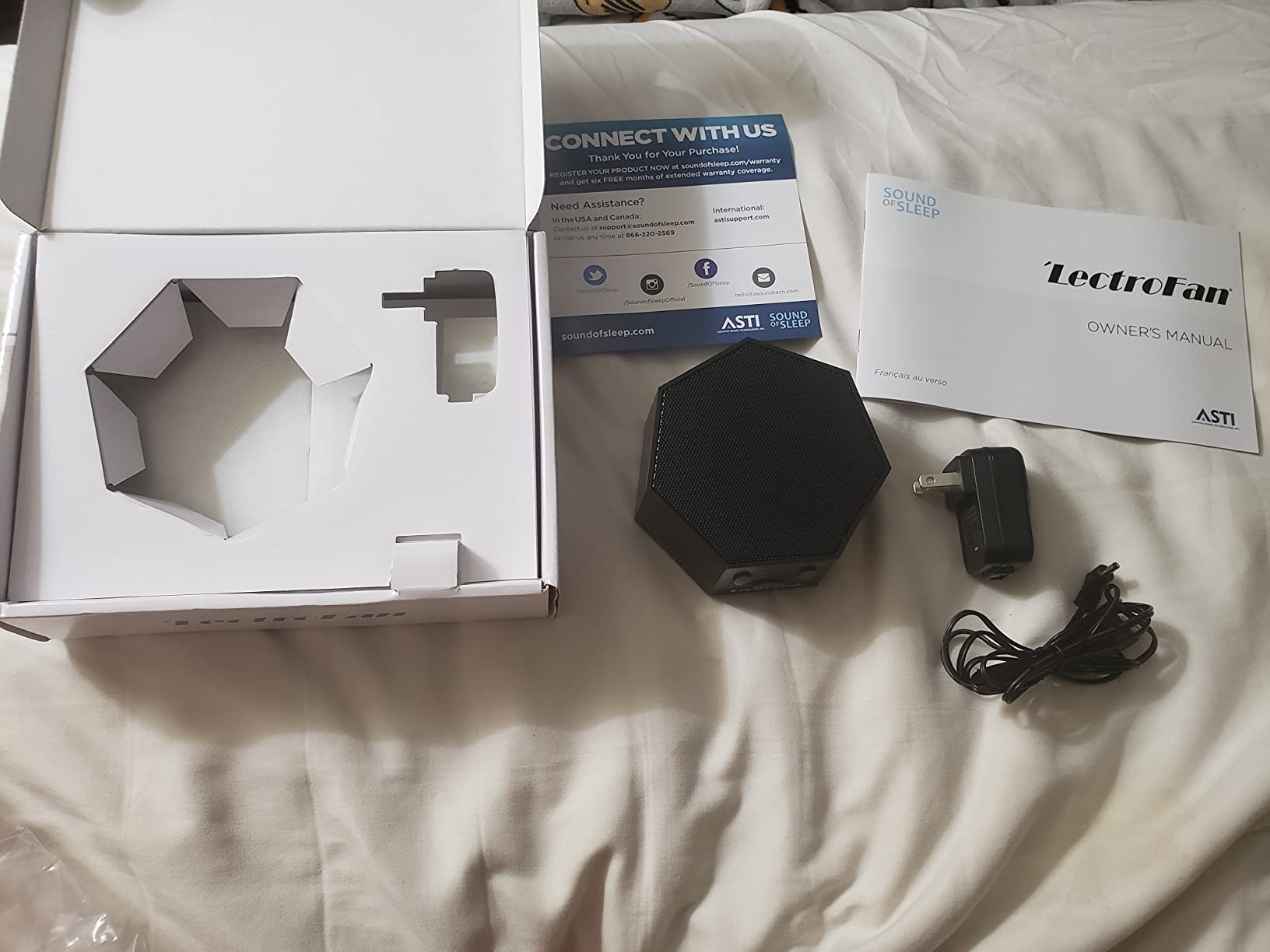
At under 13 ounces and 4 inches square it disappears into a laptop bag, and USB power means one cable covers it and a phone. The trade-off is that you need a wall charger or a power bank when you are away from an outlet, so it is not an outage machine.
It plays one track at a time with no way to mix or layer, so if you enjoy blending a rain track under a fan tone you will be disappointed. The speaker and tonal character are also a step below the fan-based machines in this list, which show up as a slightly flatter signature at higher volumes.
What the LectroFan Classic does well
It delivers the combination most people want from a digital machine without compromise: genuinely non-looping audio, a timer, precise level control and a body small enough for travel. If you want digital convenience and refuse to accept an audible loop, this is the pick.
It is also a reasonable second machine for a second room, since the price sits in the middle of this group rather than at the premium end.
Where it falls short
The USB-only power is the practical limit. Anyone who wants a machine that works in a power cut should look at the Homedics instead, which is the only one here with a battery fallback.
Listeners who grew up sleeping with a real fan tend to find the recorded rushing-air tracks less convincing than the Dohm, and anyone who wants several sound types blended at once will find the single-track limit frustrating.
5. SNOOZ Original – Best for App Control and Scheduling
SNOOZ Original Smart White Noise Sound Machine, Real Fan Inside for Sleep
- True fan-based non-looping sound
- Ten volume levels give finer adjustment than two-speed analog
- App scheduling automates bedtime and wake
- Handles snoring tinnitus dogs and office talk
- Compact at 1.1 lb with a 6-foot cord
- Highest cost in this group
- Only one sound with no nature recordings
- Corded with a US plug and no battery
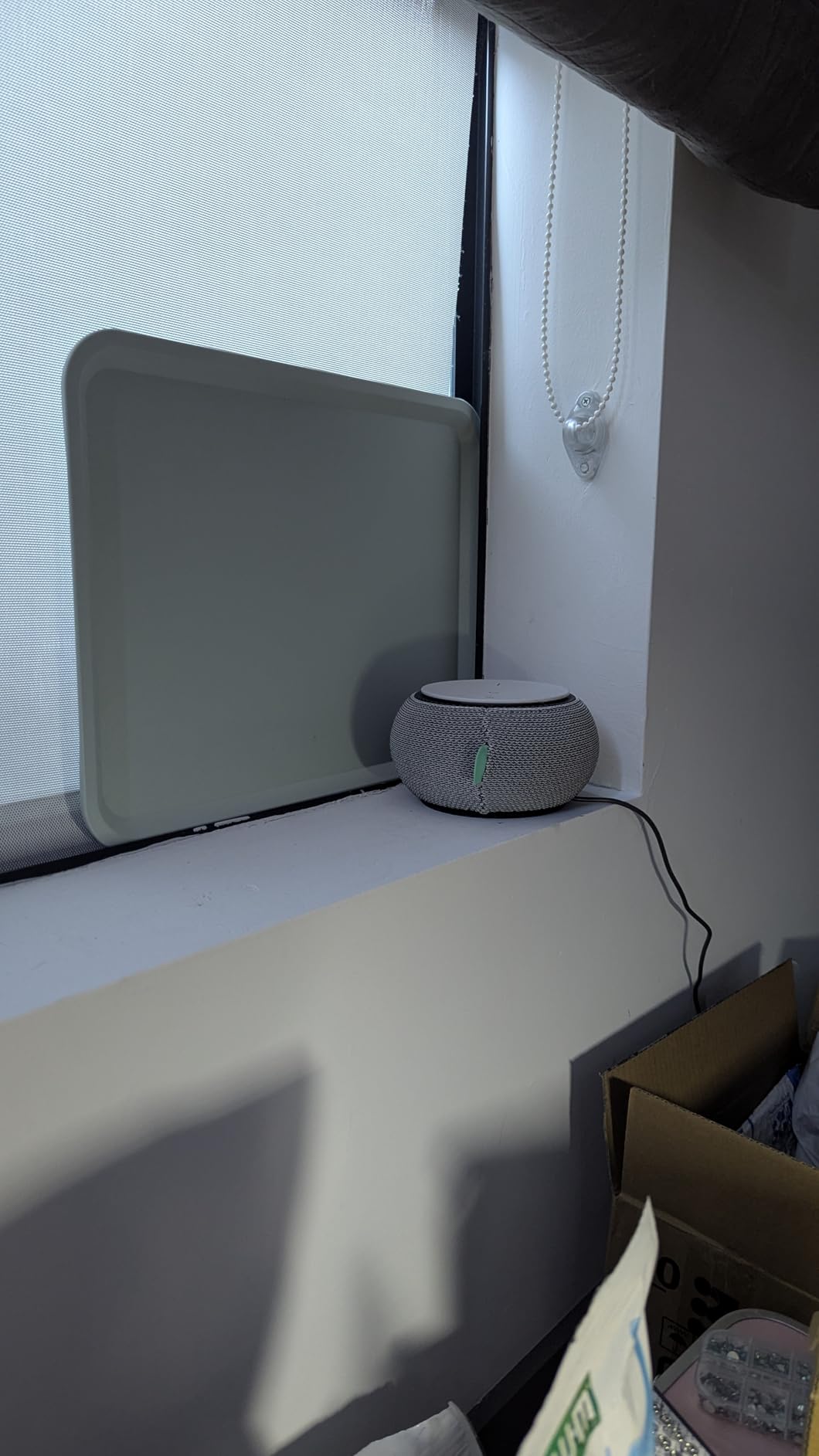
The SNOOZ is the Dohm mechanism wrapped in modern controls, and that is both its appeal and its limitation. The fan inside produces the same non-looping natural sound, but you get ten volume levels instead of two, and a free app that schedules the machine to start and stop on its own.
The scheduling is the part that changes routines. Set it once and the machine fades up at bedtime and off in the morning without you touching anything, and the app doubles as a remote from anywhere in the room. For people who travel often or split nights between a bedroom and a daytime room, that removes the one daily friction point every other analog machine has.
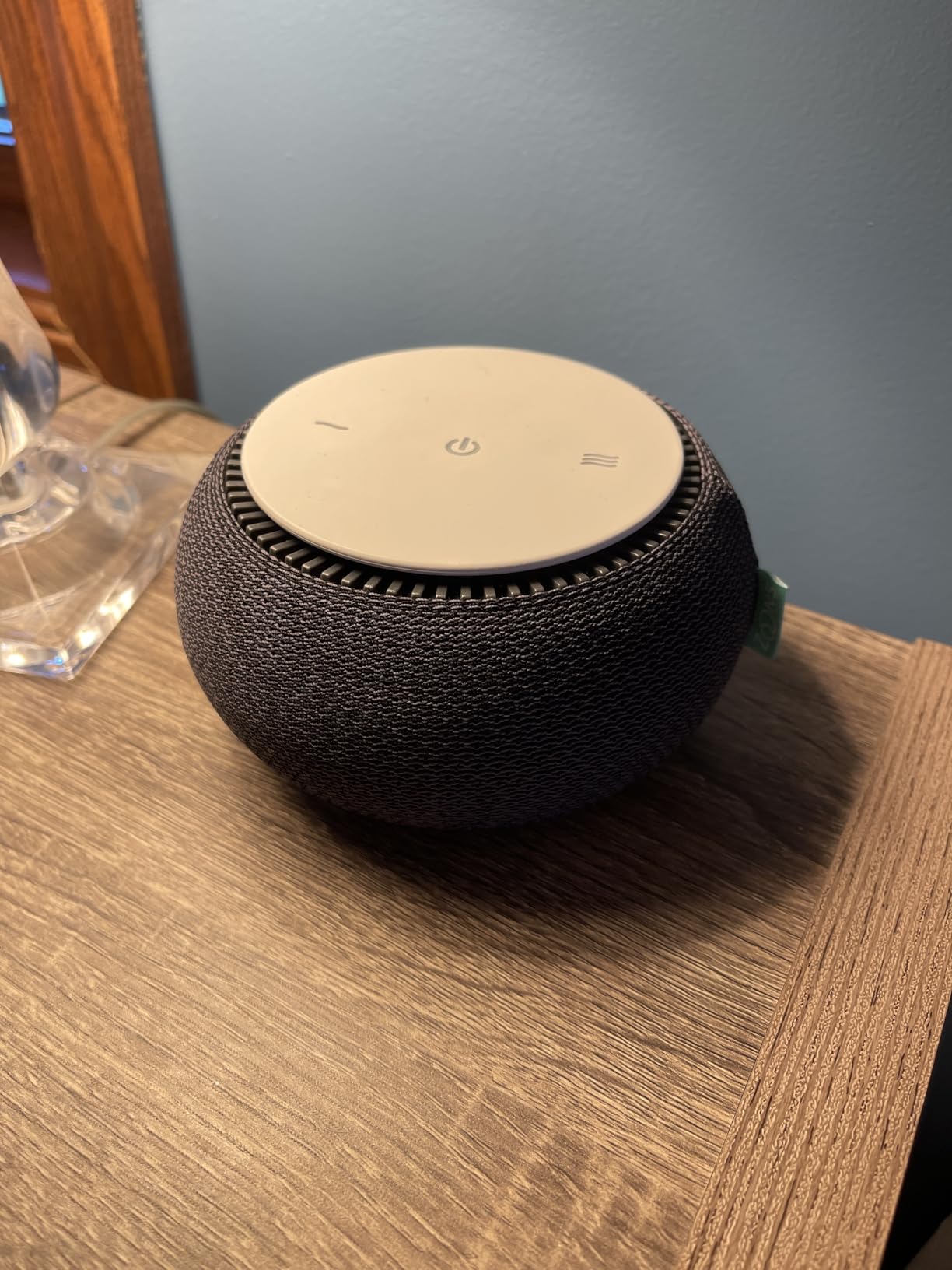
Owner feedback treats it as a premium upgrade from analog fan machines, and specifically calls out tinnitus masking and office privacy as uses where it performs well. Its recommended placement is 3 to 6 feet from your head, between you and the noise source, which is exactly the technique that makes fan-based noise effective rather than merely pleasant.
There is only one sound. There are no nature recordings, no white or pink or brown variants, and no lullabies. If you want to fall asleep to rain, that is a hard stop, and reviewers consistently redirect those buyers to a digital machine instead.
Who the SNOOZ suits
It suits people who want fan-based sound but not analog controls, and anyone who wants their bedtime routine fully automated. The 10-level volume is a real improvement on two-speed dials, letting you dial in a very quiet level for a light sleeper or push it hard for city noise.
It also works well for shared home offices and for travel, where the app means the same machine can be set for a hotel night and a home night without reprogramming anything.
Who should skip it
Skip it if you care about cost. It is the most expensive machine in this group by a wide margin, and you are paying largely for the app and the level control rather than for better sound generation than the Dohm.
Skip it if you want sound variety, and skip it outside the US if you travel internationally, since it is corded with a Type A plug and no battery option.
6. Housbay 31-Sound White Noise Machine – Best Sound Library and Speaker
- Largest sound library here at 31 recordings
- 5W speaker is clear at low volume
- Auto-off timer fades out softly
- Controls tilted for eyes-free adjustment
- Wood grain finish in eight finishes
- Heavier and larger than palm-sized models
- No battery so it must stay plugged in
- No memory function so settings reset
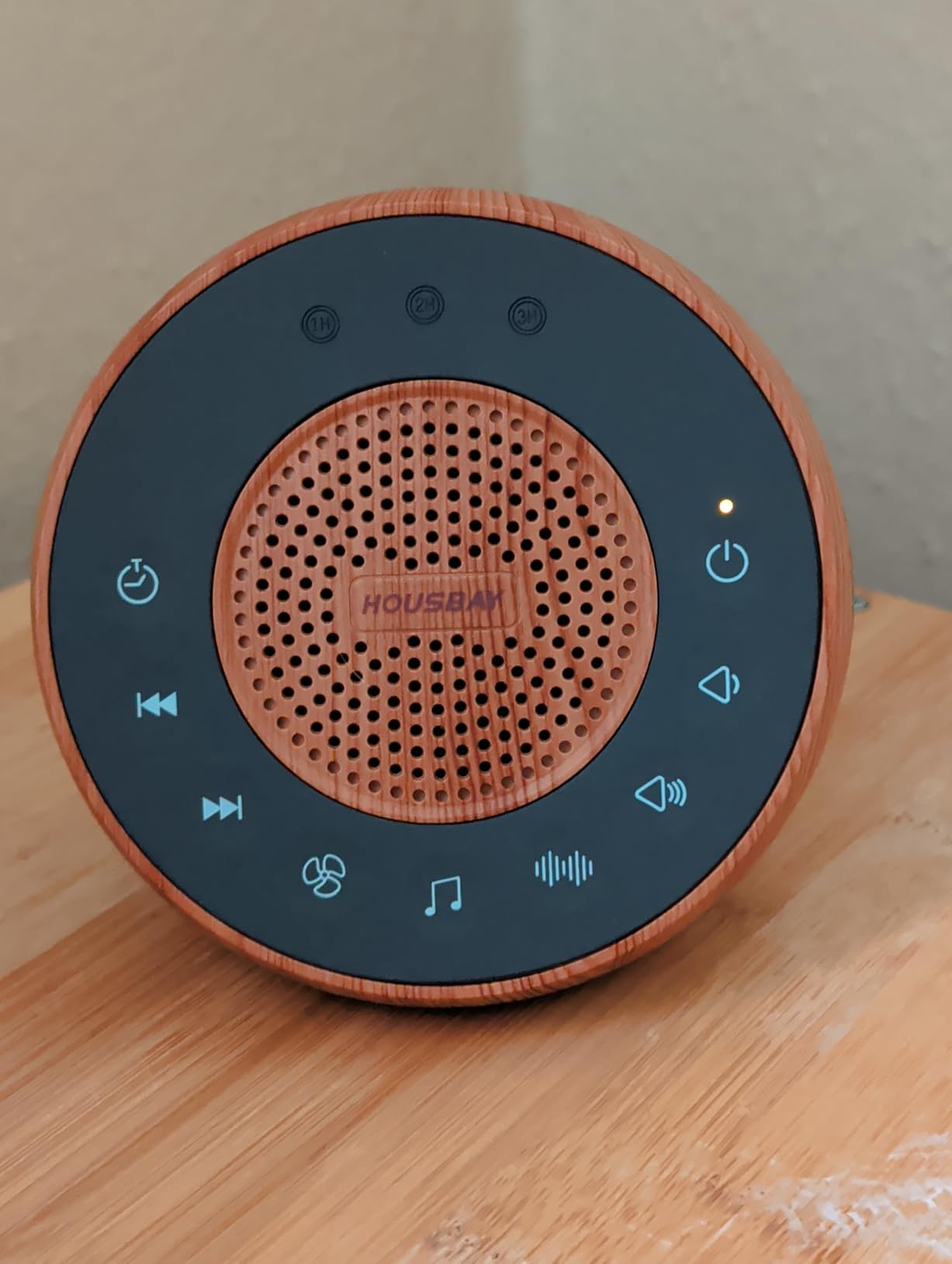
The Housbay is the one to buy if the reason you want a machine is choice. Thirty-one sounds, including white noise, fan, rain, thunder and ocean, is the largest library here, and every track is recorded from real environments rather than synthesised from scratch.
The 5W forward-facing stereo speaker is the other reason. It was clear at low settings in our testing, which means you can mask a room without blasting it, and forward-facing output means the sound reaches you rather than dissipating into the wall behind the unit. That is a real difference from the small drivers most competitors use.
The 45-degree tilted control surface is a sleep-specific touch that reviewers consistently single out. You can find and press the buttons by feel in a dark room without a light source, which solves the problem that plagues the Magicteam and the Easysleep. The timer also fades rather than cutting out, so a light sleeper is not woken by an abrupt silence.
The wood-grain housing comes in eight finishes and looks more like furniture than electronics, which matters more than it sounds if the machine lives on a visible nightstand. Several owners note that it is the best-looking machine they own.
Where the Housbay wins
It wins for anyone who likes to browse and for anyone whose masking job needs clarity rather than raw volume. A house with hard surfaces and reflective floors benefits from a directional speaker, and a household where two people want different sounds at different times can just pick a different track each night.
It is also a good fit for a home office, where you want background sound that does not fatigue the ears over a full working day.
Where it does not
It has no battery, so it is dead without power, and there is no memory function, which means you re-choose your sound and volume every single night. That omission is annoying over time even though it is not a dealbreaker on the first night.
At 15.2 ounces and nearly 4.5 inches tall it is the bulkiest machine here, so it stays home rather than travelling. And it still plays one track at a time with no mixing.
7. Easysleep White Noise Machine – Budget Pick with a Night Light
- 25 non-looping sounds including piano and meditation tracks
- 32 volume levels with real masking output
- Dimmable four-level night light doubles as a lamp
- Memory restores settings for a one-button bedtime
- Lightest and most compact option here
- Indicator and button labels hard to read in the dark
- Audio is acceptable rather than rich
- Proprietary barrel power plug
- Some crackle at maximum volume
The Easysleep is the lowest cost machine in this group and still manages to include things competitors charge more for: 25 non-looping sounds, 32 volume levels, a memory function and a four-level dimmable night light. That combination is hard to argue with if you are furnishing a guest room or a second bedroom on a budget.
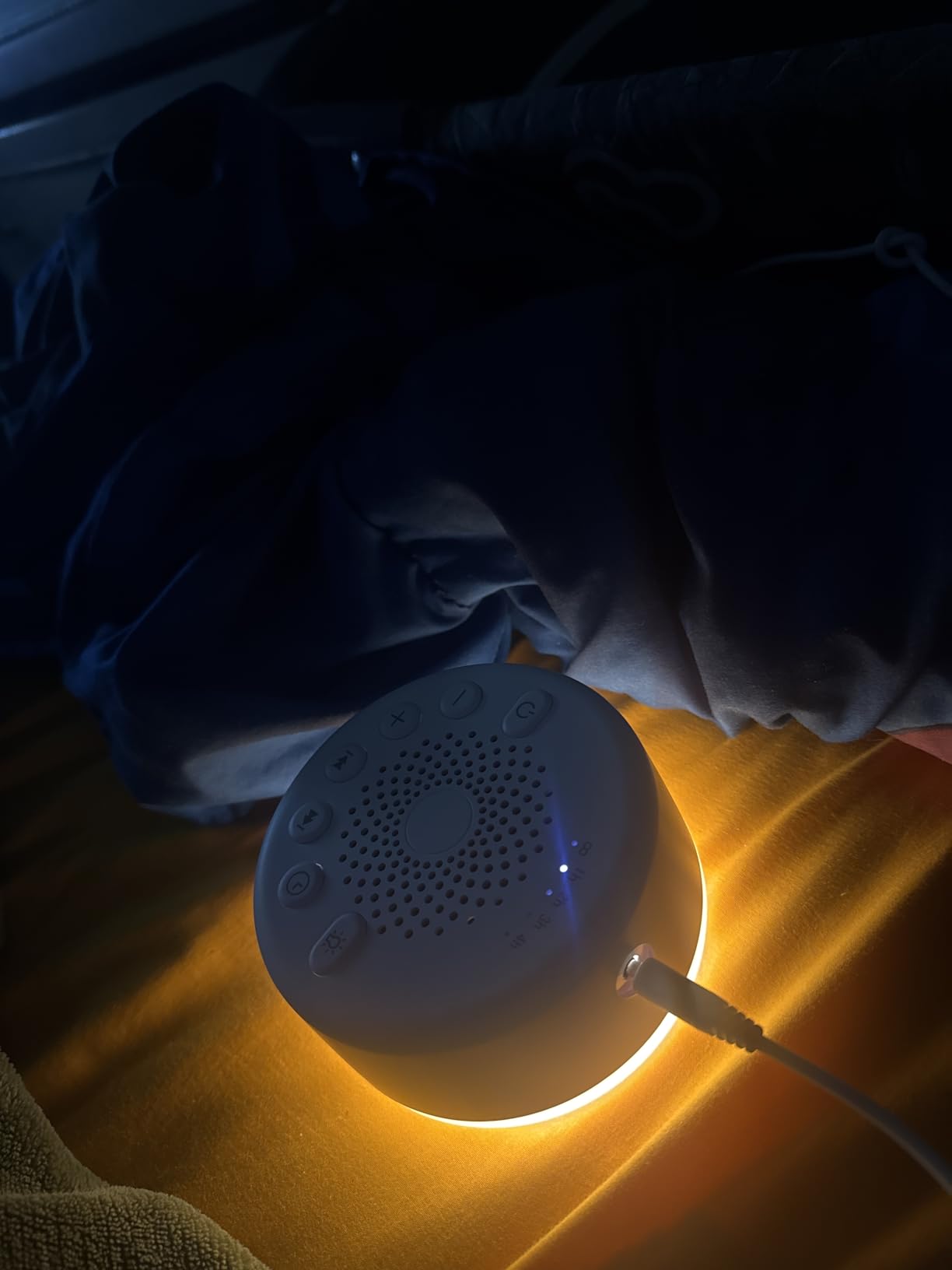
The night light is the sleeper’s feature rather than the parent’s, and adult readers should still use it. It gives you a soft amber glow to find the controls without turning on a lamp, which is exactly the light pollution problem that keeps people awake in unfamiliar rooms.
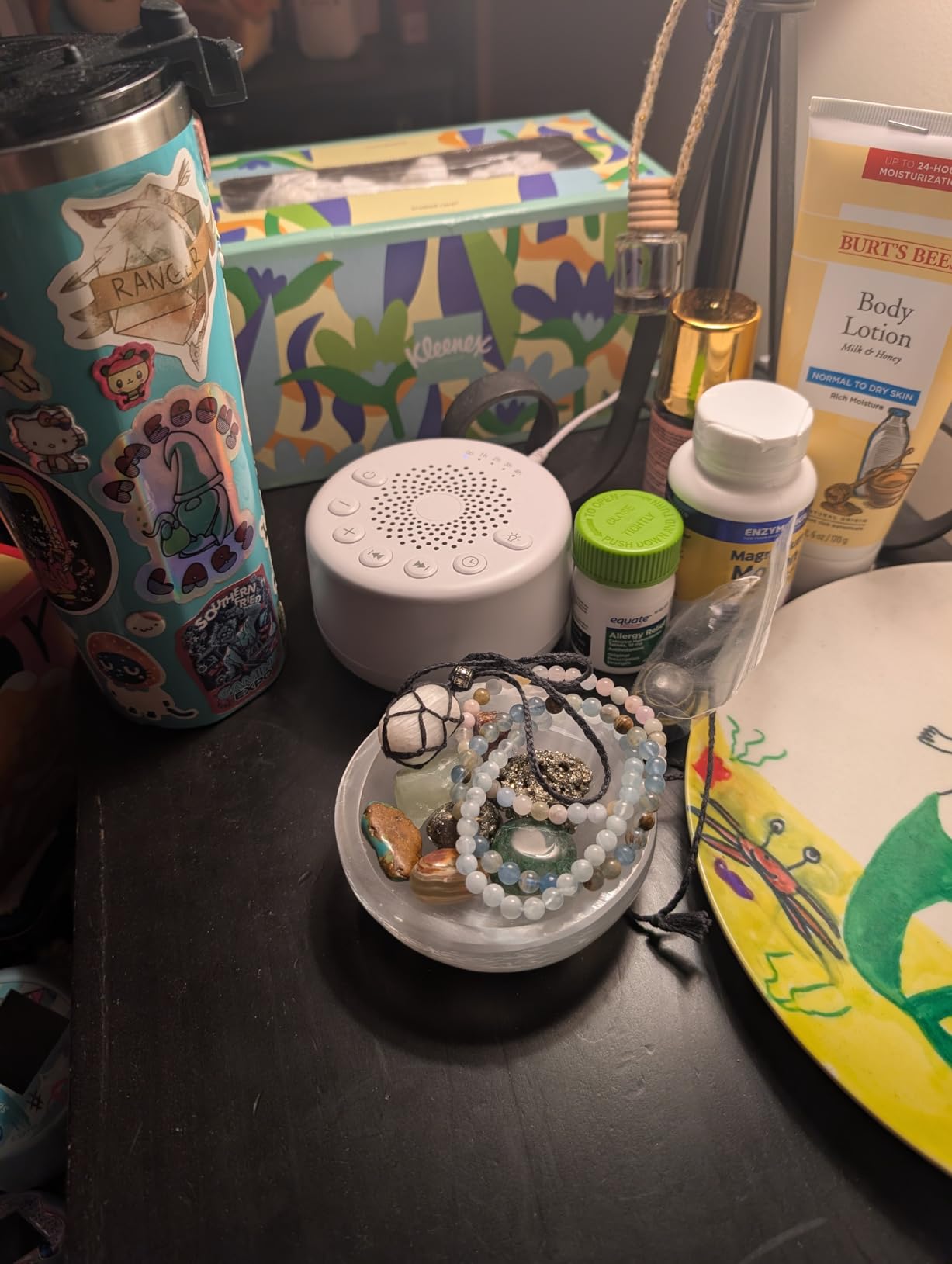
Owners report it masking garbage trucks, passing cars and street noise, and it is used for tinnitus as well as sleep. At 6.7 ounces it is the lightest machine here and moves between a handbag, a suitcase and a bedside table without thought. An 18-month warranty is also longer than most of the digital units in this list.
The audio is the compromise. Reviewers describe it as acceptable rather than rich, and the speaker lacks clarity compared with the Housbay’s 5W driver. It plays one sound at a time, and the sound library leans toward relaxation tracks such as piano, space music and meditation bell rather than pure masking tones.
Who the Easysleep suits
It suits anyone who wants the full feature set at the bottom of the price range, or who needs a machine for a room where appearance and a soft light matter. The memory function and large, well-spaced, clearly marked buttons mean bedtime is genuinely a one-button operation once you have set it up.
It is also a good budget machine for masking street noise in a bedroom on a normal budget, and a reasonable choice for focus work where you want variety without a subscription.
Who should skip it
Skip it if sound quality is the priority. At high volume there is a slight crackle on some units, and the audio is thinner than the fan-based machines here. Skip it if you care about future-proofing, since the round barrel-style power plug is proprietary and cannot be swapped for a standard USB cable.
Also expect to squint at it in the dark. The status indicator and button labels are hard to make out at night, even with the night light on.
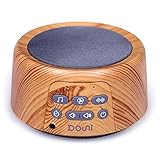
8. Douni White Noise Machine – Best for Loud Masking and Private Listening
- 27 non-looping sounds with no identifiable loop
- Wood grain finish reviewers describe as realistic
- Headphone jack allows private listening
- Long included power cord
- 32 volume levels reaching 85 dB
- Memory removes nightly re-adjustment
- No night light or backlit buttons
- No Bluetooth and no sound mixing
- Slight crackle at maximum volume
- Some newer units reported as quieter than earlier ones
The Douni exists for one job above all others: getting loud. Thirty-two volume levels reaching approximately 85 dB is the highest published output in this group, and it is the machine to reach for when the problem is road works, a neighbour’s workshop, or a partner who snores loudly enough to wake you through a wall.
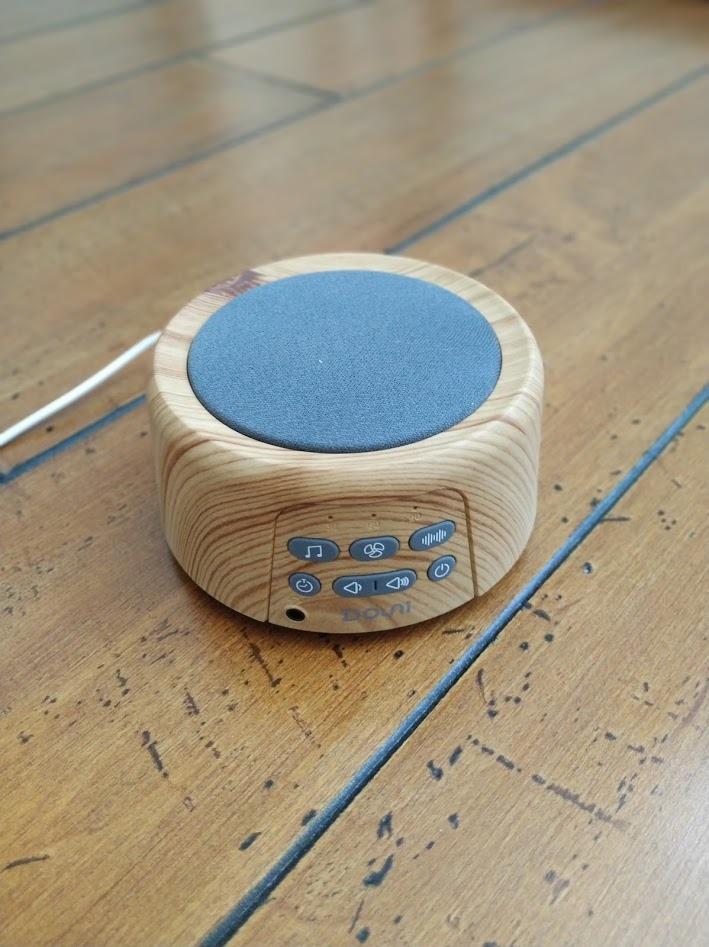
Its 27 tracks split into seven white noises, seven fan sounds and thirteen nature recordings, and the fan recordings are the ones users who dislike bright digital noise gravitate to. The headphone jack is the sleeper’s sleeper feature: it lets one person listen in a shared bedroom without filling the room with sound for two.
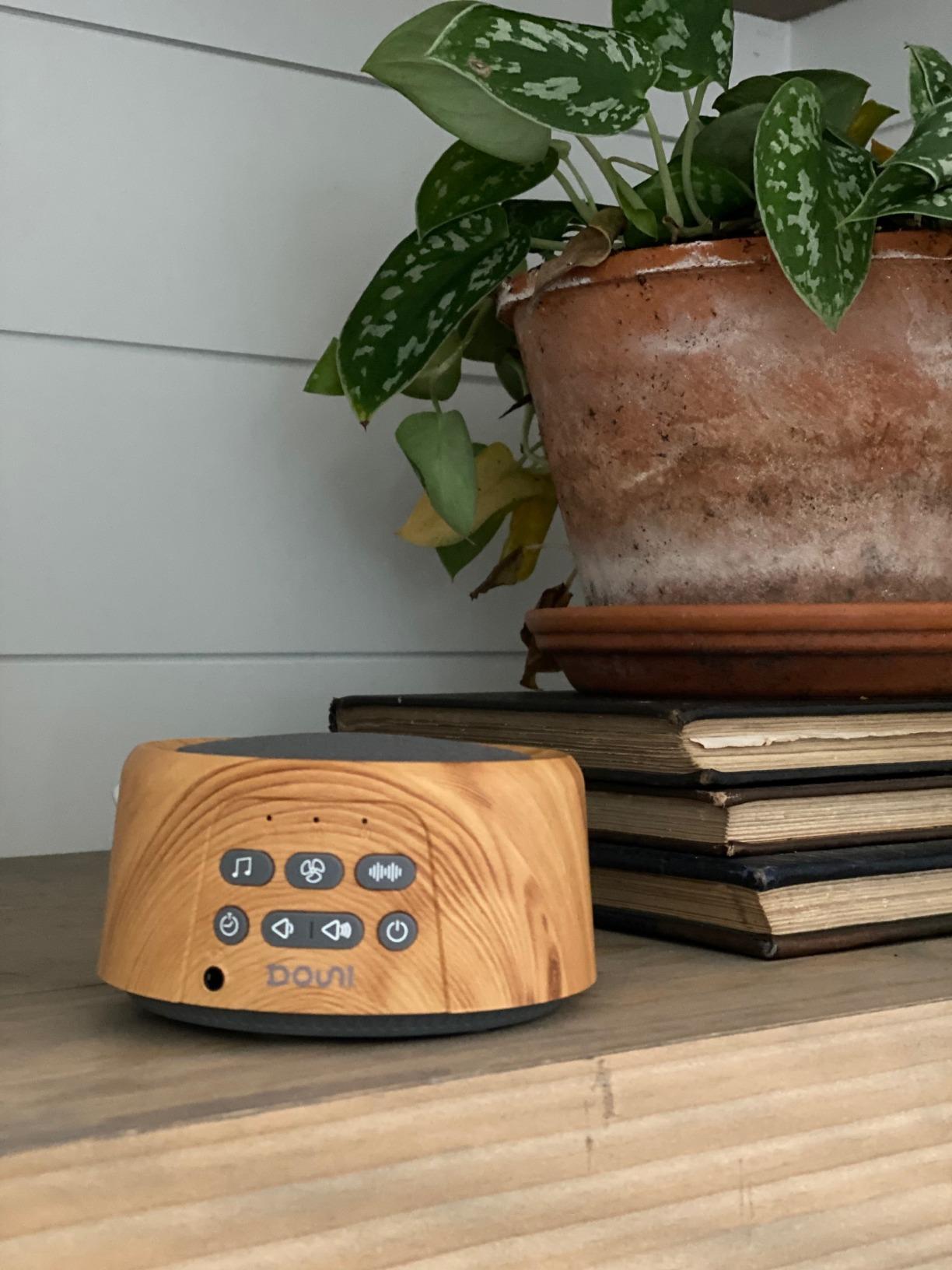
The wood-grain housing is the most convincing of the digital units here. Owners who record their own field noise single out the loop-free library as the reason it works for them, and several mention it replacing sleeping pills after months of use against traffic and hotel noise.
The long included power cord is a small thing that shows up constantly in reviews. Most compact machines ship with a frustratingly short lead, and this one does not, which makes placement between you and the noise source far easier.
What the Douni does well
It does loud masking better than anything else here, and the private listening option through the 3.5mm jack is genuinely useful in a shared bedroom. If you work nights and sleep by day in a home with a noisy street, the output headroom matters more than sound variety.
It is also a good second machine for a partner who needs something different from the one on your side of the bed, since the two units would never have to share a single sound.
Where it falls short
There is no night light and no backlit buttons, so the controls have to be found by feel in a dark room. There is no Bluetooth and no way to mix or stack sounds, which rules it out if you want a Bluetooth speaker as a fallback.
A minority of buyers report that newer units are not as loud as earlier versions, or produce artefacts in the white noise setting, though the manufacturer has issued replacements for defective units.
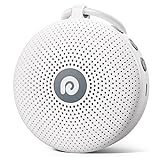
9. Dreamegg D11 Max – Best Cordless Option with a Rechargeable Battery
- Only genuinely cordless option in this group
- 1800mAh battery runs through a full night
- 21 sounds spanning noise nature and lullabies
- Child lock and memory function
- Lanyard hangs on a stroller or suitcase
- Needs recharging between nights
- Lower output than plug-in units for heavy masking
- Digital sounds rather than fan-based
- Feature set leans toward nursery use
Every other machine here dies when the power does, or needs a socket within reach of the bed. The Dreamegg D11 Max is the exception: a built-in 1800mAh rechargeable battery that runs through a full night on one charge, which is a much larger cell than the 500mAh typical of portable units at this size.
That single feature changes where you can use it. It works in a tent, on a plane, in a hotel room with no accessible socket, and during a power cut, which is precisely the scenario forum readers describe worrying about in apartments with noisy neighbours.
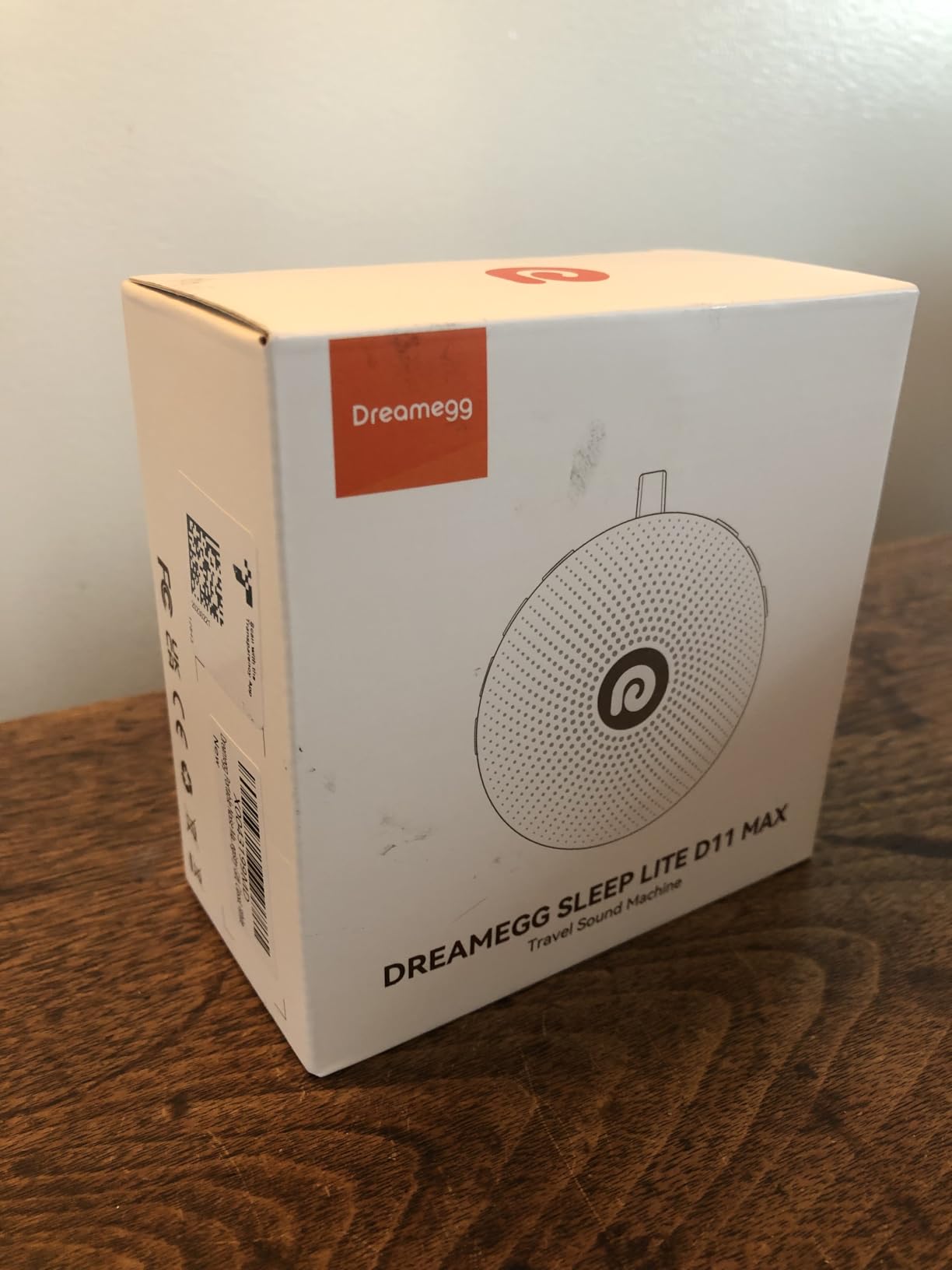
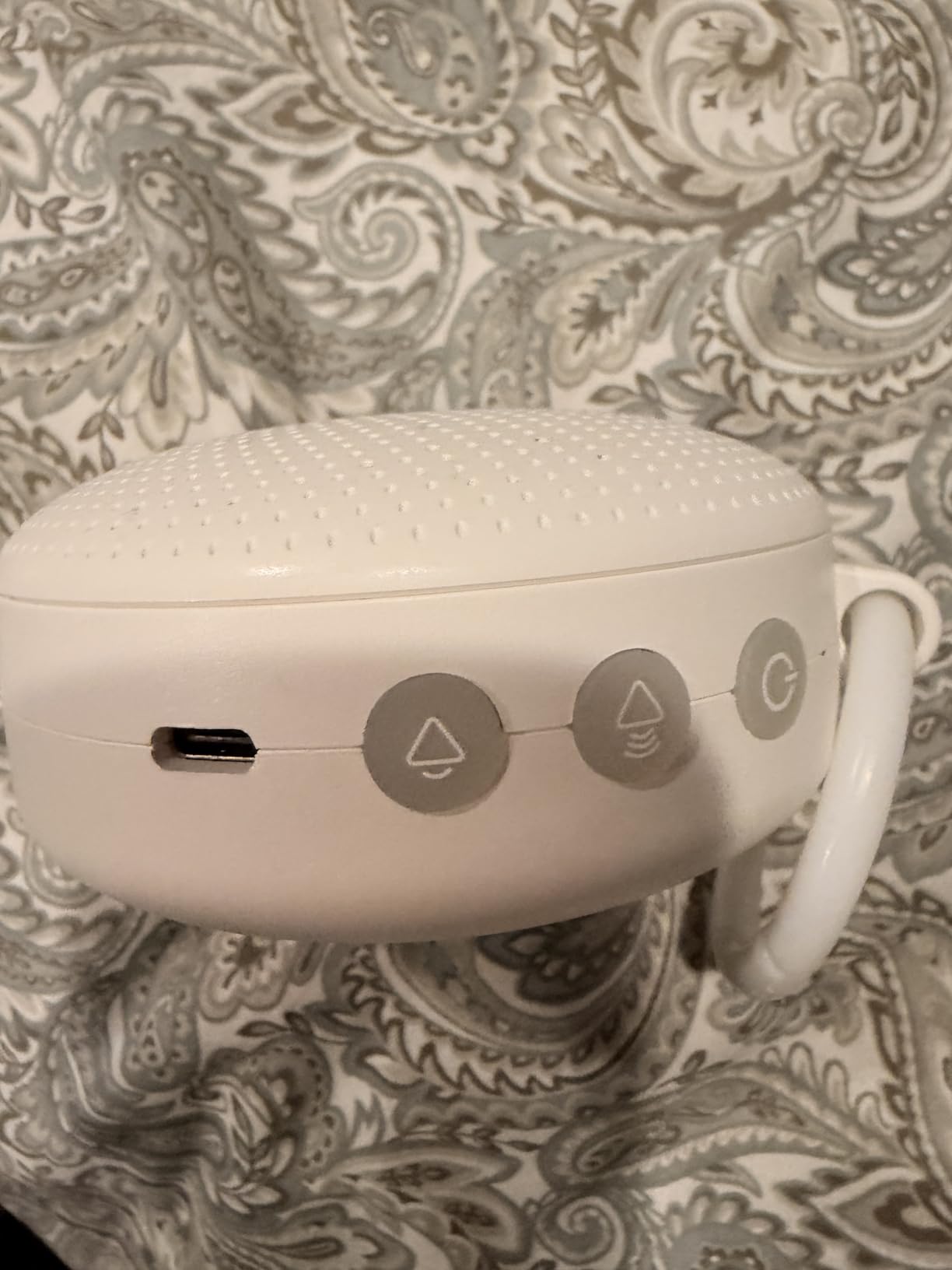
The lanyard and loop let it hang from a suitcase handle or a headboard so it is not sitting on a hard nightstand transmitting vibration. Twenty-one sounds cover white noise, nature recordings and lullabies, and a memory function plus child lock make it practical to set once and leave alone.
Masking power is the compromise. It is a small driver, so it is adequate rather than overwhelming against genuinely loud sources, and the sound is digital rather than fan-based. It also needs recharging, so it is not a permanent bedside fixture you never touch.
Who the Dreamegg suits
It suits anyone who sleeps in places without a usable outlet, and anyone who wants a backup machine for outages. Frequent travellers and shift workers who nap in unfamiliar rooms get more from it than anyone else, and the USB-C charging means one cable for phone and machine.
If you are buying for a household with a baby and an adult who needs a machine on the road, it covers both cases with one device.
Who should skip it
Skip it if your problem is loud neighbours or a snoring partner and you want to overpower them. For that, the Douni at 85 dB or the Dohm with its tone control are the right tools, and a rechargeable portable unit is not.
Skip it if you want fan-based sound or a large sound library, and skip it if you dislike a device you must remember to charge rather than one that runs off a wall.
10. LectroFan EVO – Best for Office Privacy and Room-Filling Coverage
Adaptive Sound Technologies LectroFan EVO Sound Machine, White
- 22 non-looping sounds with no repeat pattern
- Upward-facing speaker fills the room evenly
- Built-in headphone jack for private listening
- Sleep timer plus precision volume
- Two-year manufacturer warranty
- Most expensive digital-only option
- USB powered so it needs an outlet or power bank
- ABS plastic build feels less premium
- Lower volume ceiling than higher-wattage units
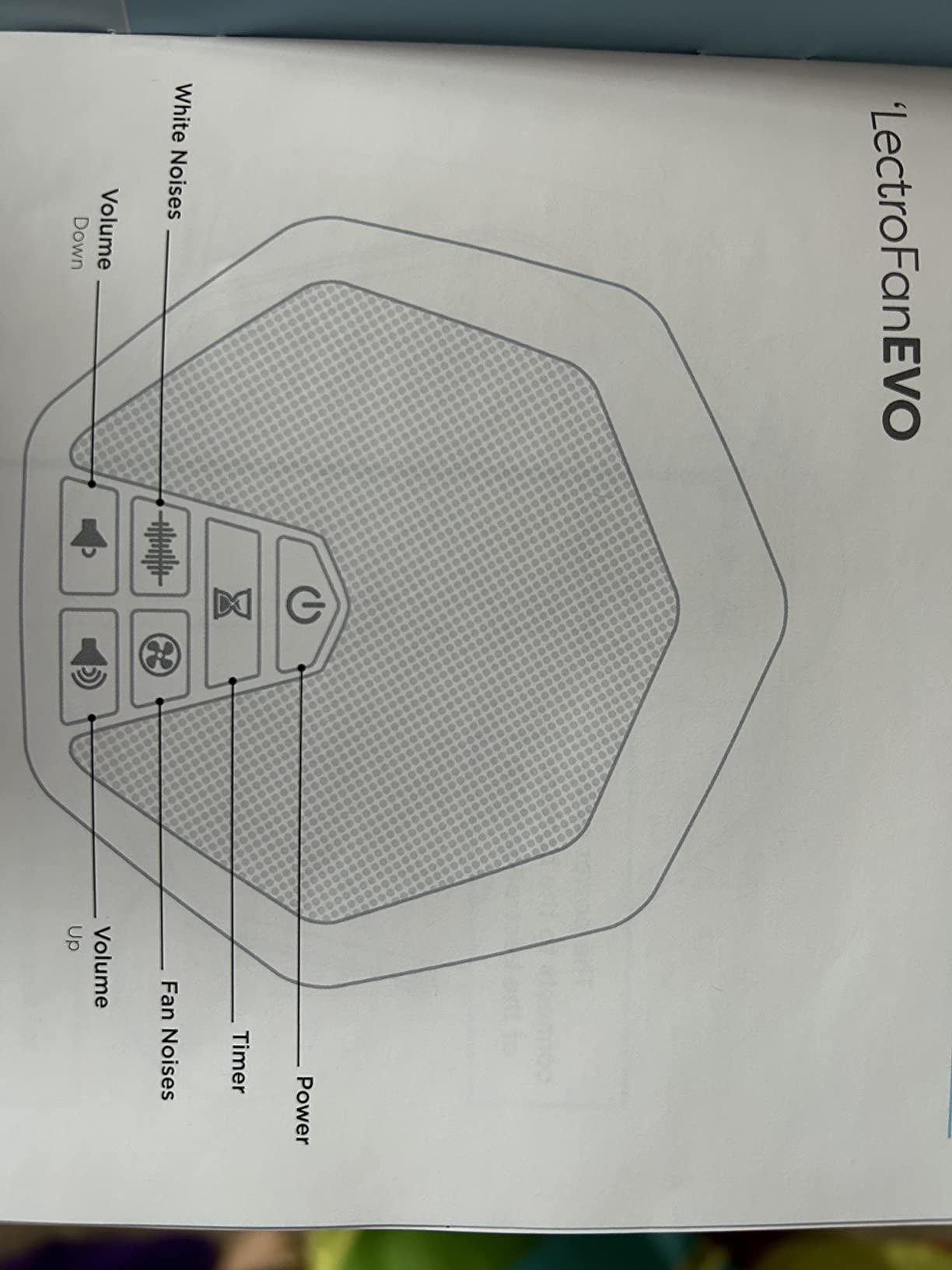
The LectroFan EVO is the LectroFan Classic with a better speaker. Twenty-two non-looping sounds are joined by an upward-facing driver that disperses sound upward and outward, filling a room evenly instead of pushing a narrow cone at the far wall, and that geometry is why it works so well for open-plan office privacy.
Put it on a desk between you and a chatty colleague and the whole workspace sits under an even wash rather than a directional blast. It is also one of the few machines here with both a built-in headphone jack and a sleep timer, so the same device handles a work call and a night of sleep.
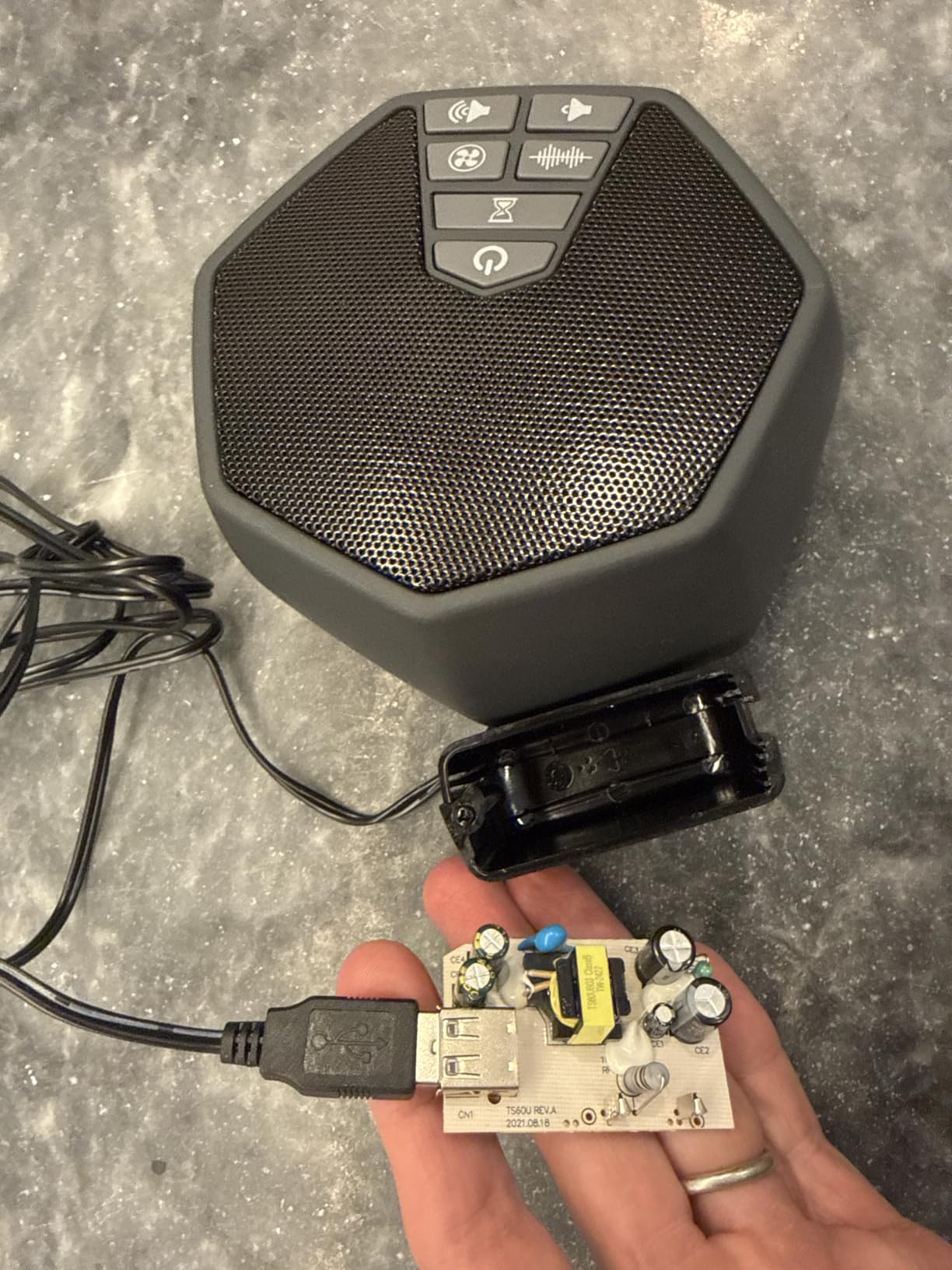
Two years of manufacturer warranty is a meaningful commitment from a brand with a long history in this category, and owners note it as a reason for confidence in a machine they intend to keep for years. The 12.8-ounce, travel-ready build moves easily between a desk and a nightstand.
What you give up is premium build feel and top-end volume. The ABS plastic housing reads as lighter and cheaper than the metal fan-based machines, and the volume ceiling is below the Douni, so in a very loud environment it is not the tool you want.
Who the LectroFan EVO suits
It suits people who need one machine for two jobs, a home office during the day and a bedroom at night, and it suits open-plan workers who want conversation-level privacy without a door. The headphone jack covers shared-wall apartments where you want to listen privately rather than fill the room.
The upward-filling speaker also makes it a good bedroom choice for anyone who wants the sound to reach them from across a large room rather than sitting on the nightstand.
Who should skip it
Skip it if you want fan-based sound, a real metal build, or volume headroom for loud neighbours. Skip it if you are travelling, since USB power means you need an outlet or a power bank at your destination.
There is also no Bluetooth or mixing, so it cannot double as a normal speaker.
Fan-Based or Digital: Which One Should You Buy?
This is the most argued question in the category, and almost every article takes a side without giving you a way to decide. The honest answer is that the right choice depends on one thing: whether your brain catches a repeating pattern.
A mechanical fan produces sound continuously, so it has no loop point to catch. It is also broadband and slightly uneven, which is precisely why people who slept beside a real fan find recorded fan loops unsatisfying. If you have never had a problem with a repeating track, you will be perfectly happy with any digital machine here.
If you have had that problem, start with the Dohm. The home test is simple: play any digital track at low volume for 20 minutes in a dark room and notice whether you start anticipating the repeat. If you do, the fan-based Dohm or SNOOZ will solve something no digital machine will.
Where fan-based and digital machines differ
Loop risk: fan-based machines have none, because the sound is generated continuously rather than played back. Digital machines vary widely, though the non-looping models in this list avoid it.
Sound variety: a fan-based machine gives you one tone-adjustable sound. The digital units here go up to 31 separate recordings.
Naturalness: fan-based noise is the most natural, a broadband rush of air. Digital sound depends entirely on the quality of the original recording.
Timer: fan-based machines usually ship with no timer and need a smart plug to be automated. Digital machines usually include a built-in timer with auto-off.
Best suited to: fan-based wins for loop-sensitive sleepers, tinnitus masking and office privacy. Digital wins for anyone who wants variety plus a reliable timer.
How to Choose a White Noise Machine: 8 Criteria
Start with the noise, not the features. Whatever you buy only works if the output sits just above the sound you are trying to cover, so masking capability ranks first, and the way to raise masking power is volume headroom plus tone control rather than a longer sound list.
Second, decide fan or digital using the test above. Third, check whether the tracks loop. Forum consensus is firm on this point: users describe their brains latching onto a repeating track and becoming irritated after 20 or 30 minutes, and non-looping audio is the single most requested fix in the category.
Fourth, look at the timer. A forced 45-minute or 60-minute auto-off is one of the most common complaints, because it cuts out while a light sleeper is still drifting off. Continuous play matters more than the presence of a timer at all.
Fifth, check power. Mains only means dead without a socket. Battery or rechargeable means portable and outage-proof. The Homedics and the Dreamegg are the two here that keep working when the power does not.
Sixth, think about the memory function. Settings that reset every night mean re-adjusting in the dark every single morning, which is a small irritation that compounds into a real dislike of the machine.
Seventh, check the display and lighting. Any light in the room is a problem, so a dimmable night light is a feature rather than a distraction, and unlit buttons that you must find by feel are better than a bright clock face. If your real problem is screen glare rather than sound, the best white lamps for a desk address the light side of the problem directly.
Eighth, consider the extras honestly. A headphone jack matters in a shared bedroom. Bluetooth matters if you want one device for music and noise. An app matters if you want fully automated scheduling. None of these are essential, and paying a large premium for a subscription-gated library is rarely worth it.
Safety and Hearing: How Loud Is Too Loud?
The main risk with any sound machine is sustained exposure at a level that damages hearing. The commonly cited safety ceiling for adults is roughly 70 decibels, above which prolonged exposure can cause noise-induced hearing loss. That is a guideline about duration, not a switch-off point, but it is a good number to treat as your ceiling.
Keep the machine at a level that just covers your noise rather than one that overwhelms it. If you raise your own voice to be heard over the machine in the same room, it is too loud. Most people set digital machines far higher than they need to, because the low settings still drown out a quiet bedroom.
Placement matters as much as volume. The standard guidance is 3 to 6 feet from your head, positioned between you and the source of the noise. The further away it is, the more you turn it up, and the higher your exposure. Moving the unit closer and turning it down achieves the same masking with less risk.
Is it okay to sleep with white noise every night? For most adults, yes, at a moderate level and with sensible placement. The concern people raise in forums is dependency, not hearing, and that is a reasonable one to take seriously. A machine is a tool for masking a specific problem, and using it every night in a quiet room where you sleep fine treats a problem you do not have.
For tinnitus, persistent ringing, ear pain, or any sudden change in hearing, speak to a clinician before adding a masking machine. A sound machine can make tinnitus easier to tolerate, but it is not a treatment for the underlying cause.
Should You Use a Phone App or Smart Speaker Instead?
Sometimes, yes, and it is worth ruling out before you spend anything. A phone app gives you hundreds of tracks for nothing, and a smart speaker with a white noise skill does the same. The problem with both is the phone, because using it as a sound machine means a lit screen, notifications, and an easy path into social media at midnight, all of which work against the sleep you are trying to protect.
A smart speaker solves the phone problem partly. It plays continuous sound with no screen and can be scheduled, so for masking a steady hum of traffic or a chatty neighbour it is a genuinely good free option that costs nothing.
Where hardware wins is power, volume and consistency. Speakers run out of battery or need a wall outlet, most cannot produce enough level to mask a snoring partner, and app tracks still loop. A dedicated machine has one job, runs all night, and does not need a screen within reach of your pillow.
One alternative worth considering is an air purifier. Several forum users point out that a purifier already produces usable broadband noise while also cleaning and circulating the air, which makes it a two-in-one answer for a bedroom where air quality and noise are both problems. It is a good fit if you want one device doing two jobs, and a poor fit if masking is the only goal.
If you travel often and want to block aircraft cabin noise rather than block sound, our guide to the best noise cancelling headphones for flights covers that side of the problem. For frequent flyers, the best noise cancelling headphones for frequent flyers roundup is the deeper version.
Frequently Asked Questions
Do white noise machines actually help sleep?
Yes, for most people. A white noise machine fills the frequency gaps between disruptive sounds, so your brain hears one even acoustic blanket instead of tracking each individual noise, which reduces the chance that a door slam, a snoring partner, or traffic wakes you. It works best when the machine sits just above the level of the noise you are masking, and when your problem is environmental noise rather than racing thoughts.
Which white noise machine is best for sleep?
The Yogasleep Dohm Classic is our top pick for most adults because it uses a real mechanical fan, so the sound never loops and never announces a repeat point. It runs at roughly 60 dB, has two speeds with tone control, and effectively masks traffic, neighbours, barking dogs and snoring partners. If you want sound variety or a timer instead, the Magicteam with 20 non-looping sounds is the alternative.
Is it okay to sleep with white noise every night?
For most adults, yes, at a moderate level with sensible placement. Keep the volume just above the noise you are masking, treat 70 dB as a ceiling for sustained exposure, and position the unit 3 to 6 feet from your head between you and the noise source. The more common concern is dependency rather than hearing, so a machine is best used for a specific recurring problem rather than by habit in an already quiet room.
What is the healthiest noise to sleep to?
No noise type is medically healthier than another. White noise spreads energy evenly across all frequencies and masks the most, but the bright top end can feel harsh. Pink noise drops the high frequencies and often feels easier to tolerate. Brown noise concentrates in the deep bass and is most often reported as the best for deep sleep. Choose the colour that stays comfortable for you, at a level low enough to sit under your disruptive noise.
How far should a white noise machine be from the bed?
Place it between 3 and 6 feet from your head, positioned between you and the source of the noise. Distance matters because the further the unit sits, the louder you turn it up to achieve the same masking. Keeping it close and the volume low reduces your hearing exposure while giving the same result. Make sure the cord reaches, and use a shelf or table rather than a hard nightstand if vibration is an issue.
Conclusion: The Best White Noise Machines for Adults
After weeks with all ten, the Yogasleep Dohm Classic is the machine we would put on a nightstand and leave there. The fan inside produces sound that never loops, tone control covers everything from bright masking to deep brown-leaning rumble, and the service life reported by long-term owners is measured in decades rather than years. For most adults dealing with traffic, neighbours, barking dogs or a snoring partner, that is the single best answer.
Buy the Magicteam if you want 20 non-looping sounds, 32 volume levels and a memory function at the low end of this price range. Buy the Homedics if you need something that survives a power cut. Buy the Douni if the noise you are fighting is genuinely loud, and the Dreamegg if there is no socket where you sleep.
Whichever you choose, the placement and the volume matter more than the model. Three to 6 feet away, between you and the noise, turned down as far as it will still work, is what makes the machine do its job in 2026. If you also need sound masking for a nursery rather than an adult bedroom, our guide to the best white noise machines for babies covers that side.