
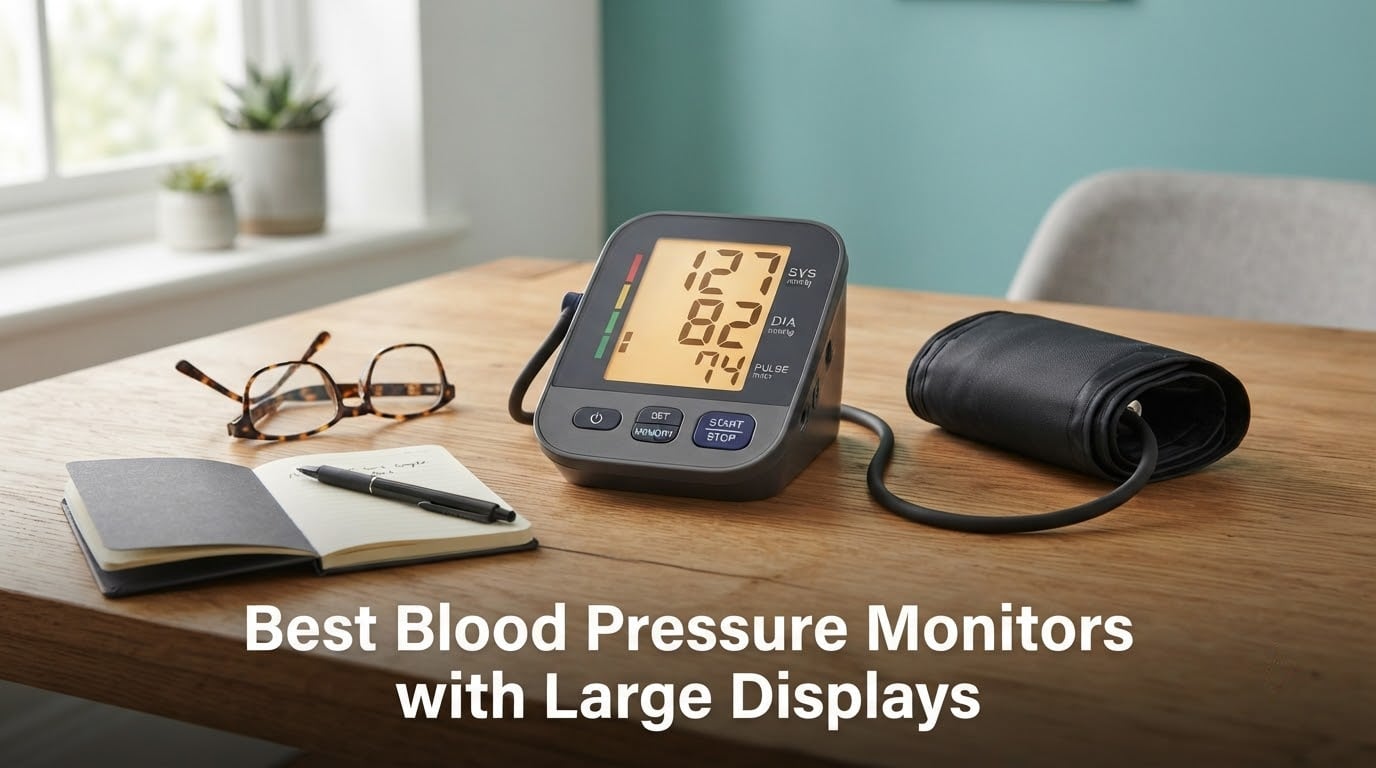
The best blood pressure monitors with large displays are the Konquest KBP-2704A, the Paramed B22S and the yuwell YE660E PRO. All three put oversized numerals on a bright backlit or high-contrast screen, and two of them can also read your numbers aloud.
That answer matters more than it sounds. A home monitor is only useful if you can read it accurately, log it correctly and act on it. AARP’s testers ranked user-friendliness right behind accuracy among the priorities that drive a purchase, and readability is the part of friendliness most people notice first. One AARP tester described a unit whose display dropped LED segments so that a two could be mistaken for an eight, and a monitor you misread is a monitor you mis-track.
We spent weeks reading manufacturer specifications, clinical validation listings and thousands of owner reviews across ten large-display monitors, then sorted them specifically on screen legibility rather than on feature count. Note that a large display and a large cuff are two different things: one is how you read the number, the other is whether the number is accurate in the first place. Our wider guides cover blood pressure monitors for home use and upper arm monitors for accuracy if you want the full picture beyond display size.
We earn a commission when you buy through links on this page, at no extra cost to you. That never changes which monitor sits at the top of the list.
Top 3Best Blood Pressure Monitors with Large Displays
These three are the clearest display-first buys in the group: the most owner-verified screen, the widest reviewed voice feature, and the most guided setup for someone who has never taken a reading before.
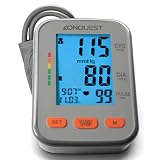
Konquest KBP-2704A
- Near-inch-high backlit numerals
- WHO blood pressure indicator
- 8.5-16.5 inch cuff
- Reading memory

Paramed B22S
- Oversized LCD numerals
- Voice broadcast
- 8.7-16.5 inch self-checking cuff
- 120 readings

yuwell YE660E PRO
- Large backlit screen
- Full voice broadcast
- 8.6-17.7 inch cuff
- 199 readings with averaging
All 10 Large-Display Monitors at a Glance
Every monitor below has a large-display design, but they are not equally legible. Screen size, backlighting and readout method differ enough that the fastest way to choose is to scan the key features column first.
| Product | Specifications | Action |
|---|---|---|
| Konquest KBP-2704A |
|
Check Latest Price |
| Paramed B22S |
|
Check Latest Price |
| yuwell YE660E PRO |
|
Check Latest Price |
 Invaxe AOJ-30G Invaxe AOJ-30G |
|
Check Latest Price |
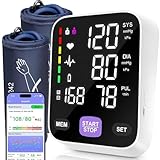 Andesfit A02-SEB Andesfit A02-SEB |
|
Check Latest Price |
 DobyVoe A08 DobyVoe A08 |
|
Check Latest Price |
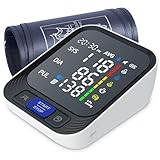 Acenis AOJ-30F Acenis AOJ-30F |
|
Check Latest Price |
 ProHeal Talking Monitor ProHeal Talking Monitor |
|
Check Latest Price |
 TDMOON U80BH TDMOON U80BH |
|
Check Latest Price |
 RunStar BP-206 RunStar BP-206 |
|
Check Latest Price |
1. Konquest KBP-2704A: The Best Overall Large-Display Monitor
- Near-inch-high numerals stay readable in dim rooms
- Owners report readings matching physician and pharmacy units
- Self-cinching cuff works over light clothing
- Fits teen-sized through standard adult arms
- Long life on standard AA cells
- Screen shows more data than some owners find necessary
- Cuff can inflate uncomfortably tight if wrapped snugly
- No AC adapter included although a port is present
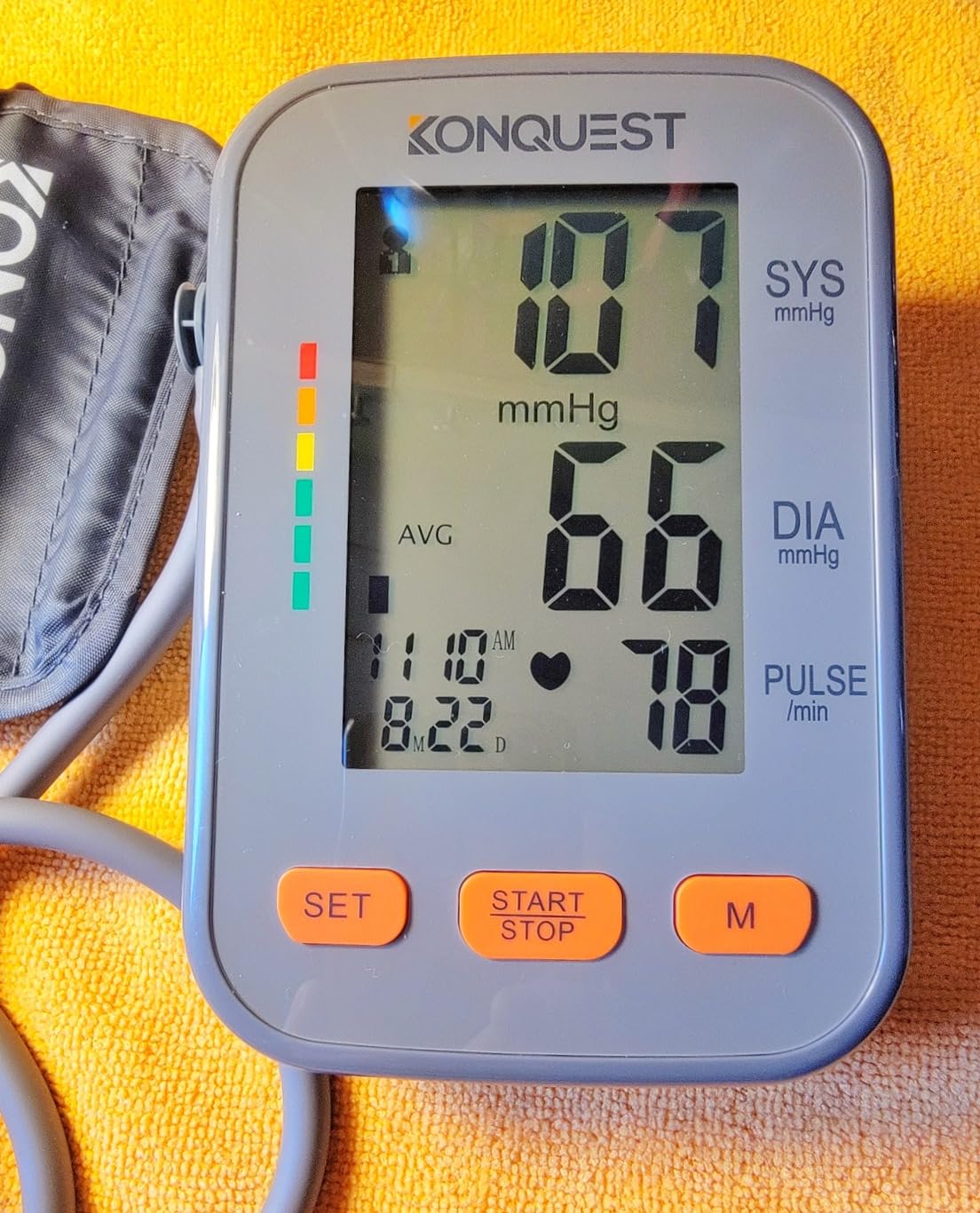
Out of ten monitors, the Konquest KBP-2704A has the most owner history behind its screen, and that matters for a display-led buying guide. It carries a 4.5 rating across more than 34,000 reviews, which is the largest verified base in this group, and the display draws consistent praise for numerals close to an inch high on a backlit LCD.
The screen shows systolic, diastolic, pulse, date, time and the active user profile on one panel, which is more information than some competing screens carry. Owners also report that the readings held up when checked against physician and pharmacy units, and several describe the unit surviving years of daily use and repeated drops.
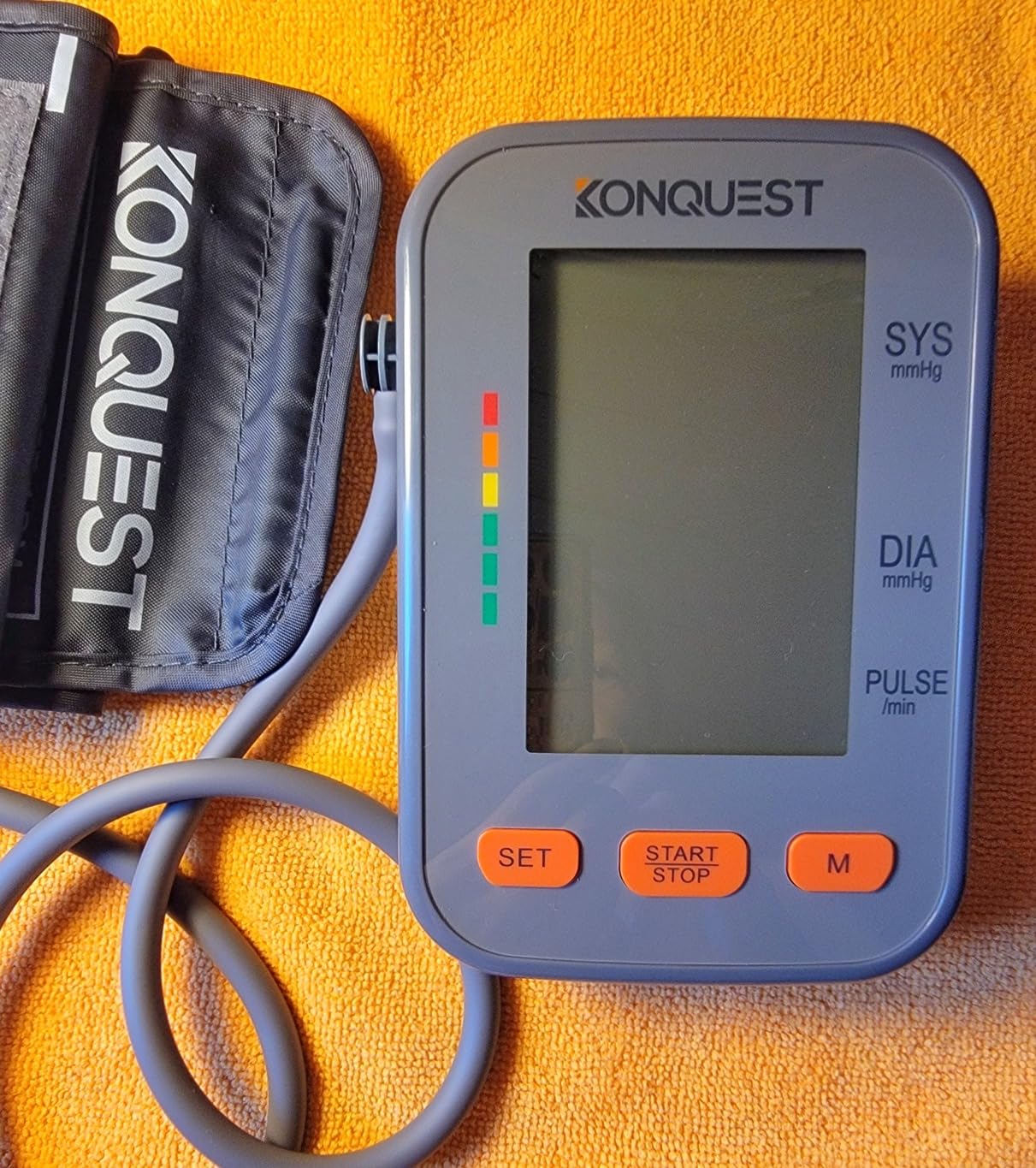
On the mechanics side, the cuff fits 8.5 to 16.5 inches, so it covers slim adult arms as well as standard ones, and the self-cinching design lets you wrap it one-handed over light clothing. A memory function stores readings so you can spot a trend rather than relying on a scrap of paper.
The irregular heartbeat detector and the WHO blood pressure indicator both add value here. The WHO bar gives you a normal-or-high judgment without needing to remember the systolic thresholds, which is one more piece of information to read off a big screen instead of from memory.
Who this monitor suits
This is the one to buy if you want the most proven large-display screen without paying for app connectivity. The near-inch numerals are legible in a dim room and at arm’s length, and the WHO indicator reduces the chance you misfile a reading.
It is also a strong first monitor for a household that wants to start tracking and see whether the habit sticks before committing to a smart device.
Where it falls short
The screen carries more on-screen data than strictly necessary, and that crowding is the complaint we saw repeated most often. Users who prefer two numbers and nothing else may find it busier than they would like.
Two smaller limits: the cuff can feel uncomfortably tight if you wrap it too snugly, and an AC adapter is not included even though a port is present for one. Four AA batteries are in the box.
2. Paramed B22S: Best for Two-User Homes
- Very large bright LCD with oversized numerals
- Readings matched higher-end monitors in side-by-side tests
- Voice broadcast with three volume levels or silent mode
- Fast quiet inflation and deflation
- Compact body and long battery life
- No backlight so dim-room reading is harder
- Manual contains typos and awkward wording
- Some owners want a bigger physical unit
The Paramed B22S is the pick for a couple or two-person household that wants one device to track both of you. It stores up to 120 readings with a date display across two profiles, and the numbers sit on a large LCD with oversized digits and oversized buttons.
Owners repeatedly single out accuracy as the standout, describing readings that matched clinician-tested and higher-end brand monitors when the two were set side by side. Inflation and deflation are reported as fast and quiet, and the Velcro closure stays put through a measurement.
The voice broadcast is the feature that separates it from most units at this level. It runs at three volume levels and can be switched off completely for silent use, so the same monitor works for a person with reduced hearing and a person who does not want an announcer at breakfast.
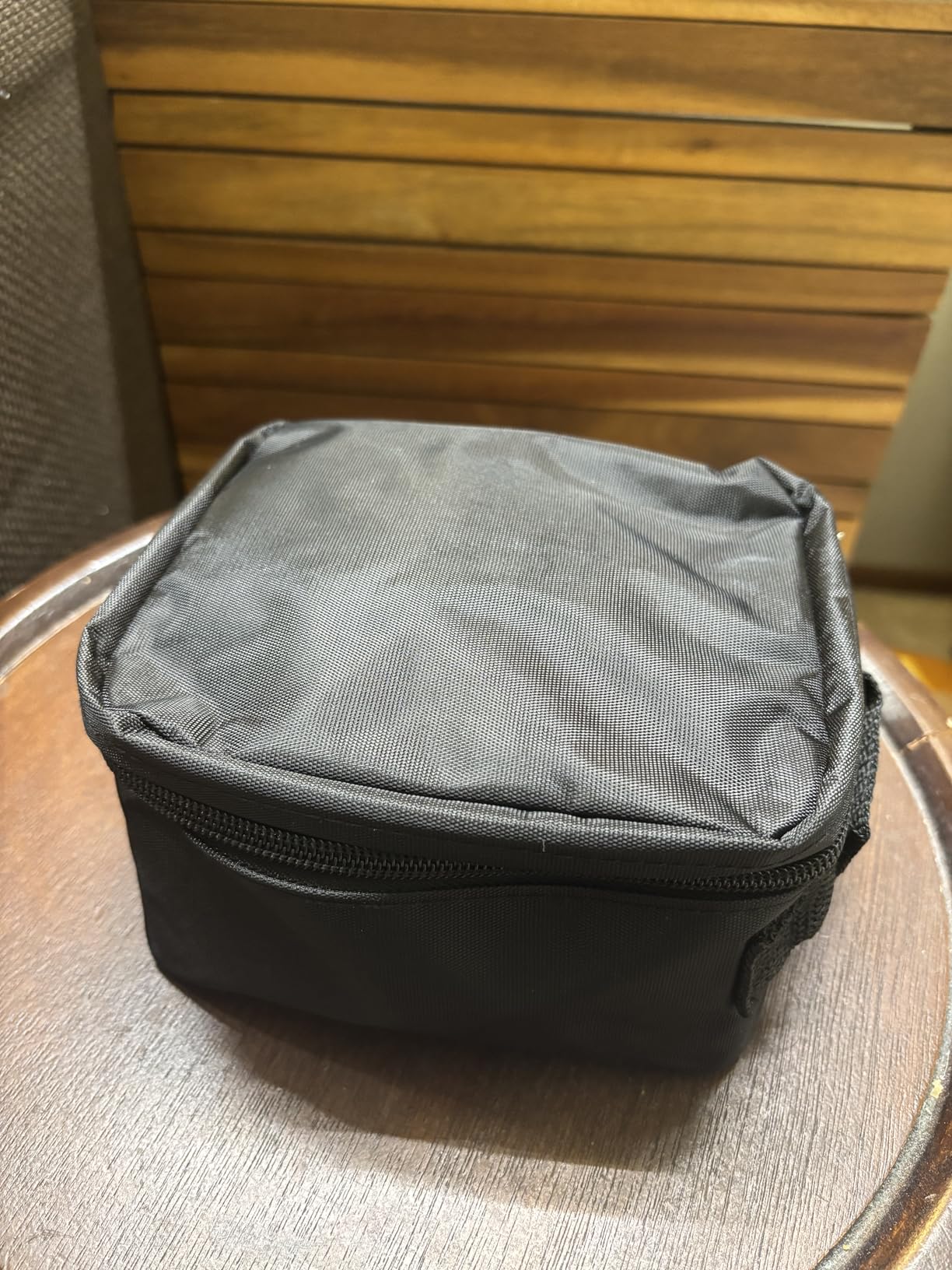
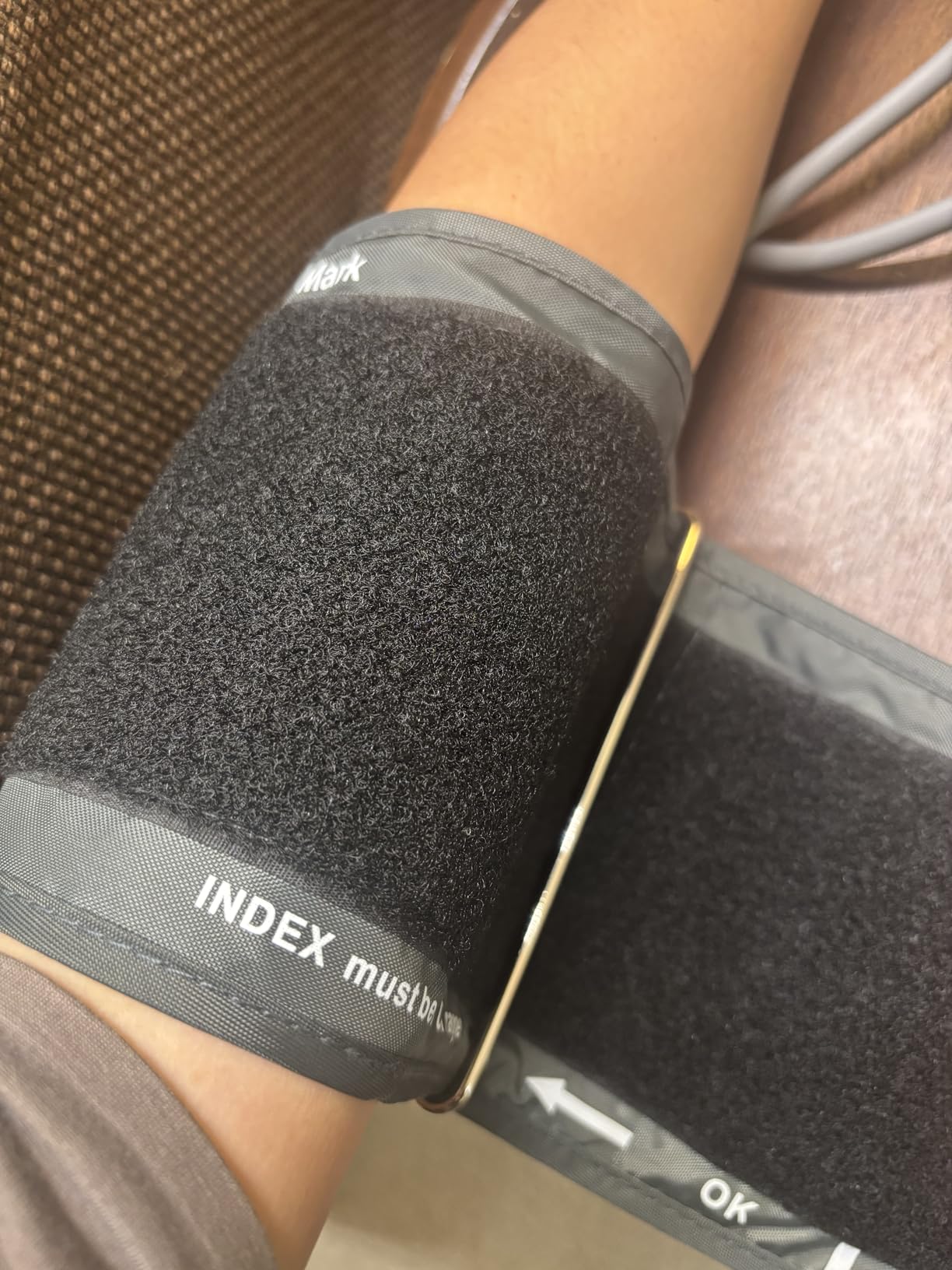
The cuff fits 8.7 to 16.5 inches and a self-check feature confirms correct placement, which is a small but real guard against a misread caused by a loose wrap. The body is compact at just over a pound, and it ships with a carry bag.
Who this monitor suits
Choose it if two people share one monitor and you want separate stored histories without an app. The oversized buttons matter as much as the oversized numerals for anyone with arthritis or a tremor.
The silent-or-loud voice option also makes it a good fit for a household where one person is hard of hearing and another prefers quiet.
Where it falls short
It has no backlight. That is the most requested improvement in the reviews and the reason we placed it second rather than first: excellent numerals in a lit room, noticeably harder at 2am.
The instruction manual contains typos and awkward wording, so budget extra time for setup, and a minority of owners would like a physically larger unit than the 5.9 by 4.7 by 3.9 inch body.
3. yuwell YE660E PRO: Best for Guided Setup
- Full voice broadcast walks through the measurement and result
- Soft wide-range cuff inflates with less discomfort
- 199 reading memory with rolling 3-reading average
- Self-test and mis-operation reminders
- WHO classification bar and irregular heartbeat alert
- Readings stay on the device with no app export
- Single memory bank suits one user best
- Wide cuff may be loose on smaller arms
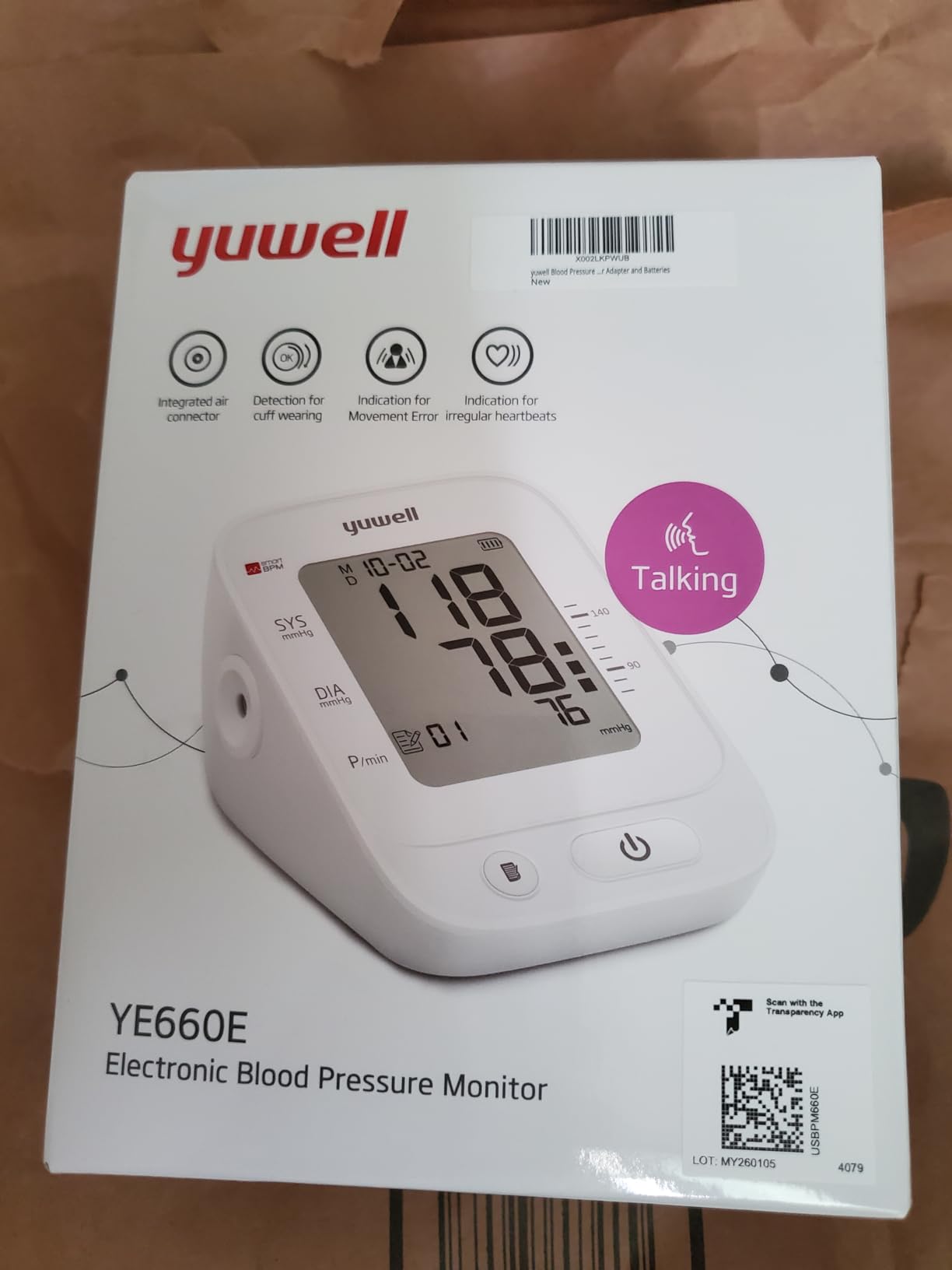
The yuwell YE660E PRO is the model we would hand to someone taking their first home reading. Everything happens from one button, and the unit talks you through the measurement and announces the result at the end, so you are not guessing which of the numbers on the screen is the one you need.
The display is a large backlit screen aimed squarely at older users, and it shows a WHO blood pressure classification bar alongside the readings. Owners like the guided experience, the soft cuff and the 199-reading memory that keeps a rolling average of the last three measurements.
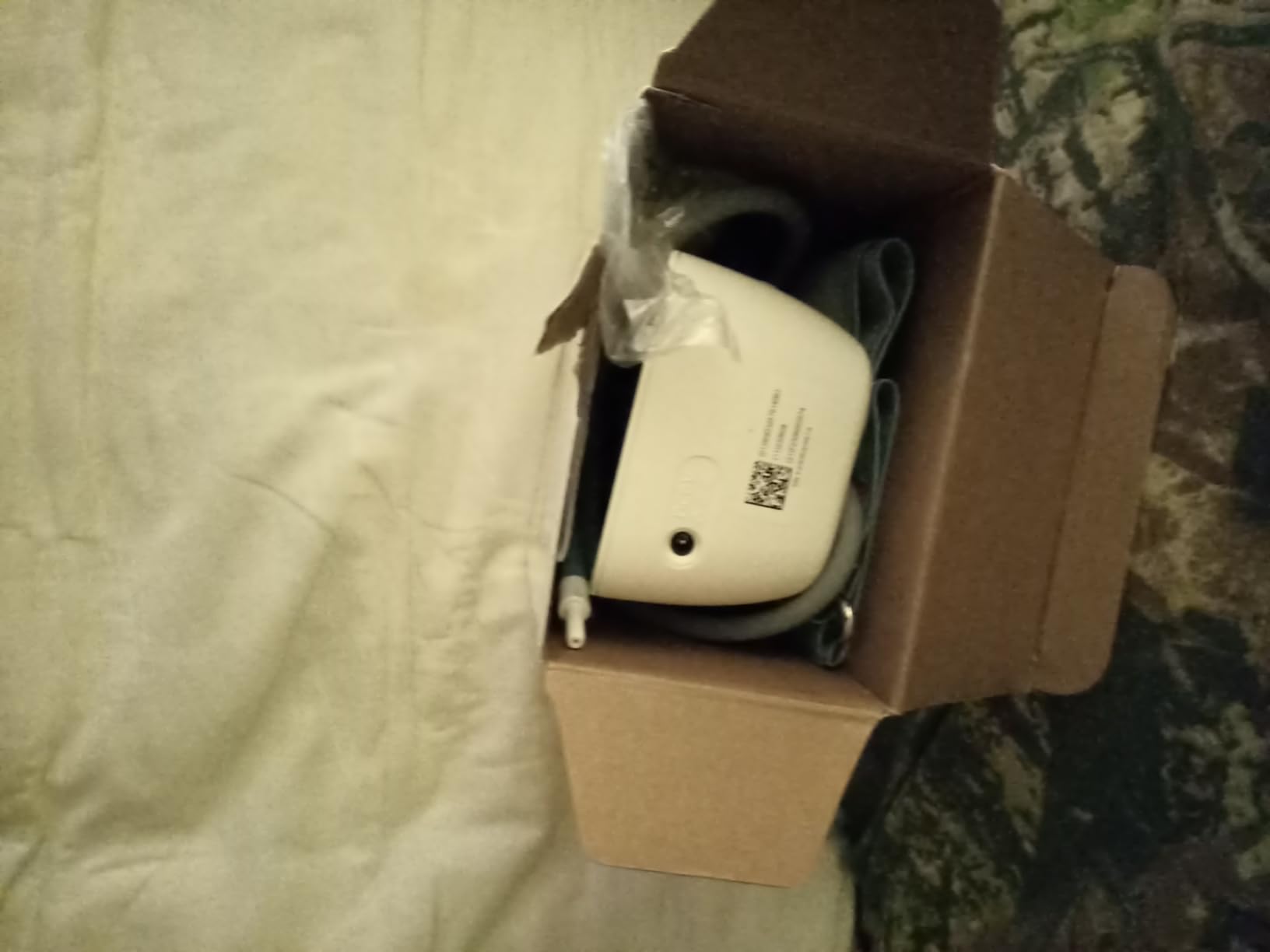
On the accuracy side, the listing states the unit meets the European Society of Hypertension standard with an algorithm tuned on clinical hypertension data. It also includes body-movement detection with a posture reminder, which is a quiet nod to the fact that most bad home readings come from position rather than from the device.
The cuff covers 8.6 to 17.7 inches, the widest standard range of the units in this roundup, and the intelligent pressurization is designed to cut over-inflation discomfort. That makes it a sensible pick for a mid-to-large arm that a standard cuff would squeeze.
Who this monitor suits
It fits a first-time buyer, an older adult living alone, and anyone who wants the device to explain itself rather than decode a screen. Voice plus backlight covers both sight and hearing limits in one package.
It is also a good match if you want a monitor you can leave on the kitchen table and use without reading a manual first.
Where it falls short
There is no app or Bluetooth export, so your log lives on the device and a doctor visit means writing numbers down or reading them off the screen. If you want a trend file to email, look at the app-sync options instead.
The 199-reading memory is a single bank rather than separate profiles, and the wide 8.6-inch lower limit means the cuff may sit loose on a smaller arm.
4. Invaxe AOJ-30G: The Biggest Angled Screen
- Massive bright backlit screen with large clear numerals
- Fast 30 second setup and one-touch operation
- Angled body is easy to read at a glance
- Color-coded pressure indicator
- Comfortable cuff on larger arms
- Supplied USB cable was unreliable for some buyers
- Batteries drained quickly in one reported case
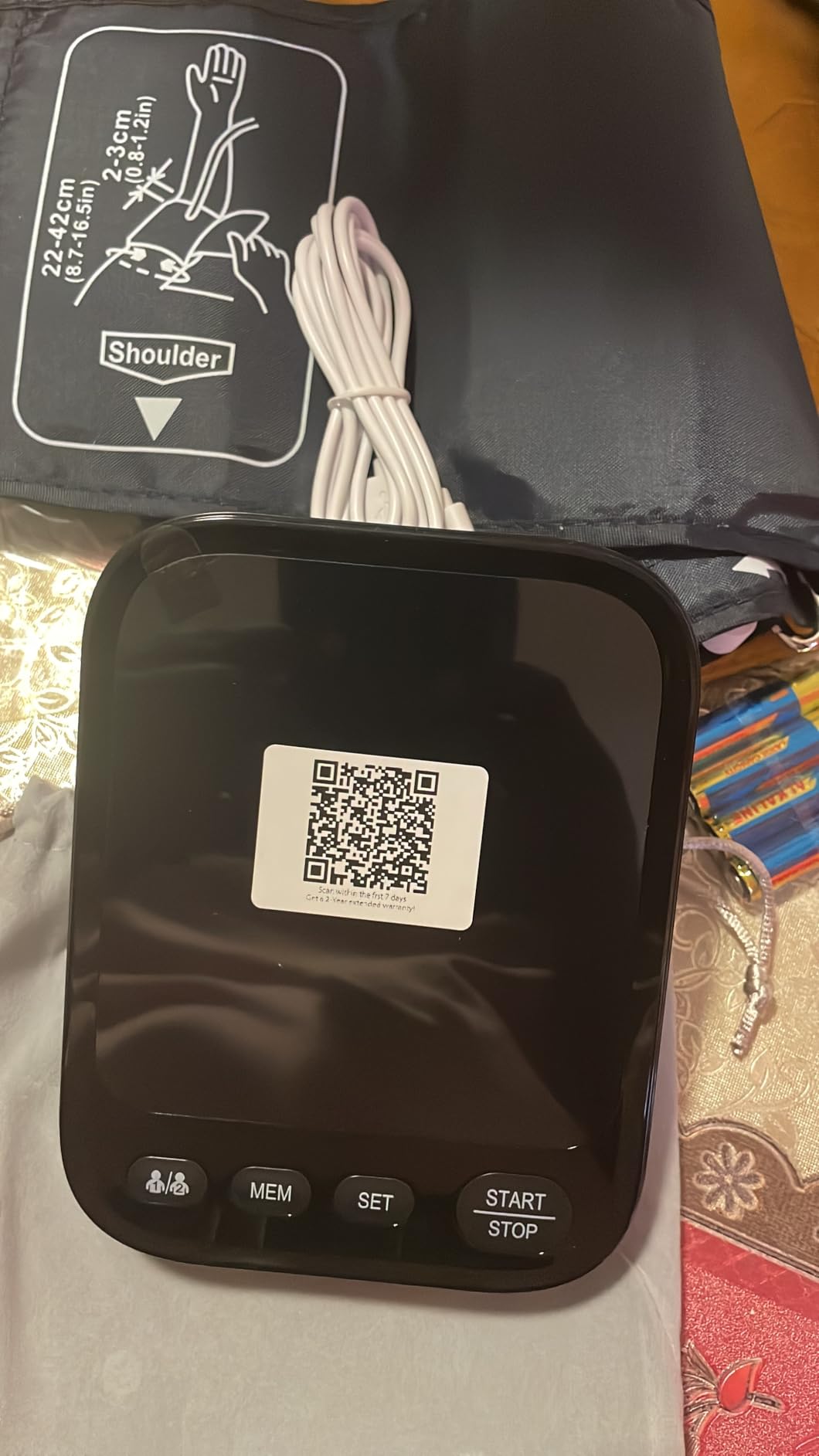
The Invaxe AOJ-30G wins on physical screen size among the units with the deepest owner feedback. Its 4.5 inch backlit LCD sits on a body angled at 45 degrees, so the numbers face you rather than sitting flat on a table, and the numerals are described by owners as large and clear.
Setup is quick at about 30 seconds and operation is one-touch. Two users each get 199 stored readings with an automatic average of the last three, and the cuff fits 9 to 17 inches with automatic position detection and a reminder if it is seated incorrectly.
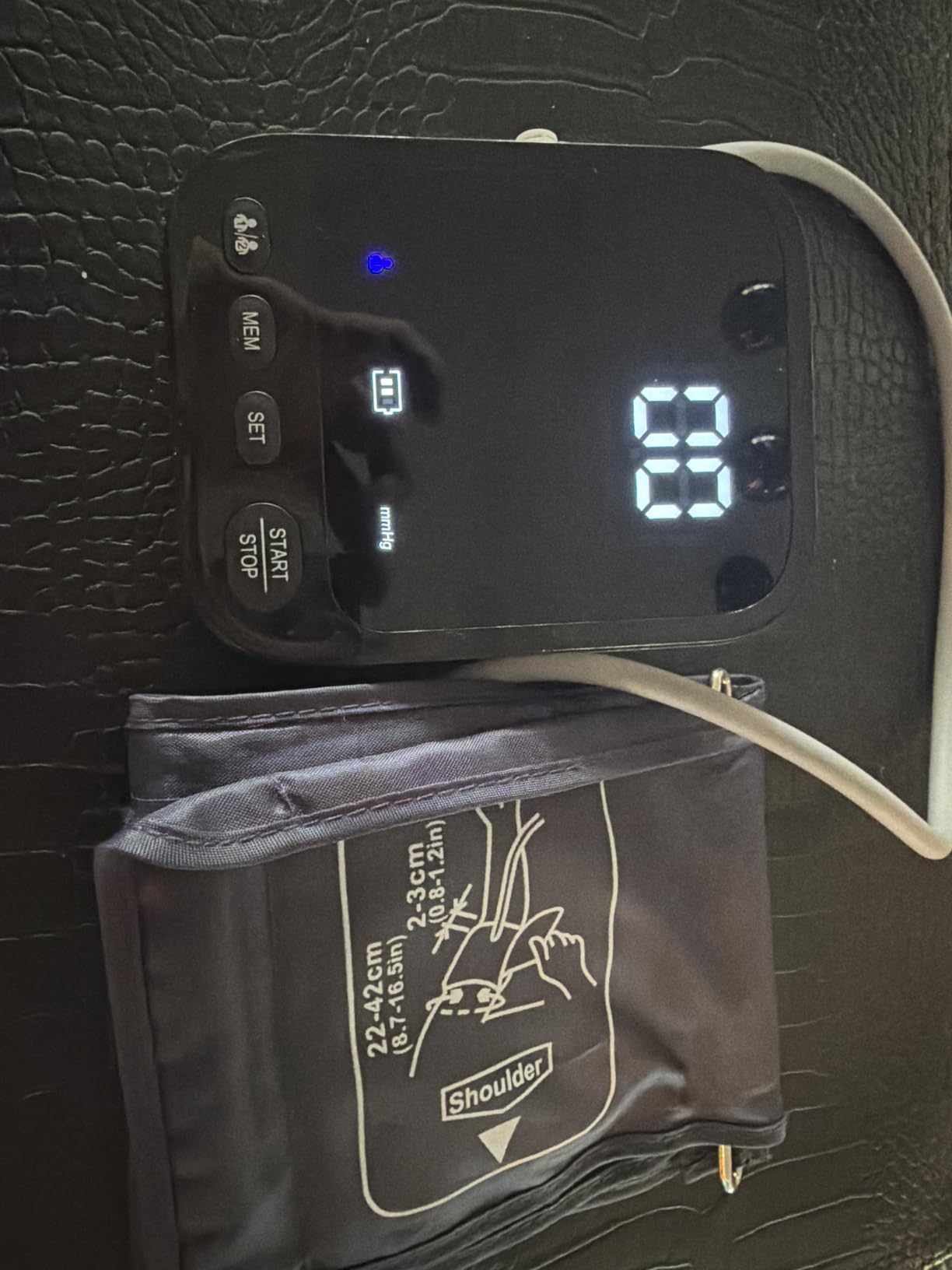
The angled body is a display feature in disguise. It solves the posture problem that makes a big screen hard to use, because you do not have to pick the monitor up or crane over it to read the result.
Accuracy checks out well in owner reports, with readings landing close to a doctor’s office unit. A high-sensitivity sensor handles irregular heartbeat detection and a six-level color pressure indicator, and the unit carries a lifetime warranty with 24/7 support.
Who this monitor suits
Pick it if the single biggest thing you want is a large screen you can see from a normal seated position, and if the unit lives on a bedside table or a kitchen counter rather than in a drawer.
The two-user memory and the position detection make it a reasonable shared device for a couple who both track pressure.
Where it falls short
Power is the weak point. The supplied USB cable did not work reliably for a number of buyers, though the seller subsequently acknowledged the issue, and one report described batteries draining quickly.
It runs on 4 AAA batteries or USB, with no AC adapter in the box, and the cuff range tops out at 17 inches, so a very large arm needs a different model.
5. Andesfit A02-SEB: Best for App Sync and Wider Arms
- Largest stated display in the group with large numerals
- Two cuff sizes suit larger-bodied users
- Bluetooth sync builds unlimited history in the app
- No login or personal data required
- USB Type-C plug-in as well as batteries
- Color cues do not help colorblind readers
- USB Type-C is power only and not charging
- At 1.7 pounds it is a heavier unit to carry between rooms
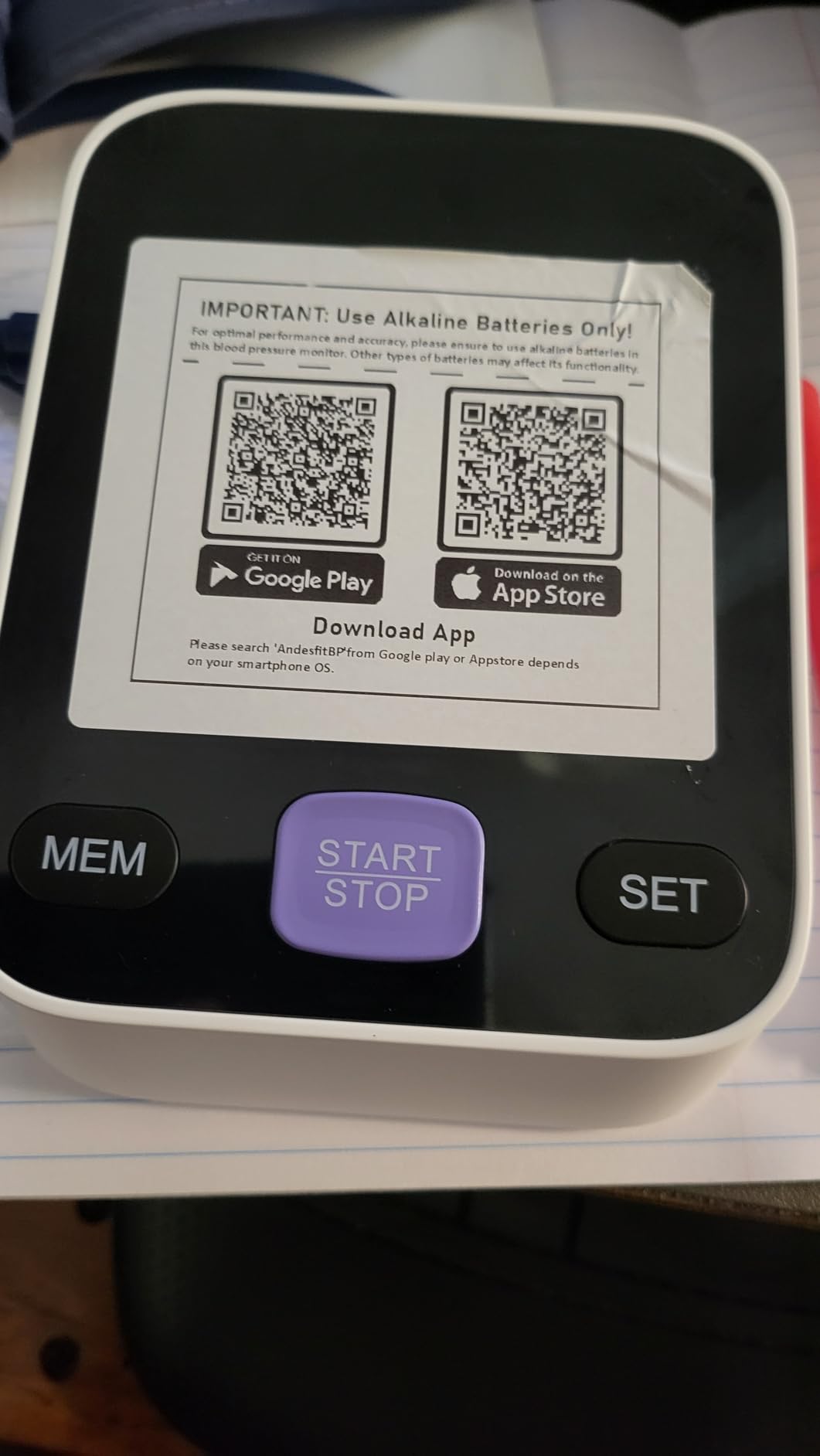
The Andesfit A02-SEB is the choice when the reading needs to reach a doctor as a file rather than a memory. A free companion app syncs over Bluetooth to Apple Health and Google Fit, stores unlimited measurement data, generates trend charts and exports CSV reports, with no login and no personal data required.
The display is a 6 inch color LED screen built for seniors with large numerals, so it is the biggest stated panel among these ten. Two profiles are supported with 199 readings each on the device, on top of the app history.
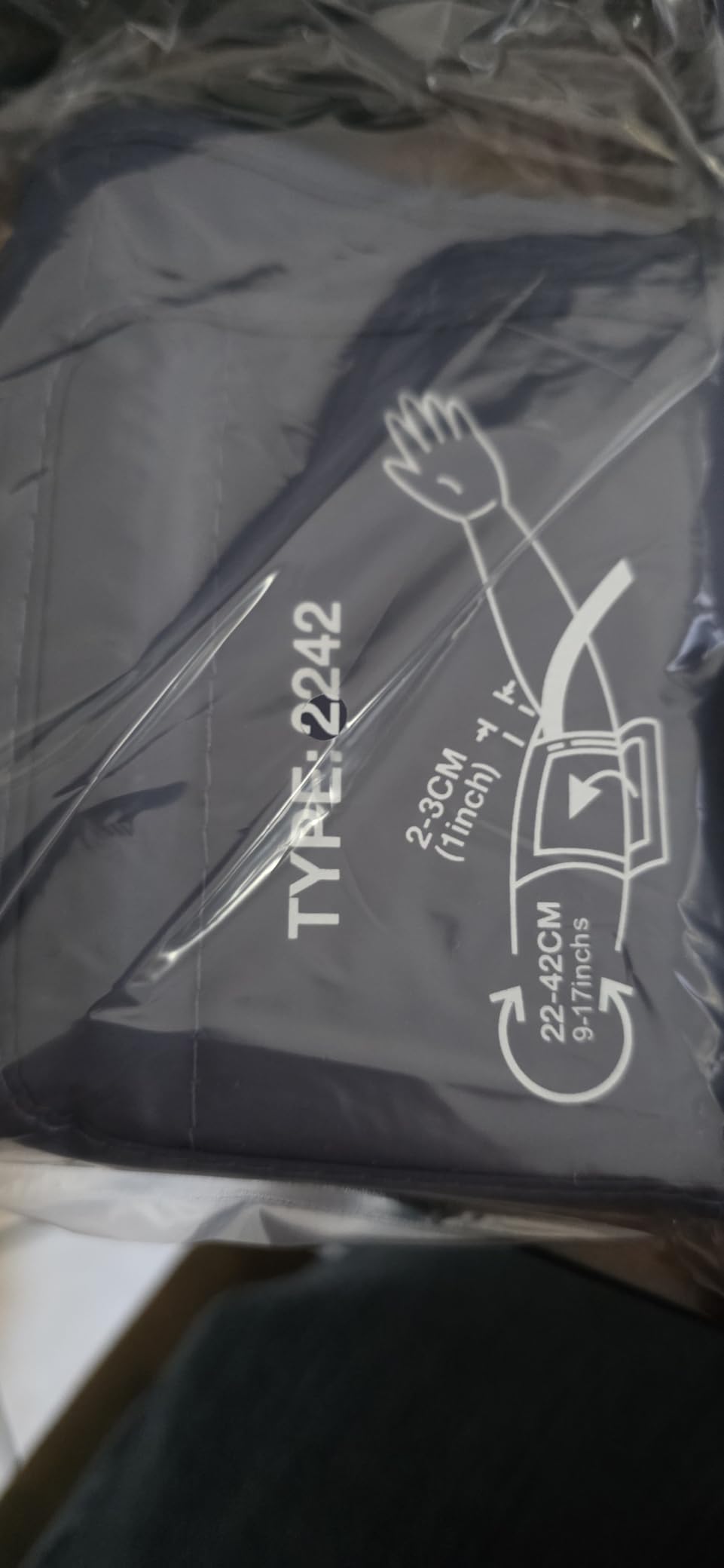
Two cuff sizes ship in the box, a 17 inch standard and a 21 inch extra large, covering 9 to 17 inch arm circumferences between them. That makes this one of the few units here that can grow with a larger arm, and it is the clearest answer in this roundup to the recurring question about extra-large cuffs.
The listing positions the unit as FDA-cleared with clinical accuracy standards, which is a claim worth verifying yourself in the FDA database before you rely on it. Power is flexible: 4 AA batteries, or a USB Type-C plug-in for a unit that stays on a desk.
Who this monitor suits
It fits a household that wants an ongoing record without handwriting anything, and a larger-armed user who wants both a big screen and the right cuff in one box.
It also suits anyone already syncing to Apple Health or Google Fit, since the export path is already built in.
Where it falls short
The color LED screen leans on color, and color alone is not a reliable signal for a colorblind reader. Look for a device that also states the range in words or a symbol.
The USB Type-C port is power only rather than charging, so the unit is either battery-powered or tethered. At 1.7 pounds it is also one of the heavier bodies here to move between rooms.
6. DobyVoe A08: Best for Wider Arms
- Large bright 5.4 inch LED screen that is easy to read
- Two cuff sizes cover standard and very large arms
- Cuff stays on without sliding and fits one-handed
- Three profiles with 199 readings each for family tracking
- Runs on batteries or Type-C power
- Setup is more involved than some buyers expected
- One reviewer reported inconsistent measurements
- Type-C cable is power only and does not charge
The DobyVoe A08 is the straightest answer to the large-cuff question. It ships with two cuff sizes, a standard 9 to 17 inch and a large 13 to 21 inch, and the larger one is the sleeve most often asked about in search results about bariatric monitors.
The display is a 5.4 inch LED large screen, and owners describe it as bright and easy to read. Three user profiles each store 199 readings, which is generous for a family that wants separate histories without an app.
Operation is fully automatic one-touch with intelligent pressurization and automatic inflation and deflation. Owners note that the cuff stays in place without sliding and can be applied one-handed, and that readings matched other machines in side-by-side comparisons.
Power is dual: 3 AAA batteries for travel, or a Type-C interface for a unit that lives at home. A storage bag, a detailed manual and 24/7 customer support are included.
Who this monitor suits
Choose it if your arm circumference sits above the reach of a standard 9 to 17 inch cuff and you also want a large screen. The two-cuff bundle removes the most common cause of a wrong reading at home.
The three profiles also make it a practical pick for a family or a couple plus an adult child tracking alongside a parent.
Where it falls short
Setup is more involved than some buyers expected, and a minority found the operation less convenient than the device they replaced. One reviewer reported inconsistent measurements, which is a reminder to confirm any new monitor against a known-good unit.
The Type-C cable is power only and does not charge the batteries, and the listed dimensions of one by one by one inch are not useful for judging desk footprint, so measure the space before you commit.
7. Acenis AOJ-30F: Best for Color Zone Readouts
Blood Pressure Monitor – Automatic Blood Pressure Machine for Home Use – Large Color Screen and Large Adjustable Cuff for Reliable Readings
- Large digits readable with poor eyesight
- Color-coded indicator shows the pressure zone at a glance
- Readings matched a clinic unit in a nurse side-by-side test
- Works on batteries or the included cord
- Responsive service that supplied a free replacement
- Some owners want a physically larger unit
- One unit stopped working after about a year
- Battery level shown as a three-bar display rather than a number
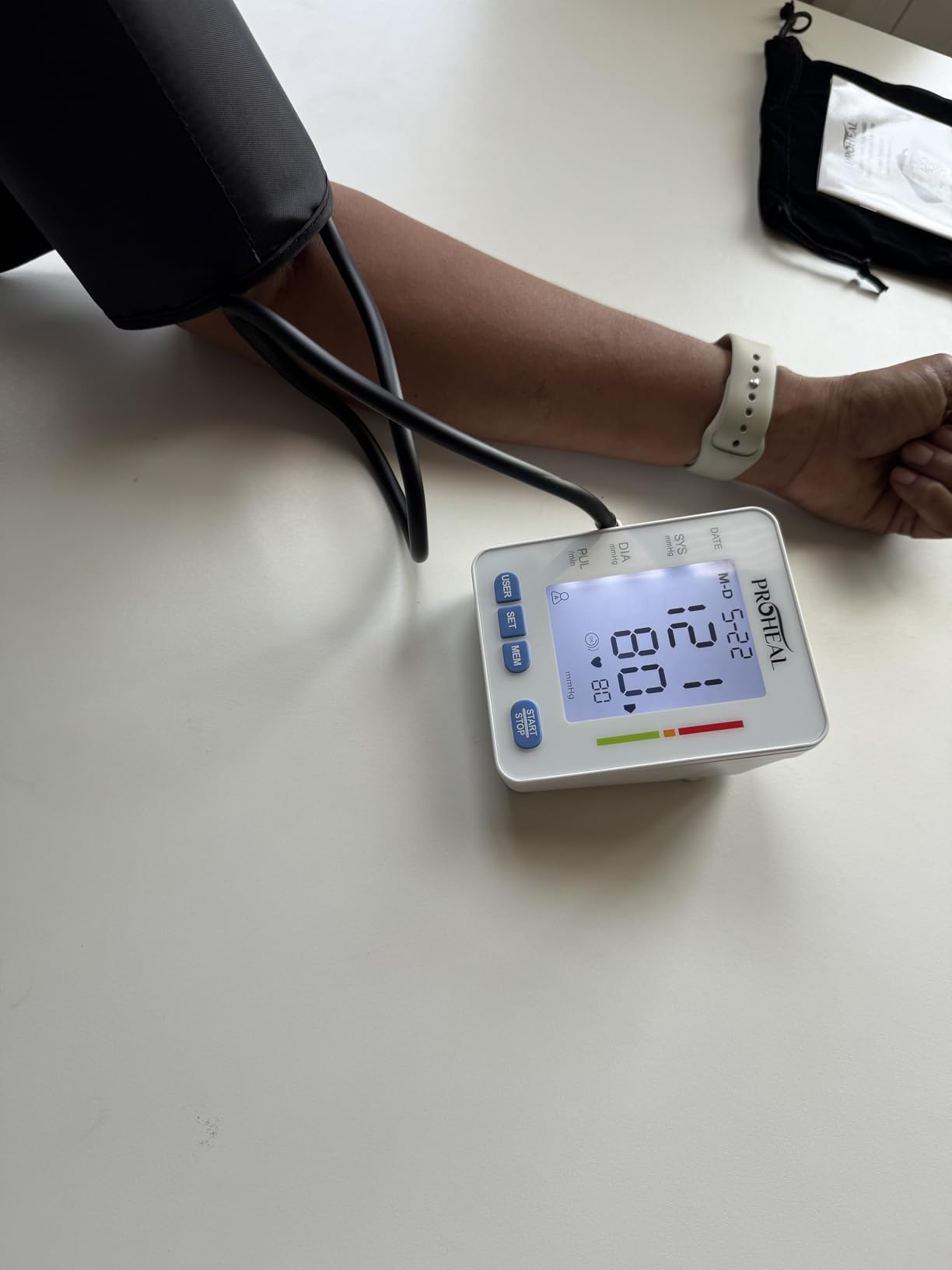
The Acenis AOJ-30F is the monitor for someone who wants a verdict, not just two numbers. Its large color screen uses large digits, and indicator lights show green, yellow or red pressure zones, so you can see at a glance whether a reading is normal, elevated or high without consulting a chart.
That is exactly the benefit AARP’s testers described on a color-coded display they liked, and the same benefit comes with the same limitation we come back to below. Operation is one-touch, with results in about 40 seconds.
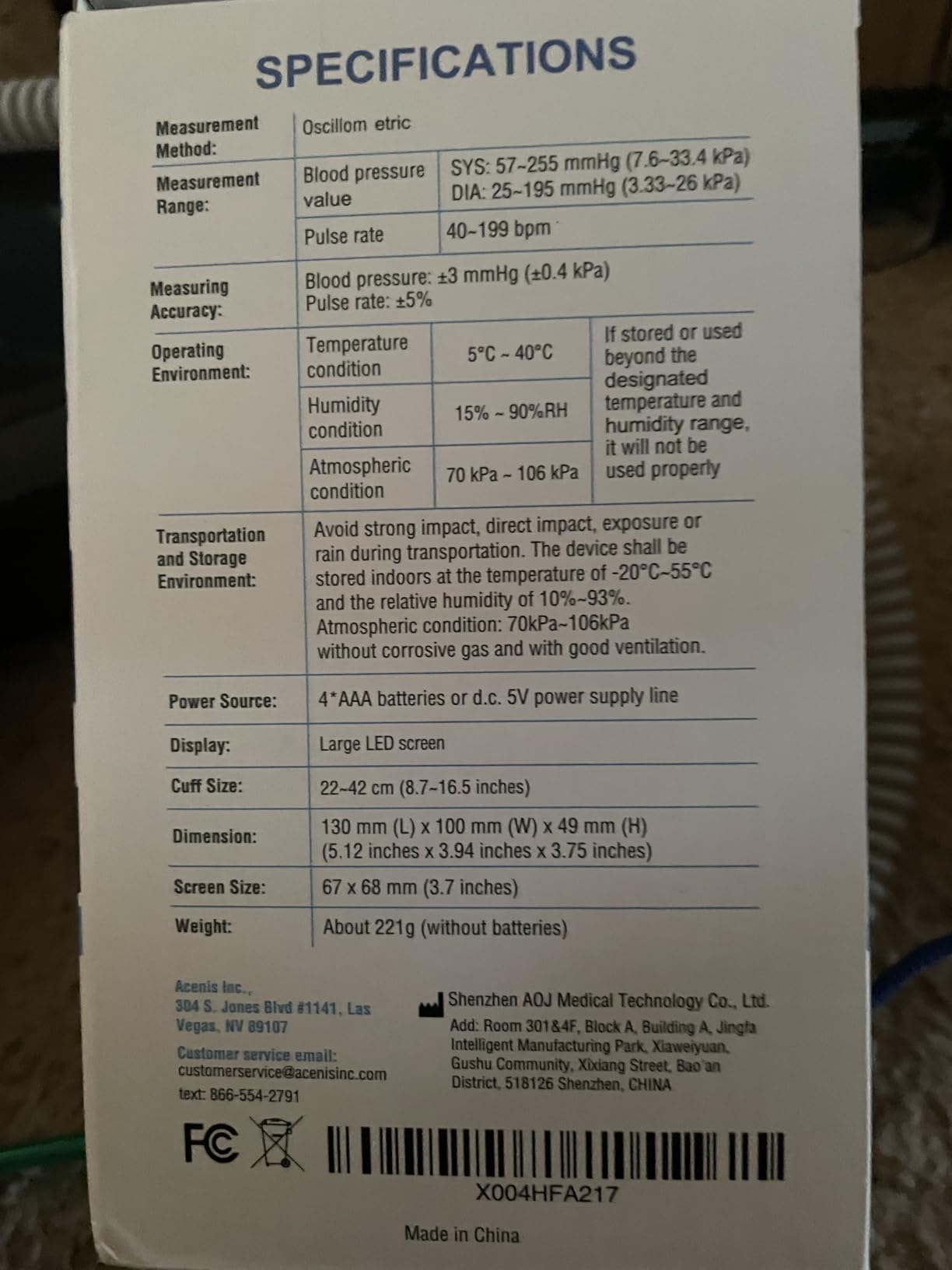
Accuracy is the strongest part of the owner feedback here. One buyer matched a clinic measurement exactly, and another beat a pharmacy-purchased unit in a nurse-run side-by-side test, which is a stronger claim than most owner reviews can make.
The large adjustable cuff gives a snug but comfortable fit across body types, dual power runs on 4 AAA batteries or the included external cord, and date and time are settable for paper or digital logs. A three-bar indicator shows the battery level.
Who this monitor suits
It fits a user who wants the display to interpret the reading for them, and a household where someone else may need to glance at the monitor and understand it instantly.
The 1.1 pound body and the simple one-touch flow also suit anyone setting up a monitor for a parent or spouse.
Where it falls short
Color zones are not a substitute for digits, and a colorblind reader will lose the meaning of the lights entirely. The numbers are still there, but the quick read is gone.
Some owners would like a physically larger unit than the 5 by 2.87 by 3.66 inch body, and one unit reportedly malfunctioned after about a year, though customer service supplied a free replacement.
8. ProHeal Talking Monitor: Best for Low Vision
- Loud clear spoken readout of every number
- Announces whether the reading is high low or normal
- Large backlit display with color range indicators
- Simple setup and everyday operation
- Lightest body in the group at 9.35 ounces
- Cuff can be too large for smaller arms and gave poor readings
- Instructions are not comprehensive
- USB power requires staying plugged in during use
- One unit failed after about five and a half months with difficult warranty support
The ProHeal talking monitor is the most direct answer to low vision. A clear voice announces systolic, diastolic and pulse aloud, and it tells you whether the reading is high, low or normal, which means you get the interpretation and the numbers without depending on the screen at all.
The display is still good in its own right: large backlit digits with green, orange and red range indicators plus an irregular heartbeat symbol. Volume is adjustable and the broadcast can be switched off for silent use.
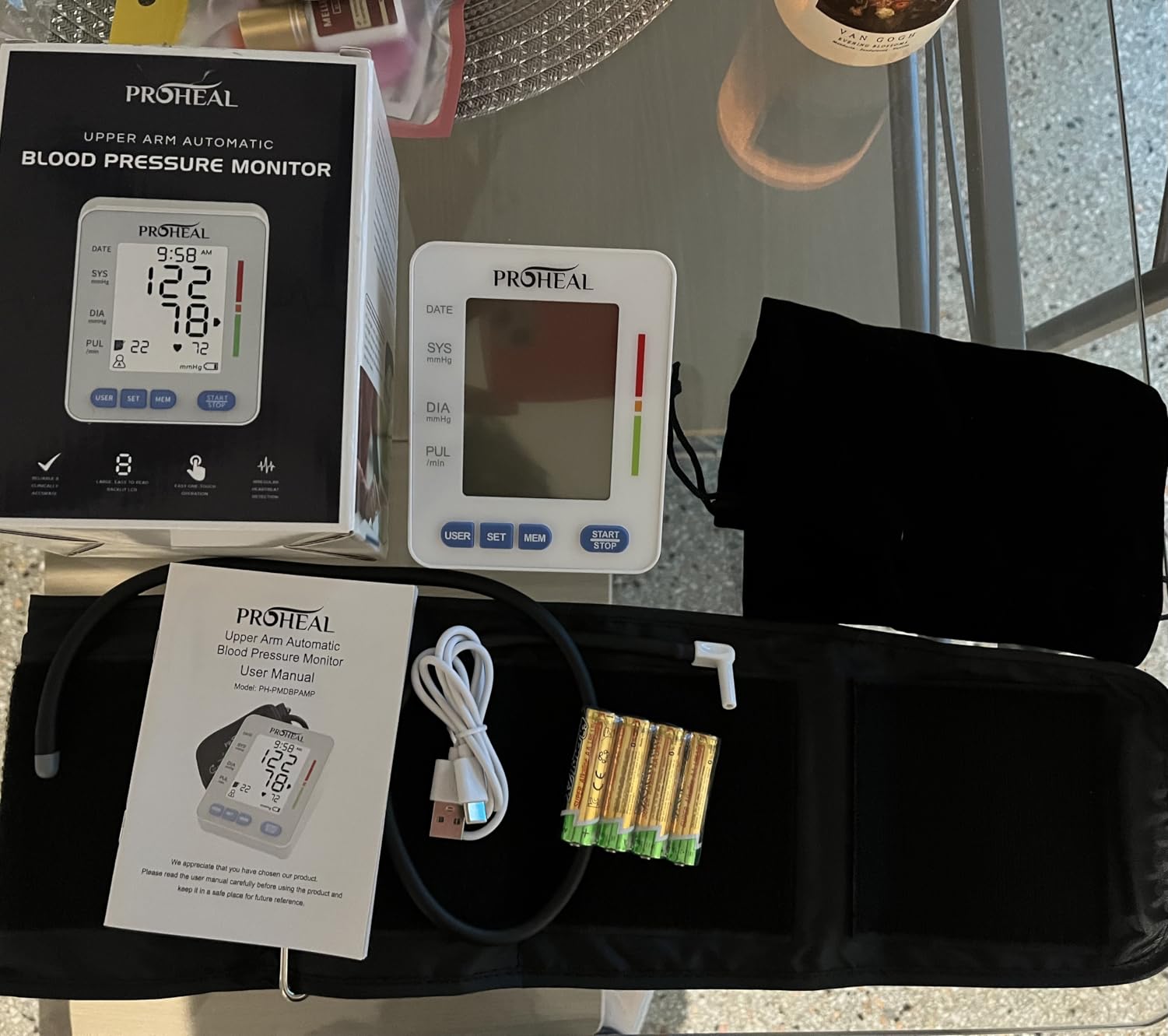
Three user profiles store 240 readings in total, 80 each, tagged with date and time. At 9.35 ounces with a carry bag, it is the lightest body in this roundup and the easiest to move between the bedroom and a clinic visit.
Power is dual, 4 AA batteries or a 5V USB Type-C wall adapter, and the cuff is adjustable for 8 to 16 inch arm circumference.
Who this monitor suits
It fits a reader with diabetic retinopathy, macular degeneration or post-stroke vision loss, where a backlit screen alone may not be enough. It also suits anyone who finds squinting at a small LCD tiring rather than impossible.
For a caregiver, hearing the result spoken is often more useful than being handed a device to read.
Where it falls short
The cuff is the main problem. It runs 8 to 16 inches and can be too large for smaller arms, which produced poor readings in owner reports, so measure your arm before buying.
The instructions are not comprehensive, USB power means staying plugged in during a measurement rather than operating as a rechargeable unit, and one unit stopped working after roughly five and a half months with difficulty reaching the vendor for a warranty replacement.
9. TDMOON U80BH: Best for Plugged-In Use
- Big clearly legible numerals on a 3.5 inch LCD
- Detachable cuff covers 9-17 inch arms
- Two-user mode with 90 readings per person
- AC adapter included for a fixed home station
- Also works as a heart rate pulse monitor
- No backlight so dim-room reading is harder
- 4 AA batteries are not included for cordless use
- Readings stay on the device with no app export
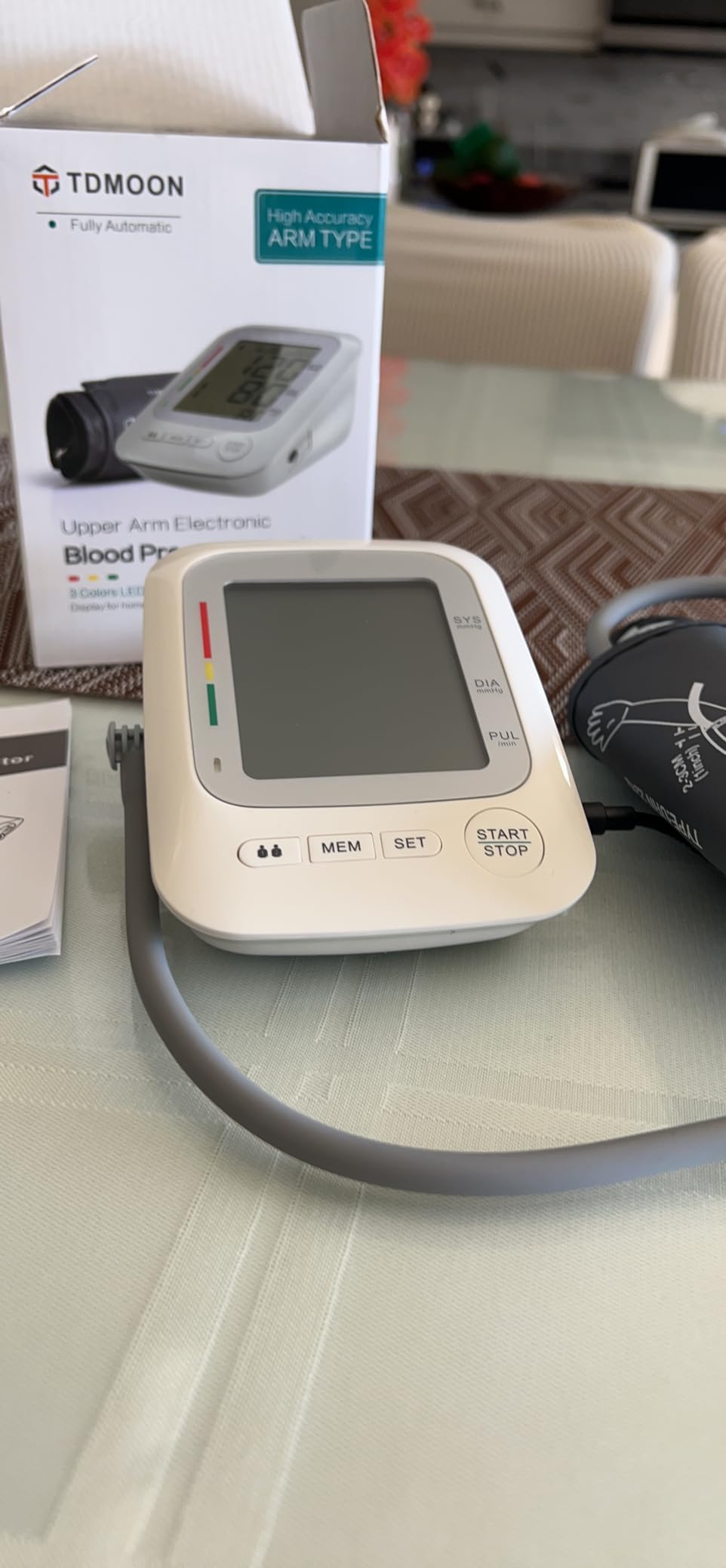
The TDMOON U80BH is the straightforward desk unit. A 3.5 inch large LCD shows systolic, diastolic and heart rate in numerals owners describe as big and clearly legible, and a 6V AC adapter is included in the box, so you can set it on a table and never think about batteries.
It also works as a heart rate pulse monitor, runs a stable algorithm and chip for consistent measurement, and includes a detachable extra-large cuff fitting 9 to 17 inch upper arms.
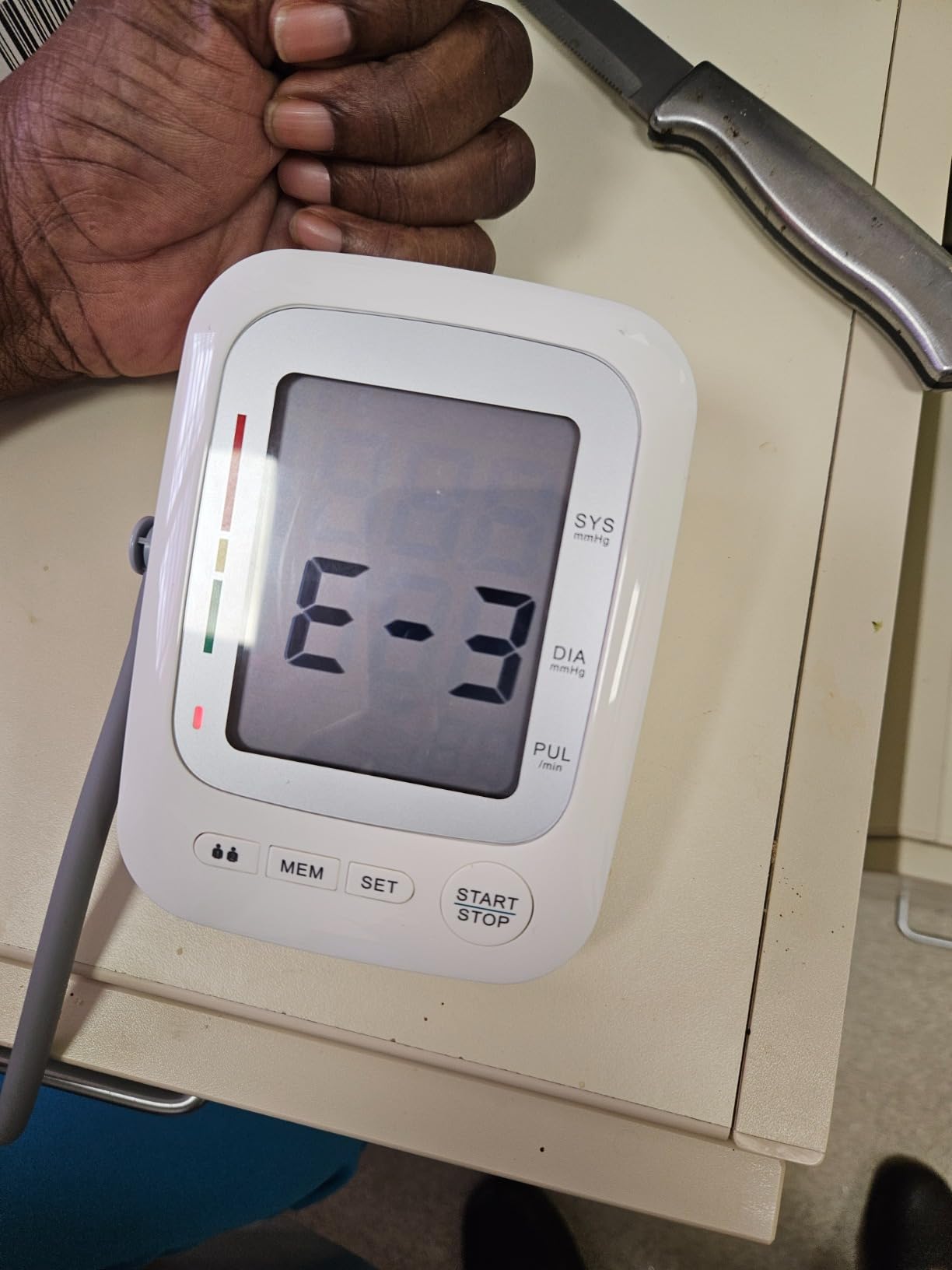
Two users are supported with up to 90 stored measurements each, and records carry a date and time stamp. That is a sensible amount of history for tracking a medication change without turning the device into a project.
Battery operation works as a backup with 4 AA cells, though those cells are not included. Records are date and time stamped, so a paper or digital log is easy to keep.
Who this monitor suits
It fits a fixed home setup where the monitor lives in one spot, and a two-person household that wants separate stored histories on the device with no account or app.
The detachable cuff is also convenient if more than one person in the house takes readings.
Where it falls short
The LCD has no backlight, so it loses the same advantage the Konquest and yuwell hold in a dim room. This is the one unit in the roundup we would not recommend for night-time dosing.
The 4 AA batteries are not included for cordless use, and there is no app or export path, so getting readings to a doctor means writing them down.
10. RunStar BP-206: Best for Charged Travel Use
- Large 5.0 inch display with jumbo fonts and 3-color backlight
- App sync builds charts without manual logging
- Five-language voice broadcast aids accessibility
- Smart Cuff Detection alerts on a loose or misplaced cuff
- FSA and HSA eligible
- Fits 8.6-16.5 inches with a soft cuff
- Smaller review base than the leaders here
- App setup is a step before the first reading
- Cuff tops out below the widest ranges in this roundup
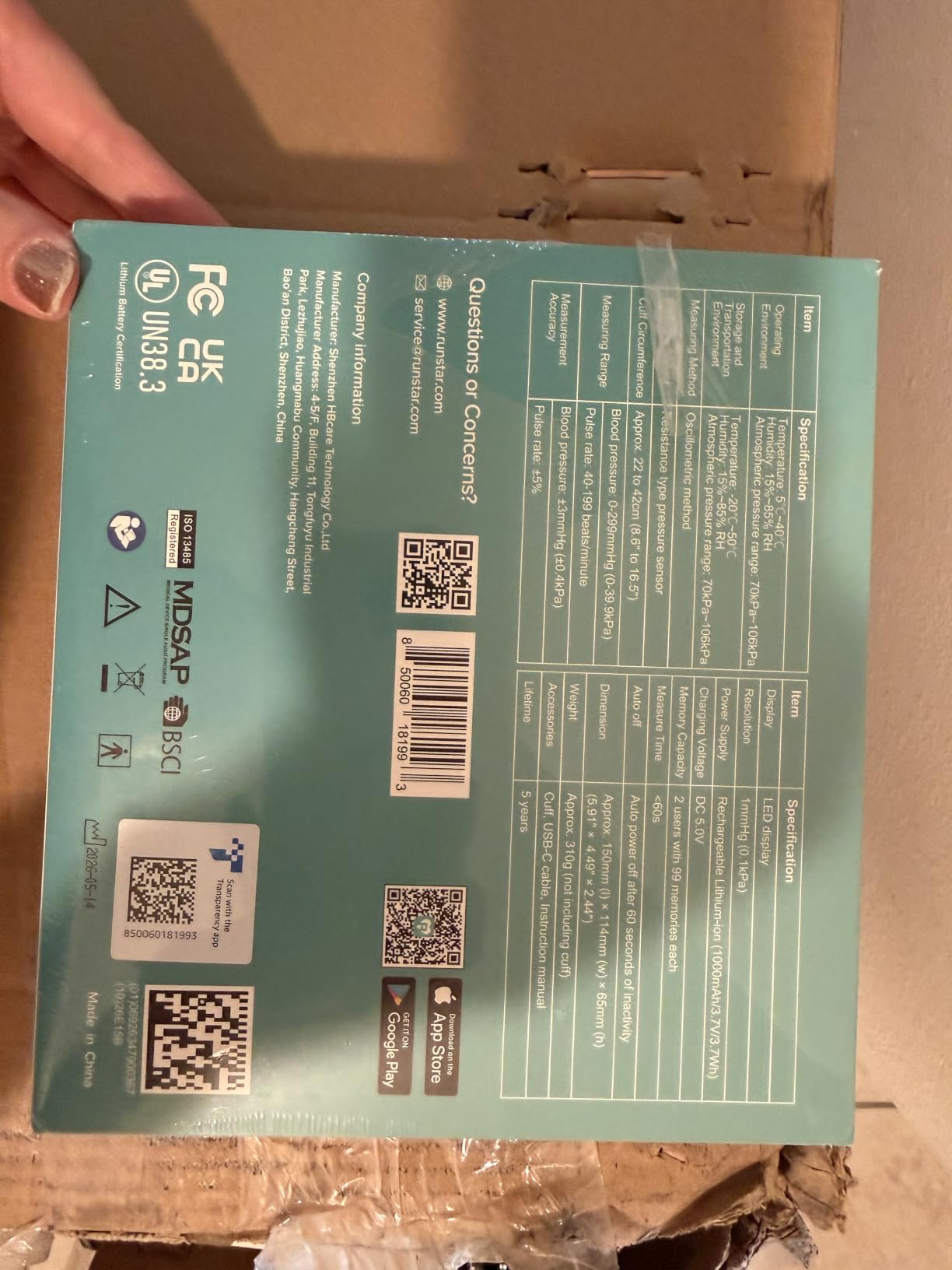
The RunStar BP-206 is the newest unit here, first listed in 2026, and it combines a 5.0 inch display with jumbo fonts and a three-color backlight system that shifts between white, yellow and red to signal an optimal, elevated or high result.
One-touch operation syncs to a free iOS and Android app that generates charts and long-term trends, so you are not maintaining a log by hand. Voice broadcast covers five languages, which is a meaningful accessibility feature in a multilingual household.
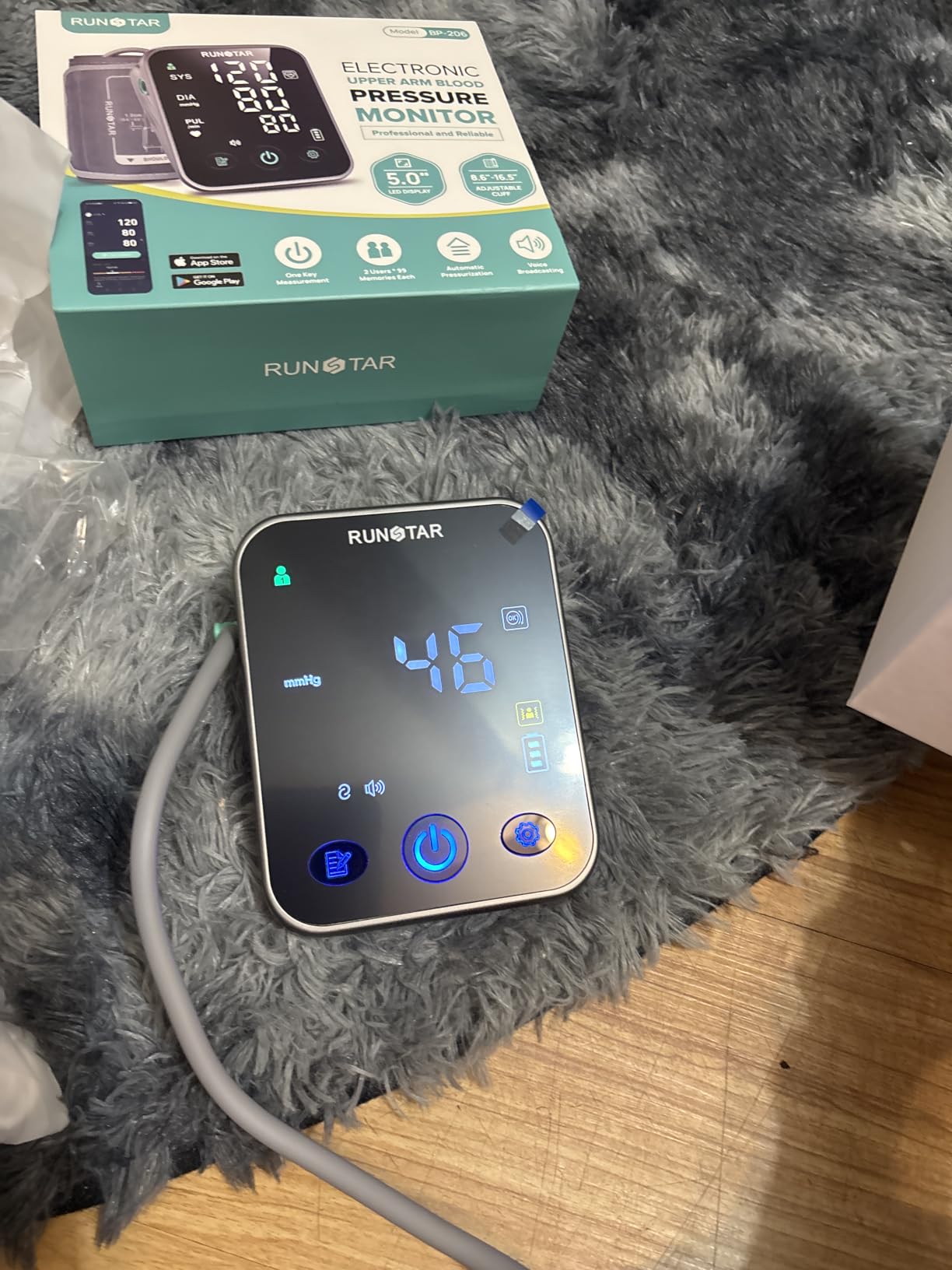
The soft upper arm cuff fits 8.6 to 16.5 inches and adds Smart Cuff Detection, which alerts you when the cuff is loose or misplaced. That removes one of the most common reasons for a home reading to be wrong.
Charging is the standout practical detail: a full charge takes about 1.5 hours and lasts up to five months at twice-daily measurement, which is what makes it the travel pick in this roundup. The unit is FSA and HSA eligible, and the listing describes VTEC technology tuned to arterial micro-vibrations for clinical-grade precision.
Who this monitor suits
It fits someone who wants app-based trends without a subscription, and a user whose household reads labels in more than one language. The five-month battery life suits travel and infrequent monitoring.
Smart Cuff Detection is a genuine safety net for a first-time user who will otherwise not know when the wrap is wrong.
Where it falls short
With 209 reviews it carries the smallest owner history in this roundup, so there is less long-term durability feedback than the leaders have. That is the main reason it sits at the bottom of the list despite a strong display.
App setup is an extra step before your first reading, and the 8.6 to 16.5 inch cuff tops out below the widest ranges available here.
What to Look for When Buying a Large-Display Monitor
Start with the screen, then check the cuff, then check validation. Here is what actually matters, in the order we would weigh it.
Display size and legibility
Screen size alone tells you little. What matters is numeral height, the gap between segments and how much other information shares the panel. The screens in this roundup run from a 3.5 inch LCD to a 6 inch color LED, and the two ends of that range are not close in legibility. Treat any published screen diagonal as a starting point and look for owner descriptions of the actual numerals.
Backlit or not
A backlit screen can be read in a dim room, which matters for anyone checking pressure before a morning dose. It is the single most requested improvement in the owner reviews of the one non-backlit unit here, and it is why we would not place the TDMOON higher. Glare is the related problem, so a screen you can angle toward yourself beats one that sits flat under a window.
Dual display and side-by-side readings
A dual layout puts your current reading next to your previous one, which makes a rising trend obvious without opening an app. None of the ten units here uses a true side-by-side screen, so look for an on-screen history bar or a WHO classification indicator instead. Either gives you the same information at a glance.
Color-coded indicators and their limits
Green, yellow and red zones are genuinely useful for normal, elevated and high results, and several units here offer them. They are also useless for a colorblind reader, and color vision deficiency is more common in older adults. Never rely on a color light alone; the monitor should also state the range in a symbol, a bar or a voice announcement.
Large display is not a large cuff
These are separate attributes that search results routinely mix up. The display decides whether you can read the number. The cuff decides whether the number is right. A cuff that is too small reads falsely high and one that is too large reads falsely low, which makes cuff fit the biggest accuracy issue in home monitoring. Standard cuffs run roughly 9 to 17 inches; bariatric cuffs cover about 13 to 21 inches, and the DobyVoe A08 and the Andesfit are the two units here that address a wider arm.
Accuracy and clinical validation
Check the U.S. Blood Pressure Validated Device Listing, a joint AMA and Hypertension Canada program, for the exact model. FDA marketing authorization or 510(k) clearance is a separate, weaker signal: it means the device is cleared for sale, not that its accuracy has been independently confirmed against a reference standard. Both editorial roundups competing with this one place the validation listing above brand reputation, and we agree.
Memory, multi-user and getting data to a doctor
Two profiles let a couple track separately on one device. For a doctor, an app export is worth more than extra on-device memory, and the Andesfit and RunStar both sync to Apple Health or Google Fit and build trend charts. If you have no app, confirm the memory count before buying, because two or three weeks of readings is a real pattern and twenty readings is not.
Voice guidance and one-touch operation
Voice is the most valuable display feature for low vision, and four of these units speak their results aloud. For users with arthritis, one-button operation and a cuff you can wrap one-handed matter as much as the screen. Pair the two and you have a monitor that works for a whole household.
Power, batteries and cord length
Note the difference between a USB port that powers the unit and one that charges a battery; several listings blur this. Then check the tube length from cuff to body, because a short cord forces the monitor onto your lap and an awkward arm position can distort the reading. Our coverage of blood pressure monitor deals tracks which models bundle an adapter.
How to Take an Accurate Reading at Home
A large display only helps if the number underneath it is right. These seven steps follow the standard upper-arm method recommended for home monitoring.
1. Rest for five minutes first. Sit quietly with your back supported and feet flat on the floor. No exercise, caffeine or smoking in the previous 30 minutes.
2. Measure at a consistent time. Twice a day, morning and evening, at similar times each day gives you the trend a doctor actually needs.
3. Use the bare arm. A cuff over a sleeve produces a higher reading. Rest your arm on a table so it is supported at roughly heart level.
4. Position the cuff correctly. Place the artery mark on the inside of your upper arm, about an inch above your elbow crease, and wrap it snugly. A cuff that is too loose or too tight is the most common source of error.
5. Sit still and silent. No talking, no moving your legs, no shifting your arm. Talk and movement both push the number up.
6. Take two readings and record both. Leave a minute between them and log both rather than only the second, which tends to read lower.
7. Bring the monitor to appointments. Checking your device against a clinic unit at least once a year is the simplest way to know it still reads true.
As a general guide, a reading at or above 180 systolic and 120 diastolic is a hypertensive crisis reading, and one at or below 90 over 60 is hypotension. If you see either, repeat the reading after five minutes and contact a health professional; do not change medication on your own.
Frequently Asked Questions
What is the best blood pressure monitor with an extra large cuff?
Among the monitors we tested, the DobyVoe A08 is the clearest answer because it ships with two cuffs: a standard 9-17 inch and a large 13-21 inch. The Andesfit A02-SEB is close behind, including 17 inch and 21 inch cuffs. Remember that cuff size and display size are different things: a large cuff fixes accuracy, a large display fixes readability.
What is the best home blood pressure machine with a large cuff?
For a home machine with a genuinely large cuff, look for a listing that states the arm circumference in inches rather than a vague size label. The DobyVoe A08 covers up to 21 inches and the Andesfit A02-SEB includes a 21 inch cuff. Measure your arm with a tape measure before ordering, because an ill-fitting cuff reads falsely high or low.
What brand is the most accurate blood pressure monitor?
Brand reputation is a weak guide to accuracy. The stronger test is whether the exact model appears on the U.S. Blood Pressure Validated Device Listing, the AMA and Hypertension Canada program that checks devices against a reference standard. FDA marketing authorization alone only means the device may be sold, not that its accuracy was independently verified.
Is there an OMRON blood pressure monitor with an extra large cuff available?
OMRON is a leading upper-arm brand, and its 10 Series BP7465 is described by the manufacturer as having a high-contrast backlit dual display with extra-large numbers and a 9-17 inch Easy-Wrap ComFit cuff. For an arm above 17 inches, check the cuff range printed on any OMRON model before buying, since OMRON sells separate extra-large cuffs. We did not test an OMRON unit in this roundup.
How big should a blood pressure monitor display be?
There is no official standard, so judge the numerals rather than the panel. Look for digits you can read from roughly two feet away in a normally lit room, a backlight for dim conditions, clean gaps between LED segments, and as little competing information on the screen as possible. In this roundup, screens ranged from 3.5 inches to 6 inches and the smaller ones were still legible.
Are large display blood pressure monitors more accurate?
No. Display size affects whether you read and record a number correctly, but the accuracy comes from the sensor, the algorithm and above all the cuff fit. Two monitors with identical screens can disagree by several points. Check the validation listing, use the right cuff for your arm circumference, and compare your device against a clinic unit once a year.
Is a wrist or arm blood pressure monitor better?
Upper-arm monitors are the recommended form factor because they are easier to position correctly and have been validated more widely. Wrist monitors are useful only when an upper-arm cuff cannot be used, and their readings vary more with wrist position relative to the heart. For most people, especially anyone prioritizing readability, choose an upper-arm model.
Does Medicare cover blood pressure monitors?
Original Medicare generally does not cover a home blood pressure monitor as a standard benefit, and neither do most Medicaid programs. A flexible spending account or health savings account is the most common way to pay for one, and some Medicare Advantage plans offer an allowance toward monitoring devices. Check with your plan directly before buying.
Conclusion: The Best Large-Display Monitors for 2026
The Konquest KBP-2704A takes the top spot among the best blood pressure monitors with large displays because it combines the most heavily owner-verified screen in this group with near-inch-high backlit numerals and a 4.5 rating across more than 34,000 reviews. If you want the screen to read your numbers to you, the ProHeal talking monitor and the yuwell YE660E PRO are the two to compare, and if your arm is larger than a standard cuff, look at the DobyVoe A08 or the Andesfit A02-SEB.
Whichever you pick, measure your arm, check the model against the U.S. Blood Pressure Validated Device Listing, and take two readings at the same times each day. Specs change, so re-verify the display and cuff range on the manufacturer’s page before you order, and bring the monitor to your next appointment for a comparison check.
This roundup was reviewed and updated in 2026. We earn a commission when you buy through links on this page, at no additional cost to you. Nothing in this article is medical advice; discuss any change in your readings with your clinician.