
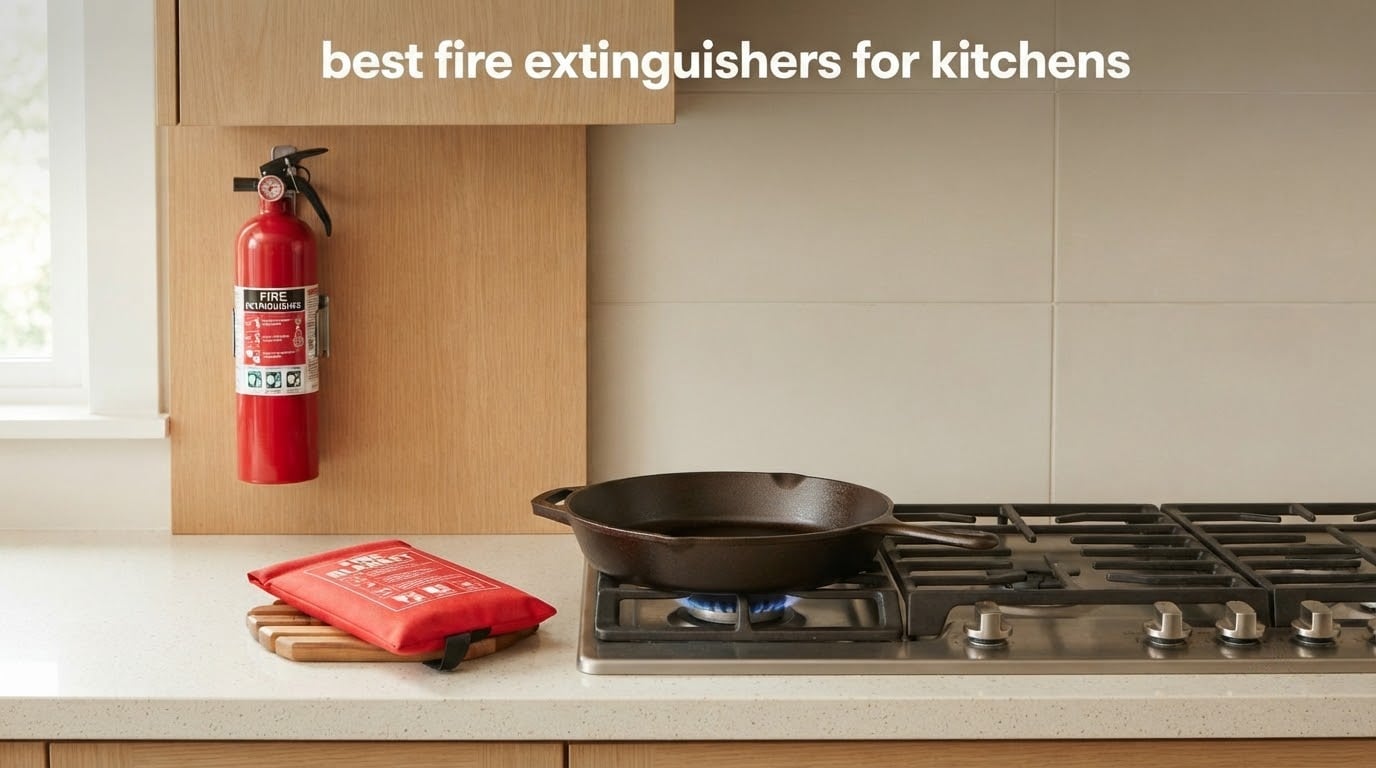
Never put water on a cooking-oil or grease fire. Water flashes into steam and can throw burning oil across the room, which turns a manageable flare-up into a room-filling event in seconds. The correct first move for a pan fire is a lid over the pan and the burner turned off, then an extinguisher rated for Class B or Class K if the lid does not contain it.
That warning is the reason the best fire extinguishers for kitchens are not all built the same way. A unit packed with monoammonium phosphate knocks down a grease fire fast and leaves a corrosive powder that attacks stainless steel and electronics. A sodium bicarbonate or wet chemical unit blankets the oil instead and cleans up far better. A water-based aerosol sprays in seconds and leaves nothing behind, but covers a much smaller area.
We compared ten extinguishers that are actually kitchen-relevant, checking the UL rating printed on the label, the agent inside, discharge time, effective range, unit weight and warranty length for each one. The list below covers everything from a full rechargeable ABC cylinder to a press-and-spray can for renters who will not drill a hole in a cabinet wall. Last updated for 2026.
Top 3 Best Fire Extinguishers for Kitchens (October 2026)
Our top pick, the First Alert Standard Home Use, is the one most kitchens should own. It carries a 1-A:10-B:C UL rating, an all-metal body with a commercial-grade valve, and a recharge path through a certified professional, which is the combination households rarely find together.
The Kidde Basic 110 is the value pick at an identical UL rating and a fraction of the size. The First Alert HOME2PRO is the upgrade for anyone who fries a lot or wants a unit that meets the higher 2-A:10-B:C code threshold.
All 10 Kitchen Fire Extinguishers Compared in 2026
| Product | Specifications | Action |
|---|---|---|
 First Alert Standard Home Use First Alert Standard Home Use |
|
Check Latest Price |
 Kidde Basic 110 FA110G Kidde Basic 110 FA110G |
|
Check Latest Price |
 First Alert EZ Fire Spray First Alert EZ Fire Spray |
|
Check Latest Price |
 First Alert HOME2PRO First Alert HOME2PRO |
|
Check Latest Price |
 LifeSafe StaySafe All-in-1 LifeSafe StaySafe All-in-1 |
|
Check Latest Price |
 AmzBoom 2-Pack AmzBoom 2-Pack |
|
Check Latest Price |
 Kidde KD143-210ABC Kidde KD143-210ABC |
|
Check Latest Price |
 Ougist 4-Pack Foam Ougist 4-Pack Foam |
|
Check Latest Price |
 Amerex B417T Amerex B417T |
|
Check Latest Price |
 Ougist FF1KG Ougist FF1KG |
|
Check Latest Price |
Every extinguisher below has a mounted position in someone’s kitchen. The rows that most often surprise people are the aerosol and water-based spray models: they are not the strongest units on this list, but they are the ones most people will actually reach for under stress.
1. First Alert Standard Home Use – Best Overall Kitchen Fire Extinguisher
- Covers grease
- electrical and ordinary combustibles in one rating
- All-metal body with commercial-grade metal valve
- Rechargeable by a certified professional after use
- Color-coded corrosion-resistant gauge
- Coast Guard approved for marine use
- Included mounting bracket is basic rather than heavy-duty
- Handle and trigger components are plastic
This is the unit we ended up recommending to friends and family. The 1-A:10-B:C rating means it handles burning cooking oil, energized electrical faults and ordinary combustibles like cabinetry without needing a second device, and the 10: part of the B rating is a real capacity bump over smaller units rather than a marketing number.
What separates it from the pack is the metal. The cylinder, valve and trigger are all metal, which is the physical cue that the unit is rechargeable through a certified professional instead of single-use. A disposable cylinder is pressurized once and discarded; a rechargeable one gets serviced and returned.
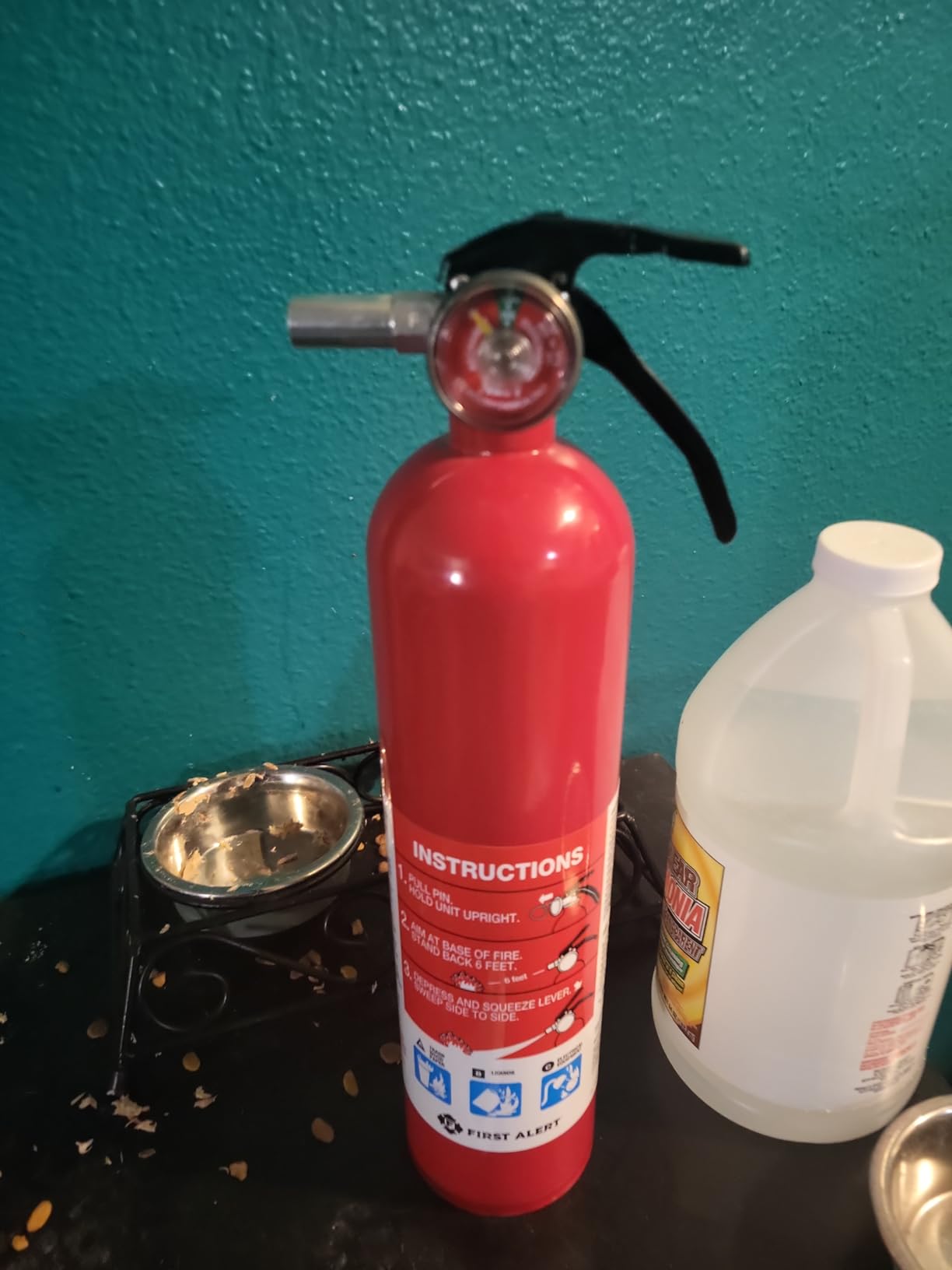
The clear color-coded pressure gauge is the part we check most often. Green means charged, red means the pressure has dropped out of the useful band, and a needle in the danger zone means you replace it rather than trust it. Ten years of limited manufacturer warranty is a long service commitment for a household device.
At 4.5 pounds, this is a size an older adult can lift and control one-handed, and it fits in the cabinet space beside the range or under the sink without looking like equipment rather than kitchenware. The one drawback worth flagging: the bracket that comes in the box is thin sheet metal, and on a tiled backsplash you will want better anchors.
What the UL rating actually buys you
The 1-A:10-B:C marking decodes into a 1-square-foot-per-A rating for wood and paper, 10 square feet of flammable liquid, and Class C electrical coverage. For a kitchen, the 10-B:C half is the number that matters, because cooking oil is a Class B flammable liquid and a toaster or a faulty outlet is Class C.
Because the same agent handles both, one unit covers the two fires a kitchen actually produces. That is why we rated it above units that cover grease beautifully but leave a powered appliance fire to a different bottle.
Where it falls short in a real kitchen
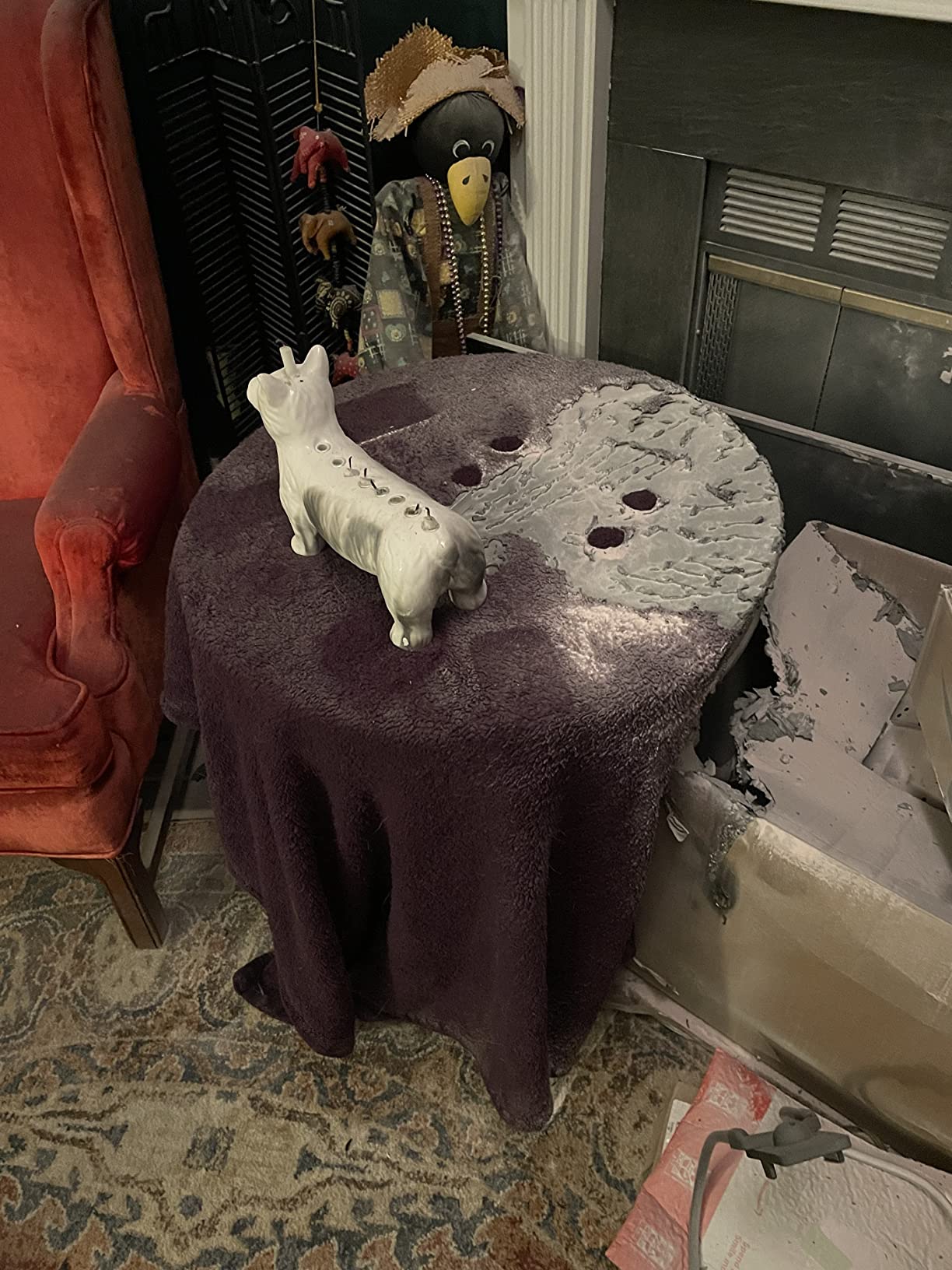
The monoammonium phosphate agent is a dry powder, and it is aggressive on surfaces. Get it onto a stainless range or a countertop with an integrated electronics panel and you will be wiping down a corrosive film afterward. On a fire that is already small, though, knock-down speed usually outweighs cleanup.
There is also no splash-reducing nozzle on this model. For a deep fryer or a pan of hot oil, a flared nozzle that cuts the spray force helps keep the oil from jumping out of the pan, and this unit does not have one. Buy a lid and a fire blanket alongside it and the gap stops mattering.
2. Kidde Basic 110 FA110G – Best Value Kitchen Extinguisher
- UL listed 1-A:10-B:C rating covers common household fires
- Compact and lightweight aluminum body
- Easy-to-read pressure indicator
- Includes a plastic strap mounting bracket
- Powder-coated cylinder resists corrosion
- Residential single-use only and cannot be recharged
- Plastic strap bracket is lighter duty than a metal hanger
The Kidde FA110G is the same UL rating as our top pick in a noticeably smaller body. It carries 2.5 pounds of agent and weighs 3.9 pounds complete, so it disappears into a narrow cabinet gap next to the range where a larger cylinder simply will not fit.
That same rating is the reason we like it for kitchens specifically. It is rated for trash, wood, paper, liquids, gases and electrical fires, which covers a stovetop flare-up, a burner gas leak and a toaster fire with the same canister. The powder-coated aluminum cylinder resists the humidity and grease that shortens the life of an untreated steel body.
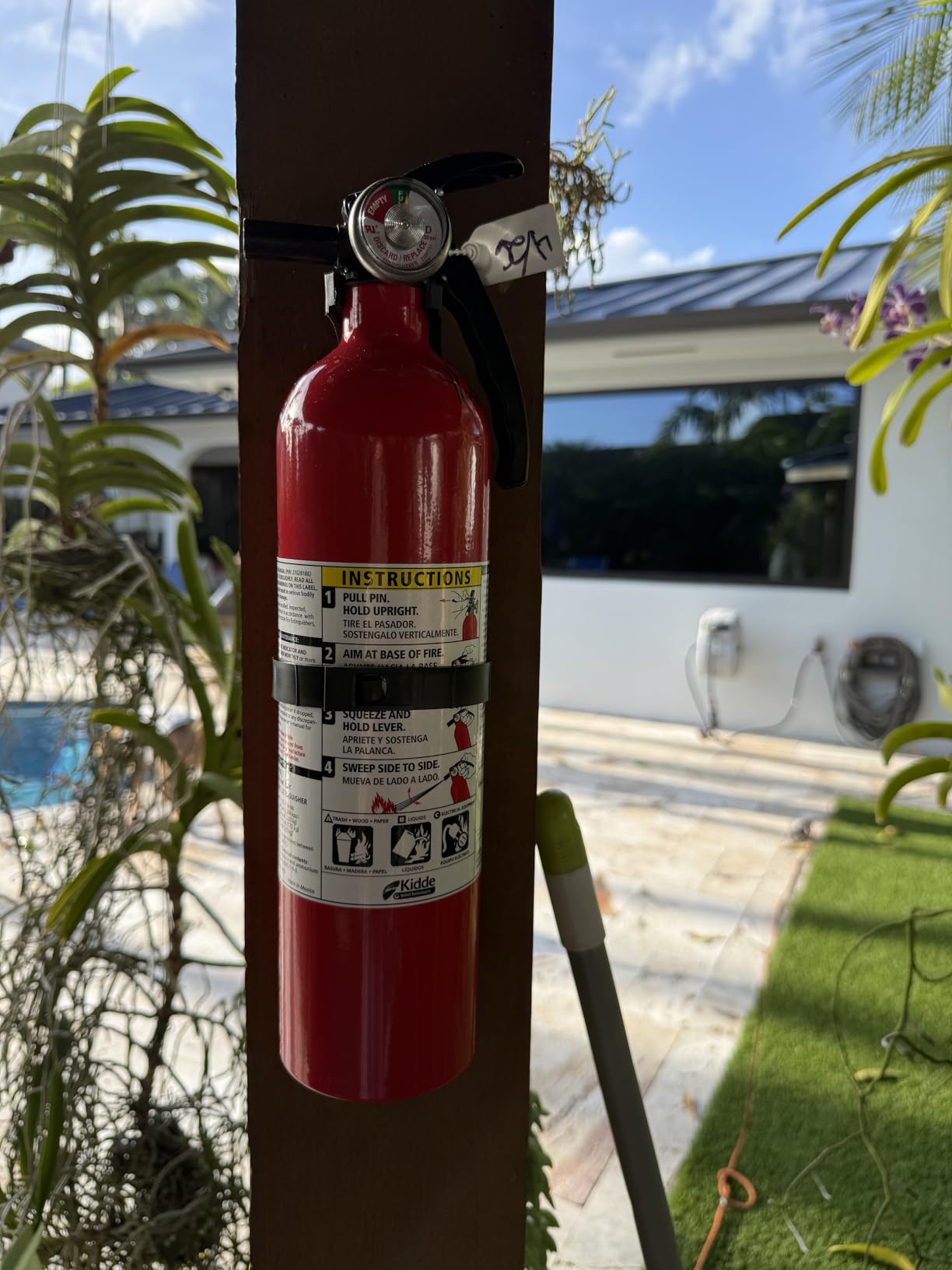
Buyers consistently point to the pressure indicator being readable from a step back, which matters more than it sounds. During a fire you are not leaning over the label, you are gripping the handle and looking at the bottom of the unit from four feet away.
It comes with a plastic strap mounting bracket and a QR code for product registration and service information. The bracket is adequate for drywall but thin on masonry, and because the unit is single-use, treat the six-year limited warranty as a defect window rather than a service life.
Why size matters more than you think
A 2.5-pound agent charge gives you a short burst. That is genuinely enough for a pan fire that has just started, which is the fire class a kitchen produces most often. It is not enough for a fire that has reached the cabinet above the range, and pretending otherwise is how people get hurt.
We recommend treating this as the first line of defense paired with a lid, a fire blanket and a working smoke alarm, not as the only thing between your family and a kitchen fire.
What a Kidde buyer should know
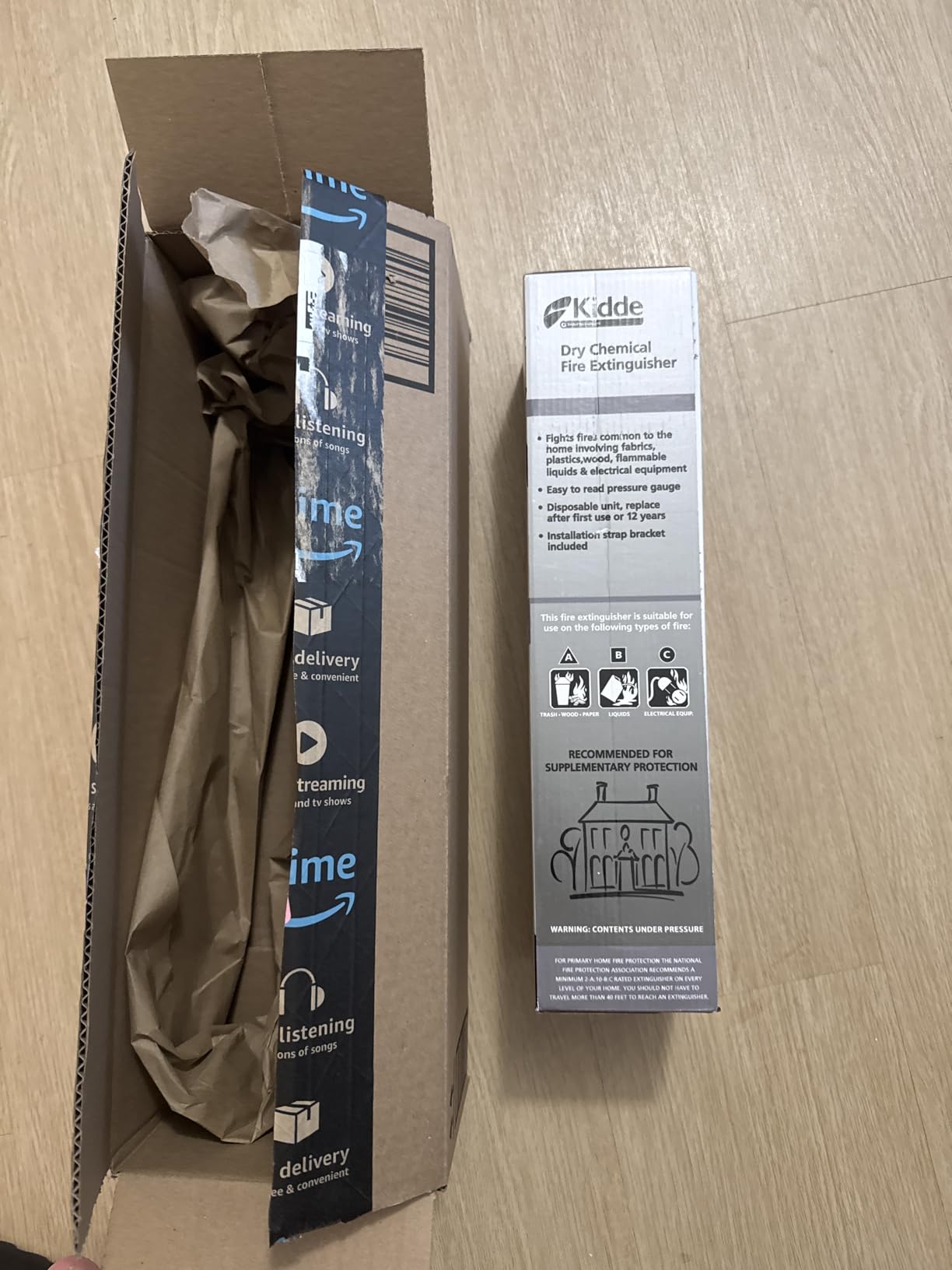
Kidde is a widely used brand with a long service history, and the concern some owners raise is older recall activity rather than anything about this model. The practical check is simple: look at the label for a UL listing mark and the manufacture date, keep the model number, and confirm the warranty status through the QR code on the label.
Because the valve is not serviceable, a unit that has been discharged or has lost pressure goes to household hazardous waste rather than back to the shelf. Plan for replacement rather than a recharge visit, which is the tradeoff for the lighter body.
3. First Alert EZ Fire Spray AF400 – Best Backup for People Who Hate Extinguisher Handles
- Discharges for about 32 seconds at the press of a button
- Biodegradable non-toxic formula that wipes clean
- Light can is easy to hold and operate
- Covers paper and fabric plus wood and grease and electrical fires
- Aerosol format covers far less area than a pressurized cylinder
- Suitable as a backup rather than a primary unit
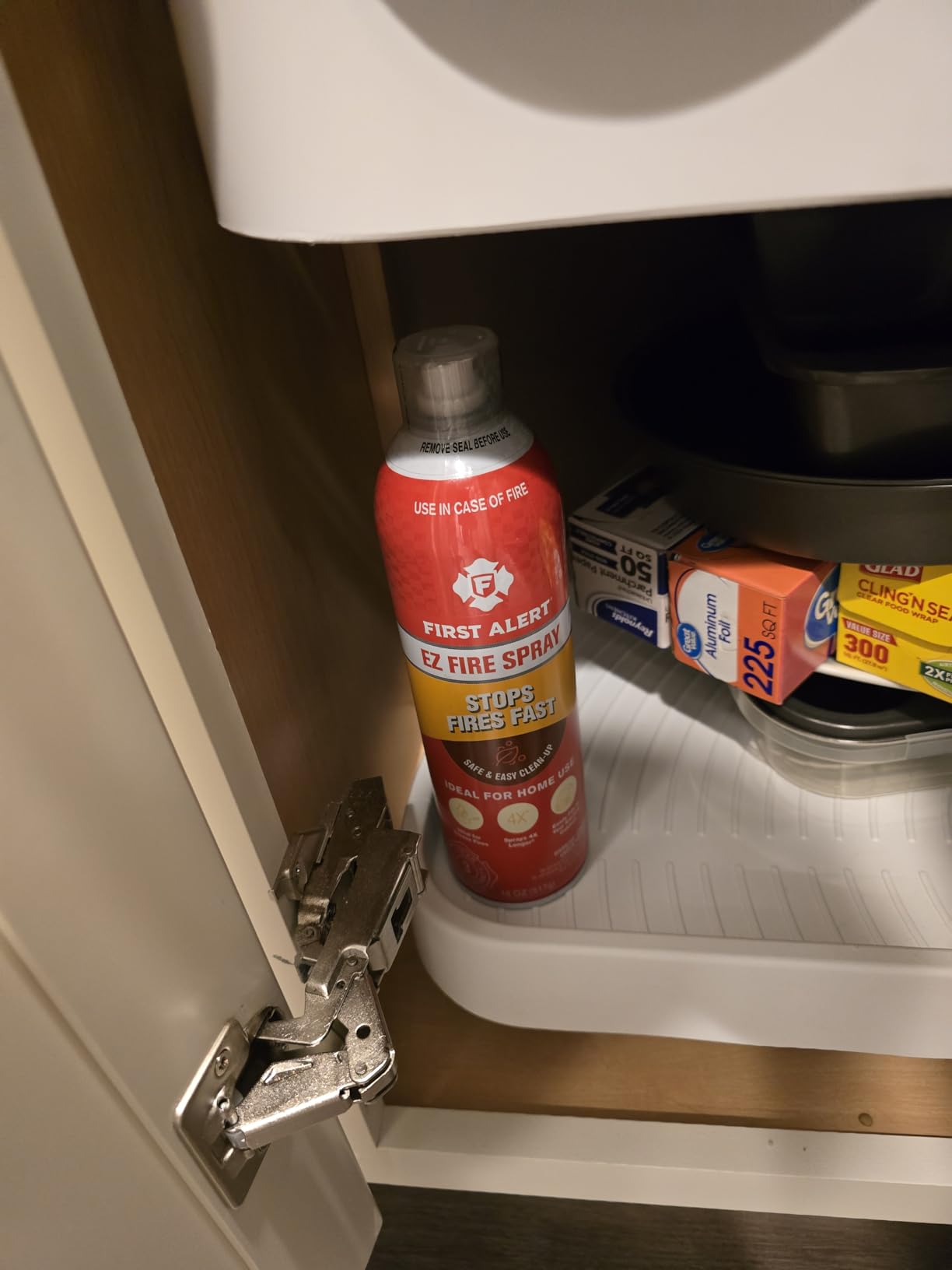
There is no pin, no lever and no gauge needle to read. You take the cap off and press the button, and the can discharges for roughly 32 seconds. For a household that has one extinguisher gathering dust because nobody can remember the pull-pin sequence, that changes whether it gets used at all.
The formula is biodegradable and non-toxic and it wipes clean, which is the practical reason to keep one of these in a kitchen. A dry chemical unit put out on a cooking surface leaves a film you will still be scrubbing an hour later, and around a toaster or an air fryer that film is corrosive.

Owners also like the size. The can is small enough for a drawer, a pantry shelf or a grill cabinet, and the same unit works in a garage, a boat or an RV. That portability is why it appears in so many first-aid and emergency kits.
The honest limitation is coverage area. An aerosol can puts out a stovetop pan fire or a wastebasket fire. It is not engineered to fight a fire that has climbed into cabinetry, and treating a small can as your only protection is the mistake we most want to avoid in this article.
The first-purchase path for a kitchen with nothing in it
For readers who came to this page owning zero fire equipment, the sensible sequence is a lid, a fire blanket and one of these cans. That trio covers the overwhelming majority of cooking fires in a home and lives in a drawer where it is visible.
Then add a pressurized ABC unit within a year. The aerosol buys you the seconds and the nerve, and the cylinder handles the fire that has already grown beyond a pan.
When this is the wrong choice
If you deep fry, run a wood burner next to the range, or cook in an open-plan room where a grease fire can travel, the discharge volume here is not enough. Deep fryers and grease fires produce heat output that a small aerosol will slow rather than stop.
It is also ETL rated rather than UL listed, with a 3-year limited warranty. That is a legitimate safety certification for a consumer aerosol, but if you want a UL mark on the label for an insurance or landlord requirement, choose a listed cylinder instead.
4. First Alert HOME2PRO – Most Versatile for Heavy Oil Cooking
- Higher 2-A:10-B:C rating than basic home units
- Rechargeable through certified professionals
- All-metal body with commercial-grade valve and trigger
- Wall hook and color-coded gauge included
- Manageable weight for its capacity
- Heavier and bulkier than a 1-A rated kitchen unit
- Too large for tight cabinet spaces
The number that separates this from every basic home unit is the 2 in 2-A:10-B:C. It is the rating that meets the common minimum code threshold for residential extinguishers, and it doubles the Class A capacity while keeping the same 10-B:C flammable liquid rating.
It uses monoammonium phosphate agent, which is the same chemistry as the smaller units but delivered from a larger charge. The practical effect is a longer burn time, which matters when the fire is bigger than a pan or when the pan is a deep fryer full of oil.
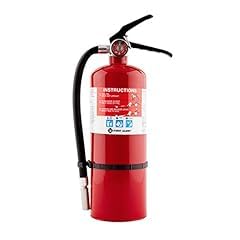
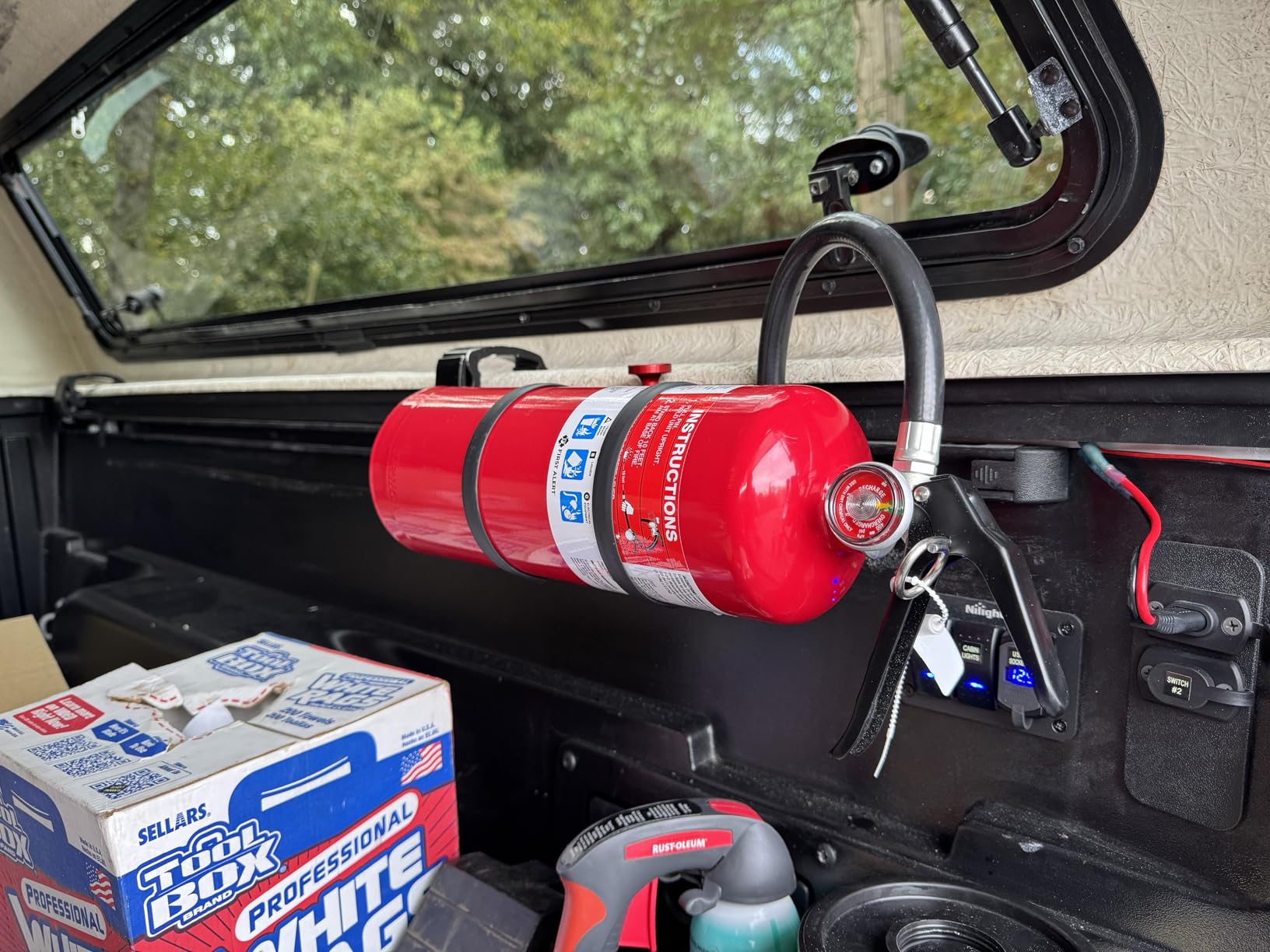
Everything structural is metal: cylinder, valve and trigger. That is the rechargeable build, so after a discharge the unit goes to a certified professional for a refill rather than to the trash.
The corrosion-resistant color-coded gauge is easy to check at a glance, and the included wall hook mounts high enough to stay out of steam and splatter while remaining reachable. Owners report the gauge holding green through garage and basement temperature swings.
When a 2-A:10-B:C rating matters
Class A is ordinary combustibles: wood cabinetry, paper, trash, cardboard. A 1-A unit covers one square foot of that material; a 2-A unit covers two. For a kitchen with wooden cabinets directly above the range, that extra capacity is the difference between knocking the fire down and having it re-ignite in the cabinet above.
If you have an open kitchen where a fire can spread into a dining area, or you cook with oil several times a week, this is the rating worth paying up for. For a galley kitchen with a tile backsplash and a metal range, the savings from a 1-A unit are real.
What you give up for the extra capacity
At 9.6 pounds and 17 inches tall, this is not a unit you tuck into a cabinet. It wants a wall bracket near the kitchen exit, where it stays cool and where you are not reaching over hot burners to grab it.
The weight is also a factor under panic. A larger charge is more firefighting capacity but requires a two-handed grip, so a smaller secondary unit mounted closer to the range is still a reasonable pairing rather than a luxury.
5. LifeSafe StaySafe All-in-1 – Best for Lithium-Ion Battery Fires
LifeSafe Technologies StaySafe All-in-1 Portable Fire Extinguisher, Compact Fire Spray Easy to use on 10 Types of Fires, Non-Toxic & Eco-Friendly
- Covers cooking oil and lithium-ion battery fires
- Liquid formula safe on energized wiring up to 1000V
- Compact enough for a drawer or a motorcycle or vehicle door panel
- Non-toxic and leaves no residue to wipe up
- Protective cap keeps kitchen grease off the spray button
- Must be shaken periodically or the agent may not dispense
- Small capacity limits sustained firefighting
Air fryers, e-scooters, cordless tools and laptops all changed what a kitchen fire can be. A lithium-ion cell can re-ignite after it appears out, and the thermal runaway produces its own oxygen, which is why a standard dry chemical unit does not reliably stop one.
This is the only unit in our group explicitly formulated for lithium-ion battery fires, and it uses a liquid agent rather than a dry powder. It is safe on energized electrical fires up to 1000V, which also means you can spray an in-wall outlet or a powered appliance without a worry about conductivity.
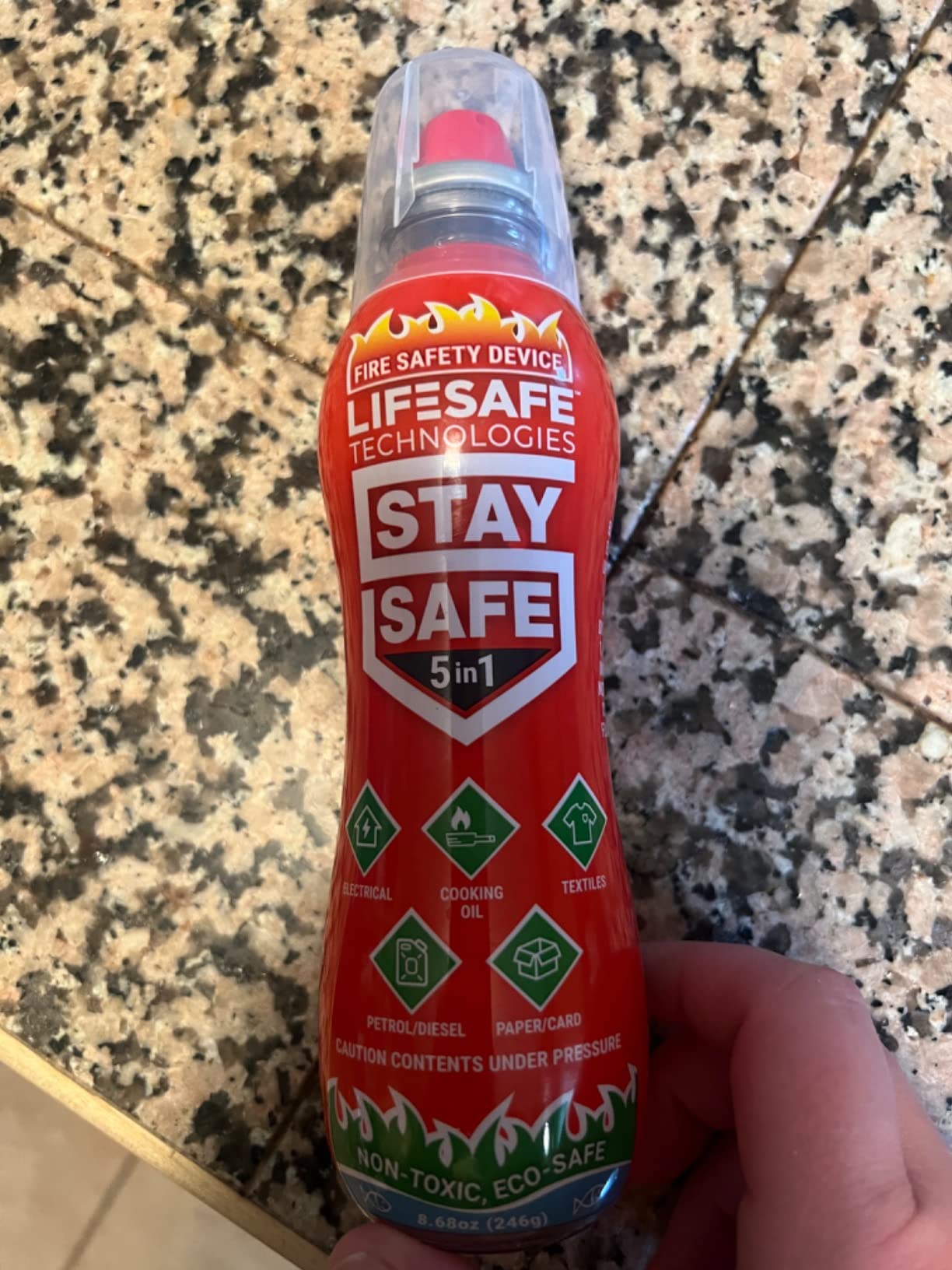
The agent is non-toxic and non-hazardous and leaves no toxic residue, so there is no cleanup step after a knockdown near a laptop or a phone charger. Buyers mention the protective cap as a small but real detail: it stops kitchen grease from settling on the spray button.
Owners also flag the one maintenance habit nobody remembers: shake the can periodically. A liquid agent that has settled can fail to dispense properly at the moment you need it, so treat it like any other periodic kitchen check.
What a lithium-ion fire changes in the plan
A battery fire is best handled by removing the fuel: unplug the appliance, move the device away from anything flammable if you can do so safely, then apply extinguishing agent. A dry chemical ABC unit will knock down flames but does not reliably stop thermal runaway, and the cell can reignite hours later.
That is why we treat this as a companion rather than a replacement. Keep it near the air fryer outlet or the charging station, and keep a standard ABC cylinder mounted by the kitchen exit for the cooking fires it does not cover.
What to watch before you buy
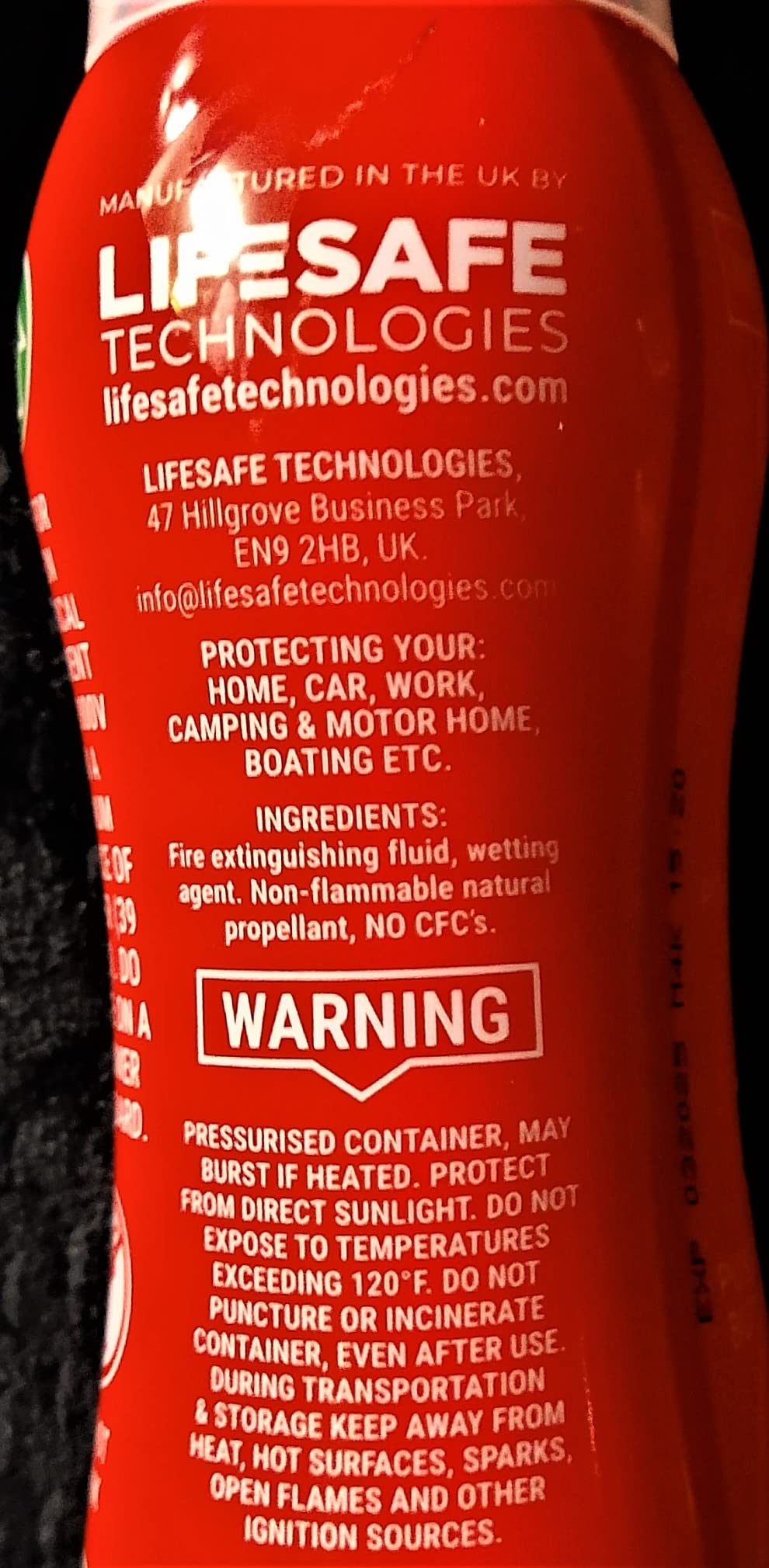
Several owners report buying it for peace of mind without ever testing it, and a small can is not a substitute for a full cylinder. Coverage area is limited, and a fire in a grease-filled pan outruns a 9.9-ounce agent quickly.
The listing states the fluid is tested and approved by third-party facilities against recognized standards, but no warranty length is stated on the packaging. If a written warranty matters to you for an insurance or landlord requirement, pick a cylinder with a stated term.
6. AmzBoom 2-Pack – Best for Renters and Multi-Room Placement
- Water-based non-toxic formula leaves no residue
- Handles cooking oil plus gasoline and lithium-ion battery fires
- 6-year warranty
- Small capacity makes it supplemental rather than a replacement
- Canisters are smaller than photos suggest
- Aerosol-style rather than a pressurized cylinder
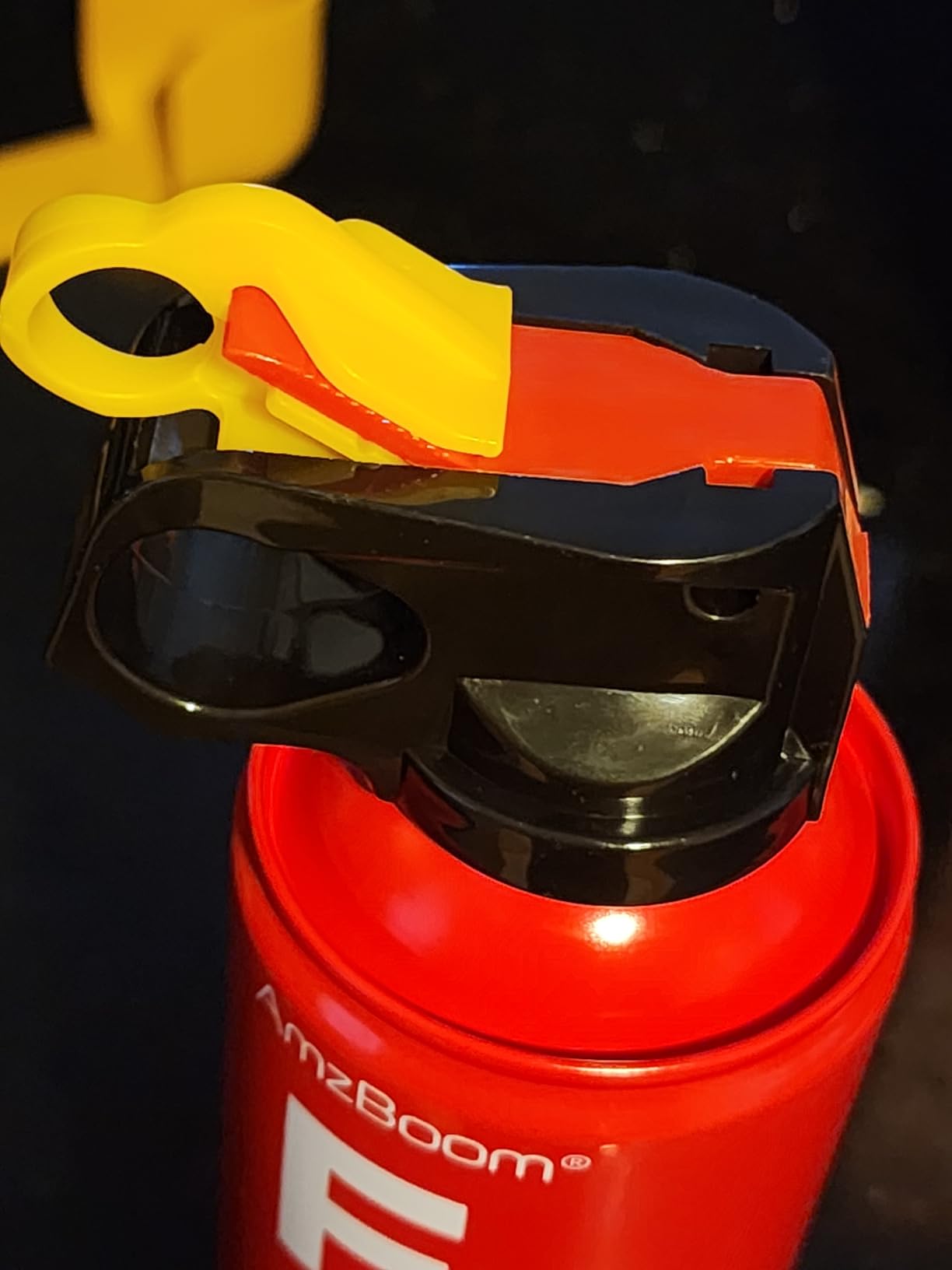
Renters are the group most underserved by kitchen extinguisher advice, because the obvious solution is a bracket screwed into a cabinet wall. This pack arrives with two mounting brackets and uses a press-and-spray activation that needs no pull pin, no lever and no gauge to read.
Activation is press, aim and spray. That is genuinely simpler than the PASS sequence, and it is the reason we would put one of these in the hands of an older adult who has never used a pressurized extinguisher.
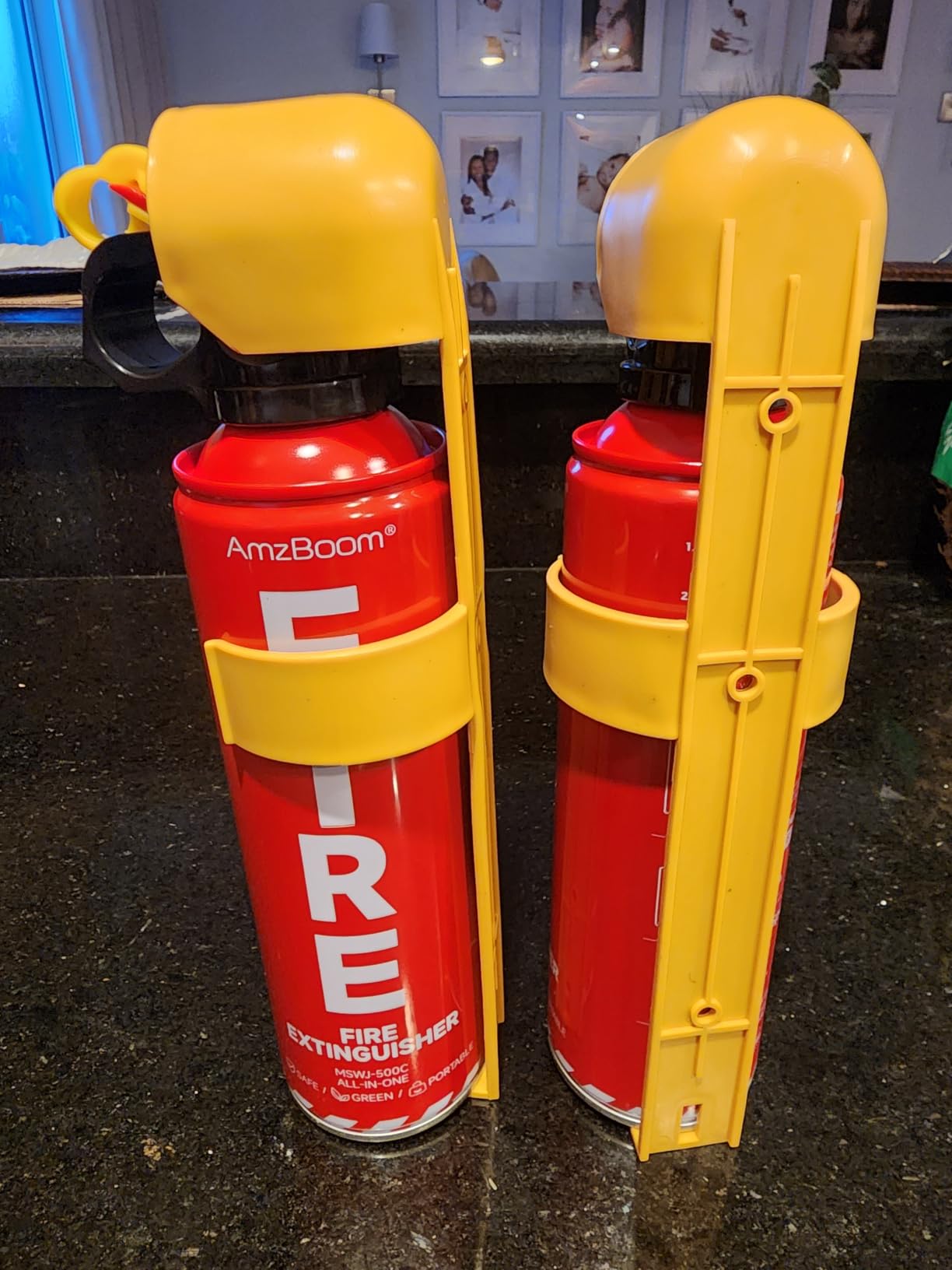
The water-based non-toxic formula leaves no residue, so a knockdown next to a cooktop or a power strip does not create a corrosive cleanup job. Rated coverage spans wood, cooking oils, gasoline and lithium-ion battery fires, which makes it a genuinely broad small-fire unit.
The two-pack solves a second problem: a single canister in a small kitchen means you back up away from the fire and the unit is on the wrong side of you. Two placements, one by the range and one by the exit, remove that problem entirely.
How to mount without drilling
The included brackets are the whole point for apartment dwellers. If your lease forbids holes, adhesive-backed mounts and a cabinet interior shelf work fine, and keep the canister upright with the nozzle accessible rather than lying on its side.
Position it on the way out of the kitchen, not above the range. An extinguisher mounted over the cooktop has to be reached through the flame front, and mounting it too close means smoke and falling grease reach it first.
Where it does not replace a cylinder
Reviewers are consistent that the canisters are smaller than they look in photos, and that the pair is supplemental protection. A small water-based canister will handle a first-year grease flare-up and nothing approaching a developed fire.
If you own a home, add a rechargeable ABC cylinder within the year and use this pack as the accessible first-response tool. If you rent, this is a reasonable standalone answer for a small kitchen where drilling is not an option.
7. Kidde KD143-210ABC – Best for Code Compliance and Inspection
Kidde Living Area Fire Extinguisher for Home, 2-A:10-B:C, KD143-210ABC
- 2-A:10-B:C rating gives more power than basic home units
- Manageable 4 lb size usable by older adults
- Metal valve with impact-resistant handle
- Reported to satisfy home inspection requirements
- Wall hanger included
- Wall hanger mounting hardware not included
- Residential single-use only
This is the interesting middle of the size range. It holds 4 pounds of monoammonium phosphate agent, carries the same 2-A:10-B:C rating as units twice its size, and discharges in 13 to 15 seconds with a 12 to 18 foot effective range at 100 PSI operating pressure.
Those published numbers are what we would want before buying a kitchen unit. Discharge time tells you how long you can work the fire before the agent runs out, and effective range tells you whether you can stand safely back or whether you have to stand over the pan.
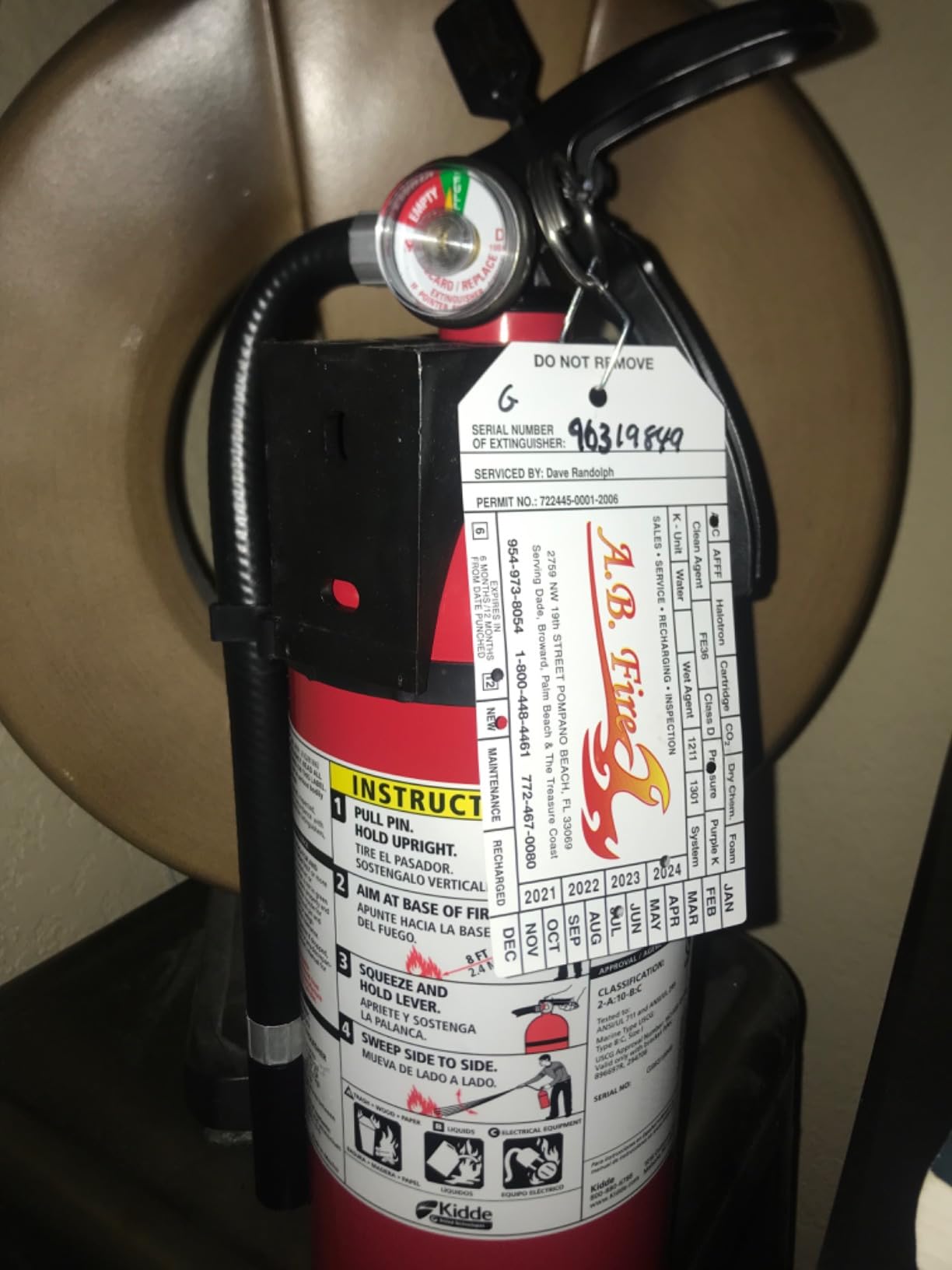
Owners consistently report it passing home inspections and satisfying licensing or rental requirements, and the reason is the printed 2-A:10-B:C UL rating combined with the metal valve assembly. If a landlord or inspector asks for documentation, the label is your documentation.
The easy-pull safety pin with a rust- and impact-resistant handle is a smaller detail than it sounds. A corroded pin is a real failure mode in a humid kitchen, and a pin that will not pull is worse than no extinguisher at all.
Why 4 pounds is the sweet spot for many kitchens
Ten pounds is difficult to lift and control in a panic, and 2.5 pounds runs out quickly on anything past a first pan fire. Four pounds with a 13-15 second discharge sits between those, and the 12-18 foot range lets you stand at arm’s length from the fire rather than leaning over it.
For most home kitchens we would put this size ahead of the 9.6-pound HOME2PRO on handling alone, unless you fry heavily or need the higher capacity for a reason.
The one complaint worth planning around
The most repeated review note is that the UL-approved plastic wall hanger arrives without the screws. That is a two-minute fix with hardware store screws, but it is the kind of small annoyance that turns into a canister sitting on the counter, which is effectively the same as no extinguisher.
It is also single-use residential, so once discharged it is replaced rather than recharged. Budget for a replacement after the first real use, and check the gauge monthly so you know the condition before you need it.
8. Ougist 4-Pack Water-Based Foam – Best for Spreading Coverage Around the Home
- Four canisters allow placement throughout the home
- garage
- vehicle and office
- Water-based foam leaves no sticky residue
- 13-foot spray distance allows knockdown from a safer position
- Wall brackets and 16 screws included
- Small enough to store in a glove box or under the sink
- Mini size limits sustained firefighting compared with cylinders
- Best treated as supplemental rather than primary protection
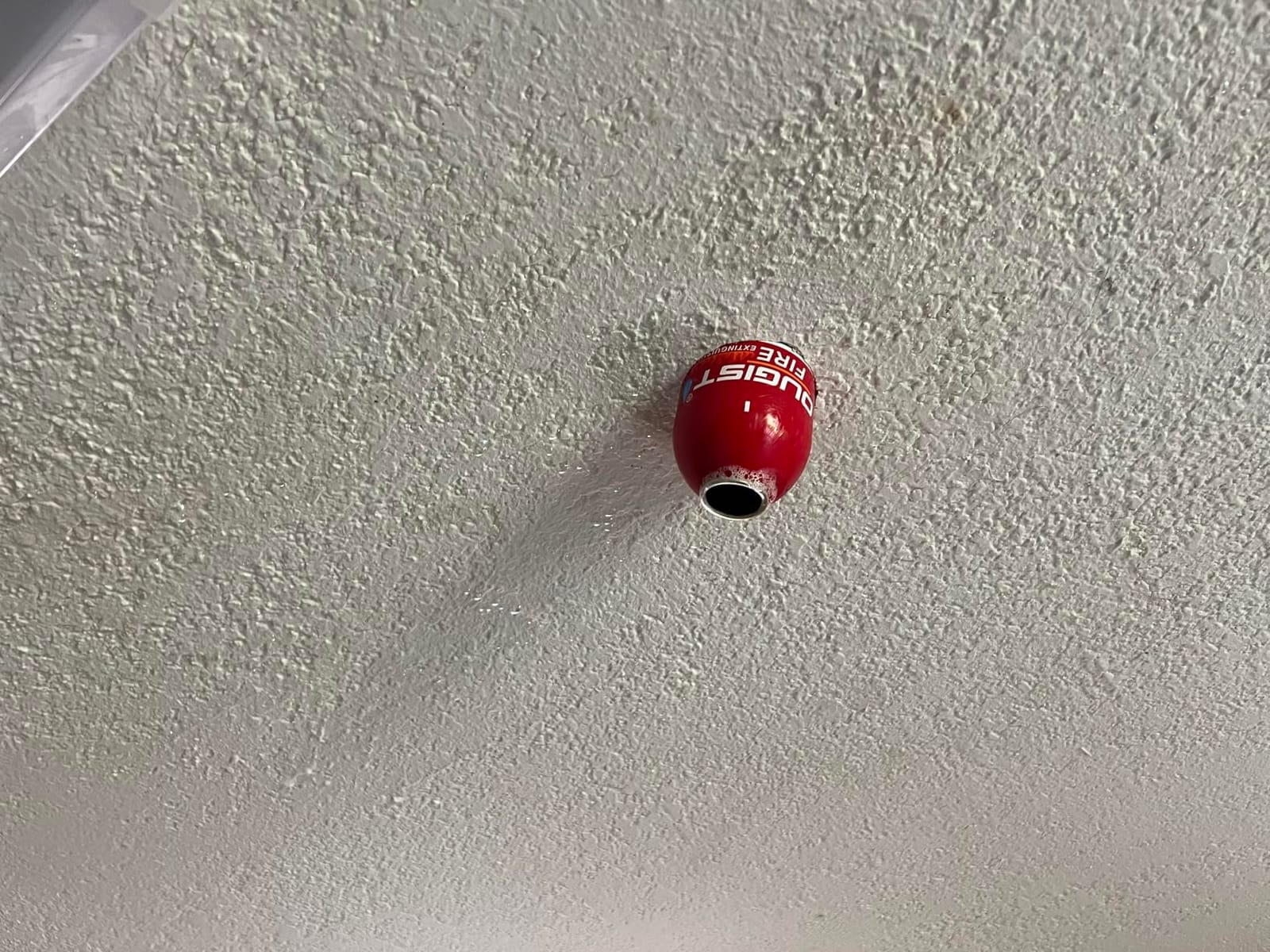
Each canister holds 21 ounces and measures 3.3 by 2 by 11.7 inches, which is small enough for a kitchen drawer, a vehicle glove box or a cabinet beside a built-in grill. The pack includes four canisters, four mounts and 16 screws, so nothing needs a separate hardware run.
The water-based foam formula handles kitchen grease, electrical, liquid and small surface fires and leaves no powder or sticky residue behind. That residue-free claim is the reason it fits a kitchen at all: no corrosive film on a stainless range or a countertop control panel.
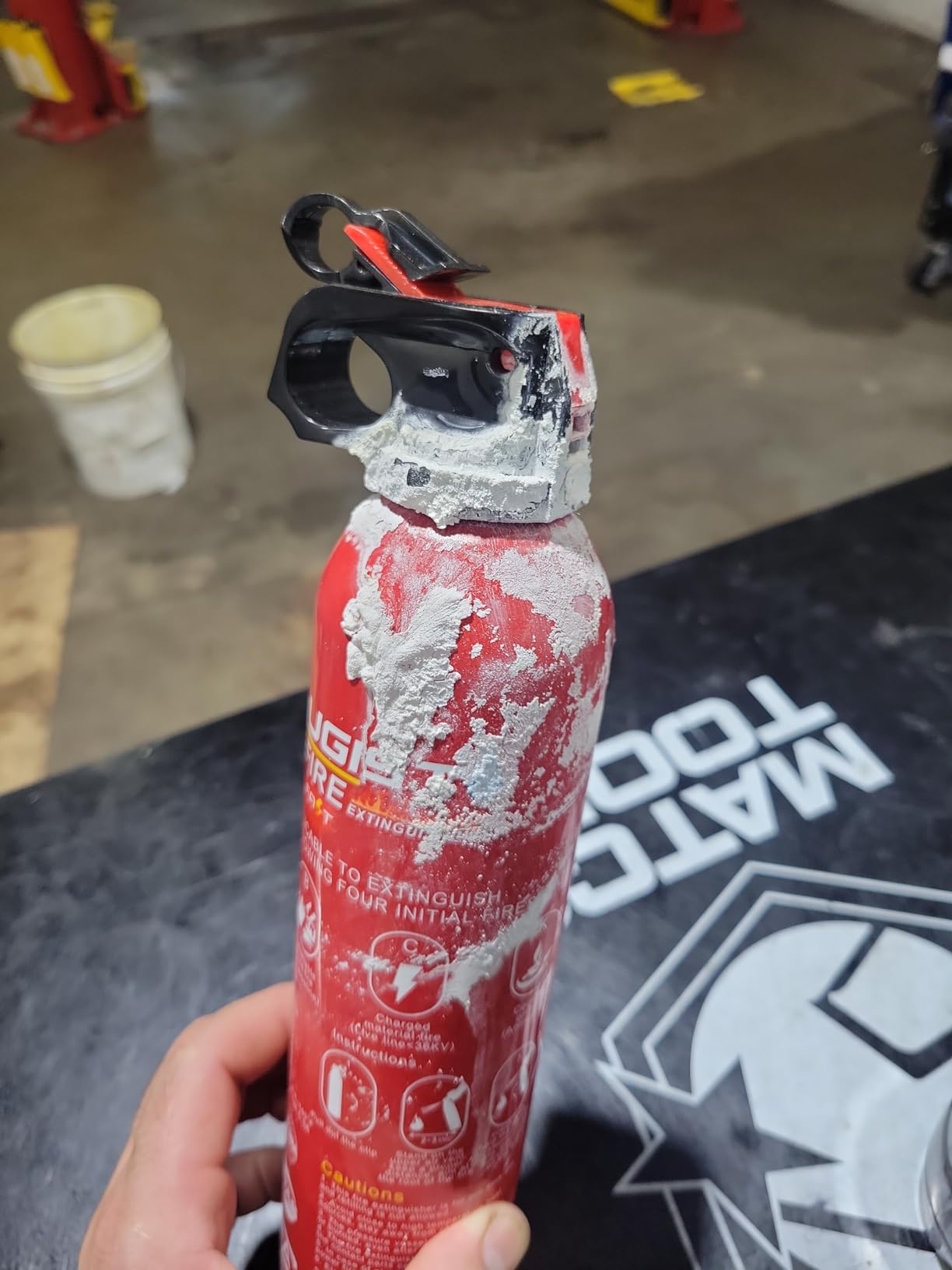
Push-button activation keeps it simple, and the 13-foot maximum spray distance means you can knock a fire down from a safer position than the pan itself. Reviewers treat the pack as good value for spreading small protection around several rooms rather than concentrating it in one.
Placement planning is the smart way to use this pack: one by the kitchen exit, one near the laundry area, one in the garage or near a grill, and one in the vehicle. Fire extinguishers earn their keep by proximity, not by count.
Supplemental versus primary protection
Be clear about what 21 ounces can do. It is built for small surface fires and first-response knock-down, and reviewers describe it as supplemental to a full extinguisher rather than a stand-in for one.
Used in that role it spreads four mounted points of coverage through the house, with none of the powder cleanup that follows a dry chemical discharge.
Watch the temperature range
These are intended for indoor, ambient-temperature storage. Do not leave a canister in a garage that freezes hard or in a car parked in summer sun, because a pressurized water-based canister is more sensitive to temperature extremes than a dry chemical unit.
Check the label for the stated storage range and follow it. If your kitchen includes a detached garage or a covered outdoor kitchen, put a separate canister there rather than moving one in and out.
9. Amerex B417T – Best for All-Metal Build and Heavy-Duty Feel
Amerex B417T, 2.5 Pound ABC Dry Chemical Class A B C Multi-Purpose 2.5 Pound Fire Extinguisher with Wall Bracket
- Heavy-duty steel construction with all-metal fittings
- 2.5 lb ABC rating covers the common household classes
- Comparable build to units supplied by alarm companies
- Wall bracket included for mounting
- Solid feel with good discharge reserve
- Wall mount is occasionally absent from the box
- Included bracket is a basic hook rather than a strap stand
- Heavier than typical kitchen units
The Amerex B417T is built harder than most units its size. It is a 2.5 pound ABC dry chemical extinguisher with all-metal fittings and no plastic components in the valve path, and it is a noticeably solid object in the hand.
Buyers comparing it to equipment supplied by alarm companies find the build comparable while costing materially less, and the wall bracket means it mounts without a separate purchase. ABC dry chemical is the broad default agent for a home, covering wood, paper, trash, plastics, gasoline, oil and electrical fires.
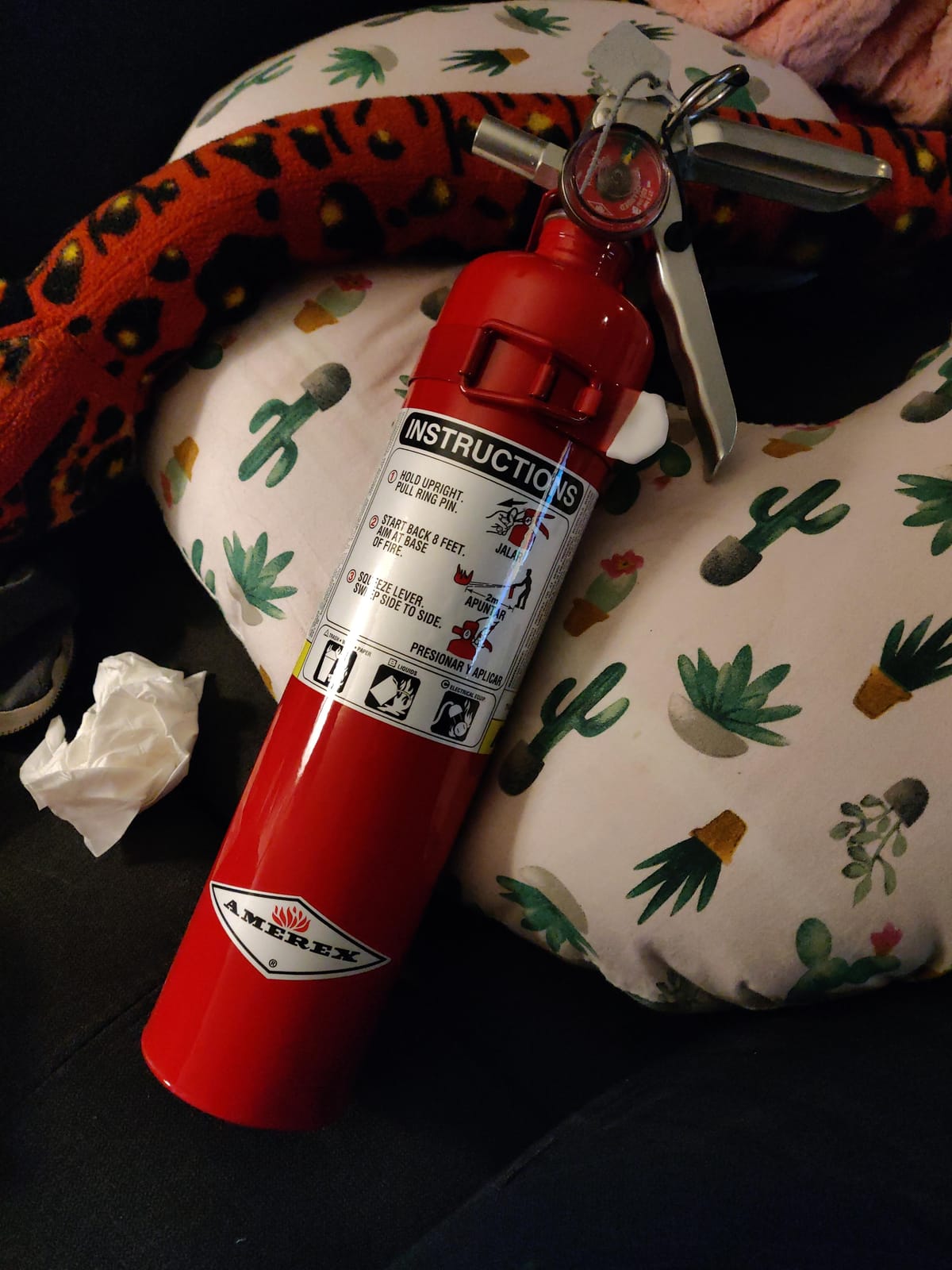
At 5 pounds and 16 inches tall it is heavier than most kitchen units, which cuts both ways. It stays planted when you squeeze the trigger, and it is a two-hand lift if your arm is not at full strength.
The dry chemical agent is the familiar compromise: fast knockdown on grease and electrical fires, and a powder residue that needs sweeping and, near electronics, damp wiping with care because the powder is mildly corrosive.
Who should choose this one
If you want a conventional cylinder with a metal build and you are less worried about the smaller 2.5 pound charge, this is a solid general-purpose pick. It suits a garage-adjacent kitchen or a home where the same extinguisher will cover a workshop as well as a cooktop.
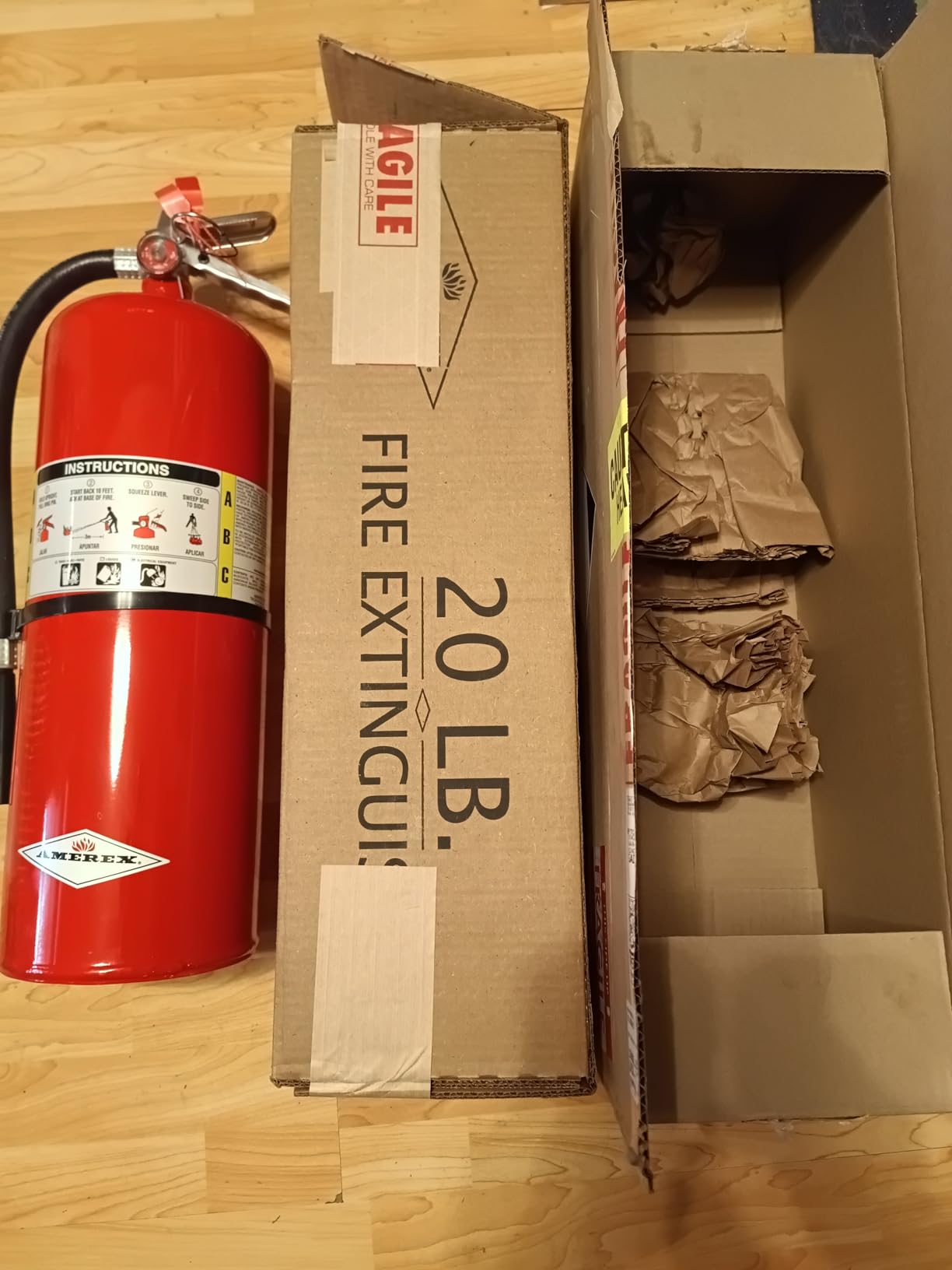
Check the box on arrival. The recurring review note is that the wall mount is occasionally absent from the packaging, so open it before you leave and confirm the bracket is inside.
The size caveat
Two and a half pounds of agent is a short burst. It handles a first-stage fire and it will not handle a fire that has reached the cabinets, which is exactly the moment most people expect a home extinguisher to perform.
If your kitchen has wooden cabinetry above the range, step up to a 4 pound unit with a 2-A:10-B:C rating. The added capacity is what separates a fire you can put out from one you should evacuate.
10. Ougist FF1KG – Best for Pinless Operation and Older Users
- Pinless quick-release handle needs no twisting
- 1-A:10-B:C dry chemical handles grease and electrical and fuel fires
- Compact carbon steel body fits under a sink or a trunk
- Wall-mount hook plus inspection card and location sign included
- Clear pressure gauge showing charge state
- Dry chemical agent leaves a powder residue to clean up
- Single-use residential unit
The patented quick-release handle removes the safety pin without twisting or pulling. Under stress, that single design decision is worth more than any spec on the label, because the most common reason a fire extinguisher sits unused is that the pin will not come loose.
The rating is a UL-style 1-A:10-B:C for Class A, B and C fires, which covers the standard kitchen set: wood and paper, flammable liquids including cooking oil, and electrical faults. The thick-wall carbon steel body weighs 4.4 pounds, a manageable size for a single-handed grip.
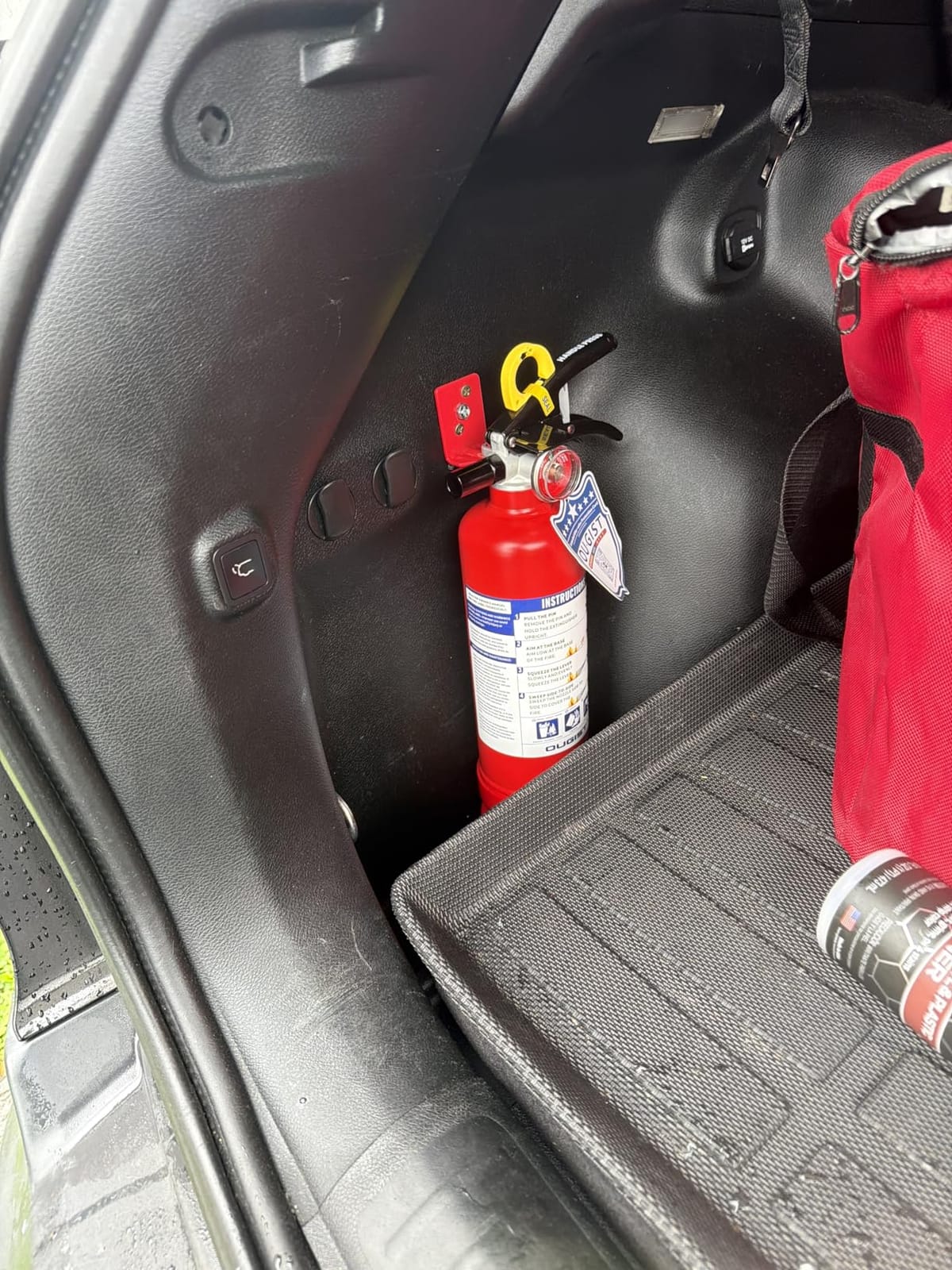
The box includes more than the extinguisher: a wall-mount hook, a monthly inspection record card, an owner’s manual and a self-adhesive location arrow sign. The inspection card is a small thing that turns monthly checking into a habit instead of an intention.
The listed temperature range runs from 140F down to -22F, so it tolerates a range of storage environments a typical home cycles through between seasons. The clear pressure gauge shows charge state at a glance.
Pinless versus a traditional pull pin
A traditional pin and tamper seal protects against accidental discharge, which matters in a house with small children or a unit stored in a busy spot. The tradeoff is friction at the moment of use, and the pinless handle removes that friction entirely.
If you are buying for an older adult, someone with limited hand strength, or anyone who has told you they would be embarrassed fumbling a pin in front of their family, this is the design that solves the actual problem.
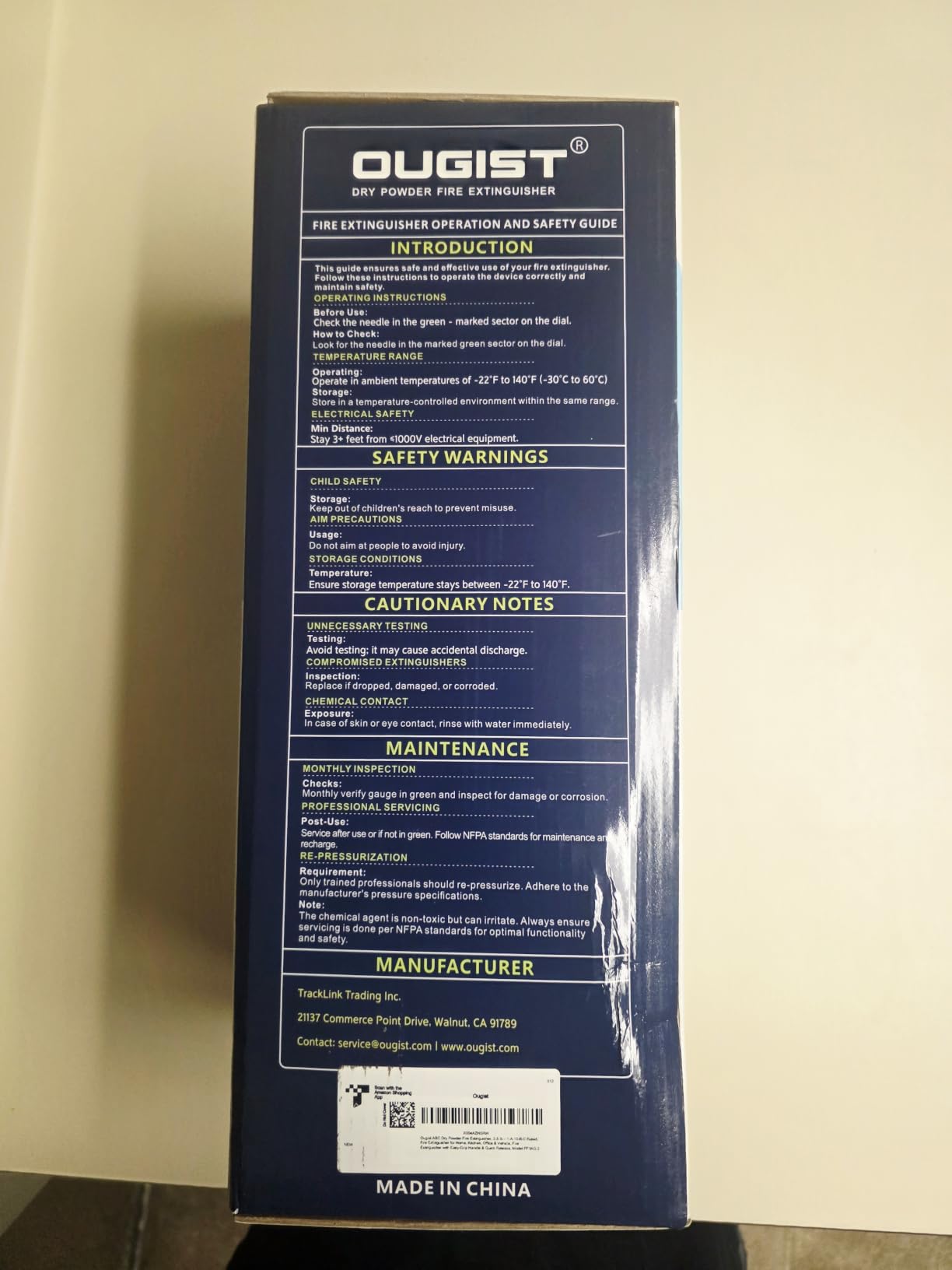
What the label does and does not give you
The dry chemical agent is monoammonium phosphate type powder, so expect a residue that needs sweeping and light damp cleaning, and avoid spraying it directly onto a computer, a television or a control panel where a corrosive film can do real damage.
It is a single-use residential unit, and it is described as a UL-style rating rather than a listed certification in the listing. If a landlord or insurer specifically requires a UL listing mark on the label, verify the mark on the physical cylinder before you buy.
How to Choose a Kitchen Fire Extinguisher
Start with the fire your kitchen actually produces. Cooking oil, grease and cooking fats are Class B flammable liquids. Fires involving cooking media are classified separately as Class K. Electrical fires from an outlet, a toaster or an air fryer are Class C, and ordinary combustibles like wood cabinets and paper towels are Class A.
Water is Class A only. Using it on a grease fire causes a violent steam expansion that can fling burning oil across the ceiling and ignite it. That is the single fact that separates a kitchen extinguisher from a general-purpose one, and it is why agent type matters more than brand.
Reading any UL rating at the store
The label is written in a shorthand that looks dense until you know the pattern. The first number and letter pair is the Class A capacity in square feet of wood and paper, then each fire class you should not think about separately. Read it left to right.
A 1-A:10-B:C covers one square foot of ordinary combustibles, 10 square feet of flammable liquid and any electrical fire. A 5-B:C is a pure Class B and C unit with no wood and paper coverage at all, which is why it works well in a kitchen where cabinetry is metal or tile. A 2A:K is a commercial wet chemical rating aimed at cooking media, and a 1-A:10-B:C is the residential default.
Multiply the A figure by the square footage of the combustible material near your range. Two square feet is a small cabinet or two, which is a realistic assumption for many kitchens. If yours runs to a full wall of wooden cabinetry over the cooktop, buy the 2-A rating rather than the 1-A.
If you cannot find a rating on the label at all, put the unit back on the shelf. An unrated canister is the fastest route to a household hazard, and the reason shoppers on forums care most about the printed listing is that it is the one claim that is independently verifiable.
Matching the agent to the cleanup you can live with
Monoammonium phosphate is the most common residential agent and the fastest on grease. It is also mildly corrosive and leaves an abrasive powder that gets into control panels and scratches finished metal. Sodium bicarbonate-based units are gentler on surfaces but more limited on the fires they cover.
Wet chemical Class K agents saponify cooking fat into a soap-like foam that cools the oil and forms a barrier against re-flash, which is why commercial kitchens use them. They are the most effective option on a deep fryer and the least convenient to buy for a home kitchen.
Water-based foam and aerosol sprays are the residue-free options. They clean up with a wipe, they are safe near electronics and children, and they cover far less area than a pressurized cylinder. Many households keep one of these in a drawer and a full cylinder on the wall, which is the pairing we would build.
Size and capacity, answered directly
For a typical home kitchen, a 2.5 to 5 pound unit covers the realistic stovetop fire. Anything larger is holding more agent than a single pan fire requires. Ten-pound cylinders belong in garages, workshops and open-plan living spaces, not next to a cooktop.
The 5 pound versus 10 pound question usually leaks in from whole-home buying, and for a kitchen specifically the answer is usually neither. A 2.5 pound kitchen-rated unit plus a 5 pound ABC cylinder covers a single room better than one 10 pound canister you cannot lift one-handed.
Judge capacity by discharge time and range rather than weight alone. The Kidde KD143 gives 13 to 15 seconds of discharge at a 12 to 18 foot range, and the aerosol canisters give around 32 seconds but from a much shorter and weaker stream. Long seconds from a small can is not the same as long seconds from a large cylinder.
Rechargeable versus disposable
Rechargeable units have a metal valve and are serviced by a certified professional after discharge, so the same canister serves a household for a decade or more. Disposable units use a plastic valve and a sealed assembly, are cheaper, and go to hazardous waste after one use.
Over a twelve-year service life, owning two or three single-use cans that replace each other costs meaningfully more than servicing one metal-valve unit, and the metal build survives the humidity and grease of a kitchen better.
There is a reasonable middle case for disposables in small apartments and rental situations, where a service visit is inconvenient and a compact unit is easier to store.
Mounting, reach and maintenance
Mount the extinguisher on the way out of the kitchen, at roughly 3.5 to 5 feet off the floor, visible from the room and not above or beside the range. An extinguisher over the cooktop has to be reached through the fire, and one behind a cabinet door is one you will not open in time.
Check the pressure gauge monthly and keep it in the green. Confirm the safety pin and tamper seal are intact, and if the canister holds dry chemical, shake it every few months so the powder does not compact at the bottom. Replace a disposable unit on the manufacturer schedule or as soon as the gauge leaves the green zone.
If you also cook outdoors, the same proximity logic applies near a grill. Our propane fire pit table picks all call for a mounted extinguisher within reach of the cooking area rather than one stored in the house.
Know when to stop. If the fire reaches the ceiling, if the room fills with smoke faster than you can stay low, if there is no clear path behind you, or if the first burst does not knock it down, get out, close the door behind you and call emergency services from outside.
We also keep a fire extinguisher guide for electronics labs on hand, because a corrosive dry chemical agent near a bench full of equipment is a decision worth planning in advance rather than after a spill.
Where to Mount It, How to Use It and When to Stop
There are three things that have to be true for any extinguisher to help you: you can reach it in seconds, you can lift it, and you know how to discharge it. A canister in a high cabinet fails the first test no matter what is printed on the label.
The PASS sequence, step by step
Pull the pin with a firm straight motion, aim the nozzle at the base of the flames from about six feet back, squeeze the handle to start the discharge, and sweep side to side across the base of the fire until it is out. Aim at the base, because the fuel is at the base and extinguishing the flames alone lets the heat soak back in and re-ignite.
For a grease fire, work the discharge across the pan at the level of the oil rather than straight down into it from high above. A hard vertical stream can push burning fat out of the pan.
Have your back to a clear exit before you squeeze. If you are not sure you can leave, do not start.
A monthly five-minute routine
Look at the gauge and confirm the needle sits in the green. Check that the pin and tamper seal are intact and that the safety seal is unbroken. Shake a dry chemical canister so the powder lifts off the base. Confirm the unit is where you left it and that the path to it is clear. Replace anything that fails a check rather than hoping.
A discharged unit goes to household hazardous waste rather than the regular bin, and a low-pressure rechargeable unit goes to a service company that refills it. Neither belongs in the trash.
The conditions that mean get out
Smoke at ceiling level, a fire that has spread past the pan, flames reaching above the range, a kitchen you cannot cross in a crouched position, or a fire you have already emptied one canister into without effect. In each of those cases the extinguisher is no longer the right tool.
Leave, close the door, call emergency services and do not re-enter. A kitchen fire that is contained is a save-a-pan event. A kitchen fire that is not contained is a building event, and no home canister changes that.
Related reading for anyone covering a second cooking space: our picks for tabletop fire pits on patios cover the same maintenance logic in a much less enclosed setting.
Frequently Asked Questions
What type of extinguisher should I use for a kitchen fire?
For a grease or cooking oil fire, use a BC sodium bicarbonate or Class K wet chemical extinguisher, or an ABC dry chemical unit, which is the most widely available option. Never use water, which flashes into steam and can throw burning oil across the room. Always turn off the heat or cover the pan with a lid first.
What fire extinguishers should be in a kitchen?
Most kitchens need two devices: one pressurized ABC or BC cylinder rated 1-A:10-B:C mounted near the kitchen exit, and one smaller residue-free water-based aerosol or foam unit kept in an accessible drawer. A fire blanket and a fitted pan lid complete the setup. Add a Class K wet chemical unit only if you deep fry heavily.
What size fire extinguisher should I use in my kitchen?
A 2.5 to 5 pound unit covers the realistic stovetop fire in a typical home kitchen. Choose 4 pounds with a 2-A:10-B:C rating if you have wooden cabinetry above the range, and choose 5 pounds for heavy oil cooking. Ten-pound cylinders are for garages, workshops and open-plan spaces rather than a cooktop.
Do I need a 5 lb or 10 lb fire extinguisher?
For most kitchens, neither is the best answer. A 2.5 pound kitchen-rated unit mounted near the exit, paired with a 4 to 5 pound ABC cylinder, covers a single kitchen better than one 10 pound canister you cannot lift and control one-handed under panic. The 10 pound size adds capacity a single pan fire does not need.
Are First Alert fire extinguishers rechargeable?
It depends on the model rather than the brand. Models built with a metal valve and metal trigger, such as the First Alert Standard Home Use and the HOME2PRO, are rechargeable by a certified professional after discharge. Units built with a plastic valve and handle are single-use residential models and are replaced instead of serviced.
How long does a kitchen fire extinguisher last?
Check the gauge monthly and keep the needle in the green. Rechargeable metal-valve units can be serviced repeatedly over many years, with warranties commonly running six to twelve years. Disposable units should be replaced when the gauge leaves the green zone, when the pin seal breaks, or on the manufacture date printed on the base.
The Bottom Line on the Best Fire Extinguishers for Kitchens
The First Alert Standard Home Use is the pick we would put in most kitchens, because a 1-A:10-B:C rating in a rechargeable all-metal body covers grease, electrical and cabinet fires with one device. The Kidde Basic 110 gets you the same UL rating in a lighter, cheaper body if storage space is tight, and the First Alert HOME2PRO is the answer when you want the higher 2-A:10-B:C capacity for heavy oil cooking.
Pair whichever cylinder you choose with a lid, a fire blanket and one residue-free spray unit in a drawer, mount it 3.5 to 5 feet off the floor on your way out of the kitchen, and check the gauge every month. If you want to narrow it further, the decision comes down to your cooktop: gas or induction, how much deep frying you do, and whether you can drill for a bracket or need an adhesive mount.