

Every dust collector advertises airflow. Almost none of them publish the number that actually decides your purchase, which is how tall the machine is and whether it eats a parking bay. That is the whole problem with searching for the best dust collectors for small garages: the popular answers are sized for shops with 900 square feet of clear floor and a dedicated equipment wall.
A one-car garage is a different problem. You have roughly 8 feet by 20 feet of usable space, the car still has to fit on weekends, and the ceiling is often 7 feet 6 inches, not 9. That means the machine choice starts with footprint and height, not CFM. I compared ten collectors and separators against those constraints, and the winners cluster into two camps: bucket-mounted cyclones that cost almost nothing and pair with a shop vac you may already own, and dedicated powered collectors for people running a planer or jointer.
The forum debate is worth hearing before you spend anything. On r/woodworking, the single most repeated thread title in this niche asks whether a dedicated dust collection setup is worth it in a home garage shop, and the answers split almost evenly between “I regret buying the big one” and “I regret waiting.” The consensus detail that shows up again and again is that people who started with a shop vac and a cyclone separator upgraded later and were happier than the ones who bought the biggest affordable unit first. If you want a broader look at machines that ignore the garage constraint entirely, our guide to dust collectors for woodworking shops covers the full size range.
What follows is a ranked breakdown of all ten picks, with real dimensions, the CFM math for common tools, and honest notes on who should skip each one. Every measurement here comes from the manufacturer listing, not a marketing summary.
Top 3 Best Dust Collectors For Small Garages (October 2026)

Dustopper PRO Cyclone Separator
- 99.9% efficiency cyclone separation
- 13L x 13W x 7H body
- Fits any standard 5-gallon bucket
- 3.6 lbs so it moves between tools

Mullet High-Speed Cyclone
- Parabolic one-piece body spins air faster
- Pre-separates over 99% of debris
- 72 dB sound level
- 7.5 lbs and cut-to-fit PVC connection

DEWALT 6-Gallon Dust Separator
- Cyclonic separation on four casters
- 15.9 x 15.9 x 31.4 inches
- 3 year limited warranty
- Handles drywall concrete and metal debris
At a Glance: All 10 Dust Collectors Compared
The table below lists every pick with its footprint, airflow and filtration type so you can measure your garage before you read a single review.
| Product | Specifications | Action |
|---|---|---|
| Dustopper PRO Cyclone Separator |
|
Check Latest Price |
| Mullet High-Speed Cyclone |
|
Check Latest Price |
| DEWALT 6-Gallon Dust Separator |
|
Check Latest Price |
 POWERTEC 1 HP Wall Mount Collector POWERTEC 1 HP Wall Mount Collector |
|
Check Latest Price |
 VEVOR Cyclone Separator Metal Tank VEVOR Cyclone Separator Metal Tank |
|
Check Latest Price |
 Rockler Dust Right Separator Rockler Dust Right Separator |
|
Check Latest Price |
 WEN 660 CFM Rolling Collector WEN 660 CFM Rolling Collector |
|
Check Latest Price |
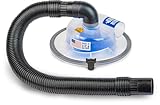 Oneida Dust Deputy Low-Pro Plus Oneida Dust Deputy Low-Pro Plus |
|
Check Latest Price |
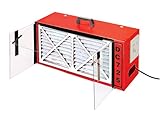 PSI DC725 Tabletop Collector PSI DC725 Tabletop Collector |
|
Check Latest Price |
 BUCKTOOL 750 CFM Auto-Start BUCKTOOL 750 CFM Auto-Start |
|
Check Latest Price |
Read the footprint column first. The separators near the top of that list sit at or below bucket height, which means they tuck under a bench or a shelf. The powered collectors further down are floor-standing, and the 65-inch BUCKTOOL at the bottom of the list is where small garages start to run out of room.
1. Dustopper PRO Cyclone Separator for 5-Gallon Buckets
Dustopper PRO Dust Collector – 99.9% Efficiency Cyclone Dust Separator
- Third-party tested at over 99.9 percent collection efficiency
- Low-profile body slides under a bench when not in use
- Preinstalled hollow-core gasket seals with no assembly
- Clear plastic shows fill level at a glance
- Thick anti-static resin resists collapsing under suction
- Performance scales with the horsepower of the vacuum you pair it with
- Gasket can lift out of its groove when the lid is removed
- Builds static that keeps fine particles suspended
- Ultrfine MDF and drywall dust still reaches the vacuum filter
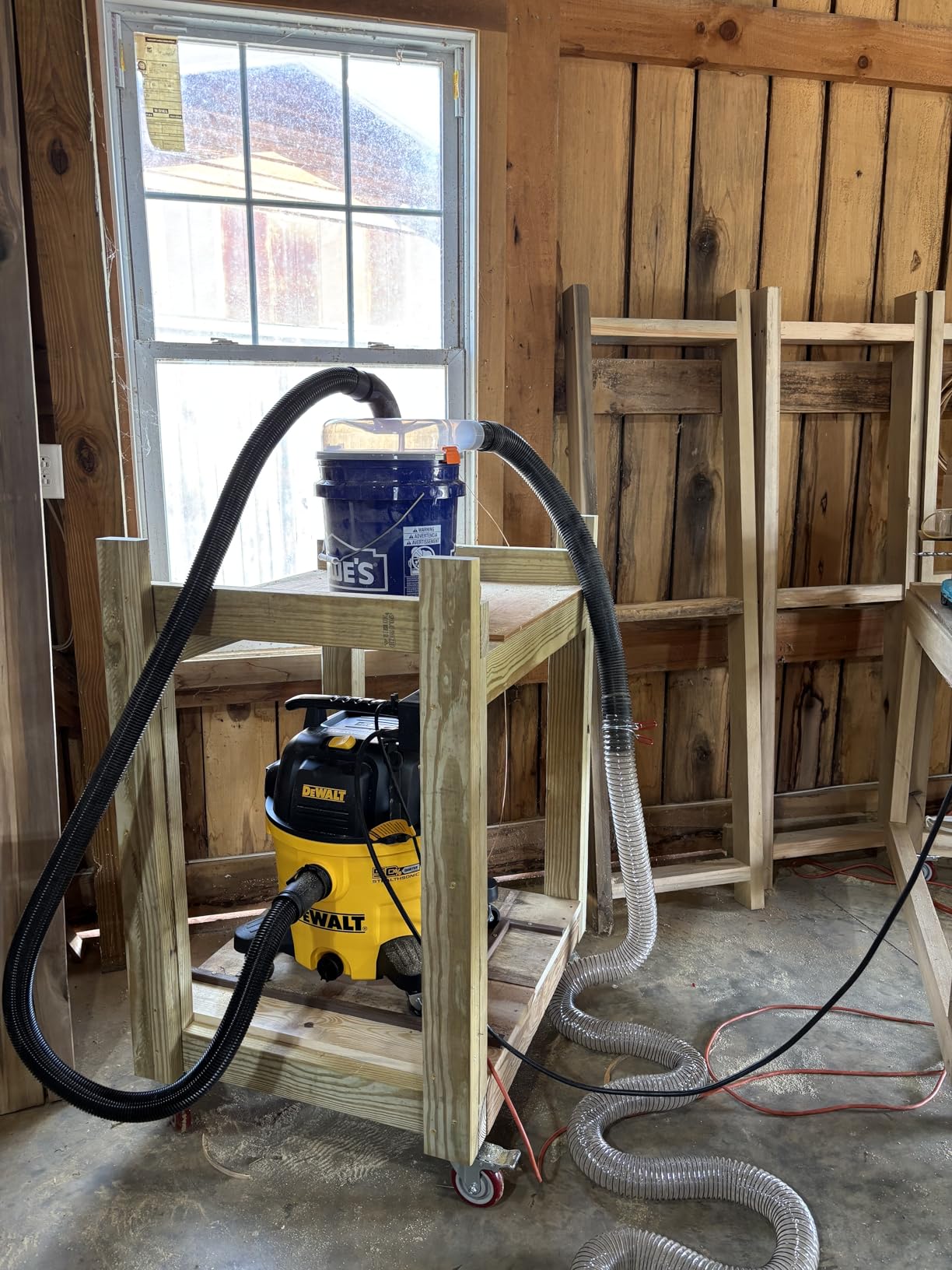
The Dustopper PRO is the piece I recommend first for a one-car garage, and the reason is simple: it is 3.6 pounds and 7 inches tall. That means it lives on a shelf or under the workbench and only comes out when you are cutting, which is the opposite of a machine that permanently occupies a parking bay.
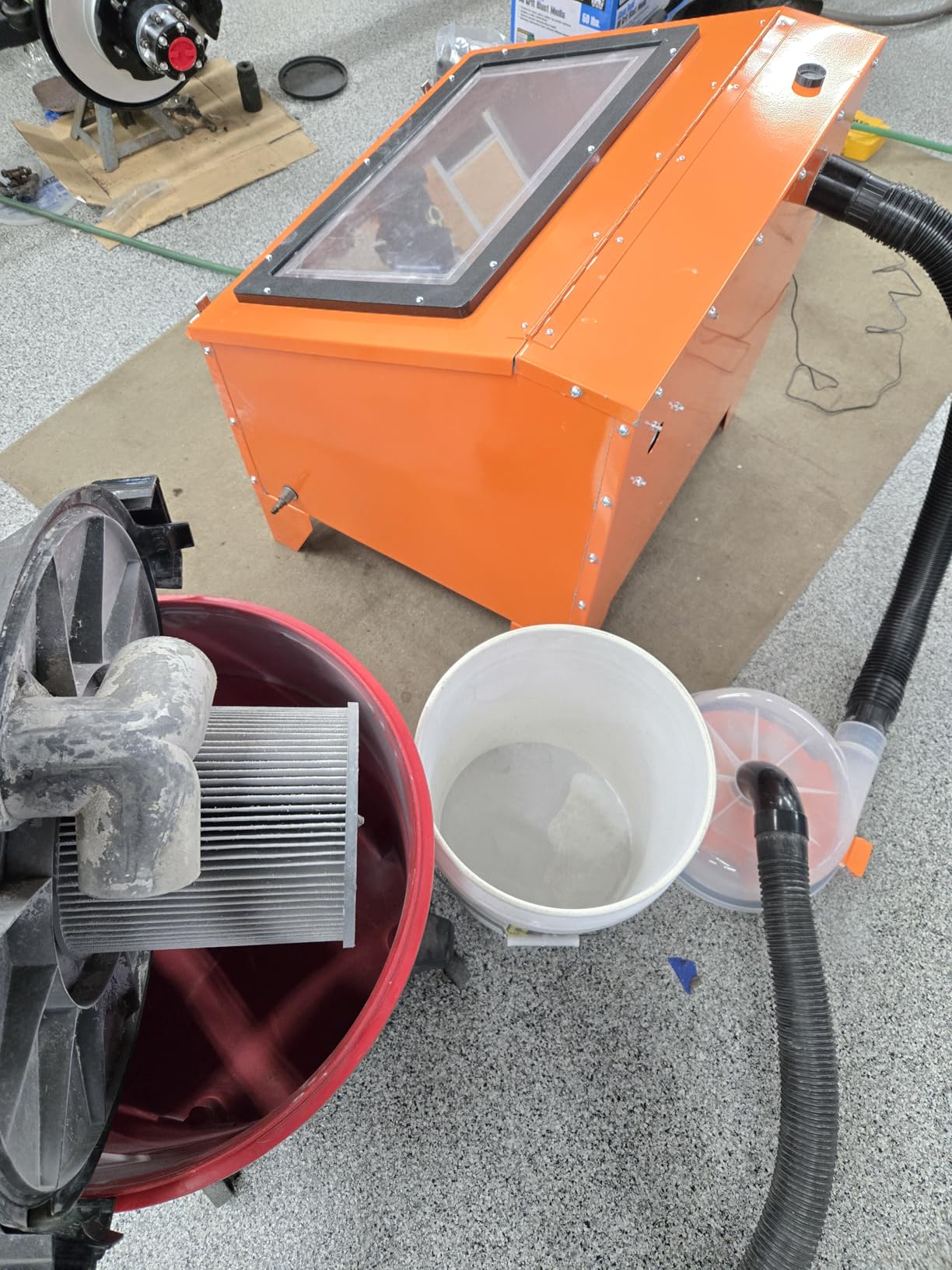
It is not a powered collector. You bolt it to a standard 5-gallon pail with the preinstalled hollow-core EPDM gasket, run a hose from your tool to the inlet, and connect your shop vac to the outlet. The two patented sweep elbows included in the box are angled to keep the airstream turning rather than choking it, which is the failure mode of cheaper lid-style separators.
Separation efficiency is not a guess here. Aerodyne Environmental, a third-party lab, tested this design against fine sawdust, coarse sawdust and drywall powder and found it captured more efficiently than the other low-profile separators in that group. Owners back that up in reviews, and the most common report is how much longer their shop vac filter lasts once the separator is in the line.
That is the economic argument: a filter that changes monthly instead of occasionally changes what this setup really costs over a year.
The 2023 Most Innovative Concept Award at the National Hardware Show went to this low-profile body shape. A full-height cyclone needs a stand plus clearance above the lid; this one sits at bucket height.
Where it works in a small garage?
This is the right pick for a table saw, a router table, a bandsaw, or a handheld sander run through a 2.5-inch hose. It is also one of the least expensive ways to find out whether you even like collecting dust at the source before you spend real money on a dedicated machine.
Because the whole assembly can be picked up and moved, the car still fits. That matters more than most spec sheets admit. Several people in the woodworkingtalk thread titled “Dust Collector For a 2 Car Garage Workshop” describe exactly this setup as their working answer, using a bucket separator rather than a fixed installation.
Where it falls short?
It is a separator, not a vacuum. If you do not already own a shop vac, you are buying one, and the total airflow you get is whatever your vacuum delivers rather than the collector’s own rating. Pair it with a weaker vac and fine dust slides straight past the separator into the filter.
The other recurring complaint is the gasket popping out of its groove when you lift the lid off the pail. It is a minor annoyance rather than a failure, but if you empty the bucket often you will meet it. Very fine MDF dust also passes through regardless of design, so if you cut a lot of engineered board, plan on a second filtration stage.
2. Mullet High-Speed Cyclone Dust Collector for Serious Airflow
Mullet Cyclone Dust Collector, High-Speed Separator for Shop Vac
- Highest average rating in the group at 4.8 stars with 88 percent five-star reviews
- Parabolic one-piece body spins the airstream faster than straight-wall designs
- Over 99 percent of debris pre-separated before air reaches the shop vac
- Rigid PVC joint replaces bungees and duct tape at the seam
- Included adapters fit most wet/dry vacuums
- Costs more than plastic bucket separators in this group
- Requires measuring and cutting PVC to length
- You supply the bucket or drum for the separated debris
The Mullet is the highest-rated product in this roundup at 4.8 stars, and the design explains why. Instead of a straight-wall cone or a bucket lid, it uses a seamless parabolic body that spins the airstream faster than either, so more heavy debris drops out before the air continues to your vacuum.
At 7.5 pounds and 29 by 16 by 12 inches as packaged, it is still a portable part rather than a fixed installation, which keeps it viable for a garage where you want clear floor. The sound level is listed at 72 dB, and that number sits meaningfully below the 80 dB figure attached to the wall-mount collector later in this list.
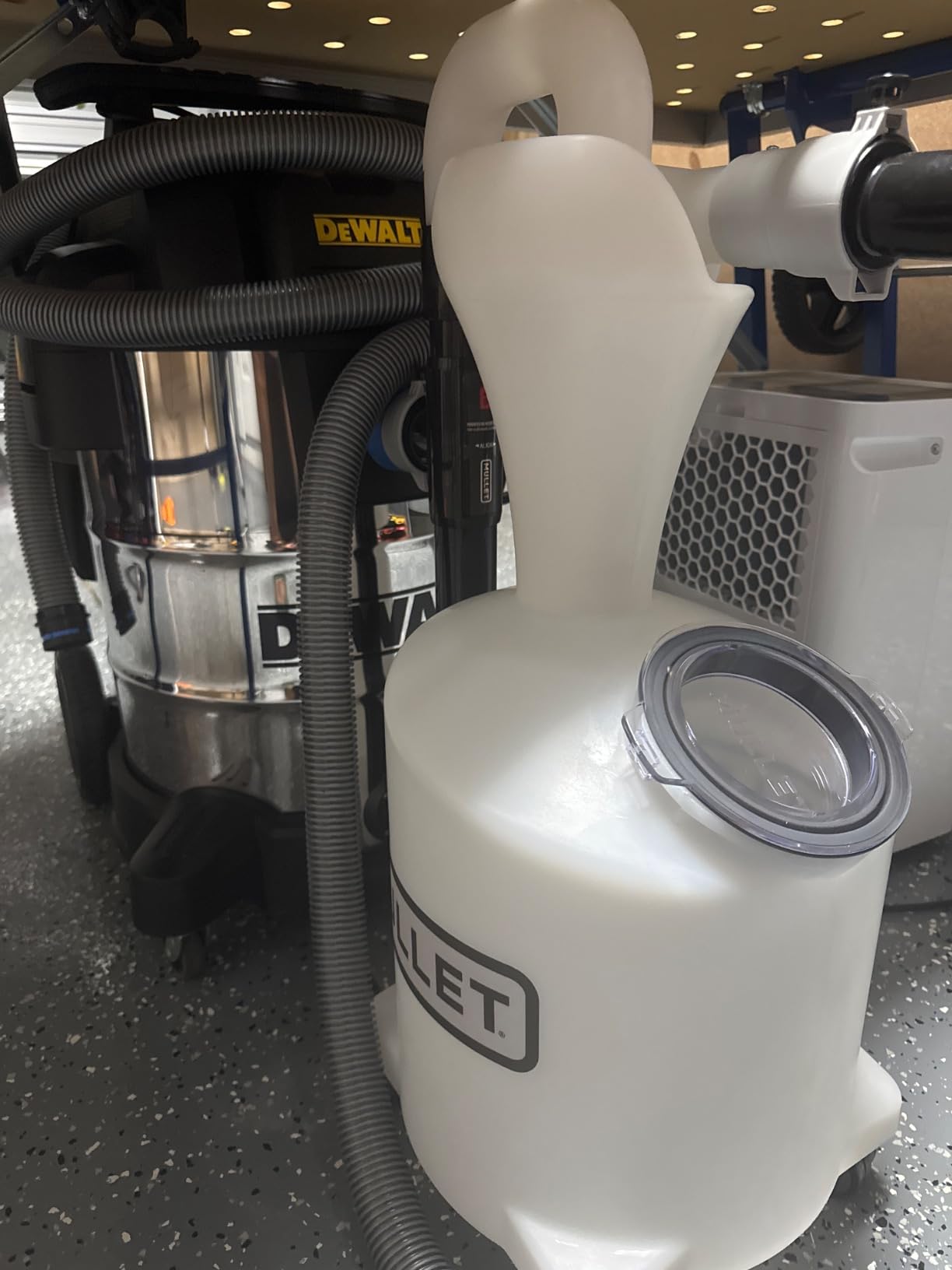
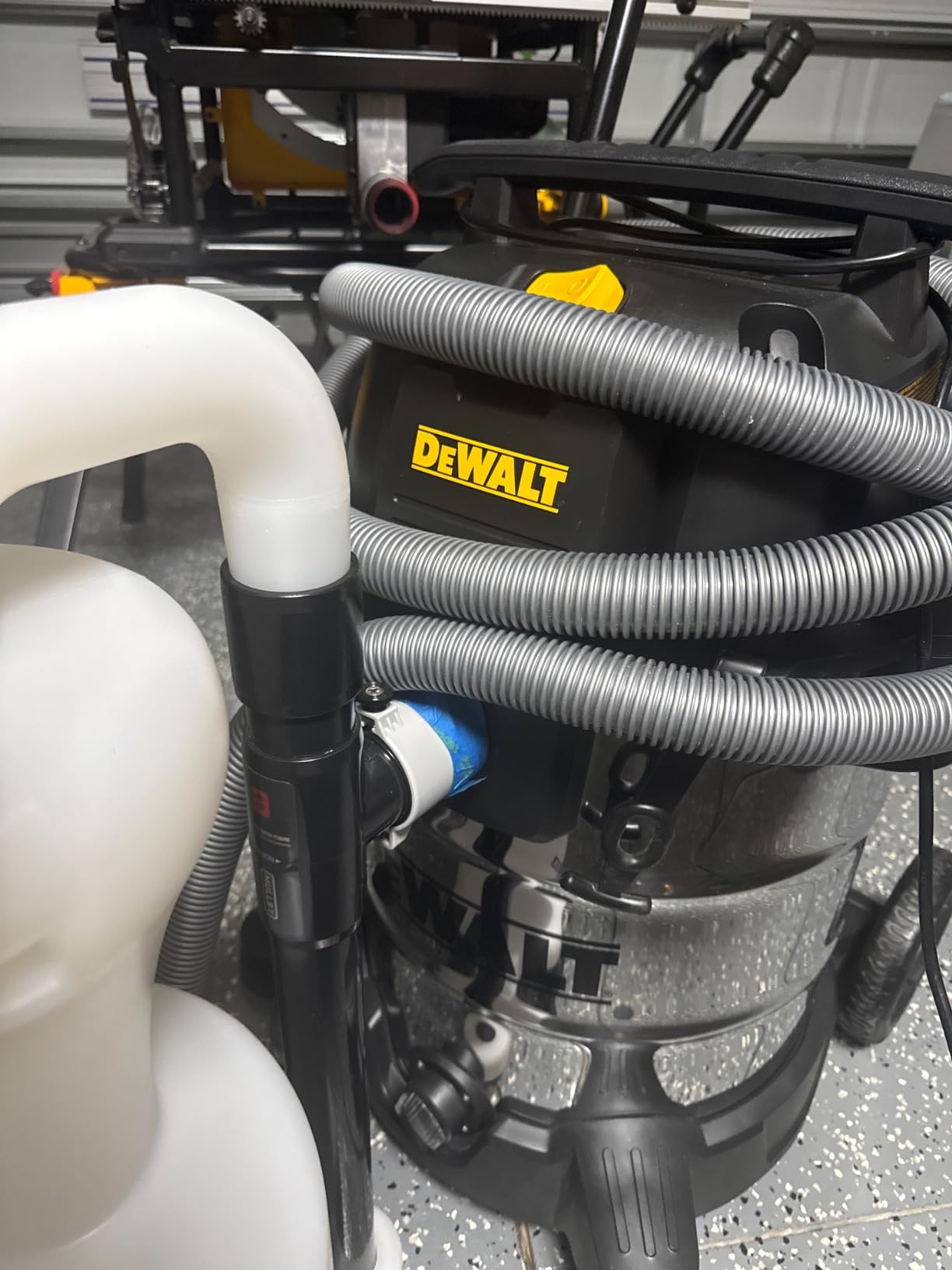
The second thing that separates it from the cheap alternatives is the joint. Most separators connect with bungee cords and duct tape because the canister and the vacuum hose do not line up cleanly. The Mullet uses a rigid cut-to-fit PVC connection that you trim to your exact setup and seal, and that eliminates the improvised seam where cheaper units leak dust.
Pre-separation above 99 percent means your vacuum filter sees clean air. Owners describe filter life extending from weeks to months, and on a shop vac that is the difference between a setup you maintain and one you dread.
Where it works in a small garage?
Choose this if your shop vac is already strong and you want the best separation available without giving up floor space. It is a sensible step up for someone who started with a lid-style separator and found dust escaping around the lid seam.
It is also the natural companion to the WEN rolling collector further down this list if you want two-stage separation without buying a full cyclone cabinet.
Where it falls short?
You have to do the fit yourself. Cutting PVC to length and building an airtight joint is a Saturday-morning job, and if you are not comfortable with a saw and a sealant you will end up with the loose connection the design was meant to eliminate.
It does not collect anything on its own. A bucket or drum is a separate purchase, and the dust capacity of whatever you choose limits how often you empty it. That is also why it costs meaningfully more than the plastic bucket separators, which arrive as one assembly.
3. DEWALT 6-Gallon Dust Separator on Casters
- Cyclonic separation keeps shop vac filters from clogging
- Four-caster base is stable and genuinely easy to move
- Detachable bucket empties in seconds
- Wide debris compatibility including drywall concrete and metal
- Backed by a three year limited warranty
- 6 gallon bucket fills faster than 10 gallon separators
- No vacuum included so a shop vac purchase is required
- Included hose is short and sized for 1-7/8 inch ports
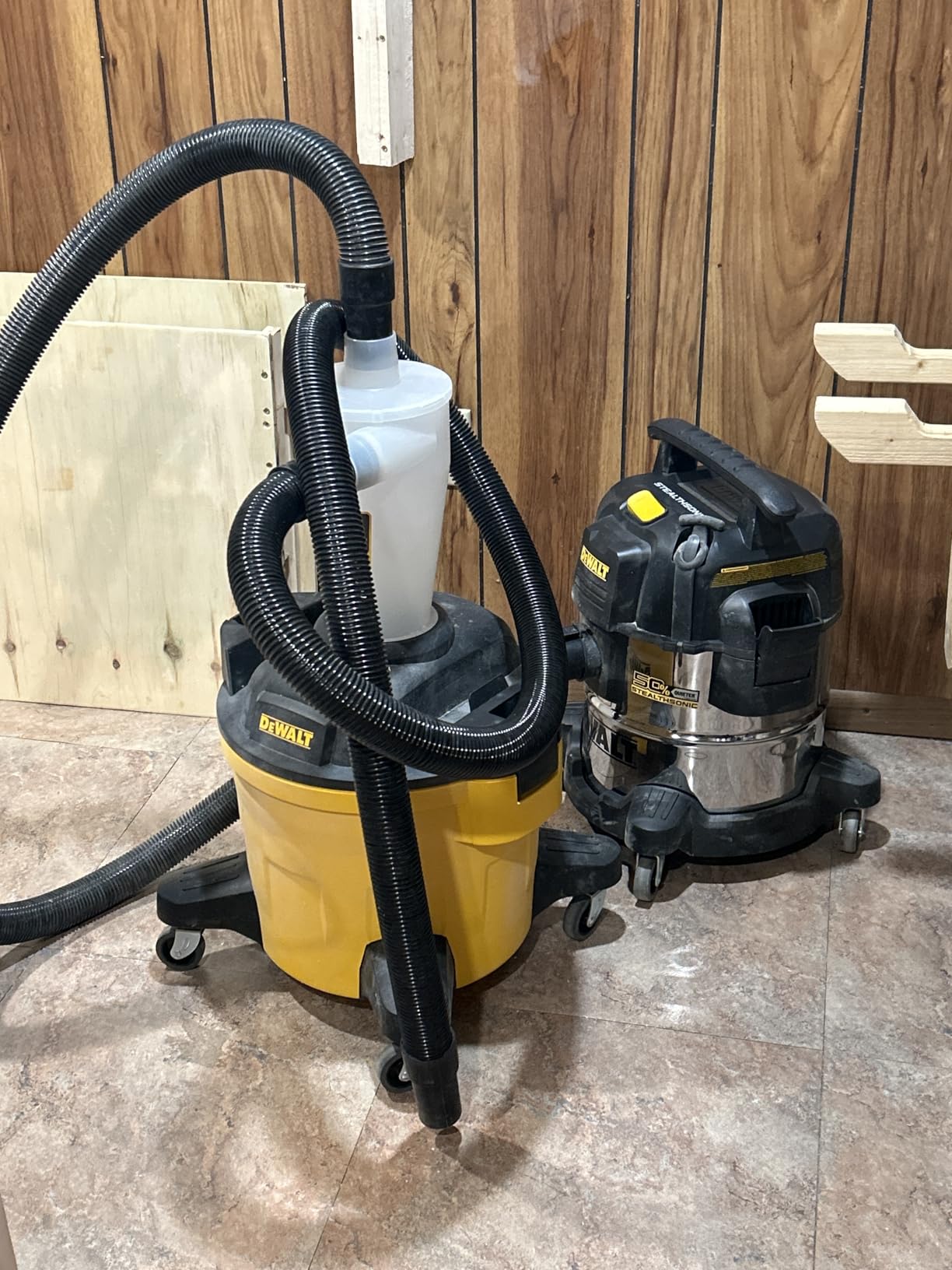
The DEWALT separator is the one I suggest to anyone who wants one box that arrives complete, sits on its own casters, and works with whatever wet/dry vac they already own. At 15.9 by 15.9 by 31.4 inches and 12 pounds, it is the only full-height wheeled unit on this list, and that height is still well under a 65-inch collector.
The 1-7/8 inch or 2-1/2 inch port compatibility covers essentially every household and industrial wet/dry vacuum on the market, which removes the single most common compatibility complaint people have with separators. The box also includes the 6-gallon poly bucket, lid, sealing strips, latches, handles, a wheel bracket, casters and hardware.
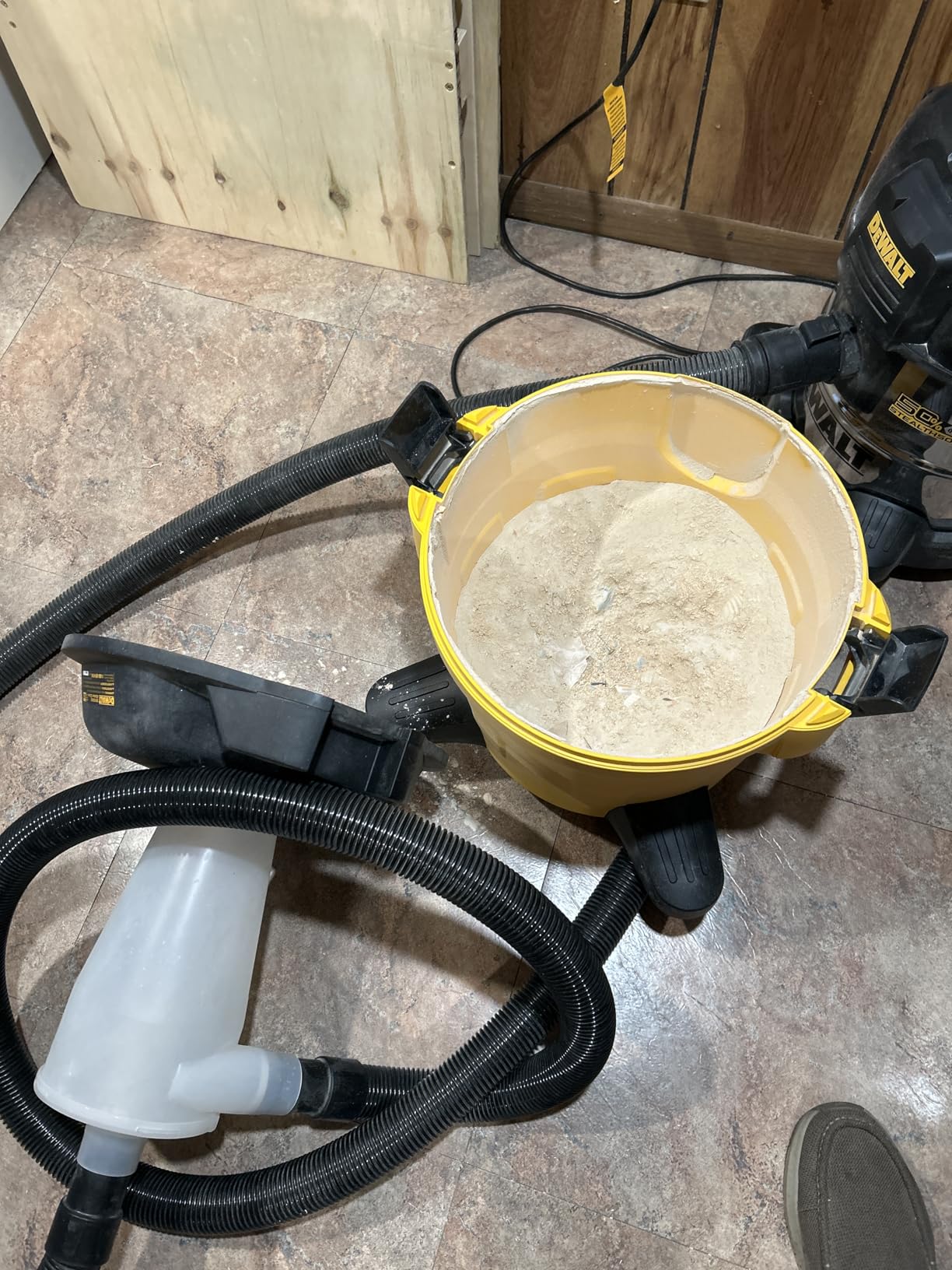
Debris versatility is broader than most collectors in this roundup. Owners use it for wood chips, drywall dust, concrete dust, clay and silica dust, metal shavings and water, which makes it useful beyond woodworking if your garage projects drift that way. The heat-resistant plastic and anti-clogging design are the parts that matter when concrete dust is involved.
At 4.5 stars with 78 percent five-star ratings across more than 680 reviews, this is the most consistent performer in the group by volume of feedback. Nobody writes forum posts about a separator that just works, which is arguably the point.
Where it works in a small garage?
Pick this for mixed-use garages, especially if you cut drywall or do metal work alongside woodworking. The four casters let you roll it to whichever machine is running, and 31 inches of height is easy to clear under a typical garage door track.
It is also the separator to choose if you dislike drilling. Nothing is mounted to a wall or a joist, and the whole system rolls back against a wall when the car comes home.
Where it falls short?
Six gallons is small. Owners consistently note the bucket fills faster than expected on planer shavings, and on a heavy cutting day you may empty it twice. The Rockler unit later in this list holds twice as much in a comparable footprint if capacity is your constraint.
The included hose is short and sized for 1-7/8 inch ports, so plan to buy a longer hose in whatever diameter your vacuum actually uses. And remember that the vacuum itself is not included; this is a separator that upgrades a vac you have, not a replacement for one.
4. POWERTEC 1 HP Wall Mount Dust Collector with 1 Micron Bag
POWERTEC 1 HP, 560 CFM Wall Mount Dust Collector with 1 Micron Dust Collector Bags, Dust Collectors for Woodworking Dust Collection System (DC5371)
- Wall mounting returns the entire floor space to the car
- 1 micron reusable bag measurably improves workshop air quality
- Viewing window in the bag shows fill level at a glance
- Vortex base design improves dust removal efficiency
- Dual voltage 120V and 240V motor
- Heavy at 35.5 pounds so the mounting structure must be solid
- 4 inch port grate collects debris and needs regular checking
- Loudest unit in this roundup at 80 dB
- Higher price point than the bucket-style separators
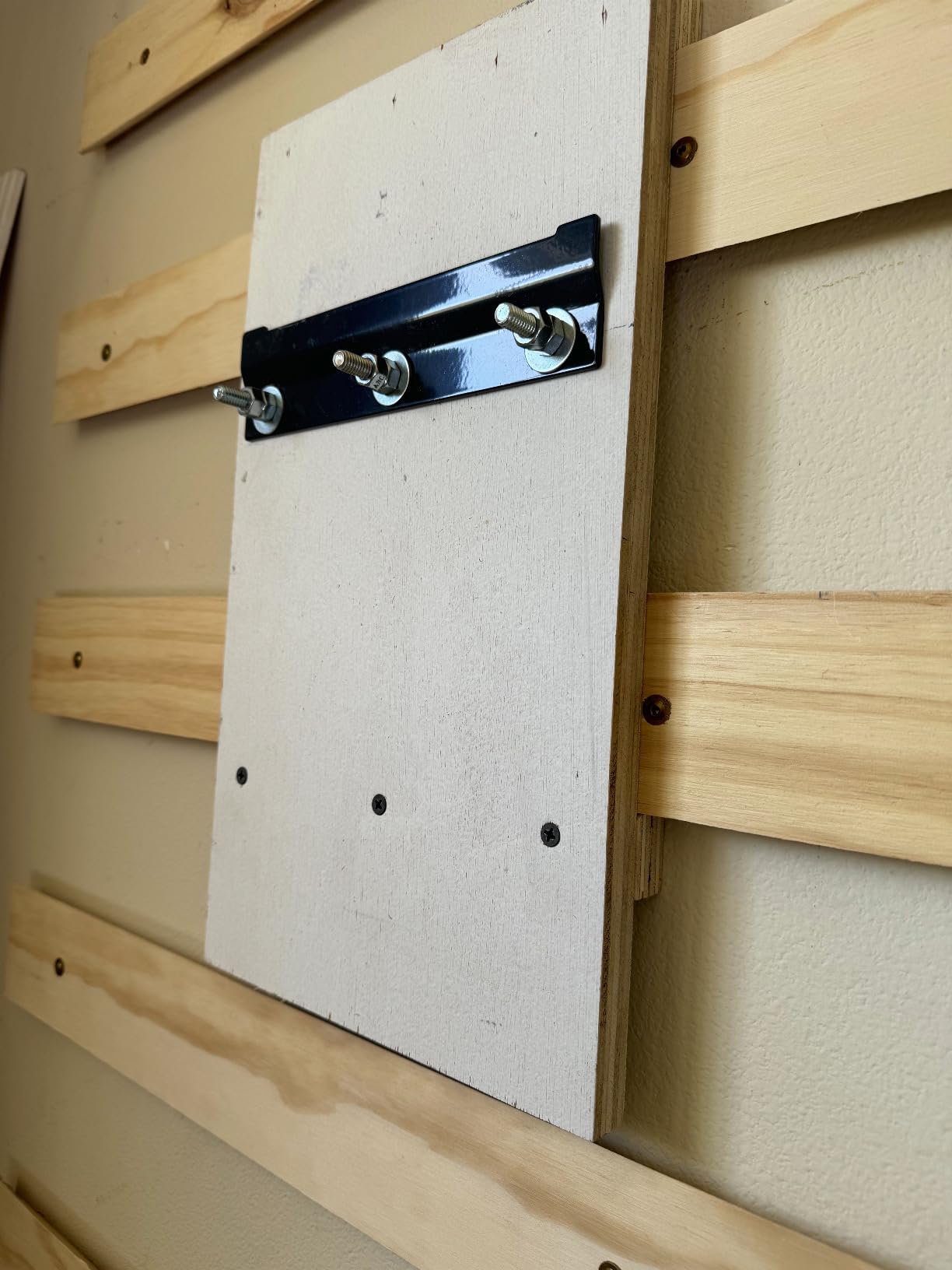
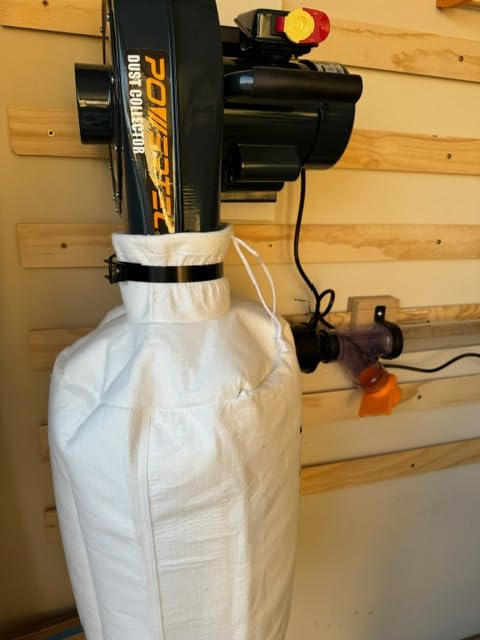
This is the only true dedicated collector on the list that mounts to a wall, and that single fact makes it the answer for a garage where every square foot of floor is contested. A 1 HP induction motor running at 3450 RPM moves 560 CFM, which comfortably covers a table saw and a jointer running one at a time.
Filtration is where it separates itself from the bucket units. The reusable 1 micron bag has a viewing window so you can judge fill level without opening anything, and a dust disposal zipper at the bottom so emptying it does not mean wrestling a bag over a bin.
The Vortex Base design reduces turbulence inside the drum for up to 10 percent better dust removal efficiency, which sounds marginal until you realize it applies to every bag change you will ever make. Buyers also like that the motor runs on 120V or 240V, so moving to a dedicated circuit later is straightforward.
At 4.4 stars with 68 percent five-star ratings, this unit appeals to hobby and small pro shops that want a dedicated wall-mounted collector instead of a bucket separator. Buyers like the fine filtration and the space savings; the recurring maintenance note is keeping the intake grate clear of debris to hold airflow.
Where it works in a small garage?
This suits a two-car garage where you want a stationary machine, or a one-car garage where you have already accepted that wall space is cheaper than floor space. It is also a good match if fine dust is your main concern rather than chip volume.
If you want a broader view of wall-mounted collectors and how they compare with rolling units, our roundup of workshop dust collectors for woodworkers goes deeper on the mounting trade-offs.
Where it falls short?
It is 35.5 pounds hanging from your ceiling joists. Standard 2×4 drywall on 16 inch centers will not carry that indefinitely, so the framing behind the mount matters more than most listings admit.
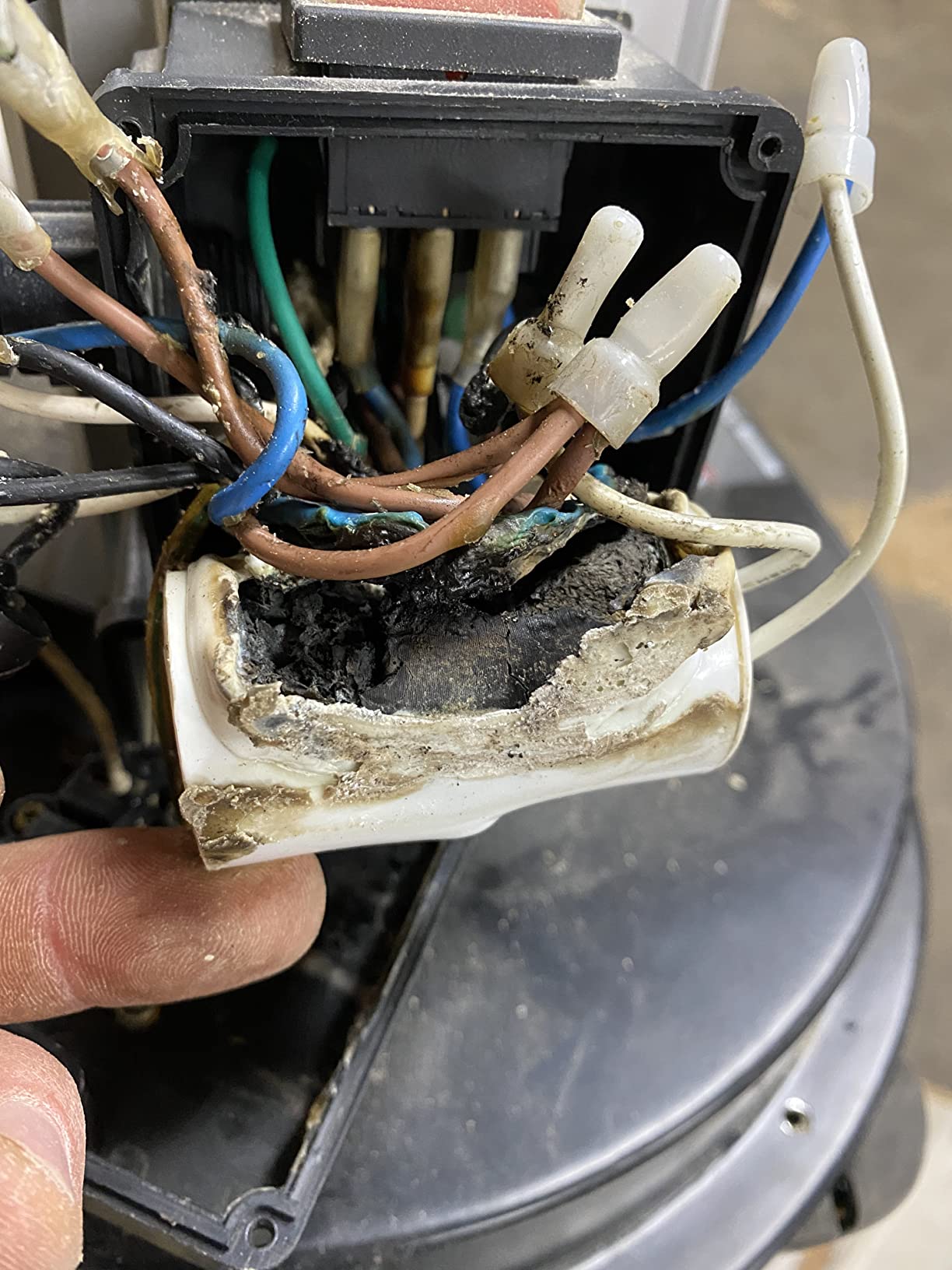
More importantly for a garage attached to a house, the sound level is listed at 80 dB. That is the loudest figure in this roundup, and people with bedrooms above the garage notice it. Reviewers also report an impeller retaining nut issue on first use, so torque it properly during setup.
5. VEVOR Cyclone Separator with 13.21-Gallon Metal Tank
VEVOR Cyclone Dust Separator with Metal Tank, 4″ Retrofit Cyclone Separator for Dust Collectors, ABS Material With 2″ Hole O.D. Connector & Hose for Wet/Dry Shop Vacuums, Fits 13.21 Gallon Tank
- Metal 13.21 gallon tank outlasts plastic bucket setups and includes a fill window
- Retrofits ahead of an existing collector and cuts bag changes dramatically
- Handles high pressure collectors without complaint
- Cyclone separation rated at 99.61 percent
- Transparent body lets you watch separation in real time
- Included 2.5 inch reducers do not seat properly without modification
- Only three casters so the tank wobbles until they are removed
- Short ports need a clamp when moving between tools
- Metal pings audibly under high pressure
The VEVOR is the odd one out on this list because it is not designed for a shop vac at all. It is a retrofit cyclone separator that bolts ahead of a larger dust collector, and at 13.21 gallons of iron barrel it solves the problem every collector owner eventually hits: bag changes every twenty minutes.
Separation is rated at 99.61 percent, and the fully transparent body lets you watch it happen instead of guessing. The barrel has a fill-level window, casters for mobility, and a 19.49 by 17.91 by 17.91 inch footprint that still fits in a garage corner.
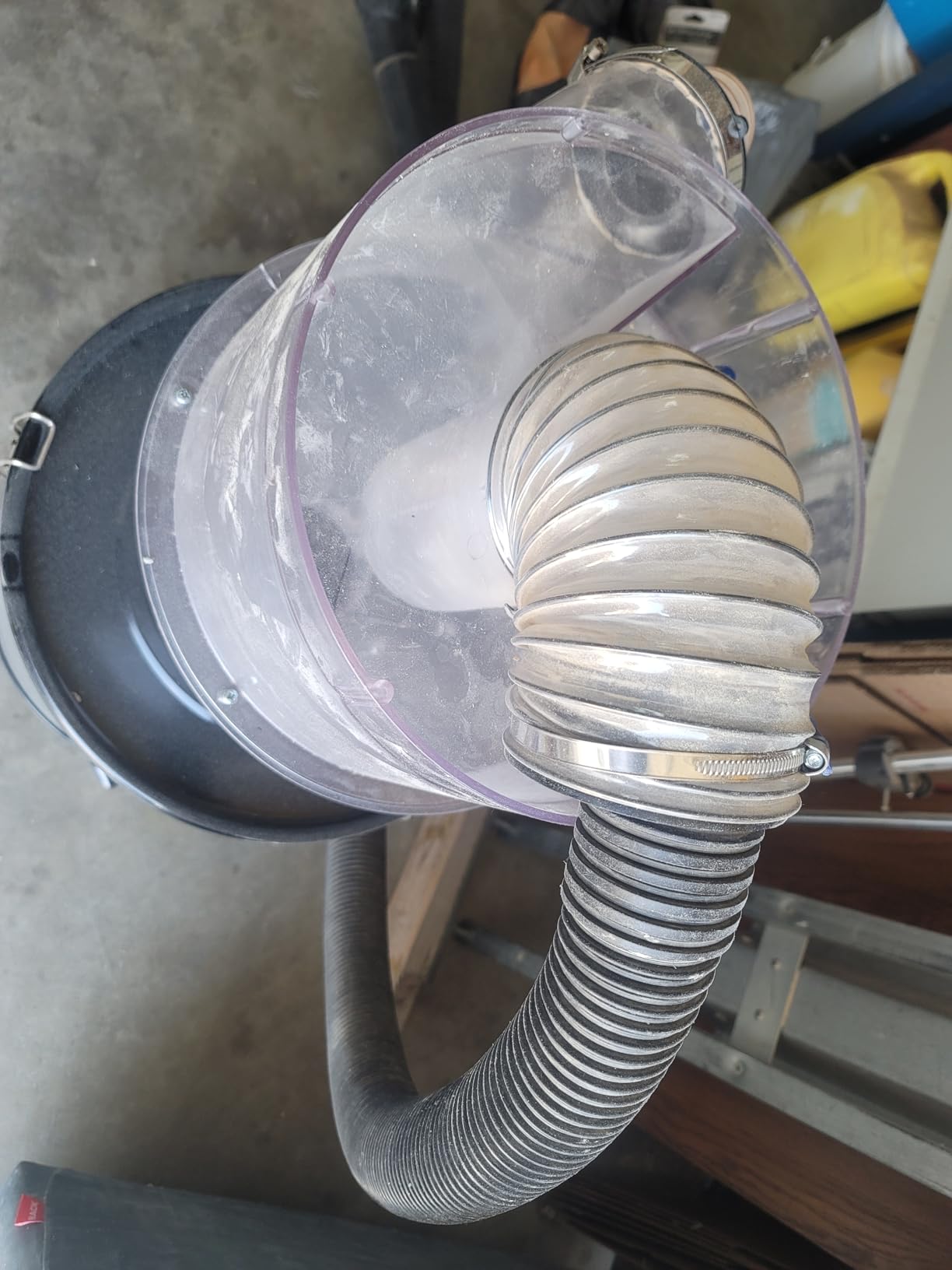
Inlet and outlet are both 3.81 inches, sized for 4 inch commercial hose, with a 1.97 inch adapter included for 2 inch household hoses. That flexibility is why owners report successfully pairing it with high pressure collectors far larger than anything else on this list. If you own a serious machine, this is the single upgrade that pays for itself fastest.
Value sentiment is strongly positive in reviews because name-brand cyclone separators of comparable capacity cost several times as much. You are buying the same physics in a cheaper steel shell.

Where it works in a small garage?
This is for the person who already owns a capable collector and is fighting constant bag changes. It also works as a standalone pre-separator ahead of a shop vac if your hose diameter matches, though that is the less common setup.
The 13.21 gallon steel barrel holds far more than any plastic bucket on this list, and emptying it takes one lift rather than four trips with a five-gallon pail.
Where it falls short?
Hardware fit is the honest weakness. The included 2.5 inch reducers do not seat correctly, and owners solve it with a foam strip or third-party couplers. Only three casters ship, which leaves the tank wobbling until you remove them, and the short ports mean you need a clamp whenever you move it.
For most one-car garage hobbyists this is more machine than you need. If you do not already own a collector rated above roughly 700 CFM, spend the money elsewhere on this list.
6. Rockler Dust Right Separator with 10-Gallon Bucket
Rockler Dust Right Dust Separator w/ 36” Hose & 10Ga Bucket for Shop Vac
- 10 gallon translucent bucket holds twice the capacity of competitor systems
- Fill level is visible through the bucket so you empty on your schedule
- Vortex action saves shop vac filter life
- Five-caster base is stable and rolls without tipping
- Light enough to carry even when full
- Lid can crack under suction in cold conditions
- Some fine dust escapes at the lid seam
- Not well suited to large planer shavings
- Bucket fills faster than buyers expect
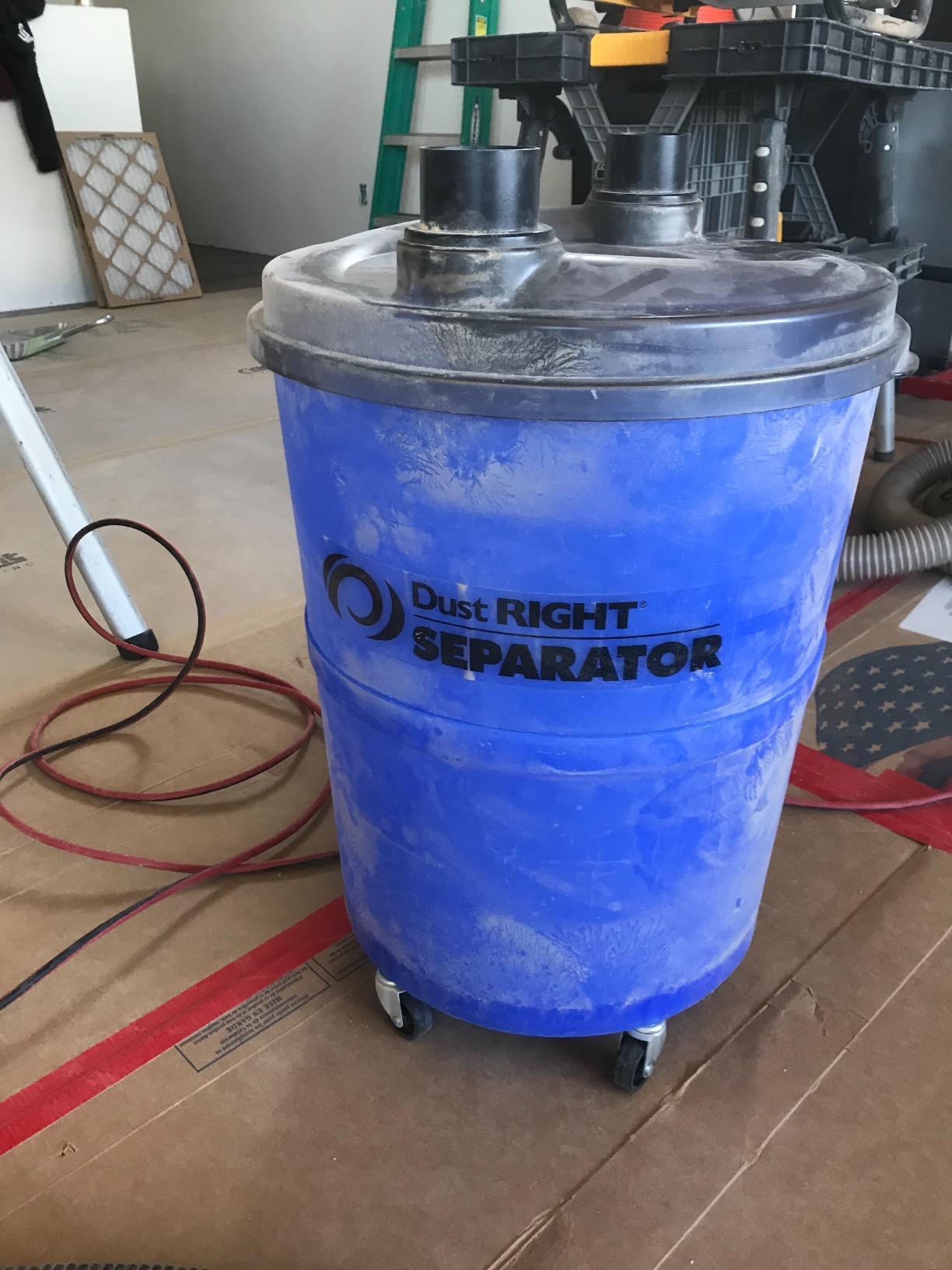
The Dust Right answers the capacity complaint that comes up with every 5-gallon setup. At 17.1 by 16.9 by 12.5 inches it has a smaller footprint than the DEWALT separator while holding twice the volume, which is the combination you want when floor space and emptying frequency both matter.
It is a two-stage cyclone with a 2-1/4 inch ID outlet, and the ports connect inside the in and out fittings so a hose cannot accidentally pop off mid-run. That detail costs nothing and removes a real annoyance. A 36 inch Flex-form hose is included, which is longer than the short stub most competitors ship.

The translucent bucket is the feature owners mention first. Being able to see the fill line from standing height means you stop guessing, and on a 10 gallon capacity you get roughly double the run time between cleanouts of a 5-gallon pail setup.
Rockler customer service is described as responsive in reviews, which matters for a product with replaceable parts that are easy to find. The company has been making woodshop accessories for decades, so parts availability is a genuine advantage over no-name separators.
Where it works in a small garage?
This is the pick for a garage where you cut hardboard, MDF or heavier stock and want fewer interruptions. A translucent 10 gallon bucket beats a clear 5 gallon pail on both axes that matter in a cramped space.
It is also the natural upgrade over the Dustopper PRO if you love that design but need more capacity and do not want a drill-based installation.
Where it falls short?
Lid durability is the recurring complaint. Owners report cracking from suction pressure, particularly in cold conditions when the plastic is brittle, and some note fine dust bypassing the separator at the lid seam. If your shop vac has unusually strong suction, inspect the lid early.
It is also not designed for large planer shavings. The cyclone works best on sawdust and moderate debris, so if a planer is your main machine you will want more airflow than a shop vac provides.
7. WEN 660 CFM Rolling Dust Collector
WEN Woodworking Dust Collector, 5.7-Amp Motor with 12-Gallon Bag, Mobile Base, and Optional Wall Mount (DC3401)
- Moves far more air than a typical shop vac for the money
- Low rolling profile with lockable swivel casters
- Can be wall mounted to free the floor entirely
- 4 inch port connects to common woodworking tools
- Easy bag changes with 4 inch thumb screw clamps
- Clogs quickly on planer shavings unless the inlet screen is removed
- Suction drops noticeably when hose diameter is reduced for sanders
- Audible through walls in an attached garage
- Impeller nut and motor bearing failures reported
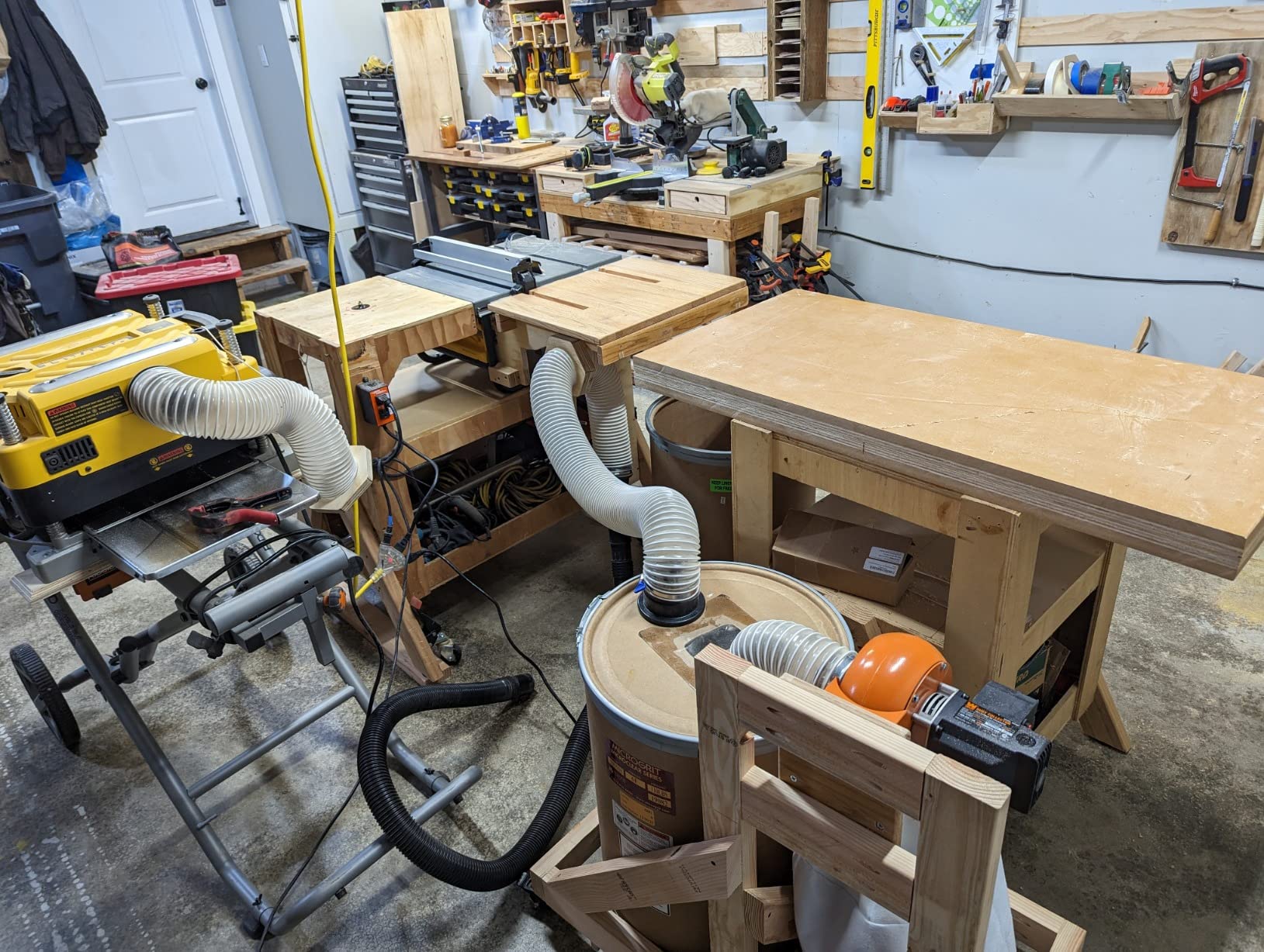
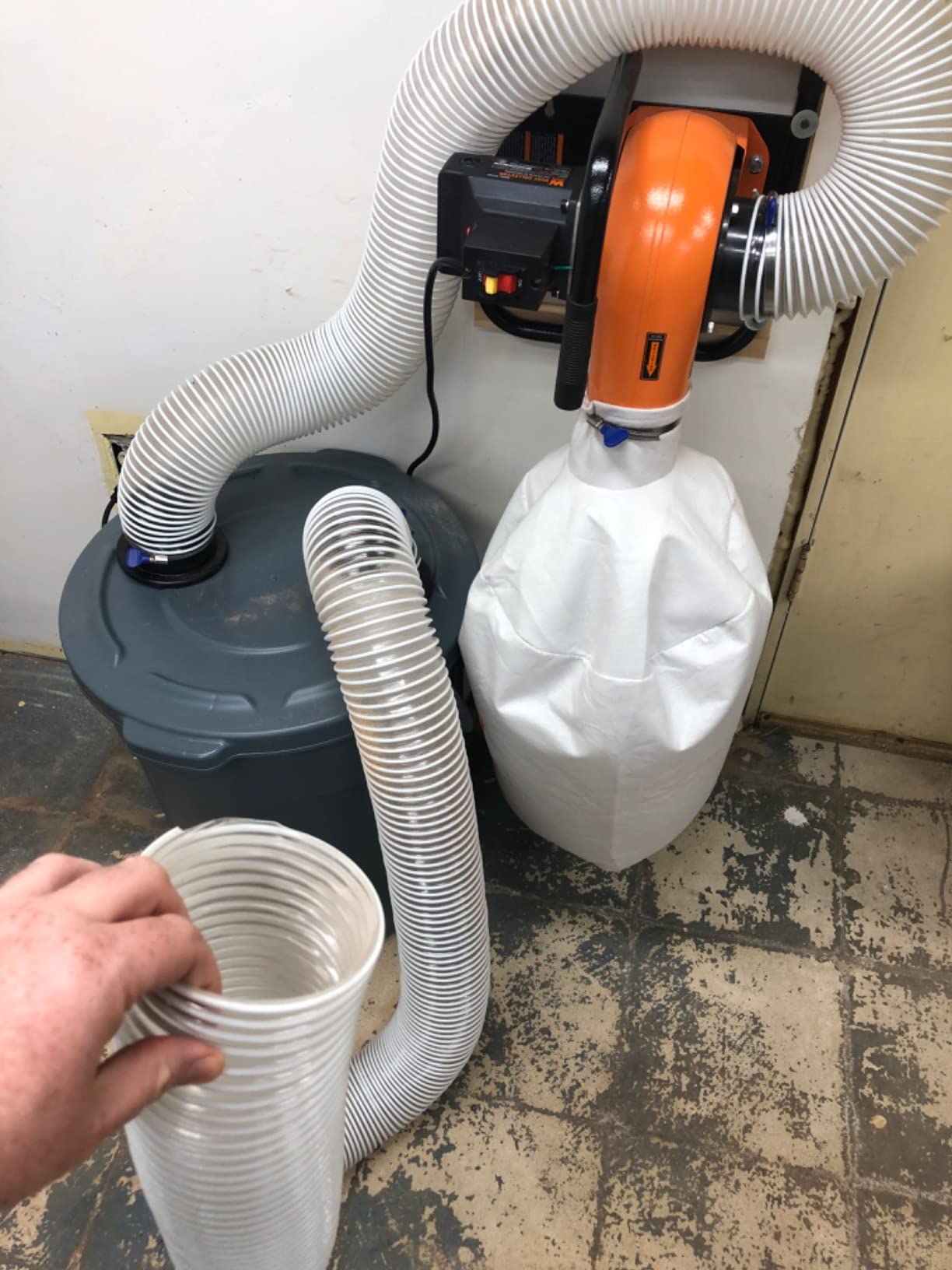
The WEN DC3401 is the cheapest path from a shop vac to a machine that will actually pull air through a 4 inch hose, and at 660 CFM it has enough throughput for a table saw with room to spare. The 5.7 amp brushed motor drives a 6 inch impeller, and the whole unit weighs 17 pounds.
Its shape is the selling point for a garage. At 34.25 by 13 by 14.2 inches it is a low, long profile on lockable swivel casters, and it has an onboard carrying handle plus an optional wall mount. If your floor space is the constraint, being able to hang it turns this from a floor-consuming machine into a wall-mounted one.
The 12 gallon 5-micron zippered collection bag changes with four thumb screw clamps, which is faster than wrestling a bag over a drum. It also has a two-year warranty, unusual at this level.
Buyers consistently treat this as a bridge between a shop vac and a full-size collector. On airflow and footprint it delivers; the complaints cluster around filtration and durability rather than performance, and at 4.1 stars across more than 670 reviews that split is visible in the ratings.
Where it works in a small garage?
This is the pick if you have a table saw and a jointer, run one tool at a time, and want something you can unplug and roll out of the way. The 4 inch port matches common woodworking dust ports, so hose selection is simple.
It is also the collector that pairs well with a downstream cyclone separator in a metal trash can if bag life becomes an issue, which several owners do.
Where it falls short?
Clogging on planer shavings is the single most common complaint, and the fix is to remove the metal inlet screen. Owners discover this themselves within the first week, which tells you the default configuration is not right for coarse debris.
There are durability reports too. An impeller retaining nut flew off on first use for some buyers, and motor bearing failure shows up around nine months. Reviewers describe it as loud enough to carry through walls, so if your garage is attached, plan on running it only during heavy cutting.
8. Oneida Dust Deputy Low-Pro Plus Kit
Dust Deputy Low-Pro Plus Cyclone Dust Separator – Engineered High Flow Wet/Dry Vacuum Kit – Fits Standard 5 Gallon Buckets – 2.5″ Adapter & 3′ Hose – Made in USA
- Complete kit includes hose elbow adapter gasket and locking latches
- Low-profile body improves airflow over cheap lid-style separators
- Sits under a 5 gallon bucket without tipping
- Built specifically for shop vac users
- Made in the USA
- Requires a 5 gallon bucket and some pails are not sturdy enough alone
- Bucket can collapse under strong suction unless reinforced
- Very fine particles still reach the vacuum on weaker vacs
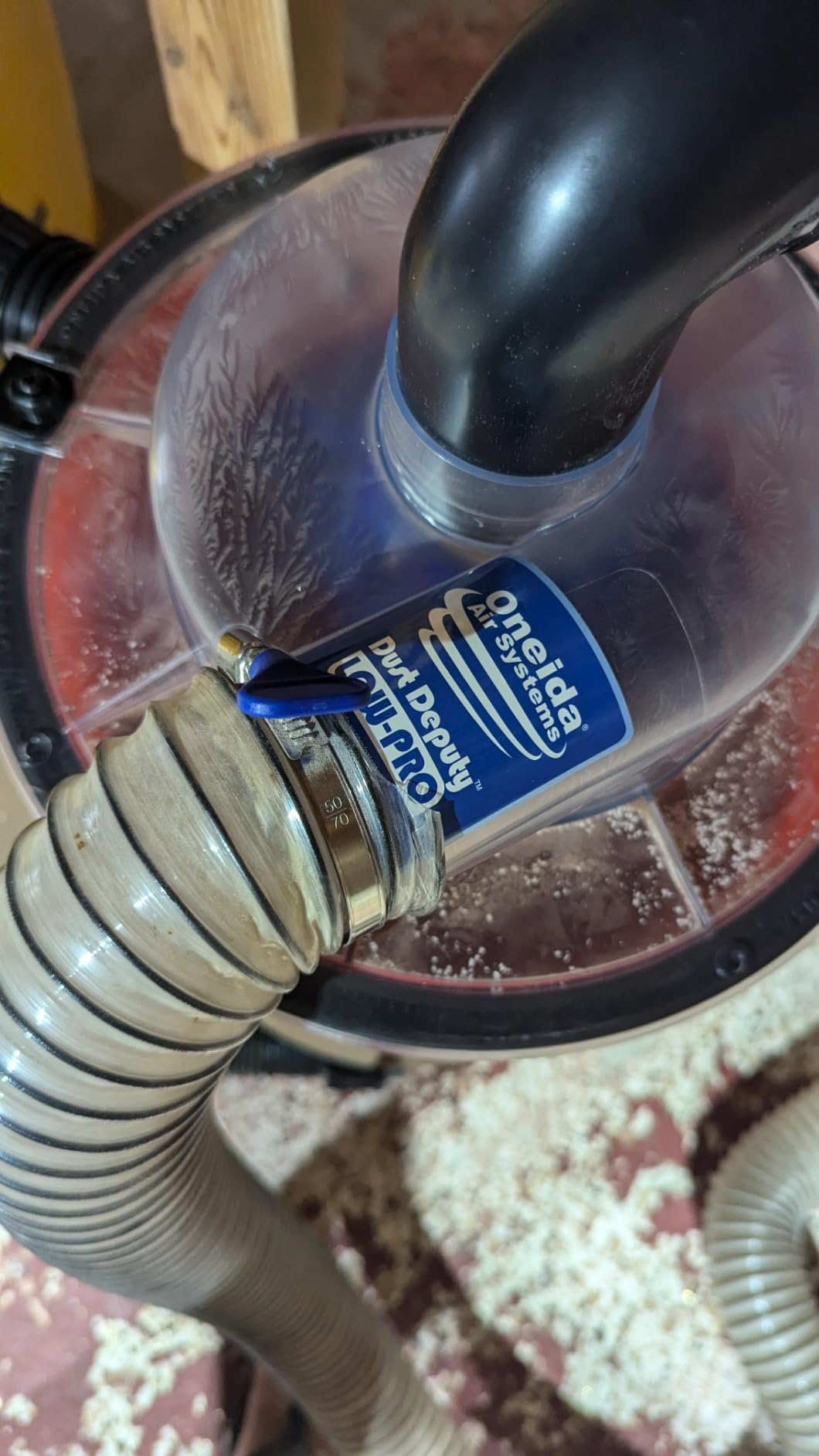
The Oneida Dust Deputy Low-Pro Plus is the answer for the person who wants the Oneida cyclone design without hunting down four separate pieces. The kit includes the lid separator, locking bucket latches, a neoprene foam lid gasket, a 3 foot flexible hose with swivel cuffs and a 2.5 inch elbow adapter.
That completeness is why it appears on forum recommendation lists more often than almost anything else in this category. Oneida Air Systems is the name behind the original Dust Deputy design, and buyers rate it at over 99.9 percent dust capture with ports sized for standard 2.5 inch hoses and 2.25 inch inner diameter connections.
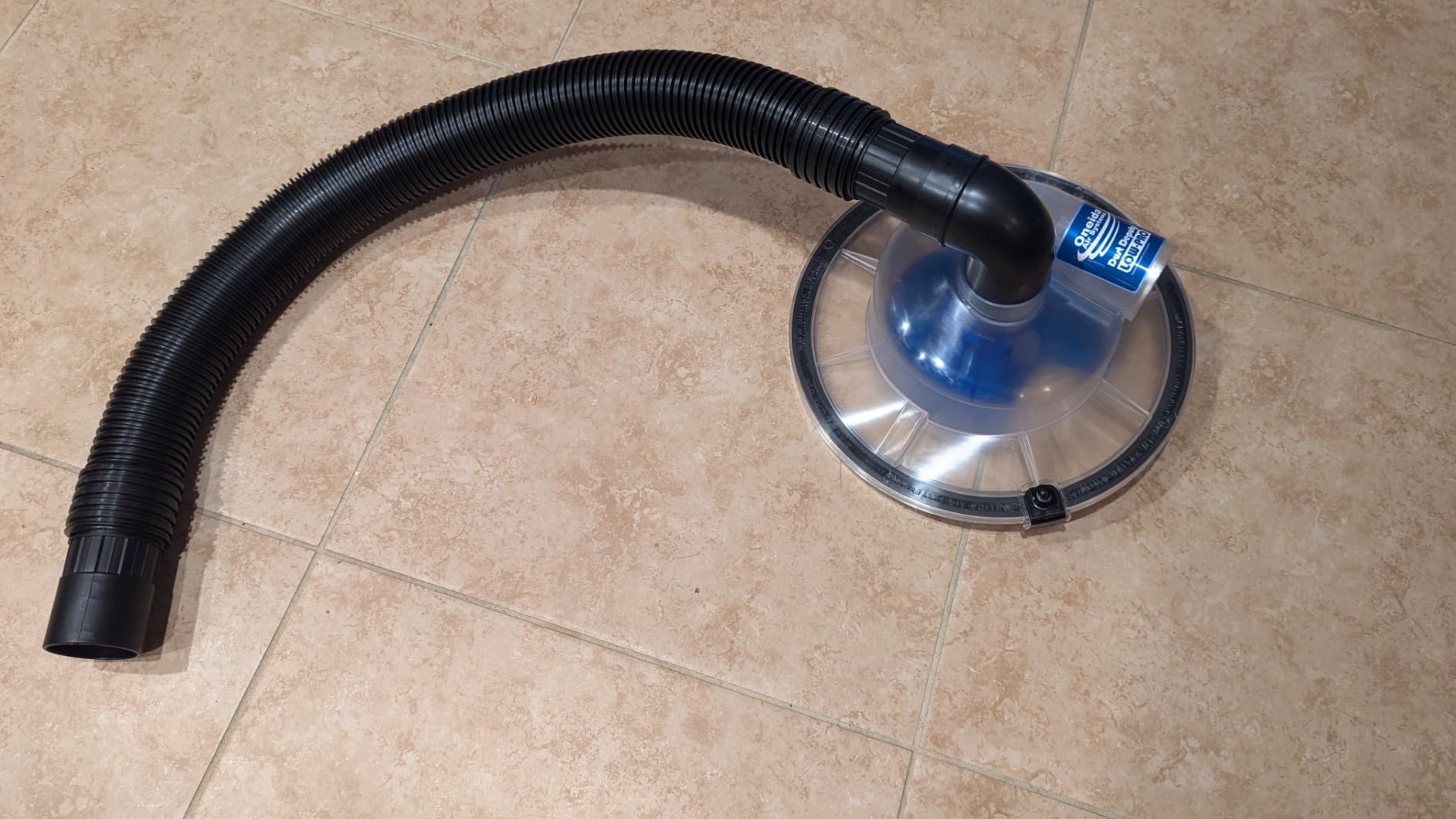
The low-profile body is not just a marketing term here. Because the cyclone sits low rather than high, the airstream spins faster and separates better, and reviewers specifically note more airflow than lid-style separators at comparable prices. Owners in woodworking forums describe adding it to an existing shop vac as the single change that made the vac worth keeping.
Oneida Air Systems builds for shop vac users specifically, which explains the detail level: swivel cuffs so hoses do not kink, latches so the lid stays shut under suction, and a foam gasket that compresses to seal.
Where it works in a small garage?
At 13 by 6 inches it is the flattest separator in this roundup and stores anywhere. It suits a router table, a bandsaw, a sander or a table saw fed by 2.5 inch hose, and it is the most forgiving choice for a first-time buyer.
The included 3 foot hose with swivel cuffs is short but high quality, and it connects straight to most wet/dry vacs without adapters.
Where it falls short?
The bucket is a real variable. Owners regularly report standard 5-gallon pails collapsing under strong suction, and the fix is to double up the pail or brace the lid. Budget for that if your shop vac has real horsepower.
Results also scale with vacuum power in a way reviewers call out repeatedly. On a small vac the separation is good, but very fine particles still make it through to the filter.
9. PSI Woodworking DC725 Tabletop Dust Collector
- True tabletop footprint of 23 by 8 inches suits a cramped garage
- Three quiet maintenance-free fans at only 1.29 amps total
- Variable speed control lets you match airflow to the task
- Two grounded 115V outlets built into the side panel
- 24 pounds makes it genuinely portable
- Single included filter rather than a bag collection system
- Suction is less powerful than a dedicated 1 HP collector for heavy planing
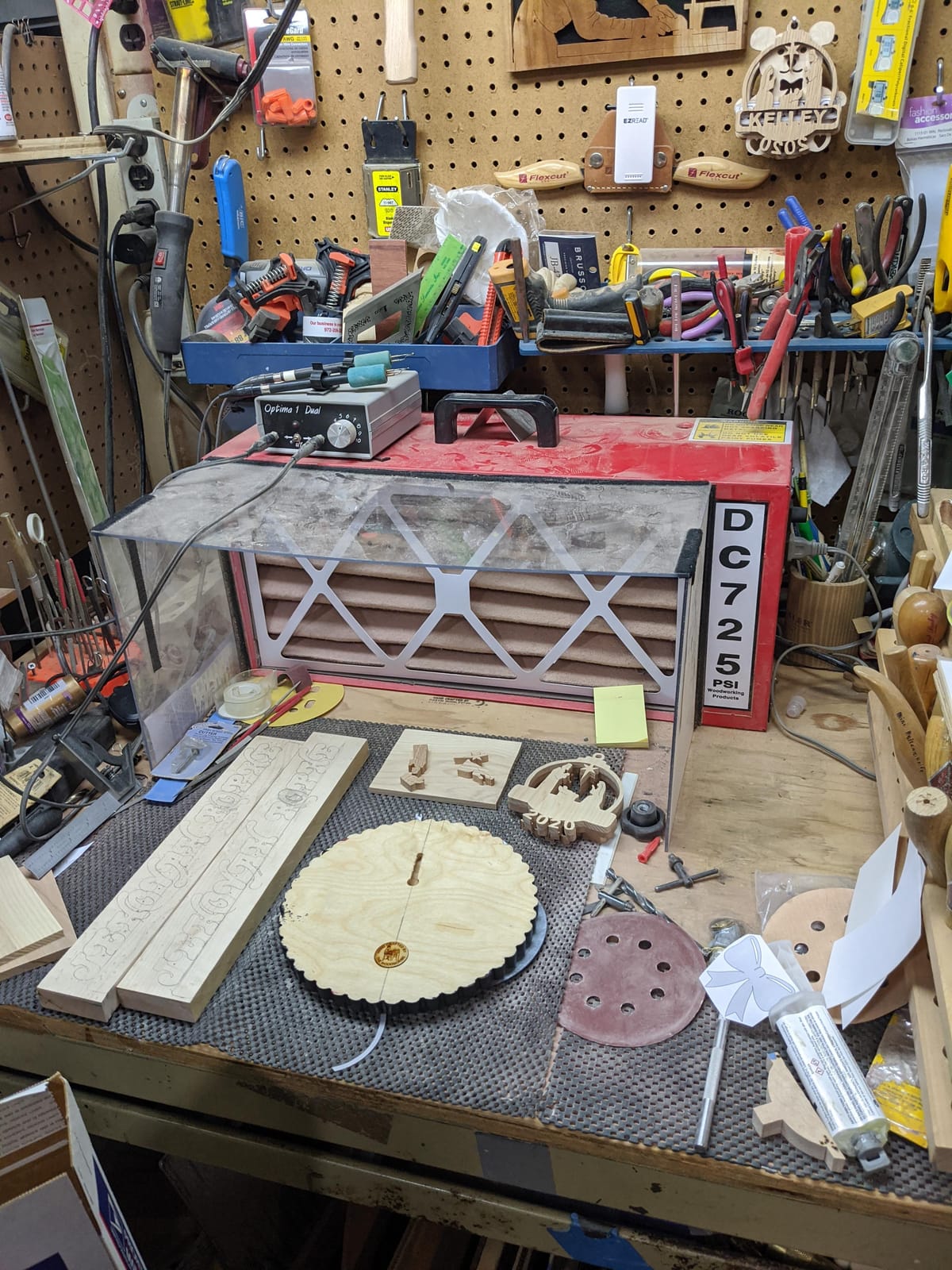
The DC725 solves a problem no other product here addresses: what fits on a bench when the car is inside. At 23 by 8 inches with a height of 10.5 inches, it occupies about the space of a toaster oven, and at 24 pounds you can carry it to a different part of the garage in one hand.
Three computer-grade maintenance-free fans deliver up to 725 CFM maximum on 110V variable speed motors, drawing 1.29 amps total. That is a fraction of the current a dedicated 1 HP collector pulls, and in a detached or noise-sensitive garage the quiet operation is the headline feature. An adjustable clear polycarbonate hood and side doors let you aim the airflow.
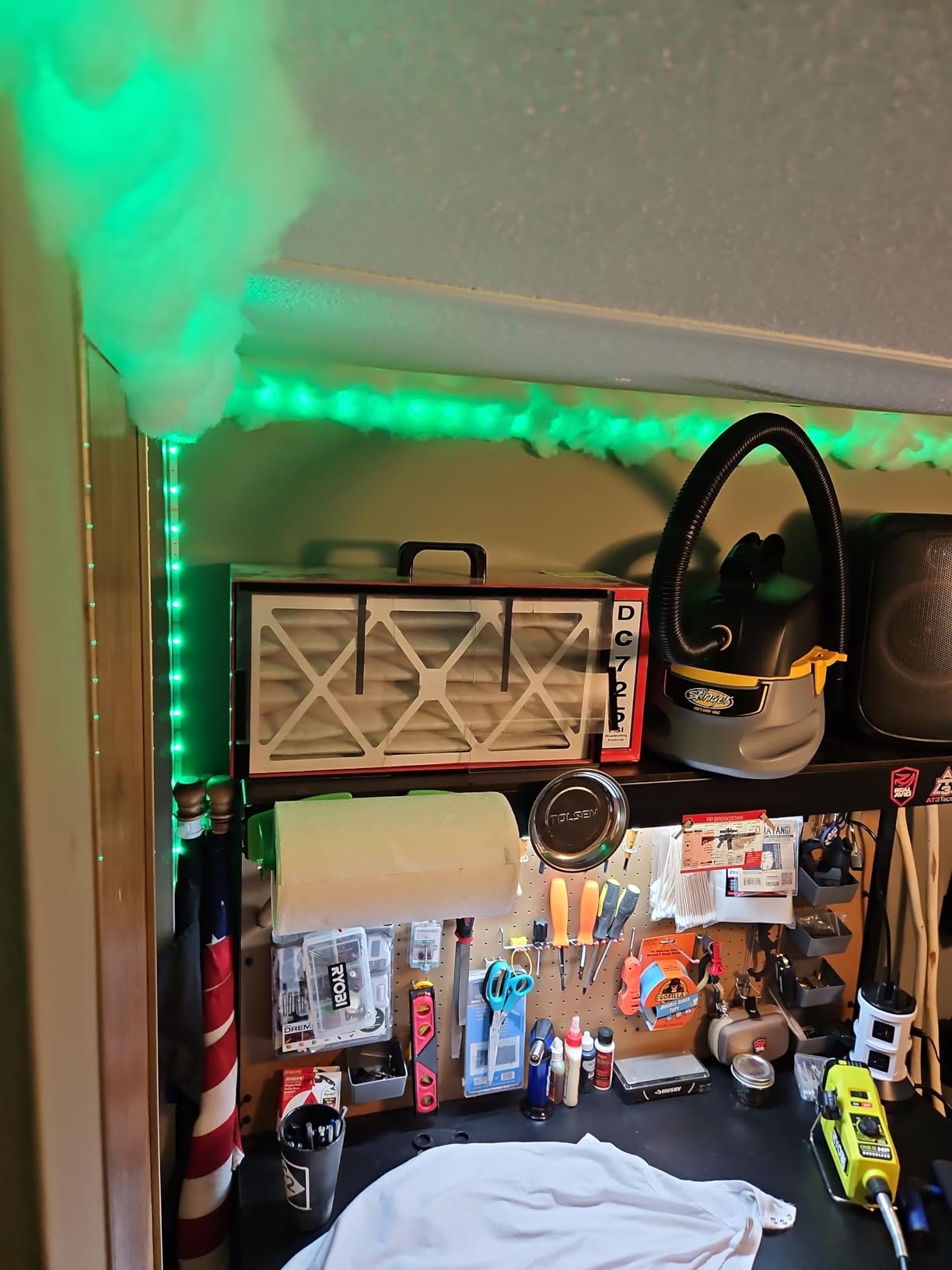
The design has been around since 2007 and that longevity shows in the details. Two grounded 115V side outlets mean you can plug a sander or a small router directly into the machine, a variable speed knob lets you dial back for delicate work, and there is a carrying handle on top. It comes with a two year warranty under normal use.
At 4.5 stars with 66 percent five-star ratings, reviewers point to quiet operation, low power draw and the footprint as the reasons it fits a garage. It is aimed at carving, sanding, grinding, woodburning and small tabletop projects rather than production work.
Where it works in a small garage?
Choose this for a hobbyist working with routers, hand planes, sanders, a scroll saw or a small lathe. If you never run a planer or jointer, a tabletop unit is all the dust collection you need and it is the least intrusive option by a wide margin.
The low current draw also means it can run on a shared circuit without interfering with a table saw or a dust collector on the same outlet.
Where it falls short?
It comes with a single filter rather than a bag system, so there is no large capacity to empty and no way to see fill level. You will need to watch airflow to know when the filter needs attention.
For heavy planing work the suction falls short of what a dedicated 1 HP collector delivers. If a planer is on your tool list, skip this one and look at the WEN or BUCKTOOL units instead.
10. BUCKTOOL 750 CFM Auto-Start Dust Collector
BUCKTOOL 750 CFM Auto-Start Dust Collector,1.2HP 13-Gallon Capacity
- Auto-start outlet powers tools up to 7A and starts the collector with them
- 750 CFM covers a compact garage shop well
- Two-stage bag setup with a 2 micron upper cloth bag
- Casters let it move between machines then park
- Five reducers and a 5 ft 4 inch hose included
- Heavy at 56 pounds and 65 inches tall for a very small garage
- Soft PET bag clamp can pinch fingers during changes
- Lowest rated option here at 4.0 stars
The BUCKTOOL is included here for one feature no other product on this list has: an auto-start function with its own power outlet for tools up to 7 amps. The collector switches on when your tool switches on and off when you finish, which removes the single most common habit failure in small shops, forgetting to turn the machine off.
The 1.2 HP 120V motor runs at 3450 RPM for 750 CFM and draws 6.5 amps at full load, and the machine is CSA listed. Two-stage filtration uses plastic and cloth lower bags plus a 2 micron cloth upper bag, which is a better fine-dust story than a single bag provides.
It also arrives genuinely ready to connect: five reducers, a 5 foot 4 inch flexible hose, and a portable base of 16-1/2 by 26-3/8 inches on caster wheels. That means it can run mobile between machines or be parked as a fixed station, which is flexible for a garage whose layout changes.
At 4.0 stars with 10 percent one-star ratings, this is the least refined product in the roundup, and the reviews say so plainly. The criticism targets hardware and handling rather than airflow, and buyers downsizing from a larger shop are advised to measure ceiling clearance first.
Where it works in a small garage?
This fits a two-car garage or a workshop space with a high ceiling, particularly if you switch between tools and want collection to start automatically. For a detached shop where nobody is listening, 750 CFM is generous for one machine at a time.
The auto-start outlet also solves an electrical problem: you no longer need a second outlet on the wall for the collector, which matters when every receptacle is already spoken for.
Where it falls short?
Height is the deal-breaker in a small garage. At 29.53 by 20.19 by 65.01 inches, it needs 65 inches of vertical clearance before you account for the hose, and it will not fit beside a car in a low-ceiling bay. At 56 pounds it is not a casual move either.
The soft PET bag clamp can pinch fingers during bag changes, a small thing that generates more complaints than it deserves. More importantly, the 4.0 rating and 10 percent one-star share suggest build quality issues that buyers on this list did not encounter.
How Much CFM Do You Actually Need?
Size your collector by the single largest tool you own, not by the total dust in your shop. Two machines running at once need roughly double the airflow of one, which is why many people who underestimate end up disappointed. The widely used rule from shop design guides is 100 CFM per inch of throat opening on table saws, and a similar 400 CFM minimum for a planer and 350 CFM for a jointer.
Here is the minimum airflow for the machines most people fit into a garage shop. These are industry-standard planning figures rather than figures specific to the picks above.
Bench or contractor planer — 500 CFM. The tool that most often forces an upgrade. A shop vac at 144 CFM cannot handle this.
12 inch jointer — 400 CFM. Roughly half of what a planer demands. Manageable with a mid-size collector.
12 inch miter saw — 350 CFM. Often handled by a shop vac plus cyclone in a one-car garage.
Router table — 180 CFM. Comfortably within reach of every unit in this roundup.
Compact or jobsite table saw — 170 CFM. The easiest tool to support. A bucket separator handles it fine.
16 inch table saw — 400 CFM. Measure the throat opening and multiply by 100 CFM.
Bench sander — 130 CFM. The exception to the rule. Fine dust, low volume, high filtration demand.
Add duct losses on top of the tool figure. A collector rated at 560 CFM connected through 20 feet of 4 inch flex hose will not deliver 560 CFM at the tool. Industry airflow testing puts a rigid 4 inch duct at roughly 12.6 square inches of cross-section versus about 28.3 square inches for 6 inch, so doubling the diameter more than doubles the air you can move at the same static pressure.
For a one-car garage, the practical rule is simpler. If your biggest tool is a table saw or a jointer, any unit in this roundup will serve you. If you own a planer, you want a dedicated collector with at least 500 CFM and you need to leave the bucket separators alone.
Shop Vac vs. Dust Collector vs. Dust Extractor
These three categories get used interchangeably by sellers, which makes shopping confusing. They solve different problems and the distinction explains why two of the strongest picks on this list are accessories rather than machines.
Shop vacuum plus cyclone separator is the budget path. A wet/dry vacuum provides suction, and a cyclone drops the heavy debris into a bucket before it reaches the filter. You get chip collection for very little, the whole assembly is portable, and the car still fits. The limits are airflow and fine dust filtration, since a typical 144 CFM shop vac will not run a planer.
Dedicated dust collector means a powered machine with its own motor, impeller and filter or bag. These move far more air, hold much more debris and are built to run for an hour at a time. The trade-off is floor space, noise and the fact that a bag or canister needs replacing on a schedule.
Dust extractor describes handheld-tool extraction, usually a compact unit that sits under a bench and auto-starts with a sander or router. These are quiet, filtered to fine dust and sized for a garage bench rather than a floor, which is why the tabletop PSI unit on this list belongs to that family even though it can also serve stationary tools.
The forum consensus, which matches our ranking, is that the shop vac plus cyclone route is the correct starting point for most one-car garages. Upgrade to a dedicated collector when, and only when, a planer or jointer forces the issue.
Do You Even Need a Dust Collector?
Sometimes the honest answer is no, and you will save both money and floor space by buying nothing. Here is when that is true.
You only use handheld tools. A random orbital sander and a hand router produce a fraction of what a planer does. A shop vac with a cyclone separator handles that entirely.
You have no planer or jointer. If your biggest stationary tool is a jobsite table saw at 170 CFM, a bucket separator covers it for a fraction of the cost of a dedicated unit.
Your garage is too tight for a permanent install. A portable separator that lives on a shelf beats a machine that takes a parking bay you need.
You work fewer than a few hours a week. Bag and filter costs are easier to amortize at higher usage. Occasional use makes replacement schedules feel punitive.
What you should buy instead in those cases: a good wet/dry vacuum with a 2-1/4 inch or 2-1/2 inch outlet, and one of the separators on this list. Users on r/woodworking frequently describe this as the setup that satisfied them, and several mention buying four different collectors over six years before landing on the simple combination.
Buy the dedicated machine when you hit a specific trigger, not on a schedule. Those triggers are: a planer on your tool list, fine MDF dust that keeps escaping the filter, a garage attached to living space where you want the collection contained at the tool, or a side business where time spent cleaning is costing you money.
Filtration Explained: Bags, Canisters, HEPA and 1-Micron
Filtration is where dust collectors are marketed hardest and understood least. A quick primer so you can read the specs above without guessing.
Micron is a thousandth of a millimeter. A 1 micron filter captures particles at or above one micron. HEPA is a specific standard: 99.97 percent efficiency on particles at 0.3 microns, which is the hardest size to capture because they behave most like air.
Wood dust from a table saw is mostly coarse, in the 20 micron range and above, so a 5 micron bag catches nearly all of it. Fine dust from a sanding disc, a planer or MDF is a different problem entirely, and that is where 1 micron bags or canisters earn their cost. The WEN on this list uses a 5 micron bag; the POWERTEC uses a reusable 1 micron bag; the BUCKTOOL uses a 2 micron cloth upper bag.
The most common complaint in every category is filter clogging, and cyclone separation is the fix. A separator drops the heavy fraction of the debris into a bucket where disposal is free, so the filter only handles what is left. That is why a Dustopper PRO ahead of a shop vac can extend filter life dramatically, and why the VEVOR retrofit cuts bag changes on a larger collector.
Cost of ownership follows from this. Paper or cloth bags are cheap and replaced often. Canister and HEPA filters cost more per unit but last longer and can be cleaned on some designs. Count what you will spend over five years rather than what the filter costs today, because forum users consistently report accessory spending that rivals the price of the collector itself.
If your garage is attached to your home, filtration matters more than most guides suggest. Fine MDF and drywall dust that escapes into the living space is a genuine health concern, and a properly filtered collector with a 1 micron bag is the cheapest fix available.
Measuring Your Garage and Avoiding Ducting Mistakes
Before you buy anything, measure. The one-car garage owner who skips this step is the one who ends up with a 65 inch machine they cannot park. Measure the ceiling height in the spot where the machine would live, the width of the bay, and the distance from each tool to the nearest wall or joist you could mount to.
Then check duct diameter against run length. A 4 inch hose loses a significant amount of airflow per foot, and flex hose costs you more than rigid duct for the same diameter. If your table saw is more than about 10 feet from where the collector will sit, rigid 4 inch duct holds up better than another 10 feet of flex. Going to 6 inch when you plan to run more than one tool is cheaper than owning a larger machine.
Three mistakes cause most of the suction complaints we saw. The first is running 4 inch flex across the whole garage in long loops, which acts like a restriction. The second is closing a blast gate too far, which strangles airflow. The third is connecting more machines than the collector can feed, then assuming the collector is faulty.
A blast gate is a simple flap valve at each machine so only the running tool draws air. Four inch blast gates are the common choice, and an auto vacuum switch can substitute for gates when your setup is mobile. Both are inexpensive next to the collector.
On safety, avoid ungrounded PVC ducting for combustible wood dust. Static build-up in plastic pipe is a documented ignition risk, and grounding the run or using metal duct removes it. Keep the collector grounded, and keep a shop vac or air filtration unit nearby for ambient dust. Fire departments consistently classify accumulated sawdust as a combustible hazard, and a collector that keeps chips off the floor and out of the air is part of that answer. Our guide to garage storage systems for small garages covers the rest of keeping a one-car garage functional.
On noise, the numbers attached to these units range from 72 dB to 80 dB, and that spread is perceptible. If you work at night or have living space above the garage, quieter designs are worth a real premium. If you only run the collector during heavy cutting, the noise lasts for minutes rather than hours.
Finally, maintenance is simple and easy to skip. Empty the bucket before it reaches the fill line. Clean the intake grate if your unit has one. Check the filter for a suction drop rather than on a calendar. A cyclone separator is not a set-and-forget device, and the units on this list all need five minutes of attention every few weeks.
Frequently Asked Questions
What is the best dust collection system for a small shop?
For most one-car garages the answer is a shop vac paired with a bucket-mounted cyclone separator, such as the Dustopper PRO or the Oneida Dust Deputy Low-Pro Plus. It costs very little, stores flat, and handles a table saw, router table or bandsaw. Upgrade to a dedicated powered collector only when a planer or jointer forces the issue.
How much CFM do I need for my tools?
Size the collector by the largest single tool. A bench planer needs about 500 CFM, a 12 inch jointer about 400, a miter saw about 350, a router table about 180 and a compact table saw about 170. For table saws the standard rule is 100 CFM per inch of throat opening.
What to use instead of a dust collector?
If you only use handheld tools or a jobsite table saw, use a wet/dry shop vacuum with a cyclone separator. That combination costs a fraction of a dedicated collector, stays portable, and leaves your floor clear for the car. Add a second filtration stage only if you cut a lot of MDF or drywall.
What is the best shop vacuum for dust collection?
Choose a wet/dry vacuum with a 2-1/4 inch or 2-1/2 inch outlet and enough peak horsepower to pull air through your hose length. Separators like the DEWALT and Rockler Dust Right units are designed around common vacuum outlet sizes. Pair a strong vacuum with a cyclone and filter costs drop sharply.
Is PVC pipe safe for dust collection ducting?
Ungrounded PVC is a static and ignition risk with combustible wood dust. Ground the duct run or use metal duct for any fixed installation, and bond the collector. Flexible hose is fine for short runs to individual machines as long as it is rated for the dust and properly clamped.
Should I buy a wall-mounted or rolling dust collector?
Wall mounting returns floor space to the car, which matters most in a one-car garage, but requires solid framing behind the mount because wall collectors weigh 35 pounds or more. A rolling unit is easier to reposition and simpler to install. Bucket-mounted separators are the most portable option of all.
Final Verdict for Small Garages
For the best dust collectors for small garages, start with the Dustopper PRO on a 5-gallon bucket. At 3.6 pounds and 7 inches tall it disappears when you are not using it, separates more than 99 percent of debris before it reaches your vacuum filter, and leaves the parking bay free. If you want the best separation technology available and already own a strong shop vac, the Mullet parabolic cyclone is the stronger machine.
If you own a planer, skip both and go straight to a dedicated collector, sizing it at 500 CFM or more. Measure your ceiling height before ordering anything. And if your garage is attached to your home, weigh the noise figures carefully before committing.
More garage shop comparisons, including the full size range of dust collectors and workshop accessories, are on our buying guides page.