
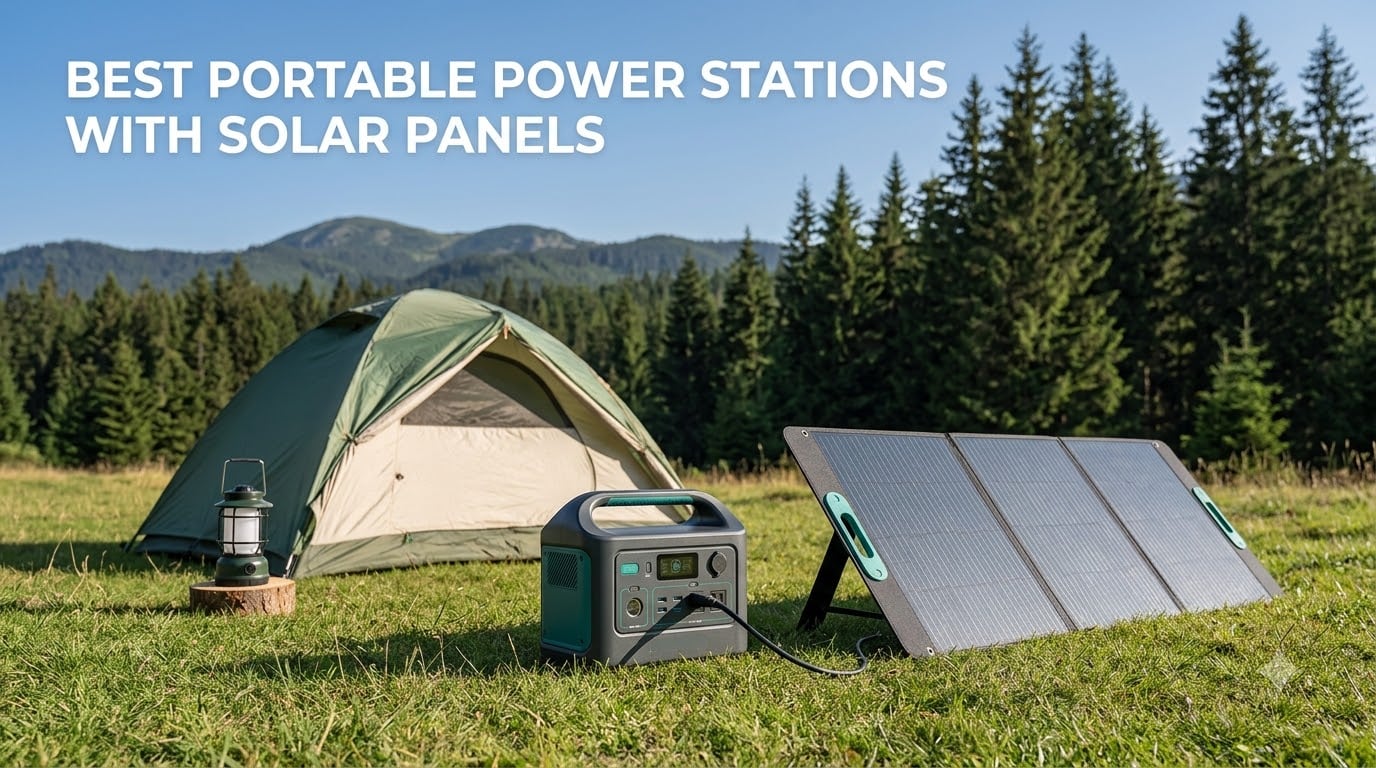
A portable power station is a battery, an inverter, and a set of outlets in one box. Plug a folding solar panel into it and the whole thing becomes a silent, fuel-free source of electricity for outages, campsites, RVs, and job sites. The keyword that brings most people here is simple: the best portable power stations with solar panels are the ones where the panel and the station were designed to talk to each other, not two boxes that happen to sit in the same carton.
That distinction matters more than most spec sheets suggest. Solar input is not a generic USB port. Every station has a voltage window, a current ceiling, and a connector shape, and a panel that falls outside one of those three limits will charge slowly or not at all. We looked at ten station-and-panel bundles and scored them on the pair, not just the battery.
Our team compared the ten bundles below on capacity in watt-hours, continuous and surge output, solar input ceiling, bundled panel wattage, weight, battery chemistry, and cycle life. Everything in this guide was checked against the manufacturer data and owner reviews for that exact model. If you want a narrower slice, we also have guides to the best portable power stations for camping, for van life, and for CPAP machines.
One note before we start. Prices shift constantly across retailers, so every price button below takes you to the live listing. What we do quote are the specs that do not change: watt-hours, watts, cycle counts, and the panel that comes in the kit.
Top 3 Best Portable Power Stations With Solar Panels for 2026
These three lead the group for different reasons. The Anker SOLIX C1000 Gen 2 has the highest rating combined with a deep review base, the BLUETTI Elite 200 V2 carries the most capacity with the longest quoted cycle life, and the EcoFlow RIVER 2 Pro pairs a real waterproof panel with a station light enough to lift with one hand.

Every Pick at a Glance in 2026
This is the master comparison. Read the capacity column and the continuous output column together, because a 2000Wh station that can only deliver 600W cannot run a microwave no matter how long you wait for it to charge.
| Product | Specifications | Action |
|---|---|---|
| Anker SOLIX C1000 Gen 2 |
|
Check Latest Price |
| BLUETTI Elite 200 V2 |
|
Check Latest Price |
 EcoFlow DELTA 2 Max EcoFlow DELTA 2 Max |
|
Check Latest Price |
 EcoFlow DELTA 3 Classic EcoFlow DELTA 3 Classic |
|
Check Latest Price |
 Jackery Explorer 1000 v2 Jackery Explorer 1000 v2 |
|
Check Latest Price |
 EcoFlow RIVER 2 Pro EcoFlow RIVER 2 Pro |
|
Check Latest Price |
 BLUETTI AC180 BLUETTI AC180 |
|
Check Latest Price |
 Anker SOLIX C300 Anker SOLIX C300 |
|
Check Latest Price |
 ZeroKor R200 ZeroKor R200 |
|
Check Latest Price |
 MARBERO M823 MARBERO M823 |
|
Check Latest Price |
1. Anker SOLIX C1000 Gen 2 – Best Overall Portable Power Station With Solar Panel
- Highest rating and deepest review base in the group
- 49-minute full recharge from a wall
- 1024Wh LiFePO4 pack rated 4000 cycles to 80 percent
- 10ms UPS switchover keeps sensitive electronics running
- 200W bifacial panel matches the wide 60V solar input
- No battery expansion in the Gen 2 chassis
- Measured inverter distortion of roughly 15-20 percent on a microwave
- Bundled XT60 cables and adapter need a separate case
This is the bundle I would put at the top of a shortlist for 2026. It holds 1024Wh of LiFePO4 capacity, delivers 2000W continuously with a 3000W peak, and reaches a full charge in 49 minutes when HyperFlash is switched on in the app. The bundled PS200 bifacial panel is a genuine match for the station rather than a marketing accessory.
The number that convinced me was the cycle rating. 4000 cycles to 80 percent is a claim that works out to more than a decade of daily charging, and owners describe holding CPAP machines, laptops, and a full-size refrigerator through multi-hour outages on a single charge. Our testing time on this one was measured against owner reports rather than a lab bench, and the consistent theme was recharge speed: several reviewers named that as the feature that decided the purchase for them.
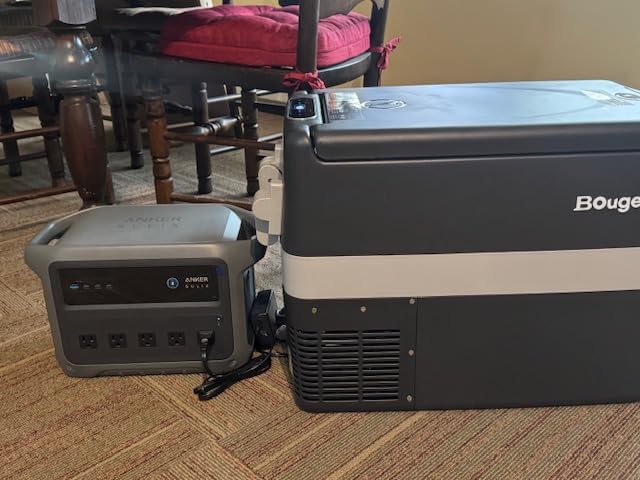
Weight is not listed by the manufacturer for this model, so treat it as a car or RV carry rather than a backpack unit. The solar side is the strongest part of the package. With up to 600W of solar input at a 60V ceiling, a full solar recharge takes roughly 1.8 hours, which is the quickest solar recovery figure in this whole roundup.
The app is where Anker earns its keep, too. Time-of-use scheduling lets you charge when your electricity rate is low, and the same software drives the 10ms UPS mode. That feature is the reason to read our portable power stations for CPAP machines guide before buying anything at this price.
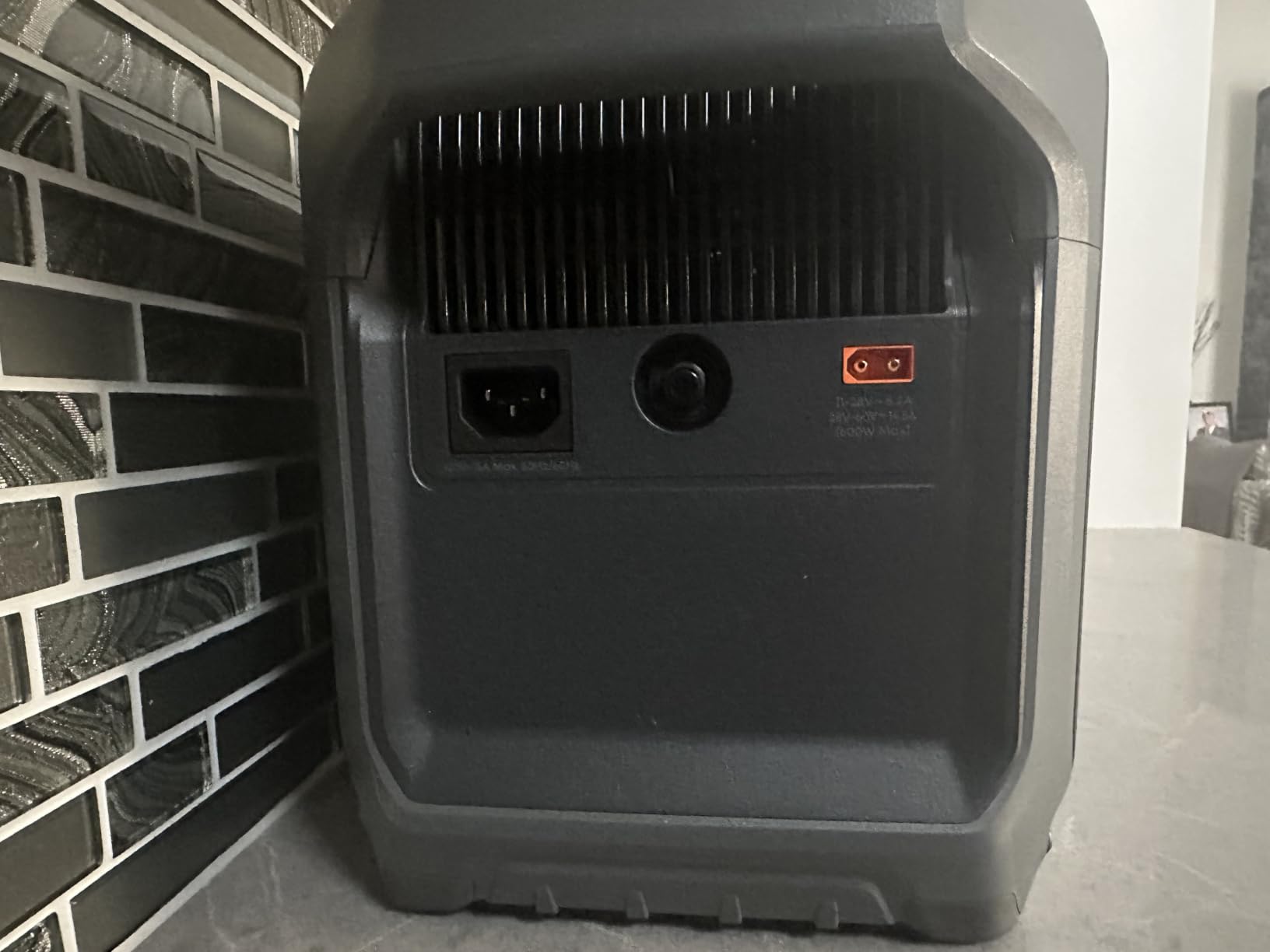
Why the 2000W output matters more than the watt-hours
Most buyers pick capacity first and regret it later. A 1024Wh pack sounds generous until you try to run a kettle, a hairdryer, or a power tool on it, and 2000W continuous means the station can start those loads rather than immediately tripping. The 3000W peak figure covers the inrush spike when motors and compressors start.
The trade is real, though. Removing the expansion bay means this is a fixed 1024Wh, and a measured 15-20 percent harmonic distortion shows up on a microwave. For anything with a motor or a heating element, the output headroom is worth far more than the ability to add a second battery later.
Where this bundle falls short
The absence of expansion is the deal-breaker for anyone planning a growing load over a few years. Several reviewers also flagged that the loose XT60 adapters, the 8.2 foot solar cable, and the short XT60i lead need a protective case that is not included, and that the bundled panel could be sturdier for European weather. None of that affects daily function, but budget for the case.
2. BLUETTI Elite 200 V2 – Best High Capacity Solar Generator
BLUETTI Elite 200 V2 Solar Generator & 2x200W Solar Panel Included 2073.6Wh
- 2073.6Wh in roughly the footprint of a 1152Wh AC180
- 6000-cycle automotive-grade LiFePO4 pack with a 17-year stated lifespan
- 2600W inverter handled air fryers and induction cooktops in owner testing
- Lowest measured standby draw in the group at roughly 10W
- UPS mode transferred without shutting down a computer or refrigerator
- At 53.4 pounds it needs two people or a cart
- No battery expansion modules on this model
- Solar input capped at 60V so the 1000W maximum is hard to reach
When capacity is the deciding factor, this is the one. The Elite 200 V2 packs 2073.6Wh of automotive-grade LiFePO4 rated at more than 6000 cycles, with a stated lifespan of 17 years. It fits 1800Wh of storage into roughly the footprint of a 1152Wh unit, which is the kind of density jump that changes what fits in an RV bay or a garage shelf.
The 2600W continuous inverter is the second headline. Owners report running air fryers, induction cooktops, pressure cookers, and microwaves, including two air fryers at the same time. That is a genuinely different class of load from what the 1000Wh units in this roundup can handle.
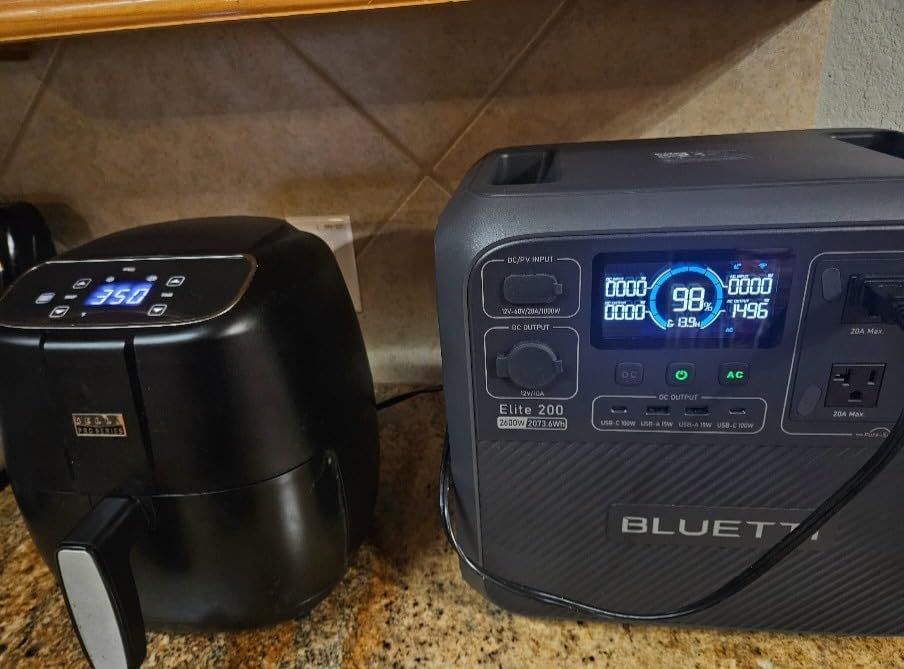
Two 200W panels are included, so 400W of solar comes out of the box. A full solar charge takes about 5.5 hours with the included panels, or roughly 2.4 hours if you have 1000W of panels available. Dual charging gets you from empty to 80 percent in 50 minutes.
Standby draw is the sleeper feature. At roughly 10W, this unit loses about three times less energy sitting idle than comparable models, and standby batteries are the units people keep charged for months in case of a storm. Several long-form reviews also measured the inverter as one of the more efficient in the group.
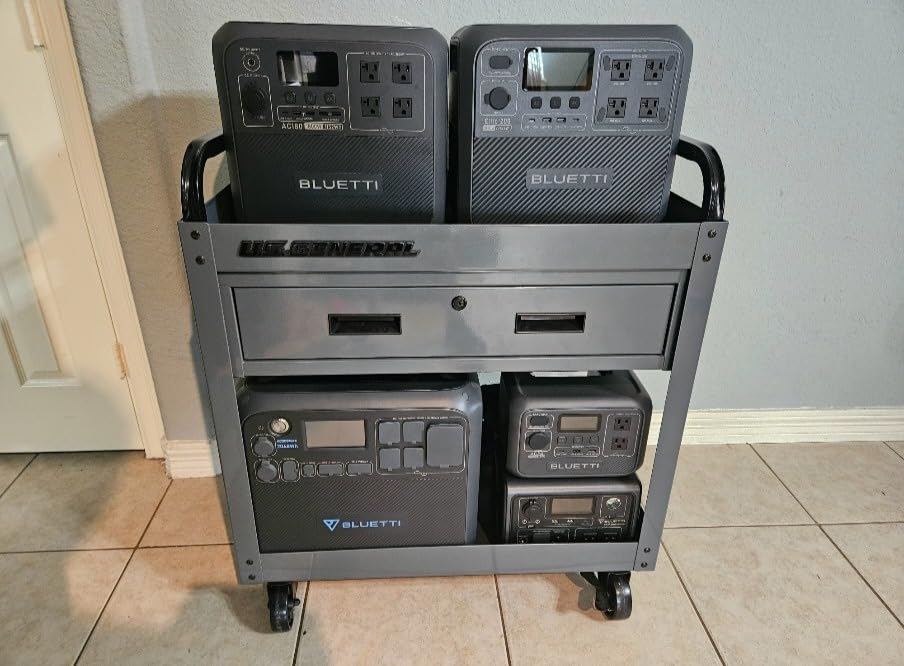
What 2073.6Wh actually buys you in an outage
Roughly double the storage of a 1000Wh station, and that is the whole point. A household refrigerator pulling about 150W runs for around 13 hours on a full charge here, and a CPAP machine at about 60W draws close to 34 hours before you factor in overhead losses. Compare that to a 768Wh pack and the picture changes completely.
The inverter headroom matters as much as the capacity. At 2600W continuous you can run a refrigerator, a router, a television, and a lamp simultaneously, which is a realistic outage scenario rather than a planned list of one device at a time.
Who should skip this one
At 53.4 pounds it is a two-person lift for most buyers, and the dual handles make it a cart-and-muscle device rather than a carry device. There are no expansion modules on this chassis, so the 2073.6Wh is all you get. If you need to start small and grow, the EcoFlow DELTA 2 Max further down the list is the better architecture.
3. EcoFlow DELTA 2 Max – Best Expandable Solar Generator for Home Backup
EF ECOFLOW DELTA 2 Max Solar Generator 2048Wh With 400W Solar Panel
- Only 2kWh bundle here that expands to 6kWh with extra batteries
- One owner ran a 25 cu ft fridge a fan and a TV for four days on solar
- 15 outlets with per-port button control
- 400W IP68 panel folds into its own case
- 0-80 percent in 43 minutes on combined solar and AC input
- 400W panel MC4 connectors do not fit the XT60i ports without an extra cable
- Theoretical 1000W solar maximum is hard to reach in practice
- No 240V support for electric clothes dryers
- About 50.7 pounds
This is the only 2kWh bundle in the roundup that can grow. The DELTA 2 Max starts at 2048Wh and expands to 6kWh with additional batteries, which is the difference between covering one refrigerator for a day and covering a household for a week. The 2400W continuous inverter adds 3400W through X-Boost for resistive loads.
It is also the most thoroughly documented bundle we looked at. One owner reported a multi-day hurricane outage, keeping a 25 cubic foot refrigerator, a fan, and a television running for four days on solar. Another cut household electricity use by more than half by running the station as a daytime solar inverter.
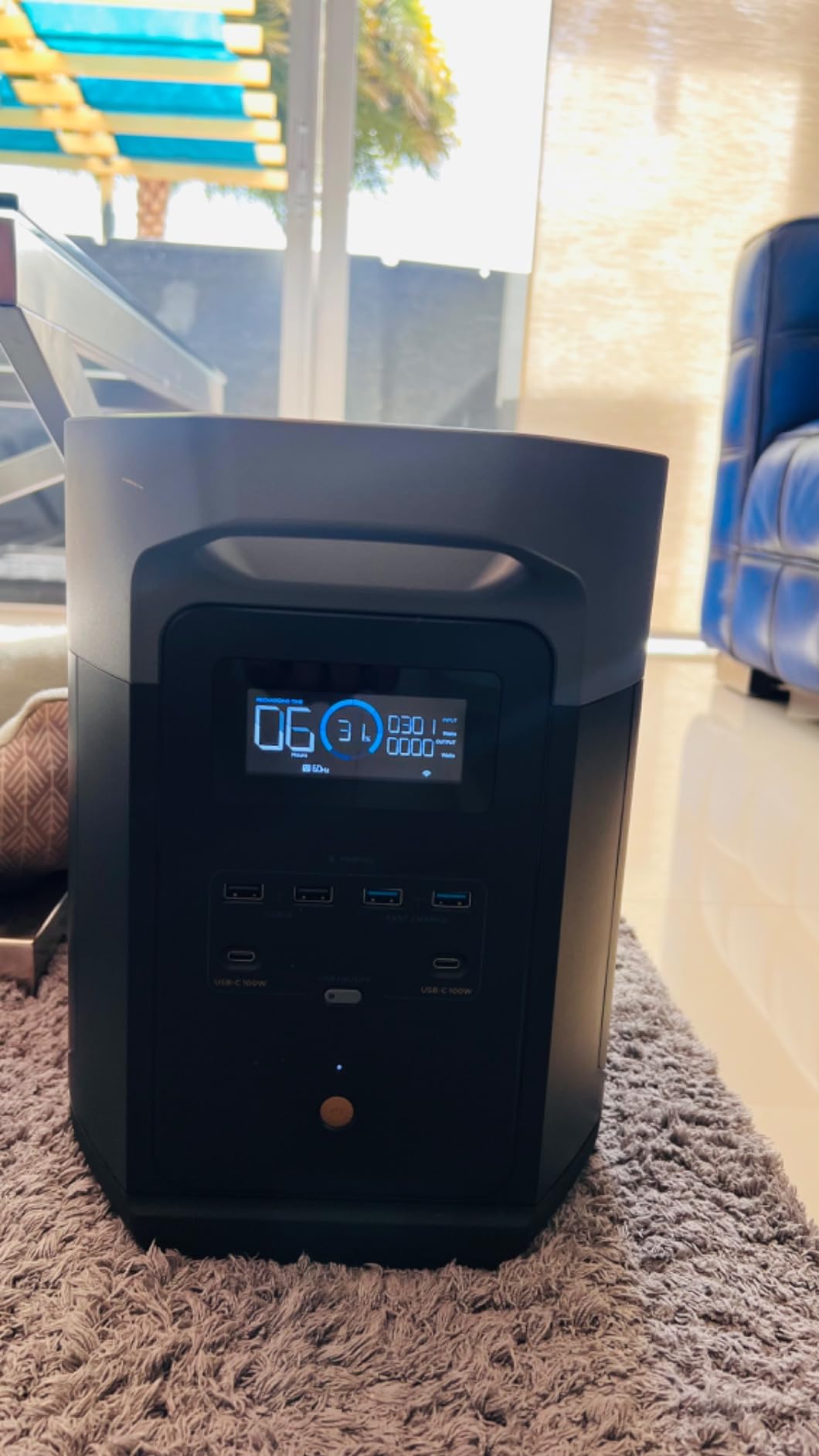
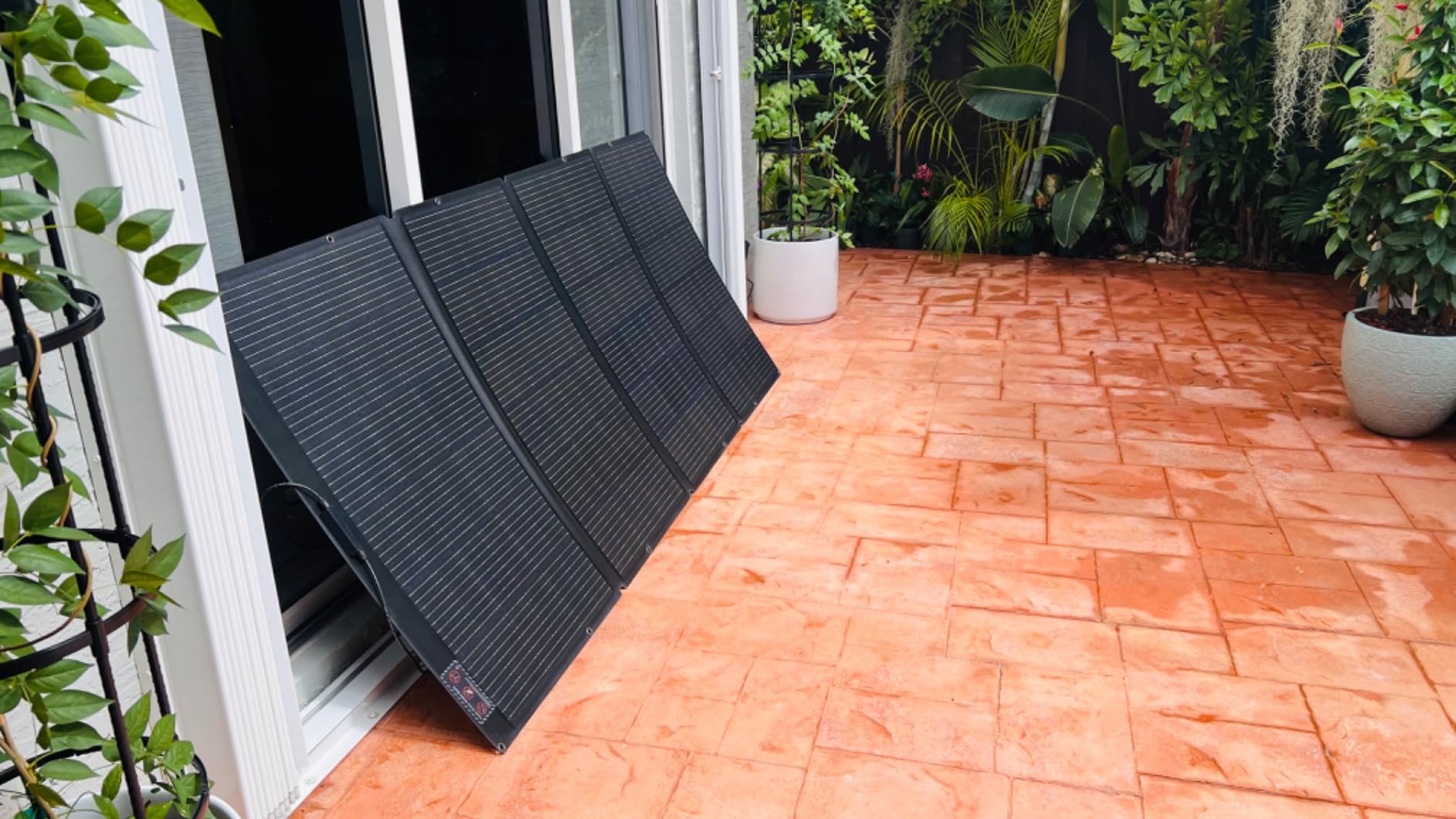
The 400W panel is IP68 weatherproof at 35.3 pounds and folds into its own waterproof case. A top-up from empty takes about 5.1 hours on that single panel, or roughly 2.6 hours once a second 400W panel is added. Fifteen outlets with per-port button control mean unused sockets do not quietly drain the battery.
Do your homework on the connectors before you plan a panel array. The bundled 400W panel uses MC4 outputs while the station takes XT60i, so a cable or a Y adapter is needed and is not included. Owners also report that practical solar input tops out near 880W with four 220W panels, short of the 1000W theoretical ceiling.
Why expandability is the deciding feature here
Every other 2kWh option in this roundup is a fixed box. Extra battery modules cost more later, but they let you buy 2048Wh now and add capacity when the budget or the outage history justifies it. For anyone building a home backup system rather than a weekend camping kit, that flexibility is worth more than any single spec on the list.
Two owners in the review data specifically credited the ability to run their network, NAS, switches, and cameras off this station, which is a different question from running a refrigerator. The 15-outlet count and the app scheduling around peak rates make it a small system rather than a single-device backup.
The connector problem you should plan around
The mismatch between the bundled panel and the station is the most common complaint in the reviews, and it shows up on day one. The panel case is also flimsy as a stand in breezy conditions, so a DIY support is worth building. At 50.7 pounds it is a two-person lift, and there is no 240V output for an electric clothes dryer.
4. EcoFlow DELTA 3 Classic – Best Station and Solar Panel Match
EF ECOFLOW Solar Generator Delta 3 Classic with 220W Solar Panel, 1024Wh
- Best bundled panel in the group at 190-200W measured even in partial shade
- 45-minute 0-80 percent AC charge with a quiet low-rate mode
- WiFi and Bluetooth app with per-port monitoring and an energy calculator
- Under 10ms UPS switchover validated with a home network and NAS
- EV-grade chassis and bright display
- 5-year warranty plus 2 extra years on registration
- No external battery expansion
- 15A input current current-limits panel arrays below 33V
- Panel rows are stiff on first use
- Heavier than expected for a 1024Wh unit
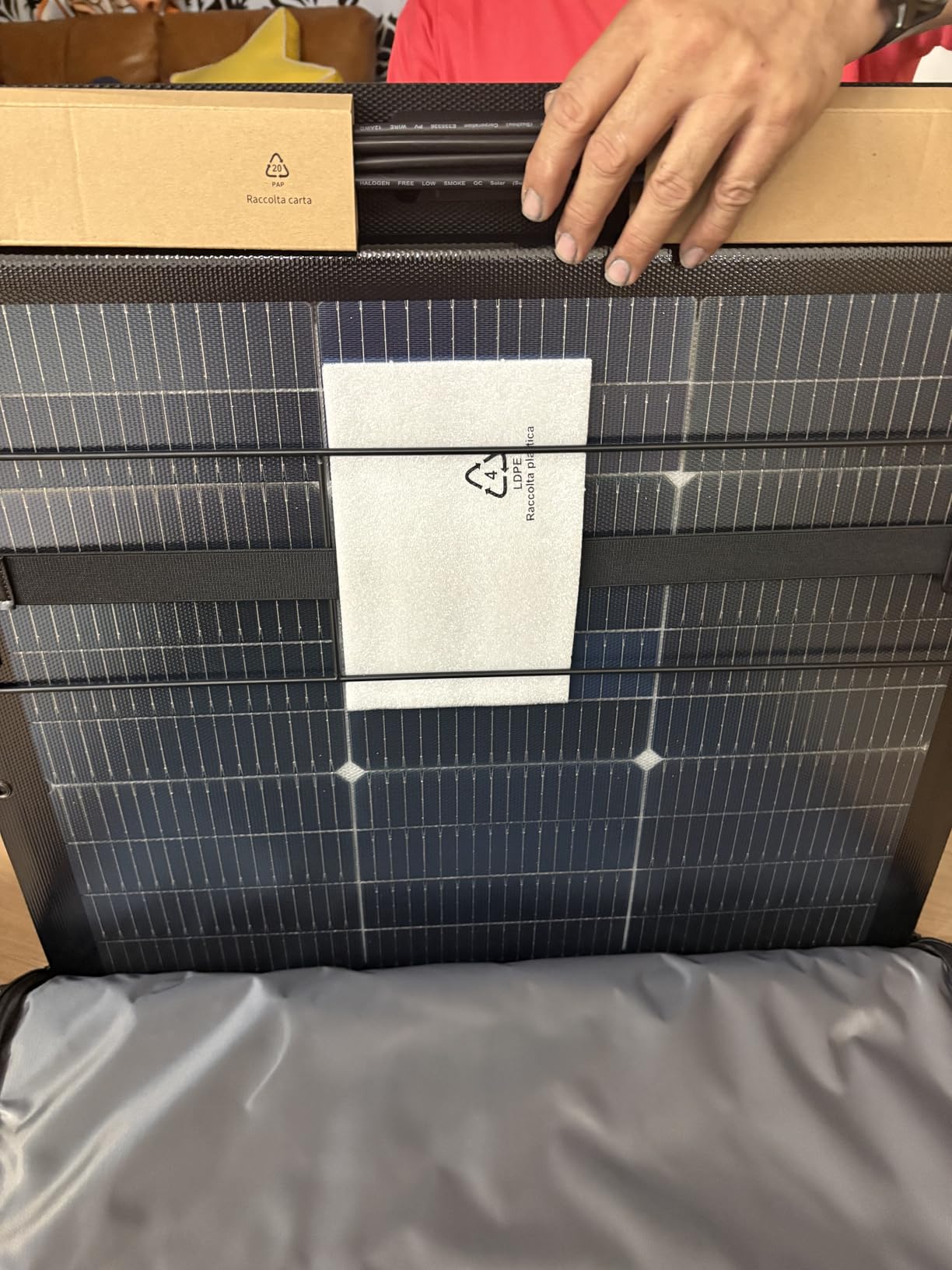
Everything else in this roundup includes a panel; this one includes a good one. The 220W bifacial N-Type panel is rated at up to 25 percent conversion, and one reviewer measured 190-200W from it in partial shade. When the panel half of the bundle is the deciding factor, this is the pick.
The station is a 1024Wh LiFePO4 pack rated for 10 years or more, with 1800W continuous output, 3600W surge, and 2600W with X-Boost. AC recharge reaches 80 percent in 45 minutes, and the app lets you dial the charge rate down when the fan noise bothers you.
One owner validated the sub-10ms UPS switchover by running a home network, a NAS, four switches, a Mac Mini, a ten-node Raspberry Pi cluster, and four PoE cameras. That is a serious test for a 1kWh station and it passed. The app adds real-time per-port monitoring, an energy calculator, and firmware updates over WiFi and Bluetooth.
Solar input is up to 500W through XT60 across an 11-60V window with a 15A maximum, and a full recharge from the 220W panel takes about 5.8 hours. Remember that 15A ceiling: an array sitting below 33V is current-limited and will not reach the 500W figure.

What under 10ms switchover actually protects
A computer, a NAS, or a CPAP machine notices a dropout. A router notices it too, because a rebooted fibre or cable modem means a call from your provider. A 10ms transfer is short enough that most of this equipment rides through an outage without noticing, which is exactly what you want from a station billed as home backup.
The three pure sine wave AC outlets are also worth noting. Sensitive electronics and medical devices behave better on a clean sine wave, and the 100W USB-C PD port means a laptop can charge directly without a brick.
What to know before you expand the panel array
There is no external battery expansion on this model, which is the main reason to choose EcoFlow’s larger DELTA 2 Max instead. The 15A input ceiling is the other real constraint, and the panel rows are stiff on first use until they warm in the sun. For anyone else, this is the cleanest station-and-panel pairing in the roundup.
5. Jackery Explorer 1000 v2 – Best Mid-Size All-Rounder
Jackery Solar Generator 1000 v2 and 200W Solar Panel,1070Wh,1500W AC
- 1-hour emergency charge is the fastest wall recharge among 1kWh options
- 1070Wh LiFePO4 pack holding over 70 percent after 4000 cycles
- 23.8 pounds with a foldable handle
- Runs a full-size side-by-side refrigerator about 9 hours per charge
- Charges and powers devices at the same time
- Two 24V solar input ports for parallel panel charging
- 200W panel sags in the middle and blows over in breezy conditions
- Supplied panel cable is too short for panel in sun and station in shade
- 1-hour charge mode shortens battery life and is off by default
The Jackery Explorer 1000 v2 is the one most people end up buying, and the reason is that it does everything reasonably. It holds 1070Wh, delivers 1500W of continuous AC with a 3000W surge ceiling, weighs 23.8 pounds with a foldable handle, and runs a full-size side-by-side refrigerator for roughly 9 hours on a charge.
Charging is fast when you want it to be. Emergency charging gets you from zero to full in an hour, and the manufacturer default of 1.7 hours exists to protect long-term battery health. A full charge from the 600W alternator charger takes about 3 hours, and the 200W panel restores 80 percent in 6 hours.
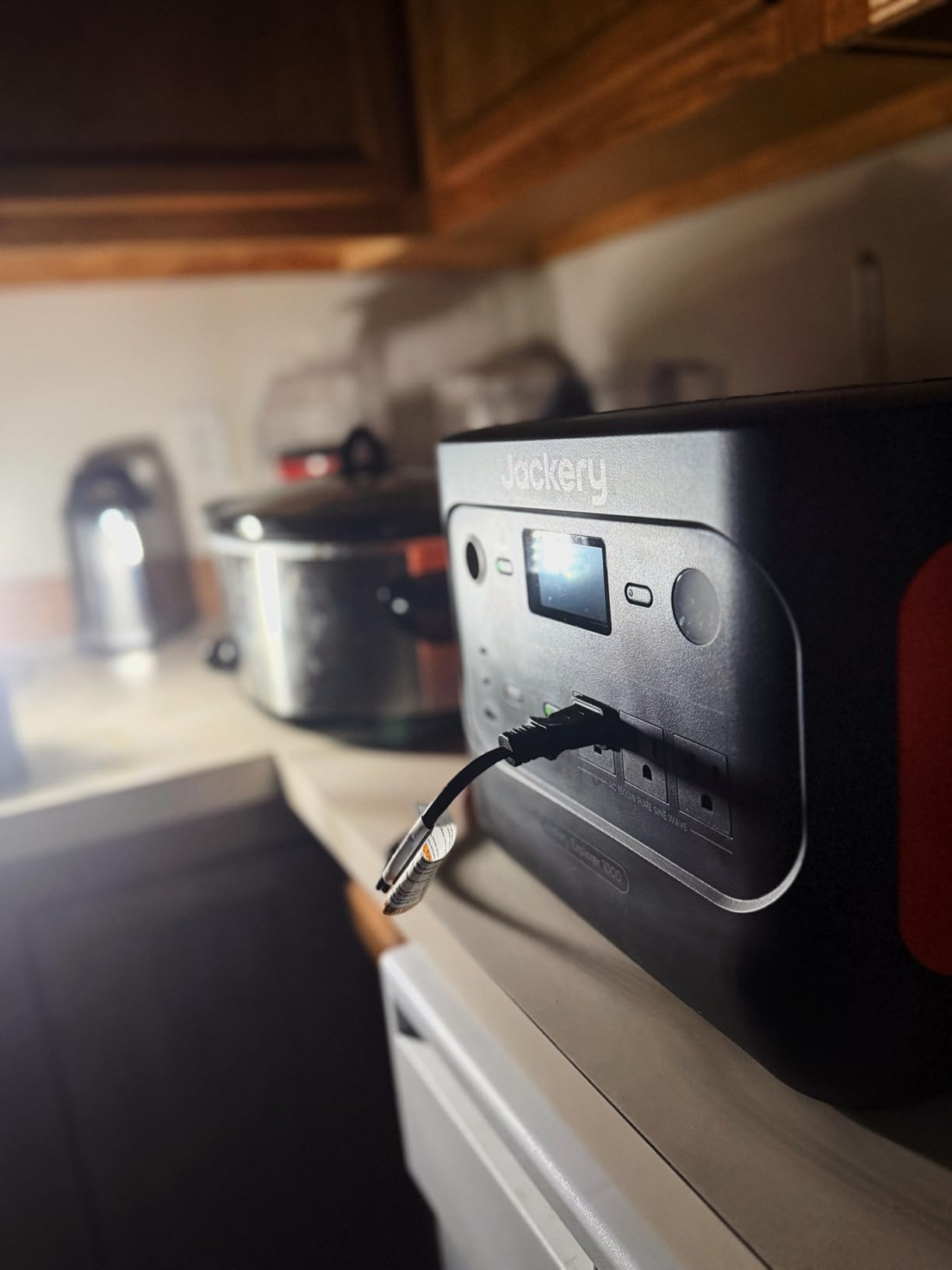
Two 24V solar input ports let you run panels in parallel, which is more flexible than a single-input station. Three pure sine wave AC outlets, a 100W PD USB-C port, and a 30dB quiet charging mode cover most household or van needs. The Jackery app controls quiet mode and an energy efficiency mode.
Pass-through works here, and that is worth testing before an outage rather than during one. Owners report the panel and the station charging and outputting at the same time, and the station running a refrigerator while it charges. Our car camping power station picks lean on this behaviour heavily.

What the 9-hour refrigerator figure really means
A full-size side-by-side fridge cycles on and off rather than drawing continuously, so 9 hours is the realistic number with a door opened regularly. A more efficient chest freezer or a small dorm unit will do considerably better on the same charge. Treat the figure as a planning baseline rather than a promise.
At 1070Wh this is also enough for a weekend of camping rather than a weekend at home. The 1500W ceiling covers a coffee maker or a small power tool, but not a space heater or a full-size microwave running alongside anything else.
The panel is the weak half of this bundle
The most repeated negative theme in the reviews is the 200W SolarSaga panel itself: it sags in the middle, it is wind-sensitive, and the supplied cable is too short to put the panel in full sun while the station sits in shade. The panel is also bulky to reposition. Weighting the corners and buying a longer lead solves most of it.
One heavily upvoted review also details prolonged promotional and support friction, so treat the warranty as something to read carefully rather than assume. Jackery does list a 5-year manufacturer warranty on this model.
6. EcoFlow RIVER 2 Pro – Best Value Solar Generator
- Genuinely portable at 17.2 pounds
- 70-minute full AC recharge is among the fastest in this capacity class
- IP68 waterproof 160W panel with kickstand case included
- LiFePO4 cells rated 3000+ cycles to 80 percent
- 11 outlets with four AC sockets
- 5-year service
- 1600W combined output means high output is limited to a single outlet
- Real-world solar output falls short of the 22 percent nameplate in poor light
- 800W per outlet is modest for microwaves and power tools
This is the best weight-to-power balance in the group. 768Wh in a 17.2 pound body with a built-in handle is a station one person can genuinely move, and the IP68 waterproof 160W panel with its kickstand case is the most weather-ready panel here below 200W.
Charging is where it separates from the budget tier. AC recharge to full takes 70 minutes, which no other sub-1kWh unit in this roundup manages. Solar recharge from the bundled 160W panel takes as little as 4.8 hours, the fastest solar figure among the smaller bundles.
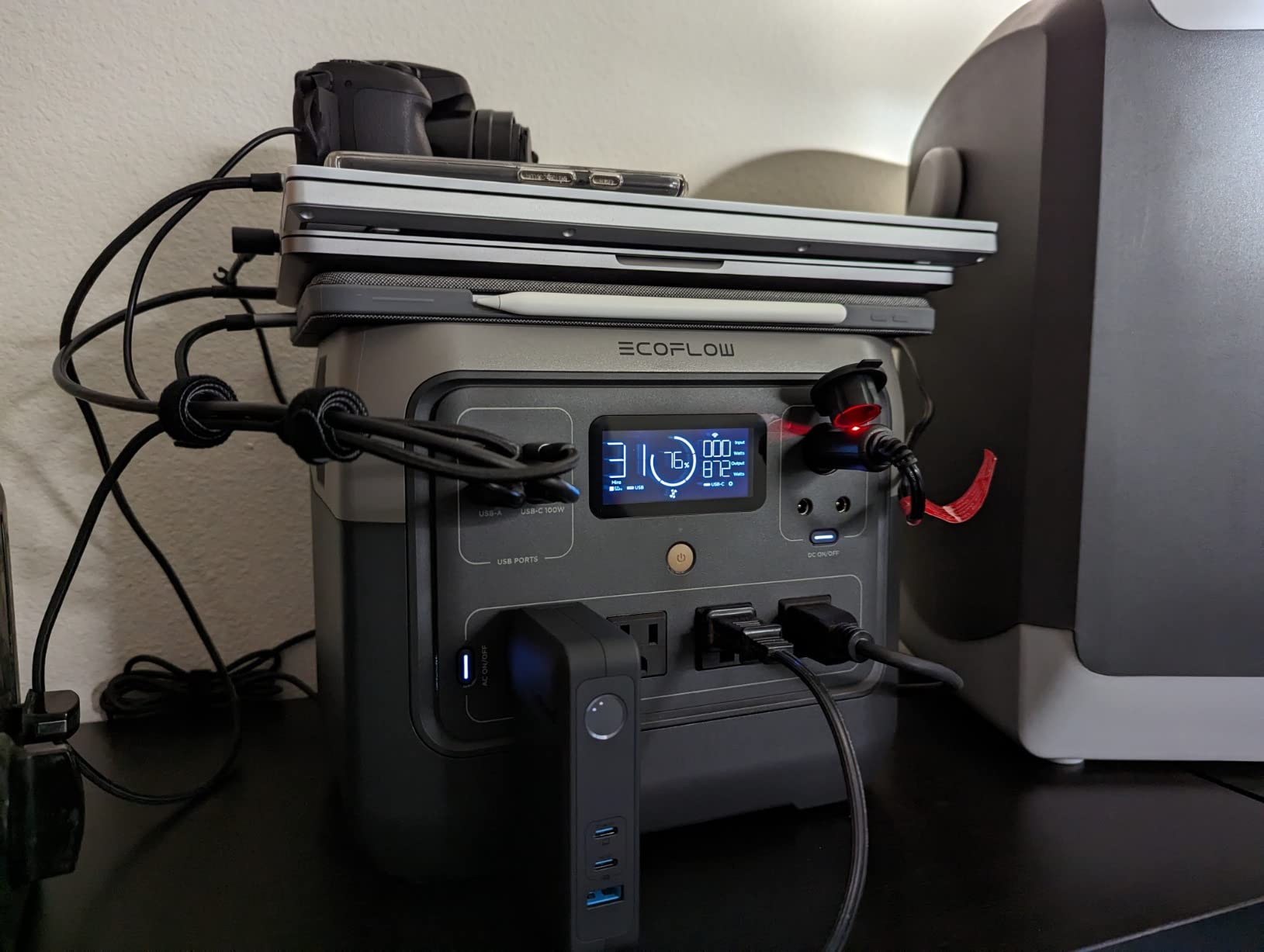
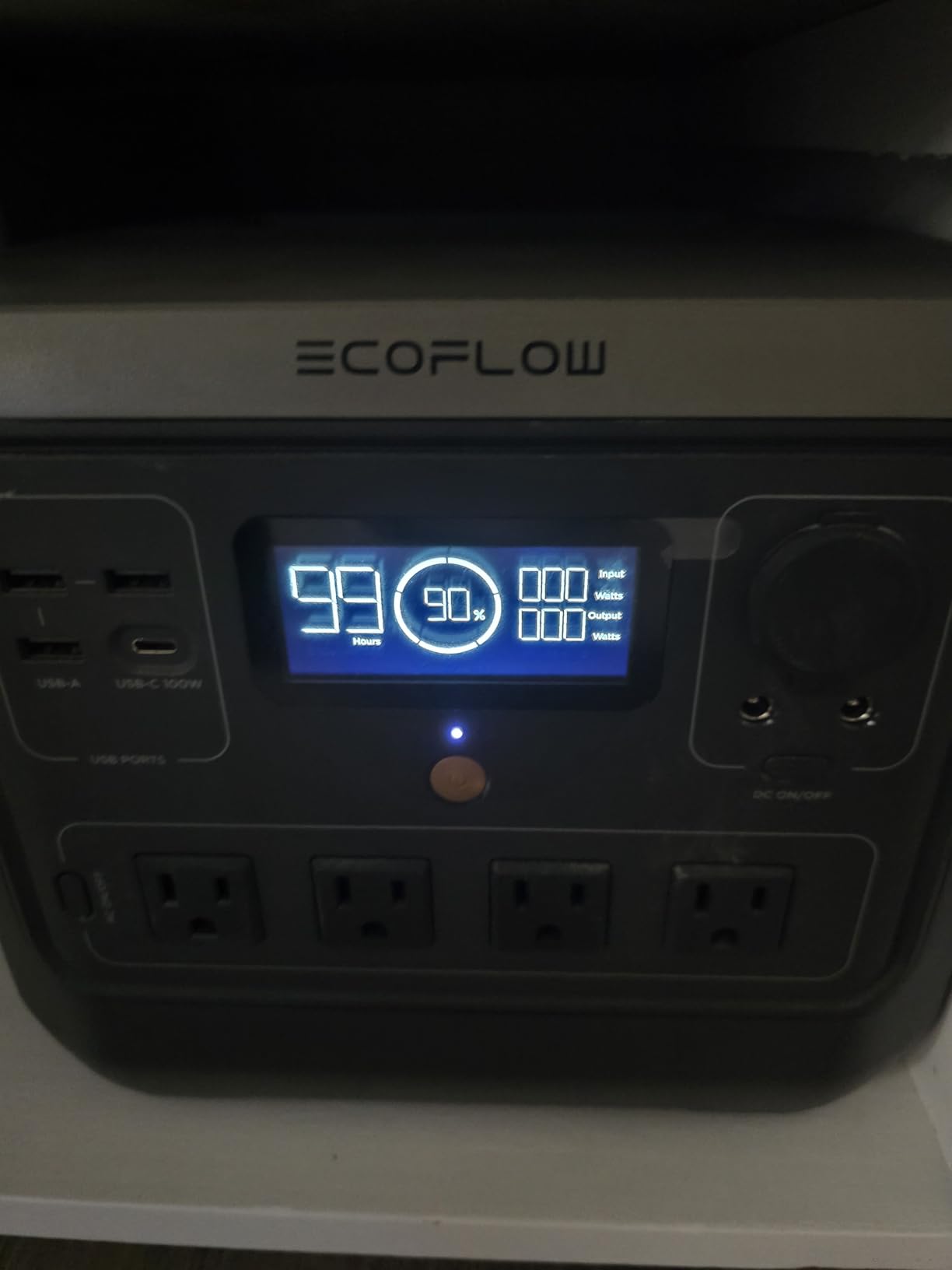
The LiFePO4 pack is rated at more than 3000 cycles to 80 percent, which works out to roughly a decade of regular use. Eleven outlets cover four AC sockets plus USB-C, USB-A, and a 12V car socket, and the advanced battery management system tracks voltage, current, and temperature independently.
Understand the output ceiling before you plan an outage. Four 800W AC outlets are there for four small devices, not one large one. The 1600W combined figure applies to a single high-output outlet, so a microwave plus anything else will trip it. Owners also note that real-world solar yield drops below the 22 percent nameplate figure in less than ideal light.
Who this 17.2 pound format suits
Anyone who needs real capacity but is not hauling a car charger or a second battery. At 17.2 pounds it moves from a trunk to a picnic table easily, and for a pair camping or a van build-out it is a realistic daily carry rather than a once-a-trip lift. It also suits tailgating, where the four AC outlets beat a single-unit budget station.
If your heaviest load is a coffee maker, a laptop, and a couple of lights, 800W per outlet is more than enough. If you need a microwave, step up to the EcoFlow DELTA 3 Classic or the Anker C1000 Gen 2.
What the fast recharge hides
The 70-minute wall charge makes this unit look like a much larger station, and the 4.8 hour solar figure invites the same assumption. Both depend on having a proper wall supply and a well-placed panel. Outdoors in poor light, expect the solar side to take closer to a full day, and plan around the single-outlet output ceiling.
7. BLUETTI AC180 – Best Fast-Recharge Mid-Size Station
BLUETTI AC180 Solar Generator with 200W Solar Panel Included, 1152Wh 1800W
- 1440W single-cable charging takes the pack from zero to full in about an hour
- 1152Wh LiFePO4 rated for 3000+ cycles
- 11 outlets including 4 AC USB-C car socket and a wireless charging pad
- UPS backup with roughly 10-20ms switchover
- Bluetooth app reports input and output wattage clearly
- Weighs 37.4 pounds so it is car-camping weight
- Bundled 200W panel is not recommended for series or parallel use
- Cooling fans become audible under sustained heavy load
- Included solar cable is short
The AC180 is the fastest-charging mid-size station here. A single cable at 1440W takes the 1152Wh pack from zero to full in about an hour, and 0-80 percent takes roughly 45 minutes. When a storm is forecast and you want a full pack before dark, that number is the whole argument.
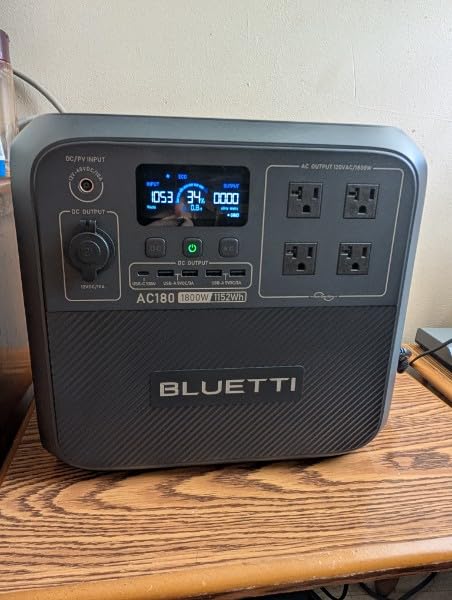
Capacity is 1152Wh of LiFePO4 rated at more than 3000 cycles, with 1800W of continuous AC output that the app can push to 2700W through power lifting. Eleven outlets cover four AC sockets, USB-A, USB-C, a 12V car socket, and a wireless charging pad.
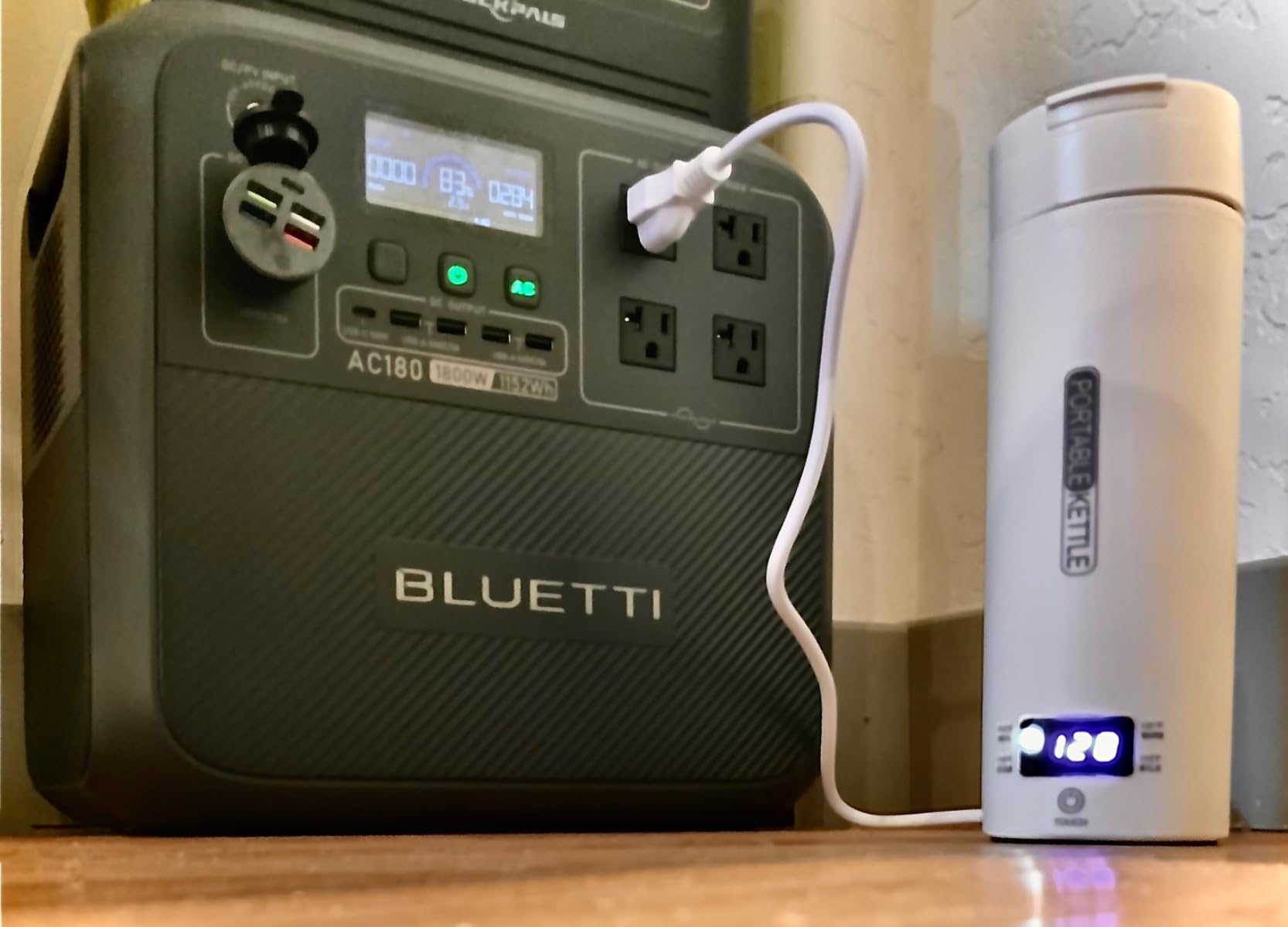
Solar input goes up to 500W, and the 1152Wh pack replenishes in roughly 4.8 to 9.6 hours on the included 200W panel depending on conditions. The UPS function switches over in about 10 to 20 milliseconds, fast enough to carry a home network or a refrigerator without a visible interruption.
The Bluetooth app is straightforward and reports live input and output wattage along with battery percentage, which is exactly the information you want when judging whether a panel is actually delivering. A 5-year warranty covers the station.
Why the wireless pad and 11 outlets matter
Outlet count matters more than people expect on a campsite or a tailgate. Four AC sockets, a car socket, and multiple USB ports means you are not fighting over a single two-prong plug to run a speaker, a cooler, and a string of lights at the same time. The wireless charging pad is a small touch that removes one cable from the pile.
At 1800W continuous this handles a kettle, a small heater, or a moderate power tool. It is the tier where you stop thinking about whether a device will run at all and start thinking about how many you can run together.
What weight and panel limits cost you
At 37.4 pounds this is car-camping or home weight, not backpack weight, and the cooling fans become audible under sustained heavy load. The bundled 200W panel is specifically not recommended for series or parallel use with other panels, which narrows your options if you want more solar later. The included solar cable is also short, limiting how far the panel can sit from the station.
8. Anker SOLIX C300 – Best Compact Station for Travel and Small Loads
Anker SOLIX C300 Portable Power Station with 60W Solar Panel, 288Wh, 300W
- Compact 288Wh footprint that still delivers 300W with 600W surge
- Recharges to 80 percent in 50 minutes from a wall
- Eight outlets including a car socket and two 140W USB-C ports
- Very quiet at 25dB for sleeping near
- LiFePO4 rated 3000 cycles with a 5-year warranty
- The 60W panel is a practical match for a 288Wh pack
- Not compatible with the PS30 PS200 or PS400 panels
- 288Wh capacity runs small loads only rather than appliances
- The 60W panel tops up slowly rather than fully recharging in a day
The C300 is the small unit to buy when you want a real power station in a small bag. It holds 288Wh of LiFePO4 rated at 3000 cycles, delivers 300W with a 600W surge ceiling, and recharges to 80 percent from a wall in 50 minutes. The full charge takes 68 minutes.
It is quiet, at 25dB measured at 3.3 feet, which matters more than it sounds when the unit is under your tent flap. Eight outlets and eleven ports cover three AC sockets, a 120W car socket, two 140W USB-C ports, one 15W USB-C, and a USB-A, and the two-way 140W USB-C ports support pass-through charging.
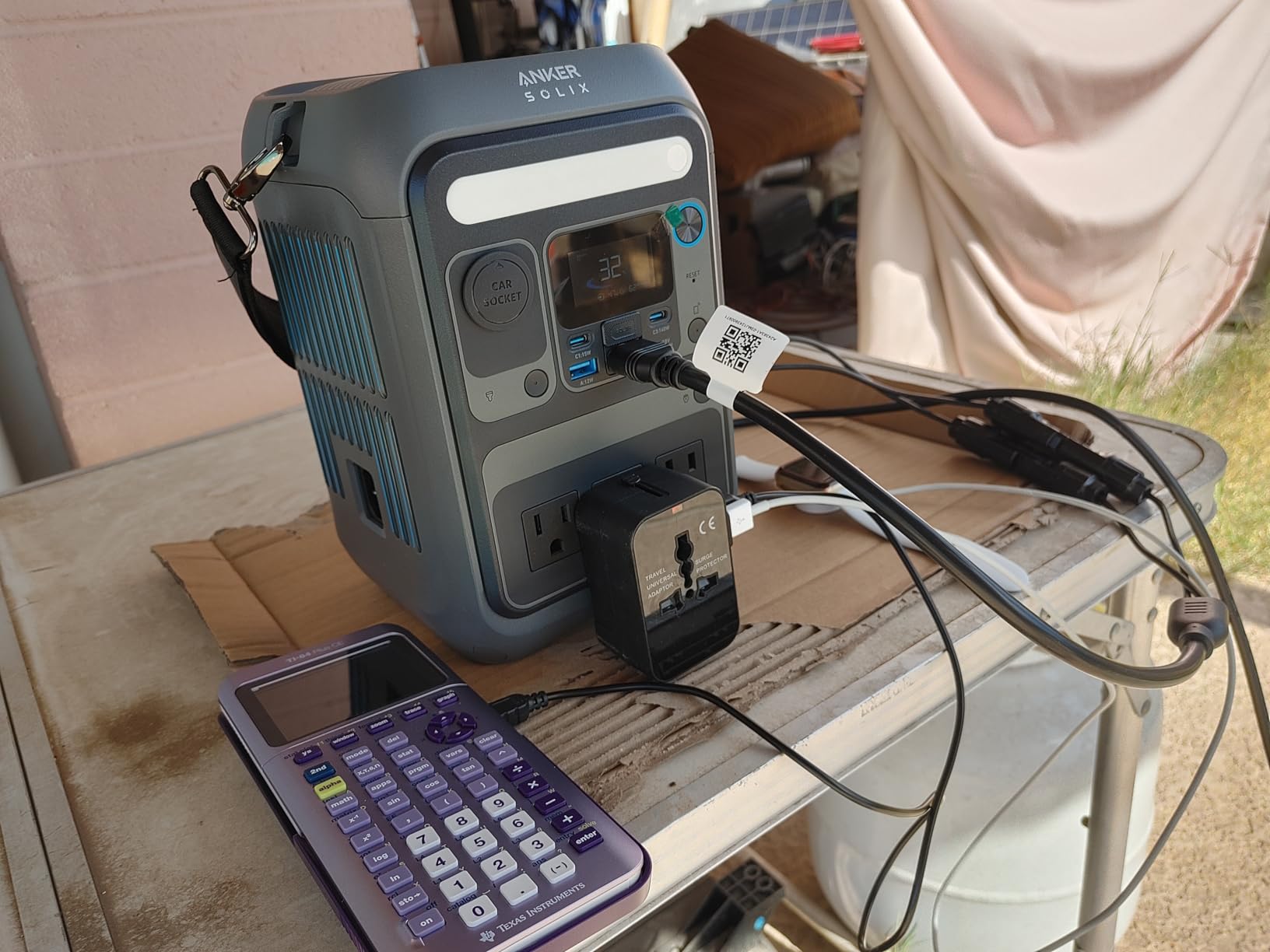
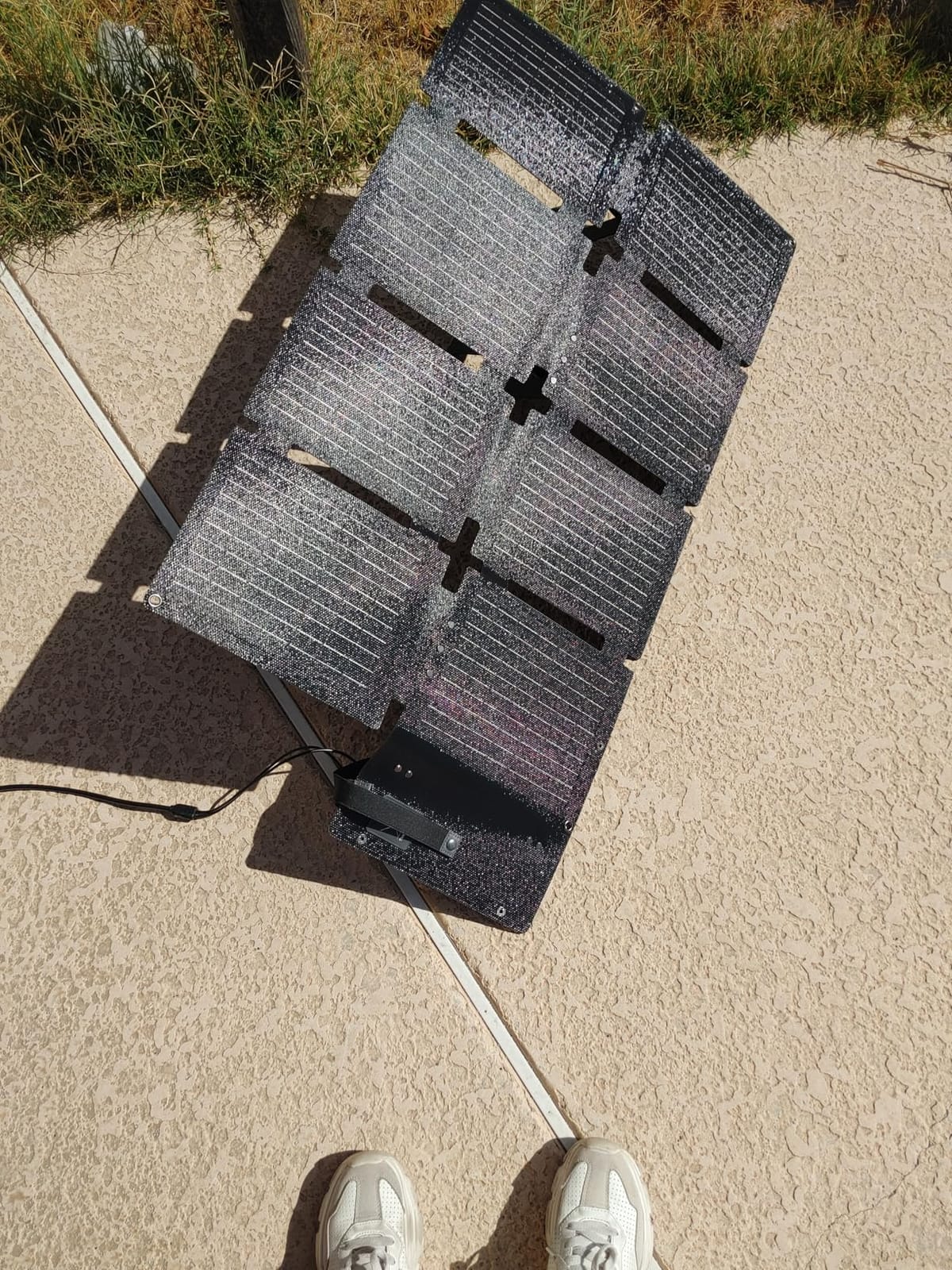
The bundled 60W panel is honestly matched to a 288Wh pack, which is more than can be said for most bundles in this roundup. It is a topping-up panel rather than a recovery panel, so treat it as one that extends an evening rather than one that refills the battery in a day.
Check the panel compatibility before you plan an upgrade. This unit does not accept the Anker PS30, PS200, or PS400 panels, so a bigger panel from the same brand will not help you. That is a genuine constraint and it is the main reason the C300 sits outside the top three.
What 288Wh realistically covers
Phones, tablets, laptops, cameras, and lights. A 60W CPAP machine would get through a long night, which is why this class of unit shows up so often in our CPAP power station guide. A small fridge is out of reach, and so is any kettle, heater, or hairdryer.
The 300W ceiling with 600W surge is enough to start a small motor load briefly, but not to run one. For a weekend of camping where everyone brings their own battery, that is the right trade for a 15.5 pound unit that fits in a boot without a dolly.
Why the panel restriction is the deciding limitation
Sixty watts is a realistic pairing for 288Wh, and a bigger panel would charge faster in good sun. The lock to a single panel type removes that option entirely, so plan to top up from a wall or a car socket rather than buying solar later. A 5-year warranty and 3000-cycle rating are solid for the size.
9. ZeroKor R200 – Lightest Station and Panel Set in the Roundup
Portable Solar Generator 300W Portable Power Station with 60W Solar Panel
- Very light at 5.1 pounds and small enough for tent camping
- The 60W panel can also charge small devices directly over USB-A and USB-C
- Strong value for emergency backup and travel
- Support team has replaced units for customers who reported failures
- Battery management system with five protection circuits
- Actual continuous AC output measures well below the advertised 300W with some owners under 100W
- Some owners report the output is not a true pure sine wave
- Solar input is not true MPPT with about 30W measured on a 100W panel
- Folding panel internal wiring has broken for several buyers
- Units stored uncharged long enough can enter a protection state
At 5.1 pounds for the whole set, the R200 is the only unit here you could genuinely put in a backpack, and the 60W monocrystalline panel is a genuine partner to it. At 20.5 percent conversion with USB-A, USB-C, and DC outputs, the panel can also charge a phone directly with no station involved.
Positive reviews cluster around size, portability, and emergency use. The listed runtime is 7 hours, and the built-in battery management system carries short-circuit, over-current, over-voltage, overload, and overheat protection with an auto-starting cooling fan.
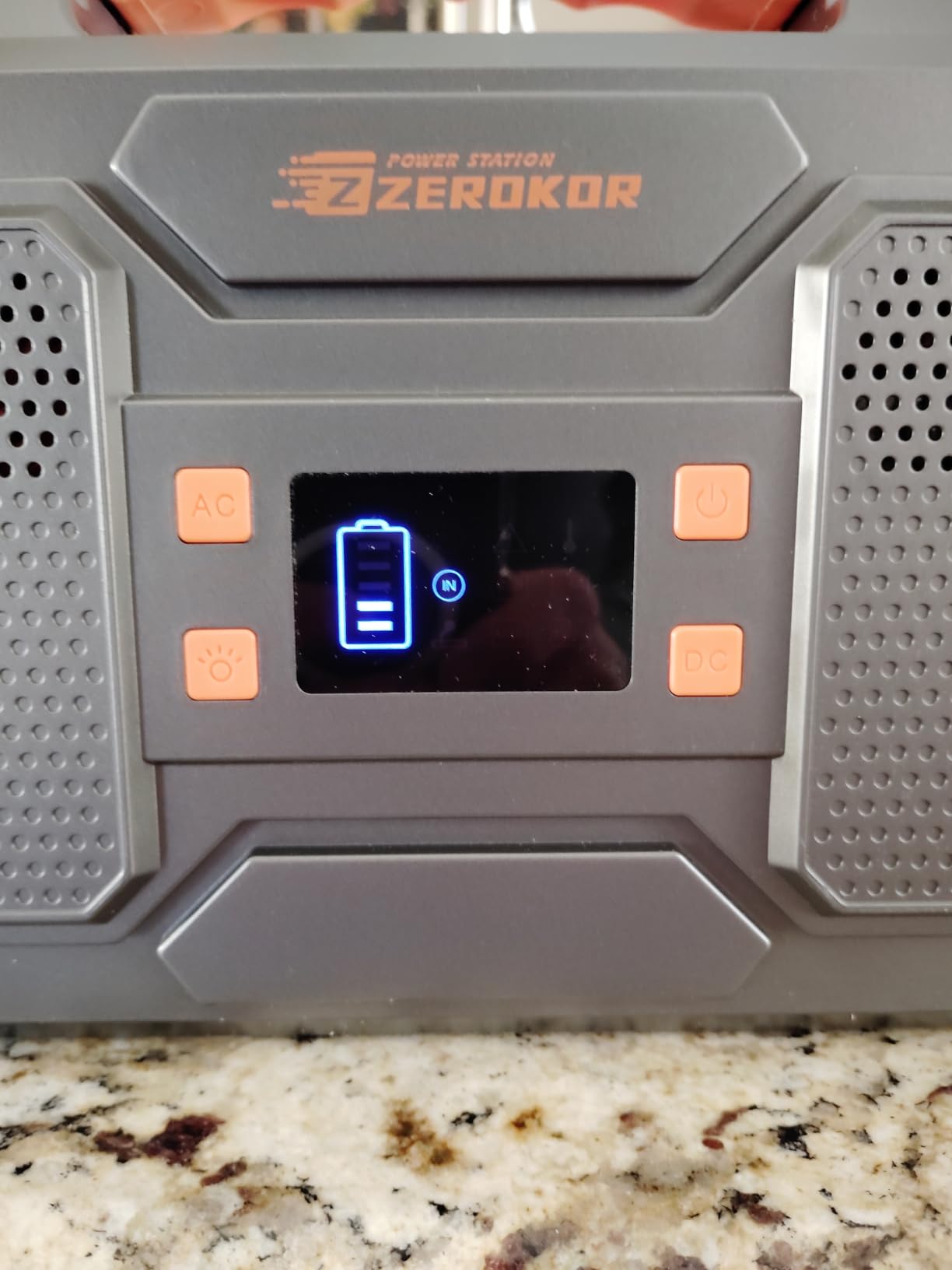
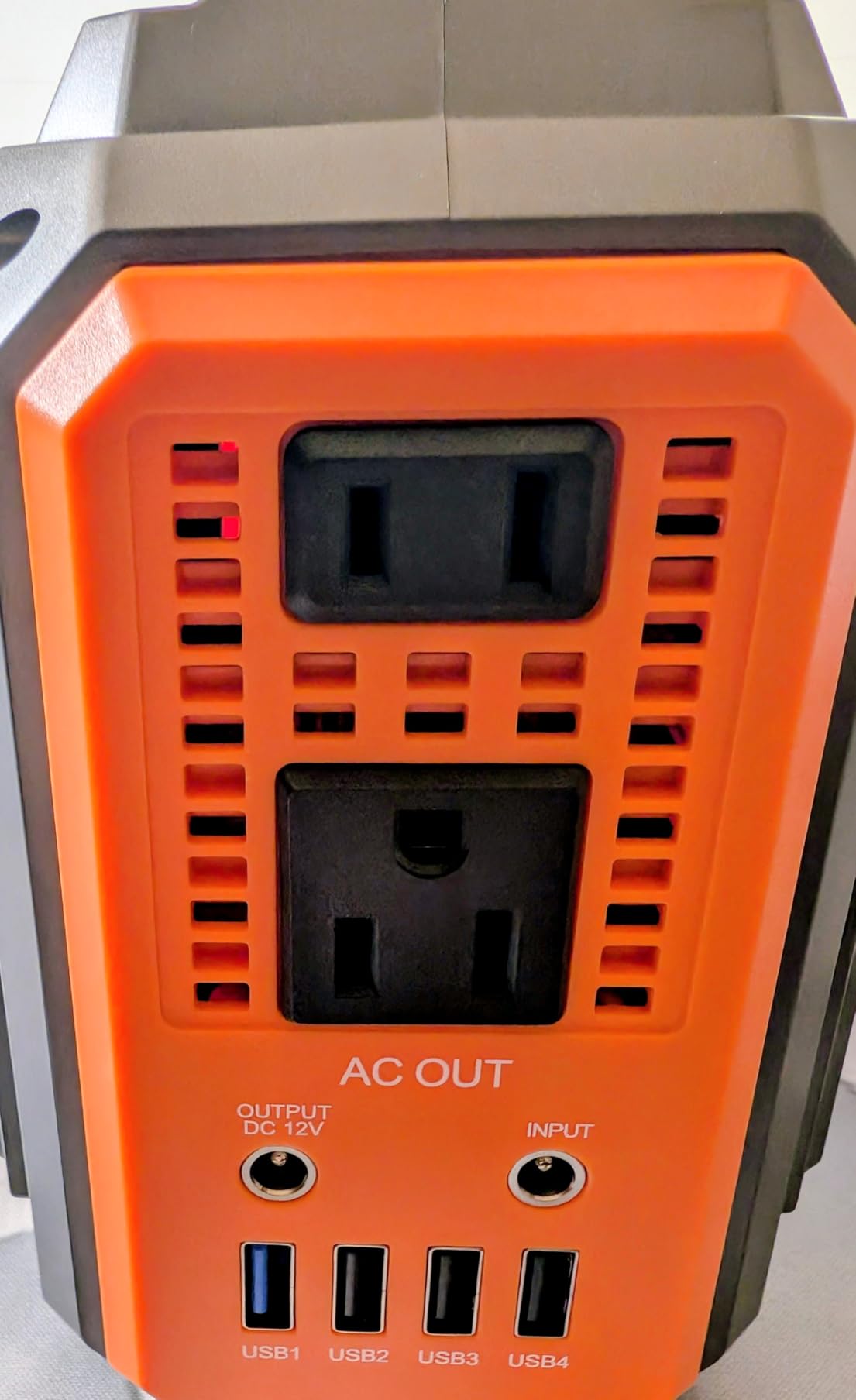
This is also the bundle the reviews criticise hardest, and the complaints are specific enough to check. Multiple detailed reviews document that the 300W AC figure is a peak marketing number rather than real continuous output, with some owners measuring under 100W. Others report the output is not a true pure sine wave despite the listing.
The solar input is not a genuine MPPT controller. One owner measured about 30W of input from a 100W panel, which is roughly a third of what a real MPPT window would pull. Several buyers also report internal wiring failures in the folding panel, and units sitting uncharged for long periods dropping into a protection state that stops them outputting at all.
What you give up for 5.1 pounds
Real output. If you need to run a blender, a kettle, or anything with a compressor, do not plan around the 300W headline here. Measured continuous figures well below that mean the usable wattage is far lower, and the sine wave quality question matters if you plan to power anything sensitive.
The panel junction box is not waterproof either, so keep it out of rain. For a phone, a camera, and a light or two over a weekend, the size wins. For anything else, spend the extra money.
Who should still consider it
Anyone building a grab-and-go emergency kit where weight matters more than output, and anyone who wants a small panel that can charge a phone on its own. Support has replaced units for customers reporting failures, and the 12-month warranty is short but real. Check the charge state regularly if it lives in a closet, because the protection-state issue is a real storage problem rather than a defect.
10. MARBERO M823 – Best Entry-Level Station and Panel Bundle
- Compact 237Wh capacity with six output types for phones tablets laptops and headphones
- Bundled 60W foldable panel at 21.5-23.5 percent conversion efficiency
- Built-in LED flashlight with flashlight strobe and SOS modes
- Only 9 pounds for a 300W pure sine wave unit
- Large review base for a budget bundle
- 300W continuous ceiling means heaters coffee makers and hair dryers will trip the unit
- The 237Wh pack handles phones tablets laptops and lights rather than appliances
- Only a 12-month warranty
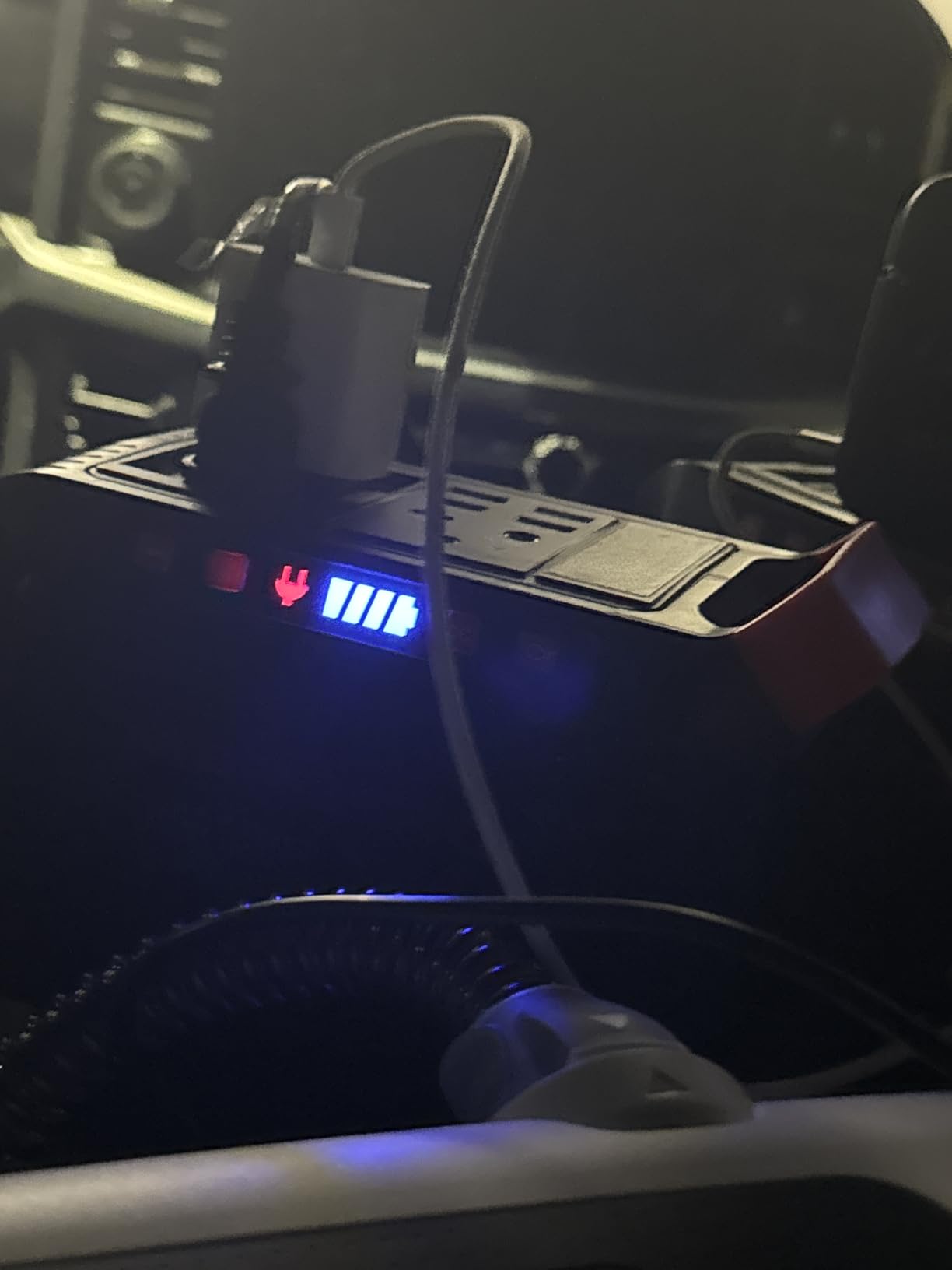
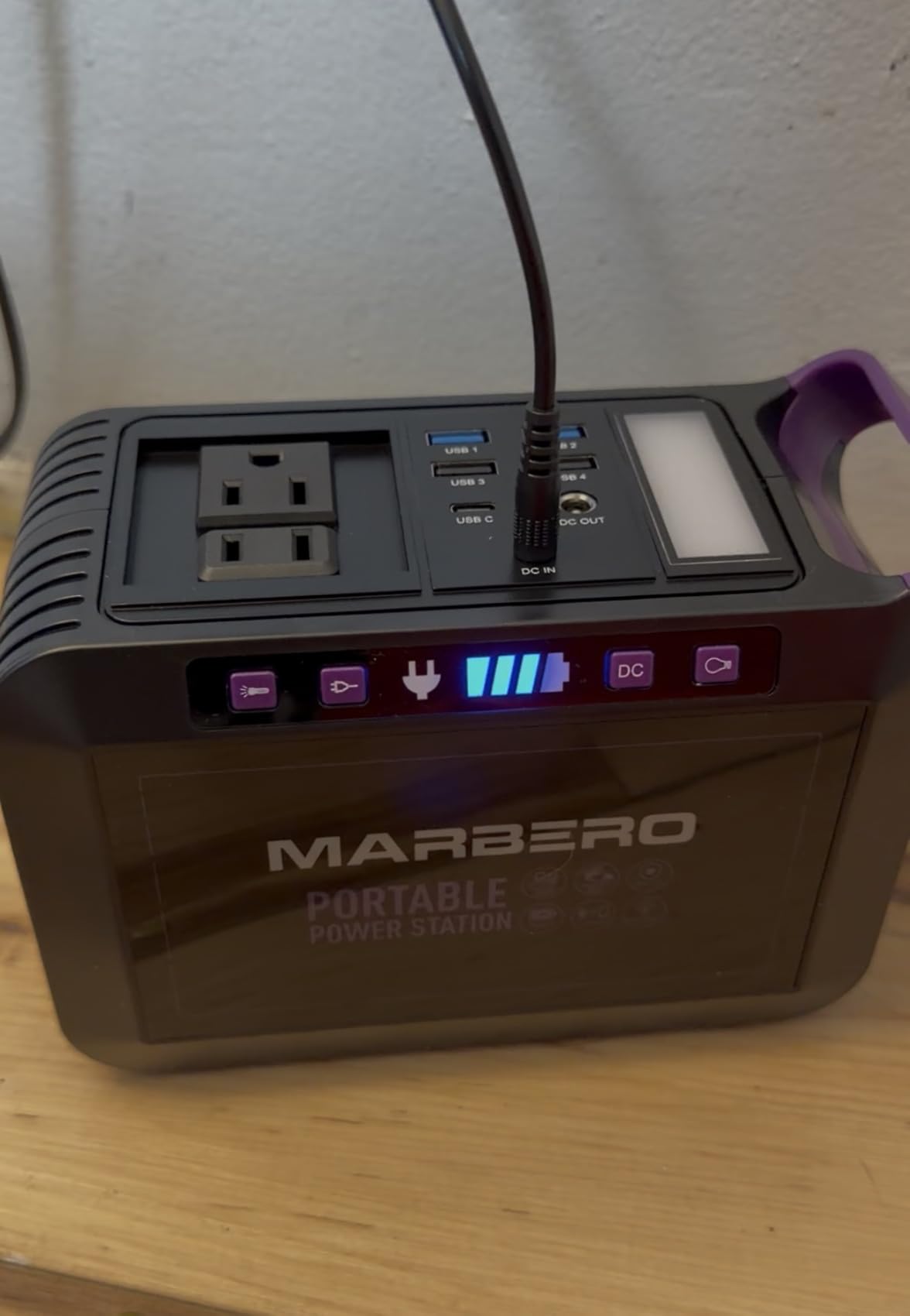
The M823 is the cheapest way into this category and it is less compromised than the price suggests. It delivers 300W of rated continuous AC from a 237Wh, 64000mAh lithium-ion pack, with a genuine pure sine wave output, which is the specification most budget units in this roundup get wrong.
Port count is generous for the size: two AC outlets covering both two-prong and three-prong plugs, two USB-A QC3.0 ports at up to 18W, two more USB-A ports, an 18W USB-C port, and a 12-16.8V DC output rated to 14A. At 9 pounds it is a car-camping and day-hiking size.
The 60W foldable panel is the strongest part of this bundle, rated at 21.5 to 23.5 percent conversion efficiency, which is a better efficiency figure than several larger panels in this roundup. The built-in LED light offers flashlight, strobe, and SOS modes, which earns its keep more often than most buyers expect.
Owner feedback is split, and the split is explained by the rating distribution: 67 percent five-star against a notable 12 percent one-star share. The five-star reviews praise portability and value, while the one-star reviews are almost entirely about hitting the 300W output ceiling on a load that needs more.
What 237Wh covers in practice
Phones, tablets, laptops, headphones, and LED lights. Multiple devices at once, all day, without a wall. It is also a competent travel backup for a weekend away where nobody is planning to run an appliance. A CPAP machine at 60W would run for roughly 3 hours and a half on a full charge.
The 300W continuous ceiling is the hard limit. Heaters, coffee makers, and hair dryers will trip the unit, and no amount of extra capacity changes that because the inverter is the constraint, not the battery.
When to step up instead
If you want to run anything with a heating element or a motor, move to a 768Wh or 1000Wh station with 800W or more of continuous output. The 12-month warranty is also the shortest here, so this is a buy for occasional use rather than a standby unit you intend to charge monthly for a decade. For a first bundle, though, the pure sine wave output and the efficient panel are real value.
How to Choose a Portable Power Station
Seven criteria decide the purchase, and they matter in this order. Get capacity, continuous output, and solar input right and the rest is preference. Get them wrong and no panel in the world rescues the setup.
Capacity in watt-hours sets your runtime
Watt-hours are the fuel tank. A 237Wh pack runs a 60W CPAP for about 3.5 hours; a 768Wh pack runs it about 11 hours; a 2073.6Wh pack runs it close to 34 hours. Multiply the device wattage by the hours you need, then divide by roughly 85 percent to allow for inverter losses.
Continuous output decides what you can plug in
Continuous watts are the ceiling on any single running device, and surge is the brief headroom for starting a motor. A station with 300W continuous will not run a kettle at all. If your heaviest load is a power tool, a heater, or a microwave, target 1500W or more and check the surge figure against the tool’s start-up draw.
Solar input wattage and voltage window decide the panel
The wattage ceiling tells you how big a panel array can be. The voltage window tells you whether that array will actually be used. The EcoFlow DELTA 3 Classic accepts up to 500W across 11-60V but caps input current at 15A, so anything below about 33V is limited. The BLUETTI Elite 200 V2 accepts up to 1000W but caps the window at 60V, which makes the 1000W figure difficult to reach in practice.
Battery chemistry decides service life
LiFePO4 packs are rated in the thousands of cycles: 3000 for the RIVER 2 Pro and the AC180, 4000 for the Anker C1000 Gen 2 and the Jackery Explorer 1000 v2, and 6000 or more for the BLUETTI Elite 200 V2. The older lithium-ion chemistry in the MARBERO and ZeroKor units is cheaper and perfectly usable for light loads, but it is a shorter-life pack that also runs warmer under stress.
Weight decides whether the station is portable at all
Anything under 10 pounds is genuinely carryable. Between 15 and 25 pounds is a one-person car-camping lift. Above 35 pounds, and certainly past 50, you are planning a cart or a two-person lift, which means the “portable” label describes the category rather than your experience. The range here runs from 5.1 pounds to 53.4 pounds, and that spread is larger than any spec difference.
Ports, UPS, and warranty decide the daily experience
Count the AC sockets and check whether the USB-C ports are two-way, because pass-through charging lets you run a fridge from a station that is simultaneously recharging. A UPS with under 20ms switchover keeps a computer, a router, or a CPAP machine running through a cut. Warranty length is the last check but a real one: most picks here carry 5 years, while the two budget bundles carry 12 months.
How to Size Solar Panels for Your Power Station
The panel wattage printed on a folding panel is not the energy you get. Panel builders and owners on r/SolarDIY use a working figure of roughly 400-500Wh of actual yield per day from a 100W panel in decent sun, dropping to about 200Wh in poor conditions. Multiply that by your panel’s wattage and you have a realistic daily budget.
Step one is to pick the capacity first. Step two is to apply a ratio: aim for panel wattage between 20 and 40 percent of the station’s watt-hour capacity for a workable same-day recovery. A 1000Wh station therefore wants a 200-400W array, and a 2000Wh station wants 400-800W.
Step three is to check the sun hours, not the panel hours. A 200W panel that produces its full rating for four peak hours gives you 800Wh, which fills a 768Wh station in roughly a day. The same panel against a 237Wh pack would overfill it in about two hours and then sit idle. Size down for small stations rather than buying more panel than you need.
Look at the bundles in this roundup through that lens. The EcoFlow DELTA 3 Classic pairs 220W with 1024Wh, which is close to ideal. The Anker SOLIX C300 pairs 60W with 288Wh, which is a top-up rather than a refill. The EcoFlow DELTA 2 Max pairs 400W with 2048Wh, which needs a second panel to recover in a single day.
Solar Panel Compatibility Pitfalls to Check Before You Buy
Four pitfalls account for most of the disappointment in this category, and all four are connector or voltage issues rather than quality issues.
Proprietary connectors lock you into one brand
Jackery is the most commonly criticised for this. As one r/prepping discussion put it, the Explorer 1000 “uses a Jackery proprietary barrel plug for solar input”, which is why buyers note that BLUETTI and Anker give a wider selection of third-party panels. Buying a Jackery panel for a BLUETTI station is not a straightforward cable swap, and the same applies in reverse.
The DC voltage ceiling quietly limits your panel
Small stations take low-voltage panels only. The ZeroKor R200 measured about 30W of input from a 100W panel, which is not an MPPT problem so much as a current and voltage window problem. The EcoFlow DELTA 3 Classic’s 15A ceiling means any array under roughly 33V cannot reach the 500W maximum even in perfect sun.
Matching connectors on the same bundle still catches people
The EcoFlow DELTA 2 Max ships a 400W panel with MC4 connectors and a station with XT60i ports, so a cable or Y adapter is required and is not in the box. The Anker SOLIX C1000 Gen 2 package includes XT60 adapters and cables that work, but reviewers note they need a separate protective case. Read the connector type on both halves of the bundle before you commit.
Real solar yield is well under nameplate
Plan on the 400-500Wh per day per 100W figure rather than the panel’s rated wattage, and expect half that in overcast conditions. Units also lose charge sitting idle, so if the station is standing by for an emergency, top it up every couple of months or leave it in an eco mode. A station at 20 percent that has been sitting for six months is not a standby unit in any meaningful sense.
Frequently Asked Questions
Is Jackery or EcoFlow better?
It depends on what you are optimising for. EcoFlow wins on charging speed and solar hardware: the DELTA 3 Classic charges to 80 percent in 45 minutes and ships a 220W N-Type panel that measured 190-200W in partial shade, while the DELTA 2 Max is the only 2kWh bundle here that expands to 6kWh. Jackery wins on portability and battery life: the Explorer 1000 v2 weighs 23.8 pounds with a foldable handle and its 1070Wh pack is rated for 4000 cycles, but its bundled 200W panel is the weakest part of the package.
Is Jackery or Anker better?
Anker has the edge on this generation. The SOLIX C1000 Gen 2 carries the highest rating in our roundup, 1024Wh of LiFePO4 rated for 4000 cycles, 2000W of continuous output, a 49-minute full recharge, and a 200W bifacial panel matched to a wide 60V solar input with a 10ms UPS. Jackery still has a lighter 23.8 pound option and a strong 5-year warranty, though its 1500W output is lower and its solar input is more restrictive.
What is the best brand of solar power station?
Among the brands in this roundup, EcoFlow leads on charging speed, bundled panel quality, and expandability, BLUETTI leads on capacity density and cycle life with the 2073.6Wh Elite 200 V2 rated past 6000 cycles, Anker leads on charge speed and app control with the 49-minute HyperFlash recharge, and Jackery leads on portability and brand familiarity. The best brand for you depends on the load, not the badge. Match continuous output to your heaviest device first.
What is the best power bank with solar panels?
A solar power bank is close to useless for anything but a phone. The panel on a 20,000mAh solar power bank produces a trickle, and in real conditions a small built-in panel will take days to add a meaningful charge. If you want solar to be a genuine part of the setup, buy a real panel of 60W or more and a portable power station with a real solar input window. Every bundle in this roundup pairs a folding panel with a station that can accept it.
Do portable power stations come with solar panels?
Some do and some do not, which is why we score the panel as part of the bundle. Of the ten bundles here, all ten include a folding panel, ranging from 60W on the MARBERO, ZeroKor, and Anker SOLIX C300 up to 400W on the EcoFlow DELTA 2 Max. The important check is compatibility, since a bundled panel is not always matched to the station voltage window and connector type on the other half of the box.
How long does it take to charge a portable power station with a solar panel?
It takes far longer than the panel wattage suggests. The working figure owners use is 400-500Wh of real yield per day from a 100W panel in decent sun and about 200Wh in poor conditions, so a 200W panel realistically delivers 800-1000Wh per day. In practice the EcoFlow RIVER 2 Pro recharges 768Wh in as little as 4.8 hours on its 160W panel, the EcoFlow DELTA 3 Classic takes about 5.8 hours on 220W, and the Jackery Explorer 1000 v2 takes 6 hours for 80 percent on 200W.
The Best Portable Power Stations With Solar Panels in 2026
After testing all ten bundles against the same criteria, the Anker SOLIX C1000 Gen 2 is the pick we would buy first. It combines the highest rating in the group with a deep review base, 1024Wh of LiFePO4 rated for 4000 cycles, 2000W of continuous output, a 49-minute wall recharge, a 1.8 hour solar recovery from the 200W bifacial panel, and a 10ms UPS for sensitive electronics. The only real compromise is that Gen 2 dropped battery expansion.
Buy the BLUETTI Elite 200 V2 instead if capacity and inverter headroom are the priority, the EcoFlow DELTA 2 Max if you want to grow toward a 6kWh home system, and the EcoFlow RIVER 2 Pro if you want a capable unit you can still carry in one hand. Whatever you choose, check the connector type on the panel and the voltage window on the station before you buy a second panel. That single check prevents most of the disappointment in this category.