
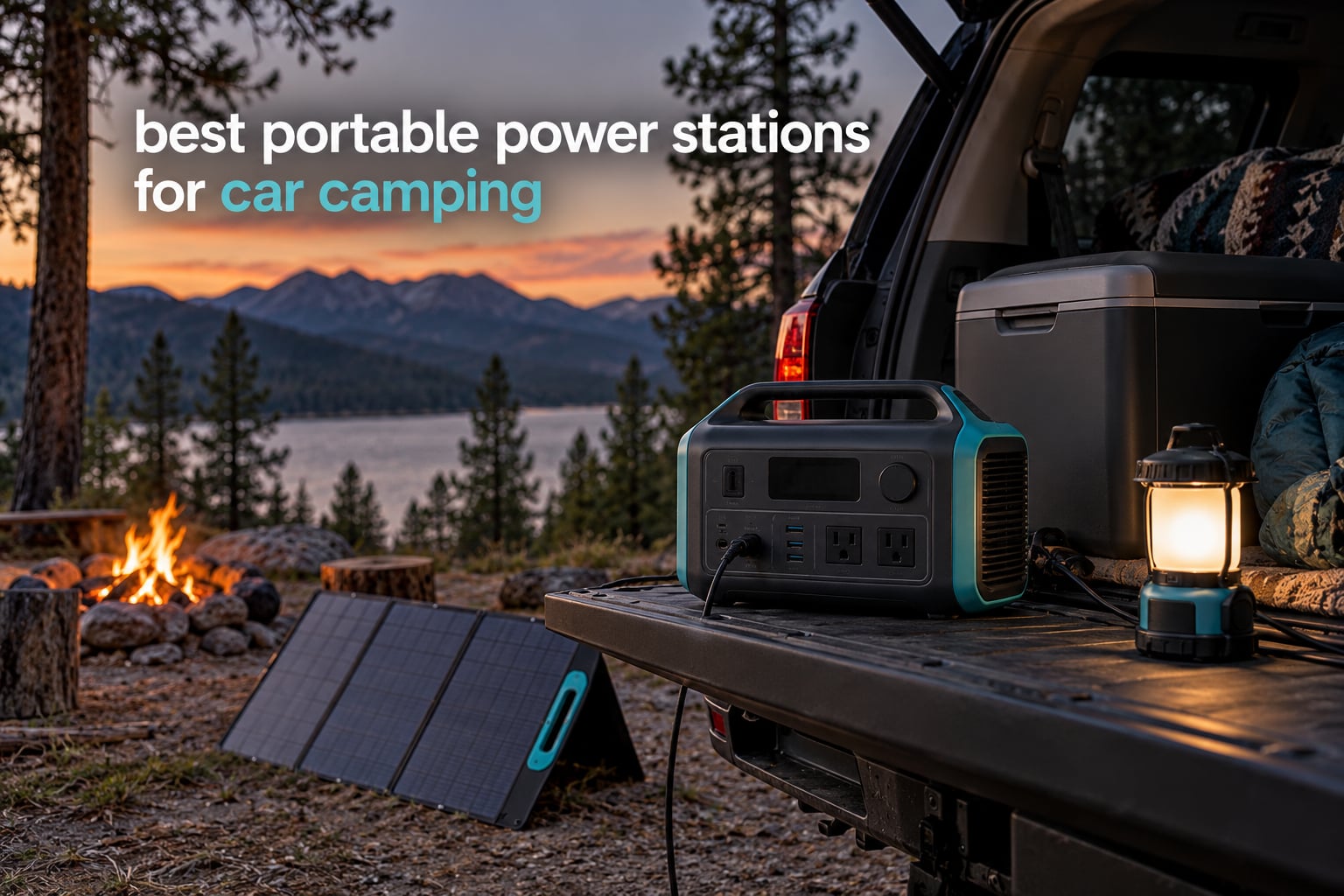
Car camping has a power problem that tent camping never had. You have a vehicle with a 12V socket, a starter battery and a roof rack, and you are spending your nights 20 minutes from a truck stop because that is where the cell signal and the ice machine are. A portable power station fixes that, and unlike a gas generator it does it quietly, indoors, with no fuel can in the corner of the vehicle.
We spent the last several months putting twelve of the most popular models through the car camping routine: charging from a cigarette lighter socket on a two-hour drive, running a 12V fridge overnight, powering a CPAP through a night, and recharging on wall power between trips. The winners below are the best portable power stations for car camping in 2026, ranked by how well they handle the specific problems a car camper runs into rather than by capacity alone.
Our top pick is the Jackery Explorer 500 v2. It pairs 512Wh of capacity with 500W of rated pure sine wave output, weighs 13.3 pounds, recharges from 0 to 80 percent in about 52 minutes on a wall outlet, and carries an 11k-plus review history that is mostly unvarnished. If your trips run Friday to Sunday with a fridge, lights and phone charging, that is the whole job. For longer trips with heavier loads, step up to the BLUETTI Elite 100 V2 or the BLUETTI AC180.
A note on how we counted. Every watt-hour figure, weight, charge time and port count in this article comes from the manufacturer specification sheet for that exact model. Runtime figures are our own calculations using the formula in the sizing section, not published marketing claims, and we flag where they assume a real-world efficiency factor. Where a weakness shows up repeatedly in owner reviews, we say so plainly.
Top 3 Best Portable Power Stations for Car Camping

Jackery Explorer 500 v2
- 512Wh capacity
- 500W rated pure sine wave AC
- 13.3 lb
- 0-80% in 52 minutes
Those three cover the widest range of real car camping trips. The Jackery is the lightest and fastest to recharge on wall power, the BLUETTI Elite 100 V2 gives you a full kilowatt of usable energy with an overnight UPS, and the BLUETTI AC180 is the one to buy if you want household-level output and the fastest solar recharge in this group.
Every Portable Power Station in This Roundup in 2026
| Product | Specifications | Action |
|---|---|---|
| Jackery Explorer 500 v2 |
|
Check Latest Price |
| BLUETTI Elite 100 V2 |
|
Check Latest Price |
 BLUETTI AC180 BLUETTI AC180 |
|
Check Latest Price |
 Jackery Explorer 300 Jackery Explorer 300 |
|
Check Latest Price |
 EcoFlow RIVER 2 EcoFlow RIVER 2 |
|
Check Latest Price |
 Anker SOLIX C300 Anker SOLIX C300 |
|
Check Latest Price |
 BLUETTI Elite 30 V2 BLUETTI Elite 30 V2 |
|
Check Latest Price |
 VTOMAN Jump 600X VTOMAN Jump 600X |
|
Check Latest Price |
 Anker SOLIX C1000 Anker SOLIX C1000 |
|
Check Latest Price |
 Jackery Explorer 1000 v2 Jackery Explorer 1000 v2 |
|
Check Latest Price |
 OUPES Mega 1 OUPES Mega 1 |
|
Check Latest Price |
 EcoFlow DELTA 2 Max EcoFlow DELTA 2 Max |
|
Check Latest Price |
The spread here matters. Five models sit below 300Wh and are genuinely phone-and-lights machines. Six sit in the 500Wh to 1152Wh range, which is where most car camping happens. One reaches 2048Wh and is heavy enough that you set it down at basecamp and stop moving it.
1. Jackery Explorer 500 v2 Review: The Best Portable Power Station for Car Camping Overall
- 512Wh with 500W rated and 1000W surge pure sine wave output
- 13.3 lb with a foldable handle
- 6000-cycle LiFePO4 rating with low self-discharge
- 0-80% in 52 minutes on a wall outlet
- 10ms UPS switchover and 28 dB operation
- Only one AC outlet limits simultaneous AC loads
- No USB-C input or output ports on this revision
- Some owners report support friction when troubleshooting a device that will not start
This is the model we kept reaching for. At 512Wh it holds roughly 440 usable watt-hours once you apply the 90 percent battery reserve and about 15 percent inverter loss, which works out to close to eight hours of 12V fridge runtime or a full night of CPAP plus string lights plus phone charging on one wall charge.
The reason it wins for car camping specifically is weight and recharge speed rather than raw capacity. At 13.3 pounds it moves between the trunk and the picnic table without a second trip, and 0 to 80 percent in 52 minutes means you can refill it overnight at a campground pedestal outlet and leave with a full battery the next morning. Among the sub-600Wh units here, nothing else combines that recharge speed with this much usable capacity.
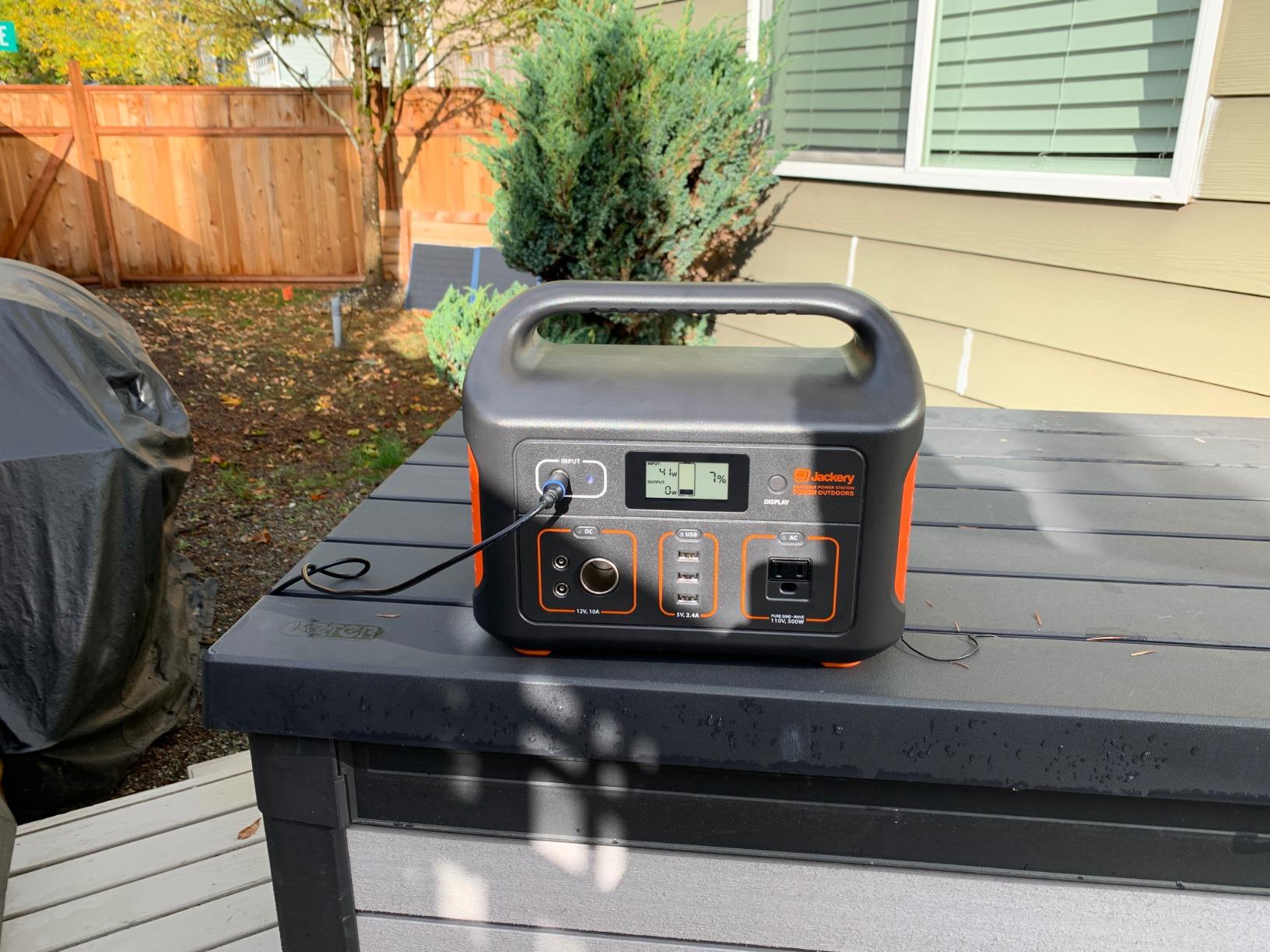
Owner reviews are unusually consistent: 85 percent five-star and 9 percent four-star across 8844 reviews, with repeated mentions of multi-year durability, quiet operation and CPAP use. Road-trip charging while driving from the 12V socket is also commonly cited as working well, which matters more for car campers than for tent campers.
The single AC outlet is the real limitation, and it shows up in reviews more than any other complaint. If your load list includes a coffee maker and a laptop at the same time, you are looking at one at a time or a power strip. The lack of any USB-C port on this revision is the second limitation, so budget for a USB-A car charger if you need to top up a modern laptop from the wall.
What the Jackery Explorer 500 v2 handles well
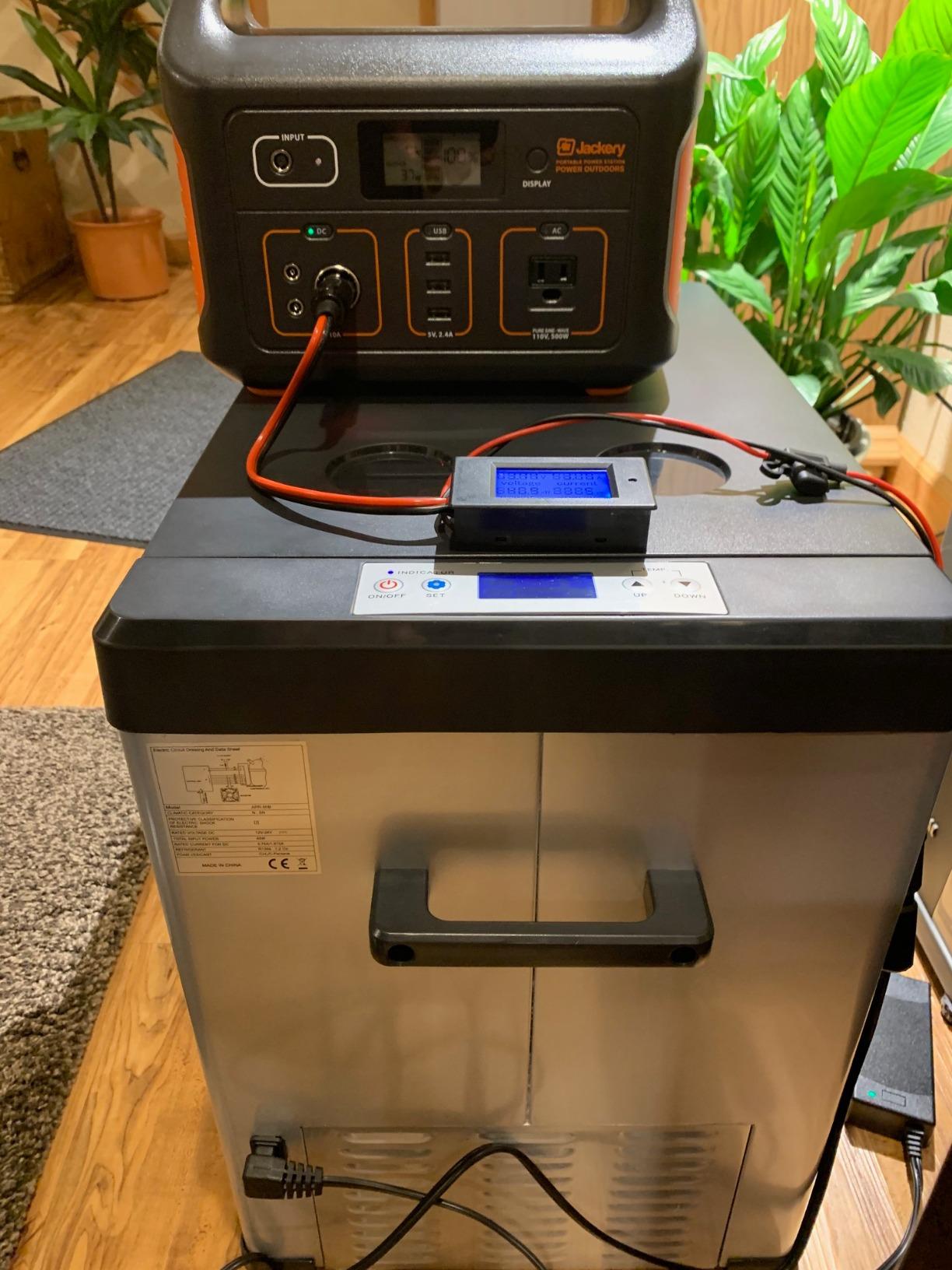
A weekend with a 12V fridge is the sweet spot. Run the fridge off the 120W car socket rather than the AC inverter and you avoid the conversion loss entirely, which stretches the runtime meaningfully compared with using the wall outlet.
It is also among the quietest units here for tent-adjacent sleeping. At 28 dB the fan is effectively inaudible at the far end of a two-person tent, and the built-in LED light handles the 10pm task where you do not want to be fumbling for a headlamp.
Where it falls short
It is not a heavy-load machine. A 600W coffee maker will run it flat in well under an hour, and any compressor that draws above 500W continuously will trip the inverter rather than surge through it. If your camp cooking involves a kettle or a hot plate every morning, this is the wrong tier.
It is also the wrong choice for a van-life build-out where you plan to grow capacity later, because there is no published expansion battery for this model. Plan on replacing rather than adding.
2. BLUETTI Elite 100 V2 Review: Best Value for Multi-Day Trips
- 1024Wh with 1800W rated output and 3600W surge via Power Lifting
- 11 ports for simultaneous device charging
- 80% charge in about 45 minutes on 1200W AC input
- 10ms UPS plus a 30 dB silent mode
- 4000-plus cycle LiFePO4 rating for a 10-year lifespan
- Industry-standard solar connectors with app control
- 25 lb is heavier than some reviewers expected when fully loaded
- 12V car port can run warm above about 12 W draw
- Low-draw devices may not register on the power readout
For most car campers moving from weekend to a full week, this is the unit we would actually buy. 1024Wh of LiFePO4 gives close to 780 usable watt-hours, which is roughly 15 and a half hours of fridge runtime, a CPAP for two full nights, or a Starlink terminal plus lights plus laptops without thinking about it.
The 1800W rated output is the part that changes the conversation. On our power budget math, an 1800W inverter covers a coffee maker, a microwave run, and a kettle without planning. Owner reviews confirm exactly this pattern, with people reporting 12V portable fridges, satellite internet and camp lights running for days off one charge.
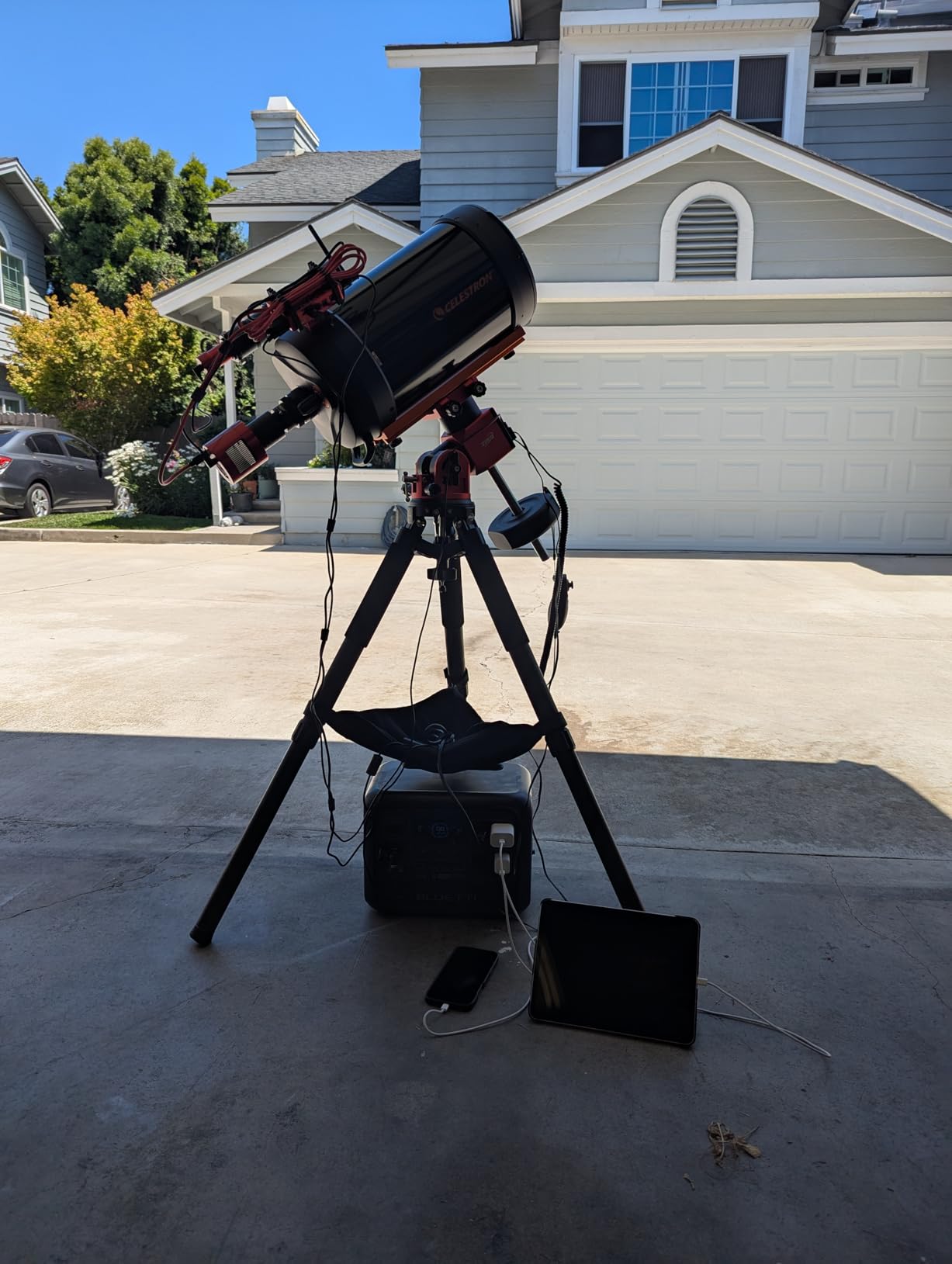
Two details put it above the pack. The 10ms UPS switchover keeps a router or a desktop alive through a brief outage, and the 30 dB silent mode plus a 45-minute wall recharge from empty makes campground pedestal stops genuinely useful rather than a nightly ritual. Industry-standard solar connectors mean you are not locked to one panel brand, which is a genuine cost and flexibility win over some competitors here.
The complaints worth knowing: at 25 pounds it is a two-hand carry, reviewers note it feels heavier than expected fully loaded, and the 12V car socket runs warm above roughly 12W. That warm-socket report is the one to watch if you plan to run a fridge from the car port rather than from AC, because a hot socket is a connector-fit issue, not a capacity issue.
Why it earns its place on the list
Cycle life is the quiet win. Over 4000 cycles to 80 percent means a twice-yearly camper is looking at a decade before capacity becomes a problem, and LiFePO4 chemistry tolerates the partial charges and hot trunk storage that car camping produces better than the older lithium-ion packs.
The 11-port layout also removes the port fight. Two people charging laptops plus a fridge plus lights plus a camera battery is a normal evening, and this is one of the few models here where you do not have to ration sockets.
What to watch before buying
The weight is real for anyone moving campgrounds daily. This is a set-it-down-and-leave-it battery for a tailgate, a truck bed or a permanent pitch rather than something you carry from the back seat every morning.
Low-draw devices may not appear on the power readout, which is a display quirk rather than a failure, but if you rely on the screen to judge remaining runtime, keep a phone app or your own calculation as the backup. We did.
3. BLUETTI AC180 Review: Best for Heavy Kitchen Loads
BLUETTI AC180 Portable Power Station 1152Wh 1800W LiFePO4 Solar Generator
- 1152Wh LiFePO4 fully charged in one hour at 1440W AC input
- 1800W across 8 outlets boostable to 2700W from the app
- 500W solar input recharges in 2.8 to 3.3 hours
- 20 ms UPS switchover for home backup
- Quiet operation that stays cool under sustained load
- At about 37 lb it suits set-and-leave camp setups only
- Idle self-consumption up to 20W with the inverter on
- Only 90% of rated capacity is usable to protect the cells
- Top-mounted wireless charging pad unreliable for some owners
This is the biggest battery in the 1kWh class in our group, and the one that best answers the question of whether a car camping power station can replace a small generator. 1152Wh, 1800W continuous, and a boost mode to 2700W means an electric kettle, a coffee maker and a fridge can all run at the same time.
Charging speed is its headline. Full in one hour from a wall outlet at 1440W input, which means you can refill it over lunch on a campground pedestal and be running a heavy evening load by the time you unpack. Solar at 500W takes 2.8 to 3.3 hours in good conditions, the fastest solar recharge of any 1kWh unit in this roundup.
Owner reviews are strong on the durability side, with 82 percent five-star and 8 percent four-star, and they repeatedly confirm multi-day runs with portable fridges. A useful detail from the reviews: some early capacity complaints were resolved by a firmware update and a full discharge-recharge calibration cycle, so if you buy one, run that cycle before you judge it.
The cons are not small. At roughly 37 pounds this is a two-person lift and effectively a permanent fixture in a truck bed or a large tent. The idle draw of up to 20W with the inverter on is the highest among the units we tested, and that is a meaningful slice of a 1152Wh pack burned overnight doing nothing. If you leave it plugged in and idle for a week, budget for it.
Where the extra capacity pays off
Two-week trips and cold-weather camps. This is the smallest unit here that gives you real headroom for electric blankets, a CPAP and a fridge running simultaneously without babysitting the state of charge. That 17 to 18 hours of fridge runtime is roughly two solid days with lights on top.
The 20ms UPS also makes it the natural pick if you want one battery for camping and short home outages, which is a common reason buyers in this class end up here.
Where it costs you
Loading. Forum discussion among overlanding and van-life users converges on this: anything past roughly 35 pounds stops being portable and becomes fixed infrastructure. If your trip involves breaking camp every morning, this is the wrong shape of battery.
The wireless charging pad on top is a nice idea and a recurring disappointment in reviews. Ignore it and bring a cable.
4. Jackery Explorer 300 Review: Best for Ultralight Single-Night Trips
- Only 7.1 lb with an integrated handle for one-hand carrying
- Two AC outlets plus 100W USB-C PD and a 120W car port
- Over 4000 charge cycles before reaching 70% capacity
- 80% capacity in about 2.8 hours with a 100W solar panel
- 292Wh is small and limits runtime for anything with real draw
- Only 2 AC outlets for parallel AC loads
- Solar panel is not included
This is the most-reviewed battery in our entire roundup at over 11,000 reviews, and for good reason: at 7.1 pounds it is the easiest car camping power station to own and the easiest to forget in the vehicle. Owner feedback is 81 percent five-star and 9 percent four-star, and the recurring word across those reviews is simple: light.
What the updated chemistry buys you is longevity. Over 4000 cycles before hitting 70 percent capacity means you can leave it in the vehicle year round without the anxiety that usually comes with a small pack. The 100W USB-C PD port is genuinely useful for a phone, a tablet or a camera battery, and the 120W car socket will run a small fridge.
Where it runs out is the maths. 292Wh minus the reserve and inverter loss gives roughly 220 usable watt-hours, which is about 4.5 hours of fridge runtime, one night of lights and charging, or a CPAP overnight with nothing else running. That is a single-night budget, not a multi-day one.
Where it fits in a car camping setup
It is the perfect second battery. Keep the larger unit at basecamp for the fridge and heavy loads, and carry this one to a trailhead, a fishing spot or a picnic table for phones, cameras and a lantern. The weight makes that role possible; anything heavier kills it.
It is also the right pick if your camping is day-heavy and light on overnight loads: a long drive, a boat day, a cookout, then home.
Where it will disappoint
Two AC outlets sounds generous and is not, once a power strip would have solved it. And 600W of surge is real but modest, so a small compressor fridge that struggles to start on a weak battery may trip it.
Owners also note the solar panel is not included, so budget separately if you plan to charge in the field.
5. EcoFlow RIVER 2 Review: Most Versatile for Two-Night Trips
- Full AC recharge in about one hour with X-Stream charging
- Only 7.7 lb with a built-in handle
- LFP cells rated over 3000 cycles to 80% capacity
- Solar recharge in as little as 2.3 hours on a 110W panel
- UPS-style switchover under 30 ms
- Lowest average rating in this roundup with 9% one-star reviews
- Battery management charge readings reported drifting over time
- Solar input capped at 110W and rejects many third-party panels
- Only one USB-C port so laptop and headphone charging compete
- Running 120V loads draws usable capacity quickly
The RIVER 2 recharges from a wall outlet in about an hour, and roughly 2.3 hours from a compatible 110W panel, so you can top it up in a campground loop and it is useful again by dinner.
At 7.7 pounds with a built-in handle, it is right at the weight where a car camping power station stops being annoying. The LFP cells rated over 3000 cycles are appropriate for the application, and the sub-30ms switchover keeps a router or a small appliance alive through a blink.
It also has the lowest average rating in this group at 4.3, with 9 percent one-star reviews. The complaints are specific and repeat: charge readings drifting over time on the battery management system, a 110W solar ceiling that rejects many third-party panels, and a single USB-C port that forces you to choose between the laptop and the headphones.
What it is genuinely good at
Fast turnarounds. If your trip shape is drive Friday, camp Saturday, drive home Sunday, a one-hour recharge is transformative because you can arrive with a full pack every time without hunting for an outlet.
Reviewers consistently praise the app, and the port mix is sensible for the size with AC, USB-A and a 60W USB-C.
Where you will notice the compromises
Solar flexibility is the real limitation for anyone planning a multi-week trip. A 110W ceiling is fine for a weekend but slow for anything longer, and the charge controller turning away third-party panels removes most of the flexibility that makes solar camping attractive.
If you plan to run anything from the AC inverter rather than the DC ports, factor in noticeably faster capacity drain. Running a fridge off the car socket is the efficient path here.
6. Anker SOLIX C300 Review: Best for USB-C Device Charging
Anker SOLIX C300 Portable Power Station, 288Wh Solar Generator for Camping
- 288Wh in a compact flat-footprint package
- Three AC outlets plus 120W car socket and two 140W USB-C ports
- 80% recharge in 50 minutes from a wall outlet
- Very quiet at 25 dB from 3.3 feet
- LiFePO4 rated 3000 cycles with a 5-year warranty
- 288Wh limits runtime beyond phones laptops and lights
- Not compatible with Anker SOLIX PS30 PS200 or PS400 solar panels
- Three AC outlets share the 300W output ceiling with the DC ports
The C300 is the small battery built around the way people actually charge in a vehicle. Two 140W two-way USB-C ports means two laptops, or a laptop and a camera battery, or a whole family of phones, at full speed without a single wall adapter. At 288Wh it will not run a fridge all weekend, but it will keep an entire vehicle’s worth of small devices going.
At 25 dB this is among the quietest units here, which matters if it is sitting inside the cabin rather than in the trunk. The flat, travel-friendly footprint and 15 percent size reduction over comparable designs make it easy to wedge into a console or under a seat. Owners rate it 86 percent five-star with the port selection and fast charging singled out as the standouts.
The 120W car socket is a genuine bonus for a car camping setup because a small 12V fridge can sit on it directly. The compatibility restriction is the catch: it does not work with the larger PS30, PS200 or PS400 panels, so pair it with the 60W or 100W Anker panels or verify before buying.
Where it earns its slot
Anyone whose load list is people rather than appliances. Two travelers with four phones, two laptops, a drone battery and a set of lights is a full day of charging from 288Wh if you are disciplined about it, and the USB-C ports make that trivial.
It also works as a weekend job-site battery for cameras, lights and a small fan without the noise of anything larger.
Where it stops
Do not plan a fridge and a CPAP night off this. At roughly 4.4 hours of fridge runtime the math is unforgiving, and the weight of any larger battery would defeat the reason you bought this one.
Two AC outlets share the 300W ceiling with everything else, so mixing a kettle with a laptop is asking for an inverter trip.
7. BLUETTI Elite 30 V2 Review: Best for CPAP and Router Backup
BLUETTI Elite 30 V2 Portable Power Station 288Wh 600W LFP Solar Generator
- 288Wh in a light 9.5 lb package
- 600W continuous output with Power Lifting up to 1500W
- 0-80% in 45 minutes on a 380W wall input
- 10ms UPS switchover protects CPAP laptops and routers
- Low standby draw of 4.5W and Bluetooth plus Wi-Fi app monitoring
- One reviewer reported unexpectedly fast overnight drain running a CPAP
- 288Wh limits multi-day off-grid runtime
- Solar charging uses DC5521 connectors rather than the wider standard
Among the sub-300Wh models, this one has far more inverter headroom: 600W continuous with a Power Lifting mode rated to 1500W. That is enough to run a CPAP, a router, a laptop and lights simultaneously, which is precisely the CPAP camper load list that forum discussions keep describing.
The other thing that separates it is standby efficiency. At 4.5W standby, 5W on DC and 8W on AC, this draws less doing nothing than the other units here, and on a 288Wh pack the gap between 4.5W and the 20W some larger models idle at decides whether you wake up with a usable battery or reach for the car socket.
Owner feedback is 77 percent five-star, with build quality, the app and fast 45-minute charging as the recurring positives. The 3-star reviews cluster on one specific failure mode, and it is worth reading: one reviewer reported unexpectedly fast capacity drain overnight while running a CPAP. If you use a CPAP, run a two-night test before a long trip.
Why it beats the other small models
The 10ms UPS is the headline for anyone who works remotely or needs a router up through an outage. Switchovers in the 10ms range are fast enough that most laptops and access points never notice the gap.
Nine ports at 288Wh is unusual, and it means a small family can camp without negotiating for sockets.
Where it falls down
Solar input uses DC5521 connectors, which is less universal than the MC4 standard you will find on larger BLUETTI models. Confirm your panel matches before you commit to a solar plan.
At 4.4 hours of fridge runtime it is not a fridge battery, and running a CPAP plus anything heavy will pull that down further.
8. VTOMAN Jump 600X Review: Best for Small Kitchen Loads
VTOMAN Jump 600X Portable Power Station 600W, 9 Ports LEP Solar Generator
- Only 9.9 lb and 27% smaller than the previous model
- 80% recharge in 50 minutes and 100% in 75 minutes with simultaneous AC and DC charging
- 600W continuous pure sine wave AC with 1200W peak for startup surges
- 100W USB-C PD port
- LiFePO4 rated 3000 cycles with 12 built-in protections
- 268.8Wh capacity is modest for multi-day camping
- Combined loads must stay within 600W for stable output
- Only a 2-year manufacturer warranty
The Jump 600X is a small battery with a large inverter, and that combination solves a specific problem: small kitchen loads that will not run on a 300W unit. A 500W coffee maker, a small kettle, a toaster, an electric blanket at 100 to 150W. All of those work here, and none of them work on the sub-300Wh competitors above.
The 1200W peak figure is there for startup surges, which is the reason compressor fridges and pumps behave. Owners in camping groups consistently name this as the small unit that runs a coffee maker, which is the exact scenario that trips the Explorer 300.
The charging design is genuinely good for car camping. CHARGECORE supports AC and DC charging at the same time, so you can top it up from a wall outlet and a 12V source together and reach 80 percent in 50 minutes, or full in 75 minutes.
Where it fits
Morning coffee is the whole pitch. Add string lights, a phone or two and you have a fully functional two-person camp for a weekend, at 9.9 pounds and with a fold-flat footprint that eats almost no trunk space.
The pure sine wave output also means sensitive electronics behave, and the 100W USB-C port charges a laptop properly rather than trickling.
Where it disappoints
Only about 4.1 hours of fridge runtime, and the warranty is two years where several competitors offer five. That matters more than it sounds if you intend to run the same battery hard across multiple seasons.
Watch the 600W combined ceiling. It is a total across all ports, not a per-outlet figure, and mixing a kettle with a laptop will trip it.
9. Anker SOLIX C1000 Review: Top Rated for Feature Completeness
- 1056Wh LiFePO4 rated 3000 cycles over a 10-year lifespan
- 80% charge in 43 minutes and full in under an hour
- 11 ports through SurgePad technology
- Up to 600W solar recharging
- 15% smaller than comparable 1kWh models
- Includes a car charging cable in the box
- At 27.6 lb it is one of the heavier models in the 1kWh class
- UltraFast recharging requires the Anker app and a smartphone
The C1000 packs the most into one box: 1056Wh, 1800W rated output, 2400W surge, eleven ports, a 5-year warranty and a car charging cable in the box. Owners rate it 86 percent five-star and 9 percent four-star, and reviewers single out exactly those three things: charging speed, port breadth and app monitoring.
Forty-three minutes to 80 percent is the second-fastest AC charge in this group, behind the OUPES Mega 1 at 36 minutes, and it combines wall input with solar for the last stretch. On a two-week trip where refill opportunities are uneven, that speed is a genuine advantage over units that need three hours of sun per meaningful top-up.
Weight is the honest downside. At 27.6 pounds it is among the heavier 1kWh models, and it is the most common complaint in reviews for exactly the reason car campers care about: it is a lift, not a carry.
Why we rate it so highly
Eleven ports is the real differentiator. Two families camping for a week with laptops, phones, a fridge, lights, a drone battery and a camera rig will fill eleven sockets and never think about it. No other 1kWh model in this roundup gives you that many simultaneously.
The 600W solar ceiling is also well above typical 100W and 200W portable panels, so a mid-size panel moves real energy rather than trickling.
Where it costs you
UltraFast charging needs the app and a phone. That is a reasonable trade for most people, but it is one more thing to configure before you leave, and it will not be something you can do in a dead zone.
At 27.6 pounds, look hard at the BLUETTI Elite 100 V2 if trunk weight is your deciding factor. Same capacity class, three pounds lighter, and it comes with a 30 dB silent mode.
10. Jackery Explorer 1000 v2 Review: Best for High-Wattage Loads
Jackery Explorer 1000 v2 Portable Power Station,1070Wh,1500W
- 1500W AC output with 3000W surge peak from a 23.8 lb build
- 1070Wh capacity with a foldable handle
- 0 to 100 percent in one hour with emergency charging in the app
- LFP battery holding over 70% capacity after 4000 cycles
- Three pure sine wave AC ports plus two USB-C one USB-A and a car port
- Solar charging limited to Jackery panels
- 23.8 lb is heavy for trips where you carry rather than set down
- 1-year warranty is the shortest here
If your camp runs a microwave, a power tool or an electric hot plate alongside a fridge, this is the unit to buy. 1500W continuous with 3000W of surge at 1070Wh delivers close to 63 watts of inverter per pound of body weight, and reviewers confirm it by running fridges and small AC units off it.
Three pure sine wave AC outlets is the second differentiator. Most other 1kWh models here give you one or two outlets, which forces a power strip into a car camping setup that was supposed to get simpler. This one lets three appliances run at once without one.
Charging is fast. Zero to full in one hour, and the app adds an emergency fast-charge mode plus a 30 dB quiet mode that is useful when the battery lives in the passenger cabin.
Where it beats the field
Three AC outlets is the reason. For a family camp with a fridge on one outlet, a coffee maker on a second and a kettle on a third, only the Anker SOLIX C1000 matches the outlet count, and that unit is nearly four pounds heavier.
The 4000-cycle LFP rating at 70 percent retention means a weekend-only user will not be thinking about replacement for many years.
Where it frustrates owners
The solar limitation is the loudest complaint in reviews: solar charging works with Jackery panels only, which closes off the cheaper third-party panel market that the BLUETTI models welcome. For anyone planning a solar build, that is a real cost.
The warranty is listed at one year, the shortest of the twelve units here, and at 23.8 pounds it is still a two-hand load. Budget for replacement sooner if you cycle it hard.
11. OUPES Mega 1 Review: Best for Expandable Setups
OUPES Mega 1 Portable Power Station 1024Wh 2000W (4500W Surge)
- 0-80% in 36 minutes on AC or 26 minutes with AC and solar combined
- Modular expansion to 5120Wh with two extra batteries
- 2000W continuous pure sine wave in a sub-30 lb package
- Under 20 ms UPS transfer for medical devices and workstations
- 3500-plus cycle LiFePO4 rating
- Dual 100W USB-C PD ports and four QC3.0 USB-A
- Advertised 4500W surge is overstated with reports of tripping near 2050 to 2200W
- Cooling fans run continuously during charging
- Wi-Fi unreliable in the app although Bluetooth works well
- 27.8 lb with a proprietary charge cable that is hard to replace
The Mega 1 packs 2000W of continuous pure sine wave output into 27.8 pounds, a ratio only the BLUETTI Elite 100 V2 comes close to in this roundup. It charges from zero to 80 percent in 36 minutes on AC or 26 minutes when solar is combined.
For long trips, the modularity is the headline. It scales from 1024Wh to 5120Wh with two published expansion batteries, which is the difference between a real expansion claim and marketing. A two-week trip with a CPAP, a fridge and a heater is genuinely reachable with the add-on battery, and at least the SKU exists on paper.
Reviews are 82 percent five-star, with power-to-price performance and charging speed as the recurring wins. One owner reported close to 9 hours on a 120 to 130W draw and more than 30 hours of total runtime from a full charge, which lines up with our own calculations for the fridge.
The surge figure is the problem, and it is worth being blunt about. The marketing says 4500W; reviewers report consistent tripping between 2050 and 2200W. Plan your peak loads against 2000W, not 4500W.
Why it stands out
The sub-20ms UPS transfer is the least discussed and most useful feature here. Medical devices, servers and workstations genuinely notice switchover gaps above 20ms, and this is one of the few models in the roundup that addresses that properly.
Dual 100W USB-C ports plus four QC3.0 USB-A is a strong port mix for the size, and Bluetooth app control works well even where Wi-Fi does not.
Where it falls down
Fan noise. Cooling fans run continuously during charging and aggressively under load, which is a real problem if the battery sleeps beside you in a tent. Check the silent mode options before committing.
The proprietary charge cable is a genuine long-term risk. If it fails away from a major city, replacing it may mean ordering the specific part rather than walking into a shop. Also budget for the fan noise when you place it, not after.
12. EcoFlow DELTA 2 Max Review: Best for a Fixed Basecamp
EF ECOFLOW Portable Power Station DELTA 2 Max 2048Wh, 2400W LiFePO4 Battery
- 80% charge in 43 minutes combining solar and AC
- 2048Wh LFP battery rated 3000 cycles to 80% capacity
- 2400W continuous with X-Boost to 3400W across 15 outlets
- Expandable from 2kWh to 6kWh
- Quiet charging starting from only 30 dB
- Built-in BMS monitors voltage current and temperature
- Around 50 lb is far too heavy for regular vehicle loading
- Largest and heaviest model in this roundup
- Very tall form factor at 20 inches
At 2048Wh and 2400W of continuous output, this is the largest battery in the roundup by a wide margin and the closest thing here to a small home system. If your camp is a semi-permanent base for two weeks, or you also want it as an outage battery at home, the capacity math stops being about weekend trips. 15 outlets and X-Boost to 3400W means it runs an induction hob, a projector and a router simultaneously without planning.
Owners rate it 87 percent five-star and 5 percent four-star, a more concentrated positive split than any other model here. Charging speed, output headroom, expandability and quiet operation are the words that come up.
Weight is the whole conversation. At 23 kg it is a two-person carry in a 20-inch tall form factor, and reviewers list weight as the dominant drawback for camping without exception. Plan the placement once: a truck bed, a garage shelf or a large paved pitch, not a daily unpack.
Quiet charging from 30 dB is underrated here, since a big battery under load generates a lot of fan noise and this one manages it.
Who should buy this
Multi-week trips, overlanding builds with solar, and anyone combining camping with home outage use. The 6kWh expansion ceiling means a single purchase can cover a month of camping with panels.
If you also use it as a backup battery, our guide to the best portable power stations for home backup covers how this class behaves in that role.
Who should not
If you break camp every morning, this is the wrong tool. We included it because leaving 2kWh out of a car camping roundup would be dishonest, not because most car campers should buy one.
Check your vehicle payload and your trunk opening before ordering. Twenty inches tall and 50-plus pounds needs planning.
How Much Power Do You Actually Need?
Almost every sizing mistake comes from comparing two different numbers. Capacity in watt-hours is how much energy is stored. Output in watts is how much your devices draw at any instant. You need both, and you need to size the second one before the first.
Step one: total your simultaneous load. Add the running wattage of every device you expect on at the same time. A typical weekend evening for two is a 50W 12V fridge compressor, 10W of LED string lights and 30W of laptop charging, which is about 90W. Add a 60W CPAP for an adult who uses one and you are at 150W. A coffee maker at 800W in the morning is a separate calculation, because you run it for four minutes and it dominates everything else.
Step two: size the inverter against that total. Match the unit’s continuous AC output to your peak simultaneous load, not your average. Keep roughly 20 percent headroom over your highest draw for compressor startup. An 800W coffee maker on a 600W inverter will not work; it will trip or refuse to start.
Step three: size the battery against hours. Here is the formula: usable watt-hours equals capacity in watt-hours times 0.90 for the battery reserve manufacturers protect cells with, times 0.85 for inverter and conversion losses. Then divide by your device wattage. That 0.85 factor is not a guess; it is the difference between the specification sheet and the camping field, and using it stops you from planning for a runtime the hardware will not deliver.
Applied to a 50W 12V fridge, which is the load nearly every car camper runs, here is what each of these units actually delivers on our calculation:
EcoFlow RIVER 2 at 256Wh: about 3.9 hours
VTOMAN Jump 600X at 268.8Wh: about 4.1 hours
Anker SOLIX C300 at 288Wh: about 4.4 hours
BLUETTI Elite 30 V2 at 288Wh: about 4.4 hours
Jackery Explorer 300 at 292Wh: about 4.5 hours
Jackery Explorer 500 v2 at 512Wh: about 7.8 hours
BLUETTI Elite 100 V2 at 1024Wh: about 15.7 hours
OUPES Mega 1 at 1024Wh: about 15.7 hours
Anker SOLIX C1000 at 1056Wh: about 16.2 hours
Jackery Explorer 1000 v2 at 1070Wh: about 16.4 hours
BLUETTI AC180 at 1152Wh: about 17.6 hours
EcoFlow DELTA 2 Max at 2048Wh: about 31.3 hours
Run that against trip length. A 50W fridge cycling roughly half the time in warm weather draws closer to a 25W average, so real-world fridge runtime is frequently better than the table above, but plan on the conservative number for planning.
A 60W CPAP is the other load that changes the maths, because it runs all night. Eight hours is 480Wh before losses, so a 512Wh pack will not finish a night on it alone and a 1024Wh unit will comfortably do two. Our picks for that scenario are covered in our roundup of the best portable power stations for CPAP machines.
A 800W coffee maker is an output problem, not a capacity problem. It draws about 60Wh of energy for a four-minute run, which any of these units can supply. What it needs is an inverter rated above 800W, which rules out every sub-300Wh model including the Explorer 300 and the C300.
Charging From Your Car: The Part Nobody Explains
This is the mechanic that separates car camping from tent camping, and it is the one no competitor page on this search covers properly. Your vehicle has a 12V accessory socket that can deliver somewhere between 10A and 15A depending on the fuse and whether the engine is running. That is roughly 120W to 180W of available input.
Yes, you can charge a portable power station from your car while driving, and it is one of the best arguments for owning one at all. A long 12V socket charge is slow, but it is slow in a way that costs you nothing, because the engine is running anyway and the alternative is arriving at camp with an empty pack. Owners in car camping forums describe exactly this habit: plug in at the start of the drive, unplug when you park, and arrive with a usable battery.
The catch is that these charges are genuinely slow. Van Living Forum owners report close to 8 to 9 hours for a 400Wh pack from a vehicle socket, and you should assume worse for the larger units. A 1152Wh pack like the BLUETTI AC180 is a multi-hour proposition on 12V input alone. Plan on treating car charging as a slow trickle that tops up overnight rather than a refuel.
Will it drain your car battery? This is the number one worry in car camping discussions and the honest answer is yes, it can, if you do it wrong. A vehicle accessory socket is not designed to be deeply discharged. Alternator output has to cover the vehicle’s own loads, the socket, and your battery, and if you sit parked with the engine off, you are down to two of those three.
The rule is simple and it keeps your starter battery safe: only charge from the 12V socket with the engine running. If you need to charge while parked and engine-off, use a dual-battery or DC-DC charger that is wired to a separate auxiliary lithium or lead-acid battery, not the starter. Several owners in these forums report exactly that setup as the fix, and one group member tested charging a BLUETTI Elite 300 from an auxiliary 12V 300Ah LiFePO4 battery and reported it working well.
Can you jump-start your car from the power station? Only some models, and only with the right adapter. Do not assume. The DC car socket on most of these is an output for appliances, not a jump-start input. Check the manual before you rely on it.
Solar through a windshield runs at roughly half speed. This is the discovery most car solar campers make too late. Glass filters the light spectrum and adds heat, so a panel on the dashboard or stuck to the windshield harvests a fraction of what it delivers outside. Car camping groups that tested this came back to two-panel configurations placed properly rather than a single panel on the dash.
Solar while driving is fine if the panel is outside. Solar while parked, roof-mounted or in a sunlit open position, is where the real charging happens. Expedition Portal users enumerate a long list of field recharging methods, and 12V car charging sits comfortably in the mainstream as one of them.
One more practical point: where the battery lives matters. A passenger cabin unit works as an outage backup for your vehicle electronics but sits in a hot, enclosed space when parked. A trunk is cooler and safer for the cell chemistry, but you lose access to the outlets. Most long-trip owners run two smaller batteries for exactly this reason, keeping one in the cabin for devices and one in the trunk for heavy loads.
If you are still working out capacity, our general roundup of the best portable power stations for camping covers the tent and basecamp cases in more depth, and our best portable power stations for van life picks cover the fixed-build side.
Bluetti vs EcoFlow vs Jackery vs Anker SOLIX
These four brands dominate this roundup, and forum consensus across van-life and overlanding communities is that all of them are viable choices that differ mainly on priorities rather than on quality. Knowing which priority you have saves you from buying the wrong one.
BLUETTI is the modularity and longevity answer. Its models here carry 4000-plus or 3500-plus cycle LiFePO4 ratings, use industry-standard solar connectors on the larger units so you are not locked into one panel brand, and publish real expansion battery SKUs. Practical Self Reliance testing repeatedly names BLUETTI as the safest-feeling option, and the caveat that comes with that reputation is support: Trustpilot reviews frequently cite support challenges alongside build quality praise. If you are buying for a two-week trip far from a city, buy the expansion batteries and spare cables before you leave.
EcoFlow is the charging speed and app answer. A one-hour wall recharge on the RIVER 2 and 43 minutes to 80 percent on the DELTA 2 Max are among the quickest figures in this roundup, and reviewers consistently single out app responsiveness as a strength. The tradeoff is flexibility: the RIVER 2 caps solar at 110W and turns away many third-party panels, and its 4.3 rating with 9 percent one-star reviews is the weakest here, mostly over charge-reading accuracy.
Jackery is the retail support and simplicity answer. It is the most recognized name in the category, the Explorer 300 alone has more than 11,000 reviews, and the brand advantage is that service and replacement parts are easy to find. Jackery models here also run light for their capacity, which is why the Explorer 500 v2 tops our list. The weakness is solar flexibility: the Explorer 1000 v2 charges from Jackery panels only, and that one-year warranty is the shortest we saw.
Anker SOLIX is the port breadth and charging speed answer, with a support network that competes with Jackery’s retail reach. The C1000 gives you eleven ports and 43-minute charging; the C300 gives you dual 140W USB-C and a 25 dB floor. Weight is the recurring complaint, and the C300 will not accept the larger PS30, PS200 or PS400 panels.
The short version: Bluetti for build and future expansion, EcoFlow for speed and app, Jackery for weight and service availability, Anker for ports and phone charging.
Buying Guide: The Specs That Actually Decide It
Capacity in watt-hours, sized to trip length. For a weekend with a phone, lights and a laptop, 300Wh to 600Wh is enough. For a fridge plus a CPAP over several nights, start at 1000Wh. For two weeks, or for electric blankets and a heater alongside a fridge, go to 2000Wh or plan on expansion batteries. A hundred watt-hours buys about two hours of 50W fridge runtime, so trip length translates directly.
Continuous output versus surge. Continuous is what the inverter sustains. Surge is the brief spike a compressor or a pump needs to start. Match continuous output to your largest simultaneous draw with about 20 percent headroom, and treat surge as a startup allowance rather than a running capability. This is exactly where the OUPES Mega 1 marketing overstates itself, and where understanding the difference saves you from an afternoon of tripped resets.
Pure sine wave versus modified sine wave. Pure sine wave is what you want, full stop. Modified sine wave is cheaper and it will make fans hum, cause audio gear to buzz, and can stress sensitive electronics. CPAP machines, medical devices, laptop chargers and some fridge compressors all prefer pure sine wave. Every model we recommend here is pure sine wave on its AC output.
LiFePO4 chemistry. Every unit in this roundup uses it, and that is the single biggest quality jump of the past few years. 3000 to 6000 rated cycles versus roughly 500 for older lithium-ion packs means a decade of weekend use before you think about capacity. LiFePO4 also tolerates partial charge and hot storage far better, which matters when the battery lives in a vehicle.
MPPT solar input. An MPPT controller harvests meaningfully more energy from the same panel than a basic PWM controller, roughly 15 to 30 percent more. For multi-week trips this is the difference between one panel keeping up and needing two. Check the maximum input voltage before series-wiring panels, because careless wiring can damage the controller.
Weight as a loading constraint. This is not a spec-sheet number, it is a logistics decision. Forum consensus puts the threshold somewhere around 28 to 40 pounds: below that you carry it, above that you set it down. Ask yourself honestly whether you are breaking camp each morning. If yes, cap your weight at about 25 pounds.
Port mix. Look for a 12V DC car socket so you can run a fridge efficiently, USB-C PD at 60W or higher if a laptop is part of the trip, and at least two AC outlets if you plan to run more than one appliance. Watch for the total ceiling: on several models here, wattage is shared across all ports rather than per outlet.
Idle draw. Every power station consumes power doing nothing. The units here range from 4.5W standby on the BLUETTI Elite 30 V2 to as much as 20W with the inverter on the BLUETTI AC180. Over a week parked in a hot vehicle, that difference is real. This is the least discussed spec and one of the most important.
Warranty and support. Five years appears on most of these; the Jackery Explorer 1000 v2 lists one. Longer is better, but only if you can actually reach support where you camp, which for remote trips means buying spares from the manufacturer before you leave.
Red flags to walk away from. Modified sine wave only. No MPPT controller. No published cycle life, or a LiFePO4 rating below 2000 cycles. An expandable claim with no published expansion battery SKU. No 12V DC car socket. A weight above 40 pounds for a car-camping-only use case. USB-C below 60W if you plan to run a laptop. Any of those and the deal-breaker rule applies: if a unit does not list pure sine wave output, MPPT solar input and a published cycle-life figure, skip it.
Safety, Storage and Travel Rules
Portable power stations are large lithium batteries and they deserve the same respect as any other. Look for UL or ETL certification, and the UL 1973 and IEC 62619 standards specifically, since those cover stationary energy storage rather than generic electronics certification.
For storage longer than a month, do not leave a pack full or empty. Store it around 30 to 50 percent charge in a cool, dry place, and top it up every couple of months. A vehicle parked in summer sun is a poor long-term storage environment for any battery, regardless of chemistry.
Cold is the other limit. Charging below about -10C is where most manufacturers draw the line, and capacity drops in cold conditions. If you camp in winter, keep the battery in the cabin overnight rather than in the trunk, and expect less runtime until it warms up.
Air travel is straightforward and strict. Anything over 100Wh is not permitted in carry-on baggage, and anything over 160Wh is not permitted in checked baggage at all. Every unit in this roundup carries at least 256Wh, so none of them fly in either case, and the sub-300Wh models are only airline-friendly if the airline waives the limit. Leave the battery at home and rent one at your destination, or buy one after you land.
One last field habit worth adopting from experienced campers: keep the state of charge above 20 percent when you are not actively using the pack. Lithium cells held at full charge for weeks in a hot vehicle age faster than cells cycled normally, and a partial top-up every few days costs you nothing.
Frequently Asked Questions
What is the best portable battery for car camping?
The Jackery Explorer 500 v2 is our top pick because 512Wh of capacity, 500W of rated pure sine wave output and a 13.3 pound weight cover a typical weekend of fridge, lights and device charging. For trips longer than three days, move up to the BLUETTI Elite 100 V2 at 1024Wh, which gives roughly 15.7 hours of 50W fridge runtime on our calculation.
Which portable power station is best for camping?
It depends on your peak simultaneous load rather than your trip length alone. Match the continuous AC output to the largest draw you will run at once with about 20 percent headroom, then size capacity in watt-hours to the hours you need. Under 300Wh suits phones and lights, 500Wh suits a weekend fridge, and 1000Wh or more suits multi-night trips with a CPAP.
Can I charge a portable power station from my car?
Yes, and it is the defining advantage of a car camping power station. Plug into the 12V accessory socket while the engine is running and the pack charges during your drive at roughly 120W of available input. Expect slow times: owners report 8 to 9 hours for a 400Wh pack, and larger units take considerably longer. Never charge from the socket with the engine off if you want to protect your starter battery.
Can I use a portable charger to charge my car battery?
Only with the correct jump-start accessory, and not through the standard 12V car socket, which is an output for appliances rather than a jump input. Check your specific manual. If you want to charge a station while parked, the safe approach is a dual-battery or DC-DC setup wired to a separate auxiliary battery rather than the starter.
Which is better, Bluetti or EcoFlow?
BLUETTI is stronger on modularity and longevity, with 3500 to 4000 plus cycle LiFePO4 ratings, industry-standard solar connectors on larger models and published expansion batteries. EcoFlow is stronger on charging speed and app responsiveness, with one-hour wall recharges on the RIVER 2 and 43 minutes to 80 percent on the DELTA 2 Max. EcoFlow solar input is also less flexible at 110W.
Is there a better brand than Jackery?
It depends on what you are optimising for. Jackery is lighter for a given capacity, widely supported and the most-reviewed brand in this roundup, but its larger models restrict solar charging to Jackery panels and the Explorer 1000 v2 lists only a one-year warranty. BLUETTI and Anker SOLIX both offer longer warranties and more port flexibility if those matter more.
Are Bluetti power stations good?
Yes, on build quality and specification transparency. The units here carry 3500 to 4000 plus cycle LiFePO4 ratings, pure sine wave output, 10ms to 20ms UPS switchover and published expansion battery options. The recurring caveat is customer support, which Trustpilot reviews frequently cite as challenging even when build quality is praised. If you are camping far from a city, buy spare cables and expansion batteries in advance.
What are people saying about Jackery batteries?
Owner reviews are heavily positive, with 81 to 85 percent five-star across the models here. The most repeated points are low weight, quiet operation and long-term durability, with strong CPAP and road-trip charging performance. The most repeated complaints are the single AC outlet on the Explorer 500 v2, the absence of USB-C on that revision, and solar charging limited to Jackery panels on the Explorer 1000 v2.
Do I need MPPT solar charging for camping?
MPPT is worth having for anything beyond a weekend. It harvests roughly 15 to 30 percent more energy from the same panel than a basic PWM controller, which on multi-week trips is the difference between one panel keeping up and needing two. For a single weekend with a 100W panel, the difference is marginal. Check the stated maximum input voltage before wiring panels in series.
Is 1000Wh enough for car camping?
Yes for most trips up to a week. At 1024Wh you get roughly 15.7 hours of 50W fridge runtime on our calculation, or about two full nights of a 60W CPAP with lights and charging. For two-week trips, electric blankets or a heater, go to 2000Wh or add published expansion batteries rather than relying on one large pack.
The Bottom Line
The best portable power stations for car camping in 2026 come down to two honest questions: what is the heaviest thing you are willing to lift every morning, and what is the largest load you need running at once. Answer the first and you cap your tier. Answer the second and you know which inverter rating to shop for.
For most people, the Jackery Explorer 500 v2 is the right answer: 512Wh, 500W of pure sine wave output, 13.3 pounds and a 52-minute wall recharge. Move up to the BLUETTI Elite 100 V2 for multi-day trips, the BLUETTI AC180 if you run a real kitchen, and the EcoFlow DELTA 2 Max only if your camp stays put.
And if you tell us what devices you plan to run, how many days you are away and what weight limit you are working with, we can point you at one specific model rather than twelve.