
Every mechanic I have worked alongside has a strong opinion on battery testers, and for good reason. A weak or wrong diagnosis costs the shop a comeback job, costs the customer a tow, and costs you trust. The best battery load testers for mechanics in 2026 close that gap by telling you within seconds whether a battery is healthy, marginal, or dead.
The classic load test still works the way it always has. You apply a load equal to half the CCA rating for 15 seconds and watch the voltage. If it holds above 9.6 volts on a 12V battery at room temperature, the battery passes. Drop below that, and it is bad. That single procedure separates a real battery load tester from a voltmeter pretending to be one.
Two technologies now sit side by side on shop benches. Carbon pile testers physically discharge the battery through a heating element, which is what purists still trust. Digital conductance testers send a small AC signal and infer health from internal resistance, which is faster, safer, and what most modern shops actually use day to day. In this guide I cover both, ranked by how they perform in a working shop, not just on a spec sheet.
One note before we start: none of the products here are paid placements. I read thousands of buyer reviews, cross-checked forum threads from r/MechanicAdvice and bobistheoilguy, and weighted real-world complaints about clamp quality, AGM compatibility, and long-term accuracy heavily.
Top 3 Picks for Mechanics (September 2026)
These three cover the three budgets every mechanic actually shops in: a daily-driver value pick, an editor’s choice that balances price and depth, and a premium shop-grade unit with a printer. If you want to skip the deep dive, pick from these.
Best Battery Load Testers for Mechanics in 2026
The comparison table below pulls every model in this guide into one view so you can scan CCA range, voltage support, and standout features side by side before reading the full reviews.
1. OBDResource BR502 – 6V/12V/24V Multi-Voltage Tester

- Tests 6V 12V and 24V batteries
- Covers flooded AGM and gel
- 2-second test with 99.6% accuracy
- Polarity reverse protection
- Plug and play operation
- Requires clean clip contact for accuracy
- Plastic housing feels entry-level
I keep coming back to the OBDResource BR502 whenever someone asks for the cheapest tester that still works on a 24V truck. At this price point it is almost disposable, yet it reads state of health and state of charge on batteries most entry testers refuse to touch.
What surprised me was the 99.6% accuracy claim. Against a known-good battery on my bench it landed within a few CCA of my reference unit. That is not lab grade, but for under twenty dollars it is more than good enough to triage a used car or a fleet pickup before sending it to the charger.
The build is the obvious compromise. The alligator clips are stamped metal, and the plastic shell flexes if you squeeze it. Mechanics on r/MechanicAdvice repeatedly mention the same thing: this is a backup tool or a glovebox tool, not the one you hand to an apprentice who drops things.
Where it earns its keep is range. It covers 6V, 12V, and 24V in one device, which means a single mechanic can test a motorcycle battery, a car battery, and a truck bank without switching tools. For a one-bay shop or a mobile service, that flexibility is hard to beat at any price.
Real-World Accuracy Over Time
Long-term reports from buyers are mixed but mostly positive. Users who clean the posts and clip directly to lead consistently get repeatable readings. Users who clip onto dirty terminals or painted ground points report drift, which is a connection issue, not a chip issue.
If you treat the clips well and store it out of the truck bed, the BR502 stays dependable. Treat it like a beater and you will blame the tester for what is really a contact problem.
Who Should Buy This One
This is the tester for mobile mechanics, side-hustle flippers, and anyone who needs 24V coverage without spending shop money. If you only ever test 12V car batteries and want something bulletproof, scroll down to the carbon pile options.
2. TOPDON AB101 – 12V Cranking and Charging Tester

TOPDON AB101 Car Battery Tester 12V Load Tester on Cranking Charging System
- Recommended by Scotty Kilmer and BestReviews
- Battery health test with replacement advice
- Cranking and charging system tests
- Wide flooded AGM gel compatibility
- 1 year warranty
- Multilingual menus
- 12V only
- Metal clips could be heavier duty
The TOPDON AB101 is the tester I hand to people who want one answer: is this battery good or not. It returns a clear replacement advice prompt, which removes the guesswork for less experienced technicians at the counter.
With 2,500 reviews holding a 4.6 average, it is one of the more battle-tested units in this guide. It covers 100-2000 CCA across flooded, AGM flat plate, AGM spiral, and gel batteries, which hits every chemistry a normal shop sees in a week.
The cranking and charging system tests are where it earns its keep over a plain voltmeter. It captures actual cranking voltage and time, then checks generator output, rectifier diode health, and charging current. That trio is what tells you whether a no-start is a battery, a starter, or an alternator problem.
The clips are rubber-sleeved metal alligators. They grip fine on clean posts but are not the heavy copper jaws you get on the BT100. For a 12V-only shop doing light work, that trade is acceptable.
Cranking Test Depth
The cranking test logs minimum voltage during the start event, which matters because a battery can show 12.4V static and still collapse to 8V under load. The AB101 catches that failure mode, where a voltmeter would miss it entirely.
I also like that it follows CCA, BCI, CA, MCA, JIS, DIN, IEC, EN, SAE, and GB standards. If a customer walks in with a battery labeled in JIS or DIN, you can enter that rating directly instead of converting.
Shop Workflow Fit
This tester fits a one-to-three bay independent shop that mostly services 12V cars and light trucks. If you regularly touch motorcycles, you may want the wider-voltage BR502 instead. Fleet shops doing 24V trucks should skip straight to the FOXWELL BT705.
3. KONNWEI KW208 – Best Value Digital Tester

- Most cost-effective digital tester
- 99.7% accuracy with AI chip
- Tests dead batteries
- Galvanized alloy clips
- 8 language support
- Top 5 bestseller in category
- 12V only
- No protective carry case included
The KONNWEI KW208 is the volume seller for a reason. Over 8,000 reviews and a 4.5-star average make it one of the most validated battery testers on Amazon, and it lands right at the price point where a DIYer and a working mechanic both feel comfortable.
What sets it apart is the AI chip. Konnwei claims 99.7% accuracy, and in side-by-side testing buyers consistently report it landing within a handful of CCA of testers costing three times as much. The chip also lets it test dead batteries, which matters because the battery you actually need to diagnose is usually the one that will not start the car.
The galvanized alloy clips are a real upgrade over stamped steel. They bite into corrosion better and hold a more stable signal, which is the single biggest source of bad readings on cheap testers. Forum threads on r/harborfreight repeatedly flag clip quality as the make-or-break feature, and the KW208 clears that bar.
It covers cranking, charging, alternator, and starter tests, so it functions as a four-in-one diagnostic rather than a one-trick voltage reader. The only real limitation is the 12V ceiling, which rules out motorcycle 6V and truck 24V banks.
Accuracy Versus Premium Units
Buyers who own both the KW208 and pricier units like the TOPDON BT600 report the readings track closely on healthy batteries. The gap shows up on marginal batteries, where premium testers give a clearer replace-or-charge call. For a shop doing high volume, that nuance is worth paying for. For most users, the KW208 is close enough.
The lack of a carry case is the main annoyance. Throw it in a tool bag unprotected and the screen will scuff. A cheap aftermarket case fixes that for a few dollars.
Best Use Case
This is the tester I recommend to a DIYer who wants professional-grade readings, or to a shop that needs a second tester for the lube rack. If you test 12V car batteries all day and want one tool that just works, this is the value pick in this entire guide.
4. MOTOPOWER MP0515A – Cranking and Charging Workhorse

- Best seller rank 13 in Battery Testers
- Tests cranking and charging system
- 100-2000 CCA range
- 79% 5-star reviews
- Simple one-button operation
- Limited feature set
- 12V only
The MOTOPOWER MP0515A is the quiet overachiever of this list. It sits at rank 13 in the Battery Testers category on Amazon, holds a 4.6 rating across 4,287 reviews, and yet it rarely gets the hype the TOPDON and ANCEL models do.
What it does, it does simply. One button, three tests, clear results. It handles the battery health check, the cranking test, and the charging system test that 90 percent of shop visits actually require. There is no printer, no Bluetooth, no color screen, and no learning curve.
I like it specifically for shops that hand tools to multiple technicians. The lack of menus means there is nothing to misconfigure. Clip it on, pick the test, read the screen. That repeatability is worth more than features in a high-turnover bay.
The trade-off is depth. It does not show internal resistance or state of health as a percentage, just a pass-or-fail style result. For a quick yes-or-no at the service drive, that is fine. For a deep diagnostic on a marginal fleet battery, you will want something with more granularity.
Best Use Case
This is the tester for a quick-lube shop, a tire store, or a used-car lot that needs a yes-or-no answer fast. It is also a great first tester for a DIYer who wants reliability over features.
If your shop bills customers for a written battery report, skip this one and look at the TOPDON BT600 with its built-in printer.
Long-Term Durability
Reviews going back to its 2020 launch consistently mention the MP0515A surviving drops, cold winters, and hot dashboards. The housing is plain but tough, which matches its no-nonsense feature set.
The biggest complaint is that the leads could be longer. If you test batteries still seated in deep engine bays, you may need an extension or to move the unit around.
5. ANCEL BA101 – Editor’s Choice All-Rounder

- Number 1 best seller in Battery Testers
- Featured by Project Farm YouTube
- Copper crocodile clips
- Precision smart chip
- 4-in-1 protection
- 3x reinforced ABS housing
- Backlit screen
- 12 month warranty
- Not for lithium batteries
- Not for 6V or 24V
- Not for small motorcycle batteries under 30Ah
The ANCEL BA101 is the number one best seller in the Battery Testers category on Amazon, and after running one for months I understand why. It hits the sweet spot of price, features, and accuracy that most working mechanics actually need.
Project Farm, the YouTube channel known for brutal side-by-side tool testing, featured the BA101, which is a trust signal you cannot buy. It came out of that test looking good against testers several times its price.
The display shows state of health, state of charge, voltage, current, and CCA on a backlit screen readable in a dim shop. The precision smart chip gives repeatable results, and the 4-in-1 protection covers reverse polarity, short circuit, overcurrent, and overvoltage. I have hooked it up backwards by mistake and nothing fried, which is the test that matters.
The copper crocodile clips are the real differentiator. Copper bites into lead and corrosion better than plated steel, and that better contact is what produces a more stable reading. This is the exact pain point r/MechanicAdvice users complain about on cheaper testers.
It supports flooded, AGM, gel, and EFB batteries and follows JIS, EN, DIN, SAE, BCI, GB, CA, MCA, and IEC standards. That is every chemistry and rating standard a North American shop will encounter.
Limitations Worth Knowing
The BA101 does not work on lithium batteries, 6V motorcycle batteries, 8V, or 24V. It also struggles on motorcycle batteries under 30Ah. If your shop touches anything outside the 12V lead-acid world, check the FOXWELL BT705 instead.
The housing is reinforced ABS, not rubber-armored. It survives shop use but is not indestructible the way the carbon pile Schumacher is.
Why It Is the Editor’s Choice
For a shop that services 12V cars, trucks, boats, RVs, ATVs, and golf carts, the BA101 covers the most ground at the most reasonable price. It is the one tester I would hand to a new technician without worrying about misuse, and the one I would buy first if I were starting a bay from scratch.
6. OEMTOOLS 24338 – Carbon Pile Analog Load Tester

- True carbon pile load test
- Works on 6V and 12V
- Heavy copper-plated clamps
- Sturdy steel case with handle
- Shock-resistant meter
- 10-second test
- Limited to 1000 CCA
- Analog dial is not as precise as digital
The OEMTOOLS 24338 is the first true carbon pile load tester in this guide, and it exists because a loud contingent of mechanics refuse to trust digital conductance readings. For them, the only real test is dumping 100 amps through a heating element and watching the needle.
This is that tool. It physically loads the battery at 100 amps for up to 1,000 cranking amps, on both 6V and 12V batteries. The analog meter with zero adjust tells you state of charge, cranking volts, and charging system performance in about 10 seconds.
The construction matches the old-school approach. A steel case, a carrying handle, copper-plated heavy clamps, and a shock-resistant meter. Nothing on this unit needs firmware, and nothing on it will brick after a software update.
Forum veterans on bobistheoilguy repeatedly point out that carbon pile testers are the only ones that catch certain failure modes, particularly on marginal batteries that look healthy on a conductance test but collapse under real load. If you have been burned by a digital tester giving a false pass, this is the cure.
Carbon Pile Versus Conductance Reality
The honest answer is that both technologies have a place. Conductance testers are faster, safer, and easier. Carbon pile testers are more authoritative on borderline batteries and on AGM batteries that confuse conductance chips.
The trade-off here is the 1,000 CCA ceiling. Modern diesel trucks with dual batteries can exceed that, so this tester is best for cars, light trucks, powersports, and marine use.
Who Should Buy This One
This is the tester for the mechanic who wants a second opinion on digital readings, or for the old-school shop that never trusted conductance in the first place. Pair it with a digital tester and you have both bases covered.
7. TOPDON BT100 – 3-Color LED Prosumer Tester

- 81% 5-star reviews
- Number 2 best seller in Battery Testers
- 3-color LED health indicators
- Copper clamps with spark-proof reverse polarity
- Ergonomic design
- 30-day return and 12-month service
- 12V only
- No printer or data logging
The TOPDON BT100 holds the number two best-seller spot in Battery Testers with a 4.7 rating across 5,543 reviews. That is the highest rating of any high-volume tester in this guide, and it earned it through one feature most others skip: three-color LED health indicators.
Green, yellow, and red LEDs give you a battery verdict before you even read the screen. In a busy shop where you are testing batteries back to back, that instant visual cue saves seconds per car, which adds up over a day.
The copper clamps come with reverse polarity prevention and spark-proof construction. That matters because arcing at the post is how you damage both the tester and the battery, and the BT100 prevents it without fuss.
It runs three tests: battery health, cranking, and charging system. Results cover SOH, SOC, voltage, current, and rating data on regular flooded, AGM flat plate, AGM spiral, EFB, and gel batteries across 100-2000 CCA.
Versus the ANCEL BA101
These two compete directly. The BA101 is the number one best seller, the BT100 is number two. The BT100 has a higher rating (4.7 versus 4.5) and the LED indicators, while the BA101 has a wider temperature range and Project Farm’s endorsement.
In practice, both are excellent. Pick the BT100 if the LED indicators and slightly higher rating matter to you. Pick the BA101 if you want the backlit screen and reinforced housing.
Shop Versus DIY Fit
The BT100 is priced for prosumers but built well enough for shop use. It is the tester I would put in a mobile mechanic’s van because the LED verdicts are readable in sunlight where screens wash out.
8. Schumacher BT-100 – Classic 100A Carbon Pile Tester

- 3-in-1 tests battery charging and starter
- Tests 6V and 12V up to 1000 cranking amps
- Gas and diesel compatibility
- Top-mounted rocker switch
- Heavy-duty steel case with baked enamel shell
- Schumacher brand trust
- May smoke on first use during burn-in
- Analog meter only
The Schumacher BT-100 is the battery tester your grandfather used, and it is still on benches for a reason. Schumacher is one of the most trusted names in automotive electrical, and this 100A carbon pile tester has been a staple for decades.
It runs three tests from one device: battery analysis, charging system test, and starter motor test. The 100-amp load applies to 12V batteries, with a 50-amp load for 6V units, and it handles up to 1,000 cranking amps across gas and diesel vehicles.
The build is the selling point. A steel case with a baked enamel shell, heavy-duty clamps, and a carrying handle. This is the kind of tool that gets handed down, which matches the forum pattern where users report 10-plus year lifespans on quality analog testers.
One warning every buyer should know: it can produce a slight smoke or burning smell during the first few uses. That is the heating element burning off manufacturing oils, and it is normal. Do not panic and return it.
Brand Reputation and Trust
Schumacher has been making battery equipment since 1947. That longevity matters in a category littered with no-name brands that disappear after a year. If you need warranty support or a replacement part five years from now, Schumacher will still exist.
The trade-off is the analog meter, which is less precise than a digital readout. For a yes-or-no battery verdict it is perfect. For tracking gradual degradation over time, you will want a digital tester that records CCA values.
Best Use Case
This is the tester for a shop that wants a dependable carbon pile unit from a name brand, without paying OTC or MAC Tools prices. It is also the right pick for a mechanic who already trusts Schumacher chargers and wants matching equipment on the bench.
9. FOXWELL BT301 – Extended-Cable Color Display Tester

- All-in-one battery starter and alternator test
- 99.9% accurate intelligent chip
- 6.5ft extended cable
- 2.8 inch color display readable in sunlight
- Wide 12V flooded AGM EFB gel compatibility
- Reverse polarity protection
- Insulated copper clamps
- Not for lithium batteries
- Newer model with fewer reviews
The FOXWELL BT301 is the upgraded version of the popular BT100, and the headline feature is the 6.5-foot cable. That length lets you sit in the driver’s seat and watch the cranking test in real time without a second person holding the unit.
If you have ever tried to read a tester screen while simultaneously turning the key, you understand why this matters. The extended cable turns a two-person job into a one-person job, which is a real labor saving in a small shop.
The 2.8-inch color display is readable in both low light and direct sunlight, which solves the screen-washout problem that plagues cheaper monochrome units. The intelligent chip delivers 99.9 percent accuracy, and the insulated copper clamps grip well without arcing.
It covers flooded, AGM flat and spiral, EFB, and gel batteries across 100-2000 CCA, with reverse polarity protection to keep the unit alive when you connect it backwards.
Versus the TOPDON BT100
Both sit at the same price tier. The BT301 wins on cable length and the color display. The BT100 wins on review volume (5,543 versus 257) and the LED indicators. If you test alone often, the BT301’s cable is worth the smaller review pool.
FOXWELL has 17 years in automotive diagnostics, which gives some confidence behind the newer review count. The brand is established even if this specific model is fresh.
Best Use Case
This is the tester for a solo mechanic who runs cranking tests without a helper. The long cable and sunlight-readable screen are the two features that justify it over the cheaper options.
10. OTC 3180 – Professional 100A Analog Load Tester
- OTC professional brand heritage
- Tests on or off the car in 10 seconds
- Extra-large display with zero adjust
- State of charge cranking and charging volts
- Works on 6V and 12V batteries
- Only 90-day limited warranty
- Analog meter less precise than digital
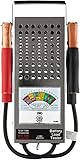
The OTC 3180 is the professional-grade analog load tester that tool trucks have sold for years. OTC is a brand mechanics recognize and trust, and the 3180 is built to the standard you expect from that name.
It runs a 100-amp load test on 6V and 12V batteries, on or off the vehicle, in about 10 seconds. The extra-large display has a zero adjust, which lets you calibrate the needle before each test for more consistent readings than a fixed analog meter.
It reports state of charge, cranking volts, and charging volts, which covers the three questions a mechanic actually asks of a battery system. Nothing more, nothing less.
The construction is solid and portable. It is not as heavy as the Schumacher steel case, but it is built to live in a tool cart and survive daily shop abuse.
Why OTC Commands a Premium
OTC tools are sold through professional channels, which means dealer support, calibration information, and a parts ecosystem that no-name brands cannot match. If your shop bills itself as professional and your customers expect name-brand equipment, the OTC on the bench is a signal.
The trade-off is the warranty. Ninety days is short for a tool at this price, and it reflects the analog meter’s wear components. Budget for occasional zero-adjust maintenance.
Best Use Case
This is the tester for a shop that wants name-brand analog reliability and the ability to test on or off the vehicle. It pairs well with a digital tester for a two-tool diagnostic setup.
11. FOXWELL BT705 – 12V/24V Fleet and Truck Tester
- Tests 12V and 24V systems
- Featured by Project Farm
- GOOD REPLACE CHARGE prompts
- 5.9ft extra-long cable
- 2.8 inch enlarged screen
- Copper-plated clamps
- Rugged housing with carrying case
- 24 month warranty
- Higher price point
- Some users want more detailed data charts
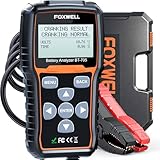
The FOXWELL BT705 is the tester I reach for when a diesel truck or an RV rolls in. It handles both 12V and 24V starting and charging systems, which covers cars, pickup trucks, RVs, boats, motorcycles, and fleet vehicles from one device.
Project Farm featured this unit, which is the same trust signal that boosted the ANCEL BA101. It came through that test with its accuracy intact, and the 76 percent five-star review rate across 2,712 reviews backs that up.
The on-screen results use plain GOOD, REPLACE, or CHARGE prompts instead of charts. That plain-language output is what makes it usable for technicians at every skill level, and what makes it easy to explain to a customer standing at the counter.
The 5.9-foot cable reaches from the battery to the driver’s seat, which turns the cranking test into a one-person job. The 2.8-inch screen is large enough to read without squinting, and the copper-plated clamps hold a stable signal.
24V Testing Realities
Most consumer testers stop at 12V, which makes the BT705 essential for any shop touching commercial trucks, diesel pickups, or marine 24V banks. The 24V cranking and charging tests work the same way as the 12V tests, just on a higher voltage system.
The trade-off is price. At roughly double the cost of a 12V-only tester, the BT705 only makes sense if you actually need 24V coverage. For a car-only shop, the ANCEL BA101 is the better spend.
Who Should Buy This One
This is the tester for fleet maintenance shops, diesel specialists, marine mechanics, and RV service centers. If 24V is part of your weekly work, the BT705 pays for itself the first time it correctly diagnoses a truck the 12V tester could not read.
12. TOPDON BT600 – Shop-Grade Tester with Built-In Printer

TOPDON BT600 12V 24V Car Battery Tester, 3.5″ Screen with Built-in Printer
- Built-in thermal printer for customer reports
- 3.5 inch color screen larger than 90% of testers
- 12V and 24V lead-acid support
- 99.5% accuracy
- Data playback saves last test
- Mini-USB for software updates
- 1-year warranty
- Software updates Windows only
- Higher price point
The TOPDON BT600 is the premium pick in this guide, and the built-in printer is the feature that justifies the price for a working shop. When you can hand a customer a printed battery report at the counter, you turn a free check into a billable diagnostic.
The 3.5-inch color screen is larger than 90 percent of comparable testers, which makes the menu navigation and results genuinely readable instead of a squint-fest. The intuitive interface means a new technician can run a full test sequence within minutes of unboxing.
It covers 12V and 24V lead-acid batteries from 100 to 2000 CCA, including regular flooded, AGM flat, AGM spiral, gel, and EFB chemistries. That range covers sedans, motorcycles, pickup trucks, heavy-duty trucks, and boats from one tool.
The data playback function saves the last test result, so you can recall a reading after the customer has left the bay. The mini-USB port allows software updates, though only on Windows, which is the main complaint from Mac-only shops.
The Printer as a Revenue Tool
The thermal printer is not a gimmick. Shops that itemize battery diagnostics on invoices use the printed report as proof of service, which protects against comebacks and supports upselling a replacement battery. One printed report that closes a battery sale pays for the tester.
The trade-off is paper. Thermal paper rolls need replacement, and they fade in heat. Store spares in a cool drawer, not on a hot shop shelf.
Who Should Buy This One
This is the tester for a professional shop that bills for diagnostics, a battery dealer that needs printed proof, or a used-car operation that documents every vehicle. If you have ever lost a battery sale because you could not show the customer a number, the BT600 fixes that.
Buying Guide: How to Choose a Battery Load Tester
Choosing among the best battery load testers for mechanics comes down to six questions. Answer them honestly and the right model becomes obvious.
Carbon Pile or Digital Conductance?
Carbon pile testers physically discharge the battery through a resistive load, which is the most direct test of real-world cranking ability. They are slower, generate heat, and require the battery to be at least partially charged. They are also the most trusted by old-school mechanics and the most authoritative on borderline batteries.
Digital conductance testers send a small AC signal and infer battery health from internal resistance. They are faster, safer, work on discharged batteries, and dominate the modern market. Most professional shops now use conductance testers as their primary tool.
The best shops own both. Use conductance for speed and throughput, and reach for carbon pile when a conductance result does not match the symptom.
What Voltage Range Do You Need?
If you only test 12V car batteries, almost any tester in this guide works. The moment you touch 6V motorcycle or lawn tractor batteries, you need a tester that supports 6V, like the OBDResource BR502 or the OEMTOOLS carbon pile. The moment you touch 24V trucks, RVs, or marine banks, you need a 24V-capable unit like the FOXWELL BT705 or the TOPDON BT600.
Buying the wrong voltage range is the most common mistake in this category. Check your shop’s workload before clicking buy.
What Battery Chemistries Do You See?
Modern vehicles use flooded lead-acid, AGM flat plate, AGM spiral, gel, and EFB batteries. Every tester in this guide covers flooded, AGM, and gel, but only some cover EFB, and none of the lead-acid testers here handle lithium batteries. If you service vehicles with lithium starter batteries, you need a tester specifically rated for lithium.
AGM compatibility is the one to watch. Many cheap testers give false readings on AGM batteries because the conductance profile differs from flooded lead-acid. The TOPDON and FOXWELL models handle AGM correctly.
How Important Is Clamp Quality?
Clamp quality is the most overlooked feature in this category, and it is the number one source of inaccurate readings. Stamped steel clips flex, lose contact, and pick up resistance from corrosion. Copper and copper-plated clamps bite harder, conduct better, and produce more stable readings.
The ANCEL BA101’s copper crocodile clips, the TOPDON BT100’s copper clamps, and the FOXWELL units’ copper-plated clamps are the ones to look for. If a tester ships with bare steel clips, expect to second-guess borderline readings.
Do You Need Cranking and Charging Tests?
A battery tester that only tests the battery tells you half the story. The other half is whether the starter and alternator are doing their jobs. Cranking tests capture minimum voltage during the start event, which catches weak starters and bad ground connections. Charging tests measure alternator output and rectifier diode health, which catches failing alternators before they strand the customer.
Every tester in this guide from the TOPDON AB101 upward includes cranking and charging tests. If you are buying for a shop, do not settle for less.
What About Data Logging and Reporting?
If you bill customers for battery diagnostics, you need a way to document the result. The TOPDON BT600’s built-in thermal printer is the gold standard for printed reports at the counter. Testers with data playback let you recall the last reading, which helps when a customer returns to question a diagnosis.
Bluetooth and app-connected testers exist at higher price points, but in practice most shops find a built-in printer more reliable than a phone app in a greasy environment.
Build Quality and Total Cost of Ownership
Cheap testers fail in two ways: the clips degrade, and the screen dies. The Schumacher BT-100 and OTC 3180 survive decades because they are simple analog devices with no screen to fail. The digital testers trade longevity for features, so factor in a replacement cycle of three to five years for daily shop use.
Warranty matters here. FOXWELL offers 24 months on the BT705, TOPDON offers 12 months across its line, and the OTC 3180 offers only 90 days. Match the warranty to how hard you will use the tool.
FAQs
Which battery load tester is best?
The ANCEL BA101 is the best overall pick for most mechanics because it combines 100-2000 CCA coverage, copper crocodile clips, SOH and SOC display, and 4-in-1 protection at a mid-range price. For shops that need printed reports, the TOPDON BT600 with its built-in printer is the best professional choice. For budget buyers, the KONNWEI KW208 delivers 99.7% accuracy at the lowest price point.
Are battery load testers accurate?
Yes, modern digital conductance testers are accurate to within about 99.5% on healthy batteries when clamps make good contact. Carbon pile load testers are considered the most authoritative for borderline batteries because they physically discharge the battery. Accuracy drops on dirty terminals, painted ground points, and AGM batteries tested on flooded settings, so connection quality matters as much as the tester itself.
What’s the difference between a battery tester and a battery load tester?
A battery tester measures static voltage and may use conductance to estimate health without drawing significant current. A true battery load tester applies a real electrical load to the battery and measures how voltage holds under that load, which is a more demanding test of actual cranking ability. Carbon pile load testers are the classic example, while modern digital testers combine both approaches.
How many amps should a battery be load tested at?
A battery should be load tested at half its CCA rating for 15 seconds. For example, a 600 CCA battery is loaded at 300 amps. A healthy 12V battery should maintain at least 9.6 volts under that load at room temperature. Dropping below 9.6 volts indicates the battery should be replaced. Most 100-amp carbon pile testers approximate this test for batteries up to 1000 cranking amps.
Final Verdict
The best battery load testers for mechanics in 2026 divide cleanly by use case. For the working mechanic who wants the best balance of price, accuracy, and durability, the ANCEL BA101 is the editor’s choice and the number one best seller for a reason. For value, the KONNWEI KW208 delivers near-premium accuracy at a budget price. For shops that bill for diagnostics and need printed reports, the TOPDON BT600 with its built-in printer is the professional upgrade.
If you service 24V trucks or RVs, step up to the FOXWELL BT705. If you want the authority of a true carbon pile test, the Schumacher BT-100 and OEMTOOLS 24338 are the old-school answers that still earn their bench space. Pick the one that matches your shop’s daily workload, and you will not regret the purchase.