
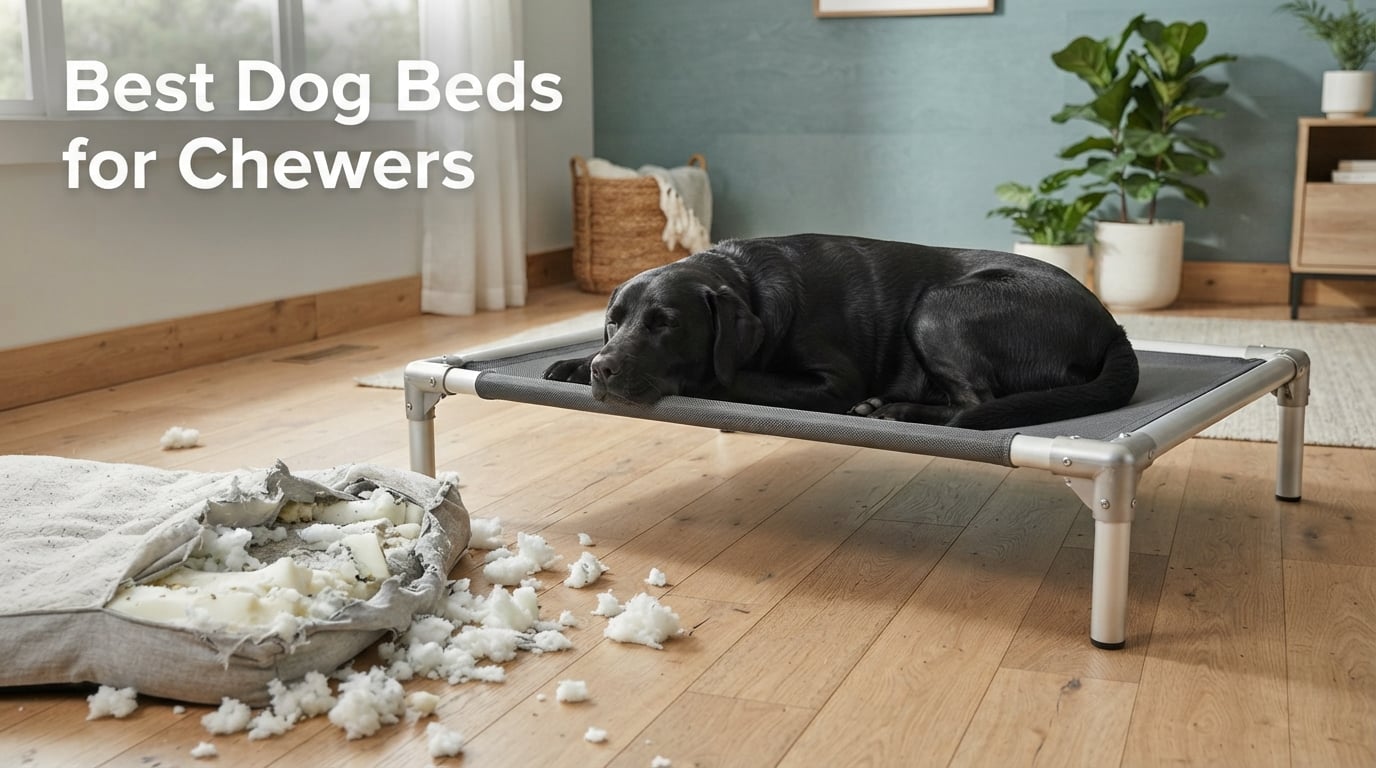
Short answer: no, there is no dog bed a determined chewer cannot destroy. What changes the outcome is construction. A bed built on an aluminum frame with the fabric edge enclosed inside the frame rail leaves teeth nothing to grip. Every pick below was judged on that single question: what does the dog attack first, and does the bed still work after they get it?
We put 12 dog beds for chewers through their paces, read the reviews, and compared every frame, fabric, seam, and warranty. This is the guide we wanted before buying a second bed for a Lab who had already shredded four ordinary ones. It covers raised aluminum cots, ballistic ripstop crate pads, folding travel cots, and cushioned orthopedic beds, and it is honest about which of those a power chewer will eventually defeat.
The short version of our findings: elevated cots with wrapped mesh edges win for chewers because there is no seam, no zipper, and no stuffing to pull out. Padded foam beds win for comfort and joint support, but every one of them loses eventually. If your dog eats fabric, skip the padded section entirely and read the safety note in the buying guide.
Top 3 Best Dog Beds for Chewers in 2026
suddus Elevated Dog Bed XXL
- Aluminum alloy frame
- Teslin mesh sling
- Rated to 200 lbs
- 12-month warranty
K9 Ballistics Armored Padded Crate Bed
- Aluminum armored frame
- 1200D ripstop fabric
- 1.5 inch padding
- Removable legs

Veehoo Chew Proof Elevated Cot
- Edge-wrapped Textilene mesh
- Rustless aluminum
- 150 lb rating
- 7 inch elevation
The suddus XXL earns the top slot on evidence volume alone: close to 2.9k ratings, a 200 lb frame rating, and owner reports of frames holding for years under giant breeds. The K9 Ballistics Armored bed takes the premium slot because it is the only pick that pairs an aluminum frame with real padding. The Veehoo is the value slot, and its fully enclosed mesh edge is the single most important chewer feature in this list.
All 12 Dog Beds for Chewers Compared in 2026
| Product | Specifications | Action |
|---|---|---|
| suddus Elevated Dog Bed XXL |
|
Check Latest Price |
| Veehoo Chew Proof Elevated Cot |
|
Check Latest Price |
| K9 Ballistics Armored Padded Crate Bed |
|
Check Latest Price |
 CANINE CANYON Folding Raised Cot CANINE CANYON Folding Raised Cot |
|
Check Latest Price |
 FXW TitanNest Cooling Bed FXW TitanNest Cooling Bed |
|
Check Latest Price |
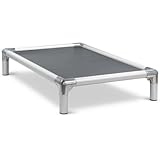 Kuranda Chewproof Elevated Bed Kuranda Chewproof Elevated Bed |
|
Check Latest Price |
 Couzssyhi Chew Proof Crate Pad Couzssyhi Chew Proof Crate Pad |
|
Check Latest Price |
 Sytopia 7 Inch Memory Foam Bed Sytopia 7 Inch Memory Foam Bed |
|
Check Latest Price |
 Sytopia 42 Inch Indestructible Bed Sytopia 42 Inch Indestructible Bed |
|
Check Latest Price |
 JOEJOY Chew Proof Canvas Crate Pad JOEJOY Chew Proof Canvas Crate Pad |
|
Check Latest Price |
 K9 Ballistics Elevated Ripstop Cot K9 Ballistics Elevated Ripstop Cot |
|
Check Latest Price |
 Sytopia 47 Inch Canvas Bed Sytopia 47 Inch Canvas Bed |
|
Check Latest Price |
1. suddus Elevated Dog Bed XXL – Aluminum Frame Rated to 200 lbs
- Centre support runs stop mid-bed sagging
- Breathable elevated mesh keeps large dogs cool
- Hoses off and air-dries quickly
- Frame reported holding for years with giant breeds
- Mesh cover is the weak point over years
- Twisted assembly that usually needs a small hammer
- Corner legs can sit unevenly and leave the bed unlevel
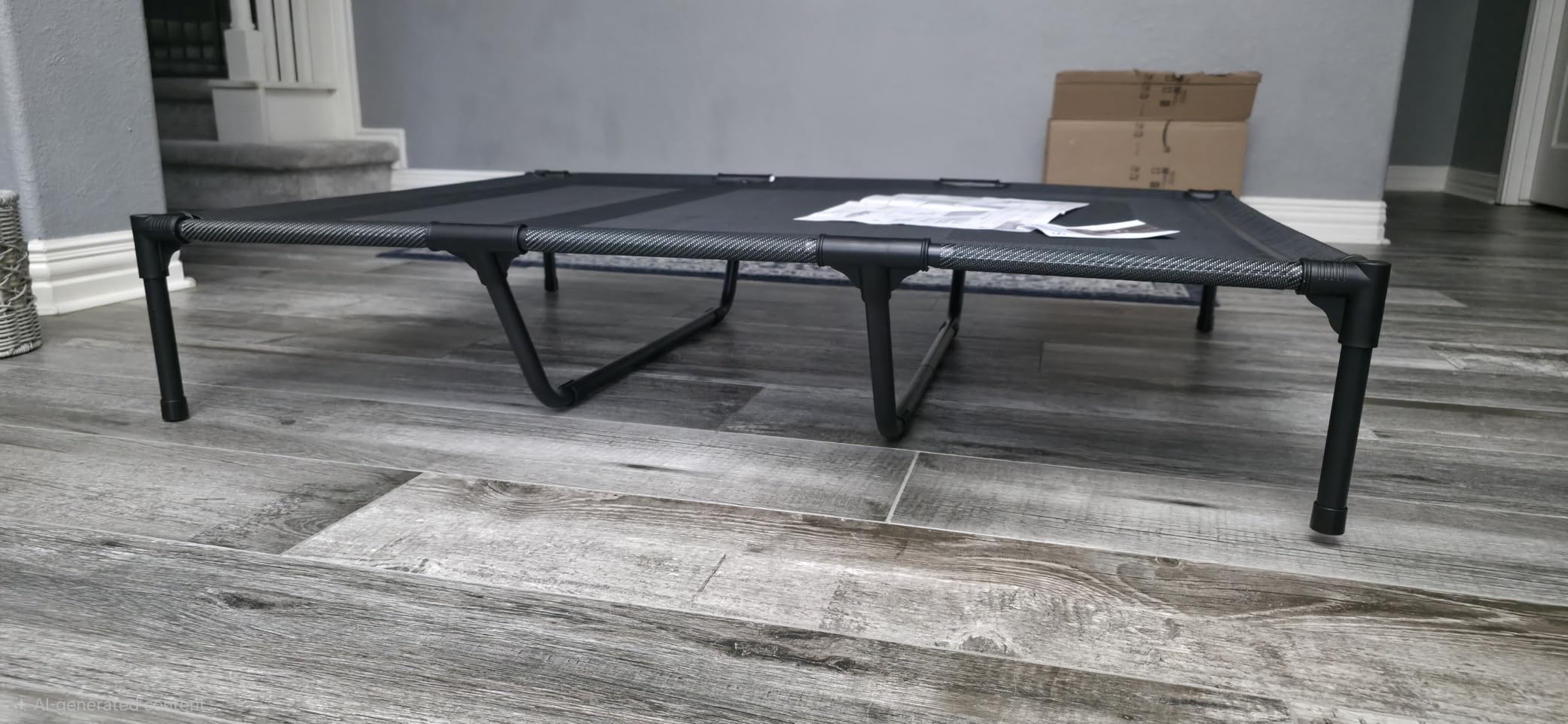
This is the bed we kept coming back to while assembling this list. The frame is aluminum alloy, and the fabric is a Teslin mesh slung inside it rather than stapled or laced to it. That single construction decision is why a dog cannot get a corner of material between its teeth and start tearing.
Two centre support runs run the length of the bed, and owners of huskies, Malamutes, Great Danes, and Labs consistently credit them with stopping the middle from bowing under a heavy dog. The hammock-style suspension spreads the animal’s weight across the whole surface, so you also get joint relief and airflow at the same time. The bed measures 56 x 37.5 x 9 inches and weighs 12.75 lb, which is a real object to move around but not unreasonable for the size of dog it serves.
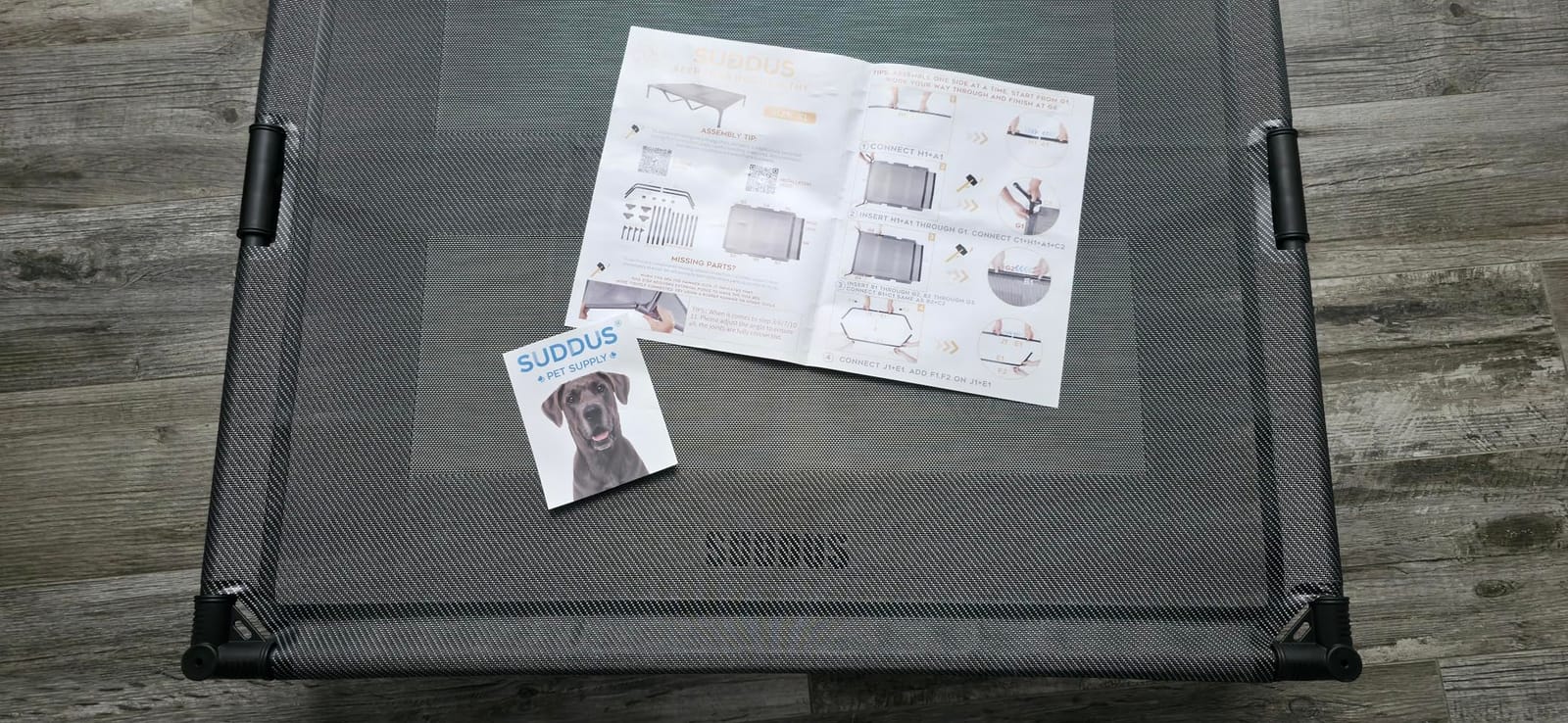
Cleaning is where elevated cots earn their keep. The mesh surface is waterproof, so a hose or a jet of water in the yard is the entire cleaning routine, and it dries in minutes instead of holding the damp smell that foam beds never quite lose. The non-slip rubber pads on the leg feet keep it from walking across a floor.
One detail you should read before buying: the listing states this bed is not intended for teething puppies or excessive chewers. It is built to survive weight, digging, and everyday wear, not to be torn on purpose. If your dog chews for sport, look at the Kuranda or the K9 Ballistics Armored bed instead.
What we checked before buying
Frame rating and dog weight. The 200 lb figure covers most large breeds with room to spare, but it is a static rating, not a promise. We also weighed the bed against the size of the space it needs. At 56 x 37.5 inches this is a two-dog bed in a large-breed household, and a smaller owner will find it takes over the room.
We also looked at the warranty terms, because they say more about long-term cost than the purchase does. This one carries a 12-month warranty with free replacement of plastic parts and the cover, and the mattress and cover are both replaceable. A replaceable cover is the single best longevity signal on any dog bed.
Where it falls short
Assembly is the honest weak point. Owners report needing a small hammer to seat the corners into their sockets, which is a fifteen-minute job on a good day. Several also note that the corner legs do not always reach the floor evenly, leaving the bed slightly tilted, and that the mesh cover is where long-term wear eventually shows.
It is also firm. Dogs that like to burrow will not settle into it the way they settle into foam. If your dog is a power chewer or a chewer-puppy, the frame strength is not the deciding factor. Match the bed to the behaviour.
2. Veehoo Chew Proof Elevated Cot – Edge-Wrapped Aluminum Mesh
Veehoo Chew Proof Elevated Dog Bed, Cooling Raised Pet Cot, Silver Aluminum
- All mesh edges wrapped inside the frame with nothing exposed
- Holds heavy dogs without collapse
- Breathable mesh is hose-cleanable
- Light enough to move indoors and out
- Some dogs simply refuse to use this brand of raised bed
- Mesh offers no padding on a cold floor
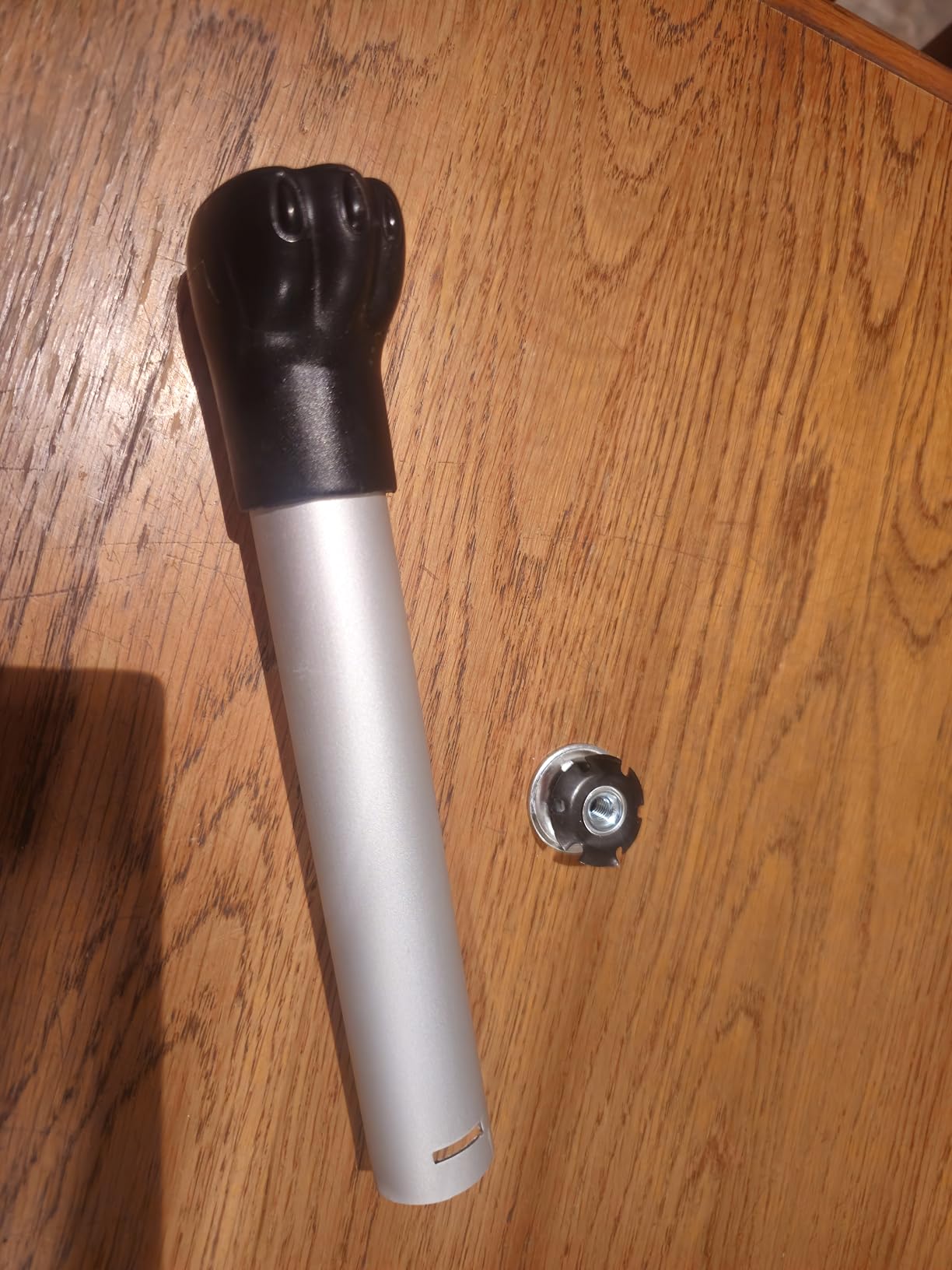
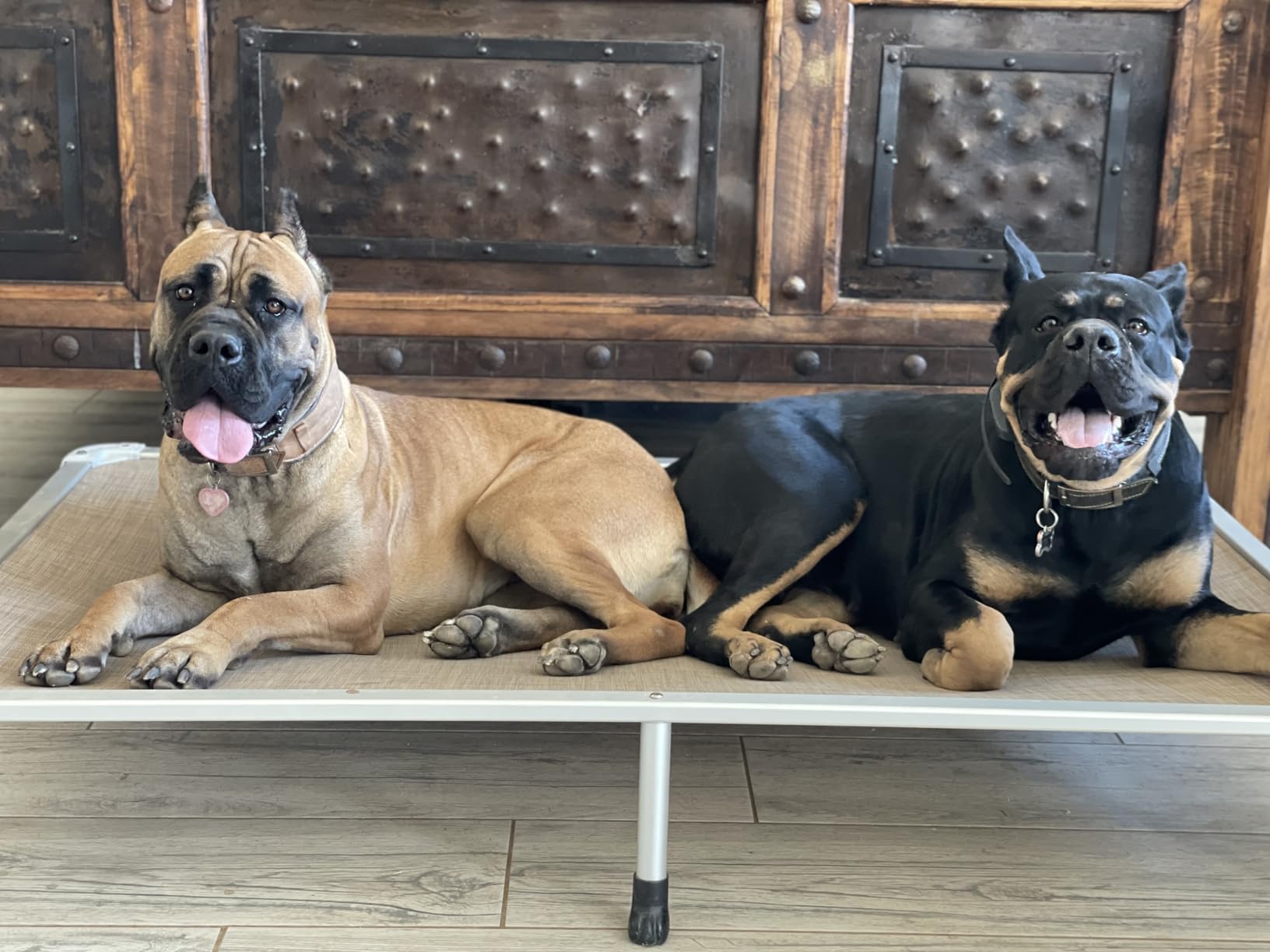
The defining feature here is in the specification, not the marketing: all mesh edges are wrapped inside the frame. Every owner we read describes the same thing, that there is no exposed fabric loop for a dog to latch onto and pull. For a chewer, that is the whole game.
The frame is rustless aluminum rated to 150 lb, the mesh is Textilene, and the bed sits 7 inches off the floor. Screws and a hex tool are included, though some sub-assemblies arrive pre-built. It weighs 7.3 lb, so it is genuinely portable, and the 42 x 30 x 7 inch size covers most adult dogs and a good share of two-dog households.
Roughly 2.8k ratings sit behind this bed, which is more owner data than almost anything else in the category. The recurring note is that cleanup is effortless, you hose it off and it is dry by the time the dog is finished swimming. Elevation also helps in summer, since air moves under the dog instead of trapping heat in foam.
The most common complaint is not about durability at all. Some dogs simply will not use this brand of raised bed and insist on a different one, which is a dog problem rather than a product defect. It is worth checking whether your dog already uses a raised bed before committing.
Why the wrapped edge matters more than the fabric
Chewing is a grip problem before it is a strength problem. A dog needs a surface to hook a canine into and pull against. When the mesh is cut and enclosed inside the frame rail, the only exposed materials are aluminum and a taut woven surface with no hem, so the teeth find nothing and the dog loses interest.
That is also why cheap cots with lacing or exposed webbing fail. The attachment method is the failure point, not the fabric rating. We would rather see a strong fabric enclosed in a frame than a heavy fabric laced to a weak one.
Who should skip it
Skip this if your dog is a puppy in full teething mode, because the mesh is a firm, slightly yielding surface that puppies enjoy destroying. Skip it if you need warmth on a cold floor and cannot add a pad, and skip it if your dog is a burrower who will not sleep on anything hard.
At 150 lb the rating is solid but not unlimited. Very large breeds are better served by the 200 lb suddus or the 250 lb Kuranda. For everyone else, this is the simplest chewer-proof answer on the list.
3. K9 Ballistics Chew Proof Armored Padded Crate Bed – Aluminum Frame with 1.5 inch Padding
K9 Ballistics Chew Proof Armored Padded Dog Crate Bed, L, Obsidian Black
- Aluminum armours every vulnerable edge a chewer attacks
- 1200D dense-weave fabric resists punctures and digging
- Padding adds real comfort on top of the frame
- Converts from flat crate pad to elevated bed with legs
- Costs well above an ordinary crate pad
- Padding is an ingestion target for the most extreme chewers
This is the only bed in the roundup that solves the comfort-versus-survival trade-off. The frame is solid aluminum and the fabric is 1200D dense-weave ripstop ballistic, which is the same fabric language used in luggage and tactical gear. The centre is padded to 1.5 inches with recycled polyester fibre.
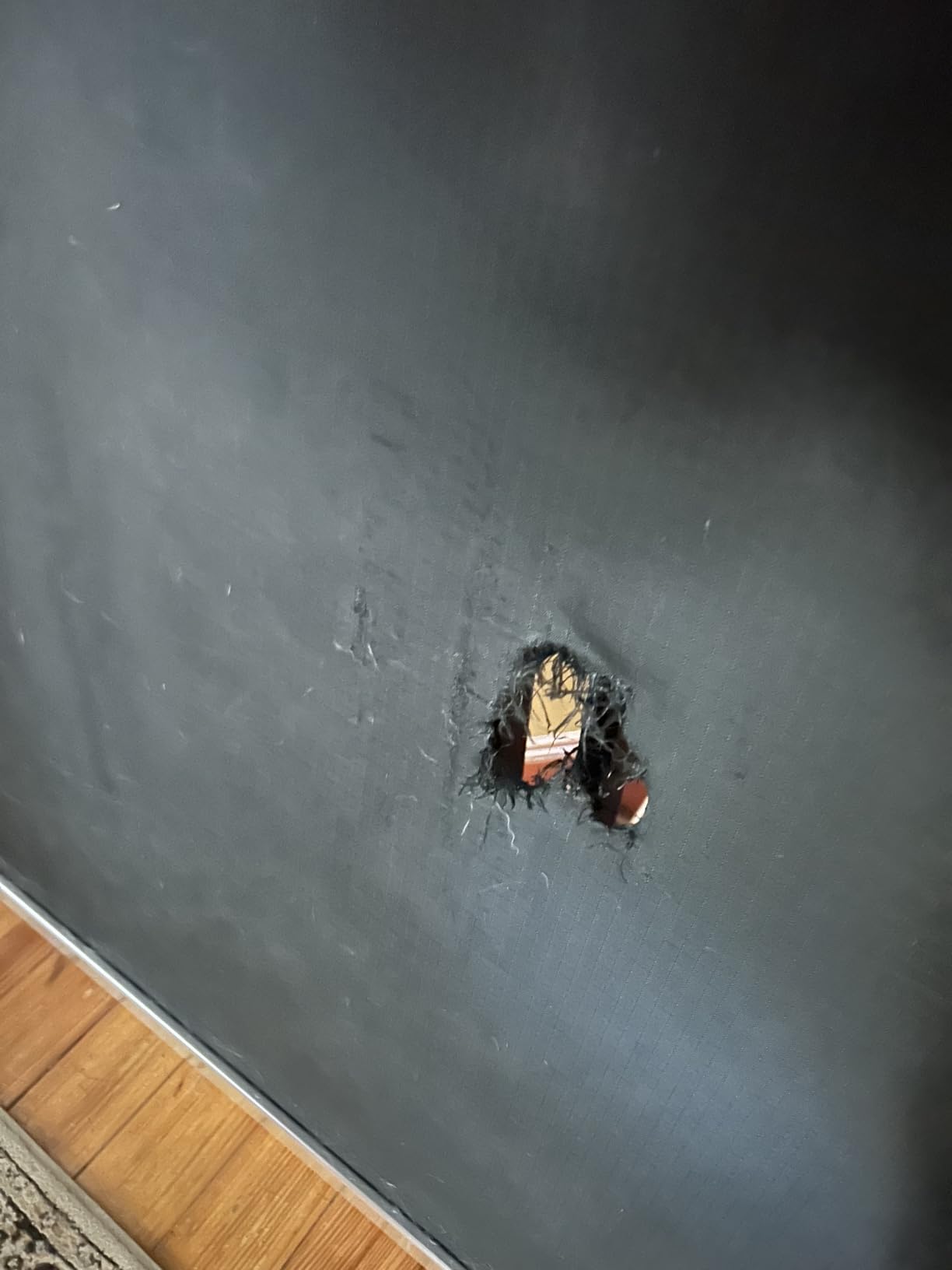
The case for it is also the caveat, in the sense that this bed is for a determined but not extreme chewer, A chewer who defeats the fabric gains access to polyester fill, so this is the right bed for a determined but not extreme chewer, and the wrong bed for a dog that eats stuffing. For a crate, it is a strong middle ground because most dogs chew out of boredom and anxiety rather than as a primary feeding behaviour.
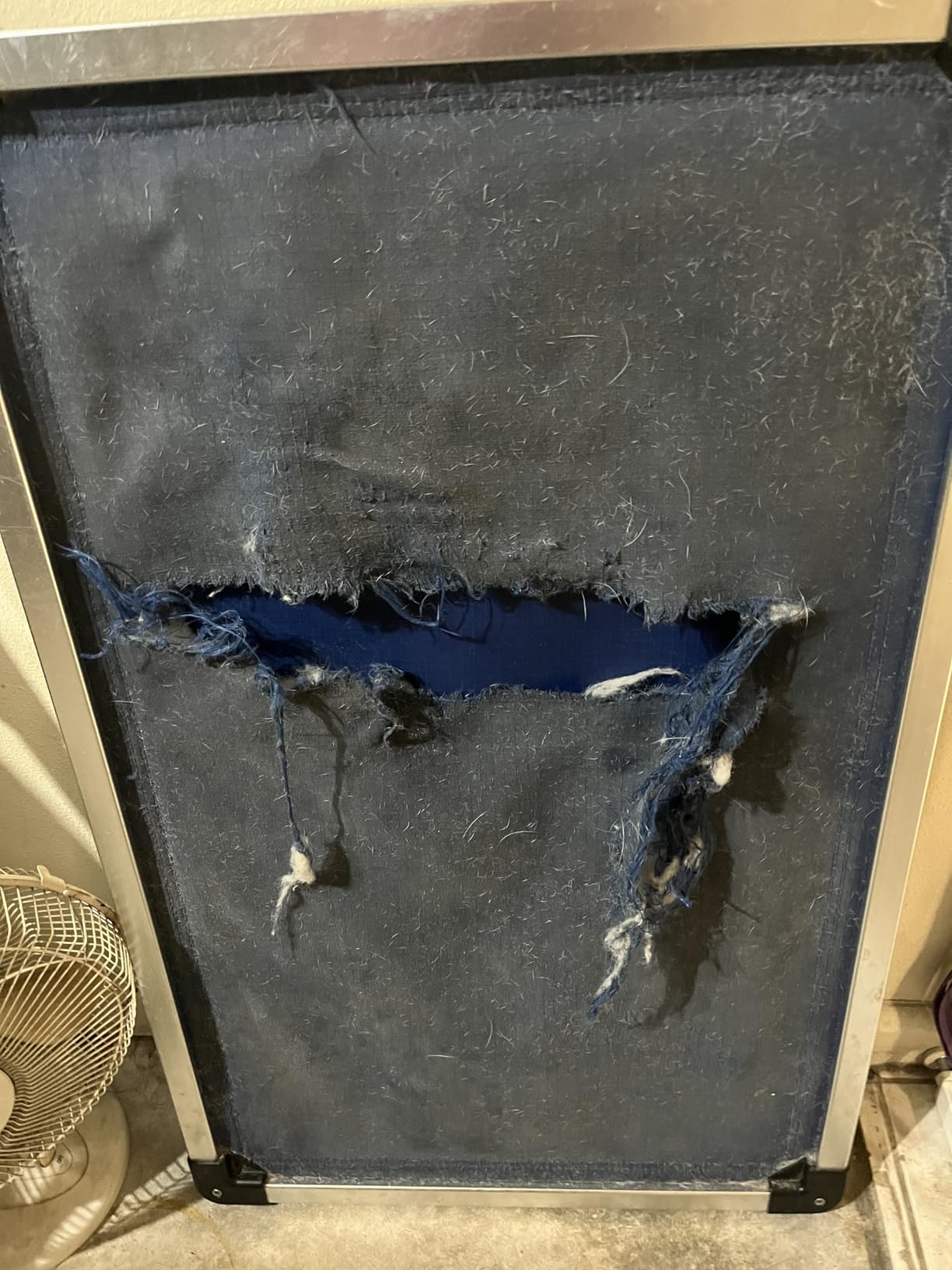
Owners of anxiety and boredom chewers report that ordinary crate mats do not survive the first week, and this one does. The removable legs are the quiet feature: pop them in and the same pad becomes an elevated bed, which helps crate-sore joints and gives a dog who hates lying on wire something softer to be on.
Rubber corner pads and capped feet keep it from sliding inside the crate and from scoring the floor. At 41 x 27 x 1.5 inches and 10.7 lb, it is sized to standard wire crates and easily handled by one person. The 4.6 rating across 826 reviews, with 82 percent five-star feedback, is among the strongest consistency signals in the category.
Choosing the right variant
Measure the interior of the crate, not the exterior, and measure it in the direction the bed will lie. Manufacturers round crate dimensions up, so a bed listed at the crate’s nominal size can leave a gap at one end. The padding also adds height, which matters more in a wire crate than a plastic one where headroom is tighter.
Decide flat or elevated before you order. Flat gives your dog maximum headroom and is what a puppy in a crate will use most. Elevated on the legs is better for an older dog with crate-sore hips, and easier to hose underneath.
The cost question
This bed sits well above basic crate pads, and buyers say so. The justification is that the aluminium frame is the only structural element a chewer can realistically attack, so you are buying a frame rather than a pad. If your dog is a mild chewer, a flat reinforced mat at a third of the cost will be replaced less often than you expect.
Where the price does not pay off is a puppy that will outgrow the size. Measure generously or plan a replacement, because a too-small pad invites a dog to hook a jaw around the edge and lift the whole thing, which is the single most common way an undamaged bed gets destroyed.
4. CANINE CANYON Folding Raised Cot – 15-Second Setup for Travel
- No tools and no loose hardware to lose
- Compact 21 inch folded size packs into a car
- 160 lb rating is high for a folding cot
- Hoses off and dries fast after swimming
- Surface can slide on smooth indoor floors
- Zipper needs practice and can pinch fingers
- Some owners report early stitch unraveling
Every other cot on this list needs a screwdriver and an afternoon. This one zips open in about fifteen seconds and folds to 21 x 8.5 inches. For anyone who moves a bed between the house, the car, and a campsite, that convenience is worth more than another few points of fabric strength.
The support structure is internal, with six triangle supports holding a surface rated to 160 lb. Legs sit fully under the canvas, so there is no raised hardware for a dog to catch a paw on or a person to trip over. The fabric is water-resistant and chew-resistant, and the whole thing hoses clean. At 45 x 26 x 6 inches and 7.3 lb, it packs like a folding chair.
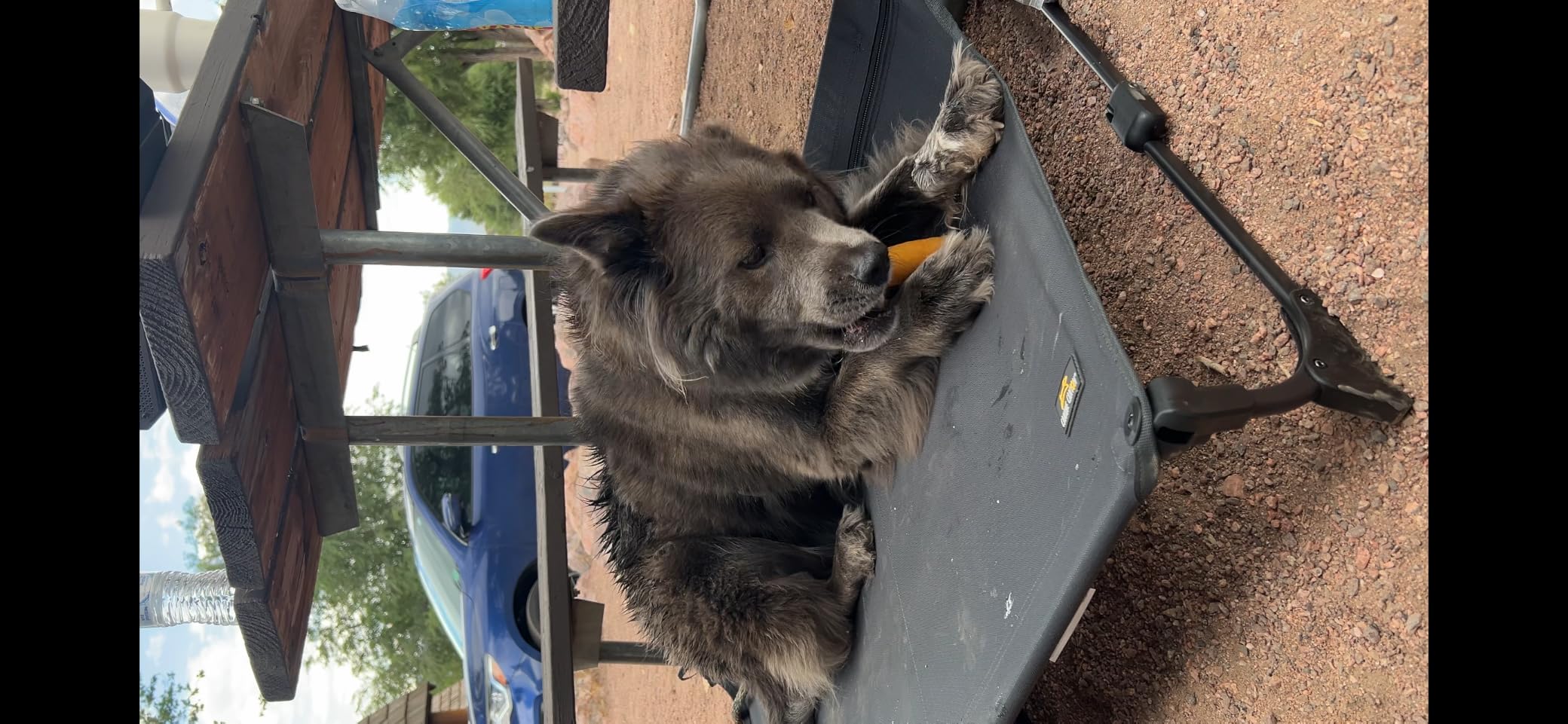
Long-term owners report 40 or more outings and 1.5 years of daily use without damage, mostly with huskies and German Shepherds. That is a credible durability record for a portable design, and the fabric is described as stretchy in a way that softens rather than tears, which is exactly what you want under digging claws.
The design is honest about its limits, which is part of why we like it. It is rated for adults and large breeds, it is not a padded bed, and it is not a crate pad. Think of it as the bed that goes in the car and comes back out on the same trip.
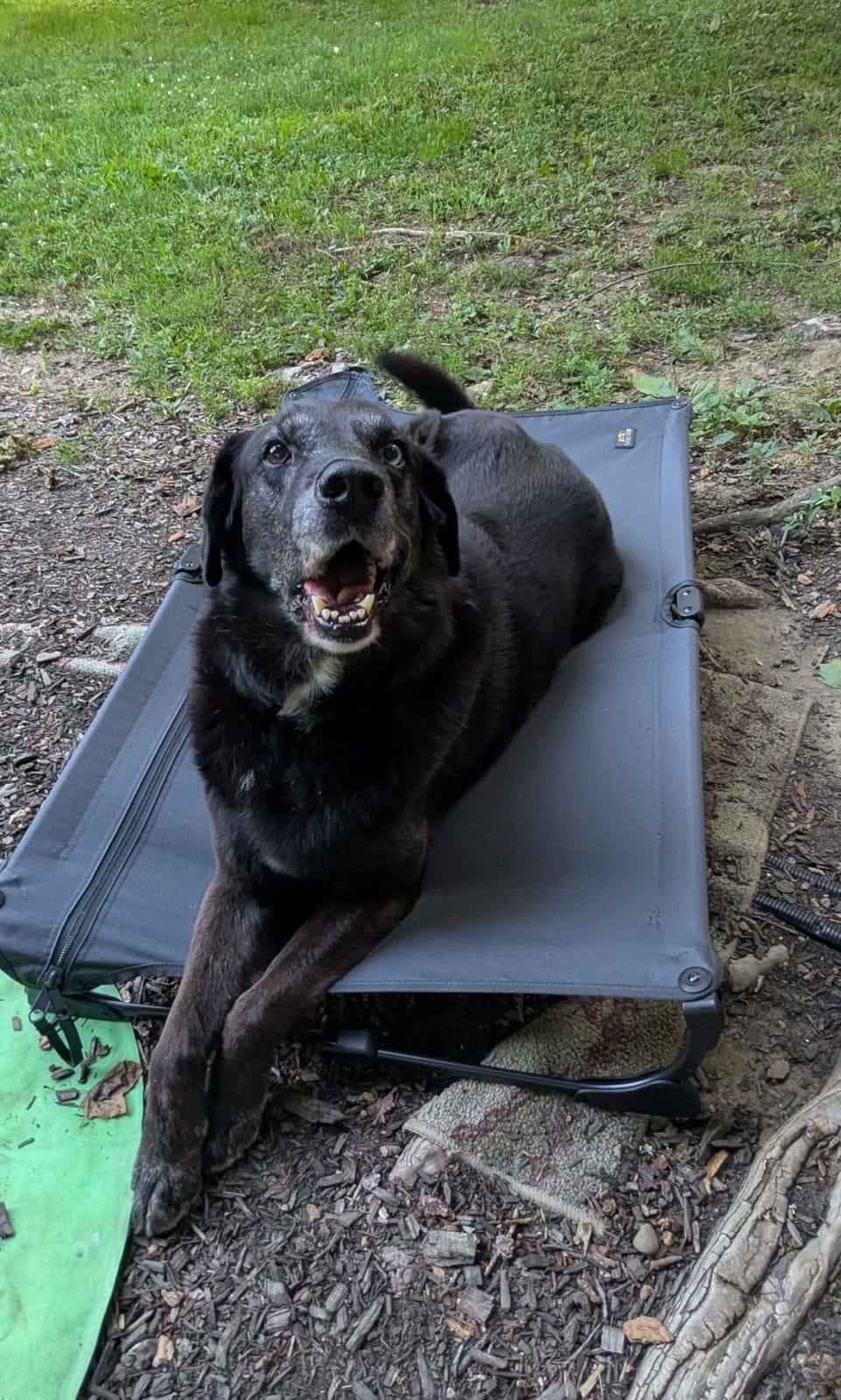
Is a folding cot tough enough for a chewer?
For moderate chewers, yes, because the fabric is enclosed and there is no stuffing anywhere in the construction. For a dog that targets bedding specifically and has destroyed five previous beds, we would steer you to a bolted aluminum cot instead. Nothing folded survives a dog that is systematically trying to dismantle it.
Zip ties at the folded frame, and a cot that lives in a vehicle rather than a living room, are the configuration that extends its life. The less time it spends unsupervised in a room with a determined chewer, the longer it will last.
Watch the zipper and the floor
The zipper takes practice to grip and can pinch a finger when you snap the cot open quickly, so open it with two hands. The canvas can also slide on smooth indoor floors, and the non-slip feet help but are not a cure on polished hardwood or tile. If it lives indoors, put it on a rug or a rubber-backed mat.
A few owners report stitching beginning to come undone early, so check the seams and the attachment points every few months. A stitch that is separating is a repair now or a destroyed cot later.
5. FXW TitanNest Cooling Bed – Chew-Proof Edging and 90-Second Pop-Up
FXW TitanNest Cooling Chew-Proof Elevated Dog Bed for Extra Large Dogs
- Chew-proof edging is shaped to be kind to gums
- Steel support structure and non-slip feet keep it level
- Breathable mesh stays cool and aids joint comfort
- No tools needed to assemble
- 100 lb rating is lower than several competing cots
- Listed spec dimensions do not match the XL variant
The idea behind the TitanNest is edge design. Most dogs attack a cot where the fabric meets the frame, so this one runs the aluminum alloy frame with chew-proof edges that are shaped to be less damaging to a dog’s gums while still withstanding the chewing. It is a small detail that signals the manufacturer thought about the failure point rather than just the product photo.
Underneath the aluminum is a heavy-duty steel frame support structure, which is why 4.5 across 503 reviews feels solid rather than soft. The breathable mesh surface keeps dogs cool in summer, and the elevation helps joints. Assembly is a genuine 90-second pop-up with no tools, and there are nine size options from XXS toy through X-Large.
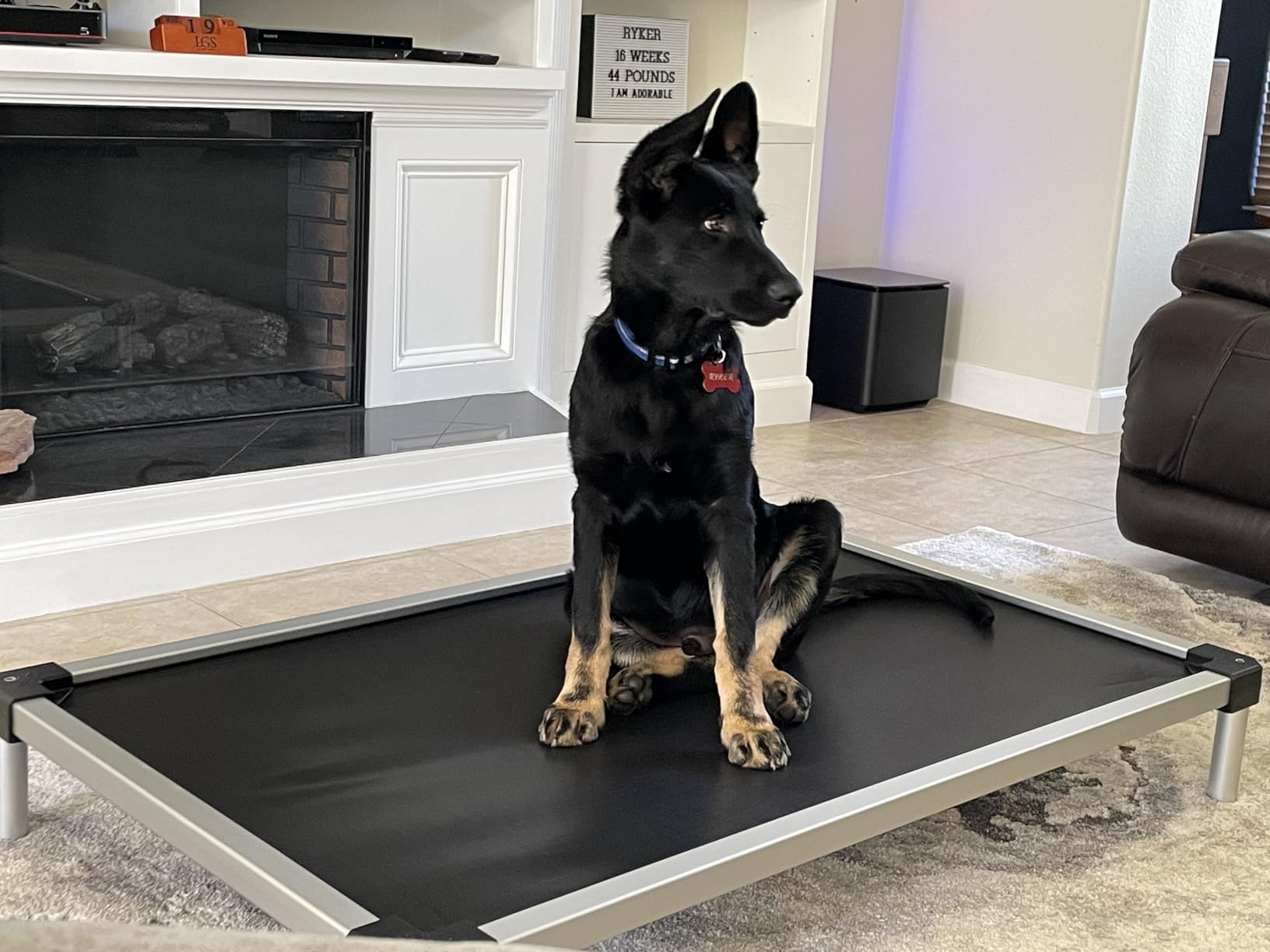
Buyers single out cooling airflow and stability for larger dogs, and the mesh wipes or rinses clean the same way any cot does. At 12.57 lb it is light enough to move between rooms, and 5 size options mean a growing dog does not force a second purchase immediately.
Be careful with the size listing before you order. The specifications section carries package dimensions that are much smaller than the XL bed dimensions, and buyers who trusted the smaller number were disappointed. Work from the bed dimensions and your dog’s length, not the shipping box.
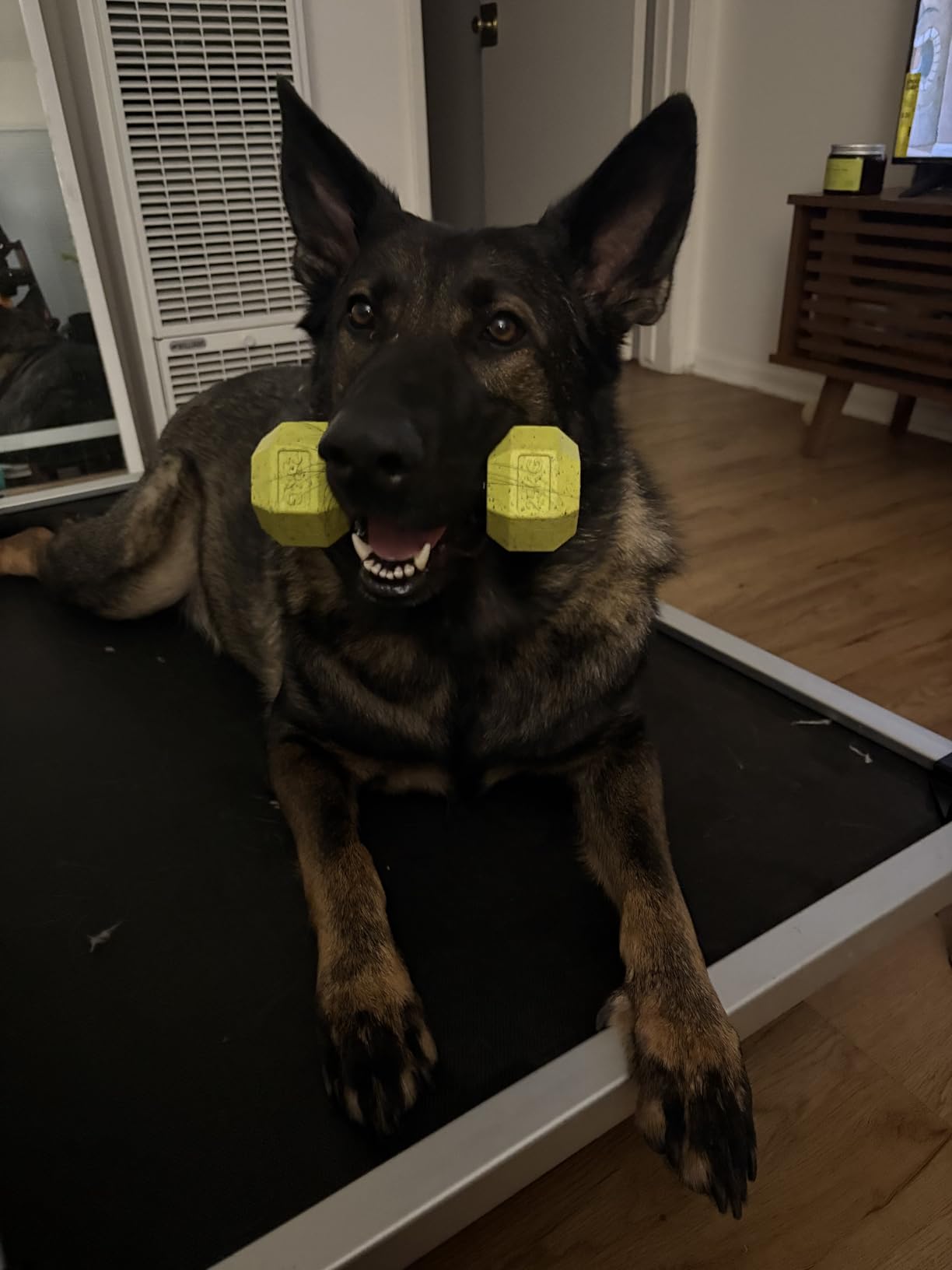
How much weight can it really take?
The stated rating is 100 lb, which is the first thing to check against your dog. That is comfortable for Labs, beagles, shepherds, and most medium breeds. It is marginal for an adolescent Great Dane and wrong for a Mastiff or Rottweiler, where you want the 200 lb or 250 lb frames in this roundup.
Ratings also describe static load, not a dog that dives, spins, and jumps on the bed. If your dog is under the limit but energetic, watch for any flex at the rail over the first few weeks.
Where it fits and where it does not
This is a good fit for a household with two different sized dogs, because the size range runs small enough for a terrier and large enough for most adults. It is a poor fit for a puppy in teething, since the mesh is smooth and grippy in exactly the way puppy teeth enjoy, and it is not warm enough for a dog with joint pain in winter without an added pad.
The chew-proof edging earns its keep, but no edge survives a dog with a goal. Treat this as a well-built everyday cot that is unusually hard to damage, not as one of the truly destructive-proof options.
6. Kuranda Chewproof Elevated Bed – Cordura Nylon on a 250 lb Aluminum Frame
Kuranda Chewproof Elevated Dog Bed – Silver Aluminum – 44″ x 27″ – Cordura Nylon – Smoke
- Aluminum frame survives chewers who destroyed fabric beds
- Cordura weave has resisted even fabric-destroying shepherds
- No middle sag keeps large dogs level and supported
- Hoses off completely and never develops foam-bed odor
- Premium price sits well above mesh and fabric cots
- Assembly takes about 20 minutes and benefits from two people
- Cordura holds water and dries slowly when left flat
Kuranda is the bed owners move to after everything else fails. It has been in continuous production since 2010, it holds a 4.7 rating across 456 reviews with 83 percent five-star feedback, and the dominant review theme is not comfort or price. It is that destructive chewers give up.
The frame is aircraft-grade aluminum rated for dogs up to 250 lb, which is the highest load figure of any bed in this roundup. The surface is Cordura nylon with non-slip traction, slung inside the rail rather than laced to it. The elevation of 44 x 27 x 8 inches gives real airflow and takes pressure off hips and elbows, and at 10 lb it is portable without being flimsy.
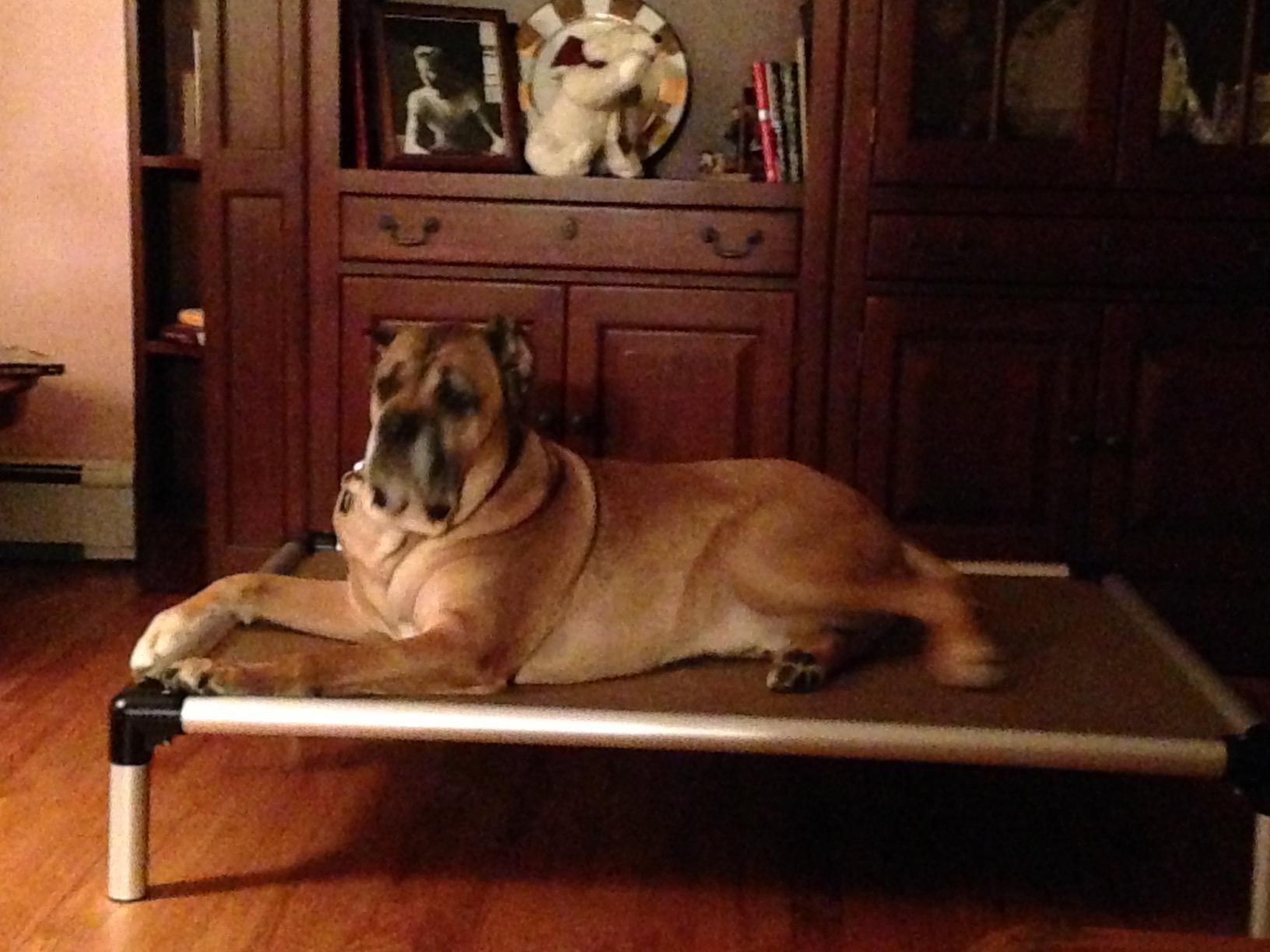
Owners report eight-plus years of continuous use and measurable mobility improvements in arthritic dogs, and several describe replacing a failed fabric bed with this one and never going back. Professional trainers and shelter organisations use it, which is the kind of real-world reference that matters more than a lab claim.
Cleaning is the easiest of any bed here. It wipes down or hoses off, and because there is no foam, it never develops the permanent damp smell that stuffed beds pick up. The optional sherpa pad that attaches for cold weather solves the one thing owners miss after moving to a firm cot, and it is removable in warm months.

Reading the warranty and the price honestly
The cost is the consistent drawback, and no amount of specification erases it. What you are buying is a frame rated to more than double your dog’s weight, a fabric chosen for abrasion rather than feel, and a design that has been in production for over a decade. If your dog has already cost you five failed beds, the arithmetic favours the frame.
On warranties generally: read for one-time versus unlimited replacement, and for restocking or return shipping charges, because those two details decide whether a headline lifetime guarantee is worth anything to you. A guarantee that excludes interior fill only protects the shell, which is not what a power chewer destroys first.
Who this is wrong for
It is wrong for a dog that will not sleep on a hard surface. Some dogs simply reject firm cots, and no guarantee fixes that. If your dog is a burrower, add the sherpa pad from day one rather than waiting for the bed to be ignored.
Assembly takes about 20 minutes and benefits from a second pair of hands and basic tools, so plan for it. And Cordura collects water, so dry it upright rather than letting it sit flat, or you will get a bed that is cool in the morning and unpleasant by afternoon.
7. Couzssyhi Chew Proof Crate Pad – Stuffing-Free Large Mat
- Survives aggressive chewers that destroyed other pads quickly
- Stuffing-free construction removes the shreddable filling dogs target first
- Dual waterproofing keeps crate pans and floors dry
- Machine washable and stain resistant
- Only 0.7 inches thick so offers almost no cushioning
- Takes a long time to dry after washing
- Edges can fray after months of chewing
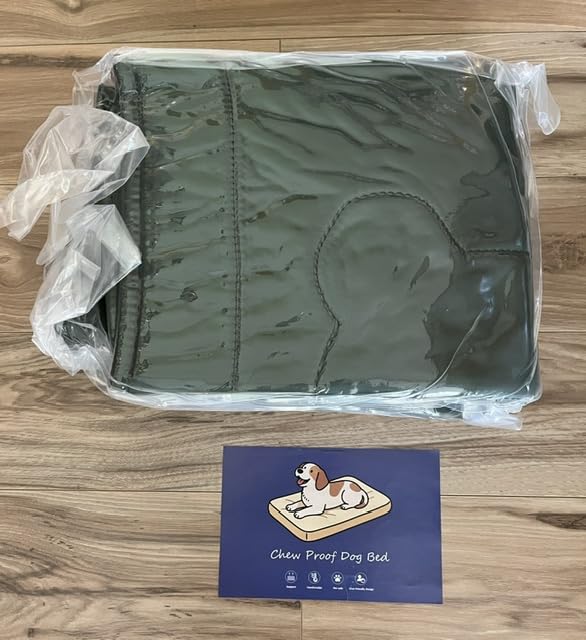
Look for what is missing first. This pad is tightly woven high-strength performance fabric with no stuffing at all, and that absence is the entire design. A conventional crate mat gives a chewer two prizes: fabric to tear and foam to swallow. This one offers only the first, and the fabric is engineered for it.
Underneath is a dual-layer waterproof barrier that locks liquid out of the base, which matters more than owners expect in a crate, where accidents are common. The surface is stain resistant and machine washable, the pad folds flat for storage, and at 41 x 28 x 0.7 inches and 4.5 lb it fits most standard crates and lifts with one hand.
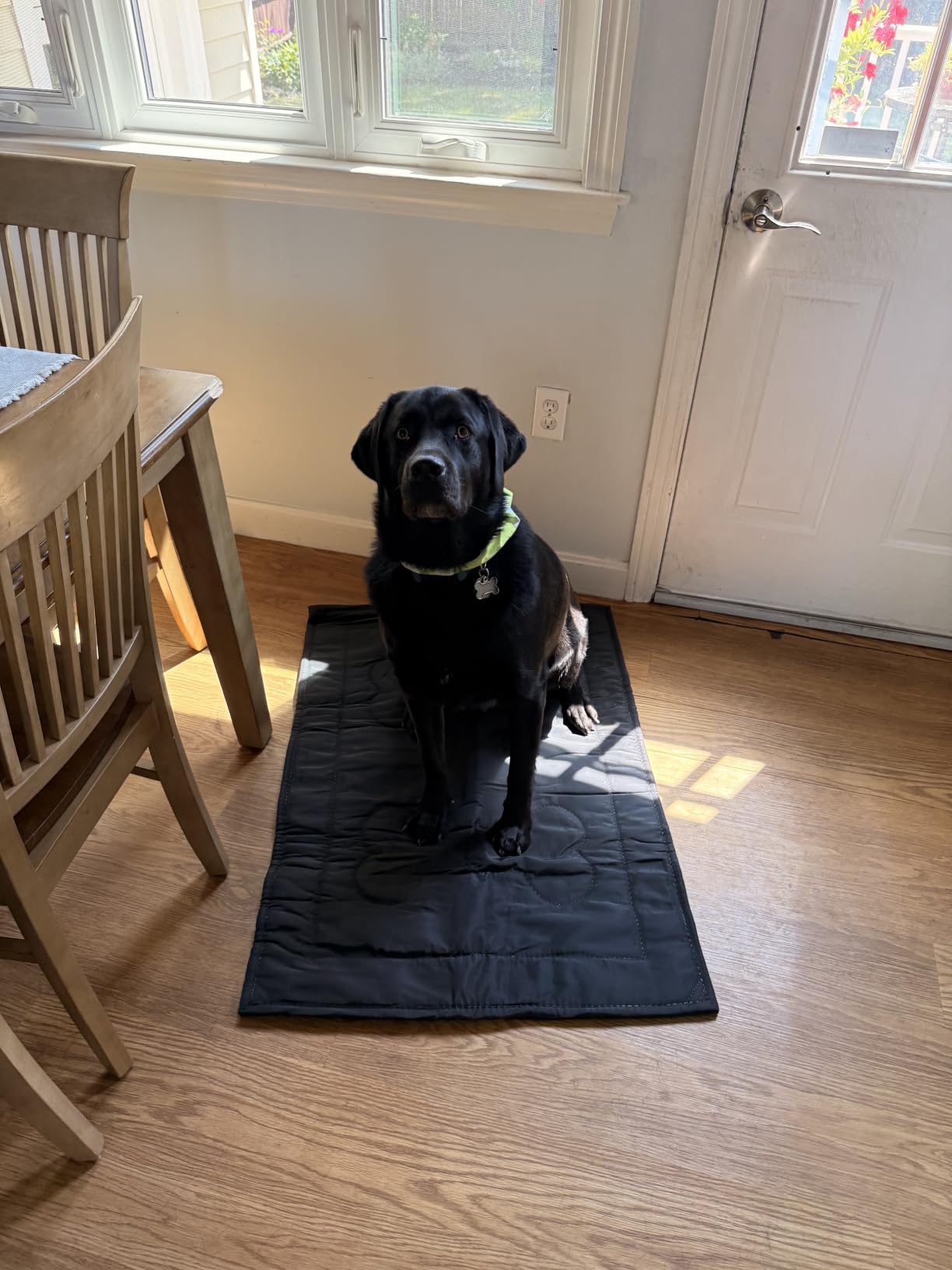
Owner reports are unusually vivid on this one. A 17 lb schnauzer that chewed through other beds in minutes is a frequently repeated example, and separation-anxiety dogs that normally destroy bedding within minutes are the other common case. If your dog chews only when you leave, this is a well-matched answer.
Backed by 180-day product support, it is also the cheapest path to testing whether a stuffing-free design works for your dog before you spend real money on a frame. Nine colour and size variants mean you can buy a second one for rotation, which solves the drying problem described below.
What you give up for chew resistance
Comfort. At 0.7 inches this is a protective mat, not a cushion, and a dog with hip or elbow problems will not find it comfortable over a long night. There is no joint support of any kind here, and for a senior or large-breed dog, that is a real cost rather than a footnote.
You also get no elevation, so the mat lies on the crate floor and gets soiled from underneath. For crate training that is usually acceptable. For a dog that spends hours in a crate, an elevated pad or a cot is more comfortable.
Plan for the drying time
The material takes a long time to dry after washing, which is the most repeated practical complaint in the reviews. Buy two and rotate them, one drying while the other is in use. Edges can fray after months of chewing, so this is durable rather than truly indestructible, and the 4.1 rating reflects that honestly.
If your dog is a true fabric eater, the absence of stuffing makes this one of the safer picks in the roundup, but it will not survive indefinitely. Treat it as the affordable first step up from a sleeping bag.
8. Sytopia 7 Inch Memory Foam Bed – Joint Support with a Waterproof Liner
- 7 inches of 35D memory foam gives genuine joint and hip support
- Waterproof liner and washable cover handle incontinence
- Great Dane and Mastiff owners report a full-length fit
- Raised headrest and bolster suit dogs that sleep on a pillow
- Cover is chew-resistant rather than chew-proof and does tear
- Vacuum-packed delivery needs 6 to 24 hours to expand
- Soft side walls will not hold a second large dog
Be clear about what this is: the comfort pick, not a chewer-proof pick. It is a 7-inch-thick 35D high-density memory foam core with a raised headrest, a bolster, and a lowered front edge, and for a senior or giant-breed dog that is worth more than any fabric rating. For a destructive chewer, it is not the right tool.
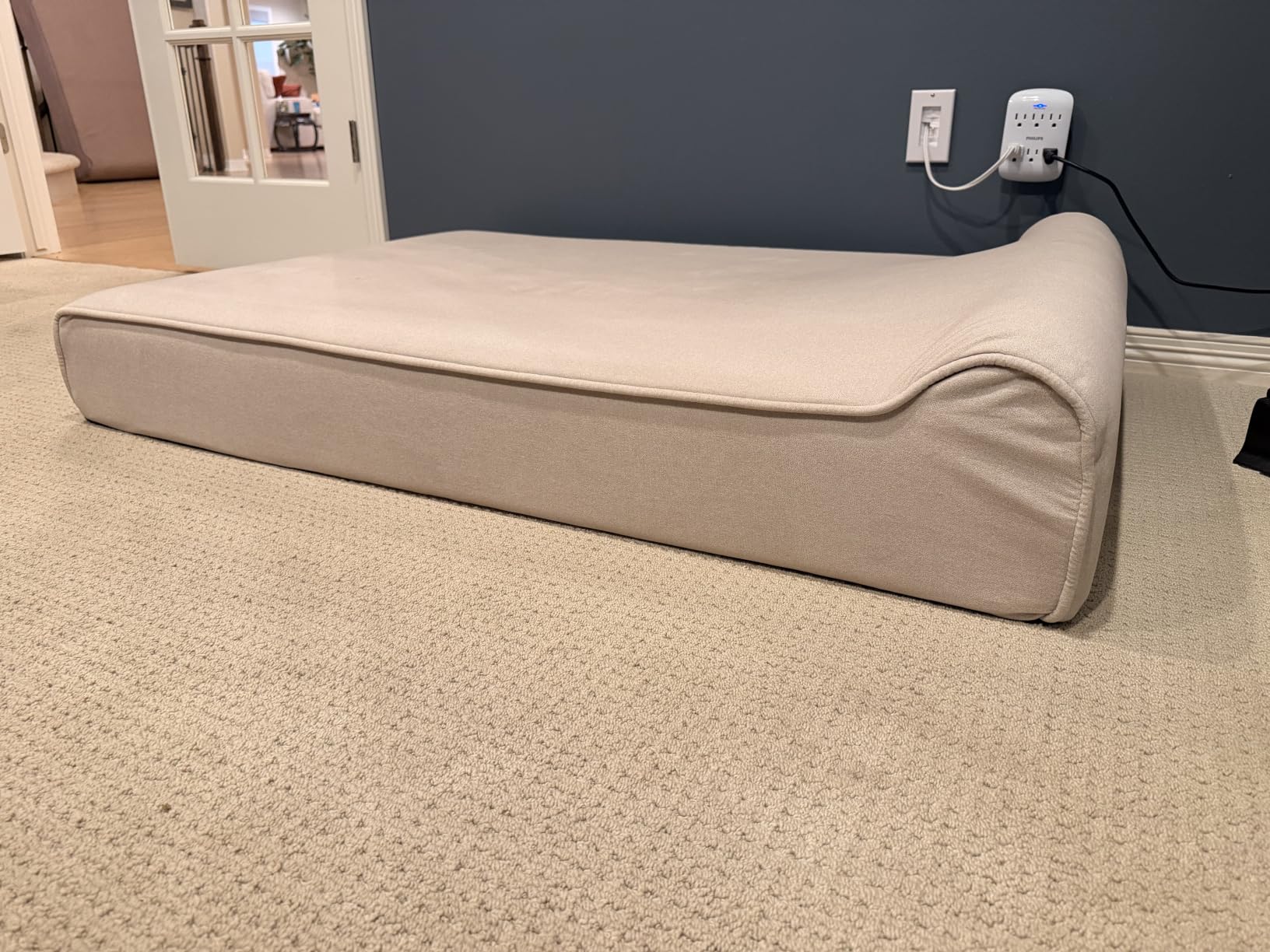
What makes it work as a bed is the waterproof inner liner, which protects the foam from spills and accidents, and the zippered machine-washable 380g canvas outer cover. The non-slip base holds on all floor types, the 50 x 34 inch surface suits large breeds, and the materials are CertiPUR-US and OEKO-TEX certified. At 18.8 lb it is a two-person lift for some sizes.
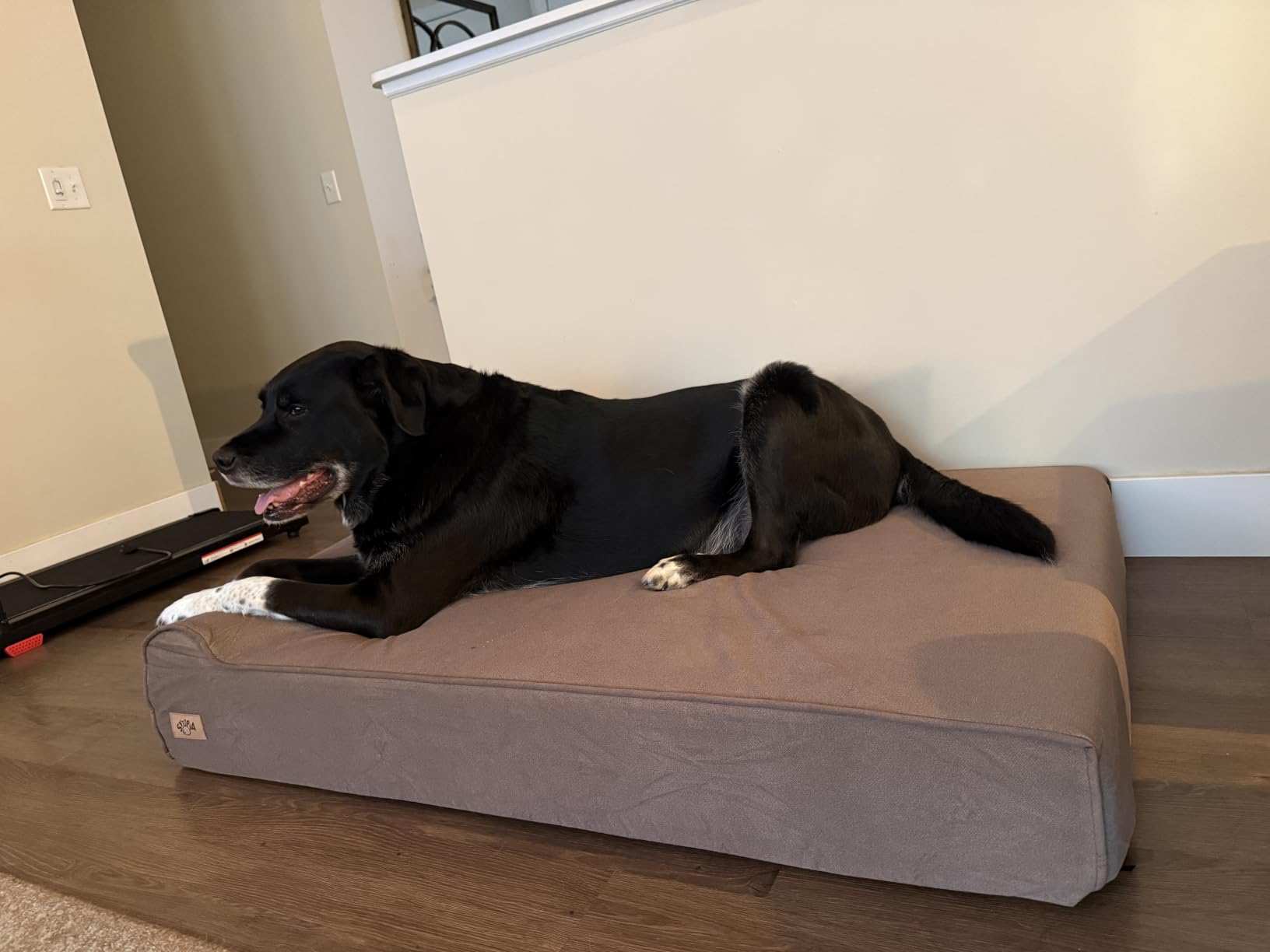
Reviewers here are mostly owners of Great Danes, Mastiffs, and older dogs, and they report better sleep, more time spent on the bed, and visible improvement in hip and joint comfort. Relief for dogs with UTIs or incontinence is a separate and frequently cited benefit, and it comes straight from the liner and the washable cover.
The cover survives repeated machine washing and upholstery cleaning, and at least one owner received a full replacement bed after a cover tear. That kind of support responsiveness is worth more than a longer warranty printed on a box.
Check your dog’s dimensions twice
For a memory foam bed, length matters more than width. Measure from the base of the tail to the nose while the dog lies down, then add a few inches at each end. A dog that overhangs a bolster will end up on the floor by the second week, and owners of 115 to 150 lb dogs report full-length fits on this size.
Also plan the expansion window. Vacuum-packed delivery means 6 to 24 hours before use, and a dog that jumps onto foam that has not fully expanded can dent the core permanently.
Where it falls short for a chewer
The canvas is chew-resistant, not chew-proof, and a determined large dog will tear a hole in the cover over months. When that happens, the liner slows the damage but does not prevent it. A minority of units also arrive with a broken zipper or lopsided foam, so inspect the unit on arrival.
The side walls are soft and will not hold a second large dog on the bed. For a multi-dog household buying one oversized foam bed, that is a real limitation, and a reinforced woven bed of the same footprint is the better answer.
9. Sytopia 42 Inch Indestructible Bed – Egg-Crate Foam and Velvet Surface
- Foam base holds its shape instead of collapsing over time
- Removable cover with good quality zippers and fitted pockets
- Low enough cost to own one per dog
- Large breeds share it happily
- Marketing says indestructible and some dogs shred it in hours
- 6.1 inches of foam is hard for elderly or short-legged dogs
- Waterproof cover is slow to wash and slow to dry
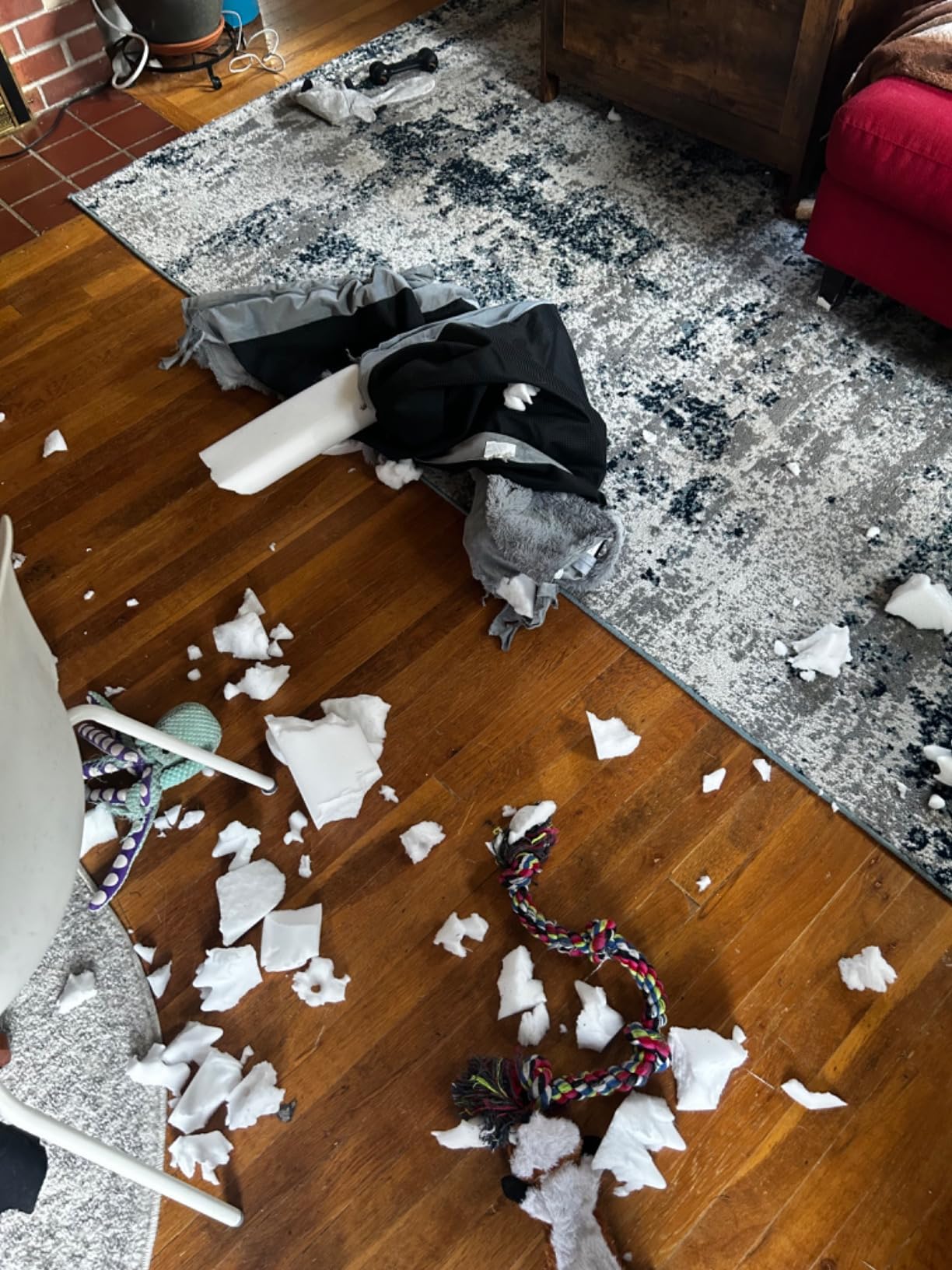
Ignore the word indestructible in the product name. It is a marketing term with no engineering meaning, and the reviews make the gap obvious. Several owners report dogs chewing through the border or destroying the bed within hours. What this bed actually is: a well-made, well-priced cushioned bed for dogs that are not determined chewers.
The construction is a high-density egg-crate foam base for joint, hip, and elbow pressure relief with a soft Dutch velvet sleeping surface and a durable polyester shell. The cover is waterproof, zips off completely, and is machine washable, and the non-slip bottom works on floors, in crates, and in vehicles. At 42 x 30 x 6.1 inches it is suited to dogs up to 100 lb.

Where it earns its price is in the washable cover and the bolstered sides, which behave more like a couch. Many owners report a full year of use intact, and the non-slip base means you can move it between rooms without it skating. At 3 lb it is light enough to reposition constantly, which matters in a multi-dog home.
Because it is one of the more affordable options here, owners buy one per dog rather than sharing, and Great Dane, Mastiff, and doodle owners all report the dogs sharing it happily. That is the practical case for this bed.
Size up if your dog is close to the limit
The stated limit is 100 lb at 42 x 30 inches. Reviewers suggest sizing up when a dog is near that ceiling, and the advice is sound, because an undersized bed lets a dog work an edge under a paw and pull at the border, which is exactly how these beds fail.
Measure your dog stretched out and add a few inches. If you are between sizes, the larger one is the correct answer, and the extra width is also what lets a second dog lie down.
The height problem nobody mentions
At 6.1 inches, the bed is tall enough that very elderly dogs or short-legged breeds struggle to step on and off it. Watch a senior dog use it for the first few days. If they hesitate at the edge, a lower bed or a cot is the better long-term choice for joint health.
Allow 24 to 72 hours for full foam expansion after delivery, and expect the waterproof cover to be a slow item to wash and dry. Rotate two covers if you have a dog with continence issues.
10. JOEJOY Chew Proof Canvas Crate Pad with a Hidden Zipper
JOEJOY Chew Proof Indestructible Dog Bed for Large Dog, Chewproof Crate Pad
- Canvas holds up better to chewing digging and scratching than standard mats
- Blended fill cushions joints without going flat
- Hidden zipper keeps the metal pull out of reach
- Works as mat crate pad elevated insert or car bed
- Marketed for moderate rather than severe chewers
- Canvas can stay damp and heavy after a soak
- 4 inch profile takes up more floor space than a flat mat
The detail worth paying attention to is the concealed zipper. A visible metal zipper pull is an invitation, and dogs find it immediately. Hiding it removes one of the three standard failure points in a stuffed bed, alongside seams and foam, which is a sensible design decision for a crate pad.
The shell is ultra-durable heavy-duty canvas built to take moderate chewing, scratching, and digging. The fill is a blend of 70 percent high-density sponge chunks and 30 percent soft PP cotton, which contours to the body and holds its shape. The water-resistant cover wipes clean, and the removable cover is machine washable. At 42 x 30 x 3 inches and 10.69 lb, it is a substantial pad rather than a thin one.
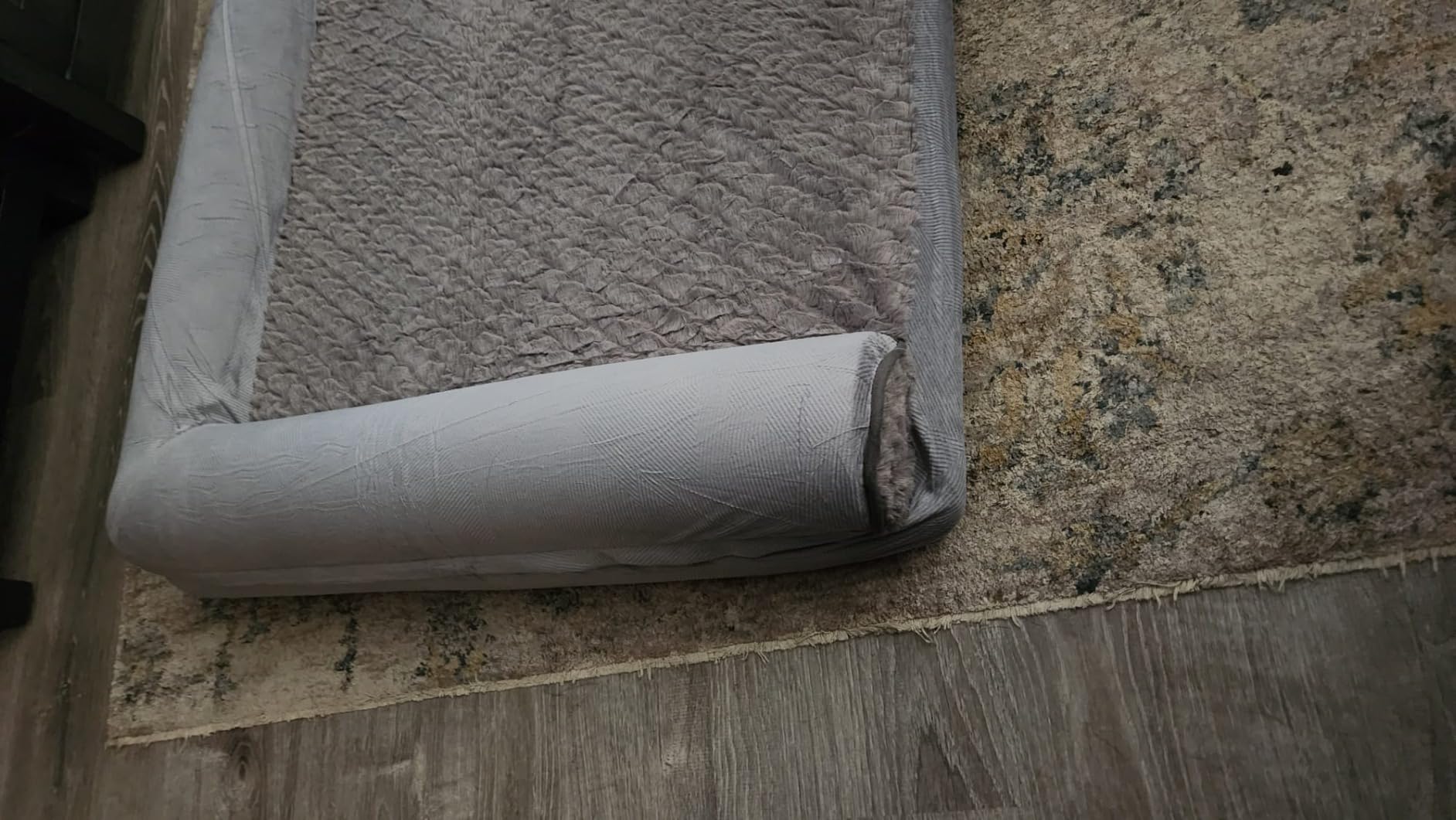
The versatility is genuine rather than marketing. Owners use it as a floor mat, a crate pad, an insert for an elevated bed, and a back-of-car liner, and in the last role it solves a problem most owners do not know they have. Grey and brown are available in XL at 42 inches and XXL at 47 inches.
Reviewers mostly praise the durability against chewing and digging and the cushioned fill that does not flatten within a few months. That combination, rather than any single specification, is why this one keeps appearing in long-term use reports.
Who this pad suits
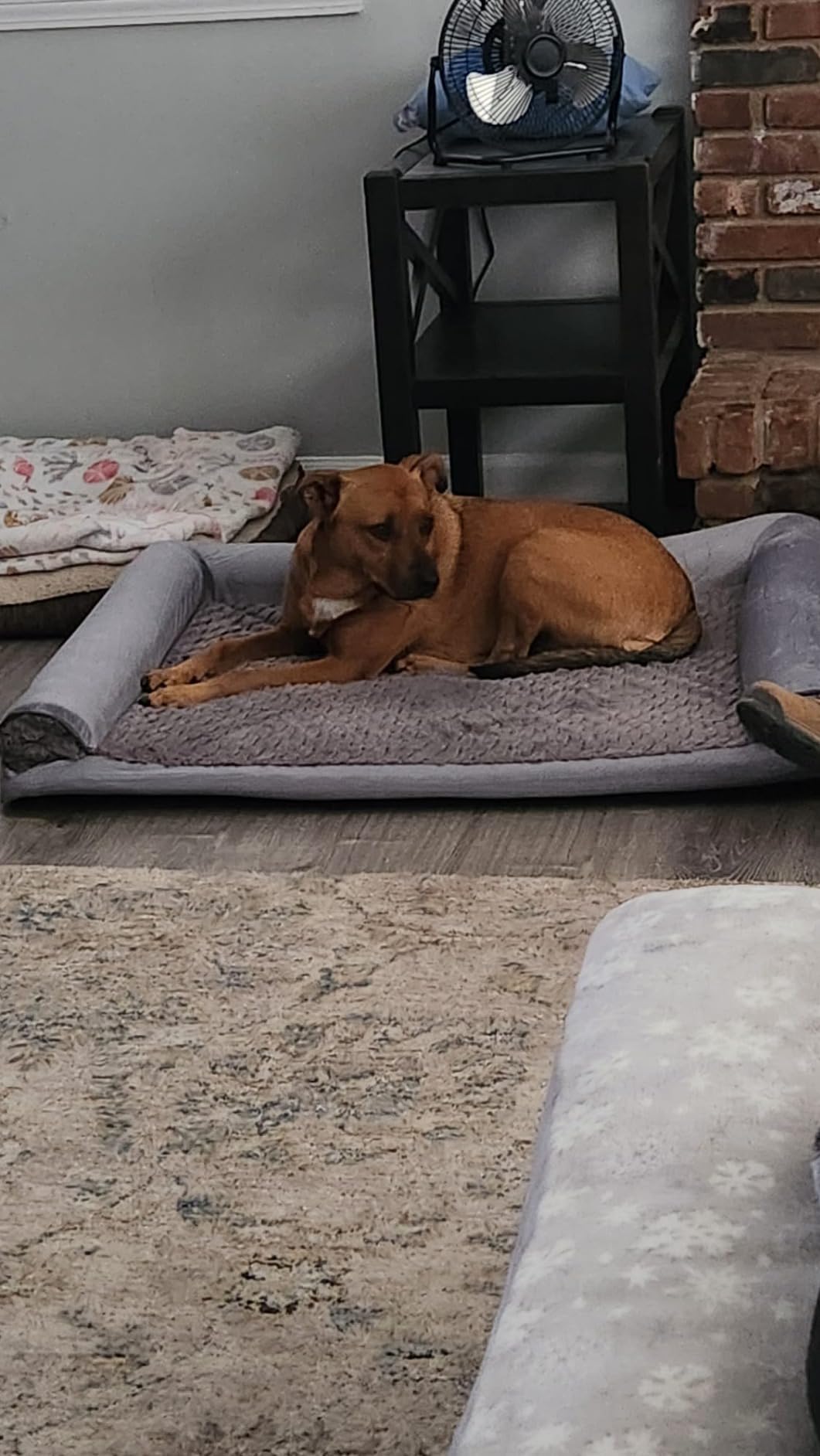
It suits dogs who dig, scratch, and chew moderately, and who need something with real cushioning in a crate or a car. The orthopedic blend is a genuine advantage over a flat mat for a dog that spends hours on the bed during a long crate day.
It does not suit a severe chewer. The canvas is rated for moderate chewing, and a determined dog will work through it. The 4.1 rating across 169 reviews reflects a well-made product with a clearly stated limit, not a defect.
Handling notes before you order
At 10.69 lb this is heavy, and the 4 inch thickness means the 47 inch XXL takes up a genuine footprint in a small room. If your space is tight, the flatter stuffing-free mat is the better geometry.
The water-resistant coating can leave the canvas feeling damp and heavy after a full soak despite the coating, so air it out fully before reusing it. Check the hidden zipper area every couple of months, because that is where a determined chewer will start working.
11. K9 Ballistics Chew Proof Elevated Cot – 1200D Ballistic Ripstop Sling
K9 Ballistics Chew Proof Elevated Cot Bed, L, Obsidian Black Ripstop
- Aluminum frame removes the weak points for persistent chewers
- 1200D ripstop fabric resists punctures tearing and digging
- Fabric shrugs off water odor dirt and fur
- Arrives assembled with legs simply popping into sockets
- Sling surface offers minimal padding compared with a cushioned bed
- Frame and sling take up more floor area in small rooms
- Crate fit depends on inner dimensions brands often round up
Digging and chewing are the same problem from two directions. A dog that excavates a bed destroys it through friction and claws, and a dog that chews destroys it through teeth. The 1200D dense-weave ballistic ripstop on this cot is the fabric in this roundup that is explicitly specified against both, along with punctures, tears, water, fur, and odour.
The solid aluminum frame armors the vulnerable chewing points of the cot, which is the same approach as the armored padded bed, without the padding. It arrives already assembled and the only job is popping the legs into their sockets. The soft non-skid foot pads keep it in place and protect hardwood, LVP, and concrete, which matters more than it sounds on a hard floor.
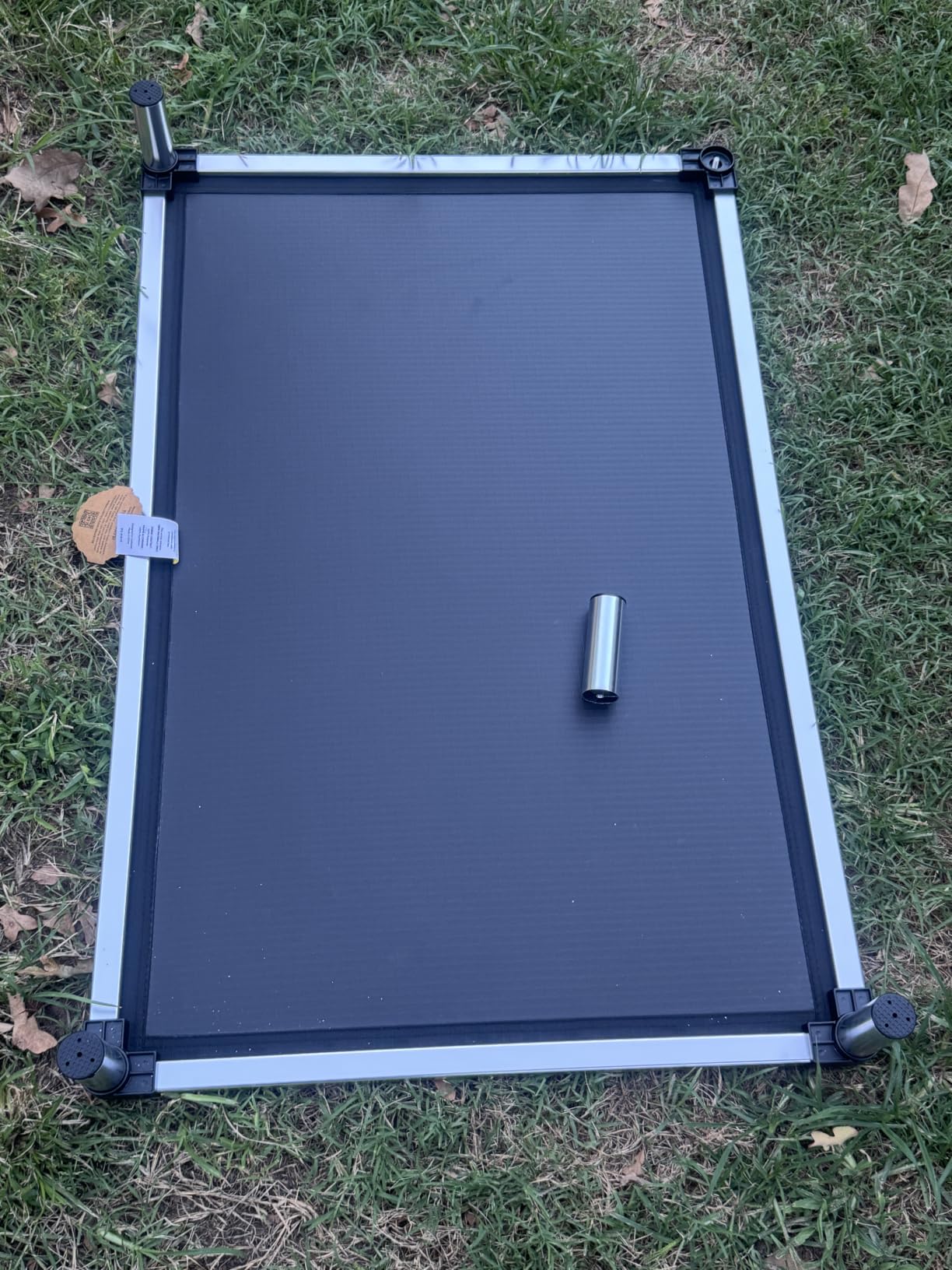
Owners of heavy chewers and diggers report the frame and ballistic sling surviving destructive behaviour, and the no-assembly setup is repeatedly called out as a relief. The 4.4 rating across 71 reviews comes with 79 percent five-star feedback, which is a strong ratio on a smaller volume.
The large size is 41 x 27 x 6 inches, with small through XX-large options listed from 29 inches up to 50 inches. It is sized to fit inside a standard wire crate and slides in through the crate door at an angle, which is the detail that tells you the manufacturer thought about crate use rather than just claiming it.
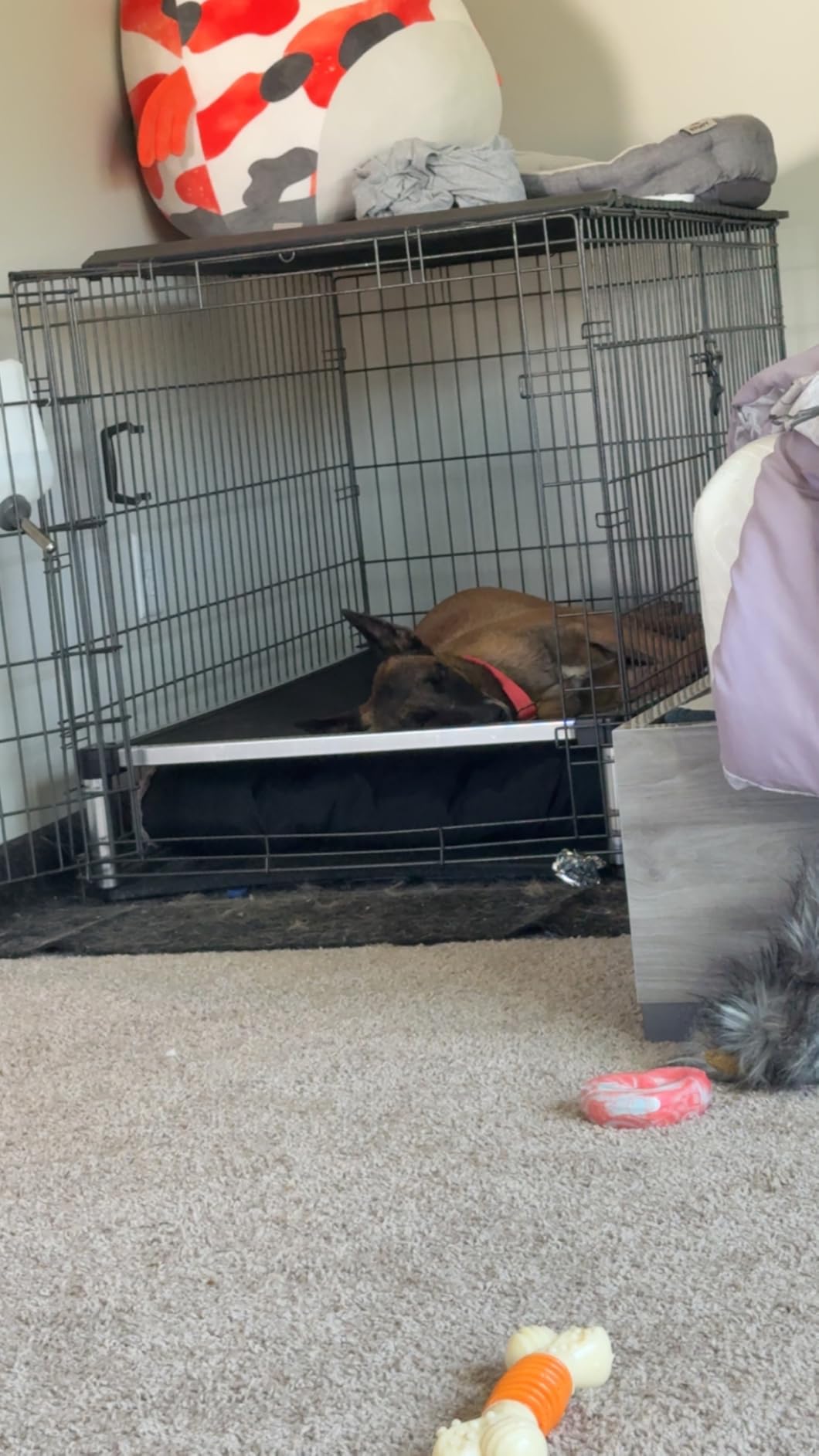
Crate fit is the whole question here
Measure the interior of your crate in the direction the bed lies, and note that manufacturers round crate dimensions up. A bed listed at the nominal crate size can leave a gap at one end, and that gap is where a dog hooks a jaw and starts pulling the whole thing upward.
If the bed is slightly too small, it will be dragged around the crate. If it is slightly too large, it simply will not go in. Measure first and order second.
The comfort trade-off
There is no padding on a sling, so dogs who sleep on top of them will tell you about it. Owners note the surface feels firm and less cozy than a cushioned bed, and the frame plus sling footprint is larger than a flat pad, which is a problem in a small room or a small crate.
For a digging chewer who sleeps lightly, that trade is worth it. For a senior dog, either accept the firmness or use the padded armored version in this roundup instead, which gives you the same frame with 1.5 inches of cushioning.
12. Sytopia 47 Inch Indestructible Bed – 420gsm Canvas for Large Chewers
- 420gsm dense canvas resists chewing digging and water
- Plush supportive filling makes a comfortable large-dog rest
- Removable cover and hidden zipper simplify cleaning
- 47 x 30 inch XXL fits large chewers and crates
- Water resistance needs prompt hand washing to hold up
- Filling needs re-fluffing after repeated machine washing
- Listing variants are fixed sizes so check the dog will not outgrow it
This carries the highest average rating in the roundup, at 4.9 with 86 percent five-star feedback across 52 reviews. That is a small sample, and we treat small samples cautiously, so read this as a well-liked bed rather than a proven one.
What earns the rating is the exterior: 420gsm high-density spandex canvas with a water-repellent, chew-resistant finish, in a 47 x 30 x 4 inch XXL that suits large chewers and standard crates. The filling is plush and supportive, and the cover unzips with a hidden zipper, so cleaning means removing a washable panel rather than dismantling the bed.
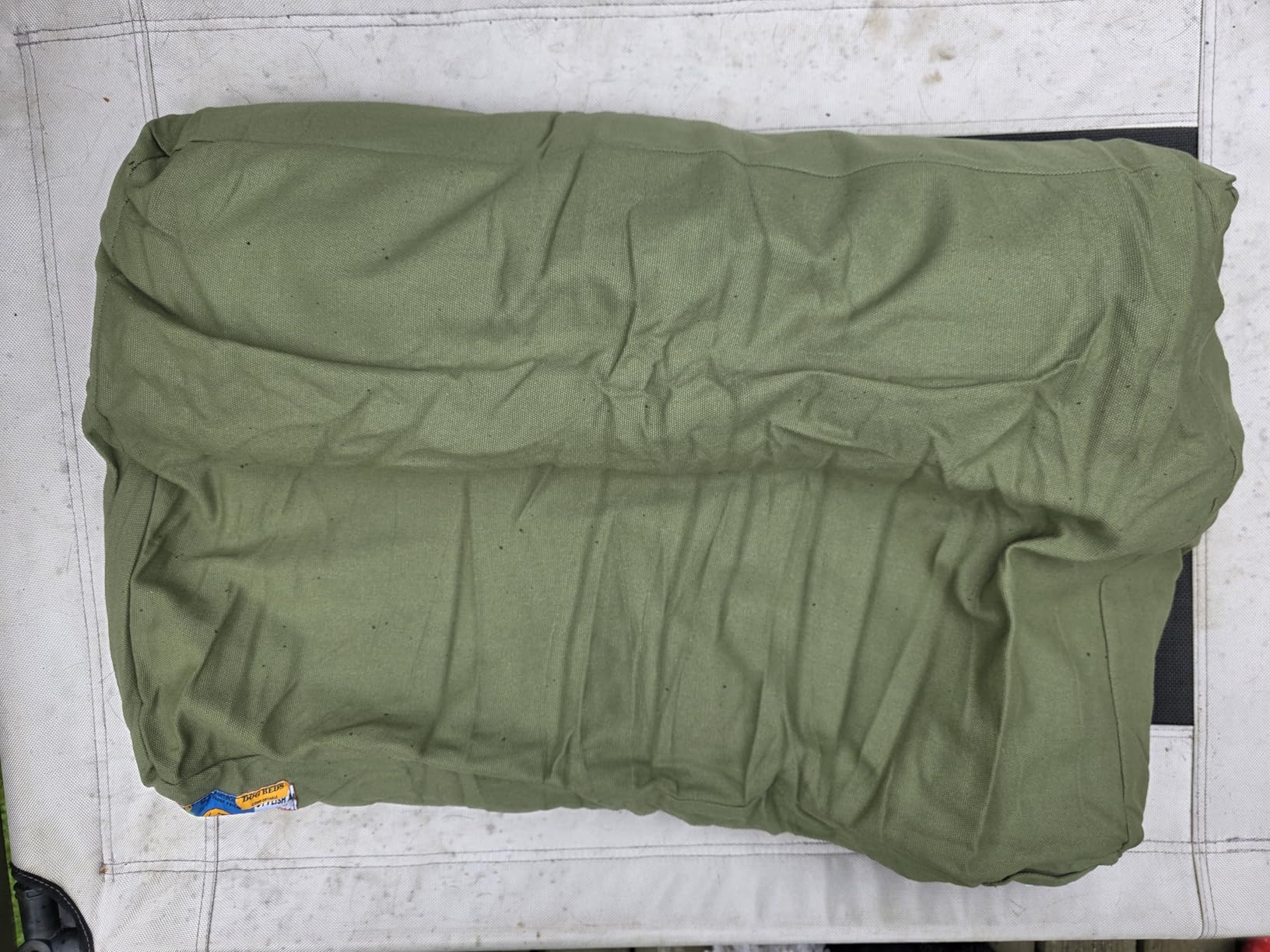
Size options run from medium at 30 x 20 x 4 inches for dogs up to 40 lb, through large and extra large, to this 47 inch XXL for dogs up to 130 lb. That spread is unusually well documented in the listing, and it is the fastest way to check fit before you order.
The practical notes are consistent across reviews. Hand wash rather than machine wash, and the water-repellent finish holds up. Fluff the bed by hand or tumble dry low afterwards to bring the loft back, because the filling compresses over repeated washing even when the cover looks fine.
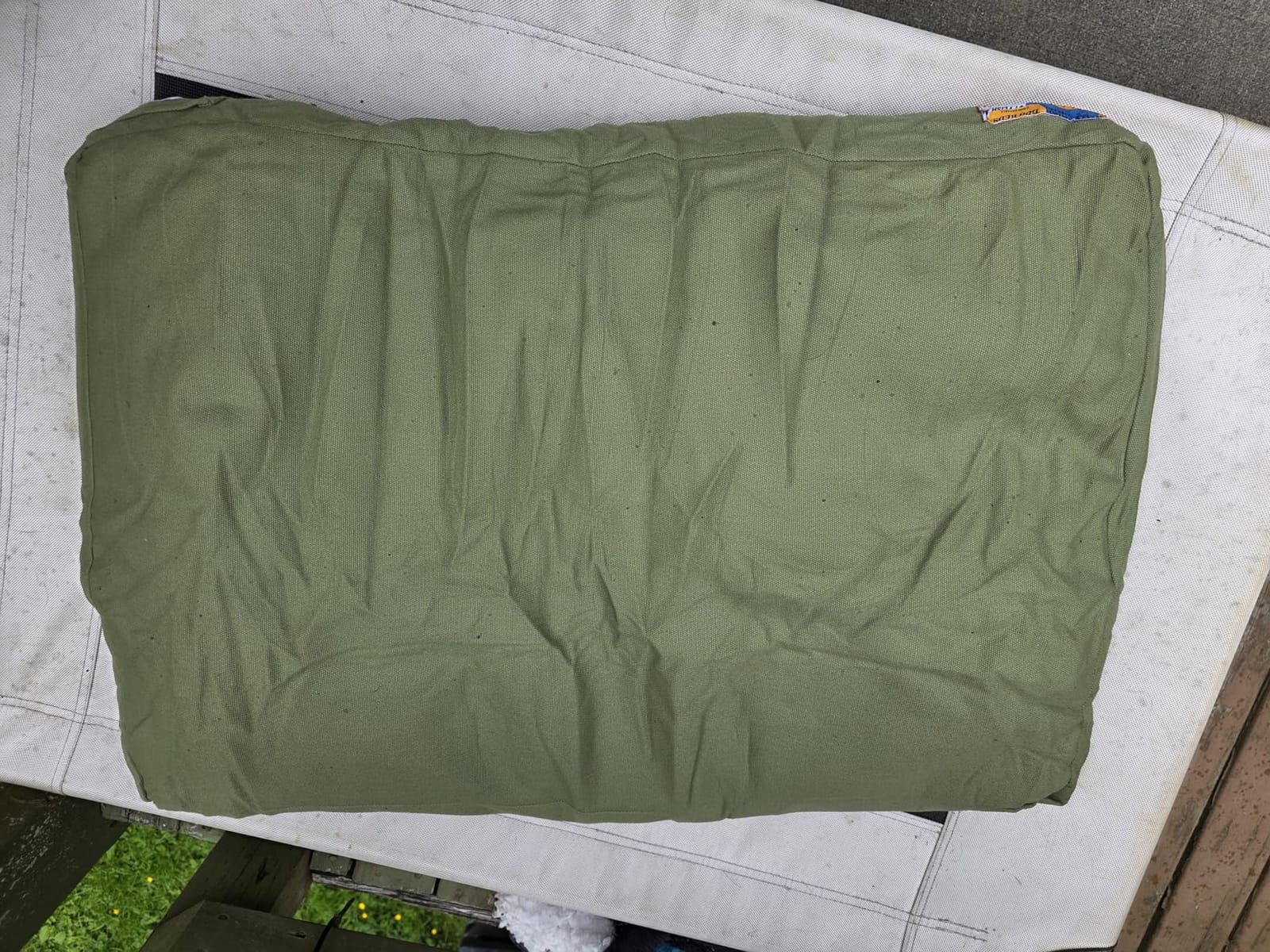
Is it a patio bed or an indoor bed?
Both, with a caveat. The water-repellent canvas and the wipe-clean finish suit a covered patio, a porch, or an indoor-outdoor covered kennel, and a plush bed the dog can settle into is a real advantage in a space where concrete is cold. What it is not is a bed for a dog spending full days in direct sun and rain, because UV and constant wetting will shorten the life of any canvas.
If it lives outside, bring it in during hard weather, and dry it rather than rolling it up damp.
What to watch after the first month
Check the border and the hidden zipper every few weeks, since that is where a chewer starts. The chew-resistant finish slows the point of entry but does not remove it, so treat this as a bed for a moderate chewer that is spending time outdoors rather than for a dog deliberately dismantling bedding.
Also confirm the size before you commit. The listing variants are fixed sizes, so a fast-growing puppy may outgrow 47 inches within a year, and replacing a bed is a recurring cost that erodes the value of a good first purchase.
How to Choose a Bed That Survives Chewing
Start by measuring your chewer honestly
Chewer severity is the single variable that decides the answer, and almost nobody assesses it before buying. A mild chewer is a puppy or an adult dog that mouths bedding occasionally and moves on. A moderate chewer targets the bed specifically and gets through ordinary foam within weeks. A power chewer dismantles beds deliberately and will keep going until the bed is structurally gone.
Watch your dog for a week. Note whether it chews other things, whether the chewing is tied to your absence, and whether the dog is teething. A dog that only attacks the bed is usually bored or anxious, and the bed is a symptom rather than the disease. A dog that chews everything is a power chewer who needs a frame, not a thicker pad.
Match the tier to the bed type
Mild chewers and puppies can be given a reinforced pad or a washable foam bed. The foam gives the jaw something satisfying and the cover survives long enough to be useful. Expect a teething puppy to get through it anyway, because the chewing is developmental rather than destructive, and that is normal.
Moderate chewers should move to a stuffing-free mat with a tightly woven cover, or a padded bed with a concealed zipper. Removing the fill removes the prize. Power chewers need an aluminum frame with the fabric enclosed inside the rail, and no amount of fabric weight substitutes for a frame. Dogs that eat fabric should not have a stuffed bed at all, at any price.
Materials that stop chewing, and materials that do not
Aluminum frames are the strongest answer. A frame rated well above your dog’s weight, with fabric slung inside the rail and corners enclosed or capped, removes the grip point that every other design leaves available. Steel support structures add stability and prevent flex, which matters because a flexing bed invites a dog to work at the joint.
Ballistic nylon and 1200D dense-weave ripstop are the workhorse fabrics for chew resistance, specified against puncture, tear, dirt, fur, odour, and water. Ripstop in general resists tearing because its grid stops a small tear from spreading. Cordura nylon is chosen for abrasion resistance, and Textilene and Teslin mesh are chosen for airflow and cleanability rather than for surviving a determined attack.
Heavy-duty vinyl is the traditional fabric for the most destructive dogs, and PVC vinyl is the practical upgrade. On the cushion side, closed-cell foam resists water and shredding better than open-cell memory foam, and high-density egg-crate foam holds shape longer than loose polyester fill.
What to avoid is more specific than what to buy. Skip exposed foam, skip loose polyester fill, skip visible zippers with metal pulls, skip decorative topstitching across a surface a dog can reach, and skip any attachment method that leaves lacing or webbing loops exposed. Dogs are pattern-selective chewers and they go to the same three places every time: the corner, the seam, and the hardware.
On the softer beds, our picks with orthopedic support are worth a look for ageing dogs, and the wider guides to orthopedic dog beds for large breeds and orthopedic beds for senior dogs go into the joint support question in more detail.
Decoding the warranty before you buy
Check four things. How long is the guarantee, is it one-time replacement or unlimited, does it cover interior fill or only the shell, and are there restocking or return shipping charges. A one-time replacement on a five-year-old bed is very different from an unlimited one, and a guarantee that excludes the fill covers the part your dog will not destroy first.
Look for real-world use as a trust signal rather than a lab claim. Kennels, shelters, and breeders running multiple dogs report more honestly than a laboratory test, and the review volume matters. A bed with a few hundred ratings over years is a safer bet than one with fifty ratings accumulated in a month, whatever the average says.
Replaceable covers and replaceable parts are the underrated longevity features. The suddus bed replaces covers and plastic parts under warranty, and a bed you can re-cover is a bed you do not replace.
Sizing, cleaning, and the ingestion risk
Measure from the base of the tail to the nose while the dog is lying down, then add a few inches at each end. For width, measure the widest point of the dog lying on its side and add a few inches. A bed that is too small lets a dog hook a jaw around the edge and lift the whole thing, which destroys an otherwise undamaged bed, and this is the most common avoidable failure we see in the reviews.
For cleaning, an elevated cot that hoses off beats everything. A stuffed bed needs a removable machine-washable cover and a waterproof liner to be genuinely maintainable, and if you buy one, buy a second cover to rotate. Allow for foam expansion after vacuum-packed delivery, 6 to 24 hours for thick memory foam and up to 72 hours for a smaller foam bed.
The ingestion risk deserves its own warning. Foam chunks, polyester fill, and fabric fragments can cause intestinal obstruction, which is a veterinary emergency rather than an inconvenience. If your dog swallows the material it chews, a stuffing-free mat or an aluminum cot is not a compromise. It is the only responsible option.
Reducing the chewing itself
A better bed helps, but it does not fix the behaviour. Redirect first: keep a durable chew toy in the same spot as the bed so the association is formed early. Trade second, and trade consistently. When you catch your dog at the bed, exchange it for a toy within a few seconds, reward the drop, and never punish the discovery of it.
Enrich the day next, because most destructive bed chewing is boredom or separation anxiety rather than chewing preference. Longer walks, food puzzles, and a chew routine that occupies the same time slot as the bed attack do more than any bed change. Finally, restrict access during peak times. Closing the dog in a crate with an aluminum cot, or tying the pad down so it cannot be lifted, removes the opportunity on the days the dog is most likely to attack.
And buy a second bed before the first one is destroyed. A dog without a bed on the day the order arrives is a dog chewing your sofa.
Frequently Asked Questions
Is there a dog bed that my dog can’t chew?
No bed survives a determined power chewer indefinitely, but an aluminum-frame cot with the fabric edge enclosed inside the frame rail removes the grip point a dog needs to start tearing. Our top pick is the suddus XXL elevated bed, rated to 200 lb, with the Kuranda at a 250 lb rating as the option for the most destructive dogs.
What is the best chew-proof fabric for dog beds?
1200D dense-weave ballistic ripstop and ballistic nylon are the strongest practical choices, specified against puncture, tear, dirt, fur, odour and water. Ripstop’s grid stops small tears spreading, and Cordura nylon is the pick when abrasion and digging are the main risk. Fabric choice matters less than how it is attached, so always check the edge is enclosed in the frame.
Is a raised dog bed better for chewers?
Usually yes. An elevated cot has no stuffing, no exposed seams and no visible zipper, so there is nothing for teeth to grip, and the surface washes off with a hose. The trade-off is comfort, since the surface is firm. Many owners add a removable sherpa or fleece pad in cold weather, which solves the objection without giving up the frame.
Why does my dog chew up his bed?
The most common causes are boredom, separation anxiety, teething in puppies under two, and the natural digging and nesting instinct. A dog that chews only the bed while you are away is usually anxious rather than interested in the fabric, and the bed is a symptom. A dog that chews everything is a power chewer who needs a framed bed. Longer walks, food puzzles, a chew toy in the same spot, and consistent trading all reduce the behaviour.
What are the best orthopedic dog beds according to reviews?
Reviewers most often praise 7-inch 35D high-density memory foam with a waterproof liner and a machine-washable cover. Owners of Great Danes, Mastiffs, and older dogs report better sleep, more time spent on the bed, and visible improvement in hip and joint comfort, with the liner helping dogs that have continence issues. These beds are comfortable rather than chew-proof, so pair one with a framed bed if your dog is also destructive.
The Right Bed for Your Chewer in 2026
For most chewers, the suddus XXL elevated bed is the best dog bed for chewers in 2026 because a 200 lb aluminum frame and an enclosed mesh sling leave nothing to grip, and the evidence behind it is deep. If your dog is genuinely destructive, step up to the Kuranda at a 250 lb rating or the K9 Ballistics Armored bed if comfort in a crate matters. If you are testing the waters, the stuffing-free Couzssyhi pad costs the least and teaches you how your dog chews.
Match the bed to the behaviour, read the warranty fine print before you pay, and keep a second bed ready. That is how you stop buying the same replacement every few months.