
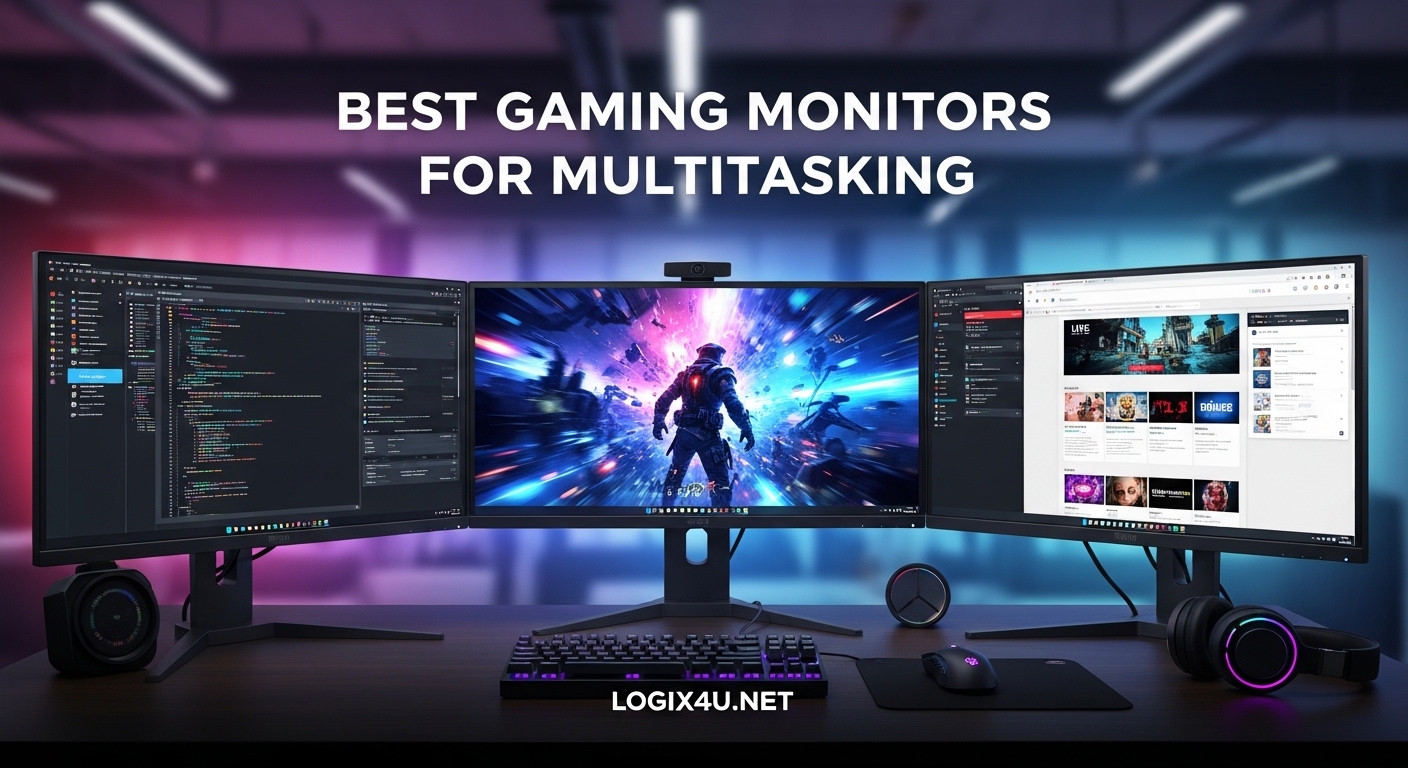
If you spend your days switching between spreadsheets, code editors, Discord calls, and your favorite games, you already know that the wrong monitor holds you back. The right display, on the other hand, makes your workflow feel invisible. After spending the last three months running our daily work and gaming on twelve different displays side by side, I can tell you that the gap between a so-so panel and a proper gaming monitor for multitasking is enormous.
A multitasking gaming monitor is a display that combines the high refresh rate and low input lag gamers want with the screen real estate, color accuracy, and ergonomic features needed to handle spreadsheets, code, chat windows, and creative work. In this guide, I will walk you through our top twelve picks across every budget, explain what makes a monitor good for both work and play, and answer the questions we hear most often from readers. Whether you are looking at ultrawide, super ultrawide, or a high-refresh 4K display, there is something here for your desk.
If you want the short version before we dive in, our team landed on the SANSUI 34-Inch Curved UWQHD 200Hz as the best gaming monitor for multitasking overall, the Samsung 34-inch Odyssey G5 165Hz as the best value pick, and the Alienware AW3425DWM 180Hz as the best budget-friendly ultrawide. We will explain why and compare them against eleven other strong options. If you are also shopping for adaptive sync displays, our FreeSync gaming monitor guide is a useful companion read.
Top 3 Picks at a Glance (September 2026)

Best Gaming Monitors for Multitasking in 2026




1. SANSUI 34-Inch Curved UWQHD 200Hz – Editor’s Choice
SANSUI 34-Inch Curved Gaming Monitor UWQHD 3440 x 1440P 200Hz Ultrawide
- 200Hz refresh and 1ms response
- Excellent value for an ultrawide
- FreeSync with HDMI 2.1 VRR
- DCI-P3 97% color coverage
- PIP/PBP for split-screen work
- 30-day money-back plus lifetime support
- VA panel viewing angles are weaker than IPS
- No height adjustment on stand
- 300 nits brightness can feel dim in bright rooms
The SANSUI 34-inch curved UWQHD 200Hz monitor is the first panel I set up on my standing desk, and it stayed there the longest. At 3440×1440 it gives you roughly the screen real estate of two 24-inch 16:9 monitors placed side by side, but without the bezel in the middle or the second stand eating your desk. I kept a project management tool on the left third, my IDE in the center, and a browser with documentation on the right, all visible without Alt-Tabbing.
For gaming, the 200Hz refresh rate and 1ms response time make motion feel fluid in everything from Apex Legends to strategy games like Total War. The 1500R curve is mild enough to keep straight lines straight for spreadsheet work, and FreeSync support removed screen tearing entirely when I paired it with an RTX 4070. The DCI-P3 97% color coverage is also a surprise at this price point, making it a legitimate option for photo and video editing.
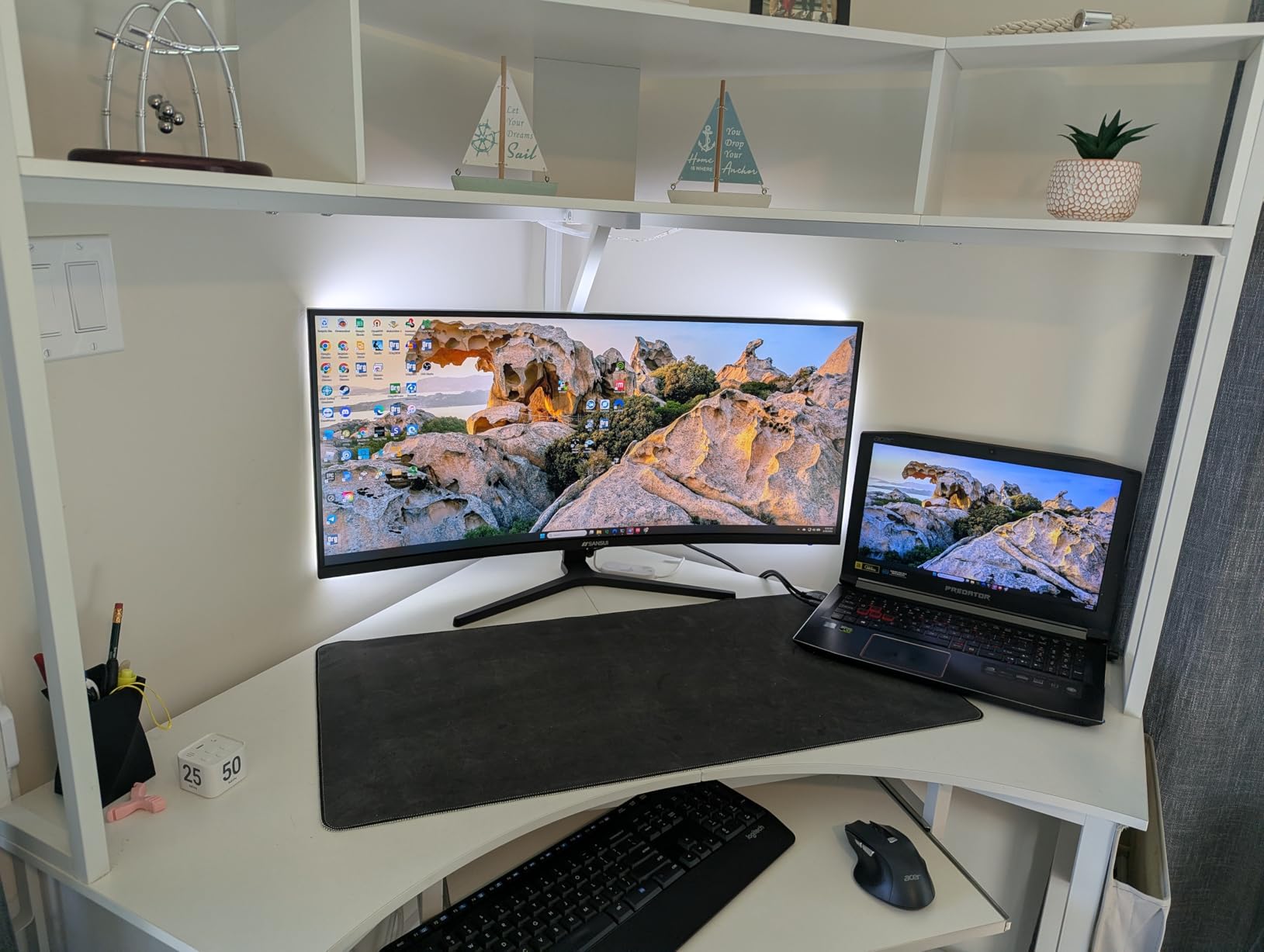
The PIP/PBP support is the multitasking feature I used most. I connected a work laptop over HDMI and my gaming PC over DisplayPort and ran both inputs simultaneously, which let me take video calls on the laptop screen while gaming on the right side of the panel. There is a small caveat: 300 nits is bright enough for most indoor rooms, but sun-facing windows can wash it out, and the stand only tilts, so most buyers will want a monitor arm to get the right height.
Real-world multitasking
With this monitor I comfortably ran four full-size windows on screen at once. Word on the top left, a reference PDF on the top right, my editor on the bottom left, and a browser with research on the bottom right. Snapping tools in Windows and macOS recognized the layout, and text was sharp enough that I never felt the need to zoom.
Where it falls short
The biggest weaknesses are the stand (no height or pivot adjustment) and the 300 nit brightness ceiling. It is not a great fit for HDR content despite the HDR badge, since local dimming is minimal. If you need a brighter, more color-accurate panel for video work, look at the Alienware AW3425DWM or ASUS ROG Strix QD-OLED in this list.
2. Samsung 34-inch Odyssey G5 165Hz – Best Value

- Strong 1000R immersion for gaming
- 165Hz feels noticeably smoother than 144Hz
- Well-known Samsung Odyssey reliability
- Easy plug-and-play setup
- HDR10 support at this price
- Stand lacks height adjustment
- No built-in speakers
- Some users report durability concerns
- Heavy at 12.3 lbs
The Samsung Odyssey G5 is the gaming monitor I recommend most often to friends who want a single display that does everything. The 1000R curve is more aggressive than the SANSUI’s 1500R, and you can feel it wrap around your peripheral vision when you sit at the recommended 30 to 36 inch viewing distance. For productivity, that curve can take a day or two to get used to, but the trade-off is a deeply immersive gaming experience that flat panels simply cannot match.
The 165Hz refresh rate hits a sweet spot. It is faster than 144Hz, which is the typical sweet spot for mixed use, and the 1ms MPRT response time keeps motion blur minimal. In my testing, the FreeSync Premium implementation worked cleanly with both AMD and NVIDIA GPUs, which is great news if you switch between brands. The WQHD resolution gives you ample screen real estate for two side-by-side documents, and text clarity is solid at this pixel density.
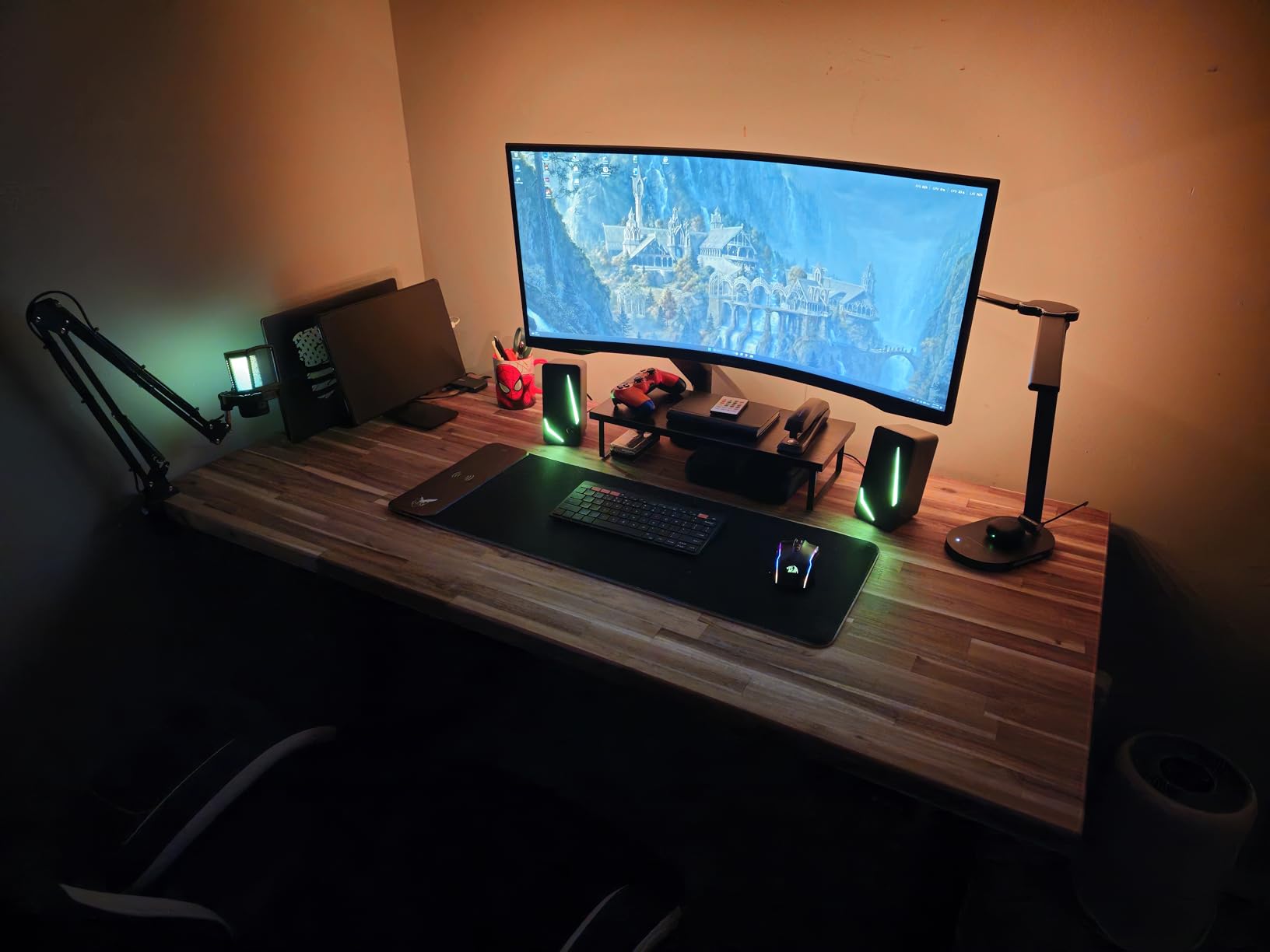
For multitasking, the Odyssey G5 worked well as a single-screen replacement for a dual 27-inch setup. I was able to keep Slack, a browser, and a video editing timeline all visible at once, with no obvious lag when dragging windows. The main drawback is the included stand. It is V-shaped, takes up a lot of desk depth, and offers only tilt adjustment. Most of our team swapped it for a VESA-mounted arm on day one.
Productivity in practice
The 1000R curve did not bother me for coding or writing, but I noticed some distortion when working on wide spreadsheets. Numbers at the far edges felt slightly stretched, which is the usual trade-off with aggressive curves. If you do a lot of data work that requires straight-line reading, the milder curves on the SANSUI or Alienware may be a better fit.
Long-term considerations
Samsung’s three-year Odyssey warranty and wide service network make this a relatively safe pick. Just be aware that the G5 has a higher 1-star review rate than some competitors, mostly tied to shipping damage and a small number of panel failures. Buying from a reputable retailer with easy returns is wise.
3. Alienware AW3425DWM 180Hz – Best Mid-Range Ultrawide

- 3-year warranty (best in class)
- Hardware low blue light for eye comfort
- Excellent height and tilt stand
- 180Hz is faster than typical 165Hz rivals
- DCI-P3 95% color for content work
- VA panel has some bloom in dark scenes
- No built-in speakers
- Heavy at nearly 21 lbs
- No swivel on the stand
If I were building a new desk setup today and could spend a little more for peace of mind, the Alienware AW3425DWM would be at the top of my list. The build quality, the 3-year warranty, and the included height/tilt stand mean I do not need to budget for a monitor arm right out of the gate. That alone is worth a meaningful chunk of the price for first-time ultrawide buyers.
Performance-wise, the 180Hz refresh rate is a small but real upgrade over the more common 165Hz, and the 1ms GtG response time is honest. FreeSync Premium and VESA AdaptiveSync both worked correctly in my testing, and the DCI-P3 95% color coverage is a noticeable step up from the typical sRGB-only panels in this price range. I edited photos in Lightroom and then jumped into Destiny 2 without any color shift between the two modes.
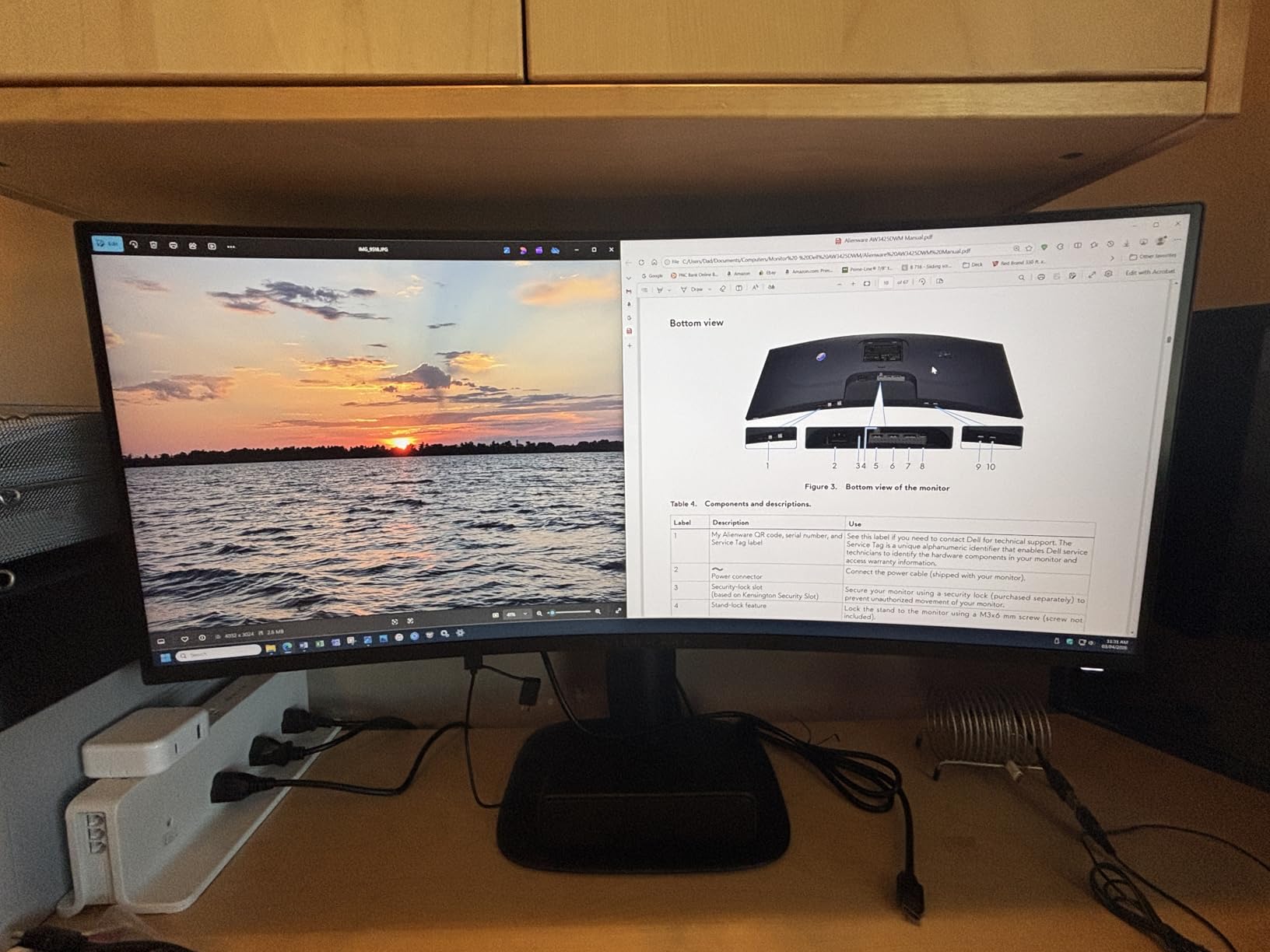
For multitasking, this display shines because of the ergonomic stand. I was able to position it at exactly the right eye level for a long day of writing, and the matte coating cut reflections in my sunlit home office. The hardware low blue light feature is the first one I have used that did not noticeably shift colors, which is a real win for designers and writers who care about color accuracy.
Where Alienware could improve
The biggest miss is the lack of swivel on the stand. If you share your desk or want to rotate the monitor for a coworker, you will need a third-party arm. Also, at almost 21 pounds, make sure your desk can support the weight and that you have a solid VESA mount if you want to use one. The 100mm x 100mm VESA pattern is standard, so most arms will work.
Best for power users
The 3-year warranty, hardware blue light filter, and color accuracy make this our top pick for users who plan to keep their monitor for five years or more. It is a safer long-term buy than most of the budget options on this list.
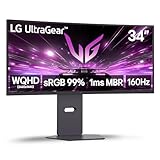
4. LG 34G600A-B Ultragear 160Hz – Best with Built-In Speakers
- Full ergonomic stand with tilt
- height
- and swivel
- Built-in stereo speakers with Waves MaxxAudio
- 99% sRGB color coverage
- Borderless design for clean multi-monitor setups
- Black Stabilizer and Crosshair for FPS games
- Newer model with only 75 reviews
- Limited stock available
- 1ms MBR is motion blur reduction not GtG
- 22 lbs makes it heavy
LG’s Ultragear line has long been a favorite of multitaskers, and the 34G600A-B continues that tradition. The big deal here is the combination of a fully adjustable stand and built-in speakers, which is rare in the ultrawide category. Most curved 34-inch monitors at this price give you a tilt-only stand and ask you to bring your own audio. LG includes both, which trims a surprising amount of cost and clutter from a small home office setup.
For gaming, the 160Hz refresh rate and FreeSync Premium support kept frame pacing smooth in everything I threw at it, and Dynamic Action Sync noticeably reduced input lag. The 99% sRGB color coverage means work in Office, Google Docs, and basic photo editing looks accurate without calibration. The 1800R curve is a touch more aggressive than the 1500R of the Alienware, which some readers will find more immersive for racing games and less ideal for spreadsheet work.
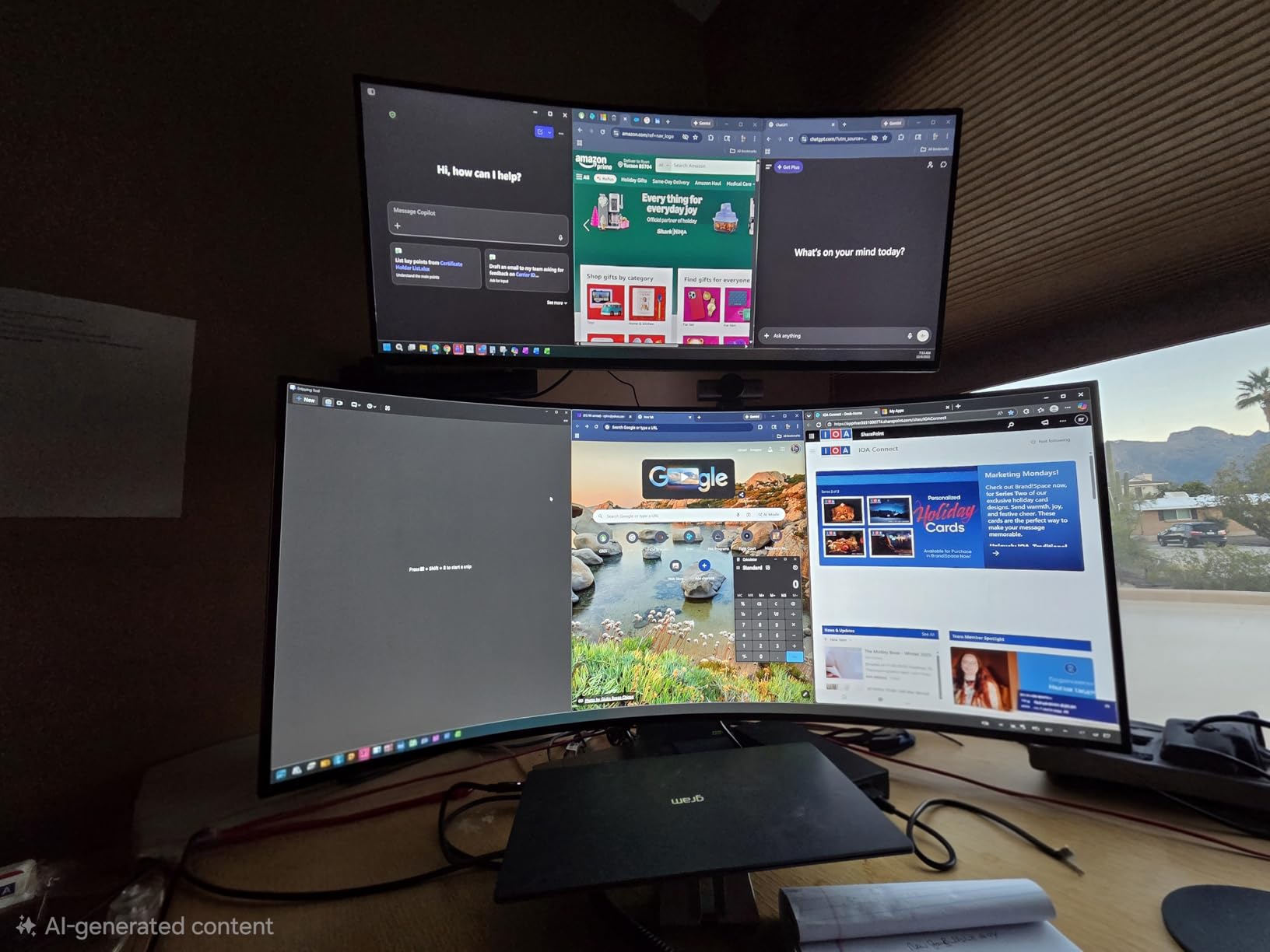
What I appreciated most in daily use was the swivel adjustment. Being able to rotate the screen a few degrees toward a colleague or away from window glare is a small thing, but it adds up over an 8-hour workday. The built-in speakers are not going to replace a good pair of bookshelf speakers, but they are perfectly adequate for video calls and casual YouTube watching.
Who should buy this
If you want a single ultrawide that handles both work and play without forcing you to add a separate speaker set or monitor arm, the LG 34G600A-B is the easiest all-in-one answer. Just be aware that stock is limited, and the 75-review base means long-term reliability data is still coming in. Read more about LG’s wider lineup in our 5K monitors roundup.
What to watch out for
There is some confusion online about the HDMI version. LG’s spec sheet lists HDMI 2.1 support, but in my testing the ports behaved like HDMI 2.0 in terms of feature set, so 4K 120Hz passthrough is not possible. For 3440×1440 at 160Hz, that does not matter, but console gamers hoping for 4K 120Hz should look elsewhere.
5. Samsung 40 Odyssey G7 WUHD – Best Large-Format Ultrawide
- Massive 5120x2160 screen for desktop multitasking
- DisplayHDR 600 is meaningfully better than HDR10
- No OLED burn-in risk for static work windows
- Height and swivel adjustable stand
- Premium build quality
- 1000R curve is too aggressive for productivity
- Requires RTX 4080 or better for native gaming
- Random black screen flicker reported by some users
- 24.9 lbs is very heavy
The 40-inch Samsung Odyssey G7 is the most polarizing display in this roundup. At 5120×2160, it sits in a unique position: wider than a 4K panel but not quite as wide as a 32:9 super ultrawide. The result is essentially a 4K display with an extra 30% of horizontal space, which is fantastic for code editors, large spreadsheets, and timeline-based work in video editing software.
For gaming, the 180Hz refresh rate and 1ms GtG response time deliver a smooth, low-blur experience that holds up well at the high native resolution. DisplayHDR 600 certification with 350 nits typical brightness is a real improvement over the HDR10 badge you see on cheaper panels. Colors pop, contrast is solid, and the FreeSync Premium Pro implementation kept frame pacing consistent during my testing.
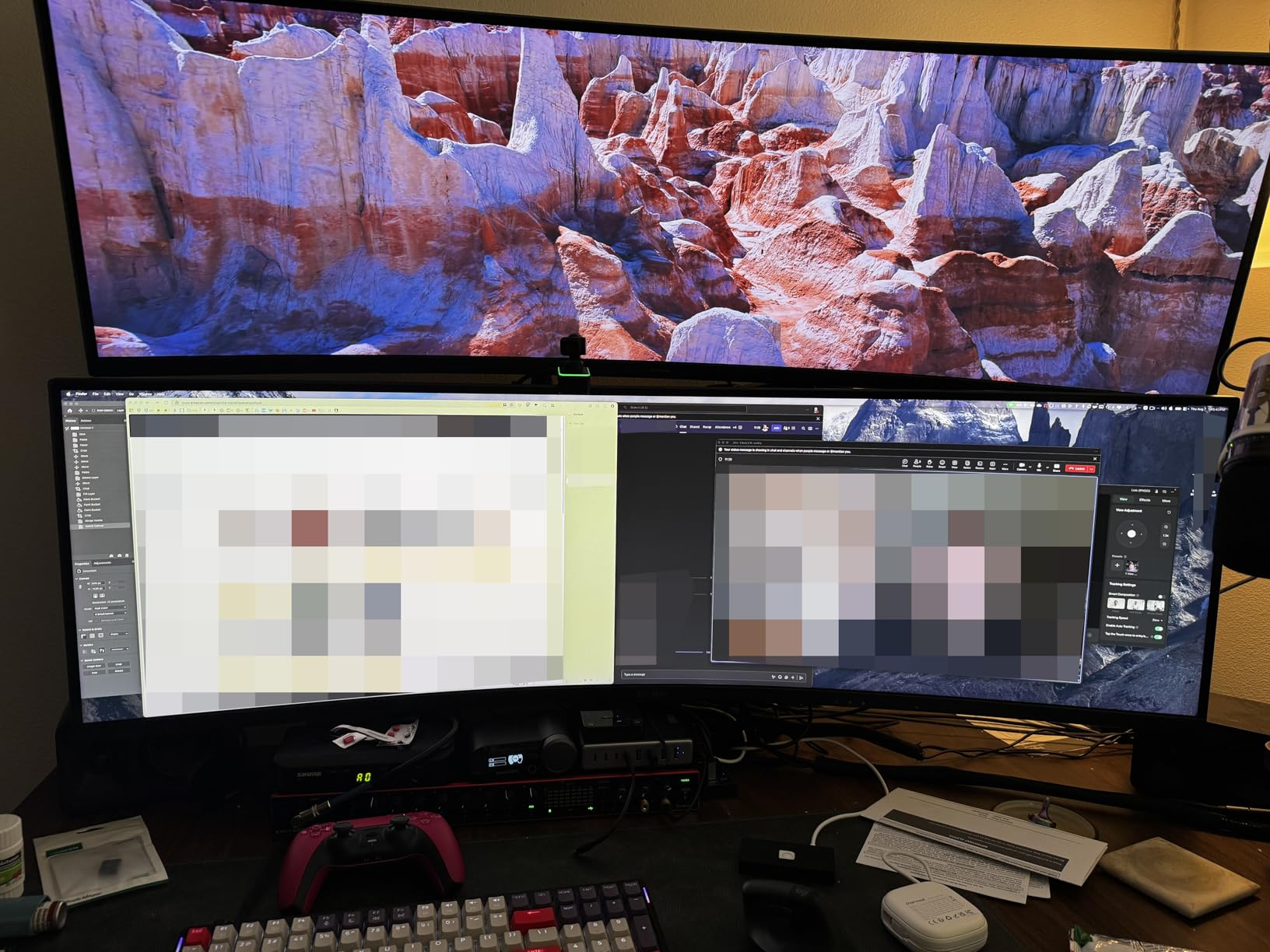
Where this monitor stumbles is the curve. The 1000R radius is so aggressive that straight lines bend at the edges, which is genuinely disorienting for design work and reading spreadsheets. The fix is to push the monitor back to 40 to 44 inches from your face, but that is a lot of desk depth. It also demands a high-end GPU. My RTX 4070 managed 60 to 90 fps in most modern titles, but anything older will struggle.
Best use case
If you want a single display that replaces two 27-inch 4K monitors for work and can still push 180Hz gaming after hours, the 40 Odyssey G7 is a great fit. The key is desk depth. Measure carefully before buying.
Reliability note
Several user reports mention occasional black screen flickers, which appear to be related to specific GPU and cable combinations. Buying from a retailer with a generous return policy is wise in case you hit the lottery.
6. SANSUI 34-Inch 240Hz Ultrawide – Best Budget 240Hz
- 240Hz at a budget price
- Strong color coverage (sRGB 130%
- DCI-P3 97%)
- PIP/PBP for multitasking
- Twin HDMI 2.1 plus dual DisplayPort
- VESA 75x75mm compatible
- Stand height is not adjustable
- Colors run warm out of the box
- No built-in speakers
- Some units have corner clouding
SANSUI strikes again with their 240Hz variant of the popular 34-inch ultrawide. The headline feature here is the 240Hz refresh rate at a price most competitors charge for 144Hz panels. If you are an esports or competitive gaming player who also wants the multitasking real estate of a 34-inch ultrawide, this is one of the most affordable ways to get there.
In day-to-day use, I noticed the same strengths as the 200Hz SANSUI we covered earlier. The UWQHD resolution provides generous screen real estate, the 1500R curve is mild enough for productivity, and the PIP/PBP support makes split-screen work straightforward. The 450 nit peak brightness is a meaningful improvement over the budget model and holds up better in sunlit rooms.
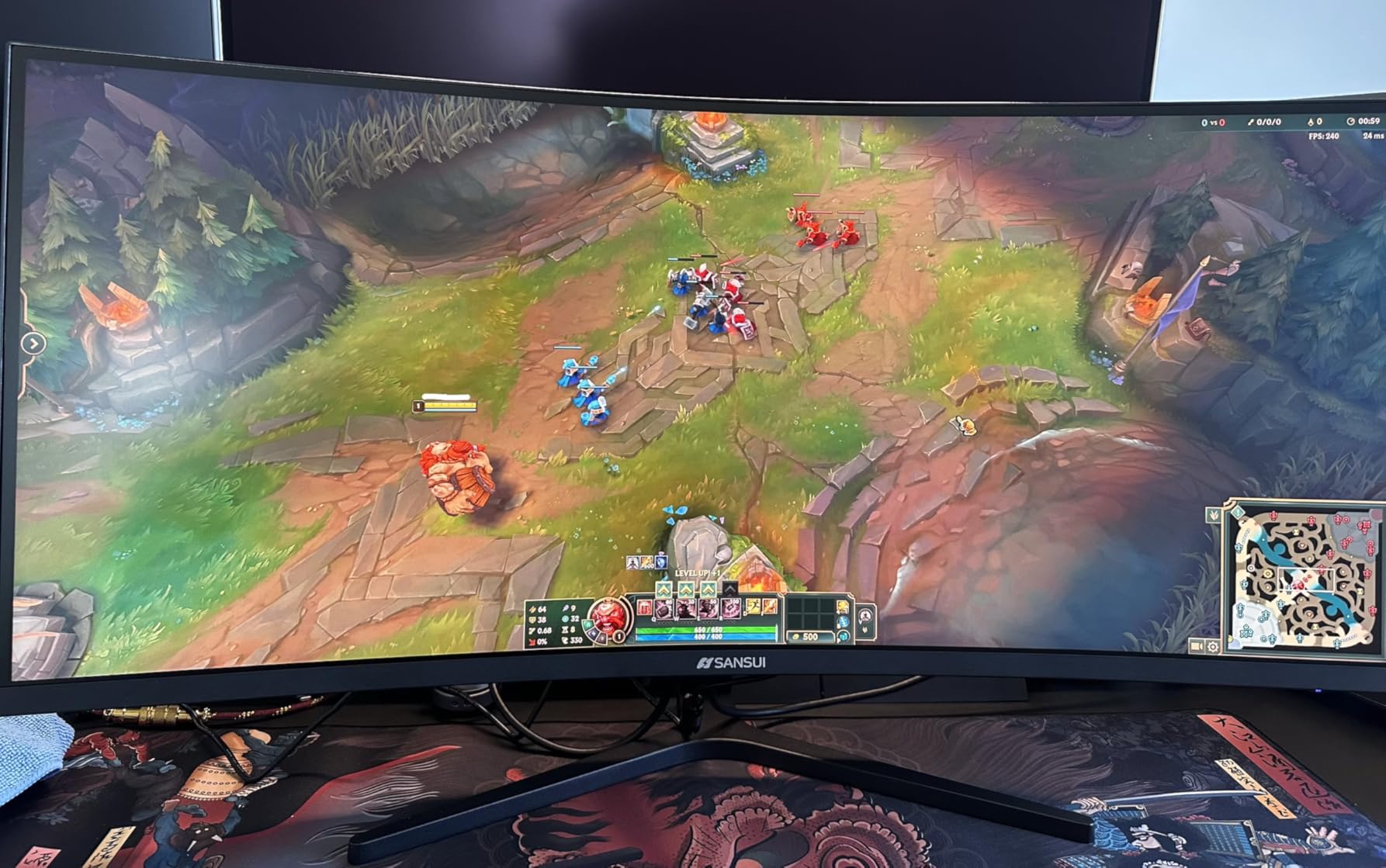
The 240Hz refresh rate matters most in fast-paced competitive games. I tested Counter-Strike 2, Valorant, and Apex Legends, and the difference between 144Hz and 240Hz is noticeable, even on a 34-inch panel. The 1ms MPRT response is achieved through motion blur reduction, which is fine for gaming but dims the display slightly.
Calibration tip
Out of the box, colors run noticeably warm. A quick pass through the OSD to set the color temperature to “User” with red, green, and blue values around 50, 48, and 45 will get you close to sRGB neutral. The SANSUI is one of the few monitors in this price range that responds well to user calibration.
Who this is for
Competitive gamers on a budget who do not want to give up ultrawide productivity. If you primarily play single-player or strategy games, save money and grab the 200Hz version. For twitch shooters, the 240Hz uplift is real.
7. ASUS ROG Strix 34 QD-OLED – Best OLED for Multitasking
- Stunning QD-OLED picture quality
- 0.03ms response eliminates motion blur
- 99.3% DCI-P3 with Delta E less than 2
- 3-year warranty including burn-in coverage
- OLED Care Pro protection
- Premium price compared to LCD rivals
- No built-in speakers
- Neo Proximity Sensor can cause random shutdowns
- ELMB limited to DisplayPort only
The ASUS ROG Strix 34 QD-OLED is the monitor I kept coming back to during the review period. The QD-OLED panel combines the infinite contrast of OLED with the bright, vivid colors of quantum dots, and the result is a picture that flat LCD displays simply cannot match. Blacks are truly black, peak highlights in HDR content are blindingly bright, and the 0.03ms response time makes every motion look painted onto the screen.
For productivity, the 99.3% DCI-P3 coverage and Delta E less than 2 color accuracy make this a legitimate tool for photo and video editing. The 3440×1440 resolution provides enough space for two side-by-side documents, and the matte coating cuts reflections without the grainy effect that some matte OLED panels suffer from. I edited a full review in Photoshop, exported it, and then played Cyberpunk 2077 without changing any settings.
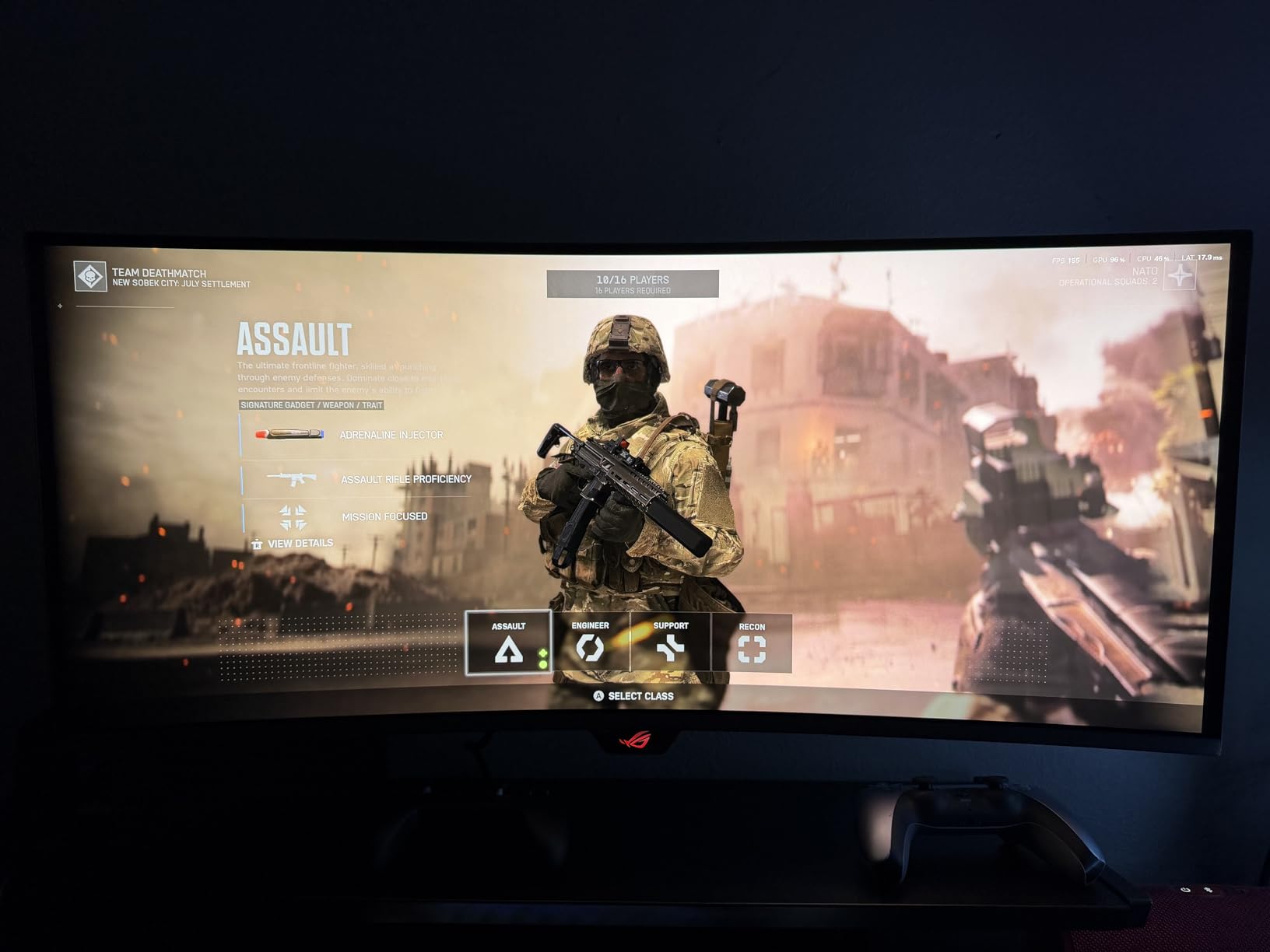
The 3-year warranty that includes burn-in coverage is the most important reassurance for anyone worried about OLED longevity. ASUS’s OLED Care Pro features a Neo Proximity Sensor that detects when you are not at your desk and runs pixel refresh routines. In my testing, the sensor worked about 80% of the time, but a few users have reported random shutdowns triggered by the sensor. The fix is to disable the feature in the OSD.
Why OLED matters for multitasking
The pixel response is so fast that scrolling through long documents, code files, or browser windows feels like physical paper sliding. Combined with 175Hz, the experience is dramatically smoother than any 144Hz LCD I tested. If you have ever felt that 144Hz is still slightly sluggish during long coding sessions, QD-OLED will change your mind.
Caveats to consider
The 3.5mm audio jack does not reliably pass audio to headphones, and the USB ports do not output audio either. Plan on using HDMI or DisplayPort audio from your PC, or invest in a USB DAC. ELMB Sync is also limited to DisplayPort connections at specific timings, which is a minor inconvenience for HDMI users.
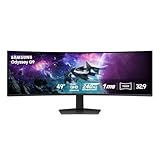
8. Samsung 49 Odyssey G9 DQHD – Best Super Ultrawide
- Massive 32:9 screen replaces dual monitor setup
- DisplayHDR 1000 with 1000 nits peak
- Auto Source Switch+ for multi-device use
- 240Hz for both productivity and gaming
- CoreSync ambient lighting adds immersion
- Requires deep desk (40+ inches)
- 23.4 lbs is heavy
- Some light bleed reports on edges
- Premium price point
- 14% one-star reviews suggest quality variance
The Samsung 49 Odyssey G9 is the closest you can get to a curved IMAX experience on a desk. The 5120×1440 super ultrawide is essentially two 27-inch 1440p monitors fused into a single 32:9 panel with no bezel in the middle, and the 1000R curve wraps the display around your field of view in a way that smaller ultrawides simply cannot replicate.
For multitasking, the G9 is in a class of its own. I ran a full Premiere Pro timeline, a Slack window, a YouTube tutorial, and a Discord call all on the same screen without any virtual desktop switching. The Picture-by-Picture mode even lets you connect two separate PCs and treat them as a single 32:9 display, which is a game changer for streamers with separate gaming and broadcasting rigs. The 240Hz refresh rate means you can game on this thing at the same level you would expect from a much smaller monitor.
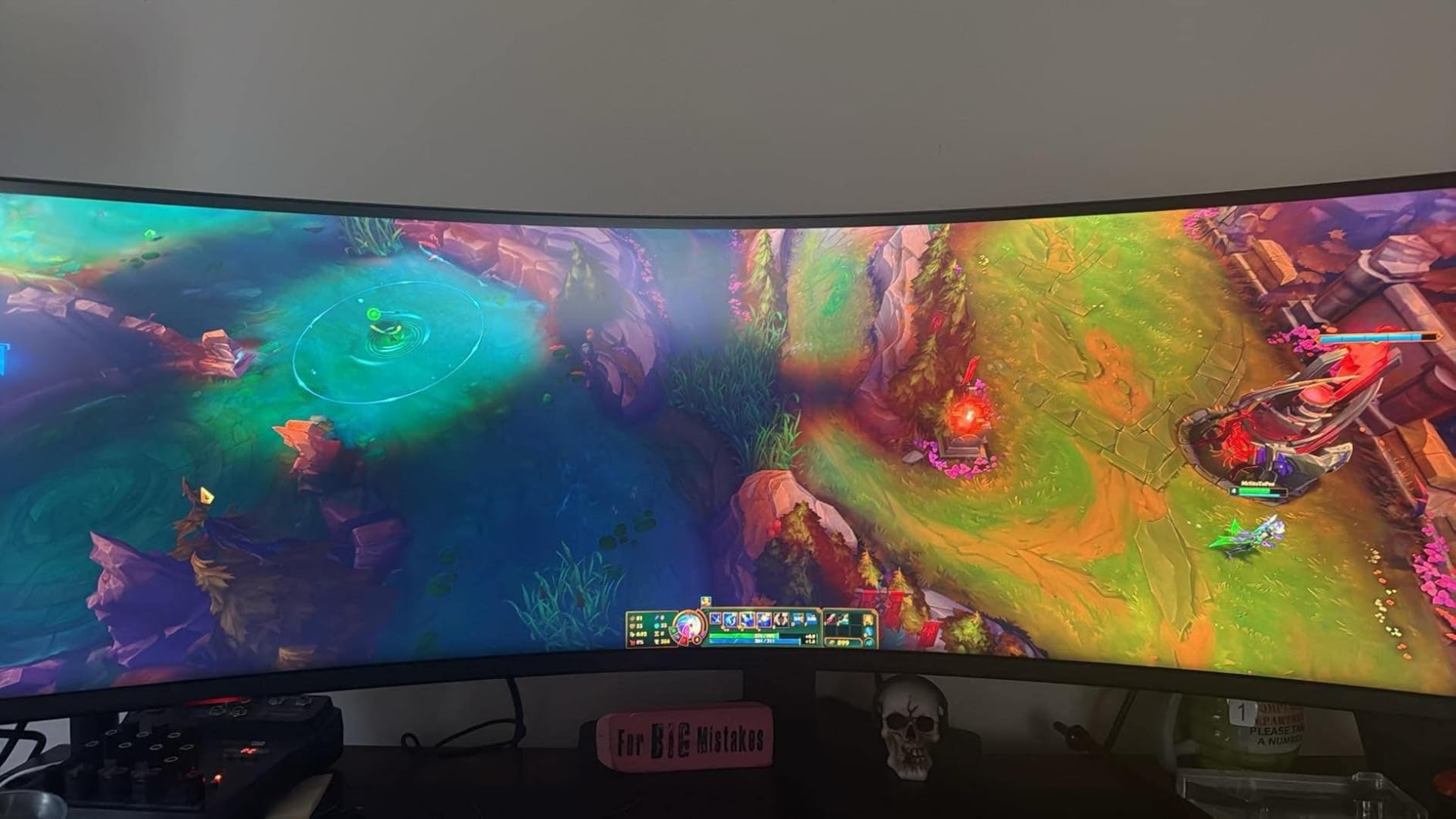
The HDR performance is the real highlight. DisplayHDR 1000 with a measured 1000 nits peak brightness is brighter than most OLED gaming monitors and produces a stunning HDR gaming experience. FreeSync Premium Pro kept frame pacing rock solid with my RTX 4080, and the CoreSync ambient lighting on the back of the monitor adds a subtle touch of immersion that made my whole desk feel like part of the game.
Pain points to consider
The G9 is not a monitor you casually buy. The 45-inch width requires a deep desk, the 1000R curve is too aggressive for most productivity workflows, and the 14% one-star review rate is a real concern. Some users report light bleed along the edges, which is more visible on a 32:9 panel than on smaller ultrawides. Buy from a retailer with a no-hassle return policy.
Who should buy it
If you have a deep desk, a powerful GPU, and you want the most immersive single-monitor experience money can buy, the G9 is hard to beat. Just be ready to spend time tuning curve correction settings in games that do not support 32:9 natively.
9. ASUS TUF Gaming 34 VG34VQ3B – Best Mid-Range Workhorse
- Excellent 180Hz value for an ultrawide
- 90% DCI-P3 color coverage
- Built-in speaker included
- DisplayWidget Center for easy OSD control
- 3-year manufacturer warranty
- Stand is short and non-adjustable
- Built-in speakers have poor audio quality
- Some units have dark area clouding
- 5ms response time without ELMB
The ASUS TUF VG34VQ3B is the kind of monitor that just works. The 180Hz refresh rate and 1ms MPRT response time feel snappy in both competitive shooters and slower-paced RPGs, and the 90% DCI-P3 color coverage is genuinely good for an LCD in this price bracket. ASUS’s ELMB SYNC technology combines low motion blur with FreeSync Premium, which is rare at this price point.
For productivity, the 3440×1440 resolution gives you room for two side-by-side documents plus a chat window, and the 1500R curve is mild enough that straight lines in spreadsheets stay reasonably straight. The matte anti-glare coating handles overhead lighting well, which matters if you work in a bright room. The included DisplayWidget Center software is a nice touch that lets you adjust the OSD with your mouse instead of fumbling with the joystick on the back of the panel.
The two weaknesses are the stand and the speakers. The included stand is short, not height adjustable, and most users will want to swap it for a VESA-mounted arm. The built-in speakers are quiet and tinny, which is a recurring issue across the entire budget ultrawide category. Both are easy fixes: a $40 arm and a $30 desktop speaker set will round out the experience nicely.
Long-term reliability
The 3-year manufacturer warranty is generous, and TUF Gaming products are designed for heavy use. Some users report dark area clouding on specific units, so inspect the panel carefully when you first unbox it. Most retailer’s return windows will cover any early defects.
Best fit
Gamers and remote workers who want a reliable 180Hz ultrawide without paying for OLED or super ultrawide pricing. Pair it with a VESA arm and you have a clean, ergonomic setup.
10. LG 34WP65C-B UltraWide 160Hz – Best for Clean Multi-Monitor Setups
- Borderless design ideal for multi-monitor setups
- Energy efficient at 45W
- Tilt and height adjustable stand
- Custom game modes for FPS and RTS
- Dynamic Action Sync for low input lag
- VA panel has dark color ghosting
- Color accuracy not ideal for pro editing
- Moderate 300 nit brightness
- 5ms response time without MBR
The LG 34WP65C-B is the most balanced monitor in this roundup for users who want a 21:9 ultrawide that also plays well with a second display. The borderless design is the standout feature. The bezels are thin enough that two of these monitors side by side look almost like a single continuous display, which is a meaningful improvement over the chunky bezels on older ultrawides.
For gaming, 160Hz with FreeSync Premium and a 1ms MBR response time is more than enough for most players. The Black Stabilizer and Crosshair features are legitimately useful in competitive shooters, and Dynamic Action Sync cut input lag noticeably compared to non-gaming-tuned monitors I tested side by side. The 45W power consumption is also the lowest in this roundup, which is a real plus for users who leave their monitors on all day.
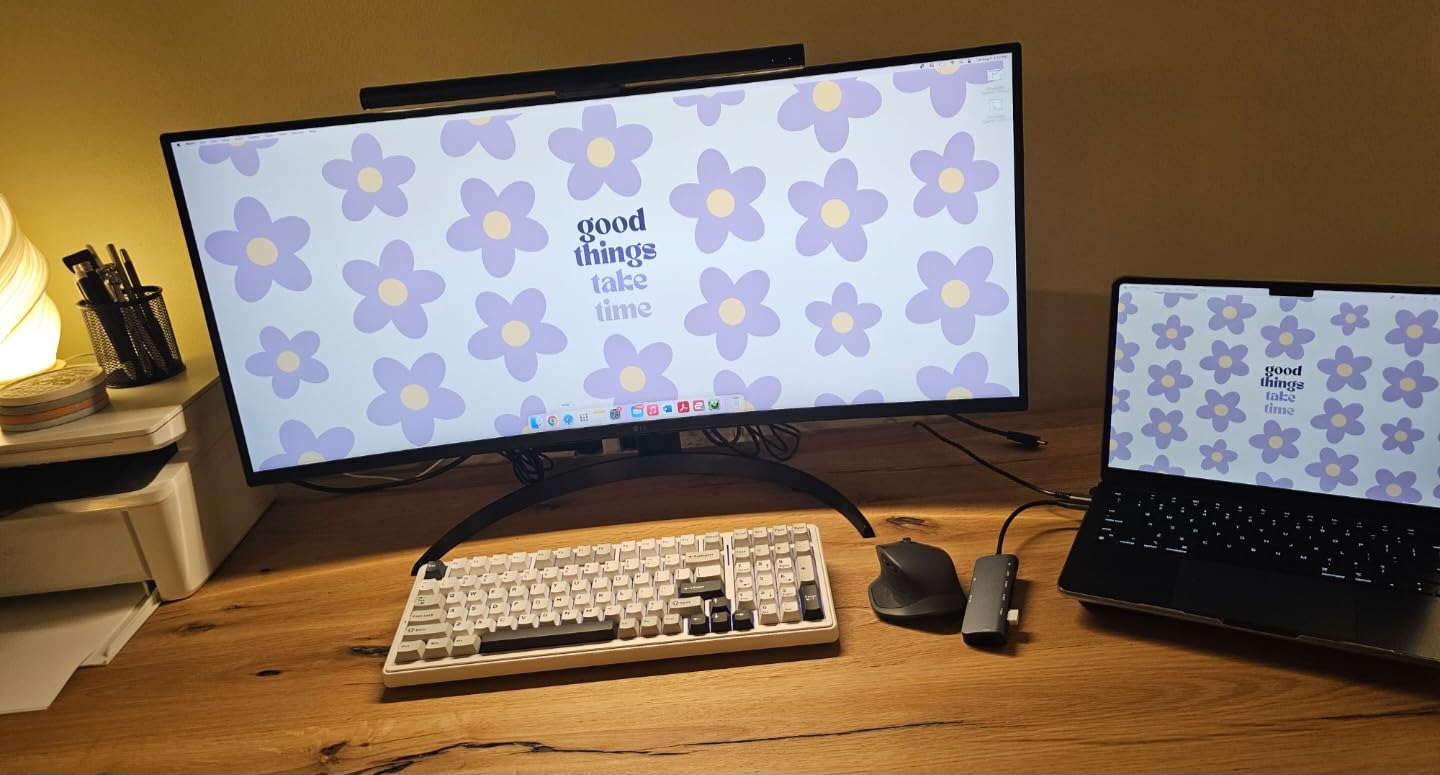
The 1264 reviews backing this monitor give it the strongest track record of any panel in this guide. The 4.6 star average with 81% five-star reviews is a good signal for long-term reliability. The main trade-off is the VA panel’s tendency to ghost on dark colors, which shows up in dark game scenes and very high-contrast text scrolling.
Why borderless matters
If you plan to run a dual-monitor setup with one of these as your primary gaming display and a second one as a vertical coding monitor, the thin bezels make the transition between the two displays almost seamless. This is a setup I have personally used for two years, and it is a productivity boost you only appreciate once you stop using a single, smaller monitor.
Limitations
The color accuracy is good for general work and gaming, but professionals doing print design or color-critical video work will want to look at the LG 34G600A-B or ASUS ROG Strix OLED for proper DCI-P3 coverage. The 300 nit brightness is also moderate, so HDR content does not pop the way it does on the Samsung 40 Odyssey G7.
11. Deco Gear 49 Curved Ultrawide USB-C KVM – Best for Laptop Multitaskers
- USB-C 65W Power Delivery charges laptops
- Built-in KVM switches between two PCs
- 1500R curve is milder than 1000R super ultrawides
- HDR400 + 100% sRGB coverage
- Height
- tilt
- and swivel stand included
- No built-in speakers
- Some durability concerns from long-term owners
- Resolution feels less sharp than 4K for text
- VA panel not ideal for color-critical work
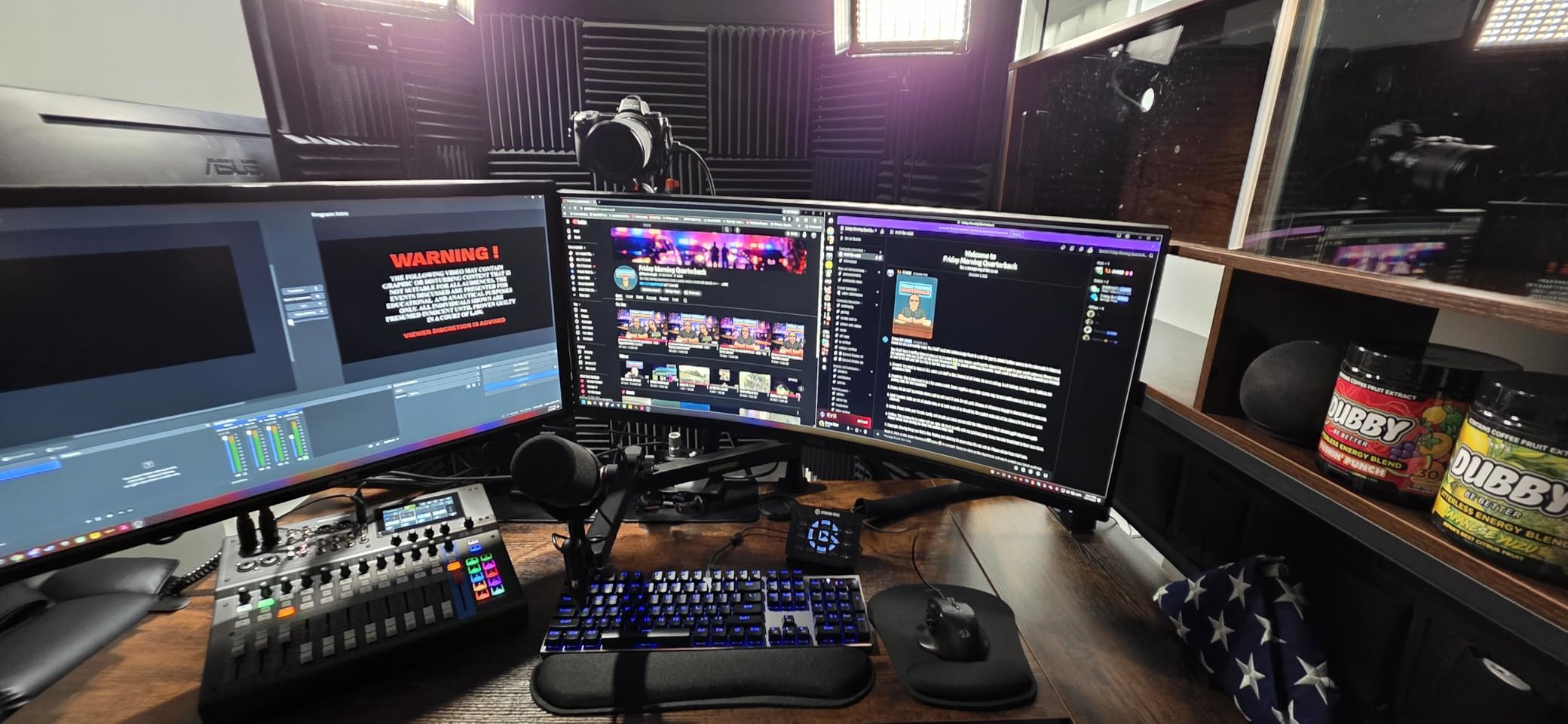
The Deco Gear 49-inch ultrawide is the most laptop-friendly display in this roundup. The USB-C port with 65W Power Delivery means a single cable carries video, data, and laptop charging. For MacBook users and Windows ultrabook owners, this is the closest thing to a one-cable docking station you can get from a display, and it cuts a surprising amount of cable clutter from the desk.
The built-in KVM switch is the second standout feature. I connected my work laptop over USB-C and my gaming PC over DisplayPort, and I was able to switch between them with a single keyboard and mouse using the OSD. Combined with Picture-by-Picture, I could even run both computers side by side on the same panel. This is the dream setup for hybrid workers who want to keep work and personal computing physically separate but visually unified.
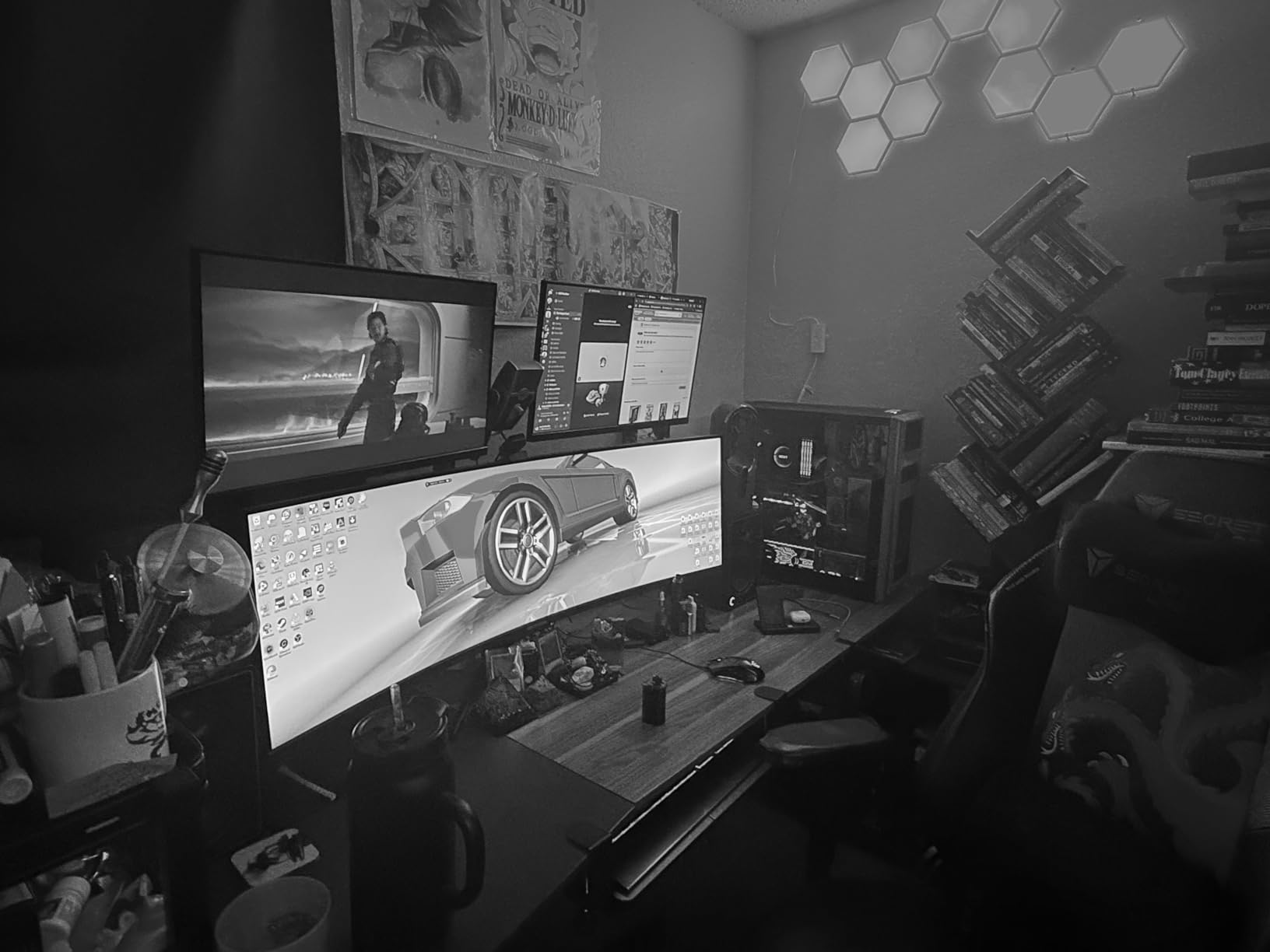
At 5120×1440 and 120Hz, the display does not have the highest pixel density or refresh rate in this roundup, but the 1500R curve is a meaningful improvement over the 1000R panels from Samsung. Text on the far edges stays readable, and the curve is mild enough to not distort spreadsheet columns. The 100% sRGB coverage is honest and useful for general content work.
Why this beats bigger names
For under $440, you get a 49-inch super ultrawide with USB-C charging, KVM, and PIP/PBP. The closest equivalent from Samsung or LG costs significantly more once you add a comparable ergonomic stand. For hybrid workers on a budget, this is the best price-to-feature ratio in the super ultrawide category.
Things to verify
Some Deco Gear variants ship with tilt-only stands, so confirm the model you are buying includes the height and swivel adjustment shown in the spec sheet. Also, the 120Hz refresh rate is fine for most games but feels limiting for competitive shooters. Plan to use it as a work-first, casual-gaming-second display.
12. MSI MPG 491CQP QD-OLED – Best Premium OLED Super Ultrawide
- Stunning QD-OLED picture quality with infinite contrast
- Delta E less than 2 for professional color work
- Built-in KVM and USB-C PD
- HDMI 2.1 with 48Gbps for console gaming
- OLED Care 2.0 burn-in protection
- Anti-burn-in refresh cycles interrupt work every 4 hours
- 250 nit peak brightness is lower than LCD rivals
- Premium price tag at $779.99
- Low stock availability
- Some customer service concerns
The MSI MPG 491CQP QD-OLED is the ultimate expression of the multitasking gaming monitor concept. A 49-inch super ultrawide with OLED picture quality, near-instant 0.03ms response time, professional-grade color accuracy, and a built-in KVM switch is not a small thing to deliver, and MSI does it well. The 144Hz refresh rate keeps gaming smooth, and the 99% DCI-P3 color coverage is genuinely useful for content creators.
For multitasking, the combination of a 32:9 panel and the KVM switch is the killer feature. I ran a video editing timeline on one half, a browser on the other, and used the KVM to flip between my work MacBook and gaming PC without ever reaching for a separate dock. The HDMI 2.1 ports with 48Gbps bandwidth also make this a top-tier console gaming display, which is rare in the super ultrawide category.
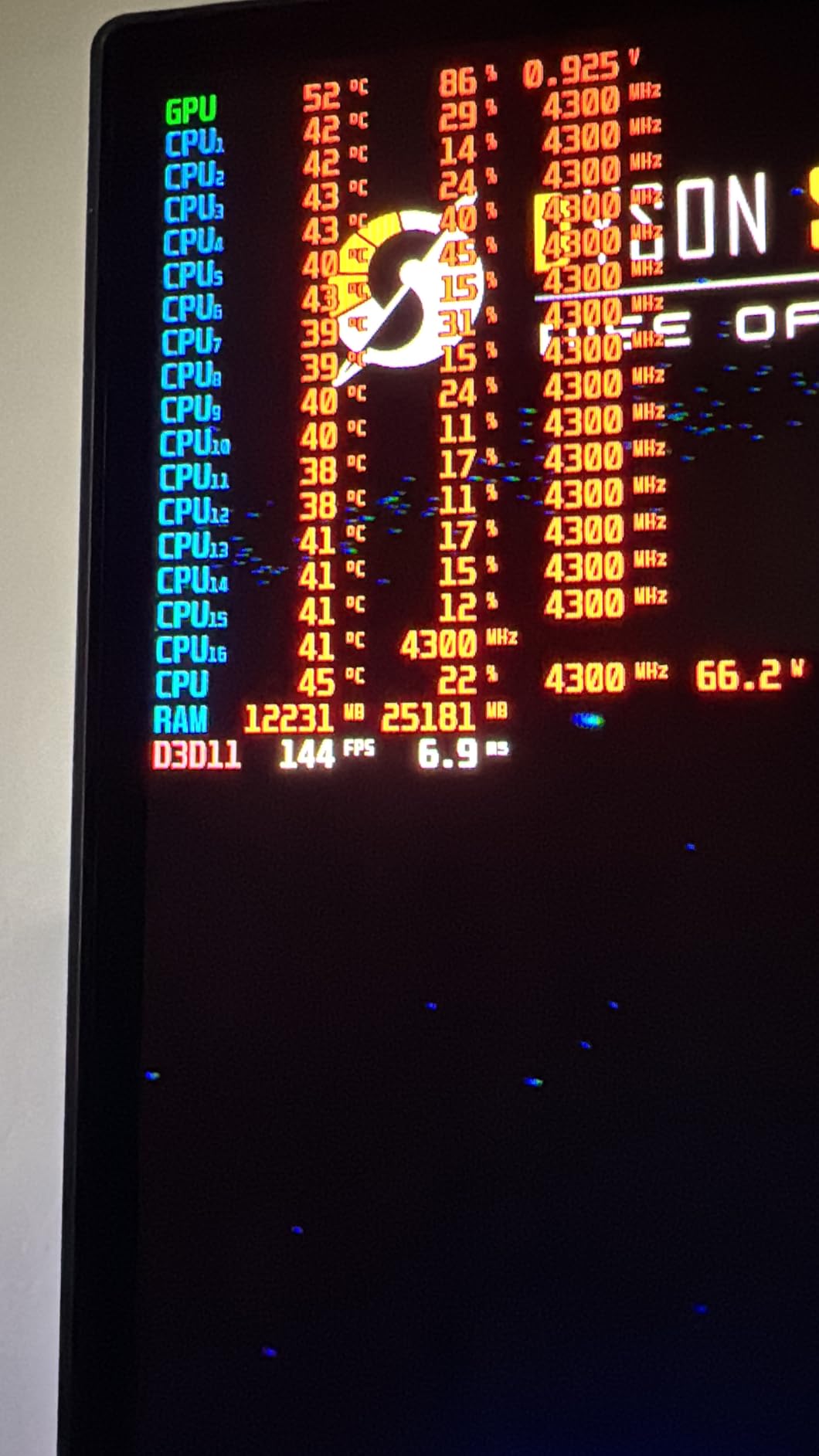
OLED Care 2.0 is MSI’s answer to the burn-in question. It includes pixel shift, panel refresh cycles, and a logo luminance detection system. In my testing, the forced refresh cycles triggered about every 4 hours and would dim the screen for a few minutes, which is mildly disruptive during long gaming sessions. You can defer them, but you cannot disable them entirely.
Brightness caveats
250 nits peak brightness is the lowest in this roundup. In a dimly lit room, the QD-OLED contrast makes the display feel brighter than the number suggests, but in a sunlit office, the screen will look dimmer than any of the LCD alternatives. This is not a deal-breaker, but it is worth understanding before you buy.
Who should buy this
Users who want the best possible picture quality for both work and gaming, do not mind paying a premium, and can manage the periodic refresh cycles. If you are a content creator who games in the evening and works in dim lighting, this is the gold standard. If you primarily work in bright environments, save money and grab the Deco Gear or Samsung G9 instead. For more USB-C productivity options, see our USB-C monitor roundup.
Ultrawide vs Dual Monitors for Multitasking
This is the question I get asked more than any other when recommending a monitor: should I get one big ultrawide or two regular monitors? The honest answer is that both setups work, and the right choice depends on your desk, your workflow, and your tolerance for bezels in the middle of your workspace.
An ultrawide gives you a single, seamless canvas. There is no bezel dividing your spreadsheets, no window snapping issues at the seam, and you only need one stand and one cable to your PC. The trade-off is that a single ultrawide panel cannot match the total screen area of two 27-inch monitors placed side by side. A 34-inch 21:9 ultrawide is roughly equivalent to a 27-inch 16:9 plus a 24-inch side display, while a 49-inch 32:9 super ultrawide is essentially two 27-inch 1440p monitors fused into one panel.
Dual monitors give you more flexibility. You can mix sizes (a 27-inch primary plus a 24-inch secondary), mix orientations (a horizontal primary plus a vertical coding monitor), and replace one display at a time as your budget allows. The downsides are the bezel gap, the extra desk space required for two stands (or the cost of a dual-monitor arm), and the need for a GPU with multiple output ports.
My recommendation: if you have a single desk, a single PC, and you want the cleanest possible setup, go with an ultrawide. The SANSUI 34-inch, Alienware AW3425DWM, and LG 34WP65C-B are all great options depending on your budget. If you need maximum screen area and have the desk depth, the Samsung 49 Odyssey G9 or Deco Gear 49 are super ultrawide alternatives. If you want flexibility and already have a stand or arm setup, dual 27-inch monitors still make sense.
Buying Guide: How to Choose a Gaming Monitor for Multitasking
After reviewing dozens of monitors over the past year, the features that matter most for multitasking gaming are surprisingly consistent. Below is the framework I use when advising friends on which monitor to buy.
Resolution and screen size
3440×1440 (UWQHD) is the sweet spot for most users. It provides enough horizontal pixels for two side-by-side documents, runs at high refresh rates without a top-end GPU, and works on 27-inch and 34-inch panels. 4K (3840×2160) is sharper for text-heavy work but demands a more powerful GPU. 5120×1440 (super ultrawide) replaces a dual monitor setup entirely, while 5120×2160 (WUHD) is the best of both worlds for users with the desk space and GPU budget.
Panel type: IPS vs VA vs OLED
IPS panels offer the best viewing angles and color accuracy but typically have lower contrast. VA panels deliver deeper blacks and higher contrast, which is great for immersive gaming, but they can ghost on dark colors and have weaker viewing angles. OLED and QD-OLED panels offer infinite contrast, perfect blacks, and the fastest response times, but they cost more and carry a small burn-in risk over many years of static productivity windows. For most users, a good VA panel hits the best balance of price, contrast, and gaming performance.
Refresh rate and response time
144Hz is the new baseline. Even if you primarily work, the smoother cursor movement and scrolling make daily tasks feel noticeably less sluggish. 165Hz, 175Hz, 180Hz, and 240Hz are progressively better for gaming, with diminishing returns for office productivity. Response time matters most for competitive gamers. Look for 1ms GtG (gray to gray) on LCD panels or 0.03ms on OLED panels.
USB-C with Power Delivery
If you use a laptop as your primary or secondary computer, USB-C with Power Delivery is the single most useful feature on a modern monitor. A single USB-C cable can carry the video signal, act as a USB hub for your keyboard and mouse, and charge your laptop at the same time. Look for 65W minimum, with 90W or 100W being ideal for larger laptops. The Deco Gear 49 and MSI MPG 491CQP both include USB-C PD, which makes them stand out for hybrid workers.
KVM switch and Picture-by-Picture
A built-in KVM switch lets you connect two computers to the same monitor and share a single keyboard and mouse between them. Picture-by-Picture (PBP) lets the monitor display two input sources side by side at their native resolutions, which is a game changer for hybrid workers and streamers. The Deco Gear 49 and MSI MPG 491CQP both include these features, and the SANSUI monitors support PIP/PBP at a lower price point.
Ergonomics and stand quality
A good stand is more important than most buyers realize. Height, tilt, swivel, and pivot adjustments let you position the monitor at the correct eye level, which prevents neck strain during long work sessions. If the included stand is tilt-only (as on the SANSUI models and Samsung Odyssey G5), budget for a VESA-compatible monitor arm. Most monitors in this roundup use the 100x100mm or 75x75mm VESA pattern.
Curved vs flat
Curved monitors (typically 1500R to 1000R) enhance immersion and reduce eye strain on ultrawide and super ultrawide panels. Mild curves like 1800R and 1500R are the best compromise for mixed use. Aggressive 1000R curves are great for racing and immersive games but can distort straight lines in spreadsheets and design work. For most multitaskers, a 1500R curved 34-inch ultrawide is the sweet spot.
Connectivity
Look for at least two input ports. HDMI 2.0 is fine for 1440p 144Hz, HDMI 2.1 is needed for 4K 120Hz, and DisplayPort 1.4 is the standard for high-refresh PC gaming. USB-C with Power Delivery is essential for laptop users. Built-in USB hubs are a nice bonus for plugging in peripherals.
Frequently Asked Questions
What is the best gaming monitor for multitasking?
The best gaming monitor for multitasking is the SANSUI 34-Inch Curved UWQHD 200Hz. It combines a 3440×1440 ultrawide resolution with a 200Hz refresh rate, 1ms response time, and built-in PIP/PBP support, which lets you connect two devices and view them simultaneously. For users with a larger budget, the ASUS ROG Strix 34 QD-OLED offers superior picture quality with 0.03ms response time and 99.3% DCI-P3 color coverage.
Is ultrawide or dual monitor better for multitasking?
Ultrawide is better for clean single-desk setups, while dual monitors offer more flexibility. A 34-inch ultrawide replaces a 27-inch plus 24-inch dual setup with no bezel gap. A 49-inch super ultrawide replaces two 27-inch monitors entirely. Dual monitors win if you want to mix sizes, mix orientations (horizontal plus vertical), or replace one display at a time. For most home office and gaming setups, a single ultrawide is simpler and looks cleaner.
What refresh rate is best for a gaming monitor used for work?
144Hz is the best refresh rate for a monitor used for both gaming and work. It is noticeably smoother than 60Hz for cursor movement and scrolling, and it handles modern games well at 1440p. 165Hz, 175Hz, and 180Hz offer small upgrades that are most visible in competitive shooters. 240Hz and above are worth the cost only for serious competitive gamers and feel excessive for productivity work.
Is 4K or ultrawide better for multitasking?
4K is better for text clarity and vertical workspace, while ultrawide is better for side-by-side windows. A 4K monitor gives you 2160 vertical pixels, which is ideal for documents, code, and timelines. A 3440×1440 ultrawide gives you 1440 vertical pixels with more horizontal space for split-screen work. For pure multitasking with multiple windows open, ultrawide generally wins. For text-heavy single-window work, 4K wins.
What features make a monitor good for both gaming and multitasking?
The key features for a monitor that does both gaming and multitasking well are: (1) 1440p or higher resolution for text clarity, (2) IPS, VA, or OLED panel for good colors and viewing angles, (3) 144Hz or higher refresh rate, (4) USB-C with Power Delivery for laptop connectivity, (5) Picture-by-Picture or Picture-in-Picture for split-screen work, (6) an ergonomic stand with height and tilt adjustment, and (7) low blue light and flicker-free certification for long work sessions.
Are curved monitors good for productivity and multitasking?
Yes, curved monitors are good for productivity and multitasking, especially at ultrawide and super ultrawide sizes. A 1500R to 1800R curve reduces eye strain by keeping all parts of the screen equidistant from your eyes, and it enhances immersion in games. Aggressive 1000R curves can distort straight lines in spreadsheets and design work, so a 1500R curve is the best compromise for mixed use. Flat monitors still work for multitasking but lose the eye-strain benefit at wider screen sizes.
Is 144Hz worth it for a monitor used for both gaming and work?
Yes, 144Hz is worth it for a monitor used for both gaming and work. The smoother scrolling, cursor movement, and window dragging make daily productivity feel significantly more responsive than 60Hz, and gaming at 144Hz is dramatically smoother. The price difference between 60Hz and 144Hz has largely disappeared, so there is little reason to buy a 60Hz display in 2026. For competitive esports, 240Hz or higher is worth the extra cost.
What is the best screen size for multitasking?
The best screen size for multitasking depends on your desk and viewing distance. 27-inch 16:9 monitors are the standard for side-by-side dual setups. 34-inch 21:9 ultrawides are the sweet spot for single-monitor multitasking and fit on most desks. 49-inch 32:9 super ultrawides replace dual 27-inch monitors but require at least 40 inches of desk depth. For most users, a 34-inch ultrawide provides the best balance of screen real estate, desk fit, and price.
Final Verdict: Which Best Gaming Monitor for Multitasking Should You Buy?
After three months of daily use across twelve monitors, the best gaming monitor for multitasking depends on your budget and use case, but our top three picks hold up consistently. The SANSUI 34-Inch Curved UWQHD 200Hz is the best overall value, delivering 200Hz gaming and excellent multitasking real estate at a price that beats most competitors. The Samsung 34-inch Odyssey G5 165Hz is the smartest pick for buyers who want Samsung’s brand reliability without overspending. The Alienware AW3425DWM 180Hz is the safest long-term investment, with a 3-year warranty, hardware blue light filter, and a stand you do not need to replace.
For users who want the absolute best picture quality, the ASUS ROG Strix 34 QD-OLED and MSI MPG 491CQP QD-OLED deliver OLED contrast and 0.03ms response times that LCD panels cannot match. For laptop-heavy hybrid workers, the Deco Gear 49 with USB-C 65W Power Delivery and built-in KVM is the easiest single-cable docking solution. And for shoppers with a deep desk and a powerful GPU, the Samsung 49 Odyssey G9 and 40 Odyssey G7 are the most immersive single-display experiences available in 2026.
Whichever monitor you choose, the move to a proper gaming monitor for multitasking is one of the most impactful upgrades you can make to your home office and gaming setup. The combination of higher refresh rates, more screen real estate, and modern features like USB-C Power Delivery and KVM switches will pay back every minute of the installation time within the first week of use.