
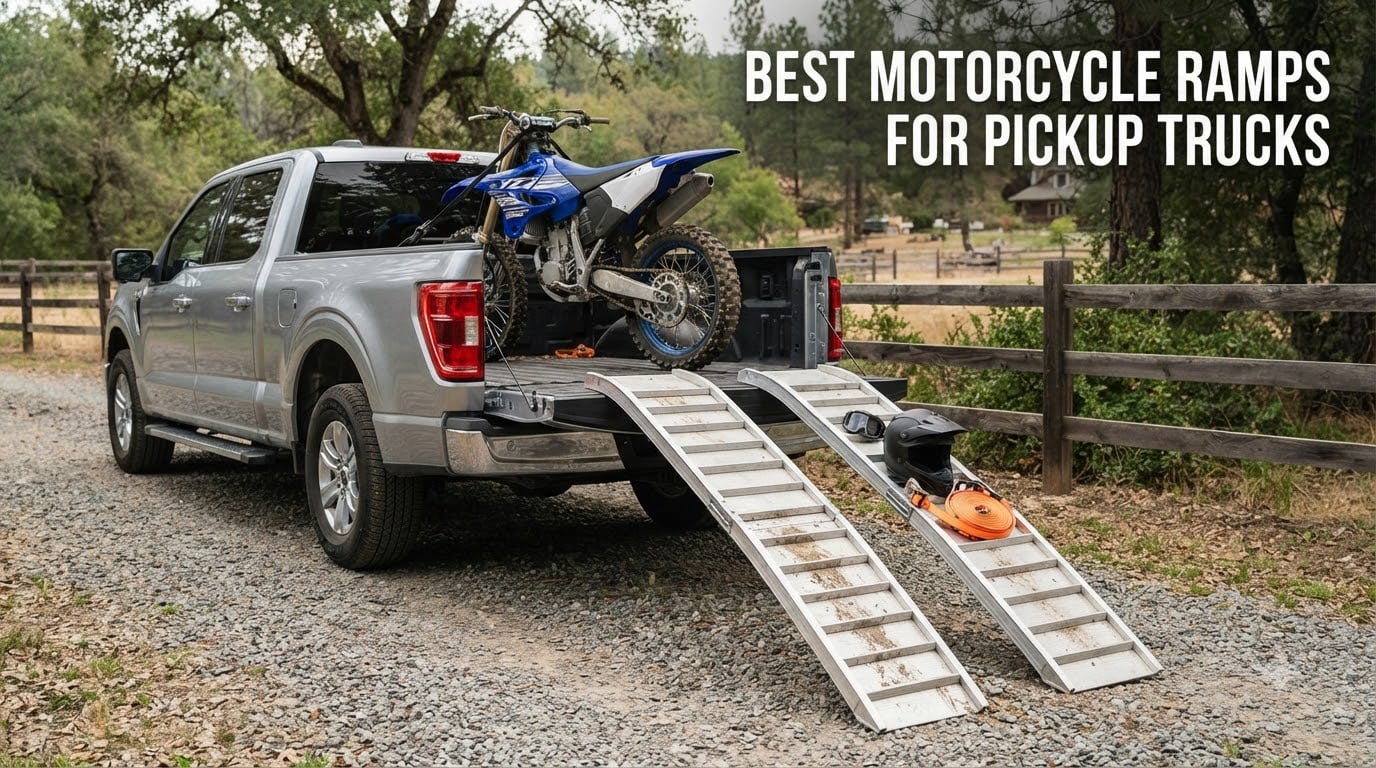
Two numbers decide everything when you pick a ramp for a pickup: your bed height and your bike’s weight. A short ramp on a lifted truck creates a slope so steep the bike high-centers at the tailgate or kicks back at the rider, and a ramp rated below your bike’s weight is asking for bent beams mid-climb. Once those two numbers are set, the rest of the decision narrows fast.
This is our guide to the best motorcycle ramps for pickup trucks in 2026, covering ten aluminum ramps we compared on length, load rating, folded size, weight and deck design. We weighed the published specs against what owners report about flex, slipping and tailgate damage, because the spec sheet rarely tells the whole story.
Everything here fits the truck-bed use case specifically. If you need ramps for a trailer or for moving a mower, the logic is similar but the loading heights are different, and threshold ramps for doorways cover the low-clearance garage version. Riders who want the general motorcycle ramp picture without the truck-bed specifics can start with our motorcycle ramps for loading roundup instead.
One safety note before we start. Manufacturer usage guidelines call for a second person when loading a bike, and every ramp in this guide is rated for a load that is evenly distributed across the deck, not a single point. Ride up slowly, keep the bike in first gear, and never stand downhill of it.
Top 3 Best Motorcycle Ramps for Pickup Trucks in 2026


The VENDAV 7.5 ft ramp takes the top slot because it pairs a 4.7 rating across 489 reviews with a 15.5 lb weight, which means one person can actually lift it into the bed. The Titan 9 ft pair wins on length and capacity for lifted trucks, and the Ruedamann ramp’s flat ribbed deck is the easiest surface for tires to climb.
Quick Comparison of Every Ramp in 2026
| Product | Specifications | Action |
|---|---|---|
| VENDAV 7.5 ft Folding Aluminum Ramp |
|
Check Latest Price |
| Titan Ramps 9 ft Arched 2-Pack |
|
Check Latest Price |
 VNN Ramp with Walking Step VNN Ramp with Walking Step |
|
Check Latest Price |
 KROAK 7.5 ft 850 lb Ramp KROAK 7.5 ft 850 lb Ramp |
|
Check Latest Price |
 Black Widow 10 ft 3-Piece Ramp Black Widow 10 ft 3-Piece Ramp |
|
Check Latest Price |
 VEVOR 7.5 ft 1500 lb 2-Pack VEVOR 7.5 ft 1500 lb 2-Pack |
|
Check Latest Price |
 Gorkett 6 ft 440 lb Ramp Gorkett 6 ft 440 lb Ramp |
|
Check Latest Price |
| Ruedamann 7.5 ft Ribbed Ramp |
|
Check Latest Price |
 VEVOR 8810 lb 72 in 2-Pack VEVOR 8810 lb 72 in 2-Pack |
|
Check Latest Price |
 MAXIVAMN 7.5 ft Punch-Plate 2-Pack MAXIVAMN 7.5 ft Punch-Plate 2-Pack |
|
Check Latest Price |
Two things jump out of that table. Every option here is aluminum, and only two of the ten run longer than 7.5 ft of open length, which is why bed height matters so much. We will get to the math in the ramp-length section below.
1. VENDAV 7.5 ft Folding Aluminum Ramp – Best All-Round Pick
Motorcycle Ramp for Pickup Trucks, 7.5 ft Folding Aluminum Dirt Bike Ramp
- Light enough for one person to lift
- 750 lb covers most street and dirt bikes
- Crossbar rungs grip tires and pass debris
- Arched top eases solo loading
- Included safety strap
- Raw aluminum edges can scratch a bed liner
- Strap is essential to stop the tabs slipping
- One durability complaint at first use
This is the ramp we would put in a truck bed first. At 15.5 lb it is one of the lighter ramps we compared, and that weight matters more than buyers expect because somebody has to lift it into the bed, position it against the tailgate and fold it back up afterward.
The deck is 89 by 12 inches with roughly an 11 inch wheel path between the side rails, which is enough to keep a tire tracking straight without feeling narrow under a wide adventure bike. Crossbar rungs give the tire a defined edge to climb and let mud and grass clippings fall through instead of packing into the channels.
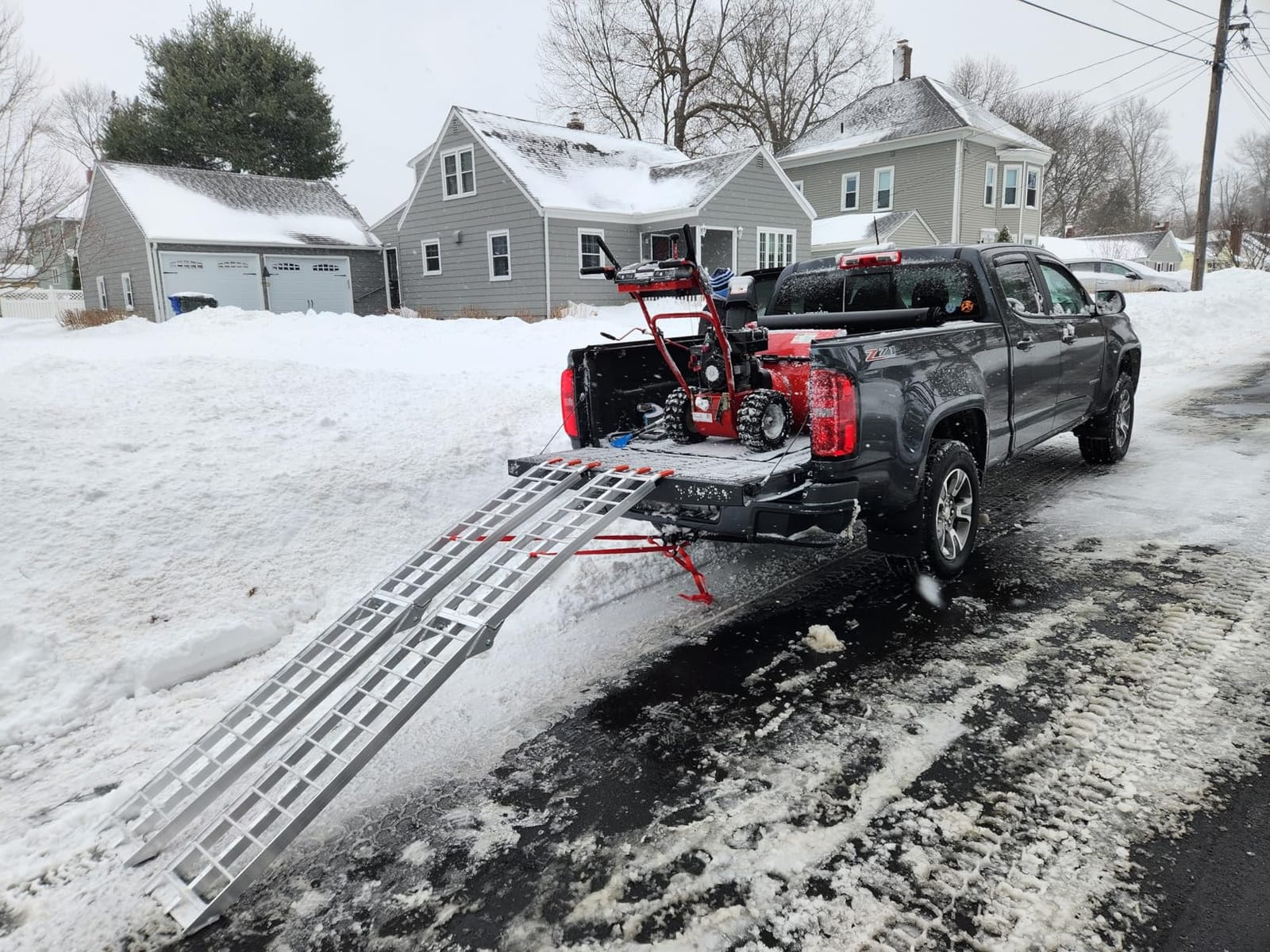
Capacity is 750 lb when the load sits evenly, which covers nearly every street motorcycle and most dirt bikes with a rider. We would not put a touring bike and a passenger on this deck without adding a margin, and the single-ramp layout means you need a spotter to steady the bike while it climbs.
The included safety strap is not a nice-to-have. Owners report that the upper tabs can slide off the tailgate on wet or icy pavement without it, and the strap is what stops that happening. Buyers who want to protect a spray-on liner should watch the raw aluminum edges, which are not fully deburred.
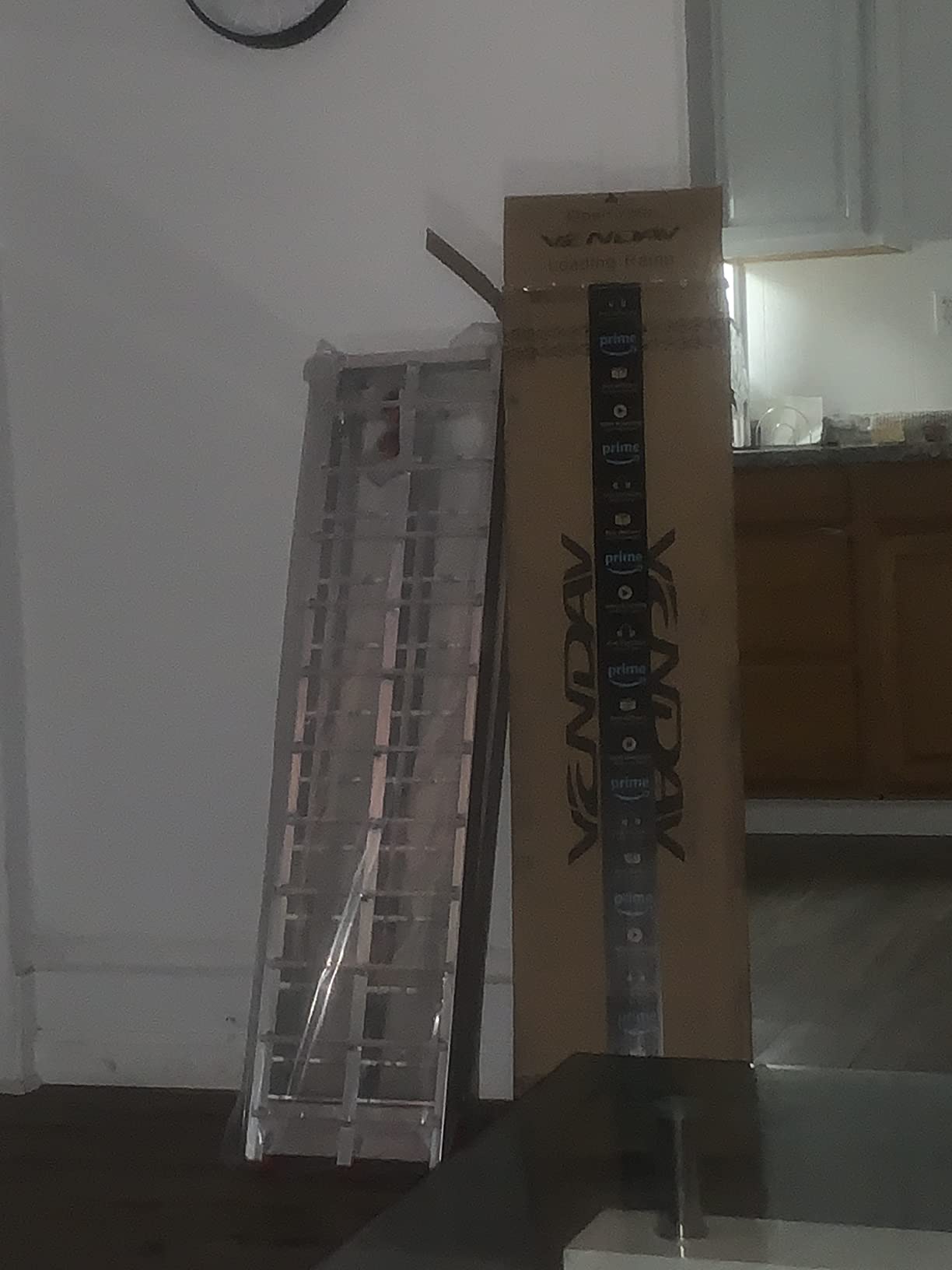
Who the 7.5 ft VENDAV suits
It fits an unmodified half-ton or midsize truck bed in the 24 to 30 inch range, and it is the pick for anyone who loads alone or moves bikes regularly on a fuel budget. Riders hauling e-bikes, snow blowers and small machines get a second use out of the same deck.
We would also pick it for a dirt bike headed to a track or a local trail, where a grippy rung surface matters more than a wide ride-up platform. Folding to 44.5 inches means it lives in a short-bed truck or a garage shelf year-round.
Where it falls short
A lifted truck with a 36 inch or taller bed will make a 7.5 ft ramp feel steep, and that angle is where high-centering starts. The single 12 inch deck also means no room to walk beside the bike, so a spotter is the safer loading method.
One buyer reported a break during first use with an 80cc ATV, which is an isolated report against 489 reviews but worth knowing. We would keep the deck centered over the tailgate rather than cantilevering it out over the tailgate pivot.
2. Titan Ramps 9 ft Arched 2-Pack – Best for Lifted Trucks
- 9 ft length gives a gentle grade on tall beds
- Arched profile prevents bottoming out
- Two ramps let you walk beside the bike
- Folds flat for storage
- Serrated crossbars grip in mud
- Included strap is small and single-hooked
- Tailgate contact area can slide
- Cotter pins and hardware feel cheap
- Paint finish scratches easily
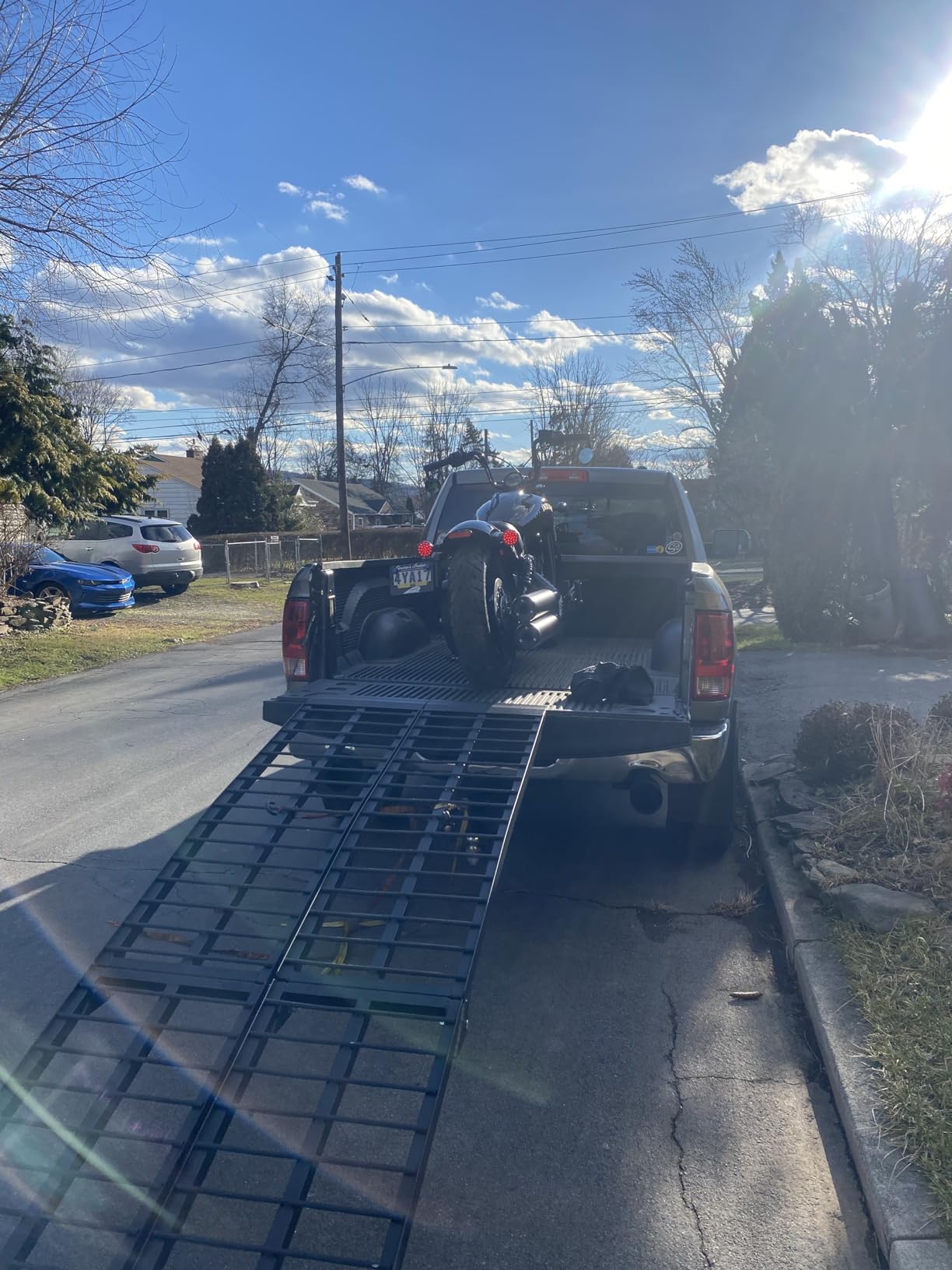
Length is the reason this set keeps coming up in truck forums, and it is the reason it works here. At 108 inches open, it turns the same 32 inch bed rise into a noticeably shallower climb than a 7.5 ft ramp would, which is the single biggest fix for the steep-angle complaints we found in owner discussions.
The arch is the second argument. A curved deck means the bike’s underside approaches the tailgate at a rising angle instead of slamming into the tailgate pivot square, which matters for anything with low exhaust or a low belly pan. Serrated crossbars hold traction in wet grass and mud, not just on dry pavement.
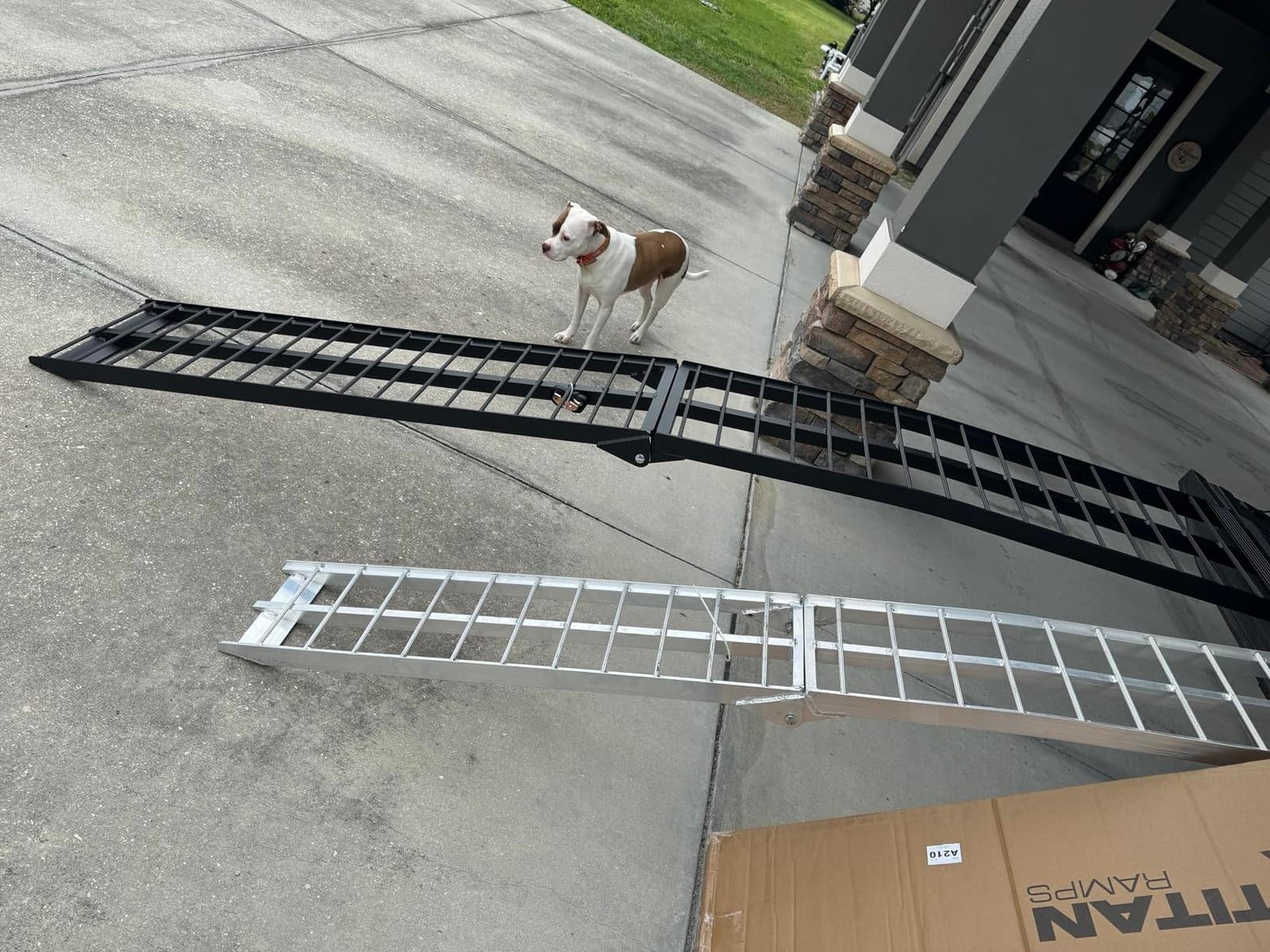
With two ramps in the set you get a proper two-wheel track, so the bike sits between the ramps rather than on one, and you can walk alongside it. Capacity is 1200 lb combined, well above the weight of a street bike plus rider and close to a heavy cruiser with a passenger.
Both ramps fold down to a few inches thick, so they stow under a bed cover, along a bed wall or in a short-bed truck. That storage flexibility is a real advantage over wide 3-piece decks that take up half a bed.
Who the Titan 9 ft pair suits
This is the set for lifted trucks, 3/4-ton and one-ton beds in the 32 to 40 inch range, where shorter ramps genuinely feel steep. It also suits riders who load two-wheeled equipment regularly and want the option of walking beside the machine.
We would pair it with ratchet straps straight away. The supplied strap is small and has a hook on only one end, so it works as a temporary tether but not as long-term hardware.
Where it falls short
At 42 lb for the pair this is a two-person carry for most riders, and reviewers mention springiness under load compared with steel. The tailgate contact area has no plastic dip, so it can creep on smooth surfaces if the strap is not tensioned.
Some owners also report that the paint finish scratches off easily and is not powder coated, so a visible scuff after a season of use is normal. Cosmetic, but buyers who care about appearance should know.
3. VNN Ramp with Integrated Walking Step – Best for Solo Loading
- Separate 7.88 in walking step for one-person loading
- Long low-angle profile
- Four-fold design packs down fast
- Punched surface grips wet and dry
- Aircraft-grade aluminum
- Single ramp
- not a pair
- Some buyers find it still short for wide machines
- Heavy for a solo carry
Almost every owner complaint about single-runner ramps comes down to the same problem, and this one solves it. The deck splits into a riding lane for the front wheel and a separate 7.88 inch walking step so the rider can support the bike while walking alongside it, which is the feature owners single out most.
At 82 inches the ramp is longer than most single runners in its class, and the manufacturer rates it for loading heights of roughly 24 to 35 inches. That covers most unmodified and mid-size truck beds plus a light lift kit, and the 1,100 lb rating handles anything from a dirt bike to a heavy adventure bike.
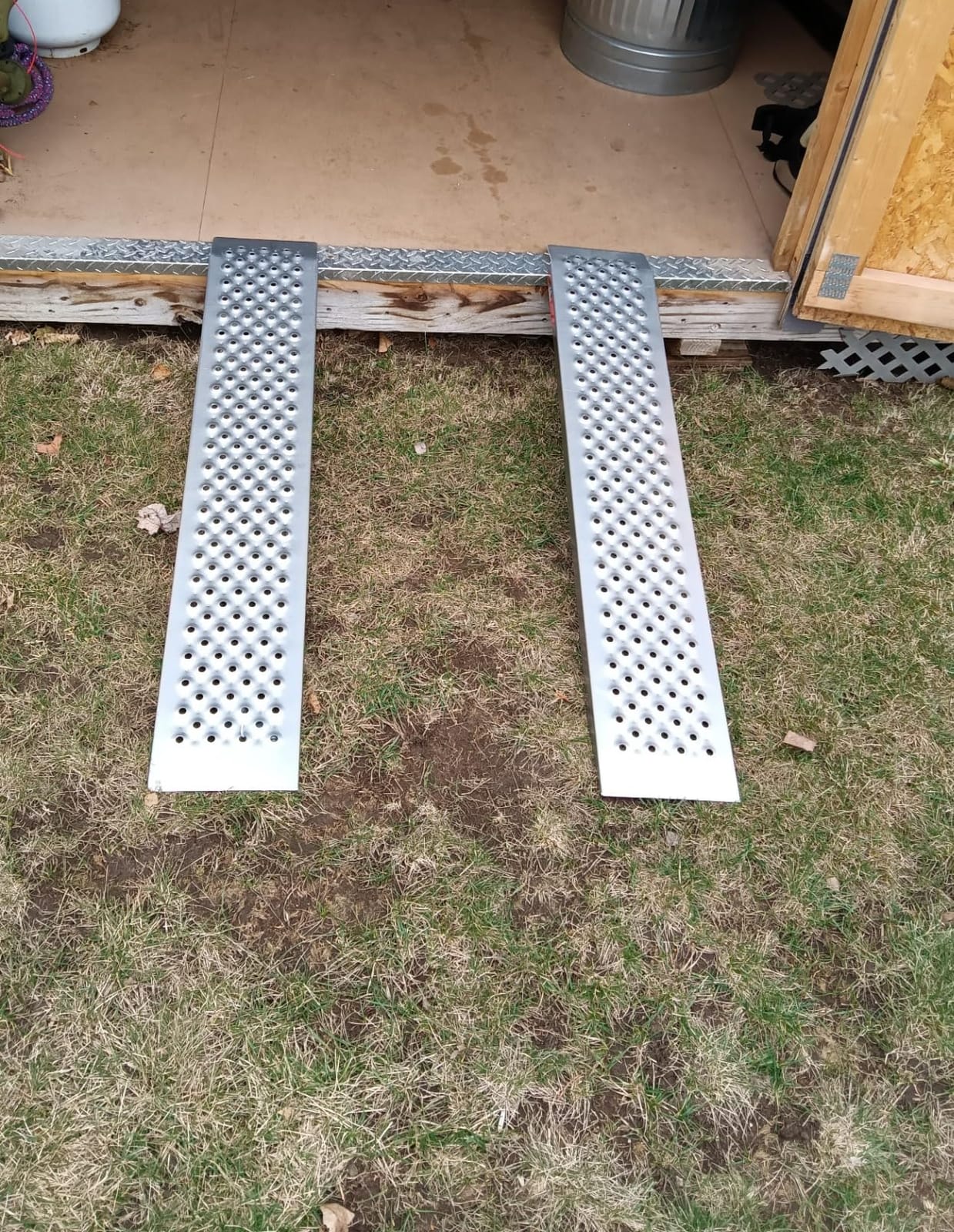
The 4-fold design collapses in about eight seconds and folds down compact enough for a bed or a garage corner. A carrying handle is built in, and the under-bars accept ratchet straps, which solves the slipping problem on smooth tailgates better than most bundled hardware.
Capacity splits into two ratings: 1,100 lb on the riding section and 400 lb on the walking step. The lower walking-step figure is not a flaw, it is simply the part that carries a person rather than a machine.
Who the VNN ramp suits
It is built for the rider who loads without help. If you refuse to own a ramp that requires a second person on the tailgate, this is one of the few designs where that is realistic, because the walking step gives you a handhold the whole way up.
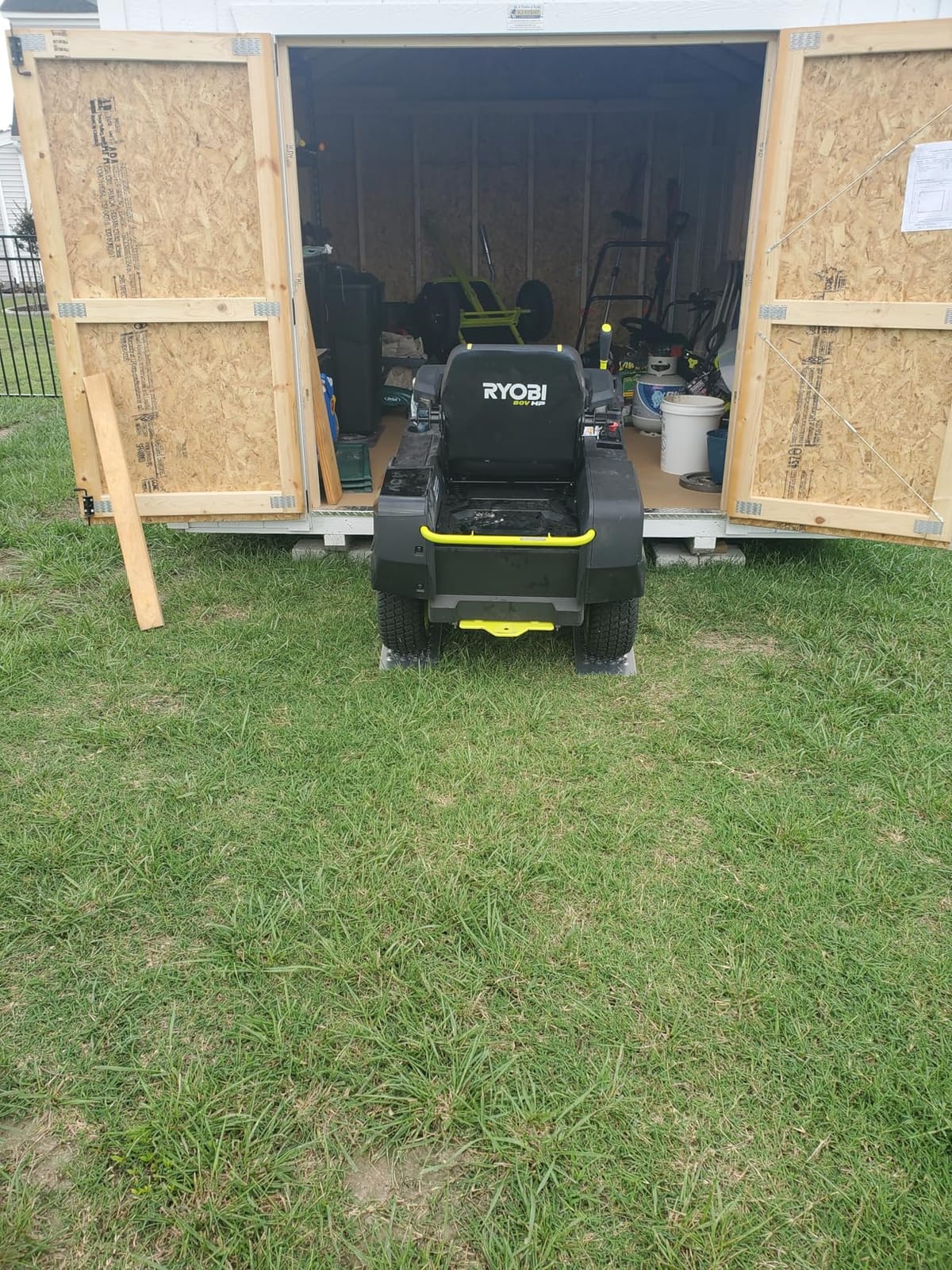
It also works well for mixed use, since the wide plate suits a zero-turn mower or a garden tractor as readily as a bike. We would pick it for anyone whose bed is under 32 inches and who loads in the dark or on wet ground.
Where it falls short
It is one ramp. Several buyers expected a two-piece set and were disappointed, so if you plan to load a full-width machine you will need a second unit or a different design.
At 40.4 lb it is one of the heavier single ramps here, and a few owners with very wide or very tall loads still found the angle steeper than they wanted. If your bed is above 35 inches, step up to a longer arched model.
4. KROAK 7.5 ft 850 lb Aluminum Ramp – Best Budget Pair of Specs
- Full-welded frame shows no flex under heavy loads
- Light at 16.6 lb
- Folds in half for storage
- 23 crossbars spread the load
- Wider deck than most rivals
- Bundled cam-lock straps are weak
- Glove quality is poor
- Strapping takes care to get right
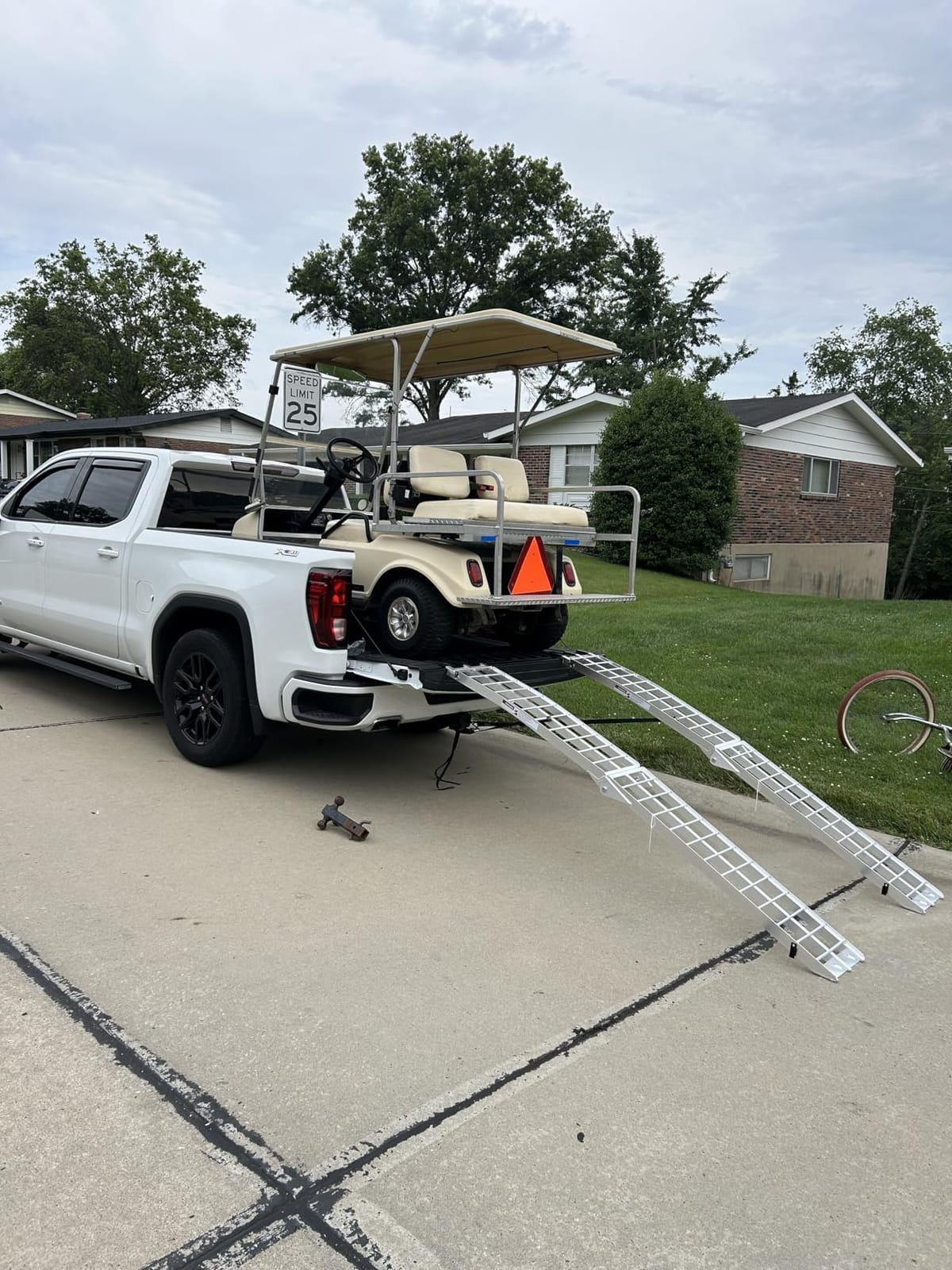
The KROAK is the ramp owners report upgrading to when an older set starts to flex. At 90 inches with 23 crossbars and a 2 inch profile, the full-welded frame held an 800 lb ATV with a plow without visible bend according to multiple buyer reports, and several switched over from a lighter, springier 1,500 lb set.
Capacity is 850 lb, which leaves a usable margin over most street bikes and dirt bikes with a rider. The stated maximum use height is 34.5 inches, so it covers unmodified, midsize and moderately lifted beds but stops short of the tallest lifted trucks.
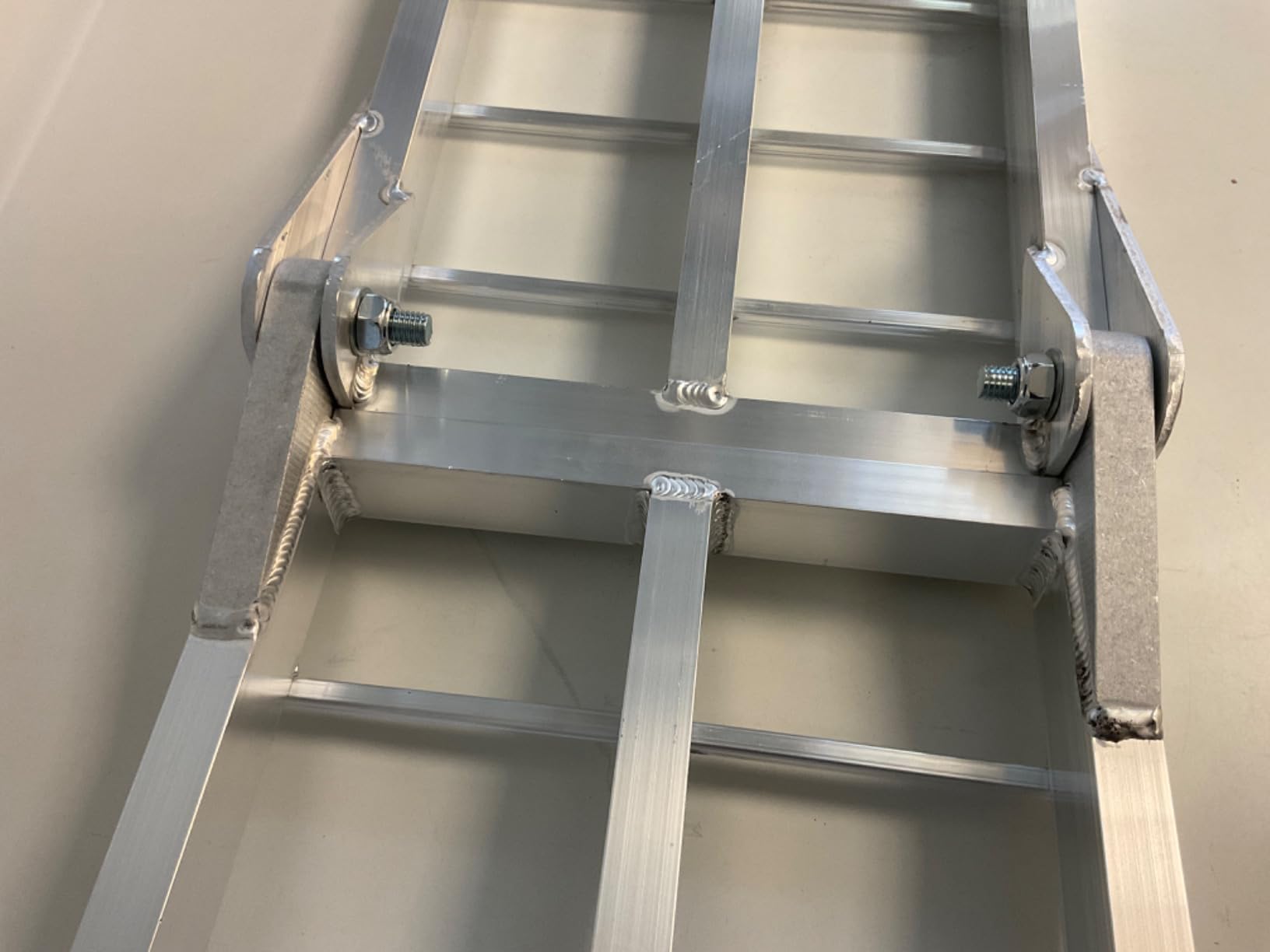
A detail that gets overlooked: the deck is slightly wider and the tread slightly more aggressive than most budget ramps, so a foot placed alongside the tire finds purchase. That matters for solo loading more than the published capacity number does.
It folds to about 45.8 inches and holds shut with a velcro closure, and the box includes straps and a pair of gloves. Folding is quick enough to do between every trip rather than leaving the ramp permanently stowed away.
Who the KROAK ramp suits
It suits a rider with a bed under about 32 inches who wants a genuinely rigid ramp at a modest weight. The 16.6 lb figure means one person can position it, and the 90 inch length is long enough that the slope does not get uncomfortable.
Multi-use buyers benefit too, since the same ramp handles a dirt bike, a bicycle, a mower or a pair of e-bikes as a two-up setup if you buy a second ramp later.
Where it falls short
The bundled cam-lock straps are the weak point and the most common complaint. Owners routinely replace them with ratchet straps, and we would do the same before the first load rather than trusting cam buckles with a bike’s weight on them.
Securing the strap properly takes a little practice, and the included gloves are described as cheap. Plan on buying a real ratchet strap and a decent pair of gloves as part of the kit.
5. Black Widow 10 ft 3-Piece Wide Ramp – Best for Heavy Cruisers
10′ Black Widow Motorcycle Ramp, 1,500 lb Cap, Aluminum, Folding
- Arched deck clears low-slung cruisers
- 38 in width keeps both feet on the ramp
- Each section folds for storage
- 1500 lb rating and a 5 year warranty
- 81 lb is a two-person lift
- Sections can separate without a cinched strap
- Mid-span hump lifts the front wheel
- Not for beds over 35 inches
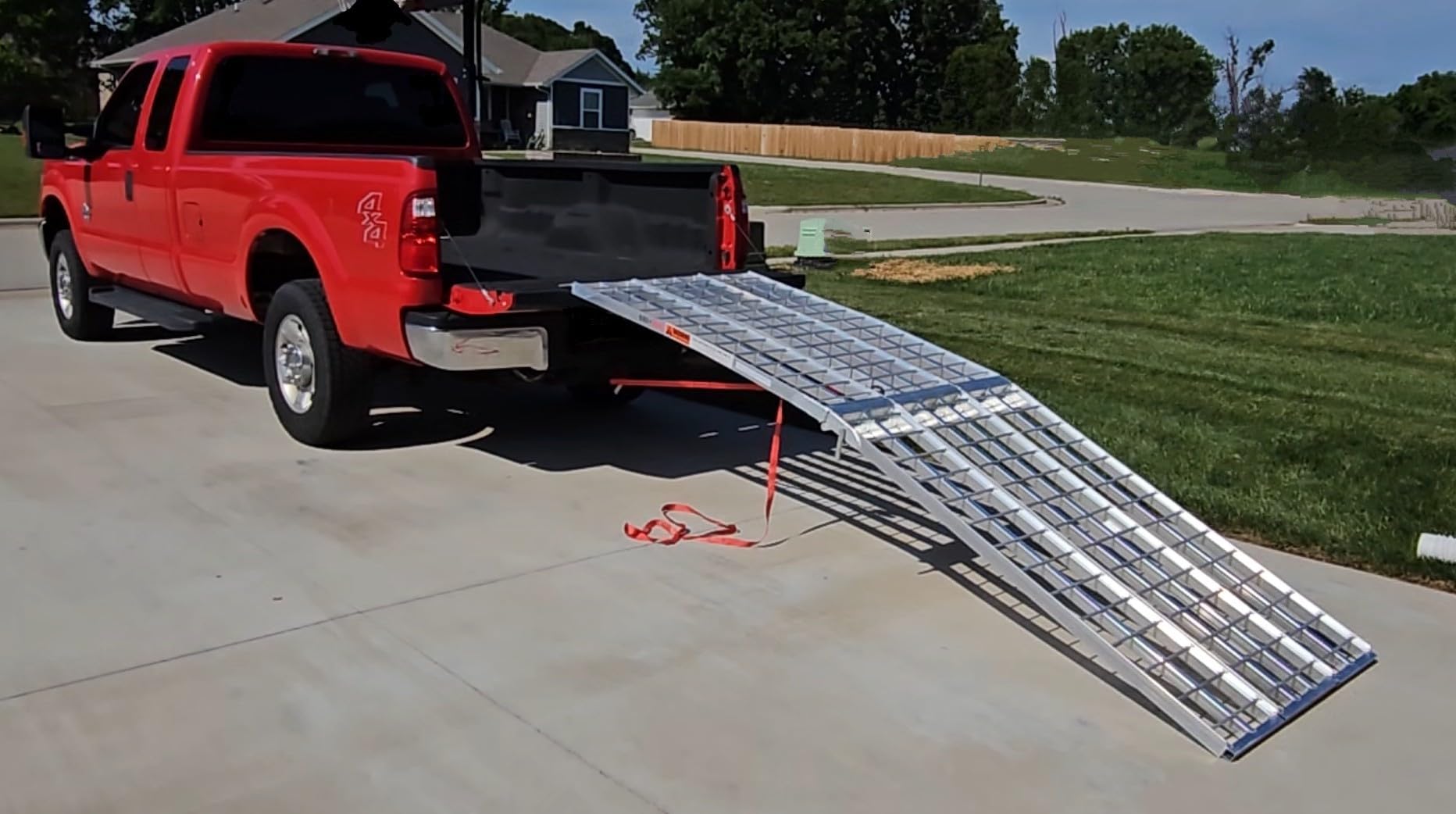
This is the wide-deck answer for big bikes. A Street Glide, Road Glide or Gold Wing has the weight and the low exhaust that defeats narrow single runners, and the 38 inch arched deck gives the rider room on both sides so the bike can be walked up rather than pushed.
The arch is doing real work here. Owners loading low-exhausting cruisers report the curve keeps the bike from bottoming out on the tailgate pivot, and the 1,500 lb rating sits comfortably above a heavy touring bike plus rider. The 10 ft length also gives a workable angle on a three-quarter-ton bed.
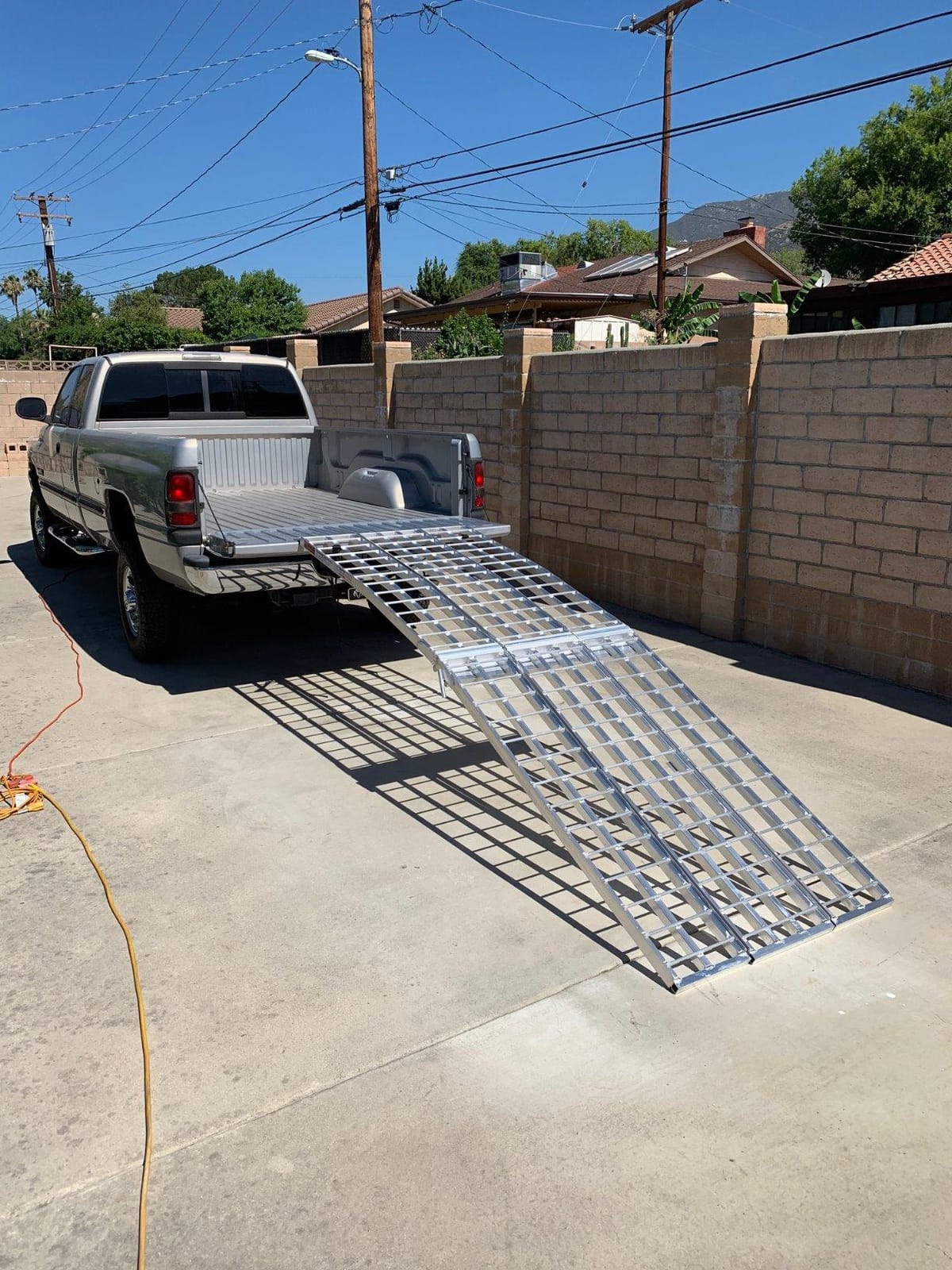
Each of the three sections folds in half for transport, and the 5 year manufacturer warranty is the longest in this group. For a ramp expected to sit in a truck bed for a decade, that warranty length is a fair proxy for build confidence.
It is a three-piece design, meaning the center section and two side sections assemble into one wide deck. That is what allows 38 inches of width without a 38 inch wide single object to wrestle into the bed.
Who the Black Widow 3-piece suits
It suits owners of heavy cruisers, touring bikes and large adventure bikes who want to walk their machine up with a spotter rather than ride it. Riders with back or knee problems find a walkable wide deck much easier than a single narrow runner.
The 10 ft length also makes it the natural choice for three-quarter-ton and one-ton beds. The published limit is a loading height of 35 inches, so check your bed before committing.
Where it falls short
At 81 lb this is a two-person lift and it is the heaviest ramp in the group by a wide margin. Buyers with a half-ton truck should weigh the handling honestly before ordering.
The sections can separate or gap at the bottom unless you cinch a strap underneath, and the mid-span hump lifts the front wheel abruptly, which some riders find harder than a flat profile. The outer sections are not checker plated, so shoes can catch in the holes.
6. VEVOR 7.5 ft 1500 lb 2-Pack – Best Two-Ramp Value Set
- Two ramps let you walk beside the bike
- 1500 lb pair holds heavy equipment
- Light at 32 lb for the pair
- Reinforced joint latches securely
- Gloves included
- Actual width closer to 11 in than the 12 in listed
- Sharp aluminum edges
- Lowest rating in this group at 4.1
- Service reported as unresponsive
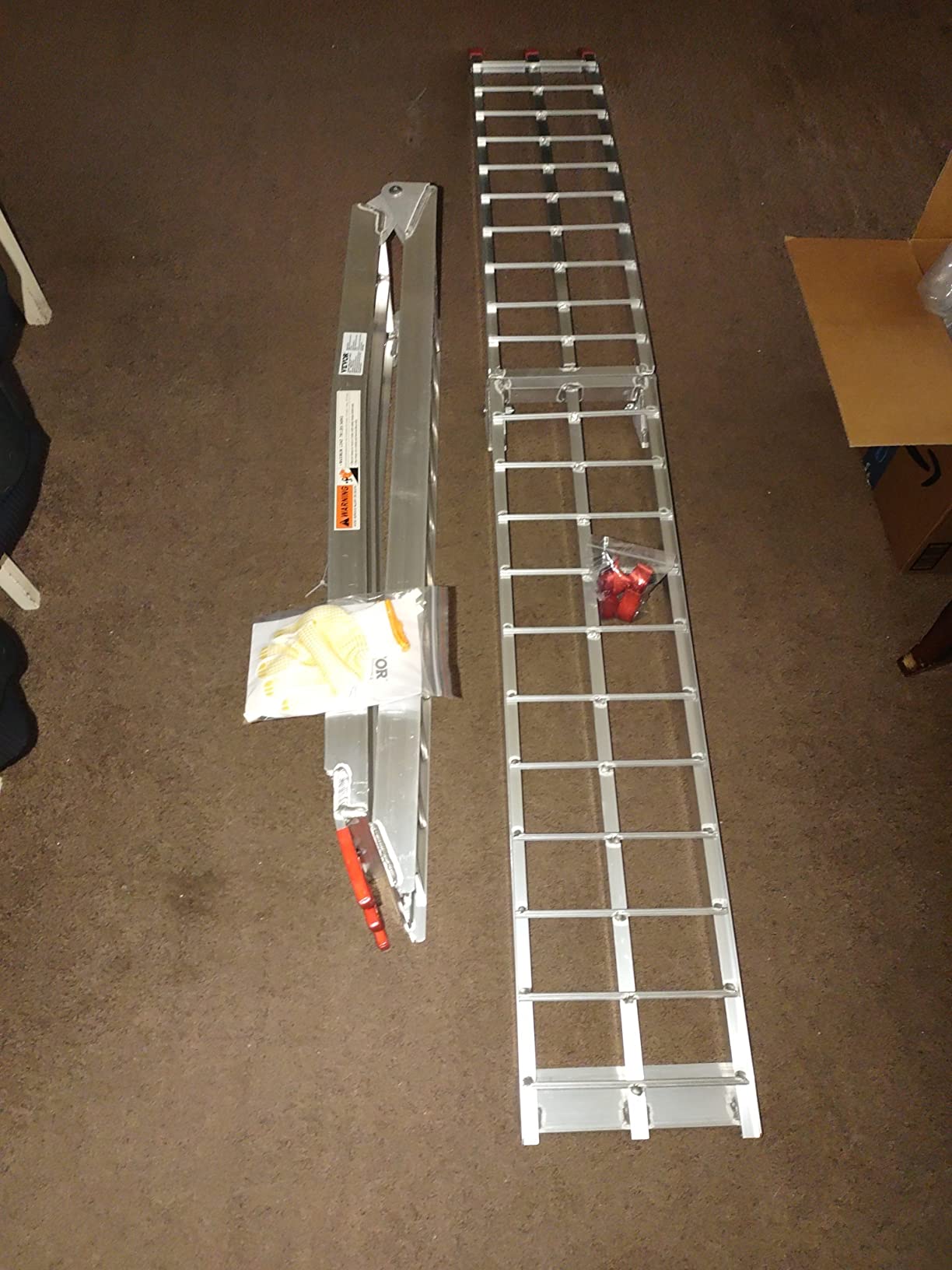
Two ramps change the loading technique completely, and this set gives you that for less than most single wide decks. With one ramp on each side of the tire, you can walk up beside the bike, correct a lean early and generally load faster than you can on a single deck.
The rating is 1,500 lb per pair, or 750 lb per ramp, and owners report holding a fully loaded KLR 650 or an ATV without flex. At 32 lb for the pair it is light enough that one person can position each ramp separately, which is a genuine advantage over the 81 lb wide decks.
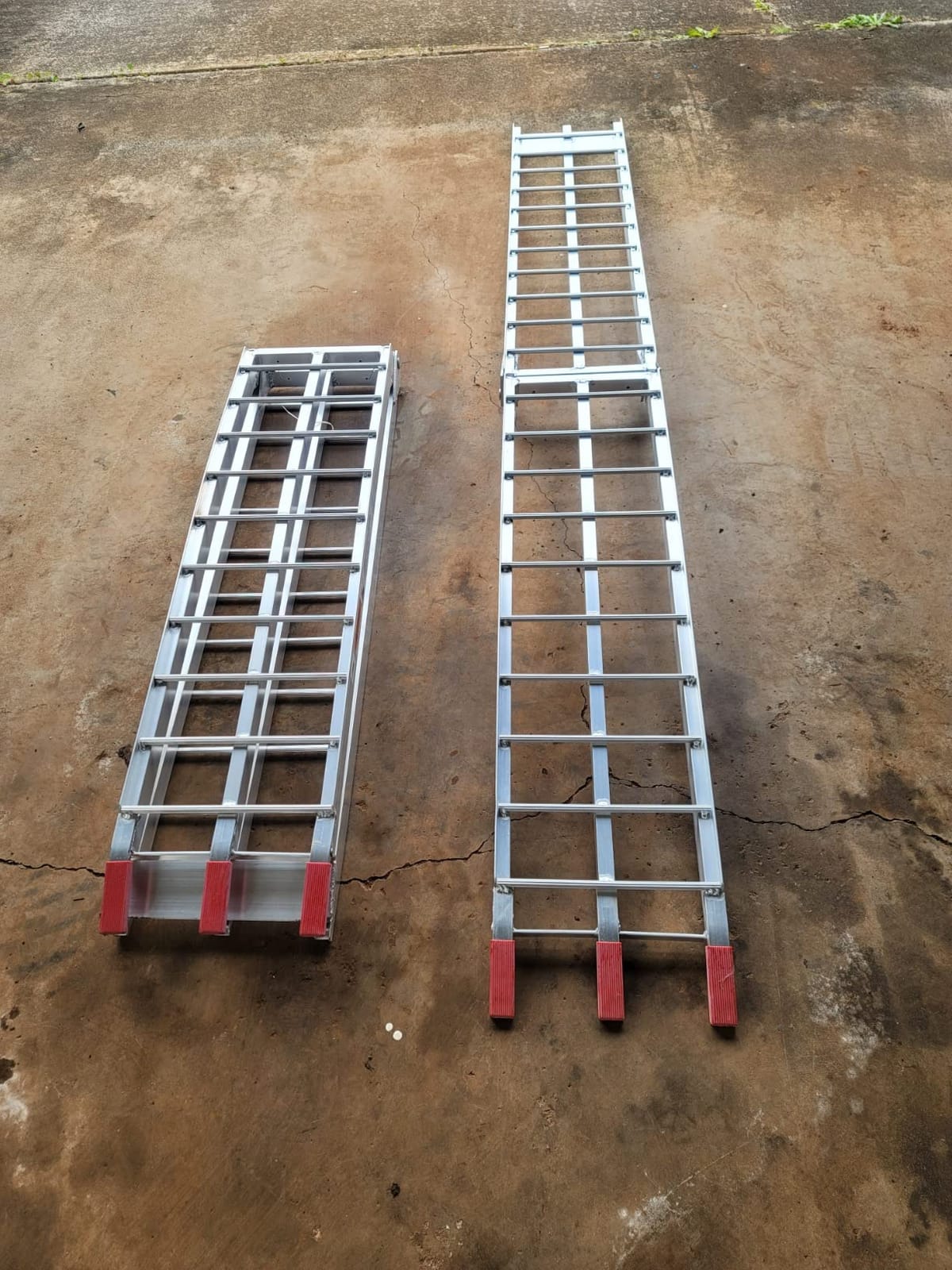
The arch keeps the bike off the tailgate pivot, and the reinforced triangular joint folds smoothly and latches snugly, which stops the two halves drifting apart mid-climb. One owner pointed out the useful bonus that the second ramp doubles as a walkway while you position the first.
Each ramp folds to about 45.7 inches, so the pair stows along a bed wall without taking much room. Rubber-tipped fingers and adjustable safety straps keep the tops from sliding off the tailgate.
Who the VEVOR pair suits
It suits anyone who prefers a two-wheel track and a spotter-friendly load over a single wide deck, especially on a truck with a bed under 32 inches. The included gloves are genuinely useful because the finish is rougher than the photos suggest.
It is also a good multi-use pair for an ATV, a UTV or a riding mower, since the spacing between the ramps can be set to match the equipment’s wheel track.
Where it falls short
The listed 12 inch width measures closer to 11 inches, which owners flag as misleading and which narrows the wheel path. At 4.1 stars with 15% one-star reviews, this is the lowest-rated ramp we include, and the reported gaps about the sizing discrepancy did not help confidence.
There is also no manufacturer warranty listed. Budget for a ratchet strap and expect to file the edges down before the first load if you are handling the ramp without gloves.
7. Gorkett 6 ft 440 lb Folding Ramp – Best for E-Bikes and Small Machines
Gorkett 6FT Folding Motorcycle Loading Ramp, 440 lb Aluminum Ramp for Bikes
- Only 8 lb
- easy to carry and store
- Tall side rails keep the tire tracking
- Perforated holes grip and drain water
- Backing pads protect the tailgate
- 440 lb and 5.3 in channel rule out most full-size bikes
- Some describe the deck as shaky
- Strap has a hook on one end only
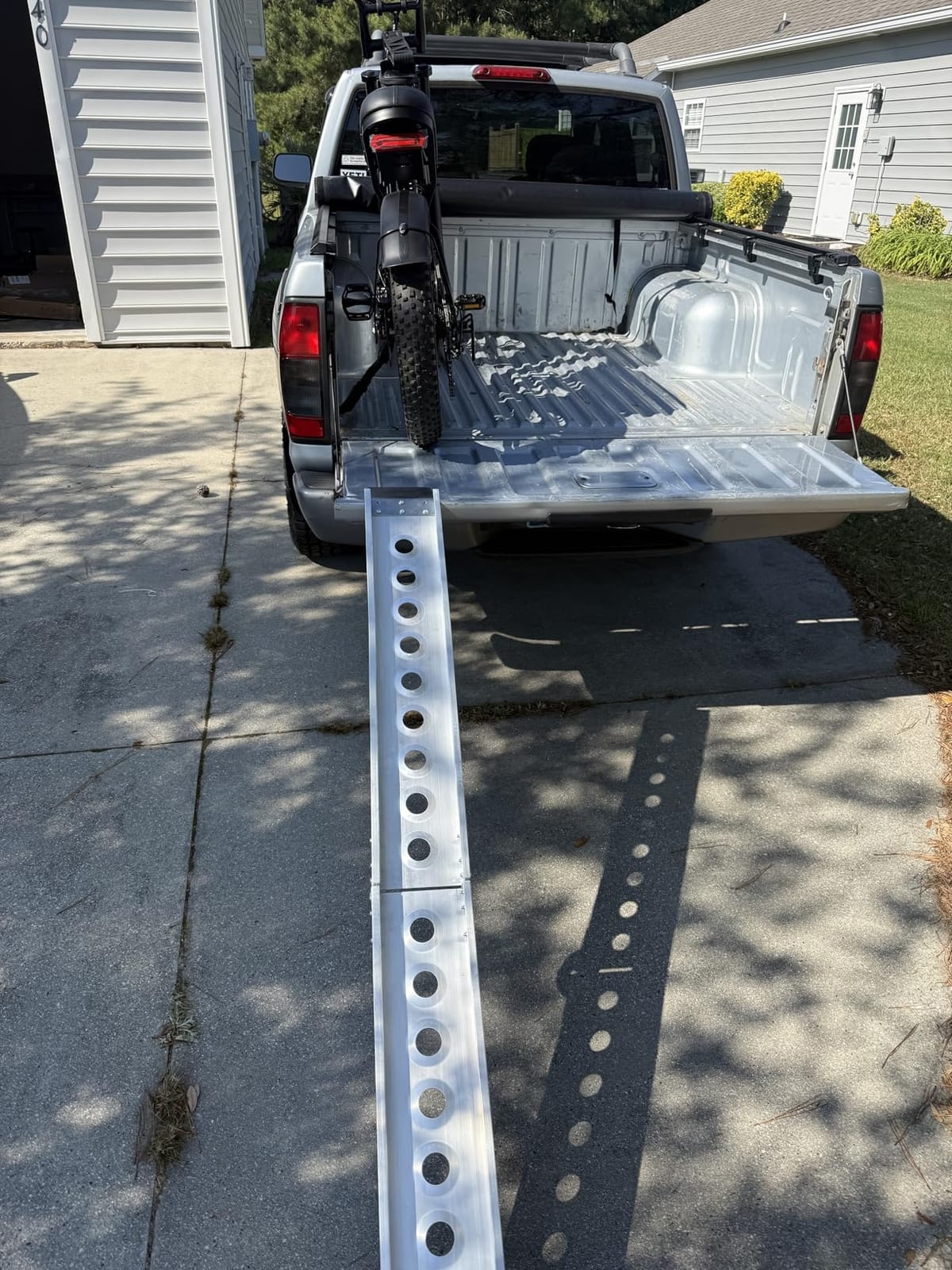
This is not a full motorcycle ramp and we want to be clear about that. At 440 lb with a 5.3 inch inner channel, it is built for e-bikes, scooters, small dirt bikes and bicycles, and any rider with a 500 lb or heavier street bike should look elsewhere in this list.
What it does well is weight. At 8.03 lb it folds to 37.8 inches and can live permanently in a cab or under a seat, which no other ramp here can claim. For someone moving e-bikes to a trailhead or a bike to a repair shop several times a month, that permanent storage is the whole point.
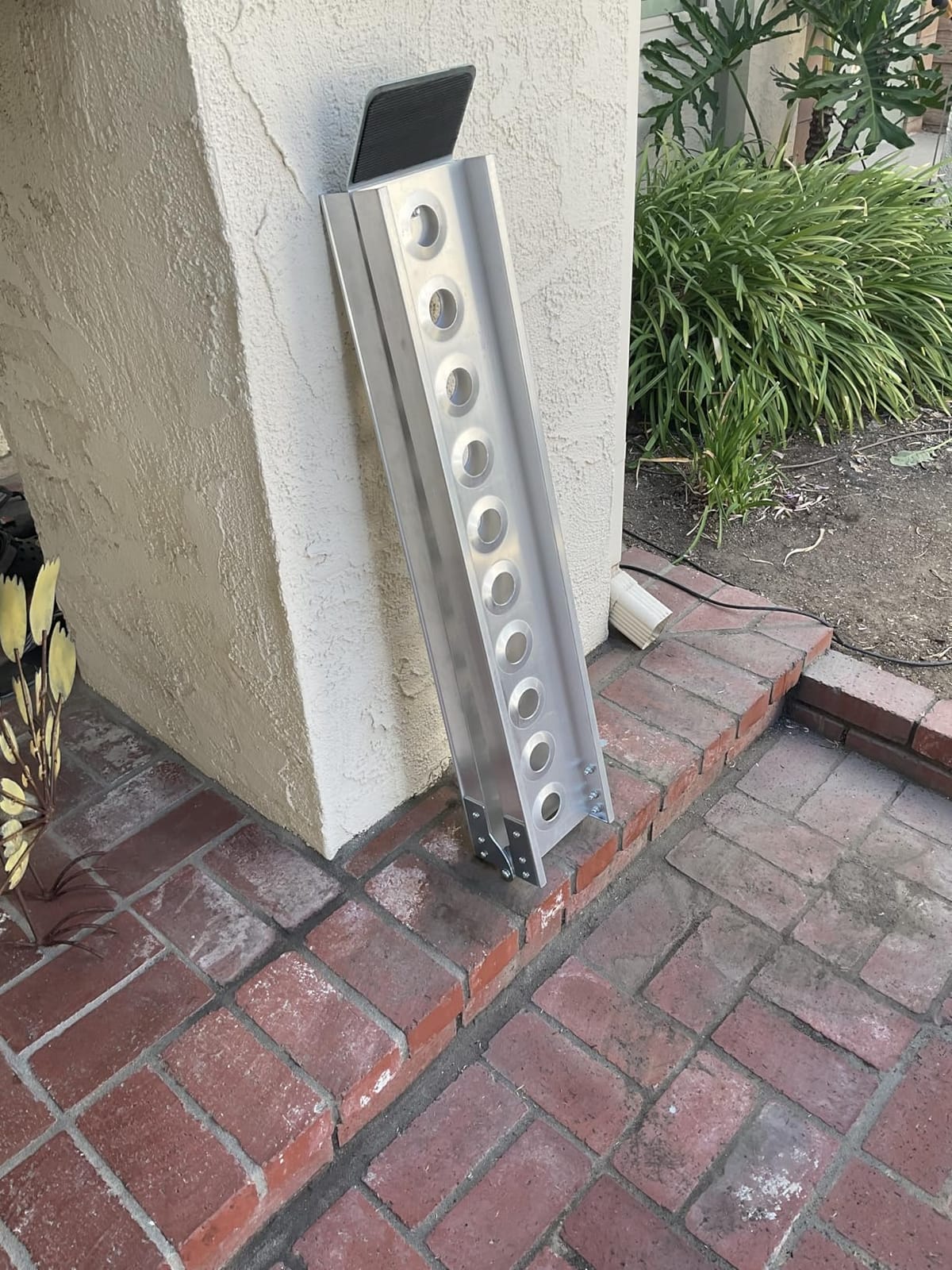
The tall side rails are more useful than they look, channeling the tire so it tracks straight rather than wandering on a 6.4 inch wide deck. Perforated holes give grip in the wet and let water drain instead of pooling. Protective backing pads on the top fingers protect tailgate paint.
Owners report it handling heavy e-bikes and small dirt bikes without complaint. The 72.4 inch length gives a workable angle on a lower-bed truck, but the narrow channel is the limit, not the capacity.
Who the Gorkett ramp suits
It suits e-bike and scooter owners, small dirt bike riders and anyone moving a bike inside a van or SUV. The fold-flat size means it can stay in the vehicle permanently instead of living in a garage.
It is also a reasonable second ramp for a rider who already owns a wide deck and wants a lightweight narrow option for bicycles and small machines.
Where it falls short
Do not stretch this one. A 440 lb rating and a 5.3 inch inner channel exclude most full-size motorcycles, and a handful of reviewers describe the deck as shaky or flimsy under load.
The supplied strap has a hook on one end and no way to secure the open end, so it is a tether rather than a restraint. Buy a proper cam buckle or ratchet strap to go with it.
8. Ruedamann 7.5 ft Ribbed Aluminum Ramp – Best Flat Deck for Tire Grip
- Flat ribbed surface rolls tires up easily
- Light at 15.6 lb with a latching handle
- Ribbed texture holds traction wet
- Rubber-wrapped edges protect the truck
- Strong enough for a Yamaha MT-10
- Sold as a single ramp only
- One unit arrived missing a part
- One unit showed transit damage
The defining feature here is a flat ribbed surface instead of ladder-style rungs, and owners consistently say it is the reason the ramp rates so well. A tire rolls up a continuous surface without catching on a crossbar, which makes the climb smoother and less likely to unsettle a heavy bike mid-ramp.
At 4.6 stars from 259 reviews it is among the highest-rated ramps here. The ribbed texture is pressed directly into the aluminum, so there is no separate tread layer to peel off or wear through, and it holds traction in wet conditions.
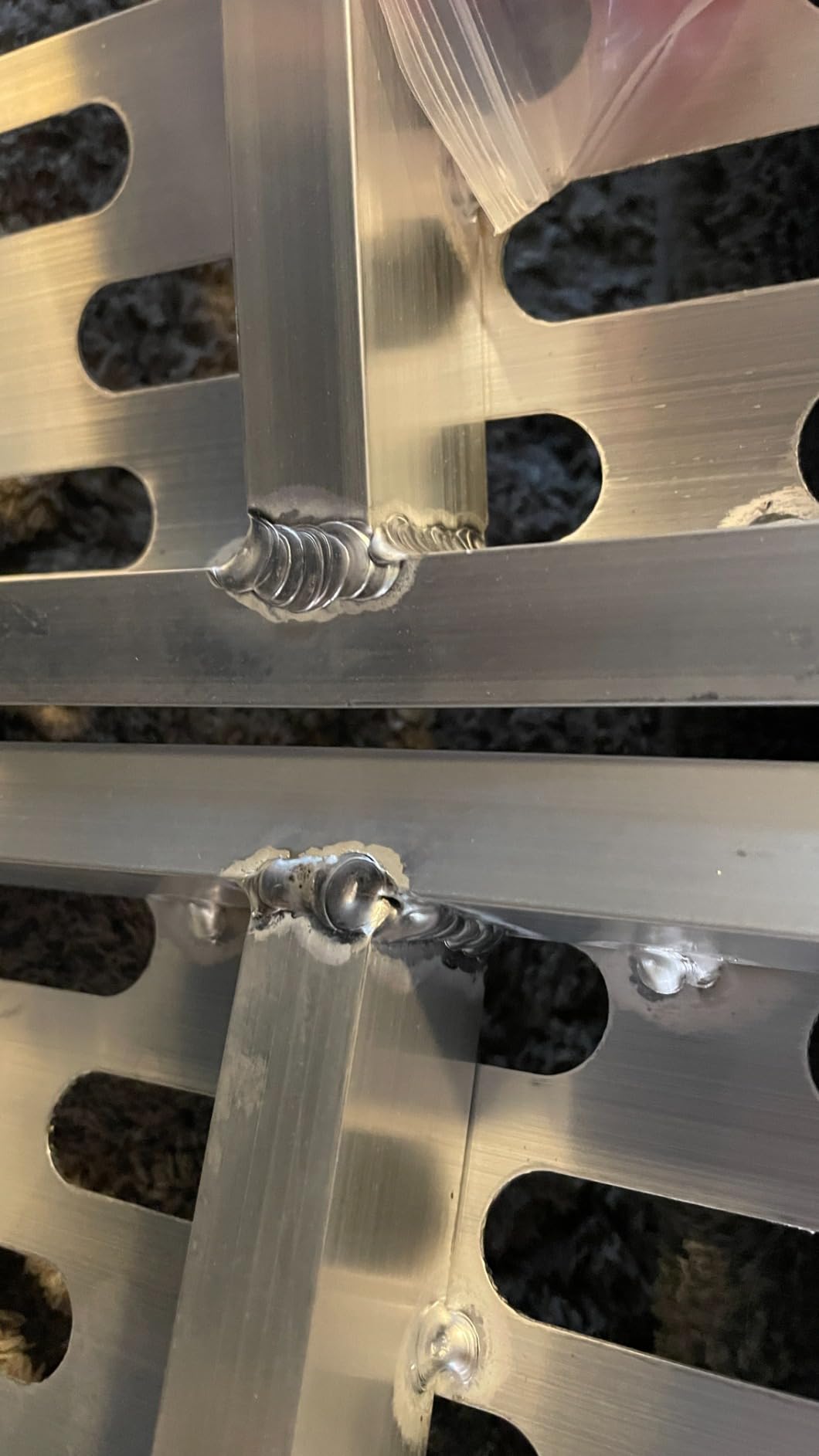
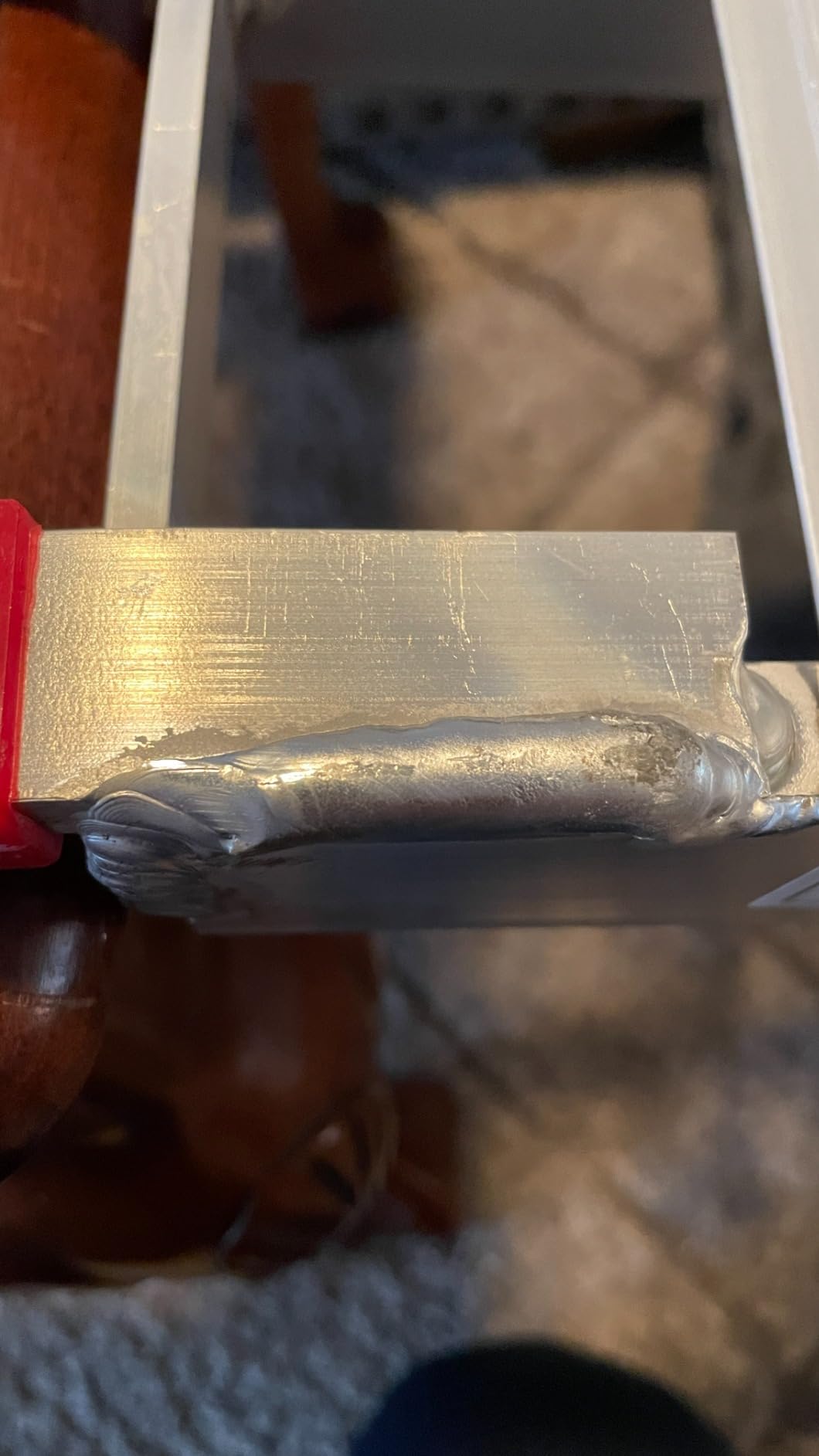
It weighs 15.6 lb and folds to 45.3 by 11 by 5.7 inches, and the rubber handle doubles as a latch that holds the folded ramp shut. Rubber-wrapped edges protect tailgate trim and add stability against the gate, and the rear welding is reinforced for durability.
Capacity is 750 lb per ramp, which suits a street bike plus rider. Owners report it handling a Yamaha MT-10 and, used as a pair, an ATV.
Who the Ruedamann ramp suits
It suits riders who want the smoothest possible climb on a factory-height or midsize bed, and anyone loading a bike in the rain or on grass where a ribbed surface reads better than open rungs. The 7.5 ft length keeps the slope gentle for walking a bike up.
Buyers who load a mix of motorcycles, e-bikes, mowers and snow blowers get a single deck that handles all of it, provided they buy a second ramp for full-width equipment.
Where it falls short
It is a single ramp, and several buyers expected a pair, so read the pack count before ordering. For wide machines you will need a second unit or a wide-deck design.
Quality control is the other soft spot, with reports of a missing rubber cover on one unit and light transit damage on another. Inspect the ramp and its rubber parts the day it arrives.
9. VEVOR 8810 lb 72 in 2-Pack – Best for Tractors and Multi-Use Equipment
- Very high rating for its weight
- 15 in width gives real wheel-path room
- Stair-step rungs spread the load
- Top hook end resists tipping
- Hollow build stays portable
- Part number lists 6800 lb while the title says 8810 lb
- No owner review text was returned
- No manufacturer warranty listed
This pair is rated well past anything a motorcycle needs, and we include it because a lot of buyers buy one ramp and end up wanting to move a compact tractor, an ATV or a UTV with the same gear. At 4.7 stars with 193 reviews it is tied for the highest rating in this group.
The listing rate is 8,810 lb while the manufacturer part number reads 6800 lb, and buyers should note that discrepancy. Either figure is far beyond a bike, so the capacity question is academic for a motorcycle but matters if you borrow it for a tractor.
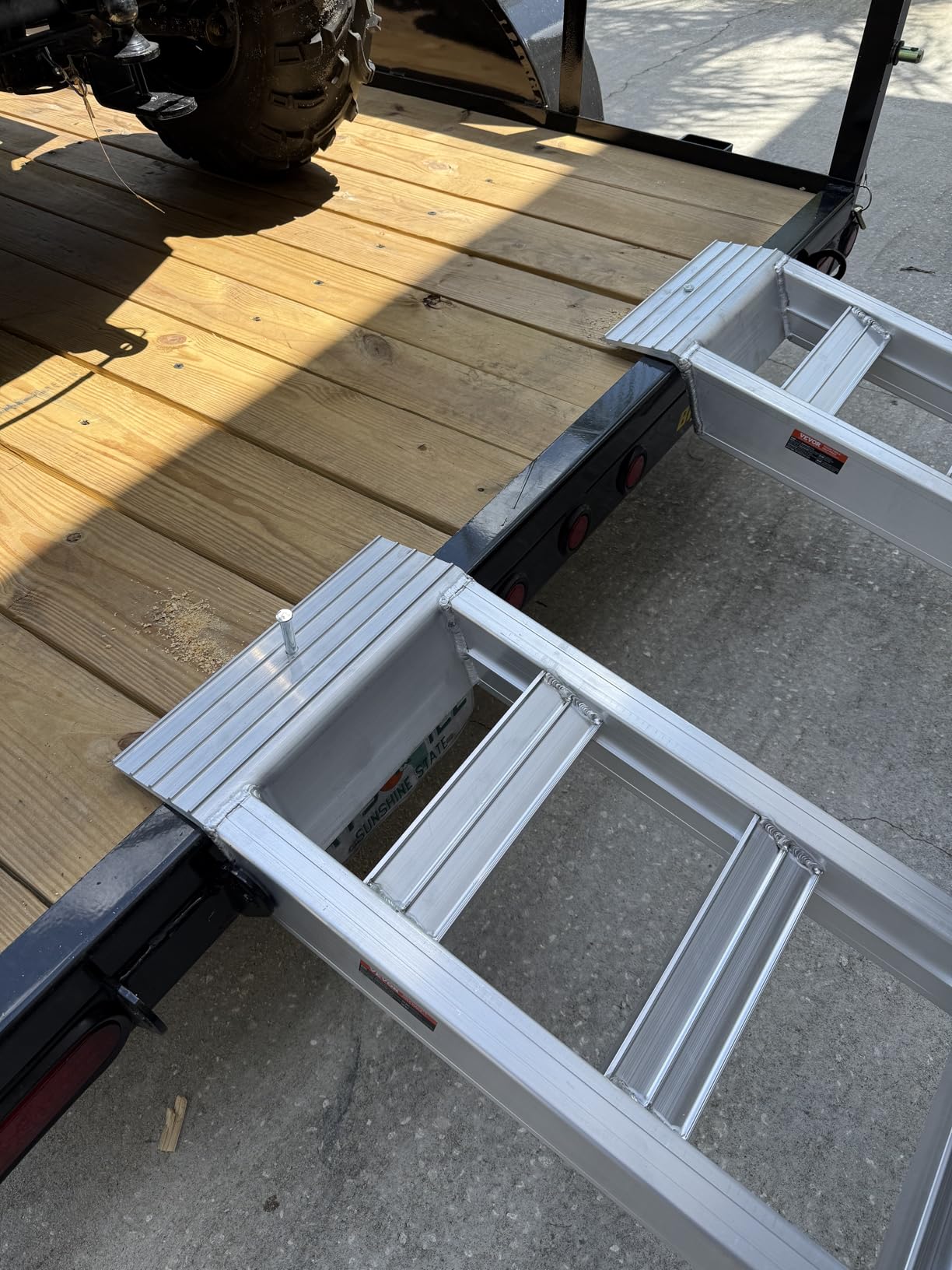
Construction is a hollow stair-step design with a 2 inch thick main beam, and the 15 inch width gives more wheel path than the narrow runners elsewhere in this list. Stair-step rungs increase friction and spread load evenly, and the top hook attaching end with an extension plate resists tipping.
Adjustable safety straps are included and thick gloves are in the box. At 61 lb for the pair it is portable enough to move around a garage or a truck bed, though it is not a one-person lift for the full pair.
Who the 8810 lb pair suits
It suits owners of compact tractors, ATVs, UTVs and riding equipment who want one set of ramps to cover everything, and it works for a motorcycle as long as the 6 ft length suits your bed angle.
The 15 inch width and the hook ends make it the better choice of the two heavy-duty pairs here for a wide single-track wheel path.
Where it falls short
At 72 inches it is short for tall beds, so a 36 inch lifted truck will feel a steeper angle than the rating suggests. Length matters more for bikes than capacity does.
No customer review text was returned for this listing, so our read on it rests on the rating, the volume and the published specifications rather than on owner accounts. No manufacturer warranty is listed either.
10. MAXIVAMN 7.5 ft Punch-Plate 2-Pack – Best Punch-Plate Pair
MAXIVAMN Loading Ramps for Pickup Trucks, 7.5 ft Aluminum ATV Ramps, 2 Pack
- 1500 lb per pair with no flex reported
- Each ramp light enough to carry alone
- Punch plate grips in mud
- Rubber tips save tailgate trim
- No corrosion after rain
- Bundled straps described as cheap
- Some flex near the 750 lb per-ramp limit
- Heavier than expected for aluminum
The punch-plate surface is what separates this pair. Instead of open rungs, the deck is a perforated plate that gives the tire multiple contact points, and motorcycle owners report loading a CBR1000RR into a Honda Ridgeline with room to spare and citing the grip in muddy ground.
Each ramp measures 89 by 12 inches and folds to about 44.5 inches with built-in carry handles, and the pair is rated at 1,500 lb combined or 750 lb per ramp. One reviewer loaded an 800 lb total combination with no flex or wobble.
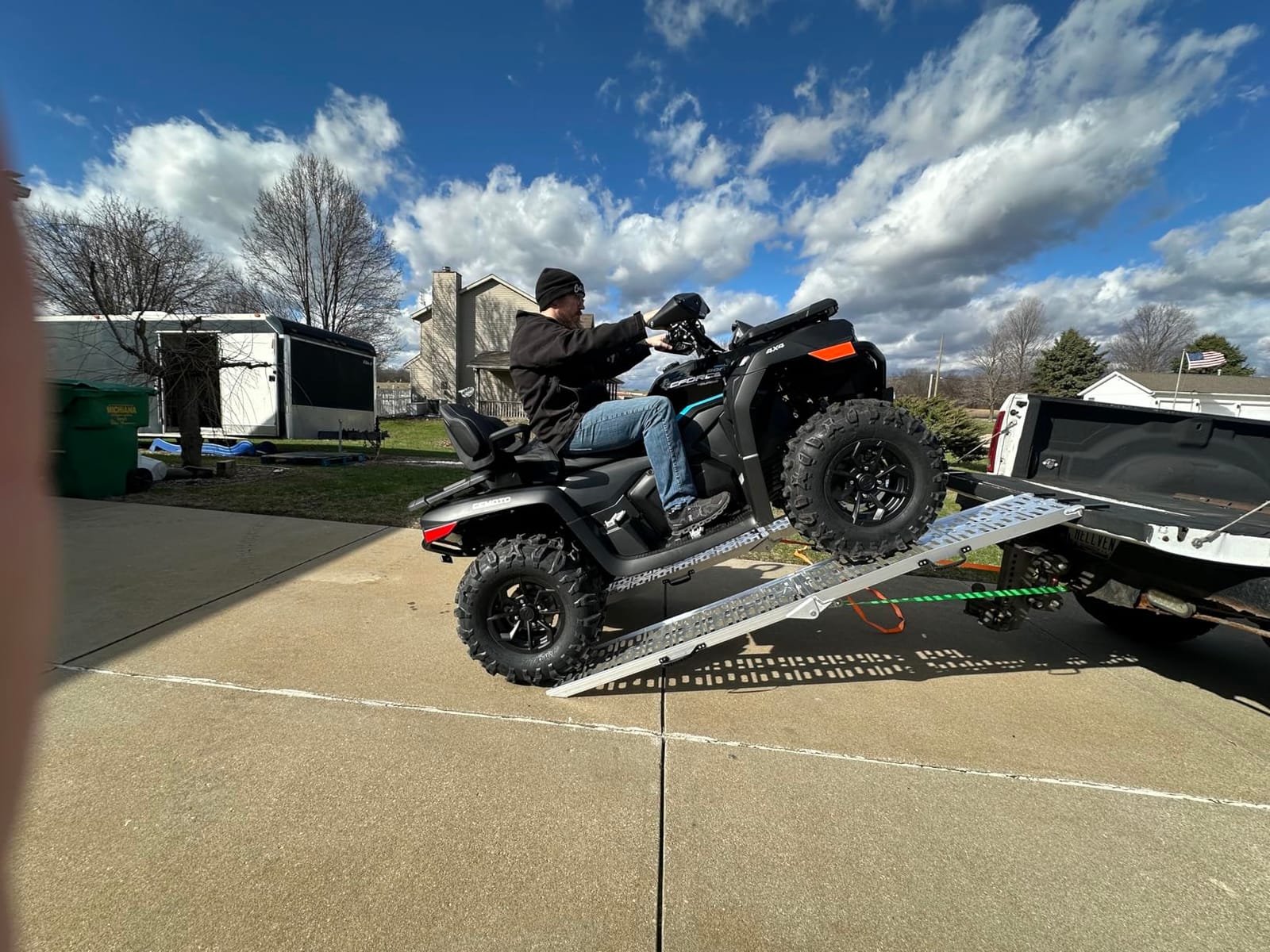
Rubber-tipped upper fingers grip the tailgate without cutting up tailgate trim, and each ramp ships with its own safety strap. The listed weight is 14.4 kg per ramp, and users confirm the aluminum shows no corrosion after sitting out in a drizzle.
The two-ramp layout also suits wider equipment. Buyers use it for ATVs, UTVs, riding mowers and garden tractors by widening the spacing to match the wheel track, which makes it a genuine multi-use set rather than a bike-only ramp.
Who the MAXIVAMN pair suits
It suits riders who load in mud, grass or rain and want a continuous surface under the tire, and it suits anyone who wants a two-ramp setup for a full-width machine without moving up to a wide three-piece deck.
At 4.6 stars from 157 reviews it sits near the top of the ratings here, and each ramp is light enough to position alone before the second is brought up.
Where it falls short
The most common complaint is the supplied straps, which owners describe as cheap even though they function. Replace them with ratchet straps before the first heavy load.
Some flex appears close to the 750 lb per-ramp rating, so it is not the right tool for a heavy touring bike with a passenger. The listing weight may also surprise you for an aluminum bi-fold set.
What Type of Motorcycle Ramp Do You Need?
For most pickup owners the answer is a folding aluminum arched ramp, at least 7.5 ft long, rated above your bike’s weight, with a rubber-tipped lip and a working safety strap. Longer than that for tall or lifted beds, wider than that for a heavy cruiser, and never lighter than a spotter for anything that weighs more than a dirt bike.
Beyond that, the market splits into four styles, and each solves a different problem.
Arched single runner. One narrow deck with a curved profile and side rails. It is the light, compact option, easiest to store of the four, and the arch is what prevents a bike from bottoming out at the tailgate. Best for one rider, one bike, a factory-height bed and light loads. This is the style most of our picks use.
Bi-fold with a walking step. A wider deck that folds into itself, often with a separate side step so the rider can walk beside the machine. It is the best choice for solo loading, since you have a handhold and somewhere to put your weight the whole way up.
Tri-fold three-piece wide deck. A center section plus two side sections that assemble into a 30 to 38 inch wide surface. It is the only style that lets you walk a heavy touring bike up with both feet on the ramp, at the cost of weight and bulk.
Two-ramp or wide plate set. A pair of narrow ramps run under each wheel, or a pair of wide plates. You can correct a lean early, the load is split across two beams, and the second ramp doubles as a walkway. It is the most forgiving setup for a spotter-assisted load.
One category we do not cover here is the generic steel tri-fold equipment ramp sold for ATVs and machinery. Those are legitimate products, but they are built for a different loading height and a different job.
How Long Should Your Ramp Be? The Bed Height Formula
The formula is a slope calculation. Measure your loading height, which is the distance from the ground to the top of the tailgate when it is fully lowered, then divide it by the tangent of your target angle. For motorcycles the accepted safe band is 16 to 23 degrees, with most manufacturers designing for the lower half of that range.
Worked example for the most common question. For a 2 foot rise, or 24 inches, a 16 degree angle needs roughly 7 ft and 8 in of run, and a 20 degree angle needs roughly 5 ft and 11 in. Add ramp structure and the tailgate lip and you want at least 7.5 ft, which is why 7.5 ft ramps are the default length in this category.
Here is what the formula produces across common bed heights, using the 16 to 20 degree band as the working range.
24 inch bed (small truck, midsize crossover): minimum run of about 5 ft 11 in to 7 ft 8 in. A 7.5 ft ramp is comfortable here.
28 inch bed (half-ton pickup): minimum run of about 7 ft to 9 ft 3 in. A 7.5 ft ramp works, a 9 ft ramp is better.
32 inch bed (full-size pickup): minimum run of about 8 ft 1 in to 10 ft 10 in. Aim for 9 ft or longer.
36 inch bed (lifted or heavy-duty pickup): minimum run of about 9 ft 2 in to 12 ft 5 in. This is where 10 ft ramps earn their weight.
40 inch bed (heavily lifted truck): minimum run of about 10 ft 3 in to 14 ft. A bi-fold or three-piece design is the only practical answer.
Beyond length, a second number matters: ground clearance. A long, low approach angle at the top of the ramp still high-centers if the transition into the bed is abrupt, which is exactly what the arch is for. And if you can position the truck on a bank or a slope to lower the effective rise, owners recommend doing so before buying anything longer.
Which Ramps Fit Which Bed Height?
Beds under 28 inches are the easy case. Almost every ramp on this list works, and the 7.5 ft single runners are the sensible choice because they are light, easy to store and angled gently enough to walk a bike up.
Beds between 28 and 32 inches are where the 7.5 ft versus 9 ft decision bites. At 32 inches, a 7.5 ft ramp puts you near the steep end of the safe gradient, so the Titan 9 ft pair or the Ruedamann and VENDAV 7.5 ft ramps work, with the 9 ft set better on a lifted or loaded truck.
Beds over 32 inches, which means lifted trucks and three-quarter-ton models, call for the long options. The Black Widow 10 ft three-piece ramp and the Titan 9 ft pair are the two picks that make a tall bed workable, and the Black Widow carries a published limit of 35 inches.
For loaded trucks or anything past 35 inches, the honest answer is that a long bi-fold set, a purpose-built three-piece deck or a powered ramp lift is the only sensible path. The VNN ramp is published for roughly 24 to 35 inches, the KROAK for a maximum of 34.5 inches, and those limits exist because the ramp angles past them are not safe to walk a bike up.
If you are protecting the bed itself while loading, our truck bed liner roundup covers the surfaces that keep aluminum edges and rubber tips from marking paint and trim.
How to Load a Motorcycle Into a Pickup Truck Bed
Inspect the ramp before anything else. Check the welds, the hinge play, the tread condition and the rubber tips on the upper fingers. A new ramp with a cracked weld or a missing strap is not a ramp you want under a bike.
Check the strap and the bed. Confirm the safety strap is long enough to reach a solid anchor point, and clear the bed of mud, ice and loose gear before you position the ramp.
Position the truck where it helps. Where possible, park on a slight slope or bank so the bed end is lower than the front. It reduces the effective ramp angle at no cost.
Lower the tailgate fully and seat the ramp. Push the ramp hard against the tailgate so the rubber tips grip, then take up the slack on the strap so the tabs cannot walk off.
Line the bike up square. Start the bike in first gear, at idle, and use the friction zone or your feet to move it. A bike that enters the ramp at an angle is a bike that high-centers.
Ride up under control. Stay on the friction zone, keep the bars straight and look past the ramp at the bed floor, not down at your front wheel. The spotter walks beside, never in front of or behind.
Roll off gently. Once the front wheel is in the bed, keep rolling until both wheels clear the transition, then brake and shift into neutral. Do not stop with the bike balanced on the hump.
Unload in reverse. Swing the front wheel down the ramp, stay on the friction zone to the bottom, and only then apply the brake. The steepest moment is the transition, not the base.
Loading a roughly 700 lb bike with the rear wheel sitting a few inches off the ground is a three-person job, and riders on forums who have done it describe the moment at the transition as the point where a spotter earns their place.
How to Secure Your Motorcycle in the Truck Bed
The standard method is ratchet straps, a front wheel chock and the bike in gear. Compressing the front suspension removes the slack that lets a bike walk forward in a stop, and the gear prevents it rolling at all. Place the bike in first gear, then compress the front end until the bars move noticeably, and strap it in that position.
Chock the front wheel first. A wheel chock under the front tire stops forward movement before any strap carries load.
Put the bike in first gear. Chain and shaft drive both need this, and it costs nothing.
Compress the front suspension. Sit on the bike or press the bars and hold, then strap from the chock to solid bed anchor points.
Use ratchet straps, not the supplied cam buckles. Owners across forums consistently report replacing bundled cam-lock straps with ratchet hardware before the first load.
Strap to rated anchor points. Use the bed’s tie-down loops or rails, never to a plastic tie-down insert alone.
Add a rear strap on heavy bikes. A touring bike or an adventure bike with a loaded tail gets a second strap at the rear so it cannot pitch under braking.
Re-check after five minutes of driving. Straps settle and hardware loosens, so tension them once more before you leave.
Re-check the ramp too. If the ramp is still in the bed, strap it separately so it cannot become a projectile on a hard stop.
Straps, chocks and tie-down points are the parts most often bought after the ramp itself, so budget for them together. If your truck also carries a bull bar or grille guard, our bull bar roundup for pickup trucks covers the fit checks worth doing before drilling, and a truck-rated floor jack is the other tool that earns its keep in the same bed.
Buying Guide: What Actually Matters in a Motorcycle Ramp
Length versus bed height. This is the first and hardest constraint. Use the formula above, add a margin, and remember that the loading height is measured with the tailgate fully lowered, not with the bed floor at the tailgate lip. A truck that measures 30 inches at the rear may be closer to 32 inches where the ramp meets the bed.
Load capacity with a margin. Published ratings across this category run from 440 lb to well past 8,000 lb, and most listings give a per-ramp figure plus a per-set figure. VEVOR’s 7.5 ft pair is 1,500 lb as a pair and 750 lb per ramp, which tells you which number to read. Add a 20% margin over your bike’s weight, and add your own body weight if you ride up.
Aluminum versus steel. Every ramp we reviewed is aluminum, and the reason is weight. Aluminum runs at roughly a third of the weight of steel at comparable stiffness, which is the difference between a one-person carry and needing a second pair of hands. Steel wins on raw strength and on a wide multi-use deck, and costs more to move.
Arched versus straight. An arch raises the surface under the bike as it approaches the tailgate, which prevents the high-centering that ends rides on short ramps with low ground clearance. On a lifted truck, treat the arch as a requirement rather than a preference.
Single runner versus two ramps or a wide deck. A single runner is the light and compact option, and a spotter handles it safely. Two ramps let you correct a lean and give the rider a place to walk. A wide three-piece deck is the only option that lets both feet stay on the ramp with a heavy touring bike. Match the style to the bike and to whether you load alone.
Safety straps. Owners across forums name this as the most commonly omitted safety item. A ramp that can slide off the tailgate is a ramp that can take a bike down with it, and a cheap strap with a single hook is worse than a proper ratchet strap because it encourages false confidence.
Folded length and tailgate-closed storage. Check the folded length against your bed before you order. Ramps that fold to 45 inches or less fit against a bed wall with the tailgate shut, while a 38 inch wide three-piece deck takes a large share of a short bed.
Traction surface. Open crossbar rungs shed mud and grass, flat ribbed surfaces roll a tire up without catching, and perforated punch plate gives multiple contact points. Whichever you choose, dry it off after muddy loads because wet mud on any of these surfaces is slippery.
Build quality and origin. Inspect welds, hinge play and tread finish on arrival. Owners weigh American-made ramps against imported budget models largely on weld and hinge durability, and the practical test is simple: a hinge with visible play will develop more of it after a season of loading.
Weight per ramp. Anything under 16 lb can be carried by one person into a bed. Above 30 lb you are planning a two-person lift, and at 81 lb you need a ramp that breaks into pieces, which is the Black Widow’s argument for its 3-piece design.
Frequently Asked Questions
How much weight can a truck ramp hold?
Ramp ratings in this category run from 440 lb for light e-bike models to more than 8,000 lb for equipment-rated pairs. Most listings publish both a per-ramp and a per-set figure, so a pair rated 1,500 lb is 750 lb per ramp. Add a 20% margin over the combined weight of bike and rider, and only ever load a ramp evenly distributed.
How long should a motorcycle ramp be for my truck bed?
Measure the loading height from the ground to the top of the lowered tailgate, then keep the angle between 16 and 23 degrees. A 24 inch rise needs about 7.5 ft of run, a 32 inch rise needs about 9 ft, and a 36 inch rise needs 10 ft or a bi-fold set. Lifted trucks past 35 inches need the longest options available.
What is the best type of ramp to load a motorcycle into a truck?
A folding aluminum arched ramp, at least 7.5 ft long, rated 20% above your bike’s weight, and fitted with a safety strap. Add width or a second ramp for a heavy touring bike, and go longer for a lifted truck. Steel is rarely necessary because weight, not strength, is the limiting factor for most bikes.
Can you load a motorcycle into a truck by yourself?
It is possible with a wide plate ramp that includes a separate walking step, which gives you a handhold while you walk. For a narrow single runner or a heavy bike, use a spotter. Manufacturer usage guidelines call for a second person, and riders have reported unloading a 700 lb bike with three people rather than risk it alone.
How do you secure a motorcycle in a pickup truck bed?
Chock the front wheel, put the bike in first gear, compress the front suspension, then strap with ratchet straps to the bed’s rated tie-down anchors. Add a rear strap for a heavy bike, and re-check the tension after five minutes of driving. Owners recommend replacing any bundled cam-buckle strap with proper ratchet hardware.
Which Motorcycle Ramp Should You Buy?
Start with two numbers. Measure your loading height, and weigh your bike. Those two figures eliminate most of the field instantly, and everything after that is preference.
For most riders on a factory-height or midsize bed, the VENDAV 7.5 ft folding ramp is the pick, because a 4.7 rating across 489 reviews and a 15.5 lb weight make it the one most people can use without help. If your bed is lifted or you are over 32 inches at the tailgate, move up to the Titan 9 ft pair, which is where the extra length does the most good.
For a heavy cruiser that needs a walkable deck, the Black Widow 10 ft three-piece ramp earns its weight and its 5 year warranty. If you load alone, the VNN ramp with the integrated walking step is the design built for that job.
Whatever you choose, add a ratchet strap and buy the length your bed height actually asks for. That is the whole decision, and the broader loading ramp guide covers the options for other vehicles too.