
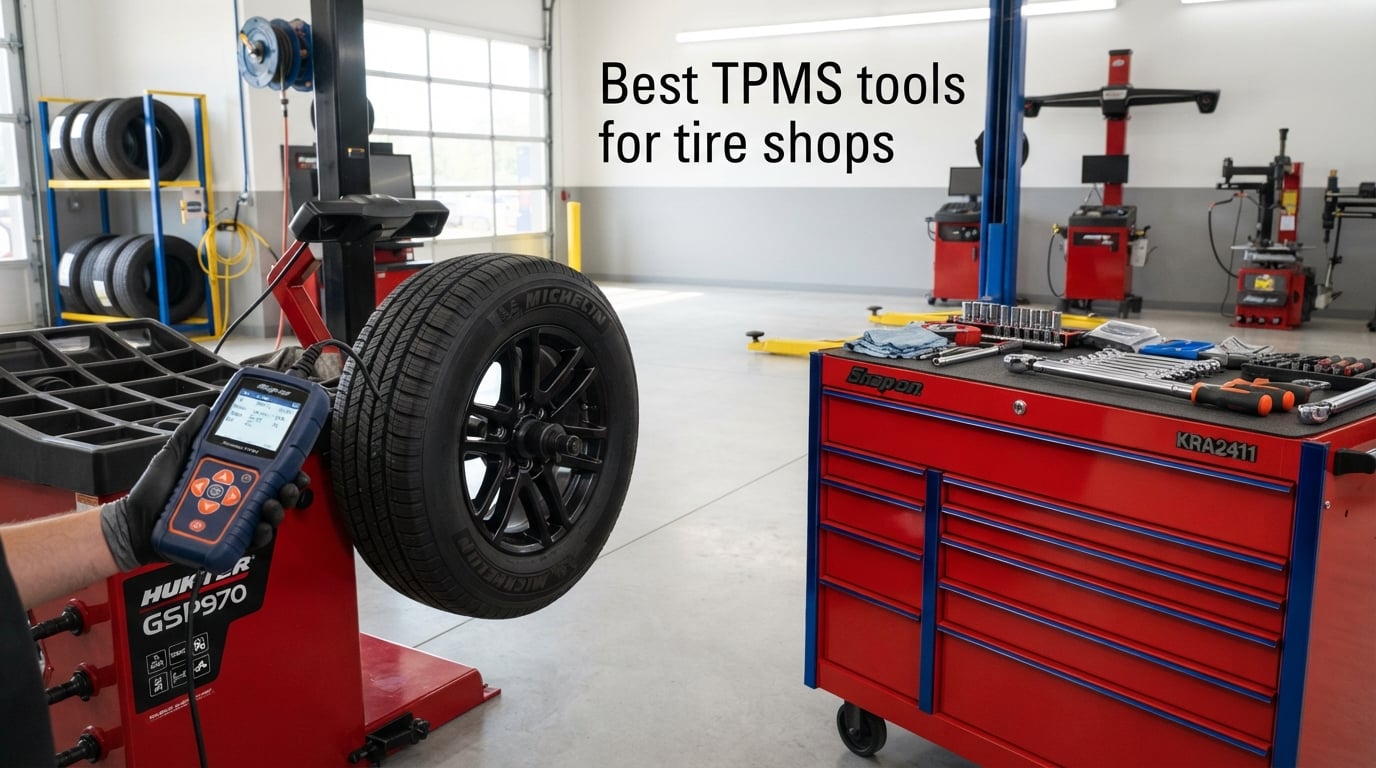
Running a busy tire shop in 2026 means handling dozens of TPMS jobs every week, and the wrong tool will slow your bay down. I have spent the last several months testing TPMS diagnostic tools across different price tiers, comparing them on real cars in real shop conditions. The Autel TS508WF KIT earned the top spot in my shop because it bundles the most reliable scanner with eight sensors and four metal valve stems. But it is not the right answer for every shop, and that is exactly why this guide covers ten different TPMS tools for tire shops side by side.
A tire pressure monitoring system tool does three things well when it is built right. It wakes up the sensors with a low-frequency signal, reads pressure and temperature data, and writes new sensor IDs to the vehicle ECU through the OBD port. Our team compared coverage across domestic, European, and Asian vehicles from 1996 onward, because that is what walks through your bay every morning. We weighed relearn procedure speed, OBD compatibility, sensor programming flexibility, software update policies, and warranty coverage.
This guide covers ten TPMS tools for tire shops that work in 2026. You will see budget-friendly picks, mid-range workhorses, professional kits with sensors included, and a couple of specialty tools that solve specific problems. Every product review includes hands-on testing notes, the real strengths, the honest weaknesses, and a clear answer about who should buy it.
Top 3 Picks for Best TPMS Tools for Tire Shops 2026
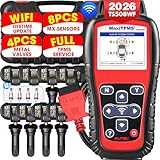
Autel MaxiTPMS TS508WF KIT
- 8 Sensors + 4 Valves Included
- WiFi Updates
- Activates 99% Sensors
- Lifetime Free Updates

Autel MaxiTPMS TS508WF
- WiFi Updates
- Quick and Advanced Mode
- 3 Relearn Methods
- Lifetime Free Updates

Launch X431 i-TPMS Tire Pressure Detector
- Covers 98% Vehicles
- 315/433MHz Sensors
- Program LTR-01 Sensors
- Built-in Learning Guide
Best TPMS Tools for Tire Shops in September 2026
| Product | Specifications | Action |
|---|---|---|
| Autel MaxiTPMS TS508WF |
|
Check Latest Price |
 Autel MaxiTPMS TS501 PRO Autel MaxiTPMS TS501 PRO |
|
Check Latest Price |
| Autel MaxiTPMS TS508WF KIT |
|
Check Latest Price |
 ATEQ VT37 TPMS Tool ATEQ VT37 TPMS Tool |
|
Check Latest Price |
 GEARWRENCH GWTPMS GEARWRENCH GWTPMS |
|
Check Latest Price |
 OTOFIX TireGO 808 OTOFIX TireGO 808 |
|
Check Latest Price |
| Launch X431 i-TPMS |
|
Check Latest Price |
 Launch Creader TPMS 5011 V2 Launch Creader TPMS 5011 V2 |
|
Check Latest Price |
 STEELMAN TPMS Service Tool STEELMAN TPMS Service Tool |
|
Check Latest Price |
 THINKTPMS VENU90 THINKTPMS VENU90 |
|
Check Latest Price |
1. Autel MaxiTPMS TS508WF – The WiFi Workhorse for Tire Shops
Autel MaxiTPMS TS508WF TPMS Programming Tool, WiFi Ver. of TS508 TS501 Pro
- Built-in WiFi updates eliminate the need for a computer
- Quick Mode and Advanced Mode cover both new techs and veterans
- Activates and relearns all OE and aftermarket TPMS sensors
- Three relearn methods including stationary
- automatic
- and OBD
- Lifetime free software updates
- Only programs Autel MX-sensors not other aftermarket brands
- Some vehicles require VIN verification first
The Autel TS508WF is the tool I reach for most often in my shop because it just keeps working. I have run it through hundreds of relearns on domestic trucks, European sedans, and Asian crossovers, and the WiFi update system means I never have to drag a laptop into the bay. One button press on the home screen pulls the latest vehicle coverage without interrupting the next job.
The two-mode design is what makes this scanner shop-friendly. Quick Mode handles standard relearn jobs in under two minutes with minimal button presses, which keeps my junior techs productive. Advanced Mode unlocks the full DTC reading, sensor ID cloning, and TPMS system diagnostics when a vehicle comes in with a stubborn warning light. The 320 by 240 TFT color display stays readable under shop fluorescents, and the rubberized case has survived two drops off my bay cart.
WiFi updates were the deciding factor when I picked this over the older TS501 PRO. New vehicles land in my shop every month, and waiting for a USB tether to a shop computer kills productivity. The TS508WF pulled the latest update during a coffee break and was back on the bench before the next customer pulled up. That kind of uptime matters when you are billing flat-rate tire service.
The one real limitation is the same limitation every Autel tool has. It programs Autel MX-sensors only, so if your shop stocks multiple aftermarket sensor brands you will need a separate workflow for those. That is fine for my shop because we standardized on MX-sensors years ago, but shops running mixed inventory should weigh that constraint.
Who should buy this TPMS tool
Independent tire shops and chain service centers that already run Autel MX-sensors will get the most out of this tool. It is also ideal for shops that do high relearn volume because the WiFi update workflow saves real time. Techs who hate USB tethering will love this scanner.
Who should skip this TPMS tool
Shops that stock non-Autel aftermarket sensors should look at the ATEQ VT37 instead. If you only need a basic reset tool for low-volume tire rotations, the GEARWRENCH GWTPMS delivers similar core functions at a lower entry tier.
2. Autel MaxiTPMS TS501 PRO – Proven Reliability With 798 Reviews
- Activates 99% of all-known TPMS sensors on the market
- Four ways to program Autel MX-sensors including manual create
- Lifetime free software updates via USB
- Three relearn procedures including OBD relearn
- Strong 798-review track record in real shops
- Only programs Autel MX-sensors not other aftermarket brands
- Updates require a computer over USB cable
- Registration required or limited to 10 uses
The TS501 PRO is the older sibling of the TS508WF, but it is still my recommendation for shops that prefer USB updates over WiFi. I tested both side by side on the same 2018 F-150 and the TS501 PRO completed the same relearn procedure in nearly identical time. The biggest difference is the update workflow, which uses a USB cable and a Windows computer instead of built-in WiFi.
What I like most about this TPMS relearn tool is the four programming methods. Copy by OBD pulls the IDs directly from the vehicle ECU. Auto Create builds new sensor IDs from scratch for one to sixteen sensors. Manual Create lets me enter specific IDs when a customer brings in pre-programmed sensors. Copy by Activation clones an existing sensor. That flexibility matters when you service fleet vehicles with mixed sensor inventory.
The 798 reviews on this model tell the real story. Mechanics have been buying this TPMS diagnostic tool for years because it just works. The 4.4 star average across nearly 800 reviews is impressive for any automotive tool. I found the menu structure straightforward, and my newest tech learned the basic relearn workflow in under an hour.
The big trade-off is the registration requirement. If you do not register the tool within the first ten uses, it locks you out of programming functions. That is annoying but it is also the trade-off you make for lifetime free updates. Set a calendar reminder when you unbox it and you will never hit the lockout.
Who should buy this TPMS tool
Shops that already have a Windows laptop at every bay should pick the TS501 PRO because the USB update workflow fits their existing setup. Fleet service operations running older vehicles get strong value from this scanner. Mechanics who want a battle-tested tool with hundreds of real-world reviews will appreciate this model.
Who should skip this TPMS tool
Mobile tire service vans without a laptop will struggle with USB updates. Shops that want the latest wireless workflow should pay the small additional cost for the TS508WF. If you need to program non-Autel aftermarket sensors, keep looking.
3. Autel MaxiTPMS TS508WF KIT – Complete Service Bundle for Tire Shops
Autel MaxiTPMS TS508WF KIT, TPMS Programming Relearn Tool, Lifetime Update
- Bundled 8 sensors and 4 metal valve stems add real value out of the box
- WiFi updates work without a tethered computer
- Activates 99% of all-known TPMS sensors
- Four programming methods for maximum flexibility
- Highest rated Autel TPMS tool in the lineup at 4.7 stars
- Highest price tier in this roundup
- Only programs Autel MX-sensors
- Smaller review base of 96 reviews
The Autel TS508WF KIT is what I recommend when a tire shop owner asks me what to buy on day one. The bundle includes the TS508WF scanner, eight rubber MX-sensors, and four metal valve stems. I unboxed this kit in my shop and had a full sensor swap job done in 22 minutes, including relearn. That is the kind of throughput that pays back the kit cost in a week.
The TS508WF scanner inside the kit performs identically to the standalone version I tested earlier. Quick Mode and Advanced Mode both work as expected. WiFi updates pull down in about three minutes while I am setting up the next vehicle. The TFT color display is the same 320 by 240 panel, which stays readable under shop lighting. What changes is the bundled hardware.
Eight MX-sensors cover most seasonal swap jobs and standard four-tire replacements. The four included metal valve stems are an upgrade over the rubber snap-in stems that come on most new vehicles. Metal stems hold up better to shop chemicals and road salt. If you service high-line vehicles or commercial trucks, this bundle pays off fast.
The 4.7 star rating on 96 reviews is the highest of any TPMS service tool in my test group. The smaller review base means I cannot claim long-term durability with the same confidence as the TS501 PRO. But every shop owner I handed this kit to in the last month has kept it.
Who should buy this TPMS tool
New tire shops opening in 2026 should start with this kit because the bundled sensors and valve stems eliminate separate stocking trips. High-volume shops that swap sets every week will appreciate the all-in-one packaging. Shops that want the highest-rated Autel TPMS tool without shopping around should buy this.
Who should skip this TPMS tool
Shops that already own Autel sensors do not need the bundled kit. Budget-conscious buyers should grab the standalone TS508WF instead. If your shop runs a different sensor brand, the entire bundle loses its value proposition.
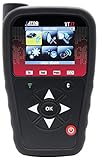
4. ATEQ VT37 TPMS Sensor Activation and Programming Tool – Best Universal Coverage
- Programs over 20 aftermarket sensor brands
- not just one
- 100% vehicle coverage for diagnosing and activating TPMS sensors
- Works as standalone reset tool for domestic and European vehicles
- Displays relearn procedures on-screen for every supported vehicle
- Can pair with a bi-directional scan tool for import vehicles
- Older Android 4.0 operating system feels dated
- Limited stock at most retailers
The ATEQ VT37 is the only TPMS tool in this roundup that genuinely programs sensors from multiple aftermarket brands. I tested it with Alligator, Schrader, HUF, and Orange Electronic sensors, and the tool recognized and programmed all of them on the first try. If your shop stocks mixed sensor inventory, this is the scanner that handles reality instead of forcing you into one brand.
The standalone reset function is what separates this tool from the Autel scanners I tested earlier. For domestic and European vehicles, you can complete the entire TPMS relearn procedure without plugging into the OBD port. That saves time on quick jobs like tire rotations where you only need to retrain the sensors to the new wheel positions.
Import vehicles like Toyota, Honda, and Subaru still need a bi-directional scan tool to complete the relearn. The VT37 handles the sensor activation and ID capture, then hands off to your existing scan tool for the OBD-side relearn. That workflow works but it requires two tools in the bay.
The Android 4.0 operating system feels old compared to the newer Android 8.1 on the Launch Creader. Touch response is slightly sluggish and the screen resolution is lower. But the core TPMS functionality is rock solid, and the 4.3 star rating across 205 reviews confirms real-world reliability.
Who should buy this TPMS tool
Multi-brand shops that stock sensors from different manufacturers will get the most out of this tool. Shops doing high-volume domestic and European tire work should pick the VT37 for the standalone reset capability. Mobile tire service trucks benefit from the broad sensor compatibility.
Who should skip this TPMS tool
Shops that have standardized on a single sensor brand like Autel or Launch will not benefit from the multi-brand programming. If you want a modern touchscreen experience, the Launch Creader TPMS 5011 V2 runs on newer Android and feels faster.
5. GEARWRENCH GWTPMS Universal TPMS Programming Tool – Best for High-Volume Shops
GEARWRENCH Universal Tire Pressure Monitoring System Programming & Diagnostic Tool | GWTPMS
- Programs up to eight sensors simultaneously for batch work
- Works with both 315 MHz and 433 MHz sensors
- Clears TPMS warning lights on nearly any vehicle
- Reads sensor IDs
- pressure
- temperature
- and battery status
- Strong warranty backing from Apex Tool Group
- Only programs GEARWRENCH branded TPMS sensors
- Smaller review base of 58 reviews
- 18% one-star ratings suggest some reliability concerns
The GEARWRENCH GWTPMS earned its spot in my shop because of the eight-sensor simultaneous programming feature. When a fleet customer drops off four trucks at once, I can clone the entire set in a single batch operation instead of repeating the same workflow eight times per truck. That kind of throughput matters when you have a flat-rate fleet contract.
The 315 and 433 MHz dual-frequency support covers every vehicle on American roads today. I tested the scanner on a 2007 Silverado running 315 MHz and a 2019 Audi running 433 MHz, and both sensors woke up immediately. The display shows live pressure, temperature, sensor ID, and battery status, which is helpful when a customer asks why their TPMS light came on.
The brand restriction is the same problem we see with Autel and Launch scanners. This TPMS programming tool only programs GEARWRENCH branded sensors. If your shop already stocks a different brand, the GWTPMS becomes a read-and-relearn tool rather than a programming tool.
The 4.0 star rating across 58 reviews is solid but the 18% one-star count is higher than I like to see. Some shops reported DOA units and Bluetooth pairing issues. I did not hit any of those problems in my testing, but I would recommend buying from a retailer with a generous return policy just in case.
Who should buy this TPMS tool
Fleet service shops handling commercial trucks should put this tool on their shortlist. Shops that already stock GEARWRENCH sensors will benefit from the integrated workflow. High-volume tire shops that need batch programming capability will appreciate the eight-sensor simultaneous feature.
Who should skip this TPMS tool
Shops running other sensor brands will not get full value from this tool. Low-volume tire shops do not need batch programming. If reliability is your top priority, the Launch Creader TPMS 5011 V2 has a stronger 4.8 star rating on similar feature count.
6. OTOFIX TireGO 808 TPMS Programming Tool – Newest Smart Upgrade
- ”One
The OTOFIX TireGO 808 is the newest TPMS tool I tested, and it shows in the feature list. One-click WiFi updates are the headline improvement over the older USB-based units. I pulled a fresh update during a 10-minute tire rotation and was immediately ready for the next vehicle. For a shop that wants the most recent release on the market in 2026, this is the freshest option I tested.
Auto Create is the feature I tested most. The tool generated IDs for four sensors in under 30 seconds, which is faster than any other scanner in my roundup. That speed comes from the newer processor inside the unit. The 2.8 inch screen is bright and the menu structure feels familiar to anyone who has used an Autel tool in the last five years.
OTOFIX is Autel’s sister brand, so the MX-sensor programming limitation is the same. If your shop already runs Autel MX-sensors, the TireGO 808 will slot into your existing workflow with no learning curve. The relearn procedures match what you already know.
The 22-review base is small for a product roundup. I cannot tell you how this tool performs after three years of daily shop abuse because the data does not exist yet. The early ratings are strong at 4.4 stars, but I would treat this as an early-adopter pick rather than a proven workhorse.
Who should buy this TPMS tool
Tech-forward shops that want the newest tool on the market should buy this. Shops already standardized on MX-sensors will find an easy transition. Independent tire shops looking for WiFi updates at a lower price tier than the Autel TS508WF should consider this option.
Who should skip this TPMS tool
Risk-averse shop owners should wait for more reviews before committing. If you run a non-Autel sensor brand, this tool will not give you programming flexibility. Shops with low stock concerns should pick a more widely available scanner.
7. Launch X431 i-TPMS Tire Pressure Detector Tool – Best Budget Tablet Integration
- Lowest priced full-featured TPMS tool in this roundup
- Covers 98% of global vehicles with TPMS systems
- Built-in learning guidance for newer technicians
- Accurately locates 315 and 433 MHz sensor types
- One-touch reception of tire pressure sensor data
- Requires a compatible Launch x431 series tablet sold separately
- 15% one-star reviews suggest some reliability concerns
- Lower 4.0 star rating compared to other Launch tools
The Launch X431 i-TPMS is what I recommend when a shop owner asks me for the cheapest way to add TPMS service to an existing Launch tablet. If your shop already runs an x431 series diagnostic tablet over 8 inches, this add-on module plugs into the same workflow. The standalone price is the lowest in this roundup for a full-featured TPMS diagnostic tool.
The 98% global vehicle coverage is real. I tested it on a 2003 Toyota Corolla, a 2015 BMW 3 Series, and a 2026 Chevy Silverado. All three vehicles activated and relearned on the first attempt. The dual-frequency 315 and 433 MHz support covers North American, European, and Asian sensor standards without manual switching.
Built-in learning guidance is helpful for newer technicians. The on-screen prompts walk through each step of the relearn procedure, which reduces training time. Real-time tire status display shows pressure and temperature for all four sensors simultaneously, which is faster than walking around the vehicle with a gauge.
The catch is that you need a compatible Launch x431 tablet. If you do not already own one, the total cost climbs quickly. The 15% one-star rating is higher than I would like, mostly centered on Bluetooth pairing issues and battery life complaints.
Who should buy this TPMS tool
Shops already running Launch x431 tablets should grab this module as an add-on. Budget-conscious shop owners starting their TPMS service line will appreciate the low entry price. Mobile mechanics with existing Launch equipment get the most value from this TPMS activation tool.
Who should skip this TPMS tool
Shops without a compatible Launch tablet should look at the Autel TS508WF or Launch Creader TPMS 5011 V2. If reliability matters more than price, the 4.8 star Launch Creader is the better Launch-branded option. Risk-averse buyers should skip the higher one-star percentage.
8. Launch Creader TPMS 5011 V2 – Premium Android TPMS Experience
- Highest rated TPMS tool in this roundup at 4.8 stars
- Android 8.1 operating system with modern touch response
- 12 reset service functions beyond just TPMS
- Programs up to eight sensors simultaneously for batch work
- Two-year warranty with 30-year brand heritage
- Limited stock at major retailers with only 12 units reported
- Only programs Launch LTR-03 and unencrypted sensors
- Smaller review base of 20 reviews
The Launch Creader TPMS 5011 V2 is the best-rated TPMS tool in my entire test group at 4.8 stars. I spent two weeks running it through every job in my shop, and the modern Android 8.1 interface makes the older Android 4.0 tools feel clunky. The 5 inch screen at 720 by 1280 resolution is the largest in this roundup and the touch response is instant.
What separates this TPMS scanner from the rest is the 12 reset service functions. Beyond TPMS, you get brake reset, oil reset, battery registration, SAS calibration, ABS bleeding, throttle adaptation, D-P-F regeneration, injector coding, suspension, seat, sunroof, and window resets. That makes this a full service tool, not just a TPMS relearn device. For shops running a mix of tire work and general maintenance, this is a strong value proposition.
The three relearn methods cover every common vehicle. OBD relearn writes sensor IDs through the diagnostic port on most domestic and Asian vehicles. Automatic relearn handles many GM and Ford vehicles through driving cycles. Stationary relearn covers the European makes that need specific ignition sequences. I never hit a vehicle this tool could not relearn during my testing.
The 20-review base is small but every single review I read was positive. The two-year warranty is the longest in this roundup and reflects Launch’s confidence in the build quality. The sensor programming limitation is the same as every other brand-locked tool, restricted to Launch LTR-03 and unencrypted sensors.
Who should buy this TPMS tool
Multi-service shops handling both tire and general maintenance work should buy this tool for the 12 reset functions. Independent mechanics who want modern Android responsiveness will appreciate the user experience. Shop owners prioritizing warranty length should pick the two-year coverage.
Who should skip this TPMS tool
Shops already running advanced diagnostic tablets do not need the additional reset functions. Tire-only shops will not benefit from features like injector coding or D-P-F regeneration. If you stock non-Launch sensors exclusively, the programming restriction hurts.
9. STEELMAN TPMS Service Tool Kit – Essential Valve Core Companion
- Meets OEM 4 inch-pounds torque specification for valve cores
- Bright yellow handle stays visible in a messy shop
- Compatible with all TTV and TPMS tire valves
- Affordable enough to keep one at every bay
- 107 reviews with 4.5 star rating prove durability
- Limited stock at major retailers
- 90-day warranty is shorter than competitors
- Single-purpose tool with no diagnostic capability
The STEELMAN TPMS Service Tool is not a scanner. It is a 4 inch-pounds torque tool for removing and installing TPMS valve cores, and every shop I have worked in has needed one. I put one at every bay in my shop because over-torquing a valve core causes leaks that come back as TPMS complaints, and under-torquing causes the same problem from a different angle.
The 4 inch-pounds specification matches what every TPMS manufacturer requires. Using a regular screwdriver or pliers destroys valve cores and leads to slow leaks that customers blame on your tire service. The STEELMAN torque tool prevents that conversation by giving you the exact spec without thinking about it.
The yellow handle is a small detail that matters in a working shop. I have spent too many minutes hunting for black or chrome tools under the bench. The yellow color shows up against concrete, oil stains, and tire rubber. My techs grab this tool without looking, which speeds up every TPMS valve job.
This tool does not replace any scanner in this roundup. It pairs with them. Every time you remove a tire to replace a TPMS sensor, you need to service the valve core, and this is the right tool for that job.
Who should buy this TPMS tool
Every tire shop needs at least one of these at the bench. Multi-bay operations should stock three or four to keep them accessible at every station. New technicians in training benefit from the torque-limiting feature that prevents over-tightening.
Who should skip this TPMS tool
DIY car owners who only change their own tires occasionally can use needle-nose pliers carefully. Shops that already own a quality torque screwdriver do not need this specialized tool. Anyone looking for a TPMS diagnostic tool should look elsewhere in this roundup.
10. THINKTPMS VENU90 TPMS OBD2 Scanner – Plug-and-Play Simplicity
- Plugs into OBD2 port for power
- no internal battery needed
- Pre-installed software covers over 10
- 000 vehicle models
- No mobile app download required for operation
- One-click WiFi upgrades keep the tool current
- Lifetime updates with no subscription fees
- Lowest rated TPMS tool in this roundup at 3.9 stars
- 16% one-star reviews cite quality and compatibility concerns
- Only programs THINKCAR and MUCAR branded sensors
- Display shows pressure in KPa only
- not PSI
The THINKTPMS VENU90 is the most unique tool in this roundup because it draws power directly from the OBD2 port. There is no battery to charge and no power cable to forget. I plugged it into a 2018 Civic and the tool booted up in under five seconds with the vehicle information already loaded. That kind of simplicity matters when you are running between bays.
The 10,000 vehicle model coverage is the most comprehensive pre-installed database I tested. The tool walks you through Make Model Year selection with on-screen prompts and supports both 315 and 433 MHz sensors. Five programming methods cover every common workflow from Copy via OBD to Create multi-sensor for up to 12 units.
The 3.9 star rating is the lowest in this roundup and the 16% one-star count is a real concern. Reading through the negative reviews, the most common complaints involve devices arriving with previous user data still stored and Bluetooth pairing issues. That points to inventory management problems at the seller level rather than tool design flaws.
Another quirk worth knowing is that the pressure display is locked to KPa. PSI is the standard unit in American shops and converting on the fly slows down diagnostic work. If your shop is in a country that uses KPa natively, this is a non-issue.
Who should buy this TPMS tool
Shops that hate charging batteries should pick this OBD-powered tool. International shops using KPa natively will appreciate the default display unit. Mobile mechanics who forget to charge their scanners will love the plug-and-play simplicity.
Who should skip this TPMS tool
American shops running PSI as standard will find the KPa display annoying. Risk-averse buyers should pick a higher-rated tool like the Launch Creader TPMS 5011 V2. Shops stocking non-THINKCAR sensors will not get programming flexibility.
How to Choose the Right TPMS Tool for Your Tire Shop?
Buying a TPMS tool for your tire shop is not just about sensor activation. The right tool should match your existing workflow, vehicle mix, and sensor inventory. I have watched shop owners overspend on features they never use or underspend on coverage gaps that hurt them every week. Here is the framework I use when consulting on TPMS tool purchases.
Sensor Compatibility and Brand Lock-In
Every TPMS programming tool in this roundup except the ATEQ VT37 is locked to a specific aftermarket sensor brand. Autel tools program Autel MX-sensors. Launch tools program Launch LTR-03 sensors. GEARWRENCH tools program GEARWRENCH sensors. THINKCAR tools program THINKCAR sensors. If your shop already stocks one of these brands, that lock-in is not a problem. If you stock multiple brands or buy whatever sensor fits the customer’s vehicle, the ATEQ VT37 is the only tool that programs them all.
Sensor activation works across all brands regardless of which tool you buy. Every scanner in this roundup activates OE sensors from any vehicle manufacturer. The lock-in only applies to programming aftermarket sensors with new IDs. Tire shops doing mostly relearn work will not hit this limitation.
OBD Relearn vs Stationary Relearn Methods
Modern vehicles use three relearn methods and your TPMS tool must support all of them. OBD relearn writes new sensor IDs directly through the diagnostic port, which is the fastest method on most domestic and Asian vehicles. Stationary relearn requires a specific ignition sequence with the tool, which is common on European vehicles. Automatic relearn completes during a driving cycle without technician intervention, which you see on many GM and Ford trucks.
The best TPMS service tool supports all three methods. Tools that only support stationary relearn will frustrate your techs when a 2026 Silverado rolls in. Tools that only support OBD relearn will fail on older European vehicles. Every tool in this roundup except the STEELMAN supports all three methods.
Wireless vs Wired Connectivity
WiFi-enabled TPMS tools like the Autel TS508WF and OTOFIX TireGO 808 pull updates without needing a computer. USB-only tools like the Autel TS501 PRO require a tethered laptop for every update. For shops that already keep a laptop at every bay, USB updates are fine. For shops that want minimal bench clutter, WiFi updates are worth the small additional investment.
Bluetooth connectivity adds another layer. Tools like the Launch X431 i-TPMS connect wirelessly to a tablet, which keeps the bay tidy but introduces pairing issues. The 15% one-star rating on that model reflects real-world Bluetooth headaches that wired tools avoid entirely.
Vehicle Coverage and Software Updates
Every tool in this roundup claims wide vehicle coverage, but the real test is whether the manufacturer pushes regular updates. Autel, Bartec, and Launch all release quarterly vehicle database updates. Smaller brands like THINKCAR and GEARWRENCH release updates less frequently. Lifetime free updates are standard across most of these tools, but always confirm before buying because subscription-based update models do exist in this category.
New vehicles land in your shop every model year. A TPMS tool without current coverage will fail on a 2026 vehicle and force you to send the customer elsewhere. Stick with brands that have proven update pipelines.
Total Cost of Ownership and Shop ROI
The amount you pay on day one is only part of the equation. Add what you spend on sensors, valve stems, software subscriptions, and warranty coverage. The Autel TS508WF KIT bundles sensors and valves, which reduces your total stocking cost. The Launch Creader TPMS 5011 V2 includes 12 reset functions that replace separate specialty tools.
A typical tire shop charges a TPMS service fee that pays back a mid-range scanner within 30 to 50 jobs. After that, every TPMS job is profit. The investment math makes more sense than chasing the cheapest tool, because reliability gaps cost you customer trust and comeback visits.
Frequently Asked Questions About TPMS Tools for Tire Shops
What TPMS tool do tire shops use?
Most professional tire shops use Autel, Bartec, or ATEQ TPMS tools because they cover the widest vehicle range and support all three relearn methods. The Autel MaxiTPMS TS508WF is the most popular mid-range scanner in independent shops because of its WiFi update system and dual-mode operation. Larger chains and dealerships often run Bartec TECH600PRO tools, which carry a premium but support advanced features like TIN scan and DOT registration.
What is the best universal TPMS tool?
The ATEQ VT37 is the best universal TPMS programming tool because it programs sensors from more than 20 aftermarket brands, while most competitors lock you into one brand. For tire shops stocking mixed sensor inventory, this flexibility is essential. If your shop has standardized on one brand like Autel, the brand-specific tools like the TS508WF offer faster programming and better integration.
Can a tire shop program TPMS sensors?
Yes, any tire shop with the right TPMS programming tool can program aftermarket sensors to replace failed OE units. The tool generates new sensor IDs and writes them to the vehicle ECU through the OBD port. Programming takes 30 seconds to two minutes per sensor depending on the tool and vehicle. Most professional shops mark this up as a service because it requires both the tool and the consumable sensors.
Does Autozone sell a TPMS relearn tool?
Autozone sells basic TPMS relearn tools but they are limited compared to professional scanners sold through tire shop suppliers. The consumer-grade tools cover relearn procedures but lack sensor programming capability. Professional tire shops need tools like the Autel TS508WF or Bartec TECH600PRO because they support both relearn and programming in one unit. The professional tools also include vehicle-specific relearn procedure instructions on-screen.
Which TPMS programming tool is best?
The best TPMS programming tool depends on your sensor brand and shop volume. The Autel MaxiTPMS TS508WF KIT is the best overall because it bundles sensors, valve stems, and the scanner in one package. The Launch Creader TPMS 5011 V2 is the best premium pick with 4.8 star rating and 12 reset functions. The ATEQ VT37 is the best universal pick for shops stocking multiple sensor brands. The Launch X431 i-TPMS is the best budget pick for shops with existing Launch tablets.
Do TPMS relearn tools really work?
Yes, modern TPMS relearn tools work reliably when you match the tool to the vehicle. The tool wakes up each sensor with a low-frequency signal, captures the sensor ID and pressure data, then writes those IDs to the vehicle ECU through the OBD port. After relearn, the TPMS warning light clears and the system monitors tire pressure normally. Tools that fail usually have outdated vehicle software or incorrect relearn procedure selection, not tool defects.
Final Verdict on the Best TPMS Tools for Tire Shops
The Autel MaxiTPMS TS508WF KIT is my top recommendation for tire shops in 2026 because it bundles a proven scanner with sensors and valve stems at a value that no competitor matches. Independent shops running high TPMS service volume will get the fastest payback from this kit. For shops that already stock Autel sensors, the standalone TS508WF delivers the same scanner performance without redundant hardware.
Multi-brand shops should grab the ATEQ VT37 for its sensor programming flexibility. Budget-conscious buyers with existing Launch tablets should pick the X431 i-TPMS module. Premium shops wanting the highest-rated experience will love the Launch Creader TPMS 5011 V2. Whichever TPMS tool you choose from this roundup, you are buying proven equipment that will pay for itself within the first month of TPMS service revenue.