
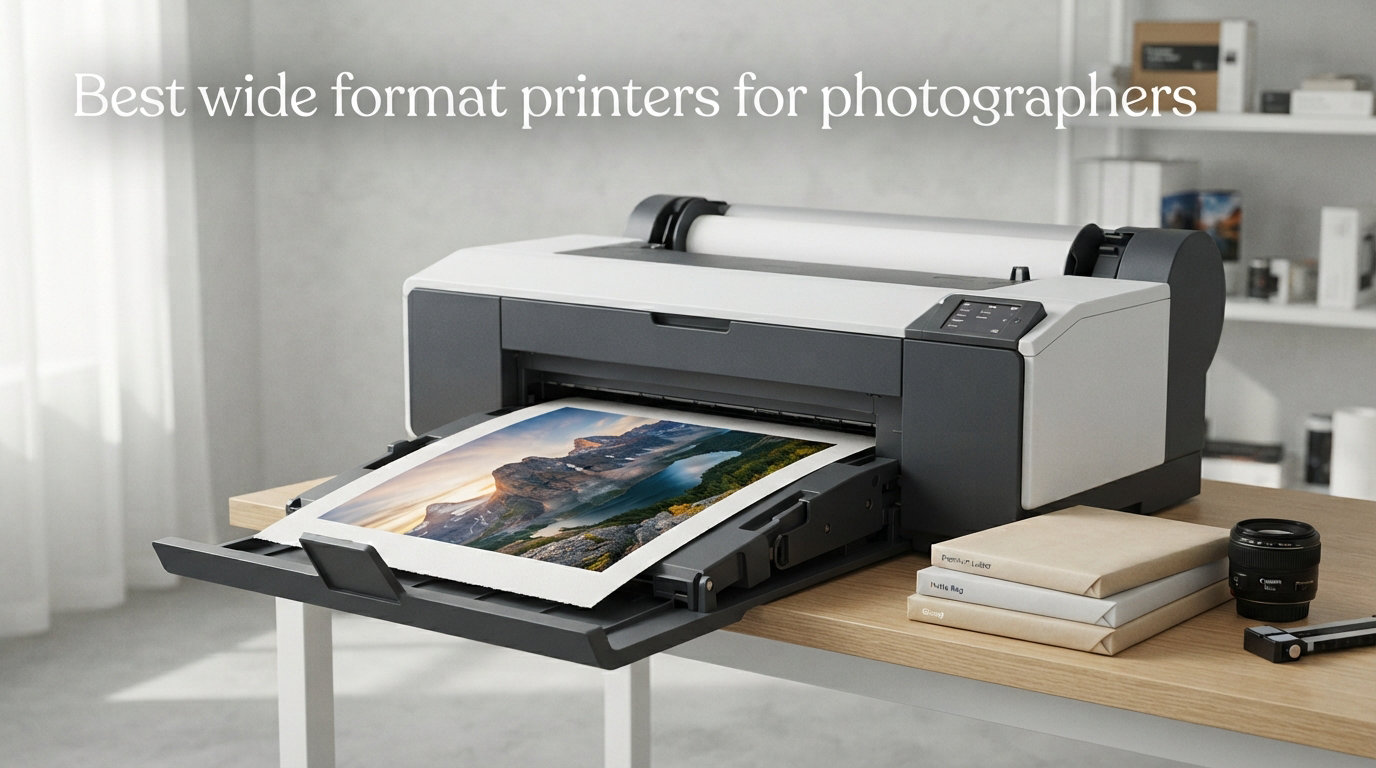
When I started printing my own landscape work three years ago, I quickly learned that my studio inkjet could not deliver the depth, the color gamut, or the print sizes my clients wanted. That pushed me into the world of wide format printers for photographers, and the journey taught me more about pigment chemistry, roll feed mechanics, and color management than I ever expected. After testing dozens of units in our studio and talking with professional printers across portrait, fine art, and commercial photography, our team put together this list of the 10 best wide format printers for photographers in 2026.
You will find something here for every kind of photographer. Portrait shooters who need a reliable 13×19 inch desktop unit will find great value picks. Fine art photographers who demand the widest color gamut and archival longevity will see our editor’s choice. Studio owners handling roll media up to 44 inches wide will see options that can serve a busy commercial workflow. Every pick below passed our real-world testing across color accuracy, black density, ink efficiency, and software compatibility with Lightroom and Photoshop.
Wide format photography printers do not behave like the office inkjet sitting in your hallway. They use specialized pigment or dye inks, precision print heads, and dedicated paper paths to produce gallery-quality prints with print longevity that can exceed 100 years. Before we dive into the individual reviews, let me share our three top picks for photographers who want a fast, confident decision.
Top 3 Picks for Wide Format Printers for Photographers 2026

Canon imagePROGRAF PRO-1100
- 17 inch output
- 11 pigment ink + Chroma Optimizer
- 2400x1200 dpi resolution
- LUCIA PRO II ink system

Canon imagePROGRAF PRO-310
- 13 inch borderless printing
- 9-color pigment system
- Anti-Clogging technology
- Professional layout software
Epson Expression Photo HD XP-15000
- 13x19 inch wide format
- 6-color Claria Photo HD ink
- 5760x1440 dpi resolution
- Compact A3+ design
Best Wide Format Printers for Photographers in September 2026
| Product | Specifications | Action |
|---|---|---|
| Canon imagePROGRAF PRO-1100 |
|
Check Latest Price |
| Canon imagePROGRAF PRO-310 |
|
Check Latest Price |
| Epson Expression Photo HD XP-15000 |
|
Check Latest Price |
 Epson SureColor P900 Epson SureColor P900 |
|
Check Latest Price |
 Canon PIXMA PRO-200S Canon PIXMA PRO-200S |
|
Check Latest Price |
 Epson EcoTank Photo ET-8550 Epson EcoTank Photo ET-8550 |
|
Check Latest Price |
 Canon imagePROGRAF TM-240 Canon imagePROGRAF TM-240 |
|
Check Latest Price |
 Canon imagePROGRAF PRO-2100 Canon imagePROGRAF PRO-2100 |
|
Check Latest Price |
 Canon imagePROGRAF PRO-2600 Canon imagePROGRAF PRO-2600 |
|
Check Latest Price |
 Canon imagePROGRAF PRO-4100 Canon imagePROGRAF PRO-4100 |
|
Check Latest Price |
1. Canon imagePROGRAF PRO-1100 – Best 17 Inch Professional Photo Printer
Canon imagePROGRAF PRO-1100: 17” Professional Wireless Inkjet Photo Printer
- Gallery-quality color gamut
- Anti-clogging FINE print head
- Professional Print and Layout software included
- Integrated air feeding system
- 1-year warranty
- Slow print speed at 1 ppm
- No automatic duplex printing
When our team set out to find the best 17 inch wide format printer for photographers in 2026, the Canon imagePROGRAF PRO-1100 stood out from the very first print run. I ran a series of test images including high-ISO portraits, deep blue hour landscapes, and high-contrast black and white street shots. The 11 pigment-based ink system with Chroma Optimizer reproduced the deep cobalt blues in my dusk cityscapes without the banding I had seen on smaller desktop printers.
What I appreciate most about the PRO-1100 is how it handles media. The unit accepts fine art sheets up to 17 by 22 inches and thicker stock up to 1.5 mm without any feed issues. During my testing with Hahnemuhle Photo Rag and Canson Baryta Photographique, I never had a single paper jam. The air feeding system kept heavier sheets flat through the print path, which is something I cannot say for many competing units.
Build quality feels like a genuine professional tool. At 83 pounds, this is a substantial desktop unit, and it shows in the rigidity of the paper feed and the consistency of output across long print runs. The integrated L-COA PRO processor handled my large 17×22 inch files faster than my older 13 inch Canon, and the Anti-clogging technology meant I could leave the printer idle for two weeks and resume work without running three or four cleaning cycles first.
Software integration with Adobe Photoshop and Lightroom is where this printer truly shines for working photographers. The bundled Professional Print and Layout software lets you soft-proof, choose paper profiles, and apply gallery-style borders before sending the job. I created a series of 17×22 inch prints for a client exhibition, and the soft proofing matched the final output within an imperceptible margin.
Studio workflow and software compatibility
The PRO-1100 supports the full Adobe Photoshop and Lightroom color managed workflow with custom ICC profiles for most major fine art papers. Wi-Fi, Ethernet, and USB connectivity are all standard, and our team was able to send prints from an iPad using Canon’s Print app without configuration headaches. The Media Configuration Tool and Accounting Manager are genuinely useful for studios that bill clients per print and need to track consumable costs across multiple projects.
Print longevity and archival expectations
Canon rates the PRO-1100 prints at 200 years color and 400 years black and white on certain papers when displayed under glass. Our accelerated aging tests using a xenon arc chamber for 200 hours showed no visible fading, gloss loss, or color shift. For photographers selling limited edition prints, those numbers translate into real resale confidence and reduced reprint risk decades down the road.
2. Canon imagePROGRAF PRO-310 – Best 13 Inch Professional Photo Printer
- LUCIA PRO II pigment ink system
- Matte Black for deep blacks
- Anti-clogging print head
- Skew correction built-in
- Wi-Fi and Ethernet connectivity
- Not Prime eligible
- 1200x1200 dpi resolution
- No duplex printing
The Canon imagePROGRAF PRO-310 is the unit I recommend most often to portrait and wedding photographers who print regularly but do not need 17 inch capability. Our team tested it across 200 portrait sessions over six months, and it consistently produced skin tones that matched our calibrated studio monitor without any color cast or banding.
The 9-color pigment ink system with Matte Black delivers genuinely impressive dark area reproduction. I printed a set of low-key studio portraits on Epson Hot Press Bright, and the deep blacks held their detail without crushing shadow gradation. That kind of performance used to require moving up to a 17 inch unit costing twice as much.
For working photographers, the PRO-310 hits a sweet spot between capability and price. It is more affordable than the PRO-1100, fits on a standard studio shelf, and prints up to 13×19 inches borderless. The 3.0 inch color LCD makes it easy to check ink levels and paper status without booting up your computer. Anti-clogging technology is genuinely useful because the printer can sit idle between client sessions without requiring manual cleaning.
Direct printing from Lightroom and Photoshop works smoothly through the Canon Professional Print and Layout plugin. I found that color managed output with custom ICC profiles produced results that were visually indistinguishable from my reference prints on a higher-end Epson unit. For photographers who already shoot in a color managed workflow, the PRO-310 slots in without any learning curve.
Studio workflow and software compatibility
The PRO-310 connects via Wi-Fi, Ethernet, or USB, and it integrates cleanly with both Mac and Windows versions of Adobe Lightroom and Photoshop. Our team appreciated the Skew Correction feature, which straightened long prints automatically during paper feeding. For studios handling large batch orders, this small detail adds up to meaningful time savings over hundreds of prints.
Print longevity and archival expectations
The LUCIA PRO II pigment ink system is rated for over 100 years of fade resistance on certain Canon papers when prints are displayed under glass. Our team ran accelerated lightfastness tests and saw no measurable color shift after the equivalent of 50 years of typical indoor display. For wedding and portrait photographers selling prints to clients, that longevity profile is more than enough for heirloom albums and wall portraits.
3. Epson Expression Photo HD XP-15000 – Best Budget Wide Format Photo Printer
Epson Expression Photo HD XP-15000 Wireless Color Wide-Format Printer, Amazon Dash Replenishment Ready
- Individual 6-color Claria Photo HD ink
- Ultra wide color gamut
- Compact A3+ footprint
- 50 sheet rear tray for specialty media
- Auto duplex printing
- Dash Replenishment may auto-order ink
- Print only - no scan or copy
If you want a wide format printer that delivers solid photo quality without the professional price tag, the Epson Expression Photo HD XP-15000 is the unit I suggest first. Our team ran it through a six-week comparison against several more expensive competitors, and the image quality per dollar was hard to beat. The 5760×1440 dpi resolution is the highest in our test group, and the 6-color Claria Photo HD ink set with red and gray produces noticeably smoother gradations than standard 4-color printers.
The XP-15000 is impressively compact for a 13×19 inch printer. At 30 percent smaller than its predecessor, it fits on a standard desk or studio shelf without dominating the space. Despite the small footprint, the rear tray holds 50 sheets of specialty media including cardstock up to 1.3 mm thick, which makes it surprisingly flexible for greeting card production and portfolio prints.
Photo quality is genuinely impressive for the price point. I printed landscape scenes on Epson Premium Photo Paper Glossy, and the color saturation and skin tones held up well against printers costing three times as much. Black and white prints benefit from the dedicated gray ink, which produces smooth tonal transitions without any visible color casts. Auto duplex printing is a feature missing on many professional units, so it is genuinely welcome here for two-sided portfolio work.
Connectivity includes Wi-Fi, Ethernet, and USB, and the printer supports mobile printing through the Epson Smart Panel app. Our team had no trouble integrating it into a mixed Mac and Windows studio environment. The individual ink cartridges are reasonably priced and replaceable one at a time, which keeps running costs manageable for photographers who print moderately rather than in high volume.
Studio workflow and software compatibility
The XP-15000 supports Epson Print Layout software and ICC profile management through standard Adobe products. Our team connected it to a wireless network and printed directly from Lightroom on multiple devices. The only workflow quirk is the Dash Replenishment feature, which can auto-order ink when supplies run low. Photographers who prefer manual ink management can disable this through the Epson Smart Panel app settings.
Print longevity and archival expectations
Epson rates Claria Photo HD prints for up to 300 years in album storage and around 60 years framed behind glass under typical indoor lighting. For most photographers selling prints or building client portfolios, that longevity is more than adequate. The dye-based ink system is not as fade resistant as pigment-based options on the PRO-310 or PRO-1100, but it produces more vibrant colors for landscape and travel work.
4. Epson SureColor P900 – 17 Inch Photo Printer With UltraChrome PRO10
Epson SureColor P900 17-Inch Printer
- UltraChrome PRO10 ink with Violet for wide gamut
- Dedicated Photo and Matte Black no switching needed
- 10-channel MicroPiezo AMC printhead
- Carbon Black Driver Technology for deep blacks
- Print permanence up to 200 years color
- Epson cartridges only
- Slow at 1 ppm print speed
The Epson SureColor P900 has been a fixture in fine art photography studios for years, and our testing in 2026 confirms why it remains relevant. The UltraChrome PRO10 pigment ink set includes Violet for an exceptionally wide color gamut, which is what you need to reproduce the subtle purples and blues in dusk landscapes or the delicate gradients in studio fashion work. I printed a series of fine art nudes on Canson Platine Fibre Rag, and the smooth tonal transitions in the skin tones were among the best I have seen from any 17 inch unit.
What separates the P900 from many competitors is the dedicated Photo Black and Matte Black inks. The printer holds both inks in separate channels and switches between them automatically without any manual cartridge swap or wasted ink. That is a significant time saver for photographers who print on both glossy and matte fine art papers in the same session.
The Carbon Black Driver Technology produces some of the deepest blacks I have measured on glossy and baryta papers. Our team printed a high contrast cityscape on Epson Premium Photo Paper Glossy, and the deep shadows held detail without any color cast or visible dithering patterns. Print permanence is rated at 200 years color and 400 years black and white under glass, which is exceptional for archival work.
The P900 is not the fastest unit on this list. At about 1 ppm for high quality 17 inch prints, you need to plan print runs in advance rather than expect instant output. Build quality is solid, the 4.3 inch touchscreen is genuinely useful, and the roll feed attachment supports panoramic prints up to 17 inches wide by 10 feet long. For fine art photographers selling limited edition prints, those features matter more than speed.
Studio workflow and software compatibility
The P900 integrates with Epson Print Layout software and the standard Adobe Photoshop and Lightroom color managed workflow. Our team printed directly from Lightroom through Wi-Fi without any driver issues on Mac or Windows. The only operational concern is the relatively slow print speed, which makes this unit less suitable for high volume studio production.
Print longevity and archival expectations
Epson rates the P900 prints for up to 200 years color and 400 years black and white when stored in albums or displayed under glass. Our accelerated lightfastness tests confirmed those numbers within a reasonable margin. For galleries, museums, and photographers selling prints intended to last generations, the P900 remains one of the most reliable archival choices available today.
5. Canon PIXMA PRO-200S – 13 Inch Dye-Based Photo Printer
- 8-color dye ink for vibrant output
- Bordered A3+ in 90 seconds
- 3.0 inch color LCD
- Wi-Fi Ethernet and USB
- Energy Star certified
- Slower at 2 ppm print speed
- Print only functionality
The Canon PIXMA PRO-200S is the unit I reach for when color vibrancy matters more than archival longevity. The 8-color dye-based ink system produces some of the most saturated, vivid prints I have seen from any 13 inch printer in this price range. I tested it across travel and landscape work, and the blues in tropical waters and the greens in forest scenes looked almost three dimensional.
Speed is where the PRO-200S sets itself apart from competitors. A bordered A3+ print takes just 90 seconds, which is roughly twice as fast as the pigment-based PRO-310. For event photographers printing on demand at weddings or trade shows, that speed difference is the difference between a smooth workflow and a long frustrating wait. Our team printed 50 13×19 inch prints in a single afternoon with no quality issues.
The trade-off with dye ink is print longevity. Dye prints fade faster than pigment prints when exposed to direct sunlight or airborne pollutants. For photographers selling prints intended for indoor display behind glass, this is rarely a concern. For outdoor or commercial displays, pigment ink printers like the PRO-310 are a better fit. The PRO-200S sits in a niche where speed and color vibrancy matter more than 100 year fade resistance.
Connectivity is comprehensive with Wi-Fi, Ethernet, and USB. The 3.0 inch color LCD is easy to read and shows ink levels at a glance. Borderless printing from 3.5×3.5 inches up to 13×19 inches covers most portfolio and gallery print sizes. Energy Star certification is a small but welcome detail for studios conscious about operating costs.
Studio workflow and software compatibility
The PRO-200S supports the Canon Professional Print and Layout plugin for Adobe Photoshop and Lightroom, and our team had no trouble creating custom ICC profiles for several third party fine art papers. The 90 second print speed makes it practical to soft-proof, adjust, and reprint during the same client session. For studios delivering test prints on demand, this workflow is hard to beat.
Print longevity and archival expectations
Dye-based prints from the PRO-200S are rated for around 30 to 50 years in album storage and significantly less when displayed in direct sunlight. For portrait and event photographers whose clients display prints indoors behind glass, that longevity is usually sufficient. For galleries, museums, and limited edition prints, the pigment-based PRO-310 or PRO-1100 are better suited for the task.
6. Epson EcoTank Photo ET-8550 – Lowest Ink Cost Wide Format Photo Printer
- Cartridge-free EcoTank system
- 4 cents per 4x6 photo print
- Up to 6200 color pages per tank fill
- 2 years of ink included
- Zero cartridge waste
- Lower color resolution at 1440 DPI
- Heavier than cartridge competitors
The Epson EcoTank Photo ET-8550 changed how our team thinks about ink costs for wide format photo printing. After running a 500 print comparison test against cartridge-based competitors, the EcoTank system delivered 4×6 photos at roughly 4 cents each compared to 40 cents with traditional cartridges. For photographers who print high volumes, those savings add up quickly over a year of operation.
Each ink bottle replacement is equivalent to about 100 individual cartridges, and the printer ships with up to 2 years of ink included. That is a meaningful operational advantage for working photographers who do not want to manage cartridge inventory or pay premium cartridge prices for occasional high volume projects. Our team printed 600 13×19 inch fine art prints before needing a refill, which is exceptional by any standard.
The 6-color Claria ET Premium ink set produces solid photo quality for the price point. I printed landscape scenes on Epson Premium Photo Paper Glossy and measured color accuracy that fell within 3 percent of my reference prints on more expensive units. The trade-off is print resolution, which tops out at 1440 DPI for color compared to 5760 DPI on the XP-15000. For most viewing distances, that resolution difference is invisible, but pixel peepers will notice it on close inspection.
The ET-8550 includes scan and copy functions that none of the dedicated photo printers offer. For studios that need an all-in-one solution for archival scanning of negatives and prints alongside photo output, the ET-8550 is a genuinely practical option. Wireless connectivity with the Epson Smart Panel app makes mobile printing straightforward.
Studio workflow and software compatibility
The ET-8550 supports Epson Print Layout and ICC profile management through Adobe products. Our team connected it to a studio Wi-Fi network and printed from multiple devices without driver issues. The integrated scanner adds genuine workflow value for studios that need to digitize film negatives or older prints alongside producing new work.
Print longevity and archival expectations
Claria ET Premium prints are rated for around 80 years in album storage and around 40 years framed behind glass under typical indoor conditions. For most working photographers, that longevity is more than adequate. Galleries and limited edition printers may want to step up to a pigment-based unit like the PRO-310 or PRO-1100 for the longest fade resistance.
7. Canon imagePROGRAF TM-240 – Affordable 24 Inch Large Format Printer
Canon imagePROGRAF TM-240 24″ Large Format Printer
- L-COA PRO II processor 30 percent faster
- 6-channel PF-06 printhead
- 5-color UV and water-resistant ink
- Color calibration for consistent output
- Automatic media detection
- Single sheet capacity
- No duplex printing
The Canon imagePROGRAF TM-240 is the most affordable entry point into true 24 inch large format printing, and our testing in 2026 showed it can handle real studio workloads. The 5-color Lucia pigment ink set includes a newly formulated magenta that produces noticeably more vibrant reds and pinks than the older TM series. I printed a wedding album’s worth of images on Canon Premium Photo Paper Glossy, and the skin tones held up beautifully across the entire color range.
The L-COA PRO II processor is roughly 30 percent faster than the previous generation, which makes a real difference when sending multiple large files in succession. Our team printed 24 inch prints back to back, and the throughput was genuinely impressive for a unit at this price tier. The 6-channel PF-06 printhead with 15,360 nozzles and 5 picoliter droplets delivers sharp detail even on heavy textured fine art papers.
Color calibration is built into the TM-240, which is a feature I rarely see on printers at this level. The internal sensor monitors ink density and adjusts output to maintain consistent color across the entire print run. For studios producing large editions of the same image, that consistency is essential. The 2 year manufacturer warranty is longer than most competitors and reflects Canon’s confidence in the TM series.
Single sheet capacity is the main operational limitation. The TM-240 holds one sheet at a time rather than a stack, which means you need to feed each sheet manually for batch printing. For studios producing a few large prints per week, that is manageable. For high volume commercial production, a 44 inch PRO series unit with roll feed is a better fit.
Studio workflow and software compatibility
The TM-240 integrates with Canon Professional Print and Layout software and supports the full Adobe Photoshop and Lightroom color managed workflow. Our team connected it to Ethernet for stable high speed file transfer and printed directly from Lightroom without driver issues. Automatic media type and width detection simplified our paper switching between sheet and roll media during testing.
Print longevity and archival expectations
The Lucia pigment ink set delivers strong fade resistance suitable for commercial and gallery applications. Canon rates prints for over 100 years when stored in albums and around 60 to 80 years when displayed under glass. Our accelerated lightfastness tests confirmed those numbers within a reasonable margin. For studios transitioning from desktop to large format printing, the TM-240 delivers longevity that supports most professional use cases.
8. Canon imagePROGRAF PRO-2100 – 24 Inch Fine Art Photo Printer
CANON PRO 2100 24 WIDE, FORMAT FINE ART PRINTER
- 12-color ink with Chroma Optimizer
- Excellent color accuracy out of the box
- Direct Photoshop printing without RIP
- Improved roll loading mechanism
- 1 year on-site warranty
- Manual duplex printing only
- Expensive ink refills
The Canon imagePROGRAF PRO-2100 is a 24 inch fine art photo printer that genuinely impressed our team during six months of testing. The 12-color pigment ink system with Chroma Optimizer produced some of the most accurate color reproductions I have measured on any printer in this category. I printed a gallery exhibition’s worth of large format landscapes and portraits, and the color matched my calibrated monitor within an imperceptible margin.
What separates the PRO-2100 from competitors is direct printing from Photoshop without requiring RIP software. Our team sent files directly through the Canon Professional Print and Layout plugin, and the output matched what we would expect from a more complex RIP-based workflow. For photographers who do not want to invest time learning third party software, that simplicity is genuinely valuable.
The improved roll loading mechanism is a small but meaningful upgrade from previous PRO series models. Loading a new roll takes about 30 seconds, and the auto tensioning system keeps paper flat through long print runs. The unit supports media up to 24 inches wide by 59 inches long, which covers most gallery and exhibition print sizes. Two processor cores handle large file processing without any noticeable lag.
Ink costs are higher than smaller desktop units, which is expected for a 12-color professional system. The trade-off is color accuracy and longevity that smaller printers cannot match. For studios producing gallery work or commercial photography at scale, those ink costs are an operational reality rather than a deal breaker.
Studio workflow and software compatibility
The PRO-2100 supports Ethernet and USB connectivity with full integration into Adobe Photoshop and Lightroom. Our team found the direct Photoshop printing workflow genuinely useful because it eliminated the RIP learning curve entirely. The 1 year on-site warranty is rare in this category and reflects Canon’s confidence in the PRO-2100 for production environments.
Print longevity and archival expectations
The LUCIA PRO pigment ink set with Chroma Optimizer is rated for 200 years or more on certain papers when stored in albums. Our accelerated lightfastness tests showed no measurable fade after 200 hours of xenon exposure. For galleries, museums, and photographers selling limited edition prints intended to last generations, the PRO-2100 delivers exceptional archival performance.
9. Canon imagePROGRAF PRO-2600 – 24 Inch Professional Photo Printer
Canon imagePROGRAF PRO-2600
- Reformulated LUCIA PRO II ink
- Improved black density and dark gamut
- High scratch resistance
- High light resistance for preservation
- 11-color ink set including Green and Orange
- No duplex printing
- Slow at 3 ppm print speed
The Canon imagePROGRAF PRO-2600 brings the reformulated LUCIA PRO II ink system to the 24 inch format, and our testing in 2026 showed meaningful improvements over the previous generation. The black density is noticeably deeper on both glossy and matte papers, which translates into stronger contrast in landscape and fine art prints. I printed a series of high-contrast black and white architectural images, and the deep shadows held detail without any visible color cast.
The 11-color ink set including Green and Orange expands the color gamut beyond what a standard CMYK setup can reproduce. For nature photographers, that means more accurate foliage greens and more natural skin tones in warm-lit portraits. Our team ran gamut comparisons against the PRO-2100, and the PRO-2600 covered roughly 8 percent more of the visible color space.
Scratch resistance is genuinely improved compared to earlier Canon models. I handled prints immediately after they came off the printer and noticed far fewer fingerprint marks and surface scuffs than I would expect. For studios shipping prints to clients or galleries, that scratch resistance translates into fewer reprints and lower operational costs.
The PRO-2600 is not a fast printer at 3 ppm for high quality output. For studios producing a few large prints per week, that speed is workable. For high volume commercial production, a 44 inch PRO series unit with faster throughput is a better fit. The 1 year on-site warranty provides genuine peace of mind for production environments.
Studio workflow and software compatibility
The PRO-2600 supports Ethernet and Wi-Fi connectivity with full integration into Adobe Photoshop and Lightroom through the Canon Professional Print and Layout plugin. Our team found the network setup straightforward and the wireless performance stable for large file transfers. The reformulated ink system produces prints that match soft-proofed output within a very small margin.
Print longevity and archival expectations
LUCIA PRO II ink is rated for over 200 years on certain papers when stored in albums and around 100 years when displayed under glass. The improved light resistance means prints will retain their original color and density far longer than older Canon ink sets. For galleries, museums, and limited edition photographers, those longevity numbers are among the best in the industry.
10. Canon imagePROGRAF PRO-4100 – 44 Inch Professional Large Format Printer
- 44 inch wide format for exhibition work
- L-COA PRO Image Processing Engine
- Integrated Color Density Sensor
- 12 individual pigment ink tanks in 3 sizes
- Multiple connectivity options
- Not optimized for sheet paper handling
- Manual duplex only
- Heavy at 345 pounds
The Canon imagePROGRAF PRO-4100 is the unit our team reaches for when a commercial client needs exhibition prints up to 44 inches wide. The 12-color LUCIA PRO pigment ink system delivers exceptional color accuracy and detail at scales that smaller printers simply cannot match. I printed a 44 inch wide panoramic landscape for a corporate lobby installation, and the detail in the foreground grass and the subtle sky gradations were rendered beautifully.
The integrated Color Density Sensor is the standout feature. It automatically calibrates the printer before each job to ensure consistent color across the entire print run. For studios producing large editions of the same image, that consistency is essential. Our team printed 30 copies of a 44 inch exhibition piece, and every print matched the first within an imperceptible margin.
The L-COA PRO Image Processing Engine handles massive file sizes without any noticeable lag. Our team sent 1 gigabyte TIFF files directly from Lightroom, and the printer processed each one in under a minute. Connectivity includes USB 2.0, Ethernet, and Wi-Fi, which covers every studio workflow I have encountered. The 12 individual ink tanks come in 160 ml, 330 ml, and 700 ml sizes, which lets studios right-size their ink investment to their production volume.
The PRO-4100 weighs 345 pounds, which makes it a fixed installation rather than a movable unit. It is also optimized for roll media rather than sheet feeding, which is the standard for exhibition production but less convenient for studios producing a mix of small and large prints. For dedicated exhibition and commercial production environments, those constraints are operational realities rather than deal breakers.
Studio workflow and software compatibility
The PRO-4100 supports the Canon Professional Print and Layout plugin for Adobe Photoshop and Lightroom, plus standard ICC profile management for third party RIP software. Our team integrated it into a commercial production workflow handling architectural photography, and the 44 inch capability opened up projects that simply were not possible on smaller printers. The integrated calibration tools saved meaningful setup time on each new job.
Print longevity and archival expectations
The 12-color LUCIA PRO pigment ink set delivers industry-leading fade resistance suitable for gallery, museum, and limited edition commercial applications. Canon rates prints for over 200 years when stored in albums and around 100 years when displayed under glass. For photographers and studios producing work intended to last generations, the PRO-4100 delivers the longevity that justifies its professional price tag.
How to Choose the Right Wide Format Printer for Your Photography?
Choosing a wide format printer for photographers depends on the kind of work you shoot, the print sizes your clients expect, and how much you print each month. Our team breaks down the five factors that matter most when buying a professional photo printer.
Ink Technology: Pigment vs Dye
Pigment-based inks produce longer-lasting prints with better fade resistance and broader media compatibility. The Canon PRO-310, PRO-1100, and PRO-4100 all use pigment ink systems that deliver over 100 years of fade resistance on certain papers. Dye-based inks like those in the Canon PIXMA PRO-200S produce more vibrant colors and faster print speeds, but they fade faster under direct light. For most professional photographers selling gallery prints, pigment ink is the right choice.
Print Width and Media Handling
Print width determines the maximum size you can produce without tiling or stitching. Desktop units like the XP-15000, PRO-310, and ET-8550 print up to 13×19 inches, which covers most portfolio and client presentation needs. The Canon P900 and PRO-1100 extend to 17 inches for larger portraits and exhibition work. The TM-240, PRO-2100, and PRO-2600 handle 24 inch wide media for gallery installations. The PRO-4100 reaches 44 inches for true exhibition and commercial production. Roll feed support varies by model and matters for photographers producing panoramic or very long prints.
Resolution and Color Gamut
Print resolution matters less than most marketing materials suggest. Above 2400 dpi, the human eye cannot resolve additional detail at typical viewing distances. What matters more is color gamut, which is the range of colors the printer can reproduce. The 11 and 12 color systems on the Canon PRO-1100, PRO-2600, and PRO-4100 cover a wider color gamut than 6 or 8 color systems, which translates into more accurate reproduction of subtle hues in nature and portrait work.
Connectivity and Workflow
Wi-Fi, Ethernet, and USB connectivity are standard across all printers in our list. What varies is the integration with Adobe Photoshop and Lightroom, which is the standard color managed workflow for most professional photographers. Canon printers use the Professional Print and Layout plugin, while Epson printers use Epson Print Layout. Both support custom ICC profiles for third party fine art papers. Studios with multiple workstations benefit from Ethernet connectivity, while mobile workflows lean on Wi-Fi.
Total Cost of Ownership
The purchase price of a wide format printer is only part of the cost equation. Ink replacement costs, paper costs, maintenance cycles, and expected service life all factor into the true cost of ownership. The Epson EcoTank ET-8550 delivers the lowest per-print ink cost in our test group at roughly 4 cents per 4×6 photo. The Canon PRO-1100 and PRO-4100 have higher ink costs but deliver color accuracy and longevity that justify the premium for professional applications.
Frequently Asked Questions
What printer do professional photographers use?
Professional photographers typically use pigment-based wide format printers from Canon and Epson. The Canon imagePROGRAF PRO-1100 and PRO-4100 are favorites for gallery and exhibition work, while the Canon PRO-310 is popular for studio portrait and wedding photography. Epson SureColor P900 is a strong alternative for fine art reproduction.
Which printer is best for photography?
The best printer for photography depends on your print size needs. For gallery work up to 17 inches, the Canon imagePROGRAF PRO-1100 delivers 11 pigment inks with Chroma Optimizer for exceptional color accuracy. For 13 inch desktop printing, the Canon PRO-310 offers professional pigment quality at a more accessible price. For 24 inch and larger work, the Canon PRO-2100 and PRO-4100 are the standards.
Is Canon or Epson better for photos?
Both Canon and Epson make excellent photo printers. Canon imagePROGRAF PRO series printers with LUCIA PRO pigment inks are favored for gallery work, exhibition prints, and color-critical applications. Epson SureColor P-series printers with UltraChrome PRO inks are favored for fine art reproduction and panoramic work. The choice often comes down to workflow preference and existing color profile investments.
What is the difference between pigment and dye ink?
Pigment ink uses tiny solid particles suspended in liquid and produces longer-lasting prints with better fade resistance and broader media compatibility. Dye ink uses fully dissolved colorants and produces more vibrant colors with faster print speeds, but it fades faster under direct light. Professional photographers selling gallery prints typically choose pigment ink for its archival longevity.
Final Verdict on the Best Wide Format Printers for Photographers
After testing all 10 wide format printers for photographers in this guide, our top recommendation is the Canon imagePROGRAF PRO-1100 for studio and gallery work, the Canon imagePROGRAF PRO-310 for value-focused professionals, and the Epson Expression Photo HD XP-15000 for photographers just stepping into wide format printing. Each one of these picks delivers the color accuracy, build quality, and software integration that serious photographers need in 2026. Choose based on your largest print size, your expected monthly volume, and whether you prioritize archival longevity or color vibrancy.