

If you have ever touched an EQ plugin, tuned a subwoofer, used a Web Audio API demo, or even worn a fitness tracker that smooths noisy heart-rate data, you have used a biquad filter. You just did not know it was called that. In 2026, it is easily one of the most quietly influential tools in all of digital signal processing.
This guide cuts past the math-heavy textbook treatment and walks through what a biquad actually is, how it works under the hood, the seven shapes it can morph into, why engineers reach for it first, and where it shows up in real gear. By the end, the math stops feeling like hieroglyphics and starts looking like a recipe you can actually read.
A biquad filter is a second-order IIR (infinite impulse response) digital filter with two poles and two zeros. It uses five coefficients to process the current input sample, the two previous input samples, and the two previous output samples. Engineers use it everywhere because a single biquad can become a lowpass, highpass, bandpass, notch, peaking, low shelf, or high shelf filter, and higher-order filters can be built by chaining biquads in series.
Here is a one-glance summary before we go deeper:
| Property | Value |
|---|---|
| Filter family | IIR (recursive) |
| Order | 2nd order |
| Poles | 2 |
| Zeros | 2 |
| Coefficients | 5 (b0, b1, b2, a1, a2 after normalization) |
| Memory required | 2 past inputs + 2 past outputs |
| Filter shapes it can produce | 7+ (lowpass, highpass, bandpass, notch, peak, low shelf, high shelf, allpass) |
| Real-time friendly | Yes |
What Is a Biquad Filter?
The word “biquad” is short for biquadratic. It refers to the fact that in the Z-domain, the filter’s transfer function is the ratio of two quadratic polynomials. That is a dry way of saying the math has two squared terms on top and two on the bottom, and those four values decide everything about how the filter behaves.
In plain English, a biquad is a small recipe. Feed it an audio sample (or any digital signal sample), and it spits out a filtered sample by doing a weighted blend of the current input, two past inputs, and two past outputs. That recursion on past outputs is the “IIR” part, because the influence of any single input can, in theory, ripple forever through the output.
The transfer function looks like this:
       b0 + b1·z⁻¹ + b2·z⁻²
H(z) = ─────────────────────
       a0 + a1·z⁻¹ + a2·z⁻²
Almost every real-world implementation normalizes a0 to 1, which leaves you with five coefficients to deal with: b0, b1, b2, a1, a2. Everything the filter can do is determined by those five numbers.
How a Biquad Filter Works (The Recipe)
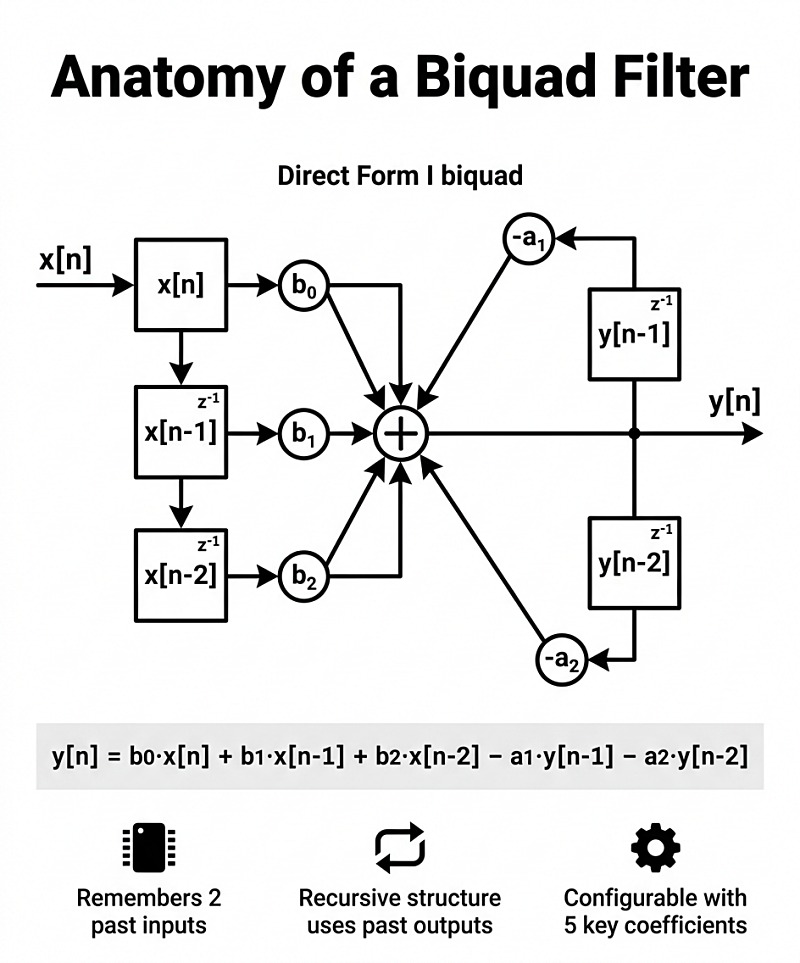
The practical way to understand a biquad is to forget the Z-domain for a second and look at the difference equation it executes, one sample at a time:
y[n] = b0·x[n] + b1·x[n−1] + b2·x[n−2] − a1·y[n−1] − a2·y[n−2]
Read left to right, that is literally all the filter does, millions of times per second, for every sample passing through.
The Feed-Forward Half
The first three terms are the feed-forward path. The filter looks at the current input x[n], the input from one sample ago x[n−1], and the input from two samples ago x[n−2], multiplies each by its own coefficient (b0, b1, b2), and adds them up. This alone, without any feedback, is a FIR filter, but it is the simpler half.
The Feedback Half
The last two terms are the feedback path. The filter remembers the two outputs it just produced, y[n−1] and y[n−2], scales them by a1 and a2, and subtracts them from the running total. This is where the IIR character comes in. Feedback is what lets a biquad build resonant peaks, sharp notches, and gentle rolloffs using a tiny number of operations.
The Five Coefficients in Plain English
Think of the coefficients as dials on a mixing desk:
- b0, b1, b2 decide how much of the present and recent input matters, and where the filter’s zeros land on the Z-plane
- a1, a2 decide how much of recent output feeds back, and where the poles land
Move the poles close to the unit circle and you get resonance and sharp peaks. Move the zeros onto the unit circle and you get perfect cancellation at specific frequencies (that is how a notch filter kills 50 Hz or 60 Hz hum). The entire sound of any biquad comes down to where those two poles and two zeros sit on a circle.
Why Stability Matters
There is one hard rule: both poles must sit inside the unit circle in the Z-domain. If a pole touches or crosses that circle, the feedback blows up and the filter becomes unstable. In practice, output values run off to infinity or oscillate forever. This is why one of the biggest selling points of biquads is that, as second-order sections, they are far less likely to go unstable than a monolithic high-order IIR filter whose coefficients can get extremely sensitive to rounding.
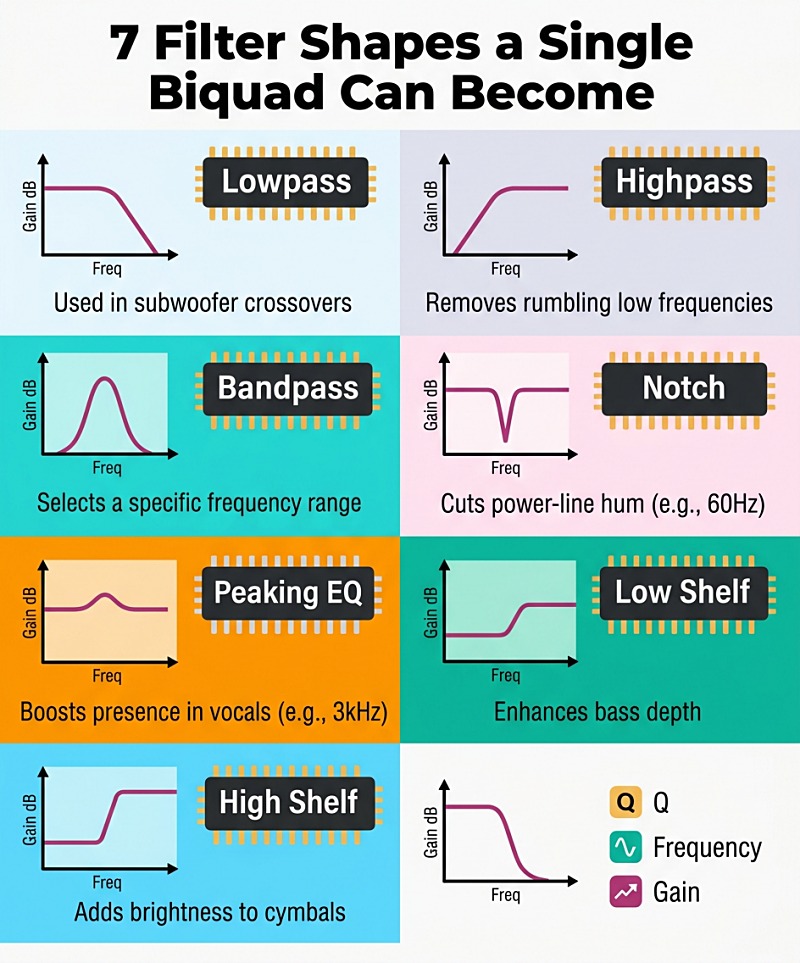
The 7 Filter Shapes a Single Biquad Can Become
Here is the real magic. Keep the same structure, change the five coefficients, and a biquad turns into a completely different filter. Robert Bristow-Johnson’s widely-used Audio EQ Cookbook published by the W3C is the reference most engineers reach for when they need the exact formulas.
| Filter Type | What It Does | Typical Use |
|---|---|---|
| Lowpass | Passes lows, cuts highs above a corner frequency | Subwoofer crossovers, anti-aliasing, smoothing sensor data |
| Highpass | Passes highs, cuts lows below a corner frequency | Removing rumble, DC blocking, tweeter protection |
| Bandpass | Passes a range, cuts both sides | Tone isolation, vocoder bands, biomedical processing |
| Notch (band-reject) | Cuts a narrow band, passes everything else | Killing 50/60 Hz hum, removing feedback squeal, room resonance |
| Peaking EQ | Boosts or cuts a specific band, leaves the rest flat | Parametric EQ bands, surgical mix corrections |
| Low Shelf | Boosts or cuts everything below a frequency | Bass tilt, warming up a mix |
| High Shelf | Boosts or cuts everything above a frequency | Air, brightness, taming harshness |
A biquad can also be configured as an allpass filter, which leaves the magnitude response flat but shifts phase. That sounds useless until you try to design a phase-correcting crossover, at which point it becomes essential.
Lowpass
The classic 12 dB per octave rolloff. Two cascaded biquads get you a Butterworth 24 dB per octave slope without the stability headache of a single fourth-order filter.
Highpass
The inverse of a lowpass. Most mixing consoles include a fixed 80 Hz or 100 Hz highpass on every channel, and that single switch is almost always a biquad behind the scenes.
Bandpass
There are two flavours. Constant-skirt gain keeps the skirt of the curve fixed, while constant-peak gain keeps the peak at 0 dB. The Audio EQ Cookbook formulas give you both.
Notch
A notch is defined by a center frequency and a Q factor. A high Q gives you a very narrow, surgical cut. Texas Instruments’ PCM6xx0 parametric filter documentation explicitly lists notch filters for removing “50 Hz or 60 Hz power line hum, transformer hum, room resonance, acoustic feedback, and any undesired specific frequency component introduced by the room acoustics or recording equipment.”
Peaking EQ
The workhorse of any parametric equalizer. You pick a center frequency, a Q (which becomes the bandwidth), and a gain in decibels. A full parametric EQ band is just one biquad running a peaking-EQ coefficient set.
Low Shelf / High Shelf
Shelves are used for broad tonal tilt instead of surgical cuts. They step the gain up or down and hold it there. Useful on mix buses, guitar tones, and mastering.
The Four Direct Forms (And Which One to Actually Use)
Any biquad can be coded up in several mathematically equivalent ways called direct forms. They all compute the same result in infinite precision, but real DSPs live in finite precision, and that is where they differ.
Direct Form I
Five multiplies and four adds, with both pairs of delays present. This is the layout most people draw first, and it is the preferred choice for fixed-point DSPs because a single summation point can use an extended-precision accumulator before rounding back down to storage width.
Direct Form II
Swap the feedback and feed-forward halves, then merge the redundant delay elements. This cuts memory in half, but the intermediate value before the feed-forward stage can overflow if the filter has a high Q. That makes it less safe on fixed-point hardware with high-resonance settings.
Transposed Direct Form II
Reverse the signal flow of Direct Form II. The filter response is identical, but intermediate sums end up between values of closer magnitude. Floating-point arithmetic is more precise when adding similar-magnitude numbers, so this form is the go-to choice for 32-bit or 64-bit float implementations in DAWs and plugins.
Transposed Direct Form I
Less common in practice, but mathematically valid. Shows up in certain HDL and FPGA-oriented biquad implementations where pipelining matters more than memory efficiency.
Quick rule of thumb:
| Processor type | Preferred form |
|---|---|
| Fixed-point DSP (e.g. older 56k, microcontrollers) | Direct Form I |
| Floating-point CPU / DSP (PC, mobile, most audio plugins) | Transposed Direct Form II |
| FPGA / HDL | Pipelined transposed forms |
Why Everyone Uses Biquad Filters
Now for the “why everyone uses them” half of the title. There are six reasons a biquad is almost always the first filter an engineer reaches for.
1. One Structure, Many Personalities
You only need to implement one piece of code. The same difference equation becomes a lowpass, a parametric band, a crossover stage, or a DC blocker, depending on which five numbers you load. That simplifies every part of the pipeline: testing, debugging, CPU profiling, and documentation.
2. Stability You Can Trust
Higher-order IIR filters are notorious for being touchy. Quantize their coefficients even slightly and poles can migrate outside the unit circle. Second-order sections, on the other hand, tolerate quantization far more gracefully. The Wikipedia article on the digital biquad filter notes the practical outcome: higher-order filters are typically implemented as serially-cascaded biquads (plus a first-order section if the order is odd) precisely to dodge this instability.
3. Cheap Enough for Real Time
A single biquad is about five multiplies, four adds, and four memory reads per sample. Even a modest DSP can run dozens on a single audio channel. miniDSP, a popular hardware processor brand, typically budgets 10 biquads per channel for parametric EQ plus more for crossovers on its entry-level boards, and each full 31-band graphic EQ needs just 31 biquads per channel.
4. Cascadable Into Anything
Need a 4th-order Butterworth lowpass? Cascade two biquads with carefully chosen Q values. Need a 10th-order elliptic filter? Cascade five. The cascade of second-order sections, often called SOS form, is the standard output of every serious filter design tool, from MATLAB to Python’s SciPy to ASN Filter Designer.
5. Parameters Any Engineer Already Understands
You do not have to think in poles and zeros. You pick a center frequency, a Q, and (for peaking and shelf types) a gain. Cookbook formulas convert those intuitive numbers into coefficients. That means a producer, a speaker designer, and a firmware engineer can all talk about the same filter in the same language.
6. Coefficients Can Be Updated Live
Because the filter state is just two past inputs and two past outputs, you can recompute coefficients on the fly (for example, in response to a moving cutoff knob) without audible clicks when the change is gradual. That is why synthesizer filter sweeps, auto-wah effects, and adaptive EQs are almost always biquad-based.
Where Biquad Filters Actually Show Up
Biquads are genuinely everywhere. A short tour:
Audio production. Every parametric EQ band in every DAW plugin is a biquad. Graphic EQs are banks of biquads. Crossovers in active monitors and car audio DSPs are stacks of biquads. Corrective tools like de-essers and resonance suppressors use biquads for their tuned bands.
Web Audio. The browser’s own BiquadFilterNode documented on MDN lets any web developer drop a configurable lowpass, highpass, bandpass, peaking, shelf, allpass, or notch filter into a web app. All of YouTube’s browser-level audio enhancements lean on it.
Speaker tuning. Products like miniDSP give users direct access to biquad coefficient slots for DIY room correction, phase-aligned crossovers, Linkwitz transforms, and custom EQ.
Synthesizers. While Moog-ladder and state-variable filters are popular for classic resonant synth sounds, a huge portion of modern soft-synth filtering is biquad-based, particularly for peak, shelf, and multi-mode designs.
Telecommunications. Pre-emphasis filters, de-emphasis filters, DC blockers, and channel equalizers in modems and radio gear are often implemented as biquad cascades. MATLAB’s Simulink DSP HDL toolbox specifically highlights DC blocking as a textbook biquad use case.
Wearables and biomedical devices. Fitness trackers, ECG front ends, EEG signal chains, and pulse oximeters use biquad filters to strip out motion noise, baseline drift, and power-line interference from sensor data. The same math that cleans up an electric guitar cleans up a heartbeat.
Servo and motion control. Industrial servo drives use biquads for notch filters that kill mechanical resonances, and lead-lag filters for loop shaping. Biquads here look identical to the audio case mathematically, they just live at much lower frequencies.
Microcontrollers. ARM’s CMSIS-DSP library ships a prebuilt arm_biquad_cascade_df1 set of functions for exactly this reason. On a Cortex-M4 or M7, a few cascaded biquads eat a trivial fraction of the CPU.
How Biquad Coefficients Are Designed
Designers almost never compute coefficients by hand. Two routes dominate in practice.
The Bilinear Transform Route
Start with a well-understood analog filter design (Butterworth, Chebyshev, elliptic, Bessel), then map it from the analog S-domain to the digital Z-domain using the bilinear transform. The transform includes a step called “prewarping” that compensates for frequency distortion near the Nyquist rate. SciPy’s bilinear_zpk, MATLAB’s bilinear, and almost every academic filter textbook use this approach.
The Cookbook Route
For audio specifically, Robert Bristow-Johnson’s Audio EQ Cookbook gives closed-form formulas for every common filter type. You plug in sample rate, center or corner frequency, Q, and gain (for peaking and shelf types), and out pop the five biquad coefficients. This is what almost every audio plugin and DSP ships in production because it is fast, well-understood, and tested at scale.
The more academic reference, Julius O. Smith’s Introduction to Digital Filters book hosted at CCRMA Stanford, covers the topology theory behind all of this in depth and is free to read online.
Common Pitfalls and Real-World Quirks
Low-Frequency Coefficient Sensitivity
At very low corner frequencies relative to the sample rate, biquad coefficients bunch together near 1.0 and small quantization errors can push the poles outside the unit circle. Nigel Redmon of EarLevel Engineering notes that biquads in 24-bit fixed-point typically start misbehaving below about 300 Hz at a 48 kHz sample rate (or about 600 Hz at 96 kHz) without mitigation. The standard fix is first-order noise shaping, where the quantization error from each step is fed into the next, or simply using double-precision arithmetic.
Floating-Point vs Fixed-Point
For 32-bit float on a desktop CPU or modern mobile SoC, precision is rarely the limiting factor. For fixed-point embedded work, double precision or noise shaping often becomes necessary, especially at high Q or low frequency.
High-Q Overflow in Direct Form II
Direct Form II’s intermediate summing node can saturate at high resonance. If you need a resonant peaking or bandpass filter on a fixed-point DSP, stay with Direct Form I and its extended accumulator.
The a/b Coefficient Convention Mess
Half the literature labels feed-forward coefficients as a (with b being feedback), and the other half labels them the opposite way. Wikipedia, the W3C Audio EQ Cookbook, and MATLAB use b for feed-forward and a for feedback. Older books and some EarLevel posts use the opposite. When you port code between sources, triple-check which convention is in play before you ship.
When Not to Use a Biquad
Biquads are not always the best answer. Linear-phase crossovers and convolution reverbs use FIR filters because phase linearity matters more than CPU cost. Moog-ladder emulations use four one-pole stages with global feedback because the musical character of their overdrive differs from a biquad’s. State-variable filters are better for live parameter modulation because frequency and Q decouple cleanly. Biquads are the default, not the universal answer.
Pro Tips When Working With Biquads
- For any Butterworth-style lowpass or highpass, set Q to 1/√2 ≈ 0.7071. That gives you the classic maximally flat passband.
- When cascading two identical lowpass biquads to get a steeper slope, the combined -3 dB point will shift. Either accept it or bump each filter’s cutoff up to compensate.
- If you need a phase-flip inside a biquad block (say, on a hardware coefficient-only DSP), just negate the b0, b1, and b2 coefficients. Same effect as multiplying by -1.
- For DC blocking, a simple first-order highpass at 10 to 20 Hz is usually enough, but a biquad with a low corner gives a cleaner transition.
- Always set the sample rate in your design tool correctly. A biquad designed at 48 kHz will be at a completely wrong frequency if loaded into a 96 kHz processor.
Biquad Filter FAQ
Is a biquad filter IIR or FIR?
A biquad is IIR. It has feedback terms (a1 and a2), which make its impulse response infinite in duration. If you zero out a1 and a2, you get a simple three-tap FIR filter, but that is not what most people mean when they say “biquad”.
Why use two cascaded biquads instead of one 4th-order filter?
Higher-order IIR filters are extremely sensitive to coefficient quantization. Small rounding errors in a monolithic 4th-order design can shove poles outside the unit circle and make the filter unstable. Two cascaded biquads have independent, well-behaved sections, so the overall design is more robust and easier to tune section by section.
How many biquads does a typical equalizer use?
A parametric EQ uses one biquad per band, so a 10-band PEQ is 10 biquads per channel. A 31-band graphic EQ uses 31 biquads per channel. A 4-way active crossover with EQ can easily chew through 30 to 50 biquads per channel. This is why DSP chips are often rated by how many biquads per channel per second they can compute.
What is the Q factor in a biquad?
Q is the “quality factor” and sets how sharp or resonant the filter is at its center or corner frequency. Low Q (around 0.5) is gentle and broad. High Q (4, 8, 16 and up) is narrow and resonant. In a bandpass or notch, Q relates directly to bandwidth: bandwidth = center frequency / Q.
Can a biquad filter be used outside audio?
Absolutely. Biquads are used in ECG and EEG signal chains, vibration analysis, servo motor control, radar preprocessing, telecoms, and general sensor conditioning. Any time you have a discrete-time signal that needs shaping in frequency, a biquad is a candidate.
Can a biquad filter go unstable?
Yes, if its poles land on or outside the unit circle in the Z-domain. In practice this happens from bad coefficient calculation, bad quantization, or accumulated rounding error on fixed-point hardware. A stable biquad has both poles strictly inside the unit circle.
What is the difference between Direct Form I and Direct Form II?
Direct Form I uses more memory but tolerates fixed-point arithmetic well and avoids mid-filter overflow. Direct Form II uses half the memory but can overflow at high Q. On floating-point systems, Transposed Direct Form II is usually preferred for its numerical behaviour.
Why is it called “biquad”?
Because its Z-domain transfer function is a biquadratic expression, meaning the ratio of two quadratic polynomials. Two squared terms on top, two squared terms on the bottom.
Final Thoughts
Biquad filters are the duct tape of digital signal processing. They are small, cheap, well-understood, reconfigurable into almost every filter shape anyone actually needs, stable enough to trust in production, and backed by decades of design tooling. They are the reason a $20 wearable can smooth sensor data in real time, why a browser can EQ a podcast, why a $4,000 mastering EQ plugin feels surgical, and why active speakers stay tight across the whole frequency range.
If you build anything in audio, DSP, embedded signal processing, or even control systems, you will spend more time with biquads than with any other filter form. Learn the difference equation, memorize the seven shapes, pick your direct form based on your hardware, and you have 90% of practical IIR filtering covered. The rest is coefficients.
Bookmark this guide, and come back to it the next time someone hands you a DSP block diagram full of second-order sections and expects you to know what to do.