
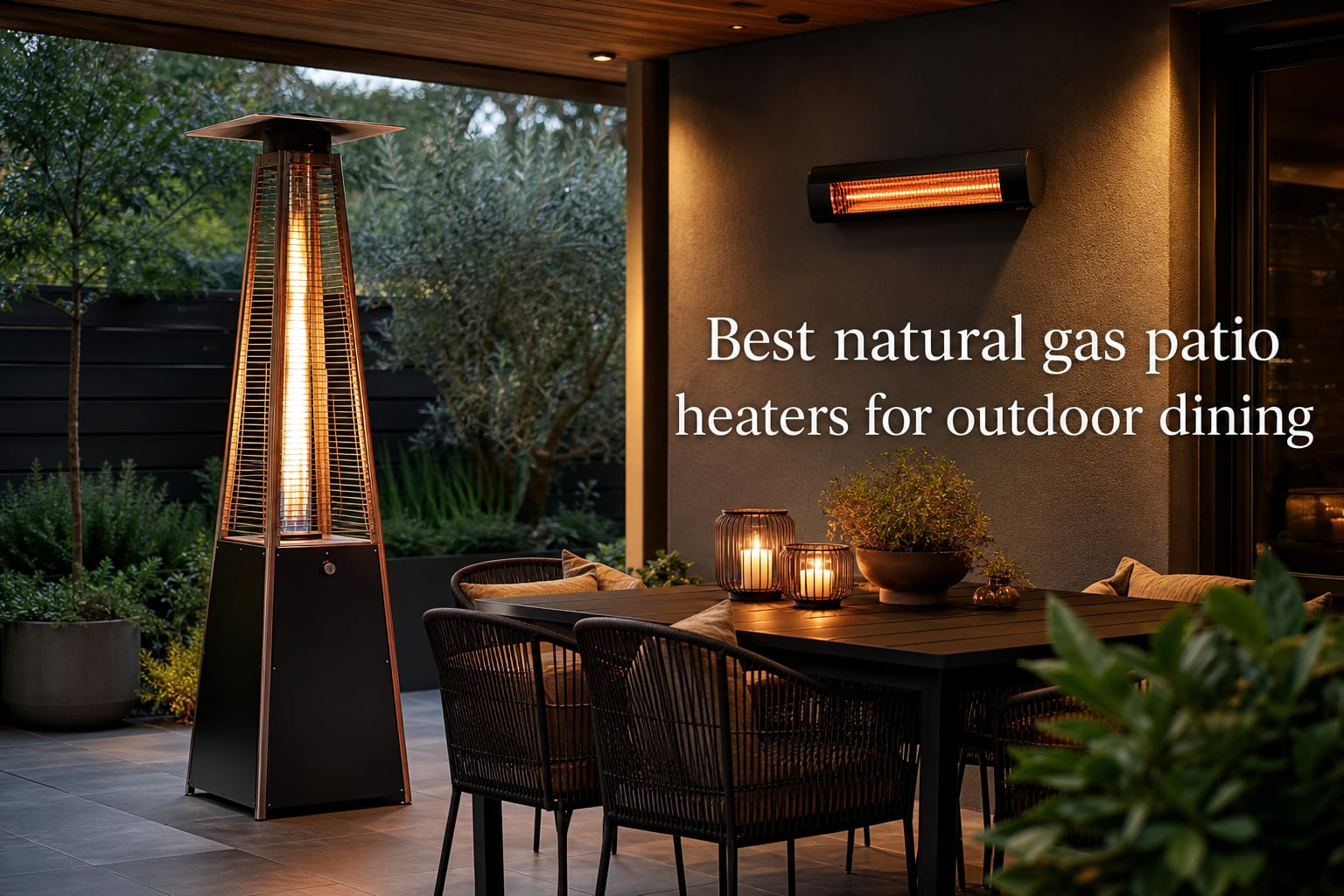
Natural gas patio heaters for outdoor dining make the most sense when your tables stay in one place and you already have, or plan to add, a properly sized gas connection. They provide steady outdoor heat without changing fuel cylinders, but they trade that convenience for professional installation, fixed placement, and careful clearance planning.
My short answer is this: choose a 45,000-BTU freestanding tower for flexible seating layouts, or a directional infrared unit when you need to keep pathways and table space clear. The Golden Flame XL-Series is my overall pick because its stated 15-foot heat diameter, 4.8-star rating from 15 reviews, fillable base, wheels, and anti-tilt shutoff fit a broad range of outdoor dining setups.
For this guide, I reviewed all six natural-gas models in the supplied product data, including their stated BTU output, coverage, construction, mounting type, safety details, ratings, review counts, and limitations. I did not run instrumented heat tests, so treat stated coverage as a starting point rather than a promise for a windy deck or an exposed restaurant patio.
Natural gas patio heaters are permanent outdoor heating units connected to a home or building gas line. They burn natural gas at a burner to create radiant heat, which a reflector dome or infrared panel directs toward diners, tables, and nearby surfaces instead of trying to warm all the moving outdoor air.
That distinction matters at dinner. A heater can have a large BTU number yet feel disappointing when it is placed too far from chairs, blocked by a tall table, or exposed to a crosswind; a smaller directional infrared heater can feel more useful when it is aimed at a compact seating zone.
Forum discussions point to the same practical concerns: people want to know whether the gas-line work needs permits, how far the warmth really reaches, and whether one heater is enough for a large area. I address those questions below, along with the difference between a movable tower attached to a hose and a genuinely fixed wall or ceiling installation.
The top 3 picks are the Golden Flame XL-Series, Golden Flame Resort, and Bromic Platinum.
The Golden Flame XL-Series is the straightforward all-around choice for a freestanding dining area. Choose the Golden Flame Resort when a visible flame and the strongest listed tower output matter most, and choose the Bromic Platinum when a mounted infrared panel is the better answer for a polished covered patio with limited floor space.

Bromic Platinum Smart Heat 500
- 215 sq ft stated coverage
- wall or ceiling mount
- tinted ceramic fascia
The six best natural gas patio heaters below cover both freestanding and mounted dining layouts in 2026.
A quick comparison is useful, but do not let it replace a site plan. The right model depends on whether guests sit around a movable table, under a fixed roofline, beside a walkway, or in an open section of patio that receives wind from one direction.
| Product | Specifications | Action |
|---|---|---|
| Golden Flame XL-Series |
|
Check Latest Price |
 Golden Flame Resort Golden Flame Resort |
|
Check Latest Price |
| Bromic Platinum Smart Heat 500 |
|
Check Latest Price |
 Bromic Tungsten Smart Heat 500 Bromic Tungsten Smart Heat 500 |
|
Check Latest Price |
 Golden Flame XL Matte Mocha Golden Flame XL Matte Mocha |
|
Check Latest Price |
 Bromic Tungsten 300 Bromic Tungsten 300 |
|
Check Latest Price |
The best overall choice is 1. Golden Flame XL-Series for flexible dining zones.
- 4.8-star rating
- Variable heat control
- Fillable stable base
- Drink table
- Pre-installed hose
- Natural gas only
- Assembly required
- Outdoor use only
The Golden Flame XL-Series is the model I would start with for a home patio or a casual restaurant seating area because its design addresses the day-to-day realities of table layouts. Its 45,000-BTU radiant burner has a stated 15-foot heating diameter, and the wide aluminum reflector is built to cast warmth outward and downward around seated guests.
The rating evidence is encouraging: it holds 4.8 stars from 15 reviews, the strongest score in this group. Buyers cited the rapid push-button ignition, useful heat output, stable base, and 360-degree drink table, which is a small feature that becomes practical beside a standing conversation area or a table at the patio edge.
Its variable heat control is a meaningful advantage for outdoor dining because every cool evening does not call for the same output. I would place the heater near the seating perimeter rather than in the middle of a narrow aisle, then use the lower setting when the air is still and increase it only as people start feeling the temperature drop.
This is a floor-mounted, 89-inch freestanding tower, so it gives you visual presence as well as heat. The two wheels make repositioning easier, yet the natural-gas hose means it is not portable in the same way as a propane tower; its usable range is limited by the supplied six-foot flexible hose and the location of the gas connection.
Stability deserves more attention than it often gets. The base can be filled with sand through a concealed cavity, and the heater has an automatic tilt shutoff; I see that combination as particularly helpful where chairs, servers, children, or pets move close to the equipment.
The stainless steel burner and aluminum reflector are sensible materials for an outdoor patio heater, but they do not make the heater maintenance-free. Keep the reflector clear, inspect the hose and flare fitting before use, and cover or store the unit according to the manufacturer instructions when it is not in service.
The best placement is beside, not inside, the dining circle.
The stated 15-foot diameter describes a broad zone, not an invitation to put a hot tower directly between diners. Positioning it near a corner of the seating group lets the reflector send heat toward shoulders and laps while leaving the center open for chairs and service.
For a rectangular table, I would test the perimeter seating first and shift the table before moving the heater. A small move can matter more than adding output because the reflector pattern needs a clear path to the people who need warmth.
The key limitation is its dedicated natural-gas connection.
This Golden Flame is not propane-compatible, so it is for buyers who are committed to a natural-gas line. A qualified gas professional should confirm gas pressure, line capacity, shutoff placement, local code requirements, and whether the supplied 3/8-inch male flare fitting is correct for the planned connection.
Do not treat the anti-tilt feature as permission to use the heater in an enclosed space or to ignore manufacturer clearances. It remains an outdoor appliance that needs open-air ventilation and a stable, level surface.
The best ambience choice is 2. Golden Flame Resort with a one-piece glass tube.
- Highest listed tower output
- Unbroken flame view
- Adjustable flame
- Protective cover
- Ballast access
- Natural gas only
- 65-pound assembled weight
- Small review sample
The Golden Flame Resort is the dining-room-style choice among the freestanding heaters because it combines a visible vertical flame with the highest listed output in this group: 49,000 BTU. It is still a radiant outdoor heater first, but the pyramid form gives a patio a focal point that a conventional mushroom-top tower does not.
The one-piece quartz glass tube is the detail that separates this version from many two-piece glass-tube designs. Without a center connector interrupting the view, the flame reads more cleanly from a table, which makes sense for a patio that is used for late dinners, celebrations, or guest-facing hospitality seating.
Golden Flame lists adjustable flame height ranging from a subdued setting to a fuller flame, along with an infrared radiant emitter screen. That range helps the owner balance visual mood and heat output, though I would not choose a flame-style heater only for looks when a location is extremely windy; placement and shielding still determine how useful the warmth feels.
There are 10 reviews behind its 4.8-star rating, so the score is very good but based on a small sample. The available feedback praises the uninterrupted flame view, output, and versatility, while the product data makes clear that this is another dedicated natural-gas appliance rather than a conversion-ready tower.
The unit stands 88 inches tall and weighs 65 pounds assembled. Mobility wheels help when you are arranging furniture, but a heater of this size is best thought of as semi-fixed: choose a reliable gas connection point and then move it within its hose range rather than expecting it to travel across the patio.
I also like that a zippered all-weather protective cover is included. A cover does not remove the need to inspect the burner, tube, connections, and base, but it can reduce the cleanup work when the heater sits outside between dining days.
The strongest use case is an open patio where flame visibility matters.
This is a good match for an outdoor dining area that needs warmth plus a visual center, especially where guests can see the tower from more than one side. The full-height flame and rich-mocha matte finish can complement a patio without adding extra floor furniture solely for atmosphere.
Use the ballast access door for added weight in windy conditions, following the manufacturer guidance. A tall pyramid heater needs a level footprint and a clear buffer from chairs, umbrellas, drapes, plants, and overhead structures.
The main tradeoff is that ambience does not replace heat zoning.
A glass tube makes the fire easy to see, but seated diners still need to be within the reflector and radiant-heating zone. On a large patio, one attractive tower may leave the far end cool; two correctly spaced heaters can be more effective than expecting one unit to cover every seat.
Before ordering, have an installer measure the connection route and plan the shutoff. The pre-connected six-foot natural-gas line with 3/8-inch male flared fitting may simplify the final hookup, but it does not substitute for compliant permanent gas work.
The best floor-saving option is 3. Bromic Platinum Smart Heat 500 for mounted infrared warmth.
- Keeps floor clear
- Directional bracket
- Tinted ceramic fascia
- Stainless construction
- Smart-control compatible
- 110V required
- Controls sold separately
- 96-inch clearances
- Professional installation
The Bromic Platinum Smart Heat 500 answers a different outdoor-dining problem: how to warm a fixed seating zone without putting a tower in the walking path. It mounts on a wall or ceiling using an adjustable directional bracket, leaving floor space for tables, chairs, wheelchairs, and servers.
Its listed 11,000-watt output is approximately 39,800 BTU equivalent, with stated coverage of 215 square feet. More important than the headline number is its infrared radiant approach, which directs heat at people and objects rather than relying on warm air that can drift away before it reaches the table.
The tinted ceramic glass fascia is designed to reduce visible light while spreading heat evenly. That makes this Bromic a sensible fit for an upscale covered patio where a bright exposed element would distract from the meal, but remember that a darker, quieter-looking unit still produces substantial heat and needs the stated clearances.
It has 4.3 stars from 19 reviews. The supplied feedback describes it as a commercial-grade, low-profile solution valued for its even radiant heat and unobtrusive form, while also noting the shorter 90-day commercial warranty compared with its one-year residential warranty.
This natural gas outdoor heater needs more planning than a freestanding tower. It requires a natural-gas connection and 110V power for ignition, and the product data calls for minimum 96-inch clearances; confirm every dimension against the live installation manual and local building rules before choosing a mounting point.
Smart-control compatibility may appeal to a restaurant operator who needs central control, although the remote or control system is not included. I would decide whether that ecosystem is wanted before installation, since access to controls and electrical routing are easier to plan while the gas work is underway.
The right application is a covered patio with fixed tables.
A wall- or ceiling-mounted infrared patio heater works well when the dining map is stable and floor circulation is important. Aim it at the seating zone, not at an empty aisle, and plan the bracket direction before drilling so the radiant field serves people rather than a wall or planter.
The listed 215-square-foot coverage is useful for estimating a small dining zone, not a whole open restaurant patio. Divide a larger area into seating clusters and consider one directional source per cluster where wind or roof geometry separates the space.
The required clearances make a site survey non-negotiable.
The minimum 96-inch clearance requirement may rule out low rooflines, shallow awnings, and tight corners. Measure from the planned heater location to every nearby ceiling, wall, umbrella, beam, curtain, and combustible surface, then have a qualified installer make the final call.
Do not mount it above an area where diners cannot be moved away from the radiant field. Aiming, vertical height, and clearance are part of the heater choice, not details to settle after delivery.
The higher-output mounted option is 4. Bromic Tungsten Smart Heat 500 for a fixed 215-square-foot zone.
- High listed output
- Wall or ceiling mounting
- Stainless steel
- Smart-control compatible
- Directional heat
- 3.9-star rating
- 110V required
- Controls sold separately
- 96-inch clearances
The Bromic Tungsten Smart Heat 500 is the stronger-output mounted sibling in this selection, listed at 12,000 watts or about 43,000 BTU equivalent. Like the Platinum, it has stated 215-square-foot coverage and an adjustable wall or ceiling bracket, so it is designed for a defined dining zone rather than casual moving around the yard.
I would look at this model when the mounted format is right but the patio is more exposed or the seating zone needs a little more stated output. Infrared heating is especially useful outside because it targets the diners and furniture in its path instead of trying to raise the temperature of the whole patio volume.
The important qualification is its 3.9-star rating from 12 reviews, lower than the Platinum’s 4.3-star result. The product data notes that 53 percent of reviewers gave it five stars but that 16 percent gave it one star, which is enough mixed feedback that I would verify warranty terms, seller support, and installer support before committing.
The form factor is still excellent for a covered patio that cannot spare floor space. Its black stainless-steel construction and tinted ceramic glass fascia suit a restrained hospitality look, and its smart-control compatibility may work for a permanent outdoor-dining installation that has an existing controls plan.
As with the Platinum, the necessary 110V ignition connection and stated 96-inch minimum clearances add complexity. A professional should assess the gas line, electrical source, structural mounting surface, bracket location, and access for future service as a single project.
The conclusion here is not that more output automatically makes it the better Bromic. The better choice is the one whose output, control needs, review profile, ceiling height, and service support match the particular patio.
The best target is a seating area that needs focused radiant heat.
Point the adjustable bracket toward the chairs where people sit still for the longest part of a meal. A directional heater can waste much of its benefit if it is installed parallel to the seating row or aimed into a wide unoccupied corridor.
For a row of tables, use a measured zone plan. Consider where guests face, how a server approaches, and whether the radiant field reaches shoulders and legs rather than only the tabletop.
The sensible decision is to weigh output against review evidence.
The 12,000-watt specification is attractive, but it should not erase the more mixed rating history. I would read current buyer feedback, retain all installation documentation, and ask the installer who will handle troubleshooting if the ignition, mounting hardware, or connection needs attention.
It is also natural-gas-only. Do not buy it as a quick substitute for a portable propane heater, because its value comes from a well-planned permanent installation.
The practical freestanding alternative is 5. Golden Flame XL Matte Mocha for a larger review sample.
- 45
- 000 BTU
- Drink surface
- Variable heat
- Anti-tilt shutoff
- 35 reviews
- 3.8-star rating
- Natural gas only
- Mixed buyer feedback
The Golden Flame XL Matte Mocha is another 89-inch, 45,000-BTU freestanding tower with a stated 15-foot heat diameter. Its design is close to the overall Golden Flame pick in the ways that matter for dining: a wide aluminum reflector hood, stainless steel burner, rapid-spark pilotless ignition, variable control, two wheels, and a flat drink or snack surface.
What makes this version distinct is the review sample. It has 35 reviews, the largest count in this roundup, but a lower 3.8-star rating; the supplied data says 57 percent of reviewers are satisfied while 16 percent left one-star feedback, making it a more mixed proposition than the 4.8-star XL-Series.
I would not dismiss it solely because the rating is lower, since it has the same core 45,000-BTU output and stated coverage that make a freestanding tower useful for outdoor dining. Still, the larger review history means the lower average should factor into the decision, particularly for a business that needs dependable operation during scheduled service hours.
Its sand-fillable base adds 25 pounds when filled and can accept up to 50 pounds of additional concealed weight. Combined with automatic tilt shutoff, that creates a thoughtful stability package for a dining patio where people may brush by the heater, though a level surface and correct placement remain the first defenses against a tip-over.
The product listing also mentions water vapor released during operation to help reduce dry air. I would treat that as a secondary comfort detail, not a reason to use this or any gas heater in a poorly ventilated or enclosed space; the intended use is outdoors with appropriate clearances.
The six-foot flexible hose uses a 3/8-inch male flare fitting, so the same natural-gas planning applies here as for the other towers. Have a professional determine whether the fixed line, valve, and connection are appropriate, and do not improvise an adapter or conversion outside manufacturer guidance.
The best fit is a movable dining layout that benefits from a table-height surface.
The flat drink surface is useful beside a cluster of lounge chairs or a standing cocktail table, where it can keep small items off the dining table. Keep drinks and napkins away from hot surfaces and leave guests a clear route around the base.
The wheels make seasonal rearranging less taxing, but the gas hose sets the actual movement boundary. Sketch seating positions around that radius before choosing where the gas stub will go.
The key buying step is checking recent reliability feedback.
The 3.8-star rating and one-star share make this a model where I would read the newest verified reviews for recurring complaints. Pay special attention to reports about ignition, burner performance, shipping damage, fit of connection parts, and whether replacement components were available.
That research is not busywork. Forum users repeatedly value responsive support and obtainable replacement parts because a patio heater becomes far less useful when a small component interrupts outdoor-dining service.
The best compact wall-bar option is 6. Bromic Tungsten 300 for a small, windy dining nook.
- Broad three-burner pattern
- 8-mph wind resistance
- 25-degree pivot
- 33-pound weight
- Wall controls
- 3.7-star rating
- 120 sq ft coverage
- Natural gas plus 110V
- Wall mount only
The Bromic Tungsten 300 has the smallest listed heat output in this guide at 26,000 BTU, but its three-burner bar design gives it a focused purpose. It is meant to heat a stated 120-square-foot zone, which can suit an intimate two- or four-table nook, a bench seating run, or a compact residential dining corner.
Its useful differentiator is stated wind resistance up to 8 mph for uninterrupted heating. No heater defeats every gust, but a radiant bar that continues working in modest wind can be more useful on an exposed patio than a larger unit whose heat is directed into open air without a plan.
The wall bracket lets the heater head pivot 25 degrees left and right from center. That is a practical form of heat zoning: rather than warming an entire patio inefficiently, you can aim the three burners along the length of a table or toward the seats that receive the prevailing breeze.
The available ratings call for care. It has 3.7 stars from 12 reviews, and the supplied review data reports a notable 30 percent of reviews at two stars, even though the bar shape, wind specification, and 33-pound weight are appealing on paper.
This is not a substitute for a wide-coverage tower. The 120-square-foot figure is considerably smaller than the 215 square feet stated for the larger Bromic units and the broad stated diameter of the Golden Flame towers, so using it on a big patio will create cold seats rather than a cozy dining experience.
It is a natural-gas appliance with a 110V ignition component and wall-mount installation. The control system is housed in the bracket away from the heat source, which can help access and durability, but the installer still needs to plan gas, power, wall strength, clearances, and service access.
The strongest layout is a narrow seating strip rather than a wide open patio.
A three-burner bar can align well with a long table, banquette, or row of small tables because its radiant pattern is wider than a single-point source. Use the 25-degree pivot to tune the direction after the seating furniture is in place.
Think of 120 square feet as one thermal zone. If the dining area is larger, build a multi-heater plan instead of placing one bar high on a wall and hoping its heat reaches every corner.
The decision should account for the lower rating and service plan.
The Tungsten 300 has capable stated features, but it is the lowest-rated model in this set. I would choose it only when its small-zone size, wall-bar form, and wind-oriented specification solve a specific layout problem that the others do not.
Ask in advance how warranty service works for the location, especially for commercial use where the listed warranty is 90 days. Keep the model information, installer records, and product documentation together for any later support request.
The right natural gas patio heater starts with heat zoning, installation, and safety.
Picking among models is easier once you separate three questions: how much seating needs warmth, where the unit can physically go, and whether the building can support the gas and electrical requirements. A heater with impressive listed BTU output is the wrong purchase if its mounting point violates clearances or directs heat away from diners.
The first sizing rule is to zone seating instead of sizing the whole yard.
BTU, or British thermal units, describes the amount of heat a burner can produce. It does not state exactly how warm guests will feel because wind, ceiling height, open sides, seating distance, and the heater’s radiant pattern all change the real result.
Start by measuring each active dining cluster. A small 120-square-foot nook can suit the stated coverage of the Bromic Tungsten 300, while a fixed 215-square-foot zone lines up with the stated coverage of the larger Bromic mounted units.
A 45,000- or 49,000-BTU freestanding Golden Flame has a stated 15-foot diameter heating area, which can serve a broader cluster when the air is calm. For a 400-square-foot patio, I would not assume one heater is enough; divide the seating into two or more zones and place sources close enough to the chairs that need heat.
Wind is the reason this method works better than a simple square-foot calculation. In an open location, locate heaters on the windward side when safe and permitted, use existing architectural windbreaks without blocking ventilation, and direct radiant panels toward people rather than across the breeze.
The better heating method is infrared for exposed fixed seating and reflector heat for flexible seating.
Infrared patio heaters warm people and objects directly in their line of sight. That makes wall- and ceiling-mounted Bromic panels especially suited to fixed tables, covered patios, and breezier spaces where warming the surrounding air would be inefficient.
Freestanding reflector towers also provide radiant warmth, but their circular arrangement suits movable chairs and flexible conversation areas. They bring the heat source closer to the group, at the cost of consuming floor space and requiring a base that guests can safely navigate around.
A visible glass-tube pyramid adds flame ambience, whereas a low-profile mounted panel can fade into the ceiling line. Neither style is inherently better; choose the one that suits the traffic pattern and the kind of experience the patio is meant to provide.
The required installation is a professional natural-gas and electrical assessment.
Natural gas is convenient because a fixed supply removes cylinder changes, but it is not a do-it-yourself shortcut. A qualified professional should assess available gas capacity, line sizing, gas pressure, shutoff valve location, connection type, appliance instructions, local permits, and inspection requirements.
Mounted Bromic heaters also list a 110V ignition requirement, so gas and electrical planning must happen together. The installer should verify that the mounting substrate can support the unit and bracket, that the wiring route is appropriate, and that controls remain accessible after installation.
Freestanding units may look simpler because they include flexible hoses, but they still need a correct, code-compliant gas connection. Do not run a hose through a doorway, under furniture, across a busy path, or where it can be pinched, heated, tripped over, or damaged.
I would buy a dedicated natural-gas model rather than depend on an unverified conversion idea. Buyers often ask whether a propane heater can be converted, but fuel conversion is not generic: it involves burner orifice, regulator, pressure, certification, and manufacturer approval, so only follow an approved kit and professional instructions for that exact unit.
The critical safety checks are clearance, stability, ventilation, and shutoff access.
Every model here is for outdoor use. A covered patio is not automatically safe simply because it has a roof; follow the individual product manual for overhead, side, and combustible-material clearances, and do not use any gas heater in an enclosed or insufficiently ventilated area.
The Bromic Platinum and Tungsten 500 list minimum 96-inch clearances, which should be verified before purchase. Tall freestanding towers also need room around their reflector or glass tube, away from umbrellas, fabric, awnings, foliage, decorative screening, and low ceilings.
For a tower, fill or ballast the base according to instructions, use a flat stable surface, and retain the anti-tilt shutoff as a backup rather than the whole plan. For a wall unit, confirm bracket integrity and aim the radiant face away from routes where people stand close for long periods.
Know where the manual gas shutoff is before the first dinner service. A routine pre-use check should include the hose or supply connection, visible burner area, ignition behavior, unusual odor, and any signs of damage; if something looks wrong, turn off the gas and call a qualified professional.
The practical maintenance routine is inspection, cleaning, protection, and records.
At the beginning of the season, inspect the exterior, mounting hardware or base, hose, fittings, ignition components, burner, and reflector. Clean only in the manner the manufacturer permits, because incorrect cleaning or blocked burner ports can affect ignition and combustion.
Keep leaves, grease, food debris, and cobwebs away from the appliance. A protective cover can help a freestanding unit between uses, while a mounted heater benefits from periodic checks for debris, corrosion, and any change in bracket alignment.
For a restaurant patio, assign the checks to a named staff member and record service dates, installer details, and model numbers. Forum discussions show that replacement-part access and responsive support matter a great deal when an outdoor heater is part of scheduled dining operations.
Review the warranty distinction before purchasing. The Bromic models list a one-year residential warranty and a 90-day commercial warranty, while the Golden Flame models list a one-year limited warranty; the written terms and local service options should be part of the buying decision.
The restaurant layout should prioritize diners and staff circulation together.
A commercial patio has a different problem from a backyard: servers need safe paths, diners need warm seats, and heaters cannot turn every route into an obstacle course. Ceiling or wall-mounted infrared models can preserve circulation when the roof height, clearances, and electrical installation support them.
Freestanding towers can work well at patio edges or within deliberately planned seating islands. Keep them out of fire exits, service lanes, and places where chairs routinely get pushed back into the base or hose area.
Use a trial seating map before fixing permanent equipment. Put chairs in their real positions, mark the proposed radiant field and heater base, then walk the routes a guest and server would take during a busy dinner.
These answers address the most common natural-gas patio-heater questions.
What is the best gas patio heater?
The Golden Flame XL-Series is the best all-around option in this six-model group for flexible outdoor dining because it combines 45,000 BTU, a stated 15-foot heating diameter, variable control, a fillable anti-tilt base, wheels, and a 4.8-star rating from 15 reviews. For a fixed covered patio, the Bromic Platinum is the better format because its mounted infrared design preserves floor space.
Which natural gas heater is best?
The best natural gas heater depends on the layout. Choose the Golden Flame XL-Series for a movable freestanding dining zone, the Golden Flame Resort for flame ambience and 49,000 BTU of listed output, or a Bromic mounted infrared model for fixed seating where a wall or ceiling installation meets the stated clearances and installation requirements.
Which outdoor gas heater is best?
A mounted infrared heater is best for a fixed, exposed seating zone because it can aim heat directly at diners and leave the floor open. A freestanding reflector tower is best for flexible table layouts. Match the heater to a measured seating zone, not the entire patio, and have a qualified professional verify the natural-gas connection and clearances.
What’s the best outdoor heater for a patio?
The best outdoor heater for a patio is one that fits the seating layout and site conditions. For broad flexible seating, select a stable freestanding natural-gas tower with anti-tilt protection; for a compact or covered patio with fixed tables, select a directional infrared wall or ceiling model. All gas heaters in this guide require outdoor use, correct ventilation, and manufacturer-specified clearances.
The best final choice matches the heater to the dining zone and gas-line plan.
For most flexible outdoor dining areas, I would choose the Golden Flame XL-Series for its 45,000-BTU output, stated 15-foot diameter, anti-tilt design, movable base, and strong 4.8-star rating. The Golden Flame Resort is the appealing alternative when a visible flame is part of the experience, while the Bromic Platinum is the clearest choice for an installed, floor-saving infrared setup.
Natural gas patio heaters for outdoor dining are worth considering in 2026 when you want a permanent fuel supply and are ready to plan the installation properly. Measure the seating zones, verify outdoor clearances and local requirements with a qualified installer, then select the heater format that puts radiant warmth on diners without compromising traffic flow or safety.