

The best auto darkening welding helmets for welders let you keep the workpiece in view before, during, and after the arc starts. That sounds simple, but it is the difference between placing a tack with a clear view and repeatedly lifting a fixed-shade hood.
An auto darkening welding helmet is a protective face shield with a filter that senses the welding arc and turns dark automatically. Most filters use arc sensors to trigger an LCD lens, moving from a light state to a welding shade in a fraction of a second while still providing UV and IR protection.
I compared the supplied specifications, stated safety certifications, power systems, feature sets, and customer-rating samples for all 10 helmets here. The right choice depends less on a badge and more on your process: low-amperage TIG asks for dependable sensing, fabrication rewards a large clear view, and occasional shop jobs may favor a simple, replaceable-battery design.
One practical point from welding-community discussions deserves attention: battery serviceability and headgear matter after the first few welds. A stated fast switching figure is useful, but a filter also needs suitable sensitivity control, enough sensors for your working position, and a hood you will actually keep on.
The three strongest picks cover professional clarity, broad value, and maximum viewing area 2026
My editor’s choice is the ESAB Sentinel A60 because its supplied data combines a large 4.65 by 2.80 inch view, four sensors, a replaceable CR2450 battery, shade adjustment in half steps, and nine stored settings. The ARCCAPTAIN HSH-S800 is the value-focused choice for a light 1-pound helmet with 1/1/1/1 optical clarity, four sensors, solar cells, and a replaceable CR2450 backup.
For a welder who prioritizes the largest stated view and productivity tracking, the Miller Digital Infinity stands apart with its 13.4-square-inch viewing area, ClearLight 4X lens, AutoSense, and InfoTrack 2.0. Those are different priorities, so treat these as fit-based recommendations rather than a one-size-fits-all ranking.
The best auto darkening welding helmets in 2026 match the filter to the job
The overview above puts all 10 supplied products in one place. Compare the viewing area, sensor count, lens technology, shade range, and power details, then read the review that matches how you weld rather than choosing from a rating alone.
| Product | Specifications | Action |
|---|---|---|
 ESAB Sentinel A60 ESAB Sentinel A60 |
|
Check Latest Price |
 ARCCAPTAIN HSH-S800 ARCCAPTAIN HSH-S800 |
|
Check Latest Price |
 Miller Digital Infinity Miller Digital Infinity |
|
Check Latest Price |
 ESAB SAVAGE A40 ESAB SAVAGE A40 |
|
Check Latest Price |
 Miller Digital Elite Miller Digital Elite |
|
Check Latest Price |
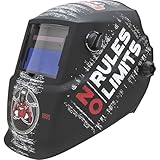 Lincoln No Rules No Limits Lincoln No Rules No Limits |
|
Check Latest Price |
 Sunstac Large View Sunstac Large View |
|
Check Latest Price |
 ARCCAPTAIN Large View Light ARCCAPTAIN Large View Light |
|
Check Latest Price |
 ARCCAPTAIN Panoramic ARCCAPTAIN Panoramic |
|
Check Latest Price |
 VILSIN Auto-Darkening VILSIN Auto-Darkening |
|
Check Latest Price |
1. ESAB Sentinel A60 is the best all-around choice for controlled settings
- Large viewing area
- Half-step shade control
- Replaceable CR2450
- True Color lens
- 400-review sample
- Internal controls
The Sentinel A60 earns the lead spot because its listed controls speak directly to repeatable work. It has a 4.65 by 2.80 inch ADF viewing area, four arc sensors, and a DIN 3/5-13 range that adjusts in 0.5 increments, which gives a welder more choice than a basic 9-13-only lens.
ESAB also lists OpTCS True Color Lens Technology, a 0.08 millisecond switching time, sensitivity and delay controls, and a shade-lock function. I would value the onboard memory for up to nine settings when moving between processes or when more than one person uses a work area.
The A60 best suits welders who change settings often
The nine memory slots and fine shade steps are the defining reason to consider this helmet. They reduce the need to rebuild a preferred setup after switching between work types, while four sensors provide more coverage than a two-sensor layout.
The supplied listing also says the CR2450 battery is replaceable and includes low-battery, grind-mode, and shade-lock LEDs. That directly addresses the serviceability concern commonly raised by welders who do not want a sealed battery to end a helmet’s useful life.
The A60 asks you to accept internal ADF adjustments
Its controls are described as internal, so this design is less convenient when a frequent setting change is needed mid-task than a helmet with an exterior adjustment. That is a workflow tradeoff, not a safety shortcut.
The available customer sample is 400 reviews with a 4.7 rating, and the supplied review summary reports 87% five-star reviews. Those figures are encouraging, but I would still inspect fit and replacement-lens availability for your own setup.
2. ARCCAPTAIN HSH-S800 is the best value pick for lightweight true-color coverage
- Lightweight
- Replaceable CR2450
- 1/1/1/1 lens
- Cheater-lens compatible
- 180-day warranty
- Budget build
The HSH-S800 pairs a stated 1-pound weight with four arc sensors, 1/1/1/1 optical clarity, and a 1/25,000-second response figure. That is an unusually complete on-paper filter package for a helmet aimed at hobby and general-shop use.
Its shade specification is 4/9-13, its view measures 3.86 by 1.69 inches, and it uses solar cells with replaceable CR2450 lithium batteries. The listing also says it accepts a cheater or magnifying lens, a useful detail for welders who need close-up assistance.
The HSH-S800 makes sense for hobby and mobile welding
A light shell can make a difference during intermittent repairs, fabrication practice, and work where you repeatedly raise and lower the hood. Its supplied materials also state shock, heat, and wear resistance, along with DIN 16 UV/IR protection from the smart filter.
There is meaningful rating volume behind it: 2,917 reviews at 4.6. The data also places it at number 2 in the welding-helmet bestseller category, so it has a much larger customer sample than several professional-feature models in this group.
The HSH-S800 has a narrower view and shorter stated warranty
The 3.86 by 1.69 inch view is not the right fit if your first priority is panoramic peripheral vision or a tall vertical view. Its stated 180-day warranty is also a shorter coverage period than some buyers may want for daily work.
Do not mistake the strong optical-class specification for proof that every budget helmet will fit every head shape. Set the headgear carefully, verify arc sensing before starting a job, and keep the lens covers clean.
3. Miller Digital Infinity is the best premium option for the largest stated view
- Largest stated view
- ClearLight 4X
- X-Mode
- AutoSense
- 76-review sample
- Two memory presets
The Digital Infinity’s headline is its 13.4-square-inch stated viewing area, the largest measurement in this selection. That extra visual space can matter when you need to see a joint, surrounding fixture, and weld path without moving your head as much.
Miller lists ClearLight 4X Lens Technology, four sensors, AutoSense adaptive sensitivity, and X-Mode for reducing sunlight interference. It also has weld, cut, grind, and X-Mode settings, plus half-shade settings and two memory presets.
The Digital Infinity suits fabrication where peripheral awareness matters
A large view is most meaningful when fit-up, longer beads, and nearby obstructions make frequent head movement frustrating. The Legacy Headgear is described as intended for all-day comfort, though actual comfort remains personal and should be checked before committing to long shifts.
InfoTrack 2.0 records arc time and arc count. For someone tracking practice, throughput, or job documentation, that is a real differentiator rather than a decorative menu feature.
The Digital Infinity is best when its specialized features will be used
Its professional feature set is more than many occasional welders need, and the supplied rating sample is 76 reviews at 4.5. The two stored presets also offer less recall capacity than the nine memories stated for the Sentinel A60.
For outdoor work, X-Mode deserves a deliberate check because the supplied data says it reduces sunlight interference. Verify the behavior with your process and work position before relying on automatic sensitivity in changing light.
4. ESAB SAVAGE A40 is the best straightforward four-sensor helmet with external shade adjustment
- External shade adjustment
- Four sensors
- True Color
- Shade 4 grind mode
- 85-review sample
- DIN 9-13 range
The ESAB SAVAGE A40 keeps its main proposition direct: an external DIN 9-13 shade adjustment, four arc sensors, and True Color viewing. External adjustment is convenient for a welder who does not want to lift the hood just to alter a shade setting.
The listed optical class is 1/1/1/2, and the inside controls adjust delay and sensitivity. There is also a Shade 4 grind mode, so the helmet can stay on during grinding instead of requiring a separate face shield for that task.
The SAVAGE A40 works well when external shade access matters
This is the model I would shortlist for a simple control layout that still provides four-sensor coverage. The DIN 9-13 range covers common welding shades, while the exterior control makes adjustments accessible between passes.
True Color is intended to give a brighter, more natural-looking view than an older green-tinted lens. It helps with seeing the work, but it does not replace correct shade selection, clean covers, or appropriate lighting.
The SAVAGE A40 does not offer the broadest stated shade range
It starts at DIN 9 in weld mode, whereas other products here list lower ranges or wider 5-13 adjustment. That may affect shoppers who specifically want a filter with more low-shade options.
The available rating is 4.8 from 85 reviews, with a supplied summary of 87% five-star reviews. It is a favorable result, but a smaller sample than the highest-volume choices in this roundup.
5. Miller Digital Elite is the best choice for X-Mode and arc-time tracking
- Clear optics
- X-Mode
- AutoSense
- Ergonomic headgear
- 55-review sample
- No stated view dimensions
The Miller Digital Elite combines ClearLight 4X lens technology with four independent sensors, X-Mode, AutoSense, and InfoTrack 2.0. It is aimed at the welder who wants electronics that actively respond to a changing environment rather than only a manual control panel.
X-Mode electromagnetically senses the weld according to the supplied data and is meant to remove sunlight interference. AutoSense adjusts helmet sensitivity by sensing the welding environment, while InfoTrack records arc time and counts.
The Digital Elite is strongest for changing work environments
Sunlight and surrounding light are recurring concerns in user conversations about auto-darkening filters. A stated anti-interference mode and adaptive sensitivity make this model relevant for welders who move between indoor bays and brighter areas.
The product data also calls out professional ergonomic headgear for all-day comfort. Headgear claims deserve a personal fit check, yet adjustability and weight distribution are sensible things to prioritize before adding any high-feature hood to a long workday.
The Digital Elite leaves some key measurements unstated in this data
The provided information does not list a viewing-area dimension or a shade-range measurement. If either figure drives your decision, confirm it with the current manufacturer documentation before choosing.
Its 4.8 rating comes from 55 reviews, with a supplied 90% five-star summary. Treat that as a positive early sample, not as the broader evidence available for models with hundreds or thousands of ratings.
6. Lincoln Electric No Rules No Limits is the best versatile option for hard-hat compatibility
- Wide process support
- Hard-hat compatible
- Extra lenses
- Shade 7-13
- 113-review sample
- 2.45-pound listed weight
Lincoln Electric lists this helmet for stick, TIG, pulsed TIG, MIG, pulsed MIG, flux core, and gouging. It has a variable shade 7-13, a 4.33 by 3.54 inch viewing area, solar power with battery backup, and a TIG rating of at least 5 amps.
Its package includes two extra inside and outside impact-resistant clear lenses. That practical inclusion matters because a scratched cover lens can make even a good auto-darkening filter feel disappointing.
The Lincoln helmet fits welders who need broad process support
A stated 5-amp TIG threshold makes this a candidate for TIG work within that range, while the shade 7-13 range reaches the higher shades needed for heavier work. It is also hard-hat compatible, a specific factor for workplaces where head protection is required.
The adjustable ratchet headgear and oversized absorbent sweatband are the listed comfort details. They are worth more than a generic “comfortable” claim because fit, sweat management, and repeatable adjustment shape whether a hood stays stable while you position a bead.
The Lincoln helmet may feel heavier than lightweight alternatives
The technical details list 2.45 pounds, while a separate supplied feature line gives 17.5 ounces; those figures conflict. I would verify the current product weight before making a comfort comparison against the listed 1-pound ARCCAPTAIN models.
The 4.6 rating is based on 113 reviews. Its strongest case is not a special electronic display but a familiar welding-brand option with versatile stated process coverage and replacement lenses included.
7. Sunstac Large Viewing Screen is the best wide-screen option with a simple dual-power design
- Large screen
- Wide shade options
- Four sensors
- Cheater-lens compatible
- C battery stated
- 2.09-pound listed weight
The Sunstac helmet lists a 3.94 by 3.27 inch viewing screen, four arc sensors, a 1/1/1/1 True Color view, and a stated 1/30,000-second darkening time. For a general-purpose hood, the wide rectangular opening is the key attraction.
Its filter covers shade 4, 5-9, and 9-13, supporting stick, TIG, MIG, cutting, MMA, and plasma applications according to the listing. It also has solar power paired with lithium-battery power and accepts a cheater lens.
The Sunstac helmet serves welders who want a broad rectangular view
A 3.94 by 3.27 inch screen gives more vertical room than many narrow-window budget helmets. That can help with keeping both the joint and the puddle visible, especially when you are learning consistent torch or gun placement.
Breathable padding and multiple fit adjustments are stated features, not guarantees of fit. Still, they are the kind of details I would inspect when comparing a helmet intended for longer sessions rather than a backup hood.
The Sunstac helmet requires a battery-detail check before purchase
The provided product information says one C battery is required and included, while the technical feature list describes a lithium battery with solar power. Because replacement-battery access is a frequent ownership pain point, confirm the current battery specification and replacement procedure first.
This helmet has 575 reviews at 4.6, with a supplied 79% five-star summary. That is a decent volume for judging broad customer sentiment, though it does not answer whether its screen geometry suits your own posture.
8. ARCCAPTAIN Large View with Light is the best option for a work light and tall screen
ARCCAPTAIN Auto Darkening Welding Helmet with Light, 3.94″X3.66″ Large View
- Tall large view
- USB LED light
- Lightweight
- Solar backup
- 4.4 rating
- 180-day warranty
This ARCCAPTAIN model combines a 3.94 by 3.66 inch viewing area with 1/1/1/1 optical clarity, True Color technology, four sensors, and stated 1/25,000-second switching. Its vertical screen dimension is a defining difference from standard narrow cartridges.
The built-in USB-powered LED work light has two brightness levels. It also uses solar panels with a CR2450 lithium battery backup and includes three replacement lenses, which makes it a practical feature-forward kit on paper.
The Large View with Light helps in dim setup areas
The work light is for seeing the setup area; it is not a substitute for safe, properly positioned shop lighting. Still, it can be useful when locating a joint or making a quick adjustment where ambient light is poor.
The data lists a 1-pound weight and ANSI Z89.1, CSA Z94.3, and DIN EN 379 certifications. Those stated standards and low listed weight are appealing for an all-purpose helmet, provided the headgear fits securely.
The Large View with Light has a lower rating than the other ARCCAPTAIN option
Its 4.4 rating from 863 reviews is still based on substantial customer volume, but it sits below the 4.6 rating of the HSH-S800. The supplied summary says 72% of its reviews are five-star, so I would read current owner feedback with attention to the light and headgear.
The listed warranty is 180 days. Buyers who expect intensive daily use should weigh that coverage period alongside its large view, accessories, and light feature.
9. ARCCAPTAIN Intelligent Panoramic is the best feature-rich helmet for a 180-degree view
- Panoramic side lenses
- Seven sensors
- Nine memories
- Rechargeable solar assist
- 101-review sample
- 4.5 rating
The ARCCAPTAIN Intelligent Panoramic is the most unusual design in this selection. It states a main lens of 4.6 by 3.2 inches plus two 1.3 by 2.5 inch side lenses, for a 180-degree panoramic system and a total stated area of 7.2 by 3.2 inches.
It also lists seven premium sensors, 1/1/1/1 optical clarity, automatic shade adjustment based on arc brightness, an internal display, nine memories, and gradient control for light-to-dark transitions. This is the supplied data’s clearest example of smart-display features entering welding helmets.
The Panoramic helmet is best for welders who value side awareness
The side lenses are meant to expand what you can see around the main viewing window. That can be attractive for work that benefits from peripheral awareness, but it does not remove the need to turn your head and maintain a safe working position.
There are three stated auto-shade modes and internal controls for shade, sensitivity, and delay. The nine memory settings can make this helmet appealing to a user who wants several saved setups without repeatedly dialing in controls.
The Panoramic helmet is a specialized choice with a modest review sample
The supplied data gives it a 4.5 rating from 101 reviews. That is enough to show early interest, but it is a smaller evidence base than the conventional ARCCAPTAIN products reviewed above.
Its 500mAh rechargeable battery has solar assist, with listed standby and operating times that change when the LED is on. If the LED work light is a central reason for buying it, factor that stated reduction in operating time into your routine.
10. VILSIN Auto-Darkening is the best basic pick with replaceable lenses and battery backup
- Replaceable CR2032
- Replacement lenses
- Padded headband
- Shade 5-13
- Two sensors
- Narrower viewing area
The VILSIN provides the essentials in a basic package: a 3.78 by 1.58 inch view, two sensors, 1/1/1/2 optical class, stated 0.06 millisecond switching, and a DIN 4 light state with 5-9 and 9-13 dark ranges. Solar charging works with a replaceable CR2032 backup battery.
It includes three replacement outside filter lenses and two inside clear lenses. That is a practical ownership detail because cover-lens replacement is part of keeping a helmet’s view clear and safe.
The VILSIN helmet fits occasional welding and a simple maintenance plan
Its supplied design combines a replaceable battery with included spare lenses, which directly answers two common maintenance worries. A padded front headband and adjustment are also listed for comfort during ordinary shop work.
The product has 298 reviews at 4.7, and the supplied summary says 80% are five-star. That is a solid rating sample for a straightforward helmet, although feature count is not the same as the professional models.
The VILSIN helmet has only two sensors and a narrow view
Two arc sensors can be adequate in a clear working position, but four or more sensors provide wider detection coverage when the torch, gun, or surrounding work can block a sensor. For awkward joints or frequent low-amperage TIG, I would prioritize a model with more stated sensors.
The 3.78 by 1.58 inch viewing area is also much narrower than the large-screen and panoramic designs. Choose it for its simple stated maintenance features, not when broad visibility is your main need.
The right buying checks start with shade range, sensors, and optical clarity
A good auto-darkening filter should be selected by the work you do, not just by the size of its window. Start with the process and amperage guidance for your work, follow the helmet maker’s instructions, and never use a helmet with damaged lenses, a failed filter, or settings you have not checked.
The correct shade is the one specified for your process and amperage
Shade numbers describe how dark the lens becomes during welding. The products here list dark ranges such as DIN 9-13, DIN 7-13, DIN 5-13, and split 5-9/9-13 ranges, while light or grind states around shade 3 or 4 let you see between welding tasks.
Higher numbers mean a darker filter, but do not assume a broader range makes one helmet automatically safer. Consult the guidance for the process and amperage you are using, then set the variable shade correctly and test the helmet before striking an arc.
Four or more sensors give better coverage when the work blocks the lens
Arc sensors detect the bright radiation from the welding arc and trigger the filter. Two-sensor helmets can be useful for basic work, while the four-sensor ESAB, Miller, Sunstac, Lincoln, and several ARCCAPTAIN models offer more detection coverage when your hand, torch, gun, or workpiece partly obstructs a sensor.
The panoramic ARCCAPTAIN lists seven sensors, and the Millers add X-Mode or AutoSense features. Those functions are intended to address environmental interference or sensitivity changes, but every welder should verify response with the actual process and position before starting a job.
A 1/1/1/1 lens is the clearest stated optical class in this group
Optical class uses four numbers to describe optical quality categories. In the supplied products, 1/1/1/1 is listed for the ARCCAPTAIN HSH-S800, Sunstac, ARCCAPTAIN Large View with Light, and ARCCAPTAIN Panoramic; 1/1/1/2 appears on the SAVAGE A40 and VILSIN.
True Color and ClearLight are brand-specific lens technologies described as making the view clearer, brighter, or more natural. They can make joint placement and puddle visibility easier, yet the clear answer to “what helmet has the clearest view?” is that the stated class, lens cleanliness, viewing-area geometry, and your eyesight all matter together.
A replaceable battery makes long-term ownership simpler
Solar assistance helps maintain a filter’s power, but it does not mean the battery question disappears. The Sentinel A60 and ARCCAPTAIN HSH-S800 state replaceable CR2450 batteries; the VILSIN lists a replaceable CR2032; and the Lincoln lists solar power with battery backup.
Forum discussions regularly flag hard-to-service or non-replaceable batteries as a disappointment. Check the current manual for battery type, access method, low-battery indicator, and replacement parts, especially if this will be your main helmet.
A comfortable headgear system matters more over a long shift than on a product page
Look for an adjustment system that holds the lens at the correct distance and angle without pressure points. The Lincoln lists a ratchet system, sweatband, and hard-hat compatibility; Miller describes ergonomic or Legacy Headgear; and the budget models list padding and multiple adjustments.
Weight should be compared carefully because supplied listings can conflict, as with the Lincoln data. Fit it with your usual safety glasses, hearing protection, and respirator where applicable, and verify that the helmet can move from up to down without slipping.
PAPR compatibility must be confirmed from the manufacturer rather than assumed
A powered air-purifying respirator can be important for professional welding conditions, but none of the supplied product specifications claim PAPR compatibility. Do not infer compatibility from a shell shape, brand reputation, or a large viewing window.
Use only a manufacturer-approved helmet and respiratory system combination, and follow workplace respiratory requirements. A good helmet protects eyes and face from welding radiation and spatter; it does not itself solve fume exposure.
The most common questions have direct fit-based answers
Who makes the best auto-darkening welding helmets?
ESAB, Miller, Lincoln Electric, and ARCCAPTAIN all have strong options in this 10-product comparison. ESAB Sentinel A60 is the all-around pick for fine shade adjustment and saved settings, while Miller models target ClearLight optics and adaptive controls. The best maker depends on your process, fit, battery-service preference, and desired view size.
What is the best welding helmet for 2026?
For 2026, the ESAB Sentinel A60 is the most balanced choice in this selection because it combines a 4.65 by 2.80 inch view, four sensors, DIN 3/5-13 adjustment in half steps, a replaceable CR2450 battery, and nine memory settings. Choose a different model if a lightweight shell, a panoramic view, or the largest possible window is your main priority.
What welding helmet has the clearest view?
The ARCCAPTAIN HSH-S800, Sunstac, ARCCAPTAIN Large View with Light, and ARCCAPTAIN Panoramic each list 1/1/1/1 optical clarity. For sheer viewing area, Miller Digital Infinity lists 13.4 square inches, while the ESAB Sentinel A60 lists a 4.65 by 2.80 inch True Color lens. Clean cover lenses and correct settings are also essential to clear visibility.
What are the best welding helmets to buy?
Buy the ESAB Sentinel A60 for fine adjustment and settings memory, ARCCAPTAIN HSH-S800 for lightweight 1/1/1/1 value, Miller Digital Infinity for its 13.4-square-inch view, Lincoln Electric for hard-hat compatibility and broad process coverage, or VILSIN for a basic model with a replaceable CR2032 backup and spare lenses. Confirm shade and fit for your work before purchase.
The ESAB Sentinel A60 is the best balanced auto darkening welding helmet for most welders
For the best auto darkening welding helmets for welders in 2026, I would begin with the ESAB Sentinel A60 for its large view, fine shade control, replaceable battery, four sensors, and saved settings. Choose the ARCCAPTAIN HSH-S800 when a light 1/1/1/1 helmet is the better fit, or the Miller Digital Infinity when the largest stated viewing area and tracking features are worth prioritizing.
Whichever model you choose, confirm its shade setting, fit, battery procedure, and filter response before welding. A well-matched helmet supports better visibility, but safe technique and the manufacturer’s instructions remain part of every weld.