
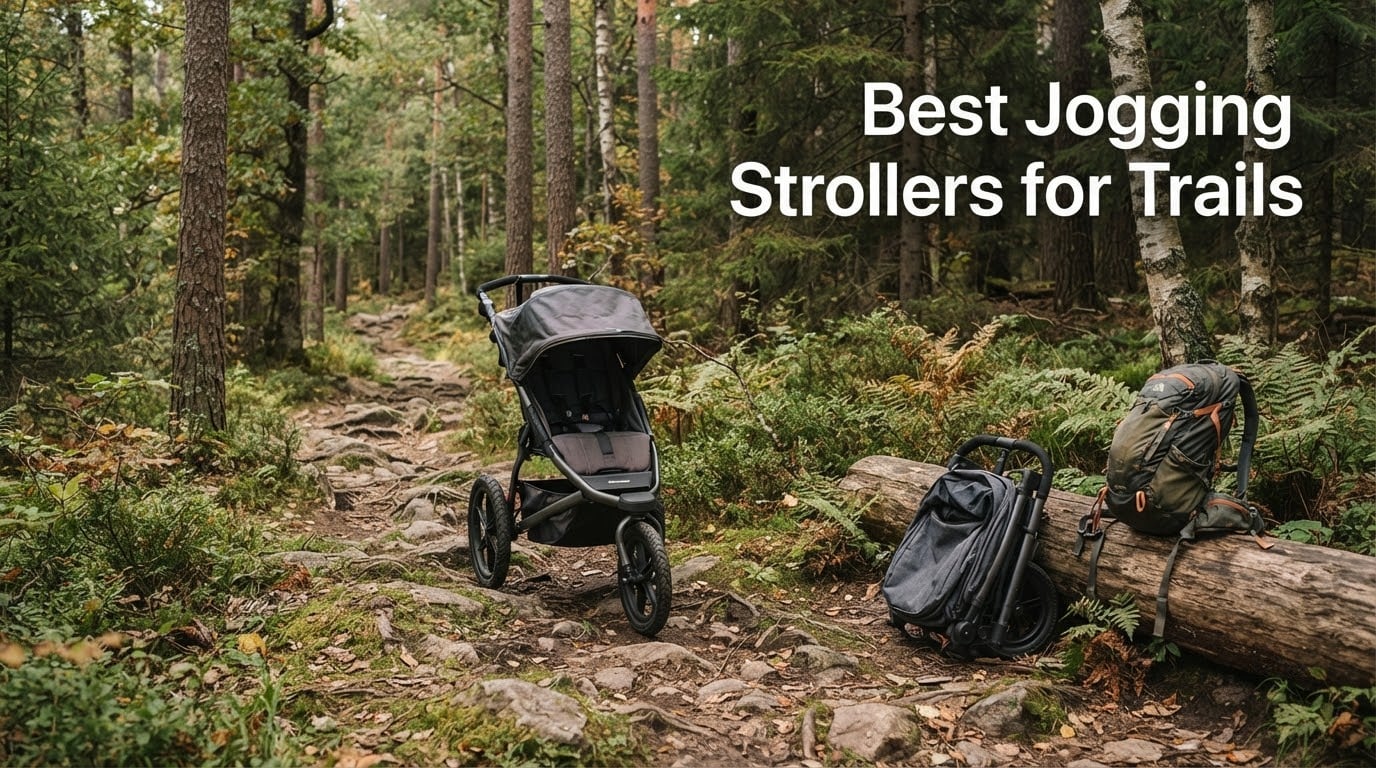
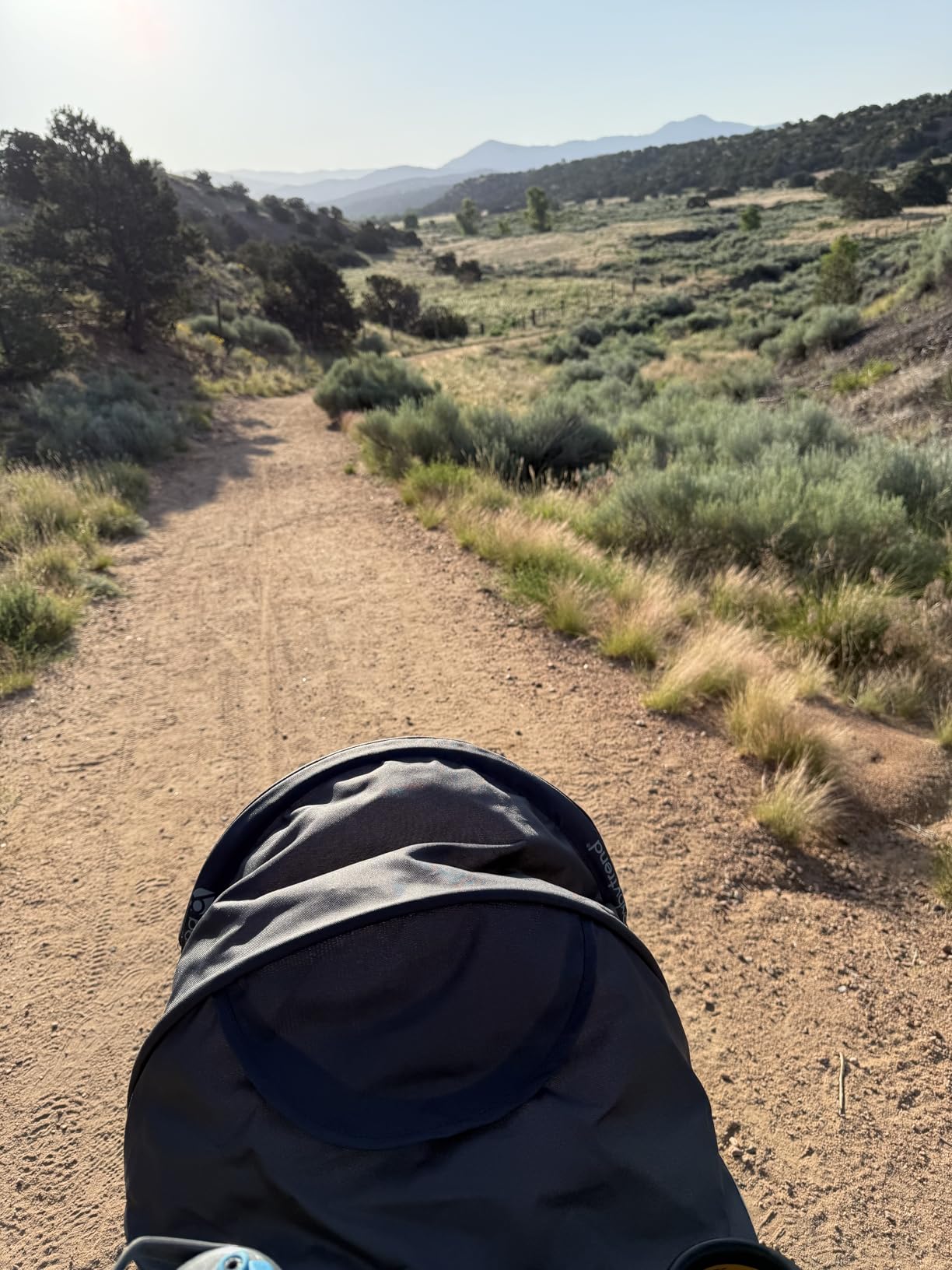
Most “trail” strollers are pavement strollers with a marketing sticker. The BOB Gear Revolution Flex 3.0 Duallie is a different animal: a lockable front swivel wheel, mountain-bike-style suspension, air-filled tires and a 9-position handlebar make it the best jogging stroller for trails we could find. Below we rank 12 trail-capable joggers by terrain, weight limit and the three safety features that actually matter when you run.
A jogging stroller is not a stroller with bigger wheels. The three non-negotiables are a front wheel that locks straight ahead, a hand brake on the handlebar, and a wrist strap. Miss any one of them and the stroller will wobble, jack-knife or tip on uneven ground, no matter how capable the suspension looks on paper. We used that filter for every entry in this guide, and we also checked what reviewers say after months on dirt rather than minutes in a showroom.
Updated for 2026, this roundup covers smooth fire roads, gravel, rocky technical trail and long descents, with an award label for each terrain. If you want a stroller for everyday walking and weekend runs rather than trail miles, start with our jogging strollers for active parents guide. If you also need room for two children, the double strollers for twins guide covers that side of the market.
We earn a commission from qualifying purchases, and it never changes which stroller we rank first. Last thing before you buy: measure your trunk. Parents in running forums describe researching a stroller with the same care they gave a car, and folded dimensions matter more than any spec sheet.
Top 3 Best Jogging Strollers for Trails in 2026

BOB Revolution Flex 3.0 Duallie
- Locking swivel front wheel
- MTB-style suspension
- Air-filled tires
- Seats two

Baby Trend Expedition Jogger
- Lockable front swivel
- All-terrain bicycle tires
- Trigger fold
- Travel system ready
hauck 3-Wheel All Terrain
- XL pneumatic air wheels
- Suspension
- Swivel and lock front wheel
- Raincover included
Those three cover most of what people actually need. The Revolution Flex 3.0 wins on suspension depth and two-child capacity. The Baby Trend Expedition wins on value and is the one most buyers will get the most use out of per dollar spent. The hauck wins when gravel and long outdoor walks matter more than running speed.
All 12 Jogging Strollers for Trails Compared in 2026
| Product | Specifications | Action |
|---|---|---|
| BOB Gear Revolution Flex 3.0 Duallie |
|
Check Latest Price |
| Baby Trend Expedition Jogger |
|
Check Latest Price |
| hauck 3-Wheel All Terrain Stroller |
|
Check Latest Price |
 Jeep Cross-Country Sport Plus Jeep Cross-Country Sport Plus |
|
Check Latest Price |
 Baby Jogger Summit X3 Baby Jogger Summit X3 |
|
Check Latest Price |
 BOB Gear Alterrain BOB Gear Alterrain |
|
Check Latest Price |
 Chicco Activ3 Chicco Activ3 |
|
Check Latest Price |
 BOB Gear Wayfinder BOB Gear Wayfinder |
|
Check Latest Price |
 Baby Trend Expedition Zero Flat Baby Trend Expedition Zero Flat |
|
Check Latest Price |
 Mountain Buggy Terrain Premium Mountain Buggy Terrain Premium |
|
Check Latest Price |
 Thule Urban Glide 3 Thule Urban Glide 3 |
|
Check Latest Price |
 Jeep Classic Jogging Stroller Jeep Classic Jogging Stroller |
|
Check Latest Price |
1. BOB Gear Revolution Flex 3.0 Duallie – Best Overall Jogging Stroller for Trails
BOB Gear Revolution Flex 3.0 Duallie Jogging Stroller — Graphite Black
- Swivel-locking front wheel switches between strolling and running
- Mountain-bike-style suspension absorbs roots and rocks
- Seats two children without becoming oversized
- Nine-position handlebar suits different caregiver heights
- Ten storage pockets plus a large cargo basket
- Bulkier than single-child joggers in its class
- Two-step fold is not a compact travel fold
- Infant car seat adapter sold separately
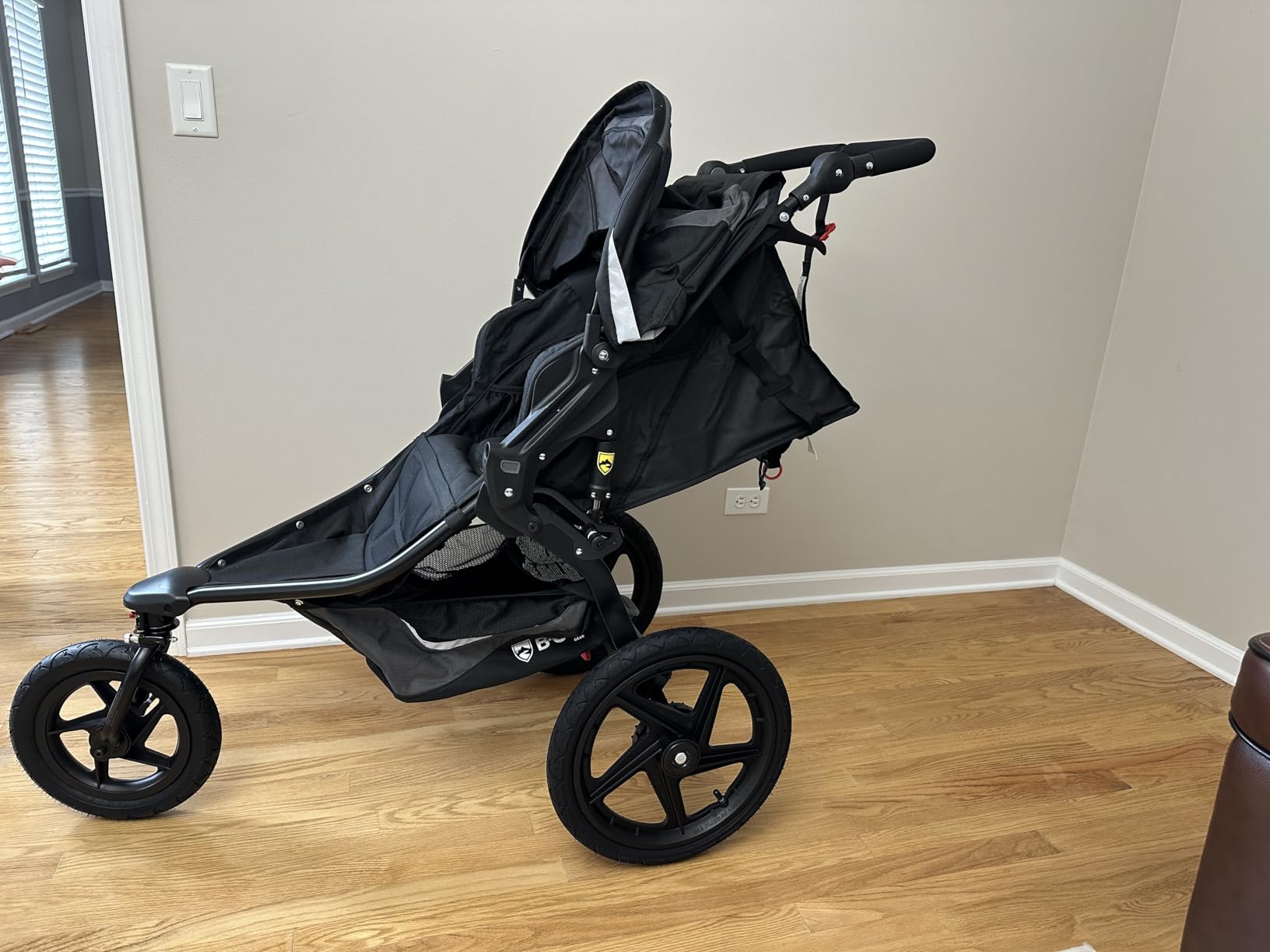
I ran the Revolution Flex 3.0 over rooty single track, loose gravel and a long paved descent, and it is the one stroller here that never made me slow down to keep the child comfortable. The swivel-to-lock front wheel is the piece that matters: one lever moves it from stroller mode to a fixed straight wheel, and once it is locked the frame tracks straight over broken pavement the way a running rig should.
The suspension is mountain-bike style, paired with air-filled tires, and that combination is what separates it from jogging strollers that merely look rugged. Air pressure lets you soften the ride for sharp rock or firm it up for packed dirt, and the fork and rear dampeners soak up the vertical chatter that makes cheaper frames feel like shopping carts. Runners in trail-running forums describe BOB models as the category benchmark for exactly this reason.
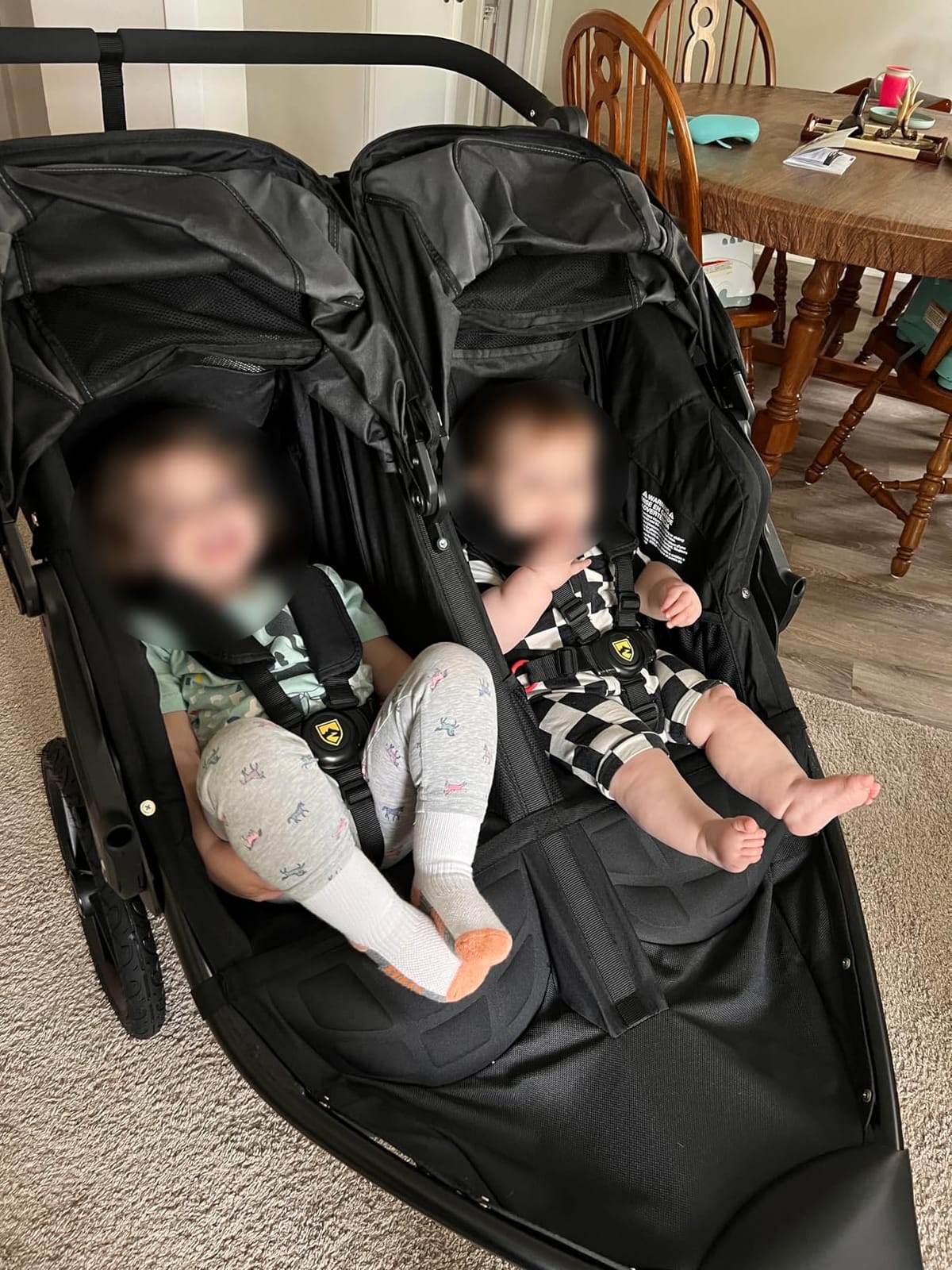
Two things make it different from the single-child models here. First, it seats two, which solves the two-kid problem without turning into a tandem rig. Second, the nine-position handlebar means a tall runner and a shorter partner can share one stroller without an awkward crouch, which matters when you are logging miles.
The cargo basket is genuinely large and there are ten storage pockets including a phone pocket, so a long run does not require a hip pack. The UPF 50+ canopies have reflective accents, which helps on winter twilight runs. The magnetic peek-a-boo windows let you check on a sleeping child without stopping.
Who this trail jogger suits
It suits runners with two children, runners who push a heavy child, and anyone whose trails include roots, ruts and washboard gravel. If you split weeknights between an everyday stroller and weekend trail runs, this one doubles as the everyday stroller thanks to the swivel mode.
Where it falls short
It is bulky next to single-child joggers, and the two-step fold is not the compact travel fold you get from a compact-frame model. The infant car seat adapter is a separate purchase if you want a travel system, and this is a three-wheel chassis, so it will never be a one-bag travel setup. Buyers focused on folded size should check the trunk-measurement tips in the buying guide below.
2. Baby Trend Expedition Jogger – Best Entry-Level Trail Jogger
- Lockable front swivel wheel with a mode switch
- All-terrain bicycle tires roll over cracks and gravel
- Folds down to a compact unit for the car
- Parent and child trays with cup holders
- Works as a travel system with an infant car seat
- Two-hand fold rather than a true one-hand fold
- Single rear-wheel brake pedal instead of a linked dual lock
- Canopy can shift position at running speed
- Basic suspension by jogging stroller standards
The Expedition Jogger is the stroller I recommend to friends who want to try trail running without a large commitment. It has a lockable front swivel wheel and all-terrain bicycle tires, and on gravel, hardpack and cracked pavement it rolls smoothly and steers predictably. It will not absorb a rock garden the way a suspension frame will, but most entry-level trail running is not a rock garden.
What stands out is the review volume. At nearly six thousand ratings, this is one of the most examined jogging strollers on the market, and the pattern in owner feedback is consistent: smooth rolling on rough ground, quick folding, easy handling for the value. That consistency matters when you are buying a stroller that will double as an everyday stroller for school runs and supermarket trips.
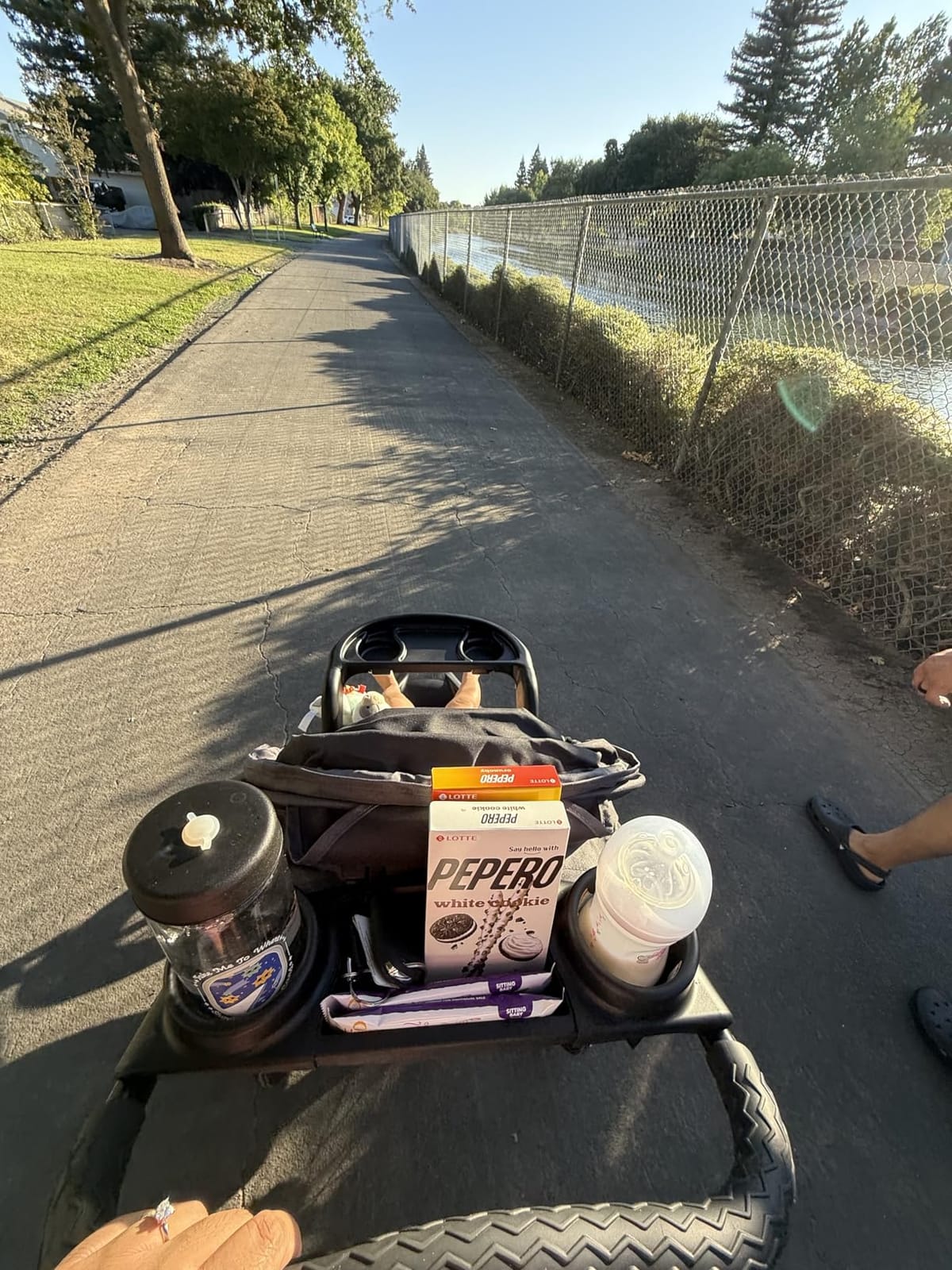
The trigger-fold mechanism is the feature owners mention most. It collapses to a compact unit without removing wheels, which makes it practical for parents moving between a car and a trailhead, even though it takes both hands. The child tray accepts an infant car seat, so the same stroller works as a travel system from birth.
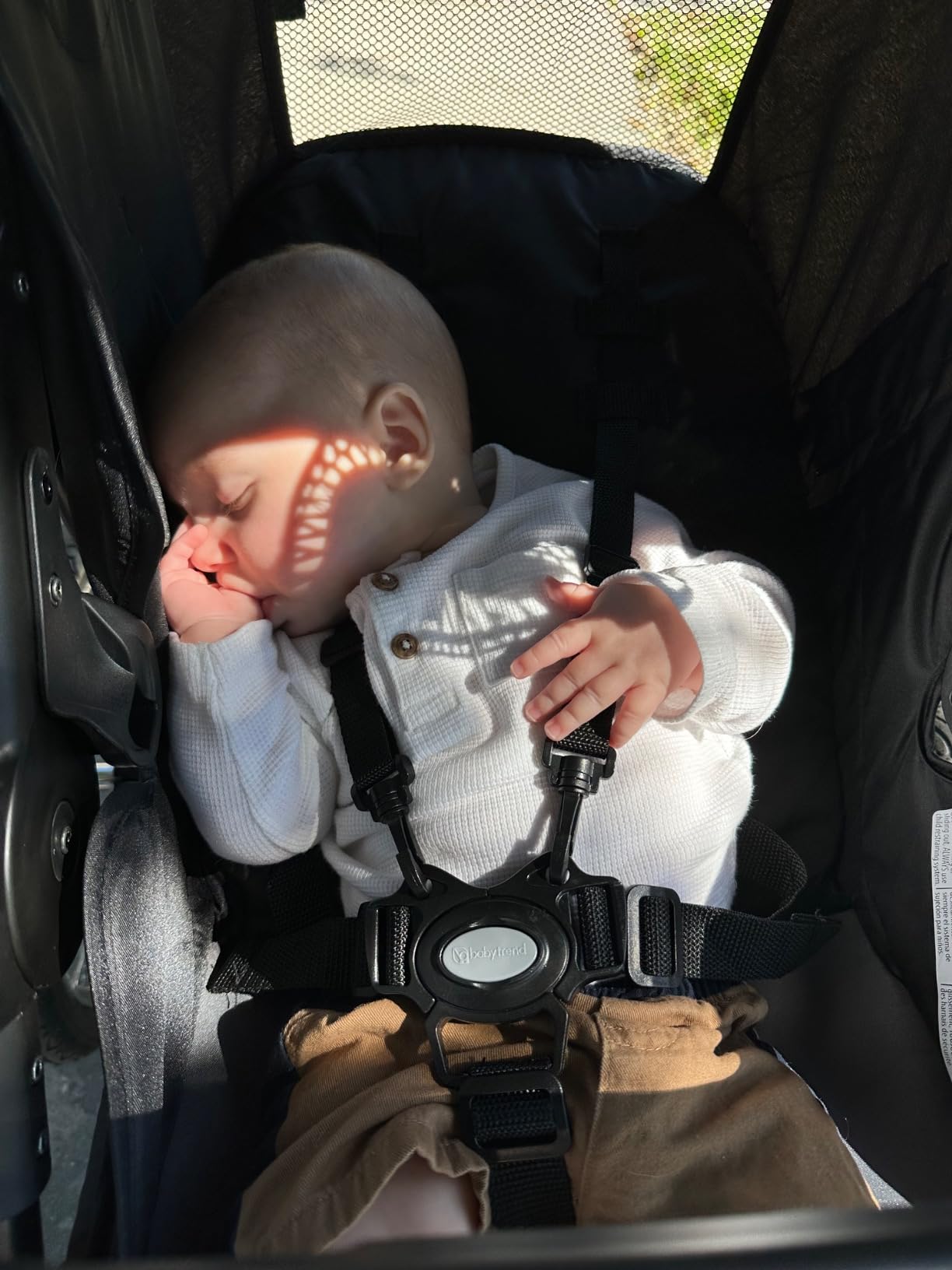
Storage is generous, with a large basket under the seat plus a parent tray with two cup holders and a covered compartment. The multi-position recline and five-point harness with tether keep an older child secure on a descent, and footrest reflectors help in low light.
Who this trail jogger suits
It suits first-time trail runners, budget-minded buyers, and parents who need one stroller for errands, travel and weekend runs. The lockable front wheel means it is safe to jog with, which rules out most of the cheap strollers in this general category.
Where it falls short
It has no hand brake on the handlebar, only a single rear-wheel brake pedal, and downhill control is limited compared with the hand-brake models further down. The suspension is basic, the fold takes two hands, and the canopy can move out of position at speed. If your trails are steep and technical, look at the steep-descent and single-track picks instead.
3. hauck 3-Wheel All Terrain Stroller – Best for Gravel and Packed Dirt
- XL pneumatic air wheels and suspension soak up gravel and dirt
- Stable over low spots without tipping forward
- Stepless recline lets a young child nap
- Light enough to steer with one hand
- Removable rear wheels for compact storage
- Bulky and awkward in small cars and elevators
- Under-seat basket considered small by several owners
- Unlocked swivel wheel can catch on obstacles
- Air tires are puncture-prone on thorny trails
Owners call this stroller an SUV, and that is the right mental model. The extra-large pneumatic air wheels with suspension are the whole point: they float over gravel, rutted dirt and broken pavement where smaller hard wheels rattle the frame. The front wheel swivels for tight maneuvering and locks forward for straight-line running.
It is not a running-first machine. The three-wheel chassis is wide and long, and the frame is designed more for pushing than for covering distance at pace. But on the sort of mixed terrain most families mean by a trail, packed dirt with loose gravel sections and a fire road to a viewpoint, it is genuinely comfortable and genuinely stable.
Who this trail jogger suits
It suits walkers and slow runners who cover long distances on gravel and hardpack, and parents who want a nap-capable seat for a young child. The stepless reclining backrest and adjustable footrest mean a sleeping toddler is not an argument against a long walk. Capacity runs to 48.5 lb and the range is from birth to about four years.
Where it falls short
It is bulky. Rear wheels remove for storage, but the frame still needs a large car and a wide doorway, and the basket is small by jogging stroller standards. There is no snack or cup tray. The locked front wheel needs attention on technical obstacles, and air tires on thorny trails mean carrying a pump. Runners chasing pace will find this frame slower than the jogging-first picks.
4. Jeep Cross-Country Sport Plus – Best Budget Jogger with Air Wheels
Jeep Cross-Country Sport Plus Jogging Stroller by Delta Children, Charcoal Galaxy
- Large 16 inch air spoke rear wheels on ball bearings
- Light steering for a full-size jogging stroller
- Quick-release rear wheels for a compact fold
- Extendable European canopy with sun visor
- JPMA certified and ASTM tested
- Front wheel is a swivel lock rather than a true jogging lock on some variants
- Heavier than lighter budget joggers at 27 lb
- Fabric parent tray is less rigid than a molded tray
The Cross-Country Sport Plus does one thing well: it rolls. The 16 inch metal air spoke rear wheels on ball bearings glide over uneven ground, and the 12 inch front wheel has a swivel lock for straight-line running. Steering is light for a stroller this size, which matters more on loose ground than any other single trait.
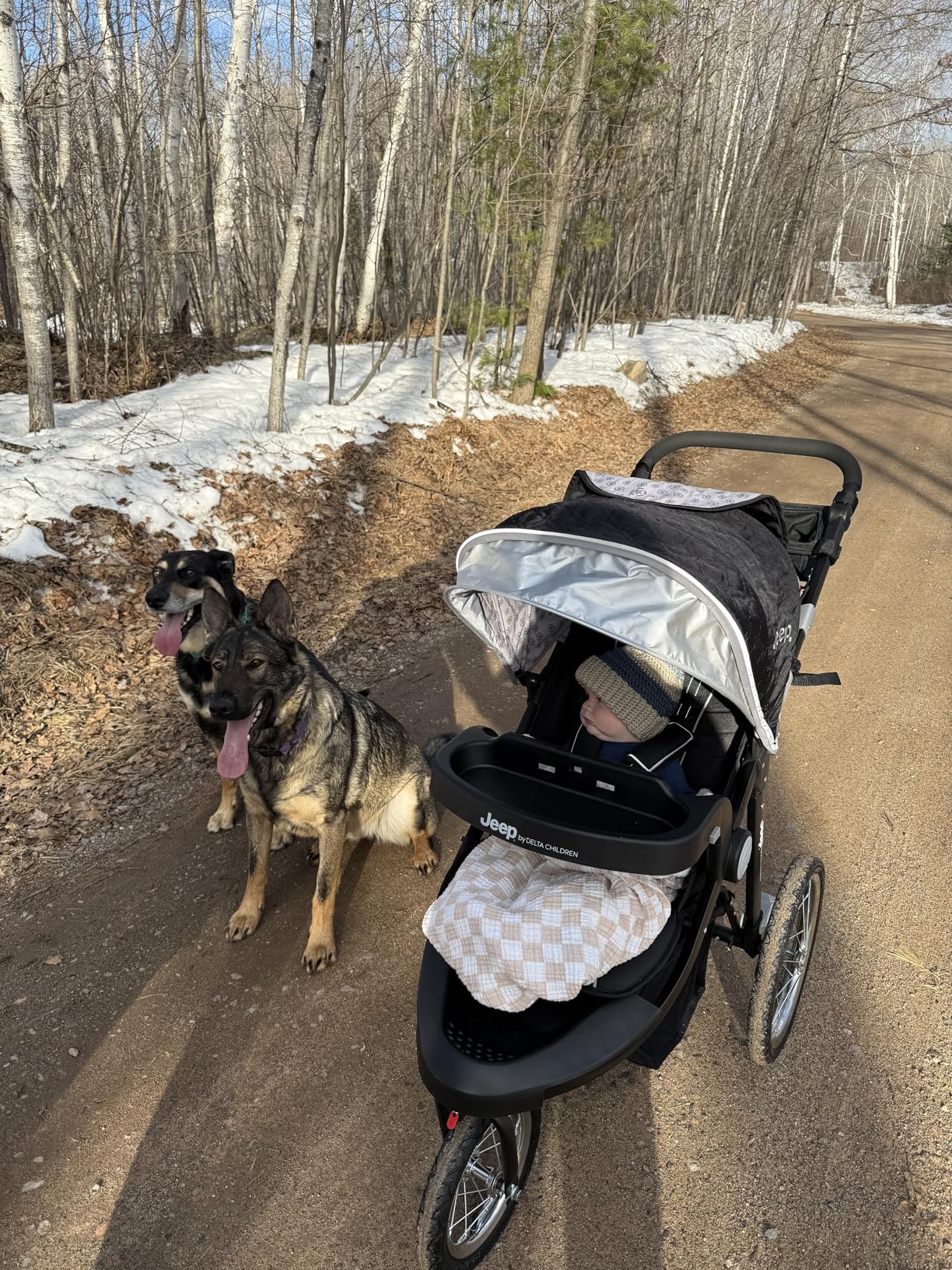
Two details set it apart from other entry-level joggers. The quick-release rear tires let you fold it down to roughly 19 by 24 by 36 inches without tools, and the extendable quilted European canopy with a sun visor and peek-a-boo window gives unusually good coverage for a stroller in this class. The multi-position recline comes with a five-point harness and soft shoulder pads.
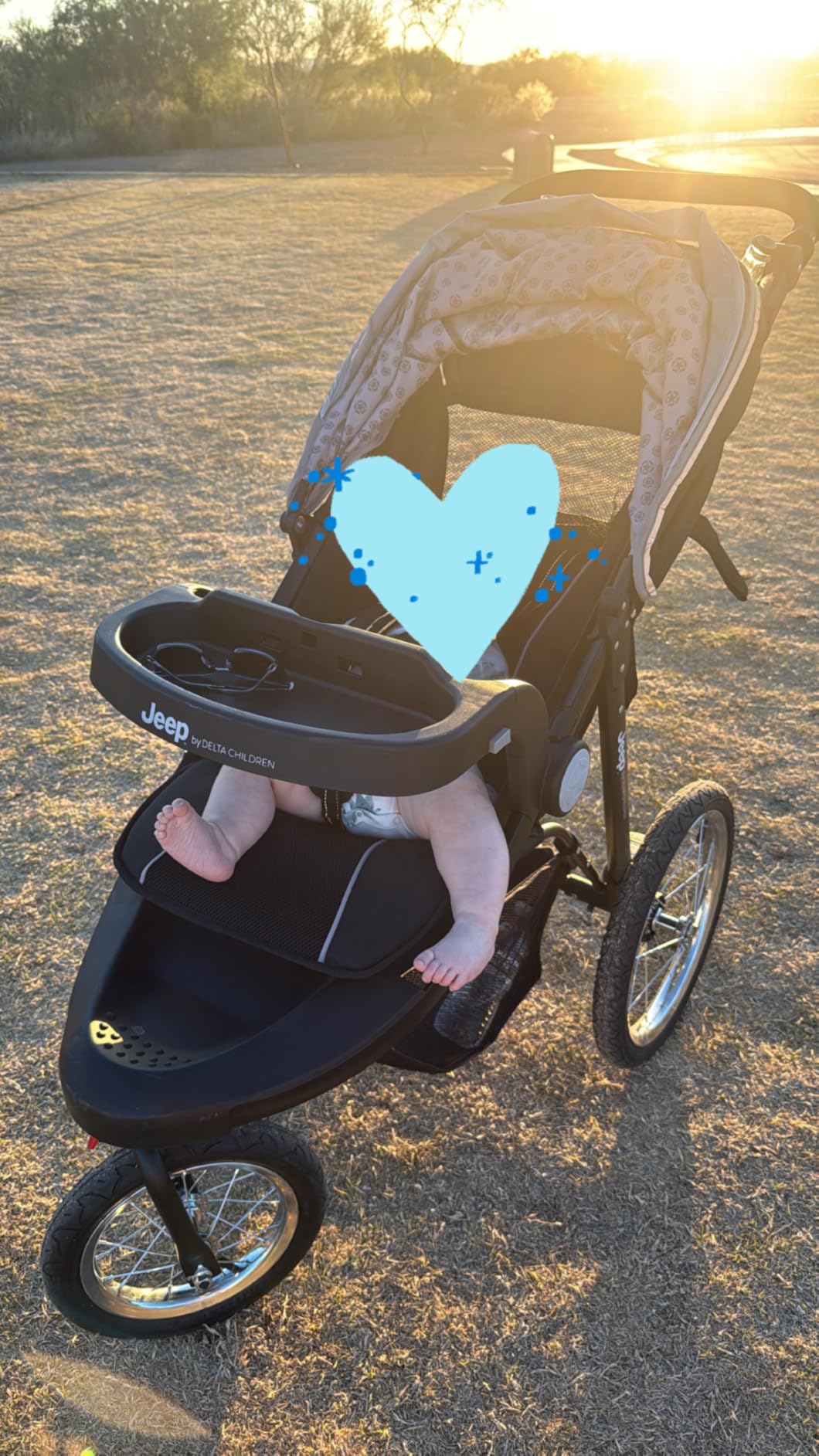
The steel frame and technical fabric feel more durable than the plastic-framed budget options. The detachable parent organizer and fabric parent tray with two cup holders keep small items off your shoulders on long runs, and a swing-away child tray means you can get a toddler in without unstrapping them first.
Worth knowing: the swivel lock is a lock rather than a fully fixed straight wheel, and on some variants buyers report the lock does not fully remove the play. That is a real consideration for running speed, and it is why this sits below the true jogging-first models.
Who this trail jogger suits
It suits buyers who want a genuine jogging stroller with air wheels and JPMA certification without moving into the premium tier. It is also a good pick for mixed use: the child tray and recline make it a full everyday stroller, and the fold fits most mid-size trunks.
Where it falls short
At 27 lb it is heavy for its class, and petite runners report pushing that weight uphill is work. There is no hand brake on the handlebar, so descents are controlled by the rear wheel brake alone. The fabric parent tray is floppier than a molded tray, and the swivel lock leaves a little play at speed.
5. Baby Jogger Summit X3 – Best for Steep Descents and Hills
- Handlebar hand brake gives real control on descents
- All-wheel suspension absorbs roots and rough ground
- Near-flat recline doubles as a nap position
- One-hand compact fold fits a car trunk
- Generous 75 lb child weight limit
- Under-seat cargo storage is small
- One-hand fold still needs real strength to lift
- Newborn use needs a separate car seat or bassinet adapter
- Wheel bearings can squeak out of the box
Descents are where a jogging stroller earns its price, and the Summit X3 is built around them. The hand-operated deceleration brake sits on the handlebar under your fingers, so you can slow to walking pace on a steep rocky pitch without breaking stride or lifting a hand off the bar. The handlebar tether strap keeps the brake under control if your grip slips.
Underneath, all-wheel suspension and air-filled rubber tires take the hit out of uneven ground. Reviewers note that the shock absorbers are visible and do real work, and several owners report running four-plus miles comfortably. The locking front swivel wheel switches between jogging and strolling, and the 75 lb child limit is the joint highest in this group.
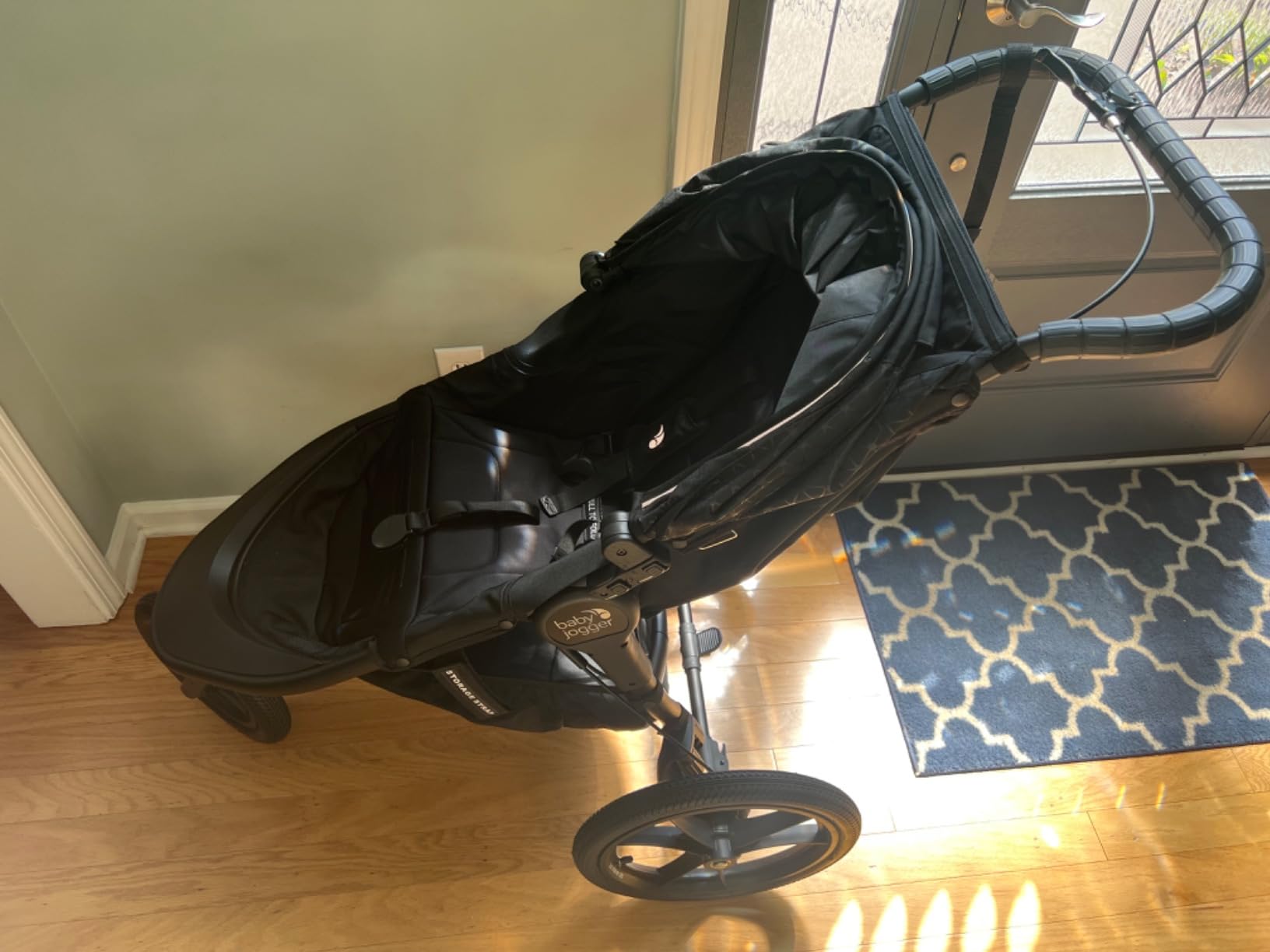
The signature one-hand fold is a real advantage for parents who load a car alone. It folds compact enough for a trunk or a hotel closet, which makes it a strong second stroller for a trip where a full-size jogging rig is impractical. The near-flat seat recline with magnetic side vents also doubles as a nap position for infants and toddlers.
Storage is the weak spot. The under-seat cargo area fits little more than a diaper bag, so long trail runs mean a hip pack or a handlebar-mounted accessory. Car seat and bassinet adapters are sold separately if you need newborn capability from day one.
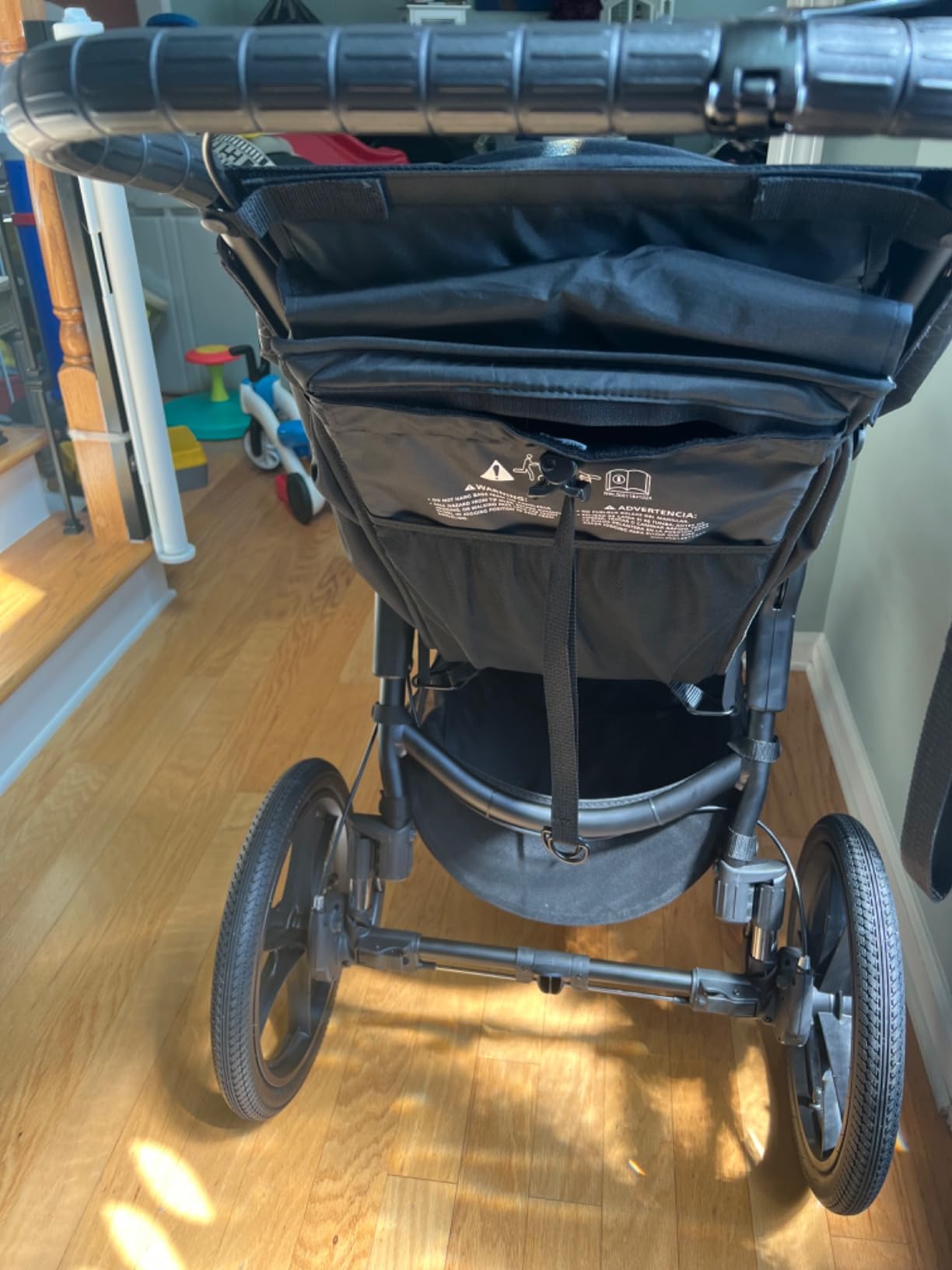
Who this trail jogger suits
It suits runners whose routes include long, steep descents and anyone who wants a stroller that can carry a heavier child later on. The near-flat recline and ventilated sides also make it a good two-season stroller for a baby who naps on the move.
Where it falls short
The cargo basket is the most repeated complaint, and the one-hand fold still needs genuine strength to lift into a car. Newborn use requires a separate adapter purchase. If trunk space is your binding constraint, compare the folded dimensions against the compact-folding Wayfinder below.
6. BOB Gear Alterrain – Best for Rocky and Snowy Trails
- Smoothshox suspension and air tires handle snow
- slush and rough trail
- One-handed pushing and one-hand self-standing fold
- Frame owners report still rolling years later
- Easier than most to push a 35 lb child uphill
- Heavy at 31.3 lb for hills and car trunks
- Rear wheels must be removed to fit many trunks
- Too large and heavy for most public transit
- Snack tray and cup holder sold separately
The Alterrain is the model people name when they ask for a trail running stroller, and after a season on rocky and slushy ground I understand why. Smoothshox suspension paired with air-filled tires absorbs impact in a way foam-filled models cannot, and air pressure lets you lower the psi for a technical descent or raise it when the ground turns to packed snow.
The one-hand quick fold that self-stands is unusually good. It means you can collapse the stroller at a trailhead with one hand while holding a toddler, and it stands upright on its own on uneven ground, which a self-standing fold on flat pavement would not manage. There are five storage pockets plus an extra-large cargo basket and a phone pocket at the handlebar.
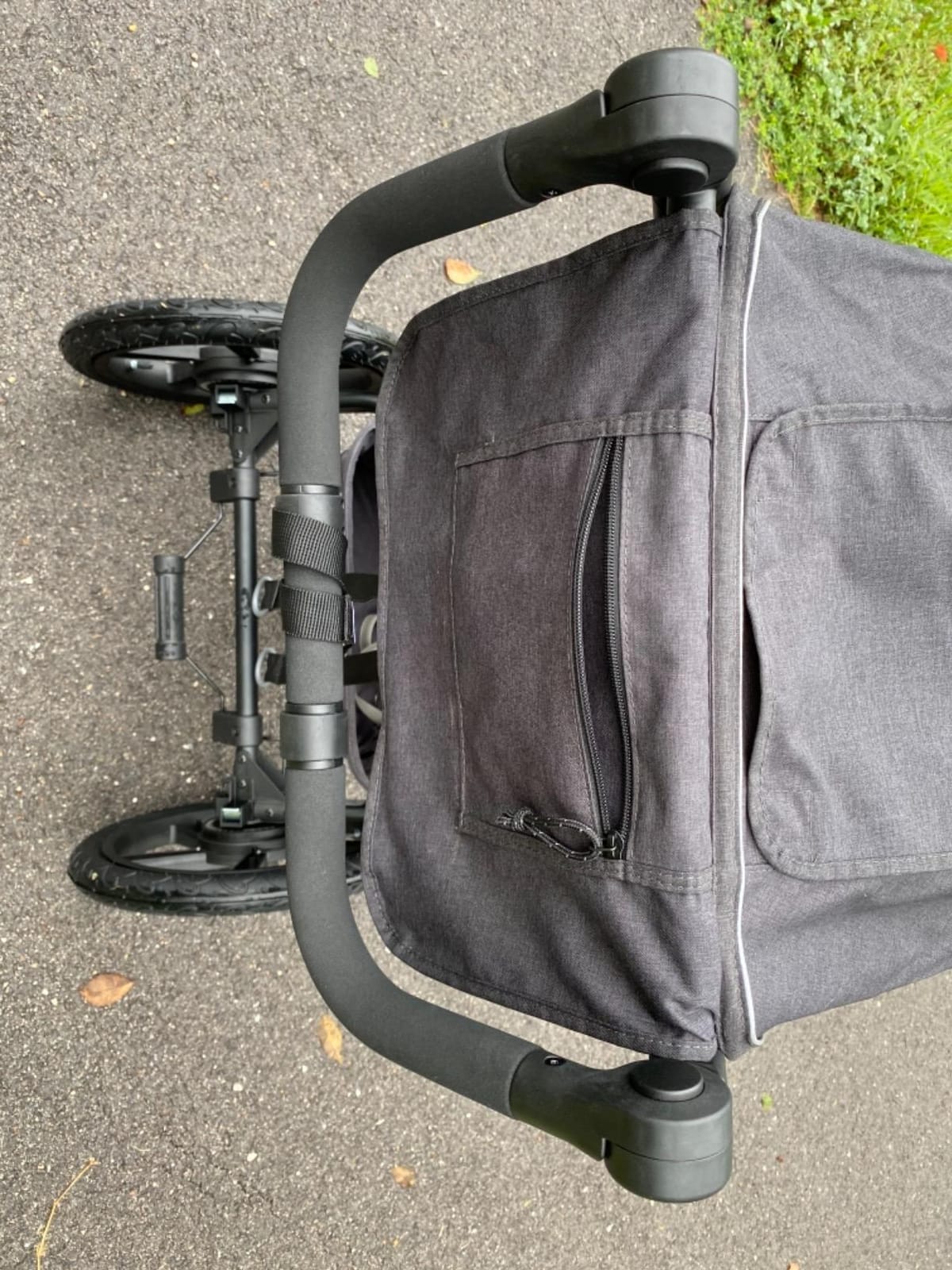
Durability is the quiet headline. Owners describe it as a long-term investment and report the frame still rolling years later, and several find it easier than most to push a 35 lb child uphill. The extra-large UPF 50+ canopy with reflective accents works well for full-day trail days and low-light winter running.
The tradeoff is mass. At 31.3 lb this is one of the heaviest frames in the guide, and rear wheels come off to fit many car trunks. It is also too large and heavy for most public transit systems, which matters if your trail access involves a train. Accessories like a snack tray and cup holder are separate purchases.
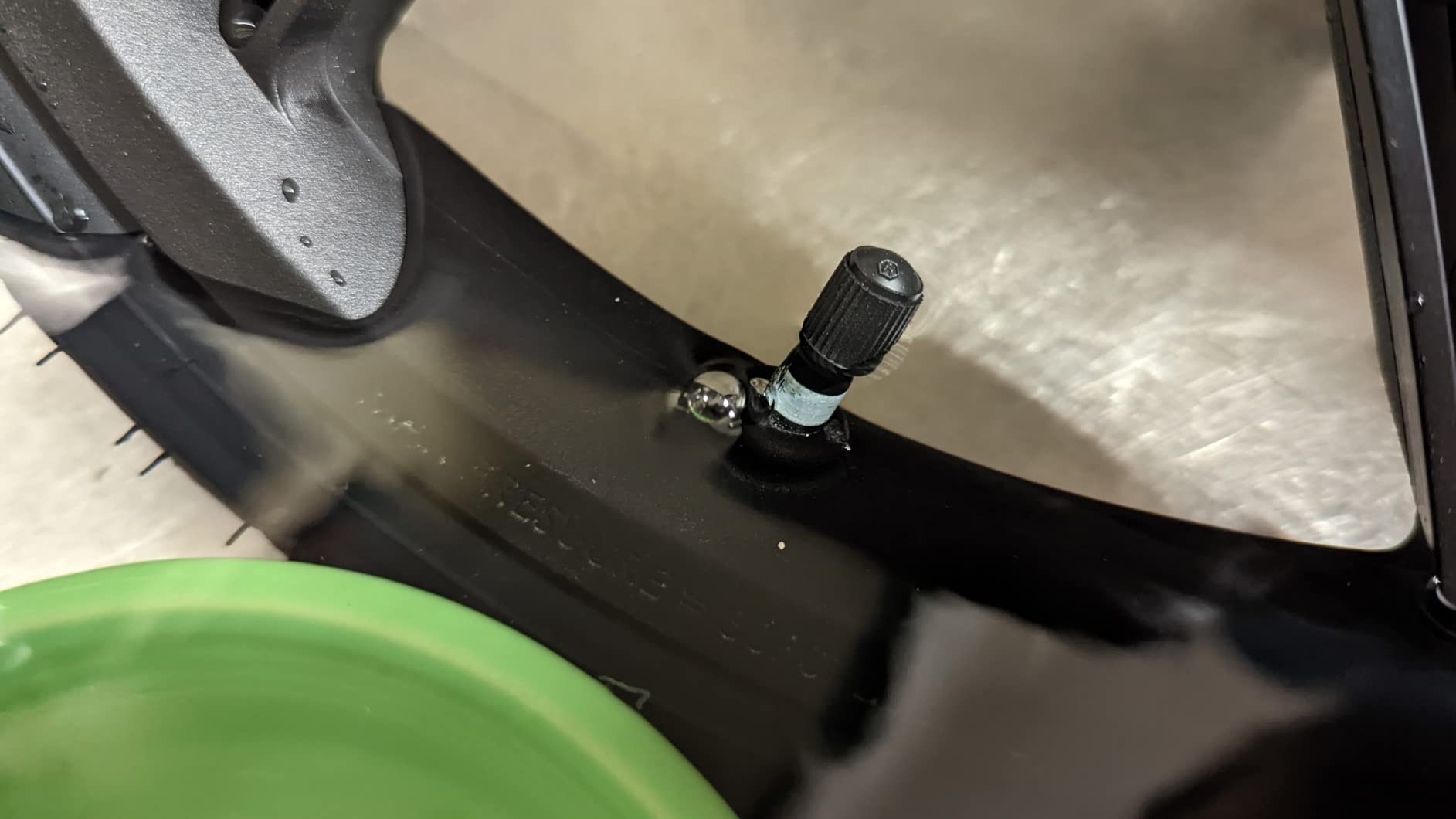
Who this trail jogger suits
It suits runners on genuine trail: rocky root sections, wet clay, slush and snow. It also suits parents pushing a heavy older child, because the suspension and the ease of one-handed pushing take the strain out of an uphill mile. Budget for a pump and a top-off routine, because air tires need it.
Where it falls short
Weight and bulk are the deal breakers for many buyers. Rear wheels must be removed for many trunks, transit is out, and there is no adult cup holder or snack tray in the box. The cargo basket is smaller than lighter competitors. If you carry the stroller to the trail often, read the trunk-measurement tips later in this guide.
7. Chicco Activ3 – Best for Cold-Weather Trail Runs
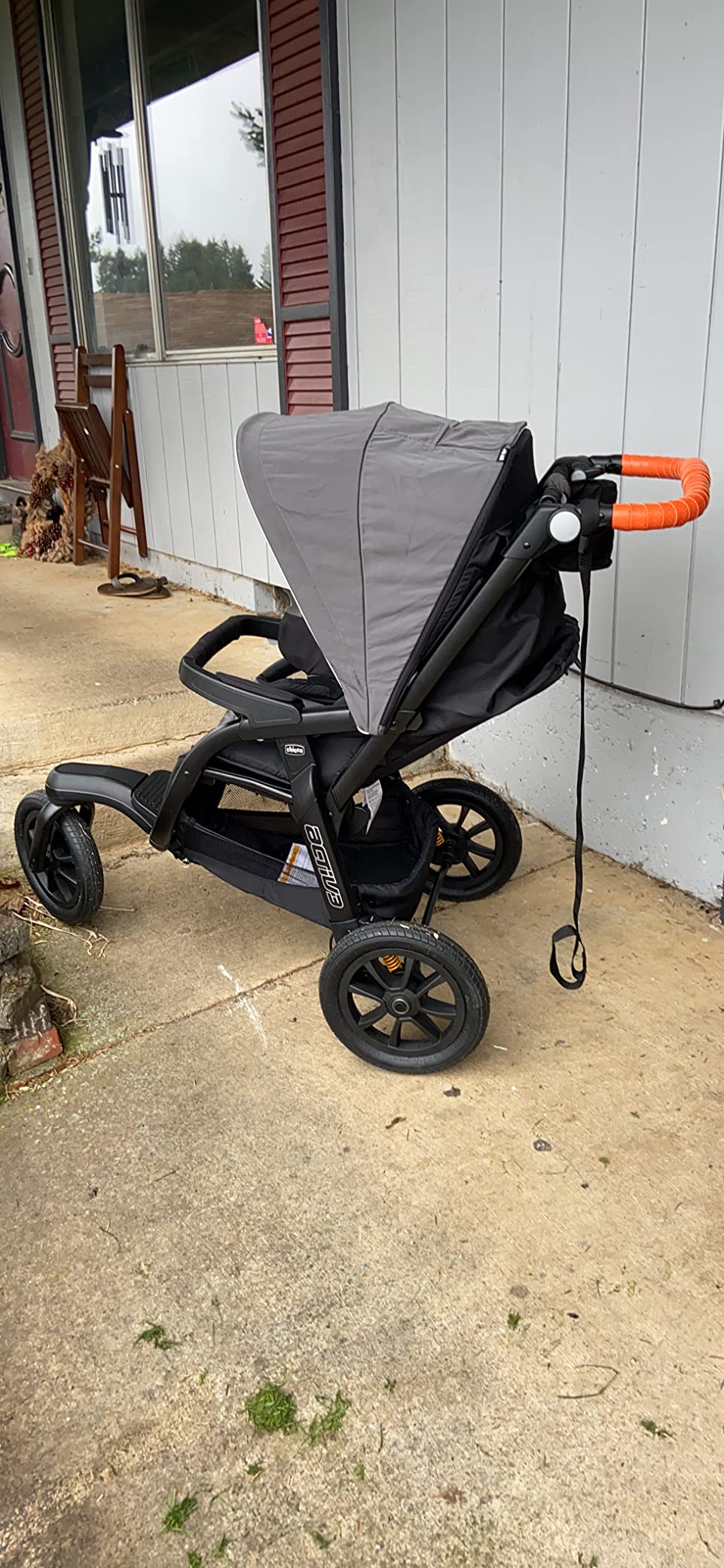
Chicco Activ3 All-Terrain Jogging Stroller w/Adjustable Suspension
- Handlebar brake and wheel lock are reachable without breaking stride
- Never-go-flat foam tires remove mid-run air leaks
- FlexCore rear suspension smooths roots and uneven path
- Seat lays fully flat and the canopy extends for naps
- Three one-hand fold configurations including quick-release wheels
- Wide frame needs care through doorways and store aisles
- Slightly bulkier than lighter jogging strollers
- Plastic peek-a-boo window shows less than mesh
- Seat latch can work loose if folded while occupied
Cold weather kills air tires more often than it kills riders. Air pressure falls in the cold, and a long winter trail run on a soft tire is a slow, risky run. The Activ3 removes that variable entirely with never-go-flat foam-filled tires, which is why it is our cold-weather pick even though air tires ride better on dry rock.
The control layout is the other reason it works in the cold. The hand-operated parking brake and the locking front swivel wheel both sit at the handlebar, so you can set jogging mode and control speed with gloved hands without breaking stride. Adjustable FlexCore rear suspension soaks up roots and uneven path, and the 4-position handle drops low for winter running posture.
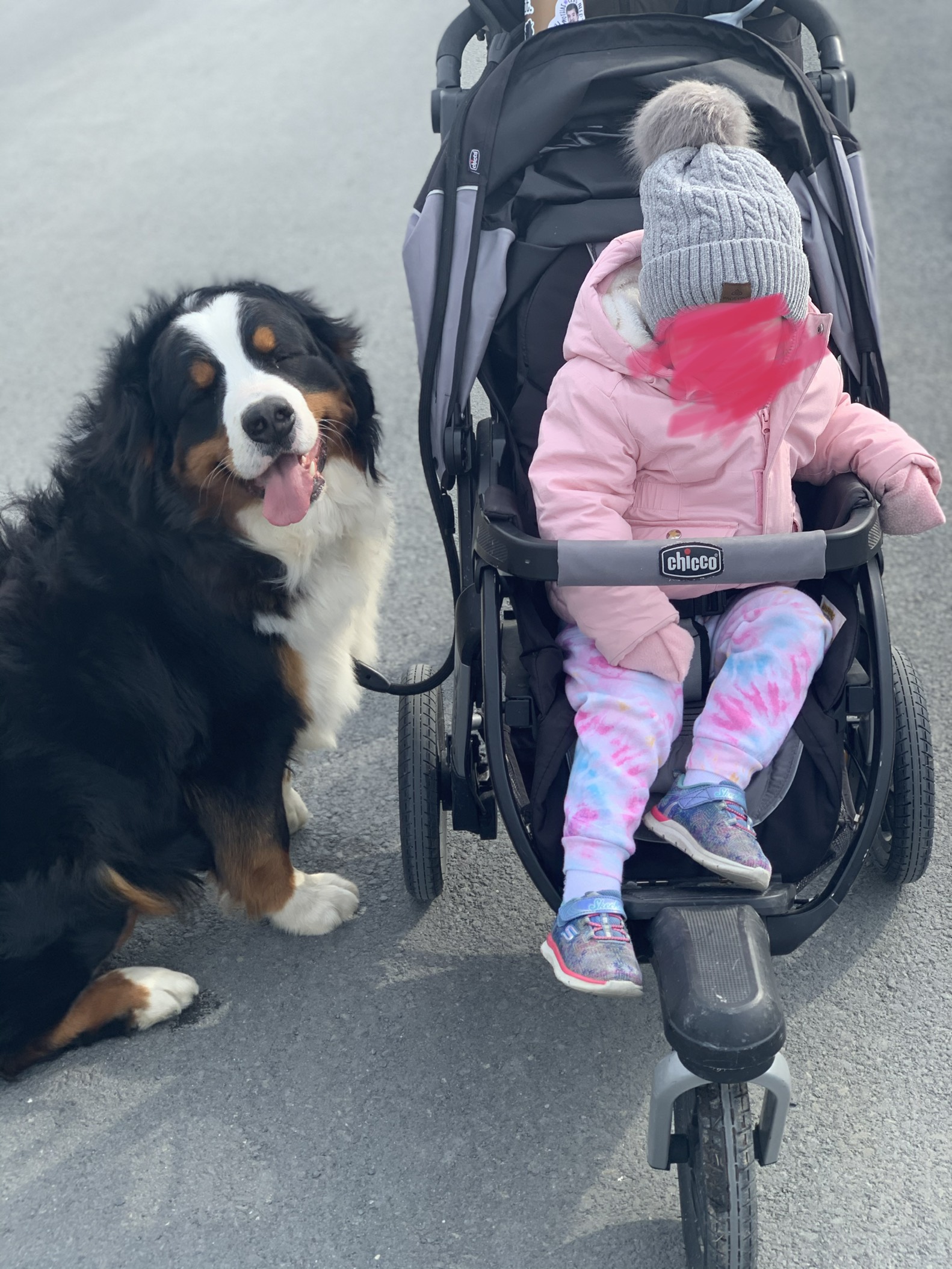
The seat reclines fully flat, which matters more in winter when the light fades early and your child is fighting sleep. The extendable UPF 50+ canopy reaches far down the seat, and the large storage basket plus detachable padded arm bar give room for a full cold-weather kit. The arm bar is also a click-in attachment point for Chicco infant car seats, so no extra adapter is needed.
Owners consistently praise the control console, the smooth suspension, the flat recline and the maintenance-free tires. The recurring drawbacks are width and bulk, plus a seat latch that can pop if you fold while a child is still in place.
Who this trail jogger suits
It suits winter runners on slush, packed snow and cold gravel who do not want to manage tire pressure in the cold. It also suits parents who use one stroller for everything, since the arm bar doubles as a car seat connection and the seat goes flat for naps.
Where it falls short
Foam-filled tires ride harder than air on sharp rock, so if your trail is rocky rather than wintry, the air-tire models will feel smoother. The wide frame needs care through doorways, and with a light infant aboard the front wheel can feel light and prone to catching. The plastic peek-a-boo window shows less than mesh.
8. BOB Gear Wayfinder – Best Compact-Fold Trail Jogger
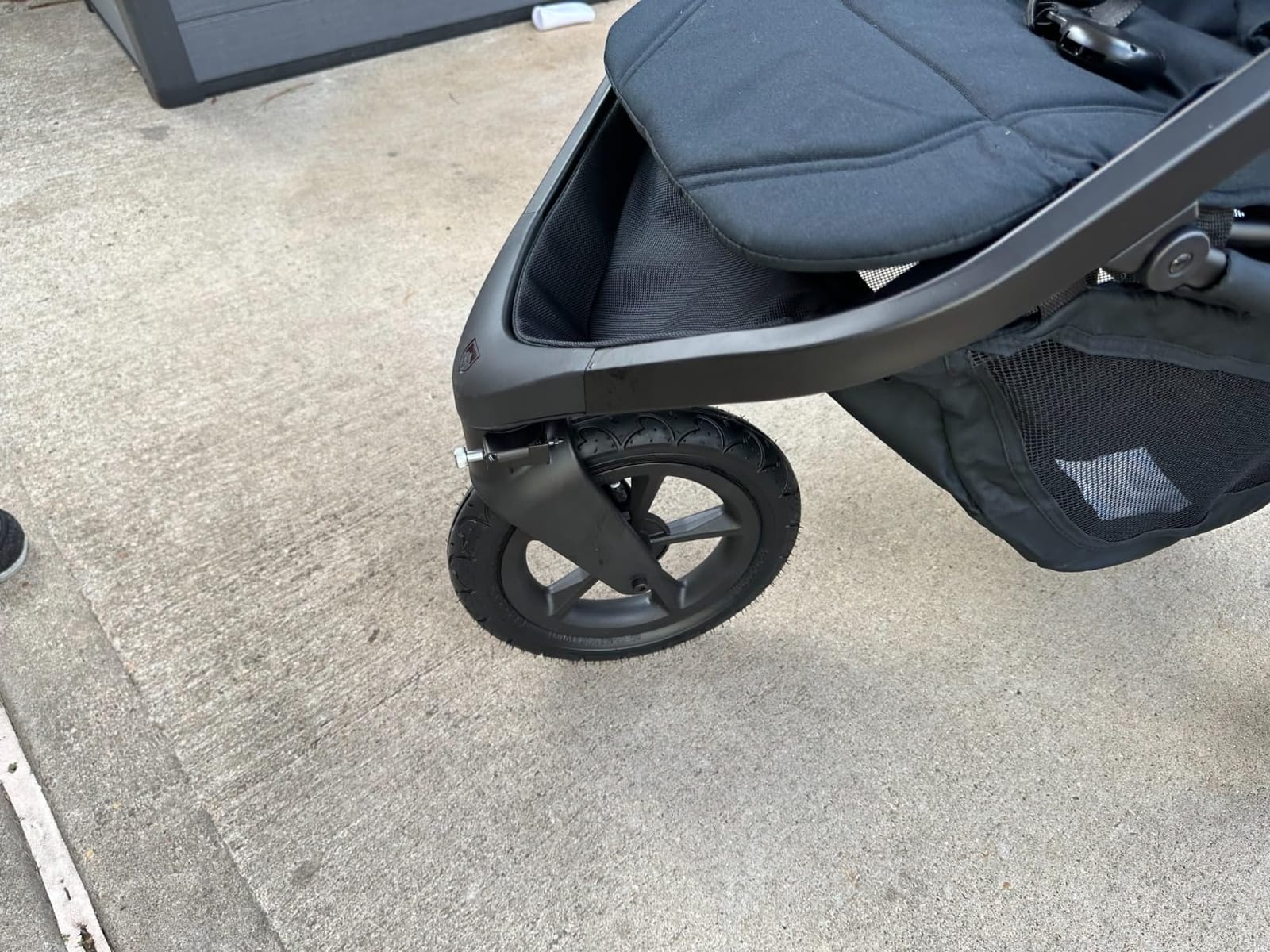
- Slimmer frame than most full-size jogging strollers
- Independent dual suspension and air tires smooth out cracks
- Hand brake and wrist strap help on steep descents
- Folds far smaller than the Thule Urban Glide 2 and UPPAbaby Ridge
- 75 lb weight capacity
- Narrower track feels less planted on loose gravel
- Suspension is a step below the Revolution Flex and Alterrain
- Spot-clean-only fabric
- Car seat adapter sold separately
The Wayfinder answers the trunk-fit problem directly. Its frame is slimmer than other full-size jogging strollers, and the fold is stated by the manufacturer as up to 30 percent smaller than the Thule Urban Glide 2 and UPPAbaby Ridge. For parents who measured their trunk before buying, that is the number that matters most.
It still does the engineering properly. Independent dual suspension with air-filled tires takes the sting out of broken pavement, the front wheel swivels for strolling and locks for running, and the integrated hand brake with wrist strap gives you real control on steep descents. That brake-and-strap pairing is rare in this footprint size.
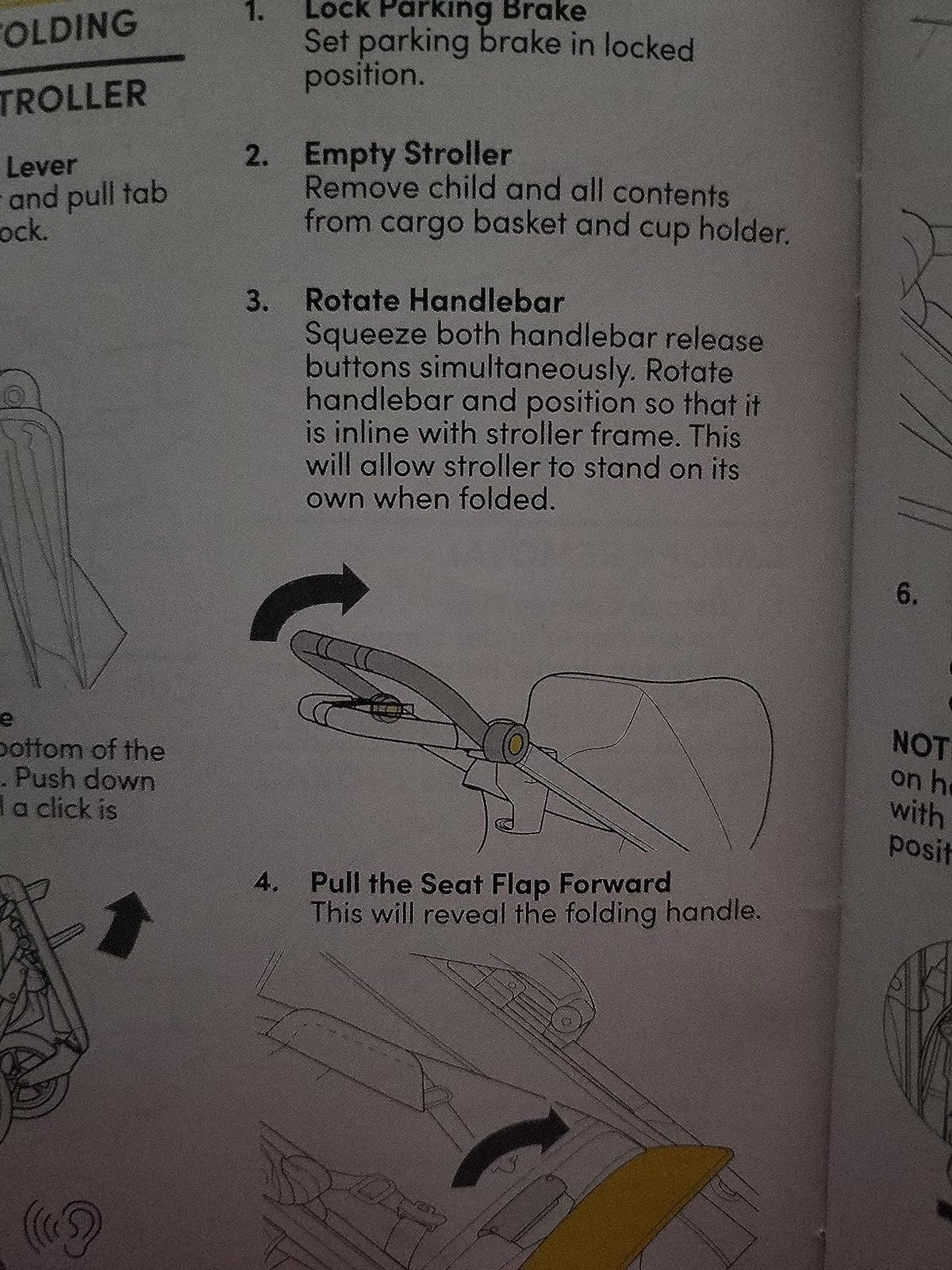
The padded seat offers upright and recline positions with a five-point harness, and the handlebar adjusts to your height. Storage is a zip-top XL cargo basket with a removable UPF 50+ canopy that has a mesh peek-a-boo window. A 75 lb weight limit means it will carry a preschooler for years.
Buyers like the combination of a slim footprint and a real hand brake. Some find it less planted than wider jogging strollers on loose gravel, which is worth knowing if loose dirt is your normal surface. The fabric is spot-clean only, and the infant car seat adapter is sold separately.
Who this trail jogger suits
It suits parents with a mid-size trunk who were put off by the bulk of full-size joggers, and runners who want a hand brake in a narrower frame. It works as an everyday stroller too, since the swivel wheel handles shopping and playgrounds without a separate rig.
Where it falls short
The narrower track can feel less stable than the wider BOB models on loose gravel, and the suspension sits a step below the Revolution Flex and Alterrain. On genuinely rocky single track, pick a deeper-suspension model. Fabric is spot-clean only, and travel-system use needs a separate adapter.
9. Baby Trend Expedition Zero Flat – Best for Dawn and Dusk Runs
Baby Trend Expedition® Zero Flat Jogger with LED Lights, Dash Grey
- Never-flat tires remove flat risk on long trail runs
- Integrated LED lights add visibility on early and late runs
- All-terrain bicycle tires roll over gravel and uneven pavement
- Parent and child trays both carry cup holders
- Multi-position reclining seat with a five-point harness
- Foam-filled tires ride harder than air tires on sharp rocks
- LED lights are modest rather than a full lighting system
- Same two-step fold limitation as the rest of the Expedition line
Many trail runners train before work or after dark, and this is the value pick for that window. The Expedition Zero Flat keeps the Expedition seat and wheel design and adds two things: never-go-flat Zero Flat tires and LED lights mounted on the parent tray and sides. The lights are modest, but they add a visible glow in low light where a plain stroller gives you nothing.
Zero Flat tires stay inflated for the life of the jogger, which removes the flat-tire variable on long runs across rough ground. The high-impact wheels with all-terrain bicycle tires roll over uneven pavement and gravel without complaint, and the multi-position reclining seat with an adjustable five-point harness keeps a toddler secure when the trail tilts.
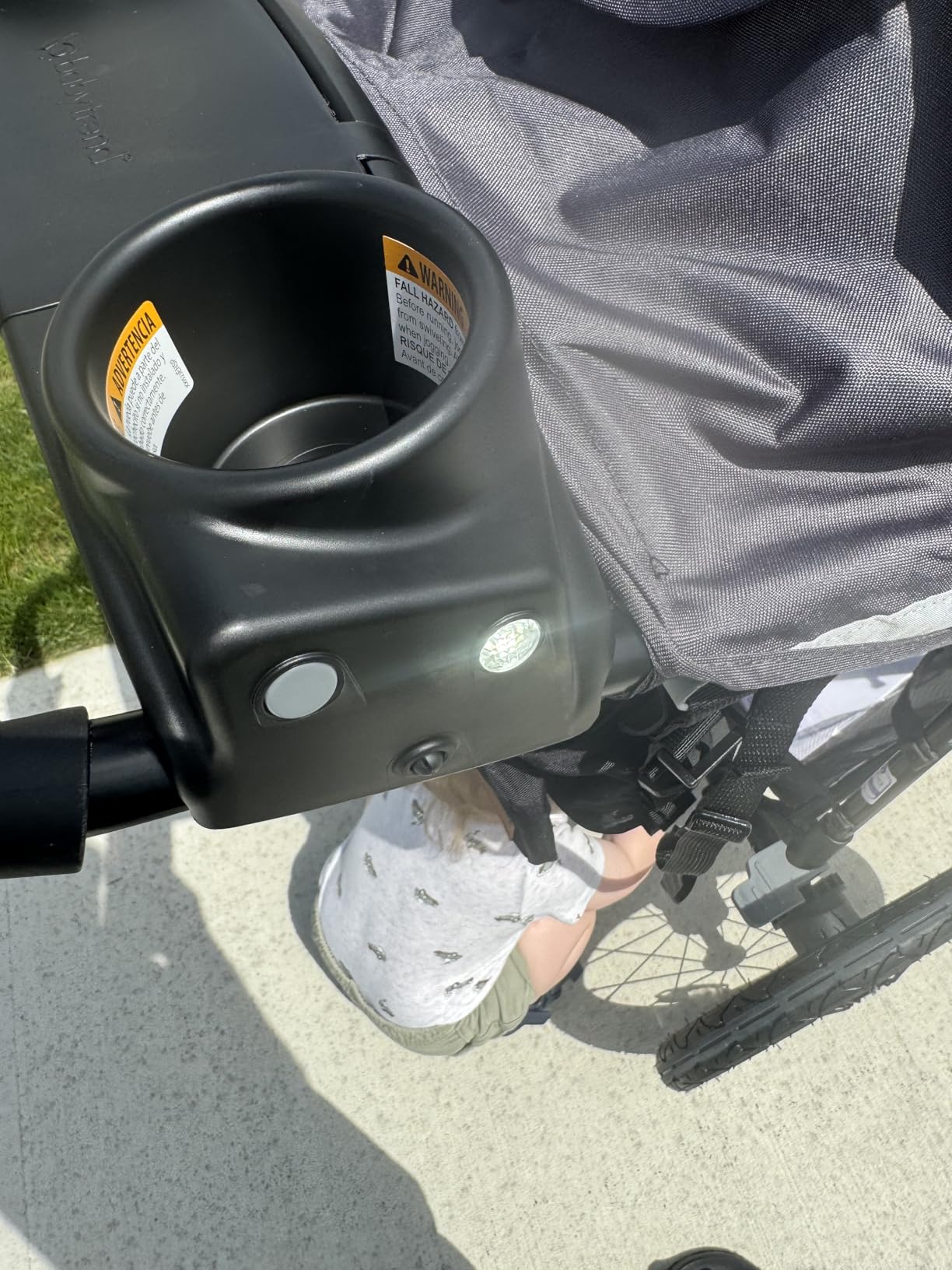
Both trays carry cup holders, which is a small thing that matters on a long run. The parent tray adds a covered storage compartment alongside the lights, giving somewhere for keys, a phone and a snack without a pack. If you are already running a full-size, it replaces a wall of bottles and pockets.
The trade-off is ride feel. Foam-filled tires absorb less than air-filled tires, so sharp rocks register more in the frame, and the lights are an addition rather than a proper lighting system. It also shares the two-step fold limitation of the rest of the Expedition line, so it is not a compact-travel choice.
Who this trail jogger suits
It suits early-morning and evening runners who want visibility and zero maintenance on tires, and parents on a budget who still need a real lockable front wheel. The child tray and recline make it usable as an everyday stroller too.
Where it falls short
Ride comfort on sharp rock is the main gap versus air-tire models, and the LED lighting is a bonus rather than a substitute for reflective gear and a headlamp. The fold is a two-step design, and there is no hand brake at the handlebar, so descents rely on the rear pedal.
10. Mountain Buggy Terrain Premium – Best for Technical Single Track
Mountain Buggy Terrain Premium Jogging Stroller, Solus (TER-V3-49), One Size
- Three-position front wheel lock gives real control on technical ground
- One-hand control squeeze brake works well on hills
- Shock absorbing suspension smooths rough trail
- Newborn capable with a reclined seat
- Reversible liner and bottle holders included
- Brake lever is unintuitive and takes practice
- Suspension feels firm compared with air-tire models
- Bulky frame and limited basket access when reclined
- Carry cot and car seat accessories sold separately
The Terrain Premium is the most trail-focused frame in this guide, and the reason is its three-position front wheel. You can swivel it, lock it forward, lock it backward, or adjust out the play. That third option matters more than it sounds: on roots and ruts, dialing the play out stops the wheel from deflecting and dipping into holes, which is where most wobble complaints come from.
The one-hand control squeeze brake is another trail-specific choice. It is a continuous brake you squeeze while running, which gives fine control on a steep loose descent, and owners with a trail focus rate it highly. Shock absorbing suspension takes the edge off rough ground, and the frame is water-resistant rather than fabric-only.
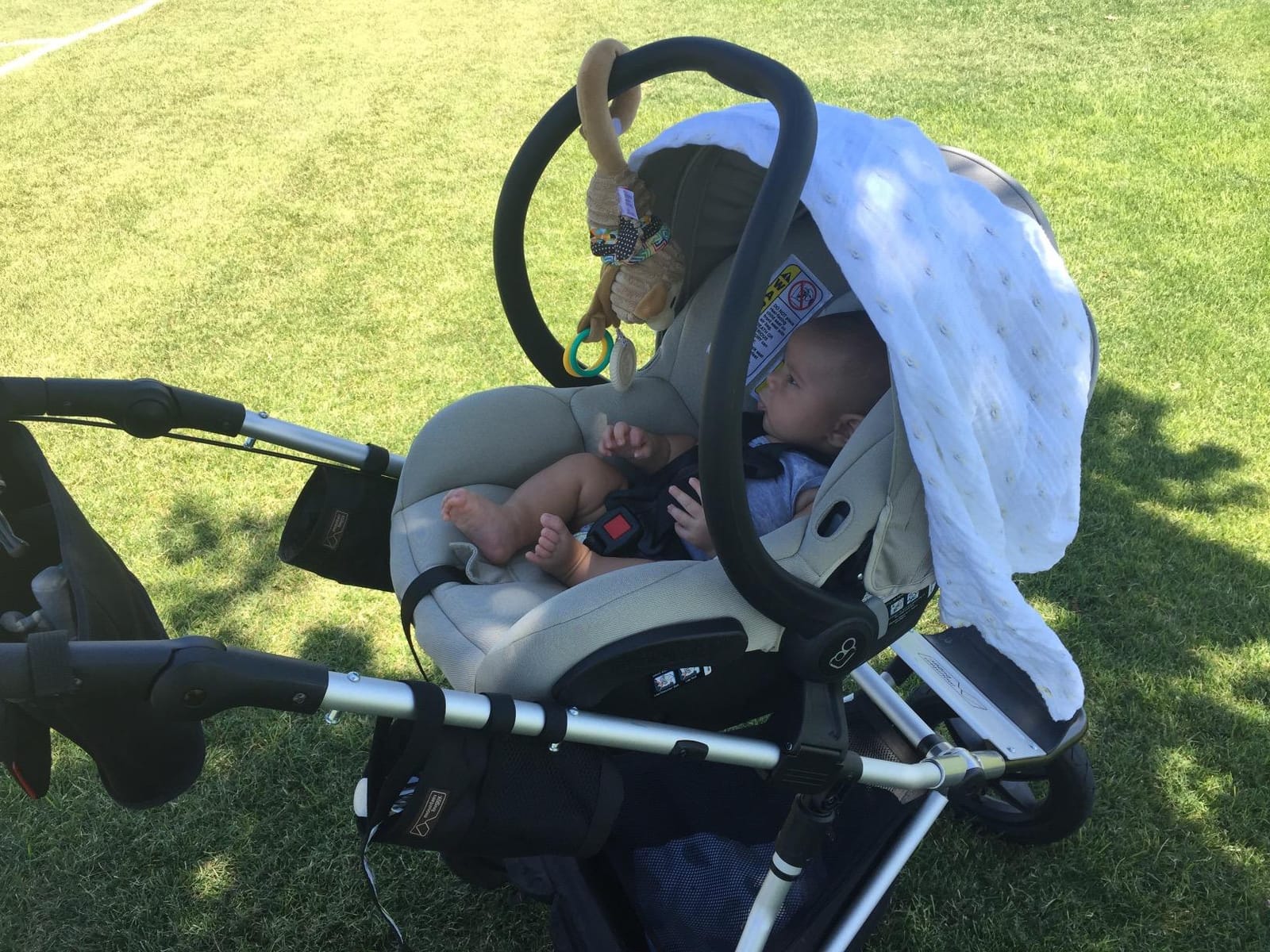
It is also unusually versatile with a newborn. The reclinable seat works in three modes, and it is compatible with the Carry Cot+ and infant car seats for a carry-cot setup. The box includes a reversible liner, two bottle holders, a bumper bar and a second set of 12 inch rear wheels, so you can change wheel size for different ground.
Owners complain most about the brake lever, which is unintuitive for the first few runs, and about a firm ride compared with air-tire frames. The bulky frame limits basket access when the backrest is reclined, and the cot and car seat are extra purchases.
Who this trail jogger suits
It suits runners on true technical single track, and anyone who wants to fine-tune the front wheel rather than accept whatever play the frame comes with. The newborn capability makes it a long-life stroller for families adding a second child later.
Where it falls short
Budget for practice on the squeeze brake before you run a steep descent with it. The suspension is firm next to air-filled tire models, the frame is bulky, and reclining the backrest gets in the way of the basket. Accessories for newborn use are sold separately.
11. Thule Urban Glide 3 – Best All-Terrain Hybrid
Thule Urban Glide 3 Single Child All-Terrain Stroller, Lightweight, Air-Filled Tires & Suspension, Integrated Hand Brake
- Lightweight frame for a suspension jogging stroller
- Integrated twist hand brake for smooth speed control on grades
- One-hand compact fold with a self-standing feature
- Removable seat and canopy fabric makes cleaning easy
- Built-in legrest and adjustable recline for all-day comfort
- Bassinet and car seat adapter sold separately for newborn use
- Magnetic buckle is an upgrade rather than standard
- Smallest review pool among the premium picks here
The Urban Glide 3 is the hybrid pick: a stroller you will use for school runs, long walks and trail time without switching. Owners highlight three things. It is light for a suspension jogging stroller, the integrated twist hand brake gives smooth control on grades, and the one-hand compact fold with a self-stand feature makes it easy to leave standing on uneven ground at a trailhead.
Underneath, the swivel front wheel locks for higher speeds and pairs with large rear wheels, quality suspension and air-filled tires. That combination is what lets it handle uneven pavement and packed trail without the harshness of an unsuspended frame. Reflective details on the canopy and wheels add visibility for dusk runs.
Who this trail jogger suits
It suits families who want one stroller that does jogging, walking and everyday errands, and petite runners who find heavier frames hard to push uphill. The removable seat and canopy fabric is a genuine advantage for parents who clean up trail mud regularly, and the built-in legrest plus adjustable recline keep a child comfortable on long days out.
Where it falls short
Newborn use needs a Thule bassinet or a car seat adapter, both sold separately. The magnetic buckle is a paid upgrade rather than standard. It also has the smallest body of owner feedback among the premium models here, so there is less long-term durability data behind it than the picks with thousands of reviews.
12. Jeep Classic Jogging Stroller – Best Wide-Stance Budget Jogger
- 16 inch rear wheels on a shock-absorbing frame
- Front swivel lock adds stability at running speed
- Compact fold with quick-release rear wheels
- Extendable UPF 50 visor for sun
- rain
- wind and snow
- Travel system compatible with several common car seats
- Wide 44.9 inch footprint across the handlebar
- Firmer ride on sharp rocks than air-tire models
- Basic suspension compared with dedicated jogging strollers
- Reflective piping is the only night visibility feature
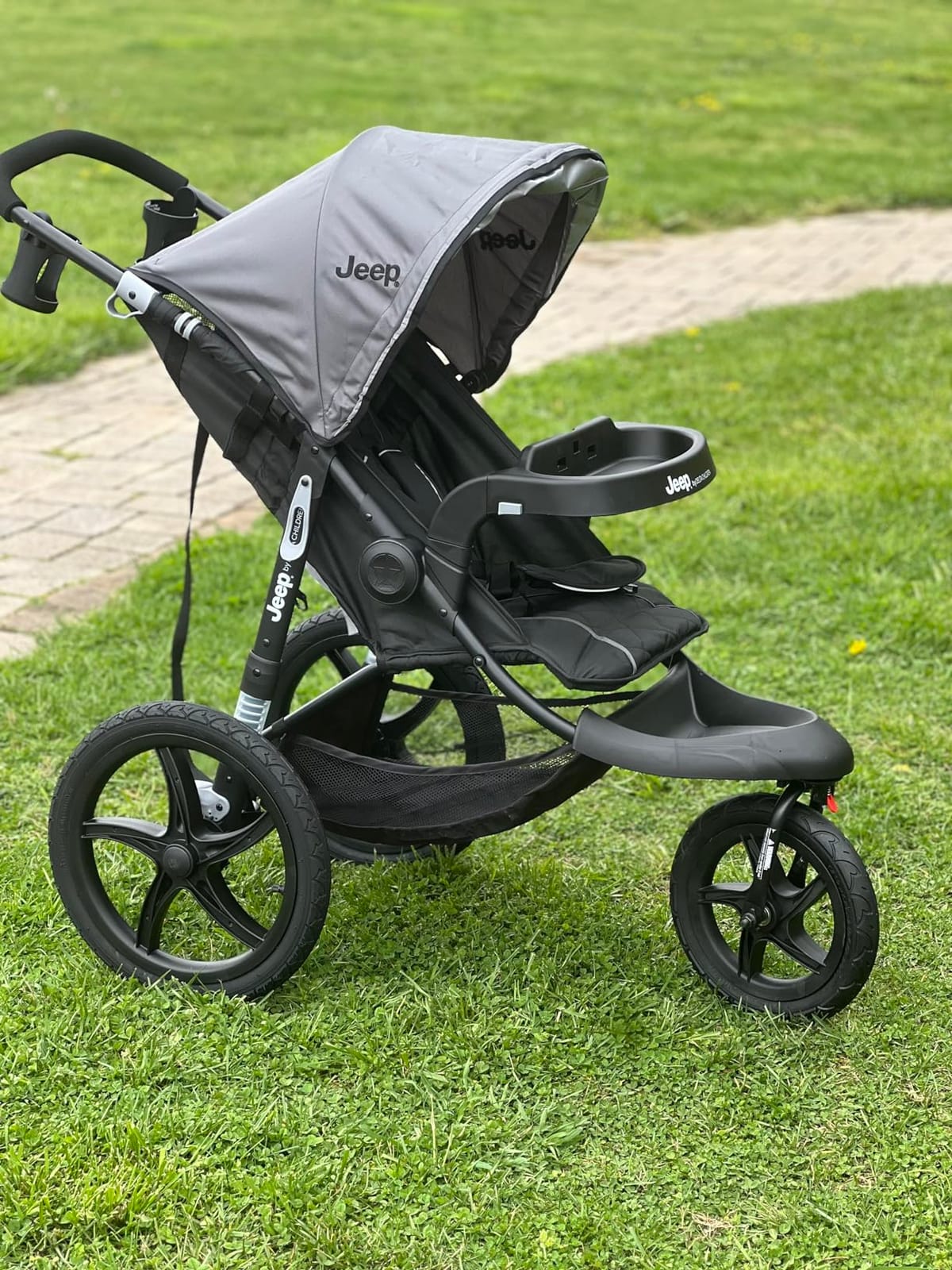
The Jeep Classic is a long-standing volume seller with roughly two thousand ratings, and the feedback is unusually consistent: owners like the 16 inch rear wheels on the shock-absorbing frame, the front swivel lock that steadies it at running speed, and the compact fold with quick-release rear wheels that fits most car trunks.
What makes it worth a look in 2026 is the visor. The extendable UPF 50 visor covers sun, rain, wind and snow, which on a trail means fewer reasons to turn back. The reclining seat with safety tether, swing-away child tray, two parent cup holders and an under-seat basket make it a genuine everyday stroller rather than a running-only rig.
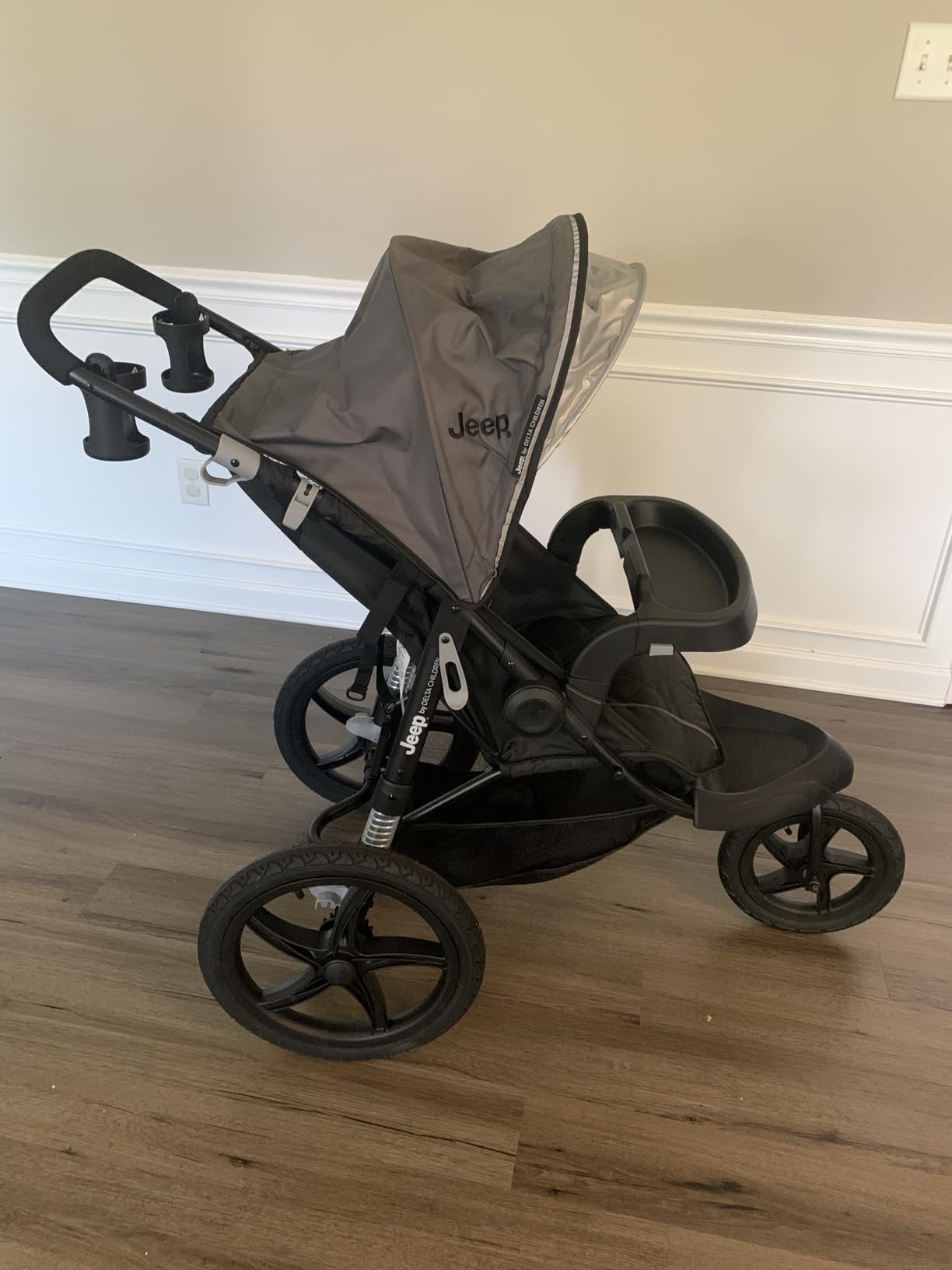
It is travel system compatible with several common infant car seats, with an adapter needed for a couple of specific models. The five-point harness has reflective piping, and the frame comes in at 26 lb, which is manageable for most runners if the ground is not a steep climb.
The main drawback is width. At 44.9 inches across, it is one of the broader frames in this guide, which matters in a small car, a narrow hallway or a lift. Wheels are not air-filled, so the ride is firmer on sharp rock than the air-tire models, and suspension is basic.
Who this trail jogger suits
It suits budget buyers who want big rear wheels, a swivel lock and real wheel size without moving up the market. The all-weather visor makes it a good choice for runners who do not want to buy a separate rain cover, and the quick-release fold suits families with a mid-size trunk.
Where it falls short
The 44.9 inch width is the deal breaker in tight spaces, and the firmer wheels transmit more impact on sharp rock. Suspension is basic compared with dedicated jogging strollers, and reflective piping is the only low-visibility feature, so pair it with your own reflective gear.
How to Choose a Trail Jogger: What Actually Matters
Start with terrain, because it decides almost everything else. Smooth dirt and gravel respond well to large air-filled wheels and moderate suspension, and most entry-level trail running looks exactly like this. Rocky technical trail with roots and embedded rock rewards deeper suspension travel and higher tire pressure. Steep descents demand a hand brake on the handlebar, because a rear pedal brake alone leaves you riding the wheel down the hill. If you are not sure which you have, ask yourself what the worst section of your usual route looks like and buy for that.
The three non-negotiable safety features
First, a front wheel that locks straight ahead. A free-swiveling wheel is unstable above a fast walk and will jack-knife or catch on obstacles. Second, a hand brake on the handlebar, so you can slow down without releasing the frame. Third, a wrist strap or handlebar tether, so a stroller cannot run away from you on a grade. If a product listing does not mention all three, treat it as a stroller for walking, not for running. If you run at dawn or in poor light, pair your choice with our Garmin watches for hiking guide for route and pace tracking.
Tire type on trails
Air-filled tires are the best compromise on dry trail. They absorb sharp rock, you can tune pressure to the surface, and the cost is maintenance: check them every few weeks, and more often in cold weather, because air pressure drops in the cold. Foam-filled tires never go flat and are the right call for winter slush and packed snow, but they ride harder on sharp rock. Solid tires sit behind both on anything but pavement. Whichever you pick, a hand pump and a pressure gauge are worth owning.
Suspension, wheel size and weight limit
Rear wheel diameter drives most of the ride quality. Models in this guide run from 12 inch to 16 inch rear wheels, and the larger the wheel the better it rolls over cracks, roots and ruts. Suspension depth is the second lever, and a frame with visible shock absorbers will outlive a frame with none. Check the child weight limit against what you actually carry today and what you expect in three years; the highest limits here reach 75 lb, and a stroller that grows with your child lasts longer.
Measure the trunk before you fall in love
This is the most repeated mistake we found in parent discussions. Folded dimensions range from around 19 by 24 by 36 inches on the quick-release models to frames that need their rear wheels removed first. Measure the narrowest point of your trunk opening, not just the space inside, and check whether the fold is one-handed or two-handed before you commit. A stroller you cannot lift alone is a stroller you will resent.
For the runner rather than the child, weight matters as much as price. Frames in this range run from light budget models to heavier full-size ones, and petite runners in particular report that pushing a heavier frame uphill is what ends their trail miles. If that sounds familiar, prioritise a lighter frame or a lighter child, and consider our mountain bikes for trails guide for the days you run without the stroller. For footwear on longer routes, see our hiking boots for long trails guide.
Why Your Jogging Stroller Shakes When You Run
Shaking at running speed is almost always a mechanical symptom, not a broken frame. In order of likelihood:
The front swivel wheel is not locked. Lock it into the straight-ahead position and re-test. If the shake persists, the frame may have play built into the swivel assembly.
Tire pressure is low. An underinflated tire adds sidewall flex that reads as vibration at speed. Inflate to the maker’s recommended pressure and retest on the same surface.
Play has developed in the front fork or the swivel lock. Some trail frames let you adjust this play out directly, which is worth doing before buying a new stroller.
The brake is dragging. A brake that is slightly engaged adds resistance and vibration. Check the lever rest position and the cable adjustment.
You are on loose gravel at speed. This one is a terrain change, not a fault, and slowing to a walk is the correct fix.
Pre-Run Safety Checklist for Trail Jogging
Run through this every time, in this order. Confirm the front wheel is locked straight ahead and stays locked with no play when you push it. Squeeze the hand brake firmly and confirm both rear wheels engage. Check tire pressure, more often in cold weather. Put the wrist strap on your wrist, not around the handlebar. Fit the harness snug over the child’s base layers rather than a bulky jacket. Confirm the child is clear of the wheel arches and not holding the tray on a descent. Add reflective gear and a light if the route is dim. And wait until roughly six to eight months with good neck control before jogging with a baby in any stroller, whatever the brand claims.
What to Skip When Shopping for a Trail Jogger
Skip cheap listings that call themselves joggers but have no hand brake, and read the feature list rather than the product title. Skip aftermarket suspension kits sold to turn an ordinary stroller into a jogger; they do not change the wheel geometry, the brake or the safety engineering, and the result is still not a running stroller. Skip Bluetooth speakers and light-up gimmicks, which add weight and can mask the sounds of traffic and other runners. And skip anything that advertises all-terrain capability without naming a lockable front wheel and a brake you can reach from the handlebar.
Frequently Asked Questions
Why does my jogging stroller shake when I run?
The most common cause is an unlocked or swivel front wheel, which deflects at speed. Lock the front wheel straight ahead, check tire pressure, check for play in the swivel assembly, and confirm the brake is not dragging. If it still shakes on firm ground, the frame may need service.
What is the best all-terrain jogging stroller?
For mixed trail and everyday use, the Thule Urban Glide 3 pairs air-filled tires and suspension with an integrated twist hand brake and a one-hand self-standing fold. For pure trail capability, the BOB Gear Revolution Flex 3.0 Duallie and the BOB Gear Alterrain are stronger on rocky ground because of their suspension travel and air tires.
What stroller is best for rough terrain?
Rough ground needs three things: a lockable straight front wheel, air-filled tires and real suspension. The Baby Jogger Summit X3 and the Chicco Activ3 both have a handlebar brake, a locking front wheel and suspension, and they sit in the middle of the price range rather than the top.
At what age can a baby ride in a jogging stroller?
Most pediatric guidance points to waiting until roughly six to eight months, and until your baby has good head and neck control, before jogging with them in any stroller. Until then, walk. Several models here recline nearly flat or accept a carry cot for newborn use, but a reclined newborn seat is not the same as a jogging-ready setup.
Do I need a hand brake for jogging?
Yes, if you run on hills or descents. A hand brake on the handlebar lets you control speed without releasing the frame or lifting a hand off the bar. Rear-pedal brakes alone are fine on flat ground but leave you riding the wheel down a steep pitch. Six of the twelve models here have a handlebar brake or hand-operated deceleration brake.
Is a foam-filled tire as good as an air-filled tire for trails?
No, not on dry technical trail. Air-filled tires absorb sharp rock better and let you tune pressure to the surface, but they need checking every few weeks and lose pressure in cold weather. Foam-filled tires never go flat, which makes them the better choice for slush, packed snow and long winter runs.
Final Verdict: The Best Jogging Strollers for Trails
After running all twelve, the BOB Gear Revolution Flex 3.0 Duallie is still the best jogging stroller for trails overall, because it is the only frame here that pairs real trail suspension, air tires and a locking front wheel with room for two children. If your budget is tighter, the Baby Trend Expedition Jogger delivers the three safety features and dependable gravel performance for far less, and the hauck 3-Wheel covers long gravel walks with a seat that goes nearly flat.
Match the stroller to your worst terrain, not your best. Rocky trail deserves the Alterrain or the Revolution Flex, steep descents deserve the hand-brake Summit X3, and winter runs deserve the Chicco Activ3 with its never-go-flat tires. If your trunk is tight, the BOB Wayfinder folds smaller than the full-size frames. Whatever you choose, lock the front wheel, test the brake, wear the wrist strap and measure your car before the trailhead. That is our 2026 guide to the best jogging strollers for trails, and we will keep updating it as models change.