
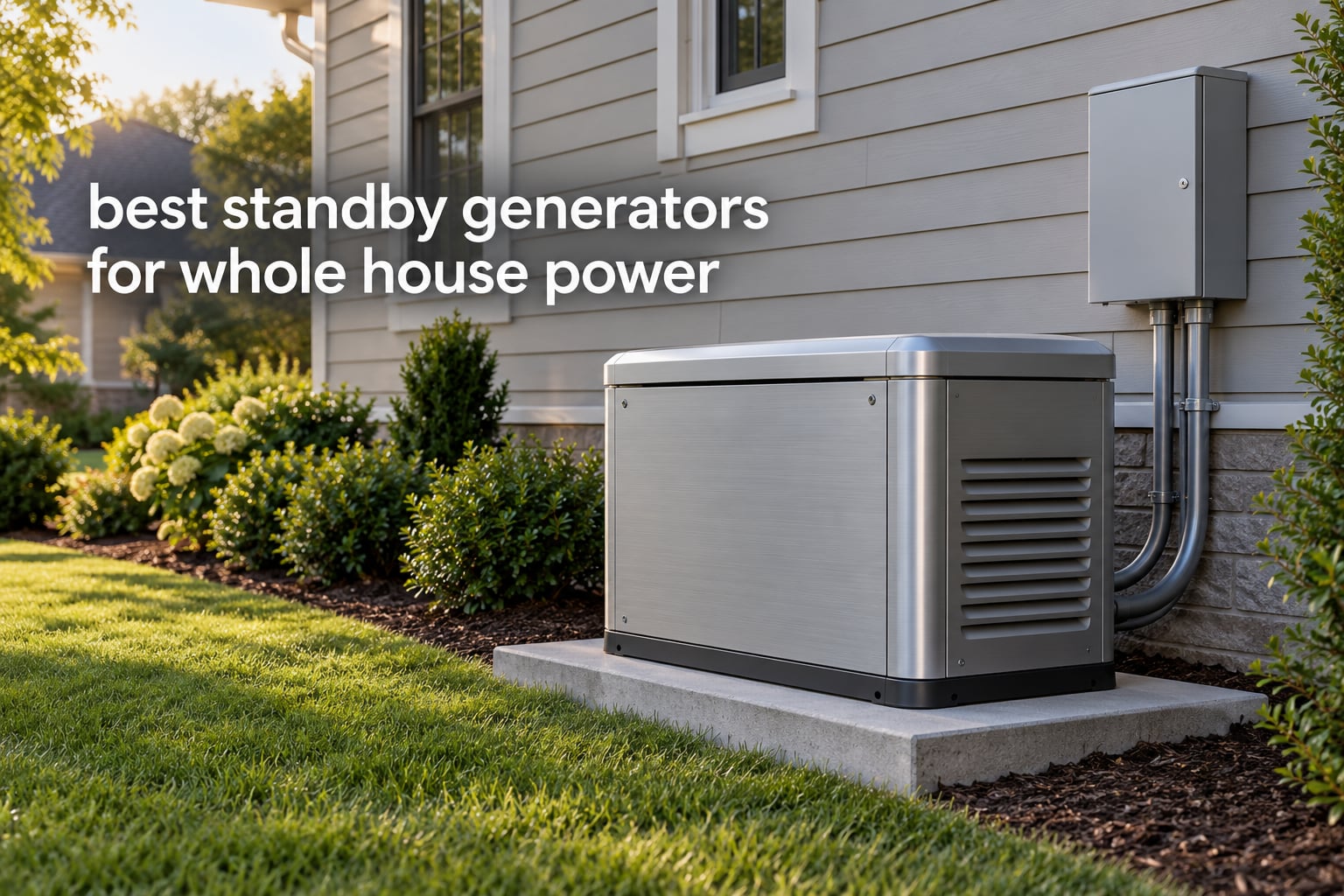
A standby generator is the difference between a spoiled fridge and a house that keeps running through a multi-day outage. If you are shopping for the best standby generators for whole house power, the shortlist comes down to six installed systems: the Generac Guardian 26kW, the Kohler 20RESCL 20kW, the Generac Guardian 22kW, the Generac 18kW with cellular monitoring, the Champion 12.5kW, and the Kohler 26RCAL 26kW.
These are permanently installed units that sit on a concrete pad outside your home, burn natural gas or liquid propane from a utility line or a tank, and start on their own within about ten seconds of a power cut. An automatic transfer switch disconnects the grid feed, starts the engine, and moves your whole panel to generator power without you touching anything.
That last part is what separates a standby system from a portable generator. A portable model means extension cords, refuelling in the rain, and starting it yourself. A standby system means your heat pump, well pump, sump pump, refrigerator, home office, and medical equipment keep running while you are asleep or two hours away. Our team compared the six below on running watts, fuel flexibility, cooling type, transfer switch rating, warranty length, and remote monitoring, and we also weighed owner reports from forums where this category has an unusually active conversation.
Top 3 Best Standby Generators for Whole House Power (October 2026)
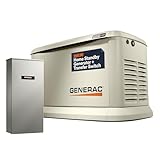
Generac Guardian 26kW with 200A Switch
- 26000W on gas or propane
- 200A transfer switch included
- Wi-Fi Mobile Link monitoring
- 5 year limited warranty

Kohler 20RESCL 20kW Air-Cooled
- 20000W air-cooled
- 200A service entrance load shedding ATS
- 10 second response
- 5 year 2000 hour warranty

Generac Guardian 22kW Wi-Fi
- 22000W on gas or propane
- Under 5 percent THD
- Quiet-Test exercise mode
- 5 year limited warranty
Standby Generators at a Glance in 2026
| Product | Specifications | Action |
|---|---|---|
| Generac Guardian 26kW Home Generator with 200A Transfer Switch |
|
Check Latest Price |
| Kohler 20RESCL-200SELS 20,000W Air-Cooled Standby Generator |
|
Check Latest Price |
| Generac Guardian 22kW Home Standby Generator with WiFi |
|
Check Latest Price |
 Generac 18kW Whole Home Generator with Cellular Capability Generac 18kW Whole Home Generator with Cellular Capability |
|
Check Latest Price |
 Champion 12.5-kW Home Standby Generator with 100-Amp Transfer Switch Champion 12.5-kW Home Standby Generator with 100-Amp Transfer Switch |
|
Check Latest Price |
 Kohler 26RCAL-200SELS 26,000-Watt Air-Cooled Standby Generator Kohler 26RCAL-200SELS 26,000-Watt Air-Cooled Standby Generator |
|
Check Latest Price |
1. Generac Guardian 26kW – Best Overall for Whole House Power
Generac Guardian 26kW Home Generator, Transfer Switch & WiFi Monitoring
- 200A transfer switch included with the generator
- True Power Technology holds total harmonic distortion under 5 percent
- Wi-Fi Mobile Link lets you confirm a test cycle from your phone
- Quiet-Test mode drops RPM during self-testing
- 58 owner reviews in the category's thinnest listing pool
- Highest purchase and installation outlay in this group
- Only 58 reviews available so reliability evidence is thin
- Professional installation required
This is the unit we would put on a house with a central air conditioner, an electric range, and a finished basement. Twenty-six kilowatts is the point where you stop thinking about which loads to leave off and start thinking about how long the outage lasts. The Generac G-Force 1000 Series engine is a 999cc four-cylinder, and the model number 7291 package arrives with the 200 amp transfer switch already in the box.
That included transfer switch matters more than the headline wattage. Plenty of listings quote a generator price and then add the switch, the concrete pad, the fuel line, and the permit later. When the switch is part of the package, the number you compare against a dealer quote is closer to the number you actually sign. Owners who bought this unit report clean, stable output through extended outages and good satisfaction with the monitoring app, including use during hurricanes.
One detail to plan for is physical size. At 48.5 by 25.1 by 28.6 inches and 518 pounds, this is not a unit you slide into a tight side yard, and local setback rules from the manufacturer are stricter than most people expect. Ask your dealer for the clearance dimensions before the pad is poured, because moving concrete later is the expensive mistake.
On power quality, Generac’s True Power Technology holds total harmonic distortion under 5 percent, which is the number to care about if you run servers, audio gear, or medical equipment. Reviewers with sensitive electronics reported fewer problems than with units they had owned previously. The Quiet-Test self-test also runs at lower RPM, which keeps the weekly exercise cycle from being an audible event on a quiet street.
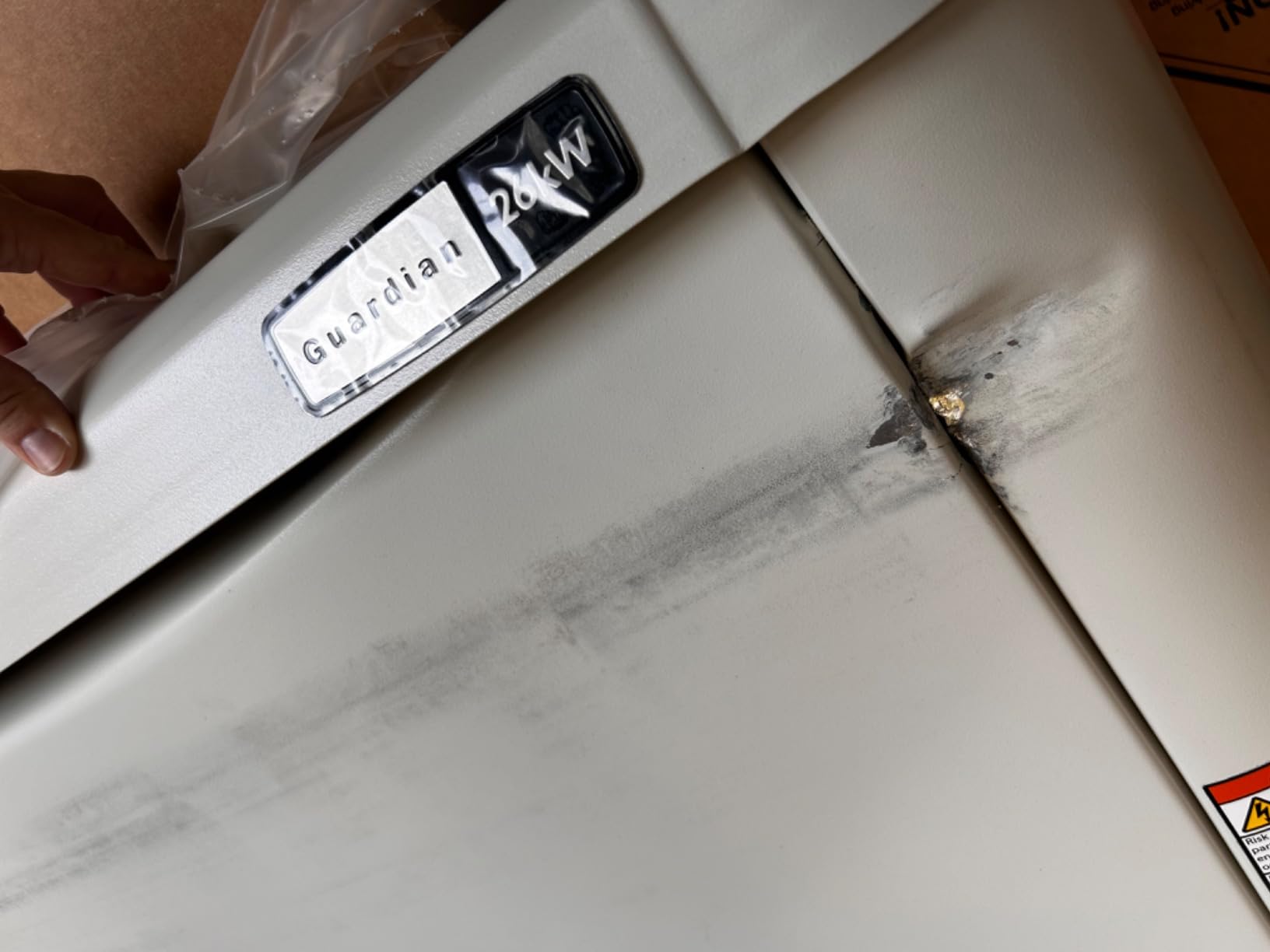
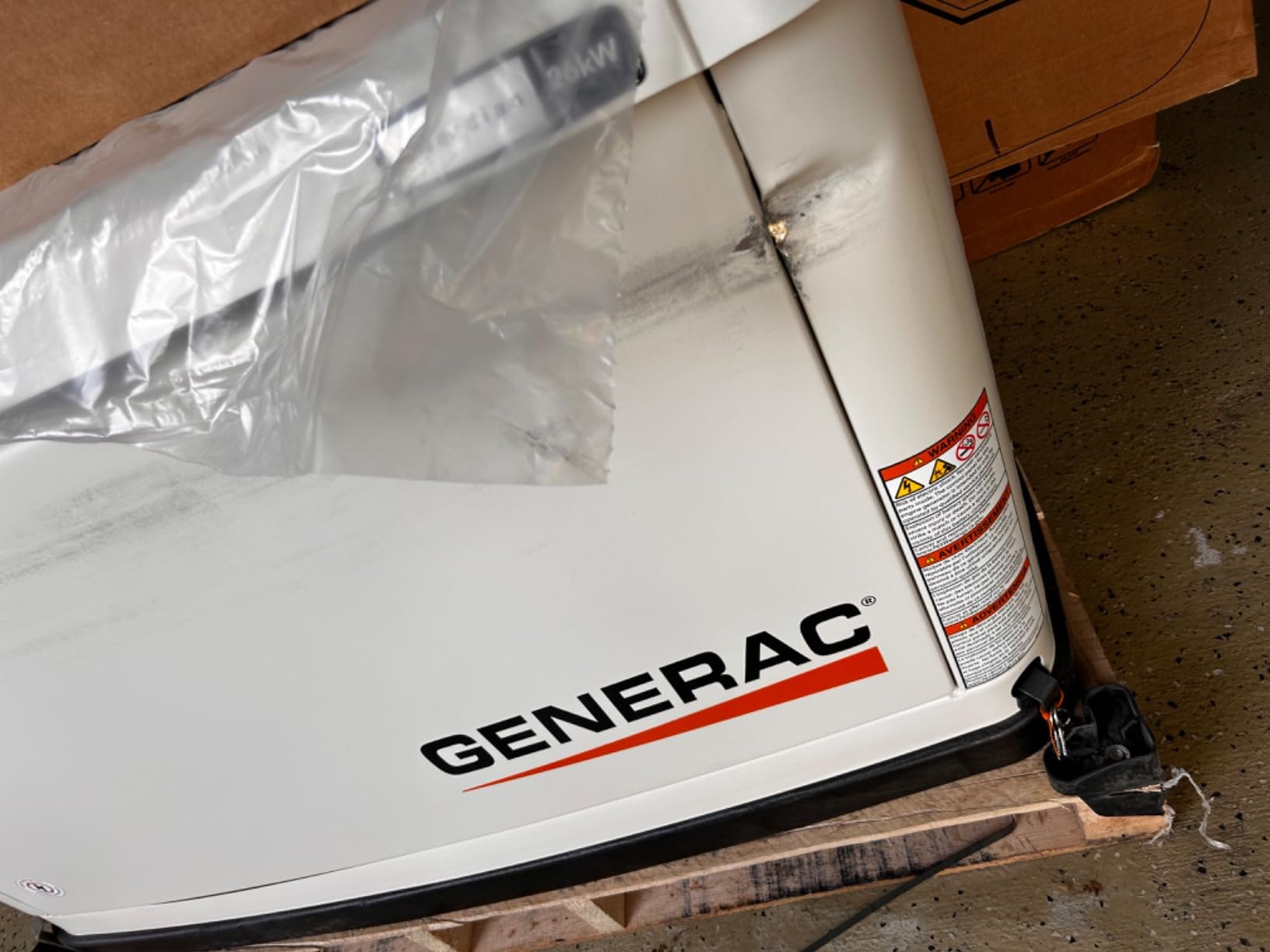
The honest weakness is the evidence base. This is dealer-fulfilled industrial equipment, and 58 reviews is a small sample for a machine expected to run for fifteen years. One owner flagged a dented rear panel arriving from delivery, which is a freight-handling issue rather than a unit defect, but it is the kind of thing to document before the driver leaves the driveway.
What the 26kW size handles that smaller models cannot
A 26 kW system covers essentially every load a modern house can throw at it. Central air with a heat pump, two electric water heaters, a well pump, a sump pump, the kitchen suite, the laundry, and the office all run simultaneously without load management doing anything clever. The engines that separate a big outage from a small one are usually compressors and pump motors, and this capacity leaves headroom for them.
It also gives you room to grow. If you plan to add an induction range, a second EV charger, or a workshop with a table saw, you will not be re-quoting the whole system in five years.
Where it will disappoint you
It is the most expensive item on this list before installation, and the total project cost runs well past the unit price once pad work, fuel line length, and electrical permits are in the quote. Neighbours can hear it during a full-load start even with Quiet-Test, so siting near a bedroom wall is a mistake. And the 200A switch is sized for the house, not for future panel upgrades beyond that.
Owners in forum threads about standby equipment repeatedly make the same point about this class of machine: installation quality decides the outcome far more than the badge on the enclosure. Get three written quotes that spell out exactly what each one includes.
2. Kohler 20RESCL 20kW – Best Premium Pick
- Load shedding transfer switch protects lower-priority circuits automatically
- Service entrance rated 200A switch handles full panel changeover
- Corrosion-proof enclosure suits coastal and coastal-adjacent sites
- 10 second transfer time
- Easy panel access for owner oil changes
- Transfer switch adds load priority configuration during commissioning
- Group 51 battery sold separately
- Only 32 reviews available
The Kohler 20RESCL-200SELS is the pick for anyone who cares more about how the system behaves than about raw output. At 20 kilowatts it will not carry every circuit in a large house, and that is the point: the load shedding transfer switch prioritises what matters and drops the rest rather than letting the engine stumble when demand climbs.
Owners who have lived with Kohler standby equipment describe the service experience as the main reason for the loyalty. The panels lift off for oil and filter access without pulling the whole machine apart, which matters when the unit sits idle for 340 weeks of the year and then runs for three days. A Kohler owner on a tractor forum described the 14 kW RCA model as easy to maintain because the panels simply lift off.
Response time is listed at 10 seconds, and the switch is service entrance rated, meaning it can sit between the meter and the main panel rather than feeding a sub-panel. That is the cleaner installation when your goal is whole-home power, and it removes a step from the installer’s scope.
Why load shedding is worth paying for
A load shedding switch lets you run a smaller generator than the home’s theoretical peak. You designate priority circuits during commissioning, usually starting with the sump pump, well pump, medical equipment, refrigeration, and internet, then the compressor loads last. When the engine approaches its limit, the switch opens non-priority circuits instead of stalling.
For most households this is a better trade than owning four more kilowatts you never use. It also gives you a defined behaviour during an outage, which matters when you are not standing next to the machine.
Where it will disappoint you
The commissioning has to be done properly or the priority scheme is guesswork, so this is a job for a trained Kohler dealer rather than a general electrician. You also need to source a Group 51 battery separately, which is an easy line item for an installer to forget. And the corrosion-proof claim is worth verifying against your own site if you are within a few miles of salt water.
The wider trade-off is dealer coverage. Buyers on generator forums describe Kohler as the premium option with a thinner local service network than Generac, so check for an authorised technician within a reasonable drive before you commit.
3. Generac Guardian 22kW – Best for Moderate Homes
- Highest owner rating in this lineup at 4.7
- Reported to run through extended outages including hurricanes
- Under 5 percent total harmonic distortion
- Quieter footprint than the 26kW at 466 pounds
- Mobile Link Wi-Fi monitoring
- Transfer switch is a separate purchase
- Only 19 reviews to judge long-term reliability
- Professional installation required
Twenty-two kilowatts is the number we keep coming back to for a typical two-thousand to three-thousand square foot house on an electrical service of 200 amps. It covers a gas furnace or a modest heat pump, a gas water heater, the kitchen, laundry, and the office with room to spare, without the fuel draw and physical footprint of the 26 kW machine.
This model carries the strongest owner rating of the six, at 4.7 with 81 percent of reviews at five stars. Owners describe reliable performance through extended outages and a favourable comparison against dealer installation quotes. The Mobile Link app is the feature people mention most, because it converts a machine you cannot hear from a machine you can verify.
The engine is the same 999cc G-Force 1000 Series used in the 26 kW, at 466 pounds and 48 by 25 by 29 inches. Same engineering family, smaller output, lower fuel consumption when you are only running essential loads.
Why 22 kW is the most common answer to the sizing question
Most homes are not sized by square footage, they are sized by one or two large loads. A central air conditioner with a 3-ton compressor, an electric water heater, and a heat pump are what drive the number. Everything else, combined, rarely crosses five kilowatts.
Add your fixed loads, add the largest motor load with a startup surge allowance, add a margin for derating in cold weather, and 20 to 22 kW is where most three-thousand-square-foot homes land. Owners sizing equipment for a two-thousand-square-foot house typically land between 14 and 18 kW.
Where it will disappoint you
The transfer switch is not in this package. Budget for a 200 amp service entrance rated switch separately, and make sure the quote you compare across brands includes it in each one.
Nineteen reviews is a small pool, and the review data itself flags one delivery with a dented rear panel, so inspect on arrival. If your home is all-electric with two heat pumps, this capacity will feel tight and you should be looking at 26 kW or above.
4. Generac 18kW with Cellular Monitoring – Best for Remote Confirmation
- Cellular monitoring works where Wi-Fi does not reach
- Weather-activated sloped roof sheds ice and snow
- Electronic fuel and ignition control trims fuel use
- Compatible with the Generac home energy ecosystem
- Lightest unit here at 426 pounds
- Only 6 reviews and one detailed 1-star report
- Cellular monitoring needs a Mobile Link subscription
- Transfer switch sold separately
This is the most interesting unit in the lineup for anyone who has ever wondered whether the generator actually ran. Built-in cellular connectivity sends status to the Mobile Link app without depending on your home Wi-Fi, which matters in two situations: a new install before the internet service is active, and an outage where the router itself is on the dead circuit.
At 18 kilowatts it sits between essential-load and mid-size whole-home work. Dual fuel means it can burn natural gas or propane, and the electronic fuel and ignition control is designed to trim consumption at partial load, where generators typically burn the most fuel per kilowatt delivered.
The weather-activated design with a sloped roof is a genuinely useful detail in northern climates. Ice and snow intrusion into an air intake or an exhaust is a common cold-weather failure, and the geometry here is meant to shed both.
Why cellular monitoring matters more than it sounds
Most standby monitoring systems report through your home internet connection. That is a single point of failure that nobody thinks about until the router is dead, which is exactly what happens during a long outage. A cellular link keeps reporting status on a different path.
It also solves the commissioning problem. Owners confirm the weekly self-test through the app, so you are not relying on a status light you have to walk outside and squint at in the rain. Check the monitoring tier cost with your dealer, since cellular service plans are billed separately.
Where it will disappoint you
Six reviews is not a sample size. One detailed 1-star review raised concerns about internet dependency in the design and battery drain, and flagged high propane consumption in cold weather. Treat that as a prompt to ask questions, not as a verdict.
Eighteen kilowatts is genuinely short for a large house with central air. And like the other listings in this category, the transfer switch is a separate line item. Our earlier guide to standby generators for whole home backup walks through the sizing arithmetic in more detail.
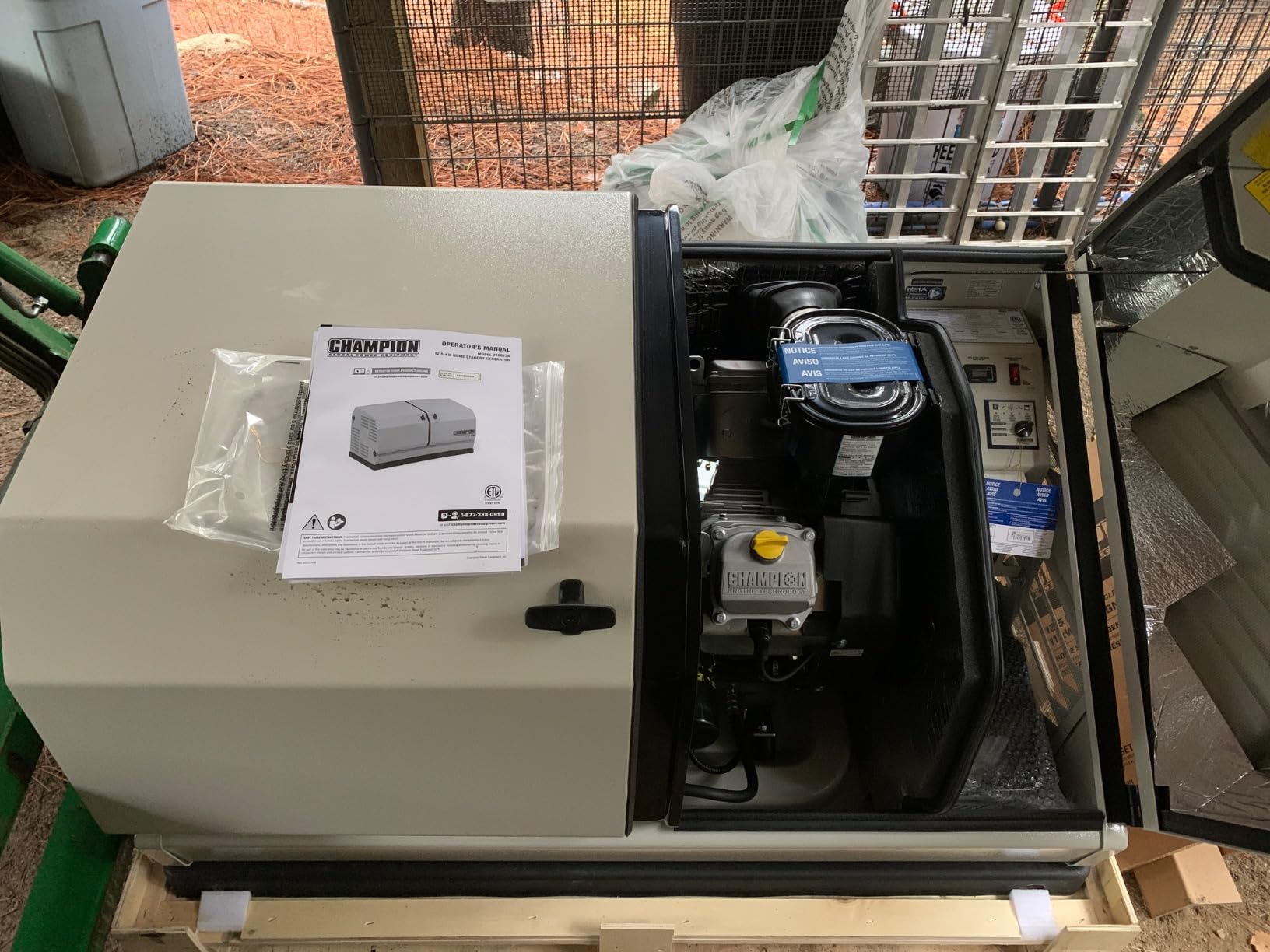
5. Champion 12.5kW – Best for Cold Climates and Quiet Streets
Champion 12.5-kW Home Standby Generator with 100-Amp Outdoor-Rated Automatic Transfer Switch
- 24-volt starting system runs to -22F with no warming kit
- Quietest operation in this group at 63 dBA
- 10 year limited warranty with lifetime technical support
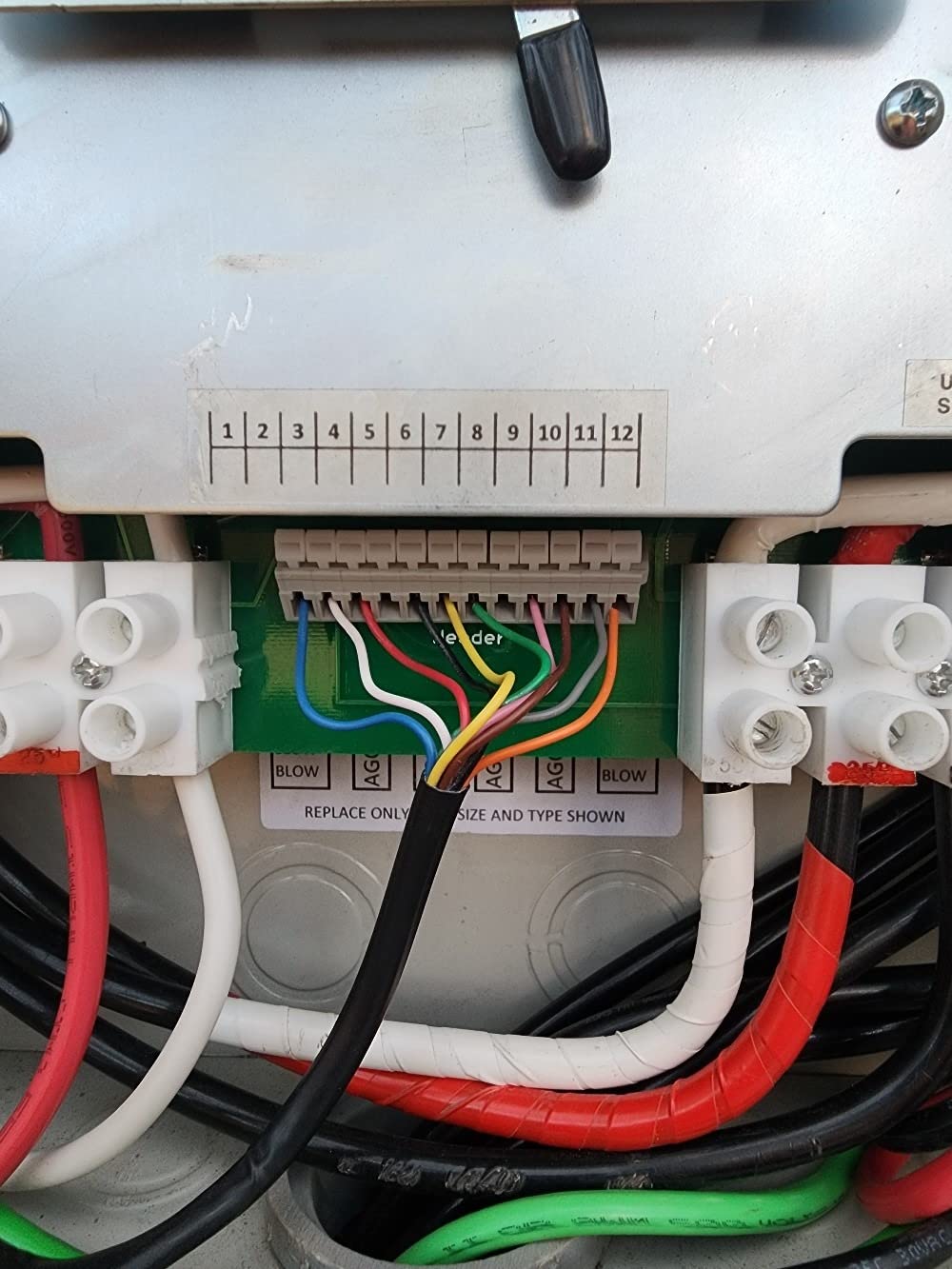
- 100A outdoor rated transfer switch with 12 circuits
- Weekly self-diagnostic tests
- Lowest output here
- suited to essentials and smaller homes
- No returns accepted on home standby models
- Transfer switch covers 12 circuits not the whole panel
If your outages come with ice, the Champion is the one I would look at first. Its 24-volt starting system is rated to crank from minus 22 degrees Fahrenheit to 104 degrees without a warming kit, which removes the oil heater that cold-region installations usually need to buy separately.
The other headline is noise. At 63 dBA with advanced sound dampening and a low-tone muffler, this is the quietest machine in the lineup, which matters if the pad has to sit close to a bedroom wall or a neighbour’s property line.
Capacity is the constraint. You get 12,500 watts on liquid propane and 11,000 on natural gas, which is an essential-load and smaller-home system. The included 100 amp outdoor rated transfer switch with 12 circuits makes that explicit, this is whole-home-lite coverage rather than full panel coverage.
What 12.5 kW actually covers
Refrigeration and freezer, a gas furnace with its blower, a sump pump, a well pump, internet and networking, lighting, and a few outlets. That is a comfortable, livable house for a week, and it is the correct answer for a 1,200 to 1,800 square foot home or a cabin.
The 10 year limited warranty is the longest in this group, and the free lifetime technical support is unusual at this category. Owners reviewing it consistently point to the quiet operation and the extreme temperature starting as the reasons they rated it well.
Where it will disappoint you
If you have central air, an electric range, and a water heater, you will be shutting things off every time. This is not the unit for a house you want to forget about during a five-day outage.
Home standby models are non-returnable, so you cannot test-drive it. Ask for a written load calculation from the dealer and check it against your own appliance list before you sign. Pricing comes through the Champion dealer network rather than a published listing, so get that number in writing.
6. Kohler 26RCAL 26,000-Watt – Best for Raw Output in a Large House
Kohler 26RCAL-200SELS Air-Cooled Standby Generator with 200 Amp Transfer Switch Single Phase, 26,000-Watt
- Highest output in the lineup on both fuels
- OnCue Plus monitoring bundled with the 200A transfer switch
- Kohler Command Pro V-Twin 999cc engine
- Service entrance rated whole-home changeover
- Handles heavy HVAC and well pump loads together
- Only 3 reviews
- Heaviest enclosure here at 625 pounds
- Dealer-only sourcing and pricing
- Metal enclosure adds weight to the pad spec
The 26RCAL-200SELS is the largest-capacity machine in this roundup, rated at 26 kilowatts on liquid propane and 24 kilowatts on natural gas. For a large house with two air-conditioning systems, a heat pump, and a well pump, that headroom is the reason to buy it rather than trimming elsewhere.
Under the hood is Kohler’s Command Pro V-Twin, a 999cc engine. The 200 amp transfer switch is included and carries OnCue Plus monitoring, so you get the status app as standard rather than as an add-on. That combination, most capacity plus integrated monitoring, does not appear anywhere else on this list.
The 5 year manufacturer warranty matches the rest of the field. At 625 pounds and 47 by 26 by 32 inches, this needs a properly engineered pad and enough clearance on all sides for service.
Why 26 kW on propane matters for big houses
The gap between the two fuel ratings is not a marketing detail. The rating on natural gas is 2 kilowatts lower than on propane, which lines up with what owners report about natural gas producing noticeably less usable output than liquid propane from an engine of the same size.
For a house that actually runs at its rating during a heat wave, that difference decides whether you have headroom or you start shedding circuits. Plan the fuel decision around the worst-case load, not the average one.
Where it will disappoint you
Three reviews. That is the number, and it is too small to support any reliability conclusion, even though the rating is a perfect 5.0. Treat the rating as a signal to ask questions rather than as evidence.
The weight and metal enclosure complicate the pad and the transport step, and this one is sourced through the Kohler dealer network. If you are in a region with thin Kohler service coverage, that local availability question matters more than the specification sheet. Our companion list of whole house generators for home backup covers the other size tiers.
How Big a Standby Generator Do You Need?
Most homes need a 10 to 14 kW generator for essential circuits and a 20 to 22 kW unit for whole-home backup. Houses above 3,000 square feet with central air, two water heaters, and an electric range need 26 kW or more.
Sizing starts with a load list, not a square-footage rule. Write down every load you would run during an outage with its running watts, then add the largest motor load with a surge allowance of roughly three times its running figure.
Start with the appliances that actually matter: refrigerator and freezer, well pump, sump pump, furnace or heat pump, water heater, internet and networking, home office equipment, lighting, medical equipment, and one or two kitchen circuits. Owners who skip this step routinely oversize and pay for kilowatts they will never draw.
Add the load you know you will add. Induction ranges, EV chargers, and heat pumps all move the number. Then apply a sizing margin of roughly 10 to 15 percent for cold-weather derating, altitude, and aging. If your heating runs on solid fuel rather than electricity, our guide to the best pellet stoves for whole house heating covers that side of the household load.
As a working map: essential circuits only usually need 7 to 10 kW. A 1,200 to 1,800 square foot home fits 10 to 14 kW. A 2,000 to 3,000 square foot house with gas heat lands at 18 to 22 kW. A large home with central air and all-electric heat needs 26 kW and possibly a load management module or a panel service upgrade.
Load management deserves a mention because it is cheaper than a panel upgrade. A module sheds lower-priority loads automatically, which lets a smaller generator serve a larger panel without you paying to replace the service.
Natural Gas or Liquid Propane: Which Fuel Should Your Standby Run?
Liquid propane delivers more usable output than natural gas from the same engine, and natural gas is more convenient because the supply never runs out. If a gas line already reaches your property, natural gas is usually the simpler long-term choice.
The output difference is real. Air-cooled units in particular are commonly reported to produce 5 to 10 percent less on natural gas than on propane, and the Kohler 26RCAL rating of 26 kW on propane versus 24 kW on natural gas shows the same pattern.
Tank sizing is where most buyers get it wrong. A 325 gallon propane tank gives roughly 195 gallons usable because of the fill percentage rule, and a 500 gallon tank gives roughly 300 gallons usable. Compare that against your burn rate before choosing a tank size.
A 100 pound portable tank is not the answer for a standby system. Standby generators are designed around a larger permanent tank or a utility gas line, and a residential propane delivery schedule is something you should confirm before the install, not after.
For long outages, fuel availability is the real constraint. A gas line keeps feeding as long as the utility system is intact, which in a regional storm can stop at the same moment your power does. Have a plan for both.
Transfer Switch, Installation, and the Maintenance Schedule
A standby generator cannot connect straight to your panel. The automatic transfer switch sits between the utility feed and the load centre, senses the loss of grid power, disconnects the grid, signals the engine to start, and closes the generator contactor once the engine reaches speed. It reverses the whole sequence when utility power returns.
Switch amperage is the decision most homeowners get wrong. A 100 amp switch covers a sub-panel or a modest panel and comes with a fixed circuit count. A 200 amp service entrance rated switch handles the whole panel and supports load shedding. If your goal is the best standby generators for whole house power rather than a subset of circuits, you want the 200 amp switch.
Installation is licensed electrical and gas work with permits. The scope typically includes the pad, the generator, the transfer switch, fuel line or tank, the electrical run to the panel, and the commissioning. Any quote that omits the transfer switch or the panel work from the price is not a complete quote.
Five checks before you sign with a dealer: confirm there is an authorised technician within a 50 mile radius, ask for the written installed scope, get three quotes, ask who performs warranty work, and confirm the load calculation is documented with your actual appliance list.
On maintenance, expect an oil and filter change once a year, a fuel filter change on a similar interval, battery inspection because the starting battery ages even while idle, and a spark plug check as the hours accumulate. Air-cooled engines run hotter, which is why owners on generator forums lean toward liquid cooling for anything at or above 14 kW.
Every one of these units should exercise itself weekly, and the Wi-Fi or app connection is how you confirm that the exercise actually happened rather than assuming it did.
Standby vs Portable vs Home Battery: Which Backs Up Your Home Better?
A standby generator runs indefinitely on a fuel supply, carries heavy motor loads, and starts itself. A portable generator is cheaper to store and cheaper to buy but needs a human, extension cords, and refuelling. A home battery with solar is silent and low maintenance but has a finite kWh reserve and cannot start a large motor load on its own.
For essentials only, a home battery can cover a few hours of refrigeration, lighting, and internet with far less fuss. For a heat pump, a well pump, or a multi-day ice storm, you need combustion capacity, and that means a standby unit.
The honest answer is that these solve different problems. Plenty of households in mild outage regions pair a battery with a small portable generator for the rare severe event.
Frequently Asked Questions
What is the best standby generator for a whole house?
For most homes the best standby generator for whole house power is a 20 to 22 kW air-cooled unit with a 200 amp service entrance transfer switch. That capacity covers a gas furnace or heat pump, a water heater, kitchen and laundry circuits, and the office without load shedding. Larger homes with central air and all-electric heat need 26 kW.
What size generator do I need to power my entire home?
Most homes need 10 to 14 kW for essential circuits and 20 to 22 kW for whole-home backup. Large homes with central air, two water heaters, and an electric range need 26 kW or more. Build the number from a load list of running watts, add a surge allowance for the largest motor, then add a 10 to 15 percent margin for cold-weather derating.
Which is better for a whole house generator, Kohler or Generac?
Generac wins on dealer coverage and unit availability, which is why it dominates the installed market and why serviceability drives many owner choices. Kohler wins on build quality, enclosure corrosion resistance, owner-accessible maintenance, and load shedding transfer switch options. Cummins Quiet Connect sits between them on support and price. Choose whichever brand has an authorised technician within a reasonable drive of your address.
What are the common problems with Kohler generators?
The most common Kohler issues reported by owners are dealer service availability in some regions, higher purchase and installation cost, and battery or solenoid faults that surface after long idle periods. Kohler standby units need a Group 51 starting battery, which is often a separate purchase. Load shedding switch priority settings also have to be configured correctly during commissioning or lower-priority circuits will not behave as intended.
What size propane tank does a standby generator need?
A 325 gallon propane tank holds roughly 195 gallons of usable fuel and a 500 gallon tank holds roughly 300 gallons usable, because of the maximum fill percentage rules. Residential standby systems are sized around those larger permanent tanks rather than portable cylinders. Confirm the burn rate in gallons per hour for your fuel choice and confirm local delivery availability before the install.
The Best Standby Generator Verdict for 2026
The Generac Guardian 26kW with its included 200 amp transfer switch is our pick for whole house power because capacity and the switch are bundled in one package. The Kohler 20RESCL 20kW is the smarter buy if you want load shedding and easy owner maintenance, and the Kohler 26RCAL 26kW goes furthest when two HVAC systems have to run at once.
Whichever of the best standby generators for whole house power you choose, the decision that matters most happens before the purchase order: confirm local dealer service, get a written installed scope, and size from a real load list. Once that is in place, the machine starts itself and you never think about it again.