
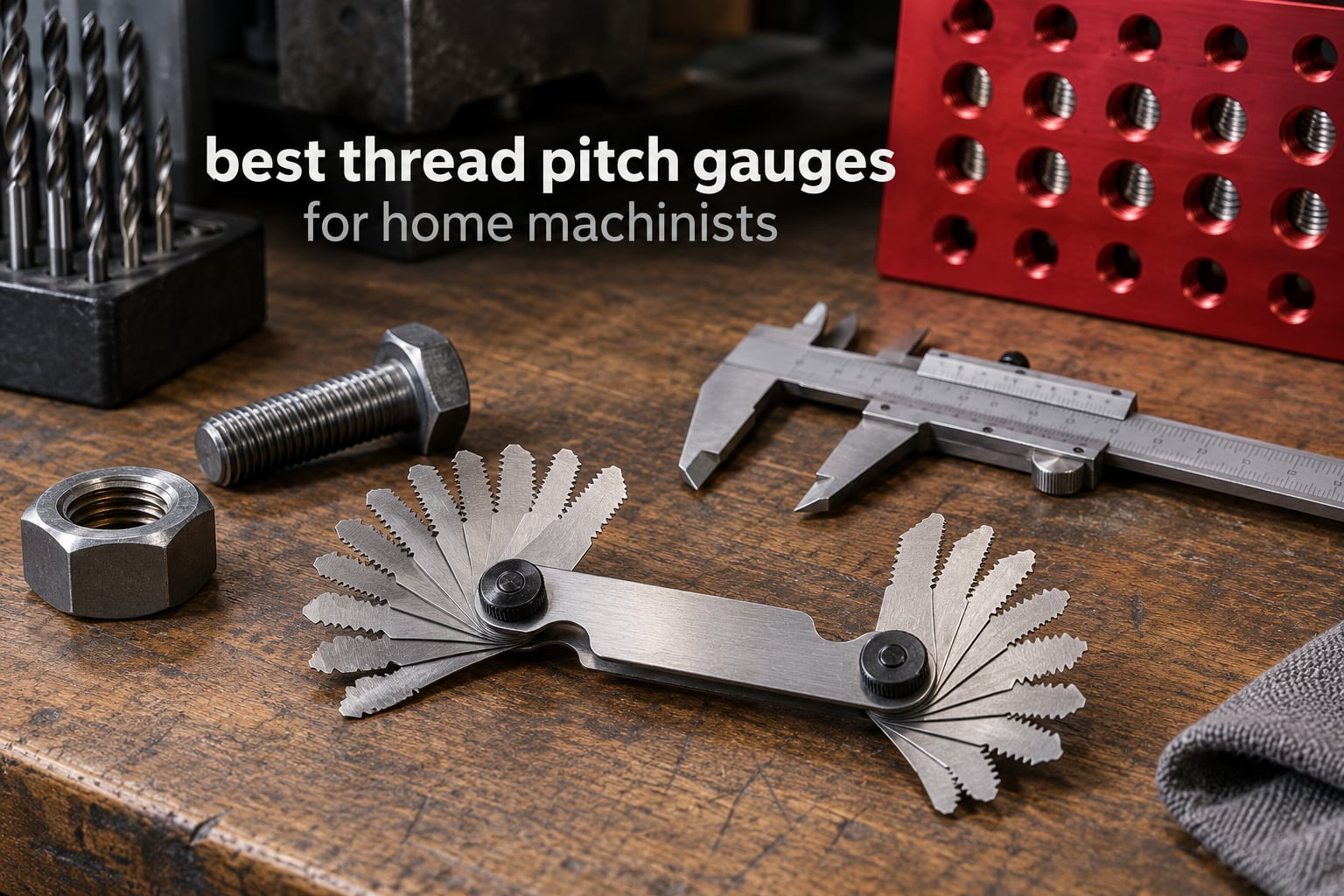
A thread pitch gauge is a folding set of thin metal leaves, each cut to a different pitch, that you press against a screw or tapped hole until one leaf meshes with no gaps. The matching leaf tells you the pitch in millimetres for metric threads or threads per inch for imperial ones, and combined with a caliper reading of the major diameter it gives you a full designation such as M8x1.25 or 5/16-18.
That fifteen-second check is the difference between ordering the right fastener and discovering at the bench that nothing fits. Home machinists hit unknown hardware constantly: an imported machine with metric fasteners, a vintage car with British Standard Whitworth threads, a drawer of salvaged bolts, a tapped hole before you commit to a tap. Forums are full of machinists describing exactly this loop. One poster on r/Machinists described the routine: calipers on the thread, comparing the number against sources online, and hoping both the table and the measurement are right.
This roundup covers ten thread pitch gauges and thread checkers, from folding stainless blade sets to wall-mounted panels, judged for the way a home shop actually uses them. I compared the ten in this guide against calipers, matched leaves to known fasteners, and paid close attention to which sizes each set actually covers. If you are also building out a bench, our picks for the best metal lathes for home machinists and the best metalworking tool sets cover the machines these gauges get used beside.
One thing to clear up before the picks: these are reference tools, not inspection gauges. A pitch gauge tells you which pitch a thread is; it does not tell you whether that thread is inside Class 2B limits as defined in ASME B1.2. A go/no-go thread checker gets you closer to that answer, and a thread pitch micrometer is the tool for actual pitch diameter. We explain where each one fits below.
Top 3 Thread Pitch Gauges for Home Machinists (October 2026)
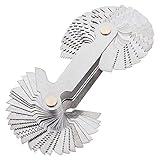
ChgImposs 55/60 Degree Gauge
- 0.25-6.0mm and 4-62 TPI
- 55 and 60 degree profiles
- Stainless wire-drawn blades
- Locking device

Grip US Thread Pitch Gauge
- 0.25-6.0mm and 4-42 SAE
- 60 degree profiles
- Locking device
- Steel construction
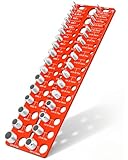
Manalete 30-Size Checker Board
- M2x0.4 to M14x2.0 and #2-56 to 5/8-18
- Class 2B steel studs
- Integrated drill gauge
- Wall mountable
Quick Thread Pitch Gauge Comparison in October 2026
All ten tools below identify thread pitch. The differences that matter to a home shop are coverage, whether the tool reaches inside a nut, and whether it lives on a wall or in your pocket.
| Product | Specifications | Action |
|---|---|---|
| ChgImposs 55/60 Degree Thread Pitch Gauge |
|
Check Latest Price |
| Grip US American National Thread Pitch Gauge |
|
Check Latest Price |
| Manalete 30-Size Nut and Bolt Thread Checker |
|
Check Latest Price |
 WEN ME210G Thread Pitch Multi-Gauge WEN ME210G Thread Pitch Multi-Gauge |
|
Check Latest Price |
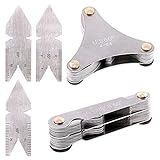 Glarks Five-Piece Pitch Gauge Kit Glarks Five-Piece Pitch Gauge Kit |
|
Check Latest Price |
 Hillman TU58 Mounted Thread Panel Hillman TU58 Mounted Thread Panel |
|
Check Latest Price |
 NAMOKA 31-Size Dual-Panel Thread Checker NAMOKA 31-Size Dual-Panel Thread Checker |
|
Check Latest Price |
 Mitutoyo 188-151 Screw Pitch Gage Mitutoyo 188-151 Screw Pitch Gage |
|
Check Latest Price |
 Miucoguier 66-Piece Nut and Bolt Thread Checker Miucoguier 66-Piece Nut and Bolt Thread Checker |
|
Check Latest Price |
 QISF Two-Gauge Whitworth Bundle QISF Two-Gauge Whitworth Bundle |
|
Check Latest Price |
1. ChgImposs 55/60 Degree Thread Pitch Gauge – widest coverage for the money
- Covers metric
- imperial and US standard in one gauge
- Wire-drawn stainless blades resist rust
- Locking device holds the chosen pitch
- Blades double as a thread angle check for lathe tooling
- Folding leaves mean hunting through the comb for each size
- Very thin blades are awkward to handle
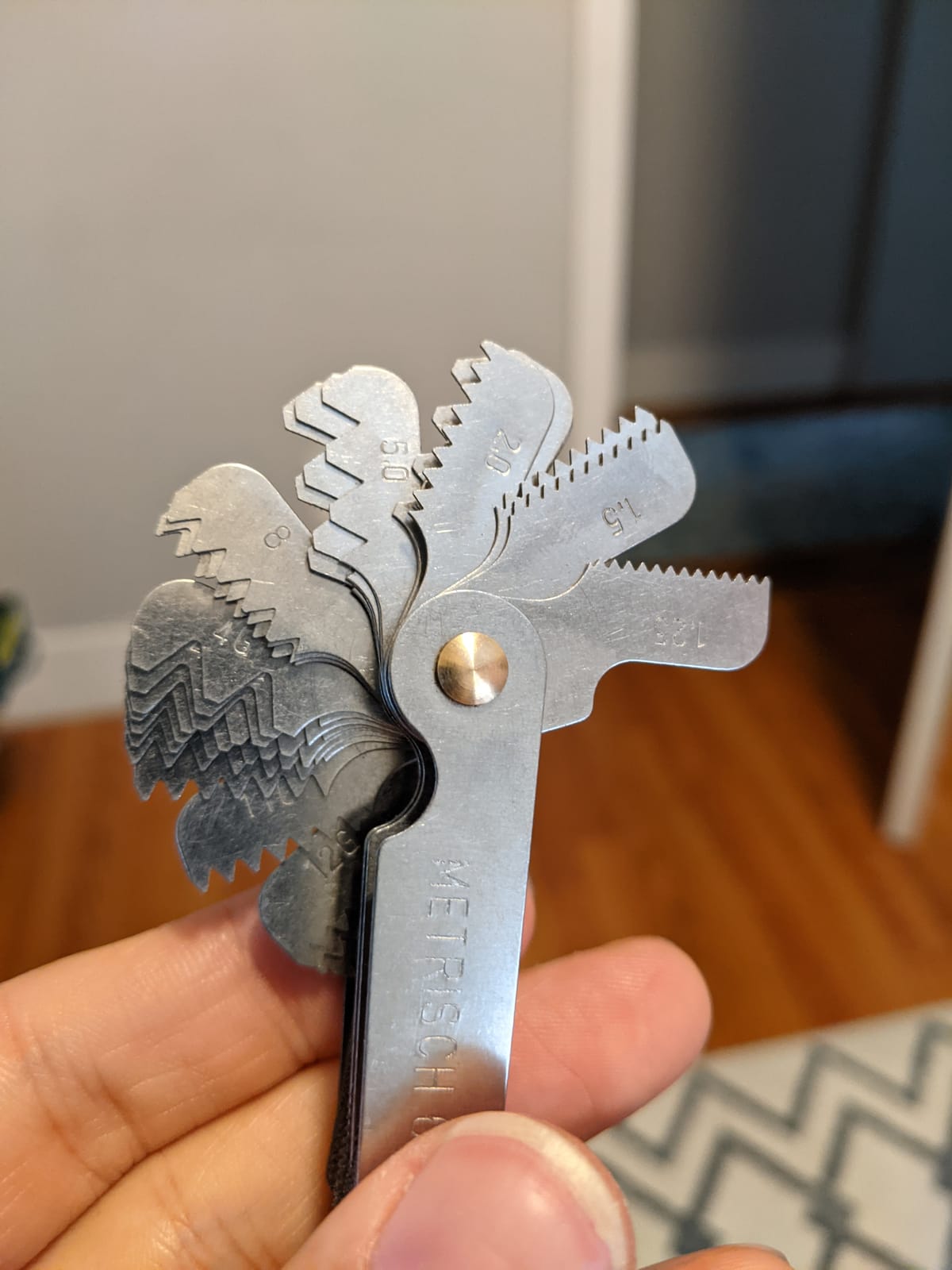
This is the gauge I reach for first in a home shop, and it earned the top spot here on coverage rather than on badge. One comb carries 24 metric sizes from 0.25mm to 6.0mm, 28 imperial sizes from 4 TPI to 62 TPI, and a set of US Standard pitches at 8, 10, 11, 14, 19 and 28. That US Standard group is the detail that separates it from most budget sets, because those odd pitches appear on vintage machinery and lamp hardware that nothing else in the drawer covers.
Having both a 55 degree and a 60 degree set of blades is a bigger deal than it sounds. The 60 degree leaves handle Unified and ISO metric threads, the same profile carried by almost every machine bolt. The 55 degree leaves are the ones that identify British Whitworth and BSF hardware, which is exactly what you are holding if you are working on an older British car or machine. A Garage Journal poster made the point about M10x1.0, a size many sets skip entirely: this one carries the full coarse metric sweep, so M10x1.0 is not a gap here.
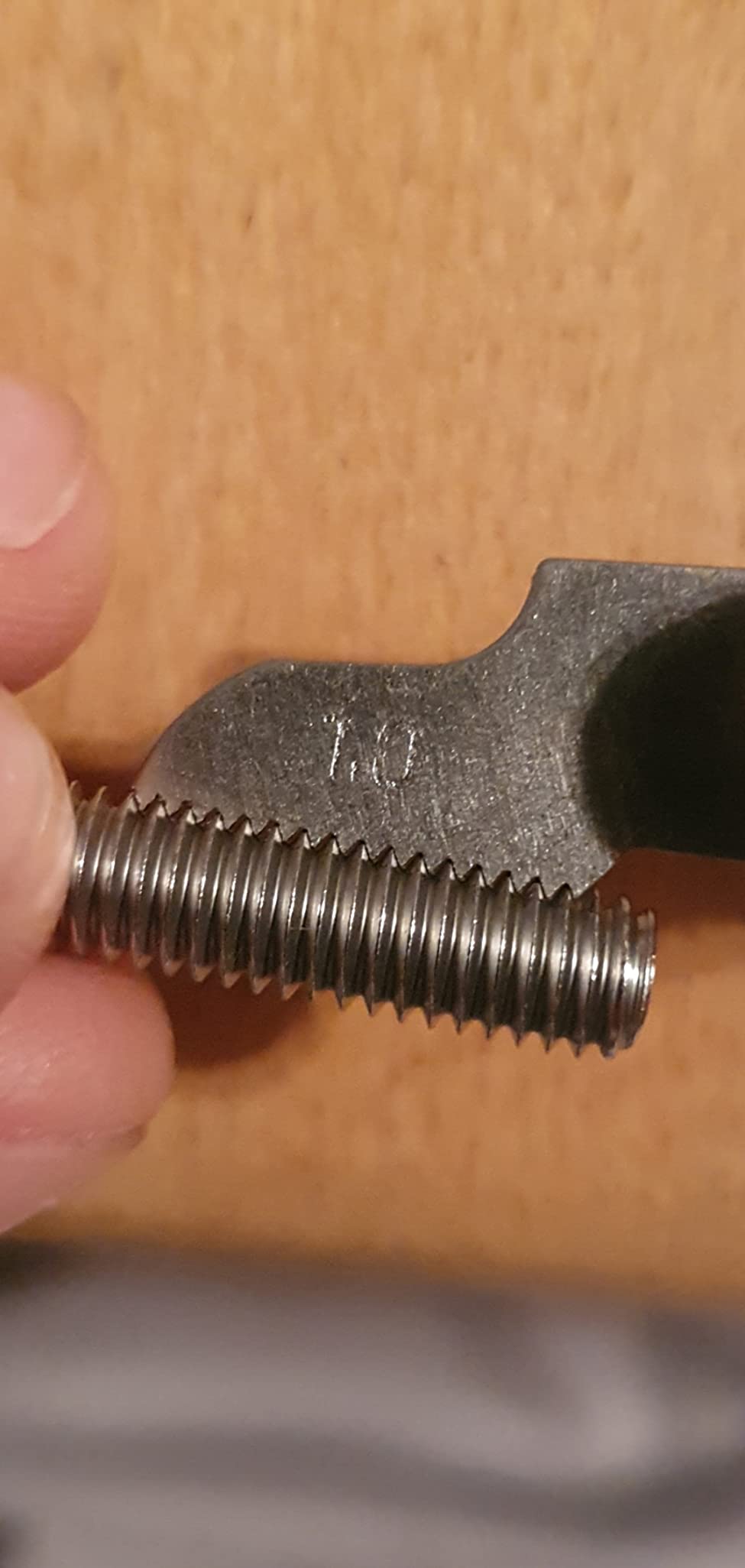
The blades are stainless steel with a wire-drawn surface, which matters in a garage where coolant, oil and metal dust all land on the same bench. The locking device is the small piece of hardware that makes the tool usable one-handed: fan out to the right leaf, lock it, and check the thread without the rest of the comb collapsing in your fingers. Reviewers consistently list the lock and the rust resistance as the two reasons it has stayed in service rather than being replaced.
The honest weakness is speed. A folding gauge means fanning through thin leaves to find the one you want, and the very fine blades are hard to pick out of the stack. On a bench where you identify fasteners ten times an hour, that friction is real. For most home shops doing occasional identification, it is a fair trade for the coverage. I pair it with a benchtop drill press setup where thread form matters, since the same 55 and 60 degree leaves double as a lathe threading tool angle reference.
What works well in a home shop
The single-comb format means one object lives in one drawer rather than five pieces spread across a bench. For a shop that does occasional work, that is the difference between a tool you use and a tool you know is somewhere in the garage.
It handles both thread systems, so an imported Japanese machine with metric hardware and a domestic machine with SAE hardware can both be identified with the same tool. Most of the alternatives in this price class make you pick a side.
Where it falls short
It cannot check a nut or any internal thread. The leaves are single-sided profile combs, and a hex nut presents four separate thread flanks with nothing to nest into. If your work involves sorting a bin of mixed nuts and bolts, you need a checker with male and female ends.
The fine end stops at 0.25mm metric, so sub-M2 hardware is out of reach, and nothing in the set is 55 degree Whitworth or 29 degree Acme. Those limits are normal for the class rather than defects.
2. Grip US American National Thread Pitch Gauge – the steel bench classic
- Long-running design from an industrial tool maker
- Locking device keeps the selected leaf in place
- Steel construction holds pitch over years
- Covers common SAE and metric pitches in one gauge
- Metric coverage stops short of the 6.0mm coarse end
- Folding format needs leaf flipping for each lookup
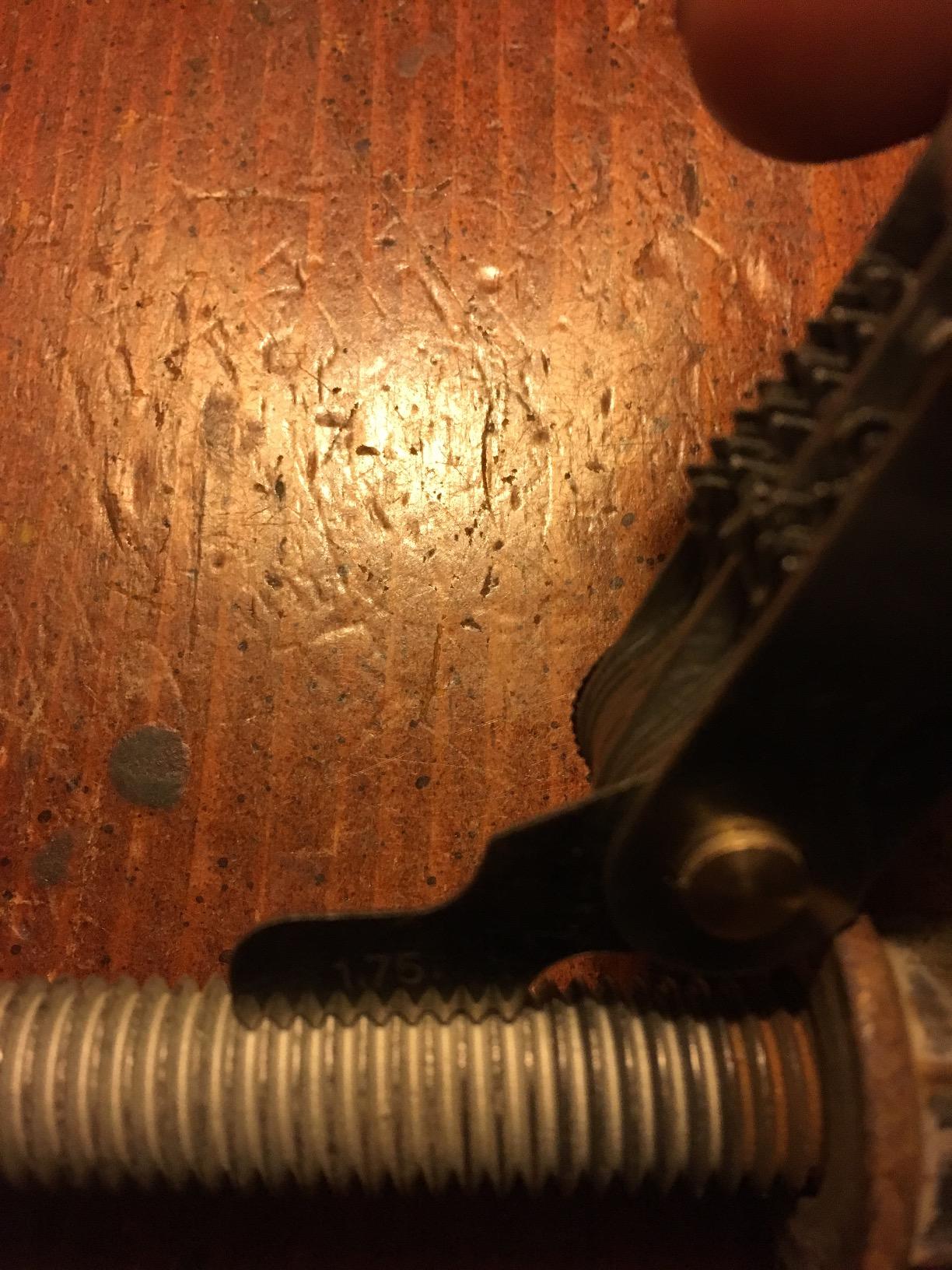
This gauge has been listed since 2011 and carries a 4.6 rating across more than 1400 reviews, which tells you something useful about reference tools: they do not go out of fashion. It measures 0.25mm to 6.0mm metric and 4 to 42 SAE, and every leaf is cut to a 60 degree profile, so it covers Unified and ISO metric work and nothing else.
The build is the differentiator against cheaper folders. Grip is an industrial tool maker, and the gauge is steel rather than a thin plated pressing, which is why owners describe it as holding its pitch accuracy over years instead of going soft. At 5.7 by 4.7 inches it is a larger format than the pocket folders, so it lives on a bench or in a drawer rather than in a shirt pocket.
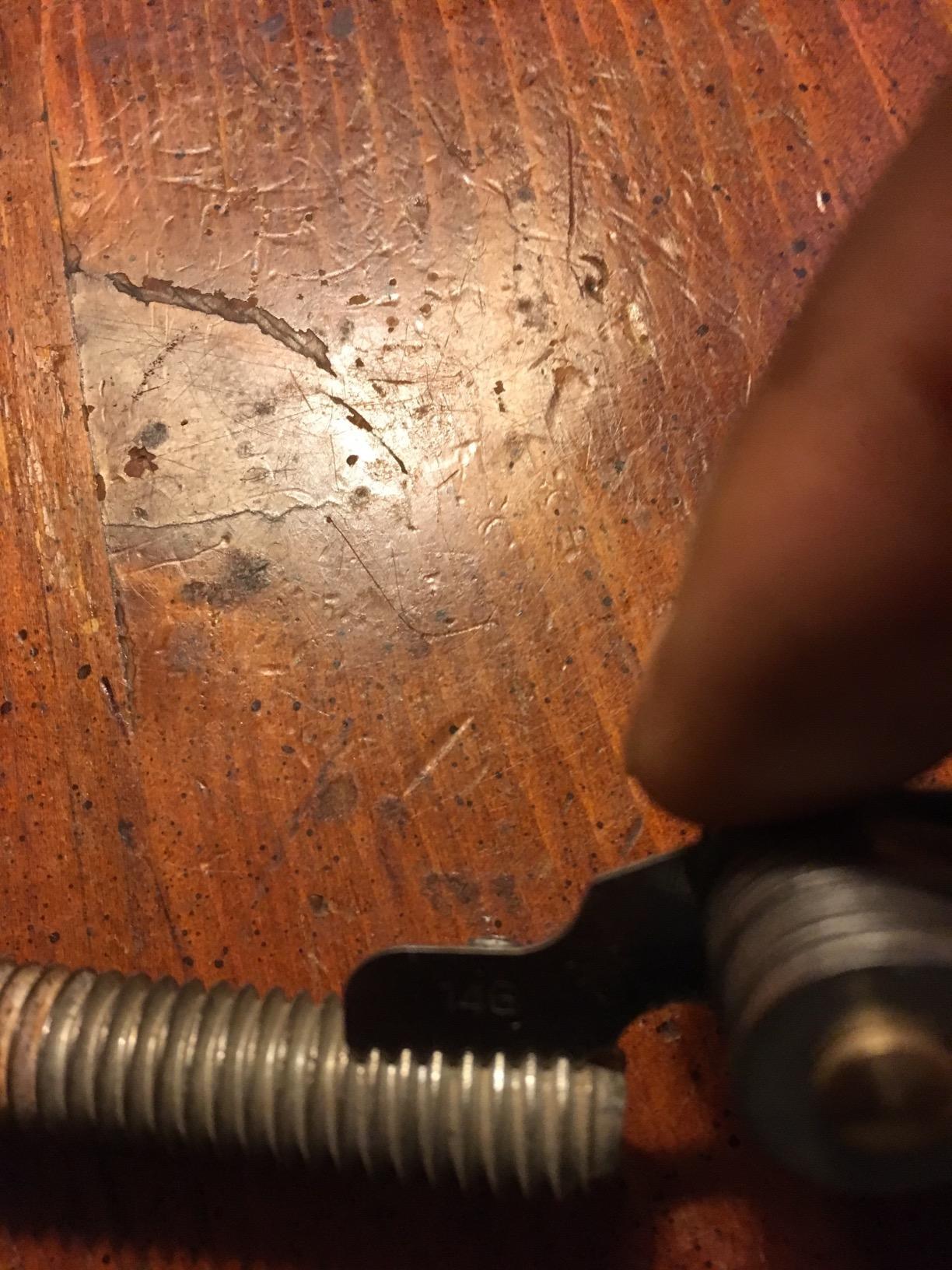
The locking device works the same way as the folding gauges above: fan to the leaf, lock it, check the thread. Because the body is larger, the leaves are wider and easier to index by eye, which is a genuine speed advantage over a 2.8 inch folder when you are working under a machine with one hand on a flashlight.
Where it differs in coverage is the top end. The 6.0mm ceiling on this set means coarse metric threads above that are out, and the 42 TPI limit on the imperial side is lower than the 62 and 84 TPI sets in this roundup. For hardware with very fine threads, that is a real limit. For the mix of machine bolts and fasteners most home machines use, it covers the range well.
Why it earns the value slot
For a shop that mainly handles 60 degree Unified and metric threads, this is the durability-for-money answer. Steel leaves and a body that does not flex mean the pitch you read is the pitch you cut.
It has the smallest gap between what it promises and what a home shop actually needs. The 60 degree only limitation costs you nothing unless you own British hardware.
Where it runs out
No Whitworth coverage, so a 55 degree BSF bolt is unreadable with it. A Garage Journal user made the point that British Standard fasteners still need sourcing from UK suppliers even in the US, and a gauge that cannot read them will not help you identify what you have ordered.
Like any leaf gauge, it stops at the bottom of its range. Micro electronics screws and sub-M2 hardware are outside a 0.25mm floor, and there is no male or female end for nuts.
3. Manalete 30-Size Thread Checker Board – best for nuts and bolts
- Board format keeps every size mounted and visible
- Checks nuts as well as bolts
- Integrated 19-hole drill bit gauge
- Pre-drilled holes for wall mounting
- Class 2B ANSI gauging standard on the studs
- Skips some intermediate metric sizes such as M9
- A few studs arrive bent
- Too large to carry in a pocket
This is a different tool wearing the same name. Instead of leaves that match a profile, it is a board of studs: a bolt on one end, a threaded hole on the other, and a printed size for each. You try a stud on a bolt, then try the same stud on a nut. If both take the go side, you have the size.
That design is why this is the pick for anyone sorting a bin of mixed fasteners. A hand-plane restorer on the Garage Journal tools forum put it plainly: the checker does nuts, and nuts are where a pitch gauge let them down. If your work involves identifying a nut as often as a bolt, the leaf gauges in this roundup will disappoint you and this board will not.
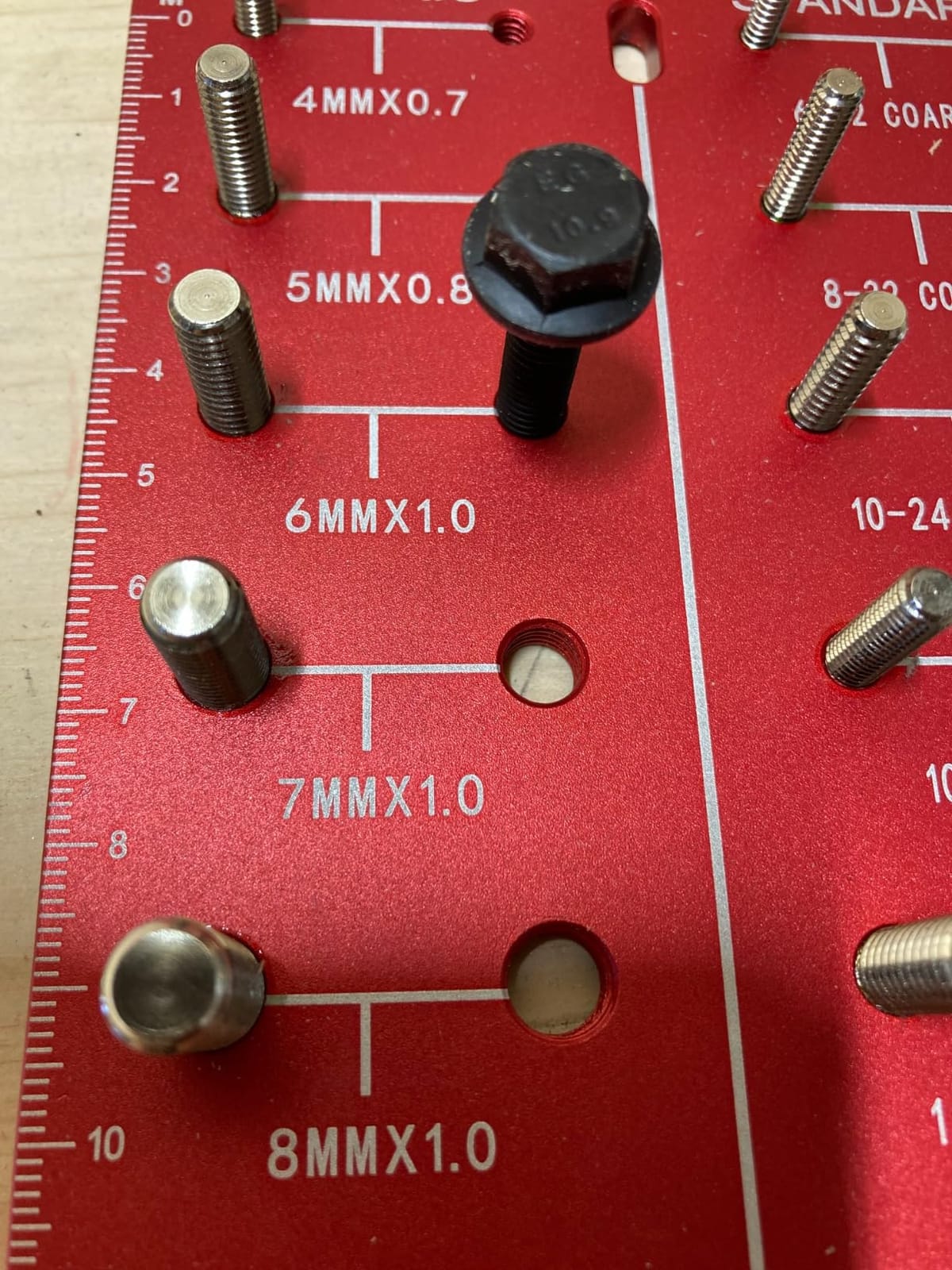
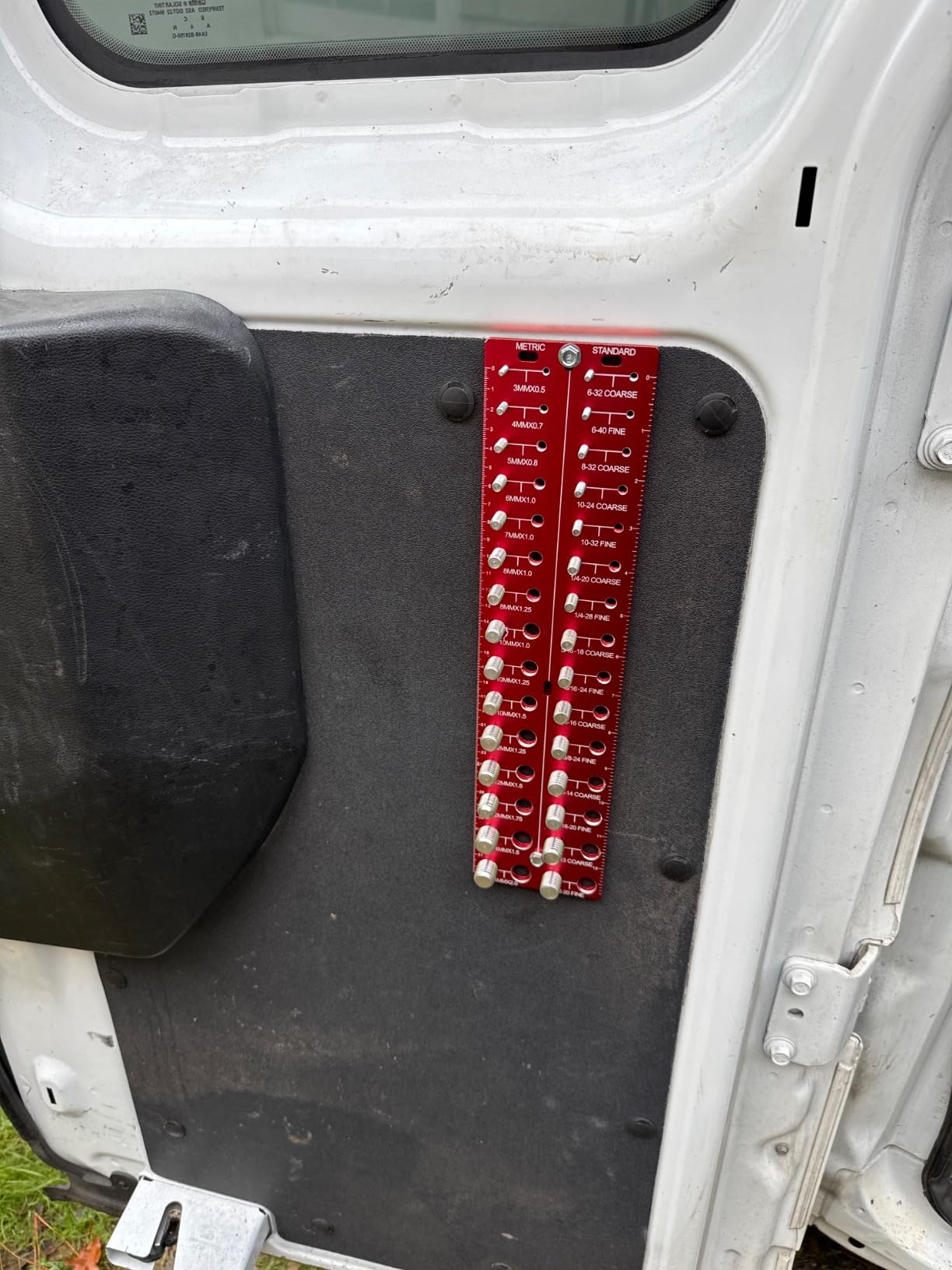
Coverage runs 30 sizes: M2x0.4 to M14x2.0 metric and #2-56 to 5/8-18 standard, which spans everything from small machine screws up to half inch hardware. The studs meet go and no-go Class 2B ANSI gauging standards, so the fit is a real pass or fail rather than a visual guess. The board is CNC-machined anodized aluminum with white laser-etched markings and inch and centimetre edge scales.
The integrated 19-hole drill bit gauge is the feature reviewers mention second most often: 6 metric holes from 4mm to 14mm and 13 imperial from 1/16 inch to 1/2 inch, which lets you confirm the tap drill size without consulting a chart. Pre-drilled mounting holes mean the board can go on the wall, which is where it earns its keep once the box is opened.
What works well
Speed is the argument. A board checker answers most standard fastener questions in seconds with no leaf flipping and no caliper, because the stud matching the hole gives you size and pitch together.
The Class 2B studs bring it closer to a real inspection answer than any leaf gauge here. It still is not a calibrated limit gauge, but it is meaningfully more than a visual match.
Where it falls short
Coverage has holes in it. 30 sizes is a curated list, not a sweep, and a buyer specifically asked for M9 because the board does not carry it. M10x1.0 is a known complaint across this category of set, so check the size list before you commit if that is your fastener.
It is fixed hardware. A board that lives on a wall cannot check a fitting buried in a machine, and it cannot reach anything under M2. Reviewers also report a few studs arriving bent, so inspect the set on arrival.
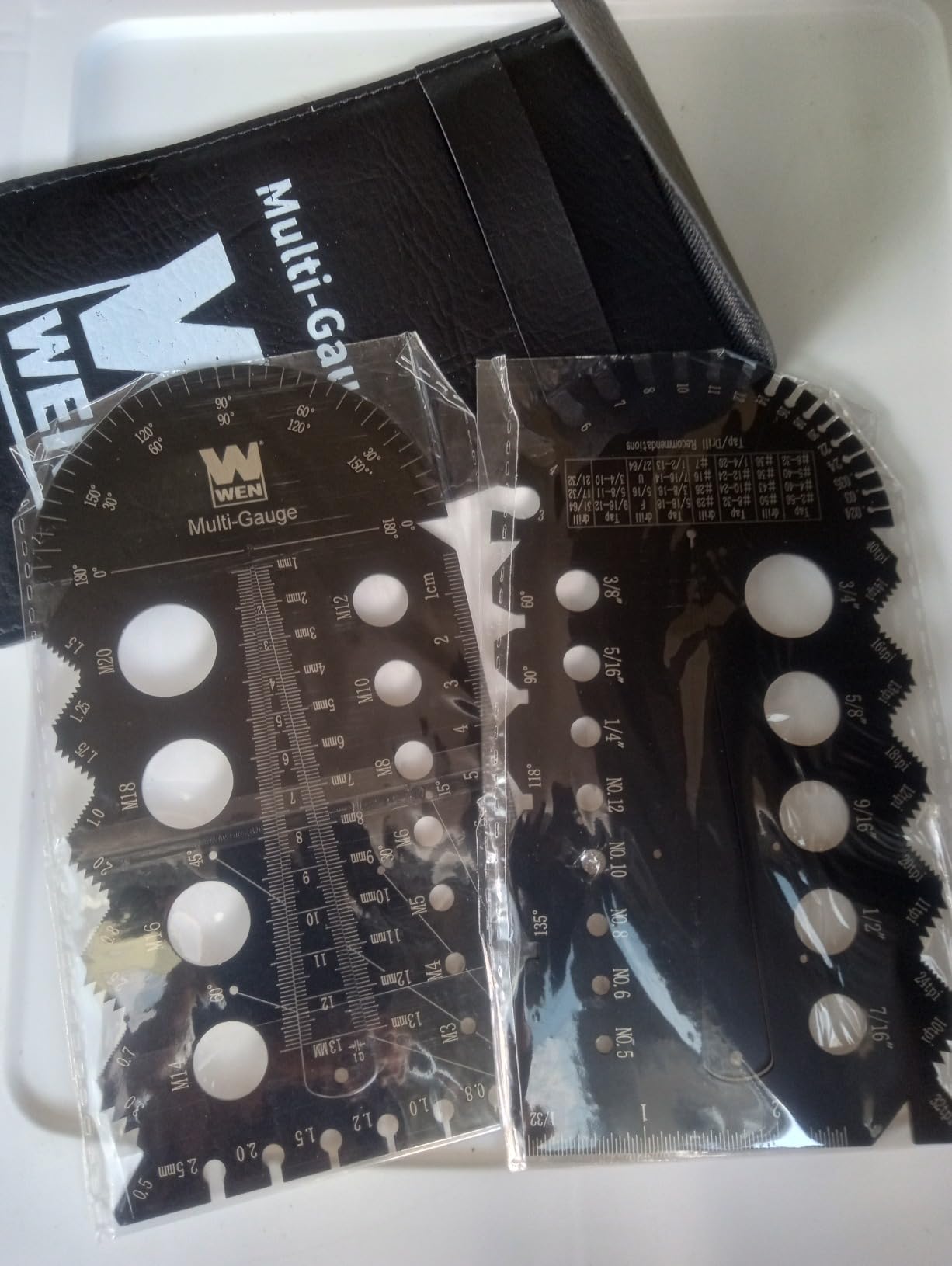
4. WEN ME210G Thread Pitch Multi-Gauge – best budget twin pack
WEN ME210G Metric and Imperial Metal Thread Pitch Multi-Gauge with Carrying Case, Two Pack, Black
- Flat open plates mean no leaf flipping
- Thin stiff plates seat into fine threads better than plastic
- Laser-etched high-contrast markings
- Onboard protractor
- ruler and wire gauge
- Leather case keeps the pair together
- Pop-out accessories can fall out of the centre slot
- No diagram explaining the extra plate features
- Will not reach the smallest machine screws
This is the fastest of the folding-class tools to use, and the reason is that it is not a folding gauge at all. Each gauge is a flat plate with a cut profile along one edge, and the two sit side by side in a leather case with nothing to fan through. Pick it up, press the edge on the thread, read the stamp.
The plates are metal, and owners are emphatic about that. Plastic thread checkers are thick enough that their profiles sit on top of a fine thread rather than nesting into it, producing a false mismatch. Thin stiff steel seats correctly, which is why several reviewers say the plate format solved a problem their old plastic gauge had created for years.
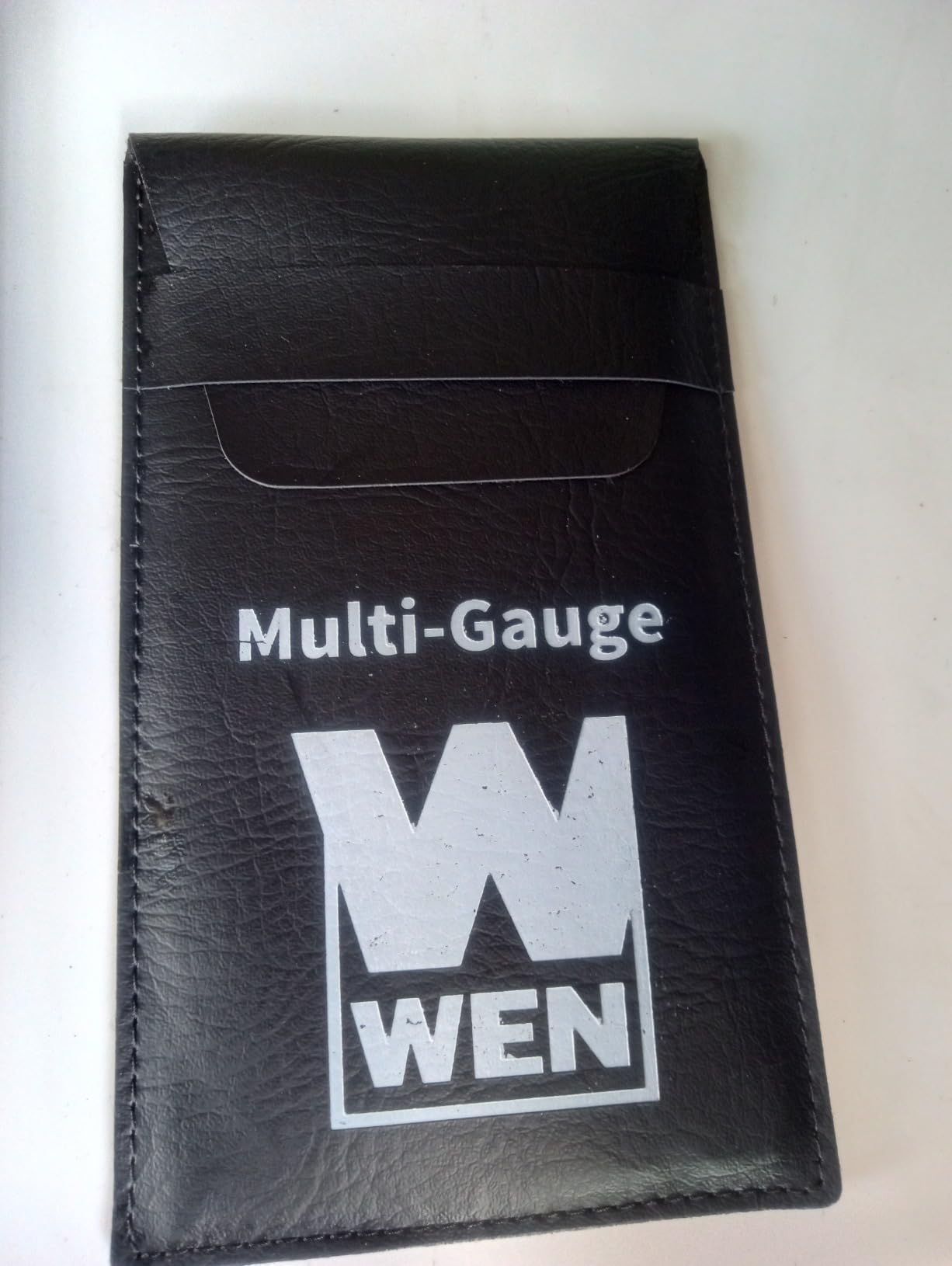
You get one metric gauge in millimetres and one imperial in inches, so the pair covers both systems. The laser-etched scales are high contrast and readable under a shop light, which matters more than it sounds when you are squinting at a profile in a dark engine bay. The plates also carry a protractor, a ruler, hole gauges and a wire gauge, plus removable taper guides for depth measurements.
Those extras are the mixed part of the package. Owners like the protractor and ruler for general shop work, but several report the pop-out pieces rattling loose in the centre slot, and one complaint that arrives repeatedly is the lack of any diagram explaining what each feature on the plate is for. You will figure it out, and then you will lose a taper guide under the bench.
Where it beats the folders
Speed of repeated use. There is no comb to open, no leaves to sort, and no risk of dropping a 0.25mm blade into the coolant. For a shop identifying fasteners regularly, that is the whole argument.
The pair-in-a-case format is a good gift for someone starting out, because it looks like a tool rather than a fan of loose metal strips, and it covers both thread systems from day one.
Where it falls short
A plate has one profile per edge, so coverage is limited by how many cut profiles the plate carries. It will not reach the smallest machine screws in your collection, and reviewers are clear that a folding gauge is still needed alongside it for full coverage.
There is no male and female end, so nuts are out. And the extra pop-out features are a small liability in a shop where things get knocked around.
5. Glarks Five-Piece Pitch Gauge Kit – Whitworth and center gauge coverage
Glarks 5Pcs Stainless Steel Screw Thread Pitch Cutting Gauge Tool Set, 51Pcs America SAE Type + 52Pcs Metric & America SAE Type & British Whitworth + 3Pcs Center Gage, Packed in Plastic Box
- The only budget bundle with Whitworth blades and a center gauge
- Chrome-finished stainless blades resist rust
- Stamped numbers stay readable
- 4-84 TPI reaches finer pitches than most sets
- Plastic box keeps loose blades organised
- Dozens of loose blades to fan through
- Bulkier than a board or plate gauge
Most thread gauge kits give you a metric set, an SAE set, and stop there. This one adds a British Whitworth set and a three-piece center gauge, and that combination is why it earns a place on a list written for home machinists rather than for general buyers. Whitworth is the 55 degree family found on British cars and machinery from the first half of the last century. A center gauge tells you whether your lathe threading tool is cutting on centre.
Coverage is broad. The SAE gauge runs 4 to 84 TPI, which is the finest imperial reach in this roundup, and the second gauge covers 0.25 to 6.0mm metric, 4G to 62G imperial, and the US Standard 8, 10, 11, 14, 19 and 28 pitches. The blades are chrome-finished stainless steel, polished smooth and treated with anti-rust oil.
Who this is for
If you are restoring British hardware, this is the kit that lets you identify a BSF or Whitworth bolt instead of guessing. A vintage car restorer on the tools forum notes that Whitworth fasteners still need sourcing from UK suppliers even in the US, which makes being able to read the thread a genuine advantage.
For anyone with a lathe, the center gauge is a separate reason to own it. Checking your threading tool against a known angle reference before you start cutting is cheap insurance against a batch of ruined parts.
What to watch
The kit is a lot of loose small metal. Over a hundred individual blades between the two main sets, each with a hole at one end for a screw-secured adjustment pin, and a plastic box that is the only thing keeping them organised. If you leave it on the bench, you will be picking blades off the floor.
Fanning through that many leaves is slow, and the set is bulkier than a board or a plate pair. Treat it as the specialist kit you reach for when you meet an odd thread, not as your daily identifier.
6. Hillman TU58 Mounted Thread Panel – best wall panel for the shop
1 TU58 Thread Measuring Gauge, Vertical Bolt and Nut Gauge / Thread Checker (Inch & Metric)
- Metal board built to be permanently mounted
- Cuts out hardware store trips for identification
- Owners report accurate results on the sizes they checked
- Markings stay clear and legible
- Compact 4 inch deep profile
- Costs more than any folding gauge in this roundup
- A few mounted gauges sit loose and cannot be tightened
- One buyer reported a rattle inside the housing
- Needs dedicated wall or bench space
This is the tool a hardware store mounts behind the counter, and owners who buy it say the shop version finally makes sense once you own one. It is a 37.85 inch tall metal panel with inch and metric bolt and nut gauges arranged vertically, designed to be screwed to a wall or the back of a door.
It is also the most expensive of the ten, and that cost only makes sense in one situation: a shop that identifies fasteners constantly. At that rate, the panel pays for itself in saved trips. A poster on the Garage Journal tools forum framed the purchase context perfectly: holding a loose fastener in your hand is easy, but a fastener that is part of a machine is exactly when you need the shop within reach.
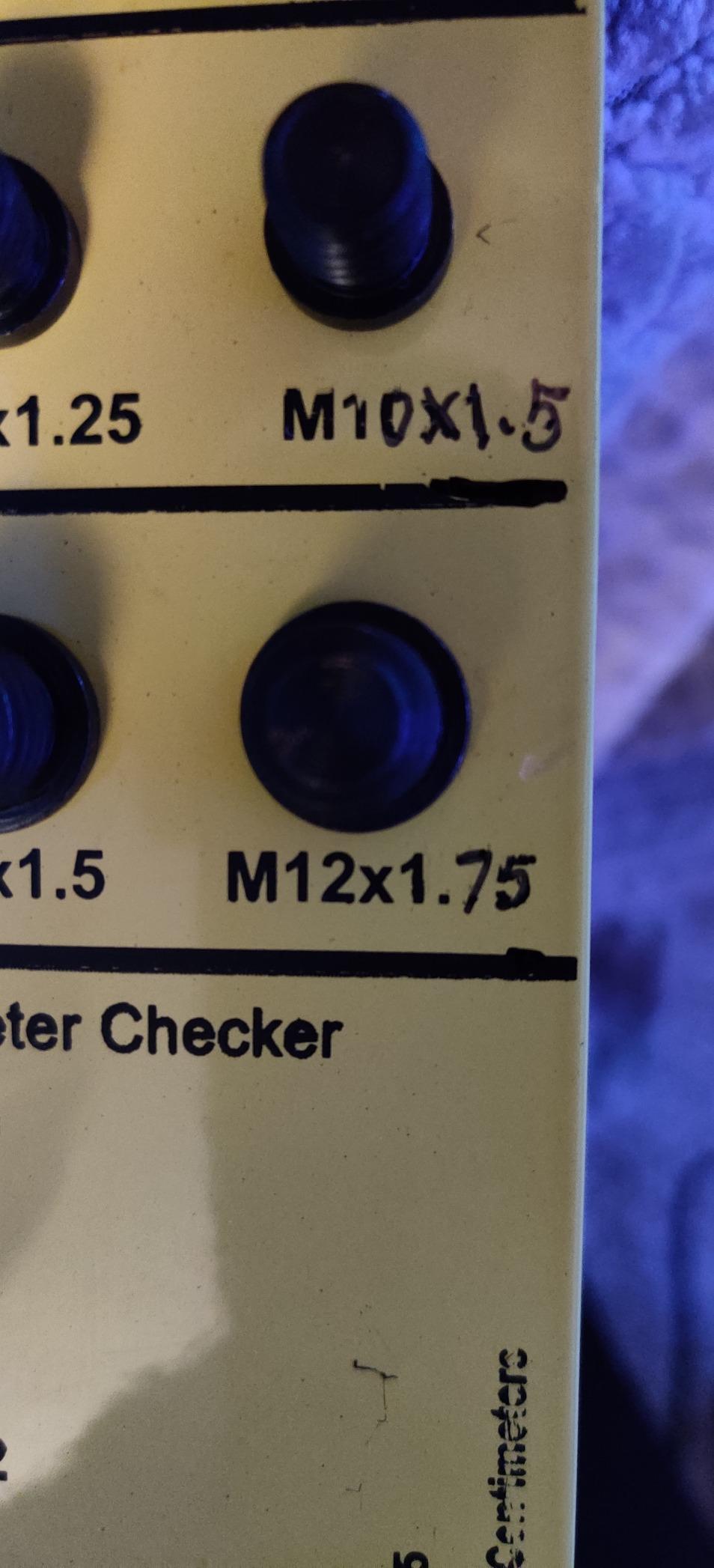
Feedback on accuracy is good, with owners reporting that the gauges checked out on the ones they could verify. It carries a 4.8 rating with 90 percent five-star responses, which is the strongest consistency in the roundup. The panel is metal rather than plastic, and the markings are clear enough to read from a normal working distance.
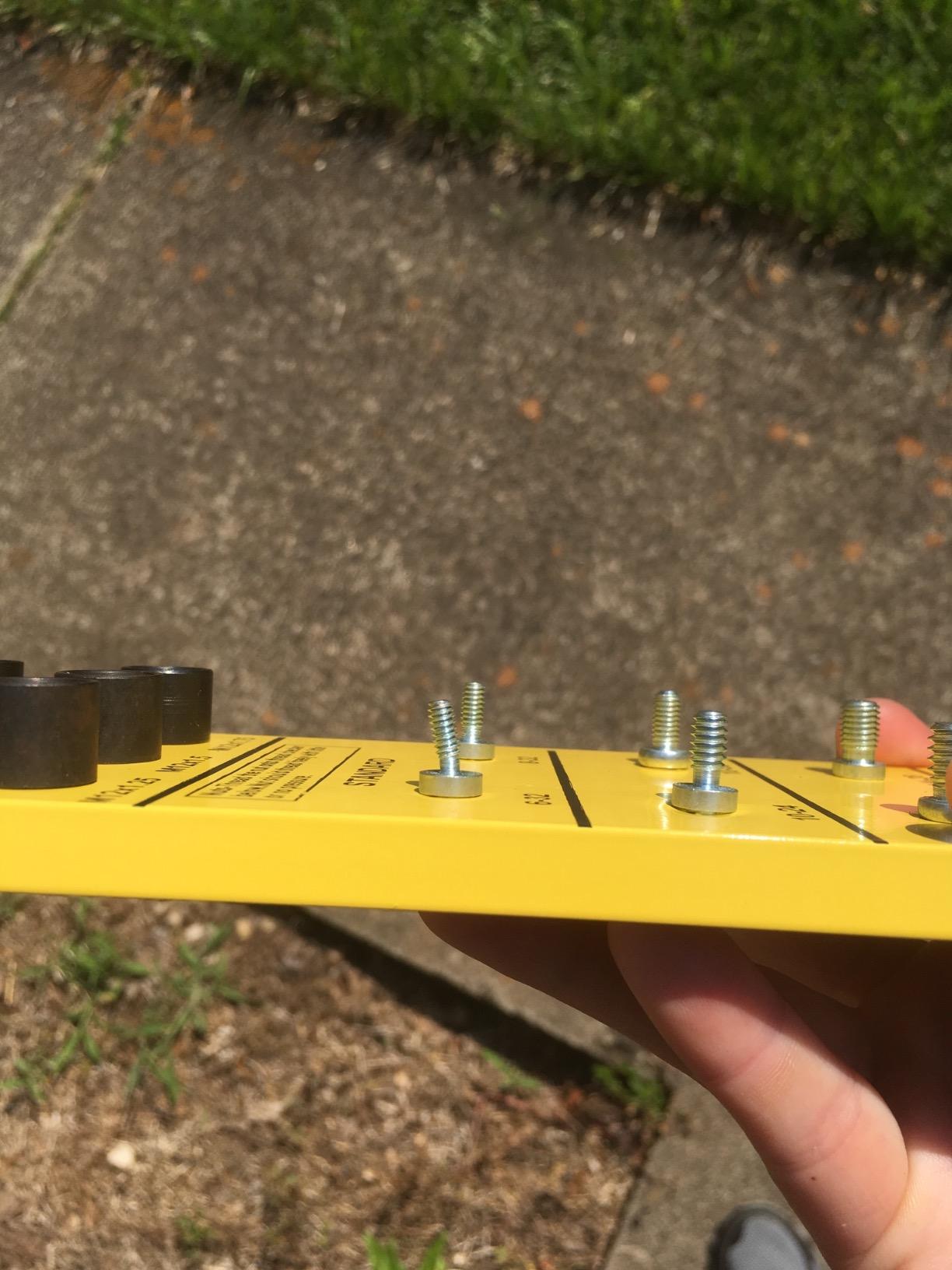
Two quality caveats came up repeatedly enough to mention. Several buyers found that a few of the mounted gauges sit loose in the board and cannot be tightened down, and one reported a rattle inside the housing that they suspected was a manufacturing offcut. Both are assembly issues rather than measurement issues, but check the fit of each gauge after it is mounted.
What works well
A permanent home in the shop means the tool is always available, which is the entire point. Nothing to lose from a drawer, nothing to clean off, no leaf to fan through when your hands are greasy.
It handles both thread systems on one panel, and bolt and nut together, so it covers the two gaps that push people toward a second purchase later.
Where it falls short
It is fixed hardware. A 37.85 inch panel needs a wall, and it cannot travel to a machine at the back of a car. If your shop is a shared corner of a garage, that space may not exist.
Coverage is fixed to whatever the manufacturer fitted. You cannot add sizes, and you cannot take one to a swap meet to check hardware before buying the parts. Treat it as shop infrastructure rather than a portable instrument.
7. NAMOKA 31-Size Dual-Panel Thread Checker – best machined board
- Highest rating of the ten with 92 percent five-star feedback
- Gauges pull out of silicone holders to reach fittings in a machine
- Owners single out the machining and layout quality
- Laser-etched stainless markings stay legible
- Dual panels separate small and large fasteners
- Does not cover every size so rare hardware needs another gauge
- Costs more than an entry level folding gauge
This is the highest-rated tool we tested in this roundup, at 4.9 stars with 92 percent five-star feedback, and the reason is a design choice the other board gauges do not make. Each gauge sits in a silicone holder rather than being permanently fixed, so you can pull out the one you need and carry it to the fitting.
That is the difference between a board checker and a tool. A fixed board answers questions about fasteners in your hand and about hardware visible on a bench. A removable gauge answers questions about a bolt buried in a gearbox housing, which is the harder half of the problem.
What works well
Coverage is 31 sizes split 16 SAE and 15 metric, laid out across two aluminum panels so small fasteners and large ones are not mixed together on one crowded plate. The lookup is faster than a single-panel board for exactly that reason.
Owners consistently single out the machining and layout as better than competing boards, and the laser-etched stainless markings are reported as staying legible after handling. Heavy-duty stainless bolts on lightweight aluminum panels is a sensible material pairing for a bench tool.
Where it falls short
31 sizes is still a curated list. Uncommon hardware will not be covered, and the set is not a substitute for a leaf gauge when you need to read a pitch on an odd thread the board skipped. A folding gauge with 4 to 84 TPI reach complements it rather than duplicates it.
The removable gauges are a small extra handling risk compared with fixed studs, and the cost sits well above a folding blade set. For occasional identification, the cheaper folders in this roundup do the same job with less commitment.
8. Mitutoyo 188-151 Screw Pitch Gage – the trusted brand reference gauge
Mitutoyo 188-151, Screw Pitch Gage, 4 – 42 TPI and 0.4 – 7mm, 51 Leaves, Inch/Metric Black
- Recognised precision metrology brand used in professional inspection
- 4-42 TPI and 0.4-7mm across 51 leaves
- Pocketable at 3.8 inches long
- Owners cite accuracy and build as worth the spend
- Folding leaves are slower than an open board or plate gauge
- No Whitworth or other non-60 degree profiles
- Premium spend for a 60 degree only gauge
Mitutoyo is the name working machinists reach for when they want a reference instrument rather than a convenience tool. A poster on Practical Machinist noted that Starrett, Mitutoyo and older Lufkin and Brown and Sharpe gauges are all considered solid choices, and users on the Garage Journal forum add that these brands can be found used for real savings. That is the honest framing for this pick: you are buying a trusted name, not extra capability.
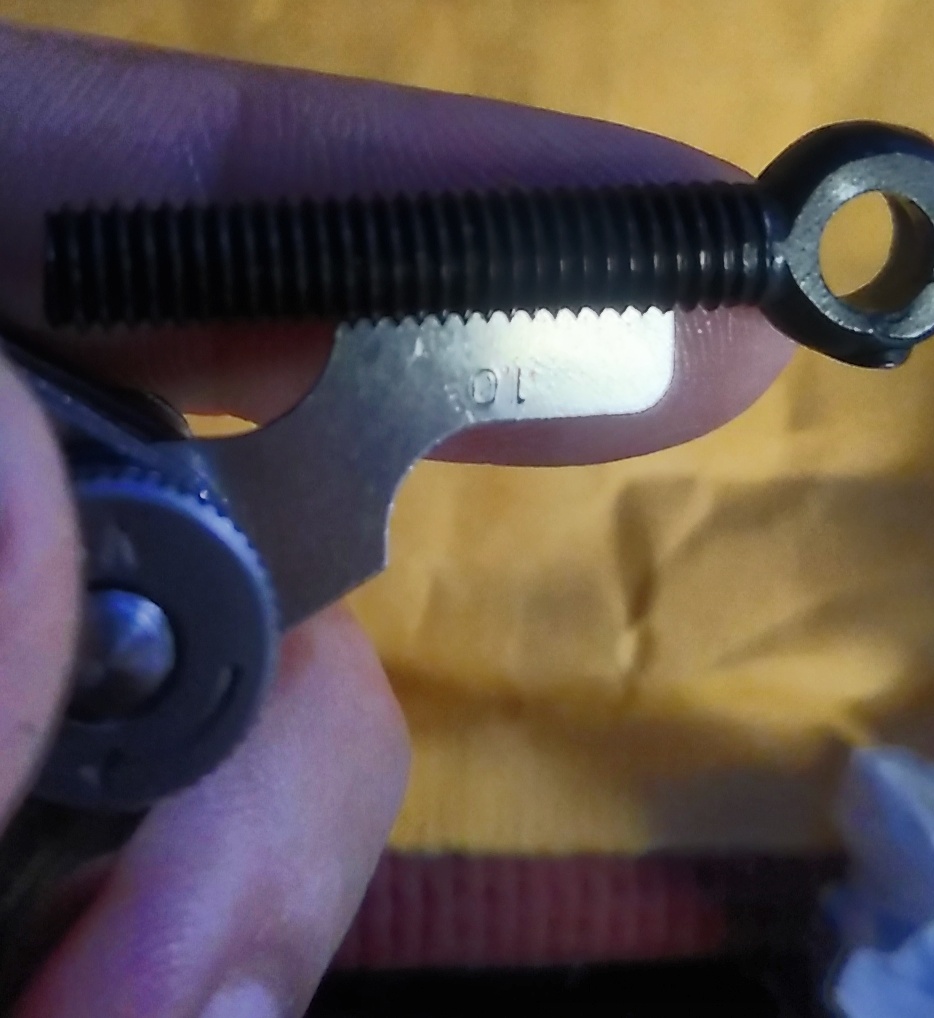
The gauge itself is a 51-leaf folder covering 4 to 42 TPI and 0.4 to 7mm metric in inch and metric. At 3.8 by 1 inch and 3.2 ounces it is the most pocketable precision folder here, which is the practical advantage over the larger steel folders.
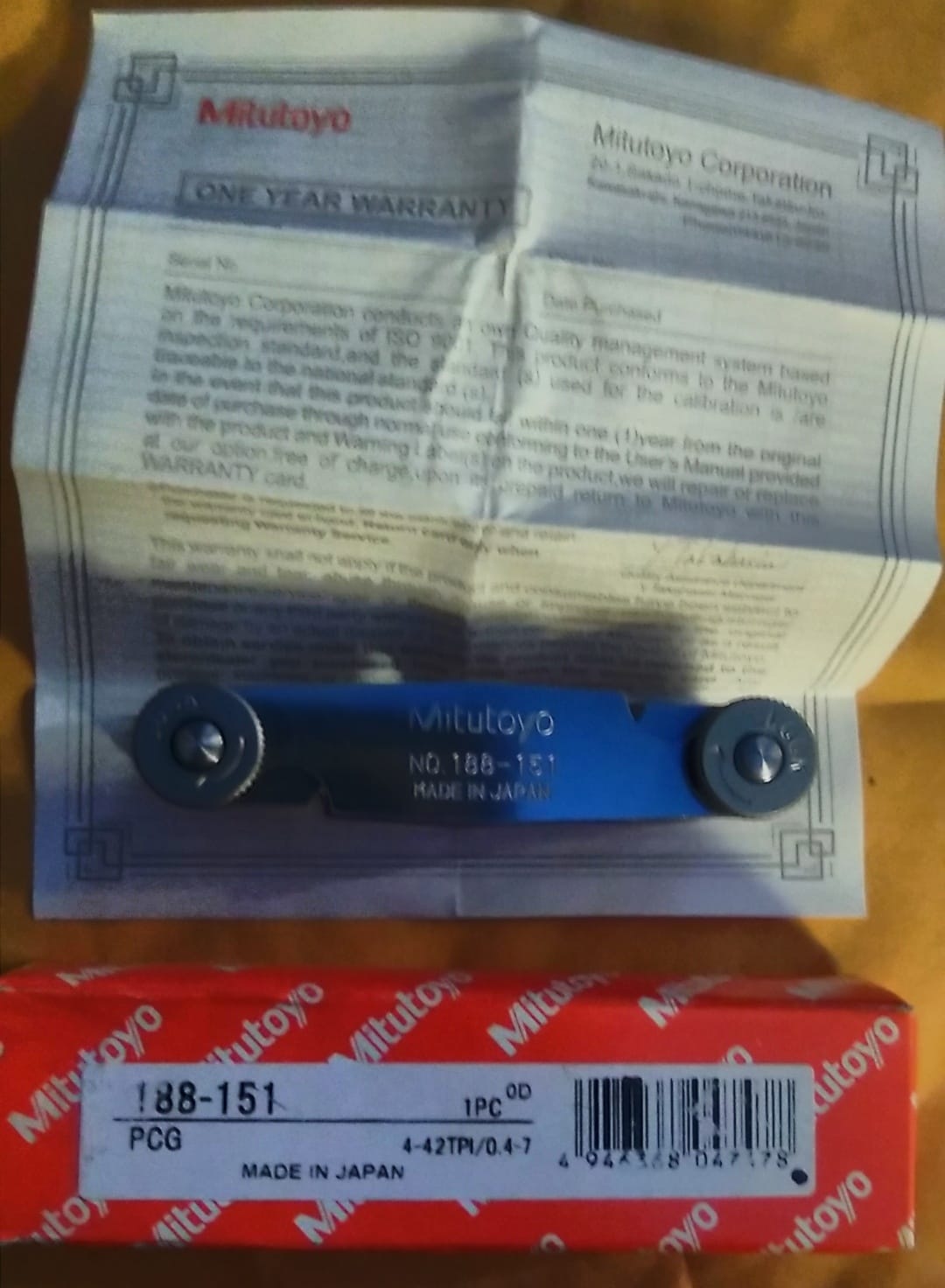
Reviewers consistently describe it as bought for accuracy and build quality, with a 4.8 rating and 86 percent five-star responses. In a home shop that has no calibrated metrology, owning a reference tool from a recognised precision maker is a reasonable way to remove the question of whether your readings are trustworthy, particularly when you are cross-checking with a caliper.
What it does not do is read anything other than 60 degree threads. There is no Whitworth set, no Acme, and no NPT. If your work touches British hardware, this is the wrong purchase however good the brand is, and the Glarks and QISF Whitworth bundles in this roundup cover that gap for less money.
When it earns its price
When you want one gauge that lives in your pocket and is the last word on a 60 degree pitch. The compact size means you can keep it in the tool bag rather than pinned to a bench, so it is there when a fastener is still installed in a machine.
When you are recording thread specs for a build and want confidence the number you wrote down is right. That is a real use for a recognised metrology name.
When it does not
When the budget is the deciding factor. A steel folder with the same 60 degree coverage costs a fraction of this and covers most of the same range, just a little less finely at the fine imperial end.
It also cannot check nuts, cannot read Whitworth, and bottoms out at 0.4mm metric, which makes the coarse end coarser than some budget sets in this roundup. A Garage Journal user summarised the frustration well: on very small threads such as 2-64 or M1.6, pitch gauges and calipers are slow and sometimes unreliable, and a dedicated small-thread checker is the answer.
9. Miucoguier 66-Piece Thread Checker – the widest size coverage
Miucoguier 66 Pcs Nut and Bolt Thread Checker, 34SAE/32Metric Thread Gauges
- Widest size range of the ten at 66 removable gauges
- Removable gauges reach fittings in confined spaces
- Colour coding and laser engraving give two readouts
- Full UNC and UNF pairs plus a complete metric spread
- Buyers report accurate results on unidentified machine screws
- Storage case is described as flimsy and is not labelled outside
- Foam insert makes the set bulkier than a folding gauge
- Many sizes are larger than a home shop ever meets
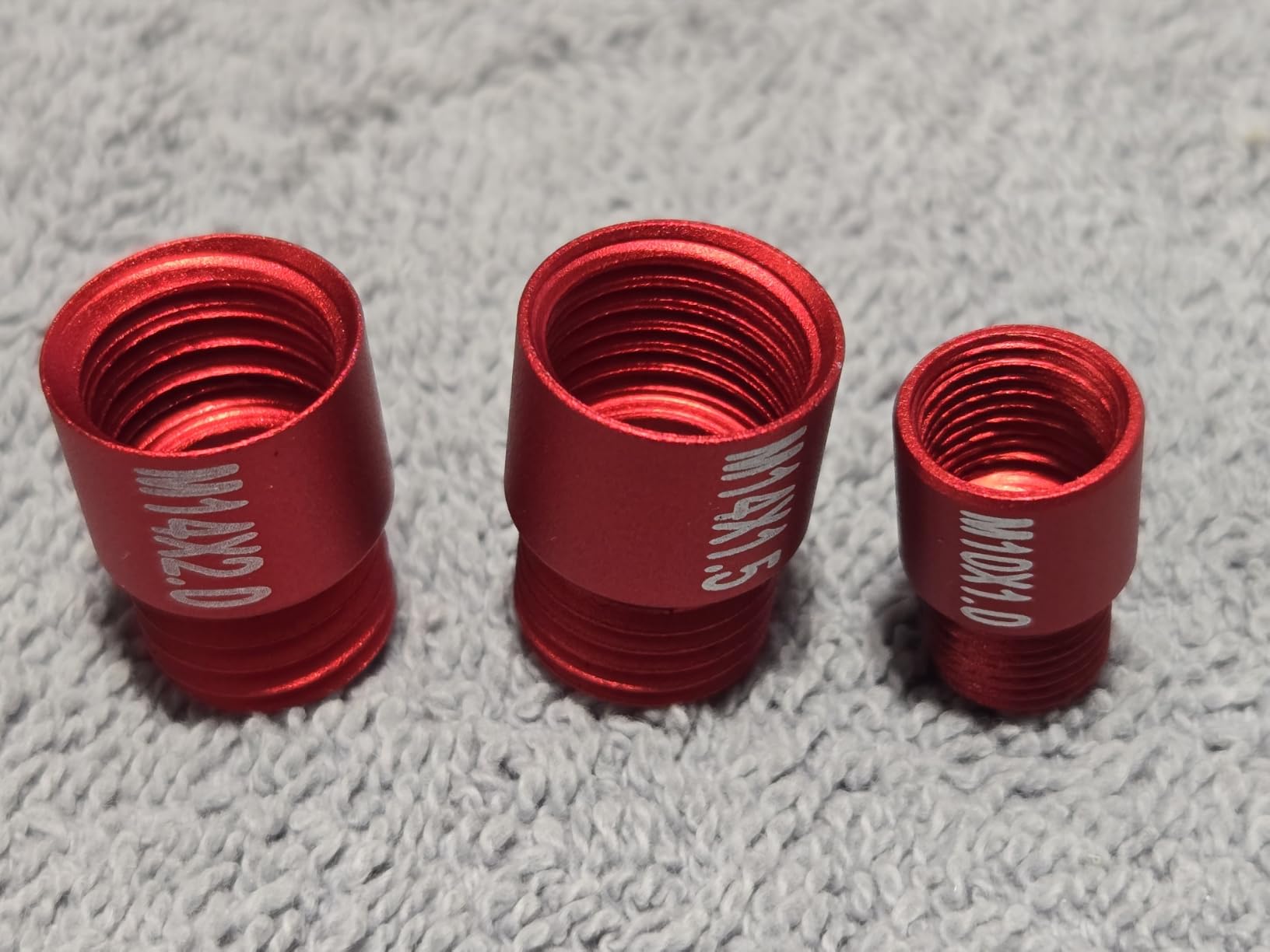
Sixty-six gauges makes this the broadest coverage in the roundup by a wide margin, and it resolves the coverage complaint that runs through every other board on this list. You get 34 SAE gauges in blue and 32 metric in red, spanning 2-56 UNC through 1-12 UNF including the coarse and fine pairs, and M2x0.4 through M24x3.0.
That M2 floor matters less than it sounds, because M2 is at the small end of ordinary machine screws rather than at the electronics scale. What you lose is the sub-M2 hardware, and as one Garage Journal poster noted, threads that small are where pitch gauges and calipers stop being practical anyway.
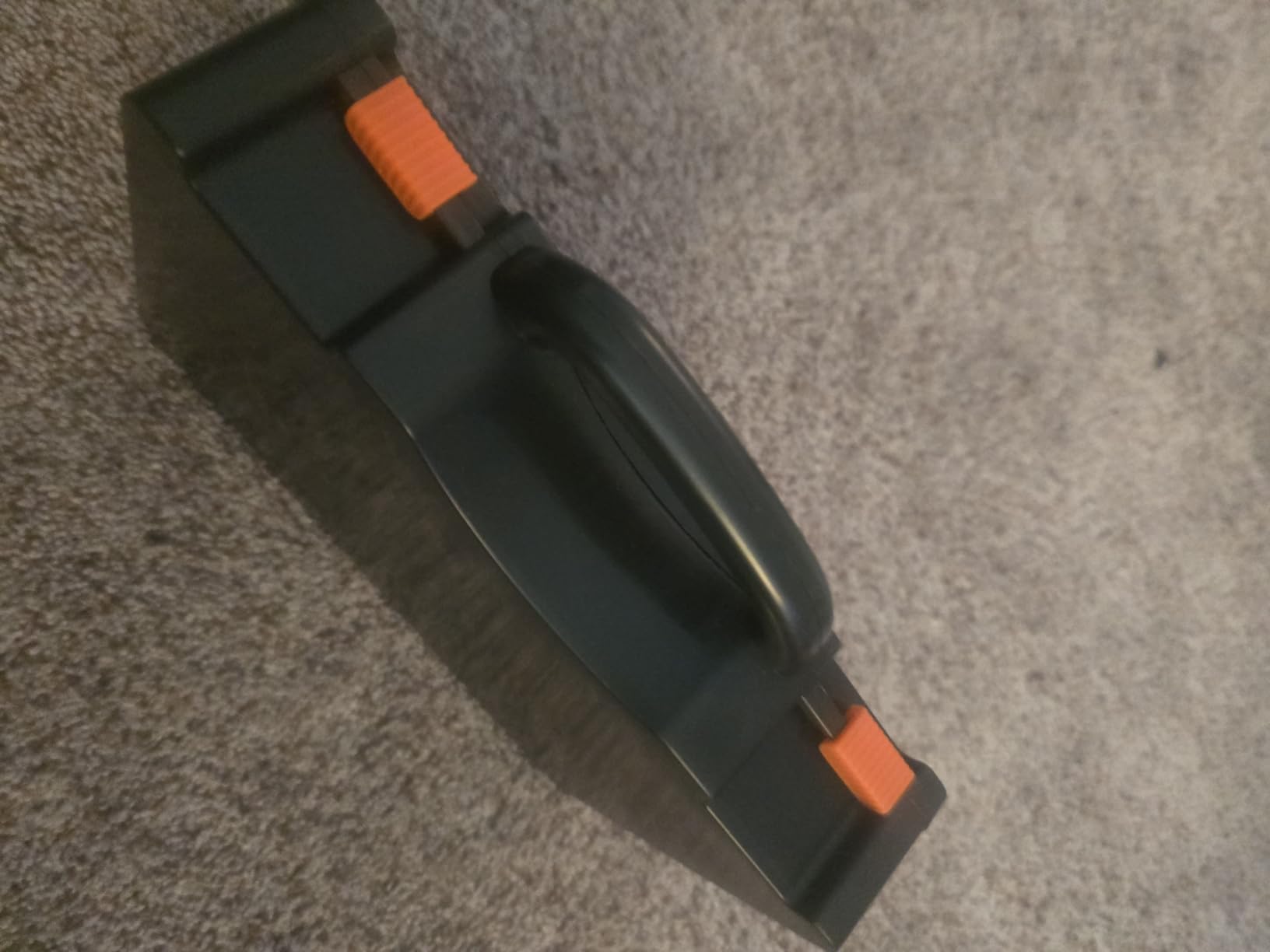
Every gauge detaches from the foam insert, which is what makes the set work in a machine rather than only on a bench. Owners describe using individual gauges on hard-to-reach machine screws where a fixed board or a vernier-style gauge would not fit. Colour coding, laser engraving and an index chart give you three different ways to read a size, which matters when you are working in poor light.
The standards language is specific and worth noting. The SAE gauges comply with Unified Thread UN and ANSI B1.1 at 2A and 2B classes, and the metric set with ISO 68-1 at 6G and 6H. That does not make it a calibrated inspection gauge, but it does mean the studs are cut to recognised limits rather than to a nominal approximation.
What works well
Coverage closes the M10x1.0 and intermediate-size gaps that owners complain about in smaller sets, because the metric list is a full sweep rather than a shortlist. That complaint is the most common one in this product category.
Being able to remove a single gauge takes this from a bench tool into a service tool, and it does both bolts and nuts through the same detachable studs.
Where it falls short
The case is the consistent weak point. Buyers describe it as thin and flimsy, and it carries no labelling on the outside, so a 66-piece foam insert that gets tipped out is a genuinely bad afternoon.
There is no Whitworth, no Acme and no NPT coverage, and the upper metric sizes go well past what most home machines ever present. You are buying completeness, not precision.
10. QISF Two-Gauge Whitworth Bundle – folding gauges for British hardware
- Two full folding gauges with 109 blades in one pack
- Whitworth coverage that most compact sets omit
- Stated accuracy of 0.01mm on chrome stainless blades
- Measures internal and external threads
- Blades double as a lathe thread cutting angle gauge
- Folding leaves slow down repeated size lookups
- 109 thin blades to sort through
Where the ChgImposs at the top of this list adds Whitworth as a bonus, this bundle is built around it. You get a 51-blade America SAE gauge running 4 to 84 TPI and a 58-blade gauge covering 0.25 to 6.0mm metric, 4G to 62G imperial, the US Standard odd pitches, and British Whitworth.
Two details make it stand out. It is stated to measure internal as well as external threads, which is unusual for a leaf gauge and quietly useful on a tapped hole. And the blades double as a thread cutting angle gauge for lathe work, so the same tool that identifies a thread also tells you whether your threading tool is set right.
Who should buy it
Restorers of British hardware. A vintage car with BSF fasteners, a British machine with Whitworth studs, a workshop full of old tooling: this is the set that lets you read those threads rather than guess at them, and the forum consensus is that such fasteners still have to be sourced from UK suppliers even in the US.
Lathe owners who want one tool for two jobs. Identifying a thread and checking your threading tool angle from the same set of blades is a real saving on bench space.
What to watch
109 blades is a lot of thin metal, and the folding format is the slowest way to find a size. Owners note that this makes the set less convenient than a board or plate gauge for fast repeated identification, which is the trade for the coverage.
The stated accuracy of 0.01mm applies to the pitch dimension, not to the profile form. It reads pitch reliably; it is still a reference tool rather than a go and no-go inspection gauge.
How to Choose a Thread Pitch Gauge (October 2026)?
Start with the thread systems you actually meet, not with the brand on the box. Metric and imperial pitches are different numbers in different units, and a gauge that covers only one leaves you guessing on half your fasteners. Almost any imported Japanese or European machine you own will be metric, and almost any American machine or vehicle fastener will be SAE Unified, so a dual-system tool is the safe default.
Next decide whether you need to check nuts. A leaf gauge reads the outside of a threaded shank only. If you sort bins of salvaged hardware, or you often need the nut rather than the bolt, a go and no-go checker with male and female ends is the right format and will save you a second purchase. One Garage Journal user described exactly that sequence: buy the pitch gauge, discover the limit, buy the checker anyway.
Then think about thread form beyond the two common systems. Sixty degree Unified and ISO metric cover the overwhelming majority of a home shop. Fifty-five degree Whitworth appears on British hardware, twenty-nine degree Acme appears on leadscrews and some machine vises, and NPT pipe threads are tapered, which means no flat profile gauge will ever read them. Check your machines before buying a 60 degree only set.
Format is the last decision. Folding leaf gauges are portable and cover the widest pitch range, but they are slow for repeated use. Flat plate gauges are fast and readable but cover fewer sizes per tool. Boards and panels are fastest of all for bench work and can check nuts, but they are fixed hardware that cannot travel to a machine. There is a genuine storage preference split in the forum community: some machinists prefer a panel on the wall, others want everything in a case.
Finally, look at the size list rather than the piece count. A 51-piece set and a 26-piece set are not comparable without reading the actual pitch ranges. This is the buying mistake the forums complain about most often, because coverage transparency matters more to a home shop than any brand badge.
Sizes cheap sets commonly miss
M10x1.0 is the most frequently named omission. A Garage Journal user advised picking a set that includes it because many thread checkers skip that size, and it shows up again and again in complaints about boards with 30 to 40 sizes.
Below M2 and below #6 the problem is structural rather than a vendor choice. Most checkers bottom out around M3 or #6, and a poster put the small-thread problem plainly: on threads such as 2-64 or M1.6, pitch gauges and calipers take too long and can be unreliable. If you work on optics, model engineering or camera equipment, buy a dedicated small-thread checker alongside whatever is on this list.
A related trap is the combined versus separate decision. A forum user compared the coverage directly: two separate checkers give 44 sizes between them, while a single combined metric and SAE checker typically gives about 26. Buying two focused tools often beats buying one compromise tool.
Thread Pitch Gauge vs Thread Checker vs Thread Micrometer
A thread pitch gauge matches a profile to find pitch. That is the whole job, and it is a genuinely good job for identifying an unknown bolt or reading the pitch of a tapped hole. It cannot check a nut, it cannot verify diameter, and it is not a go and no-go inspection tool.
A thread checker uses studs with male and female ends. It identifies size and pitch together, checks nuts as well as bolts, and the Class 2B boards give you a real pass or fail fit. What it cannot do is cover a wide pitch range or read anything outside its printed size list. For a home shop that constantly sorts mixed hardware, this is usually the more useful tool despite the narrower coverage.
A thread pitch micrometer measures actual pitch diameter. This is the tool for precision work, for setting lathe threading tools, and for anyone who needs a number rather than a match. It is more expensive, it needs care, and for occasional identification in a garage it is overkill.
The caliper and chart method needs no purchase at all, and it is where most buyers start. You measure the major diameter, estimate the pitch, and look up the designation. The problem, as machinists on r/Machinists describe it, is that calipers alone are error prone: it is easy to measure minor diameter by mistake and mis-identify the size, and the result depends on finding the right chart row.
Our verdict for a home shop: buy a folding pitch gauge for coverage and portability, and add a board checker if you handle nuts or mixed bins. Skip the micrometer unless you are cutting production threads. Use the caliper alongside whichever you choose, never instead of it.
How to Measure Thread Pitch Step by Step?
This is the workflow that turns a number on a leaf into a full thread designation, and it takes about a minute once you have done it twice.
Clean the thread first. A thread with oil, paint, rust or dried cutting fluid will not give a clean profile match and will send you to the wrong leaf.
Measure the major diameter with a caliper across the outside of an external thread, or across the inside of the crest for an internal thread. Major diameter is the widest point, not the width of the groove.
Press each leaf of the pitch gauge against the thread profile and look for the one that sits flush with no gap and no wobble. Rock it slightly; a partial match rocks, a correct match does not.
Read the pitch from the matching leaf. Metric leaves are stamped in millimetres, imperial leaves in threads per inch. They are different systems, so do not convert a TPI number into a metric pitch on the gauge itself.
For an internal thread, press the leaf into the tapped hole and rotate it slightly. The leaf that seats flat and turns smoothly gives you the pitch of the hole.
Combine the pitch with the major diameter on a thread chart to get the full designation, for example M8x1.25 or 5/16-18 UNC, then confirm the fit with a matching fastener before you order.
Step six is the one people skip and the one that prevents cross threading. A pitch reading plus a diameter reading is a strong identification, but a trial fit on a real fastener costs nothing and confirms the answer before you commit to a tap, a die, or a box of hardware.
If the gauge does not fit any thread you try, check that you are on a 60 degree leaf before concluding the thread is unusual. Most unexpected mismatches are a 55 degree Whitworth thread being checked with a 60 degree set, which is exactly the situation the Whitworth bundles in this roundup solve.
Frequently Asked Questions
What is the best thread pitch gauge to buy?
The ChgImposs 55 and 60 degree gauge is the best general choice for a home machinist, covering 0.25-6.0mm metric, 4-62 TPI imperial and the odd US Standard pitches in one folding comb. Buy a board checker such as the Manalete instead if you mostly handle nuts and mixed bins of hardware, and add a Mitutoyo 188-151 only if you want a recognised precision brand in your pocket.
What is the best thread checker?
The Manalete 30-size board is the best all-round thread checker, with steel studs cut to go and no-go Class 2B ANSI standards covering M2x0.4 to M14x2.0 and #2-56 to 5/8-18, plus an integrated drill bit gauge. The NAMOKA 31-size dual panel wins if you need to remove a gauge and use it inside a machine, and the Miucoguier 66-piece set wins on sheer size coverage.
What is the difference between a pitch gauge and a thread gauge?
A thread pitch gauge is a set of thin leaves, each cut to one pitch, and it identifies pitch on the outside of a thread only. A thread gauge is the broader term and usually means a go and no-go checker with studs that have male and female ends, so it identifies size and pitch and can also check nuts. A pitch gauge wins on coverage and portability; a checker wins on speed and internal threads.
What is a good tool for measuring bolt threads?
For a home shop, the practical answer is two tools used together: a caliper to measure the major diameter and a thread pitch gauge to identify the pitch, then a thread chart to get the full designation. A go and no-go thread checker does both in one step and also handles nuts, which is why most machinists end up owning one of each.
Can a thread pitch gauge measure internal threads?
Most cannot. A leaf pitch gauge matches the outside of a thread, so it will not read a hex nut. Some folding sets, such as the QISF bundle, are stated to measure internal threads as well as external. For checking a nut or a tapped hole routinely, a go and no-go checker with a female end is the right tool and a hand-plane restorer on a machinist forum made the same point after finding the gap the hard way.
How do I tell if a thread is metric or imperial?
Look at the thread angle. A 60 degree profile is Unified or ISO metric, and a 55 degree rounded crest is British Whitworth. Then count: metric pitches are given in millimetres, such as 1.25, while imperial is given in threads per inch, such as 18. If a 55 degree leaf sits flush, you have Whitworth hardware regardless of how modern the machine looks.
Why does my gauge not fit my bolt?
Three causes are common. You may be using a 60 degree leaf set on a 55 degree Whitworth thread, which will never match. You may be measuring the minor diameter instead of the major diameter and reading the wrong chart row. Or the pitch may sit below the smallest leaf in your set, which happens on sub-M2 and 2-64 hardware where most gauges bottom out.
Are cheap thread pitch gauges accurate enough for a home shop?
Yes, for identification. A budget stainless steel folding gauge is a reference tool and its stamped pitches are consistent enough to identify a fastener reliably, and users regularly report using them for years. They are not calibrated inspection gauges and cannot confirm ASME B1.2 Class 2B limits, so for production or customer work you would still want a go and no-go checker or a thread micrometer.
Conclusion
For most home machinists in 2026, the ChgImposs 55 and 60 degree folding gauge is the right first purchase. It covers metric, imperial and US Standard pitches, it reads both 60 degree and 55 degree thread forms, and the stainless wire-drawn blades survive a garage bench. Add a Manalete board checker when you start sorting nuts and mixed hardware, and you have covered both gaps that drive a second purchase later.
The rest of the list fills specific holes. The Glarks and QISF bundles are for British Whitworth work. The Hillman panel is shop infrastructure for a wall you can reach every day. The NAMOKA board is for machined quality and removable gauges. The Miucoguier set is for sheer coverage, and the Mitutoyo 188-151 is for a pocketable reference gauge from a name machinists trust.
Whichever you choose, use it with a caliper and a thread chart, and confirm the fit before you order hardware. That last step is what prevents cross threading, stripped threads, and a part that does not go together on a Saturday afternoon. For the rest of your bench, we have covered CNC mills for machinists and surface roughness testers in separate guides.