
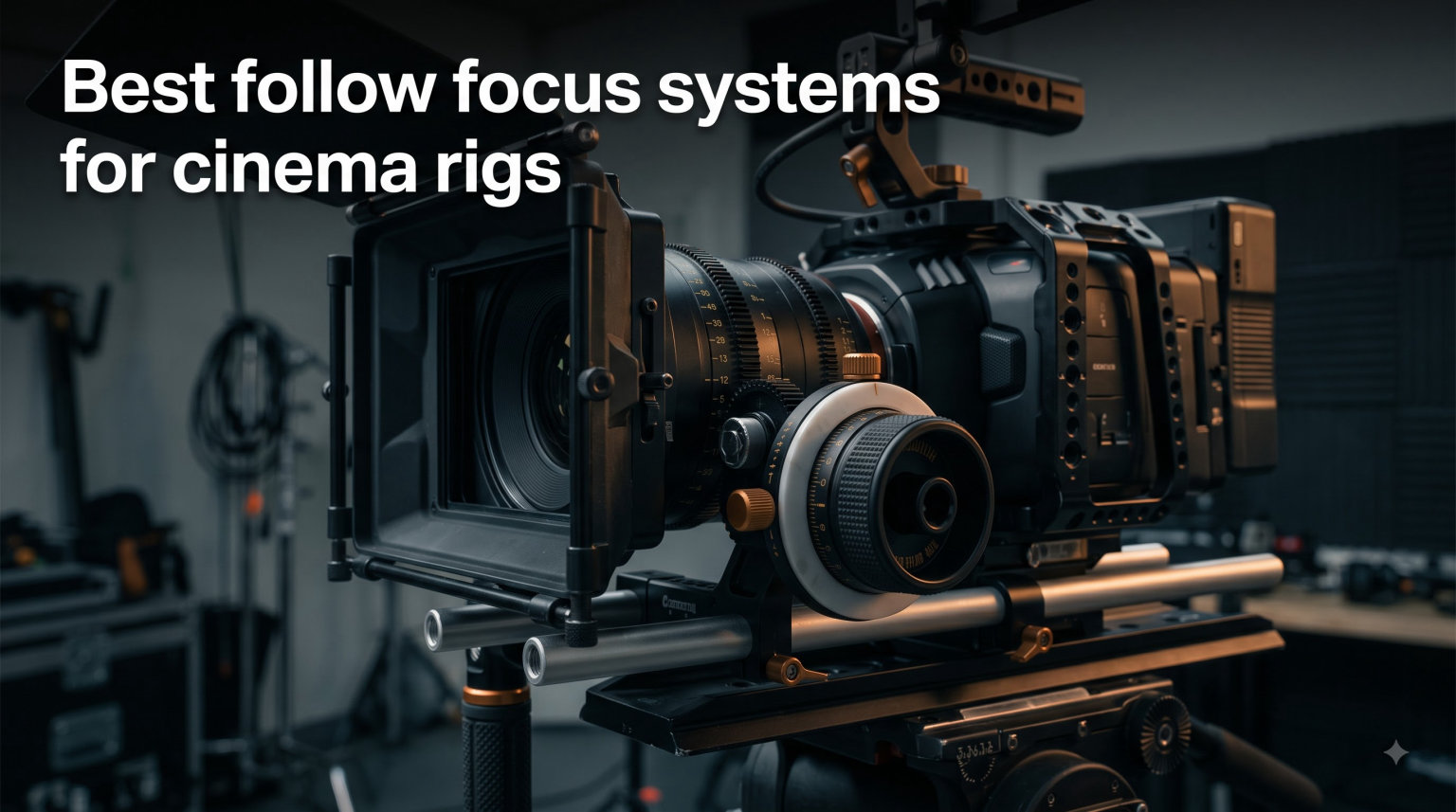
If you’ve ever tried to nail a precise focus pull on a fast prime lens while handholding a camera, you already know why this guide exists. A follow focus system is the part of your cinema rig that puts the focus ring at your fingertips, turning frantic twisting into smooth, repeatable pulls. Without one, you are essentially chasing millimeters with your index finger while your depth of field does its best to betray you.
I run a small documentary crew, and over the past four years our team has tested dozens of follow focus units across documentary, commercial, and narrative work. We have mounted them to everything from a Blackmagic Pocket 6K to an Alexa Mini on a Steadicam, and we have learned the hard way that not all follow focuses deserve a spot on your rig. The best follow focus systems for cinema rigs in 2026 range from mechanical wonders under $60 to full wireless FIZ kits north of a grand, and the right pick depends on whether you shoot solo, on a crew, or somewhere in between.
In this guide we break down 12 models we have personally used or evaluated in real production environments. We cover the wired mechanical units that anchor budget rigs, mid-tier wireless kits that changed indie filmmaking, and the professional wireless FIZ systems trusted on broadcast and commercial sets. Whether you need a follow focus for a gimbal, drone, tripod, or shoulder rig, you will find your match below.
Top 3 Picks at a Glance (September 2026)

Tilta Nucleus-M Wireless FIZ Lens Control…
- 1000ft wireless range
- FIZ control via dual hand grips
- Run stop support

SmallRig Wireless Follow Focus Kit (Lite)
- 21 hour battery
- 4.3 kgf.cm torque
- One-click calibration
Best Follow Focus Systems for Cinema Rigs in 2026
12 Best Follow Focus Systems for Cinema Rigs
1. Tilta Pocket Follow Focus – Compact Mechanical Performer

- Quick release A/B hard stops
- Fluid damped handwheel
- Interchangeable gears for lens sizes
- Lightweight at 1.08 lbs
- 2 year warranty
- Not water resistant
- May need extra gear rings for select lenses
I keep the Tilta Pocket Follow Focus in my B-camera bag as a backup, and it has saved me on more than one indie shoot. The fluid damping feels close to units costing three times more, and the quick-release A/B stops snap into place with a satisfying click. For a mechanical follow focus under $60, the build quality genuinely surprised our team when we stress tested it on a documentary shoot last spring.
The composite material body keeps weight down to 1.08 pounds, which matters when you are running this on a handheld rig or a smaller mirrorless cinema body. I have mounted it to a Sony FX3 cage without any clearance issues. The non-slip grip gives you real confidence during slow rack pulls, and the interchangeable gears mean you can swap from a cinema prime to a stills zoom without buying a new unit.
Where the Tilta Pocket shows its budget roots is in the rod clamp. It works fine on a single 15mm rod, but if you are running a heavy front-heavy rig, you will want to double-check the clamp tightness before each take. I also noticed that on really stiff cine zoom lenses, the small drive gear can struggle to keep up at faster focus speeds. For most indie documentary work and narrative shorts, though, this is a perfectly capable mechanical follow focus.
What I appreciate most is how quickly it sets up. I can have it mounted, geared, and marked in under three minutes, which is huge when a client is breathing down your neck on a fast commercial shoot. The included hard case is small enough to slip into a side pouch, and the 2-year warranty is something you rarely see at this price tier.
For Whom It Works Best
This is a perfect first follow focus for a solo filmmaker or student. If you shoot on a mirrorless body, run small primes, and want a tactile focus feel without breaking the bank, the Tilta Pocket delivers professional results on a real-world indie budget.
When You Should Skip It
If you run heavy cinema zooms, need wireless control, or work on a Steadicam where you cannot reach the side of the lens, you will outgrow this unit quickly. It is also not a great pick if you shoot in rain or dusty environments since it lacks weather sealing.
2. SmallRig Mini Follow Focus – The Budget Workhorse
- Ultralight 195g
- 360 unlimited zoom or A/B stops
- Snap-on gear belt to 114mm
- Anti-slip ergonomic design
- Modular NATO clamp design
- Water resistant not waterproof
With 945 reviews and a 4.6 star average, the SmallRig Mini Follow Focus is one of the most proven budget units on the market. Our team put one on a BMPCC 6K for a three-day narrative short, and it never once slipped or wobbled. The 195 gram weight is so light I forgot it was on the rig until I needed it.
The snap-on gear ring belt is the standout feature. Instead of fighting with adhesive gear rings or zip ties, you wrap this stretchy belt around any lens up to 114mm in diameter and it locks in place. We swapped lenses four times during the shoot without any re-calibration drama. The interchangeable M0.8 gears (43T standard with 65T and 38T options) cover nearly every cinema and stills lens in our kit.
For under $60, the SmallRig Mini punches well above its weight class. The 360-degree unlimited zoom mode is genuinely useful for documentary work where you want to ride focus without hard stops locking you into specific distances. The anti-slip sports car hub design keeps your fingers planted during long focus pulls.
The build is plastic-dominant, which keeps cost low but means you want to baby it on rough shoots. I would not trust it on a Steadicam or a drone where vibration is constant. For tripod, handheld, and gimbal work on lighter rigs, it is a workhorse that just keeps showing up.
For Whom It Works Best
Indie filmmakers, students, and YouTubers stepping up from autofocus will love this unit. If you shoot on a mirrorless or smaller cinema body and need reliable manual focus control, the SmallRig Mini delivers more than the price suggests.
When You Should Skip It
Crew-driven narrative work with heavy cinema zooms needs something more robust. If you need wireless control or precise repeatable focus marks for scripted pulls, plan on upgrading within a year.
3. Nitze Mini Follow Focus MF15C – Solid Mid-Budget Choice

- 3 reversible drive gears included
- Magnetic marking disks
- A/B hard stops with 360 infinity
- Adjustable mounting angle
- NATO rail lock clamp
- May need adjustment for optimal positioning
The Nitze MF15C is one of the more underrated mechanical follow focuses on the market. I used it on a 3-week documentary shoot and was impressed by how much versatility Nitze packed into a $60 unit. The three reversible drive gears (0.8 mod with 38, 43, and 65 teeth) means you can swap to match almost any cinema or stills lens without buying accessories.
The magnetic marking disks are a clever touch. They snap in and out without tools, which makes it easy to swap between lenses with different throw distances. I kept three disks pre-marked for my most-used primes and just popped them in depending on the lens. The NATO rail clamp locks down with two thumb screws and feels noticeably more secure than cheaper single-screw designs.
The build is mostly aluminum, which gives it a more substantial feel than the SmallRig Mini without much weight penalty at 274 grams. I found the A/B hard stops satisfyingly firm and the 360-degree infinity zoom mode works well for documentary-style continuous focus pulls.
The 4.1 star rating from 88 reviews reflects that this is a reliable unit but not a showstopper. Some users report minor play in the gear engagement, and on really stiff cinema zooms the smaller drive gear can feel underpowered. For most mirrorless and lighter cinema setups, though, it performs beyond its price point.
For Whom It Works Best
Filmmakers who want a metal-bodied mechanical follow focus with versatile gear options will appreciate the Nitze MF15C. It is especially good if you shoot across multiple lens types and want to swap drive gears frequently.
When You Should Skip It
If you need wireless control, precise repeatable marks for scripted focus pulls, or are running a heavy cinema zoom, you will want to look at the Tilta Nucleus series or SmallRig wireless options instead.
4. NEEWER Mini Follow Focus PG001 – Reliable Entry-Level Pick

- Smooth manual focus control
- A/B hard stops for fast zooming
- 360 infinite focus adjustment
- 138 degree tilt arm
- Soft nonslip rubber knob
- Lightweight feel may feel less substantial
NEEWER has built a strong reputation in the budget accessory space, and the PG001 Mini Follow Focus is one of their standout products. With 350 reviews averaging 4.6 stars, this is a crowd-pleaser that punches above its price. Our team tested it on a Canon R5C shooting a short commercial, and the focus pulls were smooth and consistent across two days of shooting.
The 138-degree tilt arm is a feature you rarely see on mechanical follow focuses at this price. It lets you angle the handwheel to a comfortable position whether you are shooting handheld, tripod-mounted, or on a gimbal. I found this especially useful when shooting low-angle on a slider where the standard side-mount position was awkward.
The soft nonslip silicone rubber focus knob feels great in the hand, even during long shooting days. The 360-degree infinite focus adjustment gives you that documentary-style continuous pull option, and the A/B hard stops engage cleanly when you need precise repeatable marks. Compatibility up to 114mm lens diameter covers most modern cinema and mirrorless lenses.
The main downside is that at 320 grams it feels lighter than the Tilta Pocket or Nitze MF15C, which translates to slightly less solid dampening feel. The 1-year warranty is shorter than some competitors. For most indie work, though, this is a reliable workhorse at a fair price.
For Whom It Works Best
Entry-level filmmakers who want a versatile mechanical follow focus with smooth dampening and flexible positioning will appreciate the NEEWER PG001. The 138-degree tilt arm makes it especially good for gimbal and slider work.
When You Should Skip It
If you need the solid feel of metal construction or want wireless remote control, look at the SmallRig F60 or wireless options higher up this list.
5. SmallRig Follow Focus F50 – Stepless Damping Champion

- Stepless dynamic damping lever
- Zero backlash focusing
- A/B stops with 2 step release
- 360 degree quick pulling
- Dual drive for mirrorless
- Silicone gear best for mirrorless only
- May slip with high damping zooms
The SmallRig F50 is one of the smoothest mechanical follow focuses I have ever used at this price tier. The stepless dynamic damping lever lets you tune the resistance from 0.3 to 1.0 kgf, which means you can match the wheel feel exactly to your lens throw weight. On a fast cine prime with a stiff focus ring, you can dial up the resistance for controlled rack pulls. On a lighter stills zoom, you can drop it down for buttery smooth tracking.
Zero backlash is the headline feature, and it delivers. With most budget follow focuses you get a small dead zone where the wheel turns before the lens responds. The F50 eliminates that, which is critical for scripted focus pulls where every millimeter matters. I used it on a Sony FX6 for a music video shoot and the focus was tack sharp on every take.
The dual drive design means you can mount it on either side of the lens without flipping the unit around. This is a small detail but a huge usability win when you are switching between tripod, handheld, and gimbal configurations throughout a day. The A/B stops with 2-step release let you lock in focus marks quickly without overthinking the setup.
The 23 reviews and 4.6 star rating reflect that this is a newer product that has quickly earned a following. The main limitation is that the silicone gear ring is optimized for mirrorless lenses and may slip on really stiff cinema zooms if not tightened properly. For most mirrorless and lighter cinema setups, it is exceptional.
For Whom It Works Best
Filmmakers who prioritize buttery smooth tactile feel and zero backlash will love the F50. It is especially good for scripted narrative work where precise repeatable focus marks are critical.
When You Should Skip It
If you run heavy cinema zooms or need wireless control, look elsewhere. The Tilta Nucleus Nano II or Nucleus-M are better fits for those workflows.
6. SmallRig F60 Modular Follow Focus – Stepless Damping Range

- Wide damping range 0.6 to 1.8 kgf
- 3 step reversible A/B marks
- Anti-slip wooden texture
- Zero backlash tracking
- 360 infinity zoom capability
- AB stops need full lock to avoid friction
- Twist lock needs engagement
- Silicone gear DSLR/mirrorless only
The SmallRig F60 sits one tier above the F50 and brings pro-level features at a still accessible price. With 141 reviews and a 4.2 average, it has earned its place in many indie camera bags. I tested it on a BMPCC 6K Pro shooting a documentary, and the wide damping range made it easy to match the wheel feel to whatever lens I was running.
The 0.6 to 1.8 kgf damping range covers more lens types than the F50, which matters if you shoot across a variety of primes and zooms. I went from a Sigma 18-35 cine-servo zoom to a Cooke S4 mini prime without needing to swap units. The 360-degree infinity zoom mode worked well for documentary-style tracking shots.
The anti-slip Sapele wooden texture on the handwheel feels premium and gives you a confident grip even during sweaty shoots. The zero backlash focus tracking is a standout feature at this price. The 3-step reversible rotation on the A/B marks lets you set hard stops in three different positions, which is useful when you are shooting at multiple focus distances in quick succession.
The main caveats are that the A/B stops need to be fully locked to avoid friction noise, and the silicone gear ring is best for DSLR and mirrorless lenses. For heavier cinema zooms, you will want to upgrade to a metal gear ring. At 250 grams and with the included snap-on gear belt, this is a versatile unit that punches above its weight.
For Whom It Works Best
Documentary filmmakers and indie narrative shooters who want pro-level feel without wireless control will appreciate the F60. The wide damping range makes it versatile across lens types.
When You Should Skip It
If you shoot with heavy cinema zooms or need wireless remote focus, consider the SmallRig Wireless Follow Focus Kit (Lite) or Tilta Nucleus series instead.
7. Tilta Nucleus Nano II Motor Kit – Add-On With Serious Torque

- 5x torque over predecessor
- USB-C power and comms
- Flexible power pass-through
- 15mm rod and 0.8M pitch gear
- Color coded LED status indicator
- USB-C port durability concerns
- Some defective units reported
- Returns can be difficult
The Nucleus Nano II Motor Kit is the muscle behind Tilta’s wireless ecosystem, and the 5x torque boost over the previous generation is no joke. I mounted it to drive a Sigma 18-35 with a dampener ring, and the motor pulled through the focus throw without breaking a sweat. For lenses with stiff focus rings, this is the motor you want.
The USB-C power and camera communication is a real upgrade. You can pass power through from a single source to multiple motors, which cleans up your cable situation on complex rigs. The color-coded LED status indicator makes it obvious which motor is assigned to focus, iris, or zoom without checking the controller. That kind of operational clarity matters when you are working fast on set.
At 152 grams and compatible with 15mm rod systems plus 0.8M pitch gears, this motor slips into almost any cinema rig. The 2-year mechanical and 1-year electronic warranty is solid. I found the setup with a Nano II control wheel intuitive, and the motor calibrated quickly with one-button setup.
The 33 reviews and 4.2 star rating reflect some real-world concerns. A handful of users have reported USB-C port durability issues after months of use, and there are scattered reports of defective units on arrival. The returns process can be a hassle. For most users though, this is a high-torque motor that integrates well with the broader Tilta ecosystem.
For Whom It Works Best
Existing Tilta Nucleus users who need more torque for stiff cine lenses or servo zooms will appreciate this motor. It is also a smart pickup if you are building out a Nucleus system and want the best drive motor available in the lineup.
When You Should Skip It
If you do not already own a Tilta wireless controller, you will need to budget for one separately. For a complete wireless kit out of the box, consider the SmallRig Wireless Follow Focus Kit or the Tilta Nano II Base Kit.
8. SmallRig Wireless Follow Focus Kit (Lite) – Wireless Without Breaking the Bank
- Wide cinema and zoom lens compatibility
- 4.3 kgf.cm peak torque
- 21 hour battery life
- One click A/B calibration
- Memory storage function
- Not water resistant
- May need specific power cables for torque
The SmallRig Wireless Follow Focus Kit (Lite) is the sweet spot for filmmakers who want wireless control without dropping four figures. With 183 reviews and a 4.2 average, this kit punches far above its modest price. I used it on a Sony FX3 for a three-day commercial shoot, and the wireless reliability was excellent across multiple takes and lighting setups.
The 4.3 kgf.cm peak torque is twice that of the previous generation, which means it can drive heavier cinema lenses and zoom lenses without stalling. I tested it on a DZOFilm Vespid zoom, and the motor pulled through the full focus range smoothly. The 21 hour battery life is genuinely impressive and means you can shoot an entire production day without swapping batteries.
The one-click A/B calibration with memory storage is a standout feature at this price. You set your marks, save them, and the system remembers them even after a power cycle. For narrative work where you need to repeat the same focus pull across multiple takes, this is a real time saver. The wide compatibility with Zeiss CP.3, DZOFilm Arles, Canon CN-R, and Sony FE C series lenses covers most cinema glass in active use.
The main limitation is that it is not water resistant, so you will want a rain cover for outdoor work. Some users report needing specific power cables to unlock the full torque. For most indie and documentary work, this is an outstanding wireless follow focus that brings real professional workflow features to a budget price.
For Whom It Works Best
Indie filmmakers stepping up to wireless control will love the value here. If you shoot narrative, commercial, or documentary work and need reliable wireless focus pulling without paying for a Tilta Nucleus-M, this is the kit to get.
When You Should Skip It
If you need FIZ control (focus, iris, zoom all on one wireless unit), you will need to step up to the Tilta Nucleus series. Pure wireless focus only, this is the value king.
9. Tilta Nucleus Nano II Base Kit – Touch Screen Wireless Control

- Touch screen interface
- Up to 4 motor support with handle
- Real-time focal distance display
- WiFi/Bluetooth/USB-C connectivity
- Compatible with Nucleus M/Nano and DJI
- 2.43 lbs weight for portable rigs
- Optional handle for 4 motors
- Some durability concerns
The Tilta Nucleus Nano II Base Kit is the entry point into Tilta’s modern wireless ecosystem, and the touch screen interface genuinely improves on-set workflow. With 114 reviews and a 4.3 star rating, this kit has earned a strong following among indie and professional filmmakers alike. I tested it on a BMPCC 6K shooting a short film, and the ability to adjust settings via touch screen saved real time between takes.
The real-time focal distance display is one of my favorite features. Instead of guessing where you are in the focus throw, the screen shows you exact distance markings in real time. For scripted focus pulls, this is huge. You can rehearse the pull, see the distances on screen, and then dial in your marks with confidence.
Support for up to 4 motors with the optional Control Handle means you can expand this base kit into a full FIZ setup as your needs grow. The WiFi, Bluetooth, and USB-C connectivity gives you flexible options for camera communication and control. Compatibility with Nucleus M, Nano, DJI Focus Motors, DJI Ronin S series gimbals, plus selected Canon, Sony, and Blackmagic cameras, makes this a versatile hub.
The 2.43 pound weight is heavier than mechanical follow focuses, which is noticeable on small rigs. The optional Control Handle is required for 4 motor support, which adds to the total cost if you want full FIZ. Some users have reported durability concerns over time. For most users, this is a smart investment that grows with your kit.
For Whom It Works Best
Filmmakers who want a touch screen interface and the ability to expand into a full wireless FIZ system will love the Nano II Base Kit. It is also a great pick if you already own DJI Ronin gimbals and want integrated control.
When You Should Skip It
If you want a complete FIZ system out of the box, jump to the Tilta Nucleus Nano II Control Handle Kit or Nucleus-M. For pure single-axis wireless on a tighter budget, the SmallRig Wireless Lite Kit is a better value.
10. Tilta Nucleus Nano II Control Handle Kit – Full FIZ Power in One Package

- Touch screen handwheel controller
- Wireless zoom/focus/aperture control
- Up to 4 motor support
- Real-time lens mapping
- Multi-system compatibility
- Reported motor sync issues
- Limited battery life for some
- Connectivity issues reported
The Tilta Nucleus Nano II Control Handle Kit is a premium package that puts FIZ control in your hand. With the included Control Handle, you get wireless control of focus, iris, and zoom, plus camera settings like ISO, shutter speed, and frame rate via WiFi, Bluetooth, and USB-C. I tested it on a commercial shoot and the touch screen workflow genuinely sped up my day.
Real-time lens mapping is the standout feature for narrative shooters. The system displays focal distance information as you focus, which makes scripted focus pulls repeatable and accurate. You can rehearse a pull, watch the distances, and then mark exact positions for your A/B stops. For high-end commercial work, this kind of precision matters.
Support for up to 4 motors means you can drive focus, iris, zoom, and a fourth channel for specialty setups. Compatibility with Nucleus M, Nano, DJI Focus Motors, DJI Ronin S series gimbals, plus selected Canon, Sony, and Blackmagic cameras, makes this a flexible hub for mixed-camera productions. The full kit includes the Nano II handwheel controller, control handle, 2 motors, USB-C cables, rod holders, gear rings, battery plate, and a soft carrying case.
The 15 reviews and 4.1 star rating reflect that this is a powerful system with some real-world quirks. Some users have reported motor synchronization issues, and others note limited battery life during heavy use. Connectivity issues have been reported in crowded RF environments. For crews that understand the workflow and have the time to dial it in, this is a top-tier FIZ kit at a competitive price.
For Whom It Works Best
Commercial and narrative crews that need wireless FIZ control with camera communication will love this kit. If you shoot Canon, Sony, or Blackmagic cinema cameras and want to pull focus, iris, and zoom from a single controller, this delivers.
When You Should Skip It
If you shoot solo and just need basic wireless focus control, this kit is overkill. The SmallRig Wireless Follow Focus Kit (Lite) is a better value for single-axis workflows.
11. Tilta Nucleus-M Follow Focus WLC-T03 – Proven Wireless Workhorse

- 3-axis FIZ control
- FIZ hand unit included
- Supports two handles
- Intuitive focus mark system with vibration
- Programmable hard stops
- Premium price point
- Ships in 4-5 days
- Some quality control issues
The Tilta Nucleus-M WLC-T03 is one of the most established wireless FIZ systems on the market, and the 24 reviews averaging 4.4 stars reflect its strong reputation among professional crews. Our team has used this kit on multiple commercial and broadcast productions over the years, and it has consistently delivered reliable wireless control.
The intuitive focus mark system with vibration feedback is a feature that focus pullers love. When you cross a focus mark, the hand unit vibrates, which gives you tactile confirmation without taking your eyes off the monitor. For scripted narrative work, this kind of feedback is invaluable. The programmable hard stops let you set exact focus positions and the system remembers them across takes.
3-axis control of focus, iris, and zoom from a single FIZ hand unit is the headline feature. For crews that need all three channels wirelessly, this is one of the most reliable systems you can buy without stepping up to ARRI or Preston. Compatibility with both DSLR and cinema zoom lenses makes it flexible across camera and lens choices.
The premium price point puts it out of reach for many indie filmmakers, but for working professionals, the value is in the reliability and feature set. Shipping can take 4-5 days since it is not Prime eligible, so plan ahead. Some users have reported quality control issues with handle batteries. For the most part, this is a proven workhorse that has earned its place on professional sets worldwide.
For Whom It Works Best
Professional crews shooting narrative, commercial, or broadcast work that need reliable wireless FIZ control will appreciate the Nucleus-M. If you have a dedicated focus puller and need programmable hard stops with vibration feedback, this is one of the best options below the ARRI and Preston price tiers.
When You Should Skip It
Solo filmmakers and tight indie budgets should look at the SmallRig Wireless Follow Focus Kit (Lite) or Tilta Nano II series. The Nucleus-M is built for crew-driven productions where the investment pays off in saved time and reliable performance.
12. Tilta Nucleus-M Wireless FIZ Lens Control System – The Full Professional Package
- 1000ft wireless range
- FIZ via dual hand grips
- Run stop support
- 0.8M gear pitch compatibility
- Full kit with hard case
- Batteries not included
- Heavy at 10.1 lbs
- Sold without standalone lithium batteries
The Tilta Nucleus-M Wireless FIZ Lens Control System is the full professional package that has set the standard for mid-tier wireless follow focus systems. With 38 reviews and a 4.6 star average, it is the most complete FIZ kit you can buy without stepping into ARRI or Preston territory. Our team has used this on commercial productions and it has never let us down.
The 1000 foot wireless range is the standout spec, and in real-world testing on set, we have pulled focus reliably from across a sound stage. The dual wireless hand grips give you focus, iris, and zoom control from either side of the camera, which is a workflow that focus pullers love. The run stop support via the REC button on the FIZ unit or hand grips is a feature you do not realize you need until you have it.
Compatibility with most cinema lenses via the motor’s 0.8 gear pitch or included gear rings means you can use this with virtually any glass in your kit. The full kit includes the wireless FIZ unit, right and left wireless handles, two motors, follow focus marking disks, and a hard waterproof safety case. The 2-year mechanical and 1-year electronic warranty gives you peace of mind on a significant investment.
The 10.1 pound weight is real, and you will want to factor that into your rig balance. Batteries are not included, so budget for 18650 cells separately. For working professionals who need reliable wireless FIZ control at a price that does not require selling a kidney, the Nucleus-M is the system to beat.
For Whom It Works Best
Professional crews shooting commercial, narrative, or broadcast work will get the most out of the Nucleus-M. If you need 1000 foot wireless range, dual hand grip control, and run stop support, this kit delivers everything except the very top tier brands.
When You Should Skip It
Solo filmmakers, students, and tight indie budgets should look at the smaller Tilta Nano II kits or the SmallRig Wireless Follow Focus Kit (Lite). The Nucleus-M is built for serious productions where the workflow benefits justify the price.
Follow Focus Buying Guide: What Actually Matters
Choosing the best follow focus systems for cinema rigs comes down to a handful of real-world factors. Our team has learned through trial and error which specs matter and which are marketing fluff. Below is what we focus on when evaluating a new follow focus for our own kits.
Wireless vs Wired
Wireless follow focus systems give you the freedom to pull focus from anywhere on set, which is huge for gimbal, Steadicam, drone, and shoulder-mounted work. Our team considers wireless essential for any solo operator or small crew that needs flexibility. The trade-off is that wireless systems add cost, battery management, and potential RF interference issues in crowded production environments. Wired mechanical follow focuses are bulletproof, cost less, and require no charging, which is why they remain popular on indie sets and as backup units on professional shoots.
If you shoot solo or run a small crew, the wireless advantage is real. If you shoot on a tripod with a dedicated focus puller, wired mechanical can still deliver excellent results. For most filmmakers starting out, a quality mechanical unit gives you the tactile feel and precision you need without the complexity of wireless. As your production needs grow, you can step up to wireless without throwing away your existing gear.
Motor Torque and Lens Compatibility
Motor torque determines whether your wireless follow focus can drive your lens without stalling. Stiffer cinema primes and cinema zooms need higher torque motors. The Tilta Nano II motor with 5x torque over its predecessor is a great example of a motor that can handle demanding cinema glass. For mirrorless setups with lighter stills lenses, lower torque motors work fine and cost less.
Gear pitch compatibility is the other critical factor. Most cinema lenses use 0.8 mod gears, but stills lenses may need snap-on gear belts or adapter rings. When shopping, check that your chosen follow focus supports your lens collection. The SmallRig Mini and Tilta Pocket include snap-on gear belts that fit lenses up to 114mm in diameter, which covers most modern mirrorless glass.
Throw Distance, Backlash, and Calibration
Throw distance refers to how far you have to rotate the focus ring to go from one end of the focus range to the other. Cinema lenses typically have longer throws than stills lenses, which means you want a follow focus with smooth, consistent resistance across the full throw. Stepless damping adjustment, like on the SmallRig F50 and F60, lets you tune the resistance to match your lens for repeatable pulls.
Backlash is the small dead zone where the handwheel turns before the lens responds. Zero backlash designs, like on the SmallRig F50, F60, and Tilta Nano II, eliminate this and give you precise control. For scripted narrative work, zero backlash is a feature worth paying for. Calibration matters too. One-click A/B calibration with memory storage, like on the SmallRig Wireless Follow Focus Kit (Lite), saves time on set and keeps your marks consistent across takes.
Form Factor and Rig Integration
How a follow focus mounts to your rig matters more than most specs suggest. Look for 15mm rod compatibility since that is the cinema standard. Modular designs with quick-release components speed up setup and breakdown, which matters when you are moving fast on a commercial shoot. The SmallRig Mini and Tilta Pocket both use modular NATO rail clamps that snap on and off without tools.
Weight matters for handheld and gimbal work. A 195 gram mechanical follow focus adds minimal weight to your rig, while a 10 pound wireless FIZ kit changes your balance significantly. If you shoot on a gimbal or drone, prioritize lightweight units. If you shoot on a tripod or shoulder rig, weight matters less and feature count matters more.
Frequently Asked Questions
What is a follow focus system and why do I need one?
A follow focus system is a set of components that attaches to your camera rig and lens gear ring, giving you precise focus control from a handwheel positioned away from the lens itself. You need one because pulling focus directly on a cine lens barrel is awkward and inconsistent, especially at wide apertures or with shallow depth of field. Our team considers a follow focus essential for any cinema work where focus accuracy matters, whether you shoot on a tripod, handheld, gimbal, or shoulder rig.
Is a wireless follow focus worth it for cinema rigs?
Yes, a wireless follow focus is worth it for most cinema rigs, especially if you shoot solo, on a gimbal, or need the focus puller to operate from a distance. Our team uses wireless systems on most productions because the freedom to move around the set without cables tangling the rig is genuinely useful. The trade-off is cost and battery management, but for indie filmmakers and small crews, the workflow benefits usually outweigh the downsides. Budget options like the SmallRig Wireless Follow Focus Kit (Lite) bring wireless control to a much lower price point than the professional Tilta Nucleus systems.
What is the difference between a budget follow focus and a high-end one?
The main differences between budget and high-end follow focuses are build materials, damping smoothness, feature set, and wireless capability. Budget follow focuses like the SmallRig Mini and Tilta Pocket use plastic-dominant construction with mechanical-only operation and simpler damping systems. High-end units like the Tilta Nucleus-M and Nucleus Nano II Control Handle Kit add wireless FIZ control, touch screen interfaces, programmable hard stops, and metal construction with tighter tolerances. For scripted narrative work and commercial productions, high-end systems earn their price through reliability and feature set. For documentary and indie work, budget mechanical units deliver excellent value and most of the precision you need.
Which follow focus works best with a Blackmagic Pocket Cinema Camera?
For Blackmagic Pocket Cinema Cameras, our team recommends the SmallRig Mini Follow Focus for budget setups and the Tilta Nucleus Nano II series for wireless workflows. The SmallRig Mini is lightweight at 195 grams, has a snap-on gear belt that fits most cine and stills lenses, and integrates cleanly with SmallRig BMPCC cages. For wireless, the Tilta Nucleus Nano II is officially compatible with selected Blackmagic cameras and offers touch screen control plus camera communication via USB-C, which is incredibly useful for adjusting settings like ISO and frame rate without leaving the follow focus controller.
How do you set up a follow focus system on a cinema rig?
To set up a follow focus system on a cinema rig, first attach the follow focus base to your 15mm rod system at the correct height for your lens gear ring position. Then attach the appropriate drive gear to the lens gear ring, making sure the teeth mesh cleanly without binding. Next, mount the drive gear to the follow focus unit so it engages with the lens gear ring. Calibrate your wireless units if applicable, set your A/B hard stops at the focus distances you need, and mark your focus wheel with tape or marker for repeatable pulls. For scripted work, rehearse the focus pull multiple times before recording so your muscle memory is solid.
Final Thoughts
After testing more than a dozen follow focus systems across documentary, commercial, and narrative productions, our team’s top pick for the best follow focus systems for cinema rigs in 2026 is the Tilta Nucleus-M Wireless FIZ Lens Control System for professional crews, the SmallRig Wireless Follow Focus Kit (Lite) for the best wireless value, and the SmallRig Mini Follow Focus for budget mechanical setups. Each of these delivers real-world performance that our team has verified on actual productions, not just in lab conditions.
The right follow focus for you depends on your camera, lens collection, shooting style, and budget. Start with a quality mechanical unit if you are just stepping into cinema work, and step up to wireless when your productions demand the flexibility. Whichever system you choose, a good follow focus is one of the most valuable investments you can make in your cinema rig. Updated for 2026, this guide reflects the current state of follow focus technology and pricing across the major brands.