
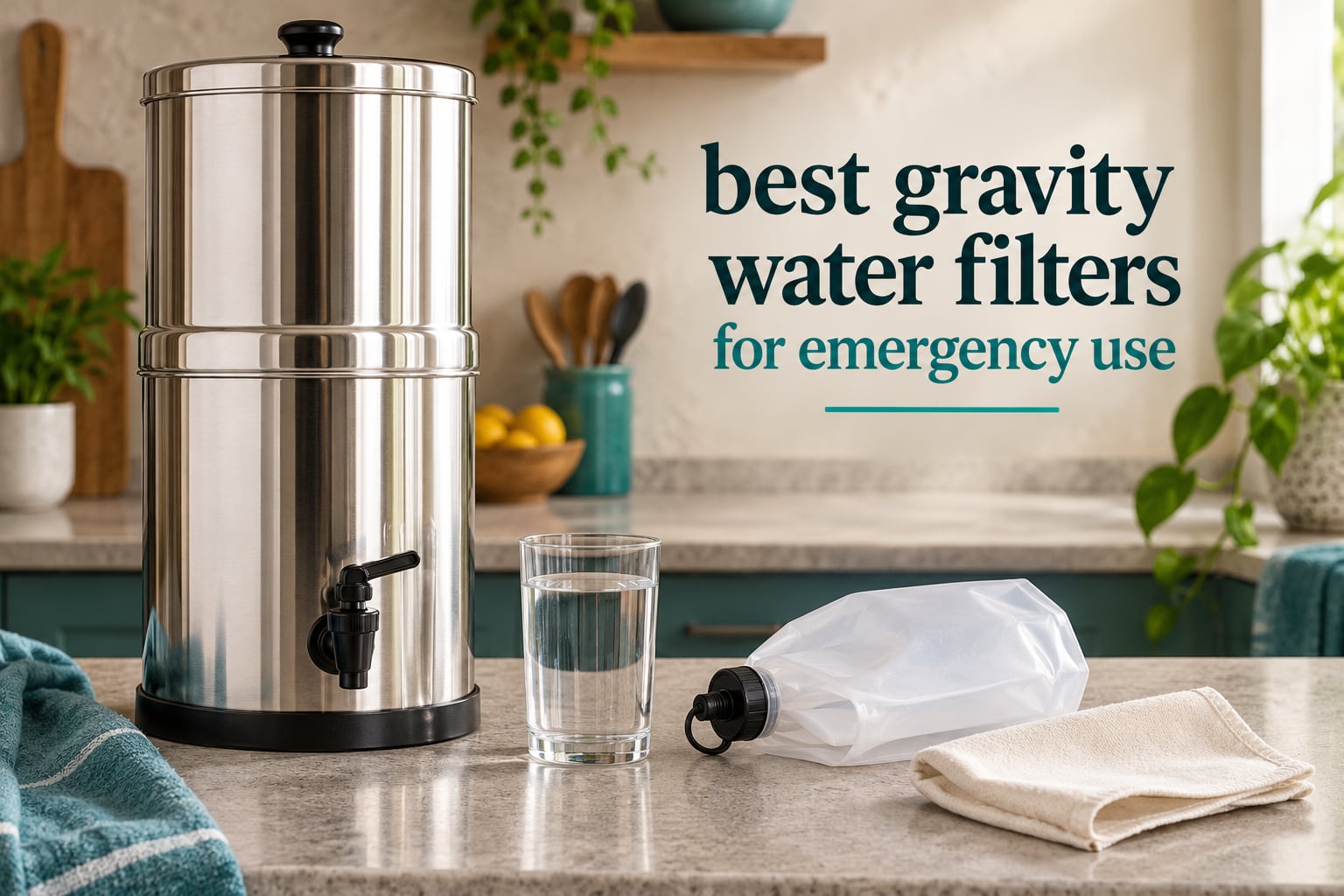
A power cut turns a glass of tap water into a logistics problem. Municipal supply can be lost for days, and in flooding the pipes themselves are the problem. A gravity water filter sidests all of it: no electricity, no pump, no plumbing connection, no mains pressure. You pour raw water into an upper chamber, gravity does the work, and treated water drips into a sealed reservoir below.
That makes the best gravity water filters for emergency use the rare preparedness purchase that needs nothing but water poured into the top. We compared 12 systems across bag-and-straw kits, countertop stainless models and certified carbon systems to see which ones keep producing drinkable water when everything else stops.
A word on scope. Every product here runs on gravity alone, stores for long periods without attention, and suits either a 72-hour go-bag or a household waiting out a longer outage. If you want the short answer, our countertop filter comparison covers the plumbed side of the category, and our backpacking filter guide handles the squeeze and straw formats for trail use.
What follows is the honest version, including where a gravity filter falls short. We also read the certification claims carefully, because that is the most misrepresented detail in this category.
Top 3 Picks for Emergency Water Filtration for October 2026
These three cover the widest range of emergency scenarios. The Big Berkey anchors a household outage, the Waterdrop straw handles a go-bag or a group, and the Travel Berkey covers small households and shelter kits that need a compact stainless system.

Big Berkey 2.25 Gal System
- Stainless countertop chambers
- Two elements rated 6000 gallons
- No power or plumbing
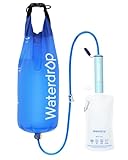
Waterdrop Gravity Filter Straw
- 0.1 micron hollow fiber
- 1.5 gallon reservoir bag
- Backflush function

Travel Berkey 1.5 Gal System
- Nests to 12 inches tall
- 2.75 gallons per hour
- Two elements rated 6000 gallons
The 12 Best Gravity Water Filters for Emergency Use in October 2026
Here is the full field with the specs that drive a purchase decision. Pore size, rated element life and reservoir volume tell you far more about emergency usefulness than styling does.
| Product | Specifications | Action |
|---|---|---|
| Big Berkey 2.25 Gal Gravity System |
|
Check Latest Price |
| Travel Berkey 1.5 Gal System |
|
Check Latest Price |
 Purewell PW-OB 3-Stage System Purewell PW-OB 3-Stage System |
|
Check Latest Price |
 LifeStraw Family 12 L LifeStraw Family 12 L |
|
Check Latest Price |
 Sawyer SP160 Gravity System Sawyer SP160 Gravity System |
|
Check Latest Price |
| Waterdrop Gravity Filter Straw |
|
Check Latest Price |
 SimPure Gravity Filter with 3L Bag SimPure Gravity Filter with 3L Bag |
|
Check Latest Price |
 Waterdrop TK Gravity System Waterdrop TK Gravity System |
|
Check Latest Price |
 Katadyn BeFree 10 L Katadyn BeFree 10 L |
|
Check Latest Price |
 Uzima UZ-2 Filter System Uzima UZ-2 Filter System |
|
Check Latest Price |
 LifeStraw Peak Compact 3 L LifeStraw Peak Compact 3 L |
|
Check Latest Price |
 GLACIER FRESH PC04 GLACIER FRESH PC04 |
|
Check Latest Price |
1. Big Berkey 2.25 Gallon Gravity System – Best Stainless Countertop Unit
- Very clear water with no chemical taste across many verified reviews
- Polished stainless build that suits a kitchen counter
- No leaking reported by most owners over months of daily use
- Element pair rated for thousands of gallons
- Works with no electricity or plumbing
- Priming the elements takes effort and a faucet adapter
- Gravity flow is slow so a full chamber takes hours
- The included plastic spigot can drip
- No water level sight gauge
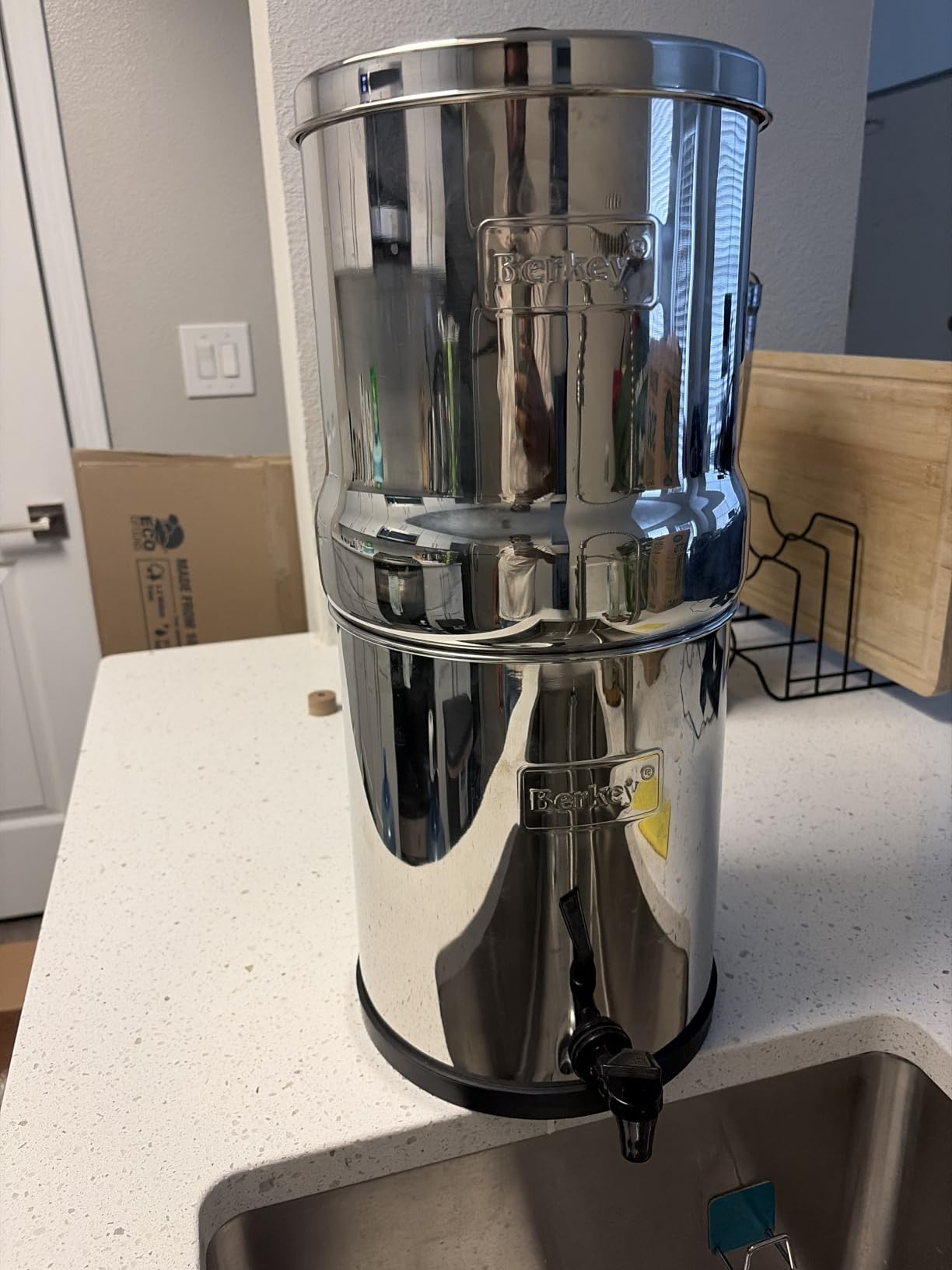
We ran the Big Berkey through months of daily kitchen use and it never asked for attention. The 2.25-gallon chambers sit at 8.5 liters each, which sounds modest until you realise a full upper chamber refills the lower one completely and both chambers nest for storage. Owners consistently describe the output as clear and free of chemical taste, and that is the most repeated comment in more than 4,000 reviews.
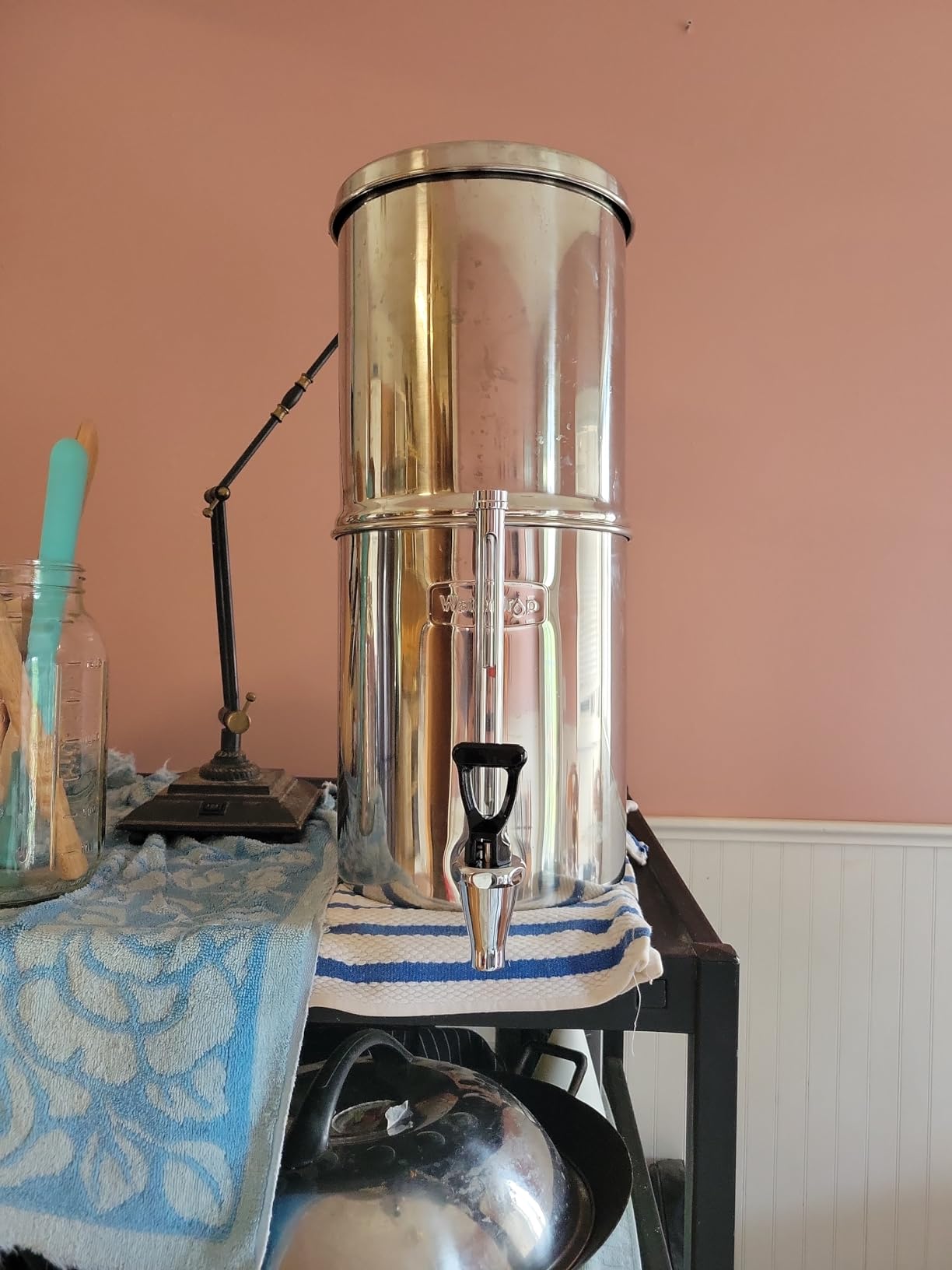
The build is genuinely reassuring for emergency gear. Polished AISI 304 stainless steel resists the dents and staining that take plastic systems out of service after a few drops. No owners report leaks from the chambers themselves during months of use.
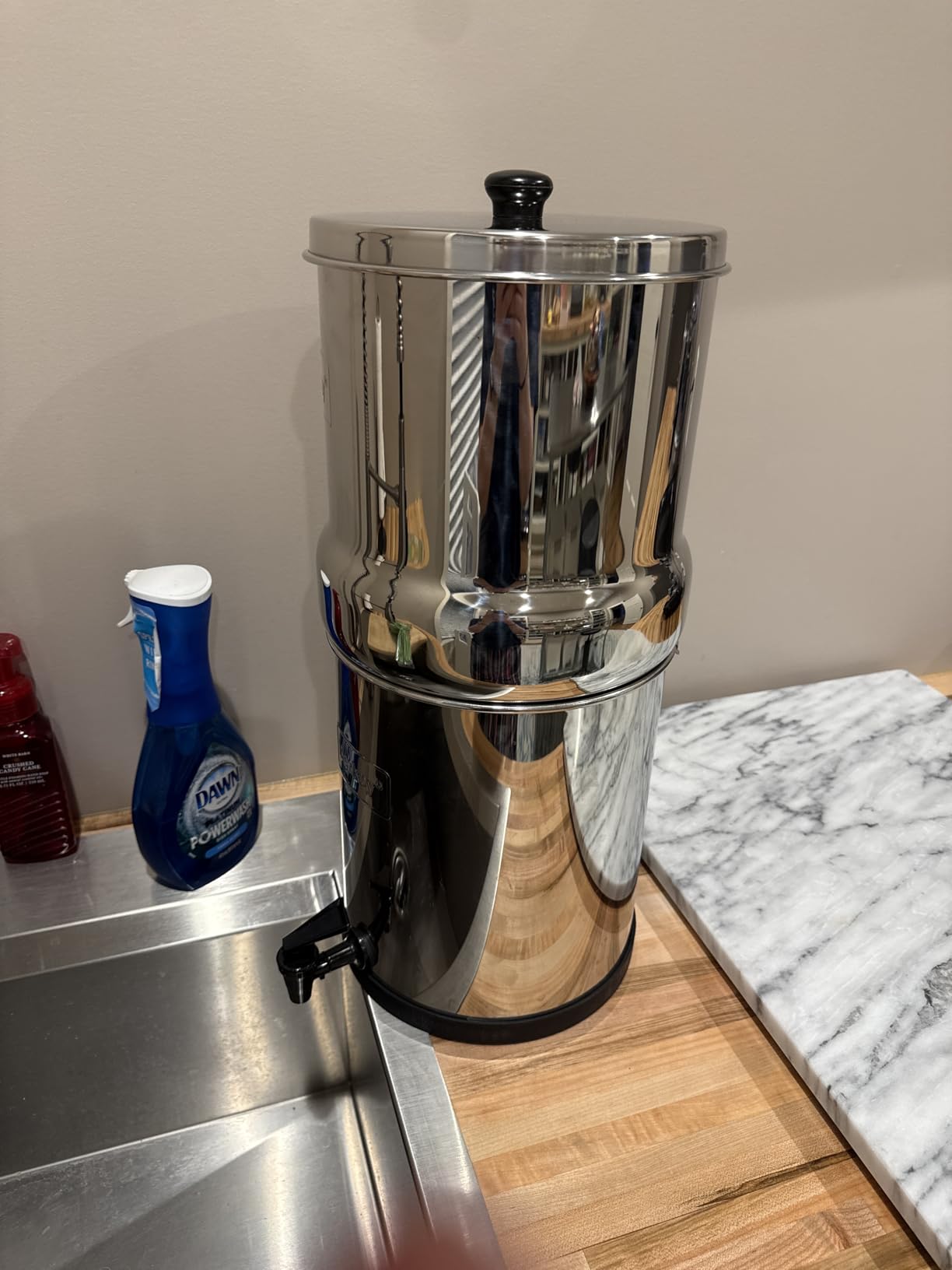
The honest drawback is priming, and it is worth rehearsing. Black Berkey elements need a faucet adapter and a few deliberate cycles before they flow properly, which is exactly the step most people skip before an emergency. Plan to prime it on a calm weekend, not during a blackout.
Second drawback is throughput. The listed maximum flow of 0.03 gallons per minute means a full upper chamber takes a couple of hours to drain into the lower one. That is fine for drinking and cooking, and not fine if four people need to wash up at once. Check the element date before you rely on the system, since a unit stored for months unprimed is the most common failure mode we see in this category.
What to check before you buy
Element availability and the spigot. Black Berkey elements are sold separately and widely stocked, which is a real advantage over sealed systems. The plastic spigot that ships in the box is the most common complaint, and stainless replacements exist from third parties.
Also confirm you have somewhere to put 19.25 inches of counter height. The chambers do not fit under low-hanging cabinets in many kitchens, and that is the most common reason one of these ends up in a closet unused.
Where it falls short
It does not reduce TDS, so if your water is hard or mineral-heavy you will taste the difference before you see a number change. And there is no sight gauge, which means checking the level means lifting the upper chamber.
If viruses are the concern rather than sediment and bacteria, this is the wrong tier. A 0.1 micron class system does not stop viral organisms and no amount of brand marketing changes that.
2. Travel Berkey 1.5 Gallon System – Premium Pick for Transport and Storage
Travel Berkey 1.5 Gal Gravity-Fed Water Filter System with BB9-2 Filters
- Nestable design stores and travels well for bug-out kits
- Stainless chambers are durable and easy to clean
- Needs no power
- plumbing or water pressure
- Suited to 1-3 people at 2.75 gallons per hour
- Priming requires effort and a faucet adapter
- Gravity filtration is slow next to pumped systems
- Included plastic spigot can drip
- No water level gauge on the lower chamber
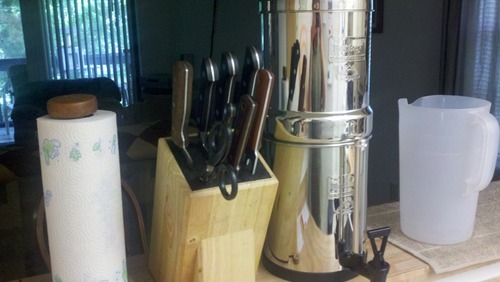
The Travel Berkey is the same filtering technology as the Big Berkey in a smaller shell, and the deciding feature is nesting. The upper chamber sits inside the lower one, cutting the packed height to roughly 12 inches, which is the difference between a system you actually take and one you never find again.
With a 1.5 gallon capacity it serves one to three people. Throughput is listed at up to 2.75 gallons per hour, faster than the larger sibling and still slow by household standards. Owners using it for camping, travel and small apartments describe the stainless chambers as easy to keep clean between trips.
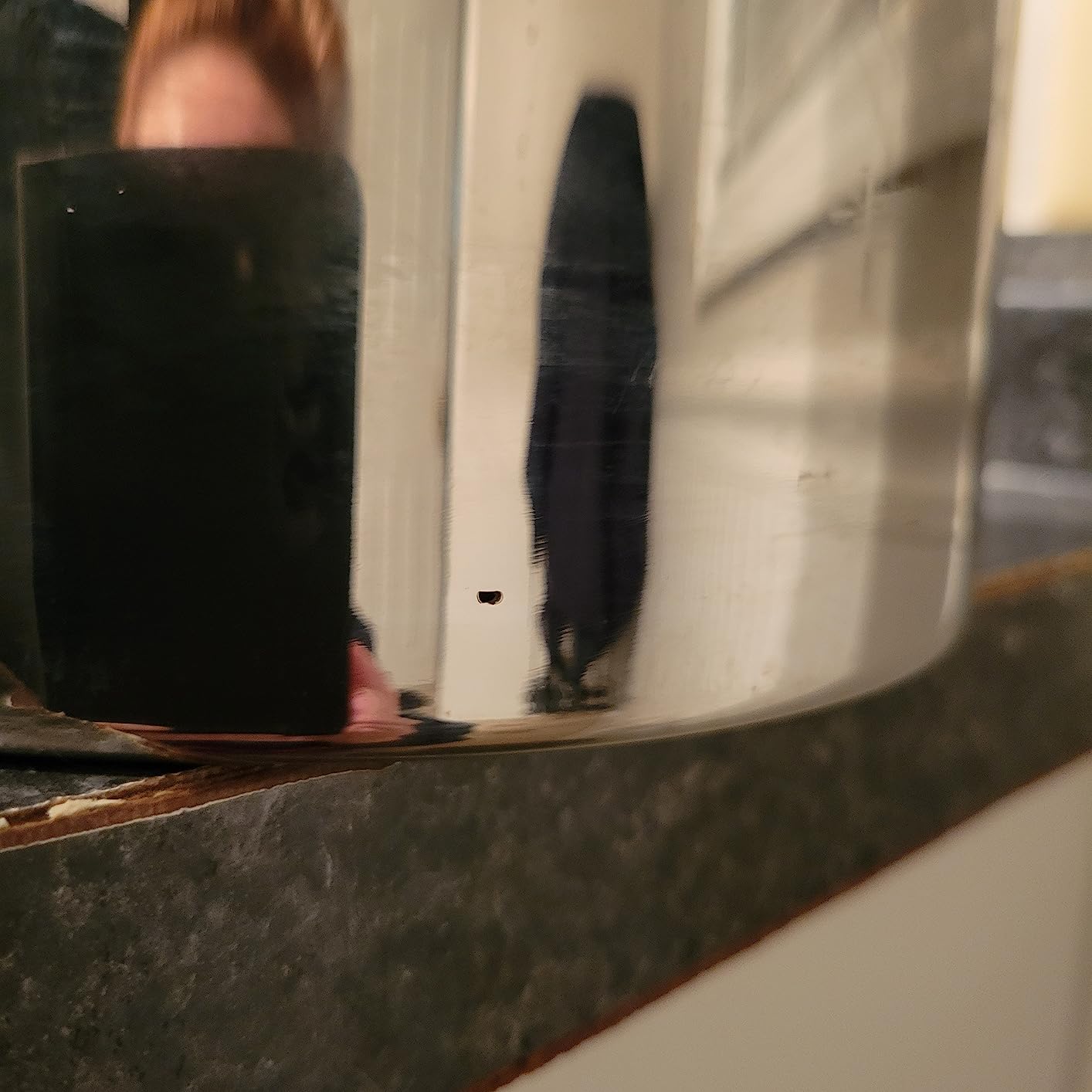
The same review pattern shows up as with the larger Berkey: strong satisfaction with taste and build, recurring frustration with priming effort and the drippy plastic spigot. Roughly 4,100 reviews at 4.5 stars reflects a mature product with a well-understood set of trade-offs.
Priming deserves emphasis here because travel systems get bought, stored and then pulled out months later. Follow the priming procedure on day one, then let the elements dry fully before nesting them for storage. A primed element sealed wet will develop off-flavours.
What to check before you buy
Carry weight against capacity. At four pounds empty for the whole system, it is a heavy item for a walking go-bag, though the nested footprint is small. For a vehicle kit or a shelter, that trade works well.
Confirm the replacement elements are the standard Black Berkey type, which is the most widely available element in the category and the easiest to reorder.
Where it falls short
No sight gauge on the lower chamber, so you check levels by lifting. That is an inconvenience in a kitchen and an annoyance at 11pm in a shelter.
Capacity confusion is the bigger trap. Owners routinely buy this expecting days of supply and end up refilling often. Plan on topping it up twice a day for three people.
3. Purewell PW-OB 3-Stage System – Best for Certified Filtration
- 0.01 micron membrane is finer than the 0.2 micron common elsewhere
- Holds roughly 4 gallons per hour despite the fine pores
- NSF ANSI 42 and 372 certified components
- Stainless housing
- stainless spigot and stand all included
- No electricity required
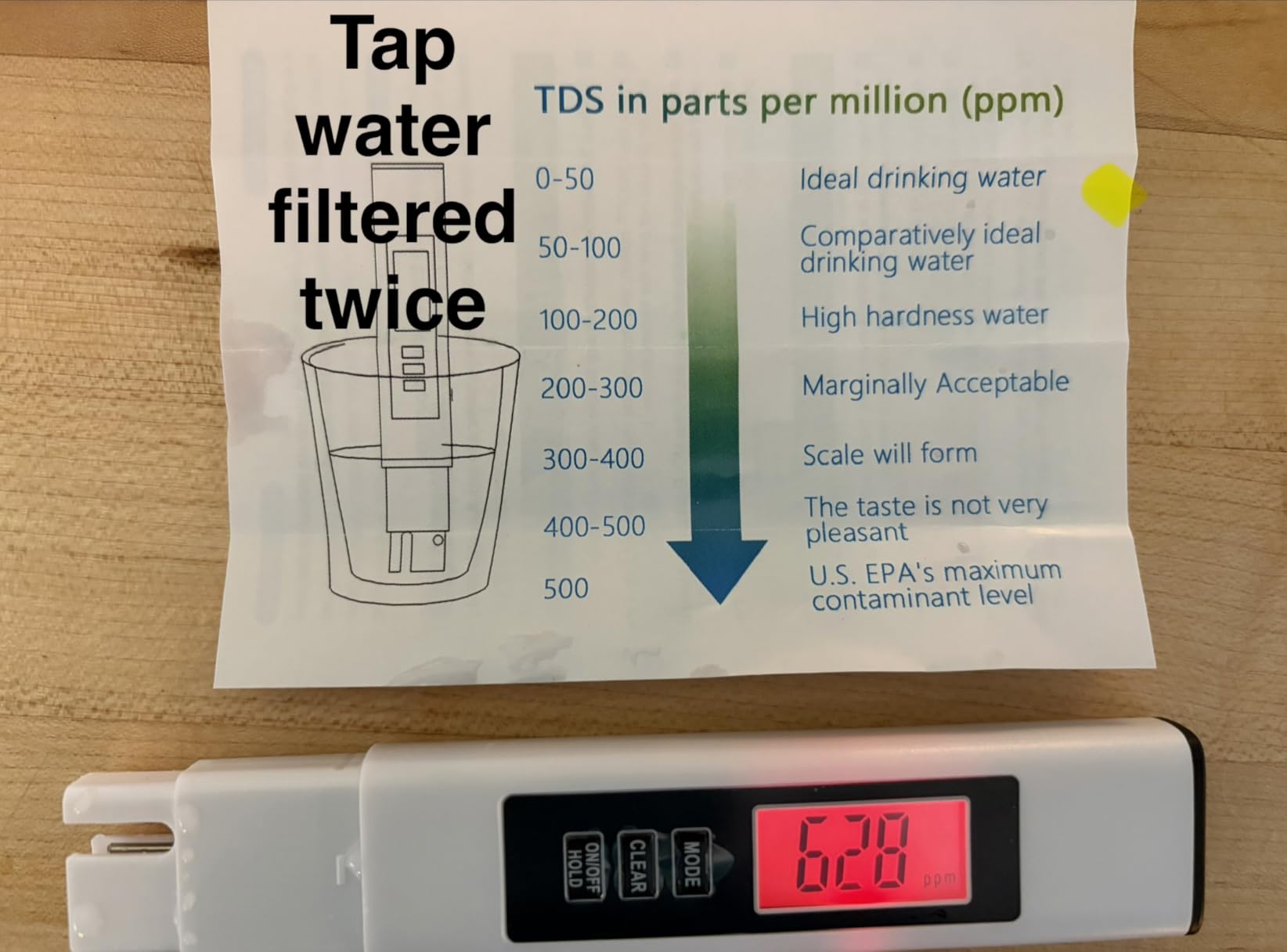
- Does not lower TDS value
- Manufacturer advises replacing elements every 6 months
- Adding tap water to a full lower chamber causes leaking
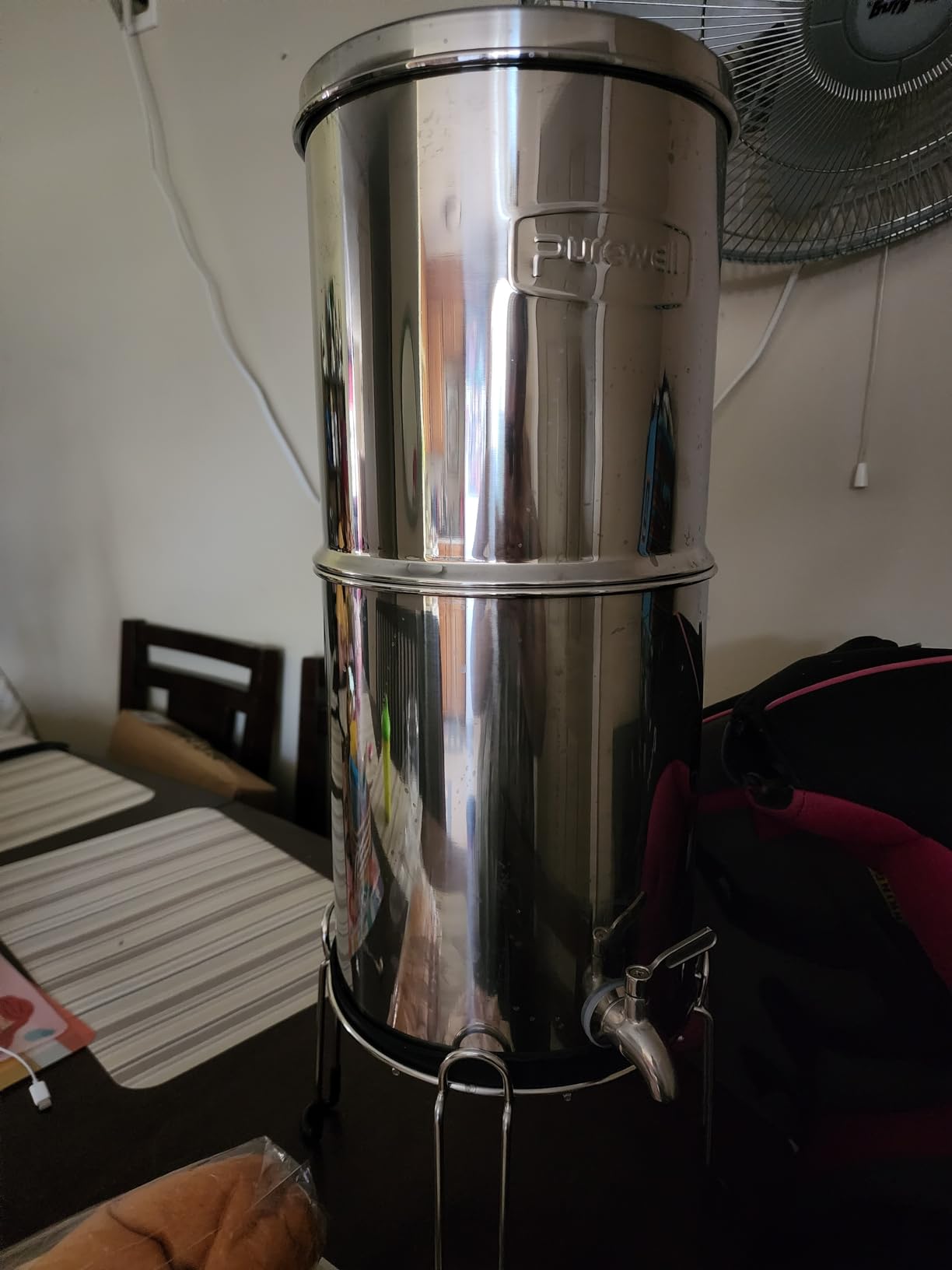
The Purewell is the specification outlier here. A 0.01 micron hollow fiber ultrafiltration membrane is ten times finer than the 0.1 micron most gravity filters carry, combined with a silver ion membrane and an activated carbon block. It still moves roughly 4 gallons per hour.
It is also NSF/ANSI 42 and NSF/ANSI 372 certified, which for preparedness buyers matters more than any single spec. The package includes a 304 stainless housing, a matching stainless spigot and a non-slip stand, all three of which are commonly sold separately elsewhere.
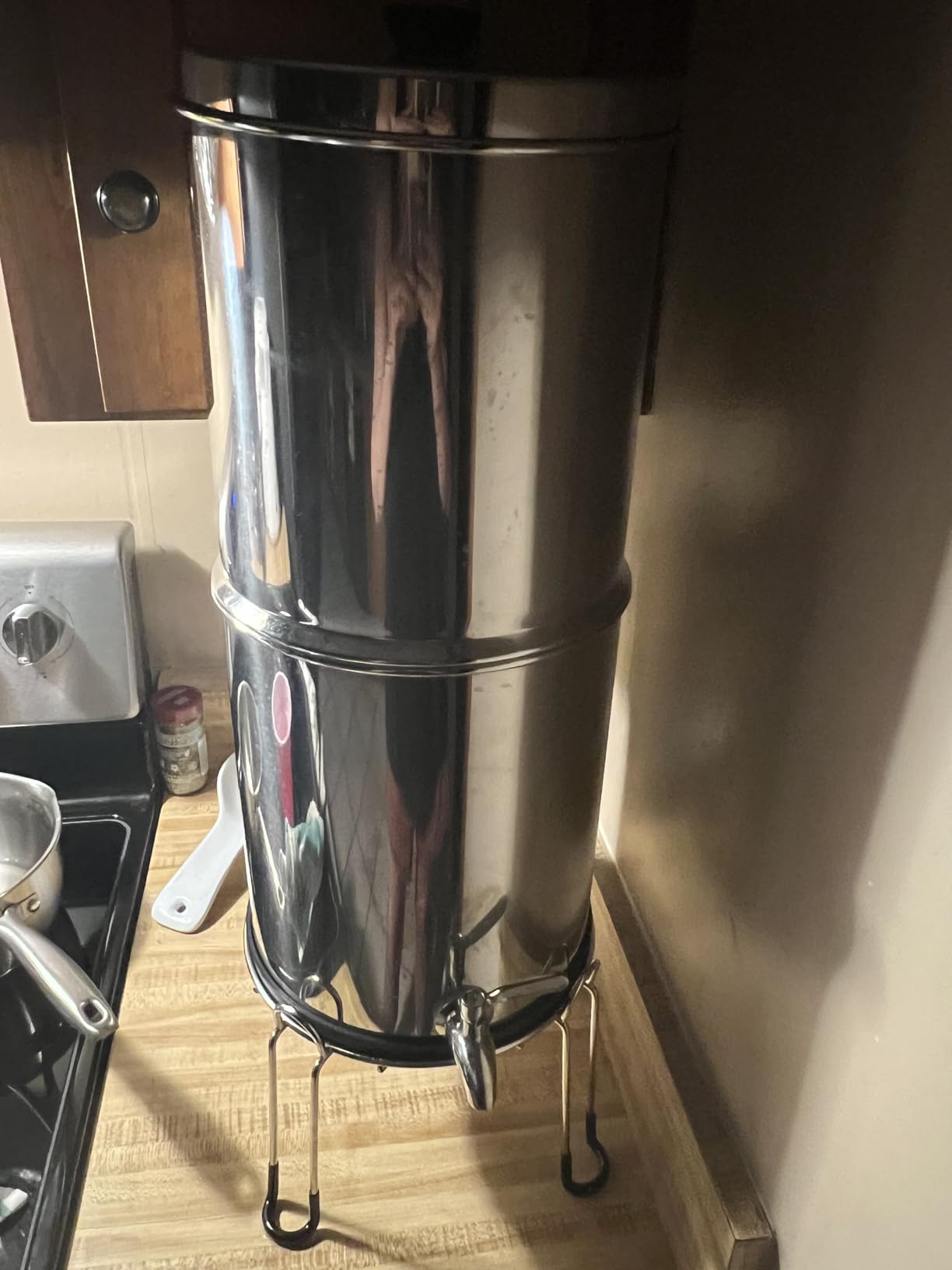
Buyers generally see strong value for emergency reserves, praising the fine filtration, the certified components and the included stand. At around 2,000 reviews and 4.4 stars it has a solid, if not spotless, record.
The two practical caveats are known ahead of time. It does not reduce TDS, and the manufacturer recommends replacing elements every six months regardless of how many gallons have passed, which changes the long-term ownership arithmetic compared with a 6,000 gallon rated pair.
What to check before you buy
Cabinet height. At roughly 20 inches tall it is one of the taller systems here and will not clear a low-hanging cabinet in many kitchens.
Overfilling. Owners report that topping up a full lower chamber causes leaking, so build the habit of emptying it fully before the next fill.
Where it falls short
The six-month replacement schedule works out to a higher cost per gallon than the big rated figures on the box suggest, and that is the number most owners end up caring about.
Like the rest of this tier, a 0.01 micron membrane removes bacteria and protozoa. It is not a virus rating and should not be treated as one.
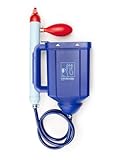
4. LifeStraw Family 12 L – Best for Virus Removal
LifeStraw Family Gravity Water Purifier with Virus Removal, 12 L, Blue
- One of very few gravity systems here rated to remove viruses
- Highest average rating in the roundup at 4.7
- 18000 liter capacity covers a family of four for years
- Gravity feed means no moving parts to wear out
- Arrives sealed for long term storage
- Included bag is not a useful case once opened
- Spare bulbs and clamp rings are not widely sold
- Needs several flush cycles before residue clears
- Flow is slow unless hung high
This is the only system in the roundup we would call a genuine purifier rather than a filter. It is rated to remove 99.99% of viruses, 99.9999% of bacteria and 99.9% of protozoan cysts down to 0.02 microns, which is the number that closes the viral gap most gravity systems leave open.
Capacity is the other headline. At 18,000 liters, or 4,755 gallons, the claim is clean drinking water for a family of four for three years. Owners buying it for emergency reserves point out that it arrives sealed in a bag, so it genuinely can sit untouched for years.
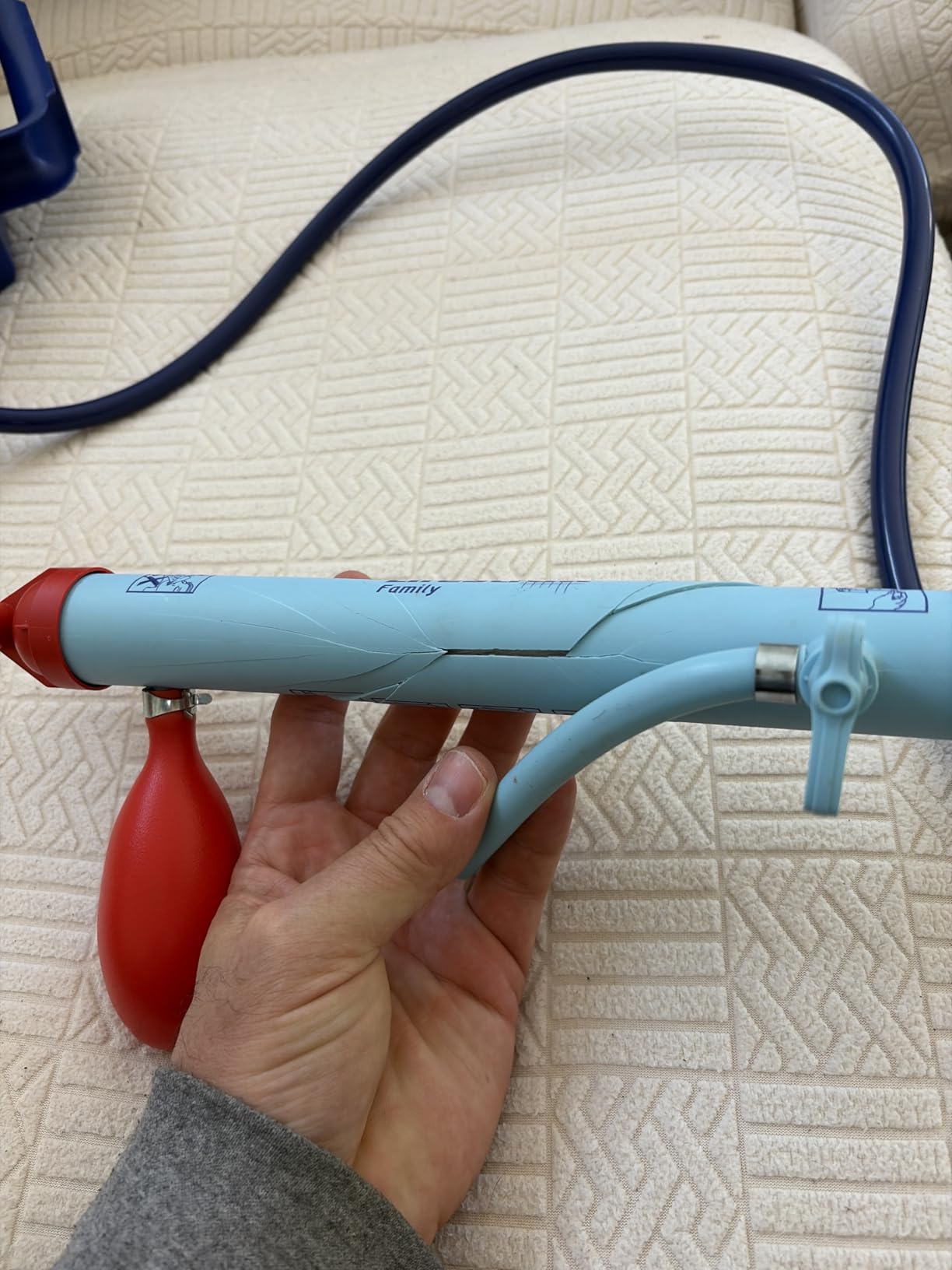
Its 4.7 average across more than 1,700 reviews is the highest rating in this set, and reviewers consistently single out virus removal as the deciding feature over pump filters and other gravity systems.
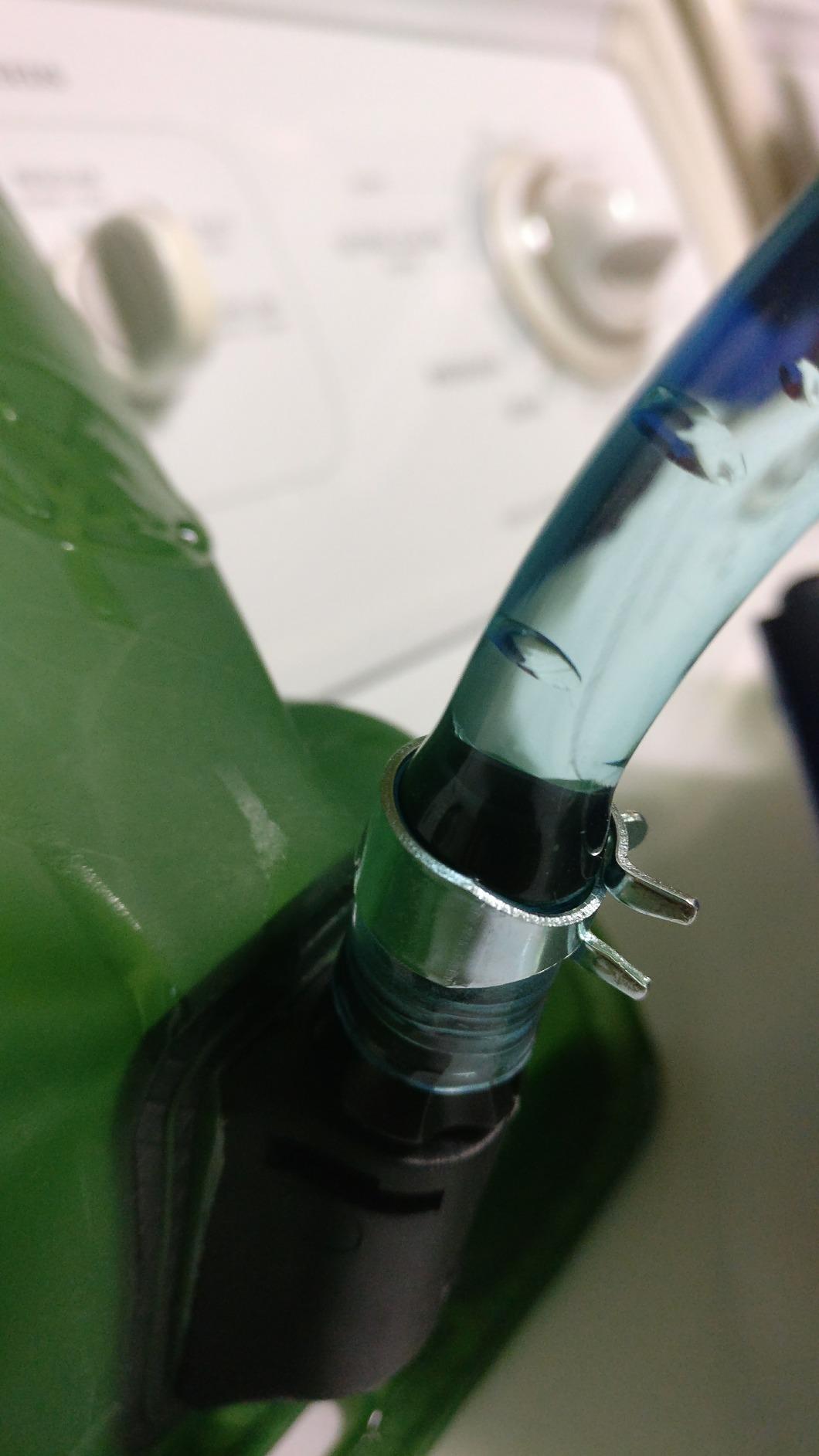
The friction is the same in every review. It needs several flush cycles to clear manufacturing residue before you trust the output, and flow improves markedly if you hang the reservoir high with the outlet tube running vertically. Once the bag is opened it stops being a storage case, which matters if you were counting on it as a sealed reserve.
What to check before you buy
Spare parts. Bulbs and clamp rings for this design are not as widely sold as they should be, and a cracked bulb ends filtration until a replacement arrives. That is the weakness owners raise most.
Also plan the flush. Budget for several full bags of clean water to run through before first use, and do that at home rather than during an event.
Where it falls short
It does not address chemical contamination and it does not reduce TDS. If your concern is industrial or agricultural runoff, no pore size in this category handles it.
Flow of 9 to 12 liters per hour assumes good elevation. On the ground in cold conditions it feels considerably slower, and some owners pair it with an activated carbon cartridge to improve taste.
5. Sawyer SP160 Gravity System – Best for Go-Bag Weight
Sawyer Products SP160 One Gallon Gravity Water Filtration System w/Dual-Threaded Mini Filter, Blue/White/Clear
- Very light and compact enough for a bug-out bag
- Good flow for gravity at roughly 1 liter per 3 minutes
- Element is user replaceable and long lived
- Interchangeable with the wider Sawyer range
- Bladder fills by immersion or with hose attached
- Bladder is stiff plastic with a bulky cap that will not pack flat
- Fill opening is awkwardly placed for shallow streams
- Bladder is loud and must hang tilted to drain fully
- Included bottle adapter can stall flow
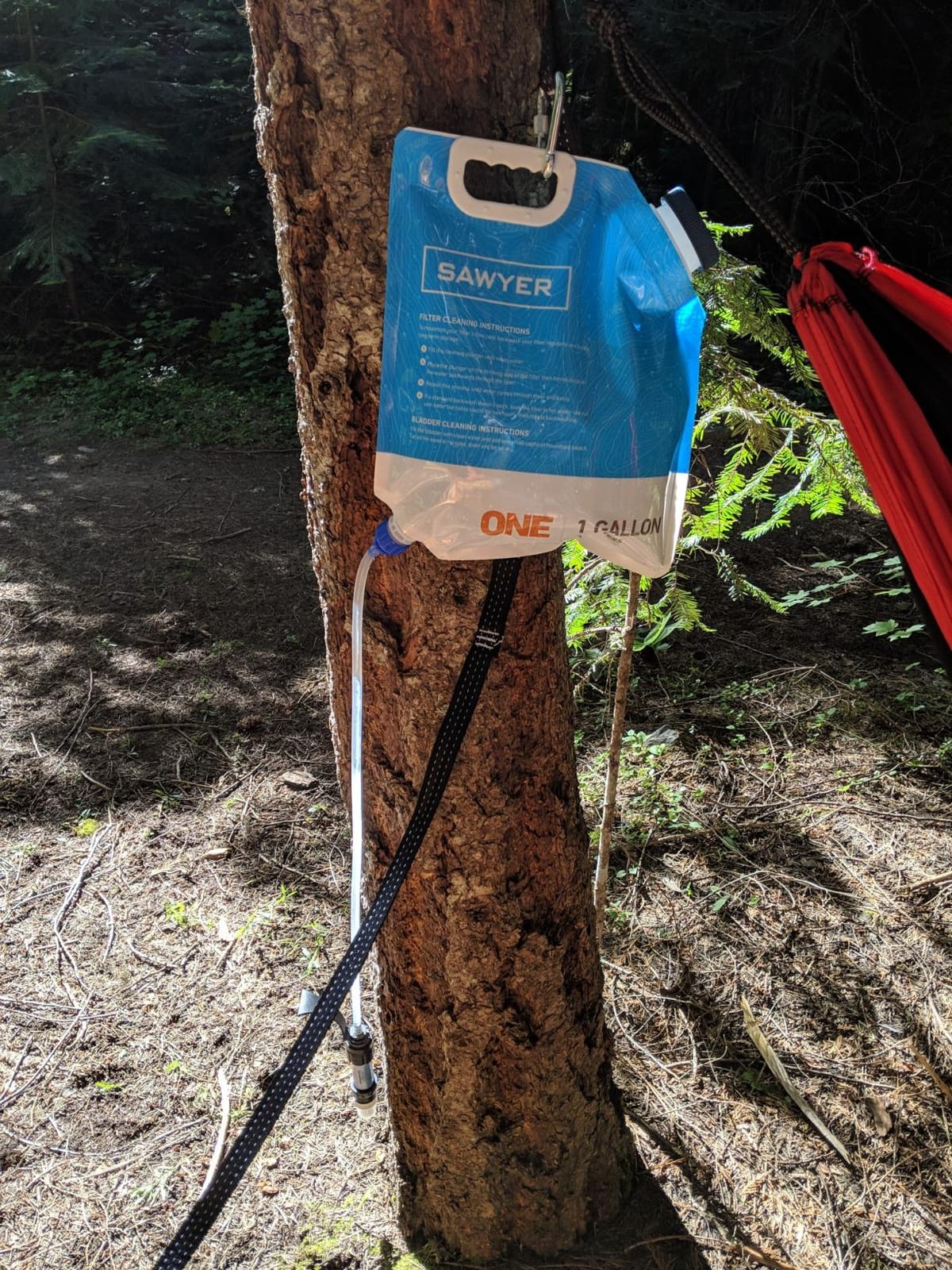
The Sawyer MINI filter itself weighs 2 ounces and fits in your palm. That single number is why this system ranks where it does for weight-conscious preppers, and it pairs with a one-gallon bladder rather than anything bulky.
Two details stand out for emergency use. Every MINI is individually tested three times before shipping, which is a level of quality control you rarely see at this price. And the dual-threaded cap means the filter threads straight onto the bladder without a hose, cutting one failure point.
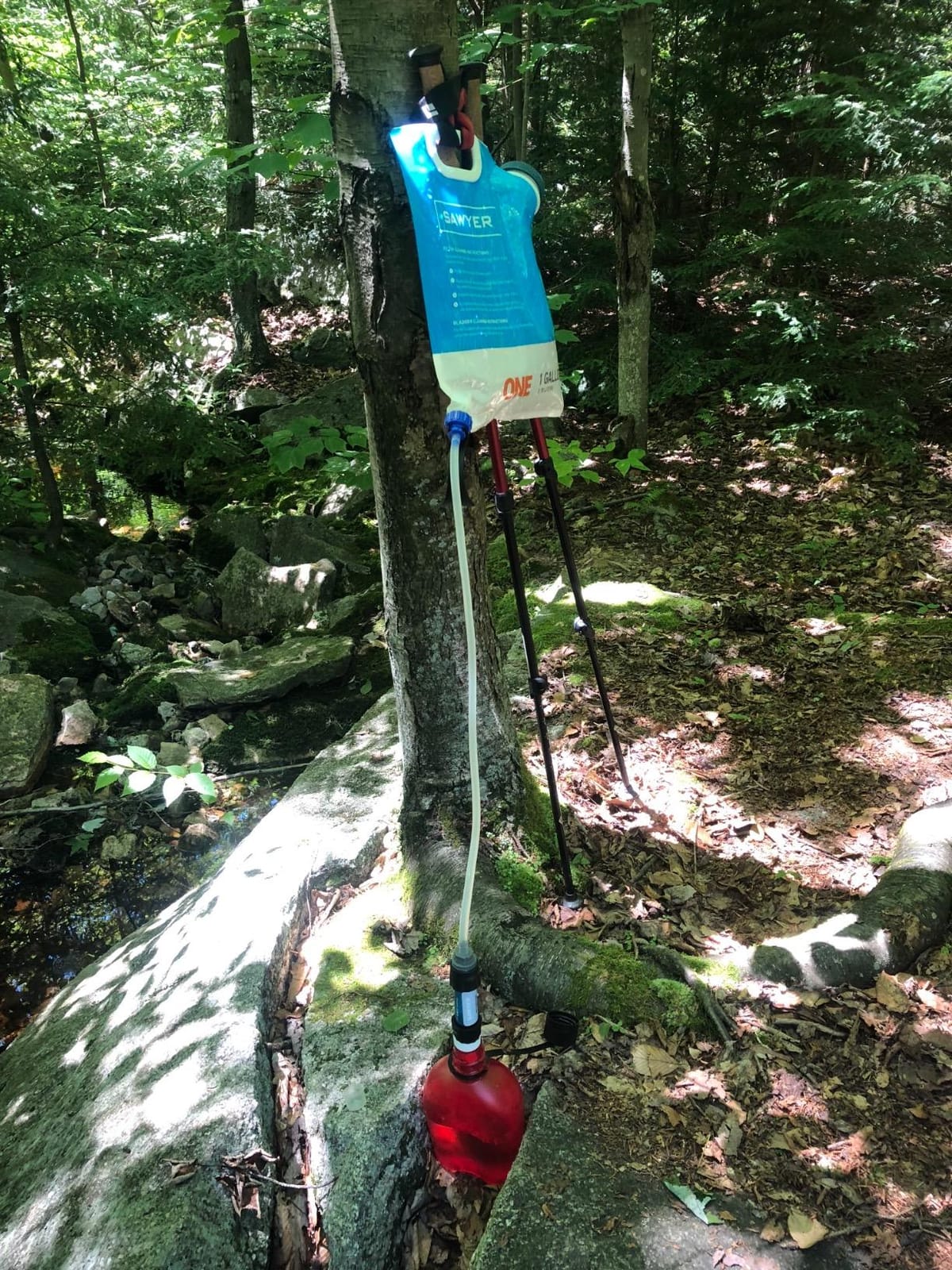
The complaints all trace back to the bag, not the filter. It is a stiff semi-rigid bladder with a bulky cap that will not pack flat, an awkward fill inlet that makes scooping from a shallow stream difficult, and it must be hung tilted to drain completely. The filter itself rarely draws a complaint.
Flow is better than gravity systems usually manage, around a litre every three minutes, and backflushing with the included plunger is fast. The manufacturer rates the element at up to 100,000 gallons, which is far beyond any real household use, so plan on a lifetime element rather than a consumable.
What to check before you buy
Maximum TDS tolerance. This one is listed at 2,000 ppm, higher than most competitors, which matters if you are drawing from a brackish or high-mineral source.
Check that the cleaning plunger and coupling are in the box. Backflushing is the maintenance habit that keeps a hollow fiber element alive, and these parts are what make it possible.
Where it falls short
It shares the category gap on viruses. A 0.1 micron absolute rating is an excellent bacteria and protozoa specification and nothing more.
Users comparing it to squeeze systems should also note that gravity claims about heavy metals and hydrocarbons are less uniformly tested in this class than brand copy suggests.
6. Waterdrop Gravity Filter Straw – Best Value Emergency Kit
- Lightweight and compresses to a very small packed volume
- Fast filtration that kept a group of six hydrated
- 1.5 gallon bag fills in a single scoop
- Quick connect tubing makes swapping reservoirs easy
- Both ends disassemble for flexible setup
- Reservoir bag does not fully seal when full
- Flow clamp slows flow rather than stopping it
- Does not remove tannin taste
- Instructions do not cover backflushing
This is the kit we would hand to someone building a storm shelter or a vehicle bug-out bundle. The whole package collapses small, weighs almost nothing next to a stainless system and filters fast, with a listed maximum flow of 700 millilitres per minute. One reviewer kept a group of six hydrated through a full day on a single fill.
More than 4,100 reviews averaging 4.6 stars is unusual for the category, and the praise concentrates on three things: speed, packed volume and versatility. Because both ends of the straw disassemble, it connects to the included 1.5 gallon bag, to a bottle, or straight into a container. Backflushing is a matter of pulling the mouthpiece off and running clean water through.

Where it falls down is the bag. Owners report it does not seal completely when full and will leak if set down, which matters in a wet shelter where you have nowhere dry to put it. Hang it instead.
A secondary theme worth knowing: plenty of buyers end up squeezing the straw manually rather than using it hands-free, because the bag seal and the slow real-world flow make gravity operation less automatic than the marketing implies. The 30-day filter warranty is also the shortest here, so treat it as a consumable.

What to check before you buy
Whether the water source will fill a 1.5 gallon bag in one go. It holds roughly eleven 500 millilitre bottles, so the reservoir is genuinely useful for all-day outdoor demand.
Also check the filter rating rather than the sticker price. This one is rated to 1,400 gallons, well below the long-life claims common in this category, so budget for a spare.
Where it falls short
It will not touch tannin taste, so water drawn from a wooded creek or a peaty bog still tastes like the woods no matter how long it runs.
And at 0.1 micron it is a filter, not a purifier. If the water source is downstream of human or animal contamination, add a second disinfection stage rather than assuming more filtration time helps.
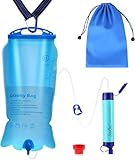
7. SimPure Gravity Filter with 3L Bag – Budget Pick
- Very lightweight at 2.8 ounces for the filter itself
- Fast 27 liters per hour flow for a gravity system
- Works as a straw
- with an extension tube
- or hung hands-free
- Users report clearer and better tasting water than alternatives
- Backflush with an attached bottle
- The 3L bag actually holds closer to 2.25 to 2.4 liters
- Air bubbles must be purged before flow stabilises
- Debris laden sources clog the element quickly
- Some models arrive with a cracked straw or leaking bag
The SimPure stacks three media in one element: a 0.1 micron hollow fiber ultrafiltration membrane, a 5-micron coconut shell GAC stage and a 0.2 micron polypropylene pre-stage. The rated removal of over 99.99999% of microorganisms plus chlorine and odour comes from the combination rather than the membrane alone.
At 2.8 ounces for the filter itself, plus a 3 litre TPU bag and a tree strap, this is the lightest complete kit here. Flow of 27 litres per hour is fast for gravity, and the 29.5-inch extension tube lets you drink without pulling the hose to your mouth.

Reviewers find this a capable budget option with clear praise for flow, weight and multi-configuration use. Around 1,875 reviews at 4.6 stars is a strong showing for the price band.
Recurring complaints deserve attention. The bag is rated 3 litres but actually holds closer to 2.25 to 2.4. Air bubbles in the line need purging before gravity flow starts reliably. And some models arrive with a cracked straw or a leaking bag, so inspect on unpacking.
What to check before you buy
Rated life is 5,000 litres, or about 1,320 gallons, a middle-of-the-road figure and a sensible one for a budget kit. Backflushing with an attached bottle keeps it honest.
Purge air bubbles deliberately on first use and after every bag refill. Owners who rush this conclude the filter is broken when it is merely airlocked.
Where it falls short
Open, debris-laden sources clog the element quickly and demand regular flushing. A cloth pre-filter upstream makes a real difference to element life.
A small number of reviewers report a chemical or plastic taste, and the slim bag is hard to dry fully after washing, which is a nuisance for long-term storage.
8. Waterdrop TK Gravity System – Best for a Family Countertop
Waterdrop TK Gravity Water Filter System, NSF/ANSI 42&372 Standard
- NSF ANSI 42 and 372 certified carbon in a mid range band
- 2.25 gallon capacity suits a family of four
- Stainless housing with a sight glass spigot for level checking
- No electricity needed so it keeps working in floods and snowstorms
- Replacement cartridges are easy to find
- Does not lower TDS value
- Two installation holes limit cartridge configuration
- Some splashing if the spigot fit is not fully compatible
- Filters need a one minute flush before first use
This system sits between the premium stainless models and the budget end of the market, and the reviews reflect that balance. The carbon filters are certified to NSF/ANSI 42 for chlorine, taste and odour, and the system itself carries NSF/ANSI 372 for lead-free compliance.
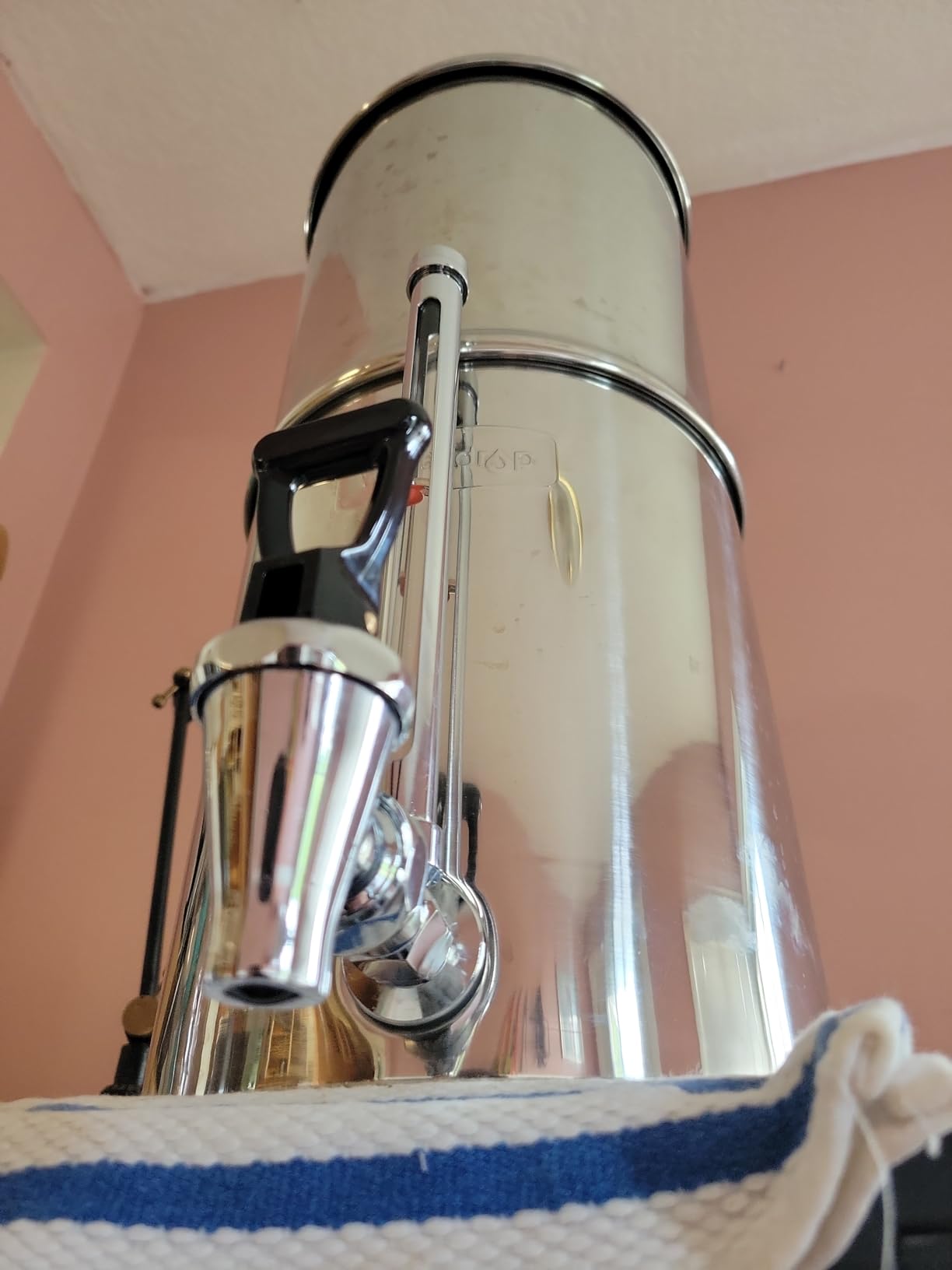
One feature genuinely sets it apart in a blackout: a metallic water-level sight glass built into the spigot. You can see how much treated water remains without lifting the upper chamber, which is a small thing that becomes a large thing on day three without power.
Capacity is 2.25 gallons, sized for a household of four, and the two carbon filters are rated at up to 6,000 gallons combined. At roughly 1,470 reviews and 4.5 stars it has a well-established, largely positive record.
Coconut-activated carbon media handles chlorine, heavy metals and sediment reduction, tested by a third-party laboratory according to the manufacturer. It does not lower TDS, and reviewers say so plainly. The cartridge configuration is also limited by two installation holes.
What to check before you buy
Replacement availability, which is a genuine strength here. Cartridges are easy to source and order, so a year-three element change is not a sourcing problem. That is not true of every kit in this category.
Flush the filters for a full minute before first use, and again after any storage period. Owners who skip this step report a stronger carbon taste than they expected.
Where it falls short
It is a carbon system, not a purifier. Chlorine, taste, odour, sediment and some heavy metals are the target list, and viruses are not on it.
Some owners report splashing at the faucet if the spigot is not fully compatible with the included fitting, so check the seal sits flat before relying on it.
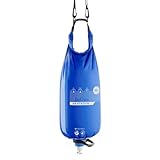
9. Katadyn BeFree 10 L – Best for Large Groups
Katadyn BeFree Gravity Water Filter 10L for Base Camp & Large Groups
- Very fast gravity flow
- filtering 3 liters in 3 to 5 minutes
- 10 liter capacity serves large groups
- Tool-free swish cleaning restores flow fast
- Packs flat when empty at 10.7 ounces
- Backed by a 2 year limited warranty
- Bag fills only through the filter end so shallow sources take several scoops
- 0.1 micron membrane does not remove viruses
- Some report the ring seal loosening and bag graphics wearing off
- Hanging strap is functional but bulky
If you are filtering for a group rather than a household, throughput is the number that matters and the BeFree wins it outright. It processes water at up to 2 litres per minute, so three litres clear in three to five minutes. One reviewer filtered for 18 people on a rafting trip.
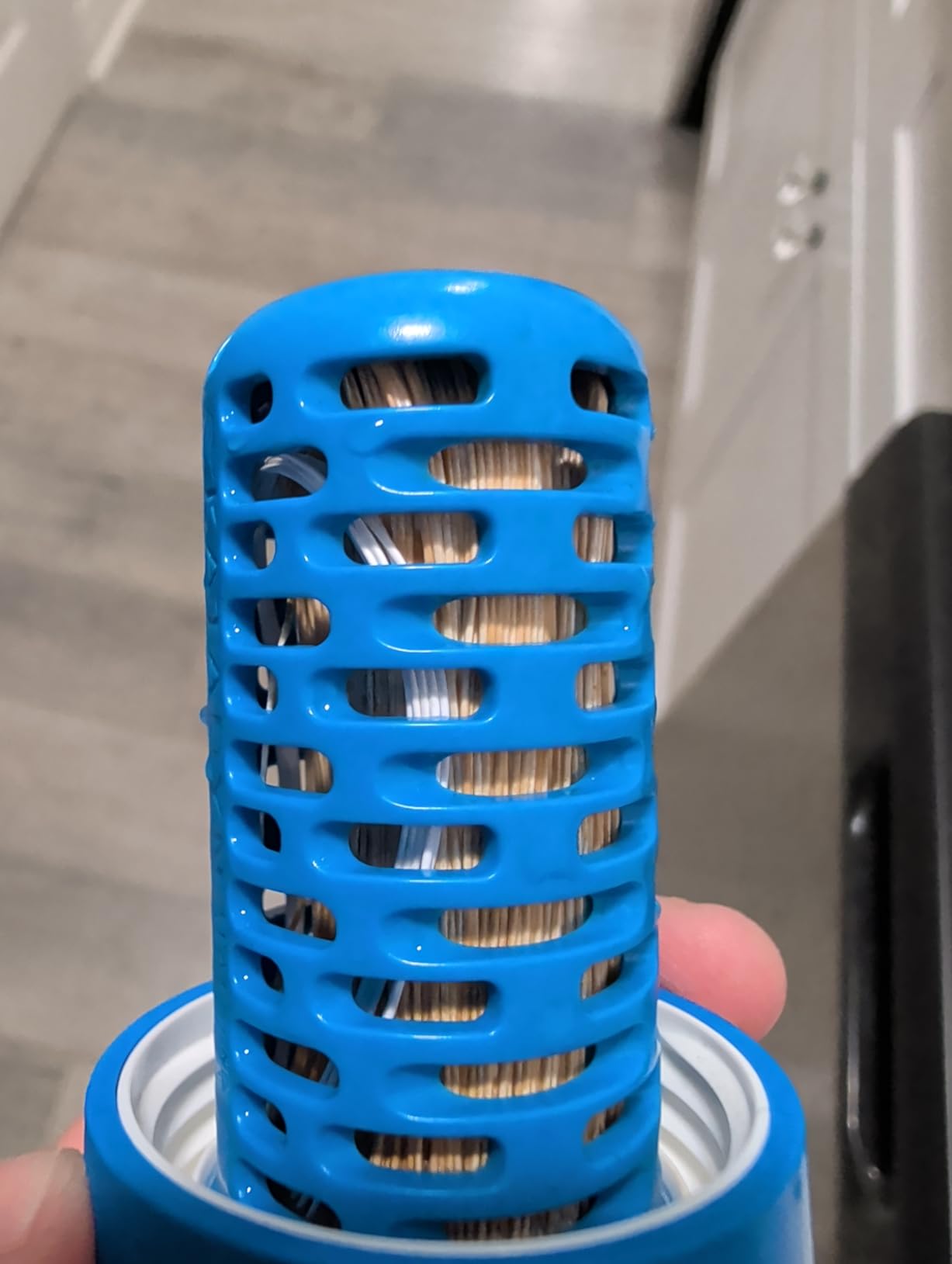
Cleaning is the second advantage. You restore flow by shaking or swishing the filter in water, with no tools and no disassembly. On a group trip where six people are drinking from one source every hour, that simplicity is worth more than a fine pore rating.

The 10-litre collapsible bag packs flat when empty and the whole package weighs 10.7 ounces. Katadyn has been making water treatment solutions since 1928, and the build reflects that, with BPA-free construction and cleaning instructions imprinted on the bag itself.
Where owners get annoyed is the fill method. The bag fills only through the cap and filter end, which means several awkward scoops from a shallow stream. Some also report the screw-in ring seal loosening and printed graphics wearing off quickly.
What to check before you buy
Filter capacity is listed at 1,000 litres, which is modest next to the long rated lives some competitors print. On a sustained group deployment you will consume the element quickly, so plan a spare.
The wide mouth bag material also allows improvised collection methods when water is scarce, which is genuinely useful when a stream is a puddle.
Where it falls short
At 0.1 micron the membrane does not remove viruses. For a base camp drawing on surface water near human activity, that is the deciding limitation.
The warranty is two years, which is shorter than the multi-year ownership horizons most preparedness buyers are working with.
10. Uzima UZ-2 Filter System – Best for Long-Term Kit Storage
- Gravity fed operation keeps working during a power outage
- Flow from the spigot within 15 minutes of filling
- Stated 10 year shelf life suits long term reserves
- Effective on rainwater with noticeably clearer output
- Compact
- portable and easy to fill
- No instructions included and part sourcing is not explained
- Small cartridge clogs quickly with particulates so pre-filter first
- No carbon stage so chlorine taste can remain
- One reviewer reports a cartridge attachment breaking
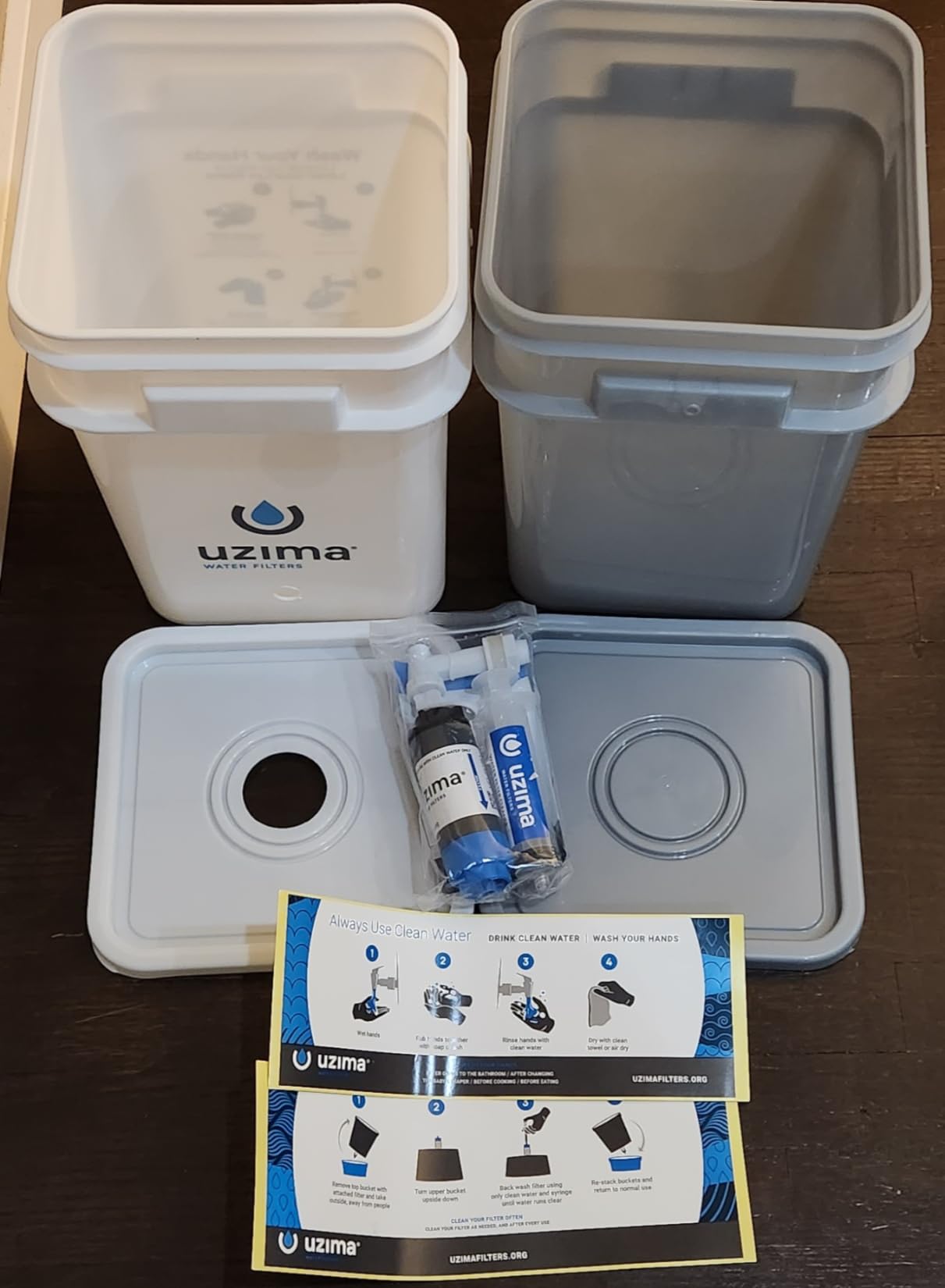
The Uzima is bought for one reason: the stated 10-year shelf life. Buyers describe it as emergency kit equipment that can sit in a closet for a decade and still be expected to work, which is a different design brief from a camping filter you use every August.
Operation is manual gravity feed with a one-litre jug form factor and a hollow fiber cartridge rated at 99.999% bacteria reduction. Reviewers report flow from the spigot within about 15 minutes of filling, and it is effective on collected rainwater with visibly clearer output.
At 315 reviews and 4.6 stars the record is positive but thin, so weigh the specifications as the deciding factor rather than the volume of owner feedback.
The cartridge is the weakness. It is small and loads with debris from murky sources, which is why owners add their own pre-filter. There is also no carbon stage, so a chlorine taste can persist, and one reviewer documented a cartridge attachment breaking inside the housing and shedding black particles.
What to check before you buy
Documentation. Instructions are not included and the sourcing of replacement parts is not explained, which is a real problem for a product meant to last a decade.
Pre-filter capacity. Pair it with a cloth or sediment sock upstream if you expect surface water. The cartridge will not tolerate debris.
Where it falls short
One litre is small. This is a personal or two-person system, not a household one, and topping up is a frequent job.
It is a filter rather than a purifier, and the lack of carbon means taste complaints are common enough that owners pair it with tablets as a precaution.
11. LifeStraw Peak Compact 3 L – Best for Versatility
- Compact and light enough for canoe and backcountry trips
- Backwash valve clears clogging when flow slows
- Fits most standard 1 and 1.5 litre bottles
- Filter stores inside the reservoir for a compact package
- A group of four drank safely from treated lake water
- Element is easily replaceable
- Flow rate is slow and slows further as the filter loads
- Some notice a slight rubbery taste on the first runs
- Filtered water can retain a slight colour tint
- Cleaning and storage instructions need careful reading
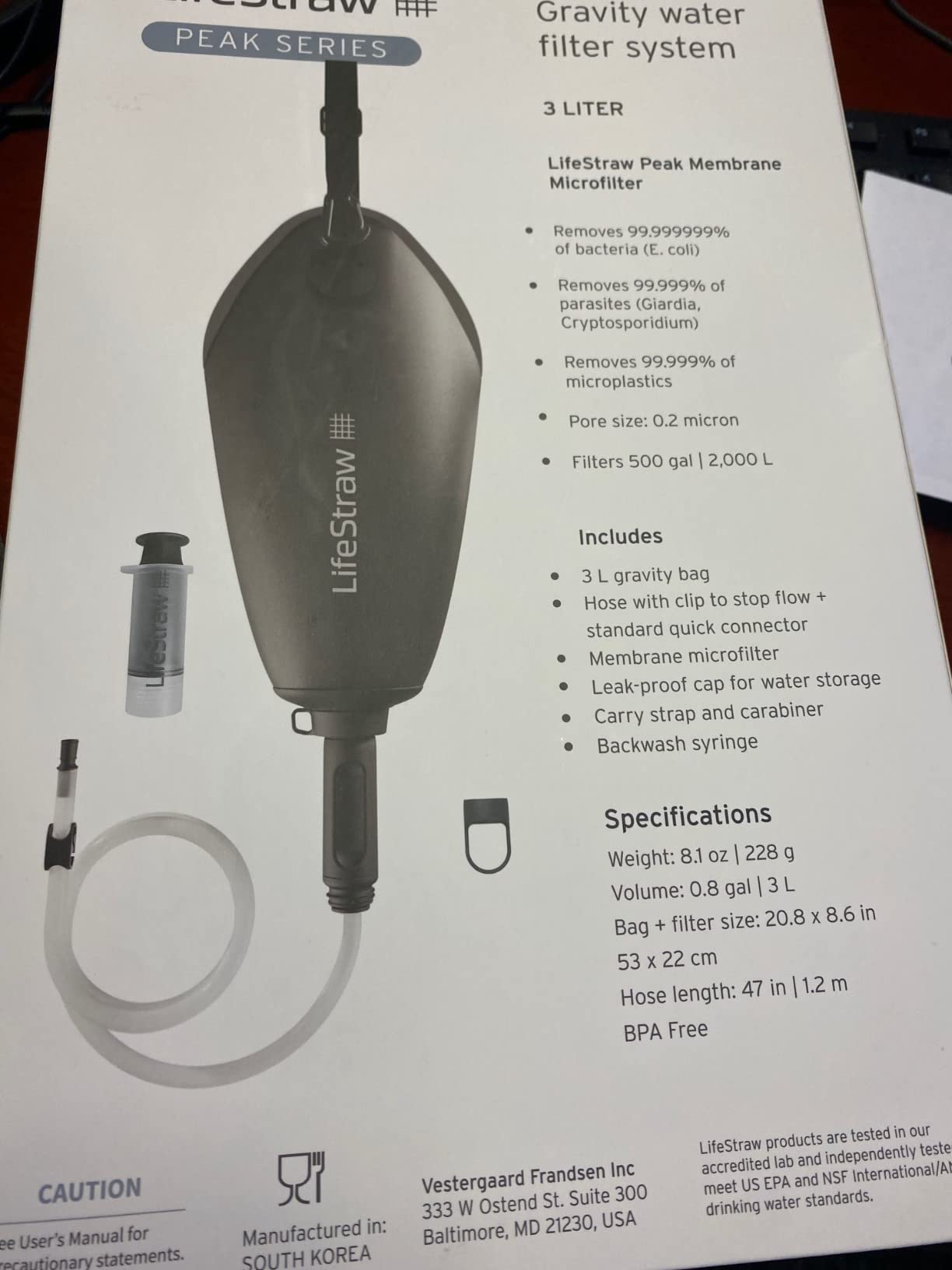
The Peak is the same filter in four configurations: a gravity system, a large squeeze bottle, a straw, or a bottle-mounted unit. In an emergency that flexibility is genuinely useful, because you can hand one to a child, clip one to a canteen and hang one by the tent without working out which arrangement fits.
Contaminant claims are specific: 99.999999% of bacteria including E. coli and Salmonella, 99.999% of parasites including Giardia and Cryptosporidium, and 99.999% of microplastics, silt and sand. The membrane was re-engineered with a custom backwash accessory specifically to handle sand and silt better.
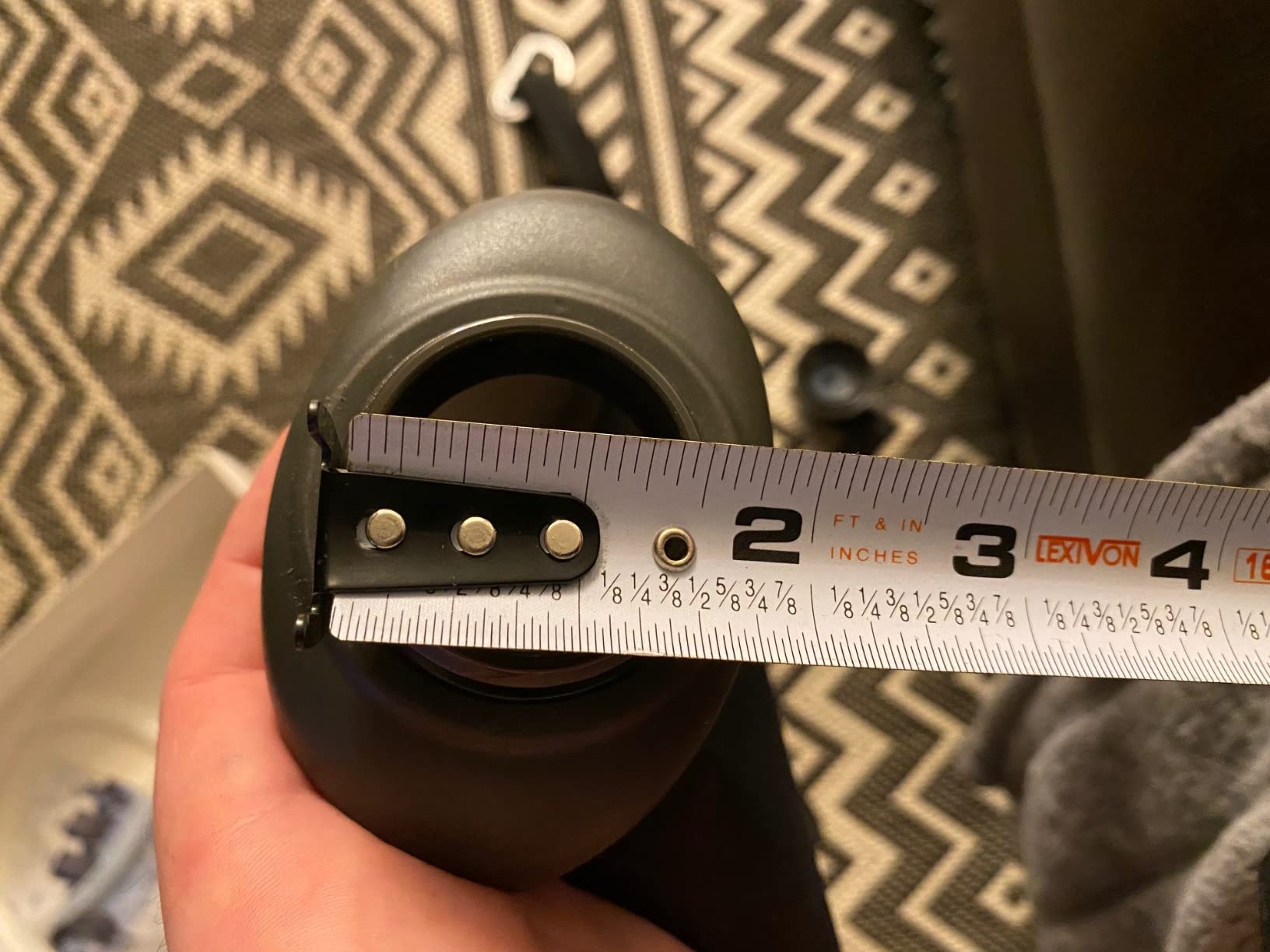
Owners like the compact package and the low weight, and several describe it as a good emergency storage item. The element is easily replaceable, which is more than can be said for every sealed kit.
The recurring drawback is flow. It is slow, and it gets slower as the membrane loads, which is why the backwash accessory matters more here than the marketing copy suggests. Some users also notice a faint rubbery taste on the first couple of runs that clears after that.
What to check before you buy
Capacity is three litres, so it is a day kit rather than a household system. It works best mounted high where the outlet can drain vertically.
Read the cleaning and storage instructions properly before putting it away. Owners who skip that step are the ones who report a lingering tint in the output.
Where it falls short
No virus rating. This sits in the filter tier alongside the other hollow fiber systems here and stops at parasites and bacteria.
At 228 grams for the whole package it is heavier than the 43 gram Sawyer configuration if weight is your primary constraint.
12. GLACIER FRESH PC04 – Best for Improving Tap Water Taste
GLACIER FRESH PC04 Gravity-Fed Countertop Water Filtration System
- Entirely stainless steel construction including the spigot
- Keg style pour spout dispenses smoothly without dripping
- Markedly improves chlorine smell and taste from tap water
- No electricity required so it works during outages
- 2.25 gallon capacity supports up to four people
- Unit is tall and may not fit under low cabinets
- Flow through the spigot is slow
- No easy way to see remaining filtered water
- Replacement filters can be tricky to track down
- Positioned for already drinkable municipal water rather than as a purifier
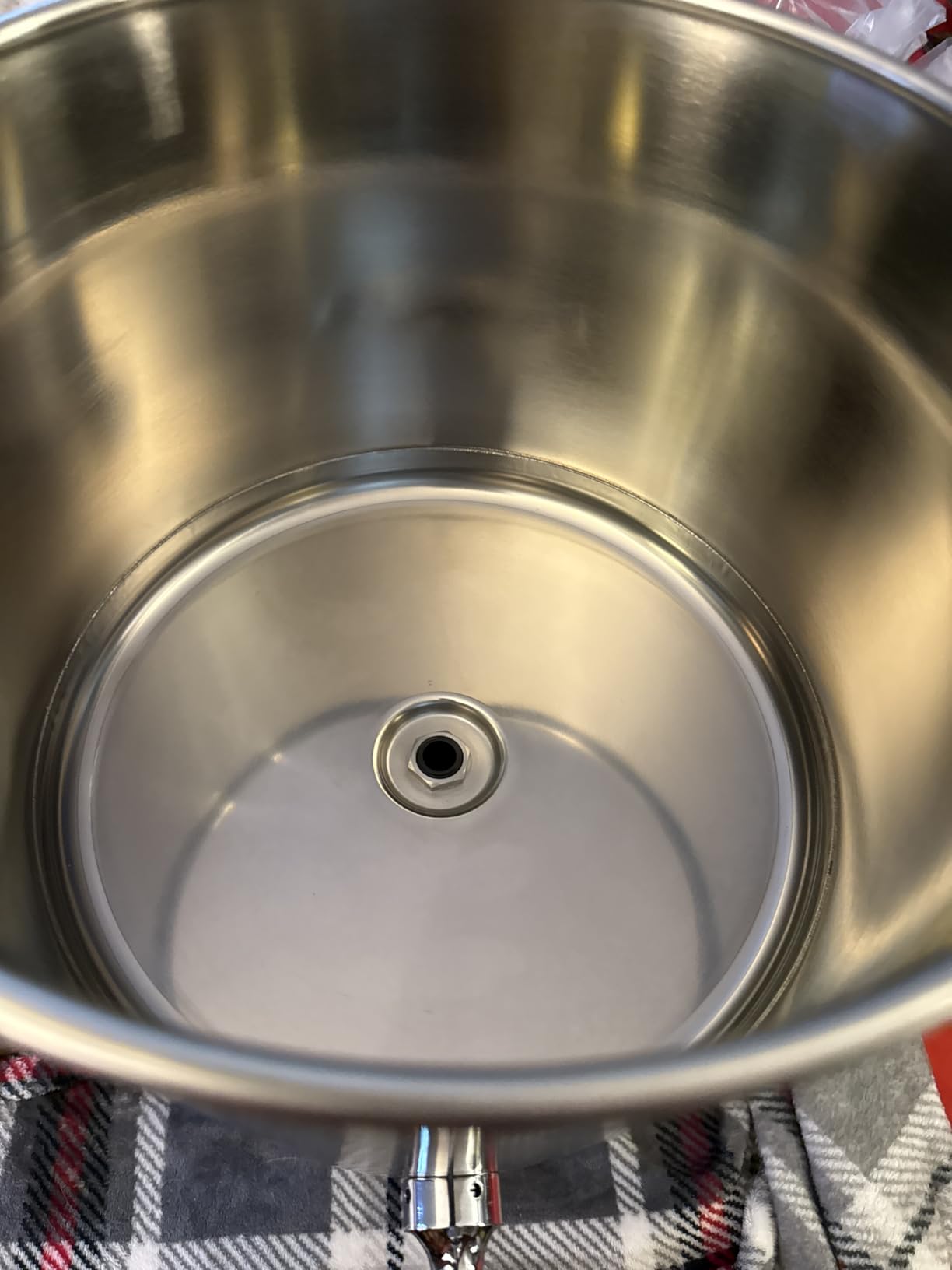
This unit takes a different approach. Rather than a carbon or hollow fiber element, it uses electrosorption media that develop a positive charge when exposed to water at pH 5 to 9, attracting negatively charged submicron contaminants and reducing heavy metals.
It is also the most purely stainless system in the roundup, including the spigot, and the keg-style pour spout dispenses without dripping. Owners filtering chlorinated municipal water report a marked improvement in smell and taste.
The design detail we liked most is the water inlet, engineered to minimise leftover water and prevent stale water sitting in the chamber. In a system you may not touch for months, that is a meaningful advantage over competitors that leave residual water behind.
The record here is small at 108 reviews and 4.4 stars, so weigh the specifications over the feedback volume. Sentiment is broadly positive about build quality, stainless construction and chlorine taste improvement.
What to check before you buy
Physical size. At 14.25 by 13.58 by 16.14 inches, it is bulky and owners specifically flag that it may not clear low-hanging cabinets.
Cartridge availability and cadence. The cartridge delivers up to 200 gallons and the manufacturer advises replacement every three months, a very different consumption pattern from the 6,000 gallon rated pairs elsewhere in this list.
Where it falls short
It is positioned for already drinkable municipal water rather than as a purifier. If your emergency is a boil-water notice or a contaminated source, this is not the tool.
There is no way to see how much filtered water remains without checking inside, flow through the spigot is slow, and one reviewer documented a cartridge attachment breaking and shedding black particles.
Filter vs Purifier: What a Gravity System Can and Cannot Do
Do gravity water filters actually work? Yes, for bacteria and protozoa. No, for viruses or chemical contamination. That split is the most important thing to understand before you buy, and it is where most marketing copy goes quiet.
Here is the pore size logic in plain terms. A 0.1 micron membrane, used by the Sawyer, Waterdrop straw, Katadyn BeFree, SimPure and LifeStraw Peak, comfortably traps bacteria and protozoan cysts because those organisms measure well above that threshold. Viruses measure below it, so they pass through. A 0.02 micron rating, used by the LifeStraw Family, is the point where virus removal becomes a defensible claim. A 0.01 micron membrane, used by the Purewell, is finer still and strips particulates more aggressively.
Finer is not always better. Every step down in pore size costs flow, and the trade-off shows up in how long a system takes to fill. More importantly, no pore size in this category removes dissolved chemicals, pesticides, fuel, solvents or PFAS. Those molecules are far smaller than any membrane here. If a flood has washed industrial or agricultural contamination into your source, filtration of any type is the wrong answer.
The test we use: if your water is a municipal supply with a boil-water notice, a filter tier is fine once you have resolved the microbial risk. If it is a retention pond, a flooded river near homes, or anything with plausible human or animal waste, you need a purifier or a disinfection stage, not a finer membrane.
How Much Water Do You Actually Need?
Plan on one gallon of water per person per day for drinking and cooking, and double it to two gallons if nobody can shower. That single number converts a reservoir size into something actionable, which is where most capacity confusion comes from.
For a 72-hour emergency that is 3 gallons per person. For one week it is 7 gallons per person. A household of four therefore needs 12 gallons to cover three days and 28 gallons to cover a full week. Run that calculation before choosing a reservoir.
Now match it to a reservoir. A 2.25 gallon countertop system holds 2.25 gallons clean at a time, so a family of four drawing 4 gallons a day for drinking and cooking will fill and empty it several times a day. A 1.5 gallon bag system is closer to a day and a half of drinking water for two people.
This is why we recommend two tiers of supply rather than one. Treat the filter as a production tool and keep stored water alongside it. Rotate stored water on a schedule, since a plastic container left in a hot garage for three years is a liability rather than an asset. Our whole house filtration guide covers what matters when the source itself needs treatment rather than emergency treatment.
What NSF/ANSI 42, 53 and 372 Actually Tell You
NSF/ANSI 42 certifies a filter for aesthetic claims: chlorine, taste, odour and sediment. NSF/ANSI 53 certifies reduction of actual health contaminants including bacteria, protozoa and, for some systems, viruses. NSF/ANSI 372 covers lead-free compliance of the wetted materials. They are not interchangeable, and a listing on one says nothing about the others.
In this roundup, the Purewell PW-OB and the Waterdrop TK both carry NSF/ANSI 42 and 372 certification on their carbon components. That is a real, checkable claim from a third party, and for a preparedness purchase we weight it heavily.
Be equally careful in the other direction. Some brands publish their own laboratory testing rather than holding ongoing third-party certification, and a familiar brand name is not a substitute for a listing you can verify. One competitor page in this category states that Berkey systems are NSF-certified while its own comparison table shows no virus removal for other models. That contradiction is exactly the kind of thing to check for yourself before relying on any roundup, including this one.
Priming, Backflushing and Storing a Filter You Rarely Use
The most common emergency-gear failure is not a bad filter. It is a good filter that sat in a closet for eleven months and was never primed. Dry elements need re-priming before first use, and the procedure is not optional.
To prime a new or long-stored system: attach the faucet adapter to a tap, soak the element until it stops absorbing water, then run water through it until the output runs clear without air bubbles or black particles. Manufacturers differ on exact steps, so follow the instructions for your model. For the Black Berkey systems specifically, priming is the most commonly cited owner frustration, which is why we recommend doing it on a calm day and keeping a spare element on hand.
Backflushing is the habit that keeps hollow fiber elements alive. Push clean water backwards through the element in short bursts, which dislodges the sediment that slows flow. The Sawyer, LifeStraw Peak, SimPure and Waterdrop straw all support some form of backflushing, and it takes seconds.
Before storage, drain every chamber and bag completely, let the parts dry fully, and pack the sealing washers and gaskets separately so they cannot dry out bonded to the housing. Keep the whole package somewhere freeze-free. Then run the red dye test before you rely on the system: add a small amount of red food colouring to the upper chamber, filter, and confirm no red reaches the output. That test is the community standard for checking breakthrough and it takes two minutes.
The Four-Layer Emergency Water Stack
No single gravity filter covers every emergency, so treat filtration as one layer of four. Adding layers is the difference between a filter and a plan.
Layer 1: sediment control. Settle turbid water in a container for several hours, then pour it through a cloth, a bandana or a sediment sock. This step protects your element more than any other habit and it costs nothing. Users filtering flood or pond water who skip this clog elements far faster than the rated lifespan suggests.
Layer 2: the gravity filter. Run the pre-filtered water through your gravity system. At 0.1 micron this handles bacteria and protozoa. At 0.02 micron or finer it adds virus reduction.
Layer 3: disinfection for unknown or contaminated sources. Chlorine dioxide tablets are the most practical option because they need no power and have a multi-year shelf life. UV purifiers work but require batteries, and boiling works and costs fuel and time. Use this layer whenever the source is not a known municipal supply.
Layer 4: stored water rotation. Fill containers with treated water, label them with the date, and rotate on a schedule you will actually keep. Stored water is the layer people forget, and it is the only one that keeps working after the filter element is exhausted.
How to Choose a Gravity Water Filter for an Emergency
Start with the scenario, not the spec sheet. A 72-hour go-bag and a household outage have almost nothing in common, and buying for the wrong one is the most common mistake in this category.
For a vehicle kit or bug-out bag, weight beats capacity. The Sawyer SP160 at a 2 ounce filter, the SimPure at 2.8 ounces, or the Waterdrop straw are the realistic answers. Anything in stainless steel belongs in a shelter, not on your back.
For a household outage, capacity and counter footprint decide it. The Big Berkey, Waterdrop TK and Purewell PW-OB are all 2.25 gallon countertop systems, and the difference is certification and sight gauges rather than core filtration. For renters who cannot touch plumbing, any of them works with zero installation.
For flood water or an unknown surface source, virus risk changes the answer. Choose a purifier-rated system such as the LifeStraw Family at 0.02 micron, and carry disinfection tablets as a third layer regardless.
For a group basecamp, throughput matters more than pore size. The Katadyn BeFree at 2 litres per minute and a 10 litre bag serves more people per hour than any finer membrane in this list, and its tool-free swish cleaning keeps it moving.
Beyond scenario, four criteria decide most purchases. First, rated life in gallons, because that is the number users actually compare and it drives cost per gallon over five years. Second, certification, since a third-party listing beats a brand’s own testing. Third, spare parts availability: bulbs, clamp rings, spigots, gaskets and washers sold separately keep a system alive instead of forcing full replacement. Fourth, storage behaviour, specifically whether the system drains dry and whether the element survives months untouched.
If you also want a broader look at filtration, our whole house city water guide and well water iron filter guide cover the whole-property end of the problem.
What We Would Skip
We would skip any sub-2-litre jug system without a clear pre-filter path. When the cartridge clogs on debris and there is no way to backflush or upstream filter, you end up discarding a cartridge that should have lasted a season.
We would also skip straws carrying a 30-day filter warranty for preparedness use. A warranty that short tells you what the manufacturer expects the element to survive, and that is a poor bet when the system sits unused for a year at a time.
And we would skip any roundup, including this one, that tells you a 0.1 micron filter handles viruses. It does not. Check the pore size, check the certification listing, and add a disinfection stage when the source is uncertain.
Frequently Asked Questions
Do gravity water filters actually work?
Yes, for bacteria and protozoa such as Giardia and Cryptosporidium, and no for viruses or chemical contamination. A 0.1 micron element traps organisms well above that size but lets most viruses pass. Virus-rated systems use 0.02 micron membranes or finer. No gravity filter removes pesticides, fuel, solvents or PFAS, so add chlorine dioxide tablets, UV or boiling when the source is contaminated.
What is the best water filter system for emergencies?
The best system depends on the scenario. For a household outage the Big Berkey 2.25 gallon or Waterdrop TK countertop systems give capacity without power. For a go-bag the Sawyer SP160, SimPure or Waterdrop straw win on weight. For flood water and unknown surface sources choose a virus-rated purifier such as the LifeStraw Family and carry disinfection tablets as a third layer.
What is the best gravity water filter for home use?
For a home without any plumbing changes, a 2.25 gallon countertop system is the most practical choice. The Big Berkey suits households wanting stainless durability, the Waterdrop TK suits anyone prioritising certification and a sight-glass spigot, and the Purewell PW-OB suits anyone wanting the finest pores and certified components. All three run with no electricity and no installation.
How much water does one person need per day in an emergency?
Plan for one gallon per person per day for drinking and cooking, and up to two gallons if nobody can shower. That makes three gallons per person for a 72-hour emergency and seven gallons per person for a full week. A household of four therefore needs 12 gallons for three days and 28 gallons for a week, which is why a single 2.25 gallon reservoir must be refilled several times a day.
How long can a gravity water filter be stored before use?
It depends on whether it was primed. Dry, unprimed elements can be stored sealed for years and then re-primed before deployment. A primed, wet element stored sealed develops off-flavours and microbial growth, so drain and dry every chamber and bag fully, store the washers separately and keep the whole package freeze-free. Always re-prime and run a red dye breakthrough test before relying on a stored system.
Can I use a gravity filter on muddy water?
Only after sediment control. Mud and silt will clog a hollow fiber element far faster than its rated gallon figure suggests. Settle the water in a container for several hours, pour off the clearer upper water, then pass it through a cloth, bandana or sediment sock before it reaches the filter. Skipping this step is the most common cause of elements failing well ahead of their rated life.
Final Verdict
The best gravity water filters for emergency use are not the ones with the finest pores. They are the ones you will actually have primed, dry and within reach when the water stops. For most households that means a 2.25 gallon countertop system, and the Big Berkey is the one we would own because the stainless chambers survive drops and the elements are easy to reorder.
Pair it with a Waterdrop straw for a portable kit and a box of chlorine dioxide tablets, and you have covered the two scenarios that actually occur. Everything else in this roundup is a variation on that plan, chosen for the size of your household, the weight you can carry and how contaminated you think the water will be.
One last thing. Priming takes twenty minutes, and doing it before you need it is the difference between a working filter and an expensive paperweight.