
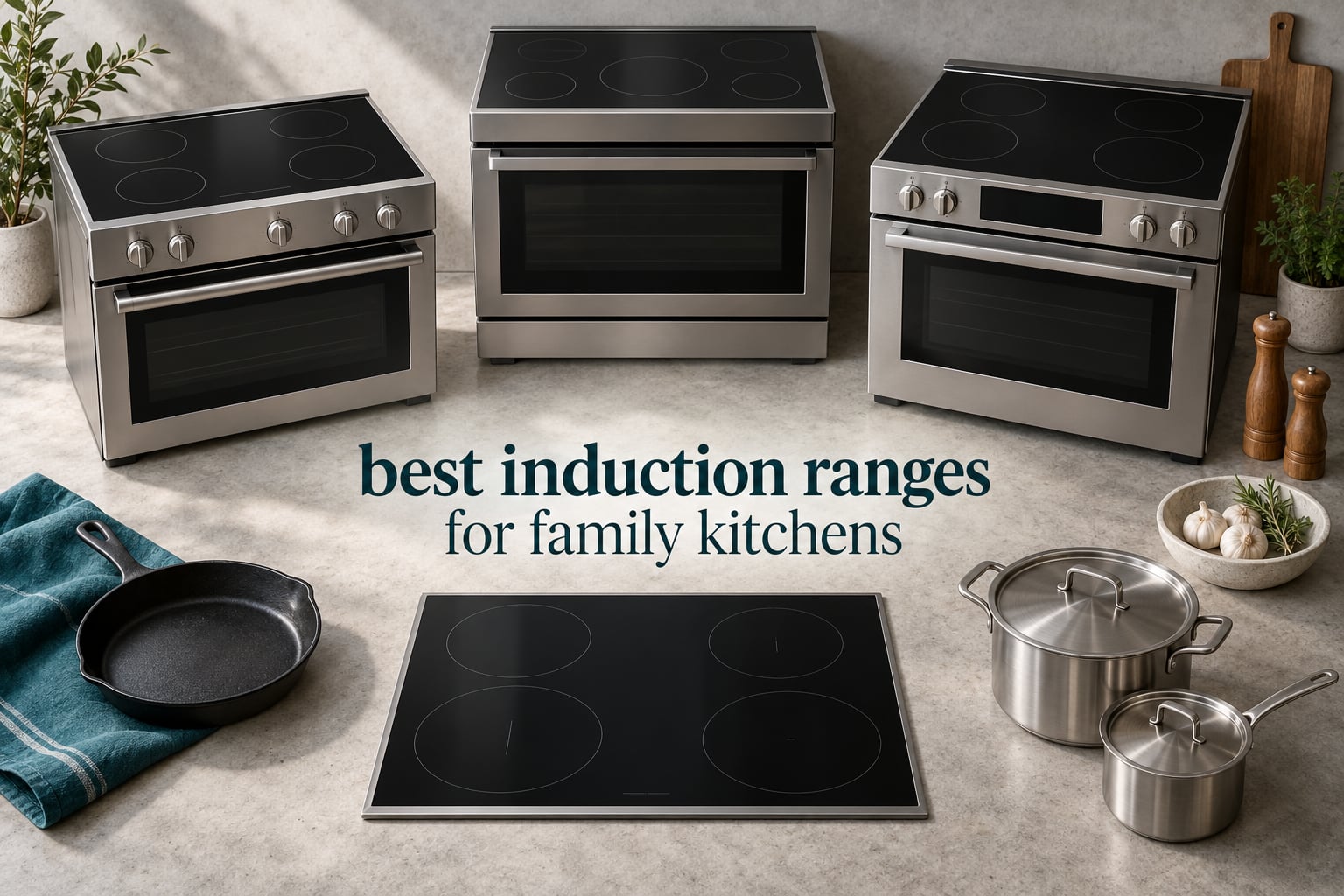
An induction range is a freestanding or slide-in appliance that heats cookware directly with an electromagnetic field instead of heating a coil or burner first. Only the pan gets hot, the glass surface stays cool enough to wipe clean in seconds, and nothing continues radiating heat after you lift the pot off. For a family kitchen, that combination is why people switch: faster weeknight cooking, a surface that does not scorch, and a cooking zone that cools almost immediately when dinner is ready.
Choosing the best induction ranges for family kitchens is harder than it looks, because the cooktop and the oven are usually sold as one appliance and reviewed as one appliance. Families who switch from gas tend to love the cooktop and feel disappointed by the oven that came with it. That pattern shows up again and again in appliance forums, alongside a second recurring theme: nobody tells you whether the range needs a 40 amp or 50 amp circuit, and finding out after delivery means a panel upgrade and a hole in the remodel budget.
We compared eight cooktop-plus-oven induction ranges on the factors that decide whether a range works for a household rather than a showroom: oven capacity in cubic feet, how many cooking positions there are and how big they are, whether the controls are knobs or a touchpad, what the oven actually offers beyond convection, and how large the review base is for the unit. We read every owner review we could find rather than relying on spec sheets alone, because element geometry problems only show up after cooking on them.
One honesty note before the picks. This list is smaller than most roundups you will find, and that is deliberate. Full-size induction ranges with a real review history are still a thin category on Amazon, so several units below have one to five reviews total. Where that is the case we say so plainly and treat the specifications as manufacturer claims rather than verified performance. What we can verify is the size of the review base, and we weigh it heavily.
Top 3 Best Induction Ranges For Family Kitchens (October 2026)

KoolMore 36 Inch Induction
- 11 kW cooktop
- 6.0 cu. ft. convection oven
- Pizza and proof modes
- 3-year warranty
Best Induction Ranges for Family Kitchens in 2026
| Product | Specifications | Action |
|---|---|---|
| Frigidaire GCRI3058AF 30 Inch Induction Range |
|
Check Latest Price |
| Kenmore 5.6 cu. ft. Induction Range |
|
Check Latest Price |
 Rangaire RRI303GS 30 Inch Induction Range Rangaire RRI303GS 30 Inch Induction Range |
|
Check Latest Price |
| KoolMore 36 Inch Professional Induction Range |
|
Check Latest Price |
 Frigidaire Professional PCFI3670AF 36 Inch Slide-In Frigidaire Professional PCFI3670AF 36 Inch Slide-In |
|
Check Latest Price |
 Forno Donatello 30 Inch Black Induction Range Forno Donatello 30 Inch Black Induction Range |
|
Check Latest Price |
 Forno Leonardo 30 Inch Slide-In Induction Range Forno Leonardo 30 Inch Slide-In Induction Range |
|
Check Latest Price |
 Frigidaire GCFI3070BF 30 Inch 5-Burner Induction Range Frigidaire GCFI3070BF 30 Inch 5-Burner Induction Range |
|
Check Latest Price |
Two things to notice before you read further. First, three of these eight units have a single review on record, and one of those three has an aggregate rating of zero, which means there is no owner feedback to judge at all. Second, the two ranges with the most reviews here are also the two most likely to have familiar problems documented in detail, which is a fair trade if you want to know what you are getting into before delivery day.
1. Frigidaire GCRI3058AF 30 Inch Induction Range with Air Fry
Frigidaire GCRI3058AF / GCRI3058AF / GCRI3058AF 30 inch Induction Range with Air Fry
- Boils water faster than a microwave on the highest setting
- Glass surface wipes clean in seconds
- Built-in air fry and convection get daily use
- Runs cooler than a gas range so the kitchen stays comfortable
- Control panel buttons need several presses to respond
- Round-pan sensors reject a rectangular cast iron griddle
- Convection fan runs on nearly every bake and is loud
This is the unit I keep coming back to for a family of four or five. It is the only range in this group with 23 reviews and a 4.0 average, and that review base is genuinely useful because owners describe the same behaviour over and over: fast boils, near-instant heat changes, and a glass top that is trivially easy to keep clean. Owners also report that switching from gas changed how they cook, because stopping a boil-over is a single tap rather than a turn of a valve.
The oven is 5.4 cubic feet with air fry and convection modes, which is a sensible middle ground for a household that bakes a full sheet pan on Sundays and reheats a lot of leftovers. It measures 29.88 inches wide by 36.63 inches high, so it fits a standard 30 inch opening.
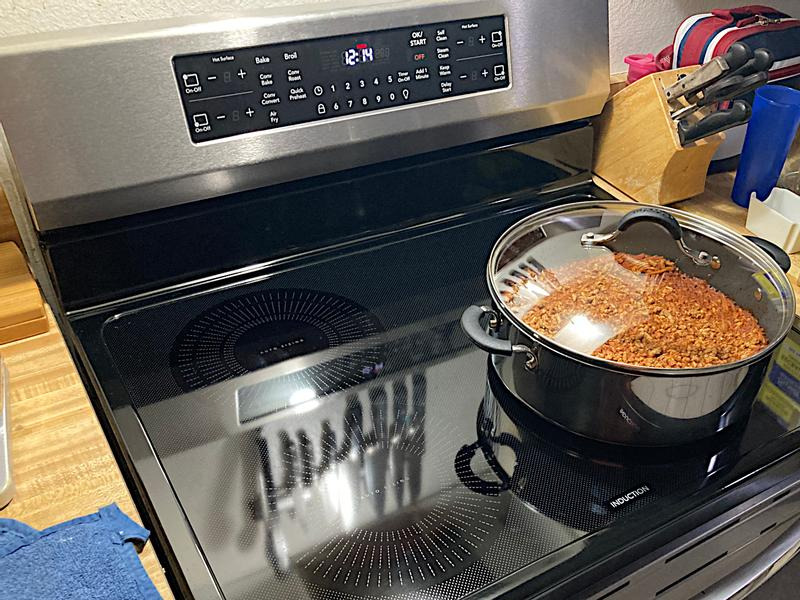
What gives me pause is the control panel. Reviewers repeatedly describe the burner buttons as unresponsive, needing several presses before they register, which is exactly the complaint you will hear from anyone cooking with wet or greasy hands on a busy weeknight. The elements also use round-pan detection rather than true auto-sizing, so a rectangular cast iron griddle will not register at all, and several owners note that only a small circle in the centre of each zone heats.
Two more details belong in any family kitchen evaluation. The convection fan runs whenever the heating element is on, so there is no true non-convection bake, and reviewers describe it as loud and slightly unbalanced. Opening the oven door also releases a sharp wave of steam straight into your face, which matters if your children are tall enough to reach the handle.
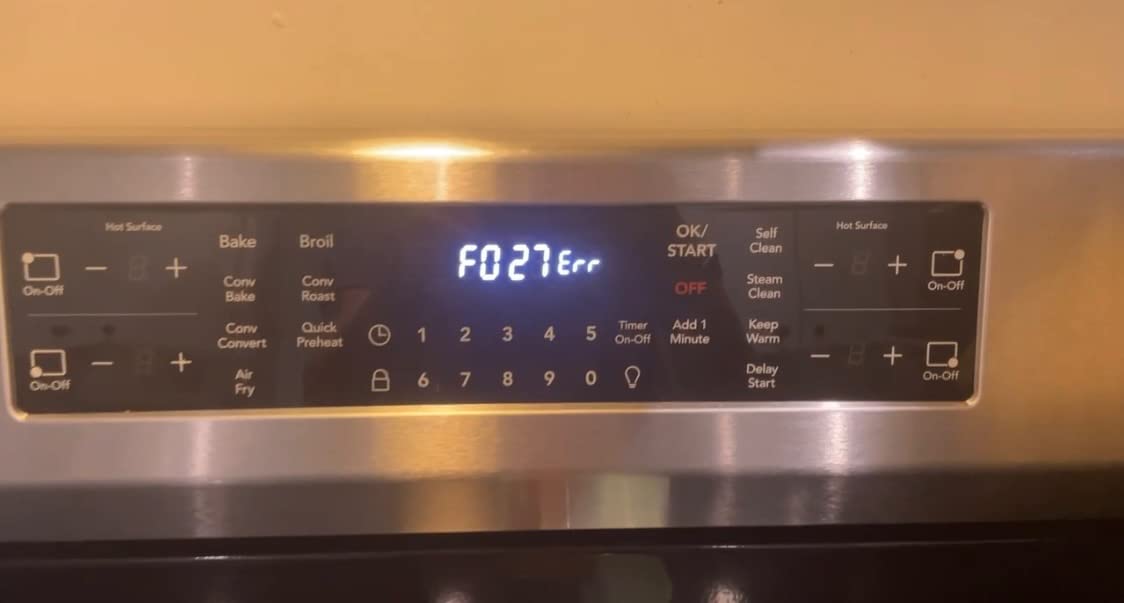
Is 5.4 cubic feet enough oven for a family of five?
For most households, yes. Five cubic feet is the practical middle of this list: large enough for a full sheet pan and two racks of casseroles, small enough that a roast does not push the rack positions to the extremes. It is noticeably roomier than the 4.4 cubic feet model further down this list.
Owners who use this range for a family tend to rely on air fry rather than deep oven bakes, and that is where the 5.4 cubic feet cavity earns its size. If you cook a large holiday turkey every year, the 6.0 and 6.2 cubic feet options are worth the extra footprint instead.
Do the touch controls and the small element zones cause daily problems?
The panel, yes. The zones, only if you use rectangular cookware. The unresponsive buttons are the single most repeated complaint in the reviews, and it is a usability issue rather than a failure, so most owners work around it and keep the range.
The round-pan sensor limitation matters more for a family that owns a rectangular griddle or a large rectangular pan. Standard round pans, including cast iron and tri-ply stainless, work as expected. There is also one documented case of a unit that began throwing error codes within four months and needed repeated service visits, which is worth factoring into a warranty comparison.
2. Kenmore 5.6 cu. ft. Induction Range
- Front knobs lock for child safety
- Built-in air fry handles large quantities
- Self-clean cycle with a hidden bake element
- Turbo boil element heats water quickly
- Power levels cycle full on and full off so simmering is hard
- Elements are small at roughly 4 inches
- Tight layout means one burner for a 12 inch pan
Kenmore built this range for people who do not want a touchpad. The front-mounted knobs are the reason parents keep it, and reviewers specifically call out that the controls lock, which helps when small children are in the kitchen. It weighs 171 pounds, has a 5.6 cubic foot oven with true convection and convection conversion, plus air fry, a self-clean cycle, a hidden bake element, a temperature probe, a halogen oven light, and a storage drawer.
At 3.4 stars across 20 reviews, it is clearly not perfect. But the feature list is the densest on this list for a mid-tier unit, and the oven accessories are standard rather than clipped. The oven measures 25 inches deep by 29.9 inches wide by 36 inches high, which is a normal 30 inch footprint.
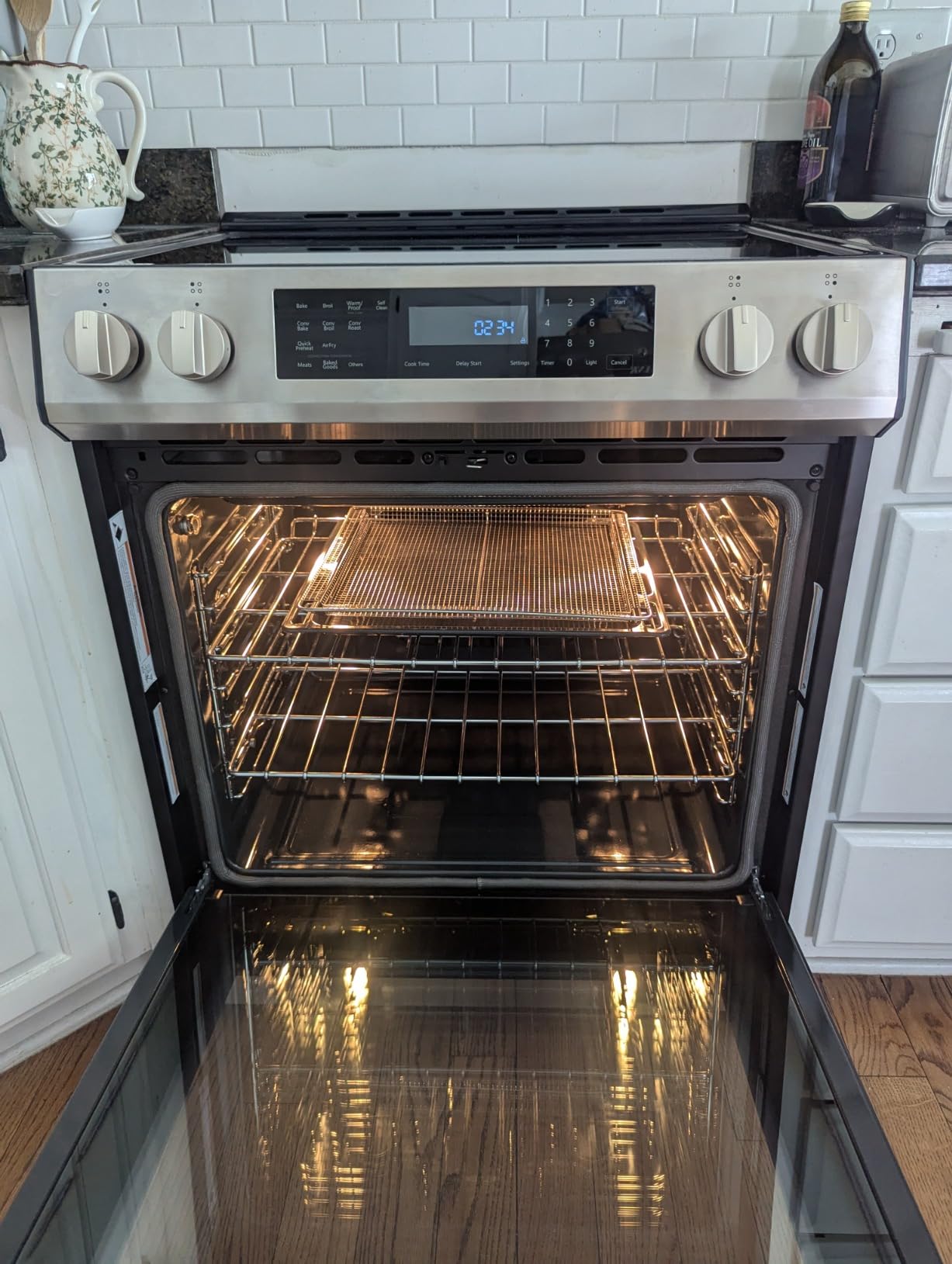
The cooktop is where the complaints concentrate, and they are specific enough to plan around. Owners report that the power settings cycle full on and full off in short bursts rather than modulating, so a steady simmer is genuinely difficult. The elements are also physically small at roughly 4 inches, meaning only the centre of a pan gets hot. Both issues point at the same root cause, and the layout is tight enough that a 12 inch pan occupies most of the surface, leaving one usable burner at a time.
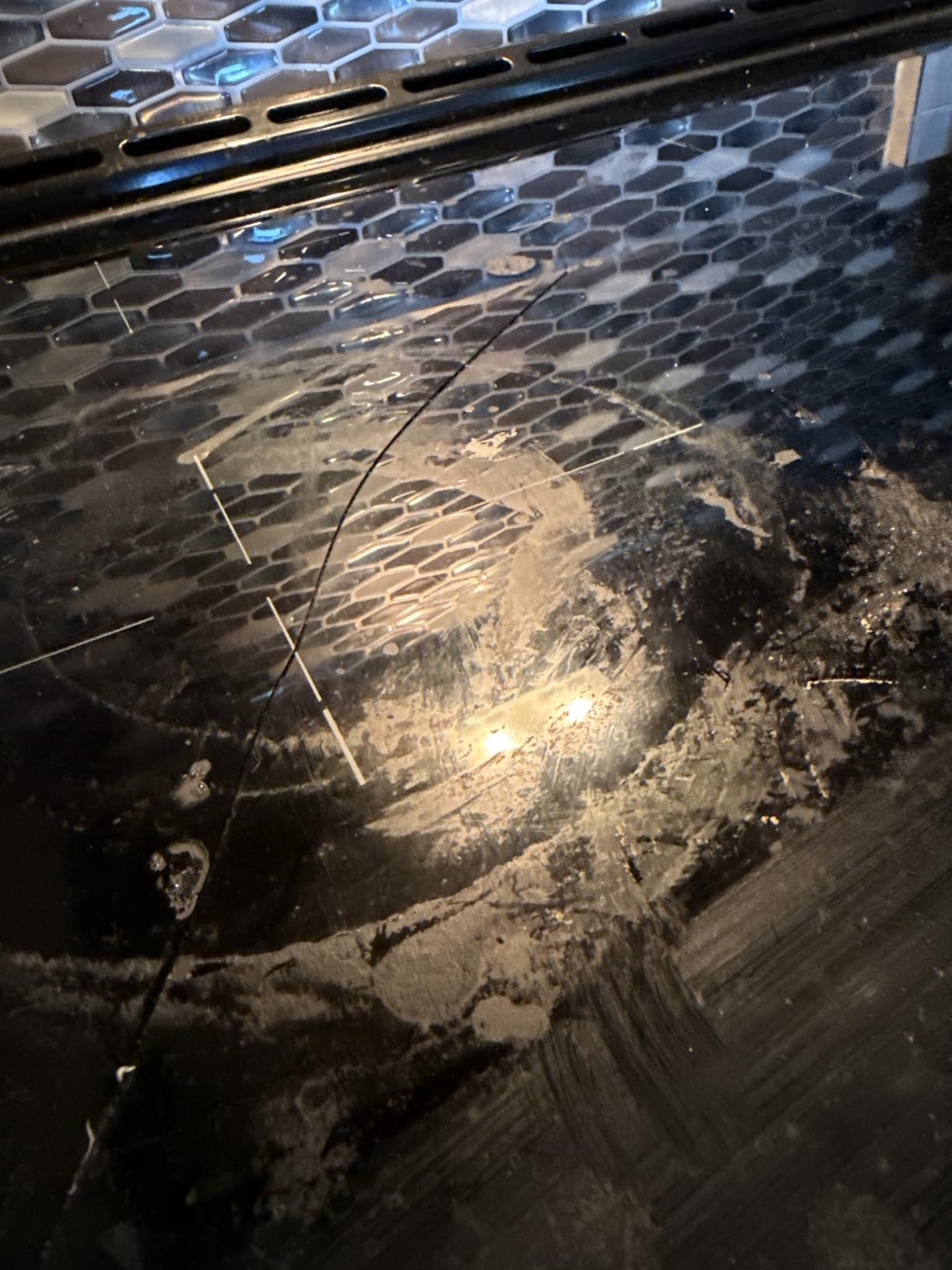
Smaller annoyances include element position markings that are two intersecting lines rather than circles, random beeps during use, a preheat beep that is quiet, cooktop clicking and humming, and metal-handled pots that vibrate on the glass. The timer needs a manual-referenced sequence to start, and no power plug is included. One owner also documented a cracked cooktop plate inside the warranty period that the manufacturer declined to cover and later listed as obsolete.
Are four small induction elements enough for a family of five?
Four elements are enough for most weeknight cooking, but not because of the count. It is the size of each element that limits this unit. Reviewers describe roughly 4 inch heating areas and a layout so tight that a 12 inch pan takes up nearly the whole cooktop, which means simultaneous cooking happens one dish at a time on the hob.
If your family cooks two pots at once, boil pasta while a sauce reduces, or run a large stockpot, a five-burner layout will serve you better. The oven side of this range is the more impressive half.
Does the power cycling make sauces and slow cooking unusable?
It makes them annoying rather than impossible. The turbo boil element heats water quickly, which is what most families use induction for, and the self-clean cycle plus hidden bake element reduce the daily cleanup burden. Low-temperature work like a béchamel or a long braise needs more attention because the element cycles rather than holding a steady low output.
Weigh the one-year appliance warranty against that behaviour. It is the shortest coverage on the list, and it arrives with no power plug, so budget for an electrician alongside the appliance delivery.
3. Rangaire RRI303GS 30 Inch Glass Touch Induction Range
Rangaire RRI303GS 30″ Glass Touch Induction Range Oven – Stainless Steel, Induction Burners, True Convection, Self Cleaning, Easy Reach Racks
- 8800W total cooktop with a 3700W boost on the right rear
- Oversized die cast metal knobs grip well with wet hands
- Air fry basket and installation kit included
- Smooth glass surface wipes down easily
- Largest burner heats only a small central circle
- Printed surface markings overstate the real burner size
- Burners shut themselves off mid-cook
- Convection oven has pronounced hot and cold spots
On paper, the Rangaire lists 8800W of total cooktop power, with a right rear burner rated at 2300W and a 3700W boost. It also carries a 5.0 cubic foot TrueAire convection oven with its own element and fan, self-cleaning, three racks, a meat probe, and oversized die cast metal knobs. The box includes an air fry basket and an installation kit, and the warranty is a one-year limited parts and labor plan.
That is a strong specification sheet. The problem is what owners actually report back, and with only 5 reviews averaging 2.6 stars the signal is not encouraging. The clearest theme is that the geometry on the paper does not match the geometry on the glass.
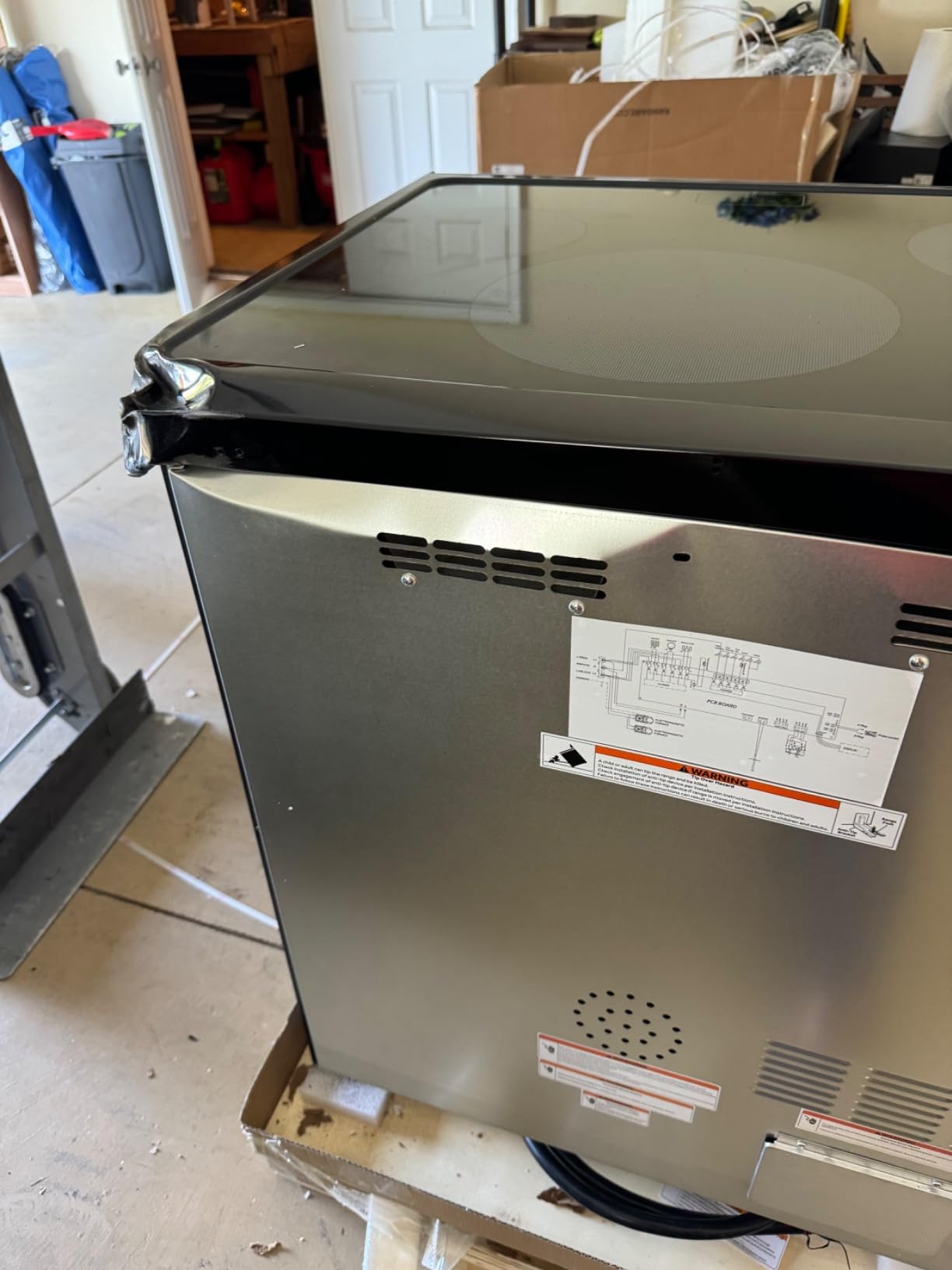
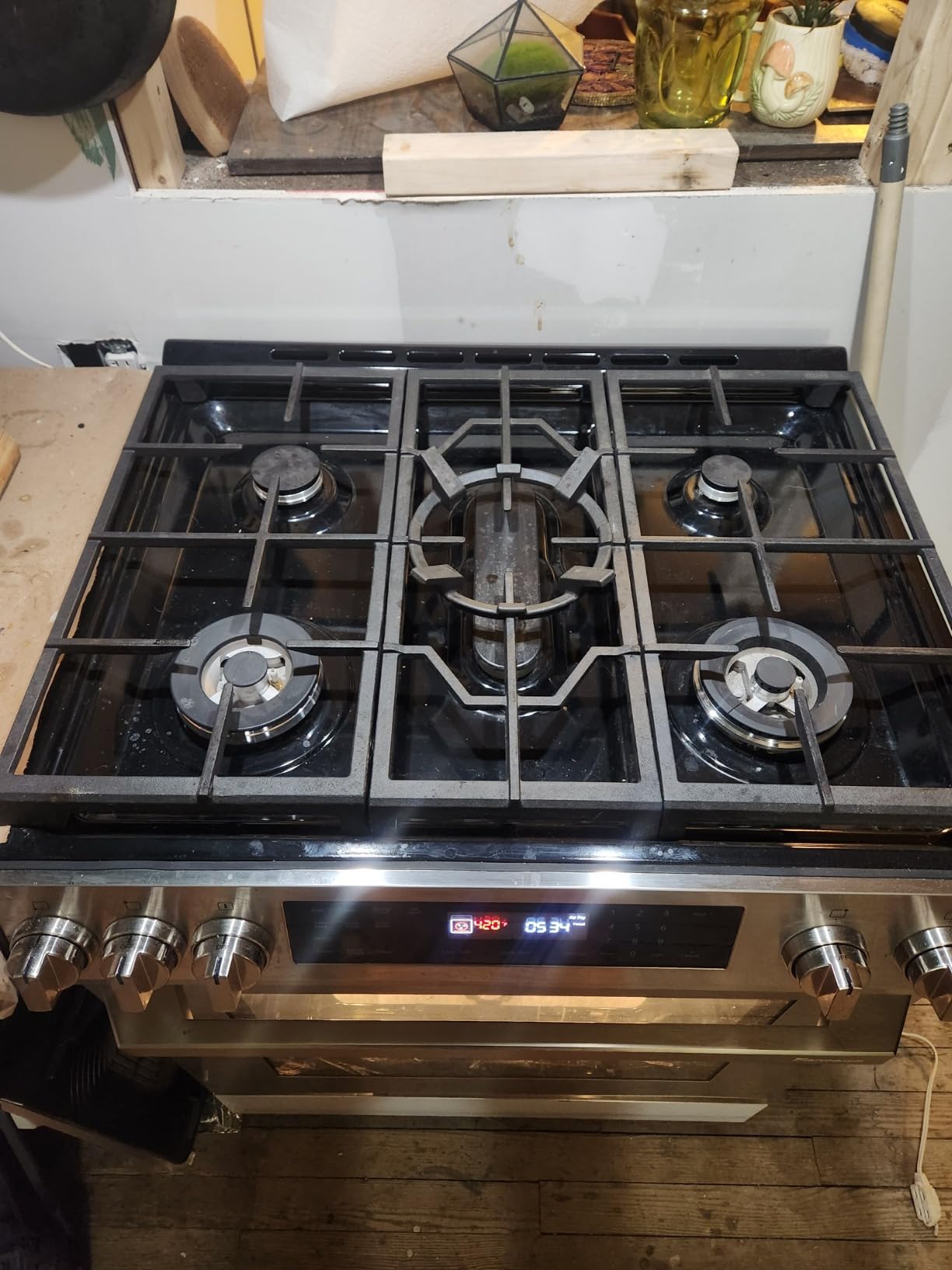
Several reviewers describe the large burner heating only a small 6 inch circle in the centre, scorching the middle of a pan while the sides stay raw. The printed surface markings overstate the true burner size, so you place a pan over what looks like a large zone and get a small hot spot. Half the numbered power settings reportedly do not work, and burners have been observed powering down on their own mid-cook.
The oven draws the same complaint. Convection is called ineffective because of pronounced hot and cold spots even with the fan running, which is a problem for anyone planning to bake regularly. On the positive side, customer service is described repeatedly as helpful and responsive, and at least one owner reports a year and a half of satisfied everyday use. One reviewer also notes that the small-burner limitation is common to many induction ranges at this level, which is useful context when you are comparing.
Is a boost burner useful if the underlying element is small?
Only partly. Boost power shortens the time to boil, which is a real benefit on a weeknight when everyone is hungry. It does not widen the heated area, and on this unit the heated area is the core complaint, so the boost does not solve the problem buyers are reacting to.
The oversized die cast knobs are the sleeper feature here. In a family kitchen they are easier to grip than a glass touchpad with messy hands, and reviewers say they stay clean. If your priority is control feel rather than raw wattage, that matters more than the headline number.
Should a family buy a range with only five reviews?
Generally no, and this is the clearest case in the list. With 5 reviews, a 2.6 average, and 34 percent of ratings at one star, there is not enough owner history to separate a design problem from a few unlucky units. The published wattage here is a spec sheet claim rather than a measured result.
If you are drawn to it anyway, the deciding question is whether your kitchen already has a 30 inch slide-in opening, since that is the listed installation type, and whether you will be satisfied with a 5.0 cubic foot oven rather than the 6 cubic foot options here.
4. KoolMore 36 Inch Professional Induction Range
- 11 kW induction cooktop
- 6.0 cu. ft. true convection oven suits family meals
- Pizza and proof and dehydration modes
- 3-year parts and labor warranty
- A rear burner locked into bridge mode and stopped working
- Oven temperature must be re-entered each time
- Firmware update needed to add temperature increment controls
For a family that actually cooks for six, the KoolMore is the range in this group with the most headroom on paper. It runs 11 kW on the induction cooktop, has a 7.8 kW true convection oven at 6.0 cubic feet, and offers bake, convection bake, broil, roast, air fry, pizza, proof, dehydration, keep warm, and fast heat modes. There is a front-mounted touchscreen with delay bake and a sync burners function that links two zones into one long surface.
It is one of just two 36 inch models here, and the one that carries a 3-year parts and labor warranty, which matters more than any smart feature when you are planning to keep a range for a decade. It is CSA certified, hardwired at 240 volts, and weighs 243 pounds. Owners describe the installation as straightforward with a hardwired cord connection.
All three reviews are five-star, and all three are short. What they support is that the range is powerful, precise, fast, easy to clean, and better value than other 36 inch induction models owners compared against. They also report it as more efficient than the gas and electric range it replaced, and owners like the air fry mode and the wider mode list for serious cooking.
The most useful note in the reviews came in February 2026, when a rear burner locked into bridge mode and stopped working on its own. It required a technician visit and a wait on a replacement part. That is a single isolated report rather than a pattern, but it is a reminder that a 36 inch slide-in with this much electronics needs a service plan you can actually reach, and it is the argument for checking local service availability before you commit to a less common brand.
Is a 36 inch range worth the space in a family kitchen?
It is worth it when you genuinely use the width. A 36 inch cooktop gives you room to run a large stockpot and still have clear space beside it, which is the everyday complaint families raise about 30 inch induction layouts. The 6.0 cubic foot oven also handles a bigger roast and more simultaneous rack cooking than anything else here.
It is not worth it if you are replacing a 30 inch range in a narrow opening or a galley layout. The unit measures 35.87 inches wide by 29.33 inches deep, and the countertop above it needs clearance for the raised control position. Our guide to the best ranges for small kitchens covers the narrower options in more detail.
Is the hardwired installation a problem for a remodel?
Not if you plan for it during the remodel and not after. A hardwired 240 volt connection means an electrician sets the circuit and the receptacle type before delivery, and the range is not plugged in by a standard delivery crew. If your existing outlet does not match, that is a wiring change before the appliance arrives rather than after.
The 3-year parts and labor warranty partially offsets the brand-unfamiliarity risk. Compare that against shorter one-year coverage on cheaper units, and against how easy it is to find a technician in your area who has worked on this chassis before you order.
5. Frigidaire Professional PCFI3670AF 36 Inch Slide-In Induction Range
Frigidaire Professional 36 in. 5 Element Slide-in Induction Range in Stainless Steel with Dual Fan Convection PCFI3670AF
- Stainless professional styling on a 36 inch slide-in chassis
- Dual fan convection oven for even baking
- Knob controls suit buyers who prefer dials
- Holds baking and broil functions in a lower drawer
- One owner received a unit showing an E6 error code on install day
- Induction top serviced and replaced repeatedly
- Burners shut off mid-cook in daily use
The appeal of this range is cosmetic and dimensional. It is a 36 inch slide-in with a professional stainless look, knob controls, dual fan convection, a baking and broil and storage drawer, and a 4.4 cubic foot oven. It weighs 223 pounds, runs on 240 volts, and is hardwired. If you want a 36 inch chassis that looks like restaurant equipment in a renovated kitchen, the physical design is the reason to want it.
With 3 reviews averaging 2.3 stars, the ownership reports are the reason to hesitate. Two detailed one-star accounts describe a range that never worked properly. One arrived not working, showing an E6 error code on installation day, and was still unfixed three months later after multiple technicians and parts orders from two different companies.
The other account describes five services and three replacements of the induction top, random shut-offs during cooking, and the workaround of keeping a cast iron skillet resting on the surface to get the burners to respond. Both reviewers fault the service organisation heavily, citing missed scheduled appointments and no escalation path. A replacement unit reportedly arrived dented and covered in sawdust.
None of that is a statement about induction as a technology. It is a statement about one model with a very thin review base, and it is why we do not put this range higher despite the attractive spec sheet. At 4.4 cubic feet it is also the smallest oven in a 36 inch body on this list, which means you give up width without gaining oven capacity.
Should a family consider this range at all?
Only as an aesthetic choice with a service plan in place. If professional styling is the priority and your kitchen already has 36 inch width, the stainless chassis, knob controls, and dual fan convection oven are legitimate reasons to want it. The 4.4 cubic foot cavity is small for a family, so treat it as a cooktop-first purchase.
What we would not do is buy it without confirming that an authorised service technician is available in your area and without a clear written return path. Three reviews cannot tell you whether the failure pattern is systematic or a couple of bad units, and two owners reporting the same symptom is enough to justify caution.
Is a 36 inch slide-in with a 4.4 cubic foot oven a sensible trade?
Only if your cooking is hob-heavy and oven-light. Dual fan convection helps distribute heat in a smaller cavity, and convection is more effective in a compact oven than a large one. Beyond that, the 6.0 cubic foot alternative on this list gives you more usable volume for the same class of appliance.
Also check the fit carefully. Dimensions are not listed for this model, and slide-in bodies are designed to sit between finished cabinets with no finished side panels, unlike a freestanding range. Our guide to professional slide-in ranges covers how to measure that opening correctly.
6. Forno Donatello 30 Inch Black Induction Range
Espresso Donatello 30″ Induction Range Black, 4 elements, 5.0 cu.ft. True Convection Oven
- Four zones totalling 8100W with a 2500W convection element
- Convection bake and broil and roast plus proof mode
- Blue enamel oven cavity built for heat retention
- Complete hardware kit including basket and pans
- One review on record carrying a zero aggregate rating
- Requires a 50 amp circuit with hardwired 240V
The Donatello is the one to look at if you want a black slide-in that coordinates with black glass cabinetry rather than fighting stainless. It is a 30 inch slide-in with four induction zones totalling 8100 watts, a 5.0 cubic foot oven, and a 2500W true convection element with automatic convection conversion. Cooking modes cover convection bake, convection broil, convection roast, proof, and quick preheat.
The build details are the sort you would want to see on a spec sheet: a speckled blue enamel oven interior, a hidden bake element, a self-clean cycle, friction-resistant door hinges that hold the door open at any position, and heavy-duty control knobs. It includes an air fry basket, broiler pan, drip pan, power cord, and level legs, and it carries a 2-year parts and labor warranty. It is UL and CSA listed and measures 27.62 inches deep by 29.92 inches wide by 37.12 inches high.
Here is the honest limit: there is effectively no owner feedback. A single review is on file with a zero aggregate rating and no written text, so every performance number in this entry comes from the manufacturer specification sheet. Treat the 8100W cooktop, the 2500W convection system, and the mode list as claims rather than verified results.
The practical detail worth planning around is installation. This range requires 240 volts at 50 amps with a pre-installed power cord, which is the highest circuit demand of any unit in this group. If your kitchen has a 40 amp circuit, this is not the model to work around, and that check belongs before you order rather than on delivery day.
Is a 50 amp circuit requirement worth avoiding?
If your kitchen already has one, no issue at all. If it does not, the upgrade is the deciding factor, not the feature list. A panel change is a separate job with its own cost and timeline, and it is the single most common reason families end up choosing a different range than the one they wanted.
A 40 amp circuit handles plenty of full-size induction ranges, so this requirement reflects the specific design rather than induction in general. Confirm what your existing range is on before assuming you need anything upgraded.
What does the blue enamel cavity actually change?
Enamel absorbs and retains heat differently from a bare steel cavity, which is why it is specified for ovens that run a dedicated high-output convection element. In practice it supports more even recovery between bakes and is easy to wipe down because there is no exposed element surface to catch spills.
Paired with the hidden bake element and the self-clean cycle, this is a low-maintenance oven on paper. Without owner reviews we would verify the convection performance and the self-clean cycle in person before committing, since neither can be confirmed from the data available.
7. Forno Leonardo 30 Inch Slide-In Induction Range
Leonardo Espresso 30″ Slide-In Electric Induction in Stainless-Steel, 5.0 cu.ft.
- 8100W induction cooktop across four zones
- 6 rack positions for multi-level family cooking
- Lightest build in this group at 145.5 pounds
- Smudge-resistant stainless with matching knobs
- The only review on record is one star
- 240V requirement needs a dedicated circuit
The Leonardo is the lighter slide-in in the Forno line and the easiest of the 30 inch bodies here to handle during installation at 145.5 pounds, roughly 90 pounds lighter than the 36 inch models. It carries an 8100 watt induction cooktop across four cooking zones, a 5.0 cubic foot convection oven with a single convection fan, and six adjustable rack positions, which is the highest rack count in this group and genuinely useful for batch cooking a week of family meals.
Oven details include a 3550 watt hidden bake element below the oven floor, a speckled blue enamel cavity, two heavy-duty chrome-plated racks, and an integrated hot surface indicator. The exterior is smudge-resistant stainless steel with matching control knobs and a pro-style handle, and it carries a 2-year parts and labor warranty. It measures 27.62 inches deep by 29.92 inches wide by 37.12 inches high, the same footprint as the Donatello.
What we cannot do is vouch for it from owner experience. The single review on record is a one-star rating with no written text, so there is no positive feedback to offset it and no detail about what went wrong. Every attribute above is manufacturer specification rather than verified behaviour, which is a meaningful difference from the Frigidaire and Kenmore at the top of this list.
The six rack positions are the reason to keep it on a shortlist for a family that cooks in volume. Most ovens at this capacity give you five, and the extra position is what lets you stagger two trays of something at different temperatures without blocking airflow.
Do six rack positions make a real difference for family cooking?
They do, but only with a convection fan that moves air well. Six positions in a 5.0 cubic foot cavity means tighter spacing than a five-position rack, so spacing trays too closely reduces circulation. If you plan to use all six regularly, verify air movement in person during a show or showroom bake.
For most families, five working positions with sensible spacing outperforms six cramped ones. Treat the extra position as a bonus for careful batch cooking rather than a reason to buy on its own.
Why does build weight matter during installation?
Because a slide-in goes between finished cabinets and often has to be angled into position, so the person moving it matters more than on a freestanding range with finished sides. At 145.5 pounds, two installers can handle this one comfortably in a tight opening, and there is less risk of dropping it against a countertop or a finished cabinet face.
It still needs a dedicated 240 volt circuit, so the electrical check applies here exactly as it does to the other 30 inch slide-ins. Confirm the circuit rating before ordering.
8. Frigidaire GCFI3070BF 30 Inch Slide-In Induction Range
Frigidaire GCFI3070BF 30-Inch Slide-In Induction Range, 5 Burner Cooktop, Large Convection Oven, Air Fry, Smudge-Proof Stainless Steel
- Five induction burners in a 30 inch body
- 6.2 cu. ft. convection oven is the largest cavity here
- Air fry plus stone-baked pizza and steam modes
- Smudge-proof stainless with knob controls
- The only review on record is a two-word endorsement with no detail
- One-year limited warranty is the shortest in this group
On paper this is the most complete family range in the group at 30 inches. It has a 5-burner induction cooktop, which no other 30 inch unit here offers, and a 6.2 cubic foot convection oven, the second largest capacity on this list. Modes include air fry, stone-baked pizza, steam, and self-clean, with three racks, knob controls, and a smudge-proof stainless steel finish.
Those two specification wins solve real family problems. Five cooking positions mean a stockpot, a saucepan, and a small pan can all run at once on a 30 inch cooktop, which is the everyday scenario that families raise in appliance forums when they ask how many elements they actually need. A 6.2 cubic foot oven in a 30 inch body handles a full sheet pan and two racks with room to spare.
Again, the limit is owner data. The entire review history is a single five-star comment, “We love it!”, dated April 2026, with no detail on any feature. That should be read as one early owner enthusiasm rather than a validated consensus, and it is the entire basis of the 5.0 average.
There is one more thing to weigh, and it is not a cooking question. The warranty is one year limited, the shortest coverage in this group, set against three years on the KoolMore and two years on both Forno units. A 6.2 cubic foot oven and a five-burner cooktop are more electronics to fail than a smaller range, which makes warranty length more relevant here rather than less.
Is a five-burner 30 inch cooktop better than four burners at 36 inches?
For most family kitchens, yes, and it is the single strongest argument for this range. Five positions in a 30 inch footprint preserve the width of a standard kitchen opening while giving you the simultaneous cooking capacity that a 36 inch cooktop provides at 36 inch width. You also keep a 6.2 cubic foot oven, which most 30 inch ranges cannot offer.
The trade is element size rather than element count. Five positions across 30 inches means each zone is smaller, so a very wide pan or a rectangular griddle is harder to place. Check your largest everyday pan against the zone markings before committing.
Should you wait for more reviews before buying?
If you are comfortable being an early owner with a one-year warranty and no verified history, the specification set is compelling enough to consider. If you would rather have evidence, this is the range to watch rather than to rush, because the review base is one comment old.
Ask yourself two practical questions. Do you cook enough at once to use a fifth position, and can you live with one year of parts and labor coverage on a range this complex? If the answers are yes, it belongs on a shortlist alongside the Frigidaire at number one.
How to Choose an Induction Range for a Family Kitchen?
The buying decision for a family comes down to four things nobody can see from a product page: how big the oven is, how wide the elements are, how the controls behave with a child’s hand near them, and what your electrical panel can supply. Get those four right and the rest is preference. Here is how to check each one.
Slide-in vs freestanding: how to check for finished sides?
A freestanding range has finished side panels and stands on its own, so it can sit against a wall or beside an appliance without cabinets. A slide-in is designed to sit between finished cabinets, with no visible side panels and often a front control panel that sits proud of the cooktop. Retailer listings label both as freestanding frequently, which is the single most common source of confusion we see in buyer comments.
The test is simple. Look for a photo showing the side of the appliance. If it is a painted or brushed metal panel with a manufacturer badge, it is freestanding. If you see cabinet material or a raw frame, it is a slide-in. Our guide to slide-in ranges for modern kitchens has the measurement details, and the practical rule is to measure the opening rather than the range, since a slide-in needs roughly 30 inches of clear width between finished cabinet faces.
30 inch vs 36 inch and element layout for family cooking
A 30 inch cooktop fits a standard kitchen opening and costs less to replace, but it limits you to one very large pan at a time unless the range has five positions. A 36 inch cooktop gives room for a stockpot and a saucepan side by side, which is the everyday difference families notice at dinner time. The oven side matters too, because a 36 inch chassis does not automatically mean a bigger oven, as the 4.4 cubic foot 36 inch range in this list shows.
Measure the space above the range too. Slide-ins with front controls need countertop clearance that a raised control panel can take away, and a 37 inch tall body under a standard counter needs checking. If your kitchen is narrow or galley-shaped, the right move is to prioritise a five-position 30 inch layout rather than squeezing in a 36 inch body.
Oven capacity and how many people an oven actually feeds
Oven capacity is quoted in cubic feet, and the useful question is what fits rather than who it feeds. As a working guide, 4.4 to 4.6 cubic feet handles a sheet pan and one rack comfortably, which suits a household of two or three. Around 5.0 to 5.6 cubic feet fits a full sheet pan plus a second rack of casseroles, which suits a family of four or five. Six cubic feet and above gives room for a large roast and multiple racks at different temperatures, which suits six or more or heavy holiday cooking.
Also check the rack count and positions, not just the volume. Six rack positions in a 5.0 cubic foot cavity give you more baking flexibility but less spacing per tray, so confirm that air can move with the trays in place. Convection quality matters as much as capacity, and hot and cold spots reported by owners on two of the ranges in this list are a legitimate reason to move to another model.
Electrical circuits: 40 amp vs 50 amp before you buy
Full-size induction ranges run on 240 volts and typically need a dedicated circuit, either 40 amp or 50 amp depending on the model. This is the most repeated question in appliance forums and the one most often left unanswered on a product page. Find out what your existing range is on before you shop: if your current appliance is a standard 30 amp electric range, your circuit may need upgrading for an induction model.
The 50 amp requirement on one of the ranges here is a design choice, not a law of induction. A 40 amp circuit handles plenty of full-size induction ranges, so if you are on 40 amps, you have more choice than you might think. Have an electrician confirm the rating and the receptacle type before delivery, because this is the change most likely to delay an installation. Our guide to induction ranges for energy efficiency covers the running cost side of the decision.
Safety features for homes with children
Induction is inherently safer around children than gas or radiant electric in one specific way: the cooking zone stops heating the moment the pan is removed, and the glass surface itself never becomes the heat source. That removes the red-hot coil problem entirely. Residual heat indicators and automatic shut-off timers add a second layer, and both are worth having in a house with toddlers.
Control design matters just as much. Lockable controls are the single most family-relevant feature on this list, and the Kenmore with locking front knobs is the clearest example, because a child cannot turn an element on without a deliberate action. A touchpad that responds to a stray touch is the opposite problem. If children are old enough to reach the panel, prioritise knobs you can lock, and consider where the range sits relative to a seating area or a doorway.
Which cookware you have to replace when switching?
Induction only works with magnetic cookware, so cast iron and stainless steel with a magnetic base work, while aluminium and copper do not. Families moving from gas often discover this after delivery, when a familiar aluminium saucepan simply will not heat, so the cookware check belongs in the decision rather than after it.
Test any pan with a magnet before you buy. If a magnet sticks to the base it will work. Budget for a replacement set of stainless pots and pans as part of the switch, and keep any cast iron you already own, since that transfers directly. A full cookware migration is the hidden cost that no competitor guide mentions.
Warranty length, service reliability, and what to prioritise
For a family that keeps an appliance for ten to fifteen years, warranty length and local service availability matter more than smart features, which is the consensus in owner discussions. Warranty coverage in this group runs from one year on the Kenmore and the Frigidaire GCFI3070BF, to two years on both Forno units, to three-year parts and labor on the KoolMore. Longer coverage on a complex appliance is worth real money.
Reliability data is mostly reported in video form rather than written reviews, and service rates vary by region more than by brand. What you can control is whether an authorised technician for that model exists near you, and whether induction tops and control boards are available locally. A range with an excellent specification and no local service is a worse family purchase than a simpler one that can be fixed this week. Our guide to induction ranges for modern homes looks at how these choices land in a renovation.
Frequently Asked Questions
What is the most reliable brand of induction range?
Reliability is best judged by warranty length and local service access rather than brand reputation. In this group the KoolMore carries 3-year parts and labor coverage, both Forno ranges carry 2 years, and the Frigidaire and Kenmore units carry one year. Before buying any model, confirm that an authorised technician for that chassis exists in your area and that induction tops and control boards are available locally.
Which brand of induction stove is considered the best?
No single brand wins every category. For a family kitchen the Frigidaire GCRI3058AF is the best-supported pick here, with 23 reviews and a 4.0 average. For control feel and child safety the Kenmore 5.6 cubic foot model has locking front knobs. For cooktop capacity in a 30 inch body the Frigidaire GCFI3070BF offers five burners and a 6.2 cubic foot oven. Pick on element layout and oven size first.
What is the downside of an induction cooktop?
The main downsides are cookware compatibility and small heating zones. Induction only works with magnetic cookware, so aluminium and copper pots will not heat at all. Many models heat only a small circle in the centre of each zone, which scorches the middle of a wide pan. Power settings on some units cycle on and off rather than modulating, and touch panels can need several presses to respond.
Do induction ranges need a 40 amp or 50 amp circuit?
Most full-size induction ranges run on 240 volts and need a dedicated circuit, either 40 amp or 50 amp depending on the model. A 40 amp circuit handles plenty of full-size induction ranges, so the 50 amp models are a design choice rather than a requirement of the technology. Check what your current range is connected to and have an electrician confirm the circuit and receptacle before delivery.
How many people can an induction range feed?
Oven capacity is the better guide than burner count. Around 4.4 to 4.6 cubic feet suits a household of two or three, 5.0 to 5.6 cubic feet fits a full sheet pan plus a second rack for a family of four or five, and 6.0 cubic feet or more handles a large roast with multiple racks at different temperatures for six or more. For simultaneous cooking, a five-burner 30 inch layout often beats four burners at 36 inches.
Are induction ranges safe for children?
Induction is safer around children in one specific way: the cooking zone stops heating as soon as the pan is lifted, and the glass surface is never the heat source, so there is no red-hot coil. For extra protection choose a range with lockable controls, such as the Kenmore with locking front knobs, and use automatic shut-off timers and residual heat indicators. A touchpad that responds to a stray touch is the feature to avoid in a house with toddlers.
Which Induction Range Should Your Family Buy?
Our pick for most families is the Frigidaire GCRI3058AF, because it is the only unit here with a review base deep enough to trust, and 23 owners describe the same fast, precise, easy-to-clean cooking. It is not perfect: the touch panel needs patience and the elements heat a small central circle, so buy it if you cook with round pots and can live with a firm button.
Buy the Kenmore instead if control feel and child safety decide the purchase, since the locking front knobs are the best answer in this group to a kitchen where children reach the panel. Buy the Frigidaire GCFI3070BF if five cooking positions and a 6.2 cubic foot oven in a 30 inch body matter more than proven reliability, and accept a one-year warranty. Buy the KoolMore if you need 36 inch width and can get a hardwired 240 volt circuit installed first.
Before any of them, test your pots with a magnet and check your circuit rating. Those two steps decide more about whether induction will work in your kitchen than any specification on the list. We will keep updating these picks as owner reviews build on the newer models, and you can see our broader testing on induction ranges for modern homes.