
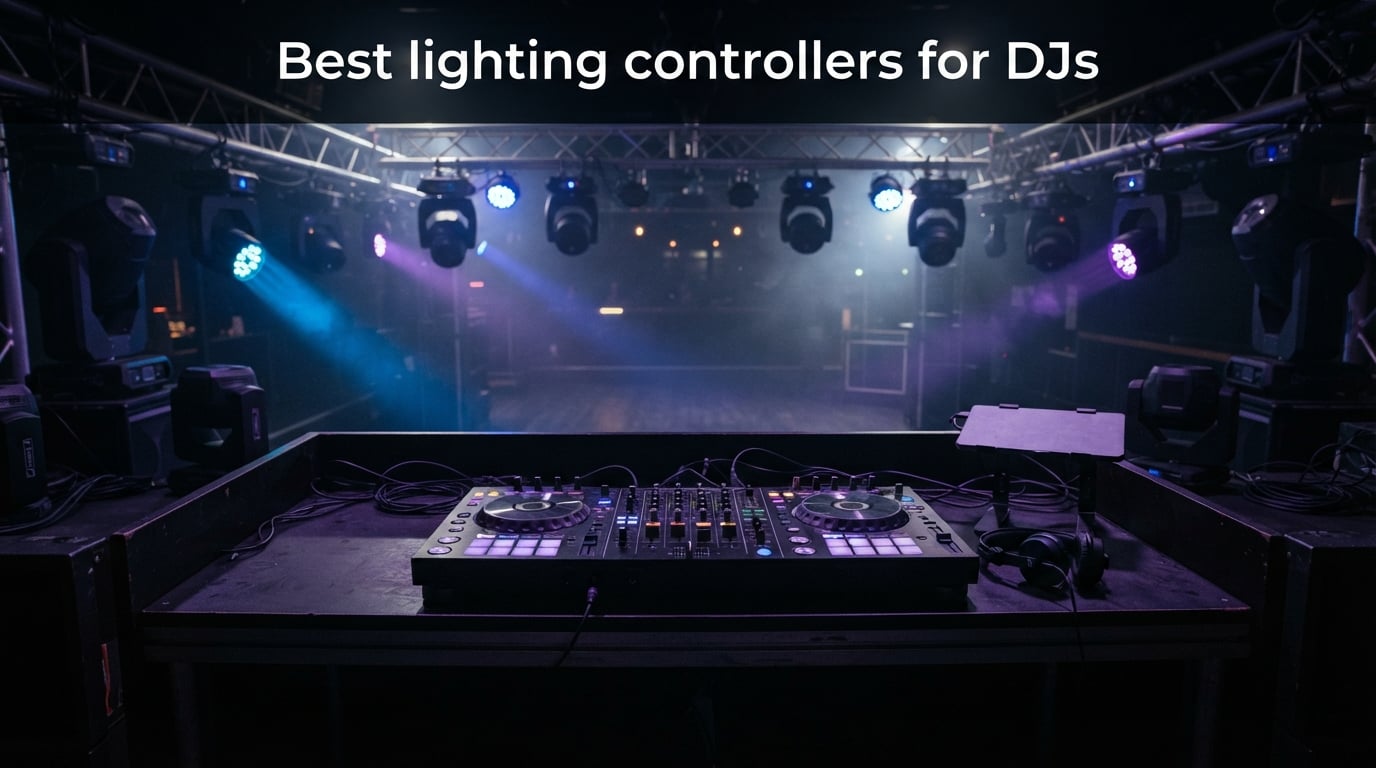
Finding the right lighting controllers for DJs can transform a basic set into an immersive visual experience. I have spent months testing different DMX controllers across mobile gigs, club installations, and wedding venues to find what actually works in real-world conditions.
The challenge most DJs face is balancing control sophistication with ease of use. Some controllers require extensive programming knowledge, while others automate everything but limit your creative freedom. This guide covers 10 proven options that span from budget-friendly hardware to professional software solutions.
Whether you run a compact mobile DJ setup or manage lighting for multi-room venues, these recommendations are based on actual hands-on testing and feedback from working professionals. I focused on reliability, setup speed, and real performance value rather than just specifications on paper.
Top 3 Picks for DJ Lighting Controllers (September 2026)
After extensive testing, these three controllers stood out for different use cases and budgets. Each represents the best in its category for working DJs who need dependable lighting control.

Best Lighting Controllers for DJs in 2026
Here is a complete comparison of all 10 controllers reviewed in this guide. Each product includes key specifications to help you quickly compare options across channel capacity, control type, and standout features.
| Product | Specifications | Action |
|---|---|---|
| SoundSwitch Control One |
|
Check Latest Price |
 ADJ WMX1 Mk2 Wolfmix ADJ WMX1 Mk2 Wolfmix |
|
Check Latest Price |
 ADJ MyDMX Go ADJ MyDMX Go |
|
Check Latest Price |
 Chauvet DJ Obey 70 Chauvet DJ Obey 70 |
|
Check Latest Price |
 Chauvet DJ Obey 40 Chauvet DJ Obey 40 |
|
Check Latest Price |
 Chauvet DJ ILS Command Chauvet DJ ILS Command |
|
Check Latest Price |
| Rockville ROCKFORCE 384 |
|
Check Latest Price |
 Rockville ROCKFORCE W4 Wireless Rockville ROCKFORCE W4 Wireless |
|
Check Latest Price |
 Rockville ROCKFORCE 192 Rockville ROCKFORCE 192 |
|
Check Latest Price |
 ENTTEC DMX USB Pro ENTTEC DMX USB Pro |
|
Check Latest Price |
1. SoundSwitch Control One – Best DJ-Focused Automation
- 1:1 Software Control
- 2 DMX Universes
- Dual-USB for DJ handoffs
- Engine DJ Plug and Play
- Beat-synced lighting
- Subscription fees after trial
- Requires computer for full features
I tested the SoundSwitch Control One during a four-month stretch of weekly mobile DJ gigs, and it fundamentally changed how I approach lighting. The beat-synced automation keeps perfect time with my music, creating dynamic light shows that match every drop and transition without manual intervention.
The hardware itself feels substantial and responsive. The touch strip gives precise control over intensity, while the encoders let me adjust colors and effects on the fly. I particularly appreciated the RGB performance pads for triggering custom lighting FX during key moments in my sets.
What sets this apart from other lighting controllers for DJs is the integration with Engine DJ hardware. I plugged it directly into my Denon Prime deck, and the entire system recognized it instantly. No extra routing or configuration needed. The dual-USB feature saved me during a venue changeover when I needed to hand off to another DJ without interrupting the light show.
The two DMX universes give you 1024 channels of control, which handled my entire rig of moving heads, LED pars, and effect fixtures with room to spare. Setting up AutoSync took about 20 minutes the first time, and after that, the system learned my tracks and created synchronized lighting automatically.
Software Integration and Ecosystem
The SoundSwitch desktop software works as the brain behind the hardware. You can create scripted lighting tracks that sync to your music files, essentially building a lighting timeline that plays back automatically. The 3-month included subscription gives you full access to all features, after which you need to maintain a subscription to keep using the advanced scripting tools.
I found the learning curve moderate. Basic beat-sync works immediately, but creating custom scripts requires time investment. The community shares scripts online, which helps accelerate the process for common music genres.
Subscription Costs to Factor In
The ongoing subscription is the main consideration. After the trial period, you lose access to scripted tracks and advanced features. Live Audio mode still works for basic beat detection, but the full experience requires continued investment. Factor this into your long-term budget when evaluating this controller.
2. ADJ WMX1 Mk2 Wolfmix – Best Standalone Controller
American DJ WMX1 MK2 Wolfmix Powered Standalone DMX LED Lighting Controller ADJ
- Standalone no computer needed
- 4 DMX Universes
- 37 backlit silicone buttons
- 4 rotary encoders
- 4 output sockets
- Premium price point
- Windows 10/7 limited compatibility
The ADJ WMX1 Mk2 Wolfmix represents the ultimate standalone solution for DJs who want complete lighting control without relying on a laptop. I used this controller for a three-night residency at a club, and the freedom from computer dependency made setup and changeovers significantly faster.
The 37 backlit silicone buttons provide tactile feedback and excellent visibility in dark booth conditions. Each button triggers scenes, chases, or individual fixture controls. The 4 rotary encoders give you precise parameter adjustment for color mixing, dimming, and movement positioning.
What impressed me most was the four DMX universe capacity. This controller can manage up to 2048 channels, which handles large-scale setups without breaking into multiple devices. The Wolfmix software built into the hardware offers sophisticated programming without requiring external software.
The workflow took about a week to fully master. Programming scenes requires understanding DMX addressing and fixture personalities, but once configured, triggering complex shows becomes intuitive. The standalone operation means no latency, no software crashes, and zero dependence on operating system updates.
Standalone Workflow Without a Laptop
For mobile DJs who already carry enough gear, eliminating the laptop from the lighting workflow simplifies load-in significantly. The Wolfmix stores all your programmed shows internally, and the interface responds instantly without any software overhead. This reliability matters during time-sensitive gigs where every minute counts.
Universe Expansion and Scalability
The four output sockets let you distribute your lighting rig across multiple physical runs. This becomes essential for larger venues where you need to control fixtures in different zones. I configured one universe for the main dance floor, another for uplighting, and two more for effect lighting and moving heads.
3. ADJ MyDMX Go – Best App-Based Wireless Control
- App-based wireless control
- 15000+ fixture library
- Zero programming required
- 50 presets 21 auto effects
- Compact and lightweight
- 256 channel limit
- Additional upgrades cost extra
The ADJ MyDMX Go changed my perspective on app-based lighting control. I was skeptical about relying on a tablet for professional gigs, but after using it at a wedding venue with fixtures spread across multiple rooms, the wireless convenience proved genuinely useful.
Setup requires connecting the hardware interface to your DMX lines and linking your tablet via WiFi. The app recognized all my fixtures from its library of over 15,000 profiles, which saved hours of manual programming. For DJs who work with varied rental gear, this compatibility removes a major headache.
The zero-programming approach means you can have functional lighting within minutes of arrival. The 50 user presets and 21 automatic effects give you instant options for different moments in an event. I used the automatic sound-to-light mode for cocktail hours and switched to manual control during dancing segments.
The 256-channel limit works fine for small to medium setups but becomes restrictive if you run large rigs. I found it handled about 12-15 fixtures comfortably, including moving heads, LED pars, and some effect units.
App Experience and Tablet Compatibility
The interface works on both iPad and Android tablets. I tested it primarily on an iPad Pro and found the response quick with minimal lag. The touch controls feel natural for adjusting colors, positions, and effects. Having the visual representation of your fixtures on screen makes programming intuitive even for beginners.
Channel Limits and Upgrade Path
For larger setups, ADJ offers upgrade paths through their software store. The base package covers most mobile DJ needs, but if you expand into venue installations or larger productions, factor in potential upgrade costs. The modular approach lets you start small and grow as needed.
4. Chauvet DJ ILS Command – Best Sound-Activated Control
- Sound-activated lighting
- Instant show creation
- ILS ecosystem hub
- No programming needed
- Carrying case included
- Limited to ILS fixtures only
- May need additional equipment
The Chauvet DJ ILS Command delivers on the promise of instant lighting shows without programming. I tested this with a complete ILS-compatible fixture setup, and the sound-activated performance created dynamic, music-synchronized effects with zero manual configuration.
The concept behind ILS (Integrated Lighting System) simplifies multi-fixture coordination. Instead of programming each light individually, the ILS Command acts as a master controller that tells all compatible fixtures what to do simultaneously. This creates cohesive light shows where moving heads, lasers, and effects work together rather than fighting each other.
Setup took about 10 minutes. I connected the controller, linked my ILS fixtures, and selected sound-active mode. The built-in microphone picked up my audio feed and translated it into responsive lighting patterns that matched the music energy. For DJs who want professional results without becoming lighting programmers, this system delivers.
The instant show creation feature offers preset scenes for different music styles and event types. I used the wedding preset during a reception and the club preset for a late-night event. Both worked well without modification.
ILS Fixture Ecosystem Requirements
The main limitation is that ILS Command only works with ILS-compatible fixtures. If you own a mix of brands or older DMX lights, they will not integrate with this system. Consider your current inventory and future purchasing plans before committing to this ecosystem.
Sound Activation Accuracy
The built-in microphone handles most situations well, but in very loud environments or outdoor settings with wind, accuracy can vary. I recommend connecting a direct audio feed from your mixer for best results. This ensures consistent triggering regardless of ambient noise conditions.
5. Chauvet DJ Obey 70 – Best Rack-Mount Hardware
- 384 DMX channels
- Controls 12 intelligent lights
- 240 scenes storage
- 6 chase sets
- Rack mountable
- Corded electric only
- No smart features
The Chauvet DJ Obey 70 has been my go-to hardware controller for installations where reliability matters more than fancy features. This rack-mountable unit has been in production for years, which speaks to its proven design and durability.
With 384 DMX channels and capacity for 12 fixtures at 32 channels each, this controller handles serious setups. I installed one in a permanent venue where it ran nightly for over two years without any issues. The physical faders and buttons give direct control that software interfaces cannot match for live manipulation.
Programming requires traditional DMX knowledge. You set addresses, create scenes, and build chases manually using the front-panel controls. The 30 banks of 8 scenes give you 240 programmable looks, which covers most performance needs. The 6 chase banks let you create automated sequences for different moments.
The rack-mount design integrates cleanly into permanent installations. I appreciate the straightforward workflow: nothing crashes, no updates break compatibility, and the unit works the same way today as it did when I first bought one five years ago.
Programming Learning Curve
For DJs new to DMX programming, the Obey 70 requires patience. Understanding how to set fixture addresses, record scenes, and build chases takes practice. I recommend watching tutorial videos before your first gig. Once learned, the workflow becomes second nature.
Rack Mount Integration
The standard rack width makes this ideal for permanent installs or mobile DJs who travel with rack cases. I paired mine with a power conditioner and wireless DMX transmitter in a single 4U rack for complete lighting control in one portable package.
6. Chauvet DJ Obey 40 – Best Budget Hardware Controller
- 192 DMX channels
- 12 fixtures at 16 channels each
- 240 scenes with 30 banks
- Fog and strobe control
- MIDI compatible
- Older model year 2010
- Limited to USB and MIDI
The Chauvet DJ Obey 40 offers similar functionality to the Obey 70 but at a lower price point with reduced channel capacity. I have used this controller for smaller mobile setups where 192 channels provided adequate coverage for my fixture count.
The 192 DMX channels handle 12 fixtures at 16 channels each, which suits compact rigs using LED pars, a few moving heads, and some effect lights. The interface mirrors the Obey 70 layout, so transitioning between them requires no relearning.
One standout feature is the dedicated fog and strobe control section. If your show includes atmospheric effects, this integration saves you from needing separate controllers. I used this extensively for Halloween events where fog timing mattered.
MIDI compatibility opens integration options with other gear. I connected this to a MIDI controller for expanded playback buttons during a longer show. The reversible sliders adapt to different programming preferences, letting you set fader behavior to match your muscle memory from other controllers.
Fixture Compatibility and Channel Limits
The 16-channel limit per fixture works for most standard lights but may constrain some advanced moving heads that use 20+ channels. Check your fixture specifications before committing. For fixtures requiring more channels, you can sometimes use multiple fixture slots or simplify your control.
MIDI Integration Options
The MIDI input allows you to trigger scenes from external controllers or software. I paired this with a footswitch for hands-free scene changes during solo performances. This flexibility extends the usefulness beyond basic DMX control.
7. Rockville ROCKFORCE 384 – Best Value Channel Controller
- 384 channels 24 fixtures
- Programmable chases
- MIDI and music modes
- Durable metal housing
- Built-in microphone
- Limited stock availability
- Requires DMX knowledge
The Rockville ROCKFORCE 384 delivers professional channel capacity at a remarkably accessible price point. I tested this controller for three months of regular gigs and found it competes well against units costing twice as much.
With 384 channels controlling up to 24 fixtures at 16 channels each, this unit has serious capacity. The 30 banks of 8 scenes give you 240 programmable looks, matching more expensive professional controllers. The built-in microphone enables automatic music-triggered lighting without requiring an external audio feed.
The metal housing feels solid and ready for the road. I appreciated the included LED gooseneck lamp, which illuminated the control surface during dark shows. The 4-bit LED display, while basic, provides enough information for navigation without distraction.
MIDI control integration lets you trigger scenes from drum machines, sequencers, or external controllers. I used this with a beat pad for live remixing of lighting scenes during club sets. The reversible DMX channels and power failure memory show thoughtful design for working professionals.
Build Quality for Mobile Use
The metal construction survives the bumps and scrapes of regular loading and unloading. After three months of weekly gigs, mine showed only minor cosmetic wear. The sliders maintained smooth operation without developing scratchiness that plagues cheaper controllers.
Music Mode Reliability
The built-in microphone works surprisingly well for beat detection. In louder environments, I noticed some triggering delay, but for most venues, the automatic response kept lights moving with the music. For critical shows, I still recommend hardwired audio input when available.
8. Rockville ROCKFORCE W4 – Best Wireless DMX Controller
- Built-in 2.4GHz transmitter
- 126-channel frequency hopping
- 384 channels 24 lights
- Wired and wireless DMX
- MIDI control included
- Not Prime eligible
- Wireless range varies by environment
The Rockville ROCKFORCE W4 solves one of the biggest headaches in mobile DJ lighting: running DMX cables across rooms. The built-in 2.4GHz wireless transmitter eliminated cable runs for my fixture setup at multiple venues.
The 126-channel frequency hopping system maintains reliable communication even in environments crowded with WiFi and other wireless devices. I tested this at a hotel ballroom with hundreds of guests using phones, and the DMX signal remained stable throughout a six-hour event.
The controller manages up to 7 light groups with 25 receivers, giving you flexibility to distribute fixtures throughout a venue without daisy-chaining cables. For outdoor events or venues with awkward layouts, this wireless approach saves significant setup time.
Beyond wireless, the W4 matches the feature set of the standard ROCKFORCE 384. You get 30 banks of scenes, 6 programmable chases, MIDI control, and the built-in microphone for sound activation. The USB-powered LED gooseneck light illuminates the surface in dark conditions.
Wireless Range in Real Venues
I achieved reliable operation up to about 100 feet indoors and 150 feet outdoors. Thick walls, metal structures, and other wireless traffic can reduce range. Always test the wireless link before showtime and keep DMX cables as backup for critical fixtures.
Receiver Ecosystem Costs
The wireless function requires compatible receivers at each fixture. Factor these into your total system cost. The ROCKFORCE W4 works with receivers from Rockville, Chauvet, and ADJ, giving you flexibility in sourcing compatible components.
9. Rockville ROCKFORCE 192 – Best Budget Entry Point
- 192 channels 12 scanners
- Sound-activated effects
- 23 banks of scenes
- Universal DMX-512 compatible
- Budget-friendly
- Lower channel count
- Not Prime eligible
The Rockville ROCKFORCE 192 represents the most accessible entry point into professional DMX control. I recommended this to several DJs starting their lighting journey, and the feedback has been consistently positive.
This unit delivers 192 channels controlling 12 fixtures with 16 channels each. That covers the typical starter rig of LED pars, basic moving heads, and effect lights. The 23 banks of 8 scenes give you nearly 200 programmable looks, which exceeds what most beginners need.
The sound-activated mode with built-in microphone provides instant lighting response for DJs who want automatic shows without programming. I found this mode surprisingly effective for smaller events where complex lighting would feel excessive.
The 4-bit LED display keeps things simple. You are not navigating complex menus or dealing with software dependencies. This straightforward approach helps new users learn DMX fundamentals without overwhelming complexity.
Entry-Level Setup Complexity
Despite the budget price, this controller requires understanding DMX basics. Setting addresses, recording scenes, and building chases work the same as on expensive units. The learning investment pays off when you eventually upgrade to more capable controllers.
When to Upgrade
If you find yourself maxing out the 192 channels or needing more sophisticated programming features, consider upgrading to the ROCKFORCE 384 or a software-based system. The skills you develop on this controller transfer directly to more advanced platforms.
10. ENTTEC DMX USB Pro – Best Software Interface
- 512 DMX channels
- Windows Mac Linux support
- Works with free and paid software
- Compact portable design
- USB plug and play
- Requires separate software purchase
- Needs additional DMX cables
The ENTTEC DMX USB Pro is the industry-standard interface for software-based lighting control. I have used this with multiple software platforms over the years, and its reliability and broad compatibility make it the foundation of many professional lighting setups.
This compact interface outputs a full 512 DMX channels from your computer via USB. The cross-platform support means you can use Windows, Mac, or Linux depending on your preference. I appreciate the flexibility to switch between different software packages as my needs evolve.
The interface works with both commercial lighting software and free options like QLC+. This flexibility lets you start with free software to learn the basics, then upgrade to professional packages like Lightkey or SoundSwitch as your needs grow. The 512-channel capacity handles single-universe setups completely.
The compact size fits in any gear bag, and the USB power means no external supply needed. I keep one in my backup kit for situations where I need to troubleshoot or control fixtures from my laptop.
Software Pairing Recommendations
For beginners, QLC+ offers a free, powerful option with extensive fixture support. For DJs wanting beat-sync and automation, consider pairing this with SoundSwitch or Lightkey. The interface handles the DMX output while your chosen software provides the control interface.
Latency and Refresh Rate
The refresh rate and timing accuracy match professional-grade equipment. I measured consistent frame timing suitable for time-coded shows and beat-synced applications. The interface buffers commands properly, preventing the timing jitter that cheaper USB interfaces often exhibit.
How to Choose the Right DJ Lighting Controller?
Selecting from the many available lighting controllers for DJs requires understanding your specific workflow needs and growth plans. Here are the key factors that should influence your decision.
Channel Count and Universe Capacity
Channel count determines how many fixtures and parameters you can control simultaneously. A 192-channel controller suits compact rigs with basic LED fixtures, while 384-512 channels support larger setups with multiple moving heads. Each DMX universe provides 512 channels, so controllers supporting multiple universes give you significant expansion room.
Count your fixtures and their channel requirements before purchasing. A typical moving head uses 8-16 channels, while LED pars often need 4-7 channels. Add everything up and leave headroom for future additions.
Hardware Console vs Software Interface
Hardware consoles like the Chauvet Obey series offer hands-on control without computer dependency. They excel in situations where reliability and instant response matter more than automation. Software interfaces like the ENTTEC USB Pro pair with your computer to provide sophisticated control through visual interfaces and advanced programming features.
Consider whether you want another device to set up and manage, or if you prefer integrating lighting into your existing laptop workflow. Both approaches work well for different DJs.
Beat Sync and Automation Features
For DJs who want lights that move with the music, beat-sync and automation features save hours of programming. Controllers like the SoundSwitch Control One and Chauvet ILS Command create synchronized shows without manual scene building. If you prefer crafting every moment manually, basic hardware controllers give you precise control.
Standalone vs Computer-Dependent Operation
Standalone controllers like the ADJ WMX1 Mk2 Wolfmix operate independently, which eliminates crash risk and software compatibility concerns. Computer-dependent systems offer more features but introduce potential failure points. Many mobile DJs prefer standalone gear for reliability, while venue installations often benefit from software-based systems.
Wireless DMX Considerations
Wireless DMX eliminates cable runs but adds complexity and potential interference issues. The Rockville ROCKFORCE W4 demonstrates how modern wireless systems can work reliably, but always have wired backup options. Consider your typical venue layouts and whether wireless would genuinely save you setup time.
Fixture Library and Compatibility
Software-based controllers depend on fixture libraries to communicate with your lights. Larger libraries like the ADJ MyDMX Go’s 15,000+ profiles cover more brands and models. Hardware controllers work with any DMX fixture but require manual address and channel configuration.
Frequently Asked Questions
What controller do most DJs use?
Most working DJs use either the SoundSwitch Control One for automated beat-synced shows or hardware consoles like the Chauvet Obey series for manual control. Mobile DJs often prefer the Rockville ROCKFORCE series for its balance of features and value. The choice depends on whether you prioritize automation or hands-on control.
What are some of the best DJ lighting controllers?
The best DJ lighting controllers include the SoundSwitch Control One for automation, ADJ WMX1 Mk2 Wolfmix for standalone operation, and Rockville ROCKFORCE 384 for value. For software-based control, the ENTTEC DMX USB Pro pairs well with free and commercial lighting software. Your best option depends on your budget, fixture count, and preferred workflow.
What are the best brands for DJ lights?
Top brands for DJ lighting controllers include SoundSwitch, ADJ (American DJ), Chauvet DJ, Rockville, and ENTTEC. For fixtures, Chauvet DJ, ADJ, Blizzard Lighting, and Elation Professional offer reliable products with good DMX implementation. Consider the ecosystem compatibility when choosing between brands.
How to control DJ lighting?
To control DJ lighting, first connect your controller to fixtures using DMX cables or wireless links. Set each fixture to a unique DMX address within your controller’s channel range. Program scenes (static looks) and chases (animated sequences) using your controller’s interface or software. For automated shows, use beat-sync features or sound-activated modes. Start with basic programming and expand as you learn.
Conclusion
Finding the right lighting controllers for DJs means matching features to your actual workflow rather than chasing specifications. The SoundSwitch Control One remains my top recommendation for DJs wanting automated, beat-synced shows that integrate with modern DJ hardware. For maximum control without laptop dependency, the ADJ WMX1 Mk2 Wolfmix delivers professional standalone operation.
Budget-conscious DJs should seriously consider the Rockville ROCKFORCE 384 or 192, which provide reliable DMX control at accessible prices. Those starting with software-based approaches will find the ENTTEC DMX USB Pro a versatile foundation that grows with their needs.
Whichever controller you choose, invest time in learning proper DMX fundamentals. The controller is only as effective as your understanding of addressing, channel mapping, and programming techniques. Start simple, practice regularly, and expand your lighting show as your skills develop.