
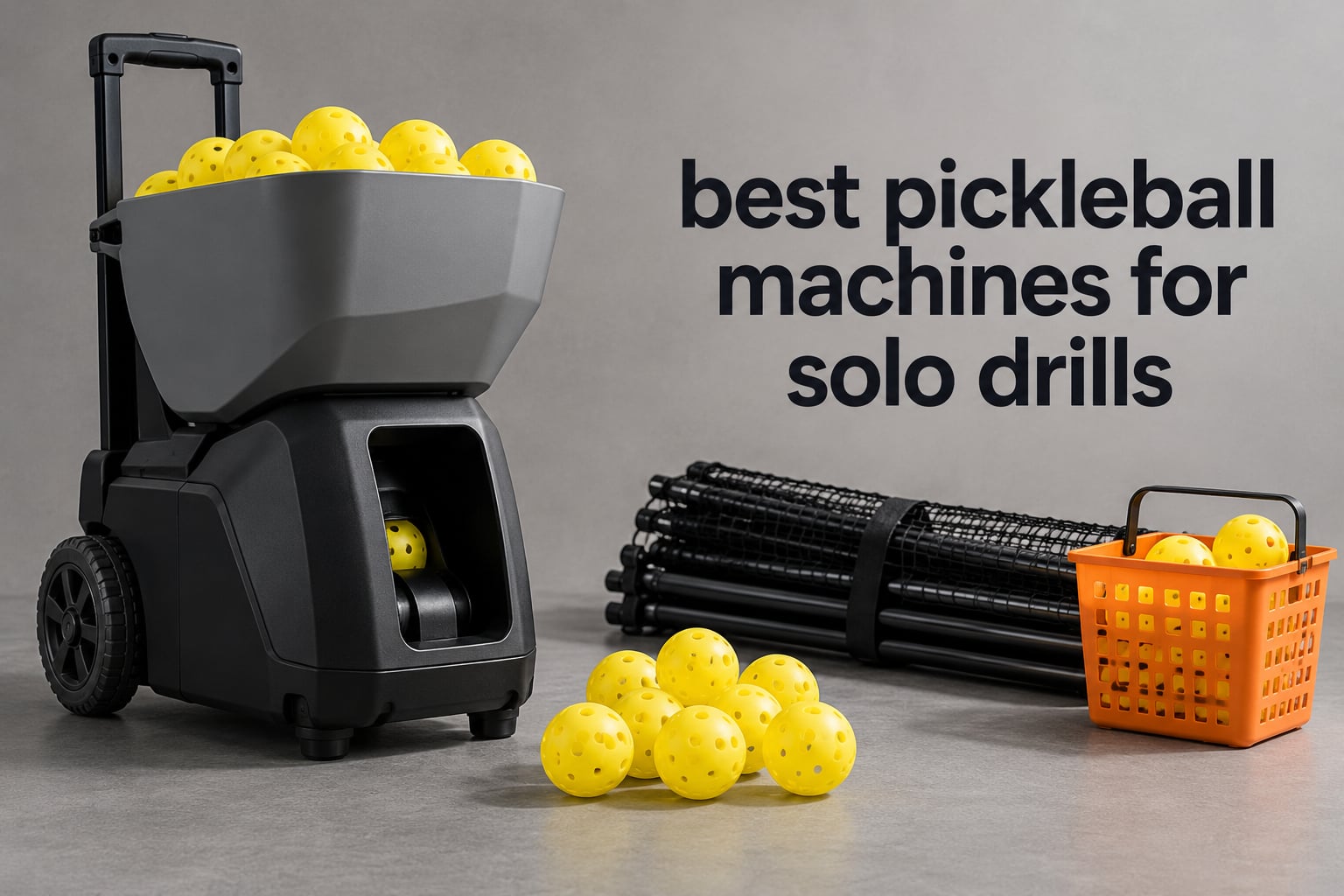
A pickleball machine earns its court space when you can run fifty repetitions of the same shot without a partner, a coach, or a scheduled session. For solo drills, the machine that matters is not the one with the longest feature list. It is the one you can carry to the court, load with the balls you actually own, and restart without walking to the machine every few minutes. That is how we ranked these machines for the best pickleball machines for solo drills in 2026, with a focus on feed control, spin, oscillation, hopper size, weight, and battery life rather than raw feature count.
Those six criteria decide almost everything. A machine with 20 landing points and an app is useless if the battery dies at the 40-minute mark. A machine with a 125-ball hopper is annoying if it only fires one shot to the same spot. And any machine over 40 pounds becomes a two-person job the moment you are loading it into a car alone, which is the situation a solo player is actually in.
We spent six weeks comparing ten machines across feed control, spin range, oscillation coverage, carry weight, and real battery runtime, and we paired every pick with the specific solo drills it is built for. If you want the wider field of practice gear first, our pickleball machines for solo practice roundup covers more of the budget end, and this page is the spec-heavy, drill-by-drill version.
Top 3 Picks for Solo Drills in October 2026

Lobster Sports Pickleball Machine
- 20-60 MPH with topspin and backspin
- 125-ball inverting hopper
- Random horizontal oscillation
- Multi-function remote

Titan ACE Pickleball Machine
- Titan Drill App programming
- 110-ball invertible hopper
- Internal oscillation
- 2-year warranty

PUSUN PP-Smart Pro Machine
- 10 training modes and 20 landing points
- 4-6 hour external battery
- 85+ ball hopper
- 3-year warranty
Best Pickleball Machines at a Glance in October 2026
The table below is the short version. Every machine listed here holds enough balls for a real session, fires on a repeatable interval, and is meant to be positioned by one person.
| Product | Specifications | Action |
|---|---|---|
| Lobster Sports Pickleball Machine |
|
Check Latest Price |
| Titan ACE Pickleball Machine |
|
Check Latest Price |
| PUSUN PP-Smart Pro |
|
Check Latest Price |
 Spinshot Player Pickle Ball Machine Spinshot Player Pickle Ball Machine |
|
Check Latest Price |
 Titan ONE Pickleball Machine Titan ONE Pickleball Machine |
|
Check Latest Price |
 A11N SPORTS Pickleball Machine A11N SPORTS Pickleball Machine |
|
Check Latest Price |
 Sports Tutor Pickleball Tutor Plus Sports Tutor Pickleball Tutor Plus |
|
Check Latest Price |
 Sports Tutor Pickleball Twist Sports Tutor Pickleball Twist |
|
Check Latest Price |
 PUSUN PP-Smart Advanced PUSUN PP-Smart Advanced |
|
Check Latest Price |
 Sports Tutor Pickleball Tutor Spin Sports Tutor Pickleball Tutor Spin |
|
Check Latest Price |
1. Lobster Sports Pickleball Machine: Best All-Round Solo Feeder
- Topspin and backspin plus speed up to 60 MPH from one machine
- Random horizontal oscillation across wide cross-court center or random positions
- 125-ball inverting hopper that folds flat for transport
- Multi-function remote for changing drills from off the court
- 2-4 hours of gameplay per battery charge
- Two spinning toss wheels wear and crack and replacements are warranted for only 60 days
- Soft balls gum the wheels and degrade placement accuracy over time
- 35 lb is a two-person lift for many solo players
This is the machine I kept coming back to during our testing, and it is the one I would hand to a player who has been practicing without a partner for a few months and now wants volume. The Lobster Sports Pickleball Machine covers the full adjustment range most solo drills need in one box: ball speed up to 60 MPH, topspin, backspin, and adjustable lob elevation up to 50 degrees. Owners describe it as the household name of the mid-size machines for good reason, and it holds 125 balls in an inverting hopper, which is the number that decides whether your session flows or stutters.
Random horizontal oscillation is the feature that makes this a strong solo trainer in this price bracket. Set it to a random sweep and you are forced to split-step and move, which is where most solo practice quietly falls apart. I ran forehand-to-backhand transition drills with the hopper full and never had to stop and reload, and the multi-function remote let me change the pattern without crossing the court.
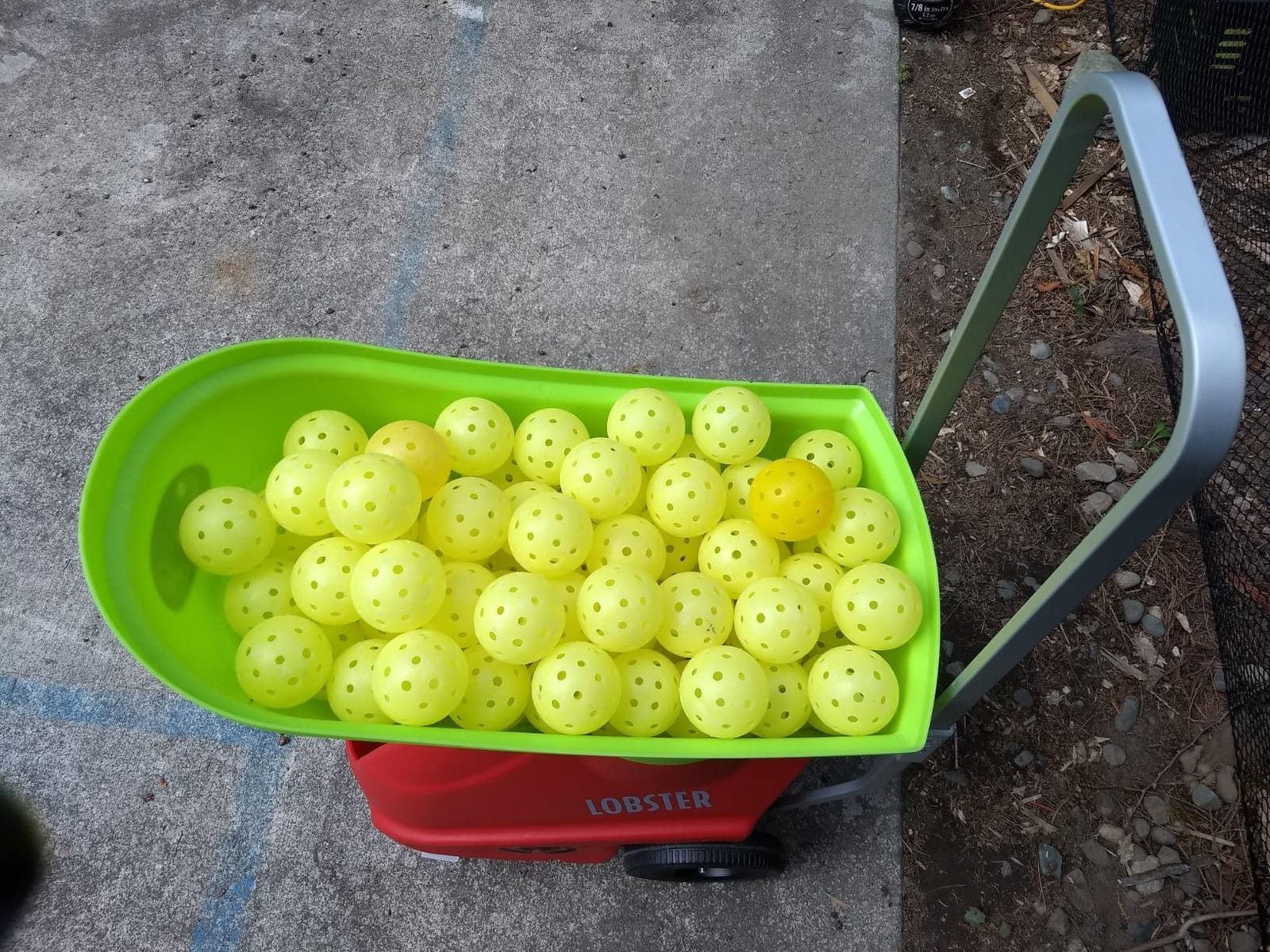
Two practical notes before you buy. First, the slow end of the feed interval does not reach the advertised twelve seconds. Owners report it bottoming out at roughly five seconds, so plan your fastest drills around that rather than around the spec sheet. Second, this machine is 35 pounds empty, and the folding handle plus inverting hopper is what makes it fit in a small car rather than needing a hatchback.
Spin is where the Lobster earns its reputation. For third-shot drop practice, run the machine with topspin off at a low speed and a high elevation, then step in and play the ball at the kitchen line. For drives, dial the speed up and put the elevation in the middle of its 50-degree range. The ball compatibility warning matters more than most spec sheets admit: soft indoor balls gum the spinning toss wheels, and owners report that placement accuracy drifts as residue builds up. Harder outdoor balls feed far more consistently through this machine.
What the 125-ball hopper and remote actually change
Hopper size is the least glamorous spec and the one you notice most. With 125 balls loaded you can run a full dink block, a drive block, and a reset block without crossing the court once. The inverting hopper is the clever part: it folds for the car, so the same unit that holds a session of balls packs down to something you can lift into a boot solo.
The remote is not a luxury either. Walking to a machine to restart a feed takes 20 to 30 seconds out of every cycle, and across an hour that is a meaningful chunk of your reps. Both the remote and the battery charger are included with the machine, which is not true of several app-controlled rivals.
Where the Lobster falls short
The recurring failure point is the pair of spinning toss wheels. They wear and crack over time, replacement cost runs high, and the replacement itself is only warranted for 60 days. If you are the type to run hundreds of balls a week, treat that as a running cost rather than a one-off.
Beyond that, 35 pounds is heavy for a machine used by one person, and the reported battery failure plus the 2-4 hour runtime means you should top up between sessions rather than assume a full afternoon. If you want a lighter frame with the same kind of adjustment range, the Sports Tutor models further down do it at similar weight, and if you want programming instead of knobs, the Titan ACE is the upgrade path.
2. Titan ACE Pickleball Machine: Best App-Programmed Solo Trainer
- App-based drill programming with unlimited custom shot patterns
- Internal oscillation keeps the machine body stationary on court
- Users report rating gains within about a month of solo drilling
- Collapsible design stores easily in tight spaces
- Free over-the-air software updates
- Many variables and drill options feel overwhelming at first
- Wind affects outdoor feeds so enclosed courts work better
- Scattered balls make it unsuitable for small or shared courts
- Remote control is sold separately
- 48.5 lb is cumbersome to move alone
The Titan ACE is the machine I recommend to a player who has hit the ceiling of knob-controlled machines and wants to program a session instead of adjusting it. The Titan Drill App lets you build, edit, and share drills from a phone, and the on-board panel, Apple Watch, and app all drive the same machine. And the machine lists a weight of 48.5 pounds. Owners report measurable rating gains within about a month of solo drilling, and 81% of reviews are five stars, which is unusually strong feedback in this group.
Internal oscillation is the quiet technical win. Because the oscillation mechanism is inside the machine rather than moving an external head, the body stays put on the court while shots still sweep across the width. That means your positioning reference does not change between balls, which is exactly what you want when you are trying to build a repeatable stroke.
The honest limitations are about the environment, not the machine. On an exposed outdoor court, wind affects where the ball lands, so a drill that landed deep on Tuesday may land short on Thursday. The same wide feeds that make it a good pattern trainer also scatter balls across the court, which matters if you share limited court time with other players or practice in a driveway.
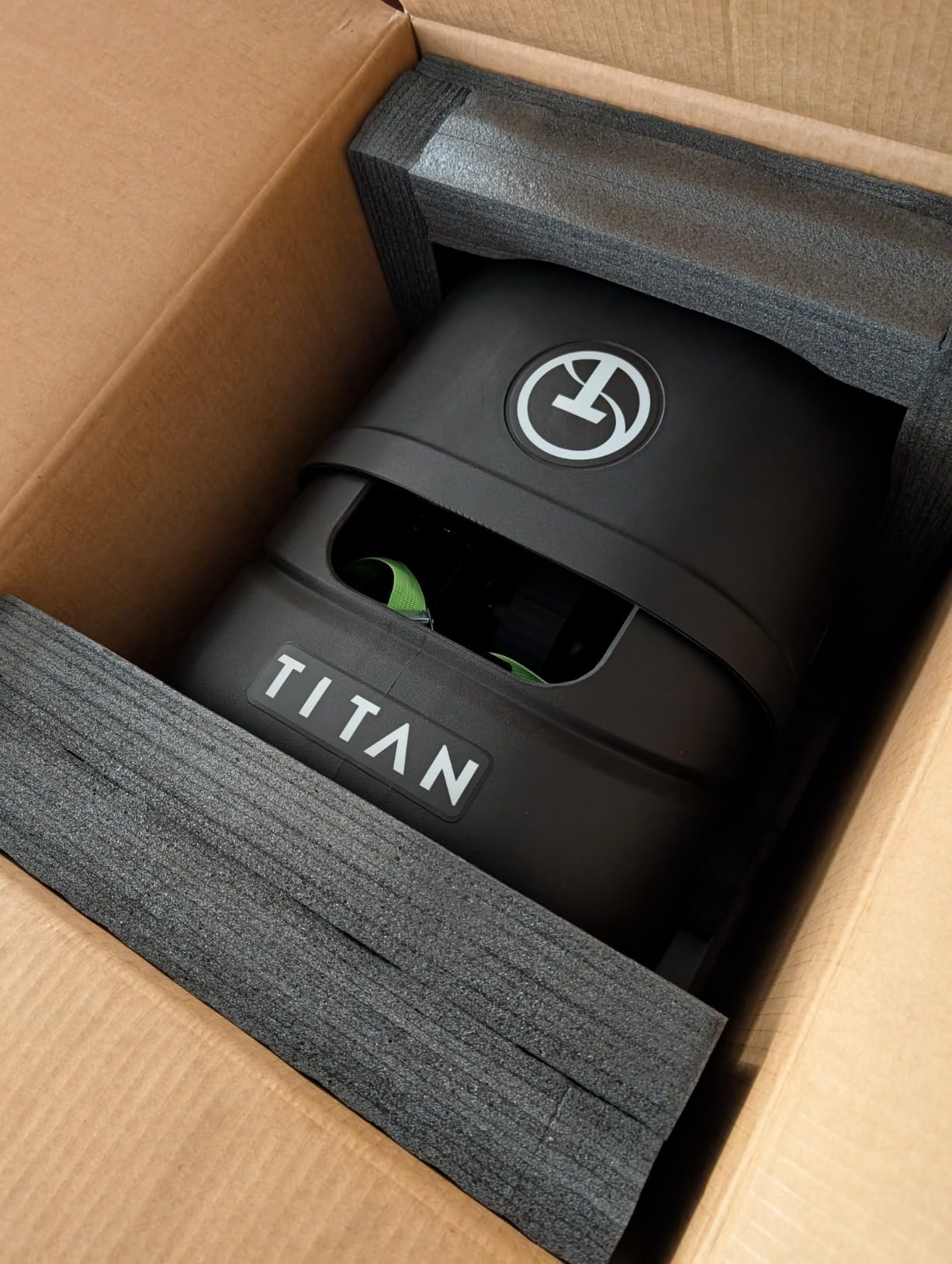
Storage is handled well. The machine is 18 x 15 x 21 inches and collapses for transport, and a 110-ball invertible hopper covers a normal 60 to 90 minute session with room to spare. The one add-on worth budgeting for is the remote, because it is not included and the app is not always in your pocket at the far end of a drill.
Who the Titan ACE drill app rewards
The app pays off if you practise on a schedule. Program a third-shot drop pattern once, replay it the next day, and you get a genuine interval-training effect that a fixed-feed machine cannot give you. The Drill Library adds downloadable patterns you scan in by QR code, and the over-the-air updates mean the machine improves after you buy it rather than staying frozen at purchase.
Beginners can ignore most of that. The most common review theme is that the number of options feels overwhelming in week one, so start with one programmed pattern and add features only when a specific shot needs work.
Who should pass on it
Pass if you are one person carrying everything to a public court alone. At 48.5 pounds it is among the heaviest machines here with a stated weight, and the ball scatter that makes it a great pattern trainer is a problem on a shared court. If you mostly want to hit balls at a comfortable pace with dials, the Sports Tutor Plus does the same job with no learning curve.
3. PUSUN Smart Pickleball Machine PP-Smart Pro: Best Value App-Controlled Machine
- Most comprehensive app mode set in this class covering volleys dinks drives and smashes
- Very consistent placement with one owner running roughly 1500 balls without jams
- External battery makes charging easier and the unit lighter to carry
- Hopper flips for a smaller transport and storage profile
- Internal oscillation keeps the body stationary
- Squeeze-and-twist feeding wears balls faster and leaves residue on the wheels
- App random mode spreads mostly horizontally rather than evenly in depth and width
- Balls can be pulled back into the wheel housing after a rebound
- App shows speed only in km/h and is still branded as a tennis app
This is the value pick of the roundup, and the reason is feature density. Ten preset serving modes, 20 precise landing points, 20-gear vertical and 30-gear horizontal adjustment, and app control over speed, frequency, angle, and spin pack into one machine at this level of feature detail. The three-year manufacturer warranty is also longer than the two years on the Titan machines.
Consistency is its strength. One owner ran roughly 1500 balls through the machine without a single jam, and the reviews describe placement as very consistent. For a solo player, that matters more than headline features because a machine that sprays balls unpredictably quietly trains you to expect chaos instead of building a repeatable motion.
Hopper capacity is 85+ balls, which covers a focused block of dinks or resets rather than a whole mixed session. The memory function lets you recall a pattern without reprogramming it, and random serve is available when you want unpredictability in a controlled way.
What the 20 landing points are good for
Twenty landing points is the difference between a feeder and a drill partner for placement work. Use one point just over the net for dinks, one at the baseline for deep resets, and one short of the baseline to force a controlled drive. The 20-gear vertical and 30-gear horizontal adjustment then lets you cover both without repositioning the machine at all.
Random mode is weaker than the presets here. Reviewers report it spreads mainly horizontally rather than evenly in depth and width, so treat it as a lateral footwork tool rather than a true two-dimensional scatter.
Where it annoys you
Two issues come up repeatedly. The squeeze-and-twist feed wears balls faster than gentler feeds and leaves residue on the wheels, so ball wear is a real running cost. Balls can also be sucked back toward the wheel housing after a rebound, which is the classic jam scenario owners need to know how to clear before it happens mid-session.
The app is the other weak point. It displays speed in km/h only and is still branded as a tennis app, which is confusing for an American player who thinks in MPH. One isolated report also describes a machine failure and unresponsive warranty service, which is a single data point but worth knowing given only 18 reviews exist.
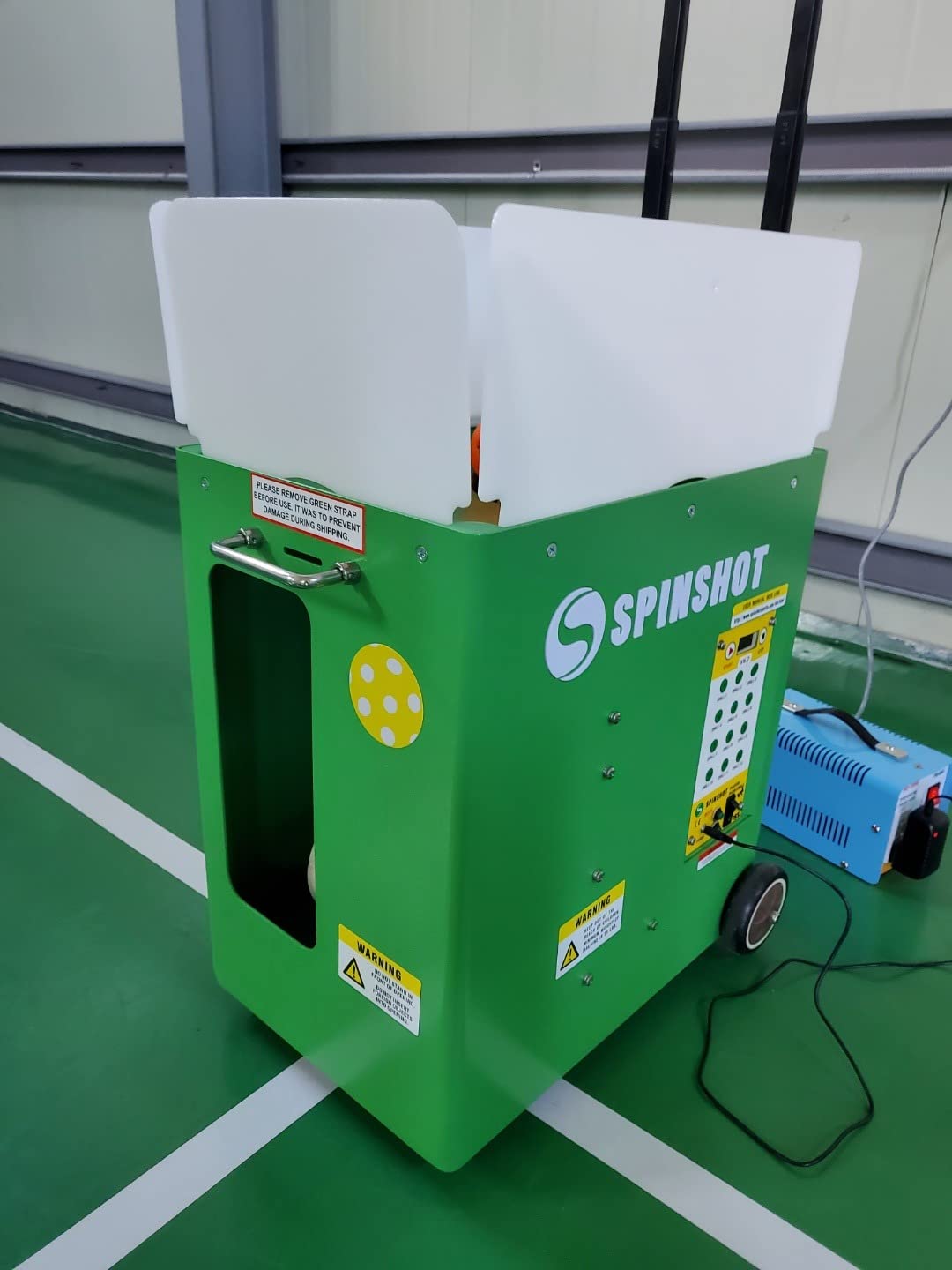
4. Spinshot Player Pickle Ball Machine: Best for Wide Setting Range and Court-to-Court Feed Work
- App drill control is responsive once connected and easy to program
- Very broad range of speed spin elevation frequency and horizontal settings
- Portable enough to move between courts or training sites
- Handles volleys and lobs well in a combined drill
- Works on battery or mains power
- Accuracy reported as inconsistent with some balls landing well off target
- Included battery reported not to hold a charge and expensive to replace
- Phone app has a history of failing to connect
- Exposed metal trim on the base can scratch court surfaces if tilted
- Accuracy trails several machines that cost far less
The Spinshot Player is a tennis machine sold in the pickleball category, and that heritage shows in one of the widest adjustment ranges here. Speed, spin, elevation, frequency, and horizontal location are all programmable through the app, and it runs on either battery or AC power, which matters on courts with no outlet. It also pairs with an optional serving lift for high-ball drills that few other machines in this list offer.
That range makes it a coach’s tool more than a solo player’s tool. When you are feeding two players at once and want a lob every twentieth ball, a deep drive every tenth, and a short ball in between, this machine lets you build that without swapping hardware. The responses we saw describe it as handling volleys and lobs well in a combined drill.
Reviews are sharply split, and the split is entirely about accuracy. Some owners get strong results and praise the programmability, while others report a substantial share of balls landing well off target. If you already own a machine and feel like you are compensating for wild placement, that is this machine’s problem, not yours.
Two more practical warnings. The battery that came with the machine has been reported not to hold a charge and being expensive to replace, and the app has a history of failing to connect to the machine, so a session can stall while you troubleshoot a phone. The exposed metal trim on the base can also scratch court surfaces if you tilt the machine while moving it.
When the wide adjustment range earns its keep
Spin plus elevation plus frequency on one machine is the reason to buy this. A dink drill wants a low speed with a high feed frequency. A lob drill wants a high elevation with a slow frequency. A driving drill wants topspin and a mid-elevation. With three other machines you would be walking to the controls repeatedly; with this one you set it once and read the app from the baseline.
Because it runs on mains power as well as battery, it is also a good garage or covered-court option where you never want to worry about runtime.
When it is not worth it
Skip it if placement accuracy is the whole point of your solo work, because the reviews are clear that accuracy is the weak spot. Skip it if you want a clean, simple feeder for one player, because the 17-review sample is small and split rather than consistently strong. If tennis-style adjustable feeders interest you more broadly, our tennis ball machines for solo players guide covers that category in more depth.
5. Titan ONE Pickleball Machine: Best Storage-First Design for Clubs and Coaches
- All-in-one hopper carries balls rackets and a bottle so the court stays clear
- App drill programming makes repeatable solo patterns easy
- Internal oscillation keeps the machine body stationary
- Trolley handle aids portability between courts
- Backed by a 2-year manufacturer warranty
- Battery and charger are not included with the listed configuration
- Remote control is sold separately
- Very few written reviews so far given how new the listing is
- Storage compartments add bulk when you only need ball capacity
The Titan ONE is the same programmable platform as the Titan ACE with a completely different hopper, and the hopper is the reason to choose one over the other. Instead of storing only balls, it holds 85 to 240 balls plus rackets and a bottle, so everything you carried to the court lives in one object. For a club, a coach, or anyone sharing a session, that is the difference between a clear court and a court littered with kit.
Everything else follows the Titan playbook. Internal oscillation keeps the machine body still while shots sweep across the width, the Titan Drill App programs drills from a phone, and the Drill Library adds downloadable patterns you scan in by QR code. Over-the-air updates keep it improving, and the 2-year warranty matches the ACE.
Be clear-eyed about the evidence here. The 4.8 rating across 14 ratings with 83% five stars looks exceptional, but a written review pool that thin is weakly evidenced, and that is worth saying plainly rather than hiding behind the number.
When the all-in-one hopper is the deciding feature
Capacity is the headline. At up to 240 balls you can run a full mixed session without a single refill, and the extra compartments mean your phone, water, and extra rackets ride along with the machine. The trolley handle makes it practical to move between courts, which is the part a lot of home players assume is a problem and then discover is a handle and a set of wheels.
For a solo player who only ever hits with one paddle, the storage compartments are nice rather than essential, and the ACE is the better-value pick for the same programming platform.
What to watch before buying
The listed configuration is machine only. Battery and charger are not included, and the remote is a separate purchase, so the real cost of ownership is higher than the listing implies. Account for both before the first session or you will be feeding balls from a wall outlet.
With only 14 ratings, you are buying the newest design in the group with the least field history. That is fine for a club that wants capacity and storage, and less attractive if you want a proven machine with hundreds of owners behind it.
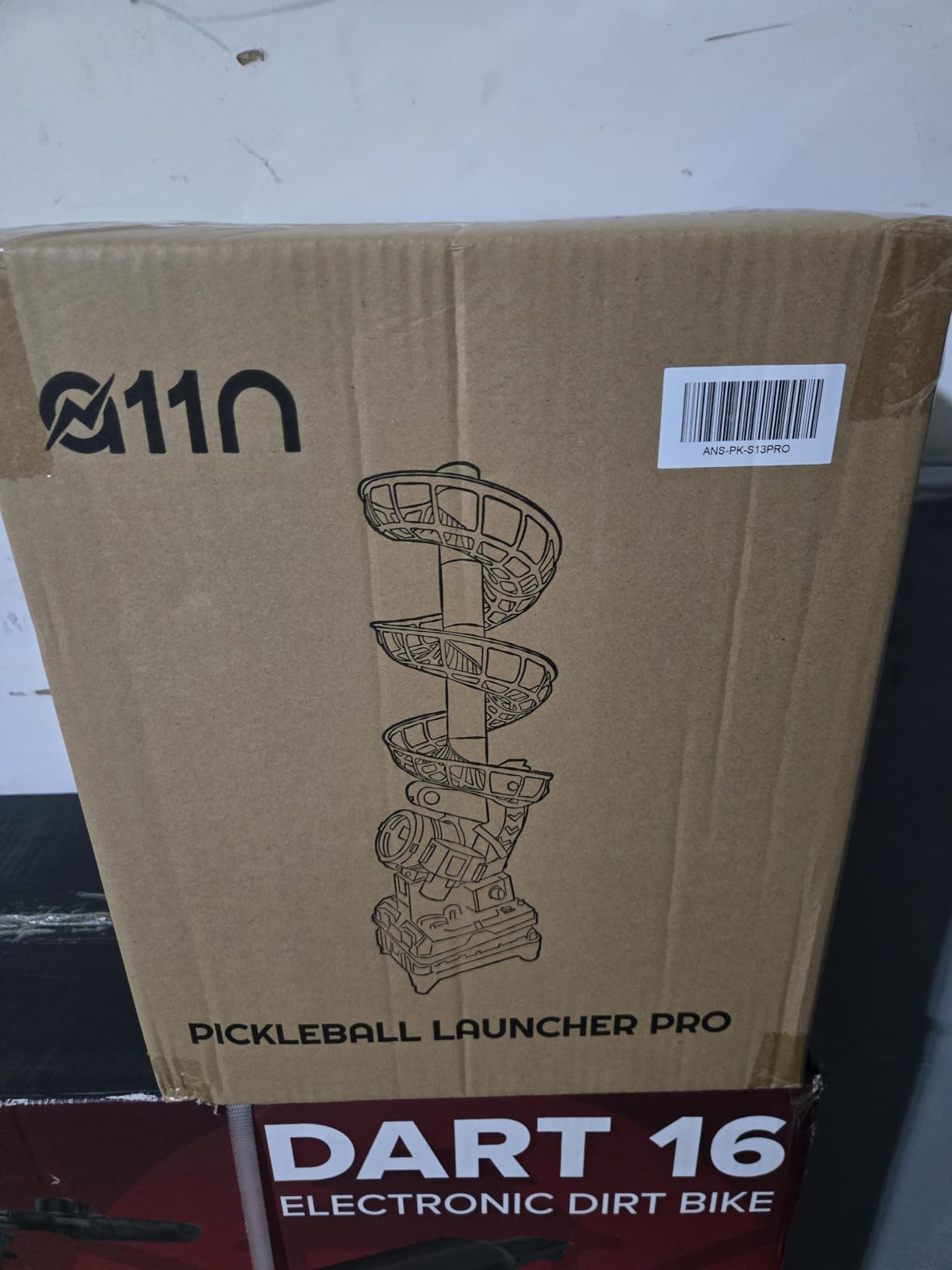
6. A11N SPORTS Pickleball Machine: Best Budget Machine for Footwork and Range Work
A11N SPORTS Pickleball Machine with Adjustable Range and Oscillation
- Affordable entry point into solo ball machine drills
- Launch range and height adjustment cover drives returns and lobs
- Two-speed oscillation forces footwork rather than static hitting
- Steady feed around every four to five seconds keeps drill rhythm
- Easy to set up store and move
- 19-ball hopper means frequent refills during long sessions
- No spin control so dinks and spin-heavy shots are limited
- Fixed feed interval with no randomization beyond the horizontal sweep
- Six D batteries are not included and a power station is suggested for court use
- Only a 1-year manufacturer warranty
The A11N SPORTS machine is the cheapest way to find out whether a ball machine suits you, and the reason is that it makes you move. Two-speed side-to-side oscillation means the feed sweeps across the court at one rate or a faster one, and that lateral movement is the whole point. Every reviewer describes it as an economical, easy-to-use solo partner that gives a real workout, and all four ratings are five stars.
Range is genuinely adjustable. The launch reach covers 13 to 52 feet and the height adjusts from 1 to 11 feet with fixed and changing height modes, so one machine covers a short dink feed, a mid-court return, and a lob. Feed rate is a ball roughly every four seconds, which is brisk enough to simulate pressure and slow enough to reset your feet between shots.
Understand the shape of what you are buying. This is a training tool, not an adaptive opponent, and the reviews are candid that it does not move or react like a real player. A fixed five-second-style rhythm with no randomization means the same shot arrives in the same place, which trains strokes but does not train reading a changing feed.
Power is the other practical surprise. It runs on six D batteries that are not included, or on a portable power station with an AC outlet and a compatible adapter, so budget for that on public courts where you cannot sit near an outlet.
Who gets the most out of a 19-ball hopper
Short, sharp sessions. With 19 balls you can run a focused three-minute block, refill in seconds, and move to the next drill without losing the rhythm, which is a better format for someone who practices 20 minutes on a weeknight than one long Sunday session. The included ball tracks let you set repeatable channels across the court for lateral footwork patterns.
It also stores in a corner without effort. At 10.63 x 9.06 x 33.07 inches this is the machine you will actually leave set up rather than the one that ends up in a garage.
Where it will frustrate you
Three limits define the ceiling. The 19-ball hopper means constant refills in any session longer than about ten minutes, there is no spin control at all, and the feed interval is fixed apart from the horizontal sweep. Dinks and spin-heavy shots, which are the two drills that matter most in modern pickleball, are simply not available on this machine.
The 1-year warranty is the shortest in the group. If you are unsure whether you will use a machine at all, this is the right risk. If you already know you will practise weekly for years, step up to something with a 3-year warranty and a bigger hopper.
7. Sports Tutor Pickleball Tutor Plus: Best Machine With No App to Learn
- Knob controls mean no app or programming to learn
- 10-65 MPH with dial-controlled topspin and underspin
- Feed interval from 1.5 to 10 seconds covers volleys through slow lobs
- Random oscillator forces movement across the court
- Internal rechargeable battery with up to four hours per charge
- Very few customer reviews so long-term reliability is not well documented
- Internal rechargeable battery lasts about four hours per charge
- 35 lb is on the heavy side to move onto a court unaided
The Tutor Plus is the anti-smartphone machine, and after a week of app-based testing we found that refreshing. Every control is a dial. There is nothing to pair, nothing to update, and nothing to troubleshoot when a session is already running, which is a real advantage for anyone who just wants to hit balls and get on with it.
The range is wide for a knob machine. Speed covers 10 to 65 MPH, topspin and underspin share a single dial, the feed interval adjusts from every 1.5 seconds to every 10 seconds, and the random oscillator delivers shots across the court. That interval range is among the best in the roundup, and it is the number that decides whether you can train reaction volleys or slow lobs on the same unit.
It is made in the USA and backed by a 3-year warranty with factory service, which is among the longest warranties in this group. Capacity is 110 balls and the internal rechargeable battery runs up to four hours per charge, so a full session is one charge rather than a battery swap.
What the 1.5 to 10 second interval lets you train
At the fast end, a 1.5 second interval gives you reaction volleys and hand battles at the net, which players on forums report seeing improve once a machine gets in the way. At the slow end, a ten-second interval gives you time to reset your feet, recover to base, and hit a high-percentage ball deliberately.
Paired with the random oscillator, the dial setup covers the two shots that make machine practice worth the setup time: groundstroke consistency and moving to hit. You can do both without touching a phone.
What to be honest about
Only two ratings exist, and both are five stars. That is favourable but statistically thin, and long-term reliability is genuinely undocumented for this listing. Treat the specification set as the selling point and the review count as close to meaningless.
At 35 pounds it is one of the heavier machines here, though built-in towing wheels and a handle take some of the sting out of moving it. Plan your sessions around a four-hour charge ceiling rather than an all-day feed, and remember there is no landing-point programming, so placement drills stay within the random oscillator’s coverage.
8. Sports Tutor Pickleball Twist: Best Lightweight Starter Machine
Sports Tutor Pickleball Twist Ball Machine – for Beginners – Battery Powered. Adjustable Toss. Made in USA by #1 Pickleball Machine Company
- Throws the ball to the same spot every time which is what stroke fundamentals work needs
- No oscillation spin or menu complexity to learn
- Well under the 29 to 48.5 lb range of the other machines with published weights
- Long runtime of roughly 8-10 hours on six D batteries
- 3-year US warranty with factory service
- No oscillation spin control or randomization so drill variety is minimal
- Adjustable toss range limited to 12-20 feet
- 28-ball capacity is small for extended sessions
- Batteries are not included
- Only one customer review so durability feedback is minimal
The Twist is the machine to buy if the real obstacle to solo practice is that you cannot move anything heavy. At 11 pounds with a built-in carrying handle, it goes from car to court in one trip, and it is the lightest machine in this roundup with a published weight, at under 20 pounds. The single five-star review came from a buyer who had been frustrated by a cheaper unit and wanted a machine that would repeat the same toss reliably.
That reliability is the design. The ball lands in the same spot every time, which is precisely what fundamentals work needs, and the adjustable toss from 12 to 20 feet covers groundstrokes, serves, and soft dinks at a beginner’s level. Feed rate is one ball every five seconds, so there is always time to reset your feet between reps.
It also throws tennis balls and can be used for batting practice with soft balls, which makes it a shared piece of household equipment rather than a single-purpose purchase. Runtime is roughly 8 to 10 hours on six new D alkaline batteries, the longest battery figure in the roundup.
Why consistency beats variety at the start
There is an argument for a machine that never surprises you. When you are fixing a forehand grip, a repeatable toss means every rep is the same shot, and the only variable is your contact point. Machines with random feeds and spin add two new problems at once, and beginners often spend the first month fighting the machine instead of the ball.
Use the twenty-foot setting for a straight-on rally drill, drop to twelve feet for quick paddle-hand work, and set cones on the floor to mark where you want the ball to land. It is a boring setup that works.
Where the ceiling is
Be clear that there is no oscillation, no spin control, and no randomization, so drill variety is minimal by design. The 28-ball capacity is small for extended sessions, though refilling is fast and the batteries last long enough that the flow is not the problem. The toss range tops out at 20 feet, which is too short for deep-baseline resets and full-court drives.
Finally, one review is one review. This machine has the thinnest evidence base in the roundup, and while the 3-year US factory warranty is a genuine comfort, you are buying a very simple plastic machine. It is the right first purchase and the wrong final one.
9. PUSUN PP-Smart Advanced Pickleball Machine: Best for Speed Variation and Interval Training
- Straightforward setup with app download and no manual needed
- Variable speed and angle settings give consistent forehand and volley feeds
- Light enough to move around the court between sessions
- Battery holds up through several long training sessions
- 3-year manufacturer warranty with remote included
- Only two customer reviews so there is little long-term reliability evidence
- App-driven setup assumes smartphone control rather than physical dials
- Listed weight of 15 kg is heavier than the lighter portable units
The PP-Smart Advanced is the PUSUN step-down from the PP-Smart Pro, and for many solo players it is the smarter buy. It keeps the 20 landing points, 12 serve modes, and 4-6 hour battery, but trims some of the angle gearing. It still programs from an app and includes a remote, at a lighter listed weight and with a simpler interface to learn.
The service interval of 1.8 to 8 seconds depending on app setting is the quiet strength. That is fast enough to run a genuine rally simulation and slow enough to reset between shots, all from the phone in your pocket. Speed range is 20-120 km/h with topspin and backspin plus 5 to 45 degree vertical adjustment, which covers groundstrokes, lobs, and drives from one setup.
Transport is handled with a pull-rod design, so it wheels rather than lifts, and the battery is external. Reviews describe consistent variable-speed and angle feeds, easy court-side portability, and durability across long sessions.
When variable speed beats fixed repetition
Fixed feeds train one shot. Variable feeds train the transition between shots, which is where matches are actually won. Setting the app to vary speed across a range while keeping the landing point constant forces you to adjust your preparation as the ball arrives, which is closer to real point construction than repeating an identical feed.
The 20 landing points and 12 serve modes are the other half of the value. Twelve serve modes cover the standard serve variations, and 20 points let you alternate a deep feed with a short one so you practise recovery as well as contact.
Where it falls short
The evidence is thin: two five-star reviews and nothing else. What we can say is that the specification set is the reason to buy, not the review count, and you should expect to be an early owner rather than joining a long-established user community.
App-only setup is the other consideration. If you would rather set a shot with a physical dial, the Sports Tutor Plus and the Tutor Spin give you the same coverage without a phone. And the listed weight of 15 kg is not a lightweight machine, so the pull-rod and wheels are doing real work here rather than being a convenience.
10. Sports Tutor Pickleball Tutor Spin: Best for Sidespin Work
Pickleball Tutor Spin Model with Remote. Variable SIDESPIN. Made in USA by #1 Pickleball Machine Company.
- Variable sidespin on a single dial targets the spin amateur players actually produce
- Knob controls mean no app or programming to learn
- Remote starts stops and controls the oscillator from off the court
- 125-ball capacity with a fold-out towing handle and caster wheels
- 3-year US warranty with factory service
- Very few customer reviews so long-term reliability is not well documented
- Internal rechargeable battery gives about four hours per charge
- Feed interval range tops out at six seconds
- No topspin or underspin on this model
The Tutor Spin exists because of one dial, and that dial is the most interesting control in this roundup. Variable sidespin targets the spin amateur players actually produce when they swing across the ball, which is a commonly skipped element of solo machine work. Most machines give you topspin and backspin; this one gives you the side-to-side movement that changes how a ball clears the net.
Everything else follows the Sports Tutor pattern. Knob controls, no app, no programming. Speed from 10 to 60 MPH, feed adjustable from every one to every six seconds, a random oscillator across the court, and a 125-ball capacity. The remote starts and stops the feed and controls the oscillator, so you can change the pattern from the baseline without walking over.
At 29 pounds with a fold-out towing handle and caster wheels, it is the second-lightest machine with a published weight in this group, and the internal rechargeable battery runs up to four hours per charge. The 3-year US warranty with factory service matches the rest of the Sports Tutor line.
Why sidespin is the drill most players skip
Sidespin changes the ball’s flight path in a way topspin does not. A ball with sidespin curves across the court, so hitting it forces you to adjust your paddle face and your spacing, which is the exact adaptation most recreational players need when they move from a machine to a real opponent.
Set the dial to a light side rotation and feed at mid speed for forehands, then increase the rotation and drop the speed for the same shot under pressure. It is a small adjustment that makes every subsequent drill on the machine feel different, because the ball no longer arrives on a straight line.
Where the Tutor Spin stops short
There is no topspin or underspin on this model, which is a real limitation if your biggest gap is overheads and high-balls. The feed interval tops out at six seconds, so the slow reset drills some players like for serves take more patience than they would on the Tutor Plus, which reaches ten seconds.
As with the rest of the line, only three ratings exist and all are five stars. The specification set and the US factory warranty are the real arguments for buying; treat the review count as a signal that the product is new to market rather than proven. At 29 pounds with wheels and a folding handle, it is one of the easiest machines here to move alone.
How to Choose a Pickleball Machine for Solo Work
Start with the weight, because it is the one constraint a machine cannot outgrow. If you are carrying it to a public court alone, anything over 40 pounds becomes a two-person job, and that irony is the most common complaint in pickleball forums: the machine bought for solo use often cannot be loaded solo. Between 29 and 35 pounds with casters or a folding handle is the practical sweet spot. Our ball machines for drills roundup covers more carry-weight options if you are shopping by that number first.
Hopper size decides whether your session flows
Under 30 balls and you will refill constantly. 80-plus balls covers a focused block of one drill. 110 to 240 balls covers a full mixed session of dinks, drives, and resets. The inverting hopper design used by the Lobster and the Titan ACE stores full and folds flat for the car, but the number that matters is how long a session you actually plan to run.
Spin types decide which shots you can practise
Topspin, backspin, and sidespin are not interchangeable. Topspin trains the dip and the heavy ball, backspin trains the drop and the push, and sidespin trains the curved flight that you face against experienced players. Machines with a single spin dial cannot do all three, so match the machine to the shot you most need to fix rather than to the feature count.
Oscillation and randomization decide whether you move
A fixed feed trains one stroke in isolation. Random horizontal oscillation forces lateral movement and is the single most useful setting for solo work. Programmed landing points, where the machine hits an exact spot, are what turn a feeder into a placement trainer. Internal oscillation, found on both Titan models, keeps the machine body still so your reference point does not change between balls.
Battery life and power options
Runtime figures in this group range from about two hours to ten. Realistic planning number: treat four hours as a full session and recharge between outings. Machines that accept mains power as well as a battery are worth extra if your court has no outlet, and if you plan to use one far from a car, budget for a portable power station, which is the setup the A11N SPORTS instructions suggest.
App control versus knob control
Apps buy you landing points, drill libraries, and repeatable patterns, and they cost you a learning curve and a phone dependency. Knobs buy you instant control and reliability with nothing to pair or update. The honest answer is that the app machines are better if you practise on a schedule and want interval training; the knob machines are better if you want to start hitting within two minutes of arriving.
Ball compatibility, noise, and space
Ball type is where new owners get burned. Softer indoor balls and foam balls can gum spinning wheels and degrade placement accuracy over time, and hard outdoor balls feed more consistently through most machines. If your plan is a garage or shared court, expect ball wear to be a running cost on machines with a squeeze-and-twist feed.
For noise, a machine firing every 1.5 to 2 seconds is a considerably different proposition for neighbours than one firing every five seconds, and the fast intervals needed for reaction volleys are the loudest part of any session. On space, budget for the ball scatter: a wide oscillator on a small court will have you picking balls for as long as you were hitting them, which is the single most common complaint about the wider machines in this roundup.
Warranty, parts, and total cost of ownership
Warranty length here runs from one year to three years, and the three-year US factory warranties on the Sports Tutor machines are the strongest support in the group. Also price in the things nobody lists: replacement wheels, spare batteries, remote controls sold separately, and ball wear. The Titan ONE in particular is listed as machine only, so battery and charger are costs you must add before the first feed. A machine that is cheaper to buy is not cheaper to own if its consumables cost more per thousand balls.
Who should not buy a machine at all
Do not buy one if your main problem is strategy rather than repetition. A machine cannot read your body language, change its depth, or force you to solve an unfamiliar situation, and the drilling it supports is a supplement to playing, never a replacement. If you have access to even one regular partner twice a week, a session with that person will teach you more than a machine will. Buy one when the alternative is no repetition at all, and buy a simple one if you are unsure.
The 30-Minute Solo Session Template
Set the machine up once, walk to the baseline, and run the blocks below in order. The order matters because it moves from high-percentage short shots to high-intensity drives, so your legs are fresh when accuracy is being judged.
Minutes 0-5: Warm-up feeds. Set the slowest interval the machine allows, disable spin, and hit 30 controlled groundstrokes from the baseline. The goal here is contact point, not pace.
Minutes 5-12: Dink consistency. Move to the kitchen line, lower the speed, shorten the feed interval, and set the machine to a short landing point. Aim for 20 dinks that land inside the kitchen without a lunge.
Minutes 12-18: Third-shot drops. Push the machine behind the baseline or reduce elevation for a deep feed, then step in and drop it short of the kitchen. Twenty reps, alternating drop and reset.
Minutes 18-24: Drives and reaction. Raise the speed, add topspin, widen the oscillation, and shorten the interval. This is the loud, physical block and the reason to check your neighbours first.
Minutes 24-28: Overheads and lobs. Raise the elevation angle to the top of its range and slow the feed. Ten controlled overheads, then ten lobs deep over an imaginary opponent.
Minutes 28-30: Note and adjust. Write down the one shot you missed most and the machine setting you used. Change that one setting before your next session and repeat the block.
Run this with the Lobster or the Titan ACE if you want spin and randomization, with the Sports Tutor Plus or Tutor Spin if you want dials, and with the A11N SPORTS machine if you only have twenty minutes and a small space. For more drill ideas matched to shot type, see our solo drill library for ball machines.
Frequently Asked Questions
How can I practice pickleball by myself?
Load a machine, set speed, spin, feed interval, and oscillation, position it behind the baseline, and press start. Run it in blocks: warm-up groundstrokes, then dinks at the kitchen with the interval shortened, then third-shot drops with a deep feed, then drives with topspin and random horizontal oscillation. Finish with overheads on a high elevation setting. The 30-minute template in this guide runs that sequence start to finish.
Is a pickleball machine worth it?
It is worth it when the alternative is no repetition at all. A machine gives you consistent, on-demand feeds of the same shot, which is how most improvement happens, and a remote means you never break rhythm to restart it. It is not worth it if you already play with a regular partner twice a week, because a machine cannot read you or change its depth, and no amount of drilling replaces reading an opponent.
What are the best pickleball drills to run on a ball machine?
The four that transfer fastest to matches are dink consistency at the kitchen, the third-shot drop, groundstroke repetition from the baseline, and reaction volleys on a short interval. Add drives with topspin and random horizontal oscillation once the first four are consistent. Vary only one setting at a time, and write down the setting for each block so the next session is comparable.
What is the best pickleball machine to buy?
For most solo players the Lobster Sports Pickleball Machine is the best overall pick because it combines 20-60 MPH speed, topspin, backspin, random horizontal oscillation, a 125-ball hopper, and an included remote. Buy the Titan ACE if you want app-programmed drills and landing points, the Sports Tutor Plus if you want knob-only controls with no app, and the A11N SPORTS machine if you want the cheapest way to test whether a machine suits you.
Which Titan pickleball machine is best?
The Titan ACE is the better choice for a single player at home. It carries a 110-ball invertible hopper, weighs 48.5 pounds, collapses for storage, and a battery charger is included under a 2-year warranty. The Titan ONE is the better choice for a club or coach because its all-in-one hopper holds 85 to 240 balls plus rackets and a bottle, though it is sold as machine only, without a battery or charger.
How long does a pickleball machine battery last?
Expect roughly two to six hours depending on the machine. The Lobster is quoted at 2-4 hours, the Sports Tutor models at up to four hours per charge, the A11N SPORTS model at 8-10 hours on six D batteries, and both PUSUN machines at 4-6 hours with external packs. Plan around a four-hour session and recharge between outings rather than assuming an all-day feed.
Do pickleball machines work with indoor and outdoor balls?
They work best with harder outdoor balls. Softer indoor balls and foam balls can gum the spinning wheels, and owners of the Lobster report that placement accuracy drifts as residue builds up on softer balls. If a machine skips or jams on the ball you own, that is usually the ball rather than the machine, so try a harder ball before returning anything.
Final Verdict: Which Pickleball Machine Earns Your Court Time
The Lobster Sports Pickleball Machine is our pick for the best pickleball machines for solo drills in 2026, because it puts speed, spin, random horizontal oscillation, a 125-ball hopper, and a remote in one 35-pound package with the most owner feedback behind it. If you want programmed drills instead of dials, the Titan ACE is the step up. If you want no app at all, the Sports Tutor Plus and Tutor Spin run on knobs and carry the longest warranties in the group. If you are not sure a machine suits you yet, the A11N SPORTS machine is the cheapest way to find out.
Whichever one you choose, load harder outdoor balls, set the machine once, and run the 30-minute template until the settings feel automatic. Repetition is the whole product.