
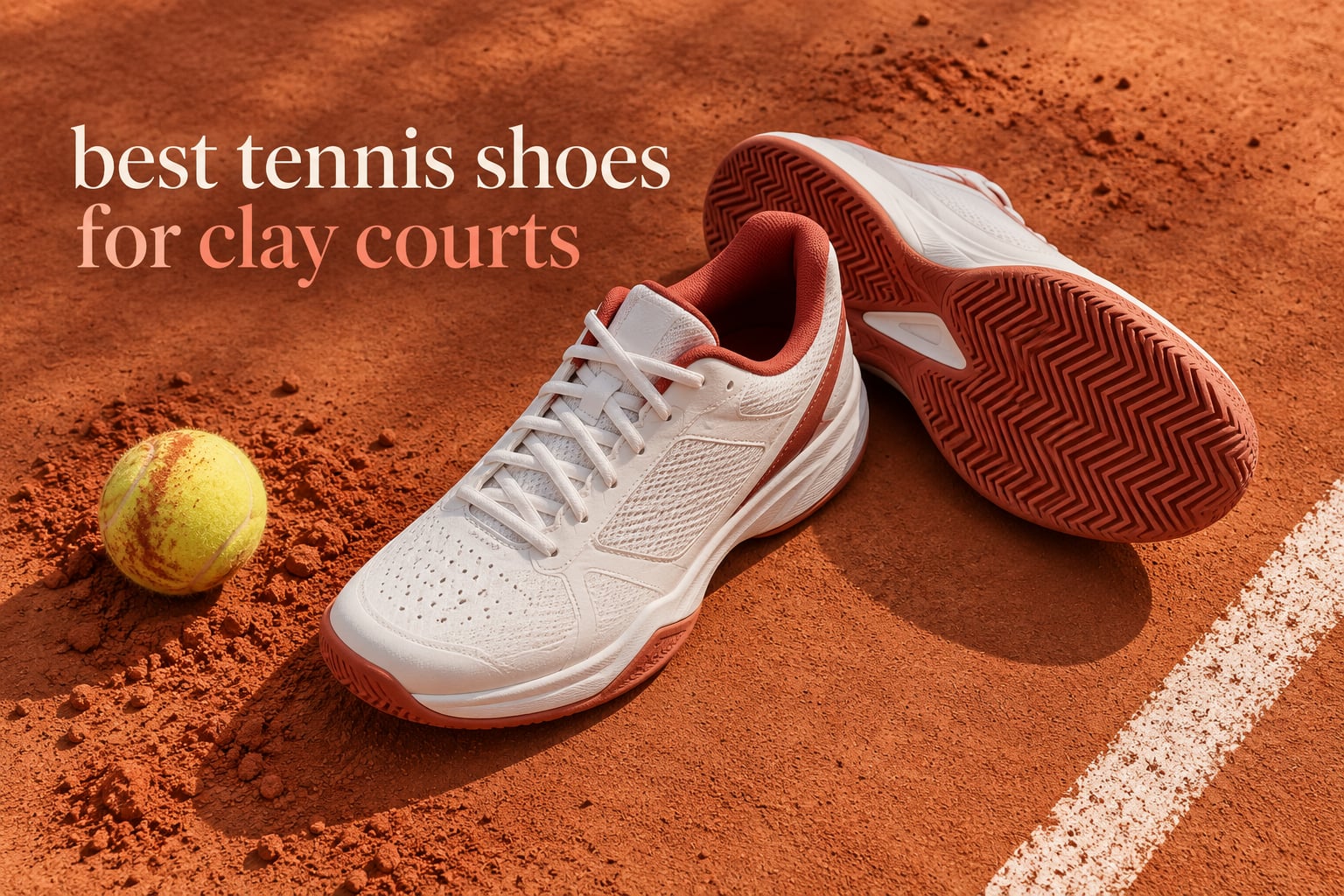
Clay is the only surface that lets you slide on purpose. On a hard court, a slide means you lost your footing; on red clay or green Har-Tru, a controlled slide into the corner is a legitimate shot. That single difference changes what a shoe has to do, and it is why the best tennis shoes for clay courts are not simply a hard court shoe with a different label.
The answer is the herringbone outsole. A clay court shoe carries a full zig-zag or chevron tread that bites into the loose crushed-brick top layer, grips in every direction, and sheds dust instead of clogging. A hard court shoe instead has a flatter, multi-directional tread designed for a surface that does not move under you.
Put a hard court shoe on clay and the flat lugs skid. Put a clay shoe on hard court and the herringbone pattern grinds the surface away in weeks while your ankle works harder than it should.
For this roundup I looked at twelve clay court models across K-Swiss, ASICS, Wilson, adidas, Mizuno, HEAD and Babolat, and I read the customer ratings and review distributions rather than the marketing copy. Every shoe below has a clay-specific outsole, and I sorted them by grip, slide control, cushioning under load, durability against toe drag and fit. You will find a lightweight speed shoe, a heavily cushioned stability shoe, wide-feet options and a couple of picks built on a women’s last.
A note on what I can and cannot tell you. I have not worn all twelve through a full clay season, so where I describe ride characteristics I am reading them against published spec sheets and the patterns that show up consistently in buyer feedback. A shoe with a thin review base gets flagged as such, because a 5.0 average from four owners is not evidence. The full lineup, updated for 2026, sits below.
If you also need balls for the same court, our tennis ball machine guide covers practice setups, and the transition lens sunglasses roundup is worth a look if your matches are outdoors in full sun.
Top 3 Clay Court Tennis Shoes for October 2026
Short version first. If you only read one line per shoe, read these three.
Best overall: the K-Swiss Hypercourt Express 2 HB Clay, for a clay outsole, a stable midfoot chassis and a breathable mesh upper that works for almost every playing style.
Best for cushioning: the ASICS Gel-Resolution X Clay, where forefoot GEL absorbs the impact of repeated slide entries and the DYNAWALL chassis keeps the foot from rolling.
Best for aggressive baseliners: the Wilson Rush Pro 4.5 Clay, whose 4D Support Chassis 2.0 runs from heel to toe to resist lateral movement.

K-Swiss Hypercourt Express 2 HB
- Clay outsole with Acosta 7.0 rubber
- Surgelite cushioning midsole
- 180 PSC midfoot chassis
- Durawrap Flex upper

ASICS Gel-Resolution X Clay
- Forefoot GEL impact absorption
- DYNAWALL lateral stability
- AHARPLUS clay outsole
- PGUARD upper reinforcement

Wilson Rush Pro 4.5 Clay
- 4D Support Chassis 2.0
- Sensifeel 2.0 mesh upper
- Energy Cell EVA forefoot
- 9 mm heel-toe drop
All 12 Clay Court Tennis Shoes Compared in October 2026
Here is the whole field in one view. The key features column gives you the technology that actually matters on clay: the outsole compound, the cushioning system, and whatever the brand uses to keep the foot from twisting.
| Product | Specifications | Action |
|---|---|---|
| K-Swiss Hypercourt Express 2 HB Clay |
|
Check Latest Price |
| ASICS Gel-Resolution X Clay |
|
Check Latest Price |
| Wilson Rush Pro 4.5 Clay |
|
Check Latest Price |
 K-Swiss Hypercourt Express 3 Clay K-Swiss Hypercourt Express 3 Clay |
|
Check Latest Price |
 ASICS Solution Speed FF 4 Clay ASICS Solution Speed FF 4 Clay |
|
Check Latest Price |
 Wilson Rush Lite 5 Clay Wilson Rush Lite 5 Clay |
|
Check Latest Price |
 Wilson Intrigue Tour Clay Wilson Intrigue Tour Clay |
|
Check Latest Price |
 adidas Barricade 14 Clay adidas Barricade 14 Clay |
|
Check Latest Price |
 Mizuno Wave Exceed Tour 7 Clay Mizuno Wave Exceed Tour 7 Clay |
|
Check Latest Price |
 HEAD Revolt Pro 5.0 Clay HEAD Revolt Pro 5.0 Clay |
|
Check Latest Price |
 Babolat Jet Tere 2 Clay Babolat Jet Tere 2 Clay |
|
Check Latest Price |
 adidas Avacourt 3 Clay adidas Avacourt 3 Clay |
|
Check Latest Price |
1. K-Swiss Hypercourt Express 2 HB Clay: our all-round clay shoe pick for 2026
- Clay-specific outsole with proven traction across 187 ratings
- Breathable mesh upper that stays cool in long matches
- Surgelite midsole is light and still returns energy
- Durawrap Flex removes the usual break-in period
- 10 percent of ratings are 1-star
- Durawrap Flex is thinner than a full leather toe guard
- Ortholite sockliner is thinner than a full memory foam insole
This is the shoe I keep coming back to. The Hypercourt Express 2 HB has been on the market for several years and it has accumulated 187 ratings with a 4.2 average, the largest evidence base of anything in this roundup. That matters more than it sounds, because most clay shoes available now are recent releases with a handful of ratings, so their claims are untested.
The outsole is Acosta 7.0 high-density rubber in a herringbone pattern, and it is the part that earns the shoe its place. High-density rubber holds its shape under repeated abrasion, which matters on rough European clay where softer compounds wear flat in a season. Underneath, the 180 PSC plantar support chassis is a 180-degree thermal plastic piece that stiffens the midfoot without turning the whole shoe rigid.
Cushioning comes from Surgelite, a lightweight EVA-style foam that favours energy return over maximum softness. If you are a heavy player who wants a plush landing, look at the ASICS below instead. If you want to stay quick through a three-hour match, Surgelite is the better call.
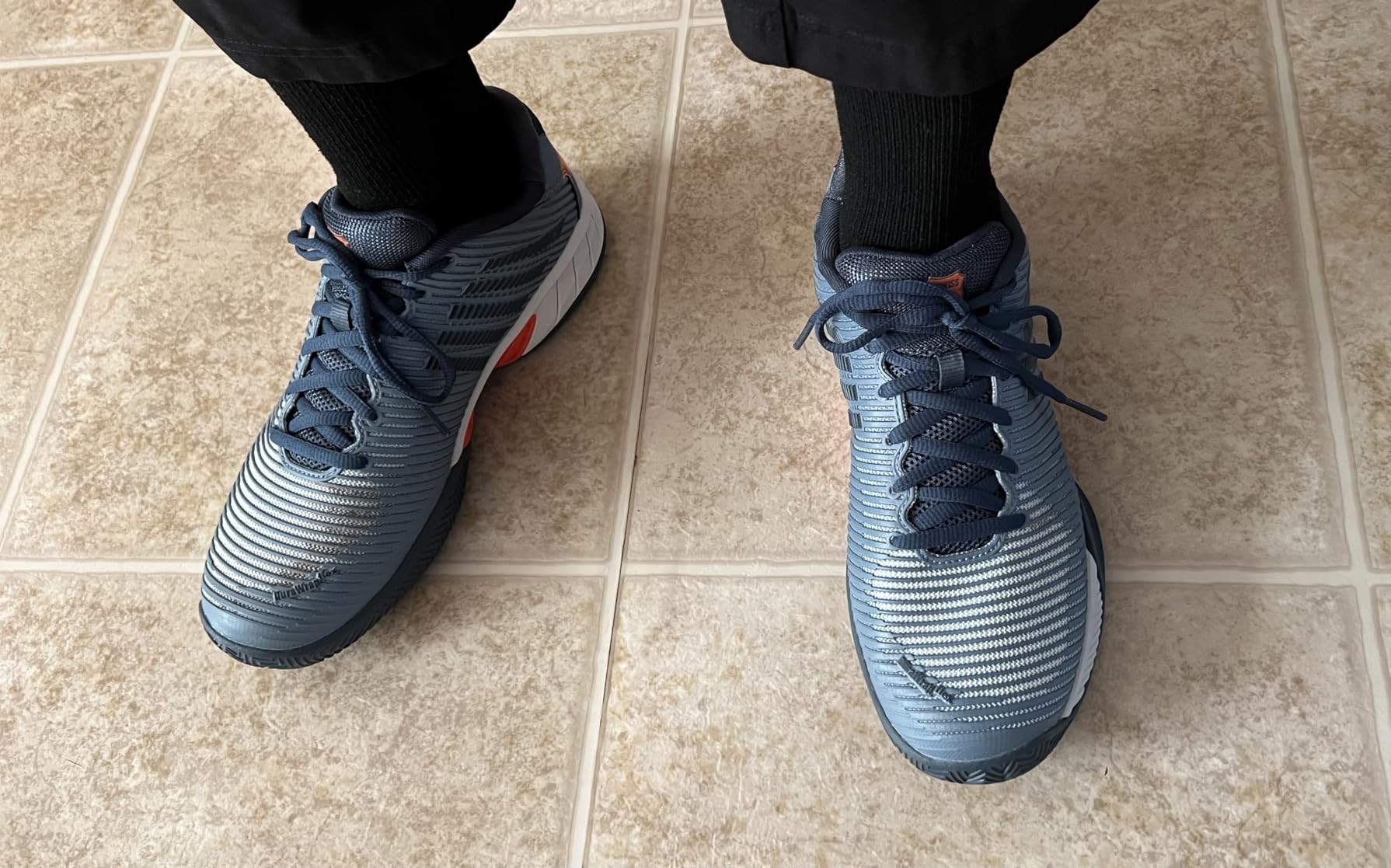
The upper is a breathable mesh wrapped in Durawrap Flex, a light material that adds abrasion resistance and flex. The brand claims no break-in period, and owners generally agree, which is unusual in a shoe with this much structure. Stay-Tied laces and Heel Grip lining handle the two things that annoy players most on clay: laces working loose during a slide, and the heel lifting on a hard stop.
One thing to know before you buy: 10 percent of the ratings are 1-star. The distribution is 66 percent five-star and 15 percent four-star, then a long thin tail of unhappy buyers. Those complaints cluster around fit and durability rather than grip, so if you have a narrow midfoot, order carefully. Players posting on r/10s regularly single out K-Swiss as holding up longer on clay than pricier rivals, and this model is the reason that reputation exists.
Who the Hypercourt Express 2 HB suits
It suits a doubles specialist first, because doubles is where sliding and hard stops happen most often and the chassis handles both without complaint. It also suits a club-level singles player who plays a mix of surfaces and just needs one dependable clay shoe, and a recreational weekend player who does not want to think about shoe technology at all.
It is least suited to a player chasing maximum cushioning under a heavy frame, or one who needs a very wide toe box. The Surgelite midsole is responsive rather than plush, and the forefoot is on the snug side compared with the adidas Barricade 14.
What to check before ordering
Check the fit across the midfoot, because that is where the 1-star complaints concentrate. The forefoot room is adequate rather than generous. If you play on very loose, deep red clay, look at the Hypercourt Express 3 Clay instead, where DragGuard 7.0 reinforcement extends outsole life in exactly that environment.
Verdict: this is the shoe to buy if you want one pair that handles singles, doubles and practice on any loose clay surface without thinking about it. The grip is proven, the review history is long, and the fit is a safe middle ground rather than a gamble.
2. ASICS Gel-Resolution X Clay: forefoot GEL cushioning for long sliding rallies
- Forefoot GEL noticeably softens landings on hard stops
- DYNAWALL and DYNALACING hold the foot through lateral moves
- AHARPLUS and PGUARD resist clay abrasion well
- Two-piece midsole improves landing stability
- Runs large
- size down a half size
- Toe box is narrow despite wide-fit marketing
- Some buyers report a stiff upper and a weak lacing system
The Gel-Resolution line has been the reference point for stability shoes for years, and this clay version keeps the core of it. The forefoot GEL is the headline: a viscous cushioning insert that absorbs impact at the exact point where a sliding player lands hardest. On clay, where players decelerate from a sprint into a low slide, that forefoot strike repeats dozens of times per set.
Stability comes from three separate systems working together. DYNAWALL is a midfoot structure that resists twisting. DYNALACING routes the lacing across the midfoot to stop the foot sliding around inside the shoe during a cut. A two-piece midsole construction handles the landings, spreading the load more evenly than a single-density midsole would.
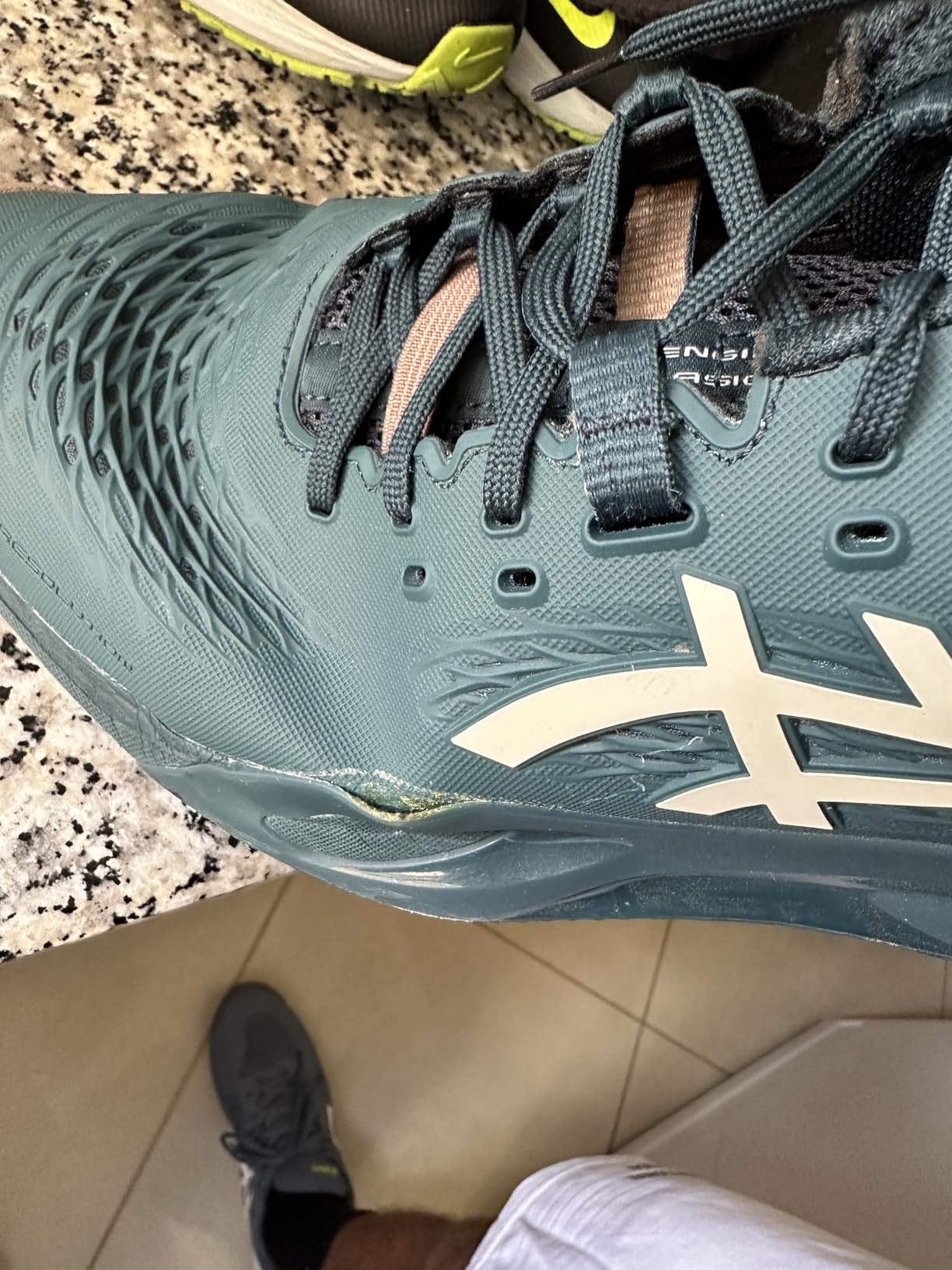
Durability is handled by AHARPLUS outsole rubber in a clay pattern, plus PGUARD reinforcement inside the forefoot upper where the toe box grinds against the clay on a serve-and-volley approach. The outsole is designed to be non-marking, which matters on a club court where a scuff mark can cost you a dispute with the club pro.
Now the part that should influence your decision more than any spec sheet. This shoe runs large, and ASICS recommends sizing down a half size, which buyers repeatedly confirm. More importantly, the toe box is narrow: several listings market the Resolution as a wide fit, yet players with genuinely wide feet report that their toes still press against the front of the shoe after a full match. If you have wide feet, this is not the pair to buy blind.
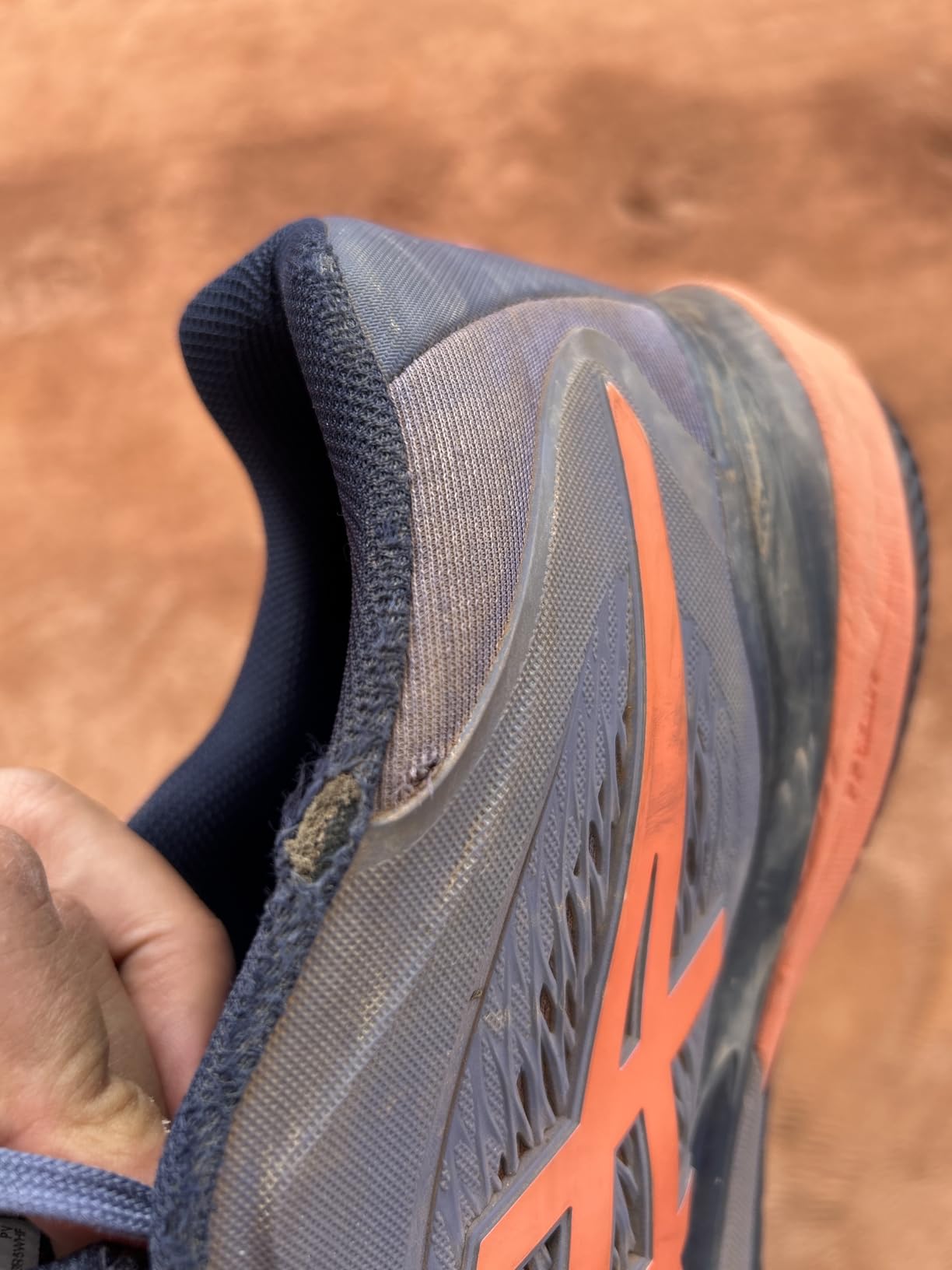
Other reported issues: a stiff-feeling upper on some builds, a lacing system that some owners find ineffective, and a pressure point near the medial arch at the heel. None of these are universal, but they appear often enough to be worth trying the shoe in a store. With 124 ratings at 4.1 stars and 62 percent five-star, the cushioning and grip are consistently praised while the fit draws the complaints.
Who the Gel-Resolution X Clay suits
This is the shoe for a player who slides. A baseliner who opens up the court and defends with a slide into the corner, a doubles player chasing drop shots, a veteran whose knees and heels feel the accumulation of impact over a long match. The forefoot GEL does its work at the exact moment you land from that slide, and a wider midsole base makes the landing predictable.
It also suits anyone who has previously hurt an ankle on a lateral movement and wants more structure than a speed shoe provides. The DYNAWALL and DYNALACING combination keeps the midfoot from moving independently of the leg during a cut.
What to check before ordering
Sizing is the whole story here. Size down a half size, and if you are between sizes or have a high instep, try both. Wide feet should skip this model or try it on carefully, because the narrow toe box is the most consistent negative theme across the ratings. The 11 percent two-star and 7 percent one-star shares are small but real.
Verdict: this is the cushioned pick. If you slide constantly, carry any extra weight, or your knees and heels feel the impact of hard court tennis even on clay, the Gel-Resolution X Clay is the pair to try first. Buy it a half size down and check the toe box.
3. Wilson Rush Pro 4.5 Clay: a support chassis built for aggressive baseliners
WILSON Rush Pro 4.5 Men’s Clay Tennis Shoe – Navy Blazer/White, Size 14 US
- Split chassis extends under the foot for real lateral resistance
- Sensifeel 2.0 mesh is genuinely breathable
- 9 mm drop sits between a speed shoe and a cushioning shoe
- Outsole grips well while leaving minimal court marks
- Traditional narrow fit squeezes the toe box
- Wide feet may need a half size up
- A minority of buyers report blisters
The Rush Pro 4.5 is built around one idea: resist lateral movement without adding mass. The 4D Support Chassis 2.0 is a split chassis that extends beneath the foot, with a lateral piece running from heel to toe. On clay, where the surface deforms under load and the foot can roll into an ankle inversion on a sudden direction change, that structure is the difference between a planted foot and a wobble.
Version 4.5 added medial support and a re-engineered mesh over the previous build. The Sensifeel 2.0 upper is minimally layered, which is why it breathes as well as it does across a long match in the heat. Inside, the Endofit full inner sock construction wraps the foot rather than sitting under it, and the Energy Cell EVA foam in the forefoot gives a softer landing without turning the whole midsole soft.
Wilson uses a 9 mm DF2 heel-toe drop, and the brand describes it as the compromise between comfort and performance. That is an unusual amount of drop for a modern tennis shoe, and it does make this a bit lower and a bit more grounded than the Solution Speed FF. If you have spent years in flat shoes, the drop will feel noticeable at first.
The rating profile here is unusually positive for a recent release. Of 88 ratings, 79 percent are five-star and 6 percent are four-star, for a 4.4 average. The grip is the most commonly praised feature, and buyers note the outsole holds traction on clay while leaving few visible marks.
The complaints are almost entirely about fit. This is a traditional narrow last, and players with wide feet are advised to size up a half size. A small number report blisters from that snug forefoot.
Who the Rush Pro 4.5 suits
It suits the aggressive baseliner who takes the ball on the rise and needs the shoe to stay planted through a heavy crosscourt swing followed by a hard recovery step. The full-length lateral chassis piece is built for exactly that sequence, and the 9 mm drop gives the shoe a settled, low feel that aggressive hitters tend to prefer.
It is a reasonable fit for doubles too, though a doubles player who spends more time on the move than planted may find the Solution Speed FF 4 lighter. It is a poor match for a player with wide feet, or for anyone who wants a soft, cushioned landing.
What to check before ordering
Try it in a store if you can. The traditional fit is the defining trait and the defining complaint, and the difference between the right size and a half size too small is a blister. If you are between sizes and have ordinary-width feet, the shoe is probably fine as listed. If your feet run wide, go up a half size and consider the Barricade 14 instead.
Verdict: pick this if you are a baseliner who takes the ball early, hits heavy with the swing, and needs the shoe to hold firm through repeated lateral stops. It is less suited to a serve-and-volley player who wants a light, flexible shoe with plenty of ground feel.
4. K-Swiss Hypercourt Express 3 Clay: the same chassis, rebuilt for toe drag
K-Swiss Men’s Hypercourt Express 3 Clay,White/Peacoat/Silver,10.5 M
- DragGuard 7.0 targets exactly the areas clay destroys
- No break-in period reported
- Heel Grip lining is one of the better sock-locking linings made
- 180 PSC keeps the midfoot from twisting
- Only 46 ratings
- so long-term evidence is thin
- 10 percent of ratings are 1-star
- Less stable than the DYNAWALL-based ASICS
This is the current version of the shoe above, and the difference matters if your game is built on slides. Durability is the pitch. DragGuard 7.0 places elevated rubber in the toe and heel, the two zones that wear out first on clay because that is where the shoe contacts the ground during a slide. Outsole abrasion on rough clay is the number one complaint in every clay forum thread I read, so a brand that specifically reinforces the drag zone is solving the right problem.
Cushioning moves to SURGE+ 7.0, a premium foam the brand positions as maximum energy return at low weight. The 180 PSC plantar support chassis carries over unchanged, and the Heel Grip lining made of interlocking fibres grips your sock to cut heel slippage. Stay Tied laces add a catch that keeps the knot from working loose mid-match.
The honest caveat is the sample size. Forty-six ratings at 4.2 stars is decent but thin, and 69 percent of those are five-star. The 10 percent one-star share is close to the older model’s, and the complaint theme is the same: comfort and fit, not grip.
Who the Hypercourt Express 3 Clay suits
It suits a heavy slider. If your matches are built around a hard slide into the corner, or you play on deep loose red clay where the brick itself acts like sandpaper, the DragGuard 7.0 reinforcement in the toe and heel is worth more to you than any other feature on this list.
It is a less clear fit for a speed-focused player. The SURGE+ 7.0 foam is cushioned and responsive rather than thin, so you are trading a little ground feel for durability and comfort.
What to check before ordering
Forty-six ratings is not much to judge, so treat the sizing as unproven rather than known. The complaints that do exist point to comfort and fit, not to grip or outsole failure, which is a reasonable signal even from a small sample. If you can compare it in person against the Express 2 HB, the choice comes down to how much you slide.
Verdict: it is a targeted upgrade rather than a different shoe. Same chassis, better reinforcement, softer foam. Buy the Express 3 if you slide a lot on abrasive clay; buy the Express 2 if you want the longer track record behind the number.
5. ASICS Solution Speed FF 4 Clay: a light build for quick redirections
- FLYTEFOAM keeps the midsole light and comfortable
- SPEEDTRUSS is designed specifically for cutting motions
- Medial PU loops stop the laces snapping under load
- Zero one-star ratings in the current sample
- Only 23 ratings to judge from
- 12 percent of ratings are 2-star on lateral stability
- Less shock absorption than the Gel-Resolution
This is the speed shoe in the group. FLYTEFOAM is a lightweight midsole foam that trades some of the plushness of the Resolution for a shoe that moves with you, and SPEEDTRUSS is a chassis geometry designed to improve quickness and cutting motions. If your points come from short, sharp redirections rather than grinding baseline exchanges, that is exactly what you want.
Two details that most buyers never notice until they need them. The medial side carries a PU loop and eyelet loops, which spread the lace load so it does not snap mid-match during an aggressive cut. And the sockliner is solution-dyed, which the manufacturer says cuts water use by about 33 percent and carbon emissions by about 45 percent against conventional dyeing.
The 23 ratings average 4.4, with 74 percent five-star and zero one-star ratings, which is a good signal for a young release. The caution is the 12 percent two-star share, the second-largest group, and the feedback there points at lateral stability. A speed-oriented chassis is deliberately less rigid than a stability chassis, so players who change direction hard and often may find the shoe does not hold them through the sharpest cuts. I would want more wear data before calling that a non-issue.
Who the Solution Speed FF 4 suits
It suits a fitter or younger player, and any doubles player who needs to react at the net without a heavy shoe slowing the first step. The SPEEDTRUSS geometry is built for cutting motions, so a player who lives on short sharp redirections will get more out of it than a grinding baseliner will.
It suits a player on a firm, fast clay surface such as artroturf, where a thin responsive midsole keeps the surface feeling lively. It does not suit a player who wants maximum joint protection, or one who plays doubles on clay and takes a lot of contact at the knees.
What to check before ordering
Twenty-three ratings is a thin base, and the 12 percent two-star share is the number to read. Those reviews point at lateral stability, which is the expected trade-off in a speed chassis. If your game involves sudden sharp direction changes at full effort, try the Gel-Resolution X Clay alongside it before deciding.
Verdict: choose the Solution Speed FF 4 if you are a younger or fitter player, or a doubles player who needs to react fast at the net. Pair it with a midsole that is at least moderate, because you are giving up some impact protection for the weight saving.
6. Wilson Rush Lite 5 Clay: dual-compound cushioning without the tour-level weight
WILSON Rush Lite 5 Clay Men’s Tennis Shoe – White/Bay/Fiery Coral, Size 12.5
- R-DST+ pairs compressed and compression-molded EVA for rebound and cushioning
- Medial Drag-Pad is aimed squarely at slide wear
- TPU Speed Clip adds lateral stability cheaply
- 4.8 average across the current rating set
- Only 8 ratings
- so the evidence is very thin
- Runs small
- size up if you are between sizes
- Less proven than the sibling Rush Pro 4.5
The Rush Lite 5 sits between the Rush Pro above and a basic court shoe. Its signature is the R-DST+ midsole, which layers two EVA compounds, a super compressed one and a compression-molded one, to get rebound from the first and cushioning from the second. That is a sensible hybrid for clay, where you want to land softly without the shoe feeling dead underfoot.
Two structural pieces do the durability and stability work. The medial Drag-Pad is a rubber overlay placed exactly where the foot contacts the clay when you slide on your inside edge, which is the most abrasive part of a tennis shoe on this surface. The TPU Speed Clip handles lateral stability. The upper is a single-layer EVA mesh, which keeps the whole shoe flexible and cool.
I want to be straight about the numbers here. Eight ratings at a 4.8 average sounds extraordinary, and 84 percent of those are five-star, but it is a very small sample and I would not build a purchase decision on it. The useful signal is that owners describe the grip on Har-Tru as strong and the shoe as more comfortable than expected, while the recurring warning is that it runs small.
Who the Rush Lite 5 suits
It suits a club player who wants a comfortable, balanced clay shoe without stepping up to a tour-level model. The R-DST+ dual midsole is a sensible compromise for someone who slides a couple of times per set rather than constantly, and the medial Drag-Pad handles the wear that follows. On green Har-Tru, which is firmer and more forgiving than loose red clay, the grip is reported as strong.
It suits a beginner moving up from a general court shoe who wants something uncomplicated and cool on the foot. The single-layer EVA mesh keeps the shoe flexible, which is friendly to a player still learning to move on clay.
What to check before ordering
Sizing is the main decision. It runs small, so size up if you are between sizes. Beyond that, the honest problem is that eight ratings cannot tell you how the Drag-Pad holds up over a season, and the shoe is new enough that long-term wear data simply does not exist yet. Buy it for the construction, not for the rating.
Verdict: on the spec sheet alone this is a well-balanced clay shoe, and the Drag-Pad plus the dual midsole make it a sensible pick for a club player who slides and wants comfort without stepping up to a tour-level model. Just treat the rating as provisional until more owners put miles on it.
7. Wilson Intrigue Tour Clay: a tour-level clay shoe on a women’s last
WILSON Intrigue Tour Clay Women’s Tennis Shoe – White/Bay/Skipper Blue, Size 8.5
- Duralast compound is built for abrasion resistance and traction
- Swiftstep TPU shank gives real torsional drive
- Designed on a women's last rather than a shrunk men's one
- Compression-molded foam keeps the ride responsive
- Only 4 ratings
- all of them 5-star
- No fit data exists yet for the women's last
- Less support structure than the Gel-Resolution
Most brands still sell their clay shoes on a men’s last scaled down, which is the single biggest reason women’s clay shoes get squeezed. The Intrigue Tour is listed as engineered for women, with the last and volume built for the women’s foot rather than adapted, and that distinction shows up in the toe box and the arch fit. It is the reason this shoe is worth a look even at an early stage.
The tech is tour-level rather than casual. Duralast is a high-density rubber compound that resists abrasion and grips across surfaces, which is what you want on clay where the outsole is the wear point. Swiftstep combines a TPU torsion shank with high-durability CMP foam to resist torsion and add drive through rotation. A compression-molded cushion foam underfoot keeps the ride responsive rather than soft.
All four ratings are five-star, and the sample is simply too small to say anything useful about it. That is not a criticism of the shoe, it is a statement about what a four-review listing can and cannot tell you. Buy it because the construction is right for clay and the last is right for the foot, not because of a 5.0 average.
Who the Intrigue Tour suits
It suits a woman who has been squeezed by scaled-down men’s clay shoes and wants a properly built last, and a high-arch player will notice the difference because a women’s last is not simply a shorter men’s last. It also suits a competitive player who wants a Duralast rubber outsole and a torsion shank without carrying the weight of a heavier support shoe.
It suits a player moving up from a club shoe who wants a step up in construction. The compression-molded cushion foam underfoot keeps the ride responsive, so you still feel the clay.
What to check before ordering
Fit is the open question, and there is no review data to help you. Four ratings, all of them five-star, tell you nothing about the last beyond what the manufacturer states. If you can try the shoe in person, do that first. If you cannot, buy from a seller with straightforward returns rather than gambling on an untested last.
Verdict: for a woman shopping the clay category, this is the pick with the fewest compromises in its design brief. The open question is fit, and only your own foot can close that. If you can try it in person, do.
8. adidas Barricade 14 Clay: a roomy toe box wrapped around a very rigid chassis
adidas Men’s Barricade 1/4 Clay Tennis, Black/Zero Metallic/Lucid Red, 12
- Explicitly spacious toe box with room for toes to spread
- Reinforced midfoot adds stability without shrinking the forefoot
- Breathable padded upper limits hot spots
- Lightest Barricade construction released so far
- Some buyers find the shoe extremely rigid and restrictive
- The rigid build makes it hard to get into
- 25 percent of the 5 ratings are 2-star
Fit is where the Barricade separates itself. adidas describes a spacious toe box with room for toes to spread during lateral movement, reinforced through the midfoot so that structure does not come at the expense of forefoot volume. Among the twelve shoes here it is the one most likely to fit a genuinely wide foot without a fight.
The outsole is a specialized clay tread that grips the surface while still allowing controlled slides, and adidas frames the whole shoe around that requirement. The chassis and claw have been reworked to hold the foot during lateral moves, and the upper is a breathable mesh with padding in the places where clay and long sessions cause rubbing.
What you are buying is control, and the control has a cost. A detailed review from an early owner describes the shoe as extremely rigid, locking the foot in place, and another notes how hard it is to get into. That rigidity is the point of a support shoe, but it is not for everyone.
The rating split here is 75 percent five-star and 25 percent two-star, which is the sharpest drop-off of any shoe in this roundup, on five ratings.
Who the Barricade 14 suits
It suits wide feet and high insteps, and anyone who has spent years avoiding tennis shoes because standard lasts squeezed their toes.
It also suits an older player who wants a planted, stable ride and does not mind weight or rigidity. The chassis and claw system resists lateral movement aggressively, and the padded breathable upper limits hot spots on long outdoor sessions.
What to check before ordering
Ask yourself whether you like firm support or soft cushioning, because this is firmly the first.
Buyers describe the shoe as extremely rigid, to the point where the foot feels locked, and one owner found it difficult to get into at all. The 25 percent two-star share sits on five ratings, so treat it as a signal rather than a verdict.
Verdict: if you have wide feet or a high instep, this is the first shoe here to try. If you want a flexible, ground-feeling shoe for clay, the rigidity will frustrate you and the K-Swiss or Babolat options suit you better.
9. Mizuno Wave Exceed Tour 7 Clay: a layered foam platform for joint comfort
Mizuno Wave Exceed Tour 7 Clay Court Men’s Racquet Sports Shoe, White-China Blue, US Mens 11
- Mizuno Wave plate spreads impact across a wider area
- Three foam technologies stack for softness and energy return
- Pownce keeps the platform light
- Layered cushioning suits older players and long sessions
- A single rating
- so there is no buyer feedback at all
- Untested fit and no durability data yet
- Heavier stack than the speed-oriented picks
This is a heavily cushioned platform, and it works differently from the ASICS approach. Rather than relying on a GEL insert at one point, the Wave Exceed Tour 7 layers several midsole technologies. The Mizuno Wave plate is a rigid plate that disperses impact energy across a broader area, which is what gives the shoe a stable base under load.
Around that plate, ENERZY XP and ENERZY NXT foams are blended for a combination of softness, response and energy return, and Pownce provides an exceedingly light midsole material in the upper stack so the added cushioning does not turn the whole shoe heavy. The result is a shoe with a lot of material between your foot and the clay.
There is one rating, a 5.0, and that is all there is. I am including this shoe because the platform design addresses a real need, not because the reviews back it up. If you are an older player, returning from injury, or simply sensitive to impact, a wider-absorbing midsole is a sensible thing to build a shoe around, and this is the one model here built entirely around that idea.
Who the Wave Exceed Tour 7 suits
It suits a player who feels impact: an older player with worn joints, someone returning from a lower-limb injury, or simply a heavy striker who notices the difference between a hard landing on clay and a cushioned one. The Mizuno Wave plate spreads energy across a wider area than a single foam can, and that is the mechanism behind the comfort claim.
It also suits a long-session player who does three sets on a Saturday. Pownce keeps the added material light enough that the shoe stays usable for a full match rather than feeling like a recovery slipper.
What to check before ordering
Expect an unknown. One rating is no rating, and there is no fit, durability or outsole-life data for this shoe from owners. The stacked foam platform also means more material than a speed shoe, so if you are used to a thin, ground-feeling clay shoe, this will feel like a different category of footwear. Try it on with your normal socks before committing.
Verdict: the impact-absorption pick, and a sensible one for joint comfort on long clay sessions. Treat the fit as unknown until you try it, and do not expect the weight of a speed shoe.
10. HEAD Revolt Pro 5.0 Clay: full herringbone coverage across the whole outsole
HEAD Revolt Pro 5.0 Men’s Clay Tennis Shoe, Blueberry/Teal, 11.5
- All-over pure herringbone covers the full outsole for uniform grip
- Reinforced protection zones are placed exactly where slides wear the upper
- Integrated lacing straps plus a 3D-TPU heel counter lock the heel
- Ventilated anti-torsion shank adds airflow as well as stability
- Only 7 ratings
- so the sample is small
- 19 percent of ratings are 2-star
- Heavier midsole than the speed picks
Most clay shoes have a herringbone outsole across the forefoot and a smoother section under the heel for sliding. The Revolt Pro 5.0 goes all over, with pure herringbone tread covering the full clay outsole, which is what makes it the most complete herringbone coverage in this roundup. HEAD describes the result as superior traction, controlled sliding and reliable grip through aggressive lateral movement.
The upper is a strong mesh paired with an engineered PU molded chassis that gives flex where you need it and durability where you do not. Reinforced protection zones are placed in the areas that take the most wear during slides, which is the difference between an outsole that lasts and an upper that tears first.
Lockdown is handled by integrated lacing straps working with a 3D-TPU heel counter. On clay, where a hard stop can lift the heel out of the shoe, that combination is worth more than most players expect. Underneath, a dynamic midsole uses a triple-compound, triple-density build, with Core Control 3D lateral TPU for stability and a ventilated 3D anti-torsion midfoot shank that improves both torsional control and airflow over a long match.
Seven ratings at 4.4 stars, with 81 percent five-star. The 19 percent two-star share is the notable entry, and with a sample this small it is hard to say what it represents. The herringbone coverage and the lockdown fit are the strongest signals in the early feedback.
Who the Revolt Pro 5.0 suits
It suits a grip-first player. If you play on a dusty or slow court and need to plant the foot hard before pushing into the next shot, all-over pure herringbone is the most uniform traction pattern available in this roundup, with no smooth heel section to lose bite during a transfer.
It also suits a heavy slider, because the reinforced protection zones on the upper are placed in the areas that a slide wears first. The integrated lacing straps and 3D-TPU heel counter give strong lockdown, which matters when a hard stop tries to lift your heel out of the shoe.
What to check before ordering
The midsole is a triple-compound, triple-density build with Core Control 3D lateral TPU, which is more structure than the speed shoes here. If you like a very thin, flexible clay shoe, this will feel like a lot. The review base is seven ratings with a 19 percent two-star share, so there is not enough data to say what that minority objects to.
Verdict: the pick for grip-first players, particularly anyone who plays on a dusty or slow court where you need to plant the foot hard before pushing off. The trade-off is a busier midsole than the speed options.
11. Babolat Jet Tere 2 Clay: an ultralight build with a narrow forefoot
Babolat Women’s Jet Tere 2 Clay Court Tennis Shoes, White/Gold Pink, US Size 7.5
- Lightest model in the Babolat range
- close to barefoot on court
- Michelin rubber grips clay and resists abrasion
- Thicker midsole adds cushioning without much weight
- Breathable mesh suits hot outdoor sessions
- Narrow toe box that the product description does not disclose
- Some buyers report foot pain that persists past the first wear
- Only 9 ratings
The Jet Tere 2 is an ultralight shoe, built for players who barely notice what they are wearing. Babolat describes it as the lightest model in its range, with a streamlined upper, breathable mesh and integrated lateral reinforcements for stability. The midsole is five percent thicker than the previous version for extra cushioning, which is a smart way to add comfort without adding mass.
Durability is where Babolat spent its budget. The outsole is thickened in the highest-wear areas and uses Michelin premium rubber for abrasion resistance, and a rubber forefoot protection piece covers the inner forefoot down to the toes. That inner forefoot is exactly where a slide wears through a light upper, so the reinforcement lands in the right place.
The outsole pattern is clay-specific, tuned for traction and controlled sliding during quick direction changes, and the Ortholite molded insole is foot-contoured rather than flat. On a hot outdoor court, the mesh breathes well enough that you will notice the lack of weight more than you notice the heat.
Now the warning, and it is a real one. The toe box is narrow, and it is not disclosed in the product description. Of nine ratings, 66 percent are five-star, but one buyer reported foot pain that persisted beyond a second wear, and the narrow forefoot is the likely reason. If you have wide feet, skip this one and look at the adidas Barricade 14.
Who the Jet Tere 2 suits
It suits a player who wants to forget about their shoes. The streamlined upper, breathable mesh and lateral reinforcements make this a good pick for doubles, where you are moving constantly, and for anyone who prefers a close, flexible fit over structure.
It suits a recreational player on a firm clay or artroturf surface, where the Michelin premium rubber grips well and the extra-thickened outsole will hold up. The Ortholite molded insole is foot-contoured, so comfort is reasonable out of the box for a light shoe.
What to check before ordering
The narrow toe box is the one thing to check, and it is not disclosed in the product description. Nine ratings with one buyer reporting foot pain that persisted past a second wear is a small but clear signal. If you have ordinary or narrow feet, you will probably be fine. If you have wide feet, do not buy this without trying it.
Verdict: the value pick for a recreational or doubles player who wants a light, simple clay shoe and fits a narrow last. It is also one of the more straightforward options in the group, which is where most of its appeal comes from.
12. adidas Avacourt 3 Clay: a straightforward clay shoe with a thin review trail
- Clay-specific outsole in an entry-level package
- Repetitor technology keeps the build light and responsive
- Simple synthetic upper is durable enough for club play
- Regular fit is predictable and widely available
- A single rating
- so no real buyer evidence
- Textile sockliner is the least supportive in the roundup
- No reinforcement detail listed for slide wear
The Avacourt 3 Clay is the simplest shoe in the roundup and that is not an insult. It is a clay court shoe with a clay outsole, a synthetic upper, laces and a textile sockliner. The one piece of named technology is Repetitor, which adidas positions as lightweight, responsive support, and the fit is a regular width, meaning nothing about it will surprise you.
For a club player who plays once or twice a week, hits mostly for fun, and wants a pair of clay shoes that grip without demanding attention, that simplicity is the appeal. There is no chassis to learn, no aggressive lateral structure to adapt to, and no dense foam to soften the feel of the court. You feel the clay, which some players prefer entirely.
The rating situation is the problem. There is one review, a 5.0, which tells you nothing about durability, fit or outsole life. The listed construction is also the least detailed in the group, with no drag guard, no forefoot reinforcement and no lateral TPU mentioned, and on a surface that eats toe boxes that absence is worth weighing.
Who the Avacourt 3 suits
It suits a new clay player and a club player who plays once or twice a week. There is no chassis to adapt to, no aggressive lateral structure and no dense foam softening the surface, so you feel the clay directly. A doubles player who sprints rather than slides will find that simplicity useful.
It suits anyone who wants a low-risk second pair to keep in the bag for a clay court, or a straightforward shoe that does not need a fitting appointment. The regular fit is predictable and the synthetic upper is durable enough for regular club wear.
What to check before ordering
Check what you are giving up. The textile sockliner is the least supportive in this roundup, and no drag guard, forefoot reinforcement or lateral TPU is listed, which on a surface that eats toe boxes is a real omission. There is also a single rating, so buyer feedback on durability and fit does not exist.
Verdict: a fair entry point for a new clay player or a secondary pair, and a sensible choice for doubles players who slide less than they sprint. If you play a lot, the extra durability of a reinforced upper will be worth spending on instead.
How to Tell a Clay Court Shoe From a Hard Court Shoe
The fastest way to know is to flip the shoe over. Everything else on the spec sheet is marketing; the outsole pattern tells you the truth.
Step one: look for herringbone. A clay outsole is covered in tight V-shaped or zig-zag grooves running across the width of the sole, and those grooves dig into loose crushed brick to grip in every direction. A hard court outsole instead has wider, flatter lugs arranged in a multi-directional pattern, sometimes with a distinct pivot circle under the ball of the foot. The reason is mechanical: a hard court is a fixed surface that does not deform, so the shoe needs shaped lugs for lateral bite, while clay is a loose layer that a thin zig-zag pattern can sink into.
Step two: check the midfoot and toe area. Clay shoes reinforce the toe and the inner forefoot, the medial side, because that is where a slide grinds the shoe against the surface, while hard court shoes concentrate rubber at the lateral edge and the heel for braking. If the product description mentions a drag guard, a drag pad or a toe-drag defence, you are looking at a clay or all-court shoe.
Step three: read the cushioning story. Clay shoes tend toward a slightly softer, more shock-absorbing midsole because players spend a lot of time in contact with the ground while sliding. Hard court shoes tend toward firmer, lower-profile foams for ground feel and quick direction changes. All-court shoes sit between the two with a shallower, sometimes partial herringbone pattern and a compromise outsole.
A note on surface type, because not all clay is the same. Red clay in Europe and South America is loose, deep and abrasive, so it fills the grooves of a herringbone sole quickly and wears outsoles faster. Green Har-Tru, common in the United States, is a firmer and more forgiving surface that rewards a shoe with good lateral bite. Padel courts and artificial clay, or artroturf, are sand-filled synthetic surfaces that are firmer and faster than real clay.
Do You Need a Separate Clay Shoe?
Yes, if you play on clay more than a few times a year. Here is the reasoning that forum players keep arriving at, and it matches how the outsoles are actually built.
All-court shoes on clay are the compromise most people try first. They will not slide out from under you as badly as a hard court shoe, and they will not wear out as fast as a full herringbone outsole on concrete. But they are designed for a surface that does not move, so the multi-directional tread does not sink into loose brick. The result is a shoe that grips well going forward and poorly during a slide, exactly when you need the most control. Players on tennisforum.com describe exactly this: predictable on the baseline, unpredictable when they slide into a ball.
The reverse case is worse in a different way. Clay shoes on hard court slide too much, because a herringbone outsole has nowhere to bite into a sealed acrylic surface. You slide on landings you did not plan, the herringbone pattern grinds flat against a surface that will not lubricate it, and the shoe can be done in a few months. Forum regulars are blunt about this: the wrong outsole is not just a comfort issue, it changes how you move and how you load your ankle and knee.
On break-in, be patient for your own sake. Some of the shoes here explicitly advertise no break-in period, the K-Swiss models using Durawrap Flex most notably, and those do play well immediately. Others, particularly the stiffer support shoes, need a few sessions before the midsole and the upper stop feeling unfamiliar. Do not judge a new clay shoe on one hard session: give it two or three, and make your first test a controlled slide rather than a full three-hour match.
One last warning from the forums, and it is the one that is most correct: do not wear running shoes or everyday sneakers on court at all. A running shoe outsole is designed for forward motion only. It offers no lateral stability, which is the mechanism behind most ankle sprains on clay.
Fit and Width Guidance for Wide Feet
Fit is where more clay shoe purchases go wrong, and the forum pain point is consistent: toes pressed against the front of the shoe after ninety minutes, then a black toenail a week later. Here is how to avoid that.
Know your toe box before anything else. Sit down in the shoe and check the gap in front of your longest toe. You want roughly a thumb’s width. Standing, the toe box will look narrower because your weight compresses the foot. If a shoe is narrow when you sit in it, it will be narrow when you play in it.
Use the width labels on the listing, not the shoe name. A model described as wide by one brand may match a standard fit from another, because the brands use different grading. Ratings that mention a narrow toe box are the fastest signal, and in this roundup the ones to know about are the ASICS Gel-Resolution X, described as wide in some listings but reported narrow by owners, and the Babolat Jet Tere 2, where the narrow forefoot is not disclosed at all.
For a genuinely wide foot, the adidas Barricade 14 has the most explicit spacious toe box in the group, and the Wilson Intrigue Tour is built on a women’s last rather than a scaled men’s one.
Heel lockdown matters more on clay than on hard court. Sliding loads the foot sideways and lifts the heel. Look for a lacing system that crosses the midfoot, an internal heel counter, and a lining that grips the sock. The ASICS DYNALACING and 3D-TPU heel counter on the HEAD Revolt Pro are both built for this, and the K-Swiss Heel Grip lining is a cheaper version of the same idea.
Use the sizing notes, and they are specific here. The Gel-Resolution X Clay runs large and ASICS recommends sizing down a half size, while the Wilson Rush Lite 5 runs small, so size up if you are between sizes. The Wilson Rush Pro 4.5 uses a traditional narrow fit that some wide-footed players resolve with a half size up. A shoe that needs a deliberate size decision is fine; a shoe that needs one and does not tell you is the problem.
How to Clean Clay Dust Out of a Herringbone Outsole
Clay dust is the quiet reason clay shoes feel slow after a few sessions. Loose dust packs into the herringbone grooves, the tread stops biting, and the shoe feels slippery on a court that is perfectly grippy. None of the competitors I compared cover this, so here is the process I would use.
First, knock it out. Take the shoes off and tap the soles firmly against a hard edge, sole to sole and then against a bench, with the herringbone facing down. Most loose dust leaves in a few dozen taps. Do this outdoors or over a bin, because the dust is fine and it will get everywhere indoors.
Second, use a stiff brush. A toothbrush is too small for the job; a wooden-bristle or nylon-bristle brush the size of a shoe brush works far better. Work the herringbone grooves in the direction of the pattern, from toe to heel, and rotate the shoe as you go so the toe and heel zones get the same attention.
Third, for anything still packed in, use water sparingly. A damp cloth or a soft brush with a little warm water and a drop of mild soap will shift stubborn packed clay. Avoid soaking the shoe, and avoid the washing machine, which destroys the midsole glue and the foam structure long before it cleans the outsole.
Fourth, dry before you store them. Stuff the toe box with paper or a shoe tree and leave them at room temperature away from radiators. Heat is what cracks clay-stained rubber, and a shoe dried warm and then flexed is the one that develops a toe drag hole two weeks later.
Do this every few sessions through a clay season and the outsole life improves noticeably. On a rough, dusty court it is the difference between a shoe that grips in November and one that has gone flat.
While you are setting up for the season, our solo player ball machine guide covers feeding drills that work on the slower bounce clay produces, which is a different problem from the bounce on a hard court.
Frequently Asked Questions
What are the best tennis shoes for playing on clay courts?
The best tennis shoes for clay courts have a full herringbone outsole, reinforced toe and drag zones, and a cushioned midsole. Our top picks are the K-Swiss Hypercourt Express 2 HB Clay for all-round grip and stability, the ASICS Gel-Resolution X Clay for forefoot GEL impact absorption, and the Wilson Rush Pro 4.5 Clay for lateral support during aggressive baseline play. All three are built specifically for loose brick surfaces.
How to tell if tennis shoes are for clay or hard court?
Flip the shoe over. A clay court shoe has tight V-shaped herringbone grooves running across the full outsole, designed to sink into loose crushed brick. A hard court shoe has wider, flatter lugs arranged multi-directionally, sometimes with a pivot circle under the ball of the foot. Clay shoes also reinforce the toe and medial forefoot for slide wear, while hard court shoes concentrate rubber at the lateral edge and heel for braking.
Do you need different tennis shoes for clay?
Yes, if you play on clay regularly. A hard court or all-court shoe has a flatter tread that does not sink into loose brick, so it grips poorly during a slide. A clay shoe on a hard surface slides unpredictably and grinds the herringbone outsole flat in a few months. The wrong outsole changes how you move and raises your risk of ankle and knee strain, so most players who play both surfaces keep a dedicated pair for each.
What are the best clay court shoes for people with wide feet?
Start with the adidas Barricade 14 Clay, which has the most explicitly spacious toe box in our roundup with room for toes to spread during lateral movement. The Wilson Intrigue Tour Clay is built on a women’s last rather than a scaled men’s last, which also helps. Avoid assuming the ASICS Gel-Resolution X Clay is wide despite some listings, because owners with wide feet report a narrow toe box. The Babolat Jet Tere 2 is also narrow and does not disclose it.
How often should I replace clay court tennis shoes?
It depends on the surface and your style more than on the calendar. On abrasive European red clay, a shoe worn down by frequent sliding can lose its tread in a single season, especially with no cleaning. On firmer green Har-Tru, most well-built clay shoes last well over a year for recreational players. Watch for the outsole smoothing at the ball of the foot and thinning at the toe, and clean the herringbone grooves every few sessions to slow the wear.
The Verdict on the Best Tennis Shoes for Clay Courts in 2026
If you are buying one pair and want the least risk, choose the K-Swiss Hypercourt Express 2 HB Clay. It has the longest track record of any shoe in this roundup at 187 ratings, a clay-specific high-density outsole, a stable midfoot chassis and a breathable upper, and it does not force you into a particular playing style.
Buy the ASICS Gel-Resolution X Clay instead if you slide constantly or your joints take a beating, and size down a half size. Buy the Wilson Rush Pro 4.5 Clay if you are a heavy-hitting baseliner who needs lateral resistance, and size up if your feet are wide. Check the outsole before anything else, brush the herringbone grooves clean every few sessions, and you will get a lot more out of any of these than most players do.