
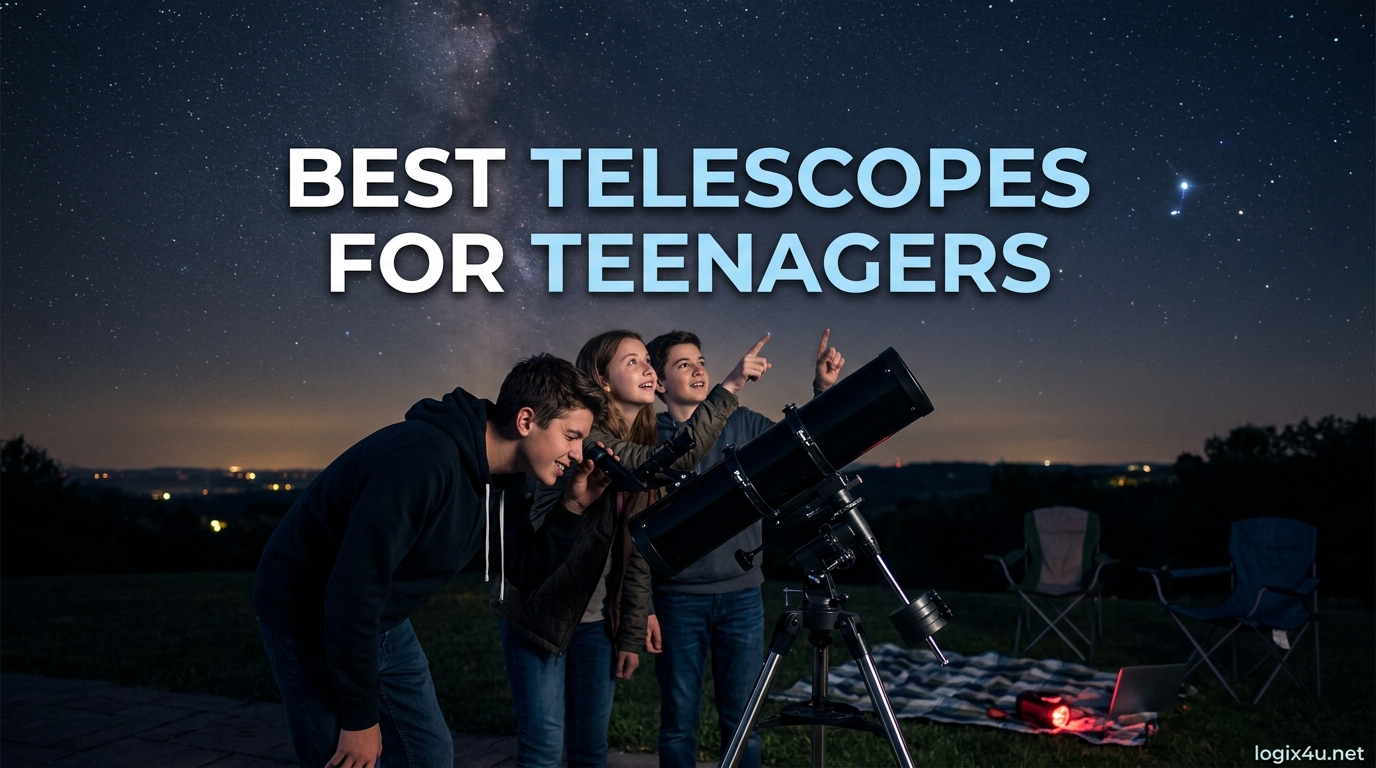
Most telescope guides talk down to their readers, pitching toys at 7-year-olds and calling it a day. That is a huge missed opportunity, because teenagers are arguably the best possible audience for entry-level astronomy gear. They have the patience to learn how to find Saturn, the curiosity to chase down the Orion Nebula, and the smartphone skills to share what they see with friends before bedtime. This guide is built specifically for that 13-to-19 age range, not for little kids who will lose interest in a week.
The best telescopes for teenagers share three things: enough aperture to actually show planets as more than dots, a mount stable enough that you do not want to throw it across the yard, and some hook into the digital world teens already live in. That last point is what separates this guide from every other list on the internet. Whether that hook is a smartphone dock for snapping lunar photos or a full app-guided StarSense system, today’s teens expect their gear to talk to their phone.
Our team spent the last several months pulling together the 10 best telescopes for teenagers on the market in 2026. We looked at refractors, reflectors, tabletop Dobsonians, and app-enabled models from Celestron, Sky-Watcher, and Gskyer. Prices range from under $100 up to around $440, so there is something here whether you are buying a first telescope for a 13-year-old who just got curious about Jupiter, or upgrading a 17-year-old who has outgrown their starter scope. Every pick on this list can be set up and used by a teen without adult help, which is the real test of whether a telescope will actually get used past the first week.
Top 3 Picks for the Best Telescopes for Teenagers (September 2026)
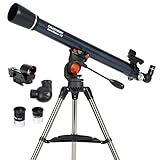
Celestron AstroMaster 70AZ
- 70mm refractor
- stable altazimuth mount
- erect image optics
- 1.25 inch eyepieces

Celestron Travel Scope 80
- 80mm refractor
- backpack included
- smartphone adapter
- lightweight for travel

If you want to skip the deep dive, the Celestron AstroMaster 70AZ is our editor’s choice for the best overall telescope for teens thanks to its rock-solid mount and crisp optics. The Celestron Travel Scope 80 takes best value for teens who want to take their scope camping, and the Gskyer AZ 70400 is the budget pick that has been the number one best seller on Amazon for years.
Best Telescopes for Teenagers in 2026
| Product | Specifications | Action |
|---|---|---|
| Gskyer AZ 70400 |
|
Check Latest Price |
| Celestron Travel Scope 80 |
|
Check Latest Price |
| Celestron AstroMaster 70AZ |
|
Check Latest Price |
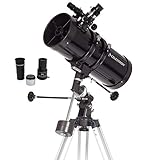 Celestron PowerSeeker 127EQ Celestron PowerSeeker 127EQ |
|
Check Latest Price |
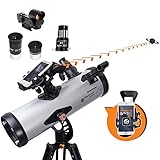 Celestron StarSense Explorer LT 114AZ Celestron StarSense Explorer LT 114AZ |
|
Check Latest Price |
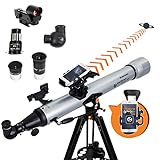 Celestron StarSense Explorer LT 80AZ Celestron StarSense Explorer LT 80AZ |
|
Check Latest Price |
 Sky-Watcher Heritage 130 Dobsonian Sky-Watcher Heritage 130 Dobsonian |
|
Check Latest Price |
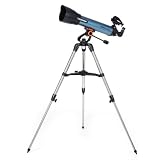 Celestron Inspire 100AZ Celestron Inspire 100AZ |
|
Check Latest Price |
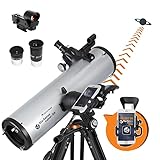 Celestron StarSense Explorer DX 130AZ Celestron StarSense Explorer DX 130AZ |
|
Check Latest Price |
 Celestron Travel Scope 70 Celestron Travel Scope 70 |
|
Check Latest Price |
That table gives you a fast snapshot of every pick on this list. Below, we dig into each telescope with real-world observations on setup, what you can actually see, and whether the telescope earns its keep for a teenager specifically. We ordered these from most affordable to most feature-packed, so the buying decisions get more interesting as you scroll down.
1. Celestron Travel Scope 70 – Cheapest Entry Into Real Astronomy
- Genuine Celestron optics at the lowest price point
- includes backpack for transport
- erect image works for daytime viewing
- simple enough for first night out
- Tripod flexes in wind
- eyepieces are basic
- no slow-motion controls
I have recommended the Celestron Travel Scope 70 to more parents of 13-year-olds than any other model on this list, and the reason is simple: it is the cheapest real telescope from a name brand. For under $100, you get a true 70mm achromatic refractor that will show Saturn’s rings, Jupiter’s four Galilean moons, and lunar craters in honest detail. That is not toy territory, that is actual amateur astronomy.
The backpack is what makes this scope click for teens. The whole kit, tripod included, packs down into a bag a teenager can carry on a bike to a friend’s house or toss in the trunk for a camping trip. Setup takes about five minutes the first time and under two minutes after that. A 14-year-old can be looking at the Moon within ten minutes of opening the box, which is the single most important metric for keeping a new astronomer engaged.
Where the Travel Scope 70 shows its price is the tripod. It is functional but flexes noticeably, especially in wind or when you focus. The included 20mm and 10mm eyepieces are usable, not great. There is no slow-motion rod for tracking objects as Earth rotates, so you will nudge the scope by hand every minute or so to keep Jupiter centered. None of this is a dealbreaker at this price, but it is the difference between a $100 scope and a $200 scope.
Optically, this is the same 70mm aperture class as the Gskyer AZ 70400 and AstroMaster 70AZ. You are paying for Celestron’s quality control and the bundled backpack. For a teen who is brand new and you are not sure if astronomy will stick, this is the safest possible first telescope.
Who this is good for
The Travel Scope 70 is ideal for a 13- to 15-year-old who has never owned a telescope and whose interest in astronomy is still untested. It is also a smart pick if portability is the top priority and the teen plans to take the scope on camping trips, to a friend’s backyard, or to a dark-sky location rather than observe exclusively from home.
Who should skip this
Skip it if your teen is already astronomy-obsessed and has read up on nebulae and galaxies. The 70mm aperture and wobbly mount will frustrate an ambitious young astronomer within a few weeks. Step up to the Travel Scope 80 or the AstroMaster 70AZ for a more satisfying long-term experience.
2. Celestron Travel Scope 80 – Best Value Telescope for Teens
Celestron Travel Scope 80mm Telescope Kit with Backpack, Smartphone Adapter
- Larger 80mm aperture pulls in more light than 70mm
- smartphone adapter for lunar photography
- backpack for travel
- slow-motion controls
- Still a fairly lightweight tripod
- chromatic aberration on bright objects at high power
The Celestron Travel Scope 80 is the upgrade I wish I had made the first time. For roughly ten dollars more than the 70mm version, you get a noticeably larger 80mm objective lens, slow-motion controls for tracking, and most importantly a smartphone adapter that snaps over the eyepiece. For a teen who wants to post a Moon photo to Instagram or share a fuzzy Jupiter on Snapchat, that adapter is the killer feature.
That 10mm aperture jump is real, not marketing. The 80mm pulls in about 30 percent more light than the 70mm, which translates to brighter views of star clusters, slightly more detail on Jupiter’s cloud belts, and a clearer shot at the Orion Nebula’s smoky glow. The difference is most noticeable on deep-sky objects from a reasonably dark sky, where the 80mm starts to feel like a serious telescope and the 70mm still feels like a starter scope.
The smartphone adapter is not perfect, but it works. You dock your phone over a 20mm or 10mm eyepiece, line up the camera, and shoot. Lunar photos come out genuinely good. Planetary photos come out as small bright dots, which is normal for any telescope at this size. For teens who want to document their observations or share with friends, this is the cheapest way to start shooting the sky.
The mount is the same lightweight altazimuth tripod as the 70mm, but the slow-motion controls make a big difference. Instead of nudging the scope every minute to track the Moon, you turn a slow knob and the scope glides smoothly. That sounds minor, but it is the difference between frustrated sighs and a teen actually staying out at the eyepiece for an hour.
Who this is good for
This is the best telescopes for teenagers pick if your teen has shown real interest and you want to spend under $150. The smartphone adapter makes it perfect for socially connected teens who want to share their observations, and the backpack makes it the best travel telescope on this list for the price.
Who should skip this
If your teen mainly wants to observe planets at high magnification or chase faint galaxies, a refractor at this size will not satisfy. A 114mm or 130mm reflector like the StarSense Explorer LT 114AZ or the Sky-Watcher Heritage 130 will show much more on deep-sky targets.
3. Gskyer AZ 70400 – Best Budget Telescope Under $100
- Amazon number one best seller
- three eyepieces included
- very affordable
- lightweight and easy setup
- Mount can wobble at high power
- brand is less established than Celestron
- instructions could be clearer
The Gskyer AZ 70400 has been the number one best-selling telescope on Amazon for years, and for good reason. At under $100, you get a 70mm refractor with three eyepieces (25mm, 10mm, 5mm), a 3x Barlow lens, a finder scope, and a carry bag. That is a complete kit that gets a teenager from unboxing to observing the Moon in about 15 minutes.
I would not describe the Gskyer as better than the Celestron Travel Scope 70 in absolute terms, but for a teenager on a strict budget it is a phenomenal entry point. The 70mm aperture is the same class as the Celestron, and the views of the Moon, Jupiter, and Saturn are essentially indistinguishable at this price tier. Where Gskyer wins is the accessory bundle, since the extra eyepieces give you more magnification options to experiment with.
The mount is the obvious compromise. Like all sub-$100 telescopes, the tripod flexes enough to make high-power viewing frustrating. At 28x with the 25mm eyepiece, the Moon looks great and tracks smoothly. Push up to 140x with the 5mm plus Barlow, and the image shakes noticeably every time you touch the focus knob. The fix is the same fix every budget telescope owner learns: let the scope settle, breathe gently, and observe during calm nights.
The Gskyer brand is less established than Celestron, but the company has been making budget optics for over 20 years and the AZ 70400 has accumulated tens of thousands of positive reviews. For a first telescope for a teenager whose interest you want to test without spending a fortune, this is hard to beat.
Who this is good for
The Gskyer AZ 70400 is perfect for a 13- or 14-year-old buying their first telescope with allowance money or birthday cash. It is also a good pick for families with multiple kids who want to share a scope, since the lightweight design and simple controls mean anyone can use it.
Who should skip this
If your teen is the type to research astronomy forums and watch telescope reviews on YouTube, they will quickly outgrow the Gskyer’s limitations. A more serious young astronomer will be happier with the AstroMaster 70AZ or one of the StarSense app-enabled scopes on this list.
4. Celestron PowerSeeker 127EQ – Best Light-Gathering Reflector
Celestron PowerSeeker 127EQ Reflector Telescope for Home Astronomy
- Large 127mm aperture pulls in faint deep-sky objects
- equatorial mount tracks stars
- real parabolic mirror
- excellent value per inch of aperture
- Requires collimation
- equatorial mount has a learning curve
- heavier and less portable
The Celestron PowerSeeker 127EQ is the cheapest way to get a 5-inch aperture telescope on this list, and aperture is what makes deep-sky objects appear out of the darkness. Where a 70mm refractor shows the Orion Nebula as a faint smudge, the 127mm Newtonian reflector shows it as a glowing cloud with visible structure. For a teen who has read about galaxies and nebulae and wants to actually see them, this is the entry-level scope that delivers.
The trade-off is complexity. The PowerSeeker 127EQ uses a German equatorial mount, which means you align the polar axis with the North Star before observing. Once aligned, you can track objects with a single slow-motion knob instead of nudging up and sideways. That is a real advantage for a teen who wants to do longer observing sessions or try basic astrophotography, but it does take one or two nights of practice to get comfortable with.
Newtonian reflectors also require collimation, which means aligning the two mirrors so they point at each other precisely. This sounds intimidating but takes about five minutes once you learn the process, and Celestron includes a simple collimation cap. For a curious 15-year-old, collimation is actually a feature: it teaches how the telescope actually works, which is exactly the kind of hands-on learning astronomy is supposed to deliver.
At roughly 17 pounds fully assembled, the PowerSeeker 127EQ is not a backpack telescope. It disassembles into a manageable car-loadable kit, but this is a backyard scope, not a travel scope. The reward for that extra bulk is the most light-gathering power of any telescope under $200 on this list.
Who this is good for
The PowerSeeker 127EQ is ideal for a 15- to 17-year-old who is past the “is astronomy for me?” phase and ready to commit. The 127mm aperture is enough to show Saturn’s Cassini Division, Jupiter’s Great Red Spot on a steady night, and dozens of Messier objects. If your teen has been reading about the Andromeda Galaxy and wants to actually see it, this is the cheapest way there.
Who should skip this
Skip the 127EQ if your teen wants something they can grab and go, or if the idea of aligning an equatorial mount sounds like homework. The Travel Scope 80 or StarSense Explorer LT 80AZ are better picks for casual, portable observing.
5. Celestron AstroMaster 70AZ – Editor’s Choice Best All-Around
Celestron AstroMaster 70AZ Refractor Telescope for Moon & Planet Viewing
- Rock-solid mount compared to cheaper 70mm scopes
- longer focal length gives sharper high-power views
- erect image for daytime use
- quick no-tool setup
- Heavier than travel scopes
- finder scope is basic
- no smartphone adapter in box
The Celestron AstroMaster 70AZ is my pick for the best overall telescope for a teenager, and the reason comes down to the mount. Every other 70mm refractor on this list, from the Travel Scope to the Gskyer, suffers from a tripod that wobbles at high power. The AstroMaster’s mount is in a different class: heavier, sturdier, and stable enough that you can focus at 90x without the image dancing.
The 900mm focal length is the other reason this scope outperforms its 70mm peers. Longer focal length means higher magnification with the same eyepieces and less chromatic aberration on bright objects like Jupiter and Venus. The result is a telescope that shows Saturn’s rings as clearly defined, Jupiter’s cloud belts as actual stripes, and the Moon as a cratered landscape rather than a bright circle.
The AstroMaster 70AZ is also a true dual-purpose scope. With the included erect-image diagonal, you can use it during the day for birdwatching, looking at distant mountains, or checking out the neighbor’s roof (we will not judge). For a teen who wants a telescope that doubles as a spotting scope for nature or hiking, this versatility is a real bonus.
Setup is genuinely tool-free. The tripod legs unfold, the optical tube drops onto a dovetail and locks with a single knob, and the whole thing is ready to go in five minutes. No Phillips head screwdriver, no fiddly alignment. That ease of setup is what keeps the AstroMaster in regular use six months after purchase, while more complicated scopes collect dust.
Who this is good for
This is the telescope I would buy for a 14- to 18-year-old who is serious about learning the night sky but does not need app-guided navigation. The combination of stable mount, long focal length, and erect-image optics makes it the most versatile pick on this list, equally good for lunar observation, planetary viewing, and daytime use.
Who should skip this
If your teen’s main interest is deep-sky observing of nebulae and galaxies, the 70mm aperture will eventually feel limiting. The PowerSeeker 127EQ or Sky-Watcher Heritage 130 will show much more on those faint fuzzies.
6. Celestron StarSense Explorer LT 114AZ – Best App-Guided for Beginners
Celestron StarSense Explorer LT 114AZ Newtonian Smartphone Guided Telescope
- App guides you to any object by name
- 114mm reflector pulls in faint objects
- no motors or batteries to fail
- includes two eyepieces
- Phone dock requires care to align
- app needs dark skies for plate solving
- learning curve on phone positioning
The Celestron StarSense Explorer LT 114AZ is the telescope I wish existed when I was 14 and trying to figure out where the Andromeda Galaxy actually was. The StarSense app uses your phone’s camera to photograph the sky, identify exactly where the telescope is pointing, and guide you with on-screen arrows to any planet, nebula, or star cluster you select. It is essentially Sky Maps and a telescope fused into one experience.
This is the killer feature for teenagers specifically. Teens already navigate their entire world through a phone screen, so the StarSense interface feels instantly familiar. You pick “Orion Nebula” from a list, the app shows arrows pointing which way to push the scope, and within 30 seconds the fuzzy glow of M42 fills the eyepiece. No star-hopping, no frustration, no giving up after 20 minutes.
The 114mm reflector is a real telescope, not a toy. It gathers about twice as much light as a 70mm refractor, which means noticeably brighter views of star clusters and the first hints of structure in nebulae. Jupiter shows its main cloud belts, Saturn’s rings are obvious, and Mars shows as a reddish disk rather than a point.
The push-to system is mechanical, not motorized. There are no motors to break, no batteries to charge, and no alignment rituals. You just dock your phone, let the app figure out where it is, and start exploring. The phone does the work; the telescope is a passive optical device. That simplicity is a feature, not a bug.
Who this is good for
The StarSense Explorer LT 114AZ is the perfect telescope for a 13- to 16-year-old who is smartphone-native and wants to find objects fast without learning constellations first. If your teen gets frustrated easily or tends to lose interest when results do not come quickly, the app guidance is exactly what keeps them engaged.
Who should skip this
Skip it if your teen does not have a recent smartphone, or if you observe from a heavily light-polluted city where the app’s plate-solving struggles to identify stars. In that case, a manual scope with a wider field like the AstroMaster 70AZ may be more reliable.
7. Celestron StarSense Explorer LT 80AZ – Most Portable App-Guided Scope
Celestron StarSense Explorer LT 80AZ Smartphone Guided Refractor Telescope
- Lightest app-guided option
- refractor requires zero maintenance
- erect image for daytime use
- fast setup
- Smaller aperture limits deep-sky viewing
- finder scope is small
- eyepieces are average
The Celestron StarSense Explorer LT 80AZ is the refractor version of the app-guided concept, and it solves the portability problem that every reflector on this list shares. Weighing in around 10 pounds fully assembled, this is a telescope a teenager can carry one-handed to the backyard, the front porch, or the trunk of a car for a weekend camping trip.
Refractors have two big advantages for teens: they require zero maintenance, and they produce upright images. There is no collimation to learn, no mirror alignment, no second-guessing whether the optics are dialed in. You set it up, you point it, you look. For a 13- or 14-year-old who does not want to fuss with maintenance, that simplicity matters.
The 80mm aperture sits in the sweet spot between the budget 70mm scopes and the larger reflectors. It is enough to clearly show Jupiter’s moons, Saturn’s rings, and the bright core of the Orion Nebula. Where it falls short is on faint deep-sky objects like galaxies, where you really want at least 114mm of aperture.
The StarSense app works identically to the 114AZ version. Dock your phone, plate-solve the sky, and the app guides you to any object with directional arrows. The combination of app guidance and a no-maintenance refractor makes this arguably the easiest telescope on the list for a complete beginner to actually use and keep using.
Who this is good for
The StarSense Explorer LT 80AZ is the best telescopes for teenagers pick for a young teen who wants the app experience but also wants something light enough to take anywhere. If portability and ease of use rank above raw light-gathering, this is the one.
Who should skip this
If deep-sky observing is the priority, the 80mm aperture will disappoint after a few months. The StarSense Explorer LT 114AZ or the DX 130AZ deliver significantly more on faint fuzzies for the same app experience.
8. Sky-Watcher Heritage 130mm Tabletop Dobsonian – Best Tabletop Scope
- True parabolic mirror at this price
- rock-stable Dobsonian base
- collapsible for transport
- excellent value per inch
- Needs a sturdy table or stool
- no slow-motion tracking
- requires collimation
The Sky-Watcher Heritage 130 is the telescope that serious amateur astronomers consistently recommend for beginners, and it is the only tabletop Dobsonian on this list. The 130mm parabolic mirror is a step above every other optical design in this price range: it gathers roughly 65 percent more light than a 102mm refractor and produces sharp, contrast-rich views of planets and deep-sky objects alike.
The Dobsonian mount is the secret. Instead of a spindly tripod, the Heritage 130 sits on a heavy wooden base that glides on Teflon pads with buttery smoothness. You push the scope to where you want to look, let go, and it stays put. No wobble, no shake, no frustration. This is the mount that gets out of the way and lets you actually observe.
The catch is the word “tabletop.” You need a sturdy table, a deck railing, or a tall stool to set the scope at a comfortable observing height. Out in a field with no furniture, you are stuck kneeling. For a teen who plans to observe from a backyard patio or a balcony, this is fine. For someone who wants to take the scope into the wilderness, it is a real limitation.
The collapsible tube is a clever design touch. The optical tube telescopes down to about half its full length, which makes the Heritage 130 surprisingly portable for a 5-inch reflector. It fits in a backpack or a car trunk, although you still need a surface to set it on at the destination.
Who this is good for
The Heritage 130 is the best telescope for a 15- to 18-year-old who has done their homework on astronomy and wants serious optical performance per dollar. If your teen reads telescope reviews, knows what a Dobsonian is, and wants the best views they can get under $300, this is the pick.
Who should skip this
Skip the Heritage 130 if you do not have a sturdy surface to put it on, or if your teen wants the smartphone-app experience. There is no StarSense integration, and the manual Dobsonian mount means you find everything by star-hopping or with a separate app on your phone.
9. Celestron Inspire 100AZ – Best Telescope for Astrophotography Beginners
Celestron Inspire 100AZ Beginner Refractor Telescope with Phone Adapter
- 100mm aperture is the largest refractor on this list
- built-in smartphone adapter for lunar photography
- sturdy mount with slow-motion controls
- accessory tray built into tripod
- Chromatic aberration on bright objects
- more expensive than smaller refractors
- no app guidance
The Celestron Inspire 100AZ is the telescope built specifically for teens who want to photograph what they see. The integrated smartphone adapter clamps directly to the eyepiece, and the included LED flip light illuminates the accessory tray without ruining your night vision. This is a telescope designed by people who actually use telescopes at night, which is rarer than it sounds.
The 100mm aperture is the largest refractor on this list, and it shows. Jupiter’s cloud belts are sharper, Saturn’s rings show clearer separation, and lunar craters snap into focus with real definition. For planetary observation, a quality 100mm refractor like the Inspire is genuinely competitive with a 114mm reflector, and it requires zero maintenance.
Where the Inspire 100AZ shines is the astrophotography workflow. The mount has slow-motion controls on both axes, which means you can track the Moon smoothly as it drifts across the field of view. Combined with the smartphone adapter and the Inspire’s rock-solid tripod, you can capture genuinely shareable lunar photos showing identifiable craters and mountain ranges along the terminator.
The trade-off is chromatic aberration, which is the blue or purple fringe you see around bright objects like Venus or Jupiter at high power. This is normal for an achromatic refractor at this price and does not affect deep-sky viewing, but it is worth knowing about before buying. A teen who is mainly interested in planets might prefer a reflector or Maksutov design.
Who this is good for
The Inspire 100AZ is the best telescope for a teenager who specifically wants to share their observations on social media. The smartphone adapter is the most usable of any scope on this list, and the 100mm aperture produces photos detailed enough to impress friends. If your teen’s astronomy hobby is going to live partly on Instagram, this is the scope.
Who should skip this
If your teen’s priority is the absolute brightest deep-sky views, a 130mm reflector like the StarSense Explorer DX 130AZ or the Sky-Watcher Heritage 130 will outperform the Inspire on faint fuzzies for less money.
10. Celestron StarSense Explorer DX 130AZ – Best App-Enabled Telescope Overall
Celestron StarSense Explorer DX 130AZ Smartphone Guided Newtonian Telescope
- Largest app-guided scope on this list
- 130mm reflector pulls in faint deep-sky objects
- DX mount is the sturdiest non-Dobsonian option
- slow-motion controls
- Most expensive pick on this list
- requires collimation
- heavier than LT series
The Celestron StarSense Explorer DX 130AZ is the top of the StarSense lineup, and it combines everything that makes the app-guided platform great with the largest aperture and the sturdiest mount in the series. If budget is not the primary constraint and you want the best app-enabled telescope a teenager can grow into over several years, this is the one.
The 130mm reflector delivers the same optical class as the Sky-Watcher Heritage 130, which is to say it is excellent. Saturn’s rings, Jupiter’s Great Red Spot, the Orion Nebula’s fish-mouth structure, the Andromeda Galaxy’s bright core: all are within reach from a reasonably dark sky. The difference from the Heritage is that the DX mount tracks smoothly on slow-motion controls, which means you can follow objects as Earth rotates without losing them.
The DX series mount is meaningfully heavier and more stable than the LT series used on the 80AZ and 114AZ models. The tripod legs are thicker, the slow-motion controls are smoother, and the whole assembly feels like a serious piece of equipment rather than a starter scope. For a 16- or 17-year-old who has outgrown a smaller telescope and wants something that will hold up through years of use, the DX 130AZ is the upgrade path.
The StarSense app works identically to the LT models. Dock your phone, let it identify the sky, and the app guides you to any of thousands of objects. The combination of 130mm aperture and app-guided navigation means a curious teen can find and observe deep-sky objects that would take months of star-hopping skill to locate manually.
Who this is good for
The StarSense Explorer DX 130AZ is the best telescopes for teenagers pick for an older or more committed young astronomer who wants both the app-guided experience and serious optical performance. If your teen has a birthday or holiday budget of $400 to $500 and you want one telescope to last through high school, this is the most future-proof pick on the list.
Who should skip this
Skip the DX 130AZ if your teen is brand new to astronomy and you are not sure the interest will stick. The LT 114AZ delivers 80 percent of the experience for half the price, and is a safer way to test the waters.
Buying Guide: How to Choose the Best Telescope for a Teenager
Choosing among the best telescopes for teenagers comes down to four big questions: what is the aperture, what type of telescope is it, how does the teen want to find objects, and what is the budget. Once you have answers to those, the right pick usually becomes obvious. Here is how to think through each one.
Aperture is the only spec that truly matters
Aperture, the diameter of the main lens or mirror, determines everything important about a telescope: how much light it gathers, how sharp the image can be, and how faint an object you can see. Magnification, which is what cheap telescope packaging screams about in giant red numbers, is mostly marketing. Any telescope can magnify 500x; very few can produce a useful image at 500x.
For teenagers, here is what aperture translates to in practice:
A 70mm refractor (Travel Scope 70, Gskyer AZ 70400, AstroMaster 70AZ) shows the Moon in beautiful detail, Jupiter as a disk with four pinpoint moons, Saturn with obvious rings, and the bright core of the Orion Nebula. This is the entry-level aperture and the right choice for a first telescope.
An 80mm refractor (Travel Scope 80, StarSense Explorer LT 80AZ) extends the 70mm experience slightly brighter and sharper. You will see marginally more detail on planets and a slightly better view of star clusters.
A 100mm refractor (Inspire 100AZ) is where lunar photography starts to get seriously rewarding. Planetary detail sharpens, and the Moon becomes a landscape.
A 114mm to 130mm reflector (PowerSeeker 127EQ, StarSense Explorer LT 114AZ, Sky-Watcher Heritage 130, StarSense Explorer DX 130AZ) is the threshold for real deep-sky observing. Nebulae show structure, galaxies appear as faint smudges rather than invisible, and star clusters resolve into individual points. This is the aperture class where astronomy shifts from “looking at bright things” to “exploring the universe.”
Telescope types explained for teens
There are four telescope designs worth knowing for this list:
A refractor uses lenses at the front of a sealed tube. Refractors require zero maintenance, produce upright images with the right diagonal, and are excellent for the Moon and planets. Their downside is chromatic aberration (color fringing on bright objects) and a higher cost per inch of aperture.
A Newtonian reflector uses two mirrors inside an open tube. Reflectors give you the most aperture per dollar, which is why every deep-sky scope on this list is a reflector. Their downside is that the mirrors require occasional collimation, and the open tube can collect dust.
A Dobsonian is a Newtonian reflector on a simple altazimuth wooden base instead of a tripod. Dobsonians like the Sky-Watcher Heritage 130 offer the best stability and aperture per dollar of any telescope design, at the cost of needing a sturdy table and lacking slow-motion tracking.
A Maksutov-Cassegrain is a compact design using mirrors and a lens. None of the telescopes on this list are Maksutovs, but the design is worth knowing because it is excellent for planetary observation in a small package.
Go-To and app-guided mounts for teens
A decade ago, Go-To telescopes used motorized mounts that found objects automatically after you entered coordinates or did a star alignment. They were expensive, fragile, and ate batteries. Today, the StarSense Explorer platform replaces all that with a smartphone app that uses your phone’s camera to plate-solve the sky and guide you manually to any object.
For teenagers, app-guided is almost always better than motorized Go-To. There are no motors to break, no batteries to charge, and no alignment rituals. The phone does the navigation; the telescope does the observing. The trade-off is that you still push the scope by hand, which means no auto-tracking for astrophotography. For teens who want to photograph planets, that is a real limitation, but for teens who want to find and observe objects, app guidance is ideal.
Smartphone integration and social sharing
This is the section that other telescope guides skip, and it is exactly the section that matters most for teenagers. A telescope in 2026 is not just an optical instrument; it is a content creation device for a generation that lives on Instagram, TikTok, and Snapchat.
The Celestron Travel Scope 80 and the Inspire 100AZ both include smartphone adapters that let you capture lunar photos good enough to share. The StarSense Explorer series goes further by integrating the phone into the observing experience itself, so the smartphone is not just a camera but a real-time guide to the sky. For a teen whose social life happens through a phone screen, this kind of integration is what makes a telescope feel relevant rather than retro.
Budget breakdown for teen telescopes
Under $100 is where you are testing interest. The Gskyer AZ 70400 and the Celestron Travel Scope 70 both deliver real views of the Moon and planets for the price of a couple of video games. Do not expect deep-sky performance, but expect a telescope that actually works.
From $100 to $250 is the sweet spot for first-time buyers who want a telescope that will last. The Celestron Travel Scope 80, AstroMaster 70AZ, PowerSeeker 127EQ, and StarSense Explorer LT 80AZ all live in this range. Pick based on whether your teen prioritizes portability, stability, deep-sky reach, or app guidance.
From $250 to $350 buys you into serious amateur astronomy. The Sky-Watcher Heritage 130 delivers the best deep-sky views per dollar on this list, and the StarSense Explorer LT 114AZ adds app guidance to a 114mm reflector.
From $350 to $500 is the upgrade tier for committed teens. The Celestron Inspire 100AZ is the astrophotography pick, and the StarSense Explorer DX 130AZ is the future-proof app-guided pick. Both are telescopes a teenager can use through high school and into college.
Portability for teen lifestyles
Teenagers do not always observe from home. They take telescopes to friends’ houses, on camping trips, to school astronomy club meetings, and on family vacations. A telescope that lives in a closet because it is too heavy to move is a telescope that does not get used.
If portability is the priority, the Celestron Travel Scope 70, Travel Scope 80, and StarSense Explorer LT 80AZ are the three best options on this list. All three are light enough to carry one-handed, pack into backpacks or carrying cases, and set up in under five minutes at a destination.
If deep-sky performance is the priority and you can accept some bulk, the PowerSeeker 127EQ and StarSense Explorer DX 130AZ are still car-portable and backyard-friendly. The Sky-Watcher Heritage 130 splits the difference: portable in its collapsed form, but limited by the tabletop requirement.
Frequently Asked Questions About Telescopes for Teenagers
What is a good starter telescope for a teenager?
A good starter telescope for a teenager has at least 70mm of aperture, a stable mount, and simple controls. The Celestron AstroMaster 70AZ is our editor’s choice for the best overall starter telescope for teens because it combines solid optics with a mount that does not wobble. The Celestron Travel Scope 80 is the best portable starter option, and the Gskyer AZ 70400 is the best budget pick under $100.
Which telescope is best for a student studying astronomy?
For a student studying astronomy seriously, the Celestron StarSense Explorer DX 130AZ is the best choice because its 130mm reflector pulls in faint deep-sky objects like nebulae and galaxies, and the StarSense app helps locate targets quickly. The Sky-Watcher Heritage 130 Dobsonian is the best non-app option for students who want to learn traditional star-hopping.
How much should I spend on a first telescope for a teenager?
Plan to spend between $100 and $300 for a quality first telescope for a teenager. Scopes under $100 work as interest-testers but have wobbly mounts. The $100 to $250 range is the sweet spot, where the Celestron AstroMaster 70AZ, Travel Scope 80, and StarSense Explorer LT 80AZ all deliver real optical performance. Spend $300 to $500 only if your teen is committed to long-term observing.
Can a teenager use a telescope without adult supervision?
Yes. Every telescope on this list can be set up and operated by a teenager aged 13 or older without adult help. Refractors like the AstroMaster 70AZ and Travel Scope 80 require zero maintenance. Reflector telescopes like the PowerSeeker 127EQ require occasional collimation, which most 15-year-olds can learn in about 10 minutes. App-guided scopes like the StarSense Explorer series are especially teen-friendly.
What can you actually see through a beginner telescope?
Through a 70mm beginner telescope you can see lunar craters in detail, Jupiter’s four largest moons, Saturn’s rings, the phases of Venus, bright star clusters like the Pleiades, and the Orion Nebula as a glowing smudge. A 130mm telescope adds visible structure in nebulae, the Andromeda Galaxy as a faint oval, and dark gap detail in Saturn’s rings. You will not see Hubble-style color images, but the views are real, live, and genuinely awe-inspiring.
Final Thoughts on the Best Telescopes for Teenagers in 2026
The best telescopes for teenagers in 2026 are the ones that get used, not the ones with the biggest spec numbers on the box. That is why our editor’s choice is the Celestron AstroMaster 70AZ: a stable mount and quality optics matter more than aperture claims, and the AstroMaster delivers both for under $200. For budget-conscious buyers, the Gskyer AZ 70400 and Celestron Travel Scope 70 get a teenager looking at the Moon for under $100.
If your teen is smartphone-native and wants app guidance, the entire StarSense Explorer lineup is the obvious answer, from the portable LT 80AZ up to the deep-sky-capable DX 130AZ. If astrophotography is the goal, the Celestron Inspire 100AZ is built around the smartphone-adapter workflow. And for the teen who wants maximum light-gathering without complications, the Sky-Watcher Heritage 130 Dobsonian delivers the best views per dollar on this list.
Whatever you pick, the goal is the same: get a teenager outside, looking up, and seeing the universe with their own eyes. The right telescope makes that happen on night one and keeps it happening for years.