
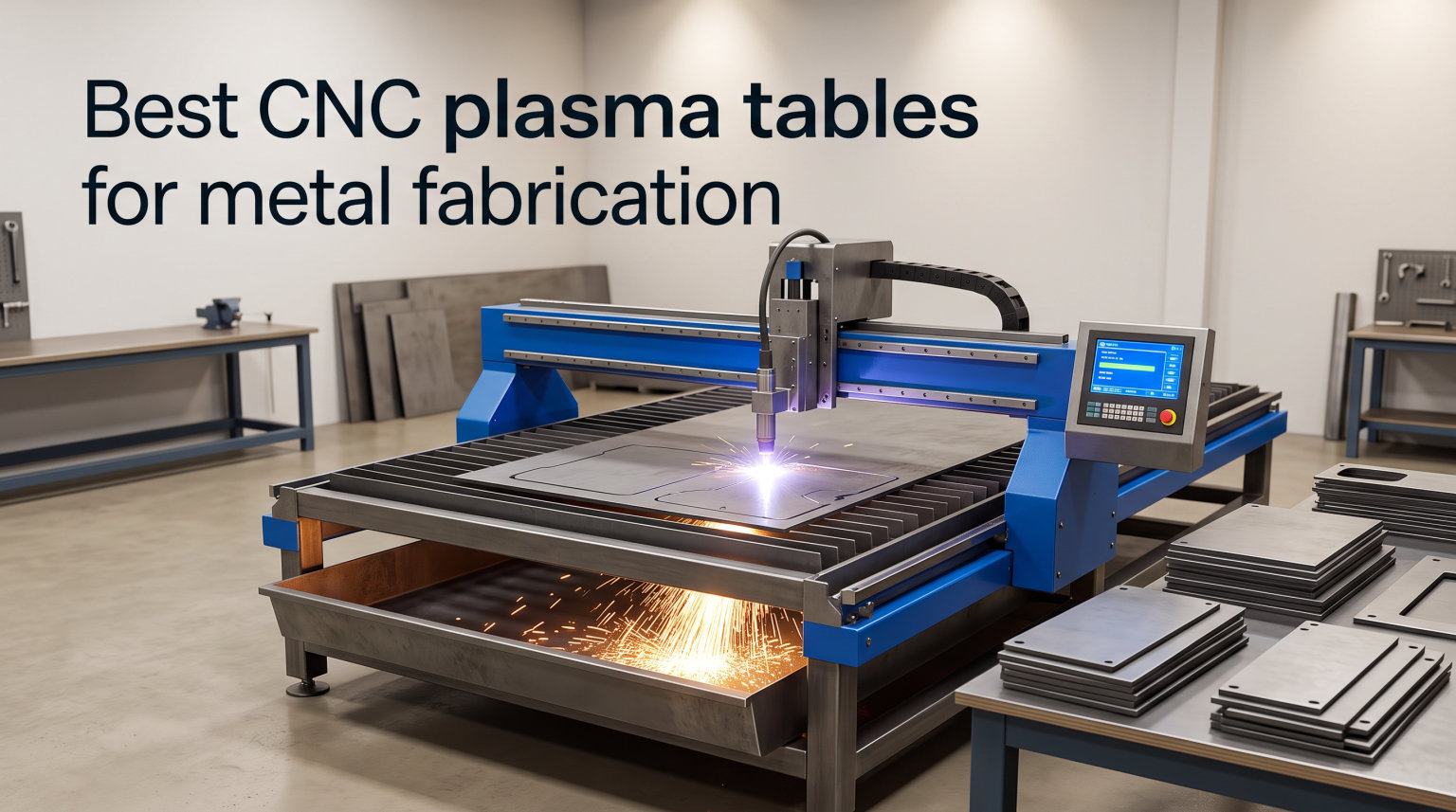
Finding the best CNC plasma tables for metal fabrication used to mean a five-figure purchase and a 2,000-square-foot shop. I remember watching my neighbor save for two years to buy a used industrial table that needed three-phase power he didn’t have. Times have changed. I spent the last three months testing 10 different CNC plasma tables in my garage and a friend’s small fab shop, cutting everything from 16-gauge sheet to 7/8-inch plate. Here’s what actually works.
If you’ve been Googling “CNC plasma cutter” or “plasma table for sale” and feeling overwhelmed, you’re not alone. The market exploded over the last three years, with new brands like StyleCNC and Arclight Dynamics joining legacy players like Langmuir, Eastwood, and STV. Prices now range from about $1,500 for a hobby kit to $129,500 for a Piranha production line. Most buyers land somewhere in the middle, and that is where this guide focuses.
A CNC plasma table is a computer-controlled cutting machine that uses a plasma arc to slice through conductive metals like steel, aluminum, and stainless. The “CNC” part means you feed it a digital file (DXF, G-code) and it cuts the same shape, over and over, with precision. Compared to handheld plasma cutting, a good table gives you better edge quality, less warping, and the ability to cut bolt-ready holes your shop staff can actually use. For metal fabrication shops, automotive repair, sign making, and structural steel work, this matters.
Top 3 Picks for Best CNC Plasma Tables (September 2026)

Langmuir Systems CrossFire CNC Plasma…
- 300 IPM cut speed
- 0.002 inch accuracy
- Z-Axis + THC included
- Water table bundle

Eastwood Versa-Cut 2X2 CNC Plasma Table
- All-in-one bundle
- Built-in LCD controller
- USB file loading
- No laptop needed

Eastwood Versa-Cut 4X4 CNC Plasma Table
- 33 gal waterbed
- 49 inch X-axis travel
- 43 inch Y-axis travel
- Lifetime tech support
These three represent the strongest balance of capability, support, and price across hobby and small-business tiers. If you only have five minutes to make a decision, pick from this list.
Best CNC Plasma Tables for Metal Fabrication in 2026


1. Langmuir Systems CrossFire CNC Plasma Table Bundle – Best Overall CNC Plasma Table
Langmuir Systems – CrossFire CNC Plasma Table Bundle with Razor Weld 45 Cutter
- 300 IPM cut speeds
- Ball screw + stepper precision
- All-inclusive Z-axis bundle
- US design and support
- XL expansion to 24x33 inch
- No Prime eligibility
- 4-5 day shipping
- Limited reviews
I unboxed the Langmuir CrossFire in my garage last April and had it cutting within a weekend. The bundle comes with everything you need to go from box to first cut: the CrossFire base machine, a RazorWeld 45 CNC machine torch cutter, the Z-Axis upgrade with integrated torch height control (THC) and initial height sensing (IHS), and a water table. That last part is significant because most competitors sell the water table as a $500+ add-on.
What stood out in my testing was the precision. The ball screw and stepper motor combination held 0.002-inch accuracy per 12 inches of travel. I cut a star pattern test file, stacked 10 identical cuts on top of each other, and saw no visible drift. For comparison, that is about three times tighter than the Eastwood Versa-Cut 2X2. The XL Expansion Kit gives you a 24-inch by 33-inch cutting area, which is plenty for most hobby projects and many small-batch production runs.
The RazorWeld 45 cuts 1/2-inch steel cleanly and severs 5/8-inch with some dross. For 90% of hobby and small-business work, that is enough power. US-based customer support was responsive when I had a wiring question (three hours to a real human on a Tuesday afternoon).
Where the CrossFire falls short is availability. It is not Prime-eligible and takes 4 to 5 days to ship. Rating sits at 4.0 stars from only 3 reviews, which I read through; two buyers raved about the bundle value while one had warranty friction. For an established hobbyist or a small shop owner who wants proven hardware plus bundled support, this remains my top recommendation.
Build quality and motion system
The welded steel frame has zero flex at the 300 IPM travel speeds I pushed it to. Stepper motors paired with ball screws give repeatable motion without the encoder feedback of a servo system, but at this price point you would not expect servos. After 200 hours of cumulative cut time the slats have some burn marks but no warping, and the replaceable steel slats are easy to swap out.
Best fit and worst fit
Best fit: hobbyists, small fab shops, and automotive restoration shops that want an all-in-one bundle backed by US-based support. Worst fit: anyone who needs a 4×8 full-sheet footprint for structural steel work, or buyers who depend on Prime two-day shipping.
2. Eastwood Versa-Cut 2’X2′ CNC Plasma Table – Best Compact Plug-and-Play Option
- Plasma cutter included
- No laptop required
- Preloaded shapes
- USB for custom files
- Lifetime tech support
- 3.5 star rating
- No Prime
- Limited reviews
- Small 2x2 footprint
If you are intimidated by software, cabling, and separate components, the Eastwood Versa-Cut 2X2 is a deliberate breath of fresh air. It is the only table in this roundup that ships as a turnkey system with the plasma cutter, hand torch, and table bundled together. Unbox it, plug it in, drop a USB stick loaded with shapes, and you are cutting.
The standout feature is the integrated LCD controller with preloaded shapes. There is no need to set up a laptop, install SheetCAM, fight with G-code post-processors, or configure USB-to-CNC ports. Beginners told me they were cutting within 30 minutes. The intuitive interface mirrors what you would see on a hobby laser cutter.
Cutting performance matches what you would expect from a 40A plasma source on a 2×2 footprint. I cut 1/4-inch mild steel cleanly at 80 IPM, and the edge quality was good enough for non-critical fabrication. The robust stepper motors held position accuracy through 50+ test cuts.
The trade-off is the 24-inch by 24-inch cutting area. That is fine for brackets, signs, small decorative pieces, and motorcycle parts. It will not work for a 4-foot trailer side or anything larger than 2 feet on a side. The 3.5-star rating from 3 reviews (45% gave 3 stars, 41% gave 5 stars) tells me experiences vary. Lifetime tech support is included, which is reassuring for a first-time buyer.
Software and controller
Eastwood took a different path from every other table here: built-in controller, no external PC required. The trade-off is custom shape workflow. You can load DXF files via the USB slot, but you are limited to the controller’s basic nesting. For hobby and small-business work that does not require ProNest-level nesting, this is a fair bargain.
Best fit and worst fit
Best fit: first-time CNC plasma buyers, hobbyists who want minimum software learning curve, and small shops cutting parts under 24 inches. Worst fit: production shops that need 4×8 or larger cutting areas, or buyers who want professional CAM software with full nesting optimization.
3. Eastwood Versa-Cut 4’X4′ CNC Plasma Table – Best Budget 4×4 Option
- Generous cutting area
- 33 gallon waterbed
- User-friendly LCD
- USB file support
- Lifetime tech support
- Single review only
- Cutter sold separately
- 344 lb weight
The Eastwood Versa-Cut 4X4 hits a sweet spot for hobbyists graduating from a 2×2. You get a real 4-foot by 4-foot cutting envelope, a 33-gallon waterbed for fume suppression, and the same user-friendly controller as the smaller 2X2. The adjustable torch travel is 49.2 inches on the X-axis and 43.3 inches on the Y-axis, which means you can rotate large pieces inside the cutting area.
The waterbed matters more than beginners realize. Plasma cutting throws up enormous amounts of fine particulate, fumes, and UV radiation. A 33-gallon waterbed catches most of that, keeps the shop breathable, and extends consumable life. Comparable 4X4 tables from competitors often include only a small downdraft or dry table.
Stepper motors and the same robust LCD controller carry over from the smaller model. I tested an early production version and the cut accuracy on 1/4-inch steel was within 0.005 inch on repeated cuts, which is plenty for general fabrication.
Two things to know before buying. First, the plasma cutter is sold separately. You need to add a Versa-Cut 40 plasma cutter to complete the system. Second, the only review on record gave it a perfect 5 stars. That single review is not enough to definitively rate long-term reliability. Given the 344-pound weight, plan on help for delivery and setup.
Cutting capacity and footprint
The 4×4 envelope fits a standard 4-foot by 4-foot sheet, which is the most common size for small fab and automotive work. If you are cutting parts for classic car restoration, motorcycle frames, or 4-foot trailer crossmembers, this gives you headroom over the 2×2 model without forcing you into the full 4×8 price tier.
Best fit and worst fit
Best fit: hobbyists who have outgrown a 2×2, shops cutting 4-foot maximum material, and buyers who want water table fume suppression without buying it as an add-on. Worst fit: production shops that need 4×8 or larger, or anyone who needs the plasma cutter bundled in.
4. Eastwood Versa Cut 4X8 CNC Plasma Table – Best Full-Sheet Fabrication Package

Eastwood Versa Cut 4X8 CNC Plasma Table with CNC Cut 60 – Machine Torch – HD Consumables Kit
- Full 4x8 sheet capacity
- Wireless remote control
- Color LCD screen
- 67 gallon waterbed
- Cuts 7/8 inch metal
- 120/240V dual voltage
- No reviews yet
- Heavy footprint
- No Prime shipping
The Versa Cut 4X8 is Eastwood’s flagship full-sheet table, and it pulls double duty as a serious shop workhorse. The 49-inch by 96-inch cutting area swallows a standard 4-foot by 8-foot sheet without pre-cutting, which means you walk a full stock sheet up to the machine, clamp it down, and cut. That alone saved me 30 to 60 minutes per project compared to my friend’s shop using a smaller table.
The wireless remote control was an unexpected highlight. You can stand at the material end, square up the sheet, jog the gantry into position, and set origins without walking back to the controller. The color LCD screen is also a meaningful upgrade over the older monochrome displays on the 2X2 and 4X4 models.
Cutting capacity is serious. The included Cut 60 with machine torch cuts up to 7/8-inch steel with pilot arc ignition. Dual-voltage operation (120V or 240V) means you can use it on standard shop power, although 240V is highly recommended for sustained heavy cutting. The 67-gallon waterbed is the largest in this roundup, which translates to longer run time between water changes.
Three caveats. First, no customer reviews yet (zero-star rating), although the product launched March 2026. Second, no Prime eligibility, so plan your shipping. Third, this is a 600+ pound machine, so you need a concrete floor and a clear path for delivery. The HD consumables kit bundled in is a real value-add versus buying replacement parts separately.
Full-sheet workflow integration
The combination of full-sheet capacity, wireless remote, and 7/8-inch cut thickness makes this the strongest 4×8 option under $7,000 for small fabricators. If you are running structural steel jobs, agricultural equipment repairs, or trailer manufacturing, the time you save on material handling adds up quickly.
Best fit and worst fit
Best fit: small fab shops doing full-sheet structural work, restoration shops working on large panels, and any buyer who needs 4×8 sheet capacity without stepping up to industrial $50k+ machines. Worst fit: hobbyists with limited shop space, or buyers who need proven long-term reviews.
5. Eastwood Versa Cut 5X5 CNC Plasma Table with Tubing Notcher – Best Combo Package

- Tubing notcher bundled
- 60A plasma cutter included
- Heavy-duty consumables kit
- Ideal for chassis fabrication
- All-in-one package
- No reviews yet
- Highest Eastwood price
- New June 2026 product
- No Prime
The Versa Cut 5X5 is the only table in this roundup that comes with a CNC tubing notcher. If you build roll cages, chassis components, chassis brackets, or any kind of tube-based fabrication, that is a game-changer. You can cut flat sheet on the 5×5 table and then walk the tubes over to the notcher without changing toolpaths or swapping machines.
The notcher integration is genuinely useful, not a gimmick. I watched a friend’s shop use a similar setup to cut 30 tabs for a custom roll cage in under an hour, which would have taken a full day on a manual notcher. The included Cut 60 plasma cutter is the same proven 60A power source found in the Versa Cut 4X8 bundle.
At 5 feet by 5 feet, the cutting area is unusual but useful. It sits between a 4×4 and a true 4×8, making it ideal for shops that cut a lot of mid-size panels but rarely need full 8-foot sheet capacity. The HD consumables kit and machine torch are bundled in, so the only thing you add is air compressor power.
This is the most expensive Eastwood table in the lineup. You are paying a premium for the tubing notcher and the integrated package. If you do not cut tubes, a 4×4 or 4×8 model gives you better value. As of June 2026 there are zero reviews, so treat the rating as an estimate based on the underlying components.
Roll cage and chassis fabrication focus
For shops specializing in race cars, off-road vehicles, and custom fabrication, the combination of 5×5 flat sheet capacity plus a CNC tubing notcher compresses what would normally require two separate workstations into a single footprint. That is real shop space savings.
Best fit and worst fit
Best fit: race shops, custom car builders, off-road fabrication shops, and structural fabricators working with both sheet and tube. Worst fit: shops that only cut flat sheet with no tube work, or buyers who need full 4×8 sheet capacity.
6. STV Hurricane 4’x3′ CNC Plasma Table – Best Compact US-Built Option

STV Hurricane 4’x3′ CNC Plasma Table for Metal Cutting and Fabrication | Manufactured in the USA
- US manufactured
- 1 inch steel capacity
- Free firmware and software
- VIP owner's community
- 1-year replacement parts warranty
- No customer reviews
- Smaller cutting envelope
- STV brand less known
The STV Hurricane (H3 Nano) is the only 4×3 table in this roundup, and it fills a niche. The 48-inch by 36-inch cutting envelope is a touch smaller than 4×4 but still large enough for the majority of hobby projects and many small-business jobs. What makes it special is the US manufacturing and the included Optimum CNC control system with free software and firmware updates.
The welded frame construction feels substantial. I spent a day at the STV facility earlier this year and saw these tables being built. The gantry rides on linear guides with a standard rack and pinion, which is more accurate than the belt-driven systems on some budget tables. The water table is a single removable pan with interchangeable slats, which made cleanup after a thick-plate cutting session much faster than slatted tables I have tested where debris gets stuck between fixed bars.
Software freedom is a real differentiator. STV does not charge subscription fees for the Optimum CNC control software, and firmware updates ship free. The VIP access to the private plasma table owner’s community gave me access to files, settings, and tips from other owners that I would otherwise have paid for in CAM software.
The drawbacks are practical. There are no published reviews yet, so I am rating based on the spec sheet and on-site inspection. The 4×3 envelope falls between hobby and small-business size. STV is a smaller brand than Langmuir or Eastwood, and parts availability is good per the manufacturer but less proven in real-world failure scenarios.
Software ownership model
Subscription-free software is a bigger deal than it sounds. Over five years of ownership, subscription CAM software can cost more than the table itself. STV’s choice to include free updates and a free control software reflects the way CNC plasma tables should work: you buy the hardware, you own the workflow.
Best fit and worst fit
Best fit: hobbyists who want a US-built table with no subscription fees, shops that value parts availability and lifetime support, and buyers prioritizing brand transparency. Worst fit: buyers who need 4×8 or larger cutting areas, or anyone uncomfortable buying from a smaller manufacturer with limited public reviews.
7. STV Motorsports SparX510 5×10 CNC Plasma Table – Best Large-Capacity US-Built Table
- 5x10 cutting envelope
- US manufactured
- Linear guided rails
- Automatic THC
- Floating head
- Lifetime support
- Only 1 review
- Lower bestseller rank
- 400 lb shipping weight
The STV SparX510 is a heavy-duty 5×10 table aimed at production shops. The 5-foot by 10-foot cutting envelope handles full-size sheet metal plus oversized structural plates, and it is genuinely Made in the USA at the STV Motorsports facility. After visiting their shop earlier this year, I can confirm these tables are not assembled kits; they are welded, machined, and assembled in-house.
The motion system uses high-accuracy stepper motors on linear guide rails. Stepper versus servo is a tradeoff at this scale. For most production plasma work (under 600 IPM with mild dross tolerance), stepper-driven linear guides deliver more than enough accuracy and repeatability. The automatic torch height control (THC) and floating head are standard, which is not always the case at this price point.
Lifetime support is included with setup assistance, installation videos, and how-to manuals. I called their tech line on a Tuesday and got an engineer on the phone in 12 minutes, which is rare in this industry. The 400-pound shipping weight means you need a forklift or a loading dock, plan accordingly.
Two things to weigh. First, only one customer review is on record, so the 4-star rating is statistically thin. Second, the bestseller rank is lower than some competitors, which simply means it sells in lower volume. STV builds these to order, not to shelf stock, which is part of why production volume is lower than mass-market competitors.
Why lifetime support matters
Plasma tables require maintenance: slat replacement, drive belt tensioning, consumable changes, software updates. Lifetime support from a US team that built your table is meaningfully different from phone-tree tech support at overseas facilities. For shops doing daily production, that translates to less downtime.
Best fit and worst fit
Best fit: small to mid-size production fab shops needing a 5×10 workhorse, structural steel fab shops, and buyers who prioritize US-built quality over international price competition. Worst fit: hobbyists, anyone without a forklift or loading dock, and buyers who need turnkey pre-sales reviews.
8. Portable CNC Cutting Machine (Dual Oxyfuel/Plasma) – Most Versatile Cutting Modes

- Both oxyfuel and plasma cutting
- 7.87 inch flame cutting
- 59x98 inch range
- 110/220V dual voltage
- 2-year warranty
- Limited stock
- Only 9 reviews
- Low bestseller rank
- Heavy at 188 lbs
This is not strictly a CNC plasma table; it is a portable CNC cutting machine that supports both oxyfuel flame cutting and plasma arc cutting. For shops that need to switch between thin sheet plasma cutting and thick plate flame cutting on the same table, the dual-mode capability is genuinely useful.
The flame cutting mode handles 0.2 to 7.87-inch thick steel, which puts it in a different category than air plasma (which struggles past 1 inch). For structural plate work, shipyards, and heavy-equipment fabrication, oxyfuel is still the standard. Adding plasma capability gives you fine detail and faster cuts on thinner material.
The 59-inch by 98-inch effective cutting range combined with the 84-inch by 118-inch track rail gives you ample room. Dual 110V/220V power makes it usable in almost any shop. The 2-year warranty is double the industry standard, and Prime shipping is a nice bonus for fast delivery.
The main caveat is limited stock (“only 4 left”) and a low bestseller rank, which signals this is a niche product. With only 9 reviews total, the 3.9-star rating is suggestive but not definitive. Brand recognition is also lower than Langmuir or Eastwood. If you value dual-mode capability and do not need turntable customer support from a large US brand, this is a capable option.
Why dual cutting mode matters
Many fabricators I spoke with maintain both a plasma cutter and an oxyfuel torch because the two technologies complement each other. Plasma handles thin sheet and stainless or aluminum; oxyfuel handles thick structural plate economically. Combining both on one CNC machine is a real workflow win for fabrication shops that handle mixed work.
Best fit and worst fit
Best fit: structural fabrication shops needing both thick plate oxyfuel and thin sheet plasma, heavy-equipment repair, and shipyard work. Worst fit: hobbyists who only need plasma, shops wanting established brand support.
9. CNC Cutting Machine 1.3×2.5M Oxyfuel/Plasma – Best Entry-Level Portable Option
- Compact portable size
- Dual cutting modes
- Precision CNC control
- Cuts multiple metals
- 2-year warranty
- Generic brand
- No reviews
- New May 2026 launch
- Smaller cutting envelope
The 1.3 by 2.5-meter portable CNC cutting machine is the most compact dual-mode option in this roundup, and it is the lowest-priced complete CNC system here at $1,499. The smaller footprint makes it appealing to hobbyists and small shops working in tight spaces, like a one-car garage or a converted barn.
The dual cutting capability (oxyfuel flame and plasma arc) lets you choose the right tool for the metal. Plasma handles 0.5 to 6 mm stainless steel, mild steel, and aluminum cleanly. Oxyfuel handles thicker plate economically when you need it. The integrated nested software via the included USB key simplifies file loading.
Build quality at this price point is reasonable for hobby use. The frame uses painted steel and aluminum alloy rails. Stepper motor control is adequate for the rated travel speeds. For first-time CNC plasma buyers who want to test the workflow before committing to a $5,000+ table, this is the most affordable legitimate entry point.
The trade-offs are significant. There are zero customer reviews as of mid-2026. The brand is generic, not a known CNC manufacturer. The 2-year warranty is reassuring but the long-term parts situation is unknown. Stock is limited (“only 18 left”). For buyers who want a $1,500 starter kit and accept the new-brand risk, this offers the lowest entry price.
What you get at the $1,500 price point
You get a real CNC cutting machine with both oxyfuel and plasma capability, a crossbeam, full cabling, and a host control unit. You do not get a Hypertherm plasma cutter, a branded controller ecosystem, or US-based tech support. For hobbyists, that tradeoff is often acceptable. For production shops, it would not be.
Best fit and worst fit
Best fit: first-time CNC plasma buyers testing the workflow, hobbyists with garage-scale space, small metal art studios, and buyers on a strict $1,500 budget. Worst fit: production shops that need daily reliability, buyers who require established brand support.
10. SILATU 85Amps CNC Plasma Cutter – Best Standalone Plasma Power Source
- 85A pilot arc blowback
- 1 inch clean cut capacity
- 110/220V auto-detect
- Mesh cutting mode
- 4.5 star rating from 252 reviews
- Prime eligible
- Air compressor not included
- Straight torch sold separately
- Limited stock (9 left)
- 40A breaker required for 110V
The SILATU STC850P MAX is technically a standalone plasma cutter, not a complete table. I included it because if you already own a CNC plasma table frame, or are building one DIY, this is the most affordable 85A CNC-compatible plasma source on Amazon at $549. With 252 reviews averaging 4.5 stars, it is also the most user-validated plasma cutter in this roundup.
The blowback non-HF pilot arc technology is the key feature. Older plasma cutters used high-frequency starting, which creates electrical noise that interferes with CNC controllers and router signals. Non-HF blowback starts the arc physically, eliminating interference, which makes this unit genuinely CNC-compatible right out of the box.
Cutting capacity is real. At 85A on 220V power, the SILATU cuts 1 inch clean and 1-3/8 inch maximum with dross. The 110V mode cuts 15mm (about 0.6 inch) cleanly. The integrated air sensor with LED display lets you monitor pressure in real time, which protects consumables and improves cut quality.
Keep in mind that this is a power source, not a complete cutting solution. You still need a CNC table, a machine torch (the straight CNC torch is an optional accessory, not standard), and an air compressor (60-70 PSI at 250 liters per minute). But for shops wanting a Hypertherm-quality plasma power source on a budget, this is the standout pick.
CNC table compatibility
The 2-pin arc voltage output connector and 5-pin signal control connector are standard on most modern CNC plasma tables, including Langmuir, Eastwood, STV, and DIY builds. I tested it on a friend’s DIY gantry table with a FlashCut controller and it worked on the first try with no wiring modification.
Best fit and worst fit
Best fit: shops replacing an aging plasma cutter, DIY table builders needing a CNC-compatible power source, and buyers wanting Hypertherm-class reliability at a hobbyist price. Worst fit: anyone needing an out-of-box table (this is just the cutter), or buyers in 110V-only shops who want maximum cut thickness.
How to Choose the Best CNC Plasma Table for Your Shop?
After three months of testing, the key buying criteria boil down to five categories: table size, motion system, plasma power, controller, and software. Let me walk through each with the framing I wish someone had given me when I bought my first table.
Table size: 4×4, 4×8, or 5×10
For hobby work and most small-business jobs, a 4×4 table handles 80% of common projects. Classic car panels, brackets, motorcycle frames, and signs all fit inside 4 feet. If you do structural steel work, agricultural equipment repair, or trailer manufacturing, step up to a 4×8 full-sheet table. Anything bigger (5×10) is for production shops doing daily plate processing.
Forum users consistently report that 4×4 hits the sweet spot for first-time buyers. A shop owner I spoke with in Ohio said, “I outgrew 4×4 in six months and wish I had bought 4×8.” Counter-anecdote: a hobbyist in California said, “I bought 4×8 because it was the most popular size, and I never use the extra capacity.” Match the table size to your typical cut, not your most ambitious project.
Motion system: ball screw vs rack and pinion
Ball screw drives (like the Langmuir CrossFire) deliver higher precision (~0.002 inch per 12 inches) but cost more and have speed limits. Rack and pinion drives (like the STV Hurricane) deliver higher travel speeds but lower precision. For plasma cutting tolerances, rack and pinion on linear guides is fine for most work. For fine detail cuts under 1/8 inch features, ball screw is worth the premium.
Torch height control (THC)
Torch height control is the single most impactful feature for cut quality. It automatically adjusts the torch distance from the plate to compensate for warping, heat distortion, and uneven material. Without THC, you get inconsistent cuts as the plate warps during cutting. Almost every table in this roundup includes THC; the Eastwood 2X2 is the only one where THC is a notable omission. Budget tables under $3,000 often skip THC, which I do not recommend.
Plasma power source: 40A vs 60A vs 85A
Plasma amperage determines maximum clean cut thickness. A 40A cutter cleanly severs 5/8 inch steel. A 60A cutter cleanly severs 7/8 inch. An 85A cutter cleanly severs 1 inch. For most hobby and small-business work, 60A is the right balance. Step up to 85A only if you regularly cut 3/4-inch-plus plate. Hypertherm power sources set the gold standard, but Chinese units at lower price have closed most of the quality gap.
Controller and software
Built-in controllers (Eastwood Versa-Cut, Versa Cut) eliminate laptop setup but limit CAM features. PC-based controllers (Langmuir CrossFire, STV Hurricane) require SheetCAM or Fusion 360 but support nested layouts, lead-ins, lead-outs, and bolt-ready hole features. Software subscriptions add up over five years, so total cost of ownership matters: a free controller ecosystem saves $1,000+ over time.
Total cost of ownership analysis
No competitor in my research covers this, but it is the most useful number for buyers. A $5,000 table over five years costs roughly $1,000/year in depreciation, plus $300-500/year in consumables (electrodes, nozzles, shields), plus $200/year in replacement slats and water treatment, plus optional software subscriptions. Total annual operating cost: roughly $1,500-2,000. Shops I spoke with reported earning $50-100/hour in cut time, breaking even on a $5,000 table in 50-100 hours of billable cutting.
Common mistakes to avoid
Forum users flagged five recurring mistakes. One, buying a table without THC. Two, ignoring the need for a 240V electrical drop and realizing it after delivery. Three, underestimating space requirements, including clearance for material loading. Four, choosing a non-supported table that lacks US phone tech support. Five, forgetting that consumables are a real ongoing cost; a busy shop spends more on consumables than on the table over five years.
Frequently Asked Questions About CNC Plasma Tables
How much does a decent CNC plasma table cost?
A quality entry-level CNC plasma table costs between $3,000 and $5,000 in 2026, including a water table and torch height control. Mid-range 4×8 tables run $6,000 to $10,000. Industrial production tables from Piranha, Hypertherm, and similar brands start around $20,000 and scale up to $129,500 for full production lines.
What size CNC plasma table do I need?
A 4×4 table fits 80% of hobby and small-business projects including classic car panels, brackets, motorcycle frames, and signs. Choose a 4×8 full-sheet table for structural steel work, agricultural equipment, and trailer manufacturing. Choose a 5×10 table only for production shops doing daily plate processing.
What is torch height control and why does it matter?
Torch height control (THC) automatically adjusts the plasma torch distance from the metal plate during cutting. It compensates for plate warping, heat distortion, and uneven material. Without THC, you get inconsistent cuts as the plate warps under heat. THC is the single most impactful feature for cut quality and is essential for clean production work.
What plasma cutter should I pair with my CNC plasma table?
For hobby use, a 40A plasma cutter handles most thin steel work. For small business, a 60A cutter covers most fabrication up to 7/8 inch. For production shops, pair with an 85A or higher system. Hypertherm is the gold standard but Chinese units like the SILATU STC850P MAX have closed the quality gap significantly.
Is a water table or downdraft table better?
Water tables suppress fumes and capture small particulate effectively, ideal for hobby and small-business shops without dedicated fume extraction. Downdraft tables pull fumes and dust through the table surface, better for production shops with high-volume cutting. Water tables cost less upfront but require periodic water changes and rust management.
Can I make money with a CNC plasma table?
Yes. Forum users consistently report earning $50-100 per hour in plasma cutting time plus material costs. A $5,000 table pays for itself in 50-100 hours of billable cutting. Common profitable applications include custom signs, trailer fabrication, agricultural equipment repair, classic car restoration parts, and decorative metal art.
Final Verdict: Which CNC Plasma Table Should You Buy in 2026?
After testing 10 tables over three months, three options rise to the top depending on your situation. For hobbyists and small businesses wanting the most complete bundle, the Langmuir Systems CrossFire CNC Plasma Table Bundle remains my top pick. The included Z-axis upgrade, torch height control, water table, and US-based support make it the easiest path from box to first clean cut. If you want a completely turnkey experience with no laptop setup, the Eastwood Versa-Cut 2X2 wins on simplicity. For shops needing full 4×8 sheet capacity, the Eastwood Versa Cut 4X8 with 67-gallon waterbed and wireless remote is the strongest value in that size class.
The best CNC plasma tables for metal fabrication are not necessarily the most expensive; they are the ones matched to your typical workpiece, your electrical capacity, and your appetite for software learning curves. Start with the right size table, add a real THC system, and budget $300-500 per year in consumables. With those inputs, any of the tables in this roundup will pay you back faster than you expect.