
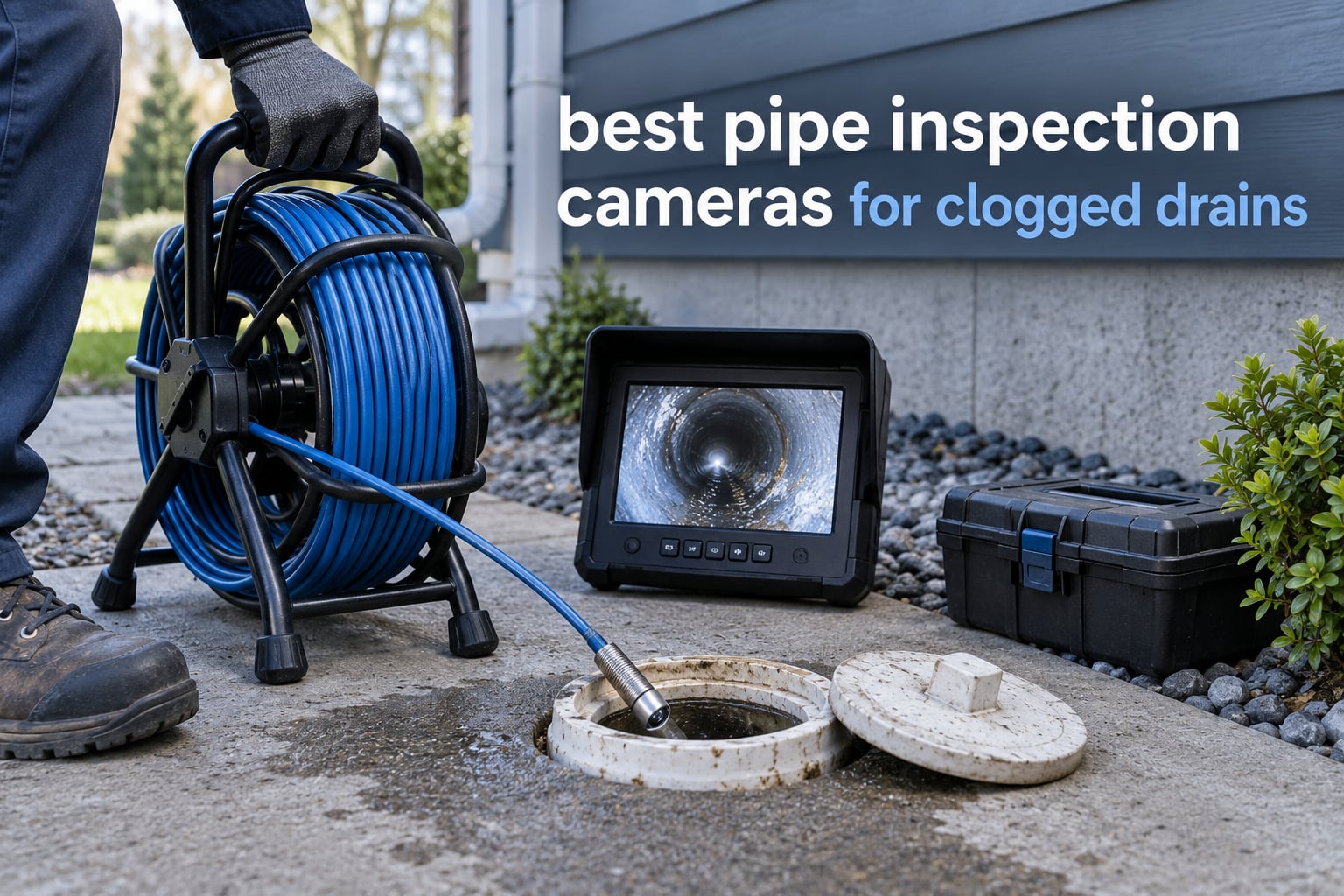
A pipe inspection camera is a waterproof camera head on a flexible pushrod cable that you feed through a drain or cleanout while a monitor above ground shows live video of the blockage, cracks, root intrusion and pipe damage inside the line. No digging, no guessing.
If you are hunting for the best pipe inspection cameras for clogged drains in 2026, you have probably already had a plumber quote a repair you could not picture. That is exactly the problem these tools solve: they replace an opinion with evidence. A backup that returns every few months usually has a cause somewhere past the cleanout, and the camera finds it before anyone starts digging.
We compared ten of the most popular drain cameras and sewer inspection cameras available now, from short handheld borescopes for shower drains to 100ft and 164ft pushrod systems used on main lines. Two groups showed up clearly: budget handheld units that handle a 2-inch branch line or a trap, and reel-based kits with self-leveling heads, DVR recording and long reach for serious main line work.
We also covered something most roundups skip, which is how not to lose a camera down the line. An r/Plumbing owner described cutting into poured concrete to recover a camera lost in a shower drain, and the fix was a two-way cleanout they added afterwards. Five minutes of planning avoids that.
Top 3 Pipe Inspection Cameras for Clogged Drains in 2026

TGJOR 5in Dual-Lens Borescope
- 5in HD screen
- 170 degree dual lens
- 16.4ft semi-rigid cable
- IP67 probe

Anysun 9in Self-Leveling Camera
- 9in 1080P IPS
- self-leveling head
- 10 hour battery
- length markers
Best Pipe Inspection Cameras (October 2026)
| Product | Specifications | Action |
|---|---|---|
| TGJOR 5in Dual-Lens Endoscope |
|
Check Latest Price |
 COOVIE 49.2ft Endoscope Camera COOVIE 49.2ft Endoscope Camera |
|
Check Latest Price |
 VEVOR 164ft Sewer Camera VEVOR 164ft Sewer Camera |
|
Check Latest Price |
 VEVOR 100ft with 7in Screen VEVOR 100ft with 7in Screen |
|
Check Latest Price |
 ChoosePRO 1080P 100ft Kit ChoosePRO 1080P 100ft Kit |
|
Check Latest Price |
 HBUDS Self-Leveling 100ft Camera HBUDS Self-Leveling 100ft Camera |
|
Check Latest Price |
 VEVOR 98ft Drain Inspection Camera VEVOR 98ft Drain Inspection Camera |
|
Check Latest Price |
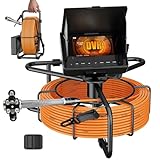
| Anysun 9in 1080P Self-Leveling Camera |
|
Check Latest Price |
 VISIOPROBE 100ft 1080P Camera VISIOPROBE 100ft 1080P Camera |
|
Check Latest Price |
 KCapyn 100ft 1080P Camera KCapyn 100ft 1080P Camera |
|
Check Latest Price |
1. TGJOR 5-Inch Dual-Lens Borescope – Best Overall for Small Drains
- Large 5in HD screen with a bright clear picture
- Dual lens switches between front and side views
- Semi-rigid cable holds shape in pipes and ducts
- Eight adjustable LEDs for dark or submerged areas
- 2000mAh battery gives 3-4 hours
- Cannot capture stills or video
- Stiff cable is awkward in tight corners
- Fixed focus with no zoom
This is the unit we kept reaching for when the problem was small and close to the house. It handles shower drains, tub lines, floor drains and the odd HVAC or automotive look without any ceremony, and it is the one we would hand to a homeowner dealing with a recurring laundry or bath backup.
The 5-inch display is the standout. Most budget borescopes squeeze a 2.3-inch screen, and you end up holding the device at arm’s length in a dark crawlspace. This one shows a wide 170 degree view with instant front and side lens switching, so you can see the pipe wall and look back up the line without turning the body.
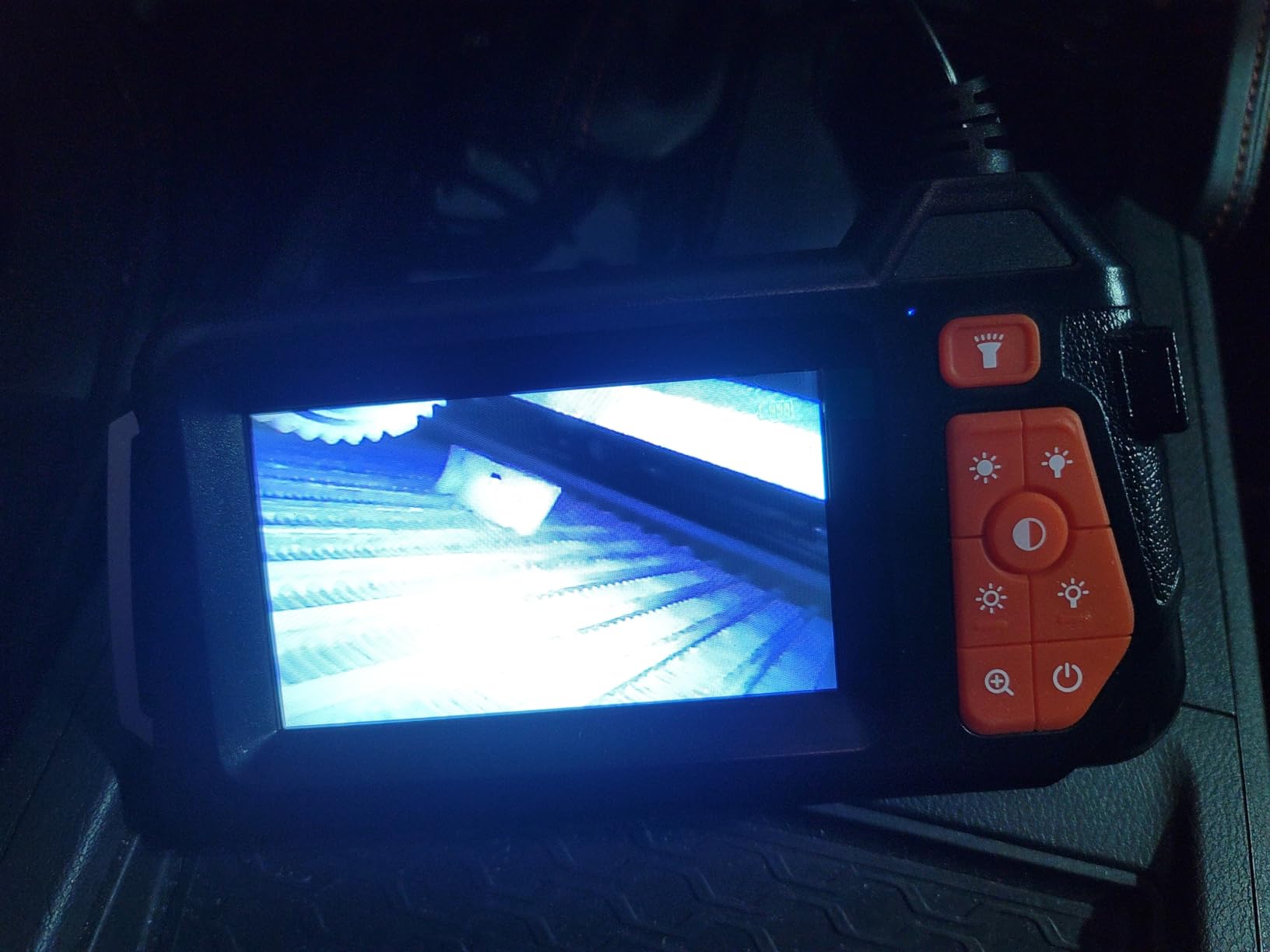
The 16.4ft semi-rigid probe holds its shape through gentle bends, which is what you want in a trap or a branch line. Eight adjustable LEDs handle the darkness, and the 2000mAh battery runs roughly three to four hours, enough for most residential work.
Buyers comparing it to Milwaukee or Bosch units note it is not in that class, and we agree. What matters more is that for a small drain it is fast, clear and cheap to learn.
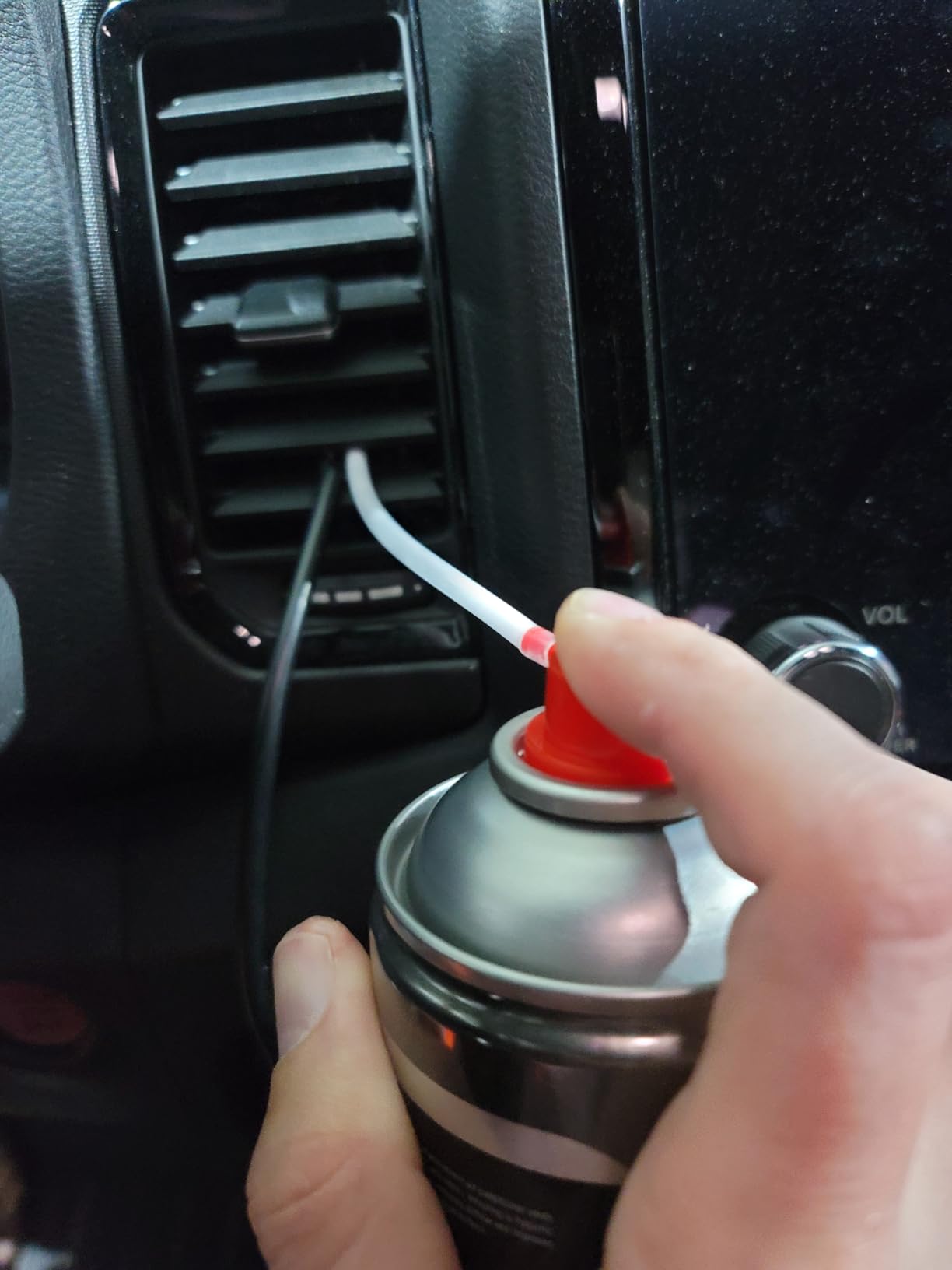
Is the 16.4ft cable enough for a bathroom line?
Yes, for anything from a shower drain through a branch line to roughly 15ft of run. The distance is measured from the tip of the probe, not from the reel, so a long P-trap eats into it quickly.
It will not reach a main sewer line or the far side of a 40ft lateral. For that you need one of the reel-based kits further down this list.
What are you giving up with a display-only camera?
Photos and video. This unit streams live and nothing else, so there is no recording to show an insurance adjuster, a landlord or a contractor after the fact.
The 1.2-4 inch focus range is also fixed, with no zoom, so hairline cracks at a distance can look soft. For finding a clog it does not matter. For documenting a claim it might.
2. COOVIE 49.2ft Endoscope Camera – Best Reach Without a Reel
- Bright 1080P image on a 4.3in IPS screen
- Eight LEDs with adjustable brightness
- Semi-rigid cable options up to 49.2ft
- Hook magnet and side mirror included
- IP67 probe for wet drain environments
- Some cameras arrive with missing screws on the reel
- Cable can be too soft for tight plumbing bends
- Fixed focus with no zoom
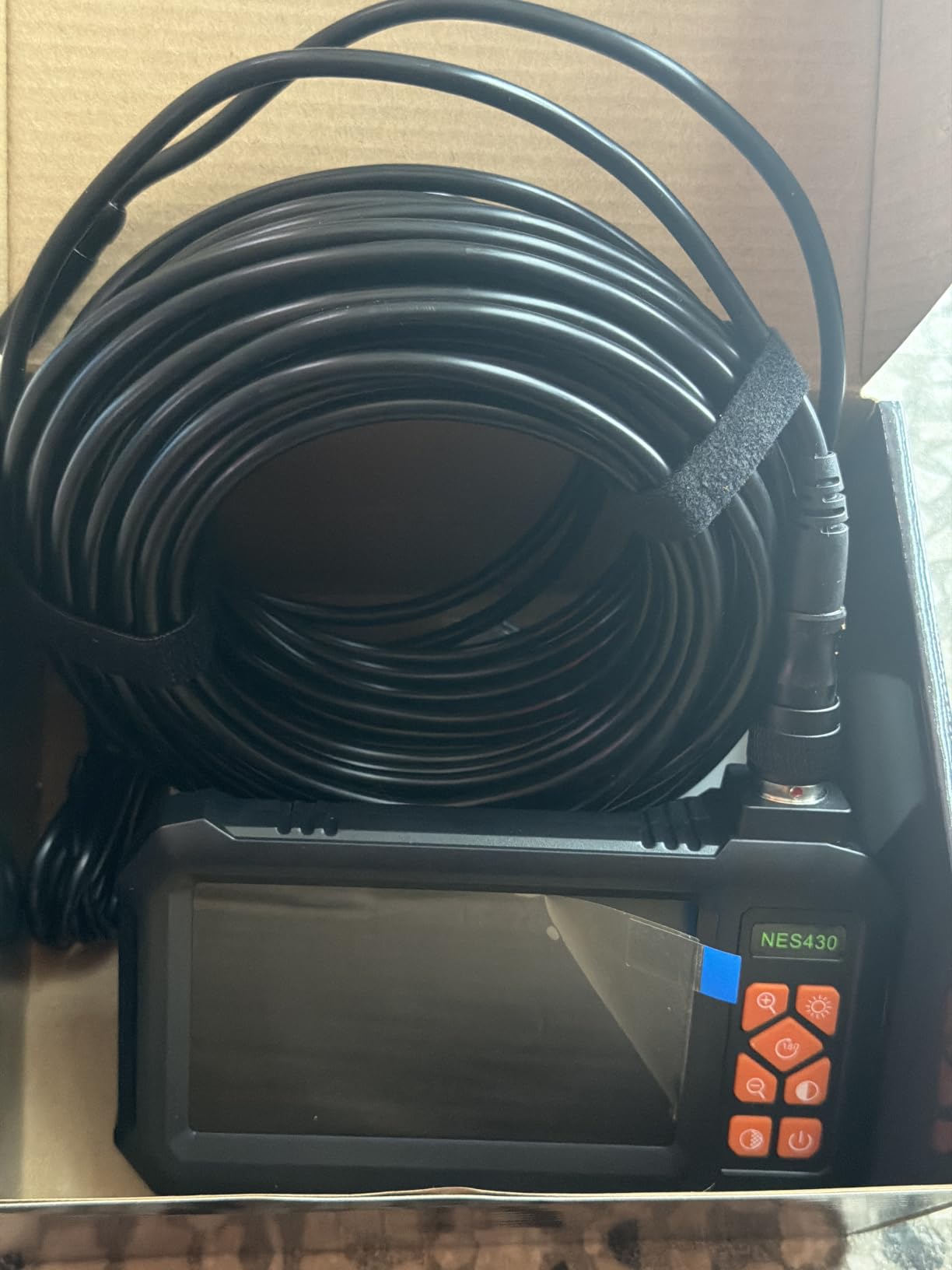
This is the odd one out in the lineup, and the reason is reach. Where every other pipe inspection camera here tops out around 16ft of probe, the cord version comes in lengths up to 49.2ft, all without the weight of a metal reel.
That makes it a genuinely useful middle ground. A homeowner with a long crawlspace or a run to a detached building can reach a far cleanout without a 20lb kit, and the 4.3-inch IPS screen with roughly a 170 degree viewing angle is brighter than most compact units.
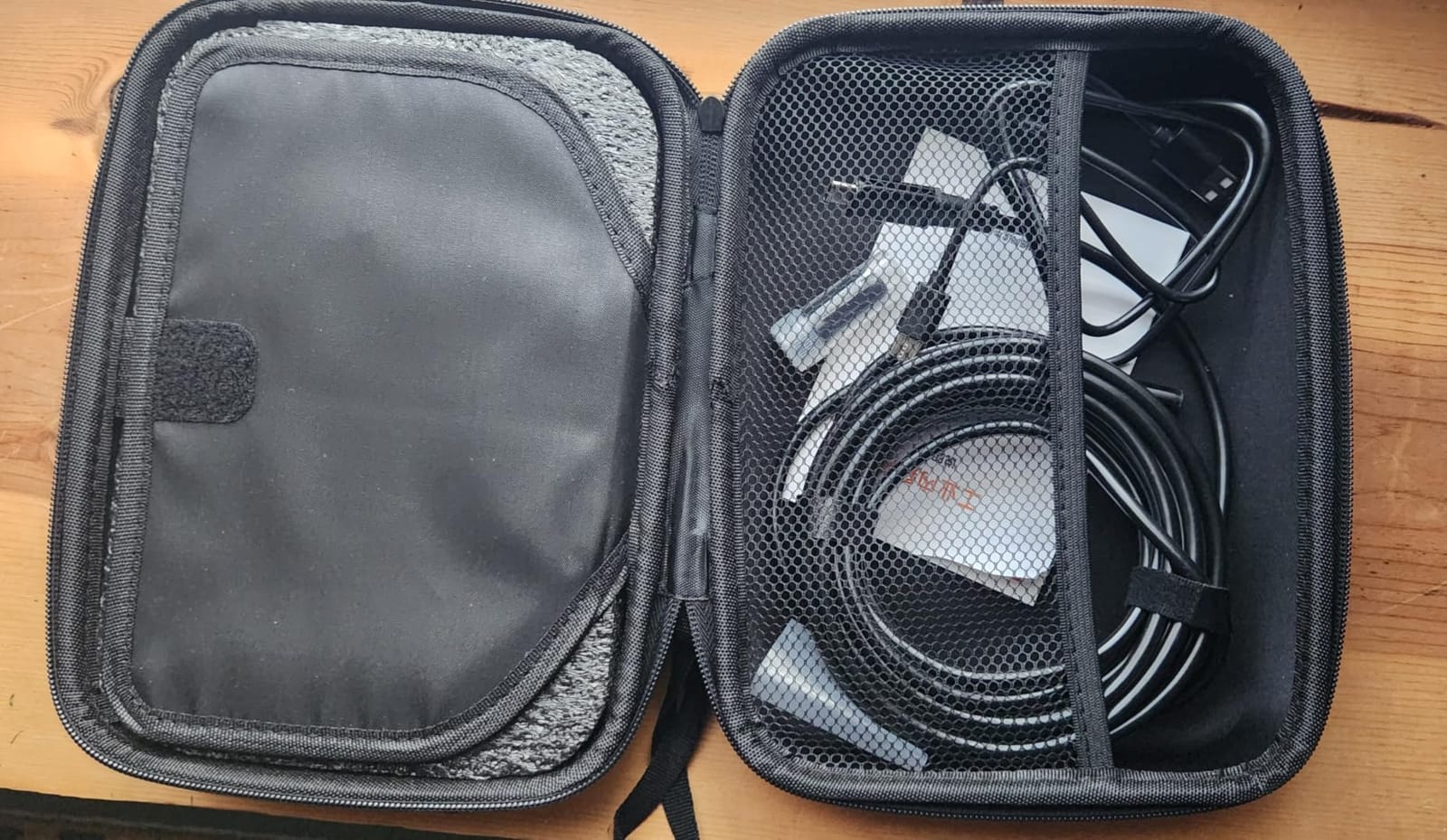
Unlike our top pick, this one records. It writes JPEG and MP4 to an SD card, which matters if your plumber, landlord or buyer wants a copy of the footage rather than your verbal description of it.
Reviewers treat this as a capable general-purpose inspection camera that gives better clarity than pricier models, and the magnet and hook attachments are useful for retrieving a dropped object from a drain as a bonus.
Is 49.2ft of cord strong enough for plumbing?
That is the trade-off. The cord holds its shape over gentle runs, but several reviews note it is too soft to push around tight plumbing bends. Reach is not the same as pushability, and the semi-rigid end model is the more capable of the two here.
Check the screws on the reel assembly when it arrives. A minority of buyers reported missing hardware on arrival.
When is this better than a full sewer camera kit?
When you want to look down a long line quickly without buying or hauling a reel. Set the monitor on a bucket, feed the cord, and record what you find.
It is not built for main lines. There is no self-leveling head, no meter counter, and the probe is IP67 rather than IP68.
3. VEVOR 164ft Sewer Camera – Best Long-Reach for Main Lines
- Very long 164ft cable with a reel for storage
- 8500mAh battery for roughly 14 hours of work
- DVR recording with 16GB microSD card included
- 17mm IP68 head works in wet dark pipes
- Six integrated LED lights
- 1200TVL resolution and 4.3in TFT screen are dated
- Manual focus with no zoom
- Small monitor for outdoor work
Reach is the whole argument here. A 164ft pushrod can go from a yard cleanout to the far end of a residential lateral, which means you can find a blockage before anyone talks about excavation.
The 8500mAh battery is listed at roughly 14 hours of continuous work, which is more than a full day of scoping. It records to an included 16GB microSD card, and the 17mm IP68 head is rated to 65.6ft of water depth, so a wet line is not a problem.
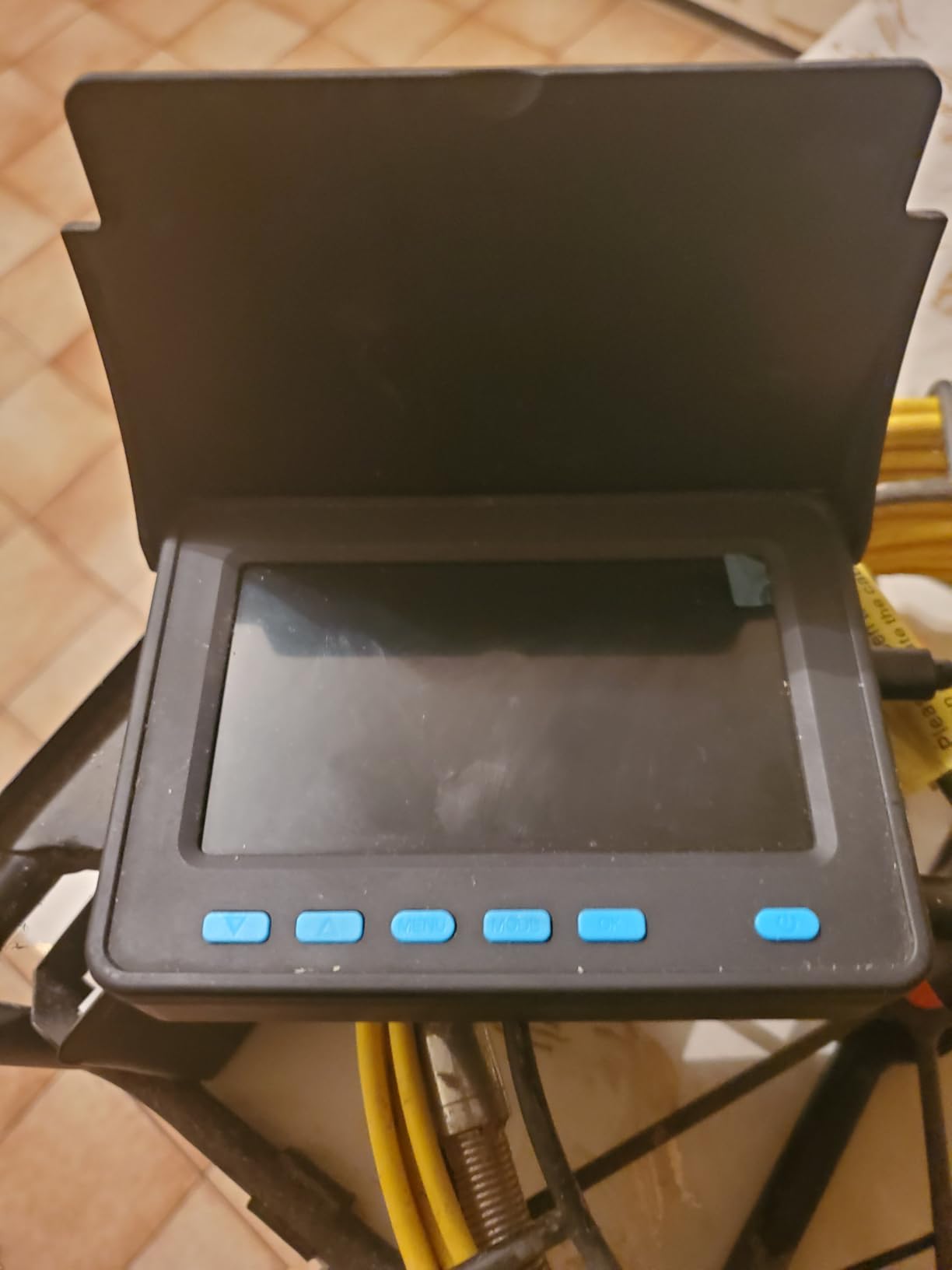
Owners like that the camera head turns easily in pipes thanks to an integrated spring, and that the reel keeps the cable tidy instead of tangling. The unit is listed as suited to pipes up to 20cm internal diameter, which covers most residential work.
This is a dependable professional-grade tool rather than a smart one. There is no self-leveling here, and the screen is an older 4.3-inch TFT.
How much cable do you actually need?
Measure from the entry point to the far cleanout before you buy. 100ft covers most single-family laterals, and 164ft buys you margin on long runs, steep slopes and multi-building properties.
Unmarked cable is the weak point of this kit. Several options in this family include distance markers, so check the variant listing carefully if depth matters to you.
Is 1200TVL resolution good enough?
It is fine for finding a clog and confirming a blockage location. It is not fine for reading hairline cracks or fine root hairs, and the 4.3-inch TFT screen looks washed out next to the 1080P IPS monitors on the newer kits.
If your problem is diagnosis rather than reach, the ChoosePRO or Anysun give you a far better picture.
4. VEVOR 100ft Drain Inspection Camera with 7-Inch Screen – Best Big-Screen Buy
- Large 7in LCD screen is easy to read outdoors
- Twelve adjustable LEDs on three brightness levels
- 98ft semi-rigid fiberglass cable handles long runs
- IP68 lens rated for straight and 45 degree pipes
- DVR and photo capture with 16GB SD card
- 480p video resolution is low for the price
- No self-leveling so the image can rotate
- Cable stiffness limits tight bends
The screen is the reason to buy this one. A 7-inch LCD is big enough to hand to someone else in the room and point at the crack, which changes a camera inspection from a technician’s monologue into a shared conversation.
Light is the other strength. Twelve adjustable LEDs across three brightness levels is a generous lighting package, and the IP68 lens is rated for straight pipes from 1.18 to 7.87 inches and 45 degree bends in the same range.
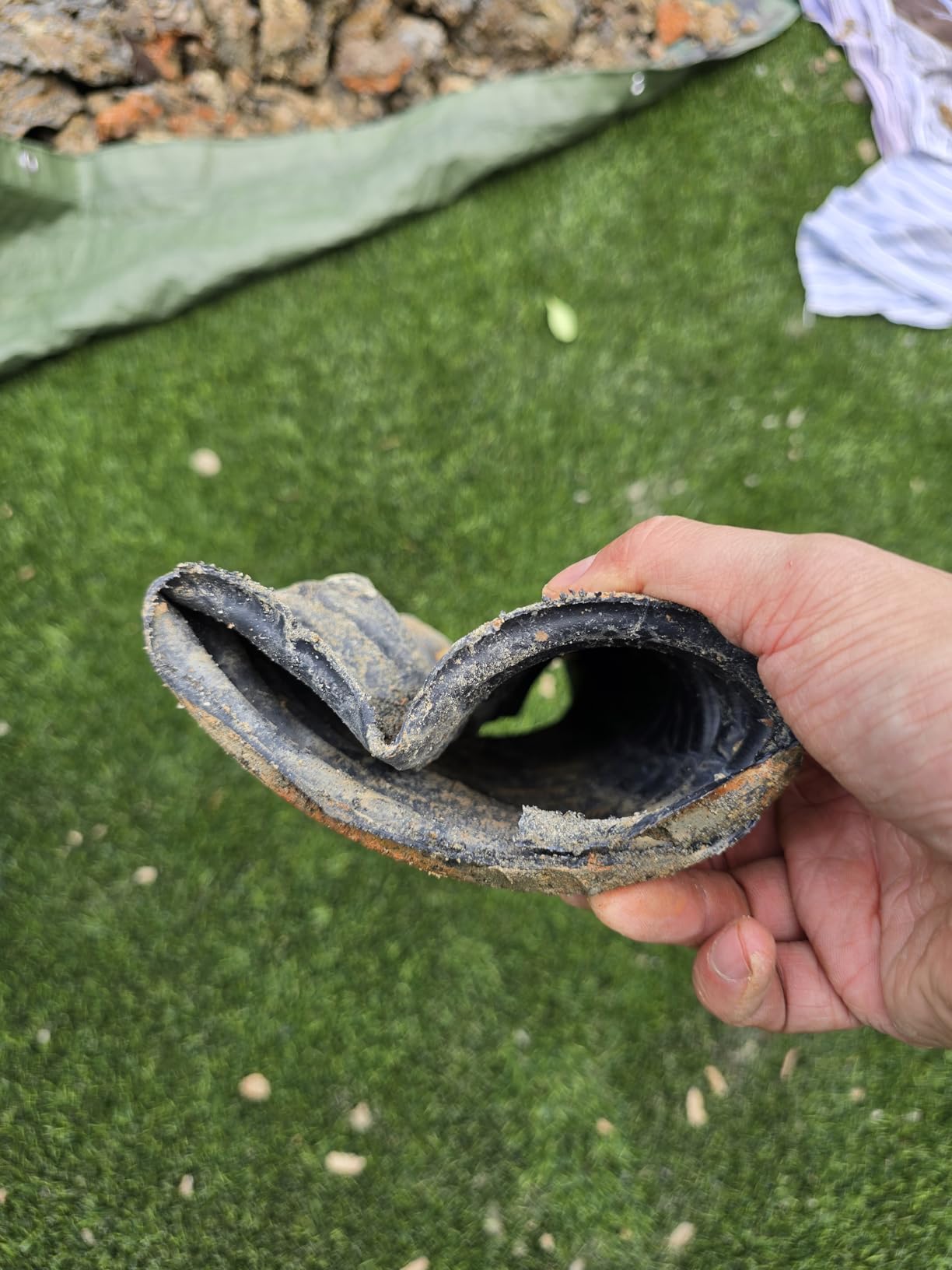
The 98ft semi-rigid fiberglass cable, included 16GB SD card and roughly six hours of 4500mAh battery make this a complete kit rather than a bare camera. It records video and stills out of the box.
This is also among the lowest-rated cameras in our group at 4 stars, and the rating distribution explains why. Owners mention 480p capture and the absence of self-leveling as the two things holding it back.

Does a bigger screen make up for 480p video?
Partly. At 7 inches the image is easier to see in daylight and easier to point at, but a large screen showing a low-resolution feed is still showing a soft image. The saved video file will not sharpen up later.
If your drain is dark and the light is the problem, the extra LEDs win. If you need to judge a crack, look for a 1080P kit instead.
Is this camera self-leveling?
No. The image can rotate in the pipe, which makes it harder to tell whether you are looking at the invert or the crown of the line. That matters for reading bellies and offsets, where orientation tells the story.
A gravity-sensor head, as on the HBUDS or Anysun, removes that headache entirely.
5. ChoosePRO HD1080P 100ft Kit – Best Premium Recording Kit
- Sharp 7in 1080P screen makes cracks and roots easy to see
- 16x zoom for small defects
- Twist-unlock reel locks or releases cable in about a second
- Footage-marked cable shows exactly how deep the problem is
- 32GB SD card included with 8 hour battery
- 18mm probe head will not fit the smallest pipes
- Manual focus needs adjusting in tight spaces
- One review reports a defective unit
This is the kit we would put in a van for a serious side job. It has the highest proportion of five-star reviews in the group, and the reason is straightforward: true 1080P video on a bright 7-inch IPS screen is a large step up from the 480p and 1200TVL feeds most kits ship with.
The 16x zoom lets you hold on a root hair or a hairline crack without creeping the head forward, and the 100ft cable is marked in feet so you can tell a homeowner the blockage sits 62ft from the cleanout instead of saying it is down there somewhere.
![[ChoosePRO®] HD1080P 18mm Sewer Camera 7'' w/1s Twist-Unlock System, DVR-32GB, 0.64'' Thicker Reel, 5000mAh 100FT Marked Cable, Plumbing Pipe Inspection Camera for Drain & Sewer Inspection customer photo 1](https://www.logix4u.net/wp-content/uploads/2026/05/B0FFGFV5J8_customer_1.jpg)
The reel design is worth noting too. A one-second twist locks or releases the cable on a 0.637-inch iron tubing frame, which stops the constant coiling that kinks cheaper pushrods. Plumbers, drain cleaners and DIYers mention the fast reel, depth marking and 32GB DVR together as the reason the kit converts people.
The 5000mAh battery runs eight hours or more per charge, and the manufacturer lists running it while plugged into a power bank as a fallback.
![[ChoosePRO®] HD1080P 18mm Sewer Camera 7'' w/1s Twist-Unlock System, DVR-32GB, 0.64'' Thicker Reel, 5000mAh 100FT Marked Cable, Plumbing Pipe Inspection Camera for Drain & Sewer Inspection customer photo 2](https://www.logix4u.net/wp-content/uploads/2026/05/B0FFGFV5J8_customer_2.jpg)
What does the DVR actually get you?
It gets you proof. You can play the footage back for a customer, save a still of a crack for an insurance file, or transfer the card to a laptop and hand it to a contractor. That documentation habit is how a camera inspection turns into a signed repair.
The card transfers by SD or USB-C, and a 32GB card is included, which is enough footage for a long day of short inspections.
Will an 18mm head fit my pipe?
In most main lines and branch lines, yes. In a small shower drain or a narrow trap, no. Two skids are included at 25mm and 84mm, and the head has a flexible stainless steel spring tip, but the base diameter still sets your minimum pipe size.
That is the one hard limit on this kit, and the same limit applies to nearly every reel-based camera in this roundup.
6. HBUDS Self-Leveling 100ft Camera – Best Self-Leveling Head
- Self-leveling gravity sensor keeps the image upright
- 100ft fiberglass cable with printed numerals and meter counter
- 7in color TFT monitor with integrated sun visor
- IP68 probe with 12 adjustable white LEDs
- DVR video and photo capture to 16GB SD card
- Display is fixed to the case and cannot tilt independently
- Very stiff cable can jam at tight bends
- Small centering rollers rather than spring-loaded ones
A self-leveling head uses a gravity sensor to keep the image upright no matter how the cable twists, and that single feature changes how easy the footage is to read. Plumbers report that color and self-leveling images make footage far easier for homeowners to interpret, because orientation is never in question.
This one also carries a meter counter and a cable printed with distance numerals, so you get both a live depth reading and a permanent record on the line itself. The 7-inch color TFT monitor sits in a case with an integrated sun visor, which is a sensible touch for work in direct sun.
Owners also like the 12 adjustable white LEDs and the 12V 4500mAh battery giving about six hours of continuous use, and the stated working limits are honest: straight 25mm pipes, 45mm bends and near-90 degree bends at 150mm.
There are real weaknesses. The display is fixed to the case and cannot tilt on its own, which causes glare in sunlight, and the cable is very stiff, so it can jam or double back at sharp or corroded bends.
Do I need a self-leveling camera head?
If you are reading footage yourself, yes. Without it the image can sit on its side, and people routinely misread a belly or an offset because they cannot tell up from down. With it, the invert stays at the bottom of the screen and the picture makes sense.
If a trained plumber is doing the scoping and you only want the file, it is a comfort feature rather than a necessity.
What about durability?
This is where we would temper expectations. Some reports describe the fiber optic cable or camera stopping after limited use, and captured images around 720×576 in AVI files that need conversion for Mac playback. Menus are described as clunky.
For daily commercial use, the Anysun, which shipped a replacement unit well past warranty, is the safer buy.
7. VEVOR 98ft Drain Inspection Camera – Best Value for Contractors
- Clear 4.3in color screen with video and photo capture
- 98ft fiberglass cable with distance markings
- Six adjustable LEDs on three brightness levels
- Open metal reel is easy to wash off after use
- Handles straight pipes 1.18 to 3.93in
- Monitor mounting hardware is cheap and can break
- Cable is very stiff for the first foot at the head
- 720p capture is below newer 1080P kits
Contractors using this camera to sell jobs report that the picture quality and lighting are surprisingly good, and that it works well on main lines and larger pipe diameters. For scoping and quoting, that is exactly what you need.
It handles straight pipes from 1.18 to 3.93 inches and 90 degree pipes from 1.97 to 3.93 inches, which covers most residential laterals. The 98ft fiberglass cable carries distance markings, and the 4500mAh battery gives about five hours of continuous inspection.
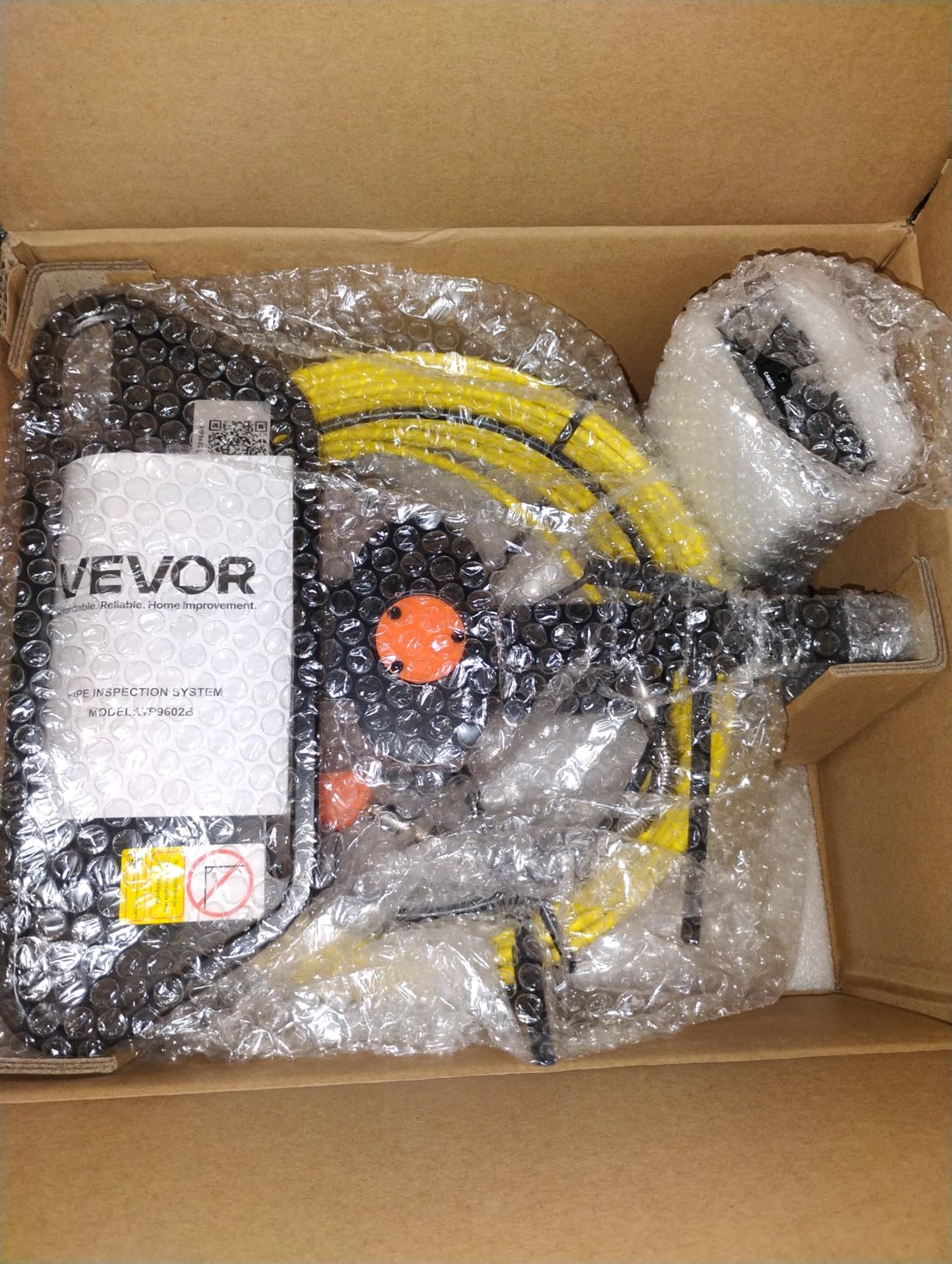
The open metal reel is a genuinely practical design choice. Several of these cameras have been used heavily, and one reviewer notes the open reel makes cleanup easy after a day in a wet crawlspace, which matters more than it sounds.
A 16GB SD card, USB-C cable and lens protection cover are included, and the kit is listed at 7.5 pounds, lighter than the 9.9-pound and 13-pound kits in this group.
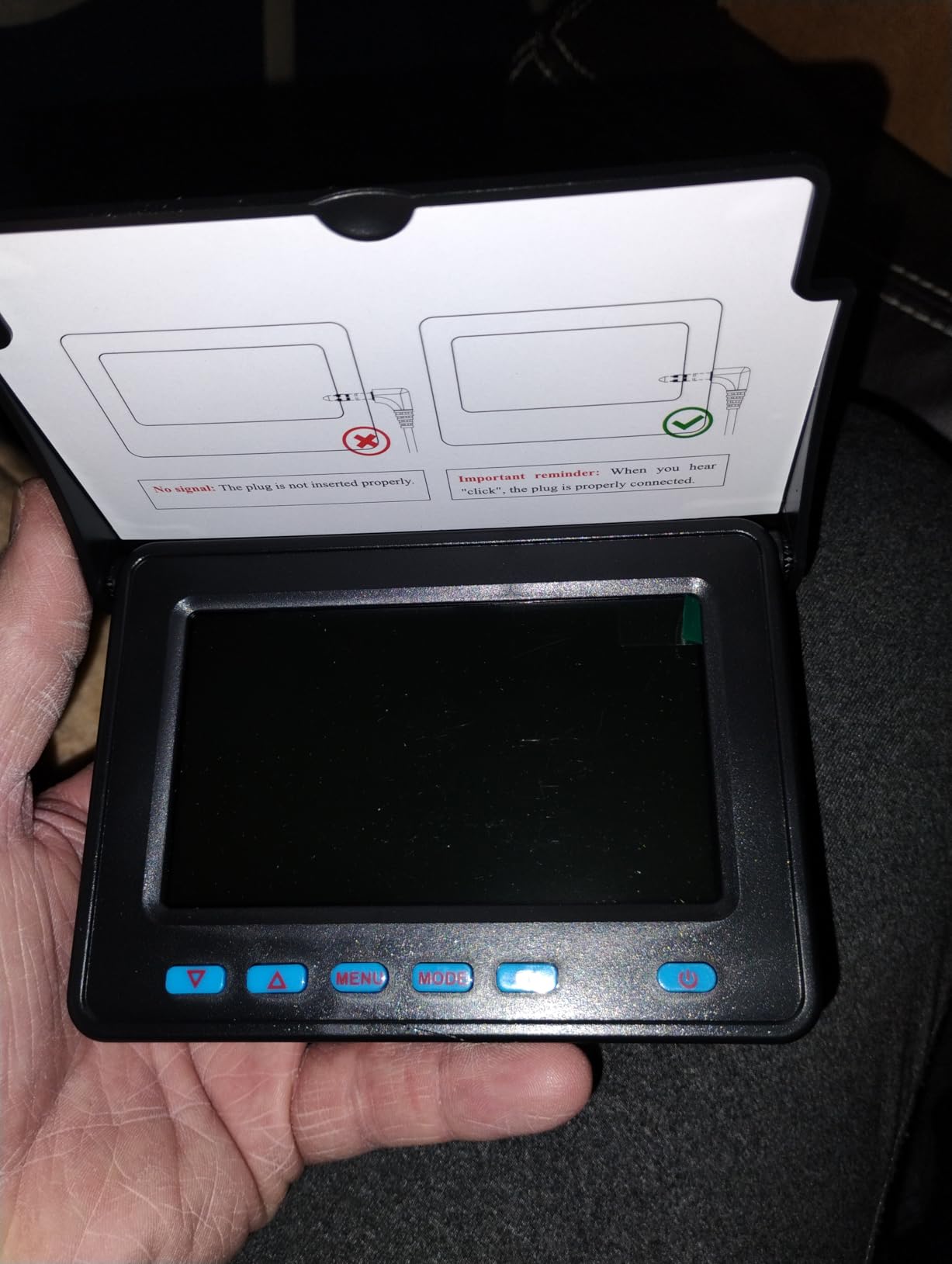
Is this camera good enough to quote jobs from?
Yes. At 720p with six LEDs and distance markings you can identify a blockage, record its position and show the customer. You will not be grading a pipe for a lining quote off this footage, but for diagnosis it holds up.
The catch is build quality at the monitor. Several users describe the mounting hardware as cheap and prone to breaking, and one long-term user reports recording stopping at random.
What about defective arrivals?
A couple of arrivals had a faulty battery or a light that did not turn on. Test the camera head, the LEDs and the recording before you rely on it in front of a customer, and keep the return window in mind.
720p capture is also below the newer 1080P kits, so if image quality is your priority rather than reach, pick the ChoosePRO or the VISIOPROBE.
8. Anysun 9-Inch 1080P Self-Leveling Camera – Best for Professional Plumbers
Anysun 9” Sewer Camera Self Leveling, Length Marker, 5100mAh, 1080P w/DVR
- Large 9in 1080P IPS screen stays bright at any angle
- Self-leveling head keeps orientation clear
- 5100mAh battery runs up to 10 hours
- 32GB SD card expandable to 128GB
- Length markers and two head skids included
- Thinner 5mm cable is weaker than the 7mm option
- Difficult to push around 45 and 90 degree bends
- LED brightness dial has a dead zone
- Winding the cable takes practice
Plumbers running apartment complexes say this unit pays for itself within a couple of inspections and replaces service calls. That is the strongest endorsement a tool in this category can get, and it lines up with what the hardware is built for.
The 9-inch 1080P IPS display is the largest screen here and stays bright and colorful from any viewing angle, which matters when you are crouching next to a cleanout in a crawlspace rather than sitting at a bench. The self-leveling IP68 stainless steel head keeps the image upright, and up to 5x digital zoom adds detail on pipe interiors.
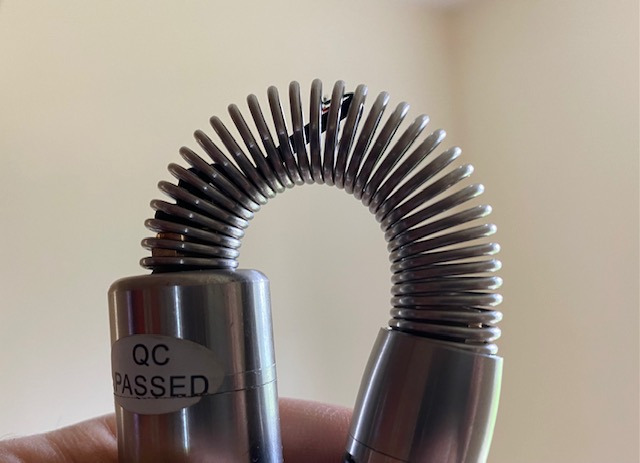
The 5100mAh battery runs up to 10 hours with an on-box charge indicator, so a full day of scoping does not need a mid-job plug-in. One-touch video and image capture go to an included 32GB SD card that supports up to 128GB, and meter markers on the push cable tell you how far the head has travelled.
Two protective skids at 36mm and 104mm cover different pipe sizes, and a sturdy metal frame makes pushing and retrieving the cable far less of a chore than winding it by hand.
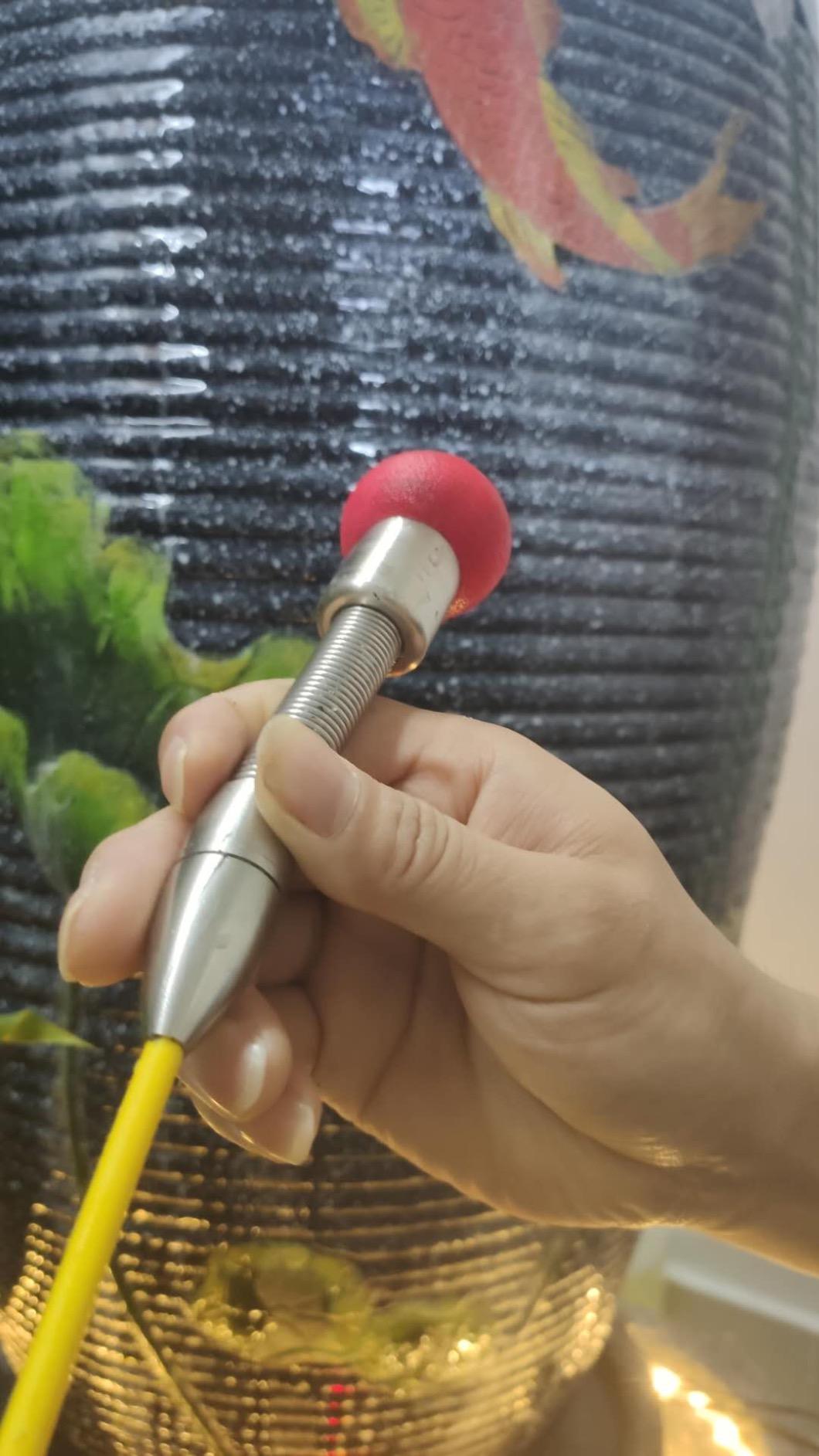
What are the real drawbacks on this kit?
Negotiating tight 45 and 90 degree bends is hard, and feeding the cable takes practice no matter how good the reel feels. The LED brightness dial has a dead zone and roughly a quarter turn of usable adjustment, which is a small annoyance on a dark job.
If you take the thinner 5mm cable option, know it is weaker than the 7mm cable for tough work. Choose the stiffer cable if you run through cast iron or root plugs.
How is the support?
Better than most in this group. Reports on earlier units describe a push cable or connector failure, but the manufacturer redesigned the head and replaced a unit well past warranty, and it lists 24/7 customer support.
That kind of response matters more than any spec sheet when a camera is your diagnostic tool five days a week.
9. VISIOPROBE 100ft 1080P Camera – Most Versatile with Audio Recording
Sewer Camera 100ft w/ 23mm 1080P Probe, 8500mAh, 32GB Audio & Video Record
- AHD 1080P probe with 145 degree wide-angle lens
- 12 adjustable LEDs light dark pipes
- IP68 stainless probe tolerates pressure cleaning
- DVR records video photos and audio to 32GB
- 8500mAh battery covers a full working day
- 23mm head must be swapped to negotiate 90 degree bends
- Cable becomes hard to push past roughly 60ft
- Cannot pass a toilet trap
Owners describe this as professional-feeling equipment at a non-professional level, and the audio recording is the feature nobody else in this group matches. When you scope a line for a customer, you can narrate what they are seeing and hand over a file that carries your explanation with it.
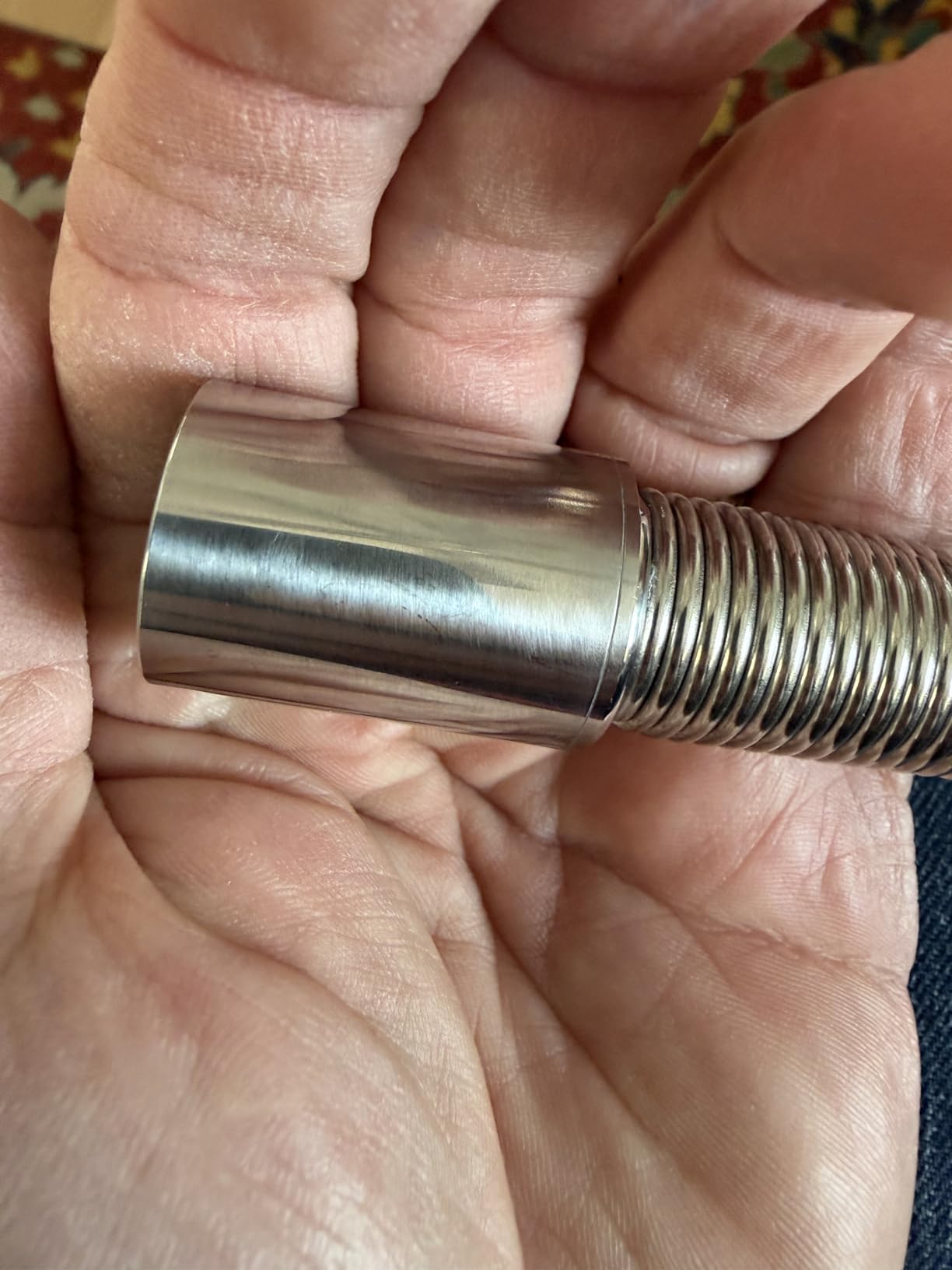
The optics are good. An AHD 1080P probe with a 145 degree wide-angle lens shows the pipe wall clearly, and 12 adjustable LEDs cover the darkness. The IP68 stainless steel head is reported to hold up under pressure cleaning, which is a real test for any probe.
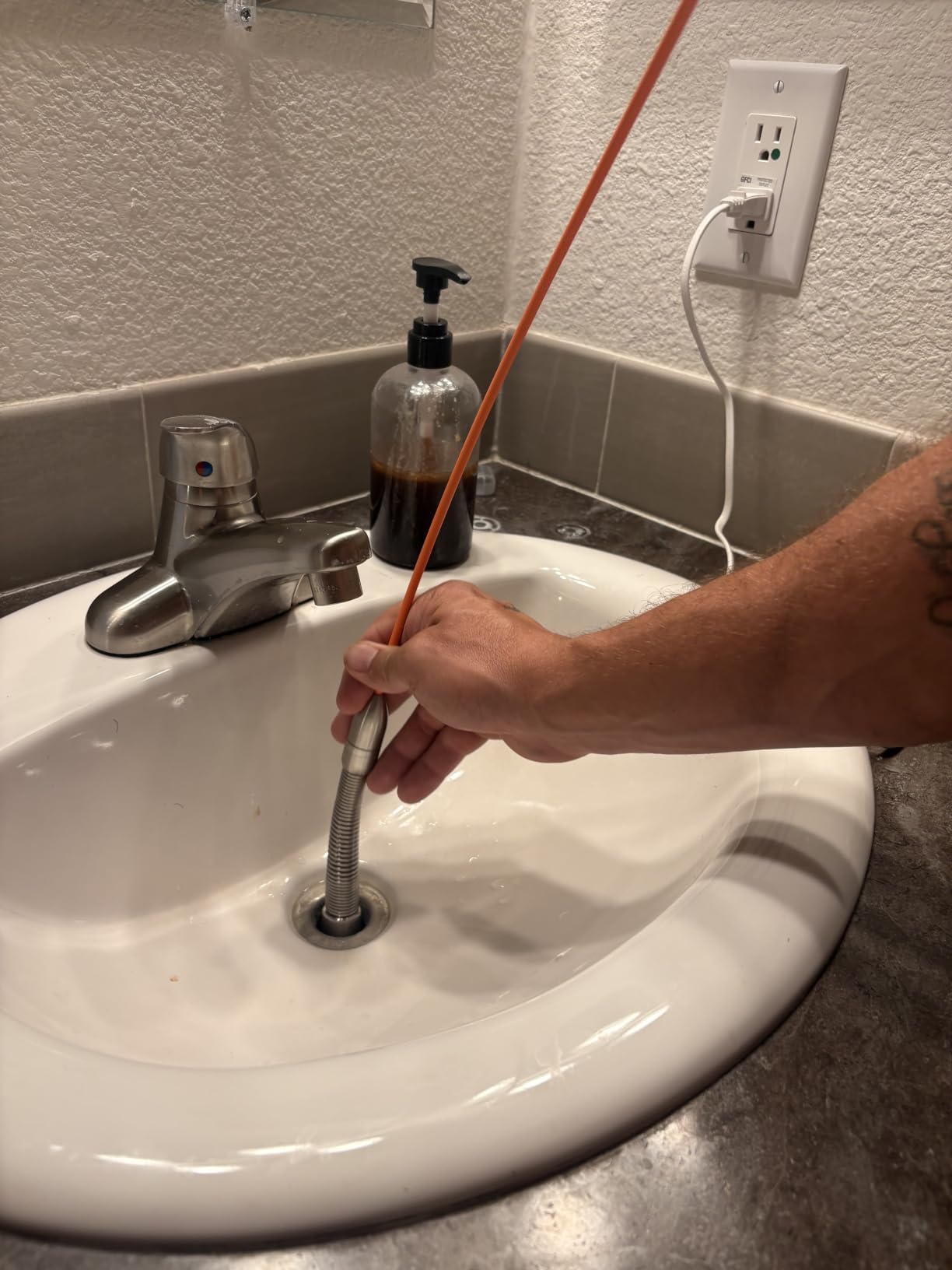
There is a 32GB TF card pre-installed, a 4.3-inch IPS monitor with an integrated sun visor, Arabic numeral depth markers printed on the cable, and an 8500mAh battery rated at up to 10 hours. Two wheeled protective heads cover different pipe diameters, and the warranty is one year with lifetime technical support.
Repeat buyers and plumbers bought a second unit, which tells you the price is doing a lot of work in a good way.
Can this get around a 90 degree bend?
Not with the head it ships with. The 23mm probe is the limiting factor, and owners swap to the smaller wheeled head to get around tight 90 degree turns. Plan on changing heads rather than forcing the cable.
It also will not pass a toilet trap, so this is a cleanout tool rather than a fixture tool.
Where does the cable get difficult?
Around 60ft. Owners consistently report the cable becoming hard to push past roughly that distance, which is well short of the 100ft the kit is sold with.
Treat it as a comfortable 60ft tool and buy the marked cable length for the reach you actually need.
10. KCapyn 100ft 1080P Camera – Best Compact Pick for Tight Pipes
- Genuine 1080P image with an IP68 waterproof and dustproof probe
- 17mm camera head fits smaller pipes
- 100ft semi-rigid cable with distance scale markings
- Built-in 32GB card for one-click capture
- Monitor and accessories fit a sturdy portable toolbox
- Screen does not tilt so glare limits outdoor viewing
- No self-leveling so the image can appear sideways
- Struggles to make 90 degree turns
- Toolbox does not fit the larger pipe adapter
The 17mm head is the point of this kit. Most reel cameras in this roundup use 18mm to 23mm probes, and two to six millimetres is the difference between passing a narrower branch line and turning back at the cleanout.
Everything else is solid. You get real 1080P video, an IP68 waterproof and dustproof probe, a 100ft high-toughness semi-rigid cable with a distance scale, six LEDs and a 5000mAh battery, plus a 32GB card built in for one-click photo and video capture.
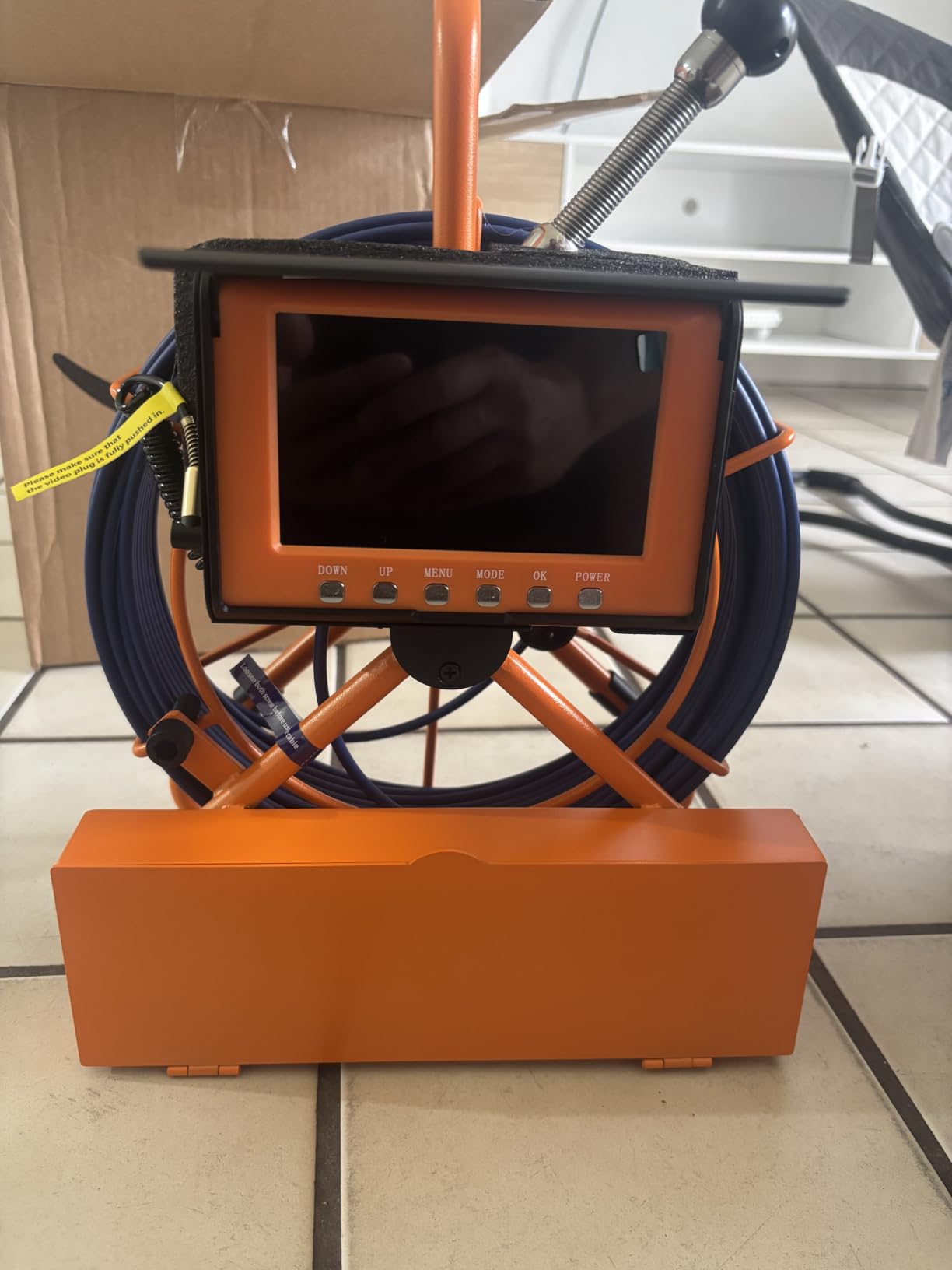
The integrated orange toolbox with the monitor housed in the lid is the sleeper feature. Plumbers and DIYers mention the all-in-one case that keeps everything organized, and several reviews are enthusiastic about pushing the camera deep through long lines without digging.
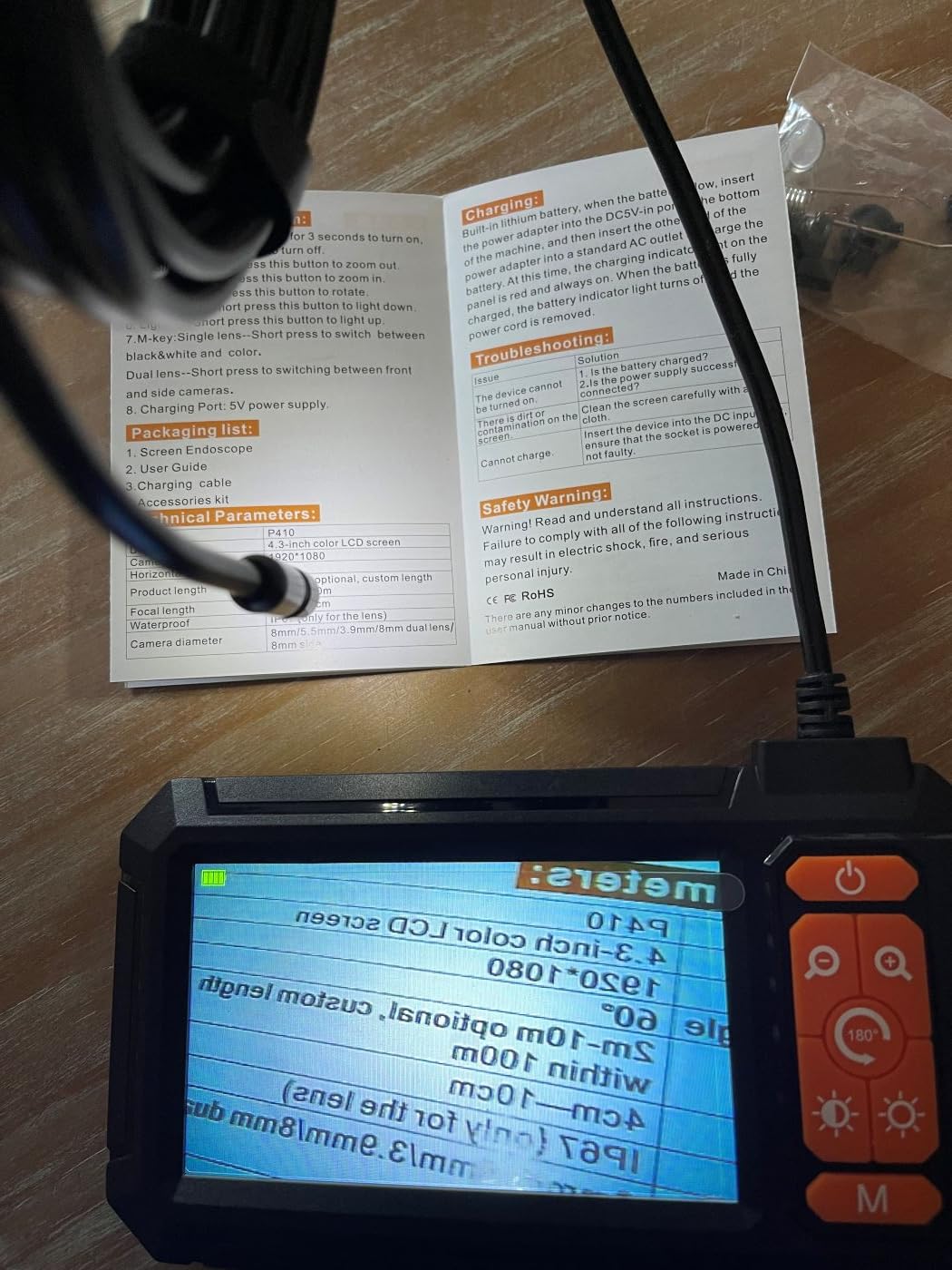
A wheeled head adapter helps center the camera in larger pipes, and the 5-inch DVR display supports real-time viewing with synchronized recording.
What are the limitations to plan around?
Three, and they are consistent. The screen does not tilt, so glare limits outdoor viewing. There is no self-leveling, so the image can appear sideways in the pipe. And the camera struggles to make 90 degree turns.
Distance markings printed in silver ink are also hard to read in a dark crawlspace, which undercuts one of the reasons to buy a marked cable in the first place.
Any build quality concerns?
A few cameras have arrived with vertical lines on the display or failed after short use, although the manufacturer is praised for shipping a replacement. The warranty is listed at six months, which is the shortest in this roundup.
Test the screen fully before you rely on it. We also noted that the toolbox does not fit the larger pipe adapter, so keep that piece separate.
How to Inspect a Clogged Drain Without Getting Your Camera Stuck
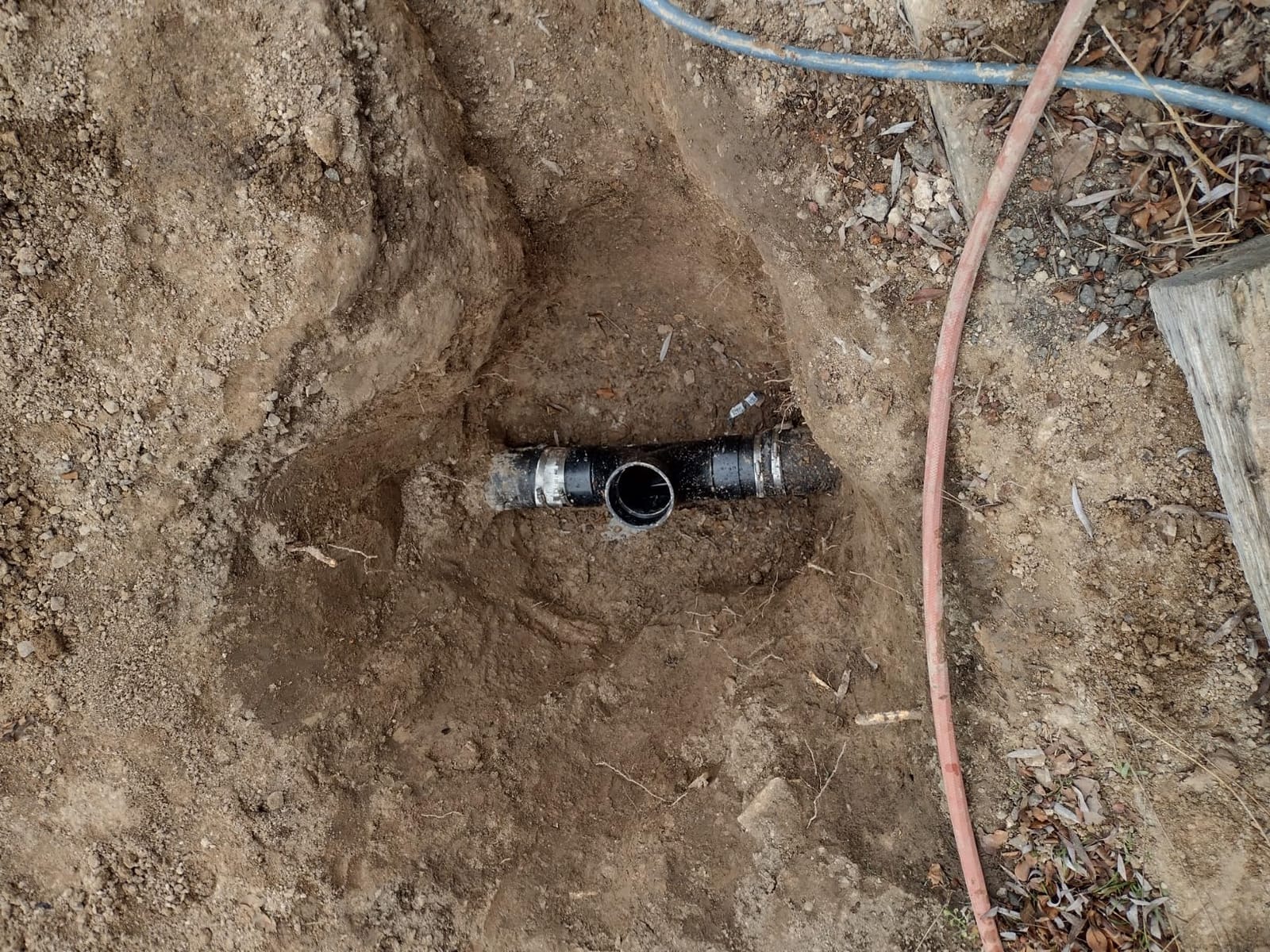
Every plumber we spoke about this topic raised the same fear, and it is the one thing none of the competitor roundups on this query warn you about. A camera head is a metal object on a cable at the far end of a line you cannot see into. If it stops and the cable will not follow, your only options are retrieval from the far end or cutting into the pipe.
The r/Plumbing case that gets repeated is a camera lost in a two-inch shower drain, followed by cutting into poured concrete to recover it. The owner afterwards installed a two-way cleanout as the lesson learned. A cleanout would have solved the retrieval problem before it started.
The steps below are what the experienced users describe doing.
1. Enter through a cleanout, not a fixture. The cleanout is the removable fitting designed to give you access. A lavatory or toilet trap is a trap in every sense, and pushing a camera through one is how cameras get lost.
2. Match the head to the pipe. Check the head diameter against the pipe diameter before you start. A 17mm head is a safer first choice in a narrow line than a 23mm head, and this is the most common reason a camera will not pass.
3. Push slowly and stop at the first resistance. Do not force the cable. When it stops, back out slightly, rotate the head and try again from a different angle. Forcing a camera past a bend is what strands it.
4. Watch the meter counter and mark the depth. Note the depth at every point of interest. If the head becomes stuck, the depth is what tells the retrieval crew where to dig.
5. Work from a cleanout with a known route. Know the pipe layout before you push. Turns, offsets and drop points are where cameras stop, and knowing the geometry tells you whether a stop is a blockage or the pipe just changed direction.
6. Keep the reel disciplined. Do not pile the cable into a heap. Feed it evenly, keep the reel turning freely, and never force a bend tighter than the cable wants to take. A kink that forms early becomes a failure point later.
What the Footage Shows: Bellies, Offsets, Roots and Cracks
Seeing the problem is only half the job. Knowing what you are looking at is the other half, and this is where most homeowners misdiagnose their own drains. Users often read belly and offset formations as collapses without a professional second read, and that gap in understanding is exactly what leads to an unnecessary replacement quote.
Belly. A section of pipe that sags, usually from soil movement or loss of support. Water and solids collect in the low spot, so you see a standing pool with debris sitting in it. A belly slows the line rather than closing it.
Offset. One section of pipe displaced out of alignment with the next, leaving a step or jog. You can often still push past one, but it scrapes the bottom of the line and catches debris. Offset at a joint is a different repair than a belly, which is why the distinction matters.
Root intrusion. Tree roots enter through the gaps between sections, often at a joint, and form a mat that catches everything passing. On camera it looks like a dark hairy mass, sometimes with fine white root tips. Roots grow back after clearing, so the intrusion point is information you want on record.
Grease and scale. A smooth, thick coating narrowing the pipe wall. It reads as a narrowing of the diameter rather than an obstruction, and it explains slow drains that never fully clear.
Cracks and breaks. Visible fractures, often with soil visible through the gap, or a collapsed section where the pipe walls converge to nothing. A camera that simply stops advancing at one point may have hit a collapse rather than a clog.
Basic clog. The simplest case. A solid mass of paper, hair or wipes sitting in an otherwise round, open pipe. If the pipe looks healthy on both sides, this is the good outcome and the easiest one to deal with.
A depth reading on the cable turns all of this into a location rather than a guess. For deeper guidance on the tools themselves, our guide to pipe cameras for DIY plumbers covers the entry points and cable handling in more detail.
Buying Guide: Cable Length, Head Size, Locator and Waterproofing
Cable length. 16ft covers a bathroom fixture or a short branch line. 100ft is the standard for residential laterals and the length most plumbers work with daily. 164ft and beyond cover long runs, multi-building properties and municipal work. Buy for the furthest point you will ever reach, not the average.
Camera head diameter. This is the number most buyers ignore and the number that decides whether the camera enters the pipe at all. Probe heads in this roundup run from 17mm to 23mm, with skids at different diameters on the larger kits.
Match the head to your smallest pipe, not your main line.
Resolution. 480p is too soft for close diagnosis. 720p is adequate for finding a blockage. 1080P, whether AHD or standard, is what you want if you intend to identify cracks or show footage to a customer. Resolution is wasted inside a small screen, so pair it with at least a 5-inch display.
Self-leveling. A gravity sensor keeps the image upright through twists and bends. It is the single biggest quality-of-life feature for anyone reading footage rather than a technician already trained to compensate.
512Hz locator. A sonde transmits a signal from the head, and a receiver above ground finds it, letting you mark the exact surface location and depth of a problem before digging. You need it if you plan to excavate or to trace a route. You can skip it if you only want to know what is wrong. Several of the kits above offer variants with a 512Hz locator, so check the option list before buying.
IP68 waterproofing. IP67 units tolerate immersion in shallow water; IP68 units are rated for depth. Every drain line is wet, so treat anything below IP67 as a dry-line tool.
DVR and storage. Recording to an SD card turns a tool into evidence. Check whether the card is included, how large it is, and whether it can be expanded. Audio recording, as on the VISIOPROBE, adds narration to the footage.
Battery and reel. A day of scoping is five to eight hours of pushing. An 8500mAh battery covers a full workday. An open metal reel washes off; a sealed plastic one holds mud. Our broader guide to inspection cameras for plumbers covers the non-plumbing electronics side of the same question.
Ownership costs. Check whether replacement cables are sold separately and what a spare costs before you buy. A kinked or damaged pushrod is the most common repair on these tools, and it is worth knowing the number in advance.
Rent, Buy or Hire a Plumber?
Homeowners ask this constantly, and the honest answer depends on how many drains you will look at over the life of the camera.
Renting makes sense if you have one recurring problem, a defined route you already know, and a cleanout within reach. Rental companies exist for exactly this, and you get 1080P hardware without owning the maintenance.
Buying makes sense if you are on a third inspection this year, if you own rental property, or if you want to scope lines before a purchase rather than after a problem. Our full roundup of pipe inspection cameras for drain diagnosis covers the hardware side in detail.
Hiring a plumber makes sense if the line runs under a slab, if the blockage may be in a section you cannot reach from a cleanout, or if you suspect a collapse rather than a clog. Locating an underground problem is the one job where a 512Hz locator plus experience genuinely beats a consumer camera.
One caution for anyone considering a professional camera inspection: get the recording, and ask for the depth reading. Fear of paying for a scoping fee and then being upsold on a full replacement is the most common complaint in plumbing forums, and a recorded file with a measured depth is what separates a diagnosis from a sales pitch.
Frequently Asked Questions
Can you camera a clogged sewer line?
Yes, and that is the main use for these tools. A pipe inspection camera is pushed through a cleanout or drain opening on a flexible cable while a monitor shows live video above ground. You can see the clog itself, along with bellies, offsets, root intrusion, grease buildup and cracks. The one case a camera cannot help with is a collapsed section where no cable can pass at all.
Can a drain camera get stuck?
Yes, and it is the most common worry among people who use them. The usual causes are entering through a fixture trap instead of a cleanout, forcing the cable past a tight bend, or using a head too large for the pipe. Enter through a cleanout, match the head diameter to the pipe, push slowly, and stop at the first resistance. Note the meter depth as you go so any stuck head has a known location.
Do I need a 512Hz locator?
Only if you intend to find the problem above ground and dig, or trace where the line runs. The sonde in the camera head transmits a signal that a receiver held over the ground picks up, giving you the depth and direction to mark on the surface. If you only want to know what is blocking the drain, a standard camera without a locator is enough and costs less.
What camera head size do I need for my drain?
Match the head to the smallest pipe on the route, not the main line. Heads commonly run from 17mm to 25mm, and larger kits include skids at different diameters. An 18mm to 23mm head suits most residential laterals, while a 17mm head is the safer choice for narrow branch lines. This single spec decides whether the camera enters the pipe at all.
Is it better to rent a sewer camera or buy one?
Rent if this is a one-time problem on a line you already understand and can reach from a cleanout. Buy if you are dealing with recurring backups, own rental property, or want to scope lines before a home purchase. Hire a plumber instead if the line runs under a slab or you suspect a collapse, because locating an underground problem needs a 512Hz locator and experience.
Final Verdict on the Best Pipe Inspection Cameras for Clogged Drains in 2026
The TGJOR 5-inch dual-lens borescope takes our Editor’s Choice because it does the most common job well. A large screen, a 170 degree front and side view and a semi-rigid 16.4ft probe handle a bathroom or branch line faster than anything else in this roundup, and it costs the least to learn.
For real main line work, the ChoosePRO 1080P 100ft kit is the one we would buy. True 1080P on a 7-inch IPS screen, 16x zoom, a marked cable and a twist-unlock reel give you both the picture and the paperwork. Plumbers who scope every day should look at the Anysun, where the 9-inch display, self-leveling head, 10 hour battery and responsive warranty support add up to the most dependable daily tool here.
Whichever you pick, enter through a cleanout, match the head to the pipe and push slowly. That habit is worth more than any spec on the box.