
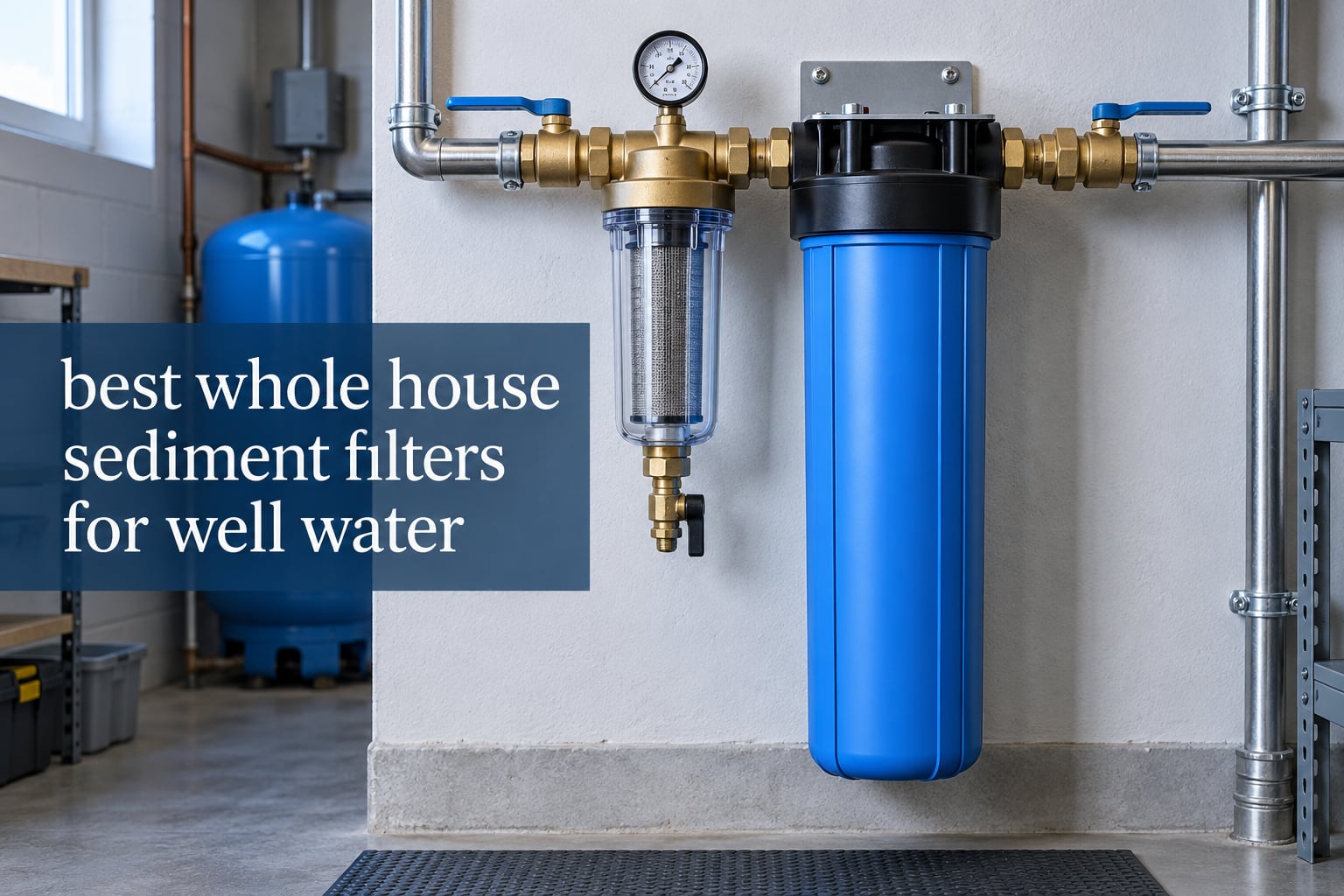
If you are choosing among the best whole house sediment filters for well water, the first decision is mechanical and it decides most of the rest: a housing that swallows replaceable cartridges, or a reusable spin-down screen you flush in place. Get that call right and micron rating, housing diameter and placement order fall into line behind it.
Well water carries what municipal supplies never deliver. Pump grit, sand, rust flake off corroding casing, and fine clay suspended after heavy rain all show up at the kitchen tap, and every one of those particles is abrasive. Left alone, grit scours faucet cartridges, packs faucet aerators solid, pits water heater dip tubes and wears pump seals from the inside.
A sediment filter installed where the main line enters the house is the cheapest insurance in the entire treatment train, because everything behind it lasts longer. Our team compared ten whole house units across spin-down mechanisms, Big Blue style housings and three-stage racks, and this roundup breaks down what each one actually does, what it costs you in maintenance attention, and which of them to skip for your particular water.
We also mapped the failures owners actually report. Reviewers on these products describe brown grit collecting in bathtub drains and aerators packing with sand within weeks, and pressure dropping noticeably when two fixtures run at once. That symptom pattern is diagnostic, and we come back to it in the buying guide. For a broader look at point-of-entry equipment, our guide to the best whole house water filters for well water covers softeners and carbon stages this one skips.
One note before the rankings. Every specification here comes from the manufacturer data for each unit, not from lab work of ours, and the ratings and review counts are the live figures attached to each listing. Where owners disagree about performance, we report the disagreement rather than smoothing it over.
Top 3 Whole House Sediment Filters for Well Water in 2026
Three picks cover most well situations: a full three-stage rack for houses that want one box to handle everything, an auto-flush system for owners who refuse to flush weekly, and a lower-cost three-stage built on brass ports and per-stage gauges.


Best Whole House Sediment Filters for Well Water at a Glance (October 2026)
The table below lists all ten picks with the mechanism, the micron rating and the flow figure that decides whether each one suits your well. Housing sizes and micron numbers come straight from the manufacturer listings.
| Product | Specifications | Action |
|---|---|---|
| Express Water 3-Stage Whole House System |
|
Check Latest Price |
| iSpring Ultimate Whole House Auto-Flush Filter |
|
Check Latest Price |
 HQUA WF3-01 3-Stage Filtration System HQUA WF3-01 3-Stage Filtration System |
|
Check Latest Price |
 SimPure DB20P-3 20 Inch 3-Stage Pre-Filtration SimPure DB20P-3 20 Inch 3-Stage Pre-Filtration |
|
Check Latest Price |
 Waterdrop BG103 Mega Spin Down Filter Waterdrop BG103 Mega Spin Down Filter |
|
Check Latest Price |
 iSpring WSP-50 50 Micron Spin Down Filter iSpring WSP-50 50 Micron Spin Down Filter |
|
Check Latest Price |
 GE GXWH40L Whole House Sediment Filter GE GXWH40L Whole House Sediment Filter |
|
Check Latest Price |
 Aquaboon 20 x 4.5 Inch Whole House Housing Aquaboon 20 x 4.5 Inch Whole House Housing |
|
Check Latest Price |
 Waterdrop WHF3T-PG 3-Stage 5 Micron System Waterdrop WHF3T-PG 3-Stage 5 Micron System |
|
Check Latest Price |
 A. O. Smith AO-WH-PREV Sediment Filter A. O. Smith AO-WH-PREV Sediment Filter |
|
Check Latest Price |
1. Express Water 3-Stage Whole House System – Best Overall Standalone
Express Water Whole House Water Filter System, Ultimate Protection, 3-Stage
- Handles sediment and heavy metals in one rack
- Stainless steel frame survives a wet utility closet
- Pressure release buttons simplify cartridge swaps
- Three gauges show which stage is loading
- All three cartridges go on one service schedule
- Polyphosphate stage does not lower hardness
- Large footprint for a small utility area
This is the unit we recommend when you want one purchase to solve sediment and a couple of other problems without thinking about ordering. The WH300SCKP pairs sediment filtration with activated carbon and KDF stages, then finishes with a polyphosphate anti-scale stage that coats pipe walls against mineral build-up. Rated capacity is 100000 gallons, and the listing puts maximum flow at 17 GPM across a 20 to 80 psi operating range.
What sold us is the physical design rather than the spec sheet. The system ships on a stainless steel stand with a bracket heavy enough to stay put, and each housing carries a pressure release button so you can swap a cartridge without shutting off the whole house. Owners describe clear improvement in water clarity and taste at every faucet, and the review base sits at 4.5 stars across more than 2700 ratings.
The common reservation is the service interval. Three stages means three cartridges, and the listing gives a 6 month filter life cycle for the set. On a well that runs cloudy after rain, the sediment element will probably outpace that, so budget for an earlier change rather than treating the date as gospel.
Size is the second reservation. The unit weighs 63 pounds and stands at 29 by 8.5 by 30 inches, so measure the utility space before you commit. A 3-stage rack on a floor or in a wall cabinet eats space a single spin-down never asks for, and the freestanding format means you need level floor beneath it.
What it handles that a bare cartridge housing cannot
The KDF and carbon stages target lead, arsenic and chromium, which matters if your well sits near old agricultural ground or plumbing solder. Taste and chlorine complaints from owners largely disappear once those stages are in place, which is why this unit shows up on wells that had two separate problems, not one.
On sediment specifically, it does the job of a mid-range cartridge but not the job of a coarse pre-screen. Fine grit and rust flake are handled; large pump debris that would wreck a carbon block is better caught upstream. If your well throws sand in heavy bursts, pair this with a spin-down in front rather than expecting stage one to be the sacrificial stage.
When to pick something else
Skip this if your utility room is tight, if you want to avoid a multi-cartridge replacement bill every few months, or if hardness is your main complaint. The polyphosphate stage prevents scale from forming but does not remove dissolved calcium and magnesium, so it is not a softener and will not soften water.
It also totals 63 pounds, which is genuinely awkward above a floor drain. Two people or a plumber will handle it comfortably. Budget accordingly if your install point is above shoulder height.
2. iSpring Ultimate Whole House Auto-Flush Filter – Best Low-Maintenance Three-Stage
- Auto-flush removes the weekly flush habit
- Highest rating in the set at 4.7 stars
- 250000 gallon capacity stretches service intervals
- Scale inhibitor protects appliance internals
- Auto-flush needs a drain line and a power supply
- 66.7 pounds needs two people to move
- Does not reduce total dissolved solids
The organizing idea here is the WSP50ARB in position one. That stage is a reusable spin-down screen with an automatic flush module bolted to it, so sediment clears itself on a timer instead of waiting for you to open a valve every week. Stage two is a compound GAC filter and stage three a coconut shell carbon block, with a scale inhibitor alongside them. Capacity is listed at 250000 gallons and maximum flow at 15 GPM through 1 inch NPT ports.
The rating profile is the strongest in this roundup: 4.7 stars with 83 percent five-star ratings and roughly 3 percent one-star. That is not a marketing artifact, it is 2237 ratings behaving like a settled product. Owners single out the maintenance saving first, then the change in water odor and taste, and several mention how quickly tech support answered.
The trade is money and plumbing. This is the highest price point of the systems we reviewed, the assembly weighs 66.7 pounds, and the auto-flush module needs both a drain line and a power supply to run its cycle. If you have nowhere to route a drain, that requirement alone disqualifies it.
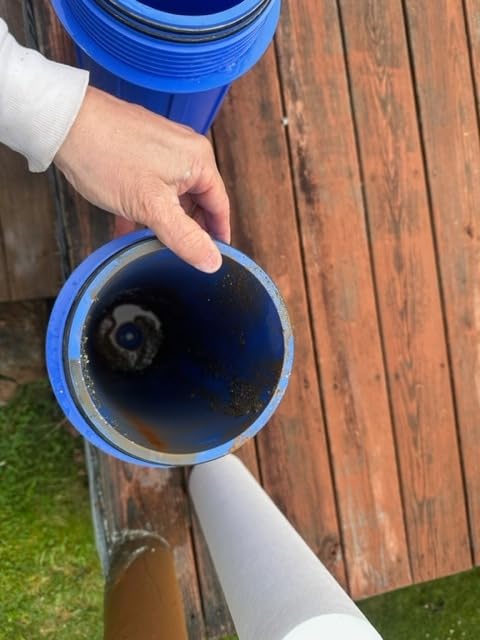
Two honest caveats from the review record. First, the system does not reduce total dissolved solids; it preserves healthy minerals rather than stripping them, which owners mostly consider a feature but which is worth stating plainly. Second, 66.7 pounds means this is not a one-person lift above a floor drain, and the geometry is 25 by 22 by 17 inches, so it needs a real footprint.
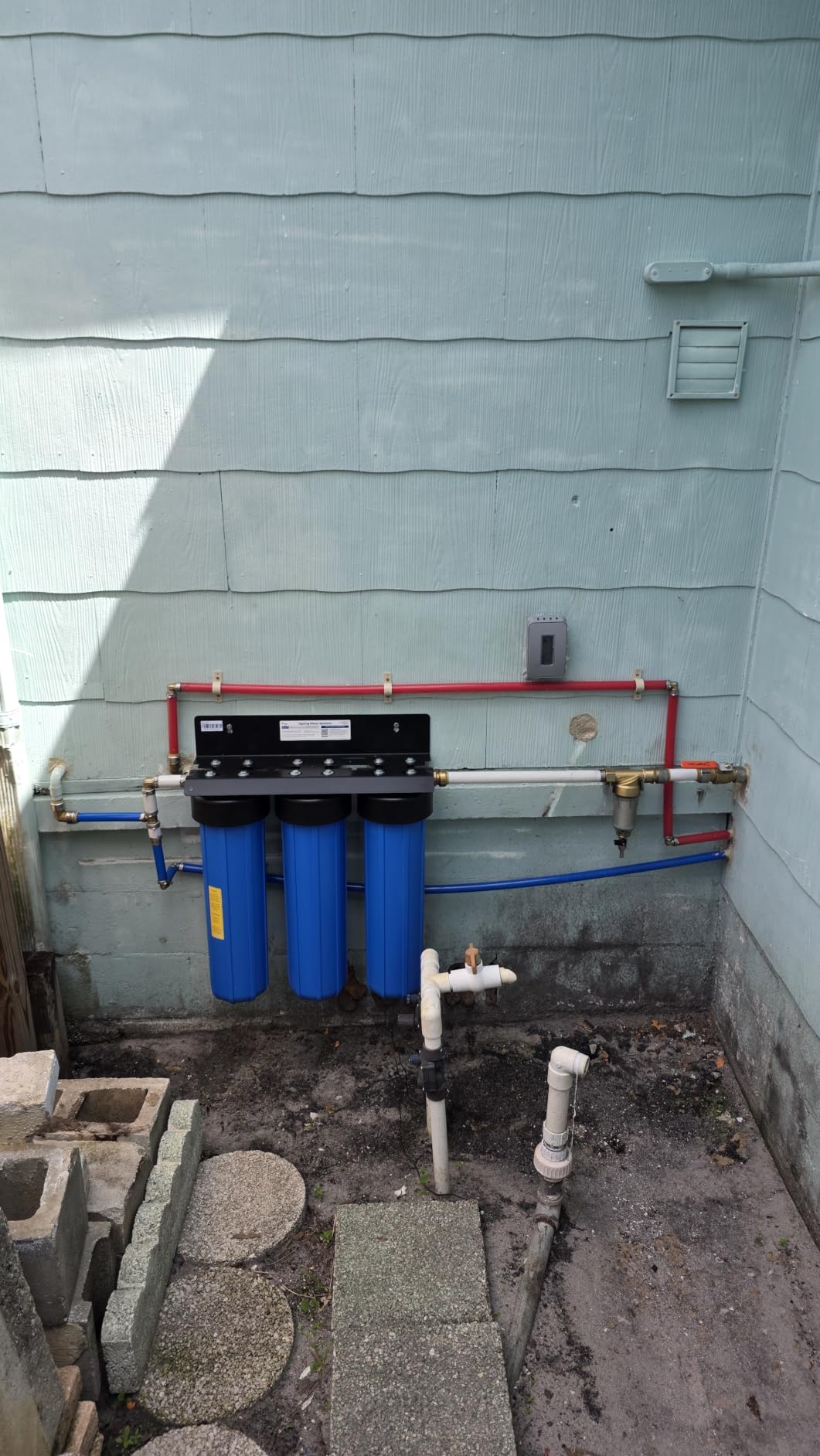
Forum regulars on plumbing forums and the plumbingforums.com crowd often describe exactly this arrangement as their working setup: a spin-down first stage to absorb the abuse, then a softener, then disinfection. The iSpring system bundles the first two ideas into one assembly, which is convenient if your space allows it.
When the auto-flush earns its cost
It earns its cost on wells with enough sediment that a manual spin-down would need weekly flushing, and on households where nobody wants that habit. Owners running high-sand wells report the timer handles the load without the screen locking up in days.
It also makes sense if you already plan a three-stage train and want the heavy lifting done. The 250000 gallon figure and the carbon stages cover a family of four for roughly a year before attention is needed under average use.
Where it falls short
The drain line and power requirement are non-negotiable. Mechanical, no-ration excuses aside, a washbasin or floor drain has to be within reach of the flush outlet, and you need an outlet for the module.
Second, if you only have sediment to deal with, this is doing carbon and scale work you may never use. A spin-down plus a single 20-inch cartridge housing handles most well water for far less money and half the weight.
3. HQUA WF3-01 3-Stage Filtration System – Best Value Three-Stage
- Brass ports resist the leaks that plague plastic ports
- Pressure gauges on every housing show which stage loads
- 180 day timers built into each housing
- Cleaning brush and extra fittings included
- Manual omits the second O-ring per housing
- 20 x 5.5 inch housings are oversized
- Cartridge labels are hard to orient
The WF3-01 does three things in one frame: sediment, a compound carbon block for heavy metals, and a second carbon stage, all in three 20 by 5.5 inch housings with reversible flow direction. The listing targets lead, mercury, arsenic, cadmium, chromium, chlorine and VOCs, with a 15 GPM maximum and a 25 to 116 psi working range.
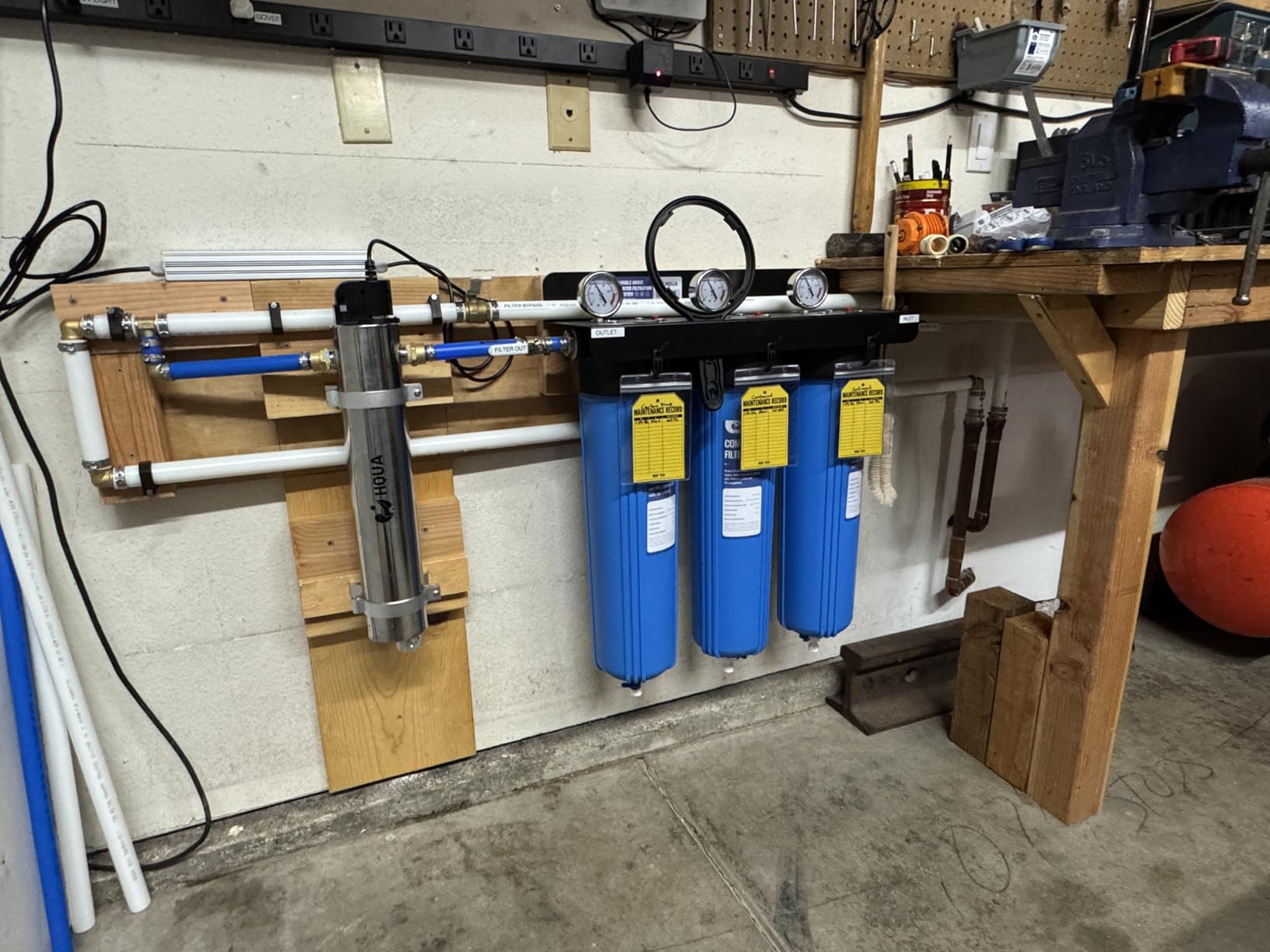
What separates it from cheaper racks is mechanical detail. The ports are brass threaded rather than plastic, which is exactly where competing systems leak according to owners. Every housing gets an oil-filled pressure gauge so you can see which stage is loading before the whole train slows down, and the drain valves let you purge cartridges in place to extend their life.
The kit is unusually complete: a housing cleaning brush that owners describe as rare and useful, spare gaskets, silicone lubricant and both 3/4 inch and 1 inch NPT adapters. Built-in 180-day filter life timers remove the guesswork from scheduling, which matters on the multi-stage builds where people forget stage two entirely.
Reviewers on high-sulfur and sandy wells report the rotten-egg smell disappearing and faucets no longer jamming. The 4.6-star average rests on a smaller base of 198 ratings, so treat it as strong but less proven than the leaders.
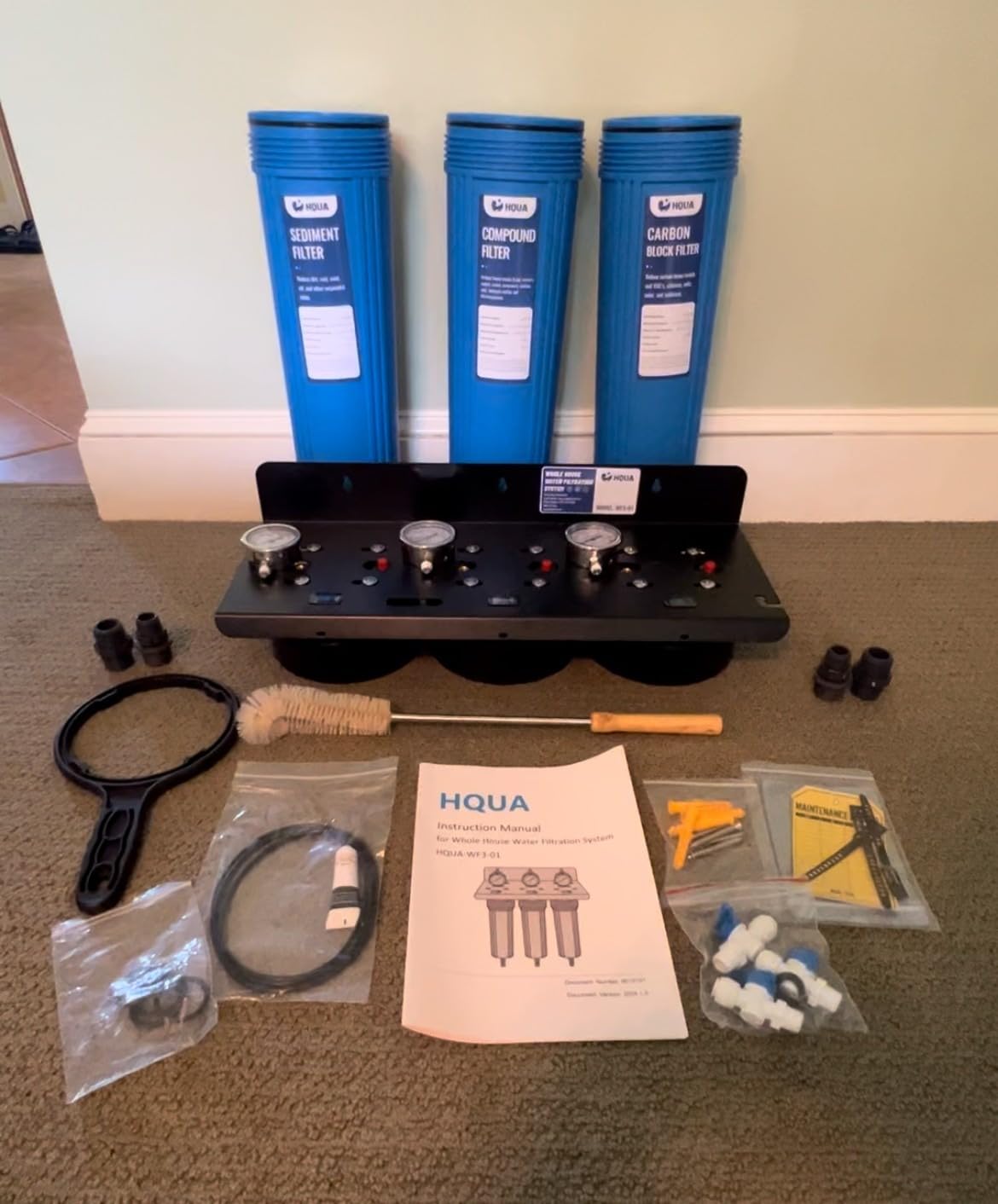
The installation note that appears again and again is a documentation gap rather than a product defect. The instructions do not mention that each housing needs two O-rings, and several buyers discovered that only after leaks appeared at startup. Count them before you pressurize.
One buyer also reported persistent thread leaks on the input side that neither Teflon tape nor pipe dope resolved, which points to a housing issue rather than technique. The 20 by 5.5 inch shells are larger than the common 20 by 4.5 inch footprint, so check your vertical and horizontal clearance before ordering.
What makes this the value pick
Brass ports, gauges on every stage, in-place drain valves and a full fitting kit at a fraction of what premium treatment trains run. On a well with iron staining and odor alongside sediment, it covers several complaints in one purchase.
The 180-day timers and per-housing gauges together give you a maintenance system most cheap racks skip entirely. You know which stage is loading without guessing.
When it is the wrong choice
Skip it if your utility space is tight, because 20 by 5.5 inch housings demand more room than the standard Big Blue shell. At 44 pounds it is manageable alone but still awkward above a drain.
It is also the wrong tool if sediment is your only problem. Two of these three stages do work you will never notice, and you pay for that in both purchase price and two more cartridges on every service cycle.
4. SimPure DB20P-3 20 Inch 3-Stage Pre-Filtration – Best Standard Cartridge Setup
SimPure Whole House Water Filter System 3-Stage 20″ *4.5″ Pre-Filtration
- Uses standard 20 by 4.5 inch cartridges you can buy anywhere
- Clear housings let you check loading without tools
- Double O-ring and brass fittings
- 150000 gallon rating at this size
- Cartridge wrappers must come off before install
- Carbon stage life of 3 to 6 months is short
- Operating pressure capped near 90 psi
This three-housing rack runs MPP sediment, GAC and CTO stages in standard 20 by 4.5 inch shells, which is the specification that matters most for ownership costs. Cartridges in that footprint are cheap, available from many brands and never lock you into one supplier, which is the opposite of buying a closed system.
Clear housings across all three stages let you check cartridge condition without breaking anything down. Owners who had been blind to loading in an opaque rack describe the change in routine as the biggest practical improvement, because you swap the stage that is actually spent instead of swapping all three.
Flow is listed at 15 GPM and capacity at 150000 gallons, with a recommended 25 to 90 psi range. At 48 pounds and 23 by 7.7 by 28.7 inches it sits in the middle of this group on both weight and footprint. The 4.5-star average comes from 518 ratings, with 76 percent five-star.
Two setup notes matter. The cartridge wrappers have to come off before install, a step that several owners admit they missed at first. And carbon stages in this format are listed at a 3 to 6 month life cycle, the shortest of the group, so the long run cost of this rack is higher than the cartridge prices suggest.
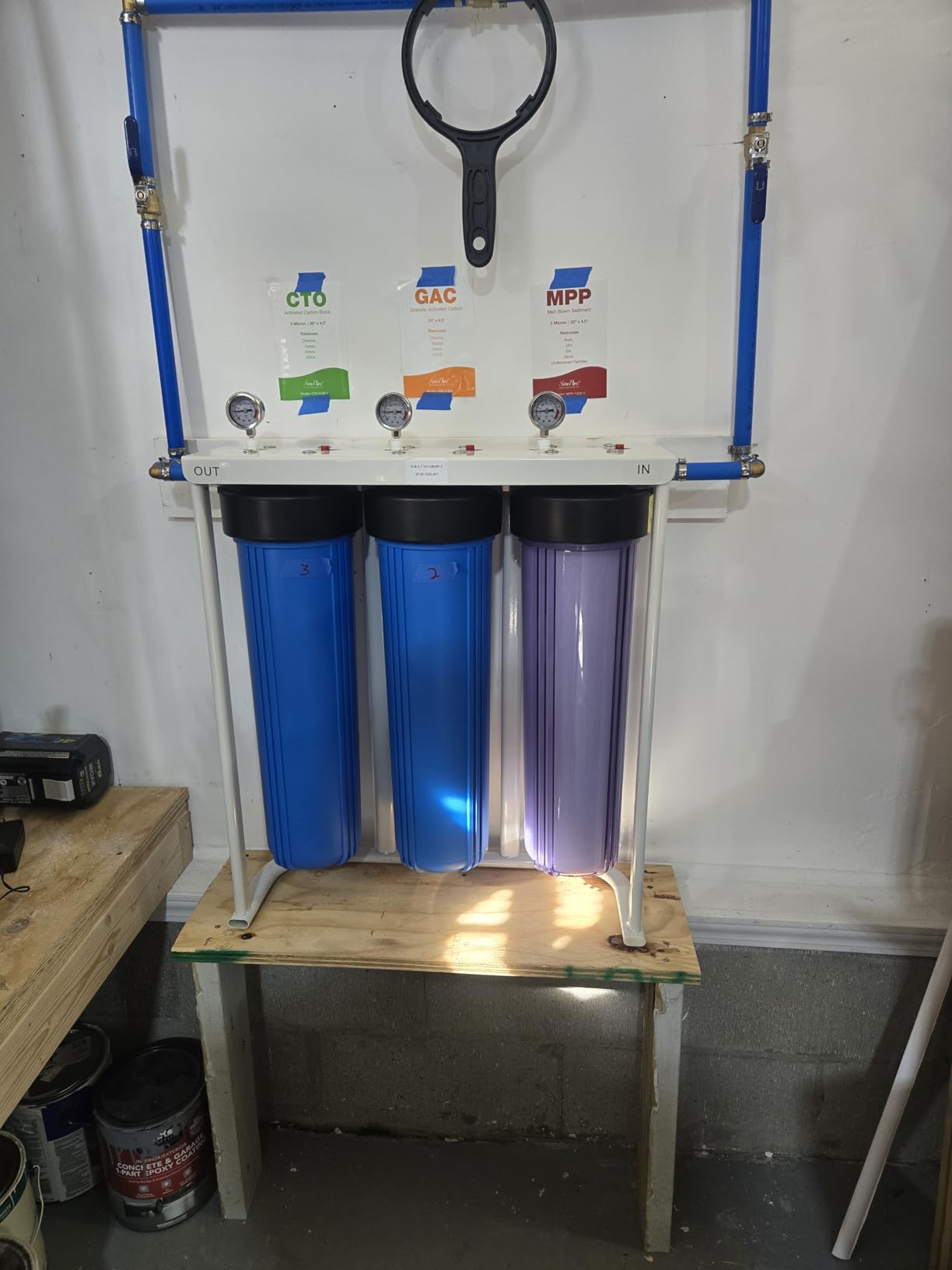
The recurring praise is value and flexibility. Being able to see filter condition through the housings and swap in generic 20 by 4.5 inch elements means you can move between sediment grades as your water changes without buying a proprietary part.
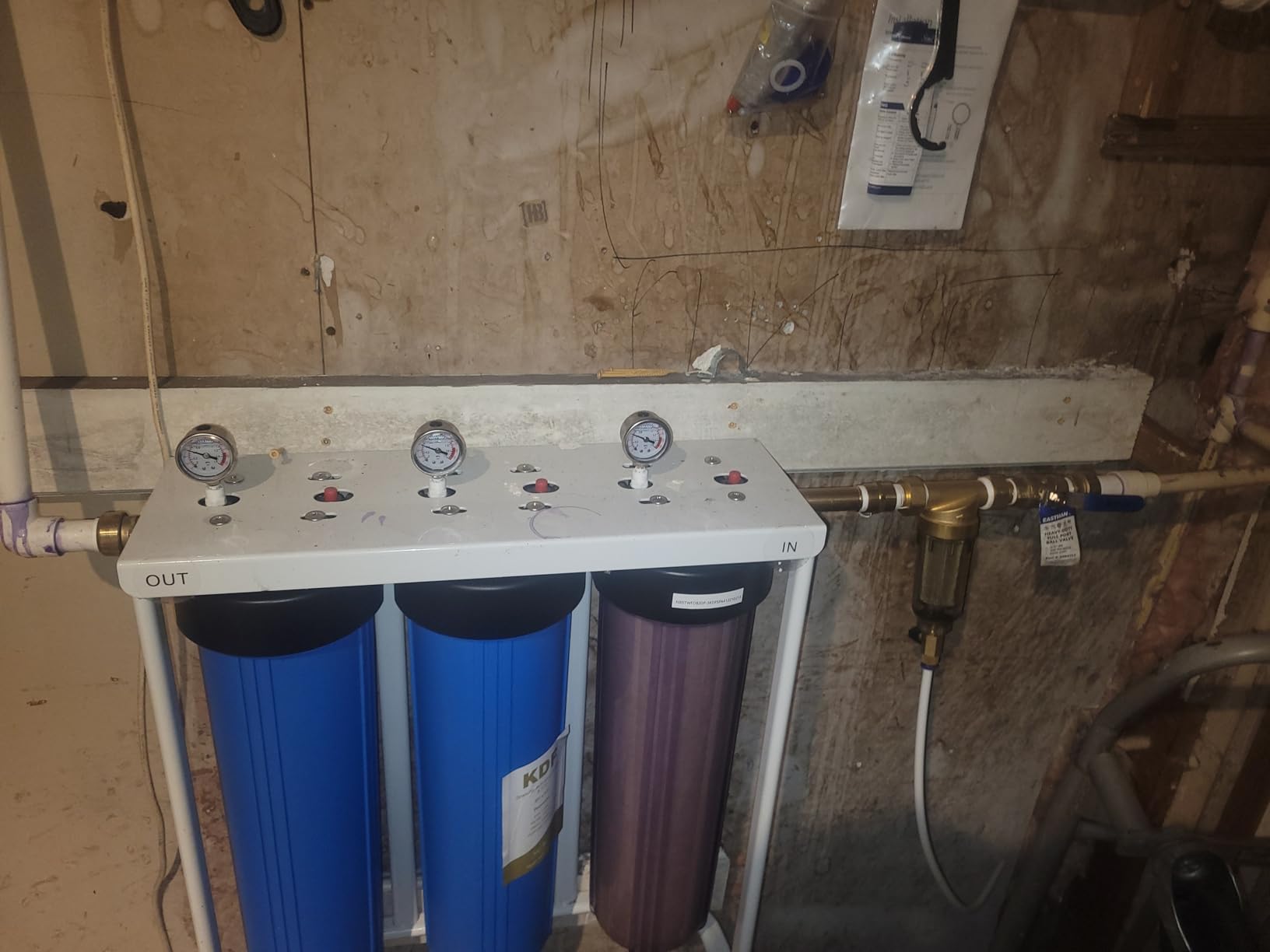
Owners also credit the double O-ring plus brass fitting combination for leak resistance, which matches what we saw elsewhere in this roundup: plastic ports are the single most common source of install complaints.
Why the standard footprint matters
Standard 20 by 4.5 inch cartridges are among the most readily available sediment elements, and the housing size is the most flexible on this list. Owners who move to coarser or finer media as conditions change can do it without replacing hardware.
For households with moderate household demand, 15 GPM at this housing size is comfortable headroom. Clear housings add serviceability you cannot retrofit later.
Where it disappoints
The carbon stages are the weak point. A 3 to 6 month life on those elements means the scheduled parts cost climbs faster than with racks that use longer-lived media, and you will be scheduling service more often than the sediment stage alone would require.
The 90 psi ceiling is also worth checking against your well. If your pressure switch is set above that, this rack runs outside its recommended range.
5. Waterdrop BG103 Mega Spin Down Filter – Best for Muddy, Sand-Heavy Wells
Waterdrop BG103 Mega Spin Down Sediment Filter, 500 + 200 Micron
- Coarse mesh built for sand rather than silt
- 25 GPM with almost no measurable pressure drop
- 360 degree flush cleans forward and reverse
- Forged brass head tested to 200000 water hammer cycles
- No recurring cartridge cost
- Bracket does not hold the unit in place
- Union reducers are awkward to seal
- Off valve does not stop downstream backflow
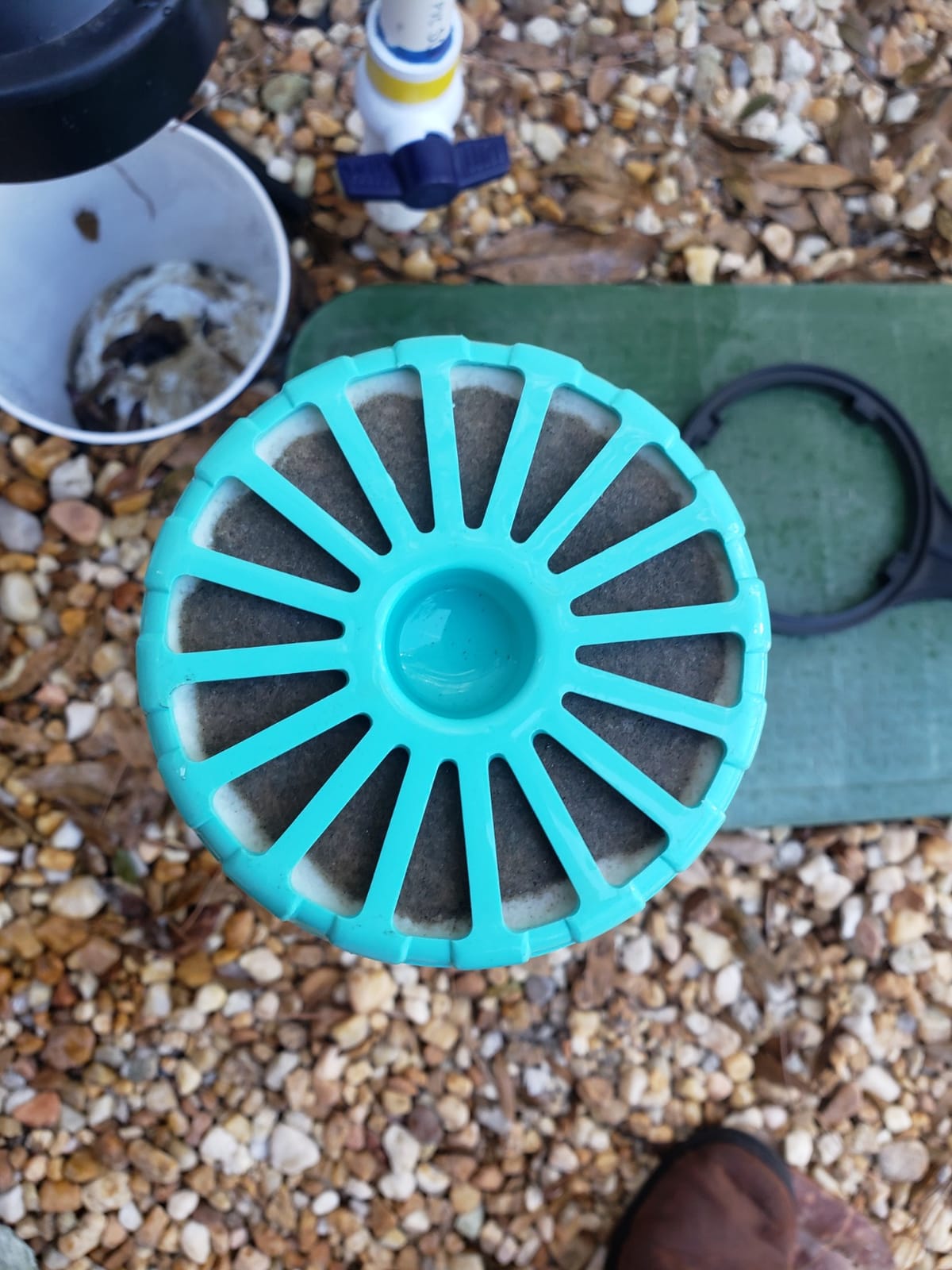
This is the spin-down built for the wells that destroy ordinary spin-downs. Instead of a 50 micron screen it runs dual 500 and 200 micron mesh, with a chamber listed at 20 times the volume of a standard spin-down and an outer mesh 7 times larger with the inner mesh 4.2 times larger. That headroom is the entire point: coarse grit falls out instead of blinding the screen.
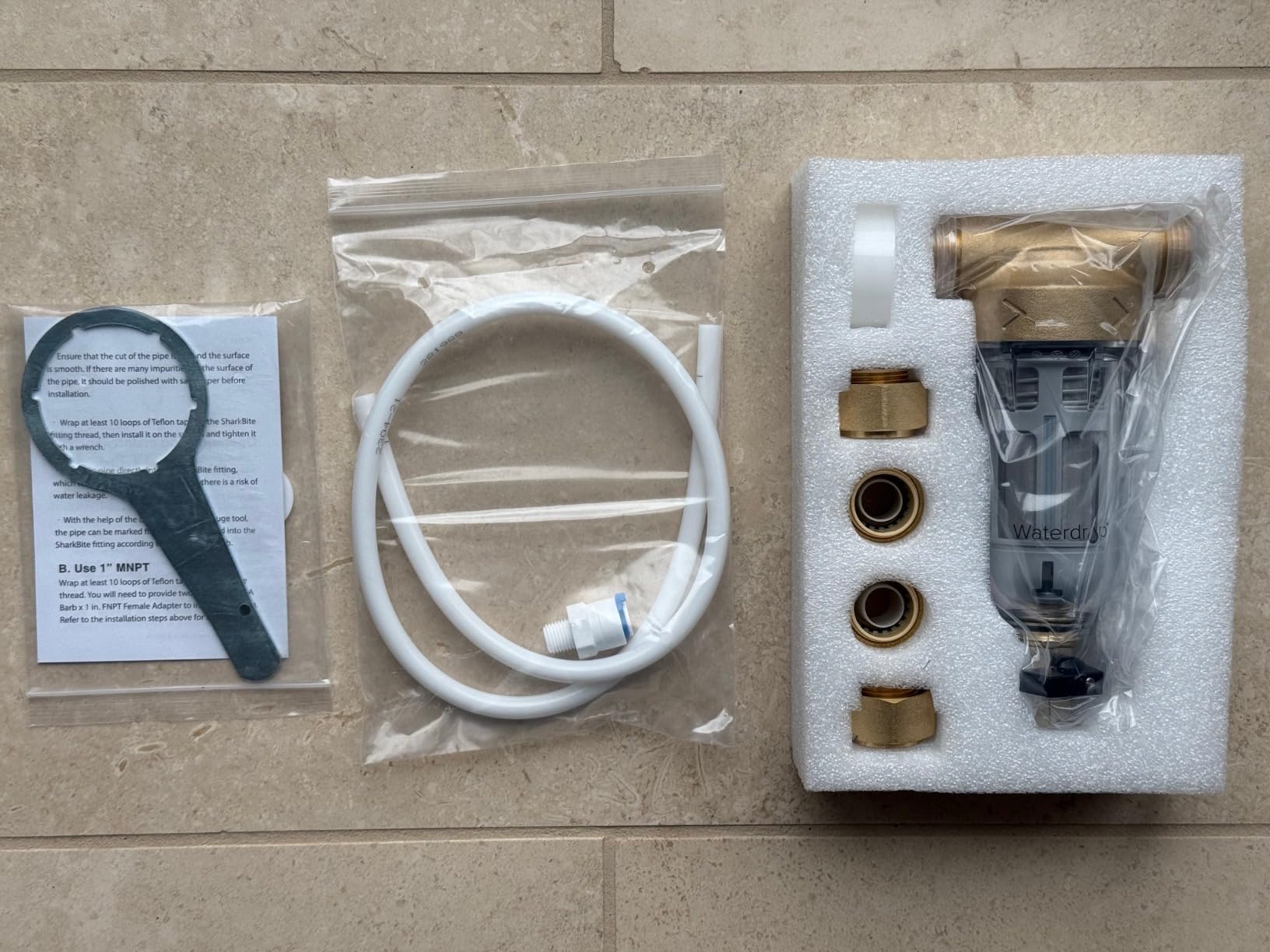
Flow is listed at 25 GPM, the highest in this roundup, with a 14.5 to 72 psi range. At 7.1 pounds and 6.9 by 5.7 by 15.9 inches it is also the smallest and lightest unit here, which matters when you are mounting it in a tight crawlspace or a pump closet.
Cleaning runs both directions through a 2-way bypass valve, so you can backflush the element as well as forward-flush it. The head is forged brass with a nano-coating and magnetic scale prevention, and the assembly is tested to 200000 water hammer cycles, 6.0 MPa and minus 22 degrees F. Buyers mostly report that it simply survives sandy wells where finer units plug up.
The 4.4-star average across 639 ratings is the second lowest here, and the complaints are specific rather than general. Several owners note that the supplied bracket positions the unit but does not hold it, so isolation valves are advisable.
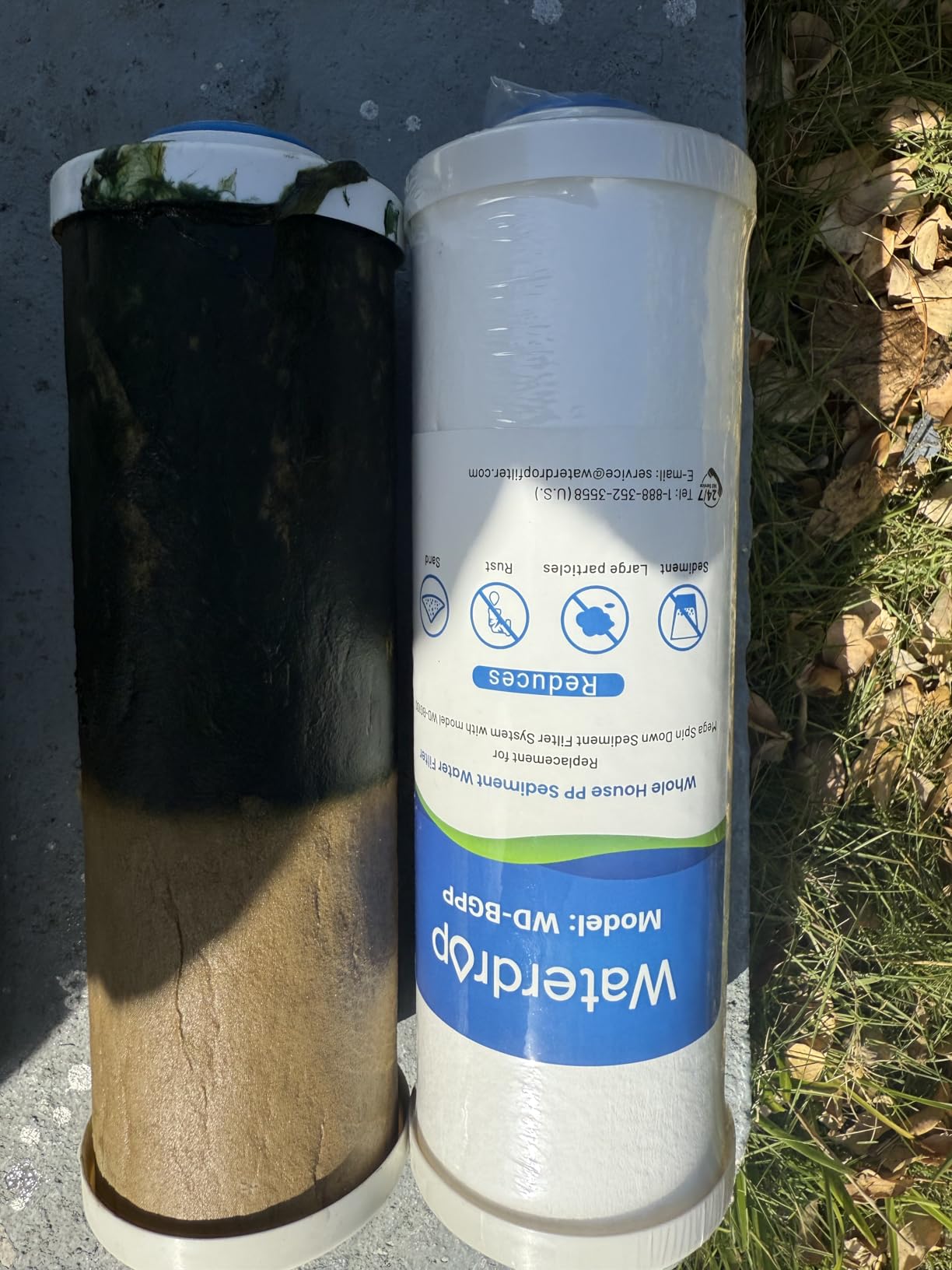
Two more honest notes from the reviews. The union reducers stepping 1-1/4 inch down to 1 inch or 3/4 inch are awkward to seal leak-free, which is the most common install friction. And the off position on the bypass handle does not stop backflow arriving from the downstream side, so a second isolation valve is the safer install.
On very silty wells the mesh still clogs, though backflushing recovers it. Finally, replacement cartridges for this model are not sold separately by the brand, so treat the element as a long-life part of the assembly rather than a consumable.
When coarse mesh beats fine mesh
Coarse mesh wins when your problem is sand and pump grit rather than clay. A 50 micron screen on a sand-heavy well blinds within days and drags flow down with it, while 500 and 200 micron mesh passes enough water for the large particles to settle out and keeps flowing.
The oversized chamber means longer intervals between backflushes than a standard spin-down, which is why owners on muddy wells pair this with a finer cartridge behind it rather than replacing it.
Where it is the wrong tool
It will not touch fine sediment. Nothing at 200 micron stops clay or fine silt, so if your water clouds rather than runs gritty, this does nothing and you need a cartridge stage behind it.
Add the bracket issue to the list: plan on isolation valves and secure mounting, because the included bracket alone is not enough in a pump closet that gets bumped.
6. iSpring WSP-50 50 Micron Spin Down Filter – Best Reusable Pre-Filter
iSpring WSP-50 Spin Down Sediment Filter, Whole House Prefilter, 50 Micron
- Reusable mesh removes recurring cartridge cost
- Most reviewed unit in the set with 3600+ ratings
- See-through housing shows loading instantly
- Screen can be swapped in other micron ratings
- Doubles as a system bleed-down point
- 50 micron plugs up on silty or iron-heavy wells
- Small 9 inch chamber needs frequent flushing
- Spare O-rings are not stocked separately
The WSP-50 is the most established reusable pre-filter on this list, sitting at 3603 reviews and 4.6 stars with 78 percent five-star. The mechanism is simple and proven: a 50 micron stainless steel mesh screen inside a see-through housing, cleaned by opening the bottom flush valve so line pressure clears the screen in seconds.
What makes it durable is the head. It is solid lead-free brass with dual O-ring sealing, rated 40 to 100 degrees F and 15 to 115 psi, and the manufacturer gives the screen a 1 to 2 year typical life. At 16 ounces and 3.5 by 3.5 by 9 inches it fits anywhere, including under a sink or inside a small cabinet.
The threading is unusually flexible for a spin-down: 1 inch MNPT and 3/4 inch FNPT on both ends plus a garden hose barb on the flush valve, so you can adapt it to whatever your existing plumbing offers. Replacement screens are available in 50, 100, 200, 500 and 1000 micron, which means you can re-size the unit later without buying a new body.
The bottom clean-out valve doubles as a bleed-down point for the rest of your plumbing, a small convenience that shows up repeatedly in owner comments about DIY work downstream of the filter.
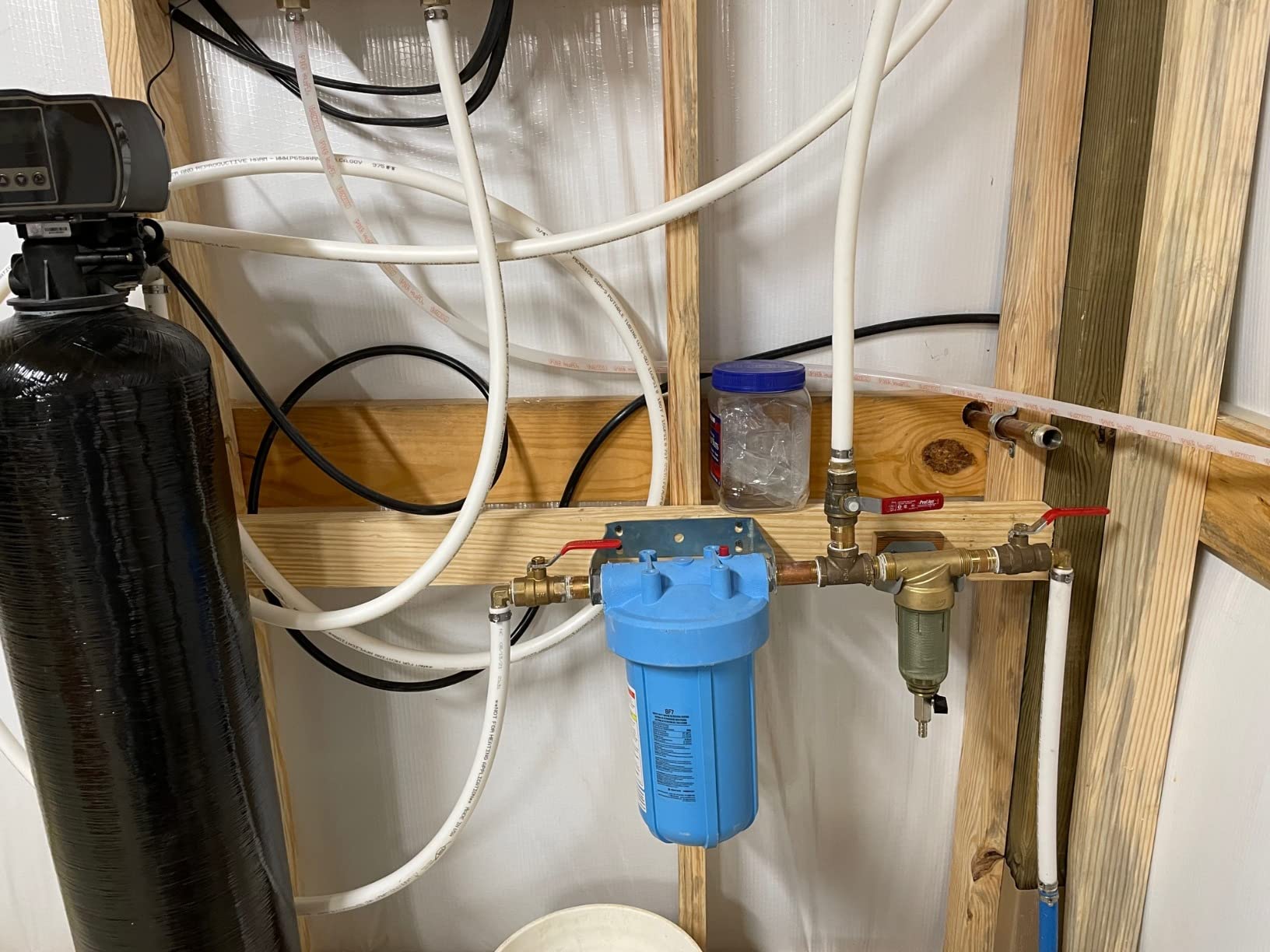
The single loudest theme in 3600 reviews is micron sizing, and it is worth reading as a warning. At 50 micron this unit is right for moderate sediment and wrong for high-silt or high-iron wells, where owners report clogging within days and a visible flow drop. Several changed to 100 or 200 micron after calling the manufacturer, which shipped replacement screens at no charge.
That support responsiveness comes up often enough to be a real differentiator, but the practical lesson is that you should size the screen to your water before you install. The 9 inch housing also holds a small sediment volume, so dirty wells mean weekly flushing rather than monthly.
Why this is the default recommendation
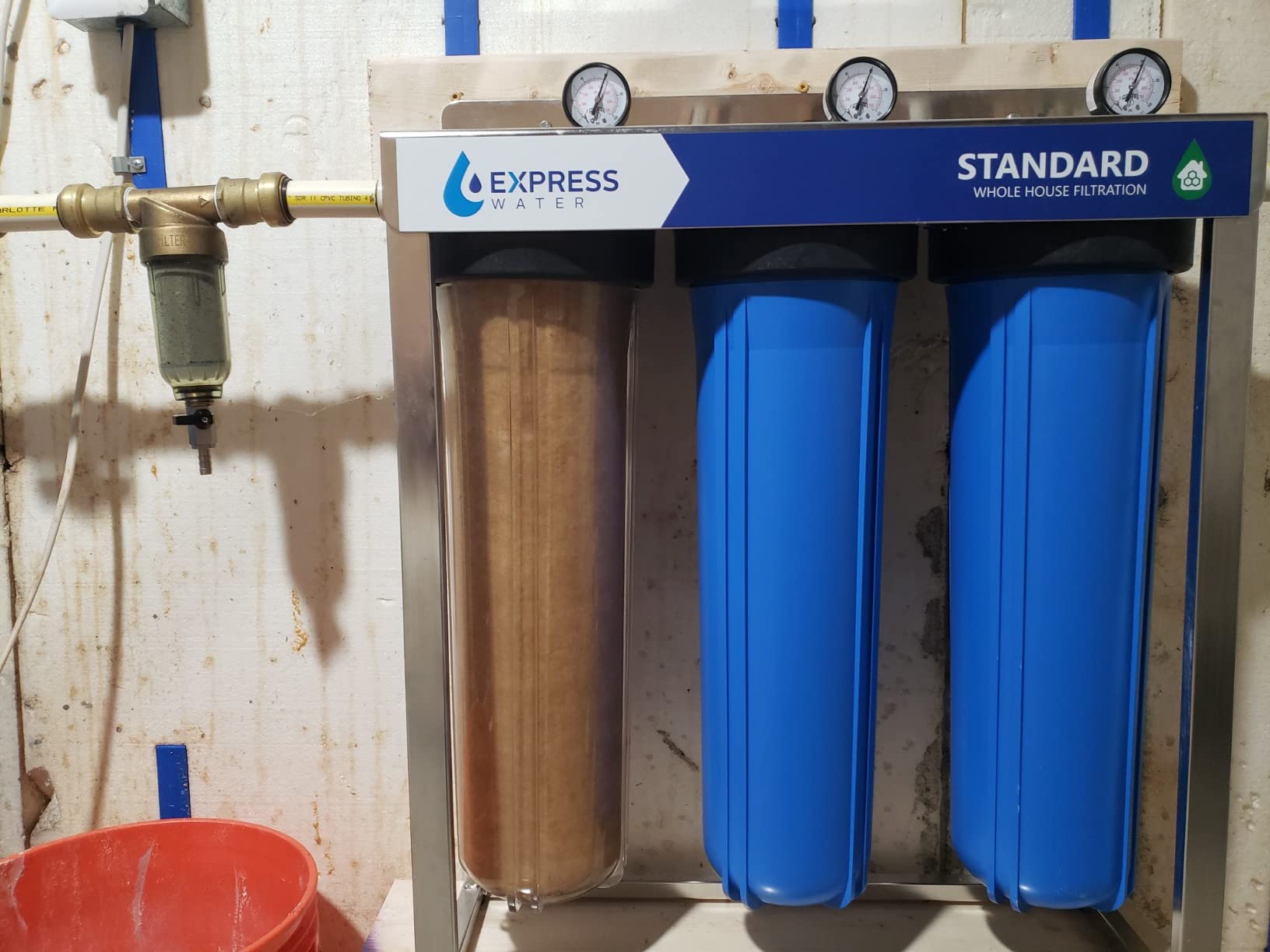
Zero recurring cartridge cost, a small footprint, brass construction and adjustable micron sizing make it the safest first stage on most wells. Owners on the plumbingforums.com threads routinely describe using a spin-down as a sacrificial stage precisely because it is cheap to maintain.
It also runs at high flow with negligible pressure loss, so adding it upstream of a softener or a cartridge housing costs you almost nothing hydraulically.
When it fails on your well
If your water is silty or iron-heavy, 50 micron is the wrong rating and the replacement cycle becomes constant. Order the 100 or 200 micron screen for those wells, or step up to a coarser unit such as the BG103 above.
Also note that spare O-rings are not stocked separately for this model, so a torn ring means replacing more than the ring. Keep the original packaging for that reason.
7. GE GXWH40L Whole House Sediment Filter – Best for Tight Utility Spaces
- Compact footprint fits where a rack cannot
- Bypass lever and pressure relief valve included
- Clear sump shows filter loading
- Reversible flow direction eases retrofit
- Works as a softener resin guard
- FXHTC and FXHSC cartridges sold separately
- Lowest flow rating here at 4 GPM
- Housing threads prone to seeping over time
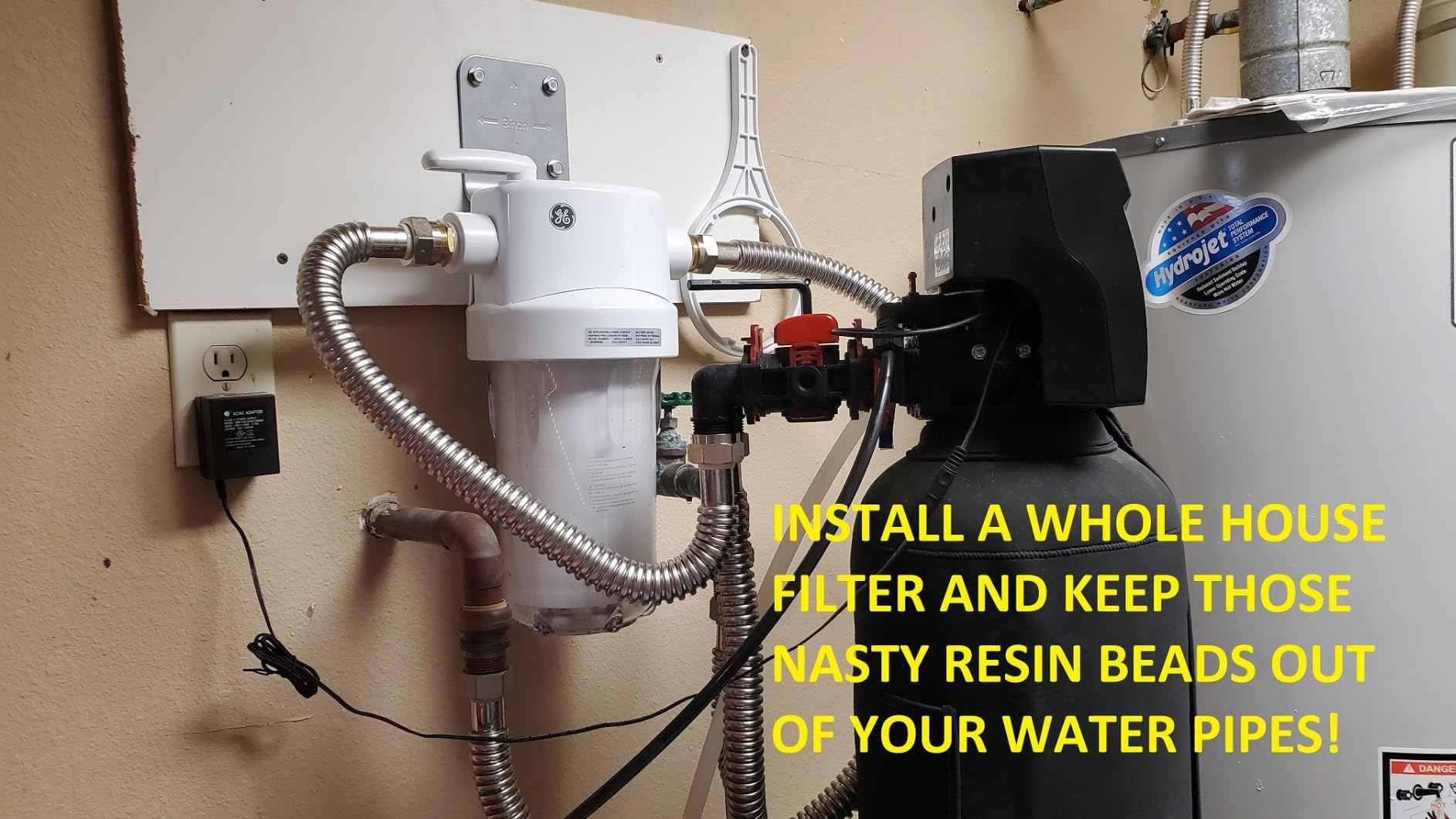
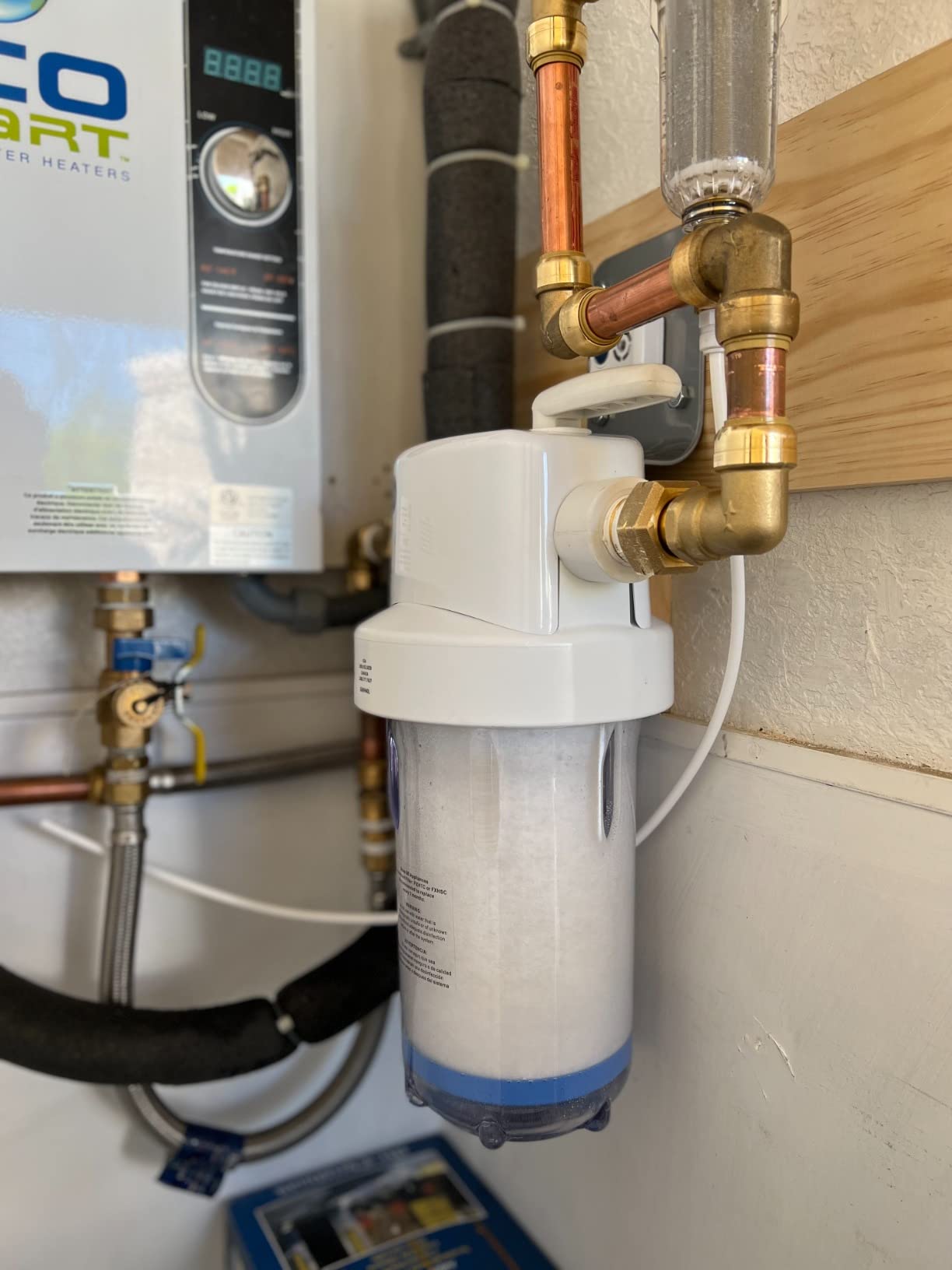
The GXWH40L is the odd shape that solves a real problem. It mounts horizontally on the pipe rather than standing upright, which means a 15.75 by 9 by 7.75 inch footprint that fits inside a narrow utility closet or tight wall cavity where a three-housing rack would not go. Owners using it as a softener resin guard or a light iron reducer on decent well water describe it as doing exactly what it promises and no more.
The housing carries a bypass lever and a pressure relief valve, so cartridge changes do not require shutting off the main. A clear sump lets you watch the filter load, and the removable inlet and outlet orientation makes retrofitting into existing plumbing easier than a fixed-flow unit.
There is a remote battery-powered filter change reminder light in the kit, which is a nice touch on a system whose service interval is short. The 4.6-star average comes from 979 ratings with 80 percent five-star, and several owners note the housing is genuinely rugged.
Be clear about what it is. Flow is listed at 4 GPM, the lowest in this roundup, with users measuring closer to 7 GPM while flushing. It is a compact guard filter, not a treatment system, and it uses GE FXHTC or FXHSC cartridges on a 3 month cycle that are not included in the box.
Two mechanical complaints recur. The housing and canister can arrive screwed together very tightly, and some owners need a vise to separate them on first setup. Separately, the housing threads are prone to seeping at residential pressure, with some units leaking over time even when installed carefully.
Because cartridges ship separately, budget for two FXHTC or FXHSC elements from day one and expect to buy them on a 90 day cycle forever. That recurring cost is the price of the compact shape.
Where a compact guard filter wins
If you rent, live in a cabin, or have a utility space where a vertical rack physically will not fit, this solves a problem nothing else on this list does. The horizontal orientation also keeps the sump accessible without pulling a tall housing out of a tight space.
As a pre-filter ahead of a softener on moderate sediment, it stops resin from reaching the house, which is exactly the sacrificial role people describe in forum threads.
When it is the wrong choice
Four GPM will not carry a household with multiple fixtures running at once, so it is a small-home or cabin product in practice. Very hard water and heavy iron loads are also outside what it can handle.
If your sediment load is real, the 90 day cartridge cycle will become monthly, and you are buying two elements a year forever to hold a small amount of dirt.
8. Aquaboon 20 x 4.5 Inch Whole House Housing – Best Replacement Housing
Aquaboon 20″ x 4.5″ Whole House Well Water Filter System with Pressure Release (1″ Port) | Certified | Compatible with Pentek 150233, 150235, Geekpure BB- 20B
- Fits Pentek 150233 and 150235 cartridges
- Thicker darker polymer than typical housings
- Included deep-tooth wrench actually grips
- Pressure gauge adds real visibility
- Owners string two in series for staged filtration
- Ships empty with no cartridge included
- Plastic threads need heavy tape or pipe dope
- Over-tightening still produces a slow drip
This is a housing, not a system, and that is exactly why it is on the list. The AB-WH20BB accepts Pentek 150233, 150235, Geekpure BB-20B and any standard 20 by 4.5 inch element, so you are never locked into one cartridge brand. That freedom is the main argument for buying a housing over a closed assembly.
Construction is where it beats the housings it competes with. The polypropylene is thicker and darker than typical Pentair and Pentek shells, with better UV resistance, and it locks firmly into the bracket so the sump cannot slip while you tighten it. The oil-filled liquid pressure gauge reads accurately, which no cheap housing in this footprint bothers with.
The included heavy-tooth wrench is a small thing that owners mention a lot: it grips the housing where the standard Pentair wrench slips. The pressure release button swaps a cartridge fast, and the double O-rings arrive pre-lubricated with food-grade silicone.
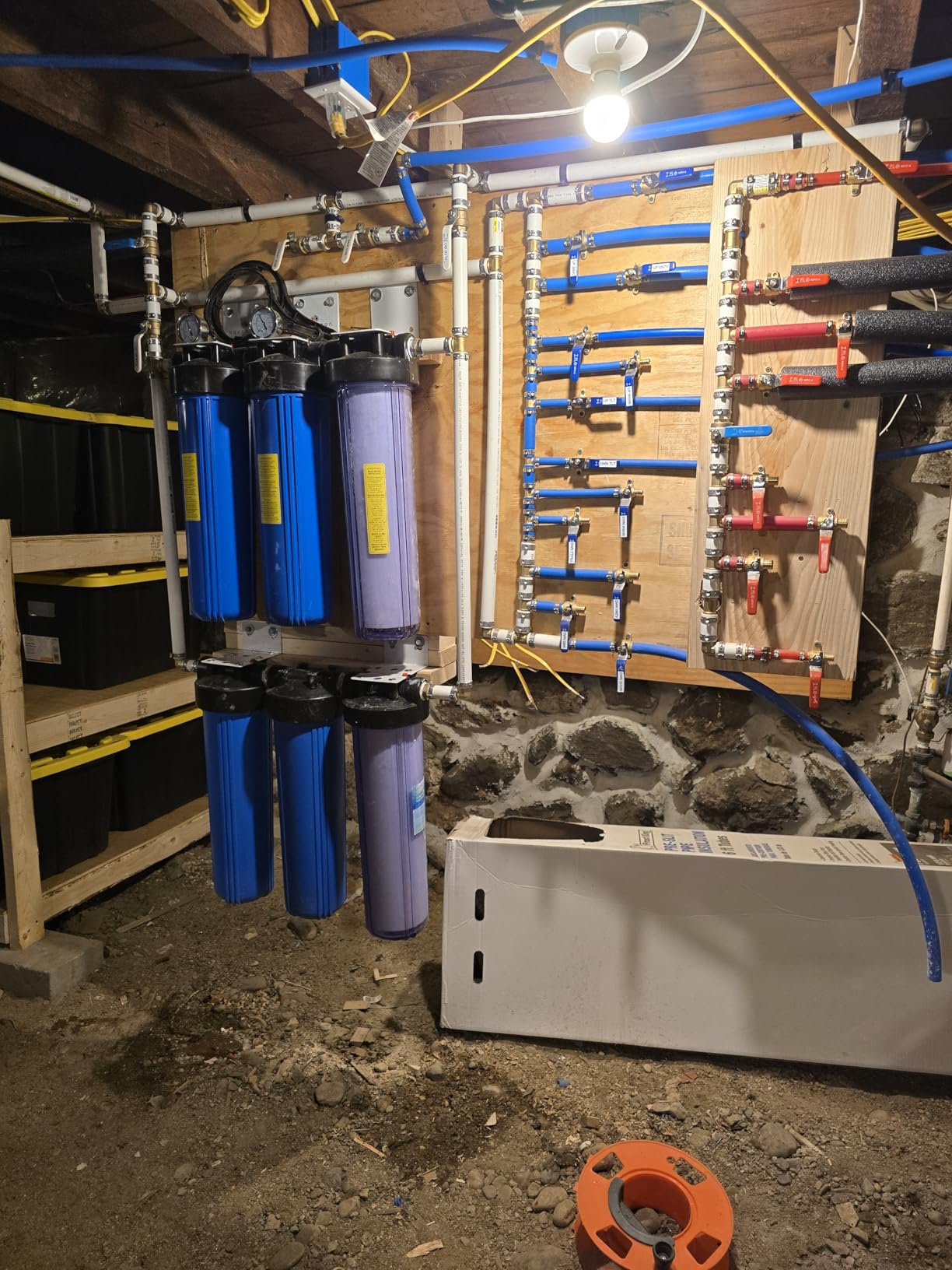
At 933 ratings and 4.5 stars with 73 percent five-star, the profile is consistent. Multiple owners string two of these in series, coarse then fine, which is the most common staged sediment arrangement described by well owners.
The one persistent complaint is thread sealing. These are deep plastic female threads and they need generous Teflon tape or pipe dope to hold pressure; over-tightening the ports can still leave a slow drip. One detailed review warns beginners to use union fittings so a leak does not mean cutting into pipe.
Two more practical notes. The housing ships empty, so the cartridge is a separate purchase, and some packages have arrived short a washer. The sump is heavy and awkward to spin on without a second pair of hands, though it is 10.4 pounds rather than a tank.
Why buy the housing instead of the system
Because it accepts standard elements. When you buy a closed three-stage rack you inherit one supplier’s cartridges at that supplier’s price. A standalone 20 by 4.5 inch housing lets you buy sediment media by the micron rating you actually need, in whatever quantity you want.
The gauge is the second reason. Knowing inlet pressure lets you watch pressure drop over time, which is the most reliable signal that a filter needs service.
When it is the wrong choice
This is not a filter, it is a container. Buy it if you already know your micron rating and want to pick your own media. Skip it if you want sediment removal out of the box, because nothing filters until you buy a cartridge.
It is also the wrong pick for small homes needing low flow, where a 20 by 4.5 inch housing with a fine cartridge will cost you pressure for capacity you will not use.
9. Waterdrop WHF3T-PG 3-Stage 5 Micron System – Best NSF-Certified Three-Stage
Waterdrop WHF3T-PG 3-Stage Whole House Water Filter System, 5 Micron
- Brass-lined inlet and outlet resist thread leaks
- Five micron sediment cartridge ships included
- NSF ANSI 372 certified for lead-free materials
- Three media cartridges included in the box
- Cartridge only sold as a full set of three
- Support bracket can bend and tilt the housings
- Cannot operate below 40 degrees F
The WHF3T-PG packs seven media stages into three housings: a 5 micron sediment element, a KDF composite, and granular activated carbon, listed at 97.72 percent chlorine reduction across the carbon stages. Flow is 15 GPM, capacity 100000 gallons, service life 12 months, and the working range is 40 to 100 degrees F.
Two details separate it. The inlet and outlet are brass-lined, which sidesteps the thread-leak problem that dominates complaints on plastic-port systems in this roundup. And it is NSF/ANSI 372 certified for lead-free materials, a certification mark most assembled systems in this price band do not carry.
Unlike the GE and Aquaboon housings that ship bare, all three cartridges are included, plus a wrench and expansion screws. Owners on chlorinated supply and district well lines report better shower feel, fresher laundry and a clear drop in chlorine taste, and the manufacturer suggests flushing the carbon filter after install by bypassing a softener in 10 minute cycles.
The 4.5-star average rests on 144 ratings, the smallest base here, so weight the spec sheet more heavily than the score.
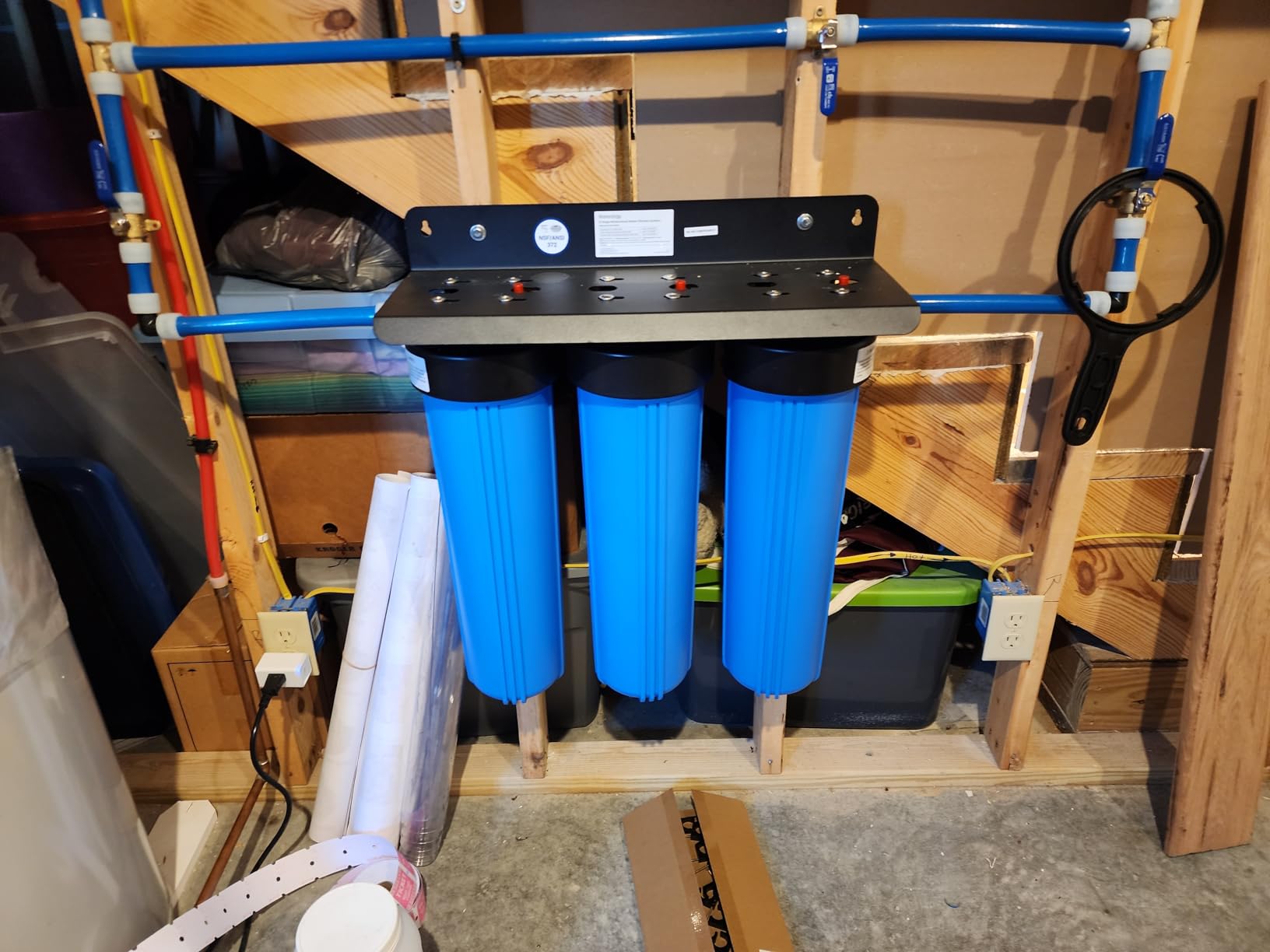
The critiques are mechanical rather than filtration related, which is a reasonable trade. The support bracket can bend, tilting the housings inward and making cartridge removal awkward. Fittings may weep even after heavy Teflon tape and pipe joint compound. And one owner received a cartridge with an incorrectly sized O-ring, resolved through tech support.
The operational constraint that bites hardest is the 40 degree F floor. This system cannot run in an unheated pump house in a climate that freezes, which rules it out for a lot of well owners despite the strong filtration claims.
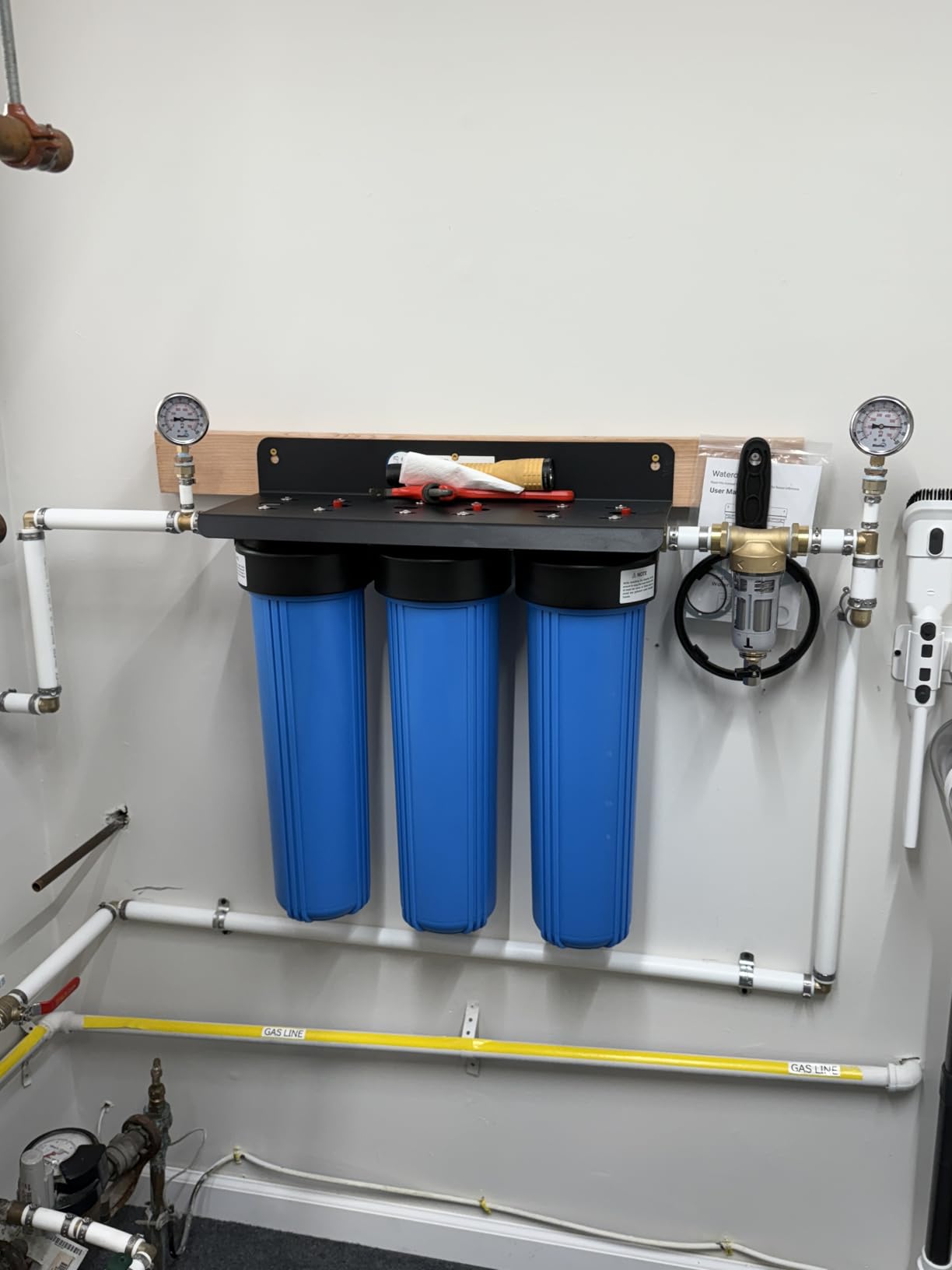
What the certification actually tells you
NSF/ANSI 372 is a lead-free materials standard, so it speaks to the metal in contact with your drinking water, not to filtration performance. It is a meaningful quality signal on a system where port material is the common failure point, and it is worth more than it looks.
The 5 micron sediment element is also the finest rating among the three-stage racks here, which matters if you are chasing fine silt rather than grit.
When it is the wrong choice
Cartridges are only sold as a full set of three, so you replace all of them whenever any one is spent. That is the ongoing cost most people underestimate, and it is why we would rather see you buy standalone housings if sediment is your only problem.
Skip it in any unheated space in a freezing climate, and skip it if thread seepage would push you to call a plumber.
10. A. O. Smith AO-WH-PREV Whole House Sediment Filter – Best Low-Profile Design
A. O. Smith Whole House Sediment Filter | Valve-in-Head | AO-WH-PREV
- One handle controls shut-off bypass and filter selection
- First cartridge and wrench included
- Metal female thread connectors
- Low profile fits tight spaces
- Passive operation keeps working without power
- Lowest rating here at 4.3 stars
- Reports of collar cracking and leaking within a year
- 6 GPM suits smaller households only
- Weak supplied bracket
The AO-WH-PREV is the simplest mechanism here and the one that ages most predictably. The valve-in-head handle combines shut-off, bypass and filter selection in a single control, so there is no separate ball valve to install and no chance of leaving it in the wrong position. It runs passively on water pressure, keeps working if power fails, and carries a 1 year limited warranty.
It is NSF certified to Standard 42 for particulate reduction, which is the contaminant-reduction certification rather than just a materials claim. Flow is listed at 6 GPM with a 25 to 100 psi range, capacity at 24000 gallons and service life at 6 months. At 15 by 6 by 5 inches the profile is one of the slimmest in this roundup.
The connector detail is worthwhile: metal female thread connectors rather than all-plastic threading, which reduces the seepage risk that dominates reviews of plastic housings here. The first sediment cartridge and a housing wrench are in the box, which saves a second order.
Long-term owners, several on their third or fourth replacement over a decade, report it keeps doing its job and effectively strips sediment and rust ahead of downstream equipment. That durability record is real, and it is the reason this unit still has 1966 ratings.
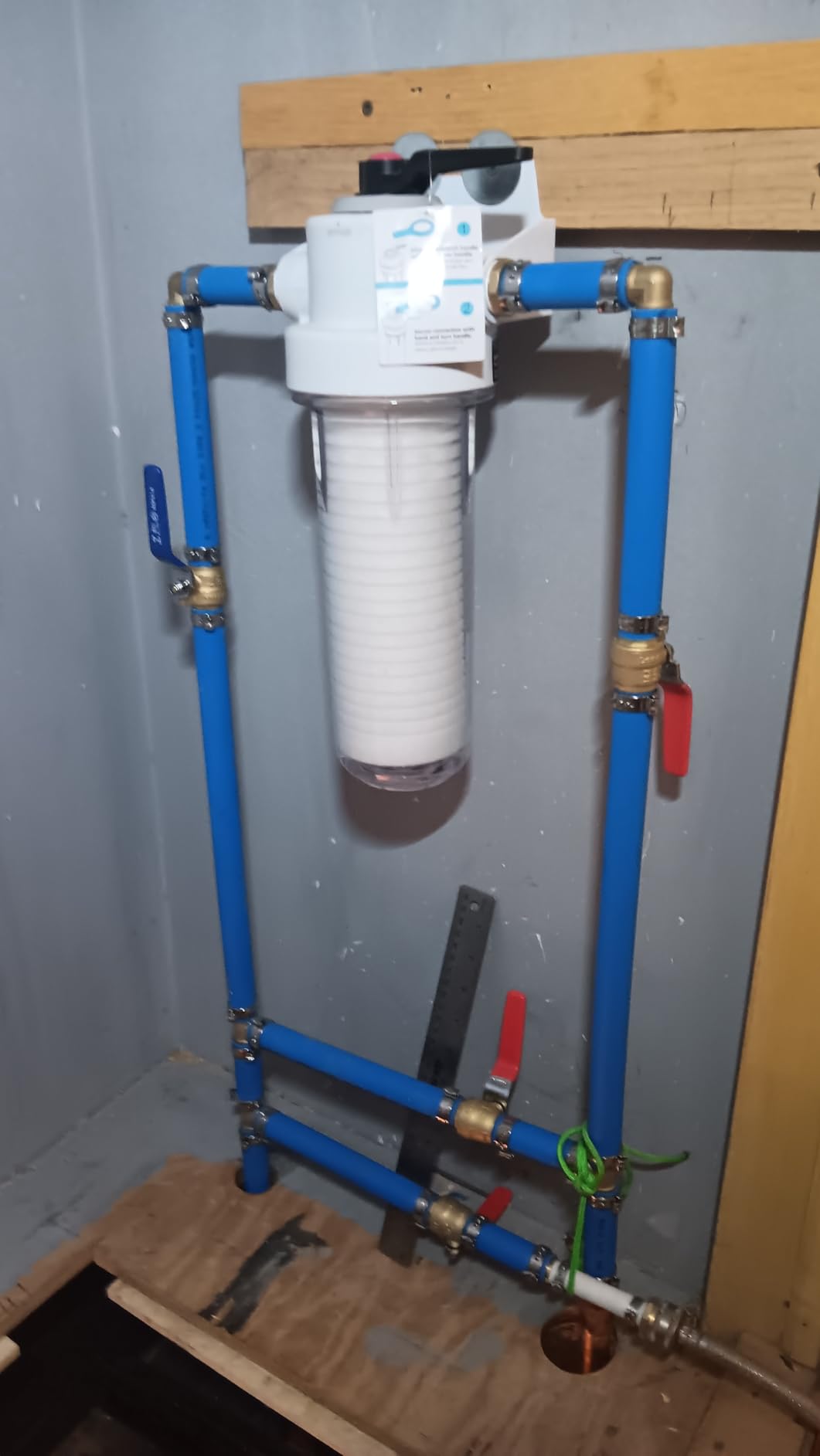
It also has the lowest rating in the set at 4.3 stars, with 8 percent one-star reviews, so we are not going to pretend the complaints are minor. The recurring one is housing durability: some clear housing models are reported to crack at the threaded collar within a year and begin leaking. That is a material failure, not an installation error.
Second, threads are described as loose or sloppy on some units and need many wraps of Teflon to seal. The supplied bracket is weak enough that owners add reinforcement washers.
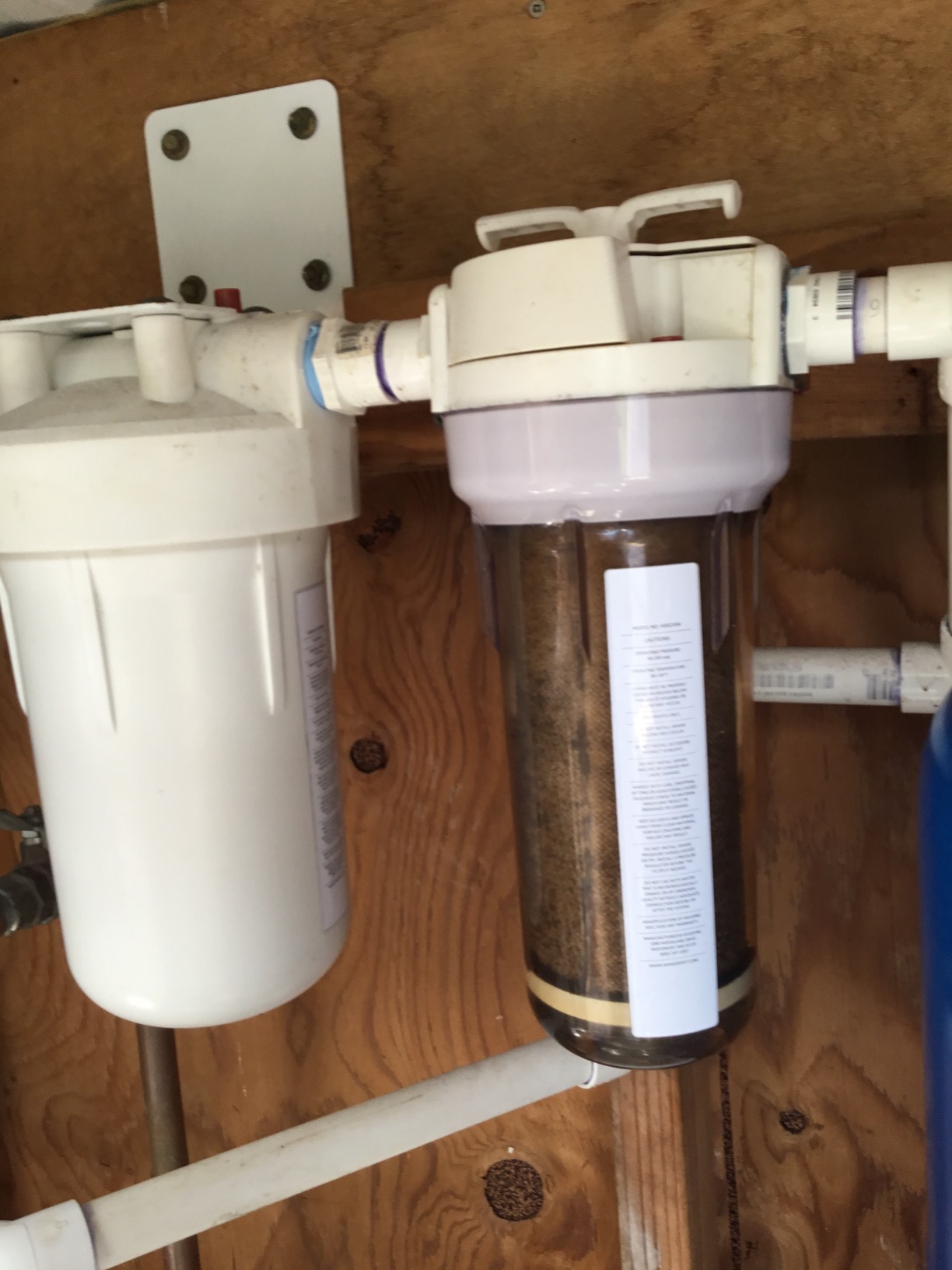
What the valve-in-head handle buys you
One control instead of three means fewer install mistakes. You cannot forget to open the bypass after a cartridge change, which is the single most common reason a new filter appears to be working the next day.
For small homes, cabins or low-flow systems, 6 GPM is genuinely adequate and the slim profile fits almost anywhere. The included cartridge gets you filtering on day one.
When it is the wrong choice
Six GPM will not support a busy household running multiple fixtures, and the collar cracking reports mean you should check the housing carefully at every service. If your space allows a 20 by 4.5 inch housing, you get far more capacity per change.
It is also a sediment filter and nothing else. If your problem is odor, hardness or iron staining, this will not touch it.
What Type of Sediment Filter Is Best for Well Water?
For most well water, the best type is a reusable spin-down filter at 100 or 200 micron installed first, followed by a 5 micron cartridge housing behind it. The spin-down catches sand and pump grit so the cartridge handles only fine silt, which roughly doubles cartridge life. A spin-down alone is enough if your water runs clear and only occasionally gritty.
That two-stage arrangement is the default answer, and it is the setup well owners describe most often on plumbing forums: coarse stage first, softener next, disinfection last. Our whole house sediment filter roundup covers the individual mechanisms in more depth if you want to compare housings directly.
Spin-Down vs Cartridge Housing: Which Mechanism Fits Your Well
The spin-down wins on sand and grit. A reusable mesh screen with no cartridge cost, a flush that takes seconds, and a failure mode that is a visible flow drop rather than a burst housing. Its weakness is that coarse mesh cannot hold fine particles at all, so silt and clay pass straight through.
The cartridge housing wins on fine sediment. Pleated and polyspun elements rated 5 to 20 microns catch what a screen never will, and the clear housings on several models here let you watch the element load. Its weakness is recurring cost and the fact that a loaded cartridge produces the same pressure drop warning without telling you the number.
Neither handles dissolved contaminants. Both are mechanical strainers for suspended solids, and both need maintenance keyed to pressure rather than to the calendar.
What Micron Rating Does Well Water Need?
Match the micron rating to the particle, not to the product. Coarse pump grit and sand sit in the 100 to 500 micron range, rust flakes span from roughly 5 to 100 micron, and fine silt and clay fall between 1 and 5 micron. Choosing a 5 micron cartridge on a sand-only well means paying for capacity you do not need and replacing it constantly.
Coarse work belongs in a spin-down at 100 or 200 micron. Fine sediment belongs in a cartridge at 5 to 20 micron. The 5 to 20 micron band is the practical sweet spot for the cartridge stage because it catches what matters for appliance protection without choking flow too early.
Media material matters as much as the number. Polyester and polypropylene pleated media hold up on untreated well water. Cellulose and cellulose-blend cartridges are cheaper but break down in water with no disinfectant, and owners on forums describe them shedding or clogging unpredictably. If you cannot confirm the media type, polyspun and string-wound are the safe choices.
Housing Size and Flow Rate: Sizing for Your Household
Bigger housing means more media and less pressure drop, which means longer intervals between services. A 10-inch by 4.5-inch housing suits a small home or a cabin with one or two baths. A 20-inch by 4.5-inch Big Blue is the standard for a three or four bedroom home. Above that, staged housings in series or a three-stage rack handle larger demand and multiple problems.
Flow ratings across this roundup run from 4 GPM on the GE compact unit to 25 GPM on the Waterdrop BG103. Peak demand matters more than average: a house with two showers and a laundry running at once needs more headroom than the daily total suggests.
Check vertical clearance before ordering any 20-inch housing. A 20 by 4.5 inch shell needs roughly 25 inches of vertical space for cartridge removal, and for a spin-down you also need a drain within reach of the flush valve.
Where the Sediment Filter Goes in Your Treatment Train
Order matters because each stage exists to protect the next one. The train runs spin-down first, then the cartridge housing, then the softener, then carbon or UV. Putting sediment after the softener means resin and iron debris reach the softener first, which is exactly what shortens resin life.
If you already own a whole-house softener, you still need sediment protection ahead of it. Resin beads are easy to damage from grit passing through, and no softener removes suspended sand. Owners on plumbingforums.com describe running a sediment filter, a three-stage filter and a UV unit in that exact sequence.
Where a filter does not fit is after everything. A stage placed last is doing damage control rather than prevention, which is the most expensive way to run a treatment train.
What a Sediment Filter Cannot Fix
Orange staining is the top well complaint and a sediment filter will not touch it. Orange staining comes from dissolved iron oxidizing in the water, and the particles are formed downstream of any strainer. The same is true of black or grey manganese staining, which typically needs an oxidation or filtration system built for it.
Hardness, sulfur odor, bacteria and dissolved metals are all outside what any filter on this list addresses. Iron and manganese require specific media or an oxidation stage. Bacteria need disinfection such as UV or shock treatment, and a sediment filter is a strainer, not a disinfectant. Sulfur odor needs sulfur-specific media, not a cartridge.
The honest move is a certified lab test before you buy. Knowing whether your problem is suspended sediment or dissolved iron changes which of these ten units is worth money, and no product list can answer that question for you.
Installation, Clearance and Maintenance
Budget an afternoon and union fittings. Nearly every install complaint in these reviews is a leak at a threaded plastic port, and union fittings mean a mistake costs you five minutes instead of a section of pipe. Budget generous Teflon tape or pipe dope on every plastic thread regardless of what the manual says.
Plan the bypass. A housing with a bypass lever or valve-in-head handle lets you isolate the unit for service without shutting off the house, and that is the difference between a two-minute cartridge change and a plumber visit.
Watch pressure drop, not the calendar. The most reliable change signal is a measurable fall in household pressure or a difference between the inlet and outlet gauges. Flush the spin-down before you touch the cartridge, because a loaded screen upstream makes a healthy cartridge look bad. For our broader treatment train options, see the whole house filtration systems guide.
Frequently Asked Questions
What type of sediment filter is best for well water?
A reusable spin-down filter at 100 or 200 micron installed first, followed by a 5 micron cartridge housing behind it, is the best setup for most wells. The spin-down catches sand and pump grit so the cartridge only handles fine silt, which roughly doubles cartridge life. A spin-down alone is sufficient when your water runs clear and only occasionally gritty.
How often should I replace a sediment filter cartridge?
Replace a cartridge when you see a pressure drop at the fixture rather than on a fixed date. On a typical household using roughly 500 gallons a day, a 5 micron pleated cartridge on moderate sediment runs several months, while a heavily loaded well can exhaust one in a few weeks. The timers built into some three-stage systems exist as a prompt, not a verdict.
What is the difference between a spin-down filter and a cartridge housing?
A spin-down uses a reusable stainless steel mesh screen that you flush in place, catching coarse grit with no recurring cartridge cost. A cartridge housing holds a replaceable pleated, polyspun or string-wound element rated 1 to 20 micron, catching fine silt at the cost of a new element each time. Coarse work belongs to the spin-down and fine work to the cartridge.
Do I need a sediment filter if I already have a whole-house water softener?
Yes. A softener exchanges ions and does not trap suspended particles, so grit passes through it and abrades the resin beads. Installing sediment filtration ahead of the softener is the standard order and is the cheapest way to extend resin life and protect downstream fixtures.
What micron rating do I need for well water?
Coarse pump grit and sand run 100 to 500 micron, rust flakes span roughly 5 to 100 micron, and fine silt and clay fall between 1 and 5 micron. Use 100 or 200 micron in a spin-down for coarse debris and 5 to 20 micron in a cartridge for fine sediment. Choosing a 5 micron cartridge on a sand-only well wastes capacity and shortens service life.
Is it worth it to get a whole house water filtration system?
For a private well, generally yes, because the water is not treated by anyone else. A point-of-entry sediment filter protects faucets, water heater dip tubes and downstream softener resin at a fraction of the cost of a full treatment train. The exception is a house with almost no sediment and an already protected softener, where a compact guard filter is enough.
The Bottom Line on Choosing a Sediment Filter for Well Water
Start with the mechanism. Coarse sand and grit call for a reusable spin-down, and fine silt calls for a cartridge housing, and the best setups run both with the spin-down first. From there, match housing size to household flow, match micron rating to particle size, and change cartridges when pressure falls rather than when a timer says so.
Of the ten we compared, the Express Water 3-Stage is our overall pick for a single-box solution, the iSpring Ultimate auto-flush setup suits owners who refuse to flush by hand, and the iSpring WSP-50 spin-down remains the most dependable reusable pre-filter on the market. Whichever you choose in 2026, put it first in the train and everything behind it will last longer.